

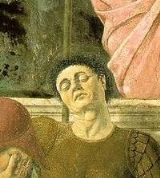
Piero della Francesca

Encyclopedia
Piero della Francesca was a painter of the Early Renaissance
. As testified by Giorgio Vasari
in his Lives of the Artists, to contemporaries he was also known as a mathematician and geometer. Nowadays Piero della Francesca is chiefly appreciated for his art. His painting was characterized by its serene humanism
, its use of geometric forms and perspective
. His most famous work is the cycle of frescoes The Legend of the True Cross in the church of San Francesco in the Tuscan town of Arezzo
.
, modern-day Tuscany
(where he also died), to Benedetto de' Franceschi, a tradesman, and Romana di Perino da Monterchi
, part of the Florentine and Tuscan Franceschi noble family.
It is not known to which master he was apprenticed, but he certainly took notice of the work of some of the Sienese
artists active in San Sepolcro during his youth; e.g. Sassetta. In 1439 Piero received, together with Domenico Veneziano
, payments for his work on fresco
es for the church of Sant'Egidio in Florence, now lost. In Florence he must have met leading masters like Fra Angelico
, Mantegna
, Luca della Robbia
and Brunelleschi
. The classicism of Masaccio's frescoes and his majestic figures in the Santa Maria del Carmine
were for him an important source of inspiration. Dating of Piero's undocumented work is difficult because his style does not seem to have developed over the years.
), which he was to complete only in the early 1460s. In 1449 he executed several frescoes in the Castello Estense
and the church of Sant'Andrea of Ferrara
, also lost. His influence was particularly strong in the later Ferrarese allegorical works of Cosimo Tura
.
Two years later he was in Rimini
, working for the condottiero Sigismondo Pandolfo Malatesta. In this sojourn he executed in 1451 the famous fresco of St. Sigismund and Sigismondo Pandolfo Malatesta in the Tempio Malatestiano, as well as Sigismondo's portrait
. In Rimini Piero may have met the famous Renaissance
mathematician and architect Leon Battista Alberti, who had redesigned the Tempio Malatestiano; although it is known that Alberti directed the execution of his designs for the church by correspondence with his building supervisor. Thereafter Piero was active in Ancona
, Pesaro
and Bologna
.
In 1454 he signed a contract for the polyptych in the church of Sant'Agostino in San Sepolcro. The central panel of this polyptic is lost and the four panels of the wings, with representations of Saints, are scattered around the world. A few years later, summoned by Pope Nicholas V
, he moved to Rome: here he executed frescoes in the Basilica di Santa Maria Maggiore
, of which only fragments remain. Two years later he was again in the Papal capital, for frescoes in Vatican Palace which have also been destroyed.
The Baptism of Christ, in The National Gallery in London, was executed around 1460 for the high altar of the church of the Priory of S. Giovanni Battista at Sansepolcro. Other notable works of Piero della Francesca's maturity are the frescoes of the Resurrection
in Sansepolcro and the Madonna del parto
in Monterchi near Sansepolcro.
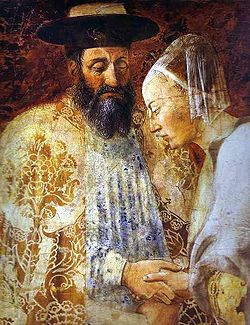 In 1452, Piero della Francesca was called to Arezzo
to replace Bicci di Lorenzo
in painting the frescoes of the basilica of San Francesco. The work was finished before 1466, probably between 1452-1456.
The cycle of frescoes
, depicting the Legend of the True Cross, is generally considered among his masterworks and those of Renaissance painting in general. The story in these frescoes derives from legendary medieval sources as to how timber relics of the True Cross
came to be found. These stories were collected in the "Golden Legend
" of Jacopo da Varazze (Jacopo da Varagine) of the mid 13th century.
 Another famous work painted in Urbino is the Double Portrait of Federico and his wife Battista Sforza, in the Uffizi
. The portraits in profile take their inspiration from large bronze medals and stucco roundels with the official portrets of Fedederico and his wife. Other paintings made in Urbino are the monumental Montefeltro Altarpiece
in the Brera Gallery in Milan and probably also the Madonna of Senigallia.
In Urbino Piero met the painters Melozzo da Forlì
, Fra Carnevale and the Flemish Justus van Gent (or Joos van Wassenhove or Giusto di Gant), the mathematician Fra Luca Pacioli
, the architect Francesco di Giorgio Martini and probably also Leon Battista Alberti.
frequently visited his workshop. It is documented that Piero rented a house in Rimini in 1482. Although he may have given up painting in his later years, Vasari's remarks that he went blind at old age and at the age of sixty, has to be doubted, since in 1485 he completed his treatise on regular solids, dedicated to Guidobaldo da Montefeltro, son and heir of Duke Federico, in his own fine handwriting. Piero made his will in 1487 and he died five years later in his own house in San Sepolcro, on the very day that Christopher Columbus
made his first landfall in the Americas
. He left his possessions to his family and the church.
 His deep interest in the theoretical study of perspective and his contemplative approach to his paintings are apparent in all his work.
Three treatises written by Piero are known to modern mathematicians: Abacus Treatise (Trattato d'Abaco), Short Book on the Five Regular Solids (Libellus de Quinque Corporibus Regularibus) and On Perspective for Painting (De Prospectiva Pingendi). The subjects covered in these writings include arithmetic
, algebra
, geometry
and innovative work in both solid geometry
and perspective
. Much of Piero’s work was later absorbed into the writing of others, notably Luca Pacioli
. Piero’s work on solid geometry appears in Pacioli’s "De divina proportione
", a work illustrated by Leonardo da Vinci
.
wrote a three movement work for orchestra entitled Les Fresques de Piero della Francesca. Dedicated to Rafael Kubelik
, it was premiered by Kubelik and the Vienna Philharmonic at the 1956 Salzburg Festival. Piero's geometrical perfection and the almost magic atmosphere of the light in his painting inspired modern painters like Giorgio de Chirico
, Massimo Campigli
, Felice Casorati
and Balthus
.
Italian Renaissance
The Italian Renaissance began the opening phase of the Renaissance, a period of great cultural change and achievement in Europe that spanned the period from the end of the 13th century to about 1600, marking the transition between Medieval and Early Modern Europe...
. As testified by Giorgio Vasari
Giorgio Vasari
Giorgio Vasari was an Italian painter, writer, historian, and architect, who is famous today for his biographies of Italian artists, considered the ideological foundation of art-historical writing.-Biography:...
in his Lives of the Artists, to contemporaries he was also known as a mathematician and geometer. Nowadays Piero della Francesca is chiefly appreciated for his art. His painting was characterized by its serene humanism
Humanism
Humanism is an approach in study, philosophy, world view or practice that focuses on human values and concerns. In philosophy and social science, humanism is a perspective which affirms some notion of human nature, and is contrasted with anti-humanism....
, its use of geometric forms and perspective
Perspective (graphical)
Perspective in the graphic arts, such as drawing, is an approximate representation, on a flat surface , of an image as it is seen by the eye...
. His most famous work is the cycle of frescoes The Legend of the True Cross in the church of San Francesco in the Tuscan town of Arezzo
Arezzo
Arezzo is a city and comune in Central Italy, capital of the province of the same name, located in Tuscany. Arezzo is about 80 km southeast of Florence, at an elevation of 296 m above sea level. In 2011 the population was about 100,000....
.
Early years
Piero was born in the town of Borgo Santo SepolcroSansepolcro
Sansepolcro , is a town and comune in Tuscany, Italy, in the province of Arezzo.Situated on the upper reaches of the Tiber river, Borgo was the birthplace of the painters Piero della Francesca, Raffaellino del Colle and Angiolo Tricca...
, modern-day Tuscany
Tuscany
Tuscany is a region in Italy. It has an area of about 23,000 square kilometres and a population of about 3.75 million inhabitants. The regional capital is Florence ....
(where he also died), to Benedetto de' Franceschi, a tradesman, and Romana di Perino da Monterchi
Monterchi
Monterchi is a comune in the Province of Arezzo in the Italian region Tuscany, located about 80 km southeast of Florence and about 20 km east of Arezzo...
, part of the Florentine and Tuscan Franceschi noble family.
It is not known to which master he was apprenticed, but he certainly took notice of the work of some of the Sienese
Siena
Siena is a city in Tuscany, Italy. It is the capital of the province of Siena.The historic centre of Siena has been declared by UNESCO a World Heritage Site. It is one of the nation's most visited tourist attractions, with over 163,000 international arrivals in 2008...
artists active in San Sepolcro during his youth; e.g. Sassetta. In 1439 Piero received, together with Domenico Veneziano
Domenico Veneziano
Domenico Veneziano was an Italian painter of the early Renaissance, active mostly in Perugia and Tuscany.Little is known of his birth, though he is thought to have been born in Venice, hence his last name. He then moved to Florence in 1422-23 as a boy, to become a pupil of Gentile da Fabriano. He...
, payments for his work on fresco
Fresco
Fresco is any of several related mural painting types, executed on plaster on walls or ceilings. The word fresco comes from the Greek word affresca which derives from the Latin word for "fresh". Frescoes first developed in the ancient world and continued to be popular through the Renaissance...
es for the church of Sant'Egidio in Florence, now lost. In Florence he must have met leading masters like Fra Angelico
Fra Angelico
Fra Angelico , born Guido di Pietro, was an Early Italian Renaissance painter described by Vasari in his Lives of the Artists as having "a rare and perfect talent"...
, Mantegna
Andrea Mantegna
Andrea Mantegna was an Italian painter, a student of Roman archeology, and son in law of Jacopo Bellini. Like other artists of the time, Mantegna experimented with perspective, e.g., by lowering the horizon in order to create a sense of greater monumentality...
, Luca della Robbia
Luca della Robbia
Luca della Robbia was an Italian sculptor from Florence, noted for his terra-cotta roundels.Luca Della Robbia developed a pottery glaze that made his creations more durable in the outdoors and thus suitable for use on the exterior of buildings. His work is noted for its charm rather than the drama...
and Brunelleschi
Filippo Brunelleschi
Filippo Brunelleschi was one of the foremost architects and engineers of the Italian Renaissance. He is perhaps most famous for inventing linear perspective and designing the dome of the Florence Cathedral, but his accomplishments also included bronze artwork, architecture , mathematics,...
. The classicism of Masaccio's frescoes and his majestic figures in the Santa Maria del Carmine
Santa Maria del Carmine, Florence
Santa Maria del Carmine is a church of the Carmelite Order, in the Oltrarno district of Florence, in Tuscany, Italy. It is famous as the location of the Brancacci Chapel housing outstanding Renaissance frescoes by Masaccio and Masolino da Panicale, later finished by Filippino Lippi.-History:The...
were for him an important source of inspiration. Dating of Piero's undocumented work is difficult because his style does not seem to have developed over the years.
Mature work
In 1442 he was listed as eligible for the City Council of San Sepolcro. Three years later, he received the commission for the altarpiece of the church of the Misericordia in San Sepolcro (including the Madonna della MisericordiaMadonna della Misericordia
The Polyptych of the Misericordia, conserved in the Pinacoteca Comunale of Sansepolcro, Tuscany, Italy, is one of the earliest works of the Italian Renaissance painter Piero della Francesca...
), which he was to complete only in the early 1460s. In 1449 he executed several frescoes in the Castello Estense
Castello Estense
The Castle Estense or Castle of Saint Michele is a moated medieval structure in the center of Ferrara, northern Italy. It is a large block with four corner towers.- History :...
and the church of Sant'Andrea of Ferrara
Ferrara
Ferrara is a city and comune in Emilia-Romagna, northern Italy, capital city of the Province of Ferrara. It is situated 50 km north-northeast of Bologna, on the Po di Volano, a branch channel of the main stream of the Po River, located 5 km north...
, also lost. His influence was particularly strong in the later Ferrarese allegorical works of Cosimo Tura
Cosimo Tura
Cosimo Tura , also known as Il Cosmè or Cosmè Tura, was an Italian early-Renaissance painter and considered one of the founders of the School of Ferrara....
.
Two years later he was in Rimini
Rimini
Rimini is a medium-sized city of 142,579 inhabitants in the Emilia-Romagna region of Italy, and capital city of the Province of Rimini. It is located on the Adriatic Sea, on the coast between the rivers Marecchia and Ausa...
, working for the condottiero Sigismondo Pandolfo Malatesta. In this sojourn he executed in 1451 the famous fresco of St. Sigismund and Sigismondo Pandolfo Malatesta in the Tempio Malatestiano, as well as Sigismondo's portrait
Portrait of Sigismondo Pandolfo Malatesta
The Portrait of Sigismondo Pandolfo Malatesta is a painting by the Italian Renaissance master Piero della Francesca . It portrays the condottiero and lord of Rimini and Fano Sigismondo Pandolfo Malatesta, and is housed in the Musée du Louvre of Paris.The portrait depicts the condottiero by profile...
. In Rimini Piero may have met the famous Renaissance
Renaissance
The Renaissance was a cultural movement that spanned roughly the 14th to the 17th century, beginning in Italy in the Late Middle Ages and later spreading to the rest of Europe. The term is also used more loosely to refer to the historical era, but since the changes of the Renaissance were not...
mathematician and architect Leon Battista Alberti, who had redesigned the Tempio Malatestiano; although it is known that Alberti directed the execution of his designs for the church by correspondence with his building supervisor. Thereafter Piero was active in Ancona
Ancona
Ancona is a city and a seaport in the Marche region, in central Italy, with a population of 101,909 . Ancona is the capital of the province of Ancona and of the region....
, Pesaro
Pesaro
Pesaro is a town and comune in the Italian region of the Marche, capital of the Pesaro e Urbino province, on the Adriatic. According to the 2007 census, its population was 92,206....
and Bologna
Bologna
Bologna is the capital city of Emilia-Romagna, in the Po Valley of Northern Italy. The city lies between the Po River and the Apennine Mountains, more specifically, between the Reno River and the Savena River. Bologna is a lively and cosmopolitan Italian college city, with spectacular history,...
.
In 1454 he signed a contract for the polyptych in the church of Sant'Agostino in San Sepolcro. The central panel of this polyptic is lost and the four panels of the wings, with representations of Saints, are scattered around the world. A few years later, summoned by Pope Nicholas V
Pope Nicholas V
Pope Nicholas V , born Tommaso Parentucelli, was Pope from March 6, 1447 to his death in 1455.-Biography:He was born at Sarzana, Liguria, where his father was a physician...
, he moved to Rome: here he executed frescoes in the Basilica di Santa Maria Maggiore
Basilica di Santa Maria Maggiore
The Papal Basilica of Saint Mary Major , known also by other names, is the largest Roman Catholic Marian church in Rome, Italy.There are other churches in Rome dedicated to Mary, such as Santa Maria in Trastevere, Santa Maria in Aracoeli, Santa Maria sopra Minerva, but the greater size of the...
, of which only fragments remain. Two years later he was again in the Papal capital, for frescoes in Vatican Palace which have also been destroyed.
The Baptism of Christ, in The National Gallery in London, was executed around 1460 for the high altar of the church of the Priory of S. Giovanni Battista at Sansepolcro. Other notable works of Piero della Francesca's maturity are the frescoes of the Resurrection
Resurrection (Piero della Francesca)
The Resurrection is a fresco by the Italian Renaissance master Piero della Francesca, painted around 1463-65. Though documentation is lacking, the gothic Residenza, the communal meeting hall in which it was painted, was returned by Florentine authorities to the citizens of Sansepolcro, Tuscany, 1...
in Sansepolcro and the Madonna del parto
Madonna del Parto
The Madonna del Parto is a fresco painting by the Italian Renaissance master Piero della Francesca, finished around 1460. It is housed in the Museo della Madonna del Parto of Monterchi, Tuscany, Italy....
in Monterchi near Sansepolcro.
Frescoes in San Francesco at Arezzo
Arezzo
Arezzo is a city and comune in Central Italy, capital of the province of the same name, located in Tuscany. Arezzo is about 80 km southeast of Florence, at an elevation of 296 m above sea level. In 2011 the population was about 100,000....
to replace Bicci di Lorenzo
Bicci di Lorenzo
Bicci di Lorenzo was an Italian painter and sculptor, active in Florence.He was born in Florence in 1373, the son of the painter, Lorenzo di Bicci, whose workshop he joined. He married in 1418, and in 1424 was registered in the Guild of Painters at Florence. His son, Neri di Bicci was also a...
in painting the frescoes of the basilica of San Francesco. The work was finished before 1466, probably between 1452-1456.
The cycle of frescoes
The History of the True Cross
The History of the True Cross or The Legend of the True Cross is a sequence of frescoes painted by Piero della Francesca in the Basilica of San Francesco in Arezzo...
, depicting the Legend of the True Cross, is generally considered among his masterworks and those of Renaissance painting in general. The story in these frescoes derives from legendary medieval sources as to how timber relics of the True Cross
True Cross
The True Cross is the name for physical remnants which, by a Christian tradition, are believed to be from the cross upon which Jesus was crucified.According to post-Nicene historians, Socrates Scholasticus and others, the Empress Helena The True Cross is the name for physical remnants which, by a...
came to be found. These stories were collected in the "Golden Legend
Golden Legend
The Golden Legend is a collection of hagiographies by Jacobus de Voragine that became a late medieval bestseller. More than a thousand manuscripts of the text have survived, compared to twenty or so of its nearest rivals...
" of Jacopo da Varazze (Jacopo da Varagine) of the mid 13th century.
Piero's activity in Urbino
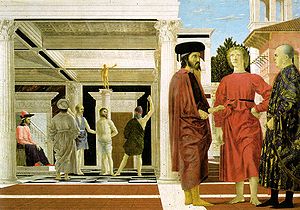
Between 1469 and 1486 Piero della Francesca worked repeatedly in the service of Count Federico III da Montefeltro (Duke in 1474). According to Giorgio Vasari, Piero would have worked for Federico's father Guidantonio, who died in February 1443. However, this is unlikely because this statement is not confirmed by documents or paintings. Vasari may have confused Guidantonio with Federico. The Flagellation is generally considered Piero's oldest work in Urbino (dating c. 1455–1470). It is one of the most famous and controversial pictures of the early Renaissance. As discussed in its own entry, it is marked by an air of geometric sobriety, in addition to presenting a perplexing enigma as to the nature of the three men standing at the foreground.Uffizi
The Uffizi Gallery , is a museum in Florence, Italy. It is one of the oldest and most famous art museums of the Western world.-History:...
. The portraits in profile take their inspiration from large bronze medals and stucco roundels with the official portrets of Fedederico and his wife. Other paintings made in Urbino are the monumental Montefeltro Altarpiece
Brera Madonna
The Brera Madonna is a painting by the Italian Renaissance master Piero della Francesca, executed in 1472-1474...
in the Brera Gallery in Milan and probably also the Madonna of Senigallia.
In Urbino Piero met the painters Melozzo da Forlì
Melozzo da Forlì
Melozzo da Forlì was an Italian Renaissance painter and architect. His fresco paintings are notable for the use of foreshortening. He was the most important member of the Forlì painting school.- Biography :...
, Fra Carnevale and the Flemish Justus van Gent (or Joos van Wassenhove or Giusto di Gant), the mathematician Fra Luca Pacioli
Luca Pacioli
Fra Luca Bartolomeo de Pacioli was an Italian mathematician, Franciscan friar, collaborator with Leonardo da Vinci, and seminal contributor to the field now known as accounting...
, the architect Francesco di Giorgio Martini and probably also Leon Battista Alberti.
His later years
In his later years, painters such as Perugino and Luca SignorelliLuca Signorelli
Luca Signorelli was an Italian Renaissance painter who was noted in particular for his ability as a draughtsman and his use of foreshortening...
frequently visited his workshop. It is documented that Piero rented a house in Rimini in 1482. Although he may have given up painting in his later years, Vasari's remarks that he went blind at old age and at the age of sixty, has to be doubted, since in 1485 he completed his treatise on regular solids, dedicated to Guidobaldo da Montefeltro, son and heir of Duke Federico, in his own fine handwriting. Piero made his will in 1487 and he died five years later in his own house in San Sepolcro, on the very day that Christopher Columbus
Christopher Columbus
Christopher Columbus was an explorer, colonizer, and navigator, born in the Republic of Genoa, in northwestern Italy. Under the auspices of the Catholic Monarchs of Spain, he completed four voyages across the Atlantic Ocean that led to general European awareness of the American continents in the...
made his first landfall in the Americas
Americas
The Americas, or America , are lands in the Western hemisphere, also known as the New World. In English, the plural form the Americas is often used to refer to the landmasses of North America and South America with their associated islands and regions, while the singular form America is primarily...
. He left his possessions to his family and the church.
Work in mathematics and geometry
Three treatises written by Piero are known to modern mathematicians: Abacus Treatise (Trattato d'Abaco), Short Book on the Five Regular Solids (Libellus de Quinque Corporibus Regularibus) and On Perspective for Painting (De Prospectiva Pingendi). The subjects covered in these writings include arithmetic
Arithmetic
Arithmetic or arithmetics is the oldest and most elementary branch of mathematics, used by almost everyone, for tasks ranging from simple day-to-day counting to advanced science and business calculations. It involves the study of quantity, especially as the result of combining numbers...
, algebra
Algebra
Algebra is the branch of mathematics concerning the study of the rules of operations and relations, and the constructions and concepts arising from them, including terms, polynomials, equations and algebraic structures...
, geometry
Geometry
Geometry arose as the field of knowledge dealing with spatial relationships. Geometry was one of the two fields of pre-modern mathematics, the other being the study of numbers ....
and innovative work in both solid geometry
Solid geometry
In mathematics, solid geometry was the traditional name for the geometry of three-dimensional Euclidean space — for practical purposes the kind of space we live in. It was developed following the development of plane geometry...
and perspective
Perspective (graphical)
Perspective in the graphic arts, such as drawing, is an approximate representation, on a flat surface , of an image as it is seen by the eye...
. Much of Piero’s work was later absorbed into the writing of others, notably Luca Pacioli
Luca Pacioli
Fra Luca Bartolomeo de Pacioli was an Italian mathematician, Franciscan friar, collaborator with Leonardo da Vinci, and seminal contributor to the field now known as accounting...
. Piero’s work on solid geometry appears in Pacioli’s "De divina proportione
De divina proportione
De Divina Proportione is a famous book on mathematics written by Luca Pacioli around 1497 in Milan. Today only two versions of the original manuscript are believed still to exist...
", a work illustrated by Leonardo da Vinci
Leonardo da Vinci
Leonardo di ser Piero da Vinci was an Italian Renaissance polymath: painter, sculptor, architect, musician, scientist, mathematician, engineer, inventor, anatomist, geologist, cartographer, botanist and writer whose genius, perhaps more than that of any other figure, epitomized the Renaissance...
.
Selected works
- Polyptych of the Misericordia (1445–1462) - Oil and tempera on panel, base 330 cm, height 273 cm, Pinacoteca Comunale, SansepolcroSansepolcroSansepolcro , is a town and comune in Tuscany, Italy, in the province of Arezzo.Situated on the upper reaches of the Tiber river, Borgo was the birthplace of the painters Piero della Francesca, Raffaellino del Colle and Angiolo Tricca...
- The Baptism of Christ (c. 1448-1450) - Tempera on panel, 168 x 116 cm, National GalleryNational Gallery, LondonThe National Gallery is an art museum on Trafalgar Square, London, United Kingdom. Founded in 1824, it houses a collection of over 2,300 paintings dating from the mid-13th century to 1900. The gallery is an exempt charity, and a non-departmental public body of the Department for Culture, Media...
, London - St. Jerome in Penitence (c. 1449-1451) - Oil on panel, 51 x 38 cm, Staatliche Museen, BerlinBerlinBerlin is the capital city of Germany and is one of the 16 states of Germany. With a population of 3.45 million people, Berlin is Germany's largest city. It is the second most populous city proper and the seventh most populous urban area in the European Union...
- St. Jerome and a Donor (1451) - Panel, 40 x 42 cm, Gallerie dell'Accademia, VeniceVeniceVenice is a city in northern Italy which is renowned for the beauty of its setting, its architecture and its artworks. It is the capital of the Veneto region...
- Sigismondo Pandolfo Malatesta Praying in Front of St. Sigismund (1451) - Fresco, Tempio MalatestianoTempio MalatestianoThe Tempio Malatestiano is the cathedral church of Rimini, Italy. Officially named for St. Francis, it takes the popular name from Sigismondo Pandolfo Malatesta, who commissioned its reconstruction by the famous Renaissance theorist and architect Leon Battista Alberti around 1450.-History:San...
, RiminiRiminiRimini is a medium-sized city of 142,579 inhabitants in the Emilia-Romagna region of Italy, and capital city of the Province of Rimini. It is located on the Adriatic Sea, on the coast between the rivers Marecchia and Ausa... - Portrait of Sigismondo Pandolfo MalatestaPortrait of Sigismondo Pandolfo MalatestaThe Portrait of Sigismondo Pandolfo Malatesta is a painting by the Italian Renaissance master Piero della Francesca . It portrays the condottiero and lord of Rimini and Fano Sigismondo Pandolfo Malatesta, and is housed in the Musée du Louvre of Paris.The portrait depicts the condottiero by profile...
(c. 1451) - Tempera and oil on panel, 44.5 x 34.5 cm, Musée du Louvre, ParisParisParis is the capital and largest city in France, situated on the river Seine, in northern France, at the heart of the Île-de-France region... - The History of the True CrossThe History of the True CrossThe History of the True Cross or The Legend of the True Cross is a sequence of frescoes painted by Piero della Francesca in the Basilica of San Francesco in Arezzo...
(c. 1455-1466) - Frescoes, San Francesco, Arezzo - The Flagellation of Christ (c. 1460) - Tempera on panel, 59 x 81.5 cm, Galleria Nazionale delle Marche, UrbinoUrbinoUrbino is a walled city in the Marche region of Italy, south-west of Pesaro, a World Heritage Site notable for a remarkable historical legacy of independent Renaissance culture, especially under the patronage of Federico da Montefeltro, duke of Urbino from 1444 to 1482...
- Polyptych of Saint Augustine (1460–1470) - Oil and tempera on panel
- ResurrectionResurrection (Piero della Francesca)The Resurrection is a fresco by the Italian Renaissance master Piero della Francesca, painted around 1463-65. Though documentation is lacking, the gothic Residenza, the communal meeting hall in which it was painted, was returned by Florentine authorities to the citizens of Sansepolcro, Tuscany, 1...
(c. 1463) - Fresco, 225 x 200 cm, Museo Civico, SansepolcroSansepolcroSansepolcro , is a town and comune in Tuscany, Italy, in the province of Arezzo.Situated on the upper reaches of the Tiber river, Borgo was the birthplace of the painters Piero della Francesca, Raffaellino del Colle and Angiolo Tricca... - Madonna del partoMadonna del PartoThe Madonna del Parto is a fresco painting by the Italian Renaissance master Piero della Francesca, finished around 1460. It is housed in the Museo della Madonna del Parto of Monterchi, Tuscany, Italy....
(1459–1467) - Detached fresco, 260 x 203 cm, Chapel of the cemetery, MonterchiMonterchiMonterchi is a comune in the Province of Arezzo in the Italian region Tuscany, located about 80 km southeast of Florence and about 20 km east of Arezzo... - Nativity (c. 1470) - 124.5 x 123 cm, National Gallery, London
- Polyptych of PerugiaPolyptych of PerugiaThe Polyptych of Perugia is a complex of paintings by the Italian Renaissance master Piero della Francesca, finished around 1470...
(c. 1470) - Oil on panel, 338 x 230 cm, Galleria Nazionale dell'UmbriaGalleria Nazionale dell'UmbriaThe Galleria Nazionale dell'Umbria is the Italian national paintings collection of Umbria, housed in the Palazzo dei Priori, Perugia, in central Italy. Its collection comprises the greatest representation of the Umbrian School of painting, ranging from the 13th to the 19th century, strongest in the...
, PerugiaPerugiaPerugia is the capital city of the region of Umbria in central Italy, near the River Tiber, and the capital of the province of Perugia. The city is located about north of Rome. It covers a high hilltop and part of the valleys around the area.... - Madonna and Child with Saints (Montefeltro Altarpiece, 1472–1474) - Oil on panel, 248 x 170 cm, Pinacoteca di Brera, MilanMilanMilan is the second-largest city in Italy and the capital city of the region of Lombardy and of the province of Milan. The city proper has a population of about 1.3 million, while its urban area, roughly coinciding with its administrative province and the bordering Province of Monza and Brianza ,...
- Paired portraits (c. 1472) of Federico da MontefeltroFederico da MontefeltroFederico da Montefeltro, also known as Federico III da Montefeltro , was one of the most successful condottieri of the Italian Renaissance, and lord of Urbino from 1444 until his death...
and Battista Sforza, respectively the Duke and Duchess of UrbinoUrbinoUrbino is a walled city in the Marche region of Italy, south-west of Pesaro, a World Heritage Site notable for a remarkable historical legacy of independent Renaissance culture, especially under the patronage of Federico da Montefeltro, duke of Urbino from 1444 to 1482...
- Oil on panel, Galleria degli Uffizi, FlorenceFlorenceFlorence is the capital city of the Italian region of Tuscany and of the province of Florence. It is the most populous city in Tuscany, with approximately 370,000 inhabitants, expanding to over 1.5 million in the metropolitan area....
. - Madonna di SenigalliaMadonna di SenigalliaThe Madonna di Senigallia is a painting by the Italian Renaissance master Piero della Francesca, finished around 1474. It is housed in the Galleria Nazionale delle Marche, in the Ducal Palace of Urbino....
(c. 1474) - Oil on panel, 67 x 53.5 cm, Galleria Nazionale delle Marche, UrbinoUrbinoUrbino is a walled city in the Marche region of Italy, south-west of Pesaro, a World Heritage Site notable for a remarkable historical legacy of independent Renaissance culture, especially under the patronage of Federico da Montefeltro, duke of Urbino from 1444 to 1482...
Inspirations
Bohuslav MartinůBohuslav Martinu
Bohuslav Martinů was a prolific Czech composer of modern classical music. He was of Czech and Rumanian ancestry. Martinů wrote six symphonies, 15 operas, 14 ballet scores and a large body of orchestral, chamber, vocal and instrumental works. Martinů became a violinist in the Czech Philharmonic...
wrote a three movement work for orchestra entitled Les Fresques de Piero della Francesca. Dedicated to Rafael Kubelik
Rafael Kubelík
Rafael Jeroným Kubelík was a Czech conductor and composer.-Early life:Kubelík was born in Býchory, Bohemia, Austria-Hungary, today's Czech Republic. He was the sixth child of the Bohemian violinist Jan Kubelík, whom the younger Kubelík described as "a kind of god to me." His mother was a Hungarian...
, it was premiered by Kubelik and the Vienna Philharmonic at the 1956 Salzburg Festival. Piero's geometrical perfection and the almost magic atmosphere of the light in his painting inspired modern painters like Giorgio de Chirico
Giorgio de Chirico
Giorgio de Chirico was a pre-Surrealist and then Surrealist Italian painter born in Volos, Greece, to a Genovese mother and a Sicilian father. He founded the scuola metafisica art movement...
, Massimo Campigli
Massimo Campigli
Massimo Campigli , born Max Ihlenfeld, was an Italian painter and journalist.He was born in Berlin, but spent most of his childhood in Florence. His family moved to Milan in 1909, and here he worked on the Letteratura magazine, frequenting avant-garde circles and making the acquaintance of...
, Felice Casorati
Felice Casorati
Felice Casorati was an Italian painter, sculptor, and printmaker. The paintings for which he is most noted include figure compositions, portraits and still lifes, which are often distinguished by unusual perspective effects.-Life and work:Casorati was born in Novara and showed an early interest in...
and Balthus
Balthus
Balthasar Klossowski de Rola , best known as Balthus, was an esteemed but controversial Polish-French modern artist....
.
External links
- Piero della Francesca and the Italian Courts - Exhibition 2007 in ArezzoArezzoArezzo is a city and comune in Central Italy, capital of the province of the same name, located in Tuscany. Arezzo is about 80 km southeast of Florence, at an elevation of 296 m above sea level. In 2011 the population was about 100,000....
*Paul Johnson, Art: A New history - Piero della Francesca article at the University of St. Andrews
- MathPages - Piero della Francesca's Tetrahedron Formula
- Piero della Francesca