


Vulgate

Encyclopedia
The Vulgate is a late 4th-century Latin translation of the Bible. It was largely the work of St. Jerome, who was commissioned by Pope Damasus I
in 382 to make a revision of the old Latin translations
. By the 13th century this revision had come to be called the versio vulgata, that is, the "commonly used translation", and ultimately it became the definitive and officially promulgated Latin version of the Bible in the Roman Catholic Church
.
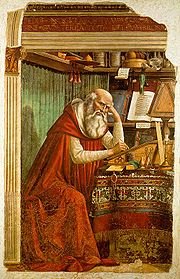 Jerome did not embark on the work with the intention of creating a new version of the whole Bible, but the changing nature of his program can be tracked in his voluminous correspondence. He had been commissioned by Damasus I in 382 to revise the Old Latin text of the four Gospels from the best Greek texts, and by the time of Damasus' death in 384 he had thoroughly completed this task, together with a more cursory revision from the Greek Septuagint of the Old Latin text of the Psalms in the Roman Psalter
which is now lost. How much of the rest of the New Testament
he then revised is difficult to judge today, but little of his work survived in the Vulgate text.
In 385, Jerome was forced out of Rome, and eventually settled in Bethlehem
, where he was able to use a surviving manuscript of the Hexapla
, likely from the nearby Theological Library of Caesarea Maritima
, a columnar comparison of the variant versions of the Old Testament undertaken 150 years before by Origen
. Jerome first embarked on a revision of the Psalms, translated from the revised Septuagint Greek column of the Hexapla
, which later came to be called the Gallican version. He also appears to have undertaken further new translations into Latin from the Hexaplar Septuagint column for other books. But from 390 to 405, Jerome translated anew from the Hebrew all 39 books in the Hebrew Bible, including a further version of the Psalms. This new translation of the Psalms was labelled by him as "iuxta Hebraeos" (i.e. "close to the Hebrews", "immediately following the Hebrews"), and was commonly found in the Vulgate, until it was widely replaced by his Gallican psalms beginning in the 9th century.
The Vulgate is usually credited as being the first translation of the Old Testament
into Latin directly from the Hebrew Tanakh
, rather than the Greek Septuagint. Jerome's extensive use of exegetical material written in Greek, on the other hand, as well as his use of the Aquiline
and Theodotion
tic columns of the Hexapla
, along with the somewhat paraphrastic style
in which he translated makes it difficult to determine exactly how direct the conversion of Hebrew to Latin was.
As Jerome completed his translations of each book of the bible, he recorded his observations and comments in an extensive correspondence with other scholars; and these letters were subsequently collected and appended as prologues to the Vulgate text for those books where they survived. In these letters, Jerome described those books or portions of books in the Septuagint that were not found in the Hebrew as being non-canonical
: he called them apocrypha
. Jerome's views did not, however, prevail; and all complete manuscripts and editions of the Vulgate include some or all these books. Of the Old Testament
texts not found in the Hebrew, Jerome translated Tobit
and Judith anew from the Aramaic; and from the Greek, the additions to Esther
from the Septuagint, and the additions to Daniel
from Theodotion
. Other books; Baruch
, Letter of Jeremiah, Wisdom
, Ecclesiasticus, 1 and 2 Maccabees
are variously found in Vulgate manuscripts with texts derived from the Old Latin; sometimes together with Latin versions of other texts found neither in the Hebrew Bible, nor in the Septuagint, 4 Esdras
, the Prayer of Manasses and Laodiceans. Their style is still markedly distinguishable from Jerome's. In the Vulgate text, Jerome's translations from the Greek of the additions to Esther and Daniel are combined with his separate translations of these books from the Hebrew.
, which date from nearly 600 years after Jerome, nevertheless transmit a consonantal Hebrew text very close to that used by Jerome. Consequently, these books of the Vulgate – though of high literary quality – have little independent interest in text critical debate. Jerome translated the books of Judith and Tobit under sufferance, engaging a Jewish intermediary to render the Aramaic into oral Hebrew, for him then to paraphrase into Latin. Their textual value is small. The Vulgate Old Testament texts that were translated from the Greek – whether by Jerome himself, or preserving revised or unrevised Old Latin versions – are however early and important secondary witnesses to the Septuagint.
Damasus had instructed Jerome to be conservative in his revision of the Old Latin Gospels, and it is possible to see Jerome's obedience to this injunction in the preservation in the Vulgate of variant Latin vocabulary for the same Greek terms. Hence, "high priest" is rendered "princeps sacerdotum" in Vulgate Matthew; as "summus sacerdos" in Vulgate Mark; and as "pontifex" in Vulgate John. Comparison of Jerome's Gospel texts with those in Old Latin witnesses, suggests that his revision was substantially concerned with redacting the expanded phraseology characteristic of the Western text-type
, in accordance with Alexandrian
, or possibly early Byzantine
, witnesses. Given Jerome's conservative methods, and that manuscript evidence from outside Egypt at this early date is very rare; these Vulgate readings have considerable critical interest. More interesting still – because effectively untouched by Jerome – are the Vulgate books of the rest of the New Testament; which demonstrate rather more of supposed "Western" expansions, and otherwise transmit a very early Old Latin text. Most valuable of all from a text-critical perspective is the Vulgate text of the Apocalypse
, a book where there is no clear majority text in the surviving Greek witnesses.
the Vulgate contains 17 prologues, 16 of which were written by Jerome
. Jerome's prologues are in a sense misnamed, as they were written not so much as prologues than as cover letters to specific individuals to accompany copies of his translations. Because they were not intended for a general audience, some of his comments in them are quite cryptic. These prologues are to the Pentateuch, to Joshua, and to Kings, which is also called the Prologus Galeatus. Following these are prologues to Chronicles, Esdras, Tobias, Judith,
Esther,
Job,
The Gallican Psalms,
Solomon,
Isaias,
Jeremias,
Ezechiel,
Daniel,
Minor prophets,
the Gospels, and the final prologue which is to the Pauline Epistles and is better known as Primum quaeritur. Related to these are Jerome's Notes on the Rest of Esther and his Prologue to the Hebrew Psalms. In addition to the Jerome's prologue to the Gallican version of the Psalms, which is commonly found in Vulgate manuscripts, his prologues also survive for the translations from the Hexaplar Septuagint of the books of Job, Ecclesiastes, Song of Songs and Chronicles.
A recurring theme of the Old Testament
prologues is Jerome's preference for the Hebraica veritas
(i.e., Hebrew truth) to the Septuagint, a preference which he defended from his detractors. He stated that the Hebrew text more clearly prefigures Christ than the Greek. Among the most remarkable of these prologues is the Prologus Galeatus, in which Jerome described an Old Testament
canon of 22 books, which he found represented in the 22-letter Hebrew
alphabet. Alternatively, he numbered the books as 24, which he described as the 24 elders in the Book of Revelation
casting their crowns before the Lamb
.
Also of note is the Primum quaeritur, which defended the Pauline authorship of the Epistle to the Hebrews
, and compared Paul's ten letters to the churches with the ten commandments. The author of the Primum quaeritur is unknown. The editors of the Stuttgart Vulgate remark that this version of the epistles first became popular among the Pelagians.
In addition to Primum quaeritur, many manuscripts contain brief notes to each of the epistles indicating where they were written, with notes about where the recipients dwelt. Adolf von Harnack
, citing De Bruyne, argued that these notes were written by Marcion of Sinope
or one of his followers.
, or "Old Latin Bible", or occasionally the "Old Latin Vulgate". (Here "Old Latin" means that they are older than the Vulgate and written in Latin, not that they are written in Old Latin
. Likewise the Latin Vulgate was so named because it was the Latin
counterpart to the Greek Vulgate
; it was not written in Vulgar Latin
.) The translations in the Vetus Latina had accumulated piecemeal over a century or more; they were not translated by a single person or institution, nor uniformly edited. The individual books varied in quality of translation and style, and different manuscripts witness wide variations in readings. Jerome, in his preface to the Vulgate gospels, commented that there were "as many [translations] as there are manuscripts". The Old Testament books of the Vetus Latina were translated from the Greek Septuagint, not from the Hebrew
.
Jerome's earliest efforts in translation, his revision of the four Gospels, was dedicated to Damasus; but his version had little or no official recognition. Jerome's translated texts had to make their way on their own merits. The Old Latin versions continued to be copied and used alongside the Vulgate versions. Bede
, writing in 8th century Northumbria, records Abbot Ceolfrid
quoting Genesis 1:16 according to both the Vulgate and the Old Latin text, as the new and former editions. Nevertheless, the superior quality of the Vulgate texts led to their increasingly superseding the Old Latin; although the loss of familiar phrases and expressions still aroused hostility in congregations; and, especially in North Africa and Spain, favourite Old Latin readings were often re-introduced by copyists, while individual books within Spanish Vulgate bibles are sometimes found to retain the Old Latin text. Spanish biblical traditions, with many Old Latin borrowings, were influential in Ireland; while both Irish and Spanish influences are found in Vulgate texts in northern France. In Italy and southern France, by contrast, a much purer Vulgate text predominated; and this is the version of the Bible that became established in England following the mission of Augustine of Canterbury
. As late as the 13th century, the Codex Gigas
retained an Old Latin text for the Apocalypse and the Acts of the Apostles.
Throughout Late Antiquity
and most of the Middle Ages
, the name Vulgata was applied to the Greek Vulgate
and the Vetus Latina
, but as the acceptance of Jerome's version overtook that of the Vetus Latina in the Western church, it too began to be called an editio vulgata, a Latin analogue to the older Greek editio vulgata. The earliest known use of the term Vulgata to describe the new Latin translation was made by Roger Bacon
in the 13th century.
Wordsworth and White suggested that Jerome used Old Latin text close to Codex Brixianus
and corrected it with the Alexandrian manuscripts.
and the Renaissance
into the Early Modern Period
is even greater than that of the King James Version in English; for Christians during these times the phraseology and wording of the Vulgate permeated all areas of the culture.
Aside from its use in prayer, liturgy and private study, the Vulgate served as inspiration for ecclesiastical art and architecture
, hymn
s, countless paintings, and popular mystery plays.
, and the Greek New Testament editions of Theodore Beza
, the accompanying Latin reference text is the Vulgate; and where Protestant churches took their lead from the Genevan example – as in England
and Scotland
– the result was a broadening appreciation of Jerome's translation in its dignified style and flowing prose. The closest equivalent in English, the King James Version or Authorized Version, shows a marked influence from the Vulgate, especially by comparison with the earlier vernacular version of Tyndale, in respect of Jerome's demonstration of how a technically exact Latinate religious vocabulary may be combined with dignified prose and vigorous poetic rhythms.
The Vulgate continued to be regarded as the standard scholarly Bible throughout most of the 17th Century. Walton's London Polyglot of 1657 disregards the English Language entirely. Walton's reference text throughout is the Vulgate. The Vulgate Latin is also found as the standard text of scripture in Thomas Hobbes
Leviathan
of 1651, indeed Hobbes gives Vulgate chapter and verse numbers (i.e. Job 41:24; not Job 41:33) for his head text. In Chapter 35: 'The Signification in Scripture of Kingdom of God' , Hobbes discusses Exodus 19:5, first in his own translation of the 'Vulgar Latin' , and then subsequently as found in the versions he terms "...the English translation made in the beginning of the reign of King James", and "The Geneva French" (i.e. Olivetan
). Hobbes advances detailed critical arguments why the Vulgate rendering is to be preferred. It remained the assumption of Protestant scholars that, while it had been of vital importance to provide the scriptures in the vernacular for ordinary people, nevertheless for those with sufficient education to do so, biblical study was best undertaken within the international common medium of the Latin Vulgate.
(1545–1563) as the touchstone of the Biblical canon
concerning which parts of books are canonical. When the council listed the books included in the canon, it qualified the books as being "entire with all their parts, as they have been used to be read in the Catholic Church, and as they are contained in the old Latin vulgate edition". There are 76 books in the edition authorized by the council
: 46 in the Old Testament
, 27 in the New Testament
, and three in the Apocrypha
. This decree was clarified somewhat by Pope Pius XI
on June 2, 1927, who allowed that the Comma Johanneum
was open to dispute, and it was further explicated by Pope Pius XII
's encyclical Divino Afflante Spiritu
.
The council then went on to cite Sacred Tradition
in support of the Vulgate's magisterial authority
:
, the Vulgate was the source text used for many translations of the Bible into vernacular languages. In English, the interlinear translation of the Lindisfarne Gospels
as well as other Old English Bible translations
, the translation
of John Wycliffe
, the Douay-Rheims Bible, the Confraternity Bible
, and Ronald Knox
's translation
were all made from the Vulgate.
" comes from the Latin publicanus (e.g., Mt 10:3), and the phrase "far be it" is a translation of the Latin expression absit (e.g., Mt 16:22 in the King James Bible). Other examples include apostolus, ecclesia, evangelium, Pascha, and angelus.
is the earliest surviving manuscript
of the complete Vulgate Bible. The Codex Fuldensis
, dating from around 545, contains most of the New Testament in the Vulgate version, but the four Vulgate gospel
s are harmonized into a continuous narrative derived from the Diatessaron
.
Over the course of the Middle Ages, the Vulgate had succumbed to the inevitable changes wrought by human error in the countless copies made of the text in monasteries across Europe. From its earliest days, readings from the Old Latin were introduced. Marginal notes were erroneously interpolated into the text. No one copy was the same as the other as scribes added, removed, misspelled, or miscorrected verses in the Latin Bible.
Alcuin
of York oversaw efforts to make an improved Vulgate, which he presented to Charlemagne
in 801; although he concentrated mainly on correcting inconsistencies of grammar and orthography, many of which were in the original text. More scholarly attempts were made by Theodulphus, Bishop of Orléans (787?–821); Lanfranc
, Archbishop of Canterbury (1070–1089); Stephen Harding
, Abbot of Cîteaux (1109–1134); and Deacon Nicolaus Maniacoria (about the beginning of the 13th century). The University of Paris
, the Dominicans, and the Franciscans following Roger Bacon
assembled lists of correctoria; approved readings where variants had been noted. Many of the readings that were recommended were later found to be interpolations, or survivals of the Old Latin text, since medieval correctors commonly sought to adjust the Vulgate text into consistency with bible quotations found in Early Church Fathers.
Though the advent of printing greatly reduced the potential of human error and increased the consistency and uniformity of the text, the earliest editions of the Vulgate merely reproduced the manuscripts that were readily available to the publishers. Of the hundreds of early editions, the most notable today is Mazarin edition
published by Johann Gutenberg and Johann Fust
in 1455, famous for its beauty and antiquity. In 1504 the first Vulgate with variant readings was published in Paris. One of the texts of the Complutensian Polyglot was an edition of the Vulgate made from ancient manuscripts and corrected to agree with the Greek.
Erasmus published an edition corrected to agree better with the Greek and Hebrew in 1516. Other corrected editions were published by Xanthus Pagninus
in 1518, Cardinal Cajetan, Augustinus Steuchius
in 1529, Abbot Isidorus Clarius
(Venice
, 1542), and others. In 1528, Robertus Stephanus
published the first of a series of critical editions, which formed the basis of the later Sistine and Clementine editions. The critical edition of John Hentenius of Louvain followed in 1547.
In 1550, Stephanus fled to Geneva
where in 1555 he issued his final critical edition of the Vulgate, which was the first complete Bible with full chapter and verse divisions, and which became the standard Biblical reference text for late 16th century Reformed theology.
After the Reformation
, when the Catholic Church strove to counter the attacks and refute the doctrines of Protestantism
, the Vulgate was reaffirmed in the Council of Trent
as the sole, authorized Latin text of the Bible. To fulfill this declaration, the council commissioned the pope to make a standard text of the Vulgate out of the countless editions produced during the Renaissance
and manuscripts produced during the Middle Ages. The actual first manifestation of this authorized text did not appear until 1590. It was sponsored by Pope Sixtus V
(1585–90) and known as the Sistine Vulgate
. It was based on the edition of Robertus Stephanus corrected to agree with the Greek, but it was hurried into print and suffered from many printing errors.
The Sixtine edition was soon replaced by Clement VIII
(1592–1605) who had ordered Franciscus Toletus
, Augustinus Valerius
, Fredericus Borromaeus
, Robertus Bellarmino
, Antonius Agellius
, and Petrus Morinus
to make corrections and a revision. This new revised version was based more on the Hentenian edition. It is called today the Sixto-Clementine Vulgate
, or simply the Clementine, although it is Sixtus' name which appears on the title page. Clement published three printings of this edition, in 1592, 1593 and 1598.
The Clementine differed from the manuscripts on which it was ultimately based in that it grouped the various prefaces of St. Jerome together at the beginning, and it removed 3
and 4 Esdras
and the Prayer of Manasses from the Old Testament
and placed them as Apocrypha into an appendix following the New Testament.
The Psalter of the Clementine Vulgate, like that of almost all earlier printed editions, is the Gallicanum, omitting Psalm 151
. It follows the Greek numbering of the Psalms, which differs from that in versions translated directly from the Hebrew.
The Clementine Vulgate of 1592 became the standard Bible text of the Roman Rite
of the Roman Catholic Church
until 1979, when the Nova Vulgata was promulgated.
issued no other official printings, leaving the task to other printers. Although the other printers of the Clementine Vulgate faithfully reproduced the words of the official edition, they were often quite free in matters of spelling, punctuation, capitalization, and paragraph boundaries. In 1906, Capuchin friar
Fr. Michael Hetzenauer produced an edition restoring the original Clementine text while taking into account variations in Clement's three printings as well as correctoria officially issued by the Vatican.
In 1982, Biblioteca de Autores Cristianos issued a printing of the Clementine Vulgate (ISBN 84-7914-021-6) omitting the Clementine Apocrypha, but containing excerpts from various magisterial
documents and the Piana version of the psalms in addition to the vulgate version.
were published. In 1734 Vallarsi published a corrected edition of the Vulgate. Most other later editions limited themselves to the New Testament
, most notably Fleck's edition of 1840, Constantin von Tischendorf
's edition of 1864, and the Oxford
edition of Bishop John Wordsworth
and Henry Julian White
in 1889. In 1906 Eberhard Nestle
published Novum Testamentum Latine, which presented the Clementine Vulgate text with a critical apparatus comparing it to the editions of Sixtus V (1590), Wordsworth and White (1889), Lachman (1842), and Tischendorf (1854), as well as the manuscripts Codex Amiatinus
and Codex Fuldensis
.
In 1907 Pope Pius X commissioned the monks of the Benedictine Abbey of St. Jerome in Rome to prepare a critical edition of Jerome's Vulgate as a basis for a revision of the Clementine. Only the Old Testament was ever completed, which however complemented the New Testament edition of Wordsworth and White; the fruit of this labour led to the creation of the Nova Vulgata. The Benedictine critical edition was used as a basis for much of the Old Testament of the Stuttgart Vulgate.
This Vulgate was first published in 1969 (5th edition, 2007) by the German Bible Society (Deutsche Bibelgesellschaft
), based in Stuttgart. This edition, alternatively titled Biblia Sacra Vulgata or Biblia Sacra iuxta vulgatam versionem (ISBN 3-438-05303-9 and ISBN 1-59856-178-2 for North America), is a "manual edition" in that it reduces much of the information in the big multi-volume critical editions that preceded it into a single compact volume. It is based on earlier critical editions of the Vulgate, including the Benedictine edition and the Latin New Testament produced by Wordsworth
and White
, which provided variant readings from the diverse manuscripts and printed editions of the Vulgate and comparison of different wordings in their footnotes. The Stuttgart Vulgate attempts, through critical comparison of important, historical manuscripts of the Vulgate, to recreate an early text, cleansed of the scribal errors of a millennium.
An important feature in the Stuttgart edition for those studying the Vulgate is the inclusion of all of Jerome's prologues to the Bible, the Testaments, and the major books and sections (Pentateuch, Gospels, Minor Prophets, etc.) of the Bible. This adheres to the style of medieval editions of the Vulgate, which were never without Jerome's prologues. In its spelling, the Stuttgart also retains a more medieval Latin orthography than the Clementine, sometimes using oe rather than ae, and having more proper nouns beginning with H (i.e., Helimelech instead of Elimelech), but the spelling is inconsistent throughout, as in the manuscripts. The Stuttgart Vulgate also follows the medieval manuscripts in using line breaks, rather than the modern system of punctuation marks, to indicate the structure of each verse. Because of these features, it initially presents an unfamiliar appearance to readers accustomed to the Clementine text.
It contains two Psalters, both the traditional Gallicanum and the juxta Hebraicum, which are printed on facing pages to allow easy comparison and contrast between the two versions. It has an expanded Apocrypha
, containing Psalm 151
and the Epistle to the Laodiceans
in addition to 3
and 4 Esdras
and the Prayer of Manasses.
In addition, its modern prefaces are a source of valuable information about the history of the Vulgate.
One reason for the Stuttgart edition's importance rests in the fact that it is the one most disseminated on the Internet. However, this electronic version is commonly mutilated, lacking all formatting, notes, prefaces and apparatus, and often lacking the Gallican Psalter, Apocrypha, and Deuterocanonical books
and sections. Moreover, the protocanonical
part of Daniel
following chapter 3 is commonly missing.
for use in the Roman rite
. The Second Vatican Council
in Sacrosanctum Concilium
mandated a revision of the Latin Psalter
in accord with modern textual and linguistic studies, while preserving or refining its Christian Latin style. In 1965 Pope Paul VI
appointed a commission to revise the rest of the Vulgate following the same principles. The Commission published its work in eight annotated sections, inviting criticism from Catholic scholars as the sections were published. The Latin Psalter was published in 1969; the New Testament was completed by 1971 and the entire Nova Vulgata was published in 1979. A second edition was published in 1986.
The foundational text of most of the Nova Vulgatas Old Testament is the critical edition done by the monks of the Benedictine Abbey of St. Jerome under Pius X. The foundational text of the books of Tobit and Judith are from manuscripts of the Vetus Latina
rather than the Vulgate. The New Testament was based on the 1969 edition of the Stuttgart Vulgate. All of these base texts were revised to accord with the modern critical editions in Greek, Hebrew, and Aramaic. There are also a number of changes where the modern scholars felt that Jerome had failed to grasp the meaning of the original languages, or had rendered it obscurely.
The Nova Vulgata does not contain some books
found in the earlier editions but omitted by the canon
of Trent
, namely the Prayer of Manasses
, the 3rd & 4th Book of Esdras, and the Epistle to the Laodiceans
.
In 1979, after decades of preparation, the Nova Vulgata was published and declared the Catholic Church's current official Latin version in the Apostolic constitution
Scripturarum Thesaurus promulgated by the Pope John Paul II. The Nova Vulgata is the translation used in the latest editions of the Roman Lectionary
, Liturgy of the Hours
, and Roman Ritual
.
The Nova Vulgata has not been widely embraced by conservative Catholics, many of whom see it as being in some verses of the Old Testament a new translation rather than a revision of Jerome's work. Also, some of its readings sound unfamiliar to those who are accustomed to the Clementine.
In 2001, the Vatican
released the instruction Liturgiam Authenticam, establishing the Nova Vulgata as a point of reference for all translations of the liturgy
of the Roman rite
into the vernacular from the original languages, "in order to maintain the tradition of interpretation that is proper to the Latin Liturgy".
and Barbara Aland updated and entirely revised Nestle's edition of 1906 and republished it under the same name, Novum Testamentum Latine (ISBN 1-59856-175-8). The new text is a reprint of the New Testament
of the Nova Vulgata to which has been added a critical apparatus
giving the variant readings of earlier editions. The editions described in the apparatus are the Stuttgart edition, the Gutenberg Bible
(1452), the Latin text of the Complutensian Polyglot (1514), the edition from Wittenberg
, which was favored by Luther
(1529), the editions of Desiderius Erasmus
(1527), Robertus Stephanus
(1540), Hentenius of Louvain
(1547), Christophorus Plantinus (1583), Pope Sixtus V (1590), Pope Clement VIII (1592), and Wordsworth and White (1954).
's name in Genesis 3:20.
(accepted as a genuine letter of Paul by many Latin commentators), although often with a note to the effect that it was not counted as canonical.
The Vulgate Old Testament from the first comprised the 39 books (as counted in Christian tradition) of the Hebrew Bible, but always also including books from the Septuagint tradition, which by this date had ceased to be used by Jews, but which was copied in Greek bibles as the Old Testament
. The Septuagint, however, was not then definitively fixed; no two surviving Greek Old Testaments of this period agree. Consequently Vulgate Old Testaments continued to vary in their content throughout the medieval period.
Although Jerome preferred the books of the Hebrew Bible, he deferred to church authority in accepting as scripture not only the Greek additions to Esther and Daniel, but also an extra five 'apocryphal' books in Judith, Tobit, Wisdom, Ecclesiasticus and the two books of Maccabees, which in his listing of the Old Testament in the prologus galeatus he placed after the Hebrew canon. But, as Jerome explained in the prologue to Jeremias, he continued to exclude altogether the Book of Baruch (and with it the letter of Jeremiah); and indeed these two books are not found in the Vulgate before the 9th century, and only in a minority of manuscripts before the 13th century. The 71 biblical books as listed by Jerome, although not in his order, formed the standard text of the Vulgate as it became established in Italy in the 5th and 6th centuries. No Italian manuscript of the whole Vulgate Bible survives, and such pandect bibles were always rare in this period; but the Codex Amiatinus
written in Northumbria from Italian exemplars around 700 and intended to be presented to the Pope, represents the complete Bible according to the Italian Vulgate tradition. It contains the standard 71 books; with the Psalms according to Jerome's translation from the Hebrew, except for Psalm 151 which is translated from the Greek.
The early Vulgate text in Spain tended to vary much further from Jerome's original, specifically in the retention of many Old Latin readings, in the expansion of the text of the Book of Proverbs, and in the incorporation into the first epistle of John of the Comma Johanneum
. Spanish bibles, on occasion, also included additional apocryphal texts, including the Book of Baruch, the Letter of Jeremiah, 3 Esdras and 4 Esdras. Spanish, Italian and Irish Vulgate traditions were all reflected in bibles created in northern France, which by the end of the 8th century featured a wide variety of highly variable texts. Under prompting from the emperor Charlemegne, several scholars attempted in the 9th century to reform the French Vulgate. The English scholar Alcuin
produced a text substantially based on Italian exemplars (although also including the Comma Johanneum), but with the major change of substituting Jerome's Gallican version of the psalms for his third version from the Hebrew that had previously predominated in bible texts. In the 50 years after Alcuin's death, the abbey of Tours reproduced his text in standardised pandect bibles, of which over 40 survive. Alcuin's contemporary Theodulf of Orleans
produced a second independent reformed recension of the Vulgate, also based largely on Italian exemplars, but with variant readings, from Spanish texts and patristic citations, indicated in the margin. Theodulf kept Jerome's Hebraic version of the Psalms, and also incorporated the Book of Baruch and the Letter of Jeremiah within the book of Jeremiah. However, otherwise Theodulf adopted Jerome's proposed order of the Old Testament, with the five books from the Septuagint at the end. Theodulf's text was widely influential. A Vulgate revision was also undertaken in the early 9th century by scholars in the Abbey of Corbie
, and bibles from this abbey are the first in France to include the books of 3 Esdras and 4 Esdras, though this practice remained rare.
Although a large number of bible manuscripts resulted from all this work, no standard Vulgate text was to be established for another three centuries. Marsden points out, in discussing the process by which the Gallican version from the Psalter came to become established as the text of the psalms in the Vulgate bible; "Its dominant position was in fact not assured before the early 13th century, and even then was not universal". However, the explosive growth of medieval universities, especially the University of Paris
during the 12th century created a demand for a new sort of Vulgate. University scholars needed the entire bible in a single, portable and comprehensive volume; which they could rely on to include all biblical texts which they might encounter in partristic references. The result was the Paris Bible, which reached its final form around 1230. The text of the Paris Bible owed most to Alcuin's revision and always presented the psalms in the Gallican version; but readings throughout were in many places adjusted to be more consistent with patristic citations (which would very frequently have been based on Old Latin or Greek texts). The book of Baruch and Letter of Jeremiah were now always included, as too were 3 Esdras, and usually (appended to the book of Chronicles) the Prayer of Manasses. Less commonly included was 4 Esdras.
The early printings of the Latin Bible took examples of the Paris Bible as their base text, culminating in the successive critical Vulgate editions of Robert Estienne
(Stephanus). Estienne's Geneva Vulgate of 1555, the first Bible to be subdivided throughout into chapters and verses, remained the standard Latin Bible for Reformed Protestantism; and established the content of the Vulgate as 76 books; 27 New Testament, 39 Hebrew Bible, plus Tobit, Judith, Wisdom, Ecclesiasticus, Baruch, I & II Maccabees, 3 Esdras, 4 Esdras and the Prayer of Manasses. At the Council of Trent
it was agreed that seven of these books: all except 3 Esdras, 4 Esdras and the Prayer of Manasses, should be considered inspired scripture; and the term "deuterocanonical", first applied by Sixtus of Siena
, was adopted to categorise them. The Council also requested that the Pope should undertake the production of definitive editions of the Latin, Greek and Hebrew scriptures conforming to their definition of the Biblical Canon
; and this resulted, after several false starts, in the publication of the Clementine Vulgate of 1592. The Clementine Vulgate incorporates the books of Trent's Deuterocanon in the main bible text; but also introduces, following the New Testament, a section of Apocrypha, containing the Prayer of Manasses, 3 Esdras, and 4 Esdras of which only the first two are found in the Septuagint.
Some manuscripts
Pope Damasus I
Pope Saint Damasus I was the bishop of Rome from 366 to 384.He was born around 305, probably near the city of Idanha-a-Velha , in what is present-day Portugal, then part of the Western Roman Empire...
in 382 to make a revision of the old Latin translations
Vetus Latina
Vetus Latina is a collective name given to the Biblical texts in Latin that were translated before St Jerome's Vulgate Bible became the standard Bible for Latin-speaking Western Christians. The phrase Vetus Latina is Latin for Old Latin, and the Vetus Latina is sometimes known as the Old Latin Bible...
. By the 13th century this revision had come to be called the versio vulgata, that is, the "commonly used translation", and ultimately it became the definitive and officially promulgated Latin version of the Bible in the Roman Catholic Church
Roman Catholic Church
The Catholic Church, also known as the Roman Catholic Church, is the world's largest Christian church, with over a billion members. Led by the Pope, it defines its mission as spreading the gospel of Jesus Christ, administering the sacraments and exercising charity...
.
Authorship
The Vulgate has a compound text that is not entirely the work of Jerome. Its components include:- Jerome's independent translation from the HebrewTanakhThe Tanakh is a name used in Judaism for the canon of the Hebrew Bible. The Tanakh is also known as the Masoretic Text or the Miqra. The name is an acronym formed from the initial Hebrew letters of the Masoretic Text's three traditional subdivisions: The Torah , Nevi'im and Ketuvim —hence...
: the books of the Hebrew Bible, usually not including his translation of the Psalms. This was completed in 405. - Translation from the Greek of TheodotionTheodotionTheodotion was a Hellenistic Jewish scholar,, perhaps working in Ephesus who in ca. AD 150 translated the Hebrew Bible into Greek. Whether he was revising the Septuagint, or was working from Hebrew manuscripts that represented a parallel tradition that has not survived, is debated...
by Jerome: The three additions to the Book of DanielBook of DanielThe Book of Daniel is a book in the Hebrew Bible. The book tells of how Daniel, and his Judean companions, were inducted into Babylon during Jewish exile, and how their positions elevated in the court of Nebuchadnezzar. The court tales span events that occur during the reigns of Nebuchadnezzar,...
; Song of the Three ChildrenThe Prayer of Azariah and Song of the Three Holy ChildrenThe Prayer of Azariah and the Song of the Three Holy Children is a lengthy passage that appears after Daniel 3:23 in Roman Catholic and Eastern Orthodox Bibles, as well as in the ancient Greek Septuagint translation. It is listed as non-canonical in Article VI of the Thirty-Nine Articles of the...
, Story of SusannaSusanna (Book of Daniel)Susanna or Shoshana included in the Book of Daniel by the Roman Catholic and Eastern Orthodox churches. It is one of the additions to Daniel, considered apocryphal by Protestants. It is listed in Article VI of the Thirty-Nine Articles of the Church of England among the books which are included...
, and The Idol Bel and the DragonBel and the DragonThe narrative of Bel and the Dragon incorporated as chapter 14 of the extended Book of Daniel exists only in Greek in the Septuagint. This chapter, along with chapter 13, is referred to as deuterocanonical, in that it is not universally accepted among Christians as belonging to the canonical works...
. The Song of the Three Children was retained within the narrative of Daniel, the other two additions Jerome moved to the end of the book. - Translation from the Septuagint by Jerome: the Rest of Esther. Jerome gathered all these additions together at the end of the book of Esther.
- Translation from the Hexaplar SeptuagintHexaplaHexapla is the term for an edition of the Bible in six versions. Especially it applies to the edition of the Old Testament compiled by Origen of Alexandria, which placed side by side:#Hebrew...
by Jerome: his Gallican version of the Book of Psalms. Jerome's Hexaplaric revisions of other books of Old Testament continued to circulate in Italy for several centuries, but only Job and fragments of other books survive. - Free translation by Jerome from a secondary Aramaic version: TobiasBook of TobitThe Book of Tobit is a book of scripture that is part of the Catholic and Orthodox biblical canon, pronounced canonical by the Council of Carthage of 397 and confirmed for Roman Catholics by the Council of Trent...
and Judith. - Revision by Jerome of the Old LatinVetus LatinaVetus Latina is a collective name given to the Biblical texts in Latin that were translated before St Jerome's Vulgate Bible became the standard Bible for Latin-speaking Western Christians. The phrase Vetus Latina is Latin for Old Latin, and the Vetus Latina is sometimes known as the Old Latin Bible...
, corrected with reference to the oldest Greek manuscripts available: the Gospels. - Old Latin, more or less revised by a person or persons unknown: BaruchBook of BaruchThe Book of Baruch, occasionally referred to as 1 Baruch, is called a deuterocanonical book of the Bible. Although not in the Hebrew Bible, it is found in the Septuagint and in the Vulgate Bible, and also in Theodotion's version. It is grouped with the prophetical books which also include Isaiah,...
, Letter of Jeremiah, 3 Esdras1 Esdras1 Esdras , Greek Ezra, is an ancient Greek version of the biblical Book of Ezra in use among ancient Jewry, the early church, and many modern Christians with varying degrees of canonicity and a high historical usefulness....
, ActsActs of the ApostlesThe Acts of the Apostles , usually referred to simply as Acts, is the fifth book of the New Testament; Acts outlines the history of the Apostolic Age...
, Epistles, and the ApocalypseBook of RevelationThe Book of Revelation is the final book of the New Testament. The title came into usage from the first word of the book in Koine Greek: apokalupsis, meaning "unveiling" or "revelation"...
. - Old Latin, wholly unrevised: Epistle to the LaodiceansEpistle to the LaodiceansAn Epistle to the Laodiceans, purportedly written by Paul of Tarsus to the Laodicean Church, is mentioned in the canonical Epistle to the Colossians...
, Prayer of Manasses, 4 Esdras2 Esdras2 Esdras or Latin Esdras is the name of an apocalyptic book in many English versions of the Bible . Its authorship is ascribed to Ezra. It is reckoned among the Apocrypha by many Protestant churches. Although Second Esdras exists in its complete form only in Latin, it was originally written in...
, WisdomBook of WisdomThe Book of Wisdom, often referred to simply as Wisdom or the Book of the Wisdom of Solomon, is one of the deuterocanonical books of the Bible. It is one of the seven Sapiential or wisdom books of the Septuagint Old Testament, which includes Job, Psalms, Proverbs, Ecclesiastes, Song of Solomon ,...
, Ecclesiasticus, and 11 MaccabeesThe First book of Maccabees is a book written in Hebrew by a Jewish author after the restoration of an independent Jewish kingdom, about the latter part of the 2nd century BC. The original Hebrew is lost and the most important surviving version is the Greek translation contained in the Septuagint...
and 2 Maccabees2 Maccabees2 Maccabees is a deuterocanonical book of the Bible, which focuses on the Jews' revolt against Antiochus IV Epiphanes and concludes with the defeat of the Syrian general Nicanor in 161 BC by Judas Maccabeus, the hero of the work....
.
Translation
Psalter
A psalter is a volume containing the Book of Psalms, often with other devotional material bound in as well, such as a liturgical calendar and litany of the Saints. Until the later medieval emergence of the book of hours, psalters were the books most widely owned by wealthy lay persons and were...
which is now lost. How much of the rest of the New Testament
New Testament
The New Testament is the second major division of the Christian biblical canon, the first such division being the much longer Old Testament....
he then revised is difficult to judge today, but little of his work survived in the Vulgate text.
In 385, Jerome was forced out of Rome, and eventually settled in Bethlehem
Bethlehem
Bethlehem is a Palestinian city in the central West Bank of the Jordan River, near Israel and approximately south of Jerusalem, with a population of about 30,000 people. It is the capital of the Bethlehem Governorate of the Palestinian National Authority and a hub of Palestinian culture and tourism...
, where he was able to use a surviving manuscript of the Hexapla
Hexapla
Hexapla is the term for an edition of the Bible in six versions. Especially it applies to the edition of the Old Testament compiled by Origen of Alexandria, which placed side by side:#Hebrew...
, likely from the nearby Theological Library of Caesarea Maritima
Theological Library of Caesarea Maritima
The Theological Library of Caesarea Maritima or simply the Library of Caesarea was the library of the Christians of Caesarea Maritima in Palestine in ancient times.-History:...
, a columnar comparison of the variant versions of the Old Testament undertaken 150 years before by Origen
Origen
Origen , or Origen Adamantius, 184/5–253/4, was an early Christian Alexandrian scholar and theologian, and one of the most distinguished writers of the early Church. As early as the fourth century, his orthodoxy was suspect, in part because he believed in the pre-existence of souls...
. Jerome first embarked on a revision of the Psalms, translated from the revised Septuagint Greek column of the Hexapla
Hexapla
Hexapla is the term for an edition of the Bible in six versions. Especially it applies to the edition of the Old Testament compiled by Origen of Alexandria, which placed side by side:#Hebrew...
, which later came to be called the Gallican version. He also appears to have undertaken further new translations into Latin from the Hexaplar Septuagint column for other books. But from 390 to 405, Jerome translated anew from the Hebrew all 39 books in the Hebrew Bible, including a further version of the Psalms. This new translation of the Psalms was labelled by him as "iuxta Hebraeos" (i.e. "close to the Hebrews", "immediately following the Hebrews"), and was commonly found in the Vulgate, until it was widely replaced by his Gallican psalms beginning in the 9th century.
The Vulgate is usually credited as being the first translation of the Old Testament
Old Testament
The Old Testament, of which Christians hold different views, is a Christian term for the religious writings of ancient Israel held sacred and inspired by Christians which overlaps with the 24-book canon of the Masoretic Text of Judaism...
into Latin directly from the Hebrew Tanakh
Tanakh
The Tanakh is a name used in Judaism for the canon of the Hebrew Bible. The Tanakh is also known as the Masoretic Text or the Miqra. The name is an acronym formed from the initial Hebrew letters of the Masoretic Text's three traditional subdivisions: The Torah , Nevi'im and Ketuvim —hence...
, rather than the Greek Septuagint. Jerome's extensive use of exegetical material written in Greek, on the other hand, as well as his use of the Aquiline
Aquila of Sinope
Aquila of Sinope was a 2nd Century CE native of Pontus in Anatolia known for producing an exceedingly literal translation of the Hebrew Bible into Greek around 130 CE. He was a proselyte to Judaism and a disciple of Rabbi Akiba...
and Theodotion
Theodotion
Theodotion was a Hellenistic Jewish scholar,, perhaps working in Ephesus who in ca. AD 150 translated the Hebrew Bible into Greek. Whether he was revising the Septuagint, or was working from Hebrew manuscripts that represented a parallel tradition that has not survived, is debated...
tic columns of the Hexapla
Hexapla
Hexapla is the term for an edition of the Bible in six versions. Especially it applies to the edition of the Old Testament compiled by Origen of Alexandria, which placed side by side:#Hebrew...
, along with the somewhat paraphrastic style
Paraphrase
Paraphrase is restatement of a text or passages, using other words. The term "paraphrase" derives via the Latin "paraphrasis" from the Greek , meaning "additional manner of expression". The act of paraphrasing is also called "paraphrasis."...
in which he translated makes it difficult to determine exactly how direct the conversion of Hebrew to Latin was.
As Jerome completed his translations of each book of the bible, he recorded his observations and comments in an extensive correspondence with other scholars; and these letters were subsequently collected and appended as prologues to the Vulgate text for those books where they survived. In these letters, Jerome described those books or portions of books in the Septuagint that were not found in the Hebrew as being non-canonical
Biblical canon
A biblical canon, or canon of scripture, is a list of books considered to be authoritative as scripture by a particular religious community. The term itself was first coined by Christians, but the idea is found in Jewish sources. The internal wording of the text can also be specified, for example...
: he called them apocrypha
Biblical apocrypha
The word "apocrypha" is today often used to refer to the collection of ancient books printed in some editions of the Bible in a separate section between the Old and New Testaments...
. Jerome's views did not, however, prevail; and all complete manuscripts and editions of the Vulgate include some or all these books. Of the Old Testament
Old Testament
The Old Testament, of which Christians hold different views, is a Christian term for the religious writings of ancient Israel held sacred and inspired by Christians which overlaps with the 24-book canon of the Masoretic Text of Judaism...
texts not found in the Hebrew, Jerome translated Tobit
Book of Tobit
The Book of Tobit is a book of scripture that is part of the Catholic and Orthodox biblical canon, pronounced canonical by the Council of Carthage of 397 and confirmed for Roman Catholics by the Council of Trent...
and Judith anew from the Aramaic; and from the Greek, the additions to Esther
Book of Esther
The Book of Esther is a book in the Ketuvim , the third section of the Jewish Tanakh and is part of the Christian Old Testament. The Book of Esther or the Megillah is the basis for the Jewish celebration of Purim...
from the Septuagint, and the additions to Daniel
Book of Daniel
The Book of Daniel is a book in the Hebrew Bible. The book tells of how Daniel, and his Judean companions, were inducted into Babylon during Jewish exile, and how their positions elevated in the court of Nebuchadnezzar. The court tales span events that occur during the reigns of Nebuchadnezzar,...
from Theodotion
Theodotion
Theodotion was a Hellenistic Jewish scholar,, perhaps working in Ephesus who in ca. AD 150 translated the Hebrew Bible into Greek. Whether he was revising the Septuagint, or was working from Hebrew manuscripts that represented a parallel tradition that has not survived, is debated...
. Other books; Baruch
Book of Baruch
The Book of Baruch, occasionally referred to as 1 Baruch, is called a deuterocanonical book of the Bible. Although not in the Hebrew Bible, it is found in the Septuagint and in the Vulgate Bible, and also in Theodotion's version. It is grouped with the prophetical books which also include Isaiah,...
, Letter of Jeremiah, Wisdom
Book of Wisdom
The Book of Wisdom, often referred to simply as Wisdom or the Book of the Wisdom of Solomon, is one of the deuterocanonical books of the Bible. It is one of the seven Sapiential or wisdom books of the Septuagint Old Testament, which includes Job, Psalms, Proverbs, Ecclesiastes, Song of Solomon ,...
, Ecclesiasticus, 1 and 2 Maccabees
Books of the Maccabees
The Books of the Maccabees are books concerned with the Maccabees, the leaders of the Jewish rebellion against the Seleucid dynasty, or related subjects.The term mostly refers to two deuterocanonical books contained in some canons of the Bible:...
are variously found in Vulgate manuscripts with texts derived from the Old Latin; sometimes together with Latin versions of other texts found neither in the Hebrew Bible, nor in the Septuagint, 4 Esdras
2 Esdras
2 Esdras or Latin Esdras is the name of an apocalyptic book in many English versions of the Bible . Its authorship is ascribed to Ezra. It is reckoned among the Apocrypha by many Protestant churches. Although Second Esdras exists in its complete form only in Latin, it was originally written in...
, the Prayer of Manasses and Laodiceans. Their style is still markedly distinguishable from Jerome's. In the Vulgate text, Jerome's translations from the Greek of the additions to Esther and Daniel are combined with his separate translations of these books from the Hebrew.
Critical value
In translating the 39 books of the Hebrew Bible, Jerome was relatively free in rendering their text into Latin, but it is possible to determine that the oldest surviving complete manuscripts of the Masoretic TextMasoretic Text
The Masoretic Text is the authoritative Hebrew text of the Jewish Bible and is regarded as Judaism's official version of the Tanakh. While the Masoretic Text defines the books of the Jewish canon, it also defines the precise letter-text of these biblical books, with their vocalization and...
, which date from nearly 600 years after Jerome, nevertheless transmit a consonantal Hebrew text very close to that used by Jerome. Consequently, these books of the Vulgate – though of high literary quality – have little independent interest in text critical debate. Jerome translated the books of Judith and Tobit under sufferance, engaging a Jewish intermediary to render the Aramaic into oral Hebrew, for him then to paraphrase into Latin. Their textual value is small. The Vulgate Old Testament texts that were translated from the Greek – whether by Jerome himself, or preserving revised or unrevised Old Latin versions – are however early and important secondary witnesses to the Septuagint.
Damasus had instructed Jerome to be conservative in his revision of the Old Latin Gospels, and it is possible to see Jerome's obedience to this injunction in the preservation in the Vulgate of variant Latin vocabulary for the same Greek terms. Hence, "high priest" is rendered "princeps sacerdotum" in Vulgate Matthew; as "summus sacerdos" in Vulgate Mark; and as "pontifex" in Vulgate John. Comparison of Jerome's Gospel texts with those in Old Latin witnesses, suggests that his revision was substantially concerned with redacting the expanded phraseology characteristic of the Western text-type
Western text-type
The Western text-type is one of several text-types used in textual criticism to describe and group the textual character of Greek New Testament manuscripts...
, in accordance with Alexandrian
Alexandrian text-type
The Alexandrian text-type , associated with Alexandria, is one of several text-types used in New Testament textual criticism to describe and group the textual character of biblical manuscripts...
, or possibly early Byzantine
Byzantine text-type
The Byzantine text-type is one of several text-types used in textual criticism to describe the textual character of Greek New Testament manuscripts. It is the form found in the largest number of surviving manuscripts, though not in the oldest...
, witnesses. Given Jerome's conservative methods, and that manuscript evidence from outside Egypt at this early date is very rare; these Vulgate readings have considerable critical interest. More interesting still – because effectively untouched by Jerome – are the Vulgate books of the rest of the New Testament; which demonstrate rather more of supposed "Western" expansions, and otherwise transmit a very early Old Latin text. Most valuable of all from a text-critical perspective is the Vulgate text of the Apocalypse
Book of Revelation
The Book of Revelation is the final book of the New Testament. The title came into usage from the first word of the book in Koine Greek: apokalupsis, meaning "unveiling" or "revelation"...
, a book where there is no clear majority text in the surviving Greek witnesses.
Prologues
In addition to the biblical textBible
The Bible refers to any one of the collections of the primary religious texts of Judaism and Christianity. There is no common version of the Bible, as the individual books , their contents and their order vary among denominations...
the Vulgate contains 17 prologues, 16 of which were written by Jerome
Jerome
Saint Jerome was a Roman Christian priest, confessor, theologian and historian, and who became a Doctor of the Church. He was the son of Eusebius, of the city of Stridon, which was on the border of Dalmatia and Pannonia...
. Jerome's prologues are in a sense misnamed, as they were written not so much as prologues than as cover letters to specific individuals to accompany copies of his translations. Because they were not intended for a general audience, some of his comments in them are quite cryptic. These prologues are to the Pentateuch, to Joshua, and to Kings, which is also called the Prologus Galeatus. Following these are prologues to Chronicles, Esdras, Tobias, Judith,
Esther,
Job,
The Gallican Psalms,
Solomon,
Isaias,
Jeremias,
Ezechiel,
Daniel,
Minor prophets,
the Gospels, and the final prologue which is to the Pauline Epistles and is better known as Primum quaeritur. Related to these are Jerome's Notes on the Rest of Esther and his Prologue to the Hebrew Psalms. In addition to the Jerome's prologue to the Gallican version of the Psalms, which is commonly found in Vulgate manuscripts, his prologues also survive for the translations from the Hexaplar Septuagint of the books of Job, Ecclesiastes, Song of Songs and Chronicles.
A recurring theme of the Old Testament
Old Testament
The Old Testament, of which Christians hold different views, is a Christian term for the religious writings of ancient Israel held sacred and inspired by Christians which overlaps with the 24-book canon of the Masoretic Text of Judaism...
prologues is Jerome's preference for the Hebraica veritas
Tanakh
The Tanakh is a name used in Judaism for the canon of the Hebrew Bible. The Tanakh is also known as the Masoretic Text or the Miqra. The name is an acronym formed from the initial Hebrew letters of the Masoretic Text's three traditional subdivisions: The Torah , Nevi'im and Ketuvim —hence...
(i.e., Hebrew truth) to the Septuagint, a preference which he defended from his detractors. He stated that the Hebrew text more clearly prefigures Christ than the Greek. Among the most remarkable of these prologues is the Prologus Galeatus, in which Jerome described an Old Testament
Old Testament
The Old Testament, of which Christians hold different views, is a Christian term for the religious writings of ancient Israel held sacred and inspired by Christians which overlaps with the 24-book canon of the Masoretic Text of Judaism...
canon of 22 books, which he found represented in the 22-letter Hebrew
Hebrew language
Hebrew is a Semitic language of the Afroasiatic language family. Culturally, is it considered by Jews and other religious groups as the language of the Jewish people, though other Jewish languages had originated among diaspora Jews, and the Hebrew language is also used by non-Jewish groups, such...
alphabet. Alternatively, he numbered the books as 24, which he described as the 24 elders in the Book of Revelation
Book of Revelation
The Book of Revelation is the final book of the New Testament. The title came into usage from the first word of the book in Koine Greek: apokalupsis, meaning "unveiling" or "revelation"...
casting their crowns before the Lamb
Lamb of God
The title Lamb of God appears in the Gospel of John, with the exclamation of John the Baptist: "Behold the Lamb of God who takes away the sin of the world" in John 1:29 when he sees Jesus....
.
Also of note is the Primum quaeritur, which defended the Pauline authorship of the Epistle to the Hebrews
Epistle to the Hebrews
The Epistle to the Hebrews is one of the books in the New Testament. Its author is not known.The primary purpose of the Letter to the Hebrews is to exhort Christians to persevere in the face of persecution. The central thought of the entire Epistle is the doctrine of the Person of Christ and his...
, and compared Paul's ten letters to the churches with the ten commandments. The author of the Primum quaeritur is unknown. The editors of the Stuttgart Vulgate remark that this version of the epistles first became popular among the Pelagians.
In addition to Primum quaeritur, many manuscripts contain brief notes to each of the epistles indicating where they were written, with notes about where the recipients dwelt. Adolf von Harnack
Adolf von Harnack
Adolf von Harnack , was a German theologian and prominent church historian.He produced many religious publications from 1873-1912....
, citing De Bruyne, argued that these notes were written by Marcion of Sinope
Marcion of Sinope
Marcion of Sinope was a bishop in early Christianity. His theology, which rejected the deity described in the Jewish Scriptures as inferior or subjugated to the God proclaimed in the Christian gospel, was denounced by the Church Fathers and he was excommunicated...
or one of his followers.
Relation with the Old Latin Bible
The Latin Biblical texts in use before the Latin Vulgate are usually referred to collectively as the Vetus LatinaVetus Latina
Vetus Latina is a collective name given to the Biblical texts in Latin that were translated before St Jerome's Vulgate Bible became the standard Bible for Latin-speaking Western Christians. The phrase Vetus Latina is Latin for Old Latin, and the Vetus Latina is sometimes known as the Old Latin Bible...
, or "Old Latin Bible", or occasionally the "Old Latin Vulgate". (Here "Old Latin" means that they are older than the Vulgate and written in Latin, not that they are written in Old Latin
Old Latin
Old Latin refers to the Latin language in the period before the age of Classical Latin; that is, all Latin before 75 BC...
. Likewise the Latin Vulgate was so named because it was the Latin
Medieval Latin
Medieval Latin was the form of Latin used in the Middle Ages, primarily as a medium of scholarly exchange and as the liturgical language of the medieval Roman Catholic Church, but also as a language of science, literature, law, and administration. Despite the clerical origin of many of its authors,...
counterpart to the Greek Vulgate
Greek Vulgate
The Greek Vulgate is a version of the Bible written in Biblical Greek. It consists primarily of the Septuagint for most of the Old Testament with the version of Theodotion used for the book of Daniel. For the New Testament it consists of the Greek text, typically the Majority or Byzantine Text...
; it was not written in Vulgar Latin
Vulgar Latin
Vulgar Latin is any of the nonstandard forms of Latin from which the Romance languages developed. Because of its nonstandard nature, it had no official orthography. All written works used Classical Latin, with very few exceptions...
.) The translations in the Vetus Latina had accumulated piecemeal over a century or more; they were not translated by a single person or institution, nor uniformly edited. The individual books varied in quality of translation and style, and different manuscripts witness wide variations in readings. Jerome, in his preface to the Vulgate gospels, commented that there were "as many [translations] as there are manuscripts". The Old Testament books of the Vetus Latina were translated from the Greek Septuagint, not from the Hebrew
Tanakh
The Tanakh is a name used in Judaism for the canon of the Hebrew Bible. The Tanakh is also known as the Masoretic Text or the Miqra. The name is an acronym formed from the initial Hebrew letters of the Masoretic Text's three traditional subdivisions: The Torah , Nevi'im and Ketuvim —hence...
.
Jerome's earliest efforts in translation, his revision of the four Gospels, was dedicated to Damasus; but his version had little or no official recognition. Jerome's translated texts had to make their way on their own merits. The Old Latin versions continued to be copied and used alongside the Vulgate versions. Bede
Bede
Bede , also referred to as Saint Bede or the Venerable Bede , was a monk at the Northumbrian monastery of Saint Peter at Monkwearmouth, today part of Sunderland, England, and of its companion monastery, Saint Paul's, in modern Jarrow , both in the Kingdom of Northumbria...
, writing in 8th century Northumbria, records Abbot Ceolfrid
Ceolfrid
Saint Ceolfrid was an Anglo-Saxon Christian abbot and saint. He is best known as the warden of Bede from the age of seven until his death in 716. He was the Abbot of Monkwearmouth-Jarrow Abbey, and a major contributor to the project Codex Amiatinus...
quoting Genesis 1:16 according to both the Vulgate and the Old Latin text, as the new and former editions. Nevertheless, the superior quality of the Vulgate texts led to their increasingly superseding the Old Latin; although the loss of familiar phrases and expressions still aroused hostility in congregations; and, especially in North Africa and Spain, favourite Old Latin readings were often re-introduced by copyists, while individual books within Spanish Vulgate bibles are sometimes found to retain the Old Latin text. Spanish biblical traditions, with many Old Latin borrowings, were influential in Ireland; while both Irish and Spanish influences are found in Vulgate texts in northern France. In Italy and southern France, by contrast, a much purer Vulgate text predominated; and this is the version of the Bible that became established in England following the mission of Augustine of Canterbury
Augustine of Canterbury
Augustine of Canterbury was a Benedictine monk who became the first Archbishop of Canterbury in the year 597...
. As late as the 13th century, the Codex Gigas
Codex Gigas
The Codex Gigas is the largest extant medieval manuscript in the world. It is also known as the Devil's Bible because of a large illustration of the devil on the inside and the legend surrounding its creation. It is thought to have been created in the early 13th century in the Benedictine...
retained an Old Latin text for the Apocalypse and the Acts of the Apostles.
Throughout Late Antiquity
Late Antiquity
Late Antiquity is a periodization used by historians to describe the time of transition from Classical Antiquity to the Middle Ages, in both mainland Europe and the Mediterranean world. Precise boundaries for the period are a matter of debate, but noted historian of the period Peter Brown proposed...
and most of the Middle Ages
Middle Ages
The Middle Ages is a periodization of European history from the 5th century to the 15th century. The Middle Ages follows the fall of the Western Roman Empire in 476 and precedes the Early Modern Era. It is the middle period of a three-period division of Western history: Classic, Medieval and Modern...
, the name Vulgata was applied to the Greek Vulgate
Greek Vulgate
The Greek Vulgate is a version of the Bible written in Biblical Greek. It consists primarily of the Septuagint for most of the Old Testament with the version of Theodotion used for the book of Daniel. For the New Testament it consists of the Greek text, typically the Majority or Byzantine Text...
and the Vetus Latina
Vetus Latina
Vetus Latina is a collective name given to the Biblical texts in Latin that were translated before St Jerome's Vulgate Bible became the standard Bible for Latin-speaking Western Christians. The phrase Vetus Latina is Latin for Old Latin, and the Vetus Latina is sometimes known as the Old Latin Bible...
, but as the acceptance of Jerome's version overtook that of the Vetus Latina in the Western church, it too began to be called an editio vulgata, a Latin analogue to the older Greek editio vulgata. The earliest known use of the term Vulgata to describe the new Latin translation was made by Roger Bacon
Roger Bacon
Roger Bacon, O.F.M. , also known as Doctor Mirabilis , was an English philosopher and Franciscan friar who placed considerable emphasis on the study of nature through empirical methods...
in the 13th century.
Wordsworth and White suggested that Jerome used Old Latin text close to Codex Brixianus
Codex Brixianus
The Codex Brixianus , designated by f, is a 6th century Latin Gospel Book which was probably produced in Italy. The manuscript contains 419 folios. The text, written on purple dyed vellum in silver ink, is a version of the old Latin translation which seems to have been a source for the Gothic...
and corrected it with the Alexandrian manuscripts.
Influence on Western culture
For over a thousand years (c. AD 400–1530), the Vulgate was the definitive edition of the most influential text in Western European society. Indeed, for most Western Christians, it was the only version of the Bible ever encountered. The Vulgate's influence throughout the Middle AgesMiddle Ages
The Middle Ages is a periodization of European history from the 5th century to the 15th century. The Middle Ages follows the fall of the Western Roman Empire in 476 and precedes the Early Modern Era. It is the middle period of a three-period division of Western history: Classic, Medieval and Modern...
and the Renaissance
Renaissance
The Renaissance was a cultural movement that spanned roughly the 14th to the 17th century, beginning in Italy in the Late Middle Ages and later spreading to the rest of Europe. The term is also used more loosely to refer to the historical era, but since the changes of the Renaissance were not...
into the Early Modern Period
Early modern period
In history, the early modern period of modern history follows the late Middle Ages. Although the chronological limits of the period are open to debate, the timeframe spans the period after the late portion of the Middle Ages through the beginning of the Age of Revolutions...
is even greater than that of the King James Version in English; for Christians during these times the phraseology and wording of the Vulgate permeated all areas of the culture.
Aside from its use in prayer, liturgy and private study, the Vulgate served as inspiration for ecclesiastical art and architecture
Poor Man's Bible
The term Poor Man's Bible has come into use in modern times to describe works of art within churches and cathedrals which either individually or collectively have been created to illustrate the teachings of the Bible for a largely illiterate population. These artworks may take the form of carvings,...
, hymn
Hymn
A hymn is a type of song, usually religious, specifically written for the purpose of praise, adoration or prayer, and typically addressed to a deity or deities, or to a prominent figure or personification...
s, countless paintings, and popular mystery plays.
Reformation
While the Genevan Reformed tradition sought to introduce vernacular versions translated from the original languages, it nevertheless retained and extended the use of the Vulgate in theological debate. In both the published Latin sermons of John CalvinJohn Calvin
John Calvin was an influential French theologian and pastor during the Protestant Reformation. He was a principal figure in the development of the system of Christian theology later called Calvinism. Originally trained as a humanist lawyer, he broke from the Roman Catholic Church around 1530...
, and the Greek New Testament editions of Theodore Beza
Theodore Beza
Theodore Beza was a French Protestant Christian theologian and scholar who played an important role in the Reformation...
, the accompanying Latin reference text is the Vulgate; and where Protestant churches took their lead from the Genevan example – as in England
England
England is a country that is part of the United Kingdom. It shares land borders with Scotland to the north and Wales to the west; the Irish Sea is to the north west, the Celtic Sea to the south west, with the North Sea to the east and the English Channel to the south separating it from continental...
and Scotland
Scotland
Scotland is a country that is part of the United Kingdom. Occupying the northern third of the island of Great Britain, it shares a border with England to the south and is bounded by the North Sea to the east, the Atlantic Ocean to the north and west, and the North Channel and Irish Sea to the...
– the result was a broadening appreciation of Jerome's translation in its dignified style and flowing prose. The closest equivalent in English, the King James Version or Authorized Version, shows a marked influence from the Vulgate, especially by comparison with the earlier vernacular version of Tyndale, in respect of Jerome's demonstration of how a technically exact Latinate religious vocabulary may be combined with dignified prose and vigorous poetic rhythms.
The Vulgate continued to be regarded as the standard scholarly Bible throughout most of the 17th Century. Walton's London Polyglot of 1657 disregards the English Language entirely. Walton's reference text throughout is the Vulgate. The Vulgate Latin is also found as the standard text of scripture in Thomas Hobbes
Thomas Hobbes
Thomas Hobbes of Malmesbury , in some older texts Thomas Hobbs of Malmsbury, was an English philosopher, best known today for his work on political philosophy...
Leviathan
Leviathan (book)
Leviathan or The Matter, Forme and Power of a Common Wealth Ecclesiasticall and Civil — commonly called simply Leviathan — is a book written by Thomas Hobbes and published in 1651. Its name derives from the biblical Leviathan...
of 1651, indeed Hobbes gives Vulgate chapter and verse numbers (i.e. Job 41:24; not Job 41:33) for his head text. In Chapter 35: 'The Signification in Scripture of Kingdom of God
Pierre Robert Olivétan
Pierre Robert Olivétan was the first to translate the Bible into the French language starting from the Hebrew and Greek texts. He was a cousin of John Calvin, who wrote a Latin preface for the translation, often called the Olivetan Bible....
). Hobbes advances detailed critical arguments why the Vulgate rendering is to be preferred. It remained the assumption of Protestant scholars that, while it had been of vital importance to provide the scriptures in the vernacular for ordinary people, nevertheless for those with sufficient education to do so, biblical study was best undertaken within the international common medium of the Latin Vulgate.
Council of Trent
The Vulgate was given an official capacity by the Council of TrentCouncil of Trent
The Council of Trent was the 16th-century Ecumenical Council of the Roman Catholic Church. It is considered to be one of the Church's most important councils. It convened in Trent between December 13, 1545, and December 4, 1563 in twenty-five sessions for three periods...
(1545–1563) as the touchstone of the Biblical canon
Biblical canon
A biblical canon, or canon of scripture, is a list of books considered to be authoritative as scripture by a particular religious community. The term itself was first coined by Christians, but the idea is found in Jewish sources. The internal wording of the text can also be specified, for example...
concerning which parts of books are canonical. When the council listed the books included in the canon, it qualified the books as being "entire with all their parts, as they have been used to be read in the Catholic Church, and as they are contained in the old Latin vulgate edition". There are 76 books in the edition authorized by the council
Books of the Latin Vulgate
These are the books of the Latin Vulgate along with the names and numbers given them in the Douay Rheims Bible and King James Bible. There are 76 books in the Clementine edition of the Latin Vulgate, 46 in the Old Testament, 27 in the New Testament, and 3 in the Apocrypha.-Old Testament:-New...
: 46 in the Old Testament
Old Testament
The Old Testament, of which Christians hold different views, is a Christian term for the religious writings of ancient Israel held sacred and inspired by Christians which overlaps with the 24-book canon of the Masoretic Text of Judaism...
, 27 in the New Testament
New Testament
The New Testament is the second major division of the Christian biblical canon, the first such division being the much longer Old Testament....
, and three in the Apocrypha
Biblical apocrypha
The word "apocrypha" is today often used to refer to the collection of ancient books printed in some editions of the Bible in a separate section between the Old and New Testaments...
. This decree was clarified somewhat by Pope Pius XI
Pope Pius XI
Pope Pius XI , born Ambrogio Damiano Achille Ratti, was Pope from 6 February 1922, and sovereign of Vatican City from its creation as an independent state on 11 February 1929 until his death on 10 February 1939...
on June 2, 1927, who allowed that the Comma Johanneum
Comma Johanneum
The Comma Johanneum is a comma in the First Epistle of John according to the Latin Vulgate text as transmitted since the Early Middle Ages, based on Vetus Latina minority readings dating to the 7th century...
was open to dispute, and it was further explicated by Pope Pius XII
Pope Pius XII
The Venerable Pope Pius XII , born Eugenio Maria Giuseppe Giovanni Pacelli , reigned as Pope, head of the Catholic Church and sovereign of Vatican City State, from 2 March 1939 until his death in 1958....
's encyclical Divino Afflante Spiritu
Divino Afflante Spiritu
Divino Afflante Spiritu is an encyclical letter issued by Pope Pius XII on September 30, 1943. It inaugurated the modern period of Roman Catholic Bible studies by permitting the limited use of modern methods of biblical criticism. The Catholic bible scholar Raymond E...
.
The council then went on to cite Sacred Tradition
Sacred Tradition
Sacred Tradition or Holy Tradition is a theological term used in some Christian traditions, primarily in the Roman Catholic, Anglican, Eastern Orthodox and Oriental Orthodox traditions, to refer to the fundamental basis of church authority....
in support of the Vulgate's magisterial authority
Magisterium
In the Catholic Church the Magisterium is the teaching authority of the Church. This authority is understood to be embodied in the episcopacy, which is the aggregation of the current bishops of the Church in union with the Pope, led by the Bishop of Rome , who has authority over the bishops,...
:
- Moreover, this sacred and holy Synod,—considering that no small utility may accrue to the Church of God, if it be made known which out of all the Latin editions, now in circulation, of the sacred books, is to be held as authentic,—ordains and declares, that the said old and vulgate edition, which, by the lengthened usage of so many years, has been approved of in the Church, be, in public lectures, disputations, sermons and expositions, held as authentic; and that no one is to dare, or presume to reject it under any pretext whatever.
Translations
Before the publication of Pius XII's Divino Afflante SpirituDivino Afflante Spiritu
Divino Afflante Spiritu is an encyclical letter issued by Pope Pius XII on September 30, 1943. It inaugurated the modern period of Roman Catholic Bible studies by permitting the limited use of modern methods of biblical criticism. The Catholic bible scholar Raymond E...
, the Vulgate was the source text used for many translations of the Bible into vernacular languages. In English, the interlinear translation of the Lindisfarne Gospels
Lindisfarne Gospels
The Lindisfarne Gospels is an illuminated Latin manuscript of the gospels of Matthew, Mark, Luke and John in the British Library...
as well as other Old English Bible translations
Old English Bible translations
A number of Old English Bible translations were prepared in medieval England, rendering parts of the Bible into the Old English language....
, the translation
Wyclif's Bible
Wycliffe's Bible is the name now given to a group of Bible translations into Middle English that were made under the direction of, or at the instigation of, John Wycliffe. They appeared over a period from approximately 1382 to 1395...
of John Wycliffe
John Wycliffe
John Wycliffe was an English Scholastic philosopher, theologian, lay preacher, translator, reformer and university teacher who was known as an early dissident in the Roman Catholic Church during the 14th century. His followers were known as Lollards, a somewhat rebellious movement, which preached...
, the Douay-Rheims Bible, the Confraternity Bible
Confraternity Bible
Confraternity Bible is a somewhat broad term that refers to any edition of the Catholic Bible translated under the auspices of the Confraternity of Christian Doctrine between 1941 and 1969. The Confraternity Bible is known, and appreciated, for the balance it strikes between accessibility and...
, and Ronald Knox
Ronald Knox
Ronald Arbuthnott Knox was an English priest, theologian and writer.-Life:Ronald Knox was born in Kibworth, Leicestershire, England into an Anglican family and was educated at Eton College, where he took the first scholarship in 1900 and Balliol College, Oxford, where again...
's translation
Knox's Translation of the Vulgate
The Holy Bible: A Translation From the Latin Vulgate in the Light of the Hebrew and Greek Originals is a Catholic version of the Bible in three volumes translated by Monsignor Ronald Knox, the English theologian, priest, and crime writer. It is more commonly known as the Knox Version...
were all made from the Vulgate.
Influence on the English language
The Vulgate had a large influence on the development of the English language, especially in matters of religion. Many Latin words were taken from the Vulgate into English nearly unchanged in meaning or spelling: creatio (e.g. Genesis 1:1, Heb 9:11), salvatio (e.g. Is 37:32, Eph 2:5), justificatio (e.g. Rom 4:25, Heb 9:1), testamentum (e.g. Mt 26:28), sanctificatio (1 Ptr 1:2, 1 Cor 1:30), regeneratio (Mt 19:28), and raptura (from a noun form of the verb rapiemur in 1 Thes 4:17). The word "publicanPublican
In antiquity, publicans were public contractors, in which role they often supplied the Roman legions and military, managed the collection of port duties, and oversaw public building projects...
" comes from the Latin publicanus (e.g., Mt 10:3), and the phrase "far be it" is a translation of the Latin expression absit (e.g., Mt 16:22 in the King James Bible). Other examples include apostolus, ecclesia, evangelium, Pascha, and angelus.
Manuscripts and early editions
A number of early manuscripts containing or reflecting the Vulgate survive today. Dating from the 8th century, the Codex AmiatinusCodex Amiatinus
The Codex Amiatinus, designated by siglum A, is the earliest surviving manuscript of the nearly complete Bible in the Latin Vulgate version, and is considered to be the most accurate copy of St. Jerome's text. It is missing the Book of Baruch. It was produced in the Anglo-Saxon kingdom of...
is the earliest surviving manuscript
Manuscript
A manuscript or handwrite is written information that has been manually created by someone or some people, such as a hand-written letter, as opposed to being printed or reproduced some other way...
of the complete Vulgate Bible. The Codex Fuldensis
Codex Fuldensis
The Codex Fuldensis, designated by F, is a New Testament manuscript based on the Latin Vulgate made between 541 and 546. The codex is considered the second most important witness to the Vulgate text; and is also the oldest complete manuscript witness to the order of the Diatessaron. It is an...
, dating from around 545, contains most of the New Testament in the Vulgate version, but the four Vulgate gospel
Gospel
A gospel is an account, often written, that describes the life of Jesus of Nazareth. In a more general sense the term "gospel" may refer to the good news message of the New Testament. It is primarily used in reference to the four canonical gospels of Matthew, Mark, Luke, and John...
s are harmonized into a continuous narrative derived from the Diatessaron
Diatessaron
The Diatessaron is the most prominent Gospel harmony created by Tatian, an early Christian apologist and ascetic. The term "diatessaron" is from Middle English by way of Latin, diatessarōn , and ultimately Greek, διὰ τεσσάρων The Diatessaron (c 160 - 175) is the most prominent Gospel harmony...
.
Over the course of the Middle Ages, the Vulgate had succumbed to the inevitable changes wrought by human error in the countless copies made of the text in monasteries across Europe. From its earliest days, readings from the Old Latin were introduced. Marginal notes were erroneously interpolated into the text. No one copy was the same as the other as scribes added, removed, misspelled, or miscorrected verses in the Latin Bible.
Alcuin
Alcuin
Alcuin of York or Ealhwine, nicknamed Albinus or Flaccus was an English scholar, ecclesiastic, poet and teacher from York, Northumbria. He was born around 735 and became the student of Archbishop Ecgbert at York...
of York oversaw efforts to make an improved Vulgate, which he presented to Charlemagne
Charlemagne
Charlemagne was King of the Franks from 768 and Emperor of the Romans from 800 to his death in 814. He expanded the Frankish kingdom into an empire that incorporated much of Western and Central Europe. During his reign, he conquered Italy and was crowned by Pope Leo III on 25 December 800...
in 801; although he concentrated mainly on correcting inconsistencies of grammar and orthography, many of which were in the original text. More scholarly attempts were made by Theodulphus, Bishop of Orléans (787?–821); Lanfranc
Lanfranc
Lanfranc was Archbishop of Canterbury, and a Lombard by birth.-Early life:Lanfranc was born in the early years of the 11th century at Pavia, where later tradition held that his father, Hanbald, held a rank broadly equivalent to magistrate...
, Archbishop of Canterbury (1070–1089); Stephen Harding
Stephen Harding
Saint Stephen Harding is a Christian saint and abbot, one of the founders of the Cistercian Order.-Life:Stephen Harding was born in Dorset, England. He was placed in Sherborne Abbey at a young age, but eventually put aside the cowl and became a travelling scholar. He eventually moved to Molesme...
, Abbot of Cîteaux (1109–1134); and Deacon Nicolaus Maniacoria (about the beginning of the 13th century). The University of Paris
University of Paris
The University of Paris was a university located in Paris, France and one of the earliest to be established in Europe. It was founded in the mid 12th century, and officially recognized as a university probably between 1160 and 1250...
, the Dominicans, and the Franciscans following Roger Bacon
Roger Bacon
Roger Bacon, O.F.M. , also known as Doctor Mirabilis , was an English philosopher and Franciscan friar who placed considerable emphasis on the study of nature through empirical methods...
assembled lists of correctoria; approved readings where variants had been noted. Many of the readings that were recommended were later found to be interpolations, or survivals of the Old Latin text, since medieval correctors commonly sought to adjust the Vulgate text into consistency with bible quotations found in Early Church Fathers.
Though the advent of printing greatly reduced the potential of human error and increased the consistency and uniformity of the text, the earliest editions of the Vulgate merely reproduced the manuscripts that were readily available to the publishers. Of the hundreds of early editions, the most notable today is Mazarin edition
Gutenberg Bible
The Gutenberg Bible was the first major book printed with a movable type printing press, and marked the start of the "Gutenberg Revolution" and the age of the printed book. Widely praised for its high aesthetic and artistic qualities, the book has an iconic status...
published by Johann Gutenberg and Johann Fust
Johann Fust
Johann Fust was an early German printer.- Family background :Fust belonged to a rich and respectable burgher family of Mainz, traceable back to the early thirteenth-century; members of the family held many civil and religious offices.The name was always written Fust, but in 1506 Peter Schöffer, in...
in 1455, famous for its beauty and antiquity. In 1504 the first Vulgate with variant readings was published in Paris. One of the texts of the Complutensian Polyglot was an edition of the Vulgate made from ancient manuscripts and corrected to agree with the Greek.
Erasmus published an edition corrected to agree better with the Greek and Hebrew in 1516. Other corrected editions were published by Xanthus Pagninus
Santes Pagnino
Santes Pagnino was a Dominican, and one of the leading philologists and Biblical scholars of his day.-Biography:...
in 1518, Cardinal Cajetan, Augustinus Steuchius
Agostino Steuco
Agostino Steuco , Italian humanist, Old Testament scholar, Counter Reformation polemicist and antiquarian, was born at Gubbio in Umbria....
in 1529, Abbot Isidorus Clarius
Isidoro Chiari
Isidoro Chiari, perhaps better known by his Latin name Isidorus Clarius and sometimes called Brixianus after the land of his birth, was one of the fathers of the Council of Trent and a translator of the Bible...
(Venice
Venice
Venice is a city in northern Italy which is renowned for the beauty of its setting, its architecture and its artworks. It is the capital of the Veneto region...
, 1542), and others. In 1528, Robertus Stephanus
Robert Estienne
Robert I Estienne , known as Robertus Stephanus in Latin and also referred to as Robert Stephens by 18th and 19th-century English writers, was a 16th century printer and classical scholar in Paris...
published the first of a series of critical editions, which formed the basis of the later Sistine and Clementine editions. The critical edition of John Hentenius of Louvain followed in 1547.
In 1550, Stephanus fled to Geneva
Geneva
Geneva In the national languages of Switzerland the city is known as Genf , Ginevra and Genevra is the second-most-populous city in Switzerland and is the most populous city of Romandie, the French-speaking part of Switzerland...
where in 1555 he issued his final critical edition of the Vulgate, which was the first complete Bible with full chapter and verse divisions, and which became the standard Biblical reference text for late 16th century Reformed theology.
Clementine Vulgate
The Clementine Vulgate (Biblia Sacra Vulgatæ Editionis Sixti Quinti Pontificis Maximi iussu recognita atque edita) is the edition most familiar to Catholics who have lived prior to the liturgical reforms following Vatican II.After the Reformation
Protestant Reformation
The Protestant Reformation was a 16th-century split within Western Christianity initiated by Martin Luther, John Calvin and other early Protestants. The efforts of the self-described "reformers", who objected to the doctrines, rituals and ecclesiastical structure of the Roman Catholic Church, led...
, when the Catholic Church strove to counter the attacks and refute the doctrines of Protestantism
Protestantism
Protestantism is one of the three major groupings within Christianity. It is a movement that began in Germany in the early 16th century as a reaction against medieval Roman Catholic doctrines and practices, especially in regards to salvation, justification, and ecclesiology.The doctrines of the...
, the Vulgate was reaffirmed in the Council of Trent
Council of Trent
The Council of Trent was the 16th-century Ecumenical Council of the Roman Catholic Church. It is considered to be one of the Church's most important councils. It convened in Trent between December 13, 1545, and December 4, 1563 in twenty-five sessions for three periods...
as the sole, authorized Latin text of the Bible. To fulfill this declaration, the council commissioned the pope to make a standard text of the Vulgate out of the countless editions produced during the Renaissance
Renaissance
The Renaissance was a cultural movement that spanned roughly the 14th to the 17th century, beginning in Italy in the Late Middle Ages and later spreading to the rest of Europe. The term is also used more loosely to refer to the historical era, but since the changes of the Renaissance were not...
and manuscripts produced during the Middle Ages. The actual first manifestation of this authorized text did not appear until 1590. It was sponsored by Pope Sixtus V
Pope Sixtus V
Pope Sixtus V , born Felice Peretti di Montalto, was Pope from 1585 to 1590.-Early life:The chronicler Andrija Zmajević states that Felice's family originated from modern-day Montenegro...
(1585–90) and known as the Sistine Vulgate
Vulgata Sixtina
The Vulgata Sixtina was a Latin edition of the Bible from 1590, prepared on the orders of Pope Sixtus V. It was the first edition of the Latin Vulgate authorised by a pope, but its official recognition was short-lived.- Three committees :...
. It was based on the edition of Robertus Stephanus corrected to agree with the Greek, but it was hurried into print and suffered from many printing errors.
The Sixtine edition was soon replaced by Clement VIII
Pope Clement VIII
Pope Clement VIII , born Ippolito Aldobrandini, was Pope from 30 January 1592 to 3 March 1605.-Cardinal:...
(1592–1605) who had ordered Franciscus Toletus
Franciscus Toletus
Francisco de Toledo, born the 4 October 1532 at Cordoba and died the 14 September 1596 in Rome, was a Spanish Jesuit theologian, Biblical exegete and professor at the Roman College...
, Augustinus Valerius
Augustinus Valerius
Augustinus Valerius, or Valerio, was born in Venice on April 7, 1531. He became a doctor of canon law. He was one of the editors of the Clementine edition of the Latin Vulgate. He died in Rome on May 24, 1606.-Notes:...
, Fredericus Borromaeus
Federico Borromeo
Federico Borromeo was an Italian ecclesiastic, cardinal and archbishop of Milan.-Biography:Federico Borromeo was born in Milan as the second son of Giulio Cesare Borromeo, Count of Arona, and Margherita Trivulzio...
, Robertus Bellarmino
Robert Bellarmine
Robert Bellarmine was an Italian Jesuit and a Cardinal of the Catholic Church. He was one of the most important figures in the Counter-Reformation...
, Antonius Agellius
Antonius Agellius
Antonius Agellius or Antonio Agellio was bishop of Acerno and a member of the Theatines, born in Sorrento. He was an editor of the Clementine edition of the Latin Vulgate....
, and Petrus Morinus
Petrus Morinus
Petrus Morinus or Pierre Morin was born in Paris in 1531. He was an editor of the Septuagint and the Vulgate. He died in Rome in 1608.-Notes:...
to make corrections and a revision. This new revised version was based more on the Hentenian edition. It is called today the Sixto-Clementine Vulgate
Sixto-Clementine Vulgate
Vulgata Sixto-Clementina, is the edition of Latin Vulgate from 1592, prepared by Pope Clement VIII. It was the second edition of the Vulgate authorised by this Pope, and it was used until the 20th century.- Clementine edition :...
, or simply the Clementine, although it is Sixtus' name which appears on the title page. Clement published three printings of this edition, in 1592, 1593 and 1598.
The Clementine differed from the manuscripts on which it was ultimately based in that it grouped the various prefaces of St. Jerome together at the beginning, and it removed 3
1 Esdras
1 Esdras , Greek Ezra, is an ancient Greek version of the biblical Book of Ezra in use among ancient Jewry, the early church, and many modern Christians with varying degrees of canonicity and a high historical usefulness....
and 4 Esdras
2 Esdras
2 Esdras or Latin Esdras is the name of an apocalyptic book in many English versions of the Bible . Its authorship is ascribed to Ezra. It is reckoned among the Apocrypha by many Protestant churches. Although Second Esdras exists in its complete form only in Latin, it was originally written in...
and the Prayer of Manasses from the Old Testament
Old Testament
The Old Testament, of which Christians hold different views, is a Christian term for the religious writings of ancient Israel held sacred and inspired by Christians which overlaps with the 24-book canon of the Masoretic Text of Judaism...
and placed them as Apocrypha into an appendix following the New Testament.
The Psalter of the Clementine Vulgate, like that of almost all earlier printed editions, is the Gallicanum, omitting Psalm 151
Psalm 151
Psalm 151 is the name given to a short psalm that is found in most copies of the Septuagint but not in the Masoretic Text of the Hebrew Bible. The title given to this psalm in the Septuagint indicates that it is supernumerary, and no number is affixed to it: "This Psalm is ascribed to David and...
. It follows the Greek numbering of the Psalms, which differs from that in versions translated directly from the Hebrew.
The Clementine Vulgate of 1592 became the standard Bible text of the Roman Rite
Roman Rite
The Roman Rite is the liturgical rite used in the Diocese of Rome in the Catholic Church. It is by far the most widespread of the Latin liturgical rites used within the Western or Latin autonomous particular Church, the particular Church that itself is also called the Latin Rite, and that is one of...
of the Roman Catholic Church
Roman Catholic Church
The Catholic Church, also known as the Roman Catholic Church, is the world's largest Christian church, with over a billion members. Led by the Pope, it defines its mission as spreading the gospel of Jesus Christ, administering the sacraments and exercising charity...
until 1979, when the Nova Vulgata was promulgated.
Later printings
After Clement's 1598 printing of the Vulgate, the VaticanHoly See
The Holy See is the episcopal jurisdiction of the Catholic Church in Rome, in which its Bishop is commonly known as the Pope. It is the preeminent episcopal see of the Catholic Church, forming the central government of the Church. As such, diplomatically, and in other spheres the Holy See acts and...
issued no other official printings, leaving the task to other printers. Although the other printers of the Clementine Vulgate faithfully reproduced the words of the official edition, they were often quite free in matters of spelling, punctuation, capitalization, and paragraph boundaries. In 1906, Capuchin friar
Order of Friars Minor Capuchin
The Order of Friars Minor Capuchin is an Order of friars in the Catholic Church, among the chief offshoots of the Franciscans. The worldwide head of the Order, called the Minister General, is currently Father Mauro Jöhri.-Origins :...
Fr. Michael Hetzenauer produced an edition restoring the original Clementine text while taking into account variations in Clement's three printings as well as correctoria officially issued by the Vatican.
In 1982, Biblioteca de Autores Cristianos issued a printing of the Clementine Vulgate (ISBN 84-7914-021-6) omitting the Clementine Apocrypha, but containing excerpts from various magisterial
Magisterium
In the Catholic Church the Magisterium is the teaching authority of the Church. This authority is understood to be embodied in the episcopacy, which is the aggregation of the current bishops of the Church in union with the Pope, led by the Bishop of Rome , who has authority over the bishops,...
documents and the Piana version of the psalms in addition to the vulgate version.
Newer critical editions
After the publication of the Clementine Vulgate, few critical editionsTextual criticism
Textual criticism is a branch of literary criticism that is concerned with the identification and removal of transcription errors in the texts of manuscripts...
were published. In 1734 Vallarsi published a corrected edition of the Vulgate. Most other later editions limited themselves to the New Testament
New Testament
The New Testament is the second major division of the Christian biblical canon, the first such division being the much longer Old Testament....
, most notably Fleck's edition of 1840, Constantin von Tischendorf
Constantin von Tischendorf
Lobegott Friedrich Constantin Tischendorf was a noted German Biblical scholar. He deciphered the Codex Ephraemi Rescriptus, a 5th century Greek manuscript of the New Testament, in the 1840s, and rediscovered the Codex Sinaiticus, a 4th century New Testament manuscript, in 1859.Tischendorf...
's edition of 1864, and the Oxford
University of Oxford
The University of Oxford is a university located in Oxford, United Kingdom. It is the second-oldest surviving university in the world and the oldest in the English-speaking world. Although its exact date of foundation is unclear, there is evidence of teaching as far back as 1096...
edition of Bishop John Wordsworth
John Wordsworth
The Right Reverend John Wordsworth was an English prelate. He was born at Harrow on the Hill, to the Reverend Christopher Wordsworth, nephew of the poet William Wordsworth...
and Henry Julian White
Henry Julian White
Henry Julian White was a biblical scholar. He was born in Islington and educated at Oxford. He was ordained in 1886, becoming the domestic chaplain of John Wordsworth in the same year. He taught at Oxford from 1895 and King's College London from 1905. He assisted Wordsworth in producing an edition...
in 1889. In 1906 Eberhard Nestle
Eberhard Nestle
Eberhard Nestle was a German biblical scholar, textual critic, Orientalist, editor of Novum Testamentum Graece, and the father of Erwin Nestle.- Life :...
published Novum Testamentum Latine, which presented the Clementine Vulgate text with a critical apparatus comparing it to the editions of Sixtus V (1590), Wordsworth and White (1889), Lachman (1842), and Tischendorf (1854), as well as the manuscripts Codex Amiatinus
Codex Amiatinus
The Codex Amiatinus, designated by siglum A, is the earliest surviving manuscript of the nearly complete Bible in the Latin Vulgate version, and is considered to be the most accurate copy of St. Jerome's text. It is missing the Book of Baruch. It was produced in the Anglo-Saxon kingdom of...
and Codex Fuldensis
Codex Fuldensis
The Codex Fuldensis, designated by F, is a New Testament manuscript based on the Latin Vulgate made between 541 and 546. The codex is considered the second most important witness to the Vulgate text; and is also the oldest complete manuscript witness to the order of the Diatessaron. It is an...
.
In 1907 Pope Pius X commissioned the monks of the Benedictine Abbey of St. Jerome in Rome to prepare a critical edition of Jerome's Vulgate as a basis for a revision of the Clementine. Only the Old Testament was ever completed, which however complemented the New Testament edition of Wordsworth and White; the fruit of this labour led to the creation of the Nova Vulgata. The Benedictine critical edition was used as a basis for much of the Old Testament of the Stuttgart Vulgate.
Stuttgart edition
| Edition sigla of the Biblia Sacra Vulgata | ||||
|---|---|---|---|---|
| * | Dates | Contents | Editor | Location |
| b | 1951–1954 | Genesis | Bonifatius Fischer Bonifatius Fischer Bonifatius Fischer was a German biblical scholar, textual critic of the Vulgate, and benedictine.Fischer questioned Jerome's authorship of some parts of the New Testament of Vulgate.... |
Freiburg Freiburg Freiburg im Breisgau is a city in Baden-Württemberg, Germany. In the extreme south-west of the country, it straddles the Dreisam river, at the foot of the Schlossberg. Historically, the city has acted as the hub of the Breisgau region on the western edge of the Black Forest in the Upper Rhine Plain... |
| b | 1977–1985 | Wisdom Book of Wisdom The Book of Wisdom, often referred to simply as Wisdom or the Book of the Wisdom of Solomon, is one of the deuterocanonical books of the Bible. It is one of the seven Sapiential or wisdom books of the Septuagint Old Testament, which includes Job, Psalms, Proverbs, Ecclesiastes, Song of Solomon ,... ; Cath General epistles General epistles are books in the New Testament in the form of letters. They are termed "general" because for the most part their intended audience seems to be Christians in general rather than individual persons or congregations as is the case with the Pauline epistles... |
Walter Thiele | Freiburg Freiburg Freiburg im Breisgau is a city in Baden-Württemberg, Germany. In the extreme south-west of the country, it straddles the Dreisam river, at the foot of the Schlossberg. Historically, the city has acted as the hub of the Breisgau region on the western edge of the Black Forest in the Upper Rhine Plain... |
| b | 1962–1991 | Paul Pauline epistles The Pauline epistles, Epistles of Paul, or Letters of Paul, are the thirteen New Testament books which have the name Paul as the first word, hence claiming authorship by Paul the Apostle. Among these letters are some of the earliest extant Christian documents... ; Hebrews Epistle to the Hebrews The Epistle to the Hebrews is one of the books in the New Testament. Its author is not known.The primary purpose of the Letter to the Hebrews is to exhort Christians to persevere in the face of persecution. The central thought of the entire Epistle is the doctrine of the Person of Christ and his... |
HJ Frede | Freiburg Freiburg Freiburg im Breisgau is a city in Baden-Württemberg, Germany. In the extreme south-west of the country, it straddles the Dreisam river, at the foot of the Schlossberg. Historically, the city has acted as the hub of the Breisgau region on the western edge of the Black Forest in the Upper Rhine Plain... |
| b | 1895 | 4 Esdras 2 Esdras 2 Esdras or Latin Esdras is the name of an apocalyptic book in many English versions of the Bible . Its authorship is ascribed to Ezra. It is reckoned among the Apocrypha by many Protestant churches. Although Second Esdras exists in its complete form only in Latin, it was originally written in... |
Robert Lubbock Bensly Robert Lubbock Bensly Robert Lubbock Bensly was an English Orientalist.He was educated at King's College London, and Gonville and Caius College, Cambridge, studied in Germany, and was appointed reader in Hebrew at Gonville and Caius College 1863... |
Cambridge Cambridge The city of Cambridge is a university town and the administrative centre of the county of Cambridgeshire, England. It lies in East Anglia about north of London. Cambridge is at the heart of the high-technology centre known as Silicon Fen – a play on Silicon Valley and the fens surrounding the... |
| c | 1592–1598 | Bible Bible The Bible refers to any one of the collections of the primary religious texts of Judaism and Christianity. There is no common version of the Bible, as the individual books , their contents and their order vary among denominations... |
Pope Clement VIII Pope Clement VIII Pope Clement VIII , born Ippolito Aldobrandini, was Pope from 30 January 1592 to 3 March 1605.-Cardinal:... |
Rome Rome Rome is the capital of Italy and the country's largest and most populated city and comune, with over 2.7 million residents in . The city is located in the central-western portion of the Italian Peninsula, on the Tiber River within the Lazio region of Italy.Rome's history spans two and a half... |
| d | 1932 | Maccabees Maccabees The Maccabees were a Jewish rebel army who took control of Judea, which had been a client state of the Seleucid Empire. They founded the Hasmonean dynasty, which ruled from 164 BCE to 63 BCE, reasserting the Jewish religion, expanding the boundaries of the Land of Israel and reducing the influence... |
Donatien de Bruyne | Maredsous Maredsous Abbey Maredsous Abbey is a Benedictine monastery at Denée near Namur in Belgium. It is a member of the Annunciation Congregation of the Benedictine Confederation.-Foundation:... |
| h | 1922 | Psalms Psalms The Book of Psalms , commonly referred to simply as Psalms, is a book of the Hebrew Bible and the Christian Bible... |
JM Harden | London London London is the capital city of :England and the :United Kingdom, the largest metropolitan area in the United Kingdom, and the largest urban zone in the European Union by most measures. Located on the River Thames, London has been a major settlement for two millennia, its history going back to its... |
| h | 1931 | Laodiceans Epistle to the Laodiceans An Epistle to the Laodiceans, purportedly written by Paul of Tarsus to the Laodicean Church, is mentioned in the canonical Epistle to the Colossians... |
Adolf von Harnack Adolf von Harnack Adolf von Harnack , was a German theologian and prominent church historian.He produced many religious publications from 1873-1912.... |
Berlin Berlin Berlin is the capital city of Germany and is one of the 16 states of Germany. With a population of 3.45 million people, Berlin is Germany's largest city. It is the second most populous city proper and the seventh most populous urban area in the European Union... |
| r | 1926–1994 | Old Testament Old Testament The Old Testament, of which Christians hold different views, is a Christian term for the religious writings of ancient Israel held sacred and inspired by Christians which overlaps with the 24-book canon of the Masoretic Text of Judaism... |
Benedictine Benedictine Benedictine refers to the spirituality and consecrated life in accordance with the Rule of St Benedict, written by Benedict of Nursia in the sixth century for the cenobitic communities he founded in central Italy. The most notable of these is Monte Cassino, the first monastery founded by Benedict... s of Jerome |
Rome Rome Rome is the capital of Italy and the country's largest and most populated city and comune, with over 2.7 million residents in . The city is located in the central-western portion of the Italian Peninsula, on the Tiber River within the Lazio region of Italy.Rome's history spans two and a half... |
| s | 1954 | Psalms Psalms The Book of Psalms , commonly referred to simply as Psalms, is a book of the Hebrew Bible and the Christian Bible... |
Henri de Sainte-Marie | Rome Rome Rome is the capital of Italy and the country's largest and most populated city and comune, with over 2.7 million residents in . The city is located in the central-western portion of the Italian Peninsula, on the Tiber River within the Lazio region of Italy.Rome's history spans two and a half... |
| v | 1889–1954 | New Testament New Testament The New Testament is the second major division of the Christian biblical canon, the first such division being the much longer Old Testament.... |
Wordsworth John Wordsworth The Right Reverend John Wordsworth was an English prelate. He was born at Harrow on the Hill, to the Reverend Christopher Wordsworth, nephew of the poet William Wordsworth... & White Henry Julian White Henry Julian White was a biblical scholar. He was born in Islington and educated at Oxford. He was ordained in 1886, becoming the domestic chaplain of John Wordsworth in the same year. He taught at Oxford from 1895 and King's College London from 1905. He assisted Wordsworth in producing an edition... |
Oxford Oxford The city of Oxford is the county town of Oxfordshire, England. The city, made prominent by its medieval university, has a population of just under 165,000, with 153,900 living within the district boundary. It lies about 50 miles north-west of London. The rivers Cherwell and Thames run through... |
| v | 1910 | 4 Esdras 2 Esdras 2 Esdras or Latin Esdras is the name of an apocalyptic book in many English versions of the Bible . Its authorship is ascribed to Ezra. It is reckoned among the Apocrypha by many Protestant churches. Although Second Esdras exists in its complete form only in Latin, it was originally written in... |
B Violet | Leipzig Leipzig Leipzig Leipzig has always been a trade city, situated during the time of the Holy Roman Empire at the intersection of the Via Regia and Via Imperii, two important trade routes. At one time, Leipzig was one of the major European centres of learning and culture in fields such as music and publishing... |
| w | 1911 | 1 Cor First Epistle to the Corinthians The first epistle of Paul the apostle to the Corinthians, often referred to as First Corinthians , is the seventh book of the New Testament of the Bible... –Eph Epistle to the Ephesians The Epistle of Paul to the Ephesians, often shortened to Ephesians, is the tenth book of the New Testament. Its authorship has traditionally been credited to Paul, but it is considered by some scholars to be "deutero-Pauline," that is, written in Paul's name by a later author strongly influenced by... |
Henry Julian White Henry Julian White Henry Julian White was a biblical scholar. He was born in Islington and educated at Oxford. He was ordained in 1886, becoming the domestic chaplain of John Wordsworth in the same year. He taught at Oxford from 1895 and King's College London from 1905. He assisted Wordsworth in producing an edition... |
Oxford Oxford The city of Oxford is the county town of Oxfordshire, England. The city, made prominent by its medieval university, has a population of just under 165,000, with 153,900 living within the district boundary. It lies about 50 miles north-west of London. The rivers Cherwell and Thames run through... |
This Vulgate was first published in 1969 (5th edition, 2007) by the German Bible Society (Deutsche Bibelgesellschaft
Deutsche Bibelgesellschaft
The Deutsche Bibelgesellschaft is a religious foundation regulated by public law. It is involved in publishing and in spreading the message of the Bible....
), based in Stuttgart. This edition, alternatively titled Biblia Sacra Vulgata or Biblia Sacra iuxta vulgatam versionem (ISBN 3-438-05303-9 and ISBN 1-59856-178-2 for North America), is a "manual edition" in that it reduces much of the information in the big multi-volume critical editions that preceded it into a single compact volume. It is based on earlier critical editions of the Vulgate, including the Benedictine edition and the Latin New Testament produced by Wordsworth
John Wordsworth
The Right Reverend John Wordsworth was an English prelate. He was born at Harrow on the Hill, to the Reverend Christopher Wordsworth, nephew of the poet William Wordsworth...
and White
Henry Julian White
Henry Julian White was a biblical scholar. He was born in Islington and educated at Oxford. He was ordained in 1886, becoming the domestic chaplain of John Wordsworth in the same year. He taught at Oxford from 1895 and King's College London from 1905. He assisted Wordsworth in producing an edition...
, which provided variant readings from the diverse manuscripts and printed editions of the Vulgate and comparison of different wordings in their footnotes. The Stuttgart Vulgate attempts, through critical comparison of important, historical manuscripts of the Vulgate, to recreate an early text, cleansed of the scribal errors of a millennium.
An important feature in the Stuttgart edition for those studying the Vulgate is the inclusion of all of Jerome's prologues to the Bible, the Testaments, and the major books and sections (Pentateuch, Gospels, Minor Prophets, etc.) of the Bible. This adheres to the style of medieval editions of the Vulgate, which were never without Jerome's prologues. In its spelling, the Stuttgart also retains a more medieval Latin orthography than the Clementine, sometimes using oe rather than ae, and having more proper nouns beginning with H (i.e., Helimelech instead of Elimelech), but the spelling is inconsistent throughout, as in the manuscripts. The Stuttgart Vulgate also follows the medieval manuscripts in using line breaks, rather than the modern system of punctuation marks, to indicate the structure of each verse. Because of these features, it initially presents an unfamiliar appearance to readers accustomed to the Clementine text.
It contains two Psalters, both the traditional Gallicanum and the juxta Hebraicum, which are printed on facing pages to allow easy comparison and contrast between the two versions. It has an expanded Apocrypha
Biblical apocrypha
The word "apocrypha" is today often used to refer to the collection of ancient books printed in some editions of the Bible in a separate section between the Old and New Testaments...
, containing Psalm 151
Psalm 151
Psalm 151 is the name given to a short psalm that is found in most copies of the Septuagint but not in the Masoretic Text of the Hebrew Bible. The title given to this psalm in the Septuagint indicates that it is supernumerary, and no number is affixed to it: "This Psalm is ascribed to David and...
and the Epistle to the Laodiceans
Epistle to the Laodiceans
An Epistle to the Laodiceans, purportedly written by Paul of Tarsus to the Laodicean Church, is mentioned in the canonical Epistle to the Colossians...
in addition to 3
1 Esdras
1 Esdras , Greek Ezra, is an ancient Greek version of the biblical Book of Ezra in use among ancient Jewry, the early church, and many modern Christians with varying degrees of canonicity and a high historical usefulness....
and 4 Esdras
2 Esdras
2 Esdras or Latin Esdras is the name of an apocalyptic book in many English versions of the Bible . Its authorship is ascribed to Ezra. It is reckoned among the Apocrypha by many Protestant churches. Although Second Esdras exists in its complete form only in Latin, it was originally written in...
and the Prayer of Manasses.
In addition, its modern prefaces are a source of valuable information about the history of the Vulgate.
One reason for the Stuttgart edition's importance rests in the fact that it is the one most disseminated on the Internet. However, this electronic version is commonly mutilated, lacking all formatting, notes, prefaces and apparatus, and often lacking the Gallican Psalter, Apocrypha, and Deuterocanonical books
Deuterocanonical books
Deuterocanonical books is a term used since the sixteenth century in the Catholic Church and Eastern Christianity to describe certain books and passages of the Christian Old Testament that are not part of the Hebrew Bible. The term is used in contrast to the protocanonical books, which are...
and sections. Moreover, the protocanonical
Protocanonical books
The protocanonical books are those books of the Old Testament which are also included in the Hebrew Bible and which have always been considered canonical by almost all Christians throughout history...
part of Daniel
Book of Daniel
The Book of Daniel is a book in the Hebrew Bible. The book tells of how Daniel, and his Judean companions, were inducted into Babylon during Jewish exile, and how their positions elevated in the court of Nebuchadnezzar. The court tales span events that occur during the reigns of Nebuchadnezzar,...
following chapter 3 is commonly missing.
Nova Vulgata
The Nova Vulgata (Bibliorum Sacrorum nova vulgata editio, ISBN 88-209-2163-4), also called the Neo-Vulgate, is currently the typical Latin edition published by the See of RomeHoly See
The Holy See is the episcopal jurisdiction of the Catholic Church in Rome, in which its Bishop is commonly known as the Pope. It is the preeminent episcopal see of the Catholic Church, forming the central government of the Church. As such, diplomatically, and in other spheres the Holy See acts and...
for use in the Roman rite
Roman Rite
The Roman Rite is the liturgical rite used in the Diocese of Rome in the Catholic Church. It is by far the most widespread of the Latin liturgical rites used within the Western or Latin autonomous particular Church, the particular Church that itself is also called the Latin Rite, and that is one of...
. The Second Vatican Council
Second Vatican Council
The Second Vatican Council addressed relations between the Roman Catholic Church and the modern world. It was the twenty-first Ecumenical Council of the Catholic Church and the second to be held at St. Peter's Basilica in the Vatican. It opened under Pope John XXIII on 11 October 1962 and closed...
in Sacrosanctum Concilium
Sacrosanctum Concilium
Sacrosanctum Concilium, the Constitution on the Sacred Liturgy, is one of the constitutions of the Second Vatican Council. It was approved by the assembled bishops by a vote of 2,147 to 4 and promulgated by Pope Paul VI on December 4, 1963...
mandated a revision of the Latin Psalter
Latin Psalters
The Latin Psalters are the translations of the Book of Psalms into the Latin language. They are the premier liturgical resource used in the Liturgy of the Hours of the Latin Rites of the Roman Catholic Church...
in accord with modern textual and linguistic studies, while preserving or refining its Christian Latin style. In 1965 Pope Paul VI
Pope Paul VI
Paul VI , born Giovanni Battista Enrico Antonio Maria Montini , reigned as Pope of the Catholic Church from 21 June 1963 until his death on 6 August 1978. Succeeding Pope John XXIII, who had convened the Second Vatican Council, he decided to continue it...
appointed a commission to revise the rest of the Vulgate following the same principles. The Commission published its work in eight annotated sections, inviting criticism from Catholic scholars as the sections were published. The Latin Psalter was published in 1969; the New Testament was completed by 1971 and the entire Nova Vulgata was published in 1979. A second edition was published in 1986.
The foundational text of most of the Nova Vulgatas Old Testament is the critical edition done by the monks of the Benedictine Abbey of St. Jerome under Pius X. The foundational text of the books of Tobit and Judith are from manuscripts of the Vetus Latina
Vetus Latina
Vetus Latina is a collective name given to the Biblical texts in Latin that were translated before St Jerome's Vulgate Bible became the standard Bible for Latin-speaking Western Christians. The phrase Vetus Latina is Latin for Old Latin, and the Vetus Latina is sometimes known as the Old Latin Bible...
rather than the Vulgate. The New Testament was based on the 1969 edition of the Stuttgart Vulgate. All of these base texts were revised to accord with the modern critical editions in Greek, Hebrew, and Aramaic. There are also a number of changes where the modern scholars felt that Jerome had failed to grasp the meaning of the original languages, or had rendered it obscurely.
The Nova Vulgata does not contain some books
Biblical apocrypha
The word "apocrypha" is today often used to refer to the collection of ancient books printed in some editions of the Bible in a separate section between the Old and New Testaments...
found in the earlier editions but omitted by the canon
Biblical canon
A biblical canon, or canon of scripture, is a list of books considered to be authoritative as scripture by a particular religious community. The term itself was first coined by Christians, but the idea is found in Jewish sources. The internal wording of the text can also be specified, for example...
of Trent
Council of Trent
The Council of Trent was the 16th-century Ecumenical Council of the Roman Catholic Church. It is considered to be one of the Church's most important councils. It convened in Trent between December 13, 1545, and December 4, 1563 in twenty-five sessions for three periods...
, namely the Prayer of Manasses
Prayer of Manasseh
The Prayer of Manasseh is a short work of 15 verses of the penitential prayer of king Manasseh of Judah. Manasseh is recorded in the Bible as one of the most idolatrous kings of Judah . Chronicles, but not Kings, records that Manasseh was taken captive by the Assyrians...
, the 3rd & 4th Book of Esdras, and the Epistle to the Laodiceans
Epistle to the Laodiceans
An Epistle to the Laodiceans, purportedly written by Paul of Tarsus to the Laodicean Church, is mentioned in the canonical Epistle to the Colossians...
.
In 1979, after decades of preparation, the Nova Vulgata was published and declared the Catholic Church's current official Latin version in the Apostolic constitution
Apostolic constitution
An apostolic constitution is the highest level of decree issued by the Pope. The use of the term constitution comes from Latin constitutio, which referred to any important law issued by the Roman emperor, and is retained in church documents because of the inheritance that the canon law of the...
Scripturarum Thesaurus promulgated by the Pope John Paul II. The Nova Vulgata is the translation used in the latest editions of the Roman Lectionary
Lectionary
A Lectionary is a book or listing that contains a collection of scripture readings appointed for Christian or Judaic worship on a given day or occasion.-History:...
, Liturgy of the Hours
Liturgy of the hours
The Liturgy of the Hours or Divine Office is the official set of daily prayers prescribed by the Catholic Church to be recited at the canonical hours by the clergy, religious orders, and laity. The Liturgy of the Hours consists primarily of psalms supplemented by hymns and readings...
, and Roman Ritual
Roman Ritual
The Roman Ritual is one of the official ritual works of the Roman Rite of the Catholic Church. It contains all of the services which may be performed by a priest or deacon which are not contained within either the Missale Romanum or the Brevarium Romanum...
.
The Nova Vulgata has not been widely embraced by conservative Catholics, many of whom see it as being in some verses of the Old Testament a new translation rather than a revision of Jerome's work. Also, some of its readings sound unfamiliar to those who are accustomed to the Clementine.
In 2001, the Vatican
Holy See
The Holy See is the episcopal jurisdiction of the Catholic Church in Rome, in which its Bishop is commonly known as the Pope. It is the preeminent episcopal see of the Catholic Church, forming the central government of the Church. As such, diplomatically, and in other spheres the Holy See acts and...
released the instruction Liturgiam Authenticam, establishing the Nova Vulgata as a point of reference for all translations of the liturgy
Liturgy
Liturgy is either the customary public worship done by a specific religious group, according to its particular traditions or a more precise term that distinguishes between those religious groups who believe their ritual requires the "people" to do the "work" of responding to the priest, and those...
of the Roman rite
Roman Rite
The Roman Rite is the liturgical rite used in the Diocese of Rome in the Catholic Church. It is by far the most widespread of the Latin liturgical rites used within the Western or Latin autonomous particular Church, the particular Church that itself is also called the Latin Rite, and that is one of...
into the vernacular from the original languages, "in order to maintain the tradition of interpretation that is proper to the Latin Liturgy".
Novum Testamentum Latine
In 1984 and 1992 KurtKurt Aland
Kurt Aland was a German Theologian and Professor of New Testament Research and Church History. He founded the Institut für neutestamentliche Textforschung in Münster and served as its first director for many years...
and Barbara Aland updated and entirely revised Nestle's edition of 1906 and republished it under the same name, Novum Testamentum Latine (ISBN 1-59856-175-8). The new text is a reprint of the New Testament
New Testament
The New Testament is the second major division of the Christian biblical canon, the first such division being the much longer Old Testament....
of the Nova Vulgata to which has been added a critical apparatus
Critical apparatus
The critical apparatus is the critical and primary source material that accompanies an edition of a text. A critical apparatus is often a by-product of textual criticism....
giving the variant readings of earlier editions. The editions described in the apparatus are the Stuttgart edition, the Gutenberg Bible
Gutenberg Bible
The Gutenberg Bible was the first major book printed with a movable type printing press, and marked the start of the "Gutenberg Revolution" and the age of the printed book. Widely praised for its high aesthetic and artistic qualities, the book has an iconic status...
(1452), the Latin text of the Complutensian Polyglot (1514), the edition from Wittenberg
Wittenberg
Wittenberg, officially Lutherstadt Wittenberg, is a city in Germany in the Bundesland Saxony-Anhalt, on the river Elbe. It has a population of about 50,000....
, which was favored by Luther
Martin Luther
Martin Luther was a German priest, professor of theology and iconic figure of the Protestant Reformation. He strongly disputed the claim that freedom from God's punishment for sin could be purchased with money. He confronted indulgence salesman Johann Tetzel with his Ninety-Five Theses in 1517...
(1529), the editions of Desiderius Erasmus
Desiderius Erasmus
Desiderius Erasmus Roterodamus , known as Erasmus of Rotterdam, was a Dutch Renaissance humanist, Catholic priest, and a theologian....
(1527), Robertus Stephanus
Robert Estienne
Robert I Estienne , known as Robertus Stephanus in Latin and also referred to as Robert Stephens by 18th and 19th-century English writers, was a 16th century printer and classical scholar in Paris...
(1540), Hentenius of Louvain
Hentenius
Hentenius was a Flemish Dominican Biblical exegete.-Life:When quite young he took the vows of religion in the Hieronymite Order in Spain, but left it about 1548 to enter the Dominican Order at Leuven , where he had gained a name at the university for scholarship...
(1547), Christophorus Plantinus (1583), Pope Sixtus V (1590), Pope Clement VIII (1592), and Wordsworth and White (1954).
Electronic editions
The title "Vulgate" is currently applied to three distinct online texts which can be found from various sources on the Internet. Which text is used can be ascertained from the spelling of EveEve (Bible)
Eve was, according to the creation of Abrahamic religions, the first woman created by God...
's name in Genesis 3:20.
- Heva: the Clementine Vulgate
- Hava: the Stuttgart edition of the Vulgate; this text is the one most widely distributed on the internet
- Eva: the Nova Vulgata
Contents
By the end of the 4th century the New Testament had been established in both Greek and Latin bibles as containing the 27 books familiar to this day; and these are the books found in all Vulgate New Testaments. Over 100 late antique and medieval Vulgate texts also include the concocted Epistle to the LaodiceansEpistle to the Laodiceans
An Epistle to the Laodiceans, purportedly written by Paul of Tarsus to the Laodicean Church, is mentioned in the canonical Epistle to the Colossians...
(accepted as a genuine letter of Paul by many Latin commentators), although often with a note to the effect that it was not counted as canonical.
The Vulgate Old Testament from the first comprised the 39 books (as counted in Christian tradition) of the Hebrew Bible, but always also including books from the Septuagint tradition, which by this date had ceased to be used by Jews, but which was copied in Greek bibles as the Old Testament
Old Testament
The Old Testament, of which Christians hold different views, is a Christian term for the religious writings of ancient Israel held sacred and inspired by Christians which overlaps with the 24-book canon of the Masoretic Text of Judaism...
. The Septuagint, however, was not then definitively fixed; no two surviving Greek Old Testaments of this period agree. Consequently Vulgate Old Testaments continued to vary in their content throughout the medieval period.
Although Jerome preferred the books of the Hebrew Bible, he deferred to church authority in accepting as scripture not only the Greek additions to Esther and Daniel, but also an extra five 'apocryphal' books in Judith, Tobit, Wisdom, Ecclesiasticus and the two books of Maccabees, which in his listing of the Old Testament in the prologus galeatus he placed after the Hebrew canon. But, as Jerome explained in the prologue to Jeremias, he continued to exclude altogether the Book of Baruch (and with it the letter of Jeremiah); and indeed these two books are not found in the Vulgate before the 9th century, and only in a minority of manuscripts before the 13th century. The 71 biblical books as listed by Jerome, although not in his order, formed the standard text of the Vulgate as it became established in Italy in the 5th and 6th centuries. No Italian manuscript of the whole Vulgate Bible survives, and such pandect bibles were always rare in this period; but the Codex Amiatinus
Codex Amiatinus
The Codex Amiatinus, designated by siglum A, is the earliest surviving manuscript of the nearly complete Bible in the Latin Vulgate version, and is considered to be the most accurate copy of St. Jerome's text. It is missing the Book of Baruch. It was produced in the Anglo-Saxon kingdom of...
written in Northumbria from Italian exemplars around 700 and intended to be presented to the Pope, represents the complete Bible according to the Italian Vulgate tradition. It contains the standard 71 books; with the Psalms according to Jerome's translation from the Hebrew, except for Psalm 151 which is translated from the Greek.
The early Vulgate text in Spain tended to vary much further from Jerome's original, specifically in the retention of many Old Latin readings, in the expansion of the text of the Book of Proverbs, and in the incorporation into the first epistle of John of the Comma Johanneum
Comma Johanneum
The Comma Johanneum is a comma in the First Epistle of John according to the Latin Vulgate text as transmitted since the Early Middle Ages, based on Vetus Latina minority readings dating to the 7th century...
. Spanish bibles, on occasion, also included additional apocryphal texts, including the Book of Baruch, the Letter of Jeremiah, 3 Esdras and 4 Esdras. Spanish, Italian and Irish Vulgate traditions were all reflected in bibles created in northern France, which by the end of the 8th century featured a wide variety of highly variable texts. Under prompting from the emperor Charlemegne, several scholars attempted in the 9th century to reform the French Vulgate. The English scholar Alcuin
Alcuin
Alcuin of York or Ealhwine, nicknamed Albinus or Flaccus was an English scholar, ecclesiastic, poet and teacher from York, Northumbria. He was born around 735 and became the student of Archbishop Ecgbert at York...
produced a text substantially based on Italian exemplars (although also including the Comma Johanneum), but with the major change of substituting Jerome's Gallican version of the psalms for his third version from the Hebrew that had previously predominated in bible texts. In the 50 years after Alcuin's death, the abbey of Tours reproduced his text in standardised pandect bibles, of which over 40 survive. Alcuin's contemporary Theodulf of Orleans
Theodulf of Orléans
Theodulf of Orléans , was the Bishop of Orléans during the reign of Charlemagne and Louis the Pious...
produced a second independent reformed recension of the Vulgate, also based largely on Italian exemplars, but with variant readings, from Spanish texts and patristic citations, indicated in the margin. Theodulf kept Jerome's Hebraic version of the Psalms, and also incorporated the Book of Baruch and the Letter of Jeremiah within the book of Jeremiah. However, otherwise Theodulf adopted Jerome's proposed order of the Old Testament, with the five books from the Septuagint at the end. Theodulf's text was widely influential. A Vulgate revision was also undertaken in the early 9th century by scholars in the Abbey of Corbie
Corbie
Corbie is a commune of the Somme department in Picardie in northern France.-Geography:The small town is situated up river from Amiens, in the département of Somme and is the main town of the canton of Corbie. It lies in the valley of the River Somme, at the confluence of the River Ancre. The town...
, and bibles from this abbey are the first in France to include the books of 3 Esdras and 4 Esdras, though this practice remained rare.
Although a large number of bible manuscripts resulted from all this work, no standard Vulgate text was to be established for another three centuries. Marsden points out, in discussing the process by which the Gallican version from the Psalter came to become established as the text of the psalms in the Vulgate bible; "Its dominant position was in fact not assured before the early 13th century, and even then was not universal". However, the explosive growth of medieval universities, especially the University of Paris
University of Paris
The University of Paris was a university located in Paris, France and one of the earliest to be established in Europe. It was founded in the mid 12th century, and officially recognized as a university probably between 1160 and 1250...
during the 12th century created a demand for a new sort of Vulgate. University scholars needed the entire bible in a single, portable and comprehensive volume; which they could rely on to include all biblical texts which they might encounter in partristic references. The result was the Paris Bible, which reached its final form around 1230. The text of the Paris Bible owed most to Alcuin's revision and always presented the psalms in the Gallican version; but readings throughout were in many places adjusted to be more consistent with patristic citations (which would very frequently have been based on Old Latin or Greek texts). The book of Baruch and Letter of Jeremiah were now always included, as too were 3 Esdras, and usually (appended to the book of Chronicles) the Prayer of Manasses. Less commonly included was 4 Esdras.
The early printings of the Latin Bible took examples of the Paris Bible as their base text, culminating in the successive critical Vulgate editions of Robert Estienne
Robert Estienne
Robert I Estienne , known as Robertus Stephanus in Latin and also referred to as Robert Stephens by 18th and 19th-century English writers, was a 16th century printer and classical scholar in Paris...
(Stephanus). Estienne's Geneva Vulgate of 1555, the first Bible to be subdivided throughout into chapters and verses, remained the standard Latin Bible for Reformed Protestantism; and established the content of the Vulgate as 76 books; 27 New Testament, 39 Hebrew Bible, plus Tobit, Judith, Wisdom, Ecclesiasticus, Baruch, I & II Maccabees, 3 Esdras, 4 Esdras and the Prayer of Manasses. At the Council of Trent
Council of Trent
The Council of Trent was the 16th-century Ecumenical Council of the Roman Catholic Church. It is considered to be one of the Church's most important councils. It convened in Trent between December 13, 1545, and December 4, 1563 in twenty-five sessions for three periods...
it was agreed that seven of these books: all except 3 Esdras, 4 Esdras and the Prayer of Manasses, should be considered inspired scripture; and the term "deuterocanonical", first applied by Sixtus of Siena
Sixtus of Siena
Sixtus of Siena , a converted Jew, followed a Franciscan course of study and became a Roman Catholic theologian. Though he was convicted of heresy he was saved by a Dominican inquisitor, the future Pope Pius V, who repealed the condemnation when Sixtus recanted and pledged to transfer to the...
, was adopted to categorise them. The Council also requested that the Pope should undertake the production of definitive editions of the Latin, Greek and Hebrew scriptures conforming to their definition of the Biblical Canon
Biblical canon
A biblical canon, or canon of scripture, is a list of books considered to be authoritative as scripture by a particular religious community. The term itself was first coined by Christians, but the idea is found in Jewish sources. The internal wording of the text can also be specified, for example...
; and this resulted, after several false starts, in the publication of the Clementine Vulgate of 1592. The Clementine Vulgate incorporates the books of Trent's Deuterocanon in the main bible text; but also introduces, following the New Testament, a section of Apocrypha, containing the Prayer of Manasses, 3 Esdras, and 4 Esdras of which only the first two are found in the Septuagint.
See also
Related articles- Bible translations into LatinBible translations into LatinThe Bible translations into Latin are the versions used in the Western part of the former Roman Empire until the Reformation, and still used, to some extent, in the Roman Catholic Church and at the Vatican.-Pre-Christian Latin translations:...
- Biblia PauperumBiblia pauperumThe Biblia pauperum was a tradition of picture Bibles beginning in the later Middle Ages. They sought to portray the historical books of the Bible visually. Unlike a simple "illustrated Bible", where the pictures are subordinated to the text, these Bibles placed the illustration in the centre,...
- Books of the Latin VulgateBooks of the Latin VulgateThese are the books of the Latin Vulgate along with the names and numbers given them in the Douay Rheims Bible and King James Bible. There are 76 books in the Clementine edition of the Latin Vulgate, 46 in the Old Testament, 27 in the New Testament, and 3 in the Apocrypha.-Old Testament:-New...
- Gutenberg BibleGutenberg BibleThe Gutenberg Bible was the first major book printed with a movable type printing press, and marked the start of the "Gutenberg Revolution" and the age of the printed book. Widely praised for its high aesthetic and artistic qualities, the book has an iconic status...
- JeromeJeromeSaint Jerome was a Roman Christian priest, confessor, theologian and historian, and who became a Doctor of the Church. He was the son of Eusebius, of the city of Stridon, which was on the border of Dalmatia and Pannonia...
- Poor Man's BiblePoor Man's BibleThe term Poor Man's Bible has come into use in modern times to describe works of art within churches and cathedrals which either individually or collectively have been created to illustrate the teachings of the Bible for a largely illiterate population. These artworks may take the form of carvings,...
- Ferdinand CavalleraFerdinand CavalleraFerdinand Cavallera was an Italian biblical scholar, textual critic, publisher of some Patristic works, and Jesuit.In 1909 he finished the Catholic Intitute in Toulouse. He examined Latin manuscripts of the Vulgate...
Some manuscripts
- List of New Testament Latin manuscripts
- Codex Sangallensis 1395Codex Sangallensis 1395The Codex Sangallensis 1395, designated by Σ, is a 5th century Latin manuscript of the New Testament. The text, written on vellum, is a version of the Latin Vulgate.- Description :...
- Codex AmiatinusCodex AmiatinusThe Codex Amiatinus, designated by siglum A, is the earliest surviving manuscript of the nearly complete Bible in the Latin Vulgate version, and is considered to be the most accurate copy of St. Jerome's text. It is missing the Book of Baruch. It was produced in the Anglo-Saxon kingdom of...
- Codex Complutensis ICodex Complutensis IThe Codex Complutensis I, designated by C, is a 10th century Latin manuscript of the Old and New Testament. The text, written on vellum, is a version of the Latin Vulgate Bible...
- Codex FuldensisCodex FuldensisThe Codex Fuldensis, designated by F, is a New Testament manuscript based on the Latin Vulgate made between 541 and 546. The codex is considered the second most important witness to the Vulgate text; and is also the oldest complete manuscript witness to the order of the Diatessaron. It is an...
- Codex GigasCodex GigasThe Codex Gigas is the largest extant medieval manuscript in the world. It is also known as the Devil's Bible because of a large illustration of the devil on the inside and the legend surrounding its creation. It is thought to have been created in the early 13th century in the Benedictine...
Further reading
- The Vulgate New Testament, with the Douay Version of 1582. In Parallel Columns (London 1872).
- Samuel Berger, Histoire de la Vulgate pendant les premiers siècles du Moyen Age (Paris 1893).
- Richard Gameson ed. The Early Medieval Bible, Cambridge University Press, 1994
- G.W.M. Lampe ed. The Cambridge History of the Bible. Vol 2 Cambidge University Press 1969.
- Richard Marsden, The Text of the Old Testament in Anglo-Saxon England, Cambridge University Press, 1995
- C. H. Turner, The Oldest Manuscript of the Vulgate Gosopels (The Clarendon Press: Oxford 1931).
External links
- Eight examples of the Vulgate, 13th – 15th centuries, Center for Digital Initiatives, University of Vermont Libraries
- Online Latin Vulgate Bible with parallel Douay-Rheims Bible and Haydock Commentary, Clementine edition, but missing 3 and 4 Esdras and the Prayer of Manasses.
- The Latin Vulgate Old Testament Bible with a line for line English translation – very useful for those that are interested in medieval literature, Stuttgart edition, but missing 3 and 4 Esdras, Manasses, Psalm 151, and Laodiceans.
- Latin Vulgate with Parallel English Douay-Rheims and King James Version, Stuttgart edition, but missing 3 and 4 Esdras, Manasses, Psalm 151, and Laodiceans.
- The Clementine Vulgate, searchable – Version 4.1.6 (2009). Michael Tweedale, et alii. Other installable modules include Weber's Stuttgart Vulgate. Missing 3 and 4 Esdras, Manasses, Psalm 151, and Laodiceans.
- Nova Vulgata, from the Vatican
- Timeline of Jerome's translations
- Stuttgart Vulgate with Apocrypha, but missing Psalm 151, Laodiceans, and most of Daniel
- Scans of the Clementine Vulgate, including Apocrypha
- Vulgate text of Laodiceans including a parallel English translation
- Psalmus 151 Latin text