


Pseudodoxia Epidemica

Encyclopedia
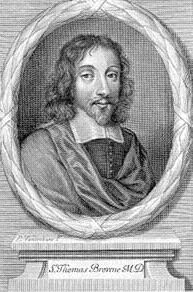
Thomas Browne
Sir Thomas Browne was an English author of varied works which reveal his wide learning in diverse fields including medicine, religion, science and the esoteric....
refuting the common errors and superstitions of his age. It first appeared in 1646 and went through five subsequent editions, the last revision occurring in 1672. The work includes evidence of Browne's adherence to the Baconian
Francis Bacon
Francis Bacon, 1st Viscount St Albans, KC was an English philosopher, statesman, scientist, lawyer, jurist, author and pioneer of the scientific method. He served both as Attorney General and Lord Chancellor of England...
method of empirical observation of nature, and was in the vanguard of work-in-progress scientific journalism in the 17th century scientific revolution
Scientific revolution
The Scientific Revolution is an era associated primarily with the 16th and 17th centuries during which new ideas and knowledge in physics, astronomy, biology, medicine and chemistry transformed medieval and ancient views of nature and laid the foundations for modern science...
, though he refers to his work as an encyclopaedia
Encyclopedia
An encyclopedia is a type of reference work, a compendium holding a summary of information from either all branches of knowledge or a particular branch of knowledge....
. Throughout its pages frequent examples of Browne's subtle humour can also be found.
Browne's three determinants for obtaining truth were firstly, the authority of past authors, secondly, the act of reason and lastly, empirical experience. Each of these determinants are employed upon subjects ranging from the cosmological to common folklore. Subjects covered in Pseudodoxia are arranged in the time-honoured Renaissance
Renaissance
The Renaissance was a cultural movement that spanned roughly the 14th to the 17th century, beginning in Italy in the Late Middle Ages and later spreading to the rest of Europe. The term is also used more loosely to refer to the historical era, but since the changes of the Renaissance were not...
scale of creation, the learned doctor assaying to dispel errors and fallacies concerning the mineral
Mineral
A mineral is a naturally occurring solid chemical substance formed through biogeochemical processes, having characteristic chemical composition, highly ordered atomic structure, and specific physical properties. By comparison, a rock is an aggregate of minerals and/or mineraloids and does not...
, vegetable
Vegetable
The noun vegetable usually means an edible plant or part of a plant other than a sweet fruit or seed. This typically means the leaf, stem, or root of a plant....
and animal
Animal
Animals are a major group of multicellular, eukaryotic organisms of the kingdom Animalia or Metazoa. Their body plan eventually becomes fixed as they develop, although some undergo a process of metamorphosis later on in their life. Most animals are motile, meaning they can move spontaneously and...
kingdoms before moving to errors pictorial, to those of man, geography
Geography
Geography is the science that studies the lands, features, inhabitants, and phenomena of Earth. A literal translation would be "to describe or write about the Earth". The first person to use the word "geography" was Eratosthenes...
, astronomy
Astronomy
Astronomy is a natural science that deals with the study of celestial objects and phenomena that originate outside the atmosphere of Earth...
and finally of the cosmos
Cosmos
In the general sense, a cosmos is an orderly or harmonious system. It originates from the Greek term κόσμος , meaning "order" or "ornament" and is antithetical to the concept of chaos. Today, the word is generally used as a synonym of the word Universe . The word cosmos originates from the same root...
.
Popular science
Pseudodoxia Epidemica was a valuable source of information which found itself upon the shelves of many homes in seventeenth century England. Being in the vanguard of the scientific writing it paved the way for much subsequent popular scientific journalism. Its science includes many examples of Browne's 'at-first-hand' empiricism as well as early examples of the formulation of scientific hypothesis.The second of Pseudodoxia Epidemicas seven books entitled Tenets concerning Mineral and Vegetable Bodies includes Browne's experiments with static electricity
Static electricity
Static electricity refers to the build-up of electric charge on the surface of objects. The static charges remain on an object until they either bleed off to ground or are quickly neutralized by a discharge. Static electricity can be contrasted with current electricity, which can be delivered...
and magnetism
Magnetism
Magnetism is a property of materials that respond at an atomic or subatomic level to an applied magnetic field. Ferromagnetism is the strongest and most familiar type of magnetism. It is responsible for the behavior of permanent magnets, which produce their own persistent magnetic fields, as well...
— the word electricity being one of many neologisms including medical
Medicine
Medicine is the science and art of healing. It encompasses a variety of health care practices evolved to maintain and restore health by the prevention and treatment of illness....
, pathology
Pathology
Pathology is the precise study and diagnosis of disease. The word pathology is from Ancient Greek , pathos, "feeling, suffering"; and , -logia, "the study of". Pathologization, to pathologize, refers to the process of defining a condition or behavior as pathological, e.g. pathological gambling....
, hallucination
Hallucination
A hallucination, in the broadest sense of the word, is a perception in the absence of a stimulus. In a stricter sense, hallucinations are defined as perceptions in a conscious and awake state in the absence of external stimuli which have qualities of real perception, in that they are vivid,...
, literary
Literature
Literature is the art of written works, and is not bound to published sources...
, and computer
Computer
A computer is a programmable machine designed to sequentially and automatically carry out a sequence of arithmetic or logical operations. The particular sequence of operations can be changed readily, allowing the computer to solve more than one kind of problem...
, which Browne's vigorous inventiveness coined into the vocabulary of the early scientific revolution.
Editions
The popularity of Pseudodoxia in its day is confirmed by the fact that it went through no fewer than six editions; the first edition appearing upon the eve of the English Civil WarEnglish Civil War
The English Civil War was a series of armed conflicts and political machinations between Parliamentarians and Royalists...
, during the reign of Charles I
Charles I of England
Charles I was King of England, King of Scotland, and King of Ireland from 27 March 1625 until his execution in 1649. Charles engaged in a struggle for power with the Parliament of England, attempting to obtain royal revenue whilst Parliament sought to curb his Royal prerogative which Charles...
in 1646. No fewer than a further five editions followed; four times during the Commonwealth era of Oliver Cromwell
Oliver Cromwell
Oliver Cromwell was an English military and political leader who overthrew the English monarchy and temporarily turned England into a republican Commonwealth, and served as Lord Protector of England, Scotland, and Ireland....
in 1650, twice in 1658, and in 1659. One final edition appeared in (1672) during the reign of King Charles II
Charles II of England
Charles II was monarch of the three kingdoms of England, Scotland, and Ireland.Charles II's father, King Charles I, was executed at Whitehall on 30 January 1649, at the climax of the English Civil War...
when the English scientific revolution was well in progress, culminating in Isaac Newton
Isaac Newton
Sir Isaac Newton PRS was an English physicist, mathematician, astronomer, natural philosopher, alchemist, and theologian, who has been "considered by many to be the greatest and most influential scientist who ever lived."...
's discoveries. Pseudodoxia was subsequently translated and published in French, Dutch, Latin and German throughout the late seventeenth and early eighteenth centuries.
Today there is considerable confusion as how best to define Sir Thomas Browne's scientific methodology, described by E.J. Merton thus:
E.S. Merton summarised the ambiguities of Browne's scientific view-point thus
"Here is Browne's scientific point of view in a nutshell. One lobe of his brain wants to study facts and test hypotheses on the basis of them, the other is fascinated by mystic symbols and analogies."
The author Robert Sencourt succinctly defined Browne's relationship to scientific enquiry as "an instance of a scientific reason, lit up by mysticism, in the Church of England."
The 1651 book Arcana Microcosmi, by Alexander Rosse, attempted to rebut many of Browne's claims.
Source
A detailed edition of Pseudodoxia Epidemica in 2 volumes was published by Oxford University PressOxford University Press
Oxford University Press is the largest university press in the world. It is a department of the University of Oxford and is governed by a group of 15 academics appointed by the Vice-Chancellor known as the Delegates of the Press. They are headed by the Secretary to the Delegates, who serves as...
in 1986, edited and comprehensively annotated by Robin Robbins.
See also
- Browne's Index to Pseudodoxia Epidemica: entitled An Alphabetical Table, records the wide spectrum of subjects covered
- Francis BaconFrancis BaconFrancis Bacon, 1st Viscount St Albans, KC was an English philosopher, statesman, scientist, lawyer, jurist, author and pioneer of the scientific method. He served both as Attorney General and Lord Chancellor of England...
- Naturalis HistoriaNaturalis HistoriaThe Natural History is an encyclopedia published circa AD 77–79 by Pliny the Elder. It is one of the largest single works to have survived from the Roman Empire to the modern day and purports to cover the entire field of ancient knowledge, based on the best authorities available to Pliny...
- Popular sciencePopular sciencePopular science, sometimes called literature of science, is interpretation of science intended for a general audience. While science journalism focuses on recent scientific developments, popular science is broad-ranging, often written by scientists as well as journalists, and is presented in many...