

Mystery play

Encyclopedia
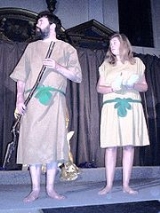
Mystery plays and miracle plays (which are two different things) are among the earliest formally developed plays
in medieval Europe
. Medieval mystery plays focused on the representation of Bible
stories in churches as tableaux
with accompanying antiphon
al song. They developed from the 10th to the 16th century, reaching the height of their popularity in the 15th century before being rendered obsolete by the rise of professional theatre. The name derives from mystery
used in its sense of miracle
, but an occasionally quoted derivation is from misterium, meaning craft
, a play performed by the craft guilds.
, verbal embellishments of liturgical texts, and slowly became more elaborate. As these liturgical dramas increased in popularity, vernacular forms emerged, as travelling companies of actors and theatrical productions organized by local communities became more common in the later Middle Ages.
The Quem Quaeritis?
is the best known early form of the dramas, a dramatised liturgical dialogue between the angel at the tomb of Christ and the women who are seeking his body. These primitive forms were later elaborated with dialogue and dramatic action. Eventually the dramas moved from church to the exterior - the churchyard and the public marketplace. These early performances were given in Latin, and were preceded by a vernacular prologue spoken by a herald who gave a synopsis of the events.
In 1210, suspicious of the growing popularity of miracle plays, Pope Innocent III
issued a papal edict
forbidding clergy from acting on a public stage. This had the effect of transferring the organization of the dramas to town guilds, after which several changes followed. Vernacular texts replaced Latin, and non-Biblical passages were added along with comic scenes, for example in the Secunda Pastorum
of the Wakefield Cycle. Acting and characterization became more elaborate.
These vernacular religious performances were, in some of the larger cities in England such as York
, performed and produced by guild
s, with each guild taking responsibility for a particular piece of scriptural history. From the guild control originated the term mystery play or mysteries, from the Latin misterium meaning "occupation" (i.e. that of the guilds). The genre was again banned, following the Reformation
and the establishment of the Church of England
in 1534.
The mystery play developed, in some places, into a series of plays dealing with all the major events in the Christian calendar, from the Creation to the Day of Judgment. By the end of the 15th century, the practice of acting these plays in cycles on festival days was established in several parts of Europe. Sometimes, each play was performed on a decorated cart called a pageant that moved about the city to allow different crowds to watch each play. The entire cycle could take up to twenty hours to perform and could be spread over a number of days. Taken as a whole, these are referred to as Corpus Christi cycles.
The plays were performed by a combination of professionals and amateurs and were written in highly elaborate stanza forms; they were often marked by the extravagance of the sets and 'special effects', but could also be stark and intimate. The variety of theatrical and poetic styles, even in a single cycle of plays, could be remarkable.
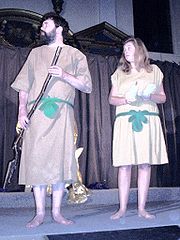 There are four complete or nearly complete extant English biblical collections of plays; we may no longer call all of them "cycles." The most complete is the York cycle
of forty-eight pageants; there are also the Towneley plays of thirty-two pageants, once thought to have been a true 'cycle' of plays acted at Wakefield
; the Ludus Coventriae (also called the N Town plays" or Hegge cycle), now generally agreed to be a redacted compilation of at least three older, unrelated plays, and the Chester cycle
of twenty-four pageants, now generally agreed to be an Elizabethan reconstruction of older medieval traditions. Also extant are two pageants from a New Testament cycle acted at Coventry
and one pageant each from Norwich and Newcastle-on-Tyne. Additionally, a fifteenth-century play of the life of Mary Magdalene
, The Brome Abraham and Isaac and a sixteenth-century play of the Conversion of Saint Paul
exist, all hailing from East Anglia
. Besides the Middle English
drama, there are three surviving plays in Cornish
known as the Ordinalia
, and several cyclical plays survive from continental Europe.
These biblical plays differ widely in content. Most contain episodes such as the Fall of Lucifer, the Creation and Fall of Man, Cain and Abel, Noah and the Flood, Abraham and Isaac, the Nativity, the Raising of Lazarus, the Passion, and the Resurrection. Other pageants included the story of Moses, the Procession of the Prophets, Christ's Baptism, the Temptation in the Wilderness, and the Assumption and Coronation of the Virgin. In given cycles, the plays came to be sponsored by the newly emerging Medieval craft guilds. The York mercers, for example, sponsored the Doomsday pageant. The guild associations are not, however, to be understood as the method of production for all towns. While the Chester pageants are associated with guilds, there is no indication that the N-Town plays are either associated with guilds or performed on pageant wagon
s. Perhaps the most famous of the mystery plays, at least to modern readers and audiences, are those of Wakefield. Unfortunately, we cannot know whether the plays of the Towneley manuscript are actually the plays performed at Wakefield but a reference in the Second Shepherds' Play to Horbery
Shrogys (http://etext.lib.virginia.edu/etcbin/toccer-old?id=AnoTown&images=images/modeng&data=/lv1/Archive/mideng-parsed&tag=public&part=13&division=div line 454) is strongly suggestive. In "The London Burial Grounds" by Mrs Basil Holmes (1897), the author claims that the Holy Priory Church, next to St Katherine Cree
on Leadenhall Street, London was the location of miracle plays from the tenth to the sixteenth century. Edmund Bonner
, Bishop of London (c 1500 - 1569) stopped this in 1542.
The most famous plays of the Towneley collection are attributed to the Wakefield Master, an anonymous playwright who wrote in the fifteenth century. Early scholars suggested that a man by the name of Gilbert Pilkington was the author, but this idea has been disproved by Craig and others. The epithet "Wakefield Master" was first applied to this individual by the literary historian Gayley. The Wakefield Master gets his name from the geographic location where he lived, the market-town of Wakefield in Yorkshire. He may have been a highly educated cleric there, or possibly a friar from a nearby monastery at Woodkirk, four miles north of Wakefield. It was once thought that this anonymous author wrote a series of 32 plays (each averaging about 384 lines) called the Towneley Cycle. The Master's contributions to this collection are still much debated, and some scholars believe he may have written fewer than ten of them. These works appear in a single manuscript, which was kept for a number of years in Towneley Hall
, Burnley
, home of the Towneley family
; the manuscript is currently found in the Huntington Library of California. It shows signs of Protestant editing — references to the Pope and the sacraments are crossed out, for instance. Likewise, twelve manuscript leaves were ripped out between the two final plays because of Catholic references. This evidence strongly suggests the play was still being read and performed as late as 1520, perhaps as late in Renaissance as the final years of King Henry VIII's reign.
The best known pageant in the Towneley manuscript is The Second Shepherds' Pageant, a burlesque of the Nativity featuring Mak the sheep stealer and his wife Gill, which more or less explicitly compares a stolen lamb to the Saviour of mankind. The Harrowing of Hell
, derived from the apocryphal Acts of Pilate
, was a popular part of the York and Wakefield cycles.
The dramas of the Elizabethan and Jacobean
periods were developed out of mystery plays.
found in the library of the Toledo Cathedral. The Auto de los Reyes Magos belongs to the Christmas cycle. It is a play of Biblical Magi
, the three wise men from the East who following a star visited the baby Jesus in Bethlehem
.
The Misteri d'Elx (in English, the Elx Mystery Play or Mystery Play of Elx
) is a liturgical drama dating from the Middle Ages, which is enacted and celebrated in the Basilica de Santa María in the city of Elx
on the 14 and 15 August of each year. In 2001, UNESCO declared it one of the Masterpieces of the Oral and Intangible Heritage of Humanity. It commemorates the Assumption of Mary.
s, particularly St. Nicholas or St. Mary, into the lives of ordinary people, rather than biblical events; however both of these terms are more commonly used by modern scholars than they were by medieval people, who used a wide variety of terminology to refer to their dramatic performances. Robert Chambers, writing in 19th century notes that "especially in England, miracle [came] to stand for religious play in general".
and Chester
in 1951 as part of the Festival of Britain
. The Mysteries
was a re-working of the Wakefield Cycle and others produced at the National Theatre
in 1977. The Lichfield
Mysteries were revived in 1994. More recently, the N-Town cycle of touring plays have been revived as the Lincoln mystery plays
. In 2001, an African version of the Chester plays was performed in London, under the direction of Mark Dornford-May
and musical direction of Charles Hazlewood.
In 2004, two mystery plays—one focusing on the Creation and the other on the Passion—were performed at Canterbury Cathedral, with actor Edward Woodward
in the role of God. The large cast also included Daniel MacPherson
, Thomas James Longley
and Joseph McManners
. The performances commissioned a further supporting cast of over 100 local people and were produced by Kevin Wood.
Play (theatre)
A play is a form of literature written by a playwright, usually consisting of scripted dialogue between characters, intended for theatrical performance rather than just reading. There are rare dramatists, notably George Bernard Shaw, who have had little preference whether their plays were performed...
in medieval Europe
Europe
Europe is, by convention, one of the world's seven continents. Comprising the westernmost peninsula of Eurasia, Europe is generally 'divided' from Asia to its east by the watershed divides of the Ural and Caucasus Mountains, the Ural River, the Caspian and Black Seas, and the waterways connecting...
. Medieval mystery plays focused on the representation of Bible
Bible
The Bible refers to any one of the collections of the primary religious texts of Judaism and Christianity. There is no common version of the Bible, as the individual books , their contents and their order vary among denominations...
stories in churches as tableaux
Tableau vivant
Tableau vivant is French for "living picture." The term describes a striking group of suitably costumed actors or artist's models, carefully posed and often theatrically lit. Throughout the duration of the display, the people shown do not speak or move...
with accompanying antiphon
Antiphon
An antiphon in Christian music and ritual, is a "responsory" by a choir or congregation, usually in Gregorian chant, to a psalm or other text in a religious service or musical work....
al song. They developed from the 10th to the 16th century, reaching the height of their popularity in the 15th century before being rendered obsolete by the rise of professional theatre. The name derives from mystery
Sacred Mysteries
The term sacred mysteries generally denotes the area of supernatural phenomena associated with a divinity or a religious ideology.-Pre-Christian religious mysteries:...
used in its sense of miracle
Miracle
A miracle often denotes an event attributed to divine intervention. Alternatively, it may be an event attributed to a miracle worker, saint, or religious leader. A miracle is sometimes thought of as a perceptible interruption of the laws of nature. Others suggest that a god may work with the laws...
, but an occasionally quoted derivation is from misterium, meaning craft
Craft
A craft is a branch of a profession that requires some particular kind of skilled work. In historical sense, particularly as pertinent to the Medieval history and earlier, the term is usually applied towards people occupied in small-scale production of goods.-Development from the past until...
, a play performed by the craft guilds.
Origins
The plays originated as simple tropesTrope (religion)
In Judaism, trope is the musical pronunciation associated with the cantillation marks used for the ritual chanting of the Torah.-For Hebrew:...
, verbal embellishments of liturgical texts, and slowly became more elaborate. As these liturgical dramas increased in popularity, vernacular forms emerged, as travelling companies of actors and theatrical productions organized by local communities became more common in the later Middle Ages.
The Quem Quaeritis?
Quem Quaeritis?
Quem Quaeritis? refers to four lines of the medieval Easter liturgy that later formed the kernel of the large body of medieval liturgical drama, which is also known as Visitatio sepulchri...
is the best known early form of the dramas, a dramatised liturgical dialogue between the angel at the tomb of Christ and the women who are seeking his body. These primitive forms were later elaborated with dialogue and dramatic action. Eventually the dramas moved from church to the exterior - the churchyard and the public marketplace. These early performances were given in Latin, and were preceded by a vernacular prologue spoken by a herald who gave a synopsis of the events.
In 1210, suspicious of the growing popularity of miracle plays, Pope Innocent III
Pope Innocent III
Pope Innocent III was Pope from 8 January 1198 until his death. His birth name was Lotario dei Conti di Segni, sometimes anglicised to Lothar of Segni....
issued a papal edict
Papal bull
A Papal bull is a particular type of letters patent or charter issued by a Pope of the Catholic Church. It is named after the bulla that was appended to the end in order to authenticate it....
forbidding clergy from acting on a public stage. This had the effect of transferring the organization of the dramas to town guilds, after which several changes followed. Vernacular texts replaced Latin, and non-Biblical passages were added along with comic scenes, for example in the Secunda Pastorum
The Second Shepherds' Play
The Second Shepherds' Play is a famous medieval mystery play which is contained in the manuscript HM1, the unique manuscript of the Wakefield Cycle. It gained its name because in the manuscript it immediately follows another nativity play involving the shepherds...
of the Wakefield Cycle. Acting and characterization became more elaborate.
These vernacular religious performances were, in some of the larger cities in England such as York
York
York is a walled city, situated at the confluence of the Rivers Ouse and Foss in North Yorkshire, England. The city has a rich heritage and has provided the backdrop to major political events throughout much of its two millennia of existence...
, performed and produced by guild
Guild
A guild is an association of craftsmen in a particular trade. The earliest types of guild were formed as confraternities of workers. They were organized in a manner something between a trade union, a cartel, and a secret society...
s, with each guild taking responsibility for a particular piece of scriptural history. From the guild control originated the term mystery play or mysteries, from the Latin misterium meaning "occupation" (i.e. that of the guilds). The genre was again banned, following the Reformation
English Reformation
The English Reformation was the series of events in 16th-century England by which the Church of England broke away from the authority of the Pope and the Roman Catholic Church....
and the establishment of the Church of England
Church of England
The Church of England is the officially established Christian church in England and the Mother Church of the worldwide Anglican Communion. The church considers itself within the tradition of Western Christianity and dates its formal establishment principally to the mission to England by St...
in 1534.
The mystery play developed, in some places, into a series of plays dealing with all the major events in the Christian calendar, from the Creation to the Day of Judgment. By the end of the 15th century, the practice of acting these plays in cycles on festival days was established in several parts of Europe. Sometimes, each play was performed on a decorated cart called a pageant that moved about the city to allow different crowds to watch each play. The entire cycle could take up to twenty hours to perform and could be spread over a number of days. Taken as a whole, these are referred to as Corpus Christi cycles.
The plays were performed by a combination of professionals and amateurs and were written in highly elaborate stanza forms; they were often marked by the extravagance of the sets and 'special effects', but could also be stark and intimate. The variety of theatrical and poetic styles, even in a single cycle of plays, could be remarkable.
English mystery plays
York Mystery Plays
The York Mystery Plays, more properly called the York Corpus Christi Plays, are a Middle English cycle of forty-eight mystery plays, or pageants, which cover sacred history from the creation to the Last Judgement. These were traditionally presented on the feast day of Corpus Christi...
of forty-eight pageants; there are also the Towneley plays of thirty-two pageants, once thought to have been a true 'cycle' of plays acted at Wakefield
Wakefield
Wakefield is the main settlement and administrative centre of the City of Wakefield, a metropolitan district of West Yorkshire, England. Located by the River Calder on the eastern edge of the Pennines, the urban area is and had a population of 76,886 in 2001....
; the Ludus Coventriae (also called the N Town plays" or Hegge cycle), now generally agreed to be a redacted compilation of at least three older, unrelated plays, and the Chester cycle
Chester Mystery Plays
The Chester Mystery Plays is a cycle of mystery plays dating back to at least the early part of the 15th century.A record of 1422 shows that the plays took place at the feast of Corpus Christi and this appears to have continued until 1521. Plays on Corpus Christi Day in 1475 included 'The trial...
of twenty-four pageants, now generally agreed to be an Elizabethan reconstruction of older medieval traditions. Also extant are two pageants from a New Testament cycle acted at Coventry
Coventry Mystery Plays
The Coventry Mystery Plays, or Coventry Corpus Christi Pageants, are a cycle of medieval mystery plays from Coventry, West Midlands, England, and are perhaps best known as the source of the "Coventry Carol". Two plays from the original cycle are extant having been copied from the now lost original...
and one pageant each from Norwich and Newcastle-on-Tyne. Additionally, a fifteenth-century play of the life of Mary Magdalene
Mary Magdalene
Mary Magdalene was one of Jesus' most celebrated disciples, and the most important woman disciple in the movement of Jesus. Jesus cleansed her of "seven demons", conventionally interpreted as referring to complex illnesses...
, The Brome Abraham and Isaac and a sixteenth-century play of the Conversion of Saint Paul
Paul of Tarsus
Paul the Apostle , also known as Saul of Tarsus, is described in the Christian New Testament as one of the most influential early Christian missionaries, with the writings ascribed to him by the church forming a considerable portion of the New Testament...
exist, all hailing from East Anglia
East Anglia
East Anglia is a traditional name for a region of eastern England, named after an ancient Anglo-Saxon kingdom, the Kingdom of the East Angles. The Angles took their name from their homeland Angeln, in northern Germany. East Anglia initially consisted of Norfolk and Suffolk, but upon the marriage of...
. Besides the Middle English
Middle English
Middle English is the stage in the history of the English language during the High and Late Middle Ages, or roughly during the four centuries between the late 11th and the late 15th century....
drama, there are three surviving plays in Cornish
Cornish language
Cornish is a Brythonic Celtic language and a recognised minority language of the United Kingdom. Along with Welsh and Breton, it is directly descended from the ancient British language spoken throughout much of Britain before the English language came to dominate...
known as the Ordinalia
Ordinalia
The Ordinalia are three medieval mystery plays written in Cornish from the late fourteenth century. The three plays are Origo Mundi, , Passio Christi and Resurrexio Domini...
, and several cyclical plays survive from continental Europe.
These biblical plays differ widely in content. Most contain episodes such as the Fall of Lucifer, the Creation and Fall of Man, Cain and Abel, Noah and the Flood, Abraham and Isaac, the Nativity, the Raising of Lazarus, the Passion, and the Resurrection. Other pageants included the story of Moses, the Procession of the Prophets, Christ's Baptism, the Temptation in the Wilderness, and the Assumption and Coronation of the Virgin. In given cycles, the plays came to be sponsored by the newly emerging Medieval craft guilds. The York mercers, for example, sponsored the Doomsday pageant. The guild associations are not, however, to be understood as the method of production for all towns. While the Chester pageants are associated with guilds, there is no indication that the N-Town plays are either associated with guilds or performed on pageant wagon
Pageant wagon
A pageant wagon is a movable stage or cart used to accommodate the mystery and miracle play cycles of the 10th through the 16th Century. These religious plays were developed from biblical texts and they reached the height of their popularity in the 15th century before being rendered obsolete by the...
s. Perhaps the most famous of the mystery plays, at least to modern readers and audiences, are those of Wakefield. Unfortunately, we cannot know whether the plays of the Towneley manuscript are actually the plays performed at Wakefield but a reference in the Second Shepherds' Play to Horbery
Horbury
-Demography:In 2008 Horbury had a largely white population compared with Yorkshire and the Humber.-Population change:The population of Horbury in 2001 was 10,002-Transport:...
Shrogys (http://etext.lib.virginia.edu/etcbin/toccer-old?id=AnoTown&images=images/modeng&data=/lv1/Archive/mideng-parsed&tag=public&part=13&division=div line 454) is strongly suggestive. In "The London Burial Grounds" by Mrs Basil Holmes (1897), the author claims that the Holy Priory Church, next to St Katherine Cree
St Katherine Cree
St Katharine Cree is a Church of England church in the Aldgate ward of the City of London, located on Leadenhall Street near Leadenhall Market.-History:...
on Leadenhall Street, London was the location of miracle plays from the tenth to the sixteenth century. Edmund Bonner
Edmund Bonner
Edmund Bonner , Bishop of London, was an English bishop. Initially an instrumental figure in the schism of Henry VIII from Rome, he was antagonized by the Protestant reforms introduced by Somerset and reconciled himself to Roman Catholicism...
, Bishop of London (c 1500 - 1569) stopped this in 1542.
The most famous plays of the Towneley collection are attributed to the Wakefield Master, an anonymous playwright who wrote in the fifteenth century. Early scholars suggested that a man by the name of Gilbert Pilkington was the author, but this idea has been disproved by Craig and others. The epithet "Wakefield Master" was first applied to this individual by the literary historian Gayley. The Wakefield Master gets his name from the geographic location where he lived, the market-town of Wakefield in Yorkshire. He may have been a highly educated cleric there, or possibly a friar from a nearby monastery at Woodkirk, four miles north of Wakefield. It was once thought that this anonymous author wrote a series of 32 plays (each averaging about 384 lines) called the Towneley Cycle. The Master's contributions to this collection are still much debated, and some scholars believe he may have written fewer than ten of them. These works appear in a single manuscript, which was kept for a number of years in Towneley Hall
Towneley Park
Towneley Park comprises Towneley Hall, a large country house, and its surrounding estate on the outskirts of Burnley, Lancashire, England....
, Burnley
Burnley
Burnley is a market town in the Burnley borough of Lancashire, England, with a population of around 73,500. It lies north of Manchester and east of Preston, at the confluence of the River Calder and River Brun....
, home of the Towneley family
Towneley (family)
The Towneley or Townley family are an English recusant family whose ancestry can be traced back to Norman England. They take their name from Towneley Hall in Burnley, Lancashire, which was the family seat until its sale in 1901.-The Towneleys of Towneley Hall:...
; the manuscript is currently found in the Huntington Library of California. It shows signs of Protestant editing — references to the Pope and the sacraments are crossed out, for instance. Likewise, twelve manuscript leaves were ripped out between the two final plays because of Catholic references. This evidence strongly suggests the play was still being read and performed as late as 1520, perhaps as late in Renaissance as the final years of King Henry VIII's reign.
The best known pageant in the Towneley manuscript is The Second Shepherds' Pageant, a burlesque of the Nativity featuring Mak the sheep stealer and his wife Gill, which more or less explicitly compares a stolen lamb to the Saviour of mankind. The Harrowing of Hell
Harrowing of Hell
The Harrowing of Hell is a doctrine in Christian theology referenced in the Apostles' Creed and the Athanasian Creed that states that Jesus Christ "descended into Hell"...
, derived from the apocryphal Acts of Pilate
Acts of Pilate
The Acts of Pilate , also called the Gospel of Pilate, is a book of New Testament apocrypha. The dates of its accreted sections are uncertain, but scholars agree in assigning the resulting work to the middle of the fourth century...
, was a popular part of the York and Wakefield cycles.
The dramas of the Elizabethan and Jacobean
Jacobean era
The Jacobean era refers to the period in English and Scottish history that coincides with the reign of King James VI of Scotland, who also inherited the crown of England in 1603 as James I...
periods were developed out of mystery plays.
Spanish mystery plays
The oldest liturgical drama (12th century) written already in old Spanish language was a codexCodex
A codex is a book in the format used for modern books, with multiple quires or gatherings typically bound together and given a cover.Developed by the Romans from wooden writing tablets, its gradual replacement...
found in the library of the Toledo Cathedral. The Auto de los Reyes Magos belongs to the Christmas cycle. It is a play of Biblical Magi
Biblical Magi
The Magi Greek: μάγοι, magoi), also referred to as the Wise Men, Kings, Astrologers, or Kings from the East, were a group of distinguished foreigners who were said to have visited Jesus after his birth, bearing gifts of gold, frankincense and myrrh...
, the three wise men from the East who following a star visited the baby Jesus in Bethlehem
Bethlehem
Bethlehem is a Palestinian city in the central West Bank of the Jordan River, near Israel and approximately south of Jerusalem, with a population of about 30,000 people. It is the capital of the Bethlehem Governorate of the Palestinian National Authority and a hub of Palestinian culture and tourism...
.
The Misteri d'Elx (in English, the Elx Mystery Play or Mystery Play of Elx
Mystery Play of Elx
The Misteri d'Elx is a liturgical drama dating from the Middle Ages, which is enacted and celebrated in the Basilica de Santa María in the city of Elx/Elche on the 14 and 15th of August of each year. In 2001, UNESCO declared it one of the Masterpieces of the Oral and Intangible Heritage of Humanity...
) is a liturgical drama dating from the Middle Ages, which is enacted and celebrated in the Basilica de Santa María in the city of Elx
Elx
Elche or Elx is a city located in the comarca of Baix Vinalopó, in the Alicante province which, in turn, is a part of the Valencian Community, Spain...
on the 14 and 15 August of each year. In 2001, UNESCO declared it one of the Masterpieces of the Oral and Intangible Heritage of Humanity. It commemorates the Assumption of Mary.
Miracle play
Miracle plays, or Saint's plays, are now distinguished from mystery plays as they specifically re-enacted miraculous interventions by the saintSaint
A saint is a holy person. In various religions, saints are people who are believed to have exceptional holiness.In Christian usage, "saint" refers to any believer who is "in Christ", and in whom Christ dwells, whether in heaven or in earth...
s, particularly St. Nicholas or St. Mary, into the lives of ordinary people, rather than biblical events; however both of these terms are more commonly used by modern scholars than they were by medieval people, who used a wide variety of terminology to refer to their dramatic performances. Robert Chambers, writing in 19th century notes that "especially in England, miracle [came] to stand for religious play in general".
Modern revivals
The Mystery Plays were revived in both YorkYork
York is a walled city, situated at the confluence of the Rivers Ouse and Foss in North Yorkshire, England. The city has a rich heritage and has provided the backdrop to major political events throughout much of its two millennia of existence...
and Chester
Chester
Chester is a city in Cheshire, England. Lying on the River Dee, close to the border with Wales, it is home to 77,040 inhabitants, and is the largest and most populous settlement of the wider unitary authority area of Cheshire West and Chester, which had a population of 328,100 according to the...
in 1951 as part of the Festival of Britain
Festival of Britain
The Festival of Britain was a national exhibition in Britain in the summer of 1951. It was organised by the government to give Britons a feeling of recovery in the aftermath of war and to promote good quality design in the rebuilding of British towns and cities. The Festival's centrepiece was in...
. The Mysteries
The Mysteries (play)
The Mysteries is a version of the medieval English mystery plays presented at London's National Theatre in 1977. The cycle of three plays tells the story of the Bible from the creation to the last judgement....
was a re-working of the Wakefield Cycle and others produced at the National Theatre
Royal National Theatre
The Royal National Theatre in London is one of the United Kingdom's two most prominent publicly funded theatre companies, alongside the Royal Shakespeare Company...
in 1977. The Lichfield
Lichfield
Lichfield is a cathedral city, civil parish and district in Staffordshire, England. One of eight civil parishes with city status in England, Lichfield is situated roughly north of Birmingham...
Mysteries were revived in 1994. More recently, the N-Town cycle of touring plays have been revived as the Lincoln mystery plays
Lincoln mystery plays
The Lincoln Mystery Plays are modern performances of medieval mystery plays and other productions in Lincoln Cathedral and the surrounding area.- Background :...
. In 2001, an African version of the Chester plays was performed in London, under the direction of Mark Dornford-May
Mark Dornford-May
Mark Dornford-May is a British-born South African theatre and film director.-Early life:Mark Dornford-May was born on his Grandfathers farm near Eastoft in Yorkshire. His paternal Grandfather was a miner on the Yorkshire coalfields...
and musical direction of Charles Hazlewood.
In 2004, two mystery plays—one focusing on the Creation and the other on the Passion—were performed at Canterbury Cathedral, with actor Edward Woodward
Edward Woodward
Edward Albert Arthur Woodward, OBE was an English stage and screen actor and singer. After graduating from the Royal Academy of Dramatic Art , Woodward began his career on stage, and throughout his career he appeared in productions in both the West End in London and on Broadway in New York...
in the role of God. The large cast also included Daniel MacPherson
Daniel MacPherson
Daniel Donald MacPherson is an Australian actor and television presenter, best known for his roles as; Joel Samuels on Neighbours, PC Cameron Tait on British police drama The Bill, and Detective Senior Constable Simon Joyner in City Homicide...
, Thomas James Longley
Thomas James Longley
Thomas James Longley is a British actor and model. Hailing from the historical English city of Canterbury, he grew up performing in plays throughout the Kent and London fringe scenes...
and Joseph McManners
Joseph McManners
Joseph McManners is an English actor and singer. He lives on a non-working farm in Petham near Canterbury and recently left Simon Langton Grammar School for Boys for Tonbridge School after being awarded a drama and academic scholarship.-Singing career:McManners decided to become a singer after he...
. The performances commissioned a further supporting cast of over 100 local people and were produced by Kevin Wood.
See also
- Biblical MagiBiblical MagiThe Magi Greek: μάγοι, magoi), also referred to as the Wise Men, Kings, Astrologers, or Kings from the East, were a group of distinguished foreigners who were said to have visited Jesus after his birth, bearing gifts of gold, frankincense and myrrh...
- Chester Plays
- Easter dramaEaster DramaAn Easter Drama is a liturgical drama or religious theatrical performance in the Roman Catholic tradition, largely limited to the Middle Ages. These performances evolved from celebrations of the liturgy to incorporate later dramatic and secular elements, and came to be performed in local languages...
- Liturgical dramaLiturgical dramaLiturgical drama or religious drama, in its various Christian contexts, originates from the mass itself, and usually presents a relatively complex ritual that includes theatrical elements...
- Medieval theatreMedieval theatreMedieval theatre refers to the theatre of Europe between the fall of the Western Roman Empire in the 5th century A.D. and the beginning of the Renaissance in approximately the 15th century A.D...
- Passion playPassion playA Passion play is a dramatic presentation depicting the Passion of Jesus Christ: his trial, suffering and death. It is a traditional part of Lent in several Christian denominations, particularly in Catholic tradition....
- York Mystery PlaysYork Mystery PlaysThe York Mystery Plays, more properly called the York Corpus Christi Plays, are a Middle English cycle of forty-eight mystery plays, or pageants, which cover sacred history from the creation to the Last Judgement. These were traditionally presented on the feast day of Corpus Christi...
- a collection of forty-eight mystery plays - Wakefield Cycle - a collection of thirty-two mystery plays performed in medieval and early Renaissance England.
External links
- The Official Lincoln Mystery Plays Website
- The Official Chester Mystery Plays Website
- Records of Early English Drama (REED) at Victoria University of the University of Toronto
- The York Mystery plays
- 2002 and 2006 York Mystery Plays
- A simulator of the progress of the pageants in the York Mystery plays
- The Lichfield Mysteries
- The York Cycle as performed in Toronto in 1998
- Medieval Imaginations: literature and visual culture in the Middle Ages
- Texts:
- The Towneley (Wakefield) Cycle in Middle English. Available from Michigan or Virginia
- The York Cycle in Middle English. Available from Michigan or Virginia
- The York cycle modernised by Chester N. Scoville and Kimberley M. Yates
- The n-Town cycle modernised by Stanley J. Kahrl and Alexandra F. Johnston
- The Chester Cycle in middle English