
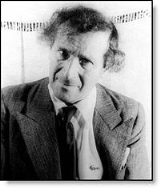
| |
Marc Chagall (; Belarusian: ????? ????????? ??????? Mojša Zaharavic Šagalau; Russian: ???? ????????? ????´? Mark Zakharovich Shagal) was a Russian-Belarusian-French painter of Jewish origin, who was born in Belarus, at that time part of the Russian Empire. He is associated with the modern movements after impressionism. Use of symbolism
Exhibitions
Chagall's work is housed in a variety of locations, including the Palais Garnier (the old opera house), the Chase Tower Plaza of downtown Chicago, the Metropolitan Opera, the Metz Cathedral, Notre-Dame de Reims, the Fraumünster abbey in Zürich, Switzerland, the Church of St. Stephan in Mainz, Germany and the Biblical Message museum in Nice, France, which Chagall helped to design.
The only church in England with a complete set of Chagall window-glass is located in the tiny village of Tudeley, in Kent, England.

Discussion
Ask a question about 'Marc Chagall'
Start a new discussion about 'Marc Chagall'
Answer questions from other users
|
Timeline
Quotations
I do not believe that scientific aims serve the cause of art well. Impressionism and Cubism are alien to me. It seem to me that art is first and foremost a condition of the soul.
If a symbol should be discovered in a painting of mine, it was not my intention. It is a result I did not seek. It is something that may be found afterwards, and which can be interepreted according to taste.

Encyclopedia
Marc Chagall (; Belarusian: ????? ????????? ??????? Mojša Zaharavic Šagalau; Russian: ???? ????????? ????´? Mark Zakharovich Shagal) was a Russian-Belarusian-French painter of Jewish origin, who was born in Belarus, at that time part of the Russian Empire. He is associated with the modern movements after impressionism.
Use of symbolism
- Cow: life par excellence: milk, meat, leather, horn, power.
- Tree: another life symbol.
- Cock (rooster): fertility, often painted together with lovers.
- Bosom (often naked): eroticism and fertility of life (Chagall loved and respected women).
- Fiddler: in Chagall's town Vitebsk the fiddler made music at crosspoints of life (birth, wedding, death).
- Herring (often also painted as a flying fish): commemorates Chagall's father working in a fish factory.
- Pendulum Clock: time, and modest life (in the time of prosecution at the Loire River the pendulum seems being driven with force into the wooden box of the pendulum clock).
- Candlestick: two candles symbolize the Shabbat or the Menorah (candlestick with seven candles) or the Hanukkah-candlestick, and therefore the life of pious Jews.
- Windows: Chagall's Love of Freedom, and Paris through the window.
- Houses of Vitebsk (often in paintings of his time in Paris): feelings for his homeland.
- Scenes of the Circus: Harmony of Man and Animal, which induces Creativity in Man.
- Crucifixion of Jesus: an unusual subject for a Jewish painter, and likely a response to the rise of anti-Semitism in Germany in the late 1930s.
- Horses: Freedom.
- The Eiffel Tower: Up in the sky, freedom.
Exhibitions
Chagall's work is housed in a variety of locations, including the Palais Garnier (the old opera house), the Chase Tower Plaza of downtown Chicago, the Metropolitan Opera, the Metz Cathedral, Notre-Dame de Reims, the Fraumünster abbey in Zürich, Switzerland, the Church of St. Stephan in Mainz, Germany and the Biblical Message museum in Nice, France, which Chagall helped to design.
The only church in England with a complete set of Chagall window-glass is located in the tiny village of Tudeley, in Kent, England. Chagall painted 12 colorful stained-glass windows in Hadassah Hospital Ein Kerem in Jerusalem, with each frame depicting a different tribe. In the United States, the Union Church of Pocantico Hills contains a set of Chagall windows commemorating the prophets, which was commissioned by John D. Rockefeller, Jr. .
At the Lincoln Center in New York City, Chagall's huge murals, The Sources of Music and The Triumph of Music, are installed in the lobby of the new Metropolitan Opera House, which opened in 1966. Also in New York, the United Nations Headquarters has a stained glass wall of his work. In 1967 the UN commemorated this artwork with a postage stamp and souvenir sheet.
In 1973, the Musée National Message Biblique Marc Chagall (Chagall Museum) opened in Nice, France. The museum in Vitebsk which bears his name was founded in 1997, in the building where his family lived on 29 Pokrovskaia street, although, prior to his death, years before the fall of the Soviet Bloc, Chagall was persona non grata in his homeland. The museum only has copies of his work.
In 2007, an exhibition of his work entitled, “Chagall of Miracles” at Il Complesso del Vittoriano was displayed and included works such as the Red Jew (1915), Above the City (1914-1918), Composition with Circles and Goat (1920), and The Fall of the Angel (1923-1947), which impacte viewers the most. Chagall was Jewish but was heavily influenced by Christian iconography, as well as a dreamer whose works touched on the harsh realities of war and persecution, and also an avant-garde artist that did not align himself with one particular movement. The works in this exhibition highlighted all these points of Chagall's personality.
Tributes Cuban singer-songwriter Silvio Rodríguez released in 1978 one of his most widely known songs, Óleo de mujer con sombrero in tribute to Chagall's work.
Jon Anderson, singer from the popular group Yes, met Chagall in the town of Opio, France as a young musician. Jon credits him as a seminal inspiration. He has recorded a piece of music in his honor, as well as the charitable Opio Foundation which he established in memory of his connection with the artist. In 1997, Pasqualina Azzarello painted A Celebration of Imagination: a Tribute to Marc Chagall, a 15'x30' public mural in Central Square in Cambridge, Massachusetts.
In 2005, musician Tori Amos recorded and released the composition "Garlands," with lyrics inspired by a series of Chagall lithographs.
In 2006, the musical group The Weepies released their album Say I Am You. One of the tracks is titled "Painting by Chagall"; part of the chorus is: "...we float like two lovers in a painting by Chagall, all around is sky and blue town, holding these flowers for a wedding gown, we live so high above the ground..." "Do Jump!", a physical theatre based in Portland, Oregon, created an acrobatic/trapeze theatre performance in tribute to Chagall.
In 2006, the fiction book "The World to Come" written by Dara Horn is about a writer who steals a painting by Marc Chagall from a local Jewish museum believing it once belonged to his parents. The book switches back and forth from the present to the 1920s, where Chagall teaches art to orphans of the Soviet pogroms. This book is a kaleidoscope of lives, eras, tragedies, and characters from Russia to Vietnam to New Jersey and follows the fictional writer's family backwards in time and Chagall's wondrous life forward. This book is based on the real event of June 7, 2001 in which the $1 million dollar "Study for Over Vitebsk" was stolen at a lively cocktail reception at the Jewish Museum in New York City. A ransom note was received on June 12, 2001 from a group calling themselves the International Committee for Art and Peace asking for peace to be established between the Israelis and Palestinians in the Middle East, a request beyond the control of the Jewish Museum. The painting was eventually discovered in February 2002 in a postal office in Topeka, Kansas and was returned to the Jewish Museum on February 21, 2002.
On July 7, 2008 Google remade their logo using his artwork, in honor of what would have been Chagall's 121st birthday. This customized version of the logo was submitted to and granted approval by the Artists Rights Society (which represents the rights of Marc Chagall in the U.S.) and the Estate of Marc Chagall. Previously, in 2002 and 2006, the Artists Rights Society clashed with Google when they asked Google to remove customised versions of its logo put up to commemorate artists Salvador Dalí and Joan Miró, alleging that portions of specific artworks under their protection had been used in the logos, and that they were used without permission.
Chagall and Popular Culture Several of Chagall's works show a violinist either floating in mid-air above a village or apparently sitting on the edge of a peaked roof. This inspired the title of the popular musical "Fiddler on the Roof."
Quotations
- "All colors are the friends of their neighbors and the lovers of their opposites."
- "Great art picks up where nature ends."
- "I am out to introduce a psychic shock into my painting, one that is always motivated by pictorial reasoning: that is to say, a fourth dimension."
- "I work in whatever medium likes me at the moment."
- "If a symbol should be discovered in a painting of mine, it was not my intention. It is a result I did not seek. It is something that may be found afterwards, and which can be interpreted according to taste."
- “If I were not a Jew…I wouldn’t have been an artist, or I would be a different artist altogether.”
- "In our life there is a single color, as on an artist's palette, which provides the meaning of life and art. It is the color of love."
- "My name is Marc, my emotional life is sensitive and my purse is empty, but they say I have talent."
- "Will God or someone give me the power to breathe my sigh into my canvases, the sigh of prayer and sadness, the prayer of salvation, of rebirth?"
- "Will there be any more?"
- "We all know that a good person can be a bad artist. But no one will ever be a genuine artist unless he is a great human being and thus also a good one."
- "Only love interests me, and I am only in contact with things I love."
Books
- Nikolaj Aaron, Marc Chagall., (Monographie) Reinbek 2003 (In German)
- Benjamin Harshav, ed. Marc Chagall on Art and Culture, Stanford, CA: Stanford University Press, 2003 ISBN 0804748306
- Aleksandr Kamensky, Marc Chagall, An Artist From Russia, Trilistnik, Moscow, 2005 (In Russian)
- Aleksandr Kamensky, Chagall: The Russian Years 1907-1922., Rizzoli, NY, 1988 (Abridged version of Marc Chagall, An Artist From Russia) ISBN 0847810801
- Jonathan Wilson, Marc Chagall, Schocken, 2007 ISBN 0805242015
- "Shishanov V.A.Vitebsk Museum of Modern Art a history of creation and a collection. 1918-1941. - Minsk: Medisont, 2007. - 144 p.
External links
|