

Philippe Leclerc de Hauteclocque

Encyclopedia
Philippe François Marie, comte de Hauteclocque, then Leclerc de Hauteclocque, by a 1945 decree that incorporated his French Resistance
alias
Jacques-Philippe Leclerc to his name, (filip ləklɛʁ də otklɔk; 22 November 1902 – 28 November 1947), was a French
general during World War II
. He became Marshal of France
posthumously, in 1952 and is known in France simply as le maréchal Leclerc.
in the department of Somme
. He was the fifth of six children of Adrien de Hauteclocque, comte de Hauteclocque (1864–1945) and Marie-Thérèse van der Cruisse de Waziers (1870–1956). Philippe was named in honour of an ancestor killed by Croats in 1635.
Leclerc came from an old line of country nobility; his direct ancestors had served in the Fifth Crusade
against Egypt, and again in the Eighth Crusade
of Saint Louis
against Tunisia in 1270. They had also fought at the Battle of Saint-Omer
in 1340 and the Battle of Fontenoy
in 1745. The family managed to survive the French Revolution
. Three members of the family served in Napoleon's
Grande Armée and a fourth, who suffered from weak health, in the supply train. The youngest of these had a son, who became a noted egyptologist
; he, in turn, had three sons. The first and third became officers in the French Army; serving during the colonial campaigns before both were killed during World War I
. The second son was Leclerc’s father; he also served in World War I, but survived the conflict and inherited the family estate in Belloy-Saint-Léonard.
, the French military academy, graduating in 1924, and entered the French Army
; he attained the rank of captain in 1937.
During World War II
, he joined the Free French forces after the fall of France
in June 1940, and made his way to London. Charles de Gaulle
upon meeting him promoted him from Captain to Major (commandant) and ordered him to French Equatorial Africa
as governor of French Cameroon from 29 August 1940 to 12 November 1940. He commanded the column which attacked the Axis
forces from Chad
, and, having marched his troops across West Africa, distinguished himself in Tunisia
.
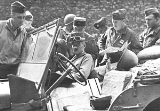
After landing in Normandy
on 1 August 1944, his 2nd Armored Division participated in the battle of the Falaise Pocket
(12 to 21 August), and went on to liberate Paris
. Allied troops were avoiding Paris, moving around it clockwise towards Germany. Leclerc and de Gaulle had to persuade Eisenhower to send troops help the Parisians, who had risen against the Germans. In The Other Side of Time, Leclerc's 2nd Armored Division had been part of Patton's Third Army, and when they entered Paris, many had not been informed of the change of command and told the Parisians that they were part of the Third Army.
In Cointet, Jean-Paul, Paris 40-44, Perrin 2001, ISBN 2-262-01516-3, Sixième Partie, chapitre 3, the author notes that the Allies originally planned to bypass Paris and places the uprising and the liberation by Leclerc in the context of the political struggle for leadership in post-liberation France, both being aimed at cementing de Gaulle's claim.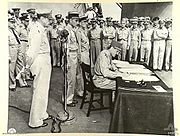
At the end of World War II in Europe
, he received command of the French Far East Expeditionary Corps
(Corps expéditionnaire français en Extrême-Orient, CEFEO), and represented France during the surrender of the Japanese Empire
on 2 September 1945; previously, in May 1945, he had been appointed a member of the Légion d'honneur
, and the same year legally changed his name
to Jacques-Philippe Leclerc de Hautecloque, incorporating his French Resistance pseudonym.
As new CEFEO commander, Leclerc set forth in October 1945 in French Indochina
, first cracking a Vietminh blockade around Saigon, then driving through the Mekong
delta and up into the highlands.
Jean Sainteny
flew to Saigon to consult Leclerc, then acting as high commissioner, who approved Sainteny's proposal to negotiate with Vietnam. Admiral d'Argenlieu bluntly denounced Leclerc: "I am amazed - yes, that is the word, amazed - that France's fine expeditionary corps in Indochina
is commanded by officers who would rather negotiate than fight".
The negotiations did not work. General Leclerc, returned to Paris from Vietnam, now warned that "anti-communism will be a useless tool unless the problem of nationalism is resolved." But his wisdom was ignored. The French Communists, after breaking with Paul Ramadier
, triggered a series of strikes and other disorders that plunged France into civil strife. Leclerc was later replaced by Jean-Étienne Valluy
.
Jacques-Philippe Leclerc de Hauteclocque died in 1947 in an airplane accident near Colomb-Béchar
, Algeria
, and was awarded the honour of Marshal of France
posthumously in 1952.
 The Leclerc
main battle tank
built by GIAT Industries (Groupement Industriel des Armements Terrestres) of France
is named after him.
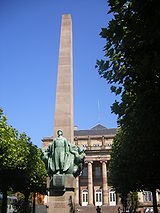
There is a monument to Leclerc at coordinates 48.82105°N 2.32494°E, in the Petit-Montrouge
quarter of the 14th arrondissement
in Paris
, between Avenue de la Porte d'Orléans and Rue de la Légion Étrangère. The monument is near the Square du Serment-de-Koufra. The "serment de Koufra" is a pledge that Leclerc made on 2 March 1941, the day after taking the Italian fort at Kufra
, Libya
: he swore that his weapons would not be laid down until the French flag flew over the cathedral of Strasbourg.
Two streets in Paris are named for Leclerc: Avenue du Général Leclerc in the 14th arrondissement and Rue du Maréchal Leclerc in the 12th arrondissement
, between the Bois de Vincennes
and the Marne River
.
French Resistance
The French Resistance is the name used to denote the collection of French resistance movements that fought against the Nazi German occupation of France and against the collaborationist Vichy régime during World War II...
alias
Pseudonym
A pseudonym is a name that a person assumes for a particular purpose and that differs from his or her original orthonym...
Jacques-Philippe Leclerc to his name, (filip ləklɛʁ də otklɔk; 22 November 1902 – 28 November 1947), was a French
France
The French Republic , The French Republic , The French Republic , (commonly known as France , is a unitary semi-presidential republic in Western Europe with several overseas territories and islands located on other continents and in the Indian, Pacific, and Atlantic oceans. Metropolitan France...
general during World War II
World War II
World War II, or the Second World War , was a global conflict lasting from 1939 to 1945, involving most of the world's nations—including all of the great powers—eventually forming two opposing military alliances: the Allies and the Axis...
. He became Marshal of France
Marshal of France
The Marshal of France is a military distinction in contemporary France, not a military rank. It is granted to generals for exceptional achievements...
posthumously, in 1952 and is known in France simply as le maréchal Leclerc.
Ancestry and family
Philippe François Marie de Hauteclocque was born on 22 November 1902 at Belloy-Saint-LéonardBelloy-Saint-Léonard
Belloy-Saint-Léonard is a commune in the Somme department in Picardie in northern France.-Geography:The commune is situated on the D157 road, some west of Amiens and south of Abbeville.-Population:-Personalities:...
in the department of Somme
Somme
Somme is a department of France, located in the north of the country and named after the Somme river. It is part of the Picardy region of France....
. He was the fifth of six children of Adrien de Hauteclocque, comte de Hauteclocque (1864–1945) and Marie-Thérèse van der Cruisse de Waziers (1870–1956). Philippe was named in honour of an ancestor killed by Croats in 1635.
Leclerc came from an old line of country nobility; his direct ancestors had served in the Fifth Crusade
Fifth Crusade
The Fifth Crusade was an attempt to reacquire Jerusalem and the rest of the Holy Land by first conquering the powerful Ayyubid state in Egypt....
against Egypt, and again in the Eighth Crusade
Eighth Crusade
The Eighth Crusade was a crusade launched by Louis IX, King of France, in 1270. The Eighth Crusade is sometimes counted as the Seventh, if the Fifth and Sixth Crusades of Frederick II are counted as a single crusade...
of Saint Louis
Louis IX of France
Louis IX , commonly Saint Louis, was King of France from 1226 until his death. He was also styled Louis II, Count of Artois from 1226 to 1237. Born at Poissy, near Paris, he was an eighth-generation descendant of Hugh Capet, and thus a member of the House of Capet, and the son of Louis VIII and...
against Tunisia in 1270. They had also fought at the Battle of Saint-Omer
Battle of Saint-Omer
The battle of Saint-Omer was a large action fought in 1340 as part of King Edward III's summer campaign against France launched from Flanders in the early stages of the Hundred Year's War. The campaign was launched in the aftermath of the battle of Sluys but proved far less successful for the...
in 1340 and the Battle of Fontenoy
Battle of Fontenoy
The Battle of Fontenoy, 11 May 1745, was a major engagement of the War of the Austrian Succession, fought between the forces of the Pragmatic Allies – comprising mainly Dutch, British, and Hanoverian troops under the nominal command of the Duke of Cumberland – and a French army under Maurice de...
in 1745. The family managed to survive the French Revolution
French Revolution
The French Revolution , sometimes distinguished as the 'Great French Revolution' , was a period of radical social and political upheaval in France and Europe. The absolute monarchy that had ruled France for centuries collapsed in three years...
. Three members of the family served in Napoleon's
Napoleon I of France
Napoleon Bonaparte was a French military and political leader during the latter stages of the French Revolution.As Napoleon I, he was Emperor of the French from 1804 to 1815...
Grande Armée and a fourth, who suffered from weak health, in the supply train. The youngest of these had a son, who became a noted egyptologist
Egyptology
Egyptology is the study of ancient Egyptian history, language, literature, religion, and art from the 5th millennium BC until the end of its native religious practices in the AD 4th century. A practitioner of the discipline is an “Egyptologist”...
; he, in turn, had three sons. The first and third became officers in the French Army; serving during the colonial campaigns before both were killed during World War I
World War I
World War I , which was predominantly called the World War or the Great War from its occurrence until 1939, and the First World War or World War I thereafter, was a major war centred in Europe that began on 28 July 1914 and lasted until 11 November 1918...
. The second son was Leclerc’s father; he also served in World War I, but survived the conflict and inherited the family estate in Belloy-Saint-Léonard.
Biography
Philippe attended the École spéciale militaire de Saint-CyrÉcole Spéciale Militaire de Saint-Cyr
The École Spéciale Militaire de Saint-Cyr is the foremost French military academy. Its official name is . It is often referred to as Saint-Cyr . Its motto is "Ils s'instruisent pour vaincre": literally "They study to vanquish" or "Training for victory"...
, the French military academy, graduating in 1924, and entered the French Army
French Army
The French Army, officially the Armée de Terre , is the land-based and largest component of the French Armed Forces.As of 2010, the army employs 123,100 regulars, 18,350 part-time reservists and 7,700 Legionnaires. All soldiers are professionals, following the suspension of conscription, voted in...
; he attained the rank of captain in 1937.
During World War II
World War II
World War II, or the Second World War , was a global conflict lasting from 1939 to 1945, involving most of the world's nations—including all of the great powers—eventually forming two opposing military alliances: the Allies and the Axis...
, he joined the Free French forces after the fall of France
Battle of France
In the Second World War, the Battle of France was the German invasion of France and the Low Countries, beginning on 10 May 1940, which ended the Phoney War. The battle consisted of two main operations. In the first, Fall Gelb , German armoured units pushed through the Ardennes, to cut off and...
in June 1940, and made his way to London. Charles de Gaulle
Charles de Gaulle
Charles André Joseph Marie de Gaulle was a French general and statesman who led the Free French Forces during World War II. He later founded the French Fifth Republic in 1958 and served as its first President from 1959 to 1969....
upon meeting him promoted him from Captain to Major (commandant) and ordered him to French Equatorial Africa
French Equatorial Africa
French Equatorial Africa or the AEF was the federation of French colonial possessions in Middle Africa, extending northwards from the Congo River to the Sahara Desert.-History:...
as governor of French Cameroon from 29 August 1940 to 12 November 1940. He commanded the column which attacked the Axis
Axis Powers
The Axis powers , also known as the Axis alliance, Axis nations, Axis countries, or just the Axis, was an alignment of great powers during the mid-20th century that fought World War II against the Allies. It began in 1936 with treaties of friendship between Germany and Italy and between Germany and...
forces from Chad
Chad
Chad , officially known as the Republic of Chad, is a landlocked country in Central Africa. It is bordered by Libya to the north, Sudan to the east, the Central African Republic to the south, Cameroon and Nigeria to the southwest, and Niger to the west...
, and, having marched his troops across West Africa, distinguished himself in Tunisia
Tunisia
Tunisia , officially the Tunisian RepublicThe long name of Tunisia in other languages used in the country is: , is the northernmost country in Africa. It is a Maghreb country and is bordered by Algeria to the west, Libya to the southeast, and the Mediterranean Sea to the north and east. Its area...
.
After landing in Normandy
Normandy
Normandy is a geographical region corresponding to the former Duchy of Normandy. It is in France.The continental territory covers 30,627 km² and forms the preponderant part of Normandy and roughly 5% of the territory of France. It is divided for administrative purposes into two régions:...
on 1 August 1944, his 2nd Armored Division participated in the battle of the Falaise Pocket
Falaise pocket
The battle of the Falaise Pocket, fought during the Second World War from 12 to 21 August 1944, was the decisive engagement of the Battle of Normandy...
(12 to 21 August), and went on to liberate Paris
Liberation of Paris
The Liberation of Paris took place during World War II from 19 August 1944 until the surrender of the occupying German garrison on August 25th. It could be regarded by some as the last battle in the Battle for Normandy, though that really ended with the crushing of the Wehrmacht forces between the...
. Allied troops were avoiding Paris, moving around it clockwise towards Germany. Leclerc and de Gaulle had to persuade Eisenhower to send troops help the Parisians, who had risen against the Germans. In The Other Side of Time, Leclerc's 2nd Armored Division had been part of Patton's Third Army, and when they entered Paris, many had not been informed of the change of command and told the Parisians that they were part of the Third Army.
In Cointet, Jean-Paul, Paris 40-44, Perrin 2001, ISBN 2-262-01516-3, Sixième Partie, chapitre 3, the author notes that the Allies originally planned to bypass Paris and places the uprising and the liberation by Leclerc in the context of the political struggle for leadership in post-liberation France, both being aimed at cementing de Gaulle's claim.
At the end of World War II in Europe
End of World War II in Europe
The final battles of the European Theatre of World War II as well as the German surrender to the Western Allies and the Soviet Union took place in late April and early May 1945.-Timeline of surrenders and deaths:...
, he received command of the French Far East Expeditionary Corps
French Far East Expeditionary Corps
The French Far East Expeditionary Corps was a colonial expeditionary force of the French Union Army sent in French Indochina in 1945 during the Pacific War.-Pacific War :...
(Corps expéditionnaire français en Extrême-Orient, CEFEO), and represented France during the surrender of the Japanese Empire
Japanese Instrument of Surrender
The Japanese Instrument of Surrender was the written agreement that enabled the Surrender of Japan, marking the end of World War II. It was signed by representatives from the Empire of Japan, the United States of America, the Republic of China, the United Kingdom, the Union of Soviet Socialist...
on 2 September 1945; previously, in May 1945, he had been appointed a member of the Légion d'honneur
Légion d'honneur
The Legion of Honour, or in full the National Order of the Legion of Honour is a French order established by Napoleon Bonaparte, First Consul of the Consulat which succeeded to the First Republic, on 19 May 1802...
, and the same year legally changed his name
Name change
Name change generally refers to a legal act allowing a person to adopt a name different than their name at birth, marriage, or adoption. The procedures and ease of a name change depend on the jurisdiction. In general, common law jurisdictions have loose limitations on name changes while civil law...
to Jacques-Philippe Leclerc de Hautecloque, incorporating his French Resistance pseudonym.
As new CEFEO commander, Leclerc set forth in October 1945 in French Indochina
French Indochina
French Indochina was part of the French colonial empire in southeast Asia. A federation of the three Vietnamese regions, Tonkin , Annam , and Cochinchina , as well as Cambodia, was formed in 1887....
, first cracking a Vietminh blockade around Saigon, then driving through the Mekong
Mekong
The Mekong is a river that runs through China, Burma, Laos, Thailand, Cambodia and Vietnam. It is the world's 10th-longest river and the 7th-longest in Asia. Its estimated length is , and it drains an area of , discharging of water annually....
delta and up into the highlands.
Jean Sainteny
Jean Sainteny
Jean Sainteny or Jean Roger was a French politician who was sent to Vietnam after the end of the Second World War in order to accept the surrender of the Japanese forces and to attempt to reincorporate Vietnam into French Indochina.- Biography :The son-in-law of the prime minister Albert Sarraut,...
flew to Saigon to consult Leclerc, then acting as high commissioner, who approved Sainteny's proposal to negotiate with Vietnam. Admiral d'Argenlieu bluntly denounced Leclerc: "I am amazed - yes, that is the word, amazed - that France's fine expeditionary corps in Indochina
Indochina
The Indochinese peninsula, is a region in Southeast Asia. It lies roughly southwest of China, and east of India. The name has its origins in the French, Indochine, as a combination of the names of "China" and "India", and was adopted when French colonizers in Vietnam began expanding their territory...
is commanded by officers who would rather negotiate than fight".
The negotiations did not work. General Leclerc, returned to Paris from Vietnam, now warned that "anti-communism will be a useless tool unless the problem of nationalism is resolved." But his wisdom was ignored. The French Communists, after breaking with Paul Ramadier
Paul Ramadier
Paul Ramadier was a prominent French politician of the Third and Fourth Republics. Mayor of Decazeville starting in 1919, he served as the first Prime Minister of the Fourth Republic in 1947. On 10 July 1940, he voted against the granting of the full powers to Marshal Philippe Pétain, who...
, triggered a series of strikes and other disorders that plunged France into civil strife. Leclerc was later replaced by Jean-Étienne Valluy
Jean-Étienne Valluy
Jean Etienne Valluy was a French general .He was born in Rive-de-Gier, Loire, on 15 May 1899 to Claude Valluy and Jeanne, Adrienne Cossanges. In 1917 he entered the military academy of Saint-Cyr...
.
Jacques-Philippe Leclerc de Hauteclocque died in 1947 in an airplane accident near Colomb-Béchar
Béchar
Béchar , formerly known as Colomb-Béchar, is a capital city of Béchar Province, Algeria. The area is controlled by Algeria, though claims have also been made on it by Morocco. In 1998 the city had a population of 134,954....
, Algeria
Algeria
Algeria , officially the People's Democratic Republic of Algeria , also formally referred to as the Democratic and Popular Republic of Algeria, is a country in the Maghreb region of Northwest Africa with Algiers as its capital.In terms of land area, it is the largest country in Africa and the Arab...
, and was awarded the honour of Marshal of France
Marshal of France
The Marshal of France is a military distinction in contemporary France, not a military rank. It is granted to generals for exceptional achievements...
posthumously in 1952.
Posthumous honours
Leclerc
The AMX-56 Leclerc, commonly known as the Leclerc, is a main battle tank built by Nexter of France. It was named in honour of General Philippe Leclerc de Hauteclocque who led the French element of the drive towards Paris while in command of the Free French 2nd Armoured Division in World War...
main battle tank
Tank
A tank is a tracked, armoured fighting vehicle designed for front-line combat which combines operational mobility, tactical offensive, and defensive capabilities...
built by GIAT Industries (Groupement Industriel des Armements Terrestres) of France
France
The French Republic , The French Republic , The French Republic , (commonly known as France , is a unitary semi-presidential republic in Western Europe with several overseas territories and islands located on other continents and in the Indian, Pacific, and Atlantic oceans. Metropolitan France...
is named after him.
There is a monument to Leclerc at coordinates 48.82105°N 2.32494°E, in the Petit-Montrouge
Petit-Montrouge
The quartier du Petit-Montrouge is number 55 of the 80 quartiers administratifs in Paris. It lies in the 14th Arrondissement, in the south of the capital. It owes its name to the adjacent commune of Montrouge, of which it formed a part before 1860...
quarter of the 14th arrondissement
XIVe arrondissement
The 14th arrondissement of Paris is one of the 20 arrondissements of the capital city of France....
in Paris
Paris
Paris is the capital and largest city in France, situated on the river Seine, in northern France, at the heart of the Île-de-France region...
, between Avenue de la Porte d'Orléans and Rue de la Légion Étrangère. The monument is near the Square du Serment-de-Koufra. The "serment de Koufra" is a pledge that Leclerc made on 2 March 1941, the day after taking the Italian fort at Kufra
Kufra
Kufra is a basin and oasis group in Al Kufrah District, southeastern Cyrenaica in Libya. Kufra is historically important above all because at the end of nineteenth century it became the center and holy place of the Senussi order...
, Libya
Libya
Libya is an African country in the Maghreb region of North Africa bordered by the Mediterranean Sea to the north, Egypt to the east, Sudan to the southeast, Chad and Niger to the south, and Algeria and Tunisia to the west....
: he swore that his weapons would not be laid down until the French flag flew over the cathedral of Strasbourg.
Jurez de ne déposer les armes que lorsque nos couleurs, nos belles couleurs, flotteront sur la cathédrale de Strasbourg.
Two streets in Paris are named for Leclerc: Avenue du Général Leclerc in the 14th arrondissement and Rue du Maréchal Leclerc in the 12th arrondissement
XIIe arrondissement
The 12th arrondissement of Paris is one of the 20 arrondissements of the capital city of France....
, between the Bois de Vincennes
Bois de Vincennes
The Bois de Vincennes is a park in the English landscape manner to the east of Paris. The park is named after the nearby town of Vincennes....
and the Marne River
Marne River
The Marne is a river in France, a right tributary of the Seine in the area east and southeast of Paris. It is long. The river gave its name to the départements of Haute-Marne, Marne, Seine-et-Marne, and Val-de-Marne....
.
Decorations
- Grand Cross of the Légion d'honneurLégion d'honneurThe Legion of Honour, or in full the National Order of the Legion of Honour is a French order established by Napoleon Bonaparte, First Consul of the Consulat which succeeded to the First Republic, on 19 May 1802...
- Companion of the LiberationOrdre de la LibérationThe Ordre de la Libération is a French Order awarded to heroes of the Liberation of France during World War II. It is an exceptional honor, the second highest after the Légion d’Honneur and only a small number of people and military units have received it, exclusively for deeds accomplished...
(6 March 1941) - Médaille militaireMédaille militaireThe Médaille militaire is a decoration of the French Republic which was first instituted in 1852.-History:The creator of the médaille was the emperor Napoléon III, who may have taken his inspiration in a medal issued by his father, Louis Bonaparte, King of Holland...
(6 June 1946) - Croix de Guerre 1939-1945Croix de guerre 1939-1945 (France)The Croix de guerre 1939–1945 is a French military decoration created on September 26, 1939, to honour people who fought with the Allies against the Axis force at any time during World War II.-Recipients:...
with 8 palms - Croix de guerre des théâtres d'opérations extérieuresCroix de guerre des Théatres d'Opérations ExterieuresThe Croix de guerre des théâtres d’opérations extérieures is a French medal rewarded for military service in foreign countries. It is granted to individuals who have received citations for their actions while engaged in military service overseas.-History:...
with palm - Médaille de la RésistanceMédaille de la RésistanceThe French Médaille de la Résistance was awarded by General Charles de Gaulle "to recognise the remarkable acts of faith and of courage that, in France, in the empire and abroad, have contributed to the resistance of the French people against the enemy and against its accomplices since June 18,...
with rosette - Médaille colonialeColonial MedalThe Colonial Medal was a French decoration created by the "loi de finances" of 26 July 1893 to reward "military services in the colonies, resulting from participation in military operations, in a colony or a protectorate"...
with bars "Maroc", "Fezzan", "Koufra", "Tripolitaine", "Tunisie", "Extrême-Orient" - Médaille des ÉvadésMédaille des ÉvadésThe Médaille des Évadés is a medal given by the government of France, to individuals who were prisoners of war and who escaped....
- Insigne des blessés militairesInsigne des blessés militairesThe Insigne des blessés militaires is a French military decoration for wounds received in the line of duty.-History:It was instituted by a law of 11 December 1916, after an idea by the nationalist writer Maurice Barrès...
- Commander of the Order of the CrownOrder of the Crown (Belgium)The Order of the Crown is an Order of Belgium which was created on 15 October 1897 by King Leopold II in his capacity as ruler of the Congo Free State. The order was first intended to recognize heroic deeds and distinguished service achieved from service in the Congo Free State - many of which acts...
with palm (Belgium) - Croix de guerreCroix de guerreThe Croix de guerre is a military decoration of France. It was first created in 1915 and consists of a square-cross medal on two crossed swords, hanging from a ribbon with various degree pins. The decoration was awarded during World War I, again in World War II, and in other conflicts...
(Belgium) - Distinguished Service OrderDistinguished Service OrderThe Distinguished Service Order is a military decoration of the United Kingdom, and formerly of other parts of the British Commonwealth and Empire, awarded for meritorious or distinguished service by officers of the armed forces during wartime, typically in actual combat.Instituted on 6 September...
(UK) - Silver StarSilver StarThe Silver Star is the third-highest combat military decoration that can be awarded to a member of any branch of the United States armed forces for valor in the face of the enemy....
(USA)
See also
- 2nd Armored Division
- Battle of KufraBattle of Kufra (1941)The Battle of Kufra was part of the World War II Allies Western Desert Campaign in the colony of Italian Libya, in the Libyan Desert of present day southeastern Libya...
- Liberation of ParisLiberation of ParisThe Liberation of Paris took place during World War II from 19 August 1944 until the surrender of the occupying German garrison on August 25th. It could be regarded by some as the last battle in the Battle for Normandy, though that really ended with the crushing of the Wehrmacht forces between the...
- Liberation of StrasbourgLiberation of StrasbourgThe Liberation of Strasbourg constituted the dramatically symbolic high point for the rehabilitation of the honor of French arms as the Allies advanced across France toward Germany in 1944...
- Mémorial du maréchal Leclerc de Hauteclocque et de la Libération de Paris