


Charcuterie

Encyclopedia
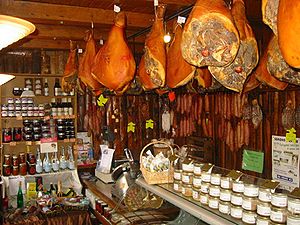
Bacon
Bacon is a cured meat prepared from a pig. It is first cured using large quantities of salt, either in a brine or in a dry packing; the result is fresh bacon . Fresh bacon may then be further dried for weeks or months in cold air, boiled, or smoked. Fresh and dried bacon must be cooked before eating...
, ham
Ham
Ham is a cut of meat from the thigh of the hind leg of certain animals, especiallypigs. Nearly all hams sold today are fully cooked or cured.-Etymology:...
, sausage
Sausage
A sausage is a food usually made from ground meat , mixed with salt, herbs, and other spices, although vegetarian sausages are available. The word sausage is derived from Old French saussiche, from the Latin word salsus, meaning salted.Typically, a sausage is formed in a casing traditionally made...
, terrine
Terrine (food)
A terrine is a French forcemeat loaf similar to a pâté, made with more coarsely chopped ingredients. Terrines are usually served cold or at room temperature.- See also :* Terrine , the cooking vessel* Pâté* Galantine* Mousseline...
s, galantine
Galantine
A galantine is a French dish of de-boned stuffed meat, most commonly poultry or fish, that is poached and served cold, coated with aspic. Galantines are often stuffed with forcemeat, and pressed into a cylindrical shape...
s, pâtés
Pates
Pates is a surname, and may refer to:* Colin Pates , retired English footballer* Richard Pates , American bishop of the Roman Catholic ChurchPates is a place name, and may refer to:Barangay PatesPate's may refer to:...
, and confit
Confit
Confit is a generic term for various kinds of food that have been immersed in a substance for both flavor and preservation. Sealed and stored in a cool place, confit can last for several months...
, primarily from pork
Pork
Pork is the culinary name for meat from the domestic pig , which is eaten in many countries. It is one of the most commonly consumed meats worldwide, with evidence of pig husbandry dating back to 5000 BC....
. Charcuterie is part of the garde manger
Garde manger
Garde manger , meaning "keep to eat" refers to a cool, well-ventilated area where cold dishes are prepared and other foods are stored under refrigeration...
chef
Chef
A chef is a person who cooks professionally for other people. Although over time the term has come to describe any person who cooks for a living, traditionally it refers to a highly skilled professional who is proficient in all aspects of food preparation.-Etymology:The word "chef" is borrowed ...
's repertoire. Originally intended as a way to preserve meats before the advent of refrigeration, they are prepared today for their flavors derived from the preservation processes.
History
Strabo
Strabo, also written Strabon was a Greek historian, geographer and philosopher.-Life:Strabo was born to an affluent family from Amaseia in Pontus , a city which he said was situated the approximate equivalent of 75 km from the Black Sea...
recorded the import of salted meats from Gaul
Gaul
Gaul was a region of Western Europe during the Iron Age and Roman era, encompassing present day France, Luxembourg and Belgium, most of Switzerland, the western part of Northern Italy, as well as the parts of the Netherlands and Germany on the left bank of the Rhine. The Gauls were the speakers of...
and the Romans may have been the first to regulate the trade of charcuterie as they wrote laws regulating the proper production of pork joints; but the French
French people
The French are a nation that share a common French culture and speak the French language as a mother tongue. Historically, the French population are descended from peoples of Celtic, Latin and Germanic origin, and are today a mixture of several ethnic groups...
have also had some influence. In 15th century France, local guild
Guild
A guild is an association of craftsmen in a particular trade. The earliest types of guild were formed as confraternities of workers. They were organized in a manner something between a trade union, a cartel, and a secret society...
s regulated tradesmen in the food production industry in each city. The guilds that produced charcuterie were those of the charcutiers. The members of this guild produced a traditional range of cooked or salted and dried meats, which varied, sometimes distinctively, from region to region. The only "raw" meat the charcutiers were allowed to sell was unrendered lard
Lard
Lard is pig fat in both its rendered and unrendered forms. Lard was commonly used in many cuisines as a cooking fat or shortening, or as a spread similar to butter. Its use in contemporary cuisine has diminished because of health concerns posed by its saturated-fat content and its often negative...
. The charcutier prepared numerous items including pâté
Pâté
Pâté is a mixture of ground meat and fat minced into a spreadable paste. Common additions include vegetables, herbs, spices, and either wine or cognac, armagnac or brandy...
s, rillettes
Rillettes
Rillettes is a preparation of meat similar to pâté. Originally made with pork, the meat is cubed or chopped, salted heavily and cooked slowly in fat until it is tender enough to be easily shredded, and then cooled with enough of the fat to form a paste...
, sausage
Sausage
A sausage is a food usually made from ground meat , mixed with salt, herbs, and other spices, although vegetarian sausages are available. The word sausage is derived from Old French saussiche, from the Latin word salsus, meaning salted.Typically, a sausage is formed in a casing traditionally made...
s, bacon
Bacon
Bacon is a cured meat prepared from a pig. It is first cured using large quantities of salt, either in a brine or in a dry packing; the result is fresh bacon . Fresh bacon may then be further dried for weeks or months in cold air, boiled, or smoked. Fresh and dried bacon must be cooked before eating...
, trotter
Trotter
Trotter may refer to:* Del Boy, Rodney and Grandad - Fictional Trotter Family from BBC sictom Only Fools and Horses* Clan Trotter, a lowland Scottish family* Trotter, a horse trained for harness racing* Italian Trotter, a breed of horse...
s, and head cheese
Head cheese
Head cheese , or brawn , is a cold cut that originated in Europe. A version pickled with vinegar is known as souse. Head cheese is not a cheese but a terrine or meat jelly made with flesh from the head of a calf or pig , and often set in aspic. Which parts of the head are used can vary, but the...
(brawn). These preservation methods ensured that meats would have a longer shelf-life.
Products created with forcemeats
Forcemeat is a mixture of ground, lean meat emulsified with fat. The emulsification can be accomplished by grinding, sieving, or pureeing the ingredients. The emulsification may either be smooth or coarse in texture, depending on the desired consistency of the final product. Forcemeats are used in the production of numerous items found in charcuterie. Proteins commonly used in the production of forcemeats include porkPork
Pork is the culinary name for meat from the domestic pig , which is eaten in many countries. It is one of the most commonly consumed meats worldwide, with evidence of pig husbandry dating back to 5000 BC....
, fish
Fish
Fish are a paraphyletic group of organisms that consist of all gill-bearing aquatic vertebrate animals that lack limbs with digits. Included in this definition are the living hagfish, lampreys, and cartilaginous and bony fish, as well as various extinct related groups...
(pike, trout
Trout
Trout is the name for a number of species of freshwater and saltwater fish belonging to the Salmoninae subfamily of the family Salmonidae. Salmon belong to the same family as trout. Most salmon species spend almost all their lives in salt water...
, or salmon
Salmon
Salmon is the common name for several species of fish in the family Salmonidae. Several other fish in the same family are called trout; the difference is often said to be that salmon migrate and trout are resident, but this distinction does not strictly hold true...
), seafood
Seafood
Seafood is any form of marine life regarded as food by humans. Seafoods include fish, molluscs , crustaceans , echinoderms . Edible sea plants, such as some seaweeds and microalgae, are also seafood, and are widely eaten around the world, especially in Asia...
, game meat
Game (food)
Game is any animal hunted for food or not normally domesticated. Game animals are also hunted for sport.The type and range of animals hunted for food varies in different parts of the world. This will be influenced by climate, animal diversity, local taste and locally accepted view about what can or...
s (venison
Venison
Venison is the meat of a game animal, especially a deer but also other animals such as antelope, wild boar, etc.-Etymology:The word derives from the Latin vēnor...
, boar
Boar
Wild boar, also wild pig, is a species of the pig genus Sus, part of the biological family Suidae. The species includes many subspecies. It is the wild ancestor of the domestic pig, an animal with which it freely hybridises...
, or rabbit
Rabbit
Rabbits are small mammals in the family Leporidae of the order Lagomorpha, found in several parts of the world...
), poultry
Poultry
Poultry are domesticated birds kept by humans for the purpose of producing eggs, meat, and/or feathers. These most typically are members of the superorder Galloanserae , especially the order Galliformes and the family Anatidae , commonly known as "waterfowl"...
, game birds, veal
Veal
Veal is the meat of young cattle , as opposed to meat from older cattle. Though veal can be produced from a calf of either sex and any breed, most veal comes from male calves of dairy cattle breeds...
, and pork livers. Pork fatback
Fatback
Fatback is a cut of meat from a domestic pig. It consists of the layer of adipose tissue under the skin of the back, with or without the skin...
is often used for the fat portion of forcemeat as it has a somewhat neutral flavor.
In American usage, there are four basic styles of forcemeat. Straight forcemeats are produced by progressively grinding equal parts pork and pork fat with a third dominant meat which can be pork or another meat. The proteins are cubed and then seasoned, cured, rested, ground and then placed into desired vessel. Country-style forcemeats are a combination of pork, pork fat, often with the addition of pork liver and garnish ingredients. The finished product has a coarse texture.
The third style is gratin
Gratin
Gratin is a widespread culinary technique in food preparation in which an ingredient is topped with a browned crust, often using breadcrumbs, grated cheese, egg and/or butter. Gratin originated in French cuisine and is usually prepared in a shallow dish of some kind...
which has a portion of the main protein browned; the French term gratin connotes a "grated" product that is browned. The final style is mousseline
Mousseline
A mousseline is a dish based on meat, fish, shellfish or foie gras to which whipped cream or, less frequently, beaten egg whites are added to lighten the texture by incorporating air bubbles. "Mousseline" is a derivative of "mousse"....
which are very light in texture utilizing lean cuts of meat usually from veal
Veal
Veal is the meat of young cattle , as opposed to meat from older cattle. Though veal can be produced from a calf of either sex and any breed, most veal comes from male calves of dairy cattle breeds...
, poultry, fish, or shellfish. The resulting texture comes from the addition of eggs and cream to this forcemeat.
Sausage
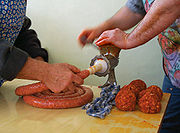
Emulsified sausage
Emulsified sausages are cooked sausages with a very fine texture, using the combination of pork, beef, or poultry with fat, salt, nitrateNitrate
The nitrate ion is a polyatomic ion with the molecular formula NO and a molecular mass of 62.0049 g/mol. It is the conjugate base of nitric acid, consisting of one central nitrogen atom surrounded by three identically-bonded oxygen atoms in a trigonal planar arrangement. The nitrate ion carries a...
, flavorings, and water. These items are emulsified at high speed in a food processor or blender. During this process the salt dissolves the muscle proteins, which helps to suspend the fat molecules. Temperature is an important part of the process: if the temperature rises above 60 degrees for pork or 70 degrees for beef, the emulsion will not hold and fat will leak from the sausage during the cooking process.
Pâté, terrine, galantine, roulade
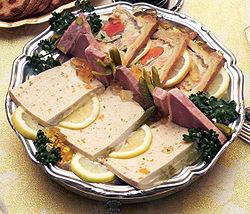
Pâté
Pâté is a mixture of ground meat and fat minced into a spreadable paste. Common additions include vegetables, herbs, spices, and either wine or cognac, armagnac or brandy...
and terrine
Terrine (food)
A terrine is a French forcemeat loaf similar to a pâté, made with more coarsely chopped ingredients. Terrines are usually served cold or at room temperature.- See also :* Terrine , the cooking vessel* Pâté* Galantine* Mousseline...
s are often cooked in a pastry crust or a earthenware container. Both the earthenware container and the dish itself are called a terrine. Pâté and terrine are very similar: the term pâté often suggests a finer-textured forcemeat
Forcemeat
Forcemeat is a mixture of ground, lean meat emulsified with fat. The emulsification can be accomplished by either grinding, sieving, or pureeing the ingredients. The emulsification may either be smooth or coarse, depending on the desired consistency of the final product...
utilizing liver, while terrines are more often made of a coarser forcemeat. The meats are chopped or ground, along with heavy seasoning, which may include fat and other proteins. The seasoning is important for pâté and terrine as they will generally be served cold, which mutes the flavors.
The mixture is placed into a lined mold, covered, and cooked in a water bath to control the temperature, which will keep the forcemeat from separating as the water bath slows the heating process of the terrine. Pâté and terrine are generally cooked to 160 degrees, while terrine made of foie gras
Foie gras
Foie gras ; French for "fat liver") is a food product made of the liver of a duck or goose that has been specially fattened. This fattening is typically achieved through gavage corn, according to French law, though outside of France it is occasionally produced using natural feeding...
are generally cooked to an internal temperature of 120 degrees. After the proper temperature is reached the terrine is removed from the oven and placed into a cooling unit topped with a weight to compact the contents of the terrine. Then it is allowed to rest for several days to allow the flavors to blend.
Galantine
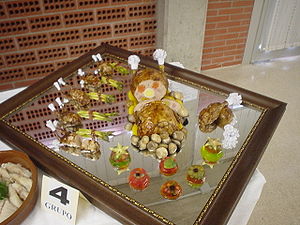
A galantine is a French dish of de-boned stuffed meat, most commonly poultry or fish, that is poached and served cold, coated with aspic. Galantines are often stuffed with forcemeat, and pressed into a cylindrical shape...
is a chilled production of poultry created after the French Revolution
French Revolution
The French Revolution , sometimes distinguished as the 'Great French Revolution' , was a period of radical social and political upheaval in France and Europe. The absolute monarchy that had ruled France for centuries collapsed in three years...
by the chef to the Marquis de Brancas. The term galant connotes urbane sophistication. Other origins are suggested: the older French word for chicken géline or galine or the word gelatin
Gelatin
Gelatin is a translucent, colorless, brittle , flavorless solid substance, derived from the collagen inside animals' skin and bones. It is commonly used as a gelling agent in food, pharmaceuticals, photography, and cosmetic manufacturing. Substances containing gelatin or functioning in a similar...
. Sources suggest that the spelling of gelatin transformed into the words galentyne, galyntyne, galandyne, and galendine.
The galantine is prepared by skinning and de-boning a chicken or other poultry. The skin is laid flat, with the pounded breast laid on top. A forcemeat is then placed on top of the pounded breast. The galantine is then rolled with the ends of the breast meeting one another. The galantine is then wrapped in cheesecloth
Cheesecloth
Cheesecloth is a loosewoven gauze-like cotton cloth used primarily in cheese making and cooking.Cheesecloth is available in at least seven different grades, from open to extra-fine weave. Grades are distinguished by the number of threads per inch in each direction.- Uses :The primary use of...
and poached in poultry stock until the proper internal temperature is reached.
Roulade
Roulade
The word roulade originates from the French word "rouler" meaning "to roll". Typically, a roulade is a European dish consisting of a slice of meat rolled around a filling, such as cheese, vegetables, or other meats. A roulade, like a braised dish, is often browned then covered with wine or stock...
is similar to a galantine. There are two major differences, the first difference being that instead of rolling the poultry evenly for the ends of the breasts to meet, the bird is rolled into a pinwheel shape. The second difference is that when the roulade is cooled by chilling it after it has been removed from the poaching liquid.
Salt-cured and brined products
Salt serves four main purposes in the preservation of food in the charcuterie kitchen. The first is inducing osmosisOsmosis
Osmosis is the movement of solvent molecules through a selectively permeable membrane into a region of higher solute concentration, aiming to equalize the solute concentrations on the two sides...
: this process involves the movement of water outside of the membranes of the cells, which in turn reabsorb the salted water back into the cell; this process assists in the destruction of harmful pathogens. The second is dehydration
Dehydration
In physiology and medicine, dehydration is defined as the excessive loss of body fluid. It is literally the removal of water from an object; however, in physiological terms, it entails a deficiency of fluid within an organism...
, which means that the salt pulls excess water from the protein, which aids in the shelf-life of the protein as there is less moisture present for bacteria to thrive in. Fermentation is the third, in which salt assists in halting the fermentation process which would otherwise completely break the meat down. Finally, salt assists in denaturing
Denaturation (biochemistry)
Denaturation is a process in which proteins or nucleic acids lose their tertiary structure and secondary structure by application of some external stress or compound, such as a strong acid or base, a concentrated inorganic salt, an organic solvent , or heat...
proteins, which in essence means that the structure of the proteins is effectively shifted, similar to the effects of cooking
Cooking
Cooking is the process of preparing food by use of heat. Cooking techniques and ingredients vary widely across the world, reflecting unique environmental, economic, and cultural traditions. Cooks themselves also vary widely in skill and training...
.
Before the discovery of nitrate
Nitrate
The nitrate ion is a polyatomic ion with the molecular formula NO and a molecular mass of 62.0049 g/mol. It is the conjugate base of nitric acid, consisting of one central nitrogen atom surrounded by three identically-bonded oxygen atoms in a trigonal planar arrangement. The nitrate ion carries a...
s and nitrite
Nitrite
The nitrite ion has the chemical formula NO2−. The anion is symmetric with equal N-O bond lengths and a O-N-O bond angle of ca. 120°. On protonation the unstable weak acid nitrous acid is produced. Nitrite can be oxidised or reduced, with product somewhat dependent on the oxidizing/reducing agent...
s by German chemists around 1900, curing was done with unrefined salt and saltpeter
Potassium nitrate
Potassium nitrate is a chemical compound with the formula KNO3. It is an ionic salt of potassium ions K+ and nitrate ions NO3−.It occurs as a mineral niter and is a natural solid source of nitrogen. Its common names include saltpetre , from medieval Latin sal petræ: "stone salt" or possibly "Salt...
. As saltpeter gives inconsistent results preventing bacterial growth, nitrate and nitrites (in the form of sodium nitrite
Sodium nitrite
Sodium nitrite is the inorganic compound with the chemical formula NaNO2. It is a white to slight yellowish crystalline powder that is very soluble in water and is hygroscopic...
and sodium nitrate
Sodium nitrate
Sodium nitrate is the chemical compound with the formula NaNO3. This salt, also known as Chile saltpeter or Peru saltpeter to distinguish it from ordinary saltpeter, potassium nitrate, is a white solid which is very soluble in water...
) have increased in popularity for their consistent results. Nitrates take a considerably longer period of time to break down in cured foods than nitrites; because of this, nitrates are the preferred curing salts for lengthy curing and drying periods. Nitrites are often used in foods that require a shorter curing time and are used for any item that will be fully cooked. Eventually a portion of the nitrates will break down into nitrites.
Nitrite has multiple purposes in the curing process. One purpose is flavor, the nitrites giving a sharp, piquant flavor to the meat. Second, the nitrites react with substances in the meat to produce nitric oxide
Nitric oxide
Nitric oxide, also known as nitrogen monoxide, is a diatomic molecule with chemical formula NO. It is a free radical and is an important intermediate in the chemical industry...
. Nitric oxide prevents iron from breaking down the fat in the meat, thus halting rancidity. The binding also creates the characteristic reddish color found in most cured meats. Finally the nitrite inhibits the growth of botulism
Botulism
Botulism also known as botulinus intoxication is a rare but serious paralytic illness caused by botulinum toxin which is metabolic waste produced under anaerobic conditions by the bacterium Clostridium botulinum, and affecting a wide range of mammals, birds and fish...
-causing organisms that would ordinarily thrive in the oxygen-deprived environment in the sausage casing. German scientists originally named botulism poisoning Wurstvergiftung or "sausage poisoning". The term botulism derives its name from the Latin term for sausage.
Eating cured meat products has been linked to a small increase in gastric cancer as well as chronic obstructive pulmonary disease
Chronic obstructive pulmonary disease
Chronic obstructive pulmonary disease , also known as chronic obstructive lung disease , chronic obstructive airway disease , chronic airflow limitation and chronic obstructive respiratory disease , is the co-occurrence of chronic bronchitis and emphysema, a pair of commonly co-existing diseases...
. The negative effects are presumed to be caused by nitrates and nitrites, as well as nitrosamine
Nitrosamine
Nitrosamines are chemical compounds of the chemical structure R1N-N=O, some of which are carcinogenic.-Usages:Nitrosamines are used in manufacture of some cosmetics, pesticides, and in most rubber products. -Occurrences:...
s which are formed by nitrites reacting with meat. These risks are generally regarded as minimal, and regulations in the United States limit residual nitrates and nitrites to 200 parts per million (0.02%) as a precautionary measure.
Curing salt blends
There are two main types of curing salt mixture used by the charcutier. The first is known by multiple names, including "tinted cure mix", "pink cure", "prague powder", or "insta-cure #1". The mixture is 94 percent sodium chlorideSodium chloride
Sodium chloride, also known as salt, common salt, table salt or halite, is an inorganic compound with the formula NaCl. Sodium chloride is the salt most responsible for the salinity of the ocean and of the extracellular fluid of many multicellular organisms...
and 6 percent sodium nitrite. When used, the recommended amount is a ratio of 4oz/113g for each 100 lb/45.36 kg of meat or .25 percent of the total weight of the meat. This blend is colored bright pink to keep the charcutier from confusing the mixture with regular salt.
The second curing salt blend is called "prague powder II" or "insta-cure #2". Also colored pink to differentiate it from table salt, this blend is produced from salt and sodium nitrate. This mixture is used for dry sausages that require a longer drying period which requires the presence of nitrate.
Seasoning and flavoring agents
Sweeteners and other flavoring agents are necessary in the production of many cured products due to the harsh flavors of the curing salts. A number of sweeteners can be used in curing foods, including dextrose, sugarSugar
Sugar is a class of edible crystalline carbohydrates, mainly sucrose, lactose, and fructose, characterized by a sweet flavor.Sucrose in its refined form primarily comes from sugar cane and sugar beet...
, corn syrup
Corn syrup
Corn syrup is a food syrup, which is made from the starch of maize and contains varying amounts of maltose and higher oligosaccharides, depending on the grade. Corn syrup is used in foods to soften texture, add volume, prevent crystallization of sugar, and enhance flavor...
, honey
Honey
Honey is a sweet food made by bees using nectar from flowers. The variety produced by honey bees is the one most commonly referred to and is the type of honey collected by beekeepers and consumed by humans...
, and maple syrup
Maple syrup
Maple syrup is a syrup usually made from the xylem sap of sugar maple, red maple, or black maple trees, although it can also be made from other maple species such as the bigleaf maple. In cold climates, these trees store starch in their trunks and roots before the winter; the starch is then...
. Dextrose is seen often in cured meats as it not only mellows the harshness, but it also increases the moisture content of the cured product while not adding a sweet flavor to the cured meat. The sweeteners also assist in stabilizing the colors in meats and it also helps the fermentation process by giving a nutrient to the bacteria.
Numerous spice
Spice
A spice is a dried seed, fruit, root, bark, or vegetative substance used in nutritionally insignificant quantities as a food additive for flavor, color, or as a preservative that kills harmful bacteria or prevents their growth. It may be used to flavour a dish or to hide other flavours...
s and herb
Herb
Except in botanical usage, an herb is "any plant with leaves, seeds, or flowers used for flavoring, food, medicine, or perfume" or "a part of such a plant as used in cooking"...
s are used in the curing process to assist with the flavor of the final product. The sweet spices regularly used include cinnamon
Cinnamon
Cinnamon is a spice obtained from the inner bark of several trees from the genus Cinnamomum that is used in both sweet and savoury foods...
, allspice
Allspice
Allspice, also called Jamaica pepper, pepper, myrtle pepper, pimenta, or newspice, is a spice that is the dried unripe fruit of Pimenta dioica , a mid-canopy tree native to the Greater Antilles, southern Mexico, and Central America, now cultivated in many warm parts of the world...
, nutmeg
Nutmeg
The nutmeg tree is any of several species of trees in genus Myristica. The most important commercial species is Myristica fragrans, an evergreen tree indigenous to the Banda Islands in the Moluccas of Indonesia...
, mace, and cardamom
Cardamom
Cardamom refers to several plants of the genera Elettaria and Amomum in the ginger family Zingiberaceae. Both genera are native to India and Bhutan; they are recognised by their small seed pod, triangular in cross-section and spindle-shaped, with a thin papery outer shell and small black seeds...
. Other flavoring agents may include dried and fresh chili
Chili pepper
Chili pepper is the fruit of plants from the genus Capsicum, members of the nightshade family, Solanaceae. The term in British English and in Australia, New Zealand, India, Malaysia and other Asian countries is just chilli without pepper.Chili peppers originated in the Americas...
es, wine
Wine
Wine is an alcoholic beverage, made of fermented fruit juice, usually from grapes. The natural chemical balance of grapes lets them ferment without the addition of sugars, acids, enzymes, or other nutrients. Grape wine is produced by fermenting crushed grapes using various types of yeast. Yeast...
, fruit juice, or vinegar
Vinegar
Vinegar is a liquid substance consisting mainly of acetic acid and water, the acetic acid being produced through the fermentation of ethanol by acetic acid bacteria. Commercial vinegar is produced either by fast or slow fermentation processes. Slow methods generally are used with traditional...
.
Fermented sausage
Leuconostoc
Leuconostoc is a genus of Gram-positive bacteria, placed within the family of Leuconostocaceae. They are generally ovoid cocci often forming chains. Leuconostoc spp. are intrinsically resistant to vancomycin and are catalase-negative . All species within this genus are heterofermentative and are...
, break down these proteins and produce lactic acid
Lactic acid
Lactic acid, also known as milk acid, is a chemical compound that plays a role in various biochemical processes and was first isolated in 1780 by the Swedish chemist Carl Wilhelm Scheele. Lactic acid is a carboxylic acid with the chemical formula C3H6O3...
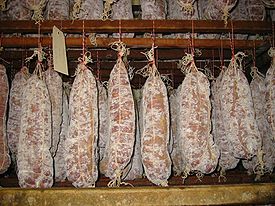
which not only affects the flavor of the sausage, but also lowers the pH from 6 to 4.5-5, preventing the growth of bacteria that could spoil the sausage. These effects are magnified during the drying process, as the salt and acidity are concentrated as moisture is extracted.
The ingredients found in a fermented sausage include meat, fat, bacterial culture, salt, spices, sugar and nitrate. Nitrate is added to fermented sausages to prevent the formation of botulism
Botulism
Botulism also known as botulinus intoxication is a rare but serious paralytic illness caused by botulinum toxin which is metabolic waste produced under anaerobic conditions by the bacterium Clostridium botulinum, and affecting a wide range of mammals, birds and fish...
-causing bacteria. Sugar is added to aid the bacterial production of lactic acid during the 18-hour to three-day fermentation process; the fermentation time depends on the temperature at which the sausage is stored: the lower the temperature, the longer the required fermentation period. A white mold and yeast normally adheres to the outside of the sausage during the drying process. This mold adds to the flavor of the sausage and aids in preventing harmful bacteria from attaching to the sausage.
There are two main types of fermented sausage. The first is the dry, salted, spiced sausages found in the warmer climates of the Mediterranean, in countries such as Italy
Italy
Italy , officially the Italian Republic languages]] under the European Charter for Regional or Minority Languages. In each of these, Italy's official name is as follows:;;;;;;;;), is a unitary parliamentary republic in South-Central Europe. To the north it borders France, Switzerland, Austria and...
, Spain
Spain
Spain , officially the Kingdom of Spain languages]] under the European Charter for Regional or Minority Languages. In each of these, Spain's official name is as follows:;;;;;;), is a country and member state of the European Union located in southwestern Europe on the Iberian Peninsula...
, and Portugal
Portugal
Portugal , officially the Portuguese Republic is a country situated in southwestern Europe on the Iberian Peninsula. Portugal is the westernmost country of Europe, and is bordered by the Atlantic Ocean to the West and South and by Spain to the North and East. The Atlantic archipelagos of the...
. Since these sausages contain 25-35% water and more than 4% salt, they may be stored at room temperature. The sausages of northern Europe usually contain less salt (around 3%) and 40-50% water, and as such do not dry well in the humid climate of countries like Germany
Germany
Germany , officially the Federal Republic of Germany , is a federal parliamentary republic in Europe. The country consists of 16 states while the capital and largest city is Berlin. Germany covers an area of 357,021 km2 and has a largely temperate seasonal climate...
.
Terminology
The French word for a person who prepares charcuterie is charcutier, generally translated into English as "pork butcher." This has led to the mistaken belief that charcuterie can only involve pork. The Food Lover's CompanionFood Lover's Companion
The New Food Lover’s Companion—currently in its Fourth Edition—is a seminal work in the culinary field. The book defines over 6,700 culinary terms in its 830 pages, along with numerous conversion tables...
, however, says that "it refers to the products, particularly (but not limited to) pork specialties such as pâté
Pâté
Pâté is a mixture of ground meat and fat minced into a spreadable paste. Common additions include vegetables, herbs, spices, and either wine or cognac, armagnac or brandy...
s, rillettes
Rillettes
Rillettes is a preparation of meat similar to pâté. Originally made with pork, the meat is cubed or chopped, salted heavily and cooked slowly in fat until it is tender enough to be easily shredded, and then cooled with enough of the fat to form a paste...
, galantine
Galantine
A galantine is a French dish of de-boned stuffed meat, most commonly poultry or fish, that is poached and served cold, coated with aspic. Galantines are often stuffed with forcemeat, and pressed into a cylindrical shape...
s, crépinette
Crépinette
A crépinette is a small, flattened sausage, sometimes referred to as a sausage parcel. It is similar in shape to a sausage patty, circular, and flatten with meat.It is made from minced or ground pork, veal, lamb or chicken, and can even be made from truffles....
s, etc., which are made and sold in a delicatessen-style shop, also called a charcuterie." The 1961 edition of Larousse Gastronomique
Larousse Gastronomique
Larousse Gastronomique is an encyclopedia of gastronomy. The majority of the book is about French cuisine, and contains recipes for French dishes and cooking techniques...
defines it as: "The art of preparing various meats, in particular pork, in order to present them in the most diverse ways."
External links
- Istituto Valorizzazione Salumi Italiani, PGI Consortium
- Salumi Casalinghi - in Italian
- Salumi from Life in Italy.com
- Salumi -- Italian Cold Cuts from About.com