


Robert Schuman

Encyclopedia
Robert Schuman was a noted Luxembourg
ish-born French statesman. Schuman was a Christian Democrat (M.R.P.
) and an independent political thinker and activist. Twice Prime Minister of France, a reformist Minister of Finance and a Foreign Minister, he was instrumental in building post-war European and trans-Atlantic institutions and is regarded as one of the founders of the European Union
, the Council of Europe
and NATO.
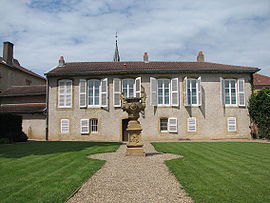 Schuman was a man of several cultures. His father, Jean-Pierre Schuman (1837–1900), was born in Évrange, Lorraine
, just across the border with Luxembourg. Jean-Pierre Schuman was a French citizen, but after Alsace-Lorraine
was annexed by the German Empire
in 1871, he became a German citizen. Robert's mother, Eugénie Duren (1864–1911), a Luxembourgian born in Bettembourg
, became a German citizen by marriage in 1884.
Schuman was born in 1886 in Clausen
, a suburb of Luxembourg as a German by virtue of the principle of jus sanguinis
. His mother tongue was Luxembourgish but he was taught French and Standard German
at school. Since he learned French only in school (which is mandatory in Luxembourg), he spoke it with a distinct accent.
Schuman pursued his secondary education at the Athénée de Luxembourg
secondary school in Luxembourg, a former Jesuit College. He then decided to study at German universities, but since the Luxembourg secondary school diploma was not valid in Germany, he had to pass the entrance exam
at the Kaiserliches Gymnasium in Metz
. His university education in law, economics, political philosophy, theology and statistics took place in the German education system. He received his law degree after studying at the universities of Bonn
, Munich, Berlin, and Strasbourg
in Alsace.
After graduation he became a lawyer and was elected to the city council of Metz.
was returned to France and Schuman became a French citizen in 1919.
Schuman became active in French politics. In 1919 he was first elected as député
to parliament on a regional list, and later serving as the député for Thionville
until 1958 with an interval during the war years. He made a major contribution to the drafting and parliamentary passage of the Lex Schuman by the French parliament. Schuman also investigated and patiently uncovered postwar corruption in the Lorraine steel india
but thanks to the intervention of a German lawyer, he was saved from being sent to Dachau. Transferred as a personal prisoner of Gauleiter
Joseph Buerckel, he escaped in 1942 and re-joined the French Resistance
. He addressed large conferences in the Free Zone
explaining why the defeat of Germany was inevitable. This was at a time when Nazi Germany was at the peak of its power. The Germans then invaded the Free Zone
. Although his life was still at risk, he spoke to friends about a Franco-German and European reconciliation that must take place after the end of hostilities, as he had already done in 1939–40.
from 1947–1948, assuring parliamentary stability during a period of revolutionary strikes and attempted insurrection. In the last days of his first administration, his government proposed plans that later resulted in the Council of Europe and the European Community single market. Becoming Foreign Minister in 1948, he retained the post in different governments until early 1953. When Schuman's first government had proposed the creation of a European Assembly, it made the issue a governmental matter for Europe, not merely an academic discussion or the subject of private conferences, like The Hague Congress
of the European Movements earlier that year. (Schuman's was one of the few governments to send active ministers.) This proposal saw life as the Council of Europe and was created within the tight schedule Schuman had set. At the signing of its Statutes at St James's Palace, London, 5 May 1949, the founding States agreed to defining the frontiers of Europe based on the principles of human rights and fundamental freedoms that Schuman enunciated there. He also announced a coming supranational union for Europe that saw light as the European Coal and Steel Community
and other such Communities within a Union framework of common law and democracy.
As Foreign Minister, he announced in September 1948 and the following year before the United Nations General Assembly, France's aim to create a democratic organisation for Europe which a post-Nazi and democratic Germany could join. In 1949–50, he made a series of speeches in Europe and North America about creating a supranational European Community. This supranational structure, he said, would create lasting peace between Member States.
On 9 May 1950, these principles of supranational democracy were announced in what has become known as the Schuman Declaration
. The text was jointly prepared by Paul Reuter, the legal adviser at the Foreign Ministry, his chef-de Cabinet, Bernard Clappier and Jean Monnet
and two of his team, Pierre Uri and Etienne Hirsch
. The French Government agreed to the Schuman Declaration which invited the Germans and all other European countries to manage their coal and steel industries jointly and democratically in Europe's first supranational Community with its five foundational institutions. On 18 April 1951 six founder members signed the Treaty of Paris (1951)
that formed the basis of the European Coal and Steel Community
. They declared this date and the corresponding democratic, supranational principles to be the 'real foundation of Europe'. Three Communities have been created so far. The Treaties of Rome, 1957, created the Economic community and the nuclear non-proliferation Community, Euratom. Together with intergovernmental machinery of later treaties, these eventually evolved into the European Union
. The Schuman Declaration
, was made on 9 May 1950 and to this day 9 May is designated Europe Day
.
As Prime Minister and Foreign Minister Schuman was instrumental in the creation of the North Atlantic Treaty Organisation, NATO. Schuman also signed the Treaty of Washington for France.The defensive principles of Nato's Article 5 were also repeated in the European Defence Community
Treaty which failed as the French National Assembly declined to vote its ratification. Schuman was a proponent of an Atlantic Community.
(the successor to the Common Assembly) which bestowed on him by acclamation the title 'Father of Europe'. He is considered one of the founding fathers of the European Union
. In 1958 he received the Karlspreis
, an Award by the German city of Aachen
to people who contributed to the European idea and European peace, commemorating Charlemagne
, ruler of what is today France and Germany, who resided and is buried at Aachen. He was also a knight of the Order of Pope Pius IX.
Celibate, modest and un-ostentatious, Schuman was an intensely religious man and Bible scholar. He was a strongly independent thinker, meditative and a courageous political activist. He commended the writings of Pope Pius XI
who condemned both Fascism and Communism. He was expert in medieval philosophy including St. Thomas Aquinas
and considered Jacques Maritain
highly. It was announced on 15 May 2004 that the diocesan investigation of the cause of beatification
would soon conclude, this might have as its result that Schuman will be declared "Blessed" by the Roman Catholic Church.
 The Schuman District
of Brussels
(including a metro/railway station
, square
) is named in his honour. Around the square ("Schuman roundabout
") can be found various European institutions, including the Berlaymont building
which is the headquarters of the European Commission
and has a monument to Schuman outside, as well as key European Parliament
buildings. In the nearby Cinquantenaire
Park, there is a bust of Schuman as a memorial to him.
A Social Science University named after him
lies in Strasbourg
(France) along with the Avenue du President Robert Schuman in that city's European Quarter
. In Luxembourg
there is a Rond Point Schuman, Boulevard Robert Schuman and a Robert Schuman Building
, of the European Parliament; and in Esch-sur-Alzette
, Luxembourg, there is a Rue Robert Schuman. The house where he was born
was restored by the European Parliament and can be visited; as can his home in Scy-Chazelle just outside Metz.
In Aix-en-Provence, a town in Bouches-du-Rhone, France, there is an Avenue Robert Schumann, which houses the three university buildings of the town and in Ireland there is a building in the University of Limerick
named the "Robert Schuman" building.
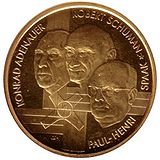
and Konrad Adenauer
.
Changes:
Luxembourg
Luxembourg , officially the Grand Duchy of Luxembourg , is a landlocked country in western Europe, bordered by Belgium, France, and Germany. It has two principal regions: the Oesling in the North as part of the Ardennes massif, and the Gutland in the south...
ish-born French statesman. Schuman was a Christian Democrat (M.R.P.
Popular Republican Movement
The Popular Republican Movement was a French Christian democratic party of the Fourth Republic...
) and an independent political thinker and activist. Twice Prime Minister of France, a reformist Minister of Finance and a Foreign Minister, he was instrumental in building post-war European and trans-Atlantic institutions and is regarded as one of the founders of the European Union
European Union
The European Union is an economic and political union of 27 independent member states which are located primarily in Europe. The EU traces its origins from the European Coal and Steel Community and the European Economic Community , formed by six countries in 1958...
, the Council of Europe
Council of Europe
The Council of Europe is an international organisation promoting co-operation between all countries of Europe in the areas of legal standards, human rights, democratic development, the rule of law and cultural co-operation...
and NATO.
Early years
Moselle
Moselle is a department in the east of France named after the river Moselle.- History :Moselle is one of the original 83 departments created during the French Revolution on March 4, 1790...
, just across the border with Luxembourg. Jean-Pierre Schuman was a French citizen, but after Alsace-Lorraine
Alsace-Lorraine
The Imperial Territory of Alsace-Lorraine was a territory created by the German Empire in 1871 after it annexed most of Alsace and the Moselle region of Lorraine following its victory in the Franco-Prussian War. The Alsatian part lay in the Rhine Valley on the west bank of the Rhine River and east...
was annexed by the German Empire
German Empire
The German Empire refers to Germany during the "Second Reich" period from the unification of Germany and proclamation of Wilhelm I as German Emperor on 18 January 1871, to 1918, when it became a federal republic after defeat in World War I and the abdication of the Emperor, Wilhelm II.The German...
in 1871, he became a German citizen. Robert's mother, Eugénie Duren (1864–1911), a Luxembourgian born in Bettembourg
Bettembourg
Bettembourg is a commune and town in southern Luxembourg. It is part of the canton of Esch-sur-Alzette, which is part of the district of Luxembourg., the town of Bettembourg, which lies in the east of the commune, has a population of 7,157...
, became a German citizen by marriage in 1884.
Schuman was born in 1886 in Clausen
Clausen, Luxembourg
Clausen is a quarter in central Luxembourg City, in southern Luxembourg.In 2001, the quarter had a population of 886 people....
, a suburb of Luxembourg as a German by virtue of the principle of jus sanguinis
Jus sanguinis
Ius sanguinis is a social policy by which citizenship is not determined by place of birth, but by having a parent who are citizens of the nation...
. His mother tongue was Luxembourgish but he was taught French and Standard German
German language
German is a West Germanic language, related to and classified alongside English and Dutch. With an estimated 90 – 98 million native speakers, German is one of the world's major languages and is the most widely-spoken first language in the European Union....
at school. Since he learned French only in school (which is mandatory in Luxembourg), he spoke it with a distinct accent.
Schuman pursued his secondary education at the Athénée de Luxembourg
Athénée de Luxembourg
The Athénée de Luxembourg , is a high school in Luxembourg City, in southern Luxembourg. It's commonly called Stater Kolléisch or De Kolléisch, and is the nation's oldest high school.-Brief history:...
secondary school in Luxembourg, a former Jesuit College. He then decided to study at German universities, but since the Luxembourg secondary school diploma was not valid in Germany, he had to pass the entrance exam
Abitur
Abitur is a designation used in Germany, Finland and Estonia for final exams that pupils take at the end of their secondary education, usually after 12 or 13 years of schooling, see also for Germany Abitur after twelve years.The Zeugnis der Allgemeinen Hochschulreife, often referred to as...
at the Kaiserliches Gymnasium in Metz
Metz
Metz is a city in the northeast of France located at the confluence of the Moselle and the Seille rivers.Metz is the capital of the Lorraine region and prefecture of the Moselle department. Located near the tripoint along the junction of France, Germany, and Luxembourg, Metz forms a central place...
. His university education in law, economics, political philosophy, theology and statistics took place in the German education system. He received his law degree after studying at the universities of Bonn
University of Bonn
The University of Bonn is a public research university located in Bonn, Germany. Founded in its present form in 1818, as the linear successor of earlier academic institutions, the University of Bonn is today one of the leading universities in Germany. The University of Bonn offers a large number...
, Munich, Berlin, and Strasbourg
University of Strasbourg
The University of Strasbourg in Strasbourg, Alsace, France, is the largest university in France, with about 43,000 students and over 4,000 researchers....
in Alsace.
After graduation he became a lawyer and was elected to the city council of Metz.
Inter-war period
After the First World War, Alsace-LorraineAlsace-Lorraine
The Imperial Territory of Alsace-Lorraine was a territory created by the German Empire in 1871 after it annexed most of Alsace and the Moselle region of Lorraine following its victory in the Franco-Prussian War. The Alsatian part lay in the Rhine Valley on the west bank of the Rhine River and east...
was returned to France and Schuman became a French citizen in 1919.
Schuman became active in French politics. In 1919 he was first elected as député
Chamber of Deputies of France
Chamber of Deputies was the name given to several parliamentary bodies in France in the nineteenth and twentieth centuries:* 1814–1848 during the Bourbon Restoration and the July Monarchy, the Chamber of Deputies was the Lower chamber of the French Parliament, elected by census suffrage.*...
to parliament on a regional list, and later serving as the député for Thionville
Thionville
Thionville , is a commune in the Moselle department in Lorraine in north-eastern France. The city is located on the left bank of the river Moselle, opposite its suburb Yutz.-Demographics:...
until 1958 with an interval during the war years. He made a major contribution to the drafting and parliamentary passage of the Lex Schuman by the French parliament. Schuman also investigated and patiently uncovered postwar corruption in the Lorraine steel india
World War II
In 1940, because of his expertise on Germany, Schuman was called to become a member of Paul Reynaud's wartime government. Later that year, he was arrested for acts of resistance and protest against Nazi methods. He was interrogated by the GestapoGestapo
The Gestapo was the official secret police of Nazi Germany. Beginning on 20 April 1934, it was under the administration of the SS leader Heinrich Himmler in his position as Chief of German Police...
but thanks to the intervention of a German lawyer, he was saved from being sent to Dachau. Transferred as a personal prisoner of Gauleiter
Gauleiter
A Gauleiter was the party leader of a regional branch of the NSDAP or the head of a Gau or of a Reichsgau.-Creation and Early Usage:...
Joseph Buerckel, he escaped in 1942 and re-joined the French Resistance
French Resistance
The French Resistance is the name used to denote the collection of French resistance movements that fought against the Nazi German occupation of France and against the collaborationist Vichy régime during World War II...
. He addressed large conferences in the Free Zone
Zone libre
The zone libre was a partition of the French metropolitan territory during the Second World War, established at the Second Armistice at Compiègne on June 22, 1940. It lay to the south of the demarcation line and was administered by the French government of Marshal Philippe Pétain based in Vichy,...
explaining why the defeat of Germany was inevitable. This was at a time when Nazi Germany was at the peak of its power. The Germans then invaded the Free Zone
Zone libre
The zone libre was a partition of the French metropolitan territory during the Second World War, established at the Second Armistice at Compiègne on June 22, 1940. It lay to the south of the demarcation line and was administered by the French government of Marshal Philippe Pétain based in Vichy,...
. Although his life was still at risk, he spoke to friends about a Franco-German and European reconciliation that must take place after the end of hostilities, as he had already done in 1939–40.
French minister
After the war Schuman rose to great prominence. He was Minister of Finance, then Prime MinisterPrime Minister of France
The Prime Minister of France in the Fifth Republic is the head of government and of the Council of Ministers of France. The head of state is the President of the French Republic...
from 1947–1948, assuring parliamentary stability during a period of revolutionary strikes and attempted insurrection. In the last days of his first administration, his government proposed plans that later resulted in the Council of Europe and the European Community single market. Becoming Foreign Minister in 1948, he retained the post in different governments until early 1953. When Schuman's first government had proposed the creation of a European Assembly, it made the issue a governmental matter for Europe, not merely an academic discussion or the subject of private conferences, like The Hague Congress
Hague Congress
There have been two events called as the Hague Congress:* Hague Congress * Hague Congress...
of the European Movements earlier that year. (Schuman's was one of the few governments to send active ministers.) This proposal saw life as the Council of Europe and was created within the tight schedule Schuman had set. At the signing of its Statutes at St James's Palace, London, 5 May 1949, the founding States agreed to defining the frontiers of Europe based on the principles of human rights and fundamental freedoms that Schuman enunciated there. He also announced a coming supranational union for Europe that saw light as the European Coal and Steel Community
European Coal and Steel Community
The European Coal and Steel Community was a six-nation international organisation serving to unify Western Europe during the Cold War and create the foundation for the modern-day developments of the European Union...
and other such Communities within a Union framework of common law and democracy.
As Foreign Minister, he announced in September 1948 and the following year before the United Nations General Assembly, France's aim to create a democratic organisation for Europe which a post-Nazi and democratic Germany could join. In 1949–50, he made a series of speeches in Europe and North America about creating a supranational European Community. This supranational structure, he said, would create lasting peace between Member States.
On 9 May 1950, these principles of supranational democracy were announced in what has become known as the Schuman Declaration
Schuman Declaration
The Schuman Declaration of 9 May 1950 was a governmental proposal by then-French Foreign Minister Robert Schuman to create a new form of organization of States in Europe called a supranational Community. Following the experiences of two world wars, France recognized that certain values such as...
. The text was jointly prepared by Paul Reuter, the legal adviser at the Foreign Ministry, his chef-de Cabinet, Bernard Clappier and Jean Monnet
Jean Monnet
Jean Omer Marie Gabriel Monnet was a French political economist and diplomat. He is regarded by many as a chief architect of European Unity and is regarded as one of its founding fathers...
and two of his team, Pierre Uri and Etienne Hirsch
Étienne Hirsch
Étienne Hirsch was a French civil engineer and administrator who served as President of the Commission of the European Atomic Energy Community between 1959–1962 .*...
. The French Government agreed to the Schuman Declaration which invited the Germans and all other European countries to manage their coal and steel industries jointly and democratically in Europe's first supranational Community with its five foundational institutions. On 18 April 1951 six founder members signed the Treaty of Paris (1951)
Treaty of Paris (1951)
The Treaty of Paris was signed on 18 April 1951 between France, West Germany, Italy and the three Benelux countries , establishing the European Coal and Steel Community , which subsequently became part of the European Union...
that formed the basis of the European Coal and Steel Community
European Coal and Steel Community
The European Coal and Steel Community was a six-nation international organisation serving to unify Western Europe during the Cold War and create the foundation for the modern-day developments of the European Union...
. They declared this date and the corresponding democratic, supranational principles to be the 'real foundation of Europe'. Three Communities have been created so far. The Treaties of Rome, 1957, created the Economic community and the nuclear non-proliferation Community, Euratom. Together with intergovernmental machinery of later treaties, these eventually evolved into the European Union
European Union
The European Union is an economic and political union of 27 independent member states which are located primarily in Europe. The EU traces its origins from the European Coal and Steel Community and the European Economic Community , formed by six countries in 1958...
. The Schuman Declaration
Schuman Declaration
The Schuman Declaration of 9 May 1950 was a governmental proposal by then-French Foreign Minister Robert Schuman to create a new form of organization of States in Europe called a supranational Community. Following the experiences of two world wars, France recognized that certain values such as...
, was made on 9 May 1950 and to this day 9 May is designated Europe Day
Europe Day
In Europe, Europe Day is an annual celebration of peace and unity in Europe. There are two separate designations of Europe Day: 5 May for the Council of Europe, and 9 May for the European Union...
.
As Prime Minister and Foreign Minister Schuman was instrumental in the creation of the North Atlantic Treaty Organisation, NATO. Schuman also signed the Treaty of Washington for France.The defensive principles of Nato's Article 5 were also repeated in the European Defence Community
European Defence Community
The European Defense Community was a plan proposed in 1950 by René Pleven, the French President of the Council , in response to the American call for the rearmament of West Germany...
Treaty which failed as the French National Assembly declined to vote its ratification. Schuman was a proponent of an Atlantic Community.
European politics
Schuman later served as Minister of Justice before becoming the first President of the European Parliamentary AssemblyPresident of the European Parliament
The President of the European Parliament presides over the debates and activities of the European Parliament. He or she also represents the Parliament within the EU and internationally. The President's signature is required for enacting most EU laws and the EU budget.Presidents serve...
(the successor to the Common Assembly) which bestowed on him by acclamation the title 'Father of Europe'. He is considered one of the founding fathers of the European Union
Founding fathers of the European Union
The Founding Fathers of the European Union are a number of men who have been recognised as making a major contribution to the development of European unity and what is now the European Union. There is no official list of founding fathers or a single event defining them so some ideas vary.-Europe's...
. In 1958 he received the Karlspreis
Karlspreis
- See also :*Charlemagne*European integration*Leipzig Human Rights Award, originally called the "Alternative Charlemagne Award", formed in opposition to Clinton's recognition with the award- External links :* http://www.karlspreis.de/ *...
, an Award by the German city of Aachen
Aachen
Aachen has historically been a spa town in North Rhine-Westphalia, Germany. Aachen was a favoured residence of Charlemagne, and the place of coronation of the Kings of Germany. Geographically, Aachen is the westernmost town of Germany, located along its borders with Belgium and the Netherlands, ...
to people who contributed to the European idea and European peace, commemorating Charlemagne
Charlemagne
Charlemagne was King of the Franks from 768 and Emperor of the Romans from 800 to his death in 814. He expanded the Frankish kingdom into an empire that incorporated much of Western and Central Europe. During his reign, he conquered Italy and was crowned by Pope Leo III on 25 December 800...
, ruler of what is today France and Germany, who resided and is buried at Aachen. He was also a knight of the Order of Pope Pius IX.
Celibate, modest and un-ostentatious, Schuman was an intensely religious man and Bible scholar. He was a strongly independent thinker, meditative and a courageous political activist. He commended the writings of Pope Pius XI
Pope Pius XI
Pope Pius XI , born Ambrogio Damiano Achille Ratti, was Pope from 6 February 1922, and sovereign of Vatican City from its creation as an independent state on 11 February 1929 until his death on 10 February 1939...
who condemned both Fascism and Communism. He was expert in medieval philosophy including St. Thomas Aquinas
Thomas Aquinas
Thomas Aquinas, O.P. , also Thomas of Aquin or Aquino, was an Italian Dominican priest of the Catholic Church, and an immensely influential philosopher and theologian in the tradition of scholasticism, known as Doctor Angelicus, Doctor Communis, or Doctor Universalis...
and considered Jacques Maritain
Jacques Maritain
Jacques Maritain was a French Catholic philosopher. Raised as a Protestant, he converted to Catholicism in 1906. An author of more than 60 books, he helped to revive St. Thomas Aquinas for modern times and is a prominent drafter of the Universal Declaration of Human Rights...
highly. It was announced on 15 May 2004 that the diocesan investigation of the cause of beatification
Beatification
Beatification is a recognition accorded by the Catholic Church of a dead person's entrance into Heaven and capacity to intercede on behalf of individuals who pray in his or her name . Beatification is the third of the four steps in the canonization process...
would soon conclude, this might have as its result that Schuman will be declared "Blessed" by the Roman Catholic Church.
Memorials
Brussels and the European Union
Brussels is considered to be the de facto capital of the European Union, having a long history of hosting the institutions of the European Union within its European Quarter...
of Brussels
Brussels
Brussels , officially the Brussels Region or Brussels-Capital Region , is the capital of Belgium and the de facto capital of the European Union...
(including a metro/railway station
Schuman station
Schuman station is a railway and metro station in the City of Brussels. The metro station opened in 1969 and serves the European quarter of Brussels.-Metro:...
, square
Town square
A town square is an open public space commonly found in the heart of a traditional town used for community gatherings. Other names for town square are civic center, city square, urban square, market square, public square, and town green.Most town squares are hardscapes suitable for open markets,...
) is named in his honour. Around the square ("Schuman roundabout
Schuman roundabout
Schuman Roundabout , or Schuman Square, is a roundabout at the end of Rue de la Loi in Brussels that serves as a focus for major institutions of the European Union ....
") can be found various European institutions, including the Berlaymont building
Berlaymont building
The Berlaymont is an office building in Brussels, Belgium that houses the headquarters of the European Commission, which is the executive of the European Union...
which is the headquarters of the European Commission
European Commission
The European Commission is the executive body of the European Union. The body is responsible for proposing legislation, implementing decisions, upholding the Union's treaties and the general day-to-day running of the Union....
and has a monument to Schuman outside, as well as key European Parliament
European Parliament
The European Parliament is the directly elected parliamentary institution of the European Union . Together with the Council of the European Union and the Commission, it exercises the legislative function of the EU and it has been described as one of the most powerful legislatures in the world...
buildings. In the nearby Cinquantenaire
Cinquantenaire
Parc du Cinquantenaire or Jubelpark is a large public, urban park in the easternmost part of the European Quarter in Brussels, Belgium....
Park, there is a bust of Schuman as a memorial to him.
A Social Science University named after him
Robert Schuman University
The Université Robert Schuman, also known as Strasbourg III or URS, was a university in Strasbourg, Alsace, France. In 2007, there were nearly 10,000 students enrolled at the university, including more than 1,500 foreign students. The university tended to teach and research in fields such as law,...
lies in Strasbourg
Strasbourg
Strasbourg is the capital and principal city of the Alsace region in eastern France and is the official seat of the European Parliament. Located close to the border with Germany, it is the capital of the Bas-Rhin département. The city and the region of Alsace are historically German-speaking,...
(France) along with the Avenue du President Robert Schuman in that city's European Quarter
European Institutions in Strasbourg
There are a range of European Institutions in Strasbourg , the oldest of which dates back to 1815. In all, there are more than twenty different institutions based in the Alsatian city...
. In Luxembourg
Luxembourg
Luxembourg , officially the Grand Duchy of Luxembourg , is a landlocked country in western Europe, bordered by Belgium, France, and Germany. It has two principal regions: the Oesling in the North as part of the Ardennes massif, and the Gutland in the south...
there is a Rond Point Schuman, Boulevard Robert Schuman and a Robert Schuman Building
European Parliament in Luxembourg
The European Parliament's presence in Sandweiler currently consists of the Parliament's secretariat, although the Parliament had held plenary sessions in the city for a brief period.-History:...
, of the European Parliament; and in Esch-sur-Alzette
Esch-sur-Alzette
Esch-sur-Alzette is a commune with city status, in south-western Luxembourg. It is the country's second city, and its second-most populous commune, with a population of 29,853 people...
, Luxembourg, there is a Rue Robert Schuman. The house where he was born
was restored by the European Parliament and can be visited; as can his home in Scy-Chazelle just outside Metz.
In Aix-en-Provence, a town in Bouches-du-Rhone, France, there is an Avenue Robert Schumann, which houses the three university buildings of the town and in Ireland there is a building in the University of Limerick
University of Limerick
The University of Limerick is a university in Ireland near the city of Limerick on the island's west coast. It was established in 1972 as the National Institute for Higher Education, Limerick and became a university by statute in 1989 in accordance with the University of Limerick Act 1989...
named the "Robert Schuman" building.
Schuman in numismatics
Schuman has left such a legacy behind, that he was the main motive for one of the most recent and famous gold commemorative coin: the Belgian 3 pioneers of the European unification gold coin, minted in 2002. The obverse side shows a portrait with the names Robert Schuman, Paul-Henri SpaakPaul-Henri Spaak
Paul Henri Charles Spaak was a Belgian Socialist politician and statesman.-Early life:Paul-Henri Spaak was born on 25 January 1899 in Schaerbeek, Belgium, to a distinguished Belgian family. His grandfather, Paul Janson was an important member of the Liberal Party...
and Konrad Adenauer
Konrad Adenauer
Konrad Hermann Joseph Adenauer was a German statesman. He was the chancellor of the West Germany from 1949 to 1963. He is widely recognised as a person who led his country from the ruins of World War II to a powerful and prosperous nation that had forged close relations with old enemies France,...
.
First ministry (24 November 1947 – 26 July 1948)
- Robert Schuman – President of the Council
- Georges BidaultGeorges BidaultGeorges-Augustin Bidault was a French politician. During World War II, he was active in the French Resistance. After the war, he served as foreign minister and prime minister on several occasions before he joined the Organisation armée secrète.-Early life:...
– Minister of Foreign Affairs - Pierre-Henri TeitgenPierre-Henri TeitgenPierre-Henri Teitgen was a French lawyer, professor and politician.Teitgen was born in Rennes, Brittany. Made prisoner of war in 1940, he played a major role in the French Resistance....
– Minister of National Defense - Jules MochJules MochJules Salvador Moch was a French politician.-Biography:...
– Minister of the Interior - René MayerRené MayerRené Mayer was a French Radical politician of the Fourth Republic who served briefly as Prime Minister during 1953. He led the Mayer Authority from 1955 to 1958.-Mayer's Ministry, 8 January – 28 June 1953:*René Mayer – President of the Council...
– Minister of Finance and Economic Affairs - Robert LacosteRobert LacosteRobert Lacoste was French politician. He was a socialist MP of the Dordogne from 1945 to 1958 and from 1962 to 1967, then senator from 1971 to 1980.- Biography :...
– Minister of Commerce and Industry - Daniel MayerDaniel MayerDaniel William Mayer was a member of the French Section of the Workers' International , a socialist party in France, president of the Ligue des droits de l'homme from 1958 to 1975. He founded the Comité d'Action Socialiste in 1941 and was a member of the Brutus Network, a Resistant Socialist group...
– Minister of Labour and Social Security - André MarieAndré MarieAndré Marie was a French Radical politician who served as Prime Minister during the Fourth Republic in 1948.-Biography:...
– Minister of Justice - Marcel Edmond Naegelen – Minister of National Education
- François MitterrandFrançois MitterrandFrançois Maurice Adrien Marie Mitterrand was the 21st President of the French Republic and ex officio Co-Prince of Andorra, serving from 1981 until 1995. He is the longest-serving President of France and, as leader of the Socialist Party, the only figure from the left so far elected President...
– Minister of Veterans and War Victims - Pierre PflimlinPierre PflimlinPierre Eugène Jean Pflimlin was a French Christian democratic politician who served as the penultimate Prime Minister of the Fourth Republic for a few weeks in 1958, before being replaced by Charles de Gaulle during the crisis of that year.-Life:...
– Minister of Agriculture - Paul Coste-FloretPaul Coste-FloretPaul Coste-Floret was a French politician. He was born and died in Montpellier, France.- Biography :Professor on the faculty of Algiers, he engaged in the French Resistance. He advised André Philip and director of the cabinet of François de Menthon...
– Minister of Overseas France - Christian PineauChristian PineauChristian Pineau was a noted French Resistance fighter.He was born in Chaumont-en-Bassigny, Haute-Marne, France and died in Paris.His father-in-law was the writer Jean Giraudoux, who was married to Pineau's mother...
– Minister of Public Works and Transport - Germaine Poinso-ChapuisGermaine Poinso-ChapuisGermaine Poinso-Chapuis was a French politician. She was the first woman to hold a Cabinet-level post in the French government...
– Minister of Public Health and Population - René CotyRené CotyRené Jules Gustave Coty was President of France from 1954 to 1959. He was the second and last president under the French Fourth Republic.-Early life and politics:...
– Minister of Reconstruction and Town Planning
Changes:
- 12 February 1948 – Édouard DepreuxÉdouard DepreuxÉdouard Depreux was a French socialist journalist, essayist, and politician of the French Fourth Republic; he was born in Viesly and died in Paris.- Early career :...
succeeds Naegelen as Minister of National Education.
Second ministry (5–11 September 1948)
- Robert Schuman – President of the Council and Minister of Foreign Affairs
- René MayerRené MayerRené Mayer was a French Radical politician of the Fourth Republic who served briefly as Prime Minister during 1953. He led the Mayer Authority from 1955 to 1958.-Mayer's Ministry, 8 January – 28 June 1953:*René Mayer – President of the Council...
– Minister of National Defense - André MarieAndré MarieAndré Marie was a French Radical politician who served as Prime Minister during the Fourth Republic in 1948.-Biography:...
– Vice President of the Council - Jules MochJules MochJules Salvador Moch was a French politician.-Biography:...
– Minister of the Interior - Christian PineauChristian PineauChristian Pineau was a noted French Resistance fighter.He was born in Chaumont-en-Bassigny, Haute-Marne, France and died in Paris.His father-in-law was the writer Jean Giraudoux, who was married to Pineau's mother...
– Minister of Finance and Economic Affairs - Robert LacosteRobert LacosteRobert Lacoste was French politician. He was a socialist MP of the Dordogne from 1945 to 1958 and from 1962 to 1967, then senator from 1971 to 1980.- Biography :...
– Minister of Commerce and Industry - Daniel MayerDaniel MayerDaniel William Mayer was a member of the French Section of the Workers' International , a socialist party in France, president of the Ligue des droits de l'homme from 1958 to 1975. He founded the Comité d'Action Socialiste in 1941 and was a member of the Brutus Network, a Resistant Socialist group...
– Minister of Labour and Social Security - Robert LecourtRobert LecourtRobert Lecourt was a French politician and lawyer, judge and the fourth President of the European Court of Justice.Lecourt was born in Pavilly, Seine-Maritime...
– Minister of Justice - Tony Revillon – Minister of National Education
- Jules Catoire – Minister of Veterans and War Victims
- Pierre PflimlinPierre PflimlinPierre Eugène Jean Pflimlin was a French Christian democratic politician who served as the penultimate Prime Minister of the Fourth Republic for a few weeks in 1958, before being replaced by Charles de Gaulle during the crisis of that year.-Life:...
– Minister of Agriculture - Paul Coste-FloretPaul Coste-FloretPaul Coste-Floret was a French politician. He was born and died in Montpellier, France.- Biography :Professor on the faculty of Algiers, he engaged in the French Resistance. He advised André Philip and director of the cabinet of François de Menthon...
– Minister of Overseas France - Henri QueuilleHenri QueuilleHenri Queuille was a French Radical politician prominent in the Third and Fourth Republics. After World War II, he served three times as Prime Minister.He was the son of a noblewoman.-First ministry :...
– Minister of Public Works, Transport, and Tourism - Pierre SchneiterPierre SchneiterFrançois Charles Pierre Schneiter was a French politician.Pierre Schneiter was born in Reims, elder son of Charles Albert Schneiter, a vintner, and Jeanne Marie Alice Sart. Charles Schneiter's father was a watchmaker from Bern, whose ancestors had come from Bavaria. Pierre's only sibling François ...
– Minister of Public Health and Population - René CotyRené CotyRené Jules Gustave Coty was President of France from 1954 to 1959. He was the second and last president under the French Fourth Republic.-Early life and politics:...
– Minister of Reconstruction and Town Planning
See also
External links
- Schuman Project, biographical information plus analysis of Schuman's work initiating a supranational European Community, why it is a major political innovation, and its comparison with classical federalism. Site includes some of Schuman's key speeches announcing the innovation in 1949–50.
- Fondation Robert Schuman
- The Katholische Akademie Trier is vested in the Robert Schuman-Haus
- Schuman Declaration (9 May 1950)
- Video of the Schuman Declaration of the creation of the ECSC – European Navigator
- 1949 letter from the UK Foreign minister Ernest BevinErnest BevinErnest Bevin was a British trade union leader and Labour politician. He served as general secretary of the powerful Transport and General Workers' Union from 1922 to 1945, as Minister of Labour in the war-time coalition government, and as Foreign Secretary in the post-war Labour Government.-Early...
to Robert Schuman, urging a reconsideration of the industrial dismantling policy in Germany.