
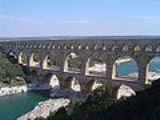
An
aqueduct is a
waterWater is a chemical substance with the chemical formula H2O. A water molecule contains one oxygen and two hydrogen atoms connected by covalent bonds. Water is a liquid at ambient conditions, but it often co-exists on Earth with its solid state, ice, and gaseous state . Water also exists in a...
supply or navigable
channelCanals are man-made channels for water. There are two types of canal:#Waterways: navigable transportation canals used for carrying ships and boats shipping goods and conveying people, further subdivided into two kinds:...
constructed to convey water. In modern engineering, the term is used for any system of pipes, ditches, canals, tunnels, and other structures used for this purpose.
In a more restricted use,
aqueduct (occasionally
water bridge) applies to any bridge or
viaductA viaduct is a bridge composed of several small spans. The term viaduct is derived from the Latin via for road and ducere to lead something. However, the Ancient Romans did not use that term per se; it is a modern derivation from an analogy with aqueduct. Like the Roman aqueducts, many early...
that transports water—instead of a path, road or railway—across a gap. Large
navigable aqueductNavigable aqueducts are bridge structures that carry navigable waterway canals over other rivers, valleys, railways or roads. They are primarily distinguished by their size, carrying a larger cross-section of water than most water-supply aqueducts...
s are used as transport links for boats or ships. Aqueducts must span a crossing at the same level as the watercourses on each side. The word is derived from the Latin
("water") and
("to lead").
Ancient aqueducts
Although particularly associated with the
RomansAncient Rome was a thriving civilization that grew on the Italian Peninsula as early as the 8th century BC. Located along the Mediterranean Sea and centered on the city of Rome, it expanded to one of the largest empires in the ancient world....
, aqueducts were devised much earlier in Greece and the
Near EastThe Near East is a geographical term that covers different countries for geographers, archeologists, and historians, on the one hand, and for political scientists, economists, and journalists, on the other...
and
Indian subcontinentThe Indian subcontinent, also Indian Subcontinent, Indo-Pak Subcontinent or South Asian Subcontinent is a region of the Asian continent on the Indian tectonic plate from the Hindu Kush or Hindu Koh, Himalayas and including the Kuen Lun and Karakoram ranges, forming a land mass which extends...
, where peoples such as the
EgyptiansAncient Egypt was an ancient civilization of Northeastern Africa, concentrated along the lower reaches of the Nile River in what is now the modern country of Egypt. Egyptian civilization coalesced around 3150 BC with the political unification of Upper and Lower Egypt under the first pharaoh...
and
HarappansThe Indus Valley Civilization was a Bronze Age civilization that was located in the northwestern region of the Indian subcontinent, consisting of what is now mainly modern-day Pakistan and northwest India...
built sophisticated
irrigationIrrigation may be defined as the science of artificial application of water to the land or soil. It is used to assist in the growing of agricultural crops, maintenance of landscapes, and revegetation of disturbed soils in dry areas and during periods of inadequate rainfall...
systems. Roman-style aqueducts were used as early as the 7th century BCE, when the
AssyriansThe Assyrian people are a distinct ethnic group whose origins lie in ancient Mesopotamia...
built an 80 km long limestone aqueduct, 10 m high and 300 m wide, to carry water across a valley to their capital city,
NinevehNineveh was an ancient Assyrian city on the eastern bank of the Tigris River, and capital of the Neo Assyrian Empire. Its ruins are across the river from the modern-day major city of Mosul, in the Ninawa Governorate of Iraq....
.
India
The Indian subcontinent is believed to have some of the earliest aqueducts. Evidence can be found at the sites of present day Hampi, Karnataka. The massive aqueducts near river Tungabhadra supplying irrigation water were once 15 miles (24.1 km) long. The waterways supplied water to royal bathhouses.
Oman
In
OmanOman , officially called the Sultanate of Oman , is an Arab state in southwest Asia on the southeast coast of the Arabian Peninsula. It is bordered by the United Arab Emirates to the northwest, Saudi Arabia to the west, and Yemen to the southwest. The coast is formed by the Arabian Sea on the...
from the Iron Age Period (found in Salut, Bat and other sites) a system of underground aqueducts called Falaj were constructed, a series of well-like vertical shafts, connected by gently sloping horizontal tunnels.
There are three types of Falaj
- Daudi (داوودية) with underground aqueducts
- Ghaili (الغيلية ) requiring a dam to collect the water
- Aini (العينية ) whose source is a water spring
These enabled large scale agriculture to flourish in a dry land environment
Persia
In
PersiaIran , officially the Islamic Republic of Iran , is a country in Southern and Western Asia. The name "Iran" has been in use natively since the Sassanian era and came into use internationally in 1935, before which the country was known to the Western world as Persia...
from early times a system of underground aqueducts called
QanatA qanāt is a water management system used to provide a reliable supply of water for human settlements and irrigation in hot, arid and semi-arid climates...
were constructed, a series of well-like vertical shafts, connected by gently sloping tunnels. This technique:
- taps into subterranean water in a manner that delivers water to the surface without need for pumping. The water drains relying on gravity, with the destination lower than the source, which is typically an upland aquifer.
- allows water to be transported long distances in hot dry climates without losing a large proportion of the source water to seepage and evaporation.
Greece
On the island of
SamosSamoš is a village in Serbia. It is situated in the Kovačica municipality, in the South Banat District, Vojvodina province. The village has a Serb ethnic majority and its population numbering 1,247 people .-See also:...
, the Tunnel of Eupalinos was built during the reign of
PolycratesPolycrates , son of Aeaces, was the tyrant of Samos from c. 538 BC to 522 BC.He took power during a festival of Hera with his brothers Pantagnotus and Syloson, but soon had Pantagnotus killed and exiled Syloson to take full control for himself. He then allied with Amasis II, pharaoh of Egypt, as...
(538-522 BC). It is considered an underground aqueduct and brought fresh water to
PythagoreionThe remains of the Pythagoreion, an ancient fortified port with Greek and Roman monuments and a spectacular tunnel, the Tunnel of Eupalinos or Eupalinian aqueduct, along with the Heraion of Samos were jointly registered as a UNESCO World Heritage Site in 1992....
for roughly a thousand years.
Roman
Roman aqueducts were built in all parts of the
Roman EmpireThe Roman Empire was the post-Republican period of the ancient Roman civilization, characterised by an autocratic form of government and large territorial holdings in Europe and around the Mediterranean....
, from Germany to Africa, and especially in the city of Rome, where they totaled over 415 km. The aqueducts supplied water to public baths and for drinking water, in large cities across the empire, and set a standard of engineering that was not surpassed for more than a thousand years.
South America
Near the
PeruPeru , officially the Republic of Peru , is a country in western South America. It is bordered on the north by Ecuador and Colombia, on the east by Brazil, on the southeast by Bolivia, on the south by Chile, and on the west by the Pacific Ocean....
vian town of Nazca, an ancient pre-Columbian system of aqueducts called
PuquiosThe Puquios are an old system of aqueducts near the city of Nazca, Peru. Out of 36 Puquios, most are still functioning and relied upon to bring fresh water into the arid desert. The Puquios have never been fully mapped, nor have any been excavated ....
were built and are still in use today. They were made of intricately placed stones, a construction material widely used by the Nazca culture. The time period in which they were constructed is still debated, but some evidence supports circa A.D. 540–552, in response to
droughtA drought is an extended period of months or years when a region notes a deficiency in its water supply. Generally, this occurs when a region receives consistently below average precipitation. It can have a substantial impact on the ecosystem and agriculture of the affected region...
periods in the region.
When European explorers arrived in the
AztecThe Aztec people were certain ethnic groups of central Mexico, particularly those groups who spoke the Nahuatl language and who dominated large parts of Mesoamerica in the 14th, 15th and 16th centuries, a period referred to as the late post-classic period in Mesoamerican chronology.Aztec is the...
capital of
Tenochtitlán early in the 16th century CE the city was found to be watered by two aqueducts.
Sri Lanka
Extensive usage of elaborate aqueducts have been found to have been used in Ancient Sri Lanka.
Modern aqueducts
In modern times, the largest aqueducts of all have been built in the United States to supply the country's biggest cities. The
Catskill AqueductThe Catskill Aqueduct, part of the New York City water supply system, brings water from the Catskill Mountains to Yonkers where it connects to other parts of the system.-History:Construction commenced in 1907...
carries water to New York City over a distance of 120 miles (190 km), but is dwarfed by aqueducts in the
far west.The Western United States, commonly referred to as the American West or simply "the West," traditionally refers to the region comprising the westernmost states of the United States. Because the U.S. expanded westward after its founding, the meaning of the West has evolved over time...
of the country, most notably the
Colorado River AqueductThe Colorado River Aqueduct, or CRA, is a water conveyance in Southern California in the United States, operated by the Metropolitan Water District of Southern California . The aqueduct impounds water from the Colorado River at Lake Havasu on the California-Arizona border west across the Mojave...
, which supplies the Los Angeles area with water from the
Colorado RiverThe Colorado River , is a river in the Southwestern United States and northwestern Mexico, approximately long, draining a part of the arid regions on the western slope of the Rocky Mountains. The watershed of the Colorado River covers in parts of seven U.S. states and two Mexican states...
nearly 400 km to the east and the 701.5 mi (1,129 km)
California AqueductThe Governor Edmund G. Brown California Aqueduct is a system of canals, tunnels, and pipelines that conveys water collected from the Sierra Nevada Mountains and valleys of Northern- and Central California to Southern California. The Department of Water Resources operates and maintains the...
, which runs from the Sacramento-San Joaquin River Delta to
Lake PerrisLake Perris is an artificial lake completed in 1973. It is the southern terminus of the California State Water Project situated in a mountain-rimmed valley between Moreno Valley, and city of Perris in what is now the Lake Perris State Recreation Area. The park offers a variety of recreational...
. The Central Arizona Project is the largest and most expensive aqueduct constructed in the United States. It stretches 336 miles from its source near
Parker, ArizonaParker is a town in and the county seat of La Paz County, Arizona, United States, on the Colorado River in Parker Valley. The population was 3,140 at the 2000 census.-History:...
to the metropolitan areas of
PhoenixPhoenix is the capital, and largest city, of the U.S. state of Arizona, as well as the sixth most populated city in the United States. Phoenix is home to 1,445,632 people according to the official 2010 U.S. Census Bureau data...
and Tucson.
A modern version of aqueduct is a
pipeline bridgeA pipeline bridge is a bridge for running a pipeline over a river. Pipeline bridges for liquids and gases are, as a rule, only built when it is not possible to run the pipeline on a conventional bridge or under the river...
.
Uses
Historically, agricultural societies have constructed aqueducts to
irrigateIrrigation may be defined as the science of artificial application of water to the land or soil. It is used to assist in the growing of agricultural crops, maintenance of landscapes, and revegetation of disturbed soils in dry areas and during periods of inadequate rainfall...
crops.
ArchimedesArchimedes of Syracuse was a Greek mathematician, physicist, engineer, inventor, and astronomer. Although few details of his life are known, he is regarded as one of the leading scientists in classical antiquity. Among his advances in physics are the foundations of hydrostatics, statics and an...
invented the
water screwThe Archimedes' screw, also called the Archimedean screw or screwpump, is a machine historically used for transferring water from a low-lying body of water into irrigation ditches...
to raise water for use in irrigation of croplands.
Another use for aqueducts is to supply large cities with drinking water. Some of the Roman aqueducts still supply water to Rome today. In
CaliforniaCalifornia is a state located on the West Coast of the United States. It is by far the most populous U.S. state, and the third-largest by land area...
, United States, three large aqueducts supply water over hundreds of miles to the Los Angeles area. Two are from the
Owens RiverThe Owens River is a river in southeastern California in the United States, approximately long. It drains into and through the Owens Valley, an arid basin between the eastern slope of the Sierra Nevada and the western faces of the Inyo and White Mountains. The river terminates at Owens Lake, but...
area and a third is from the Colorado River.
In more recent times, aqueducts were used for transportation purposes to allow
canalCanals are man-made channels for water. There are two types of canal:#Waterways: navigable transportation canals used for carrying ships and boats shipping goods and conveying people, further subdivided into two kinds:...
bargeA barge is a flat-bottomed boat, built mainly for river and canal transport of heavy goods. Some barges are not self-propelled and need to be towed by tugboats or pushed by towboats...
s to cross ravines or valleys. During the
Industrial RevolutionThe Industrial Revolution was a period from the 18th to the 19th century where major changes in agriculture, manufacturing, mining, transportation, and technology had a profound effect on the social, economic and cultural conditions of the times...
of the 18th century, aqueducts were constructed as part of the boom in canal-building.
In modern
civil engineeringCivil engineering is a professional engineering discipline that deals with the design, construction, and maintenance of the physical and naturally built environment, including works like roads, bridges, canals, dams, and buildings...
projects, detailed study and analysis of
open channel flowOpen-Channel Flow, a branch of Hydraulics, is a type of liquid flow within a conduit with a free surface, known as a channel. The other type of flow within a conduit is pipe flow. These two types of flow are similar in many ways, but differ in one important respect; the free surface...
is commonly required to support flood control, irrigation systems, and large water supply systems when an aqueduct rather than a pipeline is the preferred solution.
In the past, aqueducts often had channels made of earth or other porous materials but significant amounts of water are lost through such unlined aqueducts. As water gets increasingly scarce, these canals are being lined with
concreteConcrete is a composite construction material, composed of cement and other cementitious materials such as fly ash and slag cement, aggregate , water and chemical admixtures.The word concrete comes from the Latin word...
, polymers or impermeable soil. In some cases, a new aqueduct is built alongside the old one because it cannot be shut down during construction.
Ancient Greek aqueducts
- The Eupalinian aqueduct
The Tunnel of Eupalinos or Eupalinian aqueduct is a tunnel of length in Samos, Greece, built in the 6th century BC to serve as an aqueduct. The tunnel is the second known tunnel in history which was excavated from both ends , and the first with a geometry-based approach in doing so...
on the GreekGreece , officially the Hellenic Republic , and historically Hellas or the Republic of Greece in English, is a country in southeastern Europe....
island of SamosSamos is a Greek island in the eastern Aegean Sea, south of Chios, north of Patmos and the Dodecanese, and off the coast of Asia Minor, from which it is separated by the -wide Mycale Strait. It is also a separate regional unit of the North Aegean region, and the only municipality of the regional...
.
Roman aqueducts
- The Pont du Gard
The Pont du Gard is a notable ancient Roman aqueduct bridge that crosses the Gard River in southern France. It is part of a long aqueduct that runs between Uzès and Nîmes in the South of France. It is located in Vers-Pont-du-Gard near Remoulins, in the Gard département...
in southern France
- Barbegal aqueduct, France
- Aqueduto de São Sebastião, in Coimbra
Coimbra is a city in the municipality of Coimbra in Portugal. Although it served as the nation's capital during the High Middle Ages, it is better-known for its university, the University of Coimbra, which is one of the oldest in Europe and the oldest academic institution in the...
, Portugal
- Eifel aqueduct
The Eifel Aqueduct was one of the longest aqueducts of the Roman Empire.The aqueduct, constructed in AD 80, carried water some from the hilly Eifel region of what is now Germany to the ancient city of Colonia Claudia Ara Agrippinensium . If the auxiliary spurs to additional springs are included,...
, Germany
- Caesarea Maritima, Israel
The State of Israel is a parliamentary republic located in the Middle East, along the eastern shore of the Mediterranean Sea...
- Patras
Patras , ) is Greece's third largest urban area and the regional capital of West Greece, located in northern Peloponnese, 215 kilometers west of Athens...
, Greece
- Aqueduct of Segovia
The Aqueduct of Segovia is a Roman aqueduct and one of the most significant and best-preserved ancient monuments left on the Iberian Peninsula...
, Spain
- Acueducto de los Milagros
The Acueducto de los Milagros is a ruined Roman aqueduct in Mérida, Spain, formerly the Roman colony of Emerita Augusta....
, Mérida, SpainMérida is the capital of the autonomous community of Extremadura, western central Spain. It has a population of 57,127 . The Archaeological Ensemble of Mérida is a UNESCO World Heritage site since 1993.- Climate :...
- Tarragona
Tarragona is a city located in the south of Catalonia on the north-east of Spain, by the Mediterranean. It is the capital of the Spanish province of the same name and the capital of the Catalan comarca Tarragonès. In the medieval and modern times it was the capital of the Vegueria of Tarragona...
, Spain
- Almuñécar, Spain (5 aqueducts – 4 still in use)
- Valens Aqueduct
The Valens Aqueduct is a Roman aqueduct which was the major water-providing system of the Eastern Roman capital of Constantinople...
, IstanbulIstanbul , historically known as Byzantium and Constantinople , is the largest city of Turkey. Istanbul metropolitan province had 13.26 million people living in it as of December, 2010, which is 18% of Turkey's population and the 3rd largest metropolitan area in Europe after London and...
, TurkeyTurkey , known officially as the Republic of Turkey , is a Eurasian country located in Western Asia and in East Thrace in Southeastern Europe...
- Aqua Augusta, Italy
- Aqua Claudia
Aqua Claudia was an aqueduct of ancient Rome that, like the Anio Novus, was begun by emperor Caligula in 38 AD and completed by Emperor Claudius in 52 AD. Its main springs, the Caeruleus and Curtius, were situated 300 paces to the left of the thirty-eighth milestone of the Via Sublacensis...
and the Anio NovusAnio Novus is an aqueduct of Rome. Together with the Aqua Claudia, it was begun by emperor Caligula in 38 AD and completed in 52 AD by Claudius, who dedicated them both on August 1.-Details:...
, as part of the Porta MaggioreThe Porta Maggiore , or Porta Prenestina, is one of the eastern gates in the ancient but well-preserved 3rd-century Aurelian Walls of Rome....
, Rome, Italy
- Skopje Aqueduct, Skopje
Skopje is the capital and largest city of the Republic of Macedonia with about a third of the total population. It is the country's political, cultural, economic, and academic centre...
, Republic of MacedoniaMacedonia , officially the Republic of Macedonia , is a country located in the central Balkan peninsula in Southeast Europe. It is one of the successor states of the former Yugoslavia, from which it declared independence in 1991...
Other aqueducts


- Wignacourt Aqueduct, Malta
Malta , officially known as the Republic of Malta , is a Southern European country consisting of an archipelago situated in the centre of the Mediterranean, south of Sicily, east of Tunisia and north of Libya, with Gibraltar to the west and Alexandria to the east.Malta covers just over in...
. Built in the 16th century to transport water from the old capital city of Malta, MdinaMdina, Città Vecchia, or Città Notabile, is the old capital of Malta. Mdina is a medieval walled town situated on a hill in the centre of the island. Punic remains uncovered beyond the city’s walls suggest the importance of the general region to Malta’s Phoenician settlers. Mdina is commonly...
to the new capital city VallettaValletta is the capital of Malta, colloquially known as Il-Belt in Maltese. It is located in the central-eastern portion of the island of Malta, and the historical city has a population of 6,098. The name "Valletta" is traditionally reserved for the historic walled citadel that serves as Malta's...
. Today, only part is visible in the localities of BalzanĦal Balzan is small village in Malta, one of the so called three villages, together with Attard and Lija.The village originally consisted of a group of small dwellings and farms but eventually grew, becoming a parish in the 17th century...
, BirkirkaraBirkirkara or B'Kara is a city of 25,858 inhabitants in central Malta. It is the most populated town on the island and consists of four autonomous parishes: St Helen, St Joseph, Our Lady of Mount Carmel and St Mary. It also houses one of the most famous colleges in Malta, St Aloysius' College...
and Santa VeneraSanta Venera is a town in Malta, with a population of around 6,800 . This settlement is found in the Outer Harbour Region of Malta. The oldest buildings in Santa Venera are Wignacourt Aqueduct and Casa Leoni, both of which were built by the Knights of St. John.A new church has been built recently...
.
- Aqueduct St-Clément, Montpellier
-Neighbourhoods:Since 2001, Montpellier has been divided into seven official neighbourhoods, themselves divided into sub-neighbourhoods. Each of them possesses a neighbourhood council....
, France – 17th century
- Bar Aqueduct
The Bar Aqueduct is a stone bridge, located on the northern side of the Old Town of Bar , Montenegro...
, MontenegroMontenegro Montenegrin: Crna Gora Црна Гора , meaning "Black Mountain") is a country located in Southeastern Europe. It has a coast on the Adriatic Sea to the south-west and is bordered by Croatia to the west, Bosnia and Herzegovina to the northwest, Serbia to the northeast and Albania to the...
- 16th century
- Águas Livres Aqueduct
The Águas Livres Aqueduct is a historic aqueduct in the city of Lisbon, Portugal. It is one of the most remarkable examples of 18th-century Portuguese engineering...
, in LisbonLisbon is the capital city and largest city of Portugal with a population of 545,245 within its administrative limits on a land area of . The urban area of Lisbon extends beyond the administrative city limits with a population of 3 million on an area of , making it the 9th most populous urban...
, Portugal (built 1731–1748)
- Aqueduto de Óbidos, in Óbidos, Portugal (built 1570)
- Aqueduto de Setúbal in Setúbal
Setúbal is the main city in Setúbal Municipality in Portugal with a total area of 172.0 km² and a total population of 118,696 inhabitants in the municipality. The city proper has 89,303 inhabitants....
, Portugal (built 1696)
- Aqueduto dos Pegões in Tomar
Tomar Municipality has a total area of 351.0 km² and a total population of 43,007 inhabitants.The municipality is composed of 16 parishes, and is located in Santarém District...
, Portugal (built 1593)
- Água de Prata Aqueduct, in Évora
Évora is a municipality in Portugal. It has total area of with a population of 55,619 inhabitants. It is the seat of the Évora District and capital of the Alentejo region. The municipality is composed of 19 civil parishes, and is located in Évora District....
, Portugal (built 1531–1537)
- Santa Clara Aqueduct
thumb|right|170px|Santa Clara Aqueduct.Aqueduct of Santa Clara is an aqueduct in Portugal located in that stretches from Póvoa de Varzim to Vila do Conde, it was raised between 1626 and 1714 and was composed of 999 arches taking the waters from the spring of Terroso for the convent of Santa Clara...
, in Vila do Conde, Portugal
- Carioca Aqueduct
The Carioca Aqueduct is an aqueduct in the city of Rio de Janeiro, Brazil. The aqueduct was built in the middle of the 18th century to bring fresh water from the Carioca river to the population of the city...
in Rio de JaneiroRio de Janeiro , commonly referred to simply as Rio, is the capital city of the State of Rio de Janeiro, the second largest city of Brazil, and the third largest metropolitan area and agglomeration in South America, boasting approximately 6.3 million people within the city proper, making it the 6th...
, BrazilBrazil , officially the Federative Republic of Brazil , is the largest country in South America. It is the world's fifth largest country, both by geographical area and by population with over 192 million people...
(built 1744–1750)
- Aqueduct of Teruel, Spain
- Roquefavour aqueduct, France – built between 1842 and 1847
- Winnipeg Aqueduct, Manitoba
Manitoba is a Canadian prairie province with an area of . The province has over 110,000 lakes and has a largely continental climate because of its flat topography. Agriculture, mostly concentrated in the fertile southern and western parts of the province, is vital to the province's economy; other...
, Canada – built between 1915 and 1919
- Canal de l'Aqueduc
The Canal de l'Aqueduc is an open-air aqueduct canal on the Island of Montreal in Quebec, Canada, serving part of the drinking water needs of the city of Montreal....
, QuebecQuebec or is a province in east-central Canada. It is the only Canadian province with a predominantly French-speaking population and the only one whose sole official language is French at the provincial level....
, Canada
- Päijänne Water Tunnel
The Päijänne Water Tunnel , located in Southern Finland, is the world's second longest continuous rock tunnel . It is long and runs 30–100 meters under the surface in bedrock...
, a 120-kilometer long underground aqueduct (continuous tunnel) connecting lake Päijänne to Greater HelsinkiGreater Helsinki and the smaller Helsinki Metropolitan Area or Capital Region refer to two regions of different size surrounding Helsinki, the capital of Finland...
.
- Wan Mat Saman Aqueduct
Wan Mat Saman Aqueduct or Terusan Wan Mat Saman is the longest aqueduct in Malaysia. The total length is 31 km, connecting Sungai Kedah at Alor Star to Gurun in the south of Kedah. It was built between 1900 and 1909 at the order of Menteri Besar of Kedah at the time, Wan Mat Saman...
, KedahKedah is a state of Malaysia, located in the northwestern part of Peninsular Malaysia. The state covers a total area of over 9,000 km², and it consists of the mainland and Langkawi. The mainland has a relatively flat terrain, which is used to grow rice...
, Malaysia – built between 1900 and 1909
- Mathur Aqueduct
Mathur Aqueduct or Mathur Hanging Trough, is an Aqueduct in Southern India, in Kanyakumari District of Tamilnadu state. Built over the Pahrali River , it takes its name from Mathur, a hamlet near the Aqueduct, which is at a distance of about 3 kilometres from Thiruvattar town and about 60 km...
in Tamilnadu state, India
- Pontcysyllte Aqueduct
The Pontcysyllte Aqueduct is a navigable aqueduct that carries the Llangollen Canal over the valley of the River Dee in Wrexham in north east Wales....
in Wales
- Surviving Spanish aqueducts in Mexico:
- Aqueduct of Querétaro
Santiago de Querétaro is the capital and largest city of the state of Querétaro, located in central Mexico. It is located 213 km northwest of Mexico City, 96 km southeast of San Miguel de Allende and 200 km south of San Luis Potosí...
, Mexico – built between 1726 and 1738, 1.3 km long and featuring 74 arches.
- Aqueduct of Morelia
Morelia is a city and municipality in the north central part of the state of Michoacán in central Mexico. The city is in the Guayangareo Valley and is the capital of the state. The main pre-Hispanic cultures here were the P'urhépecha and the Matlatzinca, but no major cities were founded in the...
, MichoacánMichoacán officially Estado Libre y Soberano de Michoacán de Ocampo is one of the 31 states which, with the Federal District, comprise the 32 Federal Entities of Mexico. It is divided in 113 municipalities and its capital city is Morelia...
, built between 1735 and 1738.
- Aqueduct of Acámbaro
Acámbaro is a city and municipality in the southeastern corner of the Mexican state of Guanajuato, on the banks of the Lerma River, and the oldest of the 46 municipalities of Guanajuato. Acámbaro is noted as a major railway junction, a local transport hub, and the origin of the nationally famous...
, GuanajuatoGuanajuato officially Estado Libre y Soberano de Guanajuato is one of the 31 states which, with the Federal District, comprise the 32 Federal Entities of Mexico. It is divided in 46 municipalities and its capital city is Guanajuato....
, built in 1528.
- Chapultepec aqueduct
The Chapultepec aqueduct is an aqueduct originally built at Chapultepec by the Aztecs during the Tenochtitlan era; its original name was simply the “Great Aqueduct.” What remains of the aqueduct today is located in Mexico City near Metro Sevilla....
, Mexico D.F
- Kavala aqueduct
The Kavala aqueduct, popularly known as the Kamares , is a well-preserved aqueduct in the city of Kavala, Greece, and is one of the city's landmarks.While the aqueduct is "probably of Roman origin", the present structure dates to the 16th century...
, 16th-century Ottoman aqueduct in Kavala, Greece
- Levada
A levada is an irrigation channel or aqueduct specific to the island of Madeira in the Atlantic Ocean .-History:...
s, 1350 miles (2,172.6 km) of 17th century aqueducts on the PortuguesePortugal , officially the Portuguese Republic is a country situated in southwestern Europe on the Iberian Peninsula. Portugal is the westernmost country of Europe, and is bordered by the Atlantic Ocean to the West and South and by Spain to the North and East. The Atlantic archipelagos of the...
island of MadeiraMadeira is a Portuguese archipelago that lies between and , just under 400 km north of Tenerife, Canary Islands, in the north Atlantic Ocean and an outermost region of the European Union...
.
- Espada Aqueduct
Mission San Francisco de la Espada was a Roman Catholic mission established by Spain near San Antonio de Bexar in northern New Spain in 1731 to convert local Native Americans to Christianity and solidify Spanish territorial claims in the New World against encroachment from France...
, built 1735, in San Antonio, TexasSan Antonio is the seventh-largest city in the United States of America and the second-largest city within the state of Texas, with a population of 1.33 million. Located in the American Southwest and the south–central part of Texas, the city serves as the seat of Bexar County. In 2011,...
, United States.
- Quabbin Aqueduct
The Quabbin Aqueduct carries water from the Quabbin Reservoir to the Wachusett Reservoir. It is part of the Eastern Massachusetts public water supply system, maintained by the Massachusetts Water Resources Authority...
, 24.6 miles (39.6 km) long tunnel, in MassachusettsThe Commonwealth of Massachusetts is a state in the New England region of the northeastern United States of America. It is bordered by Rhode Island and Connecticut to the south, New York to the west, and Vermont and New Hampshire to the north; at its east lies the Atlantic Ocean. As of the 2010...
, United States.
- Chicopee Valley Aqueduct
The Chicopee Valley Aqueduct carries water from the Quabbin Reservoir in Massachusetts to the Chicopee city line. It delivers Quabbin water to Wilbraham, South Hadley fire district #1, and Chicopee...
, 13.1 miles (21.1 km) long, in MassachusettsThe Commonwealth of Massachusetts is a state in the New England region of the northeastern United States of America. It is bordered by Rhode Island and Connecticut to the south, New York to the west, and Vermont and New Hampshire to the north; at its east lies the Atlantic Ocean. As of the 2010...
, United States.
- Central Arizona Project Aqueduct
The Central Arizona Project is a 336 mi diversion canal in Arizona in the United States. The aqueduct diverts water from the Colorado River from Lake Havasu City near Parker into central and southern Arizona. The CAP is the largest and most expensive aqueduct system ever constructed in the...
- California Aqueduct
The Governor Edmund G. Brown California Aqueduct is a system of canals, tunnels, and pipelines that conveys water collected from the Sierra Nevada Mountains and valleys of Northern- and Central California to Southern California. The Department of Water Resources operates and maintains the...
, a 715 mi (1,151 km) combination of canals, pipelines and tunnels, United States.
- Delaware Aqueduct
The Delaware Aqueduct is the newest of the New York City aqueducts. It takes water from the Rondout Reservoir through the Chelsea Pump Station, the West Branch Reservoir, and the Kensico Reservoir, ending at the Hillview Reservoir in Yonkers, New York....
, in New YorkNew York is a state in the Northeastern region of the United States. It is the nation's third most populous state. New York is bordered by New Jersey and Pennsylvania to the south, and by Connecticut, Massachusetts and Vermont to the east...
State, United States – at 85 miles (137 km) long, the world's longest continuous underground tunnel.
- High Bridge
The High Bridge is a steel arch bridge, with a height of almost 140 feet over the Harlem River, connecting the New York City boroughs of The Bronx and Manhattan...
, part of the former Croton AqueductThe Croton Aqueduct or Old Croton Aqueduct was a large and complex water distribution system constructed for New York City between 1837 and 1842...
, built in 1848, is the oldest surviving bridge in New York City.
- Sooke Flowline
The Sooke Flowline is an abandoned 44 kilometer concrete aqueduct that snakes through the Sooke Hills from Sooke Lake to the Humpback Reservoir near Mt. Wells Regional Park. From this reservoir, a buried, riveted steel pressure main transported water to Victoria. In between 1994 and 2007, this...
located on Vancouver Island, Canada, is a 44 kilometres long, gravity fed concrete pipe which provided water to the City Of VictoriaVictoria is the capital city of British Columbia, Canada and is located on the southern tip of Vancouver Island off Canada's Pacific coast. The city has a population of about 78,000 within the metropolitan area of Greater Victoria, which has a population of 360,063, the 15th most populous Canadian...
for 55 years.
- National Water Carrier of Israel
The National Water Carrier of Israel is the largest water project in Israel. Its main task is to transfer water from the Sea of Galilee in the north of the country to the highly populated center and arid south and to enable efficient use of water and regulation of the water supply in the country...
located in IsraelThe State of Israel is a parliamentary republic located in the Middle East, along the eastern shore of the Mediterranean Sea...
, is a 130 km long system of giant pipes, open canals, tunnels, reservoirs and large scale pumping stations to transfer water from the Sea of GalileeThe Sea of Galilee, also Kinneret, Lake of Gennesaret, or Lake Tiberias , is the largest freshwater lake in Israel, and it is approximately in circumference, about long, and wide. The lake has a total area of , and a maximum depth of approximately 43 m...
in the north of the country to the highly populated center and arid south, built between 1953 and 1964.
See also
- Earthquake engineering
Earthquake engineering is the scientific field concerned with protecting society, the natural and the man-made environment from earthquakes by limiting the seismic risk to socio-economically acceptable levels...
- Goldfields Water Supply Scheme
The Goldfields Water Supply Scheme is a pipeline and dam project which delivers potable water to communities in Western Australia's Eastern Goldfields, particularly Coolgardie and Kalgoorlie...
- Leat
A leat is the name, common in the south and west of England and in Wales, for an artificial watercourse or aqueduct dug into the ground, especially one supplying water to a watermill or its mill pond...
- List of Roman aqueduct bridges
- Pipeline
Pipeline transport is the transportation of goods through a pipe. Most commonly, liquids and gases are sent, but pneumatic tubes that transport solid capsules using compressed air are also used....
– some used to carry water
- Roman architecture
Ancient Roman architecture adopted certain aspects of Ancient Greek architecture, creating a new architectural style. The Romans were indebted to their Etruscan neighbors and forefathers who supplied them with a wealth of knowledge essential for future architectural solutions, such as hydraulics...
- Roman engineering
Romans are famous for their advanced engineering accomplishments, although some of their own inventions were improvements on older ideas, concepts and inventions. Technology for bringing running water into cities was developed in the east, but transformed by the Romans into a technology...
- Sanitation in Ancient Rome
Sanitation in ancient Rome was a complex system similar in many ways to modern sanitation systems. During the Dark Ages, the technical knowledge of the system was lost and has subsequently been investigated by modern-era historians and archeologists....
- Water resources
Water resources are sources of water that are useful or potentially useful. Uses of water include agricultural, industrial, household, recreational and environmental activities. Virtually all of these human uses require fresh water....
External links