


Château

Encyclopedia
A château is a manor house
or residence of the lord of the manor
or a country house of nobility
or gentry
, with or without fortifications, originally—and still most frequently—in French
-speaking regions. Where clarification is needed, a fortified château (that is, a castle
) is called a château fort, such as Château fort de Roquetaillade
. Care should be taken when translating the word château into English
. It is not used in the same way as "castle", and most châteaux are described in English as "palace
s" or "country houses" rather than "castles". For example, the Château de Versailles
is so called because it was located in the countryside when it was built, but it does not bear any resemblance to a castle, so it is usually known in English as the Palace of Versailles.
The urban
counterpart of château is palais
, which in French is applied only to grand houses in a city. This usage is again different from that of the term "palace" in English, where there is no requirement that a palace must be in a city, but the word is rarely used for buildings other than the grandest royal residences. The expression hôtel particulier
is used for an urban "private house" of a grand sort. Some castles are now used as hotels.
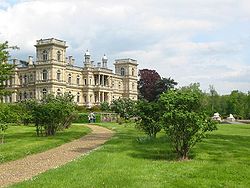 If a château is not old, then it must be grand. A château is a “power house”, as Sir John Summerson
dubbed the British and Irish “stately homes” that are the British Isles' architectural counterparts to French châteaux. It is the personal (and usually hereditary) badge of a family that, with some official rank, locally represents the royal authority; thus, the word château often refers to the dwelling of a member of either the French royalty or the nobility, but some fine châteaux, such as Vaux-le-Vicomte
, were built by the essentially high-bourgeois — people but recently ennobled: tax-farmers and ministers of Louis XIII
and his royal successors.
A château is supported by its terres (lands), composing a demesne
that renders the society of the château largely self-sufficient, in the manner of the historic Roman and Early Mediæval villa
system, (cf. manorialism
, hacienda
). The open villas of Rome in the times of Pliny the Elder
, Maecenas, and Emperor Tiberius
began to be walled-in, and then fortified in the 3rd century AD, thus evolving to castellar “châteaux”. In modern usage, a château retains some enclosures that are distant descendants of these fortifying outworks: a fenced, gated, closeable forecourt, perhaps a gatehouse
or a keeper's lodge, and supporting outbuildings (stables, kitchens, breweries, bakeries, manservant quarters in the garçonnière). Besides the cour d’honneur (court of honour) entrance, the château might have an inner cour (“court”), and inside, in the private residence, the château faces a simply and discreetly enclosed park.
In the city of Paris, the Louvre
(fortified) and the Luxembourg
(originally suburban) represented the original château but lost their château etymology, becoming “palaces” when the City enclosed them. In the U.S., the word château took root selectively, in the Gilded Age
resort town of Newport, Rhode Island
, the châteaux were called “cottages”, but, north of Wilmington, Delaware
, in the rich, rural “Château Country” centred upon the powerful Du Pont family
, château is used with its original definition. In Canada, especially in English, château usually denotes a hotel, not a house, and applies only to the largest, most elaborate railway hotels
built in the Canadian Railroad golden age, such as the Château Lake Louise
, in Lake Louise, Alberta
, the Château Laurier
, in Ottawa
, the Château Montebello
, in Montebello, Quebec
, and the most famous Château Frontenac
, in Quebec City
. Moreover, in other French-speaking European regions, such as Wallonia (Belgium
), the word Château is used with the same definition. In Belgium, a strong French architectural influence is evident in the seventeenth-century Château des Comtes de Marchin
and the eighteenth-century Château de Seneffe
.
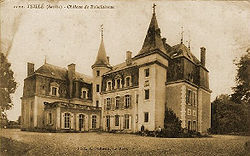

(Vallée de la Loire) is home to more than 300 châteaux
. They were built between the 10th and 20th centuries, firstly by the French kings followed soon thereafter by the nobility; hence, the Valley is termed "The Valley of the Kings". Alternatively, due to its moderate climate, wine growing soils and rich agricultural land, the Loire Valley is referred to as "The Garden of France". The châteaux range from the very large (often now in public hands) to more 'human-scale' châteaux such as the Château de Beaulieu in Saumur
which is built of the local tuffeau stone.
is simililary a baroque French chateau located in Maincy
, near Melun
, 55 km southeast of Paris in the Seine-et-Marne
département of France. It was built from 1658 to 1661 for Nicolas Fouquet
, Marquis de Belle-Isle (Belle-Île-en-Mer), Viscount of Melun and Vaux, the superintendent of finances of Louis XIV.
's son-in-law, is a French Baroque château of manageable size. Protected behind fine wrought iron double gates, the main block and its outbuildings (corps de logis), linked by balustrades, are ranged symmetrically around a dry paved and gravelled cour d'honneur. Behind, the central axis is extended between the former parterre
s, now mown hay. The park with formally shaped water was laid out by André Le Notre
. There are sumptuous interiors. The small scale (compared to Vaux-le-Vicomte
for example) makes it easier to compare it to the approximately contemporary Het Loo
, for William III of Orange
. These really are "Mansart roofs."
, but it is customary for any wine
-producing estate, no matter how humble, to prefix its name with "Château". This is true whether the building itself is a magnificent palace or a shack. If there were any trace of doubt that the Roman villas of Aquitaine
evolved into fortified self-contained châteaux, the wine-producing châteaux would dispel it.
On the other hand there are many beautiful châteaux in the Bordeaux region still depicting this Roman villa style of architecture, an example of this being Château Lagorce
in Haux.
Manor house
A manor house is a country house that historically formed the administrative centre of a manor, the lowest unit of territorial organisation in the feudal system in Europe. The term is applied to country houses that belonged to the gentry and other grand stately homes...
or residence of the lord of the manor
Lord of the Manor
The Lordship of a Manor is recognised today in England and Wales as a form of property and one of three elements of a manor that may exist separately or be combined and may be held in moieties...
or a country house of nobility
Nobility
Nobility is a social class which possesses more acknowledged privileges or eminence than members of most other classes in a society, membership therein typically being hereditary. The privileges associated with nobility may constitute substantial advantages over or relative to non-nobles, or may be...
or gentry
Gentry
Gentry denotes "well-born and well-bred people" of high social class, especially in the past....
, with or without fortifications, originally—and still most frequently—in French
French language
French is a Romance language spoken as a first language in France, the Romandy region in Switzerland, Wallonia and Brussels in Belgium, Monaco, the regions of Quebec and Acadia in Canada, and by various communities elsewhere. Second-language speakers of French are distributed throughout many parts...
-speaking regions. Where clarification is needed, a fortified château (that is, a castle
Castle
A castle is a type of fortified structure built in Europe and the Middle East during the Middle Ages by European nobility. Scholars debate the scope of the word castle, but usually consider it to be the private fortified residence of a lord or noble...
) is called a château fort, such as Château fort de Roquetaillade
Château de Roquetaillade
The Château de Roquetaillade is a castle in Mazères , in the French département of Gironde.Charlemagne, on his way to the Pyrenees with Roland, built the first fortification there...
. Care should be taken when translating the word château into English
English language
English is a West Germanic language that arose in the Anglo-Saxon kingdoms of England and spread into what was to become south-east Scotland under the influence of the Anglian medieval kingdom of Northumbria...
. It is not used in the same way as "castle", and most châteaux are described in English as "palace
Palace
A palace is a grand residence, especially a royal residence or the home of a head of state or some other high-ranking dignitary, such as a bishop or archbishop. The word itself is derived from the Latin name Palātium, for Palatine Hill, one of the seven hills in Rome. In many parts of Europe, the...
s" or "country houses" rather than "castles". For example, the Château de Versailles
Palace of Versailles
The Palace of Versailles , or simply Versailles, is a royal château in Versailles in the Île-de-France region of France. In French it is the Château de Versailles....
is so called because it was located in the countryside when it was built, but it does not bear any resemblance to a castle, so it is usually known in English as the Palace of Versailles.
The urban
Urban area
An urban area is characterized by higher population density and vast human features in comparison to areas surrounding it. Urban areas may be cities, towns or conurbations, but the term is not commonly extended to rural settlements such as villages and hamlets.Urban areas are created and further...
counterpart of château is palais
Palace
A palace is a grand residence, especially a royal residence or the home of a head of state or some other high-ranking dignitary, such as a bishop or archbishop. The word itself is derived from the Latin name Palātium, for Palatine Hill, one of the seven hills in Rome. In many parts of Europe, the...
, which in French is applied only to grand houses in a city. This usage is again different from that of the term "palace" in English, where there is no requirement that a palace must be in a city, but the word is rarely used for buildings other than the grandest royal residences. The expression hôtel particulier
Hôtel particulier
In French contexts an hôtel particulier is an urban "private house" of a grand sort. Whereas an ordinary maison was built as part of a row, sharing party walls with the houses on either side and directly fronting on a street, an hôtel particulier was often free-standing, and by the 18th century it...
is used for an urban "private house" of a grand sort. Some castles are now used as hotels.
Concept
John Summerson
Sir John Newenham Summerson CH CBE was one of the leading British architectural historians of the 20th century....
dubbed the British and Irish “stately homes” that are the British Isles' architectural counterparts to French châteaux. It is the personal (and usually hereditary) badge of a family that, with some official rank, locally represents the royal authority; thus, the word château often refers to the dwelling of a member of either the French royalty or the nobility, but some fine châteaux, such as Vaux-le-Vicomte
Vaux-le-Vicomte
The Château de Vaux-le-Vicomte is a baroque French château located in Maincy, near Melun, 55 km southeast of Paris in the Seine-et-Marne département of France...
, were built by the essentially high-bourgeois — people but recently ennobled: tax-farmers and ministers of Louis XIII
Louis XIII of France
Louis XIII was a Bourbon monarch who ruled as King of France and of Navarre from 1610 to 1643.Louis was only eight years old when he succeeded his father. His mother, Marie de Medici, acted as regent during Louis' minority...
and his royal successors.
A château is supported by its terres (lands), composing a demesne
Manorialism
Manorialism, an essential element of feudal society, was the organizing principle of rural economy that originated in the villa system of the Late Roman Empire, was widely practiced in medieval western and parts of central Europe, and was slowly replaced by the advent of a money-based market...
that renders the society of the château largely self-sufficient, in the manner of the historic Roman and Early Mediæval villa
Villa
A villa was originally an ancient Roman upper-class country house. Since its origins in the Roman villa, the idea and function of a villa have evolved considerably. After the fall of the Roman Republic, villas became small farming compounds, which were increasingly fortified in Late Antiquity,...
system, (cf. manorialism
Manorialism
Manorialism, an essential element of feudal society, was the organizing principle of rural economy that originated in the villa system of the Late Roman Empire, was widely practiced in medieval western and parts of central Europe, and was slowly replaced by the advent of a money-based market...
, hacienda
Hacienda
Hacienda is a Spanish word for an estate. Some haciendas were plantations, mines, or even business factories. Many haciendas combined these productive activities...
). The open villas of Rome in the times of Pliny the Elder
Pliny the Elder
Gaius Plinius Secundus , better known as Pliny the Elder, was a Roman author, naturalist, and natural philosopher, as well as naval and army commander of the early Roman Empire, and personal friend of the emperor Vespasian...
, Maecenas, and Emperor Tiberius
Tiberius
Tiberius , was Roman Emperor from 14 AD to 37 AD. Tiberius was by birth a Claudian, son of Tiberius Claudius Nero and Livia Drusilla. His mother divorced Nero and married Augustus in 39 BC, making him a step-son of Octavian...
began to be walled-in, and then fortified in the 3rd century AD, thus evolving to castellar “châteaux”. In modern usage, a château retains some enclosures that are distant descendants of these fortifying outworks: a fenced, gated, closeable forecourt, perhaps a gatehouse
Gatehouse
A gatehouse, in architectural terminology, is a building enclosing or accompanying a gateway for a castle, manor house, fort, town or similar buildings of importance.-History:...
or a keeper's lodge, and supporting outbuildings (stables, kitchens, breweries, bakeries, manservant quarters in the garçonnière). Besides the cour d’honneur (court of honour) entrance, the château might have an inner cour (“court”), and inside, in the private residence, the château faces a simply and discreetly enclosed park.
In the city of Paris, the Louvre
Louvre
The Musée du Louvre – in English, the Louvre Museum or simply the Louvre – is one of the world's largest museums, the most visited art museum in the world and a historic monument. A central landmark of Paris, it is located on the Right Bank of the Seine in the 1st arrondissement...
(fortified) and the Luxembourg
Luxembourg Palace
The Luxembourg Palace in the 6th arrondissement of Paris, north of the Luxembourg Garden , is the seat of the French Senate.The formal Luxembourg Garden presents a 25-hectare green parterre of gravel and lawn populated with statues and provided with large basins of water where children sail model...
(originally suburban) represented the original château but lost their château etymology, becoming “palaces” when the City enclosed them. In the U.S., the word château took root selectively, in the Gilded Age
Gilded Age
In United States history, the Gilded Age refers to the era of rapid economic and population growth in the United States during the post–Civil War and post-Reconstruction eras of the late 19th century. The term "Gilded Age" was coined by Mark Twain and Charles Dudley Warner in their book The Gilded...
resort town of Newport, Rhode Island
Newport, Rhode Island
Newport is a city on Aquidneck Island in Newport County, Rhode Island, United States, about south of Providence. Known as a New England summer resort and for the famous Newport Mansions, it is the home of Salve Regina University and Naval Station Newport which houses the United States Naval War...
, the châteaux were called “cottages”, but, north of Wilmington, Delaware
Wilmington, Delaware
Wilmington is the largest city in the state of Delaware, United States, and is located at the confluence of the Christina River and Brandywine Creek, near where the Christina flows into the Delaware River. It is the county seat of New Castle County and one of the major cities in the Delaware Valley...
, in the rich, rural “Château Country” centred upon the powerful Du Pont family
Du Pont family
The Du Pont family is an American family descended from Pierre Samuel du Pont de Nemours . The son of a Paris watchmaker and a member of a Burgundian noble family, he and his sons, Victor Marie du Pont and Eleuthère Irénée du Pont, emigrated to the United States in 1800 and used the resources of...
, château is used with its original definition. In Canada, especially in English, château usually denotes a hotel, not a house, and applies only to the largest, most elaborate railway hotels
Canada's grand railway hotels
Canada’s railway hotels are a series of grand hotels across the country, each a local and national landmark, and most of which are icons of Canadian history and architecture. Each hotel was originally built by the Canadian railway companies, or the railways acted as a catalyst for the hotel’s...
built in the Canadian Railroad golden age, such as the Château Lake Louise
Chateau Lake Louise
The Fairmont Chateau Lake Louise is a Fairmont Hotel on the eastern shore of Lake Louise, near Banff, Alberta. The original Chateau was gradually built up at the end of the 19th and the beginning of the 20th century by the Canadian Pacific Railway and was thus "kin" to its predecessors, the Banff...
, in Lake Louise, Alberta
Lake Louise, Alberta
Lake Louise is a hamlet in Alberta, Canada within Improvement District No. 9 Banff . It is named for the nearby Lake Louise, which in turn was named after the Princess Louise Caroline Alberta , the fourth daughter of Queen Victoria, and the wife of John Campbell, the 9th Duke of Argyll, who was the...
, the Château Laurier
Château Laurier
The Fairmont Château Laurier is a landmark hotel in Downtown Ottawa, Ontario located near the intersection of Rideau Street and Sussex Drive designed in the Châteauesque style.-History:...
, in Ottawa
Ottawa
Ottawa is the capital of Canada, the second largest city in the Province of Ontario, and the fourth largest city in the country. The city is located on the south bank of the Ottawa River in the eastern portion of Southern Ontario...
, the Château Montebello
Château Montebello
The Fairmont Le Château Montebello or simply Château Montebello is a hotel and resort complex in Montebello, Quebec, Canada. The setting for the retreat is of forested wildlife sanctuary and 70 lakes on the shore of the Ottawa River, between Ottawa and Montreal.-Construction:In the late 1920s,...
, in Montebello, Quebec
Montebello, Quebec
Montebello is a municipality located in the Papineau Regional County Municipality of Western Quebec . As of the 2001 census, there were 1,039 permanent residents. The village has a total area of , and is located at the eastern edge of Canada's National Capital Region.The village is world famous for...
, and the most famous Château Frontenac
Château Frontenac
The Château Frontenac, currently known as Fairmont Le Château Frontenac, is a grand hotel in Quebec City, Quebec, Canada. It was designated a National Historic Site of Canada in 1980...
, in Quebec City
Quebec City
Quebec , also Québec, Quebec City or Québec City is the capital of the Canadian province of Quebec and is located within the Capitale-Nationale region. It is the second most populous city in Quebec after Montreal, which is about to the southwest...
. Moreover, in other French-speaking European regions, such as Wallonia (Belgium
Belgium
Belgium , officially the Kingdom of Belgium, is a federal state in Western Europe. It is a founding member of the European Union and hosts the EU's headquarters, and those of several other major international organisations such as NATO.Belgium is also a member of, or affiliated to, many...
), the word Château is used with the same definition. In Belgium, a strong French architectural influence is evident in the seventeenth-century Château des Comtes de Marchin
Castle of Modave
thumb|250px|Main frontageThe Château of Modave , also known as the Château des Comtes de Marchin is a château near the village of Modave in the province of Liège, Belgium.- History :...
and the eighteenth-century Château de Seneffe
Castle of Seneffe
The Château of Seneffe or Château de Seneffe is an 18th century château located in the municipality of Seneffe in the province of Hainaut, Belgium...
.
French Châteaux
Loire Valley
The Loire ValleyLoire Valley
The Loire Valley , spanning , is located in the middle stretch of the Loire River in central France. Its area comprises approximately . It is referred to as the Cradle of the French Language, and the Garden of France due to the abundance of vineyards, fruit orchards, and artichoke, asparagus, and...
(Vallée de la Loire) is home to more than 300 châteaux
Châteaux of the Loire Valley
The châteaux of the Loire Valley are part of the architectural heritage of the historic towns of Amboise, Angers, Blois, Chinon, Nantes, Orléans, Saumur, and Tours along the Loire River in France...
. They were built between the 10th and 20th centuries, firstly by the French kings followed soon thereafter by the nobility; hence, the Valley is termed "The Valley of the Kings". Alternatively, due to its moderate climate, wine growing soils and rich agricultural land, the Loire Valley is referred to as "The Garden of France". The châteaux range from the very large (often now in public hands) to more 'human-scale' châteaux such as the Château de Beaulieu in Saumur
Saumur
Saumur is a commune in the Maine-et-Loire department in western France.The historic town is located between the Loire and Thouet rivers, and is surrounded by the vineyards of Saumur itself, Chinon, Bourgueil, Coteaux du Layon, etc...
which is built of the local tuffeau stone.
Vaux-le-Vicomte
The Château de Vaux-le-VicomteVaux-le-Vicomte
The Château de Vaux-le-Vicomte is a baroque French château located in Maincy, near Melun, 55 km southeast of Paris in the Seine-et-Marne département of France...
is simililary a baroque French chateau located in Maincy
Maincy
Maincy is a commune in the Seine-et-Marne department in the Île-de-France region in north-central France.The chateau of Vaux-le-Vicomte is located in the commune.-External links:* * * *...
, near Melun
Melun
Melun is a commune in the Seine-et-Marne department in the Île-de-France region in north-central France. Located in the south-eastern suburbs of Paris, Melun is the capital of the department, as the seat of an arrondissement...
, 55 km southeast of Paris in the Seine-et-Marne
Seine-et-Marne
Seine-et-Marne is a French department, named after the Seine and Marne rivers, and located in the Île-de-France region.- History:Seine-et-Marne is one of the original 83 departments, created on March 4, 1790 during the French Revolution in application of the law of December 22, 1789...
département of France. It was built from 1658 to 1661 for Nicolas Fouquet
Nicolas Fouquet
Nicolas Fouquet, marquis de Belle-Île, vicomte de Melun et Vaux was the Superintendent of Finances in France from 1653 until 1661 under King Louis XIV...
, Marquis de Belle-Isle (Belle-Île-en-Mer), Viscount of Melun and Vaux, the superintendent of finances of Louis XIV.
Dampierre-en-Yvelines
Built by Jules Hardouin-Mansart, 1675-1683 for the duc de Chevreuse, ColbertJean-Baptiste Colbert
Jean-Baptiste Colbert was a French politician who served as the Minister of Finances of France from 1665 to 1683 under the rule of King Louis XIV. His relentless hard work and thrift made him an esteemed minister. He achieved a reputation for his work of improving the state of French manufacturing...
's son-in-law, is a French Baroque château of manageable size. Protected behind fine wrought iron double gates, the main block and its outbuildings (corps de logis), linked by balustrades, are ranged symmetrically around a dry paved and gravelled cour d'honneur. Behind, the central axis is extended between the former parterre
Parterre
A parterre is a formal garden construction on a level surface consisting of planting beds, edged in stone or tightly clipped hedging, and gravel paths arranged to form a pleasing, usually symmetrical pattern. Parterres need not have any flowers at all...
s, now mown hay. The park with formally shaped water was laid out by André Le Notre
André Le Nôtre
André Le Nôtre was a French landscape architect and the principal gardener of King Louis XIV of France...
. There are sumptuous interiors. The small scale (compared to Vaux-le-Vicomte
Vaux-le-Vicomte
The Château de Vaux-le-Vicomte is a baroque French château located in Maincy, near Melun, 55 km southeast of Paris in the Seine-et-Marne département of France...
for example) makes it easier to compare it to the approximately contemporary Het Loo
Het Loo
Het Loo Palace is a palace in Apeldoorn, Netherlands. The symmetrical Dutch Baroque building was designed by Jacob Roman and Johan van Swieten and was built between 1684 and 1686 for stadtholder-king William III and Mary II of England...
, for William III of Orange
William III of England
William III & II was a sovereign Prince of Orange of the House of Orange-Nassau by birth. From 1672 he governed as Stadtholder William III of Orange over Holland, Zeeland, Utrecht, Guelders, and Overijssel of the Dutch Republic. From 1689 he reigned as William III over England and Ireland...
. These really are "Mansart roofs."
Bordeaux
There are many estates with true châteaux on them in BordeauxBordeaux
Bordeaux is a port city on the Garonne River in the Gironde department in southwestern France.The Bordeaux-Arcachon-Libourne metropolitan area, has a population of 1,010,000 and constitutes the sixth-largest urban area in France. It is the capital of the Aquitaine region, as well as the prefecture...
, but it is customary for any wine
Wine
Wine is an alcoholic beverage, made of fermented fruit juice, usually from grapes. The natural chemical balance of grapes lets them ferment without the addition of sugars, acids, enzymes, or other nutrients. Grape wine is produced by fermenting crushed grapes using various types of yeast. Yeast...
-producing estate, no matter how humble, to prefix its name with "Château". This is true whether the building itself is a magnificent palace or a shack. If there were any trace of doubt that the Roman villas of Aquitaine
Aquitaine
Aquitaine , archaic Guyenne/Guienne , is one of the 27 regions of France, in the south-western part of metropolitan France, along the Atlantic Ocean and the Pyrenees mountain range on the border with Spain. It comprises the 5 departments of Dordogne, :Lot et Garonne, :Pyrénées-Atlantiques, Landes...
evolved into fortified self-contained châteaux, the wine-producing châteaux would dispel it.
On the other hand there are many beautiful châteaux in the Bordeaux region still depicting this Roman villa style of architecture, an example of this being Château Lagorce
Château Lagorce
The Château Lagorce is a castle in the commune of Haux in the département of Gironde, France.The Château acquired its name "Lagorce" or "The Great Gorce", from a type of vegetation which appeared at the beginning of the 16th century.- History :...
in Haux.
See also
- ChâteauesqueChâteauesqueChâteauesque is one of several terms, including Francis I style, and, in Canada, the Château Style, that refer to a revival architectural style based on the French Renaissance architecture of the monumental French country homes built in the Loire Valley from the late fifteenth century to the...
- Châteaux of the Loire ValleyChâteaux of the Loire ValleyThe châteaux of the Loire Valley are part of the architectural heritage of the historic towns of Amboise, Angers, Blois, Chinon, Nantes, Orléans, Saumur, and Tours along the Loire River in France...
- Faux château
- List of castles
- List of castles in France
- List of castles in Belgium
External links
- château d'UsséChâteau d'UsséThe Château d'Ussé is located in the commune of Rigny-Ussé in the Indre-et-Loire département, in France. The stronghold at the edge of the Chinon forest overlooking the Indre Valley was first fortified in the eleventh century by the Norman seigneur of Ussé, Gueldin de Saumur, who surrounded the...
, in the Loire Valley, home to the Duke of Blacas, it inspired Charles Perrault for his Sleeping BeautySleeping BeautySleeping Beauty by Charles Perrault or Little Briar Rose by the Brothers Grimm is a classic fairytale involving a beautiful princess, enchantment, and a handsome prince... - Roquetaillade Castle
- Château de Montreuil-Bellay
- Château de Bellocq Bearn
- Château of Gaston Phoebus at Morlanne in Bearn
- Château de Cirey; residence of Voltaire