

Saint Stephen

Encyclopedia
Saint Stephen The Protomartyr (Koine Greek
: Στέφανος, Stephanos), the protomartyr of Christianity
, is venerated as a saint
in the Roman Catholic
, Anglican, Lutheran, Oriental Orthodox and Eastern Orthodox Church
es.
Saint Stephen's name is derived from the Greek
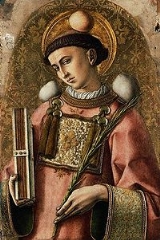
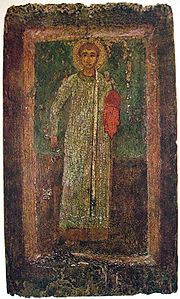
Stephanos, meaning "crown". Traditionally, Stephen is invested with a crown of martyrdom for Christianity; he is often depicted in art with three stones and the martyrs' palm. In Eastern Christian iconography
, he is shown as a young beardless man with a tonsure
, wearing a deacon's vestments, and often holding a miniature church building or a censer
. Rembrandt depicted his martyrdom in his work The Stoning of Saint Stephen
.
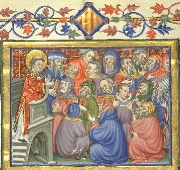 According to The Acts of the Apostles Stephen was tried by the Sanhedrin
for blasphemy
against Moses
and God and speaking against the Temple and the Law . While on trial, he experienced a theophany
in which he saw both God the Father
and God the Son
:
Acts 6–7 describe his trial.
He was stoned
to death (c. A.D. 34–35) by an infuriated mob encouraged by Saul of Tarsus. Stephen's final speech was presented as accusing the Jews of persecuting prophets who spoke out against their sins:
is included in Jacobus de Voragine
's Golden Legend
. De Voragine's version of the legend begins with a fictional etymology: Stephen (from Greek
stephanos, "crown") comes from the Hebrew
word for "norm" or "rule"; since he was the first martyr of the New Testament
, he set the norm for suffering in Christ. Or, his name comes from strenue fans, "speaking strongly," because of his manner of speaking and his religious doctrines. Or it comes from strenue stans, "laudably standing and instructing and ruling over old women." Thus, according to de Voragine, "Stephen is a crown because he is first in martyrdom, a norm by his example in suffering and his way of life, a zealous speaker in his praiseworthy teaching of the widows."
The version in the Golden Legend has Stephen appointed as one of seven deacons appointed by the apostles to appease the widows among the Christians of Gentile origin. Jealous of Stephen's success in his ministry, the Jews conspire to bring him down. First, they attempt to defeat him by way of argument, but are unsuccessful since the Holy Spirit arms Stephen with divine wisdom. Next, they bring false witnesses, who accuse him of blaspheming against God, Moses, the Law, and the Tabernacle. Aided by an angel, Stephen refutes every point, a refutation recounted in some detail. Finally, they try torture; still, Stephen attempts to convert them by inciting shame and fear in them, and by showing his love for them—he prays for his opponents as he is being stoned.
, 26 December is called "St. Stephen's Day", the "feast of Stephen" mentioned in the English
Christmas carol
"Good King Wenceslas
". It is a public holiday
in many nations that were historically Catholic, Anglican or Lutheran: Austria
, Croatia
, the Czech Republic
, Slovakia
, Poland
, the United Kingdom
(where it is also called "Boxing Day
"), the Republic of Ireland
, Italy
, Germany
, Finland
, Canada
, Australia
, and New Zealand
. In Catalonia
(though not elsewhere in Spain), it is called Sant Esteve and is a bank holiday
. In France
, the day of Saint Étienne is a bank holiday in the Alsace
-Moselle
region, but not elsewhere. December 26 is also a holiday in Ligao City
Albay
and in Tuguegarao City
, Philippines
, which celebrates a fiesta
in honour of St. Stephen Protomartyr, its patron saint.
The General Roman Calendar included also on August 3 a feast of the Invention of the Relics of St Stephen — "Invention," , meaning "finding" or "discovery" — to commemorate the finding of St Stephen's relics during the reign of Emperor Honorius
. In the Tridentine Calendar
, this feast was celebrated as a "Semidouble", a rank that it lost in 1955, when Pope Pius XII
reduced it to the rank of "Simple". It was one of the second feasts of a single saint removed from the calendar by Pope John XXIII
in 1960, and, while it is celebrated by those traditionalist Catholic
s who observe earlier versions of the Roman calendar, it is not celebrated by those who, in accordance with Pope Benedict XVI
's motu proprio, Summorum Pontificum
, observe the 1962 calendar.
 In the Eastern Orthodox Church
and those Eastern Catholic Churches which follow the Byzantine Rite
, Saint Stephen's feast day is celebrated on December 27. This day is also called the "Third Day of the Nativity".
The Republika Srpska
claims Saint Stephen as its patron saint. The Republika was proclaimed on January 9 (December 26, Saint Stephen's Day, in the Julian calendar), and that date is a national holiday as "Republic Day".
In India, the Feast of Saint Stephen is celebrated in Goa
, where Santo Estevam Island is named after him. The Santo Estevam Church http://upload.wikimedia.org/wikipedia/commons/3/3a/SEC_JUA.JPG on the island of Jua was built in 1759.
The Eastern Orthodox Church
celebrates the discovery (opening) of the Saint's relics on September 15 and the translation
of the Relics of Protomartyr Stephen on August 2. The September 15 feast day celebrates the discovery of Stephen's relics in 415, after which they were solemnly transferred to a church built in his honour in Jerusalem. Later, during the reign of Theodosius the Younger, the relics were transported to Constantinople
, the event commemorated on August 2. January 4 marks the commemoration of the "Synaxis of the 70 Apostles". Since Stephen was included in these 70 Apostles mentioned in the "Acts of the Apostles", he is also remembered on January 4.
Gregory of Tours
reported that the intercession of Stephen preserved an oratory dedicated to him at Metz
, in present-day France. His relics were preserved when the oratory was left standing, after Huns
burned the remainder of the city on Easter Eve, 451.
Koine Greek
Koine Greek is the universal dialect of the Greek language spoken throughout post-Classical antiquity , developing from the Attic dialect, with admixture of elements especially from Ionic....
: Στέφανος, Stephanos), the protomartyr of Christianity
Christianity
Christianity is a monotheistic religion based on the life and teachings of Jesus as presented in canonical gospels and other New Testament writings...
, is venerated as a saint
Saint
A saint is a holy person. In various religions, saints are people who are believed to have exceptional holiness.In Christian usage, "saint" refers to any believer who is "in Christ", and in whom Christ dwells, whether in heaven or in earth...
in the Roman Catholic
Roman Catholic Church
The Catholic Church, also known as the Roman Catholic Church, is the world's largest Christian church, with over a billion members. Led by the Pope, it defines its mission as spreading the gospel of Jesus Christ, administering the sacraments and exercising charity...
, Anglican, Lutheran, Oriental Orthodox and Eastern Orthodox Church
Eastern Orthodox Church
The Orthodox Church, officially called the Orthodox Catholic Church and commonly referred to as the Eastern Orthodox Church, is the second largest Christian denomination in the world, with an estimated 300 million adherents mainly in the countries of Belarus, Bulgaria, Cyprus, Georgia, Greece,...
es.
Saint Stephen's name is derived from the Greek
Greek language
Greek is an independent branch of the Indo-European family of languages. Native to the southern Balkans, it has the longest documented history of any Indo-European language, spanning 34 centuries of written records. Its writing system has been the Greek alphabet for the majority of its history;...
Stephanos, meaning "crown". Traditionally, Stephen is invested with a crown of martyrdom for Christianity; he is often depicted in art with three stones and the martyrs' palm. In Eastern Christian iconography
Iconography
Iconography is the branch of art history which studies the identification, description, and the interpretation of the content of images. The word iconography literally means "image writing", and comes from the Greek "image" and "to write". A secondary meaning is the painting of icons in the...
, he is shown as a young beardless man with a tonsure
Tonsure
Tonsure is the traditional practice of Christian churches of cutting or shaving the hair from the scalp of clerics, monastics, and, in the Eastern Orthodox Church, all baptized members...
, wearing a deacon's vestments, and often holding a miniature church building or a censer
Censer
Censers are any type of vessels made for burning incense. These vessels vary greatly in size, form, and material of construction. They may consist of simple earthenware bowls or fire pots to intricately carved silver or gold vessels, small table top objects a few centimetres tall to as many as...
. Rembrandt depicted his martyrdom in his work The Stoning of Saint Stephen
The Stoning of Saint Stephen
The Stoning of Saint Stephen is the first painting by Dutch artist Rembrandt, painted in 1625 at the age of 19. It is currently kept in the Musée des Beaux-Arts de Lyon.This work is inspired by the martyrdom of Saint Stephen which is recounted in Acts 7...
.
Martyrdom
Sanhedrin
The Sanhedrin was an assembly of twenty-three judges appointed in every city in the Biblical Land of Israel.The Great Sanhedrin was the supreme court of ancient Israel made of 71 members...
for blasphemy
Blasphemy
Blasphemy is irreverence towards religious or holy persons or things. Some countries have laws to punish blasphemy, while others have laws to give recourse to those who are offended by blasphemy...
against Moses
Moses
Moses was, according to the Hebrew Bible and Qur'an, a religious leader, lawgiver and prophet, to whom the authorship of the Torah is traditionally attributed...
and God and speaking against the Temple and the Law . While on trial, he experienced a theophany
Theophany
Theophany, from the Ancient Greek , meaning "appearance of God"), refers to the appearance of a deity to a human or other being, or to a divine disclosure....
in which he saw both God the Father
God the Father
God the Father is a gendered title given to God in many monotheistic religions, particularly patriarchal, Abrahamic ones. In Judaism, God is called Father because he is the creator, life-giver, law-giver, and protector...
and God the Son
God the Son
God the Son is the second person of the Trinity in Christian theology. The doctrine of the Trinity identifies Jesus of Nazareth as God the Son, united in essence but distinct in person with regard to God the Father and God the Holy Spirit...
:
- "Behold, I see the heavens opened, and the Son of man standing on the right hand of God."
Acts 6–7 describe his trial.
He was stoned
Stoning
Stoning, or lapidation, is a form of capital punishment whereby a group throws stones at a person until the person dies. No individual among the group can be identified as the one who kills the subject, yet everyone involved plainly bears some degree of moral culpability. This is in contrast to the...
to death (c. A.D. 34–35) by an infuriated mob encouraged by Saul of Tarsus. Stephen's final speech was presented as accusing the Jews of persecuting prophets who spoke out against their sins:
- "Which one of the Prophets did your fathers not persecute, and they killed the ones who prophesied the coming of the Just One, of whom now, too, you have become betrayers and murderers." (7:52)
Hagiography
Saint Stephen's hagiographyHagiography
Hagiography is the study of saints.From the Greek and , it refers literally to writings on the subject of such holy people, and specifically to the biographies of saints and ecclesiastical leaders. The term hagiology, the study of hagiography, is also current in English, though less common...
is included in Jacobus de Voragine
Jacobus de Voragine
Blessed Jacobus de Varagine or Voragine was an Italian chronicler and archbishop of Genoa. He was the author, or more accurately the compiler, of Legenda Aurea, the Golden Legend, a collection of the legendary lives of the greater saints of the medieval church that was one of the most popular...
's Golden Legend
Golden Legend
The Golden Legend is a collection of hagiographies by Jacobus de Voragine that became a late medieval bestseller. More than a thousand manuscripts of the text have survived, compared to twenty or so of its nearest rivals...
. De Voragine's version of the legend begins with a fictional etymology: Stephen (from Greek
Greek language
Greek is an independent branch of the Indo-European family of languages. Native to the southern Balkans, it has the longest documented history of any Indo-European language, spanning 34 centuries of written records. Its writing system has been the Greek alphabet for the majority of its history;...
stephanos, "crown") comes from the Hebrew
Hebrew language
Hebrew is a Semitic language of the Afroasiatic language family. Culturally, is it considered by Jews and other religious groups as the language of the Jewish people, though other Jewish languages had originated among diaspora Jews, and the Hebrew language is also used by non-Jewish groups, such...
word for "norm" or "rule"; since he was the first martyr of the New Testament
New Testament
The New Testament is the second major division of the Christian biblical canon, the first such division being the much longer Old Testament....
, he set the norm for suffering in Christ. Or, his name comes from strenue fans, "speaking strongly," because of his manner of speaking and his religious doctrines. Or it comes from strenue stans, "laudably standing and instructing and ruling over old women." Thus, according to de Voragine, "Stephen is a crown because he is first in martyrdom, a norm by his example in suffering and his way of life, a zealous speaker in his praiseworthy teaching of the widows."
The version in the Golden Legend has Stephen appointed as one of seven deacons appointed by the apostles to appease the widows among the Christians of Gentile origin. Jealous of Stephen's success in his ministry, the Jews conspire to bring him down. First, they attempt to defeat him by way of argument, but are unsuccessful since the Holy Spirit arms Stephen with divine wisdom. Next, they bring false witnesses, who accuse him of blaspheming against God, Moses, the Law, and the Tabernacle. Aided by an angel, Stephen refutes every point, a refutation recounted in some detail. Finally, they try torture; still, Stephen attempts to convert them by inciting shame and fear in them, and by showing his love for them—he prays for his opponents as he is being stoned.
St. Stephen's Day
In Western ChristianityWestern Christianity
Western Christianity is a term used to include the Latin Rite of the Catholic Church and groups historically derivative thereof, including the churches of the Anglican and Protestant traditions, which share common attributes that can be traced back to their medieval heritage...
, 26 December is called "St. Stephen's Day", the "feast of Stephen" mentioned in the English
England
England is a country that is part of the United Kingdom. It shares land borders with Scotland to the north and Wales to the west; the Irish Sea is to the north west, the Celtic Sea to the south west, with the North Sea to the east and the English Channel to the south separating it from continental...
Christmas carol
Christmas carol
A Christmas carol is a carol whose lyrics are on the theme of Christmas or the winter season in general and which are traditionally sung in the period before Christmas.-History:...
"Good King Wenceslas
Good King Wenceslas
"Good King Wenceslas" is a popular Christmas carol about a king who goes out to give alms to a poor peasant on the Feast of Stephen . During the journey, his page is about to give up the struggle against the cold weather, but is enabled to continue by following the king's footprints, step for step,...
". It is a public holiday
Public holiday
A public holiday, national holiday or legal holiday is a holiday generally established by law and is usually a non-working day during the year....
in many nations that were historically Catholic, Anglican or Lutheran: Austria
Austria
Austria , officially the Republic of Austria , is a landlocked country of roughly 8.4 million people in Central Europe. It is bordered by the Czech Republic and Germany to the north, Slovakia and Hungary to the east, Slovenia and Italy to the south, and Switzerland and Liechtenstein to the...
, Croatia
Croatia
Croatia , officially the Republic of Croatia , is a unitary democratic parliamentary republic in Europe at the crossroads of the Mitteleuropa, the Balkans, and the Mediterranean. Its capital and largest city is Zagreb. The country is divided into 20 counties and the city of Zagreb. Croatia covers ...
, the Czech Republic
Public holidays in the Czech Republic
Public holidays in the Czech RepublicDateEnglish NameCzech NameRemarks1 January Restoration Day of the Independent Czech State; New Year's DayDen obnovy samostatného českého státu; Nový rokThe independent Czech Republic was created in 1993, after dissolution of Czechoslovakia.March, AprilEaster...
, Slovakia
Slovakia
The Slovak Republic is a landlocked state in Central Europe. It has a population of over five million and an area of about . Slovakia is bordered by the Czech Republic and Austria to the west, Poland to the north, Ukraine to the east and Hungary to the south...
, Poland
Poland
Poland , officially the Republic of Poland , is a country in Central Europe bordered by Germany to the west; the Czech Republic and Slovakia to the south; Ukraine, Belarus and Lithuania to the east; and the Baltic Sea and Kaliningrad Oblast, a Russian exclave, to the north...
, the United Kingdom
United Kingdom
The United Kingdom of Great Britain and Northern IrelandIn the United Kingdom and Dependencies, other languages have been officially recognised as legitimate autochthonous languages under the European Charter for Regional or Minority Languages...
(where it is also called "Boxing Day
Boxing Day
Boxing Day is a bank or public holiday that occurs on 26 December, or the first or second weekday after Christmas Day, depending on national or regional laws. It is observed in Australia, Canada, New Zealand, the United Kingdom and some other Commonwealth nations. In Ireland, it is recognized as...
"), the Republic of Ireland
Republic of Ireland
Ireland , described as the Republic of Ireland , is a sovereign state in Europe occupying approximately five-sixths of the island of the same name. Its capital is Dublin. Ireland, which had a population of 4.58 million in 2011, is a constitutional republic governed as a parliamentary democracy,...
, Italy
Italy
Italy , officially the Italian Republic languages]] under the European Charter for Regional or Minority Languages. In each of these, Italy's official name is as follows:;;;;;;;;), is a unitary parliamentary republic in South-Central Europe. To the north it borders France, Switzerland, Austria and...
, Germany
Germany
Germany , officially the Federal Republic of Germany , is a federal parliamentary republic in Europe. The country consists of 16 states while the capital and largest city is Berlin. Germany covers an area of 357,021 km2 and has a largely temperate seasonal climate...
, Finland
Finland
Finland , officially the Republic of Finland, is a Nordic country situated in the Fennoscandian region of Northern Europe. It is bordered by Sweden in the west, Norway in the north and Russia in the east, while Estonia lies to its south across the Gulf of Finland.Around 5.4 million people reside...
, Canada
Canada
Canada is a North American country consisting of ten provinces and three territories. Located in the northern part of the continent, it extends from the Atlantic Ocean in the east to the Pacific Ocean in the west, and northward into the Arctic Ocean...
, Australia
Australia
Australia , officially the Commonwealth of Australia, is a country in the Southern Hemisphere comprising the mainland of the Australian continent, the island of Tasmania, and numerous smaller islands in the Indian and Pacific Oceans. It is the world's sixth-largest country by total area...
, and New Zealand
New Zealand
New Zealand is an island country in the south-western Pacific Ocean comprising two main landmasses and numerous smaller islands. The country is situated some east of Australia across the Tasman Sea, and roughly south of the Pacific island nations of New Caledonia, Fiji, and Tonga...
. In Catalonia
Catalonia
Catalonia is an autonomous community in northeastern Spain, with the official status of a "nationality" of Spain. Catalonia comprises four provinces: Barcelona, Girona, Lleida, and Tarragona. Its capital and largest city is Barcelona. Catalonia covers an area of 32,114 km² and has an...
(though not elsewhere in Spain), it is called Sant Esteve and is a bank holiday
Bank Holiday
A bank holiday is a public holiday in the United Kingdom or a colloquialism for public holiday in Ireland. There is no automatic right to time off on these days, although the majority of the population is granted time off work or extra pay for working on these days, depending on their contract...
. In France
France
The French Republic , The French Republic , The French Republic , (commonly known as France , is a unitary semi-presidential republic in Western Europe with several overseas territories and islands located on other continents and in the Indian, Pacific, and Atlantic oceans. Metropolitan France...
, the day of Saint Étienne is a bank holiday in the Alsace
Alsace
Alsace is the fifth-smallest of the 27 regions of France in land area , and the smallest in metropolitan France. It is also the seventh-most densely populated region in France and third most densely populated region in metropolitan France, with ca. 220 inhabitants per km²...
-Moselle
Moselle
Moselle is a department in the east of France named after the river Moselle.- History :Moselle is one of the original 83 departments created during the French Revolution on March 4, 1790...
region, but not elsewhere. December 26 is also a holiday in Ligao City
Ligao City
Ligao City is a 4th class city in the province of Albay, Philippines. According to the 2007 census, it has a population of 101,179 people in 17,031 households. Ligao City is strategically located in the heart of the Third District of Albay...
Albay
Albay
Albay is a province of the Philippines located in the Bicol Region in Luzon. Its capital is Legazpi City and the province borders Camarines Sur to the north and Sorsogon to the south. Also to the northeast is Lagonoy Gulf....
and in Tuguegarao City
Tuguegarao City
Tuguegarao City is the city capital of Cagayan, Philippines and the regional capital of Region 02 . Tuguegarao is the economic center of the Cagayan Valley Region; it is located on a peninsula in the Cagayan Valley. It is sheltered by the Sierra Madre Mountains in the East; Cordilleras in the...
, Philippines
Philippines
The Philippines , officially known as the Republic of the Philippines , is a country in Southeast Asia in the western Pacific Ocean. To its north across the Luzon Strait lies Taiwan. West across the South China Sea sits Vietnam...
, which celebrates a fiesta
Festival
A festival or gala is an event, usually and ordinarily staged by a local community, which centers on and celebrates some unique aspect of that community and the Festival....
in honour of St. Stephen Protomartyr, its patron saint.
The General Roman Calendar included also on August 3 a feast of the Invention of the Relics of St Stephen — "Invention," , meaning "finding" or "discovery" — to commemorate the finding of St Stephen's relics during the reign of Emperor Honorius
Honorius (emperor)
Honorius , was Western Roman Emperor from 395 to 423. He was the younger son of emperor Theodosius I and his first wife Aelia Flaccilla, and brother of the eastern emperor Arcadius....
. In the Tridentine Calendar
Tridentine Calendar
The Tridentine Calendar is the calendar of saints to be honoured in the course of the liturgical year in the official liturgy of the Roman Rite as reformed by Pope Pius V, implementing a decision of the Council of Trent, which entrusted the task to the Pope....
, this feast was celebrated as a "Semidouble", a rank that it lost in 1955, when Pope Pius XII
Pope Pius XII
The Venerable Pope Pius XII , born Eugenio Maria Giuseppe Giovanni Pacelli , reigned as Pope, head of the Catholic Church and sovereign of Vatican City State, from 2 March 1939 until his death in 1958....
reduced it to the rank of "Simple". It was one of the second feasts of a single saint removed from the calendar by Pope John XXIII
Pope John XXIII
-Papal election:Following the death of Pope Pius XII in 1958, Roncalli was elected Pope, to his great surprise. He had even arrived in the Vatican with a return train ticket to Venice. Many had considered Giovanni Battista Montini, Archbishop of Milan, a possible candidate, but, although archbishop...
in 1960, and, while it is celebrated by those traditionalist Catholic
Traditionalist Catholic
Traditionalist Catholics are Roman Catholics who believe that there should be a restoration of many or all of the liturgical forms, public and private devotions and presentations of Catholic teachings which prevailed in the Catholic Church before the Second Vatican Council...
s who observe earlier versions of the Roman calendar, it is not celebrated by those who, in accordance with Pope Benedict XVI
Pope Benedict XVI
Benedict XVI is the 265th and current Pope, by virtue of his office of Bishop of Rome, the Sovereign of the Vatican City State and the leader of the Catholic Church as well as the other 22 sui iuris Eastern Catholic Churches in full communion with the Holy See...
's motu proprio, Summorum Pontificum
Summorum Pontificum
Summorum Pontificum is an Apostolic Letter of Pope Benedict XVI, issued "motu proprio" . The document specified the rules, for the Latin Rite of the Catholic Church, for celebrating Mass according to the "Missal promulgated by John XXIII in 1962" , and for administering most of the sacraments in...
, observe the 1962 calendar.
Eastern Orthodox Church
The Orthodox Church, officially called the Orthodox Catholic Church and commonly referred to as the Eastern Orthodox Church, is the second largest Christian denomination in the world, with an estimated 300 million adherents mainly in the countries of Belarus, Bulgaria, Cyprus, Georgia, Greece,...
and those Eastern Catholic Churches which follow the Byzantine Rite
Byzantine Rite
The Byzantine Rite, sometimes called the Rite of Constantinople or Constantinopolitan Rite is the liturgical rite used currently by all the Eastern Orthodox Churches, by the Greek Catholic Churches , and by the Protestant Ukrainian Lutheran Church...
, Saint Stephen's feast day is celebrated on December 27. This day is also called the "Third Day of the Nativity".
The Republika Srpska
Republika Srpska
Republika Srpska is one of two main political entities of Bosnia and Herzegovina, the other being the Federation of Bosnia and Herzegovina...
claims Saint Stephen as its patron saint. The Republika was proclaimed on January 9 (December 26, Saint Stephen's Day, in the Julian calendar), and that date is a national holiday as "Republic Day".
In India, the Feast of Saint Stephen is celebrated in Goa
Goa
Goa , a former Portuguese colony, is India's smallest state by area and the fourth smallest by population. Located in South West India in the region known as the Konkan, it is bounded by the state of Maharashtra to the north, and by Karnataka to the east and south, while the Arabian Sea forms its...
, where Santo Estevam Island is named after him. The Santo Estevam Church http://upload.wikimedia.org/wikipedia/commons/3/3a/SEC_JUA.JPG on the island of Jua was built in 1759.

The Eastern Orthodox Church
Eastern Orthodox Church
The Orthodox Church, officially called the Orthodox Catholic Church and commonly referred to as the Eastern Orthodox Church, is the second largest Christian denomination in the world, with an estimated 300 million adherents mainly in the countries of Belarus, Bulgaria, Cyprus, Georgia, Greece,...
celebrates the discovery (opening) of the Saint's relics on September 15 and the translation
Translation (relics)
In Christianity, the translation of relics is the removal of holy objects from one locality to another ; usually only the movement of the remains of the saint's body would be treated so formally, with secondary relics such as items of clothing treated with less ceremony...
of the Relics of Protomartyr Stephen on August 2. The September 15 feast day celebrates the discovery of Stephen's relics in 415, after which they were solemnly transferred to a church built in his honour in Jerusalem. Later, during the reign of Theodosius the Younger, the relics were transported to Constantinople
Constantinople
Constantinople was the capital of the Roman, Eastern Roman, Byzantine, Latin, and Ottoman Empires. Throughout most of the Middle Ages, Constantinople was Europe's largest and wealthiest city.-Names:...
, the event commemorated on August 2. January 4 marks the commemoration of the "Synaxis of the 70 Apostles". Since Stephen was included in these 70 Apostles mentioned in the "Acts of the Apostles", he is also remembered on January 4.
Tomb
Many churches are named in honour of Saint Stephen, but there was no official "Tomb of St Stephen" until 415. When Christian pilgrims were traveling in large numbers to Jerusalem, a priest named Lucian said he had learned by a vision that the tomb was in Caphar Gamala, some distance to the north of Jerusalem.Gregory of Tours
Gregory of Tours
Saint Gregory of Tours was a Gallo-Roman historian and Bishop of Tours, which made him a leading prelate of Gaul. He was born Georgius Florentius, later adding the name Gregorius in honour of his maternal great-grandfather...
reported that the intercession of Stephen preserved an oratory dedicated to him at Metz
Metz
Metz is a city in the northeast of France located at the confluence of the Moselle and the Seille rivers.Metz is the capital of the Lorraine region and prefecture of the Moselle department. Located near the tripoint along the junction of France, Germany, and Luxembourg, Metz forms a central place...
, in present-day France. His relics were preserved when the oratory was left standing, after Huns
Huns
The Huns were a group of nomadic people who, appearing from east of the Volga River, migrated into Europe c. AD 370 and established the vast Hunnic Empire there. Since de Guignes linked them with the Xiongnu, who had been northern neighbours of China 300 years prior to the emergence of the Huns,...
burned the remainder of the city on Easter Eve, 451.
Commemorative places
- See also: St. Stephen's CathedralSt. Stephen's CathedralSt. Stephen's Cathedral may refer to any of the following:-France:*Agde Cathedral*Auxerre Cathedral*Bourges Cathedral*Châlons Cathedral*Limoges Cathedral*Meaux Cathedral*Metz Cathedral*Sens Cathedral*Toulouse Cathedral*Toul Cathedral...
, St. Stephen's ChurchSt. Stephen's Church- Australia :* St. Stephen's Church, Penrith, New South Wales* St. Stephen's Uniting Church, Sydney, New South Wales* , Wynyard, Tasmania- Canada:* St. Stephen's Church, St. Stephen, New Brunswick* , Saanichton, BC-England:...
- Saint ÉtienneSaint EtienneSaint Étienne is French for Saint Stephen."Saint Etienne" may further refer to:- France :*Saint-Étienne-du-Mont, a church in Paris, FranceCommunes*Saint-Étienne, in the Loire department*Saint-Étienne-à-Arnes, in the Ardennes department...
, France, and numerous other places named Saint ÉtienneSaint EtienneSaint Étienne is French for Saint Stephen."Saint Etienne" may further refer to:- France :*Saint-Étienne-du-Mont, a church in Paris, FranceCommunes*Saint-Étienne, in the Loire department*Saint-Étienne-à-Arnes, in the Ardennes department...
in the French-speaking world - Brisbane, Queensland, Australia – The Cathedral of St Stephen, Brisbane
- ViennaViennaVienna is the capital and largest city of the Republic of Austria and one of the nine states of Austria. Vienna is Austria's primary city, with a population of about 1.723 million , and is by far the largest city in Austria, as well as its cultural, economic, and political centre...
, AustriaAustriaAustria , officially the Republic of Austria , is a landlocked country of roughly 8.4 million people in Central Europe. It is bordered by the Czech Republic and Germany to the north, Slovakia and Hungary to the east, Slovenia and Italy to the south, and Switzerland and Liechtenstein to the...
– StephansdomStephansdomSt. Stephen's Cathedral is the mother church of the Archdiocese of Vienna and the seat of the Archbishop of Vienna, Christoph Cardinal Schönborn, OP...
, the Cathedral of St. Stephen, founded 1147 and seat of Cardinal Archbishop of Vienna. Symbol of the city of Vienna and of Austria, has the tallest spire in Austria and is the country's most famous church - Rome – San Lorenzo fuori le MuraSan Lorenzo fuori le MuraThe Papal Basilica of Saint Lawrence outside the Walls is a Roman Catholic parish church and minor basilica, located in Rome, Italy. The basilica is one of the Seven Pilgrim Churches of Rome and one of the five Patriarchal basilicas, each of which is assigned to a patriarchate. St...
, where his remains are interred with those of the eponymous saint under the altar - Old city of Jerusalem – the "Lions' GateThe Lions' GateThe Lions' Gate is located in the Old City Walls of Jerusalem and is one of seven open Gates in Jerusalem's Old City Walls.Located in the east wall, the entrance marks the beginning of the traditional Christian observance of the last walk of Jesus from prison to crucifixion, the Via Dolorosa...
" is also called St. Stephanus Gate, after the tradition that Stephen's stoning occurred here, though it probably occurred at Damascus GateDamascus GateDamascus Gate is the main entrance to the Old City of Jerusalem. It is located in the wall on the city's northwest side where the highway leads out to Nablus, and from there, in times past, to the capital of Syria, Damascus; as such, its modern English name is Damascus Gate, and its modern Hebrew... - LondonLondonLondon is the capital city of :England and the :United Kingdom, the largest metropolitan area in the United Kingdom, and the largest urban zone in the European Union by most measures. Located on the River Thames, London has been a major settlement for two millennia, its history going back to its...
– St Stephen's ChapelSt Stephen's ChapelSt Stephen's Chapel was a chapel in the old Palace of Westminster. It was largely lost in the fire of 1834, but the Chapel of St Mary Undercroft in the crypt survived...
in the Palace of WestminsterPalace of WestminsterThe Palace of Westminster, also known as the Houses of Parliament or Westminster Palace, is the meeting place of the two houses of the Parliament of the United Kingdom—the House of Lords and the House of Commons...
was originally built in the reign of Henry III of EnglandHenry III of EnglandHenry III was the son and successor of John as King of England, reigning for 56 years from 1216 until his death. His contemporaries knew him as Henry of Winchester. He was the first child king in England since the reign of Æthelred the Unready...
; it became the first site of the debating chamber of the British House of CommonsBritish House of CommonsThe House of Commons is the lower house of the Parliament of the United Kingdom, which also comprises the Sovereign and the House of Lords . Both Commons and Lords meet in the Palace of Westminster. The Commons is a democratically elected body, consisting of 650 members , who are known as Members... - Dublin – St. Stephen's GreenSt. Stephen's GreenSt Stephen's Green is a city centre public park in Dublin, Ireland. The park is adjacent to one of Dublin's main shopping streets, Grafton Street, and to a shopping centre named for it, while on its surrounding streets are the offices of a number of public bodies and the city terminus of one of...
- ManilaManilaManila is the capital of the Philippines. It is one of the sixteen cities forming Metro Manila.Manila is located on the eastern shores of Manila Bay and is bordered by Navotas and Caloocan to the north, Quezon City to the northeast, San Juan and Mandaluyong to the east, Makati on the southeast,...
, PhilippinesPhilippinesThe Philippines , officially known as the Republic of the Philippines , is a country in Southeast Asia in the western Pacific Ocean. To its north across the Luzon Strait lies Taiwan. West across the South China Sea sits Vietnam...
– St. Stephen's ParishSt. Stephen's ParishSt. Stephen's Parish, pro-cathedral, is the oldest Chinese church in the Philippines. It was established in 1903.The church is situated in the Sta. Cruz district of Manila, adjacent to St. Stephen's High School....
and St. Stephen's High School - San SalvadorSan SalvadorThe city of San Salvador the capital and largest city of El Salvador, which has been designated a Gamma World City. Its complete name is La Ciudad de Gran San Salvador...
, El SalvadorEl SalvadorEl Salvador or simply Salvador is the smallest and the most densely populated country in Central America. The country's capital city and largest city is San Salvador; Santa Ana and San Miguel are also important cultural and commercial centers in the country and in all of Central America...
, San Esteban, San SalvadorSan Esteban, San SalvadorSt. Stephen's Church is a historic Roman Catholic temple in downtown San Salvador, El Salvador. It belongs to the Roman Catholic Archdiocese of San Salvador and its patron saint is the protomartyr, St. Stephen. Built 1880-1890, it was heavily damaged during the 2001 El Salvador earthquakes and... - St Stephen's House, OxfordSt Stephen's House, OxfordSt Stephen’s House, Oxford , is an Anglican theological college and one of six religious Permanent Private Halls of the University of Oxford, England...
– Permanent Private HallPermanent Private HallA Permanent Private Hall at the University of Oxford is an educational institution within the university. There are six Permanent Private Halls at Oxford, five of which admit undergraduates. They were founded by different Christian denominations....
of the University of OxfordUniversity of OxfordThe University of Oxford is a university located in Oxford, United Kingdom. It is the second-oldest surviving university in the world and the oldest in the English-speaking world. Although its exact date of foundation is unclear, there is evidence of teaching as far back as 1096...
and Anglican Theological College - St Stephen's Church, BristolSt Stephen's Church, BristolSt Stephen's Church in St Stephens Avenue, is the parish church for the city of Bristol, England.It has been designated by English Heritage as a grade I listed building.- History :...
– the first city church built outside the walls around c.1250, rebuilt c1430-1490. - St. Stephens, AlabamaSt. Stephens, AlabamaSt. Stephens is an unincorporated census-designated place in Washington County, Alabama, United States. As of the 2010 census, its population was 495. Located near the Tombigbee River in the southwestern part of the state, it is composed of two distinct sites: Old St. Stephens and New St. Stephens....
– Alabama Territorial capital from 1817 to 1819. - St. Stephen, New BrunswickSt. Stephen, New BrunswickSt. Stephen is a Canadian town in Charlotte County, New Brunswick, situated on the east bank of the St. Croix River at .-Climate:...
- St. Stephen, South CarolinaSt. Stephen, South CarolinaSt. Stephen is a town in Berkeley County, South Carolina, United States. The population was 1,776 at the 2000 census.As defined by the U.S. Office of Management and Budget, and used by the U.S. Census Bureau for statistical purposes only, St. Stephen is included within the Charleston-North...
- St. Stephen Catholic Church (Ona, West VirginiaOna, West VirginiaOna is a small unincorporated community along US 60 in Cabell County, West Virginia. It is situated roughly half-way between the towns of Barboursville to the west and Milton to the east....
) - St. Stephen's Church, Kombuthurai,church built by Francis XavierFrancis XavierFrancis Xavier, born Francisco de Jasso y Azpilicueta was a pioneering Roman Catholic missionary born in the Kingdom of Navarre and co-founder of the Society of Jesus. He was a student of Saint Ignatius of Loyola and one of the first seven Jesuits, dedicated at Montmartre in 1534...
in India,asia in 1542.