
See Also

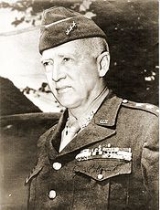
George S. Patton

George Smith Patton, Jr. was a leading U.S. Army United States Army

The United States Army is the largest branch of the United States armed forces [i] ... 

 general in World War II World War II

World War II, or the Second World War, was a worldwide [i] conflict [i] fought betwe ... 

. In his 36-year Army career, he was an advocate of armored warfare Armoured warfare

Armoured warfare in modern warfare [i] is understood to be the use of armoured fighting vehicles [i] as ... 

 and commanded major units of North Africa North African campaign

During World War II [i], the North African Campaign, also known as the Desert War, took place in t ... 

, Sicily Allied invasion of Sicily

Husky was also the codename of Australia [i]n military support to Sierra Leone [i] ending in February ... 

, and the European Theater of Operations. Many have viewed Patton as a pure and ferocious warrior, known by the nickname "Old Blood and Guts", a name given to him after a reporter misquoted his statement that it takes blood and brains to win a war. But history has left the image of a brilliant military leader whose record was also marred by insubordination and some periods of apparent instability.

Discussions

  Discussion Features

   Ask a question about 'George S. Patton'

   Start a new discussion about 'George S. Patton'

   Answer questions about 'George S. Patton'

   'George S. Patton' discussion forum

Timeline

1943   World War II: The US 7th Army U.S. Seventh Army

The United States Seventh Army is the land component of United States European Command [i]. ... 

 under General George S. Patton arrive in Messina, Italy Messina, Italy

Messina is the third largest city on the island of Sicily [i], Italy [i] and the capital of the province of Messina [i] ... 

 followed 1 hours later by the British 8th Army under Field Marshal Bernard L. Montgomery Bernard Montgomery, 1st Viscount Montgomery of Alamein

Field Marshal [i] Bernard Law Montgomery, 1st Viscount Montgomery of Alamein, KG [i] ... 

, thus completing the Allied conquest of Sicily Sicily

Sicily is an autonomous region [i] of Italy [i] and the larges ... 

.

1945   General George S. Patton dies from injuries sustained in a car accident on December 9.

1945   Died


Quotations

Remember that the enemy is just as frightened as you are, and probably more so. They are not supermen.

Wars may be fought with weapons, but they are won by men. It is the spirit of the men who follow and of the man who leads that gains that victory.

Cavalry Journal (September 1933)

Never tell people how to do things. Tell them what to do, and they will surprise you with their ingenuity.

War As I Knew It (1947) by George S. Patton, "Reflections and Suggestions"

There are four hundred neatly marked graves somewhere in Sicily. All because one man went to sleep on the job. But they are German graves, because we caught the bastard asleep before they did.

An Army is a team. It lives, sleeps, eats, and fights as a team. This individual heroic stuff is pure horse shit. The bilious bastards who write that kind of stuff for the Saturday Evening Post don't know any more about real fighting under fire than they know about fucking!

We have the finest food, the finest equipment, the best spirit, and the best men in the world. Why, by God, I actually pity those poor sons-of-bitches we're going up against. By God, I do.

       More Quotes >>


Encyclopedia

George Smith Patton, Jr. was a leading U.S. Army United States Army

The United States Army is the largest branch of the United States armed forces [i] ... 

 general in World War II World War II

World War II, or the Second World War, was a worldwide [i] conflict [i] fought betwe ... 

. In his 36-year Army career, he was an advocate of armored warfare Armoured warfare

Armoured warfare in modern warfare [i] is understood to be the use of armoured fighting vehicles [i] as ... 

 and commanded major units of North Africa North African campaign

During World War II [i], the North African Campaign, also known as the Desert War, took place in t ... 

, Sicily Allied invasion of Sicily

Husky was also the codename of Australia [i]n military support to Sierra Leone [i] ending in February... 

, and the European Theater of Operations. Many have viewed Patton as a pure and ferocious warrior, known by the nickname "Old Blood and Guts", a name given to him after a reporter misquoted his statement that it takes blood and brains to win a war. But history has left the image of a brilliant military leader whose record was also marred by insubordination and some periods of apparent instability.

Family

George Smith Patton, Jr. was born in San Gabriel, California San Gabriel, California

San Gabriel is a city in Los Angeles County [i], California [i], United States [i] ... 

 to George Smith Patton, Sr. and Ruth Wilson, daughter of Benjamin Wilson Benjamin Wilson

Benjamin Davis Wilson, statesman and politician, known to the local Indians as Don Benito due to h... 

, a prominent Pasadena Pasadena, California

Pasadena is a city in Los Angeles County [i], California [i], United States [i] ... 

 land owner and politician. The Pattons were an affluent family. As a boy, Patton was introduced to Homer Homer

Homer was a legendary early Greek [i] poet [i] and rhapsode [i] traditionally credited ... 

's Iliad Iliad

The Iliad is, together with the Odyssey [i], one of two ancient Greek [i] epic [i]... 

 and Odyssey Odyssey

The Odyssey is one of the two major ancient Greek [i] epic poem [i] ... 

, the Bible Bible

The Bible , is the name used by Jews [i] and Christians [i] for their differing canons [i]... 

, and the works of William Shakespeare William Shakespeare

William Shakespeare was an English [i] poet [i] and playwright [i] widely regarded as the great ... 

. Patton's father was a friend of John Singleton Mosby John S. Mosby

John Singleton Mosby, also known as the "Gray Ghost," was a Confederate [i] partisan [i] ... 

, a cavalry Cavalry

Soldiers or warriors who fought mounted on horseback are commonly known as cavalry .... 

 hero of the Confederate States of America Confederate States of America

The Confederate States of America was the government formed by eleven southern states of the USA [i]... 

, serving first under J.E.B. Stuart J.E.B. Stuart

James Ewell Brown Stuart was an American soldier from Virginia [i] and a Confederate Army [i] general d ... 

 and then as a guerrilla Guerrilla warfare

Guerrilla is a term borrowed from the Spanish [i] guerrilla meaning small war, ... 

 fighter. The younger Patton grew up hearing Mosby's stories of military glory. From an early age, the young Patton sought to become a general and hero in his own right.

Patton's summer home was located in Hamilton, Massachusetts. The town has since dedicated its central park to Patton, boasting a full-size World War II tank in the center of town, and the town's schools play under the name "Generals". In addition, the French Government bestowed two statues to the town commemorating Patton's service to their nation. They were improved in 2003 and sit at the entrance to Patton Park.

Patton came from a long line of soldier Soldier

A soldier is a person who has enlisted with, or has been conscripted into, the armed forces of a country.... 

s who fought and some who died in many conflicts, including General Hugh Mercer Hugh Mercer

Hugh Mercer was a brigadier general of the Continental Army [i] and a close friend to George Washington [i] ... 

 of the American Revolution American Revolution

The American Revolution was a political movement that ended British [i] control ... 

. A great-uncle, Waller T. Patton, perished of wounds received in Pickett's Charge Pickett's Charge

Pickett's Charge was a disastrous infantry assault ordered by Confederate [i] General [i] ... 

 during the Battle of Gettysburg Battle of Gettysburg

The Battle of Gettysburg , fought in and around the town of Gettysburg, Pennsylvania [i], as part of the ... 

. Another relative Hugh Weedon Mercer was a Confederate General.

Patton's paternal grandparents were Brigadier General Brigadier General

Brigadier General is the lowest rank of general [i] officer in some countries, usually ranking just abov ... 

 George Smith Patton and Susan Thornton Glassell. Patton's grandfather, born in Fredericksburg Fredericksburg, Virginia

Fredericksburg is an independent city [i] in the U.S. ... 

, graduated from Virginia Military Institute Virginia Military Institute

The Virginia Military Institute, located in Lexington, Virginia [i], is the Nation's first state military college [i] ... 

 , Class of 1852, second in a class of 24. After graduation, George Smith Patton studied law and practiced in Charleston. When the American Civil War American Civil War

The American Civil War was a sectional conflict in the United States of America [i] between the federal ... 

 broke out, he served in the 22nd Virginia Infantry of the Confederate States of America Confederate States of America

The Confederate States of America was the government formed by eleven southern states of the USA [i]... 

.

Dying at the Battle of Opequon , Patton's grandfather left behind a namesake son, born in Charleston Charleston, West Virginia

Charleston is the capital of West Virginia [i], a state [i] of the United States of America [i] ... 

, West Virginia West Virginia

West Virginia is a state [i] of the United States [i] in the region of Appalachia [i], also k ... 

 when it was still part of Virginia. The second George Smith Patton was one of four children. Graduating from the Virginia Military Institute Virginia Military Institute

The Virginia Military Institute, located in Lexington, Virginia [i], is the Nation's first state military college [i] ... 

 in 1877, before taking up a career as an attorney, Patton's father served as the first city level District Attorney of Pasadena Pasadena, California

Pasadena is a city in Los Angeles County [i], California [i], United States [i] ... 

, California California

California is a state [i] spanning the southern half of the west coast [i] ... 

 and the first mayor of San Marino, California San Marino, California

San Marino is a city in Los Angeles County [i], California [i], USA [i] ... 

.

It is rumored that Patton's mother kept paintings of Robert E. Lee Robert E. Lee

Robert Edward Lee was a career U.S. Army [i] officer and the most successful general of the Confederate [i] ... 

 and Stonewall Jackson Stonewall Jackson

Thomas Jonathan "Stonewall" Jackson was a Confederate [i] general during the American Civil War [i] ... 

 in their living room; Patton admired them as she read to him from her rocking chair. He is quoted as saying, "Until I was old enough to know better, I thought those were portraits of God the Father, and God the Son Jesus

Jesus,Some of the historians and Biblical scholars who place the birth and death of Jesus within this ra... 

."

Patton, along with many other members of his family, often claimed to have seen vivid, lifelike visions of his ancestors. He was a staunch believer in reincarnation Reincarnation

"Past Lives" redirects here.... 

, and much anecdotal evidence indicates that he held himself to be the reincarnation of the Carthaginian Carthage

The term Carthage refers both to an ancient city in North Africa [i] located in modern day Tunis [i] an ... 

 general Hannibal Hannibal Barca

Hannibal Barca was a Punic [i] military commander and politician [i], later also working in ot ... 

, a Roman legionnaire Legionary

Called miles or legionarius in Latin [i], the Roman [i] legionary was a Roman citizen [i] ... 

, a Napoleonic Napoleon I of France

Napoleon I Bonaparte, Emperor of the French, King of Italy, Mediator of the Swiss Confederation and Prot... 

 field marshal, and various other historical military figures.

Education


Patton attended Virginia Military Institute Virginia Military Institute

The Virginia Military Institute, located in Lexington, Virginia [i], is the Nation's first state military college [i] ... 

 for one year, then transferred to West Point United States Military Academy

The United States Military Academy, also known as West Point, or simply USMA , is a United States Army [i] ... 

. He flunked out after plebe year with Courtney Hodges Courtney Hodges

Courtney Hicks Hodges was an American [i] military officer [i], most prominent for ... 

 , but re-entered to graduate in 1909, being commissioned as a cavalry officer.

Patton was an intelligent child, intensively studying classical Classics

Classics, particularly within the Western [i] university [i] tradition, when used as a sin ... 

 literature Literature

Literature is literally "acquaintance with letters" as in the first sense given in the Oxford English Dictionary [i] ... 

 and military history Military history

Military history is composed of the events in the history of humanity [i] that fall within ... 

 from a young age. He learned to read at a very late age as a child having never seen a printed page until starting school at the age of twelve, and never learned basic skills such as proper spelling. Because of the late academic start that he received, it took him five years to graduate from West Point, although he did rise to become Adjutant of the Corps of Cadets.

While at West Point, Patton renewed his acquaintance with childhood friend Beatrice Ayer, the daughter of a wealthy textile Textile

A textile is a flexible material comprised of a network of natural or artificial fibre [i]s often referr ... 

 baron. The two were married shortly after his graduation.

After graduating from West Point, Patton participated in the 1912 Summer Olympics 1912 Summer Olympics

The 1912 Summer Olympics, officially known as the Games of the V Olympiad, were held in 1912 [i] i ... 

 in Stockholm Stockholm

Stockholm is the capital [i] of Sweden [i], and consequently the site of its Government [i] ... 

, representing the United States in the first-ever Modern Pentathlon Modern pentathlon

The modern pentathlon is a sport [i]s contest consisting of 5 events, hence the name pentathlon. ... 

. He finished fifth. He was leading prior to the shooting competition, in which he decided to use a .38 revolver instead of the .22 caliber the rest of the athletes used. Patton was penalized for missing the target with one of his shots. He claimed that the 'miss' actually passed through the holes put in the target by his previous bullets . Based on his exceptional performance in the earlier qualifying rounds, events may have transpired as he claimed.
His performance in the event is also notable in that he was the only competitor to defeat the French Épée champion in the fencing segment of the event.

The Patton saber


After the Olympics, Lt. Patton was made the Army's youngest-ever Master of the Sword. While Master of the Sword, Patton improved and modernized the Army's Cavalry Saber fencing techniques and designed the M1913 Cavalry Cavalry

Soldiers or warriors who fought mounted on horseback are commonly known as cavalry .... 

 Saber Sabre

The sabre or saber traces its origins to the European backsword [i] and usually but not always has ... 

. It had a large, basket-shaped hilt mounting a straight, double-edged, thrusting blade designed for use by heavy cavalry. Now known as the “Patton” saber, it was heavily influenced by the 1908 and 1912 Pattern British Army Cavalry Swords 1908 and 1912 Pattern British Army Cavalry Swords

The 1908 Pattern Cavalry [i] Trooper's [i] Sword [i] was the last service sword issued to the ca ... 

.

Early military career

During the Mexican Expedition of 1916, Patton, while assigned to the 13th Cavalry Cavalry

Soldiers or warriors who fought mounted on horseback are commonly known as cavalry .... 

 Regiment in Fort Bliss Fort Bliss

Fort Bliss is a census-designated place [i] and United States Army [i] post in El Paso County [i] ... 

, Texas Texas

Texas is a state [i] in both the Southern [i] and Western [i] ... 

, accompanied then-Brigadier General Brigadier General

Brigadier General is the lowest rank of general [i] officer in some countries, usually ranking just abov ... 

 John J. Pershing John Pershing

John Joseph "Black Jack" Pershing was an officer in the United States Army [i]. ... 

 as his aide during the Mexican Expedition in his pursuit of Pancho Villa Pancho Villa

Doroteo Arango Armbula — better known as Francisco Villa or, in its diminutive [i] form, ' ... 

. During his service, Patton, accompanied by ten soldiers of the 6th Infantry Regiment U.S. 6th Infantry Regiment

The 6th Infantry Regiment was formed in 1812.... 

, killed "General" Julio Cardenas, commander of Villa's personal bodyguard. For this action, as well as Patton's affinity for the Colt Peacemaker Colt Single Action Army handgun

Also known as the Colt Peacemaker or Single Action Army, the most exotic of which being the Bla... 

, Pershing titled Patton his "Bandito". Patton's success in this regard gained him a level of notoriety back in the United States.

World War I

At the onset of the USA's entry into World War I World War I

World War I, also known as the First World War, the Great War and "The War to End All War... 

, General Pershing John Pershing

John Joseph "Black Jack" Pershing was an officer in the United States Army [i]. ... 

 promoted Patton to the rank of captain. While in France under the Third Republic, Patton requested that he be given a combat command and Pershing assigned him to the newly formed United States Tank Corps. Depending on the source, he either led the U.S. Tank Corps, led the British Kingdom of Great Britain

Kingdom of Great Britain
... 

, or was an observer at the Battle of Cambrai Battle of Cambrai

The Battle of Cambrai was a British [i] campaign of World War I [i]. ... 

, the first where tank Tank

A tank is a tracked [i] armoured fighting vehicle [i], designed to engage enemy force ... 

s were used as a significant force. As the U.S. Tank Corps did not take part in this battle and it is extremely unlikely that an American officer would have commanded British troops, the role of observer is the most likely. From his successes , Patton was promoted to major and then lieutenant colonel and was placed in charge of the U.S. Tank Corps, which was part of the American Expeditionary Force American Expeditionary Force

The American Expeditionary Forces or AEF was the United States military [i] force in World War I [i]... 

 and then the First U.S. Army. He took part in the Battle of Saint-Mihiel Battle of Saint-Mihiel

The Battle of Saint-Mihiel was a World War I [i] battle fought between September 12 [i] - 15 [i] ... 

, September 1918, and was wounded by machine gun Machine gun

A machine gun is a fully-automatic [i] mounted or portable firearm [i], usually design ... 

 fire as he sought assistance for tanks that were mired in the mud. The bullet passed through his upper thigh and for years afterwards, when Patton was tipsy at social events, he would drop his pants to show his wound and called himself a "half-assed general." While Patton was recuperating from his wounds, hostilities ended.

For his service in the Meuse-Argonne Operations Meuse-Argonne Offensive

The Meuse-Argonne Offensive was the final offensive of World War I [i].... 

, Patton received the Distinguished Service Medal and the Distinguished Service Cross, and was given a battlefield promotion to a full colonel. For his combat wounds, he was presented the Purple Heart Purple Heart

The Purple Heart is a U.S. military decoration [i]... 

.

The interwar years

While on duty in Washington, D.C. Washington, D.C.

Washington, D.C. is the capital [i] city [i] of the United States of America [i]. ... 

 in 1919, Patton met and became close friends with Dwight D. Eisenhower Dwight D. Eisenhower

Dwight David "Ike" Eisenhower was an American [i] soldier and politician.... 

, who would play an enormous role in Patton's future career. In the early 1920s 1920s

The 1920s was a decade [i] sometimes referred to as the "Jazz Age [i]" or the "Roaring Twenties [i]," us ... 

, Patton petitioned the U.S. Congress United States Congress

The United States Congress is the legislature [i] of the United States federal government [i]. ... 

 to appropriate funding for an armored force, but had little luck. Patton also wrote professional articles on tank and armored car Armored car

An armored car or armoured car is one of several types of wheeled armored vehicles: a civilian b... 

 tactics, suggesting new methods for their use. He also continued working on improvements to tanks, coming up with innovations in radio communication Radio

Radio is the wireless transmission of signals [i], by modulation [i] of electromagnetic waves [i] ... 

 and tank mounts Tank gun

A tank gun is the main armament of a tank [i]. ... 

. However, with little money in the peacetime military for innovation, Patton eventually transferred back to the cavalry Cavalry

Soldiers or warriors who fought mounted on horseback are commonly known as cavalry .... 

—still a horse-borne force—for career advancement.

In July 1932, Patton served under Army Chief of Staff Chief of Staff of the United States Army

The Chief of Staff of the United States Army is the professional head of the United States Army [i] who ... 

 General Douglas MacArthur Douglas MacArthur

Douglas MacArthur was an American [i] general [i] and Medal of Honor [i] recipient, who w ... 

, as a major leading the cavalry , in an action to disperse the protesting veterans known as the "Bonus Army Bonus Army

The Bonus Army or Bonus March or Bonus Expeditionary Force was an assemblage of about 20,000... 

" in Washington, DC Washington, D.C.

Washington, D.C. is the capital [i] city [i] of the United States of America [i]. ... 

.

Patton served in Hawaii Hawaii

Hawaii became the 50th state [i] of the United States [i] on August 21 [i], 1959 [i]. ... 

 before returning to Washington Washington, D.C.

Washington, D.C. is the capital [i] city [i] of the United States of America [i]. ... 

 to once again ask Congress for funding for armored units. In the late 1930s 1930s

... 

, Patton was assigned command of Fort Myer Fort Myer

Fort Myer is a U.S. Army [i] post adjacent to Arlington National Cemetery [i] in Arlington County, Virginia [i] ... 

, Virginia Virginia

The Commonwealth of Virginia is one of the original thirteen colonies [i] of the United States [i] ... 

. Shortly after Germany Germany

Germany , officially the Federal Republic of Germany , is a country [i] in central Europe [i]. ... 

's blitzkrieg Blitzkrieg

Blitzkrieg is a popular name for an offensive operational-level [i] military doctrine [i]... 

attacks in Europe, Patton was finally able to convince Congress of the need for armored divisions. Shortly afterwards, Patton was promoted to Brigadier General Brigadier General

Brigadier General is the lowest rank of general [i] officer in some countries, usually ranking just abov ... 

 and put in command of the armored brigade. The brigade eventually grew into the US 2nd Armored Division U.S. 2nd Armored Division

The 2nd Armored Division of the United States Army [i] —nicknamed Hell on Wheels— play ... 

 and Patton was promoted to major general Major General

Major General or Major-General is a military rank [i] used in many countries. ... 

.

World War II

During the buildup of the U.S. Army United States Army

The United States Army is the largest branch of the United States armed forces [i] ... 

 prior to its entry into World War II World War II

World War II, or the Second World War, was a worldwide [i] conflict [i] fought betwe ... 

, Patton established the Desert Training Center in Indio, California Indio, California

Indio, California, is a U.S. [i] city located in the Coachella Valley [i] of Southern Cali ... 

. He also commanded one of the two wargaming armies in the Louisiana Maneuvers of 1941. Fort Benning, Georgia Fort Benning

Fort Benning is a United States Army [i] base, located southwest of Columbus, Georgia [i] in Muscogee County [i] ... 

, is well known for General Patton's presence.


North African campaign

In 1942, Major General Patton commanded the Western Task Force of the U.S. Army, which landed on the coast of Morocco Morocco

The Kingdom of Morocco is a country in North Africa [i]. ... 

 in Operation Torch Operation Torch

Operation Torch was the British [i]-American [i] invasion of French North Africa [i] ... 

. Patton and his staff arrived in Morocco aboard the heavy cruiser USS Augusta, which came under fire from the French battleship Jean Bart while entering the harbor of Casablanca Casablanca

Casablanca is a city [i] in western Morocco [i], located on the Atlantic Ocean [i]. ... 

.

Following the defeat of the U.S. II Corps as part of British 1st Army, by the German Afrika Korps Afrika Korps

The German Afrika Korps was the corps [i]-level headquarters controlling the German Panzer [i] division [i] ... 

 at the Battle of the Kasserine Pass Battle of the Kasserine Pass

The Battle for Kasserine Pass took place in World War II [i] during the Tunisia Campaign [i] ... 

 in 1943, Patton was made Lieutenant General and placed in command of II Corps U.S. II Corps

The US II Corps was a corps [i] of the United States Army [i] and the first American [i] f ... 

 on March 6, 1943. Tough in his training, he was generally unpopular with his troops. Both British and US officers had noted the 'softness' and lack of discipline in the II Corps under Lloyd Fredendall. Patton required all personnel to wear steel helmets, even physicians in the operating wards, and required his troops to wear the unpopular lace-up leggings and neckties. A system of fines was introduced to ensure all personnel shaved daily and observed other uniform requirements. While these measures did not make Patton popular, they did tend to restore a sense of discipline and unit pride that may have been missing earlier. In a play on his nickname, troops joked that it was "our blood and his guts". The discipline paid off quickly; by mid-March, the counteroffensive was pushing the Germans east, along with the rest of British 1st Army, while the British Eighth Army commanded by General Bernard Law Montgomery Bernard Montgomery, 1st Viscount Montgomery of Alamein

Field Marshal [i] Bernard Law Montgomery, 1st Viscount Montgomery of Alamein, KG [i] ... 

 in Tunisia Tunisia

Tunisia , officially the Tunisian Republic , is a country situated on the Mediterranean [i] coast ... 

 was simultaneously pushing them west, effectively squeezing the Germans out of North Africa.

Italian campaign


As a result of his accomplishments in North Africa, Patton was given command of the Seventh Army U.S. Seventh Army

The United States Seventh Army is the land component of United States European Command [i]. ... 

 in preparation for the 1943 invasion of Sicily Allied invasion of Sicily

Husky was also the codename of Australia [i]n military support to Sierra Leone [i] ending in February... 

. The Seventh Army's mission was to protect the left flank of the British Eighth Army as both advanced northwards towards Messina.

The Seventh Army repulsed several German counterattacks in the beachhead area before beginning its push north. Meanwhile, the Eighth Army stalled south of Mount Etna Mount Etna

Mount Etna is an active volcano [i] on the east coast of Sicily [i], close to Messina [i] ... 

 in the face of strong German defenses. The Army Group commander, Harold Alexander Harold Alexander, 1st Earl Alexander of Tunis

Field Marshal [i] Harold Rupert Leofric George Alexander, 1st Earl Alexander of Tunis, KG [i] ... 

, exercised only the loosest control over his two commanders. Montgomery therefore took the initiative to meet with Patton in an attempt to work out a coordinated campaign.

Patton formed a provisional Corps under his Chief of staff, and quickly pushed through western Sicily Sicily

Sicily is an autonomous region [i] of Italy [i] and the larges ... 

, liberating the capital, Palermo Palermo

Palermo is the principal city and administrative seat of the autonomous region of Sicily [i], Italy [i] ... 

 and then swiftly turned east towards Messina Messina, Italy

Messina is the third largest city on the island of Sicily [i], Italy [i] and the capital of the province of Messina [i] ... 

. US forces liberated Messina in accordance with the plan jointly created by Montgomery and Patton. Unfortunately for the Allies, the Germans were able to withdraw much of their strength, including heavy equipment, across the straits of Messina onto the Italian mainland.

Patton's bloodthirsty speeches resulted in controversy when it was claimed one inspired the Biscari Massacre in which American troops killed seventy-six prisoners of war. Patton's career nearly ended in August of 1943. While visiting hospitals and commending wounded soldiers, he slapped and verbally abused Privates Paul G. Bennet and Charles H. Kuhl, whom he thought were exhibiting cowardly behavior. The soldiers were suffering from "shell-shock," now known as Post-Traumatic Stress Disorder , and had no visible wounds . Because of this act, Patton was kept out of public view for some time. At the advice of Eisenhower, Patton, although not specifically ordered to do so, apologized to the individual soldiers and hospital units that witnessed the incidents. One of the soldiers thanked him and shook his hand. Ironically, many modern day psychiatrists who have examined these incidents have professed that at the time Patton himself might have been suffering from battle fatigue. When news of Patton's acts was made public months later, there were calls from some that he either resign or be fired.

However, while Patton was temporarily relieved of his duty, his prolonged stay in Sicily was interpreted by the Germans to be indicative of an upcoming invasion of southern France and later, a stay in Cairo Cairo

Cairo translated the "land of Ra'" It comes from two Coptic words "Kahi"
... 

 was interpreted as an upcoming invasion through the Balkans Balkans

The Balkans is the historic and geographic name used to describe a region [i] of southeastern ... 

. The Germans' respect for General Patton helped to tie up many German troops and would be an important factor in the months to come.

Normandy

In the period leading to the Normandy invasion Battle of Normandy

The Battle of Normandy was fought in 1944 [i] between Nazi Germany [i] in Western Europe [i] and the in ... 

, Patton gave public talks as commander of the fictional First U.S. Army Group , which was supposedly intending to invade France France

France, officially the French Republic, is a country [i] whose metropolitan territory [i] ... 

 by way of Calais Calais

Calais is a town in northern France [i], located at 5057N 152E. ... 

. This was part of a sophisticated Allied campaign of military deception, Operation Fortitude.

Following the Normandy invasion, Patton was placed in command of the U.S. Third Army U.S. Third Army

... 

, which was on the extreme left of the Allied land forces. Beginning at noon on August 1, 1944, he led this army during the late stages of Operation Cobra Operation Cobra

Operation Cobra was the codename for the World War II [i] operation planned by United States [i] Army [i] ... 

, the breakout from earlier slow fighting in the Normandy hedgerows. The Third Army simultaneously attacked west , south, east towards the Seine, and north, assisting in trapping several hundred thousand German soldiers in the Chambois pocket Falaise pocket

During August 1944 [i] the Falaise pocket was the area between the four towns of Trun [i], Argentan [i] ... 

, between Falaise and Argentan, Orne. Patton used Germany's own blitzkrieg Blitzkrieg

Blitzkrieg is a popular name for an offensive operational-level [i] military doctrine [i]... 

tactics against them, covering 600 miles in just two weeks, from Avranches Avranches

Avranches is a commune [i] of Normandy [i], France [i], in the Manche [i] dpartement [i] ... 

 to Argentan. Patton's forces were part of the Allied forces that freed northern France, bypassing Paris. The city itself was liberated by the French 2nd Armored Division under French General Leclerc Philippe Leclerc de Hauteclocque

Philippe Leclerc de Hauteclocque, was a French [i] general.
... 

, insurgents who were fighting in the city, and the US 4th Infantry Division U.S. 4th Infantry Division

The 4th Infantry Division is a combat division [i] of the United States Army [i] based at Fort Hood [i] ... 

. These early Third Army offensives showed the characteristic high mobility and aggressiveness of Patton's units. Rather than engage in set-piece slugging matches, Patton preferred to bypass centers of resistance and use the mobility of US units to the fullest, defeating German defensive positions through maneuver rather than head-on fighting whenever possible.

Lorraine

General Patton's offensive, however, came to a screeching halt on August 31, 1944, as the Third Army literally ran out of gas near the Moselle River Moselle River

The Moselle is a river [i] flowing through France [i], Luxembourg [i] and Germany [i], joining the Rhine [i] ... 

, just outside of Metz Metz

Metz is a city in the North-East of France [i], capital of the Lorraine [i] rgion [i] ... 

, France France

France, officially the French Republic, is a country [i] whose metropolitan territory [i] ... 

. The time needed to resupply was just enough to allow the Germans to further fortify the fortress of Metz. In October and November, the Third Army was mired in a near-stalemate with the Germans, with heavy casualties on both sides. By November 23, however, Metz had finally fallen to the Americans, the first time the city had been taken since the Franco-Prussian War Franco-Prussian War

The Franco-Prussian War was declared by France [i] on Prussia [i], which was backed by the North German Confederation [i]... 

.

Ardennes offensive


In late 1944, the German army made a last-ditch offensive across Belgium Belgium

The Kingdom of Belgium is a country in northwest Europe [i] bordered by the Netherlands [i] ... 

, Luxembourg Luxembourg

The Grand Duchy of Luxembourg is a small landlocked [i] country in western Europe [i], bordered by Belgium [i] ... 

, and northeastern France. The Ardennes Offensive Battle of the Bulge

The Ardennes [i] Offensive , officially named the Battle of the Ardennes by the U.S. Army [i] ... 

 , was planned by German Field Marshal Gerd von Rundstedt Gerd von Rundstedt

Karl Rudolf Gerd von Rundstedt was a field marshal [i] of the German [i] Ar ... 

. On December 16, 1944, the German army massed 29 divisions at a weak point in the Allied lines and made massive headway towards the Meuse River Meuse River

The Meuse is a major European [i] river [i], rising in France [i] and flowing through Belgium [i] and ... 

 during one of the worst winters in Europe in years.

Walter Cronkite Walter Cronkite

Walter Leland Cronkite, Jr. is a retired American [i] journalist [i], best know ... 

  tells the story of the staff meeting held the next morning to deal with Rundstedt's breakthrough. Patton was a few minutes late. When he entered, conversation stopped. Realizing that he should say something, Patton asked "What do you do when you catch a monkey hanging by its tail?" Answering his own question, he replied "You cut off its balls, and that is what I am going to do with von Rundstedt."

Patton was as good as his word, abruptly turning the Third Army north , disengaging from the front line to relieve the surrounded and besieged 101st Airborne Division 101st Airborne Division

The 101st Airborne Division—nicknamed the Screaming Eagles—is an airborne [i] ... 

 pocketed in Bastogne Bastogne

Bastogne is a municipality [i] located in the Belgian [i] province of Luxembourg [i] ... 

. By February, the Germans were in full retreat and Patton moved into the Saar Saarland

Saarland is one of the 16 states of Germany [i]. ... 

 Basin of Germany. The bulk of Third Army completed its crossing of the Rhine at Oppenheim on March 22, 1945.

Patton was planning to take Prague, Czechoslovakia Prague

Prague is the capital [i] and largest city of the Czech Republic [i]. ... 

, when the forward movement of American forces was halted. His troops liberated Pilsen Pilsen

ame=Pilsen|
name_local=Plzen|
... 

  and most of western Bohemia Bohemia

Bohemia is a historical region in central Europe [i], occupying th ... 

.

Patton's problems with humor, his image, and the press

Patton was not known for his sense of humor, and his reckless words often made him his own worst enemy. Unlike Eisenhower Dwight D. Eisenhower

Dwight David "Ike" Eisenhower was an American [i] soldier and politician.... 

, who was popular with troops partly for his self-deprecating humor, Patton disliked humor aimed at himself. The cartoonist Bill Mauldin Bill Mauldin

William Henry "Bill" Mauldin was a two-time Pulitzer Prize [i]-winning editorial cartoon [i]ist of the United States [i] ... 

 ridiculed Patton several times in his comics, prompting Patton to summon Sergeant Mauldin to his headquarters for a dressing-down. On the other hand, he was himself capable of the occasional blunt witticism: "The two most dangerous weapons the Germans have are our own armored halftrack Half-track

A half-track is a civilian or military vehicle with regular wheels on the front for steering, and caterpillar track [i] ... 

 and jeep Jeep

Jeep is an automobile [i] marque [i] of DaimlerChrysler [i].... 

. The halftrack because the boys in it go all heroic, thinking they are in a tank. The jeep because we have so many God-awful drivers." During the Battle of the Bulge Battle of the Bulge

The Ardennes [i] Offensive , officially named the Battle of the Ardennes by the U.S. Army [i] ... 

, he famously remarked that the Allies should "let the sons-of-bitches [Germans] go all the way to Paris, then we'll cut 'em off and round 'em up!" He also suggested that the German forces could attack towards the British and create "another Dunkirk". His remarks frequently ridiculed General Montgomery Bernard Montgomery, 1st Viscount Montgomery of Alamein

Field Marshal [i] Bernard Law Montgomery, 1st Viscount Montgomery of Alamein, KG [i] ... 

 and at times the Soviet Red Army Red Army

The short forms Red Army and RKKA refer to the Workers' and Peasants' Red Army, , the armed ... 

, contributing to inter-Allied discord. In the context of coalition warfare, these remarks were occasionally harmful. Eisenhower wisely used Patton's high profile with the press to contribute to Operation Fortitude; he knew the press would report on his appearances in Britain and that the Germans would pick up these reports.

Patton deliberately cultivated a flashy, distinctive image in the belief that this would motivate his troops. He was usually seen wearing a highly polished helmet, riding pants, and high cavalry boots. He carried flashy ivory-handled, nickel-plated revolvers as his most famous sidearms . His vehicles carried oversized rank insignia and loud horns. His speech was riddled with profanities. The toughness of his image and character appeared well-suited to the conditions of battle. His theatrics were admired by many, so much so that, upon his death, upwards of 20,000 soldiers volunteered to be pall bearers at his funeral. This came as a surprise to the American populace, as the media had often portrayed Patton's armies as disliking him.

Task Force Baum Controversy

On March 24th, shortly after completing his crossing of the Rhine, Patton ordered US XII Corps XII Corps (ACW)

The XII Corps was a corps [i] of the Union Army [i] during the American Civil War [i].
... 

 commander Major General Manton Eddy Manton S. Eddy

Manton Sprague Eddy was a lieutenant general of the United States Army [i].
... 

 to undertake an immediate operation to liberate the OFLAG XIII-B prison camp at Hammelburg, some 80 kilometers behind enemy lines. Eddy strongly argued against the necessity and prudence of the raid, reportedly going so far as to refuse to pass the order to the US 4th Armored Division U.S. 4th Armored Division

The 4th Armored Division of the United States Army [i] was an armored division [i] that compile ... 

 without General Eisenhower Dwight D. Eisenhower

Dwight David "Ike" Eisenhower was an American [i] soldier and politician.... 

's approval. Patton, having no desire to involve Eisenhower , flew to the XII Corps XII Corps (ACW)

The XII Corps was a corps [i] of the Union Army [i] during the American Civil War [i].
... 

 command post at Undenheim, waited until Eddy left for dinner, and personally delivered the operation order to Brigadier General Hoge of the US 4th Armored Division U.S. 4th Armored Division

The 4th Armored Division of the United States Army [i] was an armored division [i] that compile ... 

. Noting that intelligence indicated a strong Wehrmacht and possible SS Panzer presence in the area , Hoge and "Combat Command B" commander Lieutenant Colonel Creighton Abrams Creighton Abrams

Creighton Williams Abrams Jr. was a United States Army [i] general [i] who commanded military operations ... 

 told Patton that no less than a full Combat Command would be required. Patton rejected this, insisting that only a limited task force be sent. He also mandated that his aide-de-camp and personal friend, Major Alexander Stiller accompany the force "to gain experience".

The task force, named Task Force Baum Task Force Baum

Task Force Baum was a secret [i] and controversial [i] World War II [i] task force [i] setup by U.S. Army [i] ... 

 , fought valiantly through significant resistance to liberate the camp, but was too exhausted and reduced in size from 52 hours of continuous fighting to break out of the noose of Wermacht reinforcements that rapidly swarmed into the area to surround them. The bulk of the remaining force was hacked to pieces and routed in the woods around Hammelburg. Only a few managed to evade the Germans and return to American lines.

After the news of the operation became public, it was revealed that Patton's motivation for ordering the operation against apparent common sense and the strident objections of his officers was most probably personal: he had been informed on February 9th by General Eisenhower that his son-in-law, Lieutenant Colonel John K. Waters, captured in North Africa in 1943, was being held at Hammelburg. Until this information came out, Patton had always insisted he had no knowledge of Waters' whereabouts. Upon further review, Patton's explanation for insisting that Stiller go along also didn't hold water; as a decorated World War I officer, Stiller had already seen significantly more combat than most of the men in Task Force Baum, and as a personal friend of Patton's family, he had met Waters and would be able to identify him. Furthermore, Patton had always insisted that the operation to liberate the camp at Hammelburg was motivated by a deep concern for the welfare and safety of captured US servicemen, yet in an ironic twist, after Stiller was captured, Patton refused to try to liberate the camp where he and other survivors were being held, even though it was much closer to the 3rd Army line of advance than Hammelburg had been, and contained nearly twice as many troops. Patton's superior, General Omar Bradley Omar Bradley

Omar Nelson Bradley was one of the main U.S. Army [i] field commanders in North Afric ... 

, later famously characterized the raid as "a wild goose-chase that ended in a tragedy."

After the German surrender

After the surrender of May 8 1945 extinguished the common threat of Nazi Germany, Patton was quick to assert the Soviet Union would cease to be an ally of the United States. In fact, he urged his superiors to evict the Soviets from central and eastern Europe. Patton thought that the Red Army was weak, under-supplied, and vulnerable, and the United States should act on these weaknesses before the Soviets could consolidate their position. In this regard, he told then-Undersecretary of War Robert P. Patterson that the "point system" being used to demobilize Third Army troops was destroying it and creating a vacuum that the Soviets would exploit. "Mr. Secretary, for God’s sake, when you go home, stop this point system; stop breaking up these armies," pleaded the general. "Let’s keep our boots polished, bayonets sharpened, and present a picture of force and strength to these people the Soviets Soviet Union

The Union of Soviet Socialist Republics , more commonly known as the Soviet Union, was a Communist state [i] ... 

. This is the only language they understand." Asked by Patterson — who would become Secretary of War a few months later — what he would do, Patton replied: "I would have you tell the Red Army Red Army

The short forms Red Army and RKKA refer to the Workers' and Peasants' Red Army, , the armed ... 

 where their border is, and give them a limited time to get back across. Warn them that if they fail to do so, we will push them back across it."

On a personal level, Patton was disappointed by the Army's refusal to give him a combat command in the Pacific Theater of Operations Pacific Theater of Operations

The Pacific Theatre of Operations is the term used in the United States [i] for all military activity in ... 

. Unhappy with his role as the military governor of Bavaria Bavaria

The Free State [i] of Bavaria  , with an area of 70,553 km and 12.4 million inhab... 

 and depressed by his belief that he would never fight in another war, Patton's behavior and statements became increasingly erratic. He also made many anti-Russian and anti-Semitic statements in letters home. Various explanations beyond his disappointments have been proposed for Patton's erratic behaviour. Carlo D'Este, in , writes that "it seems virtually inevitable ... that Patton experienced some type of brain damage from too many head injuries" from a lifetime of numerous auto- and horse-related accidents, especially one suffered while playing polo Polo

Polo is a team sport [i] played on horseback [i] in which the objective is to score goal [i]s against a ... 

 in 1936.
It should be noted, however, that many of the controversial opinions he expressed were common at the time and his outspoken opposition to post-surrender denazification is still widely debated today. Many still laud his generous treatment of his former German enemies and his early recognition of the Soviet threat, while detractors say his protests reflect the views of a bigoted elitist. Whatever the cause, Patton found himself once again in trouble with his superiors and the American people. While speaking to a group of reporters, he compared the Nazis Nazism

National Socialism, commonly shortened to Nazism or Naziism, originated as a fascist [i] mo ... 

 to losers in American political elections. Patton was soon relieved of command of Third Army and transferred to the Fifteenth Army, a paper command preparing a history of the war.

Attitude on race

The use of African American troops during the push to the Siegfried Line offers some insight into Patton's attitude towards them. The first African American tank unit, the 761st "Black Panther" Tank Battalion U.S. 761st Tank Battalion

The 761st Tank Battalion, was a United States Army [i] tank [i] battalion [i] during World War II [i]. ... 

, was assigned to Patton in the fall of 1944, at his reluctant request. As the 761st was about to enter combat, Patton reviewed the battalion and addressed the men:

Men, you're the first Negro tankers to ever fight in the American Army. I would never have asked for you if you weren't good. I have nothing but the best in my Army. I don't care what color you are as long as you go up there and kill those Kraut sons of bitches. Everyone has their eyes on you and is expecting great things from you. Most of all your race is looking forward to you. Don't let them down and damn you, don't let me down!


However, like many military officers of the era, Patton expressed his doubts about using black men in combat. On returning to headquarters afterwards, he remarked, "They gave a good first impression, but I have no faith in the inherent fighting ability of the race."

D'Este explains that "on the one hand he could and did admire the toughness and courage" of some black soldiers but his writings can also be frequently read as "disdaining them and their officers because they were not part of his social order." Historian Hugh Cole points out that Patton was the first American military leader to integrate the rifle companies "when manpower got tight."

Patton's views on African Americans seem mild and even generous compared to remarks he made about Jew Jew

Jews are followers of Judaism [i] or, more generally, members of the Jewish people , an ethno [i]... 

s, Arabs, Hawaiian Native Hawaiians

Native Hawaiians are the Polynesia [i]n peoples of the Hawaiian Islands [i] who trace their ancestry bac ... 

s, and other ethnic groups he encountered throughout his military career . Like many Americans of his era, he generally considered those who were not of Northern European ancestry to be dirty and uncivilized. He expressed his feelings about Jews with his writings:

We entered a synagogue which was packed with the greatest stinking bunch of humanity I have ever seen. Either these Displaced Persons never had any sense of decency or else they lost it all during their period of internment by the Germans... My personal opinion is that no people could have sunk to the level of degradation these have reached in the short space of four years.


Though many of his attitudes were common in his time, as with all of his controversial opinions, he was often exceptionally blunt in his expression of them. He once wrote:

The difficulty in understanding the Russian is that we do not take cognizance of the fact that he is not a European, but an Asiatic, and therefore thinks deviously. We can no more understand a Russian than a Chinese or a Japanese, and from what I have seen of them, I have no particular desire to understand them except to ascertain how much lead or iron it takes to kill them. In addition to his other amiable characteristics, the Russian has no regard for human life and they are all out sons-of-bitches, barbarians, and chronic drunks.

Patton and Eisenhower

The relationship between George S. Patton and Dwight Eisenhower has long been of interest to historians in that the onset of World War II completely reversed the roles of the two men in the space of just under two years. When Patton and Eisenhower met in the mid 1920s, Patton was six years Eisenhower’s senior in the Army and Eisenhower saw Patton as a leading mind in tank warfare.

Between 1935 and 1940, Patton and Eisenhower developed a very close friendship to the level where the Patton and Eisenhower families were spending summer vacations together. In 1938, Patton was promoted to full colonel and Eisenhower, then still a lieutenant colonel, openly admitted that he saw Patton as a friend, superior officer, and mentor.

Upon the outbreak of World War II, Patton’s genius of tank warfare was recognized by the Army, and he was quickly made a brigadier general and, less than a year later, a major general. In 1940, Lt. Col. Eisenhower petitioned Major General Patton, offering to serve under the tank corps commander. Patton accepted readily, stating that he would like nothing better than for Eisenhower to be placed under his command.

George Marshall George Marshall

General of the Army George Catlett Marshall, GCB [i], US Army was an American [i] ... 

, recognizing that the coming conflict would require all available military talent, had other plans for Eisenhower. In 1941, after five years as a relatively unknown lieutenant colonel, Eisenhower was pr