

Lviv

Encyclopedia
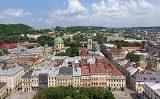
Lviv is a city in western Ukraine
. The city is regarded as one of the main cultural centres of today's Ukraine and historically has also been a major Polish and Jewish cultural center, as Poles and Jews were the two main ethnicities of the city until the outbreak of World War II and the following Holocaust and Polish population transfers (1944–1946). The historical heart of Lviv with its old buildings and cobblestone roads has survived World War II and ensuing Soviet presence largely unscathed. The city has many industries and institutions of higher education
such as the Lviv University
and the Lviv Polytechnic
. Lviv is also a home to many world-class cultural institutions, including a philharmonic orchestra and the famous Lviv Theatre of Opera and Ballet. The historic city centre
is on the UNESCO World Heritage List. Lviv celebrated its 750th anniversary with a son et lumière
in the city centre in September 2006.
Lviv was founded in 1256 in Red Ruthenia
by King Danylo Halytskyi of the Ruthenian
principality of Halych-Volhynia, and named in honour of his son, Lev. Together with the rest of Red Ruthenia
, Lviv was captured by the Kingdom of Poland in 1349 during the reign of Polish king Casimir III the Great. Lviv belonged to the Crown of the Kingdom of Poland 1349–1772, the Austrian Empire
1772–1918 and the Second Polish Republic
1918–1939. With the Invasion of Poland at the outbreak of the second World War, the city of Lviv with adjacent land were annexed and incorporated into the Soviet Union, becoming part of the Ukrainian Soviet Socialist Republic from 1939 to 1941. Between July 1941 and July 1944 Lviv was under German occupation and was located in the General Government
. In July 1944 it was captured
by the Soviet Red Army
and the Polish Home Army
. According to the agreements of the Yalta Conference
, Lviv was again integrated into the Ukrainian SSR. Most of the Poles living in Lviv were resettled into Polish territories annexed from Germany
.
After the collapse of the Soviet Union in 1991, the city remained a part of the now independent Ukraine, for which it currently serves as the administrative centre of Lviv Oblast
, and is designated as its own raion
(district) within that oblast
.
On 12 June 2009 the Ukrainian magazine Focus
assessed Lviv as the best Ukrainian city to live in. Its more Western European flavor lends it the nickname the "Little Paris
of Ukraine".
The city is expecting a sharp increase in the number of foreign visitors next summer for the 2012 UEFA European Football Championship
, and as a result a major new airport terminal is being built. Lviv is one of 8 Polish and Ukrainian cities that is co-hosting the group stages of the tournament.
, approximately 70 km from the Polish border and 160 km (99.4 mi) from the eastern Carpathian Mountains
. The average altitude of Lviv is 296 m (971.13 ft) above sea level
. Its highest point is the Vysokyi Zamok (High Castle
), 409 m (1,341.86 ft) above sea level
. This castle has a commanding view of the historic city centre with its distinctive green-domed churches and intricate architecture.
The old walled city
was at the foothills of the High Castle on the banks of the river Poltva
. In the 13th century, the river was used to transport goods. In the early 20th century, the Poltva was covered over in areas where it flows through the city. The river flows directly beneath the central street of Lviv, Freedom Avenue (Prospect Svobody) and the renowned Lviv Opera House.
(Köppen climate classification
Dfb). The average temperatures are -4 °C in January and 18 °C (64 °F) in June. Average annual rainfall is 760 mm (26 inches) with the maximum being in summer. Cloud coverage averages
266 days per year.
settlement – in the tenth century the Lendians established a fortified settlement on Castle Hill. In 1977 it was discovered that the Orthodox church of St. Nicholas had been built on a previously functioning cemetery. In 981, the Cherven Towns area was captured by Vladimir I and fell under the rule of Kievan Rus.
principality of Halych-Volhynia and named in honour of his son Lev.
In 1261 the town was invaded by the Tatars. Various sources relate the events which range from destruction of the castle through to a complete razing of the town. All the sources agree that it was on the orders of the Mongol general Burundai. The Naukove tovarystvo im. Shevchenka of the Shevchenko Scientific Society say that the order to raze the city was reduced by Burundai as the Galician-Volhynian chronicle states that in 1261 "Said Buronda to Vasylko: 'Since you are at peace with me then raze all your castles'". Basil Dmytryshyn states that the order was implied to be the fortifications as a whole "If you wish to have peace with me, then destroy [all fortifications of] your towns". According to the Universal-Lexicon der Gegenwart und Vergangenheit the town's founder was ordered to destroy the town himself.
After Daniel's death Lev rebuilt the town around the year 1270 at its present location, choosing Lviv as his residence, and made Lviv the capital of Galicia-Volhynia. The city is first mentioned in the Halych-Volhynian Chronicle which dates from 1256. The town grew quickly due to an influx of Polish people
from Kraków
, Poland, after they had suffered a widespread famine there. Around 1280 many Armenians lived in Galicia and were mainly based in Lviv where they had their own Archbishop
. The town was inherited by the Grand Duchy of Lithuania
in 1340 and ruled by voivode Dmitri Detko, the favourite of the Lithuanian prince Lubart, until 1349.
Casimir built two new castles. In 1356 he brought in German colonists and within 7 years granted the Magdeburg rights
which implied that all city matters were to be resolved by a council elected by the wealthy citizens. The city council
seal of the 14th century stated: S(igillum): Civitatis Lembvrgensis.
After Casimir had died in 1370, he was succeeded as king of Poland by his nephew, King Louis I of Hungary, who in 1372 put Lviv together with the region of Galicia-Volhynia under the administration of his relative Władysław, Duke of Opole. When in 1387 Władysław retreated from the post of its governor, Galicia-Volhynia became occupied by the Hungarians, but soon Jadwiga
, the youngest daughter of Louis, but also ruler of Poland and wife of King of Poland Władysław II Jagiełło
, unified it directly with the Crown of the Kingdom of Poland.
founded in 1389. The city's prosperity during the following centuries is owed to the trade privileges granted to it by Casimir, Jadwiga and the subsequent Polish kings.
In 1412 the city became the seat of the Roman Catholic Archdiocese
, which since 1375 had been in Halych
. In 1444 Lviv was granted with the staple right
, which resulted in city's growing prosperity and wealth, as it became one of major trading centers on the merchant routes between Central Europe and Black Sea region. It was also transformed into a one of main fortresses in the kingdom.
As Lviv prospered it became religiously and ethnically diverse with Germans, Poles, Ruthenians, Armenians and Jews being the most important nationalities living within the city. With passing time most of them had assimilated to the dominant Polish culture and became polonized
.
 In 1572 the first publisher of books in Ukraine, Ivan Fedorovych
, a graduate of the University of Kraków
, settled in Lviv for a brief period when he was chased out of Moscow. The city became a significant centre for Eastern orthodoxy with the establishment of an orthodox brotherhood, a Greek-Slavonic school and a printery which published the first full versions of the Bible in Church Slavonic in 1580.
The 17th century brought invading armies of Swedes
, Hungarians
, Turks, Russians
and Cossacks to its gates.
In 1648 a Ukrainian freedom fighting army of Cossacks and Crimean Tatars besieged Lviv. The city was not sacked due to its beauty and the leader of the revolution Bohdan Khmelnytsky
studied there as well and did not want to see it ruined. As a result a ransom of 250 000 ducat was paid and the Cossacks marched west towards Zamostia. Lviv was the only major city in Poland which was not captured by the invaders. In 1672 it was surrounded by the Ottomans
who failed to conquer it. Lviv was captured for the first time by a foreign army in 1704 when Swedish troops under King Charles XII
entered the city after a short siege.
, the region was annexed by Austria. Known in German as Lemberg, the city became the capital of the Kingdom of Galicia and Lodomeria
. The city grew dramatically under Austrian rule, increasing in population from approximately 30,000 at the time of Austrian annexation in 1772 to 206,100 by 1910.
In 1773, the first newspaper in Lviv, Gazette de Leopoli, began to be published. In 1784, a German language University was opened; after closing again in 1805, it was re-opened in 1817.
 In the 19th century, the Austrian administration attempted to Germanise
the city's educational and governmental functioning. Many cultural organizations which did not have a pro-German orientation were closed. After the revolution of 1848, the language of instruction at the University shifted from German to include Ukrainian and Polish. Around that time, a certain sociolect
developed in the city known as the Lwów dialect
. Considered to be a type of Polish dialect, it draws its roots from numerous other languages besides Polish.
In 1853, it was the first European city to have street lights due to innovations discovered by Lviv inhabitants Ignacy Łukasiewicz and Jan Zeh. In that year kerosene lamps were introduced as street lights which in 1858 were updated to gas and in 1900 to electricity.
After the so-called Ausgleich
of February 1867, the Austrian Empire
was reformed into a dualist Austria-Hungary
and a slow yet steady process of liberalisation of Austrian rule in Galicia started. From 1873, Galicia was de facto an autonomous province of Austria-Hungary
with Polish and, to a much lesser degree, Ukrainian or Ruthenian, as official languages. The Germanisation had been halted and the censorship lifted as well. Galicia
was subject to the Austrian part of the Dual Monarchy, but the Galician Sejm
and provincial administration, both established in Lviv, had extensive privileges and prerogatives, especially in education, culture, and local affairs. The city started to grow rapidly, becoming the 4th largest in Austria-Hungary, according to the census of 1910. Many Belle Époque
public edifices and tenement houses were erected, the buildings from the Austrian period, such as the opera theater built in the Viennese neo-Renaissance style, still dominate and characterize much of the centre of the city.
During Habsburg rule, Lviv became one of the most important Polish, Ukrainian and Jewish cultural centers. In Lviv, according to the Austrian census of 1910, which listed religion and language, 51% of the city's population were Roman Catholics, 28% Jews, and 19% belonged to the Ukrainian Greek Catholic Church
. Linguistically, 86% of the city's population used the Polish language and 11% preferred the Ukrainian language. Lviv was home to the Polish Ossolineum
, with the second largest collection of Polish books in the world, the Polish Academy of Arts, the Polish Historical Society
, the Polish Theater and Polish Archdiocese. At the same time, the city also housed the largest and most influential Ukrainian institutions in the world, including the Prosvita
society dedicated to spreading literacy in the Ukrainian language, the Shevchenko Scientific Society
, the Dniester Insurance Company and base of the Ukrainian cooperative movement
, and it served as the seat of the Ukrainian Catholic Church. Lviv was also a major center of Jewish culture, in particular as a center of the Yiddish language
, and was the home of the world's first Yiddish-language daily newspaper, the Lemberger Togblat, established in 1904.
In the early stage of World War I, Lviv was captured by the Russian army
in September 1914 but retaken by Austria–Hungary in June the following year.
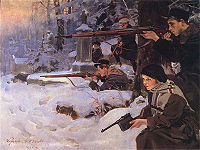 After the collapse of the Habsburg Monarchy
at the end of World War I Lviv became an arena of battle between the local Polish population and the Ukrainian Sich Riflemen. Both nations perceived the city as integral part of their new statehoods which at that time were forming in the former Austrian territories. On the night of 31 October – 1 November 1918 the Western Ukrainian National Republic was proclaimed with Lviv as its capital. 2,300 Ukrainian soldiers from the Ukrainian Sich Riflemen (Sichovi Striltsi), which had previously been a corps in the Austrian Army, took control over Lviv. The city's Polish majority opposed the Ukrainian declaration and began to fight against the Ukrainian troops. During this combat an important role was taken by young Polish city defenders called Lwów Eaglets
. For the courage of its inhabitants Lviv was awarded the Virtuti Militari
cross by Józef Piłsudski on 22 November 1920.
The Ukrainian forces withdrew outside Lviv's confines by 21 November 1918, after which elements of Polish soldiery begun to loot and burn much of the Jewish and Ukrainian quarters of the city, killing approximately 340 civilians (see: Lwów pogrom (1918)
). The retreating Ukrainian forces besieged the city. The Sich riflemen reformed into the Ukrainian Galician Army
(UHA). The Polish forces aided from central Poland, including general Haller's Blue Army, equipped by the French, relieved the besieged city in May 1919 forcing the UHA to the east. Despite Entente
mediation attempts to cease hostilities and reach a compromise between belligerents the Polish–Ukrainian War continued until July 1919 when the last UHA forces withdrew east of the river Zbruch
. The border on the river Zbruch was confirmed at the Treaty of Warsaw
, when in April 1920 Polish government signed an agreement with Symon Petlura where it was agreed that for military support against the Bolsheviks the Ukrainian People's Republic
renounced its claims to the territories of Eastern Galicia.
In August 1920 Lviv was attacked by the Red Army
under the command of Aleksandr Yegorov and Stalin
during Polish-Soviet War but the city repelled the attack
.
Polish sovereignty over Lviv was internationally recognised when the Council of Ambassadors
ultimately approved it in March 1923.
period Lviv held the rank of Poland's
third most populous city (after Warsaw
and Łódź) and became the seat of the Lwów Voivodeship
. Right after Warsaw, it was the second most important cultural and academic centre of interwar Poland. In the academic year 1937–38 there were 9,100 students attending 5 higher education facilities including the renowned university
and institute of technology
. In 1920 professor Rudolf Weigl
of the Lwów University discovered the vaccine against typhus
.
The major trade fair
called Targi Wschodnie
was established 1921. Its geographic location gave it an important role in stimulating international trade and fostering city's and Poland's economic development.
While the eastern part of the Lwów Voivodeship had a relative Ukrainian
majority in most of the rural areas the city itself did not (see table to the right). Prewar Lviv had also a large and thriving Jewish population
. The Polish inhabitants of the city spoke the characteristic Lwów dialect
.
Although Polish authorities obliged themselves internationally to provide Eastern Galicia with an autonomy (including a creation of a separate Ukrainian university in Lviv) and even though in September 1922 adequate Polish Sejm's Bill was enacted, it was not fulfilled. Instead, the Polish government closed down many Ukrainian schools that had previously flourished during Austrian rule and closed down every Ukrainian university department at the University of Lviv with the exception of one. Unlike in Austrian times, when the size and amount of public parades or other cultural expressions corresponded to each cultural group's relative population, the Polish government emphasized the Polish nature of the city and limited public displays of Jewish and Ukrainian culture. Military parades and commemorations of battles at particular streets within the city, all celebrating the Polish forces who fought against the Ukrainians in 1918, became frequent, and in the 1930s a vast memorial monument and burial ground of Polish soldiers
from that conflict was built in the city's Lychakiv Cemetery. The Polish government fostered the idea of Lviv as an eastern Polish outpost standing strong against eastern "hordes."
on 17 September. The Soviet Union annexed the eastern part of Second Polish Republic including the city of Lviv which capitulated to the Red Army on 22 September 1939.
The city (named Lvov in Russian) became the capital of the newly formed Lviv Oblast
. The Soviets opened many Ukrainian-language schools that had been closed by the Polish government and Ukrainian was reintroduced in the University of Lviv (where the Polish government had banished it during the interwar years), which became thoroughly Ukrainized
and renamed after Ukrainian writer Ivan Franko
.
The Soviets also started repressions against local Poles and Ukrainians deporting many of the citizens. Waves of deportations started with the Poles followed by the Jews who had refused Soviet passports and then the Ukrainian nationalists.
invaded the USSR.
In the initial stage of Operation Barbarossa
(late June 1941) Lviv was taken by the Germans. The evacuating Soviets killed most of the prison population. Wehrmacht forces arriving in the city discovered evidence of the Soviet mass murders committed by the NKVD
and NKGB. Ukrainian nationalists, organized as a militia, and the civilian population were allowed to take revenge on the "Jews and the Bolsheviks" and indulged in several mass killings in Lviv and the surrounding region, which resulted in the deaths estimated at between 4,000 and 10,000 Jews (see: Lviv pogroms
). The Germans during the occupation of the city committed numerous other atrocities including the "killing of Polish university professors".
On 30 June 1941 Yaroslav Stetsko
proclaimed in Lviv the Government of an independent Ukrainian state allied with Nazi Germany. This was done without pre-approval from the Germans and after 15 September 1941 the organisers were arrested.
The Sikorski–Mayski Agreement signed in London on 30 July 1941 between Polish government-in-exile and USSR's government invalidated the September 1939 Soviet-German partition of Poland, as the Soviets declared it null and void.
Meanwhile German-occupied Eastern Galicia at the beginning of August 1941 was incorporated into the General Government
as Distrikt Galizien with Lviv as district's capital.
Germany viewed Galicia, formerly Austrian crown land, as already aryan
ised and civilised. As a result the Ukrainian Galicians escaped the full extent of German acts in comparison to Ukrainians who lived in Ukraine
. German policy towards the Polish population in this area was more harsh and comparable to the situation in the rest of the General Government
. According to the Third Reich's racial policies
Galician Jews became the main target of German repressions. Almost all of the Jewish Galicians were deported to concentration camps
or killed. In 1941 there were approximately 200,000 Jews in Lviv. By the end of the war the Jewish population was virtually wiped out with only 200 to 300 Jews left alive.
(see: Lwów Uprising
), the local commanders of the Polish AK were invited to a meeting with the commanders of the Red Army where they were arrested by the NKVD.
In January 1945 the local NKVD arrested many Poles in Lviv where, according to Soviet sources, on 1 October 1944 Poles still made a clear majority – 66.7% of the population, to encourage their emigration from their city. Those arrested were released after they signed papers agreeing to emigrate to Poland which postwar borders were moved westwards with Lviv left within the borders of the Soviet Union, according to the Yalta conference
settlements.
It is estimated that from 100,000 to 140,000 Poles were resettled from the city into the so called Recovered Territories
as a part of postwar population transfers, many of them to the area of newly acquired Wrocław, formerly the German city of Breslau. Little remains of Polish culture
in Lviv except for the Italian-influenced architecture. The Polish history
of Lviv is still well remembered in Poland and those Poles who stayed in Lviv have formed their own organisation the Association of Polish Culture of the Lviv Land
.
Lviv and its population suffered greatly during the two world war
s as many of the offensives were fought across the local geography causing significant collateral damage
and disruption.
On 16 August 1945, a border agreement between the government of the Soviet Union
and the Provisional Government of National Unity
, installed by the Soviets, was signed in Moscow. In that treaty, Poland formally ceded
its prewar eastern part to the Soviet Union agreeing to the Polish-Soviet border drawn according to the so called Curzon Line
. Consequently, the agreement was ratified
on 5 February 1946. Thus, in February 1946, Lviv became a part of the Soviet Union.
In the 1950s and 1960s the city significantly expanded both in population and size mostly due to the city's rapidly growing industrial base. Due to the fight of SMERSH
with the guerrilla formations of the Ukrainian Insurgent Army the city obtained a nickname with a negative connotation of Banderstadt as the City of Stepan Bandera
. The word stadt was added instead of the common Slavic grad to imply alienation. Over the years the residents of the city found this so ridiculous that even people not familiar with Bandera accepted it as a sarcasm in reference to the Soviet perception of western Ukraine. By the time of the fall of the Soviet Union the name became a proud mark for the Lviv natives culminating in the creation of a local rock band under the name Khloptsi z Bandershtadtu (Boys from Banderstadt).
In the period of liberalisation from the Soviet system
in the 1980s the city became the centre of political movements advocating Ukrainian independence from the USSR.
during the 2004 Ukrainian presidential election
and played a key role in the Orange Revolution
. Hundreds of thousands of people would gather in freezing temperatures to demonstrate for the Orange camp. Acts of civil disobedience
forced the head of the local police to resign and the local assembly issued a resolution refusing to accept the fraudulent first official results.
Lviv remains today one of the main centres of Ukrainian culture and the origin of much of the nation's political class.
Ukraine
Ukraine is a country in Eastern Europe. It has an area of 603,628 km², making it the second largest contiguous country on the European continent, after Russia...
. The city is regarded as one of the main cultural centres of today's Ukraine and historically has also been a major Polish and Jewish cultural center, as Poles and Jews were the two main ethnicities of the city until the outbreak of World War II and the following Holocaust and Polish population transfers (1944–1946). The historical heart of Lviv with its old buildings and cobblestone roads has survived World War II and ensuing Soviet presence largely unscathed. The city has many industries and institutions of higher education
Higher education
Higher, post-secondary, tertiary, or third level education refers to the stage of learning that occurs at universities, academies, colleges, seminaries, and institutes of technology...
such as the Lviv University
Lviv University
The Lviv University or officially the Ivan Franko National University of Lviv is the oldest continuously operating university in Ukraine...
and the Lviv Polytechnic
Lviv Polytechnic
Lviv Polytechnic National University is the largest scientific university in Lviv. Since its foundation in 1844, it was one of the most important centres of science and technological development in Central Europe. In the interbellum period, the Polytechnic was one of the most important technical...
. Lviv is also a home to many world-class cultural institutions, including a philharmonic orchestra and the famous Lviv Theatre of Opera and Ballet. The historic city centre
Old Town (Lviv)
Lviv's Old Town is the historic centre of the western Ukrainian city of Lviv, in the Lviv Oblast , recognized as the State Historic-Architectural Sanctuary in 1975.-UNESCO:...
is on the UNESCO World Heritage List. Lviv celebrated its 750th anniversary with a son et lumière
Son et lumière (show)
Son et lumière , or a sound and light show, is a form of nighttime entertainment that is usually presented in an outdoor venue of historic significance....
in the city centre in September 2006.
Lviv was founded in 1256 in Red Ruthenia
Red Ruthenia
Red Ruthenia is the name used since medieval times to refer to the area known as Eastern Galicia prior to World War I; first mentioned in Polish historic chronicles in the 1321, as Ruthenia Rubra or Ruthenian Voivodeship .Ethnographers explain that the term was applied from the...
by King Danylo Halytskyi of the Ruthenian
Ruthenians
The name Ruthenian |Rus']]) is a culturally loaded term and has different meanings according to the context in which it is used. Initially, it was the ethnonym used for the East Slavic peoples who lived in Rus'. Later it was used predominantly for Ukrainians...
principality of Halych-Volhynia, and named in honour of his son, Lev. Together with the rest of Red Ruthenia
Red Ruthenia
Red Ruthenia is the name used since medieval times to refer to the area known as Eastern Galicia prior to World War I; first mentioned in Polish historic chronicles in the 1321, as Ruthenia Rubra or Ruthenian Voivodeship .Ethnographers explain that the term was applied from the...
, Lviv was captured by the Kingdom of Poland in 1349 during the reign of Polish king Casimir III the Great. Lviv belonged to the Crown of the Kingdom of Poland 1349–1772, the Austrian Empire
Austrian Empire
The Austrian Empire was a modern era successor empire, which was centered on what is today's Austria and which officially lasted from 1804 to 1867. It was followed by the Empire of Austria-Hungary, whose proclamation was a diplomatic move that elevated Hungary's status within the Austrian Empire...
1772–1918 and the Second Polish Republic
Second Polish Republic
The Second Polish Republic, Second Commonwealth of Poland or interwar Poland refers to Poland between the two world wars; a period in Polish history in which Poland was restored as an independent state. Officially known as the Republic of Poland or the Commonwealth of Poland , the Polish state was...
1918–1939. With the Invasion of Poland at the outbreak of the second World War, the city of Lviv with adjacent land were annexed and incorporated into the Soviet Union, becoming part of the Ukrainian Soviet Socialist Republic from 1939 to 1941. Between July 1941 and July 1944 Lviv was under German occupation and was located in the General Government
General Government
The General Government was an area of Second Republic of Poland under Nazi German rule during World War II; designated as a separate region of the Third Reich between 1939–1945...
. In July 1944 it was captured
Lwów Uprising
The Lwów Uprising was the armed struggle started by the Polish resistance movement organization Polish Home Army against the Nazi occupiers in Lviv, during World War II. It began on July 23, 1944 as a part of a plan of all-national uprising codenamed Operation Tempest. The uprising lasted until...
by the Soviet Red Army
Red Army
The Workers' and Peasants' Red Army started out as the Soviet Union's revolutionary communist combat groups during the Russian Civil War of 1918-1922. It grew into the national army of the Soviet Union. By the 1930s the Red Army was among the largest armies in history.The "Red Army" name refers to...
and the Polish Home Army
Armia Krajowa
The Armia Krajowa , or Home Army, was the dominant Polish resistance movement in World War II German-occupied Poland. It was formed in February 1942 from the Związek Walki Zbrojnej . Over the next two years, it absorbed most other Polish underground forces...
. According to the agreements of the Yalta Conference
Yalta Conference
The Yalta Conference, sometimes called the Crimea Conference and codenamed the Argonaut Conference, held February 4–11, 1945, was the wartime meeting of the heads of government of the United States, the United Kingdom, and the Soviet Union, represented by President Franklin D...
, Lviv was again integrated into the Ukrainian SSR. Most of the Poles living in Lviv were resettled into Polish territories annexed from Germany
Recovered Territories
Recovered or Regained Territories was an official term used by the People's Republic of Poland to describe those parts of pre-war Germany that became part of Poland after World War II...
.
After the collapse of the Soviet Union in 1991, the city remained a part of the now independent Ukraine, for which it currently serves as the administrative centre of Lviv Oblast
Lviv Oblast
Lviv Oblast is an oblast in western Ukraine. The administrative center of the oblast is the city of Lviv.-History:The oblast was created as part of the Ukrainian Soviet Socialist Republic on December 4, 1939...
, and is designated as its own raion
Raion
A raion is a type of administrative unit of several post-Soviet countries. The term, which is from French rayon 'honeycomb, department,' describes both a type of a subnational entity and a division of a city, and is commonly translated in English as "district"...
(district) within that oblast
Oblast
Oblast is a type of administrative division in Slavic countries, including some countries of the former Soviet Union. The word "oblast" is a loanword in English, but it is nevertheless often translated as "area", "zone", "province", or "region"...
.
On 12 June 2009 the Ukrainian magazine Focus
Focus (Ukrainian magazine)
Focus is a national Ukrainian weekly news magazine in Russian language published in Kiev and distributed throughout the country. The base auditory of the magazine are the people of high and above high level of income between 25 to 45 years of age that live in the 40 biggest metropolises of Ukraine...
assessed Lviv as the best Ukrainian city to live in. Its more Western European flavor lends it the nickname the "Little Paris
Paris
Paris is the capital and largest city in France, situated on the river Seine, in northern France, at the heart of the Île-de-France region...
of Ukraine".
The city is expecting a sharp increase in the number of foreign visitors next summer for the 2012 UEFA European Football Championship
2012 UEFA European Football Championship
The 2012 UEFA European Football Championship, commonly referred to as Euro 2012, will be the 14th European Championship for national football teams sanctioned by UEFA. The final tournament will be hosted by Poland and Ukraine between 8 June and 1 July 2012...
, and as a result a major new airport terminal is being built. Lviv is one of 8 Polish and Ukrainian cities that is co-hosting the group stages of the tournament.
Location
Lviv is located on the edge of the Roztochia UplandRoztocze
Roztocze is a range of hills in east-central Poland and western Ukraine which rises from the Lublin Upland and extends southeastward through Solska Wilderness and across the border into Ukrainian Podolia. Low and rolling, the range is approximately 180 km long and 14 km wide...
, approximately 70 km from the Polish border and 160 km (99.4 mi) from the eastern Carpathian Mountains
Carpathian Mountains
The Carpathian Mountains or Carpathians are a range of mountains forming an arc roughly long across Central and Eastern Europe, making them the second-longest mountain range in Europe...
. The average altitude of Lviv is 296 m (971.13 ft) above sea level
Sea level
Mean sea level is a measure of the average height of the ocean's surface ; used as a standard in reckoning land elevation...
. Its highest point is the Vysokyi Zamok (High Castle
Lviv High Castle
The Lviv High Castle or Lviv Castle Hill is a historic castle located on one of the hills of the Western Ukrainian city of Lviv. It is currently the highest point in the city, 413 metres above sea level....
), 409 m (1,341.86 ft) above sea level
Above mean sea level
The term above mean sea level refers to the elevation or altitude of any object, relative to the average sea level datum. AMSL is used extensively in radio by engineers to determine the coverage area a station will be able to reach...
. This castle has a commanding view of the historic city centre with its distinctive green-domed churches and intricate architecture.
The old walled city
Defensive wall
A defensive wall is a fortification used to protect a city or settlement from potential aggressors. In ancient to modern times, they were used to enclose settlements...
was at the foothills of the High Castle on the banks of the river Poltva
Poltva River
The Poltva River is a river in the western Ukrainian Oblast of Lviv and a tributary of the Bug River. The capital of the Lviv Oblast, Lviv, is located on the river. In the 19th century the river was included into the underground sewer system of Lviv....
. In the 13th century, the river was used to transport goods. In the early 20th century, the Poltva was covered over in areas where it flows through the city. The river flows directly beneath the central street of Lviv, Freedom Avenue (Prospect Svobody) and the renowned Lviv Opera House.
Climate
Lviv's climate is humid continentalHumid continental climate
A humid continental climate is a climatic region typified by large seasonal temperature differences, with warm to hot summers and cold winters....
(Köppen climate classification
Köppen climate classification
The Köppen climate classification is one of the most widely used climate classification systems. It was first published by Crimea German climatologist Wladimir Köppen in 1884, with several later modifications by Köppen himself, notably in 1918 and 1936...
Dfb). The average temperatures are -4 °C in January and 18 °C (64 °F) in June. Average annual rainfall is 760 mm (26 inches) with the maximum being in summer. Cloud coverage averages
266 days per year.
History
Pre-history
Archeologists have demonstrated that the Lviv area was settled by the 5th century. From the ninth century in the area of present-day Lviv, between Castle Hill and the river Poltva, there existed a LendianLendians
The Lendians were a Lechitic eastern Wends tribe recorded to have inhabited the ill-defined area in East Lesser Poland and Cherven Towns between the 7th and 11th centuries....
settlement – in the tenth century the Lendians established a fortified settlement on Castle Hill. In 1977 it was discovered that the Orthodox church of St. Nicholas had been built on a previously functioning cemetery. In 981, the Cherven Towns area was captured by Vladimir I and fell under the rule of Kievan Rus.
Halych-Volyn Principality
Lviv was founded by King Daniel of Galicia in the RuthenianRuthenians
The name Ruthenian |Rus']]) is a culturally loaded term and has different meanings according to the context in which it is used. Initially, it was the ethnonym used for the East Slavic peoples who lived in Rus'. Later it was used predominantly for Ukrainians...
principality of Halych-Volhynia and named in honour of his son Lev.
In 1261 the town was invaded by the Tatars. Various sources relate the events which range from destruction of the castle through to a complete razing of the town. All the sources agree that it was on the orders of the Mongol general Burundai. The Naukove tovarystvo im. Shevchenka of the Shevchenko Scientific Society say that the order to raze the city was reduced by Burundai as the Galician-Volhynian chronicle states that in 1261 "Said Buronda to Vasylko: 'Since you are at peace with me then raze all your castles'". Basil Dmytryshyn states that the order was implied to be the fortifications as a whole "If you wish to have peace with me, then destroy [all fortifications of] your towns". According to the Universal-Lexicon der Gegenwart und Vergangenheit the town's founder was ordered to destroy the town himself.
After Daniel's death Lev rebuilt the town around the year 1270 at its present location, choosing Lviv as his residence, and made Lviv the capital of Galicia-Volhynia. The city is first mentioned in the Halych-Volhynian Chronicle which dates from 1256. The town grew quickly due to an influx of Polish people
Poles
thumb|right|180px|The state flag of [[Poland]] as used by Polish government and diplomatic authoritiesThe Polish people, or Poles , are a nation indigenous to Poland. They are united by the Polish language, which belongs to the historical Lechitic subgroup of West Slavic languages of Central Europe...
from Kraków
Kraków
Kraków also Krakow, or Cracow , is the second largest and one of the oldest cities in Poland. Situated on the Vistula River in the Lesser Poland region, the city dates back to the 7th century. Kraków has traditionally been one of the leading centres of Polish academic, cultural, and artistic life...
, Poland, after they had suffered a widespread famine there. Around 1280 many Armenians lived in Galicia and were mainly based in Lviv where they had their own Archbishop
Archbishop
An archbishop is a bishop of higher rank, but not of higher sacramental order above that of the three orders of deacon, priest , and bishop...
. The town was inherited by the Grand Duchy of Lithuania
Grand Duchy of Lithuania
The Grand Duchy of Lithuania was a European state from the 12th /13th century until 1569 and then as a constituent part of Polish-Lithuanian Commonwealth until 1791 when Constitution of May 3, 1791 abolished it in favor of unitary state. It was founded by the Lithuanians, one of the polytheistic...
in 1340 and ruled by voivode Dmitri Detko, the favourite of the Lithuanian prince Lubart, until 1349.
Galicia–Volhynia Wars
During the wars over the succession of Galicia-Volhynia Principality in 1339 King Casimir III of Poland undertook an expedition and conquered Lviv in 1340, burning down the old princely castle. Poland ultimately gained control over Lviv and the adjacent region in 1349. From then on the population was subjected to attempts to both Polonize and Catholicize the population.Casimir built two new castles. In 1356 he brought in German colonists and within 7 years granted the Magdeburg rights
Magdeburg rights
Magdeburg Rights or Magdeburg Law were a set of German town laws regulating the degree of internal autonomy within cities and villages granted by a local ruler. Modelled and named after the laws of the German city of Magdeburg and developed during many centuries of the Holy Roman Empire, it was...
which implied that all city matters were to be resolved by a council elected by the wealthy citizens. The city council
City council
A city council or town council is the legislative body that governs a city, town, municipality or local government area.-Australia & NZ:Because of the differences in legislation between the States, the exact definition of a City Council varies...
seal of the 14th century stated: S(igillum): Civitatis Lembvrgensis.
After Casimir had died in 1370, he was succeeded as king of Poland by his nephew, King Louis I of Hungary, who in 1372 put Lviv together with the region of Galicia-Volhynia under the administration of his relative Władysław, Duke of Opole. When in 1387 Władysław retreated from the post of its governor, Galicia-Volhynia became occupied by the Hungarians, but soon Jadwiga
Jadwiga of Poland
Jadwiga was monarch of Poland from 1384 to her death. Her official title was 'king' rather than 'queen', reflecting that she was a sovereign in her own right and not merely a royal consort. She was a member of the Capetian House of Anjou, the daughter of King Louis I of Hungary and Elizabeth of...
, the youngest daughter of Louis, but also ruler of Poland and wife of King of Poland Władysław II Jagiełło
Jogaila
Jogaila, later 'He is known under a number of names: ; ; . See also: Jogaila : names and titles. was Grand Duke of Lithuania , king consort of Kingdom of Poland , and sole King of Poland . He ruled in Lithuania from 1377, at first with his uncle Kęstutis...
, unified it directly with the Crown of the Kingdom of Poland.
Kingdom of Poland
As part of the Crown of the Kingdom of Poland Lwów (Lviv) became the capital of the Ruthenian VoivodeshipRuthenian Voivodeship
Ruthenia Voivodeship was an administrative division of the Kingdom of Poland . Together with Bełz Voivodeship, it formed Lesser Poland Province with its capital city in Kraków. Part of Lesser Poland region...
founded in 1389. The city's prosperity during the following centuries is owed to the trade privileges granted to it by Casimir, Jadwiga and the subsequent Polish kings.
In 1412 the city became the seat of the Roman Catholic Archdiocese
Roman Catholic Archdiocese of Lviv
The Archdiocese of Lviv of the Latins is a metropolitan archdiocese of the Latin Rite of the Catholic Church in western Ukraine. Archbishop Mieczyslaw Mokrzycki is the current metropolitan archbishop of the archdiocese.- History :...
, which since 1375 had been in Halych
Halych
Halych is a historic city on the Dniester River in western Ukraine. The town gave its name to the historic province and kingdom of Kingdom of Galicia–Volhynia, of which it was the capital until the early 14th century, when the seat of the local princes was moved to Lviv...
. In 1444 Lviv was granted with the staple right
Staple right
The staple right was a medieval right accorded to certain ports, the staple ports, that required merchant barges or ships to unload their goods at the port, and display them for sale for a certain period, often three days...
, which resulted in city's growing prosperity and wealth, as it became one of major trading centers on the merchant routes between Central Europe and Black Sea region. It was also transformed into a one of main fortresses in the kingdom.
As Lviv prospered it became religiously and ethnically diverse with Germans, Poles, Ruthenians, Armenians and Jews being the most important nationalities living within the city. With passing time most of them had assimilated to the dominant Polish culture and became polonized
Polonization
Polonization was the acquisition or imposition of elements of Polish culture, in particular, Polish language, as experienced in some historic periods by non-Polish populations of territories controlled or substantially influenced by Poland...
.
Ivan Fyodorov (printer)
Ivan Fyodorov or Fedorovič , was one of the fathers of Eastern Slavonic printing...
, a graduate of the University of Kraków
Jagiellonian University
The Jagiellonian University was established in 1364 by Casimir III the Great in Kazimierz . It is the oldest university in Poland, the second oldest university in Central Europe and one of the oldest universities in the world....
, settled in Lviv for a brief period when he was chased out of Moscow. The city became a significant centre for Eastern orthodoxy with the establishment of an orthodox brotherhood, a Greek-Slavonic school and a printery which published the first full versions of the Bible in Church Slavonic in 1580.
The 17th century brought invading armies of Swedes
Swedish Empire
The Swedish Empire refers to the Kingdom of Sweden between 1561 and 1721 . During this time, Sweden was one of the great European powers. In Swedish, the period is called Stormaktstiden, literally meaning "the Great Power Era"...
, Hungarians
Hungary
Hungary , officially the Republic of Hungary , is a landlocked country in Central Europe. It is situated in the Carpathian Basin and is bordered by Slovakia to the north, Ukraine and Romania to the east, Serbia and Croatia to the south, Slovenia to the southwest and Austria to the west. The...
, Turks, Russians
Tsardom of Russia
The Tsardom of Russia was the name of the centralized Russian state from Ivan IV's assumption of the title of Tsar in 1547 till Peter the Great's foundation of the Russian Empire in 1721.From 1550 to 1700, Russia grew 35,000 km2 a year...
and Cossacks to its gates.
In 1648 a Ukrainian freedom fighting army of Cossacks and Crimean Tatars besieged Lviv. The city was not sacked due to its beauty and the leader of the revolution Bohdan Khmelnytsky
Bohdan Khmelnytsky
Bohdan Zynoviy Mykhailovych Khmelnytsky was a hetman of the Zaporozhian Cossack Hetmanate of Polish–Lithuanian Commonwealth . He led an uprising against the Commonwealth and its magnates which resulted in the creation of a Cossack state...
studied there as well and did not want to see it ruined. As a result a ransom of 250 000 ducat was paid and the Cossacks marched west towards Zamostia. Lviv was the only major city in Poland which was not captured by the invaders. In 1672 it was surrounded by the Ottomans
Ottoman Empire
The Ottoman EmpireIt was usually referred to as the "Ottoman Empire", the "Turkish Empire", the "Ottoman Caliphate" or more commonly "Turkey" by its contemporaries...
who failed to conquer it. Lviv was captured for the first time by a foreign army in 1704 when Swedish troops under King Charles XII
Charles XII of Sweden
Charles XII also Carl of Sweden, , Latinized to Carolus Rex, Turkish: Demirbaş Şarl, also known as Charles the Habitué was the King of the Swedish Empire from 1697 to 1718...
entered the city after a short siege.
Habsburg Empire
In 1772, following the First Partition of PolandFirst Partition of Poland
The First Partition of Poland or First Partition of the Polish-Lithuanian Commonwealth took place in 1772 as the first of three partitions that ended the existence of the Polish-Lithuanian Commonwealth by 1795. Growth in the Russian Empire's power, threatening the Kingdom of Prussia and the...
, the region was annexed by Austria. Known in German as Lemberg, the city became the capital of the Kingdom of Galicia and Lodomeria
Kingdom of Galicia and Lodomeria
The Kingdom of Galicia and Lodomeria was a crownland of the Habsburg Monarchy, the Austrian Empire, and Austria–Hungary from 1772 to 1918 .This historical region in eastern Central Europe is currently divided between Poland and Ukraine...
. The city grew dramatically under Austrian rule, increasing in population from approximately 30,000 at the time of Austrian annexation in 1772 to 206,100 by 1910.
In 1773, the first newspaper in Lviv, Gazette de Leopoli, began to be published. In 1784, a German language University was opened; after closing again in 1805, it was re-opened in 1817.
Germanisation
Germanisation is both the spread of the German language, people and culture either by force or assimilation, and the adaptation of a foreign word to the German language in linguistics, much like the Romanisation of many languages which do not use the Latin alphabet...
the city's educational and governmental functioning. Many cultural organizations which did not have a pro-German orientation were closed. After the revolution of 1848, the language of instruction at the University shifted from German to include Ukrainian and Polish. Around that time, a certain sociolect
Sociolect
In sociolinguistics, a sociolect or social dialect is a variety of language associated with a social group such as a socioeconomic class, an ethnic group, an age group, etc....
developed in the city known as the Lwów dialect
Lwów dialect
The Lwów dialect is a local variety of the Polish language characteristic of the inhabitants of the city of Lviv , now in Ukraine. Based on the substratum of the Malopolonia dialect, it was heavily influenced by borrowings from other languages spoken in Central Europe, notably German and Yiddish,...
. Considered to be a type of Polish dialect, it draws its roots from numerous other languages besides Polish.
In 1853, it was the first European city to have street lights due to innovations discovered by Lviv inhabitants Ignacy Łukasiewicz and Jan Zeh. In that year kerosene lamps were introduced as street lights which in 1858 were updated to gas and in 1900 to electricity.
After the so-called Ausgleich
Ausgleich
The Austro-Hungarian Compromise of 1867 established the dual monarchy of Austria-Hungary. The Compromise re-established the sovereignty of the Kingdom of Hungary, separate from and no longer subject to the Austrian Empire...
of February 1867, the Austrian Empire
Austrian Empire
The Austrian Empire was a modern era successor empire, which was centered on what is today's Austria and which officially lasted from 1804 to 1867. It was followed by the Empire of Austria-Hungary, whose proclamation was a diplomatic move that elevated Hungary's status within the Austrian Empire...
was reformed into a dualist Austria-Hungary
Austria-Hungary
Austria-Hungary , more formally known as the Kingdoms and Lands Represented in the Imperial Council and the Lands of the Holy Hungarian Crown of Saint Stephen, was a constitutional monarchic union between the crowns of the Austrian Empire and the Kingdom of Hungary in...
and a slow yet steady process of liberalisation of Austrian rule in Galicia started. From 1873, Galicia was de facto an autonomous province of Austria-Hungary
Austria-Hungary
Austria-Hungary , more formally known as the Kingdoms and Lands Represented in the Imperial Council and the Lands of the Holy Hungarian Crown of Saint Stephen, was a constitutional monarchic union between the crowns of the Austrian Empire and the Kingdom of Hungary in...
with Polish and, to a much lesser degree, Ukrainian or Ruthenian, as official languages. The Germanisation had been halted and the censorship lifted as well. Galicia
Galicia
-Geographic regions:* Galicia , an autonomous community in northwestern Spain** Gallaecia, a province of the Roman Empire** Kingdom of Galicia, a medieval kingdom**Nueva Galicia :*** Nueva Galicia, a region of New Spain, now in Mexico...
was subject to the Austrian part of the Dual Monarchy, but the Galician Sejm
Diet of Galicia
The Diet of Galicia was the regional assembly of the Kingdom of Galicia and Lodomeria, which was part of Austro-Hungary. The Galician diet was a unicameral assembly composed of 150 deputies, which was presided over by a marshal or a vice-marshal that were appointed by the emperor. The...
and provincial administration, both established in Lviv, had extensive privileges and prerogatives, especially in education, culture, and local affairs. The city started to grow rapidly, becoming the 4th largest in Austria-Hungary, according to the census of 1910. Many Belle Époque
Belle Époque
The Belle Époque or La Belle Époque was a period in European social history that began during the late 19th century and lasted until World War I. Occurring during the era of the French Third Republic and the German Empire, it was a period characterised by optimism and new technological and medical...
public edifices and tenement houses were erected, the buildings from the Austrian period, such as the opera theater built in the Viennese neo-Renaissance style, still dominate and characterize much of the centre of the city.
During Habsburg rule, Lviv became one of the most important Polish, Ukrainian and Jewish cultural centers. In Lviv, according to the Austrian census of 1910, which listed religion and language, 51% of the city's population were Roman Catholics, 28% Jews, and 19% belonged to the Ukrainian Greek Catholic Church
Ukrainian Greek Catholic Church
The Ukrainian Greek Catholic Church , Ukrainska Hreko-Katolytska Tserkva), is the largest Eastern Rite Catholic sui juris particular church in full communion with the Holy See, and is directly subject to the Pope...
. Linguistically, 86% of the city's population used the Polish language and 11% preferred the Ukrainian language. Lviv was home to the Polish Ossolineum
Ossolineum
The Ossolineum or Zakład Narodowy im. Ossolińskich a meritorious department for Polish science and culture , which was founded for the Polish Nation in 1817 by Józef Maksymilian Ossoliński, and was opened in 1827 in Lviv.It was one of the most important Polish...
, with the second largest collection of Polish books in the world, the Polish Academy of Arts, the Polish Historical Society
Polish Historical Society
Polish Historical Society is a Polish scientific society for historians. Founded in 1886 in Lwów by Ksawery Liske as a local society, in 1926 it became the Poland-wide organization dedicated to advancing the knowledge and studies in history of Poland. Since 1974 it organizes tournaments of...
, the Polish Theater and Polish Archdiocese. At the same time, the city also housed the largest and most influential Ukrainian institutions in the world, including the Prosvita
Prosvita
Prosvita is a society created in the nineteenth century in Ukrainian Galicia for preserving and developing Ukrainian culture and education among population....
society dedicated to spreading literacy in the Ukrainian language, the Shevchenko Scientific Society
Shevchenko Scientific Society
The Shevchenko Scientific Society is a Ukrainian scientific society devoted to the promotion of scholarly research and publication. Unlike the National Academy of Sciences of Ukraine the society is a public organization that was reestablished in Ukraine in 1989 after almost 50 years of exile...
, the Dniester Insurance Company and base of the Ukrainian cooperative movement
Ukrainian cooperative movement
The Ukrainian Cooperative Movement was a movement based primarily in Western Ukraine that addressed the economic plight of the western Ukrainian people through the creation of financial, agricultural and trade cooperatives that enabled western Ukrainians to pool their resources, to obtain less...
, and it served as the seat of the Ukrainian Catholic Church. Lviv was also a major center of Jewish culture, in particular as a center of the Yiddish language
Yiddish language
Yiddish is a High German language of Ashkenazi Jewish origin, spoken throughout the world. It developed as a fusion of German dialects with Hebrew, Aramaic, Slavic languages and traces of Romance languages...
, and was the home of the world's first Yiddish-language daily newspaper, the Lemberger Togblat, established in 1904.
In the early stage of World War I, Lviv was captured by the Russian army
Imperial Russian Army
The Imperial Russian Army was the land armed force of the Russian Empire, active from around 1721 to the Russian Revolution of 1917. In the early 1850s, the Russian army consisted of around 938,731 regular soldiers and 245,850 irregulars . Until the time of military reform of Dmitry Milyutin in...
in September 1914 but retaken by Austria–Hungary in June the following year.
Polish-Ukrainian War
Habsburg Monarchy
The Habsburg Monarchy covered the territories ruled by the junior Austrian branch of the House of Habsburg , and then by the successor House of Habsburg-Lorraine , between 1526 and 1867/1918. The Imperial capital was Vienna, except from 1583 to 1611, when it was moved to Prague...
at the end of World War I Lviv became an arena of battle between the local Polish population and the Ukrainian Sich Riflemen. Both nations perceived the city as integral part of their new statehoods which at that time were forming in the former Austrian territories. On the night of 31 October – 1 November 1918 the Western Ukrainian National Republic was proclaimed with Lviv as its capital. 2,300 Ukrainian soldiers from the Ukrainian Sich Riflemen (Sichovi Striltsi), which had previously been a corps in the Austrian Army, took control over Lviv. The city's Polish majority opposed the Ukrainian declaration and began to fight against the Ukrainian troops. During this combat an important role was taken by young Polish city defenders called Lwów Eaglets
Lwów Eaglets
Lwów Eaglets is a term of affection applied to the Polish teenagers who defended the city of Lviv in Eastern Galicia, during the Polish-Ukrainian War .-Background:...
. For the courage of its inhabitants Lviv was awarded the Virtuti Militari
Virtuti Militari
The Order Wojenny Virtuti Militari is Poland's highest military decoration for heroism and courage in the face of the enemy at war...
cross by Józef Piłsudski on 22 November 1920.
The Ukrainian forces withdrew outside Lviv's confines by 21 November 1918, after which elements of Polish soldiery begun to loot and burn much of the Jewish and Ukrainian quarters of the city, killing approximately 340 civilians (see: Lwów pogrom (1918)
Lwów pogrom (1918)
The Lwów pogrom of the Jewish population of Lwów took place on November 21–23, 1918 during the Polish-Ukrainian War. In the course of the three days of unrest in the city, an estimated 52-150 Jewish residents were murdered and hundreds injured, with widespread looting carried out by Polish...
). The retreating Ukrainian forces besieged the city. The Sich riflemen reformed into the Ukrainian Galician Army
Ukrainian Galician Army
Ukrainian Galician Army , was the Ukrainian military of the West Ukrainian National Republic during and after the Polish-Ukrainian War. -Military equipment:...
(UHA). The Polish forces aided from central Poland, including general Haller's Blue Army, equipped by the French, relieved the besieged city in May 1919 forcing the UHA to the east. Despite Entente
Allies of World War I
The Entente Powers were the countries at war with the Central Powers during World War I. The members of the Triple Entente were the United Kingdom, France, and the Russian Empire; Italy entered the war on their side in 1915...
mediation attempts to cease hostilities and reach a compromise between belligerents the Polish–Ukrainian War continued until July 1919 when the last UHA forces withdrew east of the river Zbruch
Zbruch River
Zbruch River is a river in Western Ukraine, a left tributary of the Dniester.It flows within the Podolia Upland starting from the Avratinian Upland. Zbruch is the namesake of the Zbruch idol, a sculpture of a Slavic deity in the form of a column with a head with four faces, discovered in 1848 by...
. The border on the river Zbruch was confirmed at the Treaty of Warsaw
Treaty of Warsaw (1920)
The Treaty of Warsaw of April 1920 was an alliance between the Second Polish Republic, represented by Józef Piłsudski, and the Ukrainian People's Republic, represented by Symon Petlura, against Bolshevik Russia...
, when in April 1920 Polish government signed an agreement with Symon Petlura where it was agreed that for military support against the Bolsheviks the Ukrainian People's Republic
Ukrainian People's Republic
The Ukrainian People's Republic or Ukrainian National Republic was a republic that was declared in part of the territory of modern Ukraine after the Russian Revolution, eventually headed by Symon Petliura.-Revolutionary Wave:...
renounced its claims to the territories of Eastern Galicia.
In August 1920 Lviv was attacked by the Red Army
Red Army
The Workers' and Peasants' Red Army started out as the Soviet Union's revolutionary communist combat groups during the Russian Civil War of 1918-1922. It grew into the national army of the Soviet Union. By the 1930s the Red Army was among the largest armies in history.The "Red Army" name refers to...
under the command of Aleksandr Yegorov and Stalin
Joseph Stalin
Joseph Vissarionovich Stalin was the Premier of the Soviet Union from 6 May 1941 to 5 March 1953. He was among the Bolshevik revolutionaries who brought about the October Revolution and had held the position of first General Secretary of the Communist Party of the Soviet Union's Central Committee...
during Polish-Soviet War but the city repelled the attack
Battle of Lwów (1920)
During the Polish-Soviet War of 1920 the city of Lwów was attacked by the forces of Alexander Ilyich Yegorov. Since mid-June 1920 the 1st Cavalry Army of Semyon Budyonny was trying to reach the city from the north and east. At the same time Lwów was preparing the defense...
.
Polish sovereignty over Lviv was internationally recognised when the Council of Ambassadors
Council of Ambassadors
Council of Ambassadors was an intergovernmental agency, founded in 1919 by decision of the states of the Entente. The Council was to implement the provision of the Treaty of Versailles. It comprised the ambassadors of the United Kingdom, Italy, and Japan in Paris and was chaired by foreign minister...
ultimately approved it in March 1923.
Second Polish Republic
In the interbellumInterwar period
Interwar period can refer to any period between two wars. The Interbellum is understood to be the period between the end of the Great War or First World War and the beginning of the Second World War in Europe....
period Lviv held the rank of Poland's
Second Polish Republic
The Second Polish Republic, Second Commonwealth of Poland or interwar Poland refers to Poland between the two world wars; a period in Polish history in which Poland was restored as an independent state. Officially known as the Republic of Poland or the Commonwealth of Poland , the Polish state was...
third most populous city (after Warsaw
Warsaw
Warsaw is the capital and largest city of Poland. It is located on the Vistula River, roughly from the Baltic Sea and from the Carpathian Mountains. Its population in 2010 was estimated at 1,716,855 residents with a greater metropolitan area of 2,631,902 residents, making Warsaw the 10th most...
and Łódź) and became the seat of the Lwów Voivodeship
Lwów Voivodeship
Lwów Voivodeship was an administrative unit of interwar Poland . According to Nazis and Soviets it ceased to exist in September 1939, following German and Soviet aggression on Poland . The Polish underground administration existed till August 1944.-Population:Its capital, biggest and most...
. Right after Warsaw, it was the second most important cultural and academic centre of interwar Poland. In the academic year 1937–38 there were 9,100 students attending 5 higher education facilities including the renowned university
Lviv University
The Lviv University or officially the Ivan Franko National University of Lviv is the oldest continuously operating university in Ukraine...
and institute of technology
Lviv Polytechnic
Lviv Polytechnic National University is the largest scientific university in Lviv. Since its foundation in 1844, it was one of the most important centres of science and technological development in Central Europe. In the interbellum period, the Polytechnic was one of the most important technical...
. In 1920 professor Rudolf Weigl
Rudolf Weigl
Professor Rudolf Stefan Weigl was a famous Polish biologist and inventor of the first effective vaccine against epidemic typhus. Weigl founded the Weigl Institute in Lwów, Poland , where he did his vaccine-producing research.Of Austrian ethnic descent, Weigl was born in Přerov, Moravia...
of the Lwów University discovered the vaccine against typhus
Typhus
Epidemic typhus is a form of typhus so named because the disease often causes epidemics following wars and natural disasters...
.
The major trade fair
Trade fair
A trade fair is an exhibition organized so that companies in a specific industry can showcase and demonstrate their latest products, service, study activities of rivals and examine recent market trends and opportunities...
called Targi Wschodnie
Targi Wschodnie
Targi Wschodnie was a major trade fair in interbellum Poland. It was established in 1921 and held in Lwów , and was designed to attract business people from Poland, Romania and the Soviet Union...
was established 1921. Its geographic location gave it an important role in stimulating international trade and fostering city's and Poland's economic development.
While the eastern part of the Lwów Voivodeship had a relative Ukrainian
Demographics of Ukraine
The Demographics of Ukraine is about the demographic features of the population of Ukraine, including population growth, population density, ethnicity, education level, health, economic status, religious affiliations, and other aspects of the population....
majority in most of the rural areas the city itself did not (see table to the right). Prewar Lviv had also a large and thriving Jewish population
Jewish population
Jewish population refers to the number of Jews in the world. Precise figures are difficult to calculate because the definition of "Who is a Jew" is a source of controversy.-Total population:...
. The Polish inhabitants of the city spoke the characteristic Lwów dialect
Lwów dialect
The Lwów dialect is a local variety of the Polish language characteristic of the inhabitants of the city of Lviv , now in Ukraine. Based on the substratum of the Malopolonia dialect, it was heavily influenced by borrowings from other languages spoken in Central Europe, notably German and Yiddish,...
.
Although Polish authorities obliged themselves internationally to provide Eastern Galicia with an autonomy (including a creation of a separate Ukrainian university in Lviv) and even though in September 1922 adequate Polish Sejm's Bill was enacted, it was not fulfilled. Instead, the Polish government closed down many Ukrainian schools that had previously flourished during Austrian rule and closed down every Ukrainian university department at the University of Lviv with the exception of one. Unlike in Austrian times, when the size and amount of public parades or other cultural expressions corresponded to each cultural group's relative population, the Polish government emphasized the Polish nature of the city and limited public displays of Jewish and Ukrainian culture. Military parades and commemorations of battles at particular streets within the city, all celebrating the Polish forces who fought against the Ukrainians in 1918, became frequent, and in the 1930s a vast memorial monument and burial ground of Polish soldiers
Cemetery of the Defenders of Lwów
The Cemetery of the Defenders of Lwów is a memorial and a burial place for the Poles and their allies who died in Lviv during the hostilities of the Polish-Ukrainian War and Polish-Soviet War between 1918 and 1920....
from that conflict was built in the city's Lychakiv Cemetery. The Polish government fostered the idea of Lviv as an eastern Polish outpost standing strong against eastern "hordes."
World War II and Soviet occupation
Following the signing of the Molotov-Ribbentrop Pact Germany invaded Poland on 1 September 1939 and by 14 September Lviv was completely encircled by German units. Subsequently the Soviets invaded PolandSoviet invasion of Poland
Soviet invasion of Poland can refer to:* the second phase of the Polish-Soviet War of 1920 when Soviet armies marched on Warsaw, Poland* Soviet invasion of Poland of 1939 when Soviet Union allied with Nazi Germany attacked Second Polish Republic...
on 17 September. The Soviet Union annexed the eastern part of Second Polish Republic including the city of Lviv which capitulated to the Red Army on 22 September 1939.
The city (named Lvov in Russian) became the capital of the newly formed Lviv Oblast
Lviv Oblast
Lviv Oblast is an oblast in western Ukraine. The administrative center of the oblast is the city of Lviv.-History:The oblast was created as part of the Ukrainian Soviet Socialist Republic on December 4, 1939...
. The Soviets opened many Ukrainian-language schools that had been closed by the Polish government and Ukrainian was reintroduced in the University of Lviv (where the Polish government had banished it during the interwar years), which became thoroughly Ukrainized
Ukrainization
Ukrainization is a policy of increasing the usage and facilitating the development of the Ukrainian language and promoting other elements of Ukrainian culture, in various spheres of public life such as education, publishing, government and religion.The term is used, most prominently, for the...
and renamed after Ukrainian writer Ivan Franko
Ivan Franko
Ivan Yakovych Franko was a Ukrainian poet, writer, social and literary critic, journalist, interpreter, economist, political activist, doctor of philosophy, the author of the first detective novels and modern poetry in the Ukrainian language....
.
The Soviets also started repressions against local Poles and Ukrainians deporting many of the citizens. Waves of deportations started with the Poles followed by the Jews who had refused Soviet passports and then the Ukrainian nationalists.
Nazi occupation
On 22 June 1941, Nazi Germany and several of its alliesAxis Powers
The Axis powers , also known as the Axis alliance, Axis nations, Axis countries, or just the Axis, was an alignment of great powers during the mid-20th century that fought World War II against the Allies. It began in 1936 with treaties of friendship between Germany and Italy and between Germany and...
invaded the USSR.
In the initial stage of Operation Barbarossa
Operation Barbarossa
Operation Barbarossa was the code name for Germany's invasion of the Soviet Union during World War II that began on 22 June 1941. Over 4.5 million troops of the Axis powers invaded the USSR along a front., the largest invasion in the history of warfare...
(late June 1941) Lviv was taken by the Germans. The evacuating Soviets killed most of the prison population. Wehrmacht forces arriving in the city discovered evidence of the Soviet mass murders committed by the NKVD
NKVD
The People's Commissariat for Internal Affairs was the public and secret police organization of the Soviet Union that directly executed the rule of power of the Soviets, including political repression, during the era of Joseph Stalin....
and NKGB. Ukrainian nationalists, organized as a militia, and the civilian population were allowed to take revenge on the "Jews and the Bolsheviks" and indulged in several mass killings in Lviv and the surrounding region, which resulted in the deaths estimated at between 4,000 and 10,000 Jews (see: Lviv pogroms
Lviv pogroms
The Lviv pogroms were two massacres of Jews living in and near in the city of Lwów, the occupied Republic of Poland , that took place from 30 June to 2 July and 25–29 July 1941 during World War II. 700 Jews were killed in the rioting by some Ukrainian nationalists and Ukrainian militia and further...
). The Germans during the occupation of the city committed numerous other atrocities including the "killing of Polish university professors".
On 30 June 1941 Yaroslav Stetsko
Yaroslav Stetsko
Yaroslav Stetsko was the leader of the Bandera's Organization of Ukrainian Nationalists , from 1968 until death. In 1941, during Nazi Germany invasion into the Soviet Union he was self-proclaimed temporary head of the self-proclaimed Ukrainian statehood...
proclaimed in Lviv the Government of an independent Ukrainian state allied with Nazi Germany. This was done without pre-approval from the Germans and after 15 September 1941 the organisers were arrested.
The Sikorski–Mayski Agreement signed in London on 30 July 1941 between Polish government-in-exile and USSR's government invalidated the September 1939 Soviet-German partition of Poland, as the Soviets declared it null and void.
Meanwhile German-occupied Eastern Galicia at the beginning of August 1941 was incorporated into the General Government
General Government
The General Government was an area of Second Republic of Poland under Nazi German rule during World War II; designated as a separate region of the Third Reich between 1939–1945...
as Distrikt Galizien with Lviv as district's capital.
Germany viewed Galicia, formerly Austrian crown land, as already aryan
Aryan
Aryan is an English language loanword derived from Sanskrit ārya and denoting variously*In scholarly usage:**Indo-Iranian languages *in dated usage:**the Indo-European languages more generally and their speakers...
ised and civilised. As a result the Ukrainian Galicians escaped the full extent of German acts in comparison to Ukrainians who lived in Ukraine
Ukrainian SSR
The Ukrainian Soviet Socialist Republic or in short, the Ukrainian SSR was a sovereign Soviet Socialist state and one of the fifteen constituent republics of the Soviet Union lasting from its inception in 1922 to the breakup in 1991...
. German policy towards the Polish population in this area was more harsh and comparable to the situation in the rest of the General Government
General Government
The General Government was an area of Second Republic of Poland under Nazi German rule during World War II; designated as a separate region of the Third Reich between 1939–1945...
. According to the Third Reich's racial policies
The Holocaust
The Holocaust , also known as the Shoah , was the genocide of approximately six million European Jews and millions of others during World War II, a programme of systematic state-sponsored murder by Nazi...
Galician Jews became the main target of German repressions. Almost all of the Jewish Galicians were deported to concentration camps
Internment
Internment is the imprisonment or confinement of people, commonly in large groups, without trial. The Oxford English Dictionary gives the meaning as: "The action of 'interning'; confinement within the limits of a country or place." Most modern usage is about individuals, and there is a distinction...
or killed. In 1941 there were approximately 200,000 Jews in Lviv. By the end of the war the Jewish population was virtually wiped out with only 200 to 300 Jews left alive.
Soviet re-occupation
The Soviet 3rd Tank Army entered Lviv again after the Lvov–Sandomierz Offensive of 22–24 July 1944. After the city was taken by cooperating Soviet forces and local resistance soldiers of Armia KrajowaArmia Krajowa
The Armia Krajowa , or Home Army, was the dominant Polish resistance movement in World War II German-occupied Poland. It was formed in February 1942 from the Związek Walki Zbrojnej . Over the next two years, it absorbed most other Polish underground forces...
(see: Lwów Uprising
Lwów Uprising
The Lwów Uprising was the armed struggle started by the Polish resistance movement organization Polish Home Army against the Nazi occupiers in Lviv, during World War II. It began on July 23, 1944 as a part of a plan of all-national uprising codenamed Operation Tempest. The uprising lasted until...
), the local commanders of the Polish AK were invited to a meeting with the commanders of the Red Army where they were arrested by the NKVD.
In January 1945 the local NKVD arrested many Poles in Lviv where, according to Soviet sources, on 1 October 1944 Poles still made a clear majority – 66.7% of the population, to encourage their emigration from their city. Those arrested were released after they signed papers agreeing to emigrate to Poland which postwar borders were moved westwards with Lviv left within the borders of the Soviet Union, according to the Yalta conference
Yalta Conference
The Yalta Conference, sometimes called the Crimea Conference and codenamed the Argonaut Conference, held February 4–11, 1945, was the wartime meeting of the heads of government of the United States, the United Kingdom, and the Soviet Union, represented by President Franklin D...
settlements.
It is estimated that from 100,000 to 140,000 Poles were resettled from the city into the so called Recovered Territories
Recovered Territories
Recovered or Regained Territories was an official term used by the People's Republic of Poland to describe those parts of pre-war Germany that became part of Poland after World War II...
as a part of postwar population transfers, many of them to the area of newly acquired Wrocław, formerly the German city of Breslau. Little remains of Polish culture
Culture of Poland
The culture of Poland is closely connected with its intricate 1000 year history Its unique character developed as a result of its geography at the confluence of various European regions...
in Lviv except for the Italian-influenced architecture. The Polish history
History of Poland
The History of Poland is rooted in the arrival of the Slavs, who gave rise to permanent settlement and historic development on Polish lands. During the Piast dynasty Christianity was adopted in 966 and medieval monarchy established...
of Lviv is still well remembered in Poland and those Poles who stayed in Lviv have formed their own organisation the Association of Polish Culture of the Lviv Land
Association of Polish Culture of the Lviv Land
Association of the Polish Culture of the Lviv Land is a Polish minority association, active in Lviv Oblast of western Ukraine. It was founded on December 3, 1989 in Lviv and its first director was Professor Leszek Mazepa...
.
Lviv and its population suffered greatly during the two world war
World war
A world war is a war affecting the majority of the world's most powerful and populous nations. World wars span multiple countries on multiple continents, with battles fought in multiple theaters....
s as many of the offensives were fought across the local geography causing significant collateral damage
Collateral damage
Collateral damage is damage to people or property that is unintended or incidental to the intended outcome. The phrase is prevalently used as an euphemism for civilian casualties of a military action.-Etymology:...
and disruption.
On 16 August 1945, a border agreement between the government of the Soviet Union
Government of the Soviet Union
The Council of Ministers of the Union of Soviet Socialist Republics , was the de jure government comprising the highest executive and administrative body of the Soviet Union from 1946 until 1991....
and the Provisional Government of National Unity
Provisional Government of National Unity
The Provisional Government of National Unity was a government formed by a decree of the State National Council on 28 June 1945. It was created as a coalition government between Polish Communists and the Polish government-in-exile...
, installed by the Soviets, was signed in Moscow. In that treaty, Poland formally ceded
Cession
The act of Cession, or to cede, is the assignment of property to another entity. In international law it commonly refers to land transferred by treaty...
its prewar eastern part to the Soviet Union agreeing to the Polish-Soviet border drawn according to the so called Curzon Line
Curzon Line
The Curzon Line was put forward by the Allied Supreme Council after World War I as a demarcation line between the Second Polish Republic and Bolshevik Russia and was supposed to serve as the basis for a future border. In the wake of World War I, which catalysed the Russian Revolution of 1917, the...
. Consequently, the agreement was ratified
Ratification
Ratification is a principal's approval of an act of its agent where the agent lacked authority to legally bind the principal. The term applies to private contract law, international treaties, and constitutionals in federations such as the United States and Canada.- Private law :In contract law, the...
on 5 February 1946. Thus, in February 1946, Lviv became a part of the Soviet Union.
Soviet Union
Expulsion of the Polish population together with migration from Ukrainian-speaking rural areas around the city and from other parts of the Soviet Union altered the ethnic composition of the city which became mostly Ukrainian.In the 1950s and 1960s the city significantly expanded both in population and size mostly due to the city's rapidly growing industrial base. Due to the fight of SMERSH
SMERSH
SMERSH was the counter-intelligence agency in the Red Army formed in late 1942 or even earlier, but officially founded on April 14, 1943. The name SMERSH was coined by Joseph Stalin...
with the guerrilla formations of the Ukrainian Insurgent Army the city obtained a nickname with a negative connotation of Banderstadt as the City of Stepan Bandera
Stepan Bandera
Stepan Andriyovych Bandera was a Ukrainian politician and one of the leaders of Ukrainian national movement in Western Ukraine , who headed the Organization of Ukrainian Nationalists...
. The word stadt was added instead of the common Slavic grad to imply alienation. Over the years the residents of the city found this so ridiculous that even people not familiar with Bandera accepted it as a sarcasm in reference to the Soviet perception of western Ukraine. By the time of the fall of the Soviet Union the name became a proud mark for the Lviv natives culminating in the creation of a local rock band under the name Khloptsi z Bandershtadtu (Boys from Banderstadt).
In the period of liberalisation from the Soviet system
Perestroika
Perestroika was a political movement within the Communist Party of the Soviet Union during 1980s, widely associated with the Soviet leader Mikhail Gorbachev...
in the 1980s the city became the centre of political movements advocating Ukrainian independence from the USSR.
Independent Ukraine
Citizens of Lviv strongly supported Viktor YushchenkoViktor Yushchenko
Viktor Andriyovych Yushchenko is a former President of Ukraine. He took office on January 23, 2005, following a period of popular unrest known as the Orange Revolution...
during the 2004 Ukrainian presidential election
Ukrainian presidential election, 2004
The Ukrainian presidential election, 2004 was held on October 31, November 21 and December 26, 2004. The election was the fourth presidential election to take place in Ukraine following independence from the Soviet Union...
and played a key role in the Orange Revolution
Orange Revolution
The Orange Revolution was a series of protests and political events that took place in Ukraine from late November 2004 to January 2005, in the immediate aftermath of the run-off vote of the 2004 Ukrainian presidential election which was claimed to be marred by massive corruption, voter...
. Hundreds of thousands of people would gather in freezing temperatures to demonstrate for the Orange camp. Acts of civil disobedience
Civil disobedience
Civil disobedience is the active, professed refusal to obey certain laws, demands, and commands of a government, or of an occupying international power. Civil disobedience is commonly, though not always, defined as being nonviolent resistance. It is one form of civil resistance...
forced the head of the local police to resign and the local assembly issued a resolution refusing to accept the fraudulent first official results.
Lviv remains today one of the main centres of Ukrainian culture and the origin of much of the nation's political class.
Demographics
of Lviv (2001)| Ukrainians Ukrainians Ukrainians are an East Slavic ethnic group native to Ukraine, which is the sixth-largest nation in Europe. The Constitution of Ukraine applies the term 'Ukrainians' to all its citizens... |
88.1% |
| Russians Russians The Russian people are an East Slavic ethnic group native to Russia, speaking the Russian language and primarily living in Russia and neighboring countries.... |
8.9% |
| Poles Poles thumb|right|180px|The state flag of [[Poland]] as used by Polish government and diplomatic authoritiesThe Polish people, or Poles , are a nation indigenous to Poland. They are united by the Polish language, which belongs to the historical Lechitic subgroup of West Slavic languages of Central Europe... |
0.9% |
| Belarusians Belarusians Belarusians ; are an East Slavic ethnic group who populate the majority of the Republic of Belarus. Introduced to the world as a new state in the early 1990s, the Republic of Belarus brought with it the notion of a re-emerging Belarusian ethnicity, drawn upon the lines of the Old Belarusian... |
0.4% |
| Jews Jews The Jews , also known as the Jewish people, are a nation and ethnoreligious group originating in the Israelites or Hebrews of the Ancient Near East. The Jewish ethnicity, nationality, and religion are strongly interrelated, as Judaism is the traditional faith of the Jewish nation... |
0.3% |
| Armenians Armenians Armenian people or Armenians are a nation and ethnic group native to the Armenian Highland.The largest concentration is in Armenia having a nearly-homogeneous population with 97.9% or 3,145,354 being ethnic Armenian.... |
0.1% |
according to the census of 1989
| Ukrainians | 622,800 | (79.1%) |
| Russians | 126,418 | (16.1%) |
| Jews | 12,837 | (1.6%) |
| Poles | 9,697 | (1.2%) |
| Belorusyns | 5,800 | (0.7%) |
| Armenians Armenians Armenian people or Armenians are a nation and ethnic group native to the Armenian Highland.The largest concentration is in Armenia having a nearly-homogeneous population with 97.9% or 3,145,354 being ethnic Armenian.... |
1,000 | (0.1%) |
| Total | 778,557 |
Numbers do not include regions
and surrounding towns
- 1405: approx. 4,500 inhabitants in the old town, and additionally approx. 600 in the two suburbs.
- 1544: approx. 3,000 inhabitants in the old town (number had decreased by about 30 % due to the fire of 1527), and additionally approx. 2,700 in the suburbs.
- 1840: approx. 67,000 inhabitants, including 20,000 Jews.
- 1850: nearly 80,000 inhabitants (together with the four suburbs), including more than 25,000 Jews.
- 1890: 127,943 inhabitants (64,102 male, 63,481 female), predominantly Polish (12,162 Germans, 9,067 RutheniansRutheniansThe name Ruthenian |Rus']]) is a culturally loaded term and has different meanings according to the context in which it is used. Initially, it was the ethnonym used for the East Slavic peoples who lived in Rus'. Later it was used predominantly for Ukrainians...
), among them 67,280 Catholics, 21,876 members of the Greek Uniate Churches, 2,061 Protestants and 36,130 JewsJewsThe Jews , also known as the Jewish people, are a nation and ethnoreligious group originating in the Israelites or Hebrews of the Ancient Near East. The Jewish ethnicity, nationality, and religion are strongly interrelated, as Judaism is the traditional faith of the Jewish nation...
. - 1900: 159,877 inhabitants, including the military (10,326 men). Of these inhabitants, 82,597 were members of the Roman Catholic ChurchRoman Catholic ChurchThe Catholic Church, also known as the Roman Catholic Church, is the world's largest Christian church, with over a billion members. Led by the Pope, it defines its mission as spreading the gospel of Jesus Christ, administering the sacraments and exercising charity...
, 29,327 members of the Greek Uniate Churches, and 44,258 were Jews. As their language of communication, 120,634 used PolishPolish languagePolish is a language of the Lechitic subgroup of West Slavic languages, used throughout Poland and by Polish minorities in other countries...
, 20,409 GermanGerman languageGerman is a West Germanic language, related to and classified alongside English and Dutch. With an estimated 90 – 98 million native speakers, German is one of the world's major languages and is the most widely-spoken first language in the European Union....
or YiddishYiddish languageYiddish is a High German language of Ashkenazi Jewish origin, spoken throughout the world. It developed as a fusion of German dialects with Hebrew, Aramaic, Slavic languages and traces of Romance languages...
, and 15,159 UkrainianUkrainian languageUkrainian is a language of the East Slavic subgroup of the Slavic languages. It is the official state language of Ukraine. Written Ukrainian uses a variant of the Cyrillic alphabet....
.
- 1921: 219,400 inhabitants, including 112,000 PolesPolesthumb|right|180px|The state flag of [[Poland]] as used by Polish government and diplomatic authoritiesThe Polish people, or Poles , are a nation indigenous to Poland. They are united by the Polish language, which belongs to the historical Lechitic subgroup of West Slavic languages of Central Europe...
, 76,000 Jews and 28,000 UkrainiansUkrainiansUkrainians are an East Slavic ethnic group native to Ukraine, which is the sixth-largest nation in Europe. The Constitution of Ukraine applies the term 'Ukrainians' to all its citizens...
.
- 1939: 340.000 inhabitants.
- 2001: 725,000 inhabitants, of whom 88 percent were Ukrainians, 9 percent RussiansRussiansThe Russian people are an East Slavic ethnic group native to Russia, speaking the Russian language and primarily living in Russia and neighboring countries....
and 1 percent Poles. A further 200,000 people commuted daily from suburbs.
- 2007:735,000 inhabitants.
- By gender:
- 51.5% women
- 48.5% men
- By place of birth:
- 56% born in Lviv
- 19% born in Lviv oblastLviv OblastLviv Oblast is an oblast in western Ukraine. The administrative center of the oblast is the city of Lviv.-History:The oblast was created as part of the Ukrainian Soviet Socialist Republic on December 4, 1939...
- 11% born in UkraineUkraineUkraine is a country in Eastern Europe. It has an area of 603,628 km², making it the second largest contiguous country on the European continent, after Russia...
, but in the East - 7% born in the former republics of the USSRSoviet UnionThe Soviet Union , officially the Union of Soviet Socialist Republics , was a constitutionally socialist state that existed in Eurasia between 1922 and 1991....
(Russia 4%) - 4% born in Poland
- 3% born in Western Ukraine, but not in Lviv oblastLviv OblastLviv Oblast is an oblast in western Ukraine. The administrative center of the oblast is the city of Lviv.-History:The oblast was created as part of the Ukrainian Soviet Socialist Republic on December 4, 1939...
- Religious adherence:
- 45% Ukrainian Greek Catholic ChurchUkrainian Greek Catholic ChurchThe Ukrainian Greek Catholic Church , Ukrainska Hreko-Katolytska Tserkva), is the largest Eastern Rite Catholic sui juris particular church in full communion with the Holy See, and is directly subject to the Pope...
- 31% Ukrainian Orthodox Church – Kiev Patriarchate
- 5% Ukrainian Autocephalous Orthodox ChurchUkrainian Autocephalous Orthodox ChurchThe Ukrainian Autocephalous Orthodox Church is one of the three major Orthodox Churches in Ukraine. Close to ten percent of the Christian population claim to be members of the UAOC. The other Churches are the Ukrainian Orthodox Church-Kiev Patriarchate and the Ukrainian Russophile Orthodox...
- 3% Ukrainian Orthodox Church (Moscow Patriarchate)Ukrainian Orthodox Church (Moscow Patriarchate)The Ukrainian Orthodox Church is an autonomous Church of Eastern Orthodoxy in Ukraine, under the ecclesiastic jurisdiction of the Moscow Patriarchate...
- 3% Other faiths
- 1999: 77.6 percent of Lviv's inhabitants were primarily Ukrainian-speaking.
Poles
| Year | Poles | % | Total |
|---|---|---|---|
| 1921 | 112,000 | 51 | 219,400 |
| 1989 | 9,500 | 1.2 | 790,908 |
| 2001 | 6,400 | 0.9 | 725,200 |
Many Poles moved to Lviv after the city was conquered by King Casimir in 1349. It became a major Polish cultural centre and this continued after the partitions of Poland
Partitions of Poland
The Partitions of Poland or Partitions of the Polish–Lithuanian Commonwealth took place in the second half of the 18th century and ended the existence of the Polish–Lithuanian Commonwealth, resulting in the elimination of sovereign Poland for 123 years...
.
Lviv was depolonised mainly through Soviet-arranged population exchange from 1944–46.
Those that remained found themselves having lost their state status and becoming an ethnic minority. By 1959 Poles made up only 4% of the population after Ukrainians, Russians and Jews. The Polish population underwent significant assimilation; in 1989 40% considered Ukrainian as their mother tongue, 15% Russian. During Soviet times two Polish schools continued to function: № 10 (with 8 grades) and № 24 (with 10 grades).
In the 1980s the process of uniting groups into ethnic associations was allowed. In 1988 a Polish language newspaper was allowed («Gazeta Lwowska
Gazeta Lwowska
Gazeta Lwowska is a Polish language biweekly magazine, published since December 24, 1990 in Lviv , Ukraine. The publication refers to the traditions of a Polish language paper Gazeta Lwowska, which was published between 1811 and 1944 and as such was one of the oldest Polish newspapers.Originally,...
»). The Polish population of the city continues to use the dialect of the Polish language known as Lwów dialect
Lwów dialect
The Lwów dialect is a local variety of the Polish language characteristic of the inhabitants of the city of Lviv , now in Ukraine. Based on the substratum of the Malopolonia dialect, it was heavily influenced by borrowings from other languages spoken in Central Europe, notably German and Yiddish,...
. The word ment (see militsiya
Militsiya
Militsiya or militia is used as an official name of the civilian police in several former communist states, despite its original military connotation...
) used in the Soviet Union is derived from that dialect.
Jews
The first known Jewish settlersJews
The Jews , also known as the Jewish people, are a nation and ethnoreligious group originating in the Israelites or Hebrews of the Ancient Near East. The Jewish ethnicity, nationality, and religion are strongly interrelated, as Judaism is the traditional faith of the Jewish nation...
in Lviv date back to 1256 and became an important part of this city cultural life, making significant contributions in trade, science and culture. Apart from the Rabbinate Jews there were many Karaite Jews
Crimean Karaites
The Crimean Karaites , also known as Karaim and Qarays, are a community of ethnic Turkic adherents of Karaite Judaism in Eastern Europe...
who had settle in the city after coming from the East and from Byzantium
Byzantine Empire
The Byzantine Empire was the Eastern Roman Empire during the periods of Late Antiquity and the Middle Ages, centred on the capital of Constantinople. Known simply as the Roman Empire or Romania to its inhabitants and neighbours, the Empire was the direct continuation of the Ancient Roman State...
. After Casimir III conquered Lviv in 1349 the Jewish citizens received many privileges equal to that of other citizens of Poland. Lviv had two separate Jewish quarters
Jewish quarter (diaspora)
In the Jewish Diaspora, a Jewish quarter is the area of a city traditionally inhabited by Jews. Jewish quarters, like the Jewish ghettos in Europe, were often the outgrowths of segregated ghettos instituted by the surrounding Christian authorities. A Yiddish term for a Jewish quarter or...
, one within the city walls and one outside on the outskirts of the city. Each had their separate synagogue
Synagogue
A synagogue is a Jewish house of prayer. This use of the Greek term synagogue originates in the Septuagint where it sometimes translates the Hebrew word for assembly, kahal...
s, although they both shared a cemetery which was also used by the Karaite
Crimean Karaites
The Crimean Karaites , also known as Karaim and Qarays, are a community of ethnic Turkic adherents of Karaite Judaism in Eastern Europe...
community. Before 1939 there were 97 synagogues.
Before the Holocaust
The Holocaust
The Holocaust , also known as the Shoah , was the genocide of approximately six million European Jews and millions of others during World War II, a programme of systematic state-sponsored murder by Nazi...
about one third of the city's population was made up of Jews (more than 140,000 on the eve of World War II). This number swelled to about 240,000 by the end of 1940 as tens of thousands of Jews fled from the Nazi-occupied parts of Poland into the relative (and temporary) sanctuary of Soviet-occupied Poland (including Lviv) following the Molotov-Rippentrop pact that divided Poland into Nazi and Soviet zones in 1939. Almost all these Jews were killed in The Holocaust. After the war, a new Jewish population was formed from among the hundreds of thousands of Russians and Ukrainians that migrated to the city, then called Lvov. The post-war Jewish population peaked at 30,000 in the 1970s. Currently the Jewish population has shrunk considerably as a result of emigration
Emigration
Emigration is the act of leaving one's country or region to settle in another. It is the same as immigration but from the perspective of the country of origin. Human movement before the establishment of political boundaries or within one state is termed migration. There are many reasons why people...
(mainly to Israel and the United States) and, to a lesser degree assimilation
Jewish assimilation
Jewish assimilation refers to the cultural assimilation and social integration of Jews in their surrounding culture. Assimilation became legally possible in Europe during the Age of Enlightenment.-Background:Judaism forbids the worship of other gods...
, and is estimated at 1,100. A number of organizations continue to be active.
Administrative division
Lviv is divided into six raionRaion
A raion is a type of administrative unit of several post-Soviet countries. The term, which is from French rayon 'honeycomb, department,' describes both a type of a subnational entity and a division of a city, and is commonly translated in English as "district"...
s (districts), each with its own administrative bodies:
- Halych district (ukr. Галицький район – Halytskyi raion)
- Zaliznytsia district (ukr. Залізничний район – Zaliznychnyi raion)
- Lychakiv district (ukr. Личаківський район – Lychakivs'kyi raion)
- Sykhiv district (ukr. Сихівський район – Sykhivs'kyi raion)
- Franko district (ukr. Франківський район – Frankivs'kyi raion)
- Shevchenko district (ukr. Шевченківський район – Shevchenkivs'kyi raion)
Notable suburbs include:
- VynnykyVynnykyVynnyky is a city in Lviv Oblast of Ukraine. Population is 13,654 .The city is part of Lviv-city municipality and is part of Lychakiv Raion of Lviv city.-History:...
(ukr. місто Винники) - Briukhovychi (ukr. селище Брюховичі)
- Rudne (ukr. селище Рудне)
- Derevach (ukr. село Деревач)
Culture
Lviv's historic centreOld Town (Lviv)
Lviv's Old Town is the historic centre of the western Ukrainian city of Lviv, in the Lviv Oblast , recognized as the State Historic-Architectural Sanctuary in 1975.-UNESCO:...
has been on the United Nations Educational, Scientific and Cultural Organization (UNESCO)
UNESCO
The United Nations Educational, Scientific and Cultural Organization is a specialized agency of the United Nations...
World Heritage list
World Heritage Site
A UNESCO World Heritage Site is a place that is listed by the UNESCO as of special cultural or physical significance...
since 1998. UNESCO gave the following reasons for its selection:
Architecture
Lviv's historic churches, buildings and relics date from the 13th century. In recent centuries it was spared some of the invasions and wars that destroyed other Ukrainian cities. Its architecture reflects various European styles and periods. After the fires of 1527 and 1556 Lviv lost most of its gothicGothic architecture
Gothic architecture is a style of architecture that flourished during the high and late medieval period. It evolved from Romanesque architecture and was succeeded by Renaissance architecture....
-style buildings but it retains many buildings in renaissance
Renaissance architecture
Renaissance architecture is the architecture of the period between the early 15th and early 17th centuries in different regions of Europe, demonstrating a conscious revival and development of certain elements of ancient Greek and Roman thought and material culture. Stylistically, Renaissance...
, baroque
Baroque architecture
Baroque architecture is a term used to describe the building style of the Baroque era, begun in late sixteenth century Italy, that took the Roman vocabulary of Renaissance architecture and used it in a new rhetorical and theatrical fashion, often to express the triumph of the Catholic Church and...
and the classic
Classical architecture
Classical architecture is a mode of architecture employing vocabulary derived in part from the Greek and Roman architecture of classical antiquity, enriched by classicizing architectural practice in Europe since the Renaissance...
styles. There are works by artists of the Vienna Secession
Vienna Secession
The Vienna Secession was formed in 1897 by a group of Austrian artists who had resigned from the Association of Austrian Artists, housed in the Vienna Künstlerhaus. This movement included painters, sculptors, and architects...
, Art Nouveau
Art Nouveau
Art Nouveau is an international philosophy and style of art, architecture and applied art—especially the decorative arts—that were most popular during 1890–1910. The name "Art Nouveau" is French for "new art"...
and Art Deco
Art Deco
Art deco , or deco, is an eclectic artistic and design style that began in Paris in the 1920s and flourished internationally throughout the 1930s, into the World War II era. The style influenced all areas of design, including architecture and interior design, industrial design, fashion and...
.
The buildings have many stone sculptures and carvings, particularly on large doors,which are hundreds of years old. The remains of old churches dot the central cityscape. Some three- to five-storey buildings have hidden inner courtyards and grottoes in various states of repair. Some cemeteries are of interest: for example the Lychakivskiy Cemetery where the Polish elite were buried for centuries. Leaving the central area the architectural style
Architectural style
Architectural styles classify architecture in terms of the use of form, techniques, materials, time period, region and other stylistic influences. It overlaps with, and emerges from the study of the evolution and history of architecture...
changes radically as Soviet-era high-rise blocks dominate. In the centre of the city the Soviet era
History of the Soviet Union
The history of the Soviet Union has roots in the Russian Revolution of 1917. The Bolsheviks, led by Vladimir Lenin, emerged as the main political force in the capital of the former Russian Empire, though they had to fight a long and brutal civil war against the Mensheviks, or Whites...
is reflected mainly in a few modern-style national monuments and sculptures.
Monuments in Lviv

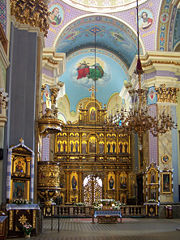
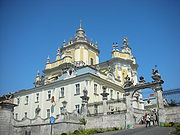
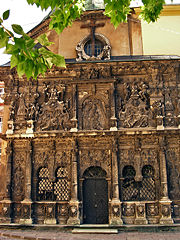

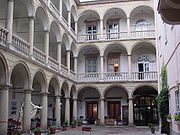

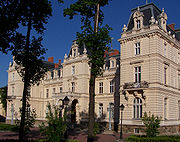

History of Lviv
Lviv is an administrative center in western Ukraine with more than a millennium of history as a settlement, and over seven centuries as a city...
. There are monuments to:
During the interbellum period there were monuments commemorated to important figures of the history of Poland. Some of these were moved to the Polish Recovered Territories
Recovered Territories
Recovered or Regained Territories was an official term used by the People's Republic of Poland to describe those parts of pre-war Germany that became part of Poland after World War II...
, like the monument of Aleksander Fredro
Aleksander Fredro
Aleksander Fredro was a Polish poet, playwright and author.-Life:Count Aleksander Fredro, of the Bończa coat of arms, was born in the village of Surochów near Jarosław, then a crown territory of Austria. A landowner's son, he was educated at home. He entered the Polish army at age 16 and saw...
which now is in Wrocław, the monument of King Jan III Sobieski
John III Sobieski
John III Sobieski was one of the most notable monarchs of the Polish–Lithuanian Commonwealth, from 1674 until his death King of Poland and Grand Duke of Lithuania. Sobieski's 22-year-reign was marked by a period of the Commonwealth's stabilization, much needed after the turmoil of the Deluge and...
which after 1945 was moved to Gdańsk
Gdansk
Gdańsk is a Polish city on the Baltic coast, at the centre of the country's fourth-largest metropolitan area.The city lies on the southern edge of Gdańsk Bay , in a conurbation with the city of Gdynia, spa town of Sopot, and suburban communities, which together form a metropolitan area called the...
, and the monument of Kornel Ujejski
Kornel Ujejski
Kornel Ujejski , also known as Cornelius Ujejski, was a Polish poet, patriot and political writer.He was named "last of the greatest Polish poets of Romanticism"....
which now is in Szczecin
Szczecin
Szczecin , is the capital city of the West Pomeranian Voivodeship in Poland. It is the country's seventh-largest city and the largest seaport in Poland on the Baltic Sea. As of June 2009 the population was 406,427....
.
Books
Every day a book market takes place around the monument to Ivan FеdorovychIvan Fyodorov (printer)
Ivan Fyodorov or Fedorovič , was one of the fathers of Eastern Slavonic printing...
. He was a typographer in the 16th century who fled Moscow and found a new home in Lviv. New ideas came to Lviv during the Austro–Hungarian Empire. In the 19th century many publishing houses
Publishing
Publishing is the process of production and dissemination of literature or information—the activity of making information available to the general public...
, newspapers and magazines were established. Among these was the Ossolineum
Ossolineum
The Ossolineum or Zakład Narodowy im. Ossolińskich a meritorious department for Polish science and culture , which was founded for the Polish Nation in 1817 by Józef Maksymilian Ossoliński, and was opened in 1827 in Lviv.It was one of the most important Polish...
which was one of the most important Polish scientific libraries. Most Polish-language books and publications of the Ossolineum library are still kept in a local Jesuit church. In 1997 the Polish government asked the Ukrainian government
Government of Ukraine
Government of Ukraine is often associated with the Cabinet of Ministers of Ukraine. However it should be considered that Ukraine is a country under a semi-presidential system with separate legislative, executive, and judicial branches of government...
to hand over these documents and in 2003 Ukraine allowed access to the publications. In 2006 an office of the Ossolineum (which now is located in Wrocław) was opened in Lviv and began a process to scan all its documents.
Literature written in Lviv contributed to Austrian, Ukrainian, Yiddish and Polish literature
Polish literature
Polish literature is the literary tradition of Poland. Most Polish literature has been written in the Polish language, though other languages, used in Poland over the centuries, have also contributed to Polish literary traditions, including Yiddish, Lithuanian, Ukrainian, Belarusian, German and...
. Translation work took place between these cultures.
Religion
Lviv is a city of religious variety and there have been conflicts between different faiths. At one point over 60 churches existed in the city. The largest Christian churchesChristian Church
The Christian Church is the assembly or association of followers of Jesus Christ. The Greek term ἐκκλησία that in its appearances in the New Testament is usually translated as "church" basically means "assembly"...
have existed in the city since the 13th century. There are three major Christian groups: The Ukrainian Catholic Archeparchy of Lviv
Ukrainian Catholic Archeparchy of Lviv
The Archeparchy of Lviv is an archeparchy of the Ukrainian Greek Catholic Church.The eparchy was established at some time during the mid 12th century, with its see originally in Halych...
, the German-speaking
German language
German is a West Germanic language, related to and classified alongside English and Dutch. With an estimated 90 – 98 million native speakers, German is one of the world's major languages and is the most widely-spoken first language in the European Union....
and Polish Catholics and the Armenian Church
Armenian Apostolic Church
The Armenian Apostolic Church is the world's oldest National Church, is part of Oriental Orthodoxy, and is one of the most ancient Christian communities. Armenia was the first country to adopt Christianity as its official religion in 301 AD, in establishing this church...
. Each have had a diocesan seat in Lviv since the 16th century. The Golden Rose Synagogue
Golden Rose Synagogue (Lviv)
The Golden Rose Synagogue, known also as the Nachmanowicz Synagogue, or the Turei Zahav Synagogue was a synagogue in Lviv, Ukraine. The Golden Rose Synagogue was the oldest synagogue in Ukraine....
was built in Lviv in 1582 and in the 18th century the Orthodox community took their allegiance to the Pope
Pope
The Pope is the Bishop of Rome, a position that makes him the leader of the worldwide Catholic Church . In the Catholic Church, the Pope is regarded as the successor of Saint Peter, the Apostle...
in Rome and became the Ukrainian Greek Catholic Church
Ukrainian Greek Catholic Church
The Ukrainian Greek Catholic Church , Ukrainska Hreko-Katolytska Tserkva), is the largest Eastern Rite Catholic sui juris particular church in full communion with the Holy See, and is directly subject to the Pope...
. This bond was forcibly dissolved in 1946 by the Soviet authorities and the Roman Catholic community was forced out by the expulsion of the Polish population. Since 1989 religious life in Lviv has experienced a revival.
Lviv is the seat of the Roman Catholic Archdiocese of Lviv
Roman Catholic Archdiocese of Lviv
The Archdiocese of Lviv of the Latins is a metropolitan archdiocese of the Latin Rite of the Catholic Church in western Ukraine. Archbishop Mieczyslaw Mokrzycki is the current metropolitan archbishop of the archdiocese.- History :...
, the centre of the Roman Catholic Church in Ukraine
Roman Catholicism in Ukraine
The Roman Catholic Church in Ukraine is part of the worldwide Roman Catholic Church, under the spiritual leadership of the Pope and curia in Rome. The present Archbishop is Mieczysław Mokrzycki ....
and until 21 August 2005 was the centre of the Ukrainian Greek Catholic Church
Ukrainian Greek Catholic Church
The Ukrainian Greek Catholic Church , Ukrainska Hreko-Katolytska Tserkva), is the largest Eastern Rite Catholic sui juris particular church in full communion with the Holy See, and is directly subject to the Pope...
. About 35 per cent of religious buildings belong to the Ukrainian Greek Catholic Church, 11.5 per cent to the Ukrainian Autocephalous Orthodox Church
Ukrainian Autocephalous Orthodox Church
The Ukrainian Autocephalous Orthodox Church is one of the three major Orthodox Churches in Ukraine. Close to ten percent of the Christian population claim to be members of the UAOC. The other Churches are the Ukrainian Orthodox Church-Kiev Patriarchate and the Ukrainian Russophile Orthodox...
, 9 per cent to the Ukrainian Orthodox Church – Kiev Patriarchate and 6 per cent to the Roman Catholic Church.
Until 2005 Lviv was the only city with two Catholic Cardinals
Cardinal (Catholicism)
A cardinal is a senior ecclesiastical official, usually an ordained bishop, and ecclesiastical prince of the Catholic Church. They are collectively known as the College of Cardinals, which as a body elects a new pope. The duties of the cardinals include attending the meetings of the College and...
: Lubomyr Husar (Byzantine Rite
Ukrainian Greek Catholic Church
The Ukrainian Greek Catholic Church , Ukrainska Hreko-Katolytska Tserkva), is the largest Eastern Rite Catholic sui juris particular church in full communion with the Holy See, and is directly subject to the Pope...
) and Marian Jaworski (Latin Rite).
In June 2001 Pope John Paul II
Pope John Paul II
Blessed Pope John Paul II , born Karol Józef Wojtyła , reigned as Pope of the Catholic Church and Sovereign of Vatican City from 16 October 1978 until his death on 2 April 2005, at of age. His was the second-longest documented pontificate, which lasted ; only Pope Pius IX ...
visited the Latin Cathedral
Latin Cathedral, Lviv
The Archcathedral Basilica of the Assumption of the Blessed Virgin Mary, in Lviv, in western Ukraine, usually called simply the Latin Cathedral , is located in city's Old Town, in the south western corner of market square....
, St. George's Cathedral
St. George's Cathedral, Lviv
St. George's Cathedral is a baroque-rococo cathedral located in the city of Lviv, the historic capital of western Ukraine. It was constructed between 1744-1760 on a hill overlooking the city. This is the third manifestation of a church to inhabit the site since the 13th century, and its prominence...
and the Armenian Cathedral
Armenian Cathedral, Lviv
The Armenian Cathedral of the Assumption of Mary ) in Lviv, Ukraine is located in the city's Old Town, north of the market square.A small Armenian church was built in the years 1363–1370, founded by an Armenian merchant from Caffa and established as the mother church of an eparchy. It is said to...
.
Lviv historically had a large and active Jewish community and until 1941 at least 45 synagogue
Synagogue
A synagogue is a Jewish house of prayer. This use of the Greek term synagogue originates in the Septuagint where it sometimes translates the Hebrew word for assembly, kahal...
s and prayer houses existed. Even in the 16th century two separate communities existed. One lived in today's old town with the other in the Krakowskie Przedmieście
Krakowskie Przedmiescie
Krakowskie Przedmieście is one of the most impressive and prestigious streets of Poland's capital.Several other Polish cities also have streets named Krakowskie Przedmieście. In Lublin, it is the main and most elegant street...
. In the 19th century a more differentiated community started to spread out. Liberal Jews sought more cultural assimilation
Cultural assimilation
Cultural assimilation is a socio-political response to demographic multi-ethnicity that supports or promotes the assimilation of ethnic minorities into the dominant culture. The term assimilation is often used with regard to immigrants and various ethnic groups who have settled in a new land. New...
and spoke German and Polish. On the other hand Orthodox and Hasidic Jews
Hasidic Judaism
Hasidic Judaism or Hasidism, from the Hebrew —Ḥasidut in Sephardi, Chasidus in Ashkenazi, meaning "piety" , is a branch of Orthodox Judaism that promotes spirituality and joy through the popularisation and internalisation of Jewish mysticism as the fundamental aspects of the Jewish faith...
tried to retain the old traditions. Between 1941 and 1944 the Germans in effect completely destroyed the centuries-old Jewish tradition of Lviv. Most synagogues were destroyed and the Jewish population forced first into a ghetto before being forcibly transported to concentration camps where they were murdered.
Under the Soviet Union synagogues remained closed and were used as storage facilities or movie houses. Only since the fall of the Iron Curtain
Iron Curtain
The concept of the Iron Curtain symbolized the ideological fighting and physical boundary dividing Europe into two separate areas from the end of World War II in 1945 until the end of the Cold War in 1989...
has the remainder of the Jewish community experienced a faint revival.
Arts
The "Group Artes" was a young movement founded in 1929. Many of the artists studied in Paris and travelled throughout Europe. They worked and experimented in different areas of modern art: FuturismFuturism
Futurism was an artistic and social movement that originated in Italy in the early 20th century.Futurism or futurist may refer to:* Afrofuturism, an African-American and African diaspora subculture* Cubo-Futurism* Ego-Futurism...
, Cubism
Cubism
Cubism was a 20th century avant-garde art movement, pioneered by Pablo Picasso and Georges Braque, that revolutionized European painting and sculpture, and inspired related movements in music, literature and architecture...
, New Objectivity
New Objectivity
The New Objectivity is a term used to characterize the attitude of public life in Weimar Germany as well as the art, literature, music, and architecture created to adapt to it...
and Surrealism
Surrealism
Surrealism is a cultural movement that began in the early 1920s, and is best known for the visual artworks and writings of the group members....
. Co–operation took place between avant-garde musicians and authors. Altogether thirteen exhibitions by "Artes" took place in Warsaw, Kraków, Łódz and Lviv. The German occupation put an end to this group. Otto Hahn was executed in 1942 in Lviv and Aleksander Riemer was murdered in 1943 in Auschwitz. Henryk Streng and Margit Reich-Sielska were able to escape the Holocaust
The Holocaust
The Holocaust , also known as the Shoah , was the genocide of approximately six million European Jews and millions of others during World War II, a programme of systematic state-sponsored murder by Nazi...
(or Shoah). Most of the surviving members of Artes lived in Poland after 1945. Only Margit Reich-Sielska (1900–1980) and Roman Sielski (1903–1990) stayed in Soviet Lviv.
For years the city was one of the most important cultural centers of Poland with such writers as Aleksander Fredro
Aleksander Fredro
Aleksander Fredro was a Polish poet, playwright and author.-Life:Count Aleksander Fredro, of the Bończa coat of arms, was born in the village of Surochów near Jarosław, then a crown territory of Austria. A landowner's son, he was educated at home. He entered the Polish army at age 16 and saw...
, Leopold Staff
Leopold Staff
Leopold Staff was a Polish poet and one of the greatest artists of European modernism honored two times by honorary degrees . He was also nominated for the Nobel Prize in Literature...
, Maria Konopnicka
Maria Konopnicka
Maria Konopnicka nee Wasiłowska , was a Polish poet, novelist, writer for children and youth, a translator, journalist and critic, as well as an activist for women's rights and Polish independence.Maria Konopnicka also composed a poem about the execution of the Irish patriot, Robert...
and Jan Kasprowicz
Jan Kasprowicz
Jan Kasprowicz was a poet, playwright, critic and translator; a foremost representative of Young Poland.-Life:...
living in Lviv. It also is home to one of the largest museums in Ukraine the National Museum of Lviv.
Theatre and opera
In 1842 the Skarbek TheatreSkarbek Theatre
Skarbek Theatre was a theater that existed in 1842-99 in the city of Lwów , which then belonged to Austria-Hungary. It was founded by Count Stanisław Skarbek, who as early as 1819 had applied for permission from the Austrian Imperial authorities.Construction of the theatre’s neoclassical building...
was opened making it the third largest theatre in Central Europe
Central Europe
Central Europe or alternatively Middle Europe is a region of the European continent lying between the variously defined areas of Eastern and Western Europe...
. In 1903 the Lviv National Opera house, which at that time was called the City-Theatre, was opened emulating the Vienna State Opera
Vienna State Opera
The Vienna State Opera is an opera house – and opera company – with a history dating back to the mid-19th century. It is located in the centre of Vienna, Austria. It was originally called the Vienna Court Opera . In 1920, with the replacement of the Habsburg Monarchy by the First Austrian...
house. The house initially offered a changing repertoire such as classical dramas in German and Polish language
Polish language
Polish is a language of the Lechitic subgroup of West Slavic languages, used throughout Poland and by Polish minorities in other countries...
, opera, operetta, comedy and theatre. The opera house is named after the diva Salomea Krushelnytska who worked here.
Museums and art galleries
The first museum of Lviv was the Lubomirscy Museum opened in 1827. It displayed a wide collection of art and historical objects connected with history of Poland. In 1857 the Baworowski Library was founded whose most precious books are now kept in Kraków.The most notable of the museums and art galleries are Lviv National Art Gallery
Lviv National Art Gallery
Lviv National Art Gallery , a leading art museum in Ukraine, has over 60,000 artworks in its collection, including works of Polish, Italian, French, German, Dutch and Flemish, Spanish, Austrian and other European artists. The gallery was founded in 1907 as a municipal museum, following the purchase...
, the Lviv National Museum which houses the National Gallery, the Museum of Religion (formerly the Museum of Atheism
Atheism
Atheism is, in a broad sense, the rejection of belief in the existence of deities. In a narrower sense, atheism is specifically the position that there are no deities...
) and the National Museum (formerly the Museum of Industry).
Music
Lviv has an active musical and cultural life. Apart from the Lviv Opera it has symphony orchestras, chamber orchestras and the Trembita Chorus. Lviv has one of the most prominent music academy and music colleges in Ukraine the Lviv ConservatoryLviv Conservatory
The Lviv National Musical Academy, M. Lysenko is a state conservatory of Ukraine based in Lviv.-History:...
and also has a factory for the manufacture of stringed musical instruments.
Lviv has been the home of numerous composers such as Mozart's son Franz Xaver Wolfgang Mozart
Franz Xaver Wolfgang Mozart
Franz Xaver Wolfgang Mozart , also known as F. X. Mozart, W. A. Mozart Son, or Wolfgang Amadeus Mozart, Jr., was the youngest child of six born to Wolfgang Amadeus Mozart and his wife Constanze. He was the younger of his parents' two surviving children...
, Stanislav Liudkevych
Stanyslav Lyudkevych
Stanyslav Pylypovych Lyudkevych was a Ukrainian composer, theorist, teacher, and musical activist. He was the People's Artist of the USSR in 1969. He earned a Ph.D. in musicology in Vienna, 1908...
and Mykola Kolessa
Mykola Kolessa
Mykola Kolessa was a prominent Ukrainian composer and conductor, born in the village of Sambir near Lviv and died in Lviv....
.
Lviv is the hometown of the Eurovision Song Contest 2004
Eurovision Song Contest 2004
The Eurovision Song Contest 2004, was the 49th Contest and it was held in the Abdi İpekçi Arena in Istanbul, Turkey. This was the first occasion in which the contest was held in Turkey after they had won the competition in 2003 with Sertab Erener singing "Everyway That I Can"...
winner Ruslana
Ruslana
Ruslana Stepanivna Lyzhychko is a World Music Award winning and MTV Europe Music Award nominated artist, and the winner of the Eurovision Song Contest 2004....
who has since become well known in Europe and the rest of the world.
The classical pianist Mieczysław Horszowski (1892–1993) was born here. The opera diva Salomea Kruszelnicka called Lviv her home in the 1920s to 1930s. Adam Han Gorski (1940– ) an internationally renowned concert violinist was born here. "Polish Radio Lwów
Polish Radio Lwów
Polish Radio Lwów was a station of the Polish Radio, located in the city of Lwów , which in the interbellum period belonged to the Second Polish Republic. It was regarded as the second most popular station of the Polish Radio, behind Radio Warsaw .- History :The station was opened on January 13,...
" was a Polish radio
Polskie Radio
Polskie Radio Spółka Akcyjna is Poland's national publicly funded radio broadcasting organization.- History :Polskie Radio was founded on 18 August 1925 and began making regular broadcasts from Warsaw on 18 April 1926....
station that went on-air on 15 January 1930. The programme proved very popular in Poland. Classical music
Classical music
Classical music is the art music produced in, or rooted in, the traditions of Western liturgical and secular music, encompassing a broad period from roughly the 11th century to present times...
and entertainment was aired as well as lectures, readings, youth-programmes, news and liturgical services on Sunday.
Popular throughout Poland was the Comic Lwów Wave a cabaret
Cabaret
Cabaret is a form, or place, of entertainment featuring comedy, song, dance, and theatre, distinguished mainly by the performance venue: a restaurant or nightclub with a stage for performances and the audience sitting at tables watching the performance, as introduced by a master of ceremonies or...
-revue with musical pieces
Musical composition
Musical composition can refer to an original piece of music, the structure of a musical piece, or the process of creating a new piece of music. People who practice composition are called composers.- Musical compositions :...
. Jewish artists contributed a great part to this artistic activity. Composers such as Henryk Wars
Henryk Wars
Henryk Wars was a Polish and later American pop music composer. He wrote the music for 50 films in the interwar period in Poland and sixty more in the United States...
, songwriter Emanuel Szlechter, the actor Mieczysław Monderer and Adolf Fleischer ("Aprikosenkranz und Untenbaum") worked in Lviv. The most notable stars of the shows were Henryk Vogelfänger
Henryk Vogelfänger
Henryk Vogelfänger , stage name Tońko, was a Polish actor. He worked and lived in prewar Lwów . Together with Kazimierz Wajda he was the star of the radio comedy duo "Szczepko and Tońko", which was widely popular in Poland.-Filmography:-External links:...
and Kazimierz Wajda
Kazimierz Wajda
Kazimierz Wajda , stage name Szczepko, was a Polish actor, comedian. He worked and lived in prewar Polish Lwów . Together with Henryk Vogelfänger he was a star of the radio comedy duo "Szczepko and Tońko", which was widely popular in Poland and abroad. Three movies were made also, along with...
who appeared together as the comic duo "Szczepko and Tońko" and were similar to Laurel and Hardy
Laurel and Hardy
Laurel and Hardy were one of the most popular and critically acclaimed comedy double acts of the early Classical Hollywood era of American cinema...
.
After World War II many of the Jewish artists and entertainers were either killed or fled and Polish artists had to leave for Poland as a result of the Yalta Conference
Yalta Conference
The Yalta Conference, sometimes called the Crimea Conference and codenamed the Argonaut Conference, held February 4–11, 1945, was the wartime meeting of the heads of government of the United States, the United Kingdom, and the Soviet Union, represented by President Franklin D...
.
Universities and academia
Lviv UniversityLviv University
The Lviv University or officially the Ivan Franko National University of Lviv is the oldest continuously operating university in Ukraine...
is one of the oldest in Central Europe and was founded as a Society of Jesus
Society of Jesus
The Society of Jesus is a Catholic male religious order that follows the teachings of the Catholic Church. The members are called Jesuits, and are also known colloquially as "God's Army" and as "The Company," these being references to founder Ignatius of Loyola's military background and a...
(Jesuit) school in 1608. Its prestige greatly increased through the work of philosopher Kazimierz Twardowski
Kazimierz Twardowski
Kazimierz Jerzy Skrzypna-Twardowski was a Polish philosopher and logician.-Life:Twardowski's family belonged to the Ogończyk coat-of-arms.Twardowski studied philosophy in Vienna with Franz Brentano and Robert Zimmermann...
(1866–1938) who was one of the founders of the Lwów-Warsaw School of Logic. This school of thought set benchmarks for academic research and education
Education
Education in its broadest, general sense is the means through which the aims and habits of a group of people lives on from one generation to the next. Generally, it occurs through any experience that has a formative effect on the way one thinks, feels, or acts...
in Poland. The Polish politician of the interbellum period Stanisław Głąbiński had served as dean of the law department (1889–1890) and as the University rector (1908–1909). In 1901 the city was the seat of the Lwów Scientific Society
Lwów Scientific Society
Lwów Scientific Society was a Polish scientific society, founded in 1901 in Lwów by Oswald Balzer as Association of Support of Polish Sciences...
among whose members were major scientific figures. The most well-known were the mathematicians Stefan Banach
Stefan Banach
Stefan Banach was a Polish mathematician who worked in interwar Poland and in Soviet Ukraine. He is generally considered to have been one of the 20th century's most important and influential mathematicians....
, Juliusz Schauder
Juliusz Schauder
Juliusz Paweł Schauder was a Polish mathematician of Jewish origin, known for his work in functional analysis, partial differential equation and mathematical physics.Born on September 21, 1899 in Lemberg, he had to fight in World War I right after his graduation from school...
and Stanisław Ulam who were founders of the Lwów School of Mathematics
Lwów School of Mathematics
The Lwów School of Mathematics was a group of mathematicians who worked between the two World Wars in Lviv, then known as Lwów and located in Poland, but now located in western Ukraine. The mathematicians often met at the famous Scottish Café to discuss mathematical problems, and published in the...
turning Lviv in the 1930s into the "World Centre of Functional Analysis" and who's share in Lviv academia was substantial.
In 1852 in Dublany
Dublany, Podlaskie Voivodeship
Dublany is a village in the administrative district of Gmina Michałowo, within Białystok County, Podlaskie Voivodeship, in north-eastern Poland, close to the border with Belarus. It lies approximately east of Michałowo and east of the regional capital Białystok.-References:...
(eight kilometers from the outskirts of Lviv) the Agricultural Academy
Agricultural Academy in Dublany
Agricultural Academy in Dublany was one of the first Polish language schools of this kind. Its history dates back to 1852, when a farm in the village of Dublany was purchased by the Galicia Agricultural Society...
was opened and was one of the first Polish agricultural colleges. The Academy was merged with the Lviv Polytechnic
Lviv Polytechnic
Lviv Polytechnic National University is the largest scientific university in Lviv. Since its foundation in 1844, it was one of the most important centres of science and technological development in Central Europe. In the interbellum period, the Polytechnic was one of the most important technical...
in 1919. Another important college of the interbellum period was the Academy of Foreign Trade in Lwów
Academy of Foreign Trade in Lwów
Academy of Foreign Trade in Lwów was one of four colleges in the city of Lwów in the interbellum period, when it belonged to the Second Polish Republic...
.
Mathematics
Lviv was the home of the Scottish CaféScottish Café
The Scottish Café was the café in Lwów where, in the 1930s and 1940s, mathematicians from the Lwów School collaboratively discussed research problems, particularly in functional analysis and topology....
where in the 1930s and the early 1940s Polish mathematician
Mathematician
A mathematician is a person whose primary area of study is the field of mathematics. Mathematicians are concerned with quantity, structure, space, and change....
s from the Lwów School of Mathematics
Lwów School of Mathematics
The Lwów School of Mathematics was a group of mathematicians who worked between the two World Wars in Lviv, then known as Lwów and located in Poland, but now located in western Ukraine. The mathematicians often met at the famous Scottish Café to discuss mathematical problems, and published in the...
met and spent their afternoons discussing mathematical problems. Stanisław Ulam who was later a participant in the Manhattan Project
Manhattan Project
The Manhattan Project was a research and development program, led by the United States with participation from the United Kingdom and Canada, that produced the first atomic bomb during World War II. From 1942 to 1946, the project was under the direction of Major General Leslie Groves of the US Army...
and the proposer of the Teller-Ulam design of thermonuclear weapons
Nuclear weapon design
Nuclear weapon designs are physical, chemical, and engineering arrangements that cause the physics package of a nuclear weapon to detonate. There are three basic design types...
, Stefan Banach
Stefan Banach
Stefan Banach was a Polish mathematician who worked in interwar Poland and in Soviet Ukraine. He is generally considered to have been one of the 20th century's most important and influential mathematicians....
one of the founders of functional analysis
Functional analysis
Functional analysis is a branch of mathematical analysis, the core of which is formed by the study of vector spaces endowed with some kind of limit-related structure and the linear operators acting upon these spaces and respecting these structures in a suitable sense...
, Hugo Steinhaus
Hugo Steinhaus
Władysław Hugo Dionizy Steinhaus was a Polish mathematician and educator. Steinhaus obtained his PhD under David Hilbert at Göttingen University in 1911 and later became a professor at the University of Lwów, where he helped establish what later became known as the Lwów School of Mathematics...
, Karol Borsuk
Karol Borsuk
Karol Borsuk was a Polish mathematician.His main interest was topology.Borsuk introduced the theory of absolute retracts and absolute neighborhood retracts , and the cohomotopy groups, later called Borsuk-Spanier cohomotopy groups. He also founded the so called Shape theory...
, Kazimierz Kuratowski
Kazimierz Kuratowski
Kazimierz Kuratowski was a Polish mathematician and logician. He was one of the leading representatives of the Warsaw School of Mathematics.-Biography and studies:...
, Mark Kac
Mark Kac
Mark Kac was a Polish mathematician. His main interest was probability theory. His question, "Can one hear the shape of a drum?" set off research into spectral theory, with the idea of understanding the extent to which the spectrum allows one to read back the geometry. Kac completed his Ph.D...
and many other notable mathematicians would gather there. The café building now houses the Universalny bank at 27 Taras Shevchenko Prospekt (prewar Polish street name: ulica Akademicka). Mathematician Zygmunt Janiszewski
Zygmunt Janiszewski
Zygmunt Janiszewski was a Polish mathematician.-Life:His mother was Julia Szulc-Chojnicka. His father, Czeslaw Janiszewski, was a graduate of the University of Warsaw and was an important person in finance, being the director of the Société du Crédit Municipal in Warsaw.Janiszewski taught at the...
died in Lviv on January 3, 1920.
Print and media
Lviv is home to one of the oldest Polish-language newspapers Gazeta LwowskaGazeta Lwowska
Gazeta Lwowska is a Polish language biweekly magazine, published since December 24, 1990 in Lviv , Ukraine. The publication refers to the traditions of a Polish language paper Gazeta Lwowska, which was published between 1811 and 1944 and as such was one of the oldest Polish newspapers.Originally,...
which was first published in 1811 and still exists in a bi–weekly form. Lviv is the center of promotion of the Ukrainian Latin alphabet
Ukrainian Latin alphabet
A Latin alphabet for the Ukrainian language has been proposed or imposed several times in the history in Ukraine, but has never challenged the conventional Cyrillic Ukrainian alphabet. Actually it is promoted as a way of facilitating the Ukrainian integration within the European Union.In or...
(Latynka).
Among other publications were such titles as
- Kurier Lwowski: associated with people's movement which existed from 1883 to 1935. Among the writers who cooperated with it were such renowned names as Eliza OrzeszkowaEliza Orzeszkowa-External links:...
, Jan KasprowiczJan KasprowiczJan Kasprowicz was a poet, playwright, critic and translator; a foremost representative of Young Poland.-Life:...
, Bolesław Limanowski, Władysław Orkan as well as Ivan FrankoIvan FrankoIvan Yakovych Franko was a Ukrainian poet, writer, social and literary critic, journalist, interpreter, economist, political activist, doctor of philosophy, the author of the first detective novels and modern poetry in the Ukrainian language....
, - Słowo Lwowskie (1895–1939): A right-wing daily which cooperated with Władysław Reymont, Henryk SienkiewiczHenryk SienkiewiczHenryk Adam Aleksander Pius Sienkiewicz was a Polish journalist and Nobel Prize-winning novelist. A Polish szlachcic of the Oszyk coat of arms, he was one of the most popular Polish writers at the turn of the 19th and 20th centuries, and received the Nobel Prize in Literature in 1905 for his...
, Kazimierz TetmajerKazimierz Przerwa-TetmajerKazimierz Przerwa-Tetmajer was a Polish poet, novelist, playwright, journalist and writer. He was a member of the Young Poland movement.-Life:...
, Leopold StaffLeopold StaffLeopold Staff was a Polish poet and one of the greatest artists of European modernism honored two times by honorary degrees . He was also nominated for the Nobel Prize in Literature...
, Jerzy Żuławski and Gabriela ZapolskaGabriela ZapolskaMaria Gabriela Stefania Korwin-Piotrowska , known as Gabriela Zapolska, was a Polish novelist, playwright, naturalist writer, feuilletonist, theatre critic and stage actress. Zapolska wrote 41 plays, 23 novels, 177 short stories, 252 works of journalism, one film script, and over 1,500...
. Among its editors-in-chief was Stanisław Grabski. In the early 20th century Słowos circulation was 20,000 and it was the first Polish newspaper to publish a serialisation of Reymont's novel Chłopi. After World War II Słowo was moved to Wrocław with first postwar issue published on 1 November 1946. - Czerwony Sztandar: A Soviet daily published between 1939 and 1941.
Starting in the 20th century a new movement started with authors from Central Europe. In Lviv a small neo-romantic
Neo-romanticism
The term neo-romanticism is used to cover a variety of movements in music, painting and architecture. It has been used with reference to very late 19th century and early 20th century composers such as Gustav Mahler particularly by Carl Dahlhaus who uses it as synonymous with late Romanticism...
group of authors formed around the lyricist
Lyricist
A lyricist is a songwriter who specializes in lyrics. A singer who writes the lyrics to songs is a singer-lyricist. This differentiates from a singer-composer, who composes the song's melody.-Collaboration:...
Schmuel Jankev Imber. Small print offices produced collections of modern poems and short stories
Short story
A short story is a work of fiction that is usually written in prose, often in narrative format. This format tends to be more pointed than longer works of fiction, such as novellas and novels. Short story definitions based on length differ somewhat, even among professional writers, in part because...
and through emigration a large networkwas established. A second smaller group in the 1930s tried to create a connection between avantgarde
Avant-garde
Avant-garde means "advance guard" or "vanguard". The adjective form is used in English to refer to people or works that are experimental or innovative, particularly with respect to art, culture, and politics....
art and Yiddish culture. Members of this group were Debora Vogel, Rachel Auerbach and Rachel Korn
Rachel Korn
Rachel Häring Korn was a Yiddish poet and author. In total, she published eight collections of poetry and two of prose.-Biography:...
. The Holocaust destroyed this movement with Debora Vogel amongst many other Yiddish authors murdered by the Germans in the 1940s.
Films and books featuring Lviv
- Portions of Schindler's ListSchindler's ListSchindler's List is a 1993 American film about Oskar Schindler, a German businessman who saved the lives of more than a thousand mostly Polish-Jewish refugees during the Holocaust by employing them in his factories. The film was directed by Steven Spielberg, and based on the novel Schindler's Ark...
were shot in the city centre as this was less expensive than filming in KrakówKrakówKraków also Krakow, or Cracow , is the second largest and one of the oldest cities in Poland. Situated on the Vistula River in the Lesser Poland region, the city dates back to the 7th century. Kraków has traditionally been one of the leading centres of Polish academic, cultural, and artistic life...
. - Some of the Austrian road-movie Blue Moon was shot in Lviv.
- Parts of the movie and novel Everything Is IlluminatedEverything Is IlluminatedEverything Is Illuminated is the first novel by the American writer Jonathan Safran Foer, published in 2002. It was adapted into a film by the same name starring Elijah Wood and Eugene Hütz in 2005.-Plot summary:...
take place in Lviv. - Brian R. Banks' Muse & Messiah: The Life, Imagination & Legacy of Bruno SchulzBruno SchulzBruno Schulz was a Polish writer, fine artist, literary critic and art teacher born to Jewish parents, and regarded as one of the great Polish-language prose stylists of the 20th century. Schulz was born in Drohobycz, in the province of Galicia then part of the Austro-Hungarian Empire, and spent...
(1892–1942) has several pages which discuss the history and cultural-social life of the Lviv region. The book includes a CD-ROMCD-ROMA CD-ROM is a pre-pressed compact disc that contains data accessible to, but not writable by, a computer for data storage and music playback. The 1985 “Yellow Book” standard developed by Sony and Philips adapted the format to hold any form of binary data....
with many old and new photographs and the first English map of nearby DrohobychDrohobychDrohobych is a city located at the confluence of the Tysmenytsia River and Seret, a tributary of the former, in the Lviv Oblast , in western Ukraine...
. - The book "The Girl in the Green Sweater: A Life in Holocaust's Shadow" by Krystyna Chiger takes place in Lviv.
- Large parts of 1997 film The TruceThe Truce (1997 film)The Truce is a 1997 film directed by Francesco Rosi, written by Tonino Guerra, based on Primo Levi's autobiography, The Truce. The film deals with Primo Levi's experiences returning from the concentration camp at Auschwitz during the Second World War....
depicting Primo LeviPrimo LeviPrimo Michele Levi was an Italian Jewish chemist and writer. He was the author of two novels and several collections of short stories, essays, and poems, but is best known for If This Is a Man, his account of the year he spent as a prisoner in the Auschwitz concentration camp in Nazi-occupied Poland...
's war experiences were shot in Lviv. - Large portions of d'Artagnan and Three MusketeersD'Artagnan and Three Musketeersd'Artagnan and Three Musketeers is a three-part musical miniseries produced in the Soviet Union and first aired in 1978. It is based on the novel The Three Musketeers by Alexandre Dumas, père....
were shot in downtown Lviv. - The book The Lemberg Mosaic (2011) by Jakob Weiss describes Jewish L'viv (Lemberg/Lwow/Lvov) during the period 1910–1943, focusing primarily on the Holocaust and related events.
Sport
Lviv was an important centre for sport in Central Europe and is regarded as the birth–place of Polish football. The first known official goal in a Polish football match was scored there on 14 July 1894 during the Lwów-Kraków game. The goal was scored by Włodzimierz Chomicki who represented the team of Lviv. In 1904 Kazimierz Hemerling from Lviv published the first translation of the rules of football into Polish and another native of Lviv, Stanisław Polakiewicz, became the first officially recognised Polish referee in 1911 the year in which the first Polish Football FederationPolish Football Association
The Polish Football Association is the governing body of football in Poland. It organizes the Polish football leagues , the Polish Cup, the Polish SuperCup, the Polish League Cup, and the Polish national football team...
was founded in Lviv.
The first Polish professional football club, Czarni Lwów
Czarni Lwów
Czarni Lwów was one of the first Polish professional sports clubs with the well developed football section as well as hockey among the several other sports. The football club was started in the late 19th century in Lwów as a school football section Sława Lwów...
opened here in 1903 and the first stadium, which belonged to Pogoń, in 1913. Another club, Pogoń Lwów
Pogon Lwów
LKS Pogoń Lwów is a former Polish professional sports club which was located in Lwów , and existed from 1904 until the outbreak of World War II in 1939. It was the second oldest Polish football club behind other teams from Lwów - Czarni and Lechia...
, was four times football champion of Poland (1922, 1923, 1925 and 1926). In the late 1920s as many as four teams from the city played in the Polish Football League (Pogoń, Czarni, Hasmonea and Lechia). Hasmonea
Hasmonea Lwów
Hasmonea Lwów was a Polish-Jewish sports club based in the city of Lwów . Created in 1908, it was the first sports club exclusively for Jewish members. It was named after the Hasmonean royal dynasty...
was the first Jewish football club in Poland. Several notable figures of Polish football came from the city including Kazimierz Górski
Kazimierz Górski
Kazimierz Klaudiusz Górski was a coach of Poland national football team and honorary president of Polish Football Union . He was also a football player, capped once for Poland....
, Ryszard Koncewicz
Ryszard Koncewicz
Ryszard Tadeusz Koncewicz was a Polish soccer player as well as a coach. In the interbellum period, Koncewicz played without notable successes for Lechia Lwów...
, Michał Matyas and Wacław Kuchar.
Lviv is also the Polish birth-place of other sports. In January 1905 the first Polish ice-hockey
Ice hockey
Ice hockey, often referred to as hockey, is a team sport played on ice, in which skaters use wooden or composite sticks to shoot a hard rubber puck into their opponent's net. The game is played between two teams of six players each. Five members of each team skate up and down the ice trying to take...
match took place there and two years later the first ski-jumping
Ski jumping
Ski jumping is a sport in which skiers go down a take-off ramp, jump and attempt to land as far as possible down the hill below. In addition to the length of the jump, judges give points for style. The skis used for ski jumping are wide and long...
competition was organized in nearby Sławsko
Slavske
thumb|250px|right|A street in SlavskeSlavske is a town and a popular ski resort in the Skole Beskids range of the Carpathian mountains in western Ukraine with a population of 3,700. It's one of the biggest Ukrainian winter sports centers...
. In the same year the first Polish basketball games were organized in Lviv's gymnasiums. In autumn 1887 a gymnasium by Lychakiv Street (pol. ulica Łyczakowska) held the first Polish track and field competition with such sports as the long jump
Long jump
The long jump is a track and field event in which athletes combine speed, strength, and agility in an attempt to leap as far as possible from a take off point...
and high jump
High jump
The high jump is a track and field athletics event in which competitors must jump over a horizontal bar placed at measured heights without the aid of certain devices in its modern most practiced format; auxiliary weights and mounds have been used for assistance; rules have changed over the years....
. Lviv's athlete Władysław Ponurski represented Austria in the 1912 Olympic Games
1912 Summer Olympics
The 1912 Summer Olympics, officially known as the Games of the V Olympiad, were an international multi-sport event held in Stockholm, Sweden, between 5 May and 27 July 1912. Twenty-eight nations and 2,407 competitors, including 48 women, competed in 102 events in 14 sports...
in Stockholm
Stockholm
Stockholm is the capital and the largest city of Sweden and constitutes the most populated urban area in Scandinavia. Stockholm is the most populous city in Sweden, with a population of 851,155 in the municipality , 1.37 million in the urban area , and around 2.1 million in the metropolitan area...
. On 9 July 1922 the first official rugby
Rugby union
Rugby union, often simply referred to as rugby, is a full contact team sport which originated in England in the early 19th century. One of the two codes of rugby football, it is based on running with the ball in hand...
game in Poland took place at the stadium of Pogoń Lwów in which the rugby team of Orzeł Biały Lwów divided itself into two teams – "The Reds" and "The Blacks". The referee of this game was a Frenchman by the name of Robineau.
Lviv now has several major professional football clubs
Football team
A football team is the collective name given to a group of players selected together in the various team sports known as football.Such teams could be selected to play in an against an opposing team, to represent a football club, group, state or nation, an All-star team or even selected as a...
and some smaller clubs. FC Karpaty Lviv
FC Karpaty Lviv
FC Karpaty Lviv is a Ukrainian professional football club from the city of Lviv. Named after the Carpathian Mountains, they are one of perennial mid-table clubs in Ukraine.-Early years :...
, founded in 1963, plays in the first division of the Ukrainian Premier League
Ukrainian Premier League
The Ukrainian Premier League is the highest division of Ukrainian annual football championship. As the Supreme League it was founded in 1991 after the fold of the Soviet Union's Vysshaya Liga. In 2008 it was reformed into a more autonomous entity of the Football Federation of Ukraine and changed...
. Sometimes citizens of Lviv assemble on the central street (Freedom Avenue) to watch and cheer during outdoor broadcasts of games.
Lviv is building a new separate stadium from its now already established Ukraina Stadium
Ukraina Stadium
Ukraina Stadium is a multi-purpose stadium in Lviv, Ukraine. It is currently used mostly for football matches, and is the home of FC Karpaty Lviv. "Ukraina" is also an alternative stadium for the Ukraine national football team where it played several of its qualification games for various...
to host three group matches during EURO 2012.
Lviv chess school is world-known. In this city used to live such notable grandmasters as Vassily Ivanchuk, Leonid Stein
Leonid Stein
Leonid Zakharovich Stein was a Soviet chess Grandmaster from Ukraine. He won three USSR Chess Championships in the 1960s , and was among the world's top ten players during that era.- Early life :...
, Alexander Beliavsky
Alexander Beliavsky
-External links:...
, Andrei Volokitin
Andrei Volokitin
Andriy Volokitin is a Ukrainian chess player and International Grandmaster of Chess.As a junior, he was twice a medallist at the World Youth Chess Championship, taking silver in 1998 at Oropesa del Mar at under-12 level, and bronze at the same venue a year later in the under-14 category...
and others.
Notable people
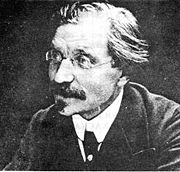
- Elena VesninaElena VesninaElena Sergeevna Vesnina is a professional female tennis player from Russia. Her career high rank was #22, achieved on 12 October 2009...
, Tennis Player - Sholem Aleichem, Yiddish author and playwright
- Bohdan-Ihor Antonych, poet
- Muhammad AsadMuhammad AsadMuhammad Asad , was an Austrian Polish Jew who converted to Islam, and a 20th century journalist, traveler, writer, social critic, linguist, thinker, reformer, diplomat, political theorist, translator and scholar...
, writer - Emanuel AxEmanuel AxEmanuel Ax is a Grammy-winning American classical pianist. He is currently a teacher on the faculty of the Juilliard School. He is considered one of the best known concert pianists of the 21st century.-Early life:...
, pianist - Stefan BanachStefan BanachStefan Banach was a Polish mathematician who worked in interwar Poland and in Soviet Ukraine. He is generally considered to have been one of the 20th century's most important and influential mathematicians....
, mathematician - Yuri BashmetYuri BashmetYuri Abramovich Bashmet is a Russian conductor and violist.Direct patrilineal descendant of Besht.-Biography:Yuri Bashmet was born on 24 January 1953 in Rostov-on-Don in the family of Abram Borisovich Bashmet and Maya Zinovyeva Bashmet . "Father's mother, Tsilya Efimovna, studied singing at the...
, viola player - Alexander BeliavskyAlexander Beliavsky-External links:...
, chess grandmaster - Wojciech BobowskiWojciech BobowskiWojciech Bobowski or Ali Ufki was a Polish musician and dragoman in the Ottoman Empire. He translated the Bible into Ottoman Turkish, composed an Ottoman Psalter, based on the Genevan metrical psalter, and wrote a grammar of the Ottoman Turkish language...
, dragoman and musician in the Ottoman EmpireOttoman EmpireThe Ottoman EmpireIt was usually referred to as the "Ottoman Empire", the "Turkish Empire", the "Ottoman Caliphate" or more commonly "Turkey" by its contemporaries...
, first translated the Bible into Ottoman Turkish - Michał Piotr Boym, preacher, sinologist, traveler, cartographer, translator, diplomat, philosopher, philologist, botanist, biologist, doctor
- Solomon Buber (1827–1906), banker, writer, philosopher
- Tadeusz BrzezińskiTadeusz BrzezinskiTadeusz Brzeziński was a Polish consular official and the father of President Jimmy Carter's national security adviser, Zbigniew Brzezinski....
, Polish consular official and the father of President Jimmy CarterJimmy CarterJames Earl "Jimmy" Carter, Jr. is an American politician who served as the 39th President of the United States and was the recipient of the 2002 Nobel Peace Prize, the only U.S. President to have received the Prize after leaving office...
's national security adviser, Zbigniew BrzezińskiZbigniew BrzezinskiZbigniew Kazimierz Brzezinski is a Polish American political scientist, geostrategist, and statesman who served as United States National Security Advisor to President Jimmy Carter from 1977 to 1981.... - Martin BuberMartin BuberMartin Buber was an Austrian-born Jewish philosopher best known for his philosophy of dialogue, a form of religious existentialism centered on the distinction between the I-Thou relationship and the I-It relationship....
, Austrian-Israelian philosopher - Ludwik FleckLudwik FleckLudwik Fleck was a Polish Israeli medical doctor and biologist who developed in the 1930s the concept of Denkkollektiv...
, Polish medical doctor and biologist - Ivan FrankoIvan FrankoIvan Yakovych Franko was a Ukrainian poet, writer, social and literary critic, journalist, interpreter, economist, political activist, doctor of philosophy, the author of the first detective novels and modern poetry in the Ukrainian language....
, writer, philosopher - Aleksander FredroAleksander FredroAleksander Fredro was a Polish poet, playwright and author.-Life:Count Aleksander Fredro, of the Bończa coat of arms, was born in the village of Surochów near Jarosław, then a crown territory of Austria. A landowner's son, he was educated at home. He entered the Polish army at age 16 and saw...
, poet, playwright - Leo FuchsLeo FuchsLeo Fuchs was a Polish-born Jewish American actor. According to YIVO, born Avrum Leib Fuchs in Warsaw; according to Schechter, born in Lemberg, Galicia, then Poland, now Lviv, Ukraine)....
, actor - Jakob-Ber Gimpel, founder of the Lemberg Yiddish Theater
- Maurice GoldhaberMaurice GoldhaberMaurice Goldhaber was an Austrian-born American physicist, who in 1957 established that neutrinos have negative helicity.-Early Life and Childhood:...
, physicist - Zbigniew HerbertZbigniew HerbertZbigniew Herbert was an influential Polish poet, essayist, drama writer, author of plays, and moralist. A member of the Polish resistance movement – Home Army during World War II, he is one of the best known and the most translated post-war Polish writers...
, poet, writer - Volodymyr IvasiukVolodymyr IvasyukVolodymyr Mykhailovych Ivasyuk or Volodymyr Ivasiuk was a very popular Ukrainian songwriter, composer and poet from the Ukrainian SSR...
, composer - Faina KirschenbaumFaina KirschenbaumFaina Kirschenbaum is an Israeli politician and member of the Knesset for Yisrael Beiteinu.-Biography:Born in Lviv , Kirschenbaum made aliyah to Israel on 31 December 1973...
, IsraelIsraelThe State of Israel is a parliamentary republic located in the Middle East, along the eastern shore of the Mediterranean Sea...
i politician - Filaret KolessaFilaret KolessaFilaret Mykhailovych Kolessa was a Ukrainian ethnographer, folklorist, composer, musicologist and literary critic. He was a member of the Shevchenko Scientific Society from 1909, The Free Ukrainian Academy of Sciences from 1929, and the founder of Ukrainian ethnographic musicology.- Biography...
, ethnographer, composer - Maria KonopnickaMaria KonopnickaMaria Konopnicka nee Wasiłowska , was a Polish poet, novelist, writer for children and youth, a translator, journalist and critic, as well as an activist for women's rights and Polish independence.Maria Konopnicka also composed a poem about the execution of the Irish patriot, Robert...
, poet, writer - Bohodar Korotovych, violinist
- Solomiya Krushelnytska, opera singer
- Les KurbasLes KurbasOleksandr-Zenon Stepanovych Kurbas , a Ukrainian movie and theater director, is considered by many to be the most important Ukrainian theater director of the 20th century...
, actor, director - Stanisław Lem, Polish writer
- Stanislav LiudkevychStanyslav LyudkevychStanyslav Pylypovych Lyudkevych was a Ukrainian composer, theorist, teacher, and musical activist. He was the People's Artist of the USSR in 1969. He earned a Ph.D. in musicology in Vienna, 1908...
, composer - Oleh LuzhnyOleh LuzhnyOleh Romanovych Luzhny is a retired Ukrainian footballer and former interim manager of FC Dynamo Kyiv. His name is alternatively Romanised as Oleg Luzhny.-Dynamo Kyiv:...
, former professional footballer, current assistant manager of FC Dynamo KyivFC Dynamo KyivFC Dynamo Kyiv is a professional football club based in the Ukrainian capital city of Kyiv. Founded in 1927, the club currently participates in the Ukrainian Premier League and has spent its entire history in the top league of Soviet and later Ukrainian football... - Ludwig von MisesLudwig von MisesLudwig Heinrich Edler von Mises was an Austrian economist, philosopher, and classical liberal who had a significant influence on the modern Libertarian movement and the "Austrian School" of economic thought.-Biography:-Early life:...
, Austrian-US American economist - Richard von Mises, Austrian-US American mathematician
- Gabriela Moyseowicz, composer, pianist
- Franz Xavier MozartFranz Xaver Wolfgang MozartFranz Xaver Wolfgang Mozart , also known as F. X. Mozart, W. A. Mozart Son, or Wolfgang Amadeus Mozart, Jr., was the youngest child of six born to Wolfgang Amadeus Mozart and his wife Constanze. He was the younger of his parents' two surviving children...
, composer - Paul MuniPaul MuniPaul Muni was an Austrian-Hungarian-born American stage and film actor...
, actor - Aleksander MyszugaAleksander MyszugaAleksander Myszuga was a Polish operatic tenor and voice teacher of Ukrainian descent. He studied voice withWalery Wysocki in Lwów and with Giovanni Sbriglia in Paris...
, opera singer - Karl RadekKarl RadekKarl Bernhardovic Radek was a socialist active in the Polish and German movements before World War I and an international Communist leader after the Russian Revolution....
(1885–1939), political activist - Joseph RothJoseph RothJoseph Roth, born Moses Joseph Roth , was an Austrian journalist and novelist, best known for his family saga Radetzky March about the decline and fall of the Austro-Hungarian Empire, and for his novel of Jewish life, Job as well as the seminal essay 'Juden auf Wanderschaft' translated in...
, Austrian writer - Tadeusz RychterTadeusz RychterTadeusz Rychter was a Polish early twentieth century artist best remembered for his watercolors of the Holy Land....
, painter - Ruslana (1973), pop singer
- Leopold von Sacher-MasochLeopold von Sacher-MasochLeopold Ritter von Sacher-Masoch was an Austrian writer and journalist, who gained renown for his romantic stories of Galician life. The term masochism is derived from his name....
, Austrian writer - Pinchas SadehPinchas SadehPinchas Sadeh, also transliterated Pinhas Sadeh, was a Polish-born Israeli novelist and poet.-Early life:Sadeh was born in Poland. He immigrated to what was then Palestine in 1934. He lived and studied in Kibbutz Sarid. Later, he studied in England....
(born Pinchas Feldman, 1929–94), Polish-born Israeli novelist and poet - Markiyan ShashkevychMarkiyan ShashkevychMarkiyan Shashkevych was a priest of the Ukrainian Greek-Catholic Church, a poet, a translator, and the leader of the literary revival in Right Bank Ukraine.In 1832, they organized a group of students aimed at the rise of the Ukrainian...
, writer - Myroslav SkorykMyroslav SkorykMyroslav Skoryk is a famous Ukrainian composer of diverse and impressive compositions. His music is contemporary in style and contains stylistic traits from two disparate folk traditions: Ukrainian and American.- Early life :...
, composer - Leopold StaffLeopold StaffLeopold Staff was a Polish poet and one of the greatest artists of European modernism honored two times by honorary degrees . He was also nominated for the Nobel Prize in Literature...
, Austrian-Polish modernist poet - Vasyl StefanykVasyl StefanykVasyl' Semenovych Stefanyk was a classical Ukrainian prose writer and political activist. He was a member of the Austrian parliament 1908-1918....
, writer - Adam UlamAdam UlamAdam Bruno Ulam was a Polish and American historian and political scientist at Harvard University. Ulam was one of the world's foremost authorities on Russia and the Soviet Union, and author of twenty books and many articles.-Biography:...
, historian - Stanisław Ulam, mathematician
- Svyatoslav VakarchukSvyatoslav VakarchukSvyatoslav Yvanovych Vakarchuk is the lead vocalist of Okean Elzy, the most successful post-Soviet rock band in Ukraine. He is the son of Ivan Vakarchuk, a professor of physics at Lviv University and the former Minister of Education and Science in Ukraine....
, rock musicianRock and rollRock and roll is a genre of popular music that originated and evolved in the United States during the late 1940s and early 1950s, primarily from a combination of African American blues, country, jazz, and gospel music... - Deborah Vogel (1902–1942), writer, poet
- Adam ZagajewskiAdam ZagajewskiAdam Zagajewski is a Polish poet, novelist, translator and essayist.In 1982 he emigrated to Paris, but in 2002 he returned to Poland, and resides in Kraków. His poem "Try To Praise The Mutilated World", printed in The New Yorker, became famous after the 11 September attacks...
, poet - Gabriela ZapolskaGabriela ZapolskaMaria Gabriela Stefania Korwin-Piotrowska , known as Gabriela Zapolska, was a Polish novelist, playwright, naturalist writer, feuilletonist, theatre critic and stage actress. Zapolska wrote 41 plays, 23 novels, 177 short stories, 252 works of journalism, one film script, and over 1,500...
, playwright, actress - Casimir ZeglenCasimir ZeglenKazimierz Żegleń , born in 1869 near Tarnopol , invented the first bulletproof vest. At the age of 18 he entered the Resurrectionist Order in Lwow . In 1890, he moved to the United States. In 1893, after the assassination of Carter Harrison, Sr., the mayor of Chicago, he invented the first...
, Inventor of the Bulletproof vestBulletproof vestA ballistic vest, bulletproof vest or bullet-resistant vest is an item of personal armor that helps absorb the impact from firearm-fired projectiles and shrapnel from explosions, and is worn on the torso... - Oleh Zhezhel (1981), choreographer, founder of KazakyKazakyKazaky is an all-male Ukrainian dance group. Assembled by choreographer Oleg Zhezhel, the group has released several songs which have garnered popularity on YouTube...
Twin towns — sister cities
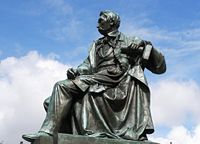
| City | State | Year |
|---|---|---|
| Winnipeg Winnipeg Winnipeg is the capital and largest city of Manitoba, Canada, and is the primary municipality of the Winnipeg Capital Region, with more than half of Manitoba's population. It is located near the longitudinal centre of North America, at the confluence of the Red and Assiniboine Rivers .The name... |
Canada | 1973 |
| Freiburg im Breisgau | Germany | 1989 |
| Rzeszów Rzeszów Rzeszów is a city in southeastern Poland with a population of 179,455 in 2010. It is located on both sides of the Wisłok River, in the heartland of the Sandomierska Valley... |
Poland | 1992 |
| Rochdale Rochdale Rochdale is a large market town in Greater Manchester, England. It lies amongst the foothills of the Pennines on the River Roch, north-northwest of Oldham, and north-northeast of the city of Manchester. Rochdale is surrounded by several smaller settlements which together form the Metropolitan... |
United Kingdom | 1992 |
| Budapest Budapest Budapest is the capital of Hungary. As the largest city of Hungary, it is the country's principal political, cultural, commercial, industrial, and transportation centre. In 2011, Budapest had 1,733,685 inhabitants, down from its 1989 peak of 2,113,645 due to suburbanization. The Budapest Commuter... |
Hungary | 1993 |
| Rishon LeZion | Israel Israel The State of Israel is a parliamentary republic located in the Middle East, along the eastern shore of the Mediterranean Sea... |
1993 |
| Przemyśl Przemysl Przemyśl is a city in south-eastern Poland with 66,756 inhabitants, as of June 2009. In 1999, it became part of the Podkarpackie Voivodeship; it was previously the capital of Przemyśl Voivodeship.... |
Poland | 1995 |
| Kraków Kraków Kraków also Krakow, or Cracow , is the second largest and one of the oldest cities in Poland. Situated on the Vistula River in the Lesser Poland region, the city dates back to the 7th century. Kraków has traditionally been one of the leading centres of Polish academic, cultural, and artistic life... |
Poland | 1995 |
| Grozny Grozny Grozny is the capital city of the Chechen Republic, Russia. The city lies on the Sunzha River. According to the preliminary results of the 2010 Census, the city had a population of 271,596; up from 210,720 recorded in the 2002 Census. but still only about two-thirds of 399,688 recorded in the 1989... |
Russia | 1998 |
| Novi Sad Novi Sad Novi Sad is the capital of the northern Serbian province of Vojvodina, and the administrative centre of the South Bačka District. The city is located in the southern part of Pannonian Plain on the Danube river.... |
Serbia Serbia Serbia , officially the Republic of Serbia , is a landlocked country located at the crossroads of Central and Southeast Europe, covering the southern part of the Carpathian basin and the central part of the Balkans... |
1999 |
| Samarkand Samarkand Although a Persian-speaking region, it was not united politically with Iran most of the times between the disintegration of the Seleucid Empire and the Arab conquest . In the 6th century it was within the domain of the Turkic kingdom of the Göktürks.At the start of the 8th century Samarkand came... |
Uzbekistan Uzbekistan Uzbekistan , officially the Republic of Uzbekistan is a doubly landlocked country in Central Asia and one of the six independent Turkic states. It shares borders with Kazakhstan to the west and to the north, Kyrgyzstan and Tajikistan to the east, and Afghanistan and Turkmenistan to the south.... |
2000 |
| Kutaisi Kutaisi Kutaisi is Georgia's second largest city and the capital of the western region of Imereti. It is 221 km to the west of Tbilisi.-Geography:... |
Georgia Georgia (country) Georgia is a sovereign state in the Caucasus region of Eurasia. Located at the crossroads of Western Asia and Eastern Europe, it is bounded to the west by the Black Sea, to the north by Russia, to the southwest by Turkey, to the south by Armenia, and to the southeast by Azerbaijan. The capital of... |
2002 |
| Wrocław | Poland | 2003 |
| Łódź | Poland | 2003 |
| Banja Luka Banja Luka -History:The name "Banja Luka" was first mentioned in a document dated February 6, 1494, but Banja Luka's history dates back to ancient times. There is a substantial evidence of the Roman presence in the region during the first few centuries A.D., including an old fort "Kastel" in the centre of... |
Bosnia and Herzegovina Bosnia and Herzegovina Bosnia and Herzegovina , sometimes called Bosnia-Herzegovina or simply Bosnia, is a country in Southern Europe, on the Balkan Peninsula. Bordered by Croatia to the north, west and south, Serbia to the east, and Montenegro to the southeast, Bosnia and Herzegovina is almost landlocked, except for the... |
2004 |
| Lublin Lublin Lublin is the ninth largest city in Poland. It is the capital of Lublin Voivodeship with a population of 350,392 . Lublin is also the largest Polish city east of the Vistula river... |
Poland | 2004 |
| Saint Petersburg Saint Petersburg Saint Petersburg is a city and a federal subject of Russia located on the Neva River at the head of the Gulf of Finland on the Baltic Sea... |
Russia | 2006 |
Economy
Lviv is one of the largest cities in Ukraine and is growing rapidly. According to the Ministry of Economy of UkraineEconomy of Ukraine
The economy of Ukraine is an emerging free market, with a gross domestic product that fell sharply for the first 10 years of its independence from the Soviet Union and then experienced rapid growth from 2000 until 2008...
the average salary in the Lviv Oblast
Lviv Oblast
Lviv Oblast is an oblast in western Ukraine. The administrative center of the oblast is the city of Lviv.-History:The oblast was created as part of the Ukrainian Soviet Socialist Republic on December 4, 1939...
is a little less than the average for Ukraine which in December 2007 was about 1616 UAH
Ukrainian hryvnia
The hryvnia, sometimes hryvnya or grivna ; sign: ₴, code: , has been the national currency of Ukraine since September 2, 1996. The hryvnia is subdivided into 100 kopiyok. In medieval times, it was a currency of Kievan Rus'....
. In 2006 Ukraine's economic freedom
Indices of Economic Freedom
The annual survey Economic Freedom of the World is an indicator produced by the Fraser Institute, a Canadian think tank which attempts to measure the degree of economic freedom in the world's nations. This indicator has been used in peer-reviewed studies some of which have found a range of...
was rated at 3.24 (where a rating 1.0 is "freer" than a rating 5.0). According to the World Bank
World Bank Group
The World Bank Group is a family of five international organizations that makes leveraged loans, generally to poor countries.The Bank came into formal existence on 27 December 1945 following international ratification of the Bretton Woods agreements, which emerged from the United Nations Monetary...
classification Lviv is a lower middle-income
Middle class
The middle class is any class of people in the middle of a societal hierarchy. In Weberian socio-economic terms, the middle class is the broad group of people in contemporary society who fall socio-economically between the working class and upper class....
city. There are many restaurants and shops as well as street vendors of food, books, clothes, traditional cultural items and tourist gifts. Banking and money trading are an important part of the economy of Lviv with many banks and exchange offices throughout the city.
Lviv Airlines
Lviv Airlines
Lviv Airlines is an airline headquartered on the grounds of Lviv International Airport in Lviv, Ukraine. It operates chartered passenger and cargo services out of Lviv International Airport.- History :...
has its head office on the grounds of Lviv Airport.
Education
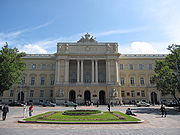
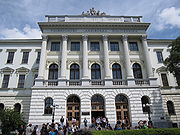
University
A university is an institution of higher education and research, which grants academic degrees in a variety of subjects. A university is an organisation that provides both undergraduate education and postgraduate education...
and a number of smaller schools of higher education. There are eight institutes of the National Academy of Science of Ukraine, more than forty research institute
Research institute
A research institute is an establishment endowed for doing research. Research institutes may specialize in basic research or may be oriented to applied research...
s, three academies and eleven state-owned colleges.
A considerable scientific potential is concentrated in the city: by the number of doctors of sciences, candidates of sciences, scientific organizations Lviv is the fourth city in Ukraine. Lviv is known for ancient academic traditions, founded by the Assumption Brotherhood School and the Jesuit Collegium. Over 100 thousand students annually study in more than 20 higher educational establishments.
Universities
- Ivan Franko National University of LvivLviv UniversityThe Lviv University or officially the Ivan Franko National University of Lviv is the oldest continuously operating university in Ukraine...
(ukr. Львівський національний університет імені Івана Франка) - Lviv PolytechnicLviv PolytechnicLviv Polytechnic National University is the largest scientific university in Lviv. Since its foundation in 1844, it was one of the most important centres of science and technological development in Central Europe. In the interbellum period, the Polytechnic was one of the most important technical...
(ukr. Національний університет "Львівська політехніка") - Danylo Halytsky Lviv National Medical UniversityDanylo Halytsky Lviv National Medical UniversityDanylo Halytsky Lviv National Medical University , — formerly known as the Lvov State Medical Institute, earlier the Faculty of Medicine of the John Casimir University and, before that, Faculty of Medicine of the Francis I University — is one of the oldest and biggest medical...
(ukr. Львiвський національний медичний унiверситет iм. Данила Галицького) - Lviv Stepan Gzhytsky national universityNational universityA national university is generally a university created or run by a government, but which at the same time operates autonomously without direct oversight or control by the state. Some national universities are closely associated with national cultural or political aspirations...
of veterinary medicineVeterinary medicineVeterinary Medicine is the branch of science that deals with the prevention, diagnosis and treatment of disease, disorder and injury in non-human animals...
and biotechnologies (ukr. Львівський національний університет ветеринарної медицини та біотехнологій імені Степана Гжицького) - National Forestry Engineering University of Ukraine (ukr. Український національний лісотехнічний університет)
- Ukrainian Catholic UniversityUkrainian Catholic UniversityThe Ukrainian Catholic University is a Catholic university in Lviv, Ukraine, affiliated with the Ukrainian Greek Catholic Church. The ceremonial inauguration honoring its founding took place on June 29, 2002...
(ukr. Український католицький університет) - Lviv National Agrarian University (ukr. Львівський національний аграрний університет)
- Lviv State University of Physical Training (ukr. Львівський державний університет фізичної культури)
- Lviv State University of Life Safety (ukr. Львівський державний університет безпеки життєдіяльності)
- Lviv State University of Interior (ukr. Львівський державний університет внутрішніх справ)
Tourist attractions
- The Old TownOld Town (Lviv)Lviv's Old Town is the historic centre of the western Ukrainian city of Lviv, in the Lviv Oblast , recognized as the State Historic-Architectural Sanctuary in 1975.-UNESCO:...
is an ancient historical part of the city.- Market SquareMarket Square (Lviv)The Rynok Square in Lviv is a central square of the city of Lviv, Ukraine. It was planned in the second half of the 14th century, following granting city rights by Polish king Casimir III, who annexed Red Ruthenia...
18,300 square metreSquare metreThe square metre or square meter is the SI derived unit of area, with symbol m2 . It is defined as the area of a square whose sides measure exactly one metre...
square in the historical center of the city where Lviv City Hall is situated - Black HouseBlack House, LvivThe Black House, or Polish: Czarna Kamienica, Ukrainian: Chorna Kamyanytsia , is a remarkable Renaissance building on the Lviv Market Square, in the city of Lviv, Ukraine. It was built for Italian tax-collector Tomaso Alberti in 1577. The architect was probably Piotr Krasowski...
- Armenian CathedralArmenian Cathedral, LvivThe Armenian Cathedral of the Assumption of Mary ) in Lviv, Ukraine is located in the city's Old Town, north of the market square.A small Armenian church was built in the years 1363–1370, founded by an Armenian merchant from Caffa and established as the mother church of an eparchy. It is said to...
- Orthodox Cathedral
- Korniakt Palace
- Latin Cathedral of the Assumption of MaryLatin Cathedral, LvivThe Archcathedral Basilica of the Assumption of the Blessed Virgin Mary, in Lviv, in western Ukraine, usually called simply the Latin Cathedral , is located in city's Old Town, in the south western corner of market square....
- St. George's CathedralSt. George's Cathedral, LvivSt. George's Cathedral is a baroque-rococo cathedral located in the city of Lviv, the historic capital of western Ukraine. It was constructed between 1744-1760 on a hill overlooking the city. This is the third manifestation of a church to inhabit the site since the 13th century, and its prominence...
of the Greek-Catholic ChurchUkrainian Greek Catholic ChurchThe Ukrainian Greek Catholic Church , Ukrainska Hreko-Katolytska Tserkva), is the largest Eastern Rite Catholic sui juris particular church in full communion with the Holy See, and is directly subject to the Pope... - Dominican Church of Corpus ChristiDominican Church, LvivThe Dominican church and monastery in Lviv, Ukraine is located in the city's Old Town, east of the market square. It was originally built as the Roman Catholic church of Corpus Christi, and today serves as the Greek Catholic church of the Holy Eucharist....
- Chapel of the Boim family
- Market Square
- Lviv High CastleLviv High CastleThe Lviv High Castle or Lviv Castle Hill is a historic castle located on one of the hills of the Western Ukrainian city of Lviv. It is currently the highest point in the city, 413 metres above sea level....
, hill overlooking the historical center of the city- Union of Lublin MoundUnion of Lublin MoundUnion of Lublin Mound is an artificial hill, 29 m high, in Lwów created in 1869-1890 to commemorate the 300th anniversary of the Union of Lublin...
- Union of Lublin Mound
- Lychakivskiy Cemetery, cemetery where the notable people were buried
- Svobody Prospekt, Lviv's central street.
- Lviv Theatre of Opera and Ballet
- Potocki PalacePotocki Palace, LvivThe Potocki Palace in Lviv was built in the 1880s as an urban seat of Alfred Józef Potocki, Minister-President of Austria. No cost was spared to make it the grandest nobleman's residence in the city....
Popular culture
The native residents of the city jokingly known as the Lvivian batiarBatiar
Batiar , a popular name for a certain class of inhabitants of the nowadays Ukrainian city of Lviv .It is a part of the city's subculture, the Lviv's "knajpa" lifestyle, and became a phenomenon at the beginning of the 20th century although takes its roots somewhere in mid 19th...
y (someone who's mischievous). Lvivians also well known for their way of speaking that was greatly influenced by the Lvivian gwara
Lwów dialect
The Lwów dialect is a local variety of the Polish language characteristic of the inhabitants of the city of Lviv , now in Ukraine. Based on the substratum of the Malopolonia dialect, it was heavily influenced by borrowings from other languages spoken in Central Europe, notably German and Yiddish,...
(talk).
Buses
The public bus networkBus network
A bus network topology is a network architecture in which a set of clients are connected via a shared communications line, called a bus. There are several common instances of the bus architecture, including one in the motherboard of most computers, and those in some versions of Ethernet...
is mainly represented by mini-buses. Large buses are inconvenient due to the traffic conditions of the narrow streets in the central historical part of the city. People call these mini-buses marshrutka
Marshrutka
Marshrutka , from marshrutnoye taksi is a share taxi in the CIS countries, the Baltic states, and Bulgaria. Marshrutnoye taksi literally means routed taxicab...
(route taxi) and they operate over the whole city. Marshrutkas have no fixed stops and stop not only at bus stops but in other places where it is allowed. The marshrutkas are cheap, fast and mostly reliable. This kind of transport is so popular and convenient that mini-buses are often overcrowded during rush hour
Rush hour
A rush hour or peak hour is a part of the day during which traffic congestion on roads and crowding on public transport is at its highest. Normally, this happens twice a day—once in the morning and once in the evening, the times during when the most people commute...
. Marshrutkas also run on suburban lines to most suburbs and nearby towns, e.g. to Shehyni
Shehyni
Shehyni is a village in the Ukraine. Located at the border with Poland, it is best known as the site of the Medyka-Shehyni border crossing.- History :...
at the Polish border. There are also two bus routes in Lviv.
The price of a one-way single ride in a marshrutka within the city of Lviv is 2.00 UAH regardless of the distance traveled. No tickets are provided – and the money is paid to the driver. The price (February 2010) of a ride on a city-bus is 1.00 UAH.
Trams
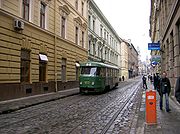
Tram
A tram is a passenger rail vehicle which runs on tracks along public urban streets and also sometimes on separate rights of way. It may also run between cities and/or towns , and/or partially grade separated even in the cities...
way lines were horse–drawn opening on 5 May 1880 and the electric tram was opened on 31 May 1894. The last horse-drawn line was transferred to electric traction in 1908. In 1922 the tramways were switched to driving on the right-hand side. After World War II and the annexation of the city by the Soviet Union several lines were closed but most of infrastructure was preserved. The tracks are narrow-gauge, unusual for the Soviet Union, but explained by the fact that the system was built while the city was part of the Austro-Hungarian Empire and needed to run in narrow medieval streets in the centre of town.
The Lviv tramway now runs about 220 cars on 75 km of track. Previously in bad shape many tracks were reconstructed in 2006 and even more are due to be reconstructed.
The price of a tram/trolleybus ticket is 2.00 UAH (reduced fare ticket is 0.50 UAH, e.g. for students). The ticket may be purchased form the driver.
Trolleybuses
After the war the city grew rapidly due to evacuees returning from Russia and the Soviet Government's vigorous development of heavy industryHeavy industry
Heavy industry does not have a single fixed meaning as compared to light industry. It can mean production of products which are either heavy in weight or in the processes leading to their production. In general, it is a popular term used within the name of many Japanese and Korean firms, meaning...
. This included the transfer of entire factories from the Urals and others to the newly "liberated" territories of the USSR.
The city centre tramway lines were replaced with trolleybus
Trolleybus
A trolleybus is an electric bus that draws its electricity from overhead wires using spring-loaded trolley poles. Two wires and poles are required to complete the electrical circuit...
es on 27 November 1952. New lines were opened to the blocks of flats
Tower block
A tower block, high-rise, apartment tower, office tower, apartment block, or block of flats, is a tall building or structure used as a residential and/or office building...
at the city outskirts. The network now runs about 100 trolleybuses–mostly of the 1980s Skoda 14Tr and LAZ 52522. In 2006–2008 11 modern low-floor trolleybuses (LAZ E183) built by the Lviv Bus Factory
Lviv Bus Factory
The Lviv Automobile Factory, , mostly known under its obsolete name L’vivs’ky Avtobusnyi Zavod is a bus manufacturing company in Lviv, Ukraine...
were purchased.
The price of a tram/trolleybus ticket is 1.00 UAH (reduced fare ticket is 0.50 UAH, e.g. for students). The ticket may be purchased from the driver.
Bicycle Transport
Cycling is a new but growing mode of transport in Lviv. In 2011 the City of Lviv ratified an ambitious 9-year program for the set-up of cycling infrastructure - until the year 2019 an overall length of 270 km (168 mi) cycle lanes and tracks shall be realized. A working group formally organised within the City Council, bringing together representatives of the city administration, members of planning and design institutes, local NGOs and other stakeholders. Events like the All-Ukrainian Bikeday or the European Mobility Week show the popularity of cycling among Lviv’s citizens.As of September 2011, 8 km (5 mi) of new infrastructure have been built. It can be expected that until the end of the year 50 km (31 mi) will be ready for use. The cycling advisor in Lviv - the first such position in Ukraine - is supervizing and pushing forward the execution of the cycling plan and coordinates with various actors in the city. The development of cycling in Ukraine is currently hampered by outdated planning norms and the fact, that most planners didn’t yet plan and experience cycling infrastructure. The update of national legislation and training for planners is therefore necessary.
Rail bus
Lviv used to have a "rail bus". This was a motor-rail car that ran from the largest district of Lviv to one of the largest industrial zones going through the central railway station. It made 7 trips a day and was meant to provide a faster and more comfortable connection between the remote urban districts. The price of a one-way single ride in the rail bus was 1.50 UAH. On 15 June 2010 the route was cancelled as unprofitable.Railways
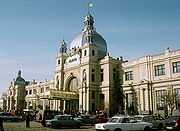
In the interbellum period Lviv (known then as Lwów) was one of the most important hubs of the Polish State Railways
Polish State Railways
is the dominant railway operator in Poland.The company was founded when the former state-owned operator was divided into several units based on the requirements laid down by the European Union...
. The junction at Lviv consisted in mid-1939 of four stations — main station Lwów Główny (now ), Lwów Kleparów (now Lviv Klepariv), Lwów Łyczaków (now Lviv Lychakiv), and Lwów Podzamcze (now Lviv Pidzamche). In August 1939 just before World War II 73 trains departed daily from the Main Station including 56 local and 17 fast trains. Lviv was directly connected with all major centers of the Second Polish Republic as well as such cities as Berlin, Bucharest
Bucharest
Bucharest is the capital municipality, cultural, industrial, and financial centre of Romania. It is the largest city in Romania, located in the southeast of the country, at , and lies on the banks of the Dâmbovița River....
, and Budapest
Budapest
Budapest is the capital of Hungary. As the largest city of Hungary, it is the country's principal political, cultural, commercial, industrial, and transportation centre. In 2011, Budapest had 1,733,685 inhabitants, down from its 1989 peak of 2,113,645 due to suburbanization. The Budapest Commuter...
.
Currently several trains cross the nearby Polish–Ukrainian border (mostly via Przemyśl
Przemysl
Przemyśl is a city in south-eastern Poland with 66,756 inhabitants, as of June 2009. In 1999, it became part of the Podkarpackie Voivodeship; it was previously the capital of Przemyśl Voivodeship....
in Poland). There are good connections to Slovakia (Košice
Košice
Košice is a city in eastern Slovakia. It is situated on the river Hornád at the eastern reaches of the Slovak Ore Mountains, near the border with Hungary...
) and Hungary (Budapest
Budapest
Budapest is the capital of Hungary. As the largest city of Hungary, it is the country's principal political, cultural, commercial, industrial, and transportation centre. In 2011, Budapest had 1,733,685 inhabitants, down from its 1989 peak of 2,113,645 due to suburbanization. The Budapest Commuter...
). Many routes have overnight trains with sleeping compartments.
Lviv railway is often called a main gateway from Ukraine to Europe although buses are often a cheaper and more convenient way of entering the "Schengen" countries.
Air transport
Beginnings of aviation in Lviv reach back to 1884 when the Aeronautic Society was opened there. The Society issued its own magazine Astronauta but soon ceased to exist. In 1909 on the initiative of Edmund Libanski the Awiata Society was founded. Among its members there was a group of professors and students of the Lviv PolytechnicLviv Polytechnic
Lviv Polytechnic National University is the largest scientific university in Lviv. Since its foundation in 1844, it was one of the most important centres of science and technological development in Central Europe. In the interbellum period, the Polytechnic was one of the most important technical...
, including Stefan Drzewiecki
Stefan Drzewiecki
Stefan Drzewiecki was a Polish scientist, journalist, engineer, constructor and inventor, working in Russia and France....
and Zygmunt Sochacki. Awiata was the oldest Polish organization of this kind and it concentrated its activities mainly on exhibitions such as the First Aviation Exhibition which took place in 1910 and featured models of aircraft built by Lviv students.
In 1913–1914 brothers Tadeusz and Władysław Floriańscy built a two-seated airplane. When World War I broke out Austrian authorities confiscated it but did not manage to evacuate the plane in time and it was seized by the Russians who used the plane for intelligence purposes. The Floriański brothers' plane was the first Polish-made aircraft. On 5 November 1918, a crew consisting of Stefan Bastyr
Stefan Bastyr
Stefan Bastyr was a Polish aviator and military pilot, one of the pioneers of the Polish aviation. He is credited with the first military flight in the history of the Polish Air Force on November 5, 1918, almost a week before Poland officially regained her independence, at the opening stages of...
and Janusz de Beaurain carried out the first ever flight under the Polish flag
Flag of Poland
The flag of Poland consists of two horizontal stripes of equal width, the upper one white and the lower one red. The two colors are defined in the Polish constitution as the national colors. A variant of the flag with the national coat of arms in the middle of the white stripe is legally reserved...
taking off from Lviv's Lewandówka (now ) airport. In the interbellum period Lviv was a major center of gliding with a notable Gliding School in Bezmiechowa which opened in 1932. In the same year the Institute of Gliding Technology was opened in Lviv and was the second such institute in the world. In 1938 the First Polish Aircraft Exhibition took place in the city.
Interbellum Lviv also was a major center of the Polish Air Force
Polish Air Force
The Polish Air Force is the military Air Force wing of the Polish Armed Forces. Until July 2004 it was officially known as Wojska Lotnicze i Obrony Powietrznej...
with the Sixth Air Regiment located there. The Regiment was based at the airport in Lviv's suburb of Skniłów (today ) opened in 1924. Sknyliv Airport is now named Lviv International Airport
Lviv International Airport
Lviv International Airport is an airport in Lviv, Ukraine. In 2010, the airport carried 481,900 passengers. The airport is located from downtown Lviv. Facilities at the airport include a café and shop as well as bus services to the city.-Future expansion:...
(LWO), and is located 6 km from the city centre. A new terminal and other improvements are being under a $200 million expansion project in preparation for the 2012 UEFA European Football Championship.
See also
- List of Leopolitans
- Polish football clubs started in Lviv: Pogoń LwówPogon LwówLKS Pogoń Lwów is a former Polish professional sports club which was located in Lwów , and existed from 1904 until the outbreak of World War II in 1939. It was the second oldest Polish football club behind other teams from Lwów - Czarni and Lechia...
, Czarni LwówCzarni LwówCzarni Lwów was one of the first Polish professional sports clubs with the well developed football section as well as hockey among the several other sports. The football club was started in the late 19th century in Lwów as a school football section Sława Lwów...
, Lechia LwówLechia LwówLechia Lwów was the first Polish professional football club, founded on summer 1903 in Lwów....
, Hasmonea LwówHasmonea LwówHasmonea Lwów was a Polish-Jewish sports club based in the city of Lwów . Created in 1908, it was the first sports club exclusively for Jewish members. It was named after the Hasmonean royal dynasty...
Tilki u Lvovi by Yurko Hnatovski (music of Henryk Warszawski)