


Les Kurbas

Encyclopedia
Oleksandr-Zenon Stepanovych Kurbas , a Ukrainian
movie and theater director, is considered by many to be the most important Ukrainian theater director of the 20th century. He formed together with Vsevolod Meyerhold
, Yevgeny Vakhtangov
and several other directors the Soviet theater avantgarde in the 1920s and 30s.
(then part of Austria-Hungary
) on February 25, 1887 and was given a double name Oleksandr-Zenon, for short Les or Oles. He was born to a well known Austrian-Ruthenian family of actors Stepan Pylypovych Yanovych (1862–1908) and Vanda Adolfivna (1867–1950) (née
- Teikhman). Parents' last name Yanovych was their pseudonym, for which they were better known, particularly in theater of "Ruska besida". Beside Les who was the first child there were three other children Kornylo, Nestor, and Nadia, however none of them survived past their teenage years.
At fist Kurbas studied at Ternopil gymnasium. In 1907 he enrolled into the Philosophy Department of University of Vienna
from where he transferred out in 1908, due to his father death enrolling later in Lviv University
(1908–1910). This was determined by the need to lead Ukrainian culture out of the provincialism it had fallen into as a result of the century-long occupation by Poland and Russia.
 In the midst of the first world war Kurbas formed the "Ternopil theatrical evenings" (1915–1916) and the Molody Teatr (Young Theater) in Kiev
in 1916, which was the first ensemble to experiment with both new and ancient acting techniques. Kurbas directed and acted in plays such as Gogol's Revizor and, most importantly and to much acclaim, Sophocles
' Oedipus the King
. Due to the shortage in resources and the general political chaos towards the end of the First World War the ensemble was disbanded. Along with it he was a professor at the Kiev Music-Drama Institute in 1916-1919 and later Kharkiv Music-Drama Institute in 1926-1933. In 1920-21 Les Kurbas has found a Kiev Drama Theater "Kiydramte".
Kurbas' next major project was Haydamaks (several stagings from 1920 on), a poem on the eighteenth-century Ukrainian upsurge against Polish occupation by Ukrainian poet laureate Taras Shevchenko
. The production was the most important Ukrainian theater production of the twentieth century and went on to be staged even after Kurbas' death (without mention of his name, though). Kurbas integrated all the techniques of the Molody era, most notably in his treatment of the choir.
were stable enough to allow Kurbas to found the "Berezil'" ("spring" or "new beginning") in Kiev. In a same year Les Kurbas invited Vadym Meller
to cooperation as a chief artist of the "Berezil'" Theater. Vadym Meller joined "Berezil'" with the experience of both easel artist and scenographer. The expressively unchained drawing, characteristic of V.Meller's early work, will become foundation, the origin in later stage productions done together with Les Kurbas. Since 1922 Les Kurbas also worked for the Odessa Film Studio
where he directed such movies as "Shvedskaya spichka" (1922), "Arsenaltsy" (1925), and others. In 1925 Vadim Meller was awarded a gold medal for the scenic design
of the "Berezil'" theatre (Exposition Internationale des Modernes, Paris
). "Berezil'" was not merely a theater, but a study and research institution which until today is nearly unequalled in its organisation. Every theater department has its own committees and workshops, and several branches were established in other Ukrainian cities. "Berezil'" attracted not only the best actors of its time: dozens of future Ukrainian actors and directors received their education here, going through a curriculum involving a whole series of acting techniques, rhythmic exercises, voice training and ensemble play. Kurbas aimed at a scientific grounding of every development in "Berezil'", which could sometimes lead to endless discussions in one of the committees. He wrote: “Today the comedy is over. The actor entered the stage, the only one by which the theater will live. Theater—tribune and spectacle, court and school, thought and folly of new man”.
In its early years the theater suffered from a shortage of suitable plays that the productions could be based on. Kurbas was only one of several directors, if the most important one, and an outstanding organizer. His stagings of the time included "Gas" by the German author Georg Kaiser and "Jimmy Higgins" by Upton Sinclair
. Kurbas made mostly use of the expressionistic techniques he had developed during the Molody era, but increased further the rhythmic organisation of the entire production.
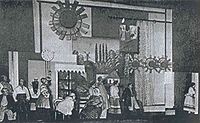 In 1927 Kurbas met up-and-coming playwright Mykola Kulish
in the Ukrainian capital of the time, Kharkiv
, where the "Berezil'" had moved in 1926. Kulish's early plays had been staged by other theaters in the rigid Soviet realist manner that would become the standard all over the Soviet Union in the 1930s. The collaboration between Kulish and Kurbas proved to be both fortunate and unfortunate for the ensemble. While productions as The People's Malakhii (1928), Myna Mazailo (1929) and Maklena Grassa (1933) set new standards in ensemble play and dramatic rigor, they also fell foul with the official Soviet propaganda policy.
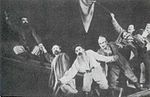 Yet Kurbas was determined to pursue his course in spite of the increasing threats. In 1930, just before the artificial famine in Ukraine, Kurbas was forced to stage Dyktatura ("Dictatorship"), by Ukrainian playwright Ivan Mykytenko. The propaganda play was an attempt to justify the Soviet policy that ultimately led to the starvation of the Ukrainian peasantry and caused several million deaths (the Holodomor
). Kurbas turned the sense of the play around, a technique he named "recoding", and made a satirical and tragic opera out of a what had been a dull realist plot. While the authorities regarded the production as a final opportunity for Kurbas to give up his refractoriness and step back in line, Kurbas followed his own political instincts. By exposing the regime for what it was, he also dealt the death-blow to the theater and himself. Kurbas wrote: “We all know what dictatorship is, but few of us pay attention to it as to a fact of intellectual nature. The obligation of every actor of the play was to make every spectator understand that the rudder of history—is in his own hands.”
(1934). Later in 1933 he was arrested and put into a labour camp (as were many other cultural figures). Even under these conditions Les Kurbas showed his unshakable love for the theater. As his friend and competitor Vsevolod Meyerhold would do later during his own imprisonment, Kurbas organized a camp theater and was even in touch with the author of one of the plays he staged to discuss dramaturgical decisions.
Kurbas was then moved to the Solovetsky Islands
, and he was shot in Sandarmokh
, Karelia
, on November 3, 1937. Soviet premier Joseph Stalin
had directly ordered the killing of exactly 1,111 artists and intellectuals held in Solovki prison camp. Kurbas' friend Mykola Kulish
, who had been held in a cage like an animal and consequently fallen into a state of utter mental derangement, met the same fate.
's Odin Teatret). Another important falsification is that Kurbas was not a communist. It would be more correct to say that he had an entirely different vision of communism and the potential of a new society for the development of human creativity. His most important goal as an artist was to "make the audience feel more alive".
Ukrainians
Ukrainians are an East Slavic ethnic group native to Ukraine, which is the sixth-largest nation in Europe. The Constitution of Ukraine applies the term 'Ukrainians' to all its citizens...
movie and theater director, is considered by many to be the most important Ukrainian theater director of the 20th century. He formed together with Vsevolod Meyerhold
Vsevolod Meyerhold
Vsevolod Emilevich Meyerhold was a great Russian and Soviet theatre director, actor and theatrical producer. His provocative experiments dealing with physical being and symbolism in an unconventional theatre setting made him one of the seminal forces in modern international theatre.-Early...
, Yevgeny Vakhtangov
Yevgeny Vakhtangov
Yevgeny Bagrationovich Vakhtangov was a Russian actor and theatre director who founded the Vakhtangov Theatre. He was a friend and mentor of Michael Chekhov.Vakhtangov was born to Armenian-Russian parents from Ossetia in Vladikavkaz...
and several other directors the Soviet theater avantgarde in the 1920s and 30s.
Early work
Kurbas was born in SambirSambir
Sambir is a city in the Lviv Oblast, Ukraine. Serving as the administrative center of the Sambir Raion , the city itself is also designated as a separate raion within the oblast. It is located at around , close to the border with Poland.-History:...
(then part of Austria-Hungary
Austria-Hungary
Austria-Hungary , more formally known as the Kingdoms and Lands Represented in the Imperial Council and the Lands of the Holy Hungarian Crown of Saint Stephen, was a constitutional monarchic union between the crowns of the Austrian Empire and the Kingdom of Hungary in...
) on February 25, 1887 and was given a double name Oleksandr-Zenon, for short Les or Oles. He was born to a well known Austrian-Ruthenian family of actors Stepan Pylypovych Yanovych (1862–1908) and Vanda Adolfivna (1867–1950) (née
NEE
NEE is a political protest group whose goal was to provide an alternative for voters who are unhappy with all political parties at hand in Belgium, where voting is compulsory.The NEE party was founded in 2005 in Antwerp...
- Teikhman). Parents' last name Yanovych was their pseudonym, for which they were better known, particularly in theater of "Ruska besida". Beside Les who was the first child there were three other children Kornylo, Nestor, and Nadia, however none of them survived past their teenage years.
At fist Kurbas studied at Ternopil gymnasium. In 1907 he enrolled into the Philosophy Department of University of Vienna
University of Vienna
The University of Vienna is a public university located in Vienna, Austria. It was founded by Duke Rudolph IV in 1365 and is the oldest university in the German-speaking world...
from where he transferred out in 1908, due to his father death enrolling later in Lviv University
Lviv University
The Lviv University or officially the Ivan Franko National University of Lviv is the oldest continuously operating university in Ukraine...
(1908–1910). This was determined by the need to lead Ukrainian culture out of the provincialism it had fallen into as a result of the century-long occupation by Poland and Russia.
Kiev
Kiev or Kyiv is the capital and the largest city of Ukraine, located in the north central part of the country on the Dnieper River. The population as of the 2001 census was 2,611,300. However, higher numbers have been cited in the press....
in 1916, which was the first ensemble to experiment with both new and ancient acting techniques. Kurbas directed and acted in plays such as Gogol's Revizor and, most importantly and to much acclaim, Sophocles
Sophocles
Sophocles is one of three ancient Greek tragedians whose plays have survived. His first plays were written later than those of Aeschylus, and earlier than or contemporary with those of Euripides...
' Oedipus the King
Oedipus the King
Oedipus the King , also known by the Latin title Oedipus Rex, is an Athenian tragedy by Sophocles that was first performed c. 429 BCE. It was the second of Sophocles's three Theban plays to be produced, but it comes first in the internal chronology, followed by Oedipus at Colonus and then Antigone...
. Due to the shortage in resources and the general political chaos towards the end of the First World War the ensemble was disbanded. Along with it he was a professor at the Kiev Music-Drama Institute in 1916-1919 and later Kharkiv Music-Drama Institute in 1926-1933. In 1920-21 Les Kurbas has found a Kiev Drama Theater "Kiydramte".
Kurbas' next major project was Haydamaks (several stagings from 1920 on), a poem on the eighteenth-century Ukrainian upsurge against Polish occupation by Ukrainian poet laureate Taras Shevchenko
Taras Shevchenko
Taras Hryhorovych Shevchenko -Life:Born into a serf family of Hryhoriy Ivanovych Shevchenko and Kateryna Yakymivna Shevchenko in the village of Moryntsi, of Kiev Governorate of the Russian Empire Shevchenko was orphaned at the age of eleven...
. The production was the most important Ukrainian theater production of the twentieth century and went on to be staged even after Kurbas' death (without mention of his name, though). Kurbas integrated all the techniques of the Molody era, most notably in his treatment of the choir.
Berezil'
It was only in 1922 that conditions in the now Soviet-ruled UkraineUkraine
Ukraine is a country in Eastern Europe. It has an area of 603,628 km², making it the second largest contiguous country on the European continent, after Russia...
were stable enough to allow Kurbas to found the "Berezil'" ("spring" or "new beginning") in Kiev. In a same year Les Kurbas invited Vadym Meller
Vadym Meller
Vadym Meller or Vadim Meller, was a Ukrainian-Russian Soviet painter, avant-garde Cubist and Constructivist artist, theatrical designer, book illustrator, and architect...
to cooperation as a chief artist of the "Berezil'" Theater. Vadym Meller joined "Berezil'" with the experience of both easel artist and scenographer. The expressively unchained drawing, characteristic of V.Meller's early work, will become foundation, the origin in later stage productions done together with Les Kurbas. Since 1922 Les Kurbas also worked for the Odessa Film Studio
Odessa Film Studio
Odessa Film Studio is a Ukrainian film studio in Odessa. It is partially owned by a government and supervised by the Department of State property fund of Ukraine together with the Ministry of Culture. Together with Dovzhenko Film Studios they are the only state-owned and major film producers in...
where he directed such movies as "Shvedskaya spichka" (1922), "Arsenaltsy" (1925), and others. In 1925 Vadim Meller was awarded a gold medal for the scenic design
Scenic design
Scenic design is the creation of theatrical, as well as film or television scenery. Scenic designers have traditionally come from a variety of artistic backgrounds, but nowadays, generally speaking, they are trained professionals, often with M.F.A...
of the "Berezil'" theatre (Exposition Internationale des Modernes, Paris
Paris
Paris is the capital and largest city in France, situated on the river Seine, in northern France, at the heart of the Île-de-France region...
). "Berezil'" was not merely a theater, but a study and research institution which until today is nearly unequalled in its organisation. Every theater department has its own committees and workshops, and several branches were established in other Ukrainian cities. "Berezil'" attracted not only the best actors of its time: dozens of future Ukrainian actors and directors received their education here, going through a curriculum involving a whole series of acting techniques, rhythmic exercises, voice training and ensemble play. Kurbas aimed at a scientific grounding of every development in "Berezil'", which could sometimes lead to endless discussions in one of the committees. He wrote: “Today the comedy is over. The actor entered the stage, the only one by which the theater will live. Theater—tribune and spectacle, court and school, thought and folly of new man”.
In its early years the theater suffered from a shortage of suitable plays that the productions could be based on. Kurbas was only one of several directors, if the most important one, and an outstanding organizer. His stagings of the time included "Gas" by the German author Georg Kaiser and "Jimmy Higgins" by Upton Sinclair
Upton Sinclair
Upton Beall Sinclair Jr. , was an American author who wrote close to one hundred books in many genres. He achieved popularity in the first half of the twentieth century, acquiring particular fame for his classic muckraking novel, The Jungle . It exposed conditions in the U.S...
. Kurbas made mostly use of the expressionistic techniques he had developed during the Molody era, but increased further the rhythmic organisation of the entire production.
Mykola Kulish
Mykola Kulish was a Ukrainian prosaic, drama writer, pedagogue, veteran of the World War I, Red Army veteran.-Brief biography:Kulish was born in a village of...
in the Ukrainian capital of the time, Kharkiv
Kharkiv
Kharkiv or Kharkov is the second-largest city in Ukraine.The city was founded in 1654 and was a major centre of Ukrainian culture in the Russian Empire. Kharkiv became the first city in Ukraine where the Ukrainian Soviet Socialist Republic was proclaimed in December 1917 and Soviet government was...
, where the "Berezil'" had moved in 1926. Kulish's early plays had been staged by other theaters in the rigid Soviet realist manner that would become the standard all over the Soviet Union in the 1930s. The collaboration between Kulish and Kurbas proved to be both fortunate and unfortunate for the ensemble. While productions as The People's Malakhii (1928), Myna Mazailo (1929) and Maklena Grassa (1933) set new standards in ensemble play and dramatic rigor, they also fell foul with the official Soviet propaganda policy.
Holodomor
The Holodomor was a man-made famine in the Ukrainian SSR between 1932 and 1933. During the famine, which is also known as the "terror-famine in Ukraine" and "famine-genocide in Ukraine", millions of Ukrainians died of starvation in a peacetime catastrophe unprecedented in the history of...
). Kurbas turned the sense of the play around, a technique he named "recoding", and made a satirical and tragic opera out of a what had been a dull realist plot. While the authorities regarded the production as a final opportunity for Kurbas to give up his refractoriness and step back in line, Kurbas followed his own political instincts. By exposing the regime for what it was, he also dealt the death-blow to the theater and himself. Kurbas wrote: “We all know what dictatorship is, but few of us pay attention to it as to a fact of intellectual nature. The obligation of every actor of the play was to make every spectator understand that the rudder of history—is in his own hands.”
Imprisonment
In 1933 Kurbas was ousted from "Berezil'". He was allowed to go to Moscow, where he probably was the major force behind Solomon Michoel's famous staging of King LearKing Lear
King Lear is a tragedy by William Shakespeare. The title character descends into madness after foolishly disposing of his estate between two of his three daughters based on their flattery, bringing tragic consequences for all. The play is based on the legend of Leir of Britain, a mythological...
(1934). Later in 1933 he was arrested and put into a labour camp (as were many other cultural figures). Even under these conditions Les Kurbas showed his unshakable love for the theater. As his friend and competitor Vsevolod Meyerhold would do later during his own imprisonment, Kurbas organized a camp theater and was even in touch with the author of one of the plays he staged to discuss dramaturgical decisions.
Kurbas was then moved to the Solovetsky Islands
Solovetsky Islands
The Solovetsky Islands , or Solovki , are an archipelago located in the Onega Bay of the White Sea, Russia. The islands are served by the Solovki Airport. Area: ....
, and he was shot in Sandarmokh
Sandarmokh
Sandarmokh is a forest massif in Medvezhyegorsky District, Karelia, Russia, a burial site of victims of Soviet political repressions, where over 9,000 bodies were discovered after the place was found in 1997 by members of the Memorial Society....
, Karelia
Karelia
Karelia , the land of the Karelian peoples, is an area in Northern Europe of historical significance for Finland, Russia, and Sweden...
, on November 3, 1937. Soviet premier Joseph Stalin
Joseph Stalin
Joseph Vissarionovich Stalin was the Premier of the Soviet Union from 6 May 1941 to 5 March 1953. He was among the Bolshevik revolutionaries who brought about the October Revolution and had held the position of first General Secretary of the Communist Party of the Soviet Union's Central Committee...
had directly ordered the killing of exactly 1,111 artists and intellectuals held in Solovki prison camp. Kurbas' friend Mykola Kulish
Mykola Kulish
Mykola Kulish was a Ukrainian prosaic, drama writer, pedagogue, veteran of the World War I, Red Army veteran.-Brief biography:Kulish was born in a village of...
, who had been held in a cage like an animal and consequently fallen into a state of utter mental derangement, met the same fate.
Posterity
The "Berezil'" Theater lived on under the name of "Shevchenko Theater". One of Kurbas' lead actors, Marjan Kurshelnytsky, led it until the 1960s, but had to make many artistic compromises. Kurbas' work could only be mentioned again from the 1960s onwards, yet the overdue research was only begun in late 1980s, mostly in Ukraine. There is a tendency in the Ukrainian research to glorify Kurbas. Some hagiographers claim that Kurbas was a genius (he was indeed multi-talented) who anticipated every development of the later 20th century theater (some of which he did, as for example in the work of Italian director Eugenio BarbaEugenio Barba
Eugenio Barba is an Italian author and theatre director based in Denmark. He is the founder of the Odin Theatre and the International School of Theatre Anthropology, both located in Holstebro, Denmark.-Biography:...
's Odin Teatret). Another important falsification is that Kurbas was not a communist. It would be more correct to say that he had an entirely different vision of communism and the potential of a new society for the development of human creativity. His most important goal as an artist was to "make the audience feel more alive".