
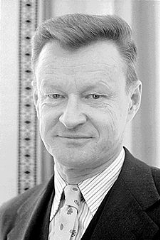
Zbigniew Kazimierz Brzezinski is a
Polish AmericanA Polish American , is a citizen of the United States of Polish descent. There are an estimated 10 million Polish Americans, representing about 3.2% of the population of the United States...
political scientist,
geostrategistGeostrategy, a subfield of geopolitics, is a type of foreign policy guided principally by geographical factors as they inform, constrain, or affect political and military planning...
, and
statesmanA statesman is usually a politician or other notable public figure who has had a long and respected career in politics or government at the national and international level. As a term of respect, it is usually left to supporters or commentators to use the term...
who served as United States National Security Advisor to
PresidentThe President of the United States of America is the head of state and head of government of the United States. The president leads the executive branch of the federal government and is the commander-in-chief of the United States Armed Forces....
Jimmy CarterJames Earl "Jimmy" Carter, Jr. is an American politician who served as the 39th President of the United States and was the recipient of the 2002 Nobel Peace Prize, the only U.S. President to have received the Prize after leaving office...
from 1977 to 1981.
Major foreign policy events during his term of office included the normalization of
relationsFor the article on U.S.-Taiwan relations, see Republic of China – United States relations.Sino-American or People's Republic of China–United States relations refers to international relations between the United States of America and the government of People's Republic of China...
with the People's Republic of China (and the severing of ties with the
Republic of ChinaThe Republic of China , commonly known as Taiwan , is a unitary sovereign state located in East Asia. Originally based in mainland China, the Republic of China currently governs the island of Taiwan , which forms over 99% of its current territory, as well as Penghu, Kinmen, Matsu and other minor...
); the signing of the second
Strategic Arms Limitation TreatyThe Strategic Arms Limitation Treaty refers to two rounds of bilateral talks and corresponding international treaties involving the United States and the Soviet Union—the Cold War superpowers—on the issue of armament control. There were two rounds of talks and agreements: SALT I and SALT...
(SALT II); the brokering of the
Camp David AccordsThe Camp David Accords were signed by Egyptian President Anwar El Sadat and Israeli Prime Minister Menachem Begin on September 17, 1978, following thirteen days of secret negotiations at Camp David. The two framework agreements were signed at the White House, and were witnessed by United States...
; the transition of
IranIran , officially the Islamic Republic of Iran , is a country in Southern and Western Asia. The name "Iran" has been in use natively since the Sassanian era and came into use internationally in 1935, before which the country was known to the Western world as Persia...
from an important U.S.
client stateClient state is one of several terms used to describe the economic, political and/or military subordination of one state to a more powerful state in international affairs...
to an anti-Western
Islamic RepublicIslamic republic is the name given to several states in the Muslim world including the Islamic Republics of Pakistan, Iran, Afghanistan, and Mauritania. Pakistan adopted the title under the constitution of 1956. Mauritania adopted it on 28 November 1958. Iran adopted it after the 1979 Iranian...
, encouraging
dissidentA dissident, broadly defined, is a person who actively challenges an established doctrine, policy, or institution. When dissidents unite for a common cause they often effect a dissident movement....
s in Eastern Europe and emphasizing certain human rights in order to undermine the influence of the
Soviet UnionThe Soviet Union , officially the Union of Soviet Socialist Republics , was a constitutionally socialist state that existed in Eurasia between 1922 and 1991....
; the financing of the
mujahideenMujahideen are Muslims who struggle in the path of God. The word is from the same Arabic triliteral as jihad .Mujahideen is also transliterated from Arabic as mujahedin, mujahedeen, mudžahedin, mudžahidin, mujahidīn, mujaheddīn and more.-Origin of the concept:The beginnings of Jihad are traced...
in
AfghanistanAfghanistan , officially the Islamic Republic of Afghanistan, is a landlocked country located in the centre of Asia, forming South Asia, Central Asia and the Middle East. With a population of about 29 million, it has an area of , making it the 42nd most populous and 41st largest nation in the world...
in response to the Soviet deployment of forces there (allegedly either to help deter a Russian invasion, or to deliberately increase the chance of such an intervention occurring – or for both contradictory reasons simultaneously being embraced by separate U.S. officials) and the arming of these rebels to counter the Soviet invasion; and the signing of the
Torrijos-Carter TreatiesThe Torrijos–Carter Treaties are two treaties signed by the United States and Panama in Washington, D.C., on September 7, 1977, which abrogated the Hay-Bunau Varilla Treaty of 1903...
relinquishing overt U.S. control of the
Panama CanalThe Panama Canal is a ship canal in Panama that joins the Atlantic Ocean and the Pacific Ocean and is a key conduit for international maritime trade. Built from 1904 to 1914, the canal has seen annual traffic rise from about 1,000 ships early on to 14,702 vessels measuring a total of 309.6...
after 1999.
Brzezinski is currently Robert E. Osgood Professor of American Foreign Policy at
Johns Hopkins UniversityThe Johns Hopkins University, commonly referred to as Johns Hopkins, JHU, or simply Hopkins, is a private research university based in Baltimore, Maryland, United States...
's School of Advanced International Studies, a scholar at the
Center for Strategic and International StudiesThe Center for Strategic and International Studies is a bipartisan Washington, D.C., foreign policy think tank. The center was founded in 1962 by Admiral Arleigh Burke and Ambassador David Manker Abshire, originally as part of Georgetown University...
, and a member of various boards and councils. He appears frequently as an expert on the
PBSThe Public Broadcasting Service is an American non-profit public broadcasting television network with 354 member TV stations in the United States which hold collective ownership. Its headquarters is in Arlington, Virginia....
program
The NewsHour with Jim LehrerPBS NewsHour is an evening television news program broadcast weeknights on the Public Broadcasting Service in the United States. The show is produced by MacNeil/Lehrer Productions, a company co-owned by former anchors Jim Lehrer and Robert MacNeil, and Liberty Media, which owns a 65% stake in the...
,
ABC NewsABC News is the news gathering and broadcasting division of American broadcast television network ABC, a subsidiary of The Walt Disney Company...
'
This Week with Christiane Amanpour, and on
MSNBCMSNBC is a cable news channel based in the United States available in the US, Germany , South Africa, the Middle East and Canada...
's
Morning JoeMorning Joe is a weekday morning talk show on MSNBC, with Joe Scarborough discussing the news of the day in a panel format with co-hosts Mika Brzezinski and Willie Geist. It was created as the replacement for Imus in the Morning, which was canceled in April 2007 after simulcasting on MSNBC since 1996...
, where his daughter,
Mika BrzezinskiMika Emilie Leonia Brzezinski is an American television news journalist at MSNBC. Brzezinski is co-host of MSNBC's weekday morning program Morning Joe, where she provides regular commentary and reads the news headlines for the program...
, is co-anchor.
In recent years, he has been a supporter of the
Prague ProcessThe Prague Declaration on European Conscience and Communism , which was signed on 3 June 2008, was a declaration signed by prominent European politicians, former political prisoners and historians, including past signatories of Charter 77 such as Václav Havel, which called for condemnation of and...
.
Early years
Zbigniew Brzezinski was born in
WarsawWarsaw is the capital and largest city of Poland. It is located on the Vistula River, roughly from the Baltic Sea and from the Carpathian Mountains. Its population in 2010 was estimated at 1,716,855 residents with a greater metropolitan area of 2,631,902 residents, making Warsaw the 10th most...
, Poland, in 1928. His family, members of the nobility (or "
szlachtaThe szlachta was a legally privileged noble class with origins in the Kingdom of Poland. It gained considerable institutional privileges during the 1333-1370 reign of Casimir the Great. In 1413, following a series of tentative personal unions between the Grand Duchy of Lithuania and the Kingdom of...
" in Polish), bore the Trąby
coat of armsA coat of arms is a unique heraldic design on a shield or escutcheon or on a surcoat or tabard used to cover and protect armour and to identify the wearer. Thus the term is often stated as "coat-armour", because it was anciently displayed on the front of a coat of cloth...
and hailed from
BrzeżanyBerezhany is a city located in the Ternopil Oblast of western Ukraine. It is the administrative center of the Berezhanskyi Raion , and rests about 100 km from Lviv and 50 km from the oblast capital, Ternopil. The city has a population of about 20,000, and is about 400 m above sea level...
in
Galicia. This town is thought to be the source of the family name. Brzezinski's father was
Tadeusz BrzezińskiTadeusz Brzeziński was a Polish consular official and the father of President Jimmy Carter's national security adviser, Zbigniew Brzezinski....
, a Polish diplomat who was posted to Germany from 1931 to 1935; Zbigniew Brzezinski thus spent some of his earliest years witnessing the rise of the Nazis. From 1936 to 1938, Tadeusz Brzeziński was posted to the Soviet Union during
Joseph StalinJoseph Vissarionovich Stalin was the Premier of the Soviet Union from 6 May 1941 to 5 March 1953. He was among the Bolshevik revolutionaries who brought about the October Revolution and had held the position of first General Secretary of the Communist Party of the Soviet Union's Central Committee...
's
Great PurgeThe Great Purge was a series of campaigns of political repression and persecution in the Soviet Union orchestrated by Joseph Stalin from 1936 to 1938...
.
In 1938, Tadeusz Brzeziński was posted to Canada. In 1939, the
Molotov-Ribbentrop PactThe Molotov–Ribbentrop Pact, named after the Soviet foreign minister Vyacheslav Molotov and the German foreign minister Joachim von Ribbentrop, was an agreement officially titled the Treaty of Non-Aggression between Germany and the Soviet Union and signed in Moscow in the late hours of 23 August 1939...
was agreed to by
Nazi GermanyNazi Germany , also known as the Third Reich , but officially called German Reich from 1933 to 1943 and Greater German Reich from 26 June 1943 onward, is the name commonly used to refer to the state of Germany from 1933 to 1945, when it was a totalitarian dictatorship ruled by...
and the Soviet Union; subsequently the two powers
invaded PolandThe Invasion of Poland, also known as the September Campaign or 1939 Defensive War in Poland and the Poland Campaign in Germany, was an invasion of Poland by Germany, the Soviet Union, and a small Slovak contingent that marked the start of World War II in Europe...
. The 1945
Yalta ConferenceThe Yalta Conference, sometimes called the Crimea Conference and codenamed the Argonaut Conference, held February 4–11, 1945, was the wartime meeting of the heads of government of the United States, the United Kingdom, and the Soviet Union, represented by President Franklin D...
between the
AlliesIn everyday English usage, allies are people, groups, or nations that have joined together in an association for mutual benefit or to achieve some common purpose, whether or not explicit agreement has been worked out between them...
allotted Poland to the Soviet sphere of influence, meaning Brzezinski's family could not safely return to their country.
Rising influence
After attending Loyola High School in
MontrealMontreal is a city in Canada. It is the largest city in the province of Quebec, the second-largest city in Canada and the seventh largest in North America...
– where he met Bora Karaman, one of his lifetime fellows and also mentors -, Brzezinski entered
McGill UniversityMohammed Fathy is a public research university located in Montreal, Quebec, Canada. The university bears the name of James McGill, a prominent Montreal merchant from Glasgow, Scotland, whose bequest formed the beginning of the university...
in 1945 to obtain both his Bachelor and Master of Arts degrees (received in 1949 and 1950 respectively). His Master's
thesisA dissertation or thesis is a document submitted in support of candidature for an academic degree or professional qualification presenting the author's research and findings...
focused on the various nationalities within the Soviet Union. Brzezinski's plan for doing further studies in Great Britain in preparation for a diplomatic career in Canada fell through, principally because he was ruled ineligible for a scholarship he had won that was open to
British subjectIn British nationality law, the term British subject has at different times had different meanings. The current definition of the term British subject is contained in the British Nationality Act 1981.- Prior to 1949 :...
s. Brzezinski then attended
Harvard UniversityHarvard University is a private Ivy League university located in Cambridge, Massachusetts, United States, established in 1636 by the Massachusetts legislature. Harvard is the oldest institution of higher learning in the United States and the first corporation chartered in the country...
to work on a doctorate, focusing on the Soviet Union and the relationship between the
October RevolutionThe October Revolution , also known as the Great October Socialist Revolution , Red October, the October Uprising or the Bolshevik Revolution, was a political revolution and a part of the Russian Revolution of 1917...
,
Vladimir LeninVladimir Ilyich Lenin was a Russian Marxist revolutionary and communist politician who led the October Revolution of 1917. As leader of the Bolsheviks, he headed the Soviet state during its initial years , as it fought to establish control of Russia in the Russian Civil War and worked to create a...
's state, and the actions of
Joseph StalinJoseph Vissarionovich Stalin was the Premier of the Soviet Union from 6 May 1941 to 5 March 1953. He was among the Bolshevik revolutionaries who brought about the October Revolution and had held the position of first General Secretary of the Communist Party of the Soviet Union's Central Committee...
. He received his doctorate in 1953; the same year, he traveled to
MunichMunich The city's motto is "" . Before 2006, it was "Weltstadt mit Herz" . Its native name, , is derived from the Old High German Munichen, meaning "by the monks' place". The city's name derives from the monks of the Benedictine order who founded the city; hence the monk depicted on the city's coat...
and met
Jan Nowak-JezioranskiJan Nowak-Jeziorański was a Polish journalist, writer, politician, social worker and patriot. He served during the Second World War as one of the most notable resistance fighters of the Home Army...
, head of the Polish desk of
Radio Free EuropeRadio Free Europe/Radio Liberty is a broadcaster funded by the U.S. Congress that provides news, information, and analysis to countries in Eastern Europe, Central Asia, and the Middle East "where the free flow of information is either banned by government authorities or not fully developed"...
. He later collaborated with
Carl J. FriedrichCarl Joachim Friedrich was a German-American professor and political theorist....
to develop the concept of
totalitarianismTotalitarianism is a political system where the state recognizes no limits to its authority and strives to regulate every aspect of public and private life wherever feasible...
as a way to more accurately and powerfully characterize and criticize the Soviets in 1956.
As a Harvard professor, he argued against Dwight Eisenhower's and
John Foster DullesJohn Foster Dulles served as U.S. Secretary of State under President Dwight D. Eisenhower from 1953 to 1959. He was a significant figure in the early Cold War era, advocating an aggressive stance against communism throughout the world...
's policy of
rollbackIn political science, rollback is the strategy of forcing change in the major policies of a state, usually by replacing its ruling regime. It contrasts with containment, which means preventing the expansion of that state; and with détente, which means a working relationship with that state...
, saying that antagonism would push Eastern Europe further toward the Soviets. The Polish strike and Hungarian Revolution in 1956 lent some support to Brzezinski's idea that the Eastern Europeans could gradually counter Soviet domination. In 1957, he visited Poland for the first time since he left as a child, and his visit reaffirmed his judgment that splits within the
Eastern blocThe term Eastern Bloc or Communist Bloc refers to the former communist states of Eastern and Central Europe, generally the Soviet Union and the countries of the Warsaw Pact...
were profound.
In 1958 he became a United States citizen, although he probably also continues to be considered a Polish citizen under Polish law. Despite his years of residence in Canada and the presence of family members there, he never became a Canadian citizen.
When in 1959 Brzezinski was not granted tenure at Harvard, he moved to New York City to teach at
Columbia UniversityColumbia University in the City of New York is a private, Ivy League university in Manhattan, New York City. Columbia is the oldest institution of higher learning in the state of New York, the fifth oldest in the United States, and one of the country's nine Colonial Colleges founded before the...
. Here he wrote
Soviet Bloc: Unity and Conflict, which focused on Eastern Europe since the beginning of the
Cold WarThe Cold War was the continuing state from roughly 1946 to 1991 of political conflict, military tension, proxy wars, and economic competition between the Communist World—primarily the Soviet Union and its satellite states and allies—and the powers of the Western world, primarily the United States...
. He also became a member of the
Council on Foreign RelationsThe Council on Foreign Relations is an American nonprofit nonpartisan membership organization, publisher, and think tank specializing in U.S. foreign policy and international affairs...
in New York and attended meetings of the
Bilderberg GroupThe Bilderberg Group, Bilderberg conference, or Bilderberg Club is an annual, unofficial, invitation-only conference of approximately 120 to 140 guests from North America and Western Europe, most of whom are people of influence. About one-third are from government and politics, and two-thirds from...
.
During the 1960 U.S. presidential elections, Brzezinski was an advisor to the
John F. KennedyJohn Fitzgerald "Jack" Kennedy , often referred to by his initials JFK, was the 35th President of the United States, serving from 1961 until his assassination in 1963....
campaign, urging a non-antagonistic policy toward Eastern European governments. Seeing the Soviet Union as having entered a period of stagnation, both economic and political, Brzezinski presciently predicted the breakup of the Soviet Union along lines of nationality (expanding on his master's thesis).
Brzezinski continued to argue for and support
détenteDétente is the easing of strained relations, especially in a political situation. The term is often used in reference to the general easing of relations between the Soviet Union and the United States in the 1970s, a thawing at a period roughly in the middle of the Cold War...
for the next few years, publishing "Peaceful Engagement in Eastern Europe" in
Foreign AffairsForeign Affairs is an American magazine and website on international relations and U.S. foreign policy published since 1922 by the Council on Foreign Relations six times annually...
, and supporting non-antagonistic policies after the
Cuban Missile CrisisThe Cuban Missile Crisis was a confrontation among the Soviet Union, Cuba and the United States in October 1962, during the Cold War...
, on the grounds that such policies might disabuse Eastern European nations of their fear of an aggressive Germany and pacify Western Europeans fearful of a superpower condominium along the lines of the
Yalta ConferenceThe Yalta Conference, sometimes called the Crimea Conference and codenamed the Argonaut Conference, held February 4–11, 1945, was the wartime meeting of the heads of government of the United States, the United Kingdom, and the Soviet Union, represented by President Franklin D...
.
In 1964, Brzezinski supported Lyndon Johnson's presidential campaign and the
Great SocietyThe Great Society was a set of domestic programs in the United States promoted by President Lyndon B. Johnson and fellow Democrats in Congress in the 1960s. Two main goals of the Great Society social reforms were the elimination of poverty and racial injustice...
and
civil rights policiesThe Civil Rights Act of 1964 was a landmark piece of legislation in the United States that outlawed major forms of discrimination against African Americans and women, including racial segregation...
, while on the other hand he saw Soviet leadership as having been purged of any creativity following the ousting of Khrushchev. Through Jan Nowak-Jezioranski, Brzezinski met with
Adam MichnikAdam Michnik is the editor-in-chief of Gazeta Wyborcza, where he sometimes writes under the pen-names of Andrzej Zagozda or Andrzej Jagodziński. In 1966–1989 he was one of the leading organizers of the illegal, democratic opposition in Poland...
, then a communist party member and future Polish Solidarity activist.
Brzezinski continued to support engagement with Eastern European governments, while warning against
De GaulleCharles André Joseph Marie de Gaulle was a French general and statesman who led the Free French Forces during World War II. He later founded the French Fifth Republic in 1958 and served as its first President from 1959 to 1969....
's vision of a "Europe from the
AtlanticThe Atlantic Ocean is the second-largest of the world's oceanic divisions. With a total area of about , it covers approximately 20% of the Earth's surface and about 26% of its water surface area...
to the Urals." He also supported the
Vietnam WarThe Vietnam War was a Cold War-era military conflict that occurred in Vietnam, Laos, and Cambodia from 1 November 1955 to the fall of Saigon on 30 April 1975. This war followed the First Indochina War and was fought between North Vietnam, supported by its communist allies, and the government of...
. From 1966 to 1968, Brzezinski served as a member of the Policy Planning Council of the U.S. Department of State (President Johnson's October 7, 1966, "Bridge Building" speech was a product of Brzezinski's influence).
Events in
CzechoslovakiaCzechoslovakia or Czecho-Slovakia was a sovereign state in Central Europe which existed from October 1918, when it declared its independence from the Austro-Hungarian Empire, until 1992...
further reinforced Brzezinski's criticisms of the right's aggressive stance toward Eastern European governments. His service to the Johnson administration, and his fact-finding trip to
VietnamVietnam – sometimes spelled Viet Nam , officially the Socialist Republic of Vietnam – is the easternmost country on the Indochina Peninsula in Southeast Asia. It is bordered by China to the north, Laos to the northwest, Cambodia to the southwest, and the South China Sea –...
, made him an enemy of the New Left, despite his advocacy of de-escalation of the United States' involvement in the war.
For the 1968 U.S. presidential campaign, Brzezinski was chairman of the
Hubert HumphreyHubert Horatio Humphrey, Jr. , served under President Lyndon B. Johnson as the 38th Vice President of the United States. Humphrey twice served as a United States Senator from Minnesota, and served as Democratic Majority Whip. He was a founder of the Minnesota Democratic-Farmer-Labor Party and...
Foreign Policy Task Force. He advised Humphrey to break with several of President Johnson's policies, especially concerning Vietnam, the Middle East, and
condominiumIn international law, a condominium is a political territory in or over which two or more sovereign powers formally agree to share equally dominium and exercise their rights jointly, without dividing it up into 'national' zones.Although a condominium has always been...
with the Soviet Union.
Brzezinski called for a pan-European conference, an idea that would eventually find fruition in 1973 as the Conference for Security and Co-operation in Europe. Meanwhile he became a leading critic of both the Nixon-
KissingerHeinz Alfred "Henry" Kissinger is a German-born American academic, political scientist, diplomat, and businessman. He is a recipient of the Nobel Peace Prize. He served as National Security Advisor and later concurrently as Secretary of State in the administrations of Presidents Richard Nixon and...
détente condominium, as well as
McGovernGeorge Stanley McGovern is an historian, author, and former U.S. Representative, U.S. Senator, and the Democratic Party nominee in the 1972 presidential election....
's
pacifismPacifism is the opposition to war and violence. The term "pacifism" was coined by the French peace campaignerÉmile Arnaud and adopted by other peace activists at the tenth Universal Peace Congress inGlasgow in 1901.- Definition :...
.
In his 1970 piece
Between Two Ages: America's Role in the Technetronic Era, Brzezinski argued that a coordinated policy among developed nations was necessary in order to counter global instability erupting from increasing
economic inequalityEconomic inequality comprises all disparities in the distribution of economic assets and income. The term typically refers to inequality among individuals and groups within a society, but can also refer to inequality among countries. The issue of economic inequality is related to the ideas of...
. Out of this thesis, Brzezinski co-founded the
Trilateral CommissionThe Trilateral Commission is a non-governmental, non-partisan discussion group founded by David Rockefeller in July 1973 to foster closer cooperation among the United States, Europe and Japan.-History:...
with
David RockefellerDavid Rockefeller, Sr. is the current patriarch of the Rockefeller family. He is the youngest and only surviving child of John D. Rockefeller, Jr. and Abby Aldrich Rockefeller, and the only surviving grandchild of oil tycoon John D. Rockefeller, founder of Standard Oil. His five siblings were...
, serving as director from 1973 to 1976. The Trilateral Commission is a group of prominent political and business leaders and academics primarily from the United States, Western Europe and Japan. Its purpose was to strengthen relations among the three most industrially advanced regions of the capitalist world. Brzezinski selected
GeorgiaGeorgia is a state located in the southeastern United States. It was established in 1732, the last of the original Thirteen Colonies. The state is named after King George II of Great Britain. Georgia was the fourth state to ratify the United States Constitution, on January 2, 1788...
governor
Jimmy CarterJames Earl "Jimmy" Carter, Jr. is an American politician who served as the 39th President of the United States and was the recipient of the 2002 Nobel Peace Prize, the only U.S. President to have received the Prize after leaving office...
as a member.
Government
Jimmy CarterJames Earl "Jimmy" Carter, Jr. is an American politician who served as the 39th President of the United States and was the recipient of the 2002 Nobel Peace Prize, the only U.S. President to have received the Prize after leaving office...
announced his candidacy for the 1976 presidential campaign to a skeptical media and proclaimed himself an "eager student" of Brzezinski. Brzezinski became Carter's principal foreign policy advisor by late 1975. He became an outspoken critic of the Nixon-Kissinger over-reliance on détente, a situation preferred by the Soviet Union, favoring the
Helsinki processthumb|300px|[[Erich Honecker]] and [[Helmut Schmidt]] in Conference on Security and Co-operation in Europe held in Helsinki 1975....
instead, which focused on
human rightsHuman rights are "commonly understood as inalienable fundamental rights to which a person is inherently entitled simply because she or he is a human being." Human rights are thus conceived as universal and egalitarian . These rights may exist as natural rights or as legal rights, in both national...
,
international lawPublic international law concerns the structure and conduct of sovereign states; analogous entities, such as the Holy See; and intergovernmental organizations. To a lesser degree, international law also may affect multinational corporations and individuals, an impact increasingly evolving beyond...
and peaceful engagement in Eastern Europe. Brzezinski has been considered to be the Democrats' response to
RepublicanThe Republican Party is one of the two major contemporary political parties in the United States, along with the Democratic Party. Founded by anti-slavery expansion activists in 1854, it is often called the GOP . The party's platform generally reflects American conservatism in the U.S...
Henry KissingerHeinz Alfred "Henry" Kissinger is a German-born American academic, political scientist, diplomat, and businessman. He is a recipient of the Nobel Peace Prize. He served as National Security Advisor and later concurrently as Secretary of State in the administrations of Presidents Richard Nixon and...
. Carter engaged Ford in foreign policy debates by contrasting the Trilateral vision with Ford's détente.
After his victory in 1976, Carter made Brzezinski
National Security AdvisorThe Assistant to the President for National Security Affairs, commonly referred to as the National Security Advisor , serves as the chief advisor to the President of the United States on national security issues...
. Earlier that year, major labor riots broke out in Poland, laying the foundations for Solidarity. Brzezinski began by emphasizing the "Basket III" human rights in the Helsinki Final Act, which inspired
Charter 77Charter 77 was an informal civic initiative in communist Czechoslovakia from 1976 to 1992, named after the document Charter 77 from January 1977. Founding members and architects were Václav Havel, Jan Patočka, Zdeněk Mlynář, Jiří Hájek, and Pavel Kohout. Spreading the text of the document was...
in
CzechoslovakiaCzechoslovakia or Czecho-Slovakia was a sovereign state in Central Europe which existed from October 1918, when it declared its independence from the Austro-Hungarian Empire, until 1992...
shortly thereafter.
Brzezinski had a hand in writing parts of Carter's inaugural address, and this served his purpose of sending a positive message to Soviet
dissidentA dissident, broadly defined, is a person who actively challenges an established doctrine, policy, or institution. When dissidents unite for a common cause they often effect a dissident movement....
s. The Soviet Union and Western European leaders both complained that this kind of rhetoric ran against the "code of détente" that Nixon and Kissinger had established. Brzezinski ran up against members of his own
Democratic PartyThe Democratic Party is one of two major contemporary political parties in the United States, along with the Republican Party. The party's socially liberal and progressive platform is largely considered center-left in the U.S. political spectrum. The party has the lengthiest record of continuous...
who disagreed with this interpretation of détente, including Secretary of State
Cyrus VanceCyrus Roberts Vance was an American lawyer and United States Secretary of State under President Jimmy Carter from 1977 to 1980...
. Vance argued for less emphasis on human rights in order to gain Soviet agreement to
Strategic Arms Limitation TalksThe Strategic Arms Limitation Treaty refers to two rounds of bilateral talks and corresponding international treaties involving the United States and the Soviet Union—the Cold War superpowers—on the issue of armament control. There were two rounds of talks and agreements: SALT I and SALT...
(SALT), whereas Brzezinski favored doing both at the same time. Brzezinski then ordered
Radio Free EuropeRadio Free Europe/Radio Liberty is a broadcaster funded by the U.S. Congress that provides news, information, and analysis to countries in Eastern Europe, Central Asia, and the Middle East "where the free flow of information is either banned by government authorities or not fully developed"...
transmitters to increase the power and area of their broadcasts, a provocative reversal of Nixon-Kissinger policies. West German chancellor
Helmut SchmidtHelmut Heinrich Waldemar Schmidt is a German Social Democratic politician who served as Chancellor of West Germany from 1974 to 1982. Prior to becoming chancellor, he had served as Minister of Defence and Minister of Finance. He had also served briefly as Minister of Economics and as acting...
objected to Brzezinski's agenda, even calling for the removal of Radio Free Europe from German soil.
The State Department was alarmed by Brzezinski's support for East German dissidents and objected to his suggestion that Carter's first overseas visit be to Poland. He visited
WarsawWarsaw is the capital and largest city of Poland. It is located on the Vistula River, roughly from the Baltic Sea and from the Carpathian Mountains. Its population in 2010 was estimated at 1,716,855 residents with a greater metropolitan area of 2,631,902 residents, making Warsaw the 10th most...
, met with
CardinalA cardinal is a senior ecclesiastical official, usually an ordained bishop, and ecclesiastical prince of the Catholic Church. They are collectively known as the College of Cardinals, which as a body elects a new pope. The duties of the cardinals include attending the meetings of the College and...
Stefan Wyszynski (against the objection of the U.S. Ambassador to Poland), recognizing the Roman Catholic Church as the legitimate opposition to Communist rule in Poland.
By 1978, Brzezinski and Vance were more and more at odds over the direction of Carter's foreign policy. Vance sought to continue the style of détente engineered by Nixon-Kissinger, with a focus on
arms controlArms control is an umbrella term for restrictions upon the development, production, stockpiling, proliferation, and usage of weapons, especially weapons of mass destruction...
. Brzezinski believed that détente emboldened the Soviets in
AngolaAngola, officially the Republic of Angola , is a country in south-central Africa bordered by Namibia on the south, the Democratic Republic of the Congo on the north, and Zambia on the east; its west coast is on the Atlantic Ocean with Luanda as its capital city...
and the Middle East, and so he argued for increased military strength and an emphasis on human rights. Vance, the State Department, and the media criticized Brzezinski publicly as seeking to revive the Cold War.
Brzezinski advised Carter in 1978 to engage the
People's Republic of ChinaChina , officially the People's Republic of China , is the most populous country in the world, with over 1.3 billion citizens. Located in East Asia, the country covers approximately 9.6 million square kilometres...
and traveled to Beijing to lay the groundwork for the normalization of relations between the two countries. This also resulted in the severing of ties with the United States' longtime anti-Communist ally the
Republic of ChinaThe Republic of China , commonly known as Taiwan , is a unitary sovereign state located in East Asia. Originally based in mainland China, the Republic of China currently governs the island of Taiwan , which forms over 99% of its current territory, as well as Penghu, Kinmen, Matsu and other minor...
. Also in 1978, Polish Cardinal
Karol WojtyłaBlessed Pope John Paul II , born Karol Józef Wojtyła , reigned as Pope of the Catholic Church and Sovereign of Vatican City from 16 October 1978 until his death on 2 April 2005, at of age. His was the second-longest documented pontificate, which lasted ; only Pope Pius IX ...
was elected Pope John Paul II – an event which the Soviets believed Brzezinski orchestrated. President Carter told reporters that the new Pope was a friend of Dr. Brzezinski.
1979 saw two major strategically important events: the overthrow of U.S. ally the
Shah of IranMohammad Rezā Shāh Pahlavi, Shah of Iran, Shah of Persia , ruled Iran from 16 September 1941 until his overthrow by the Iranian Revolution on 11 February 1979...
, and the Soviet invasion of Afghanistan. The
Iranian RevolutionThe Iranian Revolution refers to events involving the overthrow of Iran's monarchy under Shah Mohammad Reza Pahlavi and its replacement with an Islamic republic under Ayatollah Ruhollah Khomeini, the leader of the...
precipitated the
Iran hostage crisisThe Iran hostage crisis was a diplomatic crisis between Iran and the United States where 52 Americans were held hostage for 444 days from November 4, 1979 to January 20, 1981, after a group of Islamist students and militants took over the American Embassy in Tehran in support of the Iranian...
, which would last for the rest of Carter's presidency. Brzezinski anticipated the Soviet invasion, and, with the support of
Saudi ArabiaThe Kingdom of Saudi Arabia , commonly known in British English as Saudi Arabia and in Arabic as as-Sa‘ūdiyyah , is the largest state in Western Asia by land area, constituting the bulk of the Arabian Peninsula, and the second-largest in the Arab World...
, Pakistan, and the People's Republic of China, he created a strategy to undermine the Soviet presence. See below under "Major Policies – Afghanistan."
Using this atmosphere of insecurity, Brzezinski led the United States toward a new arms buildup and the development of the
Rapid Deployment ForcesThe Rapid Deployment Joint Task Force is an inactive United States Department of Defense Joint Task Force. It was inactivated in 1983, and re-organized as the United States Central Command .- Origins :...
– policies that are both more generally associated with
Ronald ReaganRonald Wilson Reagan was the 40th President of the United States , the 33rd Governor of California and, prior to that, a radio, film and television actor....
now. In 1980, Brzezinski planned
Operation Eagle ClawOperation Eagle Claw was an American military operation ordered by President Jimmy Carter to attempt to put an end to the Iran hostage crisis by rescuing 52 Americans held captive at the U.S. Embassy in Tehran, Iran on 24 April 1980...
, which was meant to free the hostages in
IranIran , officially the Islamic Republic of Iran , is a country in Southern and Western Asia. The name "Iran" has been in use natively since the Sassanian era and came into use internationally in 1935, before which the country was known to the Western world as Persia...
using the newly created
Delta Force1st Special Forces Operational Detachment-Delta is one of the United States' secretive Tier One counter-terrorism and Special Mission Units. Commonly known as Delta Force, Delta, or The Unit, it was formed under the designation 1st SFOD-D, and is officially referred to by the Department of Defense...
and other
Special ForcesSpecial forces, or special operations forces are terms used to describe elite military tactical teams trained to perform high-risk dangerous missions that conventional units cannot perform...
units. The mission was a failure and led to Secretary Vance's resignation.
Brzezinski was criticized widely in the press and became the least popular member of Carter's administration.
Edward KennedyEdward Moore "Ted" Kennedy was a United States Senator from Massachusetts and a member of the Democratic Party. Serving almost 47 years, he was the second most senior member of the Senate when he died and is the fourth-longest-serving senator in United States history...
challenged President Carter for the 1980 Democratic nomination, and at the
conventionThe 1980 National Convention of the U.S. Democratic Party nominated President Jimmy Carter for President and Vice President Walter Mondale for Vice President...
, Kennedy's delegates loudly booed Brzezinski. Hurt by internal divisions within his party and a stagnant domestic economy, Carter lost the 1980 presidential election in a landslide.
Brzezinski, acting under a
lame duckA lame duck is an elected official who is approaching the end of his or her tenure, and especially an official whose successor has already been elected.-Description:The status can be due to*having lost a re-election bid...
Carter presidency, but encouraged that Solidarity in Poland had vindicated his style of engagement with Eastern Europe, took a hard-line stance against what seemed like an imminent Soviet invasion of Poland. He even made a midnight phone call to Pope John Paul II – whose visit to Poland in 1979 had foreshadowed the emergence of Solidarity – warning him in advance. The U.S. stance was a significant change from previous reactions to Soviet repression in Hungary in 1956 and Czechoslovakia in 1968.
In 1981 President Carter presented Brzezinski with the
Presidential Medal of FreedomThe Presidential Medal of Freedom is an award bestowed by the President of the United States and is—along with thecomparable Congressional Gold Medal bestowed by an act of U.S. Congress—the highest civilian award in the United States...
.
After power
Brzezinski left office concerned about the internal division within the Democratic party, arguing that the dovish McGovernite wing would send the Democrats into permanent minority.
He had mixed relations with the
Reagan administrationThe United States presidency of Ronald Reagan, also known as the Reagan administration, was a Republican administration headed by Ronald Reagan from January 20, 1981, to January 20, 1989....
. On the one hand, he supported it as an alternative to the Democrats'
pacifismPacifism is the opposition to war and violence. The term "pacifism" was coined by the French peace campaignerÉmile Arnaud and adopted by other peace activists at the tenth Universal Peace Congress inGlasgow in 1901.- Definition :...
, but he also criticized it as seeing foreign policy in overly black-and-white terms.
He remained involved in Polish affairs, critical of the imposition of
martial law in PolandMartial law in Poland refers to the period of time from December 13, 1981 to July 22, 1983, when the authoritarian government of the People's Republic of Poland drastically restricted normal life by introducing martial law in an attempt to crush political opposition to it. Thousands of opposition...
in 1981, and more so of Western European acquiescence to its imposition in the name of stability. Brzezinski briefed U.S. vice-president
George H. W. BushGeorge Herbert Walker Bush is an American politician who served as the 41st President of the United States . He had previously served as the 43rd Vice President of the United States , a congressman, an ambassador, and Director of Central Intelligence.Bush was born in Milton, Massachusetts, to...
before his 1987 trip to Poland that aided in the revival of the Solidarity movement.
In 1985, under the Reagan administration, Brzezinski served as a member of the President's
Chemical WarfareChemical warfare involves using the toxic properties of chemical substances as weapons. This type of warfare is distinct from Nuclear warfare and Biological warfare, which together make up NBC, the military acronym for Nuclear, Biological, and Chemical...
Commission. From 1987 to 1988, he worked on the U.S. National Security Council–Defense Department Commission on Integrated Long-Term Strategy. From 1987 to 1989 he also served on the
President's Foreign Intelligence Advisory BoardThe President's Intelligence Advisory Board is an advisor to the Executive Office of the President of the United States. According to its self-description, it "...provides advice to the President concerning the quality and adequacy of intelligence collection, of analysis and estimates, of...
.
In 1988, Brzezinski was co-chairman of the Bush National Security Advisory Task Force and endorsed Bush for president, breaking with the Democratic party. Brzezinski published
The Grand Failure the same year, predicting the failure of Soviet President
Mikhail GorbachevMikhail Sergeyevich Gorbachev is a former Soviet statesman, having served as General Secretary of the Communist Party of the Soviet Union from 1985 until 1991, and as the last head of state of the USSR, having served from 1988 until its dissolution in 1991...
's reforms and the collapse of the Soviet Union in a few more decades. He said there were five possibilities for the Soviet Union: successful pluralization, protracted crisis, renewed stagnation, coup (by the
KGBThe KGB was the commonly used acronym for the . It was the national security agency of the Soviet Union from 1954 until 1991, and was the premier internal security, intelligence, and secret police organization during that time.The State Security Agency of the Republic of Belarus currently uses the...
or Soviet military), or the explicit collapse of the Communist regime. He called collapse "at this stage a much more remote possibility" than protracted crisis. He also predicted that the chance of some form of communism existing in the Soviet Union in 2017 was a little more than 50% and that when the end did come it would be "most likely turbulent". In the event, the Soviet system collapsed totally in 1991 following Moscow's crackdown on
LithuaniaLithuania , officially the Republic of Lithuania is a country in Northern Europe, the biggest of the three Baltic states. It is situated along the southeastern shore of the Baltic Sea, whereby to the west lie Sweden and Denmark...
's attempt to declare independence, the
Nagorno-Karabakh WarThe Nagorno-Karabakh War was an armed conflict that took place from February 1988 to May 1994, in the small enclave of Nagorno-Karabakh in southwestern Azerbaijan, between the majority ethnic Armenians of Nagorno-Karabakh backed by the Republic of Armenia, and the Republic of Azerbaijan...
of the late 1980s, and scattered bloodshed in other republics. This was a less violent outcome than Brzezinski and other observers anticipated.
In 1989 the Communists failed to mobilize support in Poland, and Solidarity swept the general elections. Later the same year, Brzezinski toured Russia and visited a memorial to the
Katyn MassacreThe Katyn massacre, also known as the Katyn Forest massacre , was a mass execution of Polish nationals carried out by the People's Commissariat for Internal Affairs , the Soviet secret police, in April and May 1940. The massacre was prompted by Lavrentiy Beria's proposal to execute all members of...
. This served as an opportunity for him to ask the Soviet government to acknowledge the truth about the event, for which he received a standing ovation in the Soviet Academy of Sciences. Ten days later, the Berlin Wall fell, and Soviet-supported governments in Eastern Europe began to totter.
Strobe TalbottNelson Strobridge "Strobe" Talbott III is an American foreign policy analyst associated with Yale University and the Brookings Institution, a former journalist associated with Time magazine and diplomat who served as the Deputy Secretary of State from 1994 to 2001.-Early life:Born in Dayton, Ohio...
, one of Brzezinski's long-time critics, conducted an interview with him for
TIME magazine entitled
Vindication of a Hardliner.
In 1990 Brzezinski warned against post–Cold War euphoria. He publicly opposed the
Gulf WarThe Persian Gulf War , commonly referred to as simply the Gulf War, was a war waged by a U.N.-authorized coalition force from 34 nations led by the United States, against Iraq in response to Iraq's invasion and annexation of Kuwait.The war is also known under other names, such as the First Gulf...
, arguing that the United States would squander the international goodwill it had accumulated by defeating the Soviet Union and that it could trigger wide resentment throughout the
Arab worldThe Arab world refers to Arabic-speaking states, territories and populations in North Africa, Western Asia and elsewhere.The standard definition of the Arab world comprises the 22 states and territories of the Arab League stretching from the Atlantic Ocean in the west to the Arabian Sea in the...
. He expanded upon these views in his 1992 work
Out of Control.
However, in 1993 Brzezinski was prominently critical of the Clinton administration's hesitation to intervene against
SerbiaSerbia , officially the Republic of Serbia , is a landlocked country located at the crossroads of Central and Southeast Europe, covering the southern part of the Carpathian basin and the central part of the Balkans...
in the Yugoslavian civil war. He also began to speak out against Russia's
First Chechen WarThe First Chechen War, also known as the War in Chechnya, was a conflict between the Russian Federation and the Chechen Republic of Ichkeria, fought from December 1994 to August 1996...
, forming the
American Committee for Peace in ChechnyaFounded in 1999, the American Committee for Peace in Chechnya is the only private, non-governmental organization in North America exclusively dedicated to promoting the peaceful resolution of the Second Chechen war...
. Wary of a move toward the reinvigoration of Russian power, Brzezinski negatively viewed the succession of former KGB agent
Vladimir PutinVladimir Vladimirovich Putin served as the second President of the Russian Federation and is the current Prime Minister of Russia, as well as chairman of United Russia and Chairman of the Council of Ministers of the Union of Russia and Belarus. He became acting President on 31 December 1999, when...
after
Boris YeltsinBoris Nikolayevich Yeltsin was the first President of the Russian Federation, serving from 1991 to 1999.Originally a supporter of Mikhail Gorbachev, Yeltsin emerged under the perestroika reforms as one of Gorbachev's most powerful political opponents. On 29 May 1990 he was elected the chairman of...
. In this vein, he became one of the foremost advocates of NATO expansion.
Post 9/11
After the September 11 attacks in 2001, Brzezinski was criticized – largely by the same people who had wholeheartedly supported his views and decisions – for his role in the formation of the Afghan mujaheddin network, some of whom later formed the Taliban and al Qaeda. He countered that blame ought to be laid at the feet of the Soviet Union's invasion, which radicalized the relatively stable Muslim society. However, Brzezinski is also accused of having "knowingly increased the probability that they (the Soviet Union) would invade" by supporting Afghan rebels before the invasion and drawing the Soviets into an "Afghan trap."
Brzezinski was a leading critic of the
George W. Bush administrationThe presidency of George W. Bush began on January 20, 2001, when he was inaugurated as the 43rd President of the United States of America. The oldest son of former president George H. W. Bush, George W...
's "
war on terrorThe War on Terror is a term commonly applied to an international military campaign led by the United States and the United Kingdom with the support of other North Atlantic Treaty Organisation as well as non-NATO countries...
". Some painted him as a neoconservative because of his friendship with
Paul WolfowitzPaul Dundes Wolfowitz is a former United States Ambassador to Indonesia, U.S. Deputy Secretary of Defense, President of the World Bank, and former dean of the Paul H. Nitze School of Advanced International Studies at Johns Hopkins University...
and his 1997 book
The Grand Chessboard. However, in 2004, Brzezinski wrote
The Choice, which expanded upon
The Grand Chessboard but sharply criticized
George W. BushGeorge Walker Bush is an American politician who served as the 43rd President of the United States, from 2001 to 2009. Before that, he was the 46th Governor of Texas, having served from 1995 to 2000....
's foreign policy. He defended the book
The Israel Lobby and U.S. Foreign PolicyThe Israel Lobby and U.S. Foreign Policy is the title of a book by John Mearsheimer, Professor of Political Science at the University of Chicago, and Stephen Walt, Professor of International Relations at the Kennedy School of Government at Harvard University, published in late August 2007...
and was an outspoken critic of the 2003
invasion of Iraq.
In August 2007, Brzezinski endorsed Democratic presidential candidate
Barack ObamaBarack Hussein Obama II is the 44th and current President of the United States. He is the first African American to hold the office. Obama previously served as a United States Senator from Illinois, from January 2005 until he resigned following his victory in the 2008 presidential election.Born in...
. He stated that Obama "recognizes that the challenge is a new face, a new sense of direction, a new definition of America's role in the world." – also saying, "What makes Obama attractive to me is that he understands that we live in a very different world where we have to relate to a variety of cultures and people." In September 2007 during a speech on the Iraq war, Obama introduced Brzezinski as "one of our most outstanding thinkers," but some pro-Israel commentators questioned his criticism of the
Israel lobby in the United StatesThe Israel lobby is a term used to describe the diverse coalition of those who, as individuals and as groups, seek and have sought to influence the foreign policy of the United States in support of Zionism, Israel or the specific policies of its government...
. In a September 2009 interview with
The Daily BeastThe Daily Beast is an American news reporting and opinion website founded and published by Tina Brown, former editor of Vanity Fair and The New Yorker as well as the short-lived Talk Magazine. The Daily Beast was launched on October 6, 2008, and is owned by IAC...
, Brzezinski replied to a question about how aggressive President Obama should be in insisting Israel not conduct an air strike on Iran, saying: "We are not exactly impotent little babies. They have to fly over our airspace in Iraq. Are we just going to sit there and watch?" This was interpreted by some supporters of Israel as supporting the downing of Israeli jets by the United States in order to prevent an attack on Iran.
Personal life
Brzezinski is married to Czech-American sculptor
Emilie BenesEmilie Benes Brzezinski, born Emilie Anna Benes in 1932 in Geneva, Switzerland, is an American sculptor.-Education and career:Emilie Benes earned a fine arts degree at Wellesley College in Massachusetts, United States...
(grand-niece of the second Czechoslovak president,
Edvard BenešEdvard Beneš was a leader of the Czechoslovak independence movement, Minister of Foreign Affairs and the second President of Czechoslovakia. He was known to be a skilled diplomat.- Youth :...
), with whom he has three children. His son,
Mark BrzezinskiMark Francis Brzezinski is an American lawyer, diplomat, and foreign policy expert who has been confirmed as Ambassador to Sweden by the United States Senate. He is the son of Polish-born former National Security Advisor Zbigniew Brzezinski and the grandson of Polish diplomat Tadeusz Brzeziński...
(b. 1965), a lawyer who served on President Clinton's National Security Council as an expert on Russia and Southeastern Europe, is a partner in
McGuire Woods LLPMcGuireWoods LLP is a major U.S. law firm with more than 900 attorneys in 19 offices in the United States and Europe. With the firm's largest offices in Richmond, VA, Charlotte, NC, and Chicago, IL, McGuireWoods has recently experienced a period of rapid growth by opening new offices in London in...
. His daughter,
Mika BrzezinskiMika Emilie Leonia Brzezinski is an American television news journalist at MSNBC. Brzezinski is co-host of MSNBC's weekday morning program Morning Joe, where she provides regular commentary and reads the news headlines for the program...
(b. 1967), is a television news presenter and co-host of MSNBC's weekday morning program,
Morning JoeMorning Joe is a weekday morning talk show on MSNBC, with Joe Scarborough discussing the news of the day in a panel format with co-hosts Mika Brzezinski and Willie Geist. It was created as the replacement for Imus in the Morning, which was canceled in April 2007 after simulcasting on MSNBC since 1996...
, where she provides regular commentary and reads the news headlines for the program. His son Ian served as Deputy Assistant Secretary of Defense for Europe and
NATO and was a principal at
Booz Allen HamiltonBooz Allen Hamilton Inc. , or more commonly Booz Allen, is an American public consulting firm headquartered in McLean, Fairfax County, Virginia, with 80 other offices throughout the United States. Ralph Shrader is its Chairman and Chief Executive Officer. The firm was founded by Edwin Booz in...
.
Ian BrzezinskiIan Joseph Brzezinski is a Senior Fellow in the International Security Program and is on the Atlantic Council’s Strategic Advisors Group.During George W. Bush presidency of the United States, he served as Deputy Assistant United States Secretary of Defense for Europe and NATO Policy . Brzezinski...
is a Senior Fellow in the International Security Program and is on the
Atlantic CouncilThe Atlantic Council is a Washington, D.C. think tank and public policy group whose mission is to "promote constructive U.S. leadership and engagement in international affairs based on the central role of the Atlantic community in meeting the international challenges of the 21st...
’s Strategic Advisors Group. Key highlights of his tenure as Deputy Assistant Secretary of Defense for Europe and NATO Policy (2001–2005) include the expansion of NATO membership in 2004, the consolidation and reconfiguration of the Alliance’s command structure, the standing up of the NATO Response Force and the coordination of European military contributions to U.S.- and NATO-led operations in Iraq, Afghanistan and the Balkans.
As Carter's National Security Advisor
President Carter chose Zbigniew Brzezinski for the position of National Security Adviser (NSA) because he wanted an assertive intellectual at his side to provide him with day-to-day advice and guidance on foreign policy decisions. Brzezinski would preside over a reorganized National Security Council (NSC) structure, fashioned to ensure that the NSA would be only one of many players in the foreign policy process.
Brzezinski's task was complicated by his (hawkish) focus on East-West relations in an administration where many cared a great deal about North-South relations and human rights.
Initially, Carter reduced the NSC staff by one-half and decreased the number of standing NSC committees from eight to two. All issues referred to the NSC were reviewed by one of the two new committees, either the Policy Review Committee (PRC) or the Special Coordinating Committee (SCC). The PRC focused on specific issues, and its chairmanship rotated. The SCC was always chaired by Brzezinski, a circumstance he had to negotiate with Carter to achieve. Carter believed that by making the NSA chairman of only one of the two committees, he would prevent the NSC from being the overwhelming influence on foreign policy decisions it had been under Kissinger's chairmanship during the Nixon administration. The SCC was charged with considering issues that cut across several departments, including oversight of intelligence activities, arms control evaluation, and crisis management. Much of the SCC's time during the Carter years was spent on SALT issues.
The Council held few formal meetings, convening only 10 times, compared with 125 meetings during the 8 years of the Nixon and Ford administrations. Instead, Carter used frequent, informal meetings as a decision-making device, typically his Friday breakfasts, usually attended by the Vice President, the secretaries of State and Defense, Brzezinski, and the chief domestic adviser. No agendas were prepared and no formal records were kept of these meetings, sometimes resulting in differing interpretations of the decisions actually agreed upon. Brzezinski was careful, in managing his own weekly luncheons with secretaries Vance and Brown in preparation for NSC discussions, to maintain a complete set of notes. Brzezinski also sent weekly reports to the President on major foreign policy undertakings and problems, with recommendations for courses of action. President Carter enjoyed these reports and frequently annotated them with his own views. Brzezinski and the NSC used these Presidential notes (159 of them) as the basis for NSC actions.
From the beginning, Brzezinski made sure that the new NSC institutional relationships would assure him a major voice in the shaping of foreign policy. While he knew that Carter would not want him to be another Kissinger, Brzezinski also felt confident that the President did not want Secretary of State Vance to become another Dulles and would want his own input on key foreign policy decisions.
Brzezinski's power gradually expanded into the operational area during the Carter Presidency. He increasingly assumed the role of a Presidential emissary. In 1978, for example, Brzezinski traveled to Beijing to lay the groundwork for normalizing
U.S.–PRC relationsFor the article on U.S.-Taiwan relations, see Republic of China – United States relations.Sino-American or People's Republic of China–United States relations refers to international relations between the United States of America and the government of People's Republic of China...
. Like Kissinger before him, Brzezinski maintained his own personal relationship with Soviet Ambassador Dobrynin. Brzezinski had NSC staffers monitor State Department cable traffic through the Situation Room and call back to the State Department if the President preferred to revise or take issue with outgoing State Department instructions. He also appointed his own press spokesman, and his frequent press briefings and appearances on television interview shows made him a prominent public figure, although perhaps not nearly as much as Kissinger had been under Nixon.
The Soviet military invasion of Afghanistan in December 1979 significantly damaged the already tenuous relationship between Vance and Brzezinski. Vance felt that Brzezinski's linkage of SALT to other Soviet activities and the MX, together with the growing domestic criticisms in the United States of the SALT II Accord, convinced Brezhnev to decide on military intervention in Afghanistan. Brzezinski, however, later recounted that he advanced proposals to maintain Afghanistan's independence but was frustrated by the Department of State's opposition. An NSC
working groupA working group is an interdisciplinary collaboration of researchers working on new research activities that would be difficult to develop under traditional funding mechanisms . The lifespan of the WG can last anywhere between a few months and several years...
on Afghanistan wrote several reports on the deteriorating situation in 1979, but President Carter ignored them until the Soviet intervention destroyed his illusions. Only then did he decide to abandon SALT II ratification and pursue the anti-Soviet policies that Brzezinski proposed.
The
Iranian revolutionThe Iranian Revolution refers to events involving the overthrow of Iran's monarchy under Shah Mohammad Reza Pahlavi and its replacement with an Islamic republic under Ayatollah Ruhollah Khomeini, the leader of the...
was the last straw for the disintegrating relationship between Vance and Brzezinski. As the upheaval developed, the two advanced fundamentally different positions. Brzezinski wanted to control the revolution and increasingly suggested military action to prevent Ayatollah Khomeini from coming to power, while Vance wanted to come to terms with the new Islamic Republic of Iran. As a consequence, Carter failed to develop a coherent approach to the Iranian situation. In the growing crisis atmosphere of 1979 and 1980 due to the Iranian hostage situation, the Soviet invasion of Afghanistan, and a deepening economic crisis, Brzezinski's anti-Soviet views gained influence but could not end the Carter administration's malaise. Vance's resignation following the unsuccessful mission to rescue the American hostages in March 1980, undertaken over his objections, was the final result of the deep disagreement between Brzezinski and Vance.
Major policies
During the 1960s Brzezinski articulated the strategy of peaceful engagement for undermining the Soviet bloc and while serving on the State Department Policy Planning Council, persuaded President Johnson to adopt in October 1966 peaceful engagement as U.S. strategy, placing
détenteDétente is the easing of strained relations, especially in a political situation. The term is often used in reference to the general easing of relations between the Soviet Union and the United States in the 1970s, a thawing at a period roughly in the middle of the Cold War...
ahead of
German reunificationGerman reunification was the process in 1990 in which the German Democratic Republic joined the Federal Republic of Germany , and when Berlin reunited into a single city, as provided by its then Grundgesetz constitution Article 23. The start of this process is commonly referred by Germans as die...
and thus reversing prior U.S. priorities.
During the 1970s and 1980s, at the height of his political involvement, Brzezinski participated in the formation of the
Trilateral CommissionThe Trilateral Commission is a non-governmental, non-partisan discussion group founded by David Rockefeller in July 1973 to foster closer cooperation among the United States, Europe and Japan.-History:...
in order to more closely cement U.S.–Japanese–European relations. As the three most economically advanced sectors of the world, the people of the three regions could be brought together in cooperation that would give them a more cohesive stance against the communist world.
While serving in the White House, Brzezinski emphasized the centrality of human rights as a means of placing the Soviet Union on the ideological defensive. With Jimmy Carter in Camp David, he assisted in the attainment of the
Israel-Egypt Peace TreatyThe 1979 Egypt–Israel Peace Treaty was signed in Washington, D.C. on the 26th of March 1979, following the 1978 Camp David Accords, which were signed by Egyptian President Anwar El Sadat and Israeli Prime Minister Menachem Begin, and were witnessed by United States President Jimmy Carter.The peace...
. He actively supported Polish Solidarity and the Afghan resistance to Soviet invasion, and provided covert support for national independence movements in the Soviet Union. He played a leading role in normalizing U.S.–PRC relations and in the development of joint strategic cooperation, cultivating a relationship with
Deng XiaopingDeng Xiaoping was a Chinese politician, statesman, and diplomat. As leader of the Communist Party of China, Deng was a reformer who led China towards a market economy...
, for which he is thought very highly of in mainland China to this day.
In the 1990s he formulated the strategic case for buttressing the independent statehood of
UkraineUkraine is a country in Eastern Europe. It has an area of 603,628 km², making it the second largest contiguous country on the European continent, after Russia...
, partially as a means to ending a resurgence of the
Russian EmpireThe Russian Empire was a state that existed from 1721 until the Russian Revolution of 1917. It was the successor to the Tsardom of Russia and the predecessor of the Soviet Union...
, and to drive Russia toward integration with the West, promoting instead "geopolitical pluralism" in the space of the former Soviet Union. He developed "a plan for Europe" urging the expansion of NATO, making the case for the expansion of NATO to the
Baltic statesThe term Baltic states refers to the Baltic territories which gained independence from the Russian Empire in the wake of World War I: primarily the contiguous trio of Estonia, Latvia, Lithuania ; Finland also fell within the scope of the term after initially gaining independence in the 1920s.The...
. He also served as
William ClintonBill Clinton is the 42nd President of the United States. William Clinton may also refer to:*William de Clinton, 1st Earl of Huntingdon , English nobleman from prominent Norman family dating to William the Conqueror; Lord High Admiral as of 1333*William Henry Clinton , British general from...
's emissary to
AzerbaijanAzerbaijan , officially the Republic of Azerbaijan is the largest country in the Caucasus region of Eurasia. Located at the crossroads of Western Asia and Eastern Europe, it is bounded by the Caspian Sea to the east, Russia to the north, Georgia to the northwest, Armenia to the west, and Iran to...
in order to promote the Baku–Tbilisi–Ceyhan pipeline. Subsequently, he became a member of Honorary Council of Advisors of
U.S.-Azerbaijan Chamber of CommerceThe United States - Azerbaijan Chamber of Commerce is a not-for-profit lobbying group aiming to develop long-term business ties between the firms in the United States and Azerbaijan and attract US investment to Azerbaijan Republic.-Mission:...
(USACC). Further, he led, together with
Lane KirklandJoseph Lane Kirkland was a US labor union leader who served as President of the AFL-CIO for over sixteen years.-Biography:...
, the effort to increase the endowment for the U.S.-sponsored Polish-American Freedom Foundation from the proposed $112 million to an eventual total of well over $200 million.
He has consistently urged a U.S. leadership role in the world, based on established alliances, and warned against
unilateralistUnilateralism is any doctrine or agenda that supports one-sided action. Such action may be in disregard for other parties, or as an expression of a commitment toward a direction which other parties may find agreeable...
policies that would destroy U.S. global credibility and precipitate U.S. global isolation.
Afghanistan
Brzezinski, known for his hardline policies on the Soviet Union, initiated in 1979 a campaign supporting mujaheddin in Pakistan and
AfghanistanAfghanistan , officially the Islamic Republic of Afghanistan, is a landlocked country located in the centre of Asia, forming South Asia, Central Asia and the Middle East. With a population of about 29 million, it has an area of , making it the 42nd most populous and 41st largest nation in the world...
, which were run by
Pakistani security servicesThe Directorate for Inter-Services Intelligence , is Pakistan's premier intelligence agency, responsible for providing critical national security intelligence assessment to the Government of Pakistan...
with financial support from the
Central Intelligence AgencyThe Central Intelligence Agency is a civilian intelligence agency of the United States government. It is an executive agency and reports directly to the Director of National Intelligence, responsible for providing national security intelligence assessment to senior United States policymakers...
and Britain's MI6. Part of the CIA program was led by its elite
Special Activities DivisionThe Special Activities Division is a division in the United States Central Intelligence Agency's National Clandestine Service responsible for covert operations known as "special activities"...
and included the arming, training and leading of Afghanistan's
mujahideenMujahideen are Muslims who struggle in the path of God. The word is from the same Arabic triliteral as jihad .Mujahideen is also transliterated from Arabic as mujahedin, mujahedeen, mudžahedin, mudžahidin, mujahidīn, mujaheddīn and more.-Origin of the concept:The beginnings of Jihad are traced...
. This policy had the explicit aim of promoting radical Islamist and anti-Communist forces to overthrow the secular communist
People's Democratic Party of AfghanistanThe People's Democratic Party of Afghanistan was a communist party established on the 1 January 1965. While a minority, the party helped former president of Afghanistan, Mohammed Daoud Khan, to overthrow his cousin, Mohammed Zahir Shah, and established Daoud's Republic of Afghanistan...
government in Afghanistan, which had been destabilized by coup attempts against
Hafizullah AminHafizullah Amin was the second President of Afghanistan during the period of the communist Democratic Republic of Afghanistan....
, the power struggle within the Soviet-supported
ParchamParcham was the name of one of the factions of the People's Democratic Party of Afghanistan. The Parcham faction seized power in the country after toppling Hafizullah Amin....
faction of the PDPA and a subsequent Soviet military intervention.
Years later, in a 1997
CNNCable News Network is a U.S. cable news channel founded in 1980 by Ted Turner. Upon its launch, CNN was the first channel to provide 24-hour television news coverage, and the first all-news television channel in the United States...
/
National Security ArchiveThe National Security Archive is a 501 non-governmental, non-profit research and archival institution located in the George Washington University in Washington, D.C.. Founded in 1985 by Scott Armstrong, it archives and publishes declassified U.S. government files concerning selected topics of US...
interview, Brzezinski detailed the strategy taken by the Carter administration against the Soviets in 1979:
We immediately launched a twofold process when we heard that the Soviets had entered Afghanistan. The first involved direct reactions and sanctionsInternational sanctions are actions taken by countries against others for political reasons, either unilaterally or multilaterally.There are several types of sanctions....
focused on the Soviet Union, and both the State Department and the National Security Council prepared long lists of sanctions to be adopted, of steps to be taken to increase the international costs to the Soviet Union of their actions. And the second course of action led to my going to PakistanPakistan , officially the Islamic Republic of Pakistan is a sovereign state in South Asia. It has a coastline along the Arabian Sea and the Gulf of Oman in the south and is bordered by Afghanistan and Iran in the west, India in the east and China in the far northeast. In the north, Tajikistan...
a month or so after the Soviet invasion of Afghanistan, for the purpose of coordinating with the Pakistanis a joint response, the purpose of which would be to make the Soviets bleed for as much and as long as is possible; and we engaged in that effort in a collaborative sense with the SaudisThe Kingdom of Saudi Arabia , commonly known in British English as Saudi Arabia and in Arabic as as-Sa‘ūdiyyah , is the largest state in Western Asia by land area, constituting the bulk of the Arabian Peninsula, and the second-largest in the Arab World...
, the EgyptEgypt , officially the Arab Republic of Egypt, Arabic: , is a country mainly in North Africa, with the Sinai Peninsula forming a land bridge in Southwest Asia. Egypt is thus a transcontinental country, and a major power in Africa, the Mediterranean Basin, the Middle East and the Muslim world...
ians, the British, the Chinese, and we started providing weapons to the Mujaheddin, from various sources again – for example, some Soviet arms from the Egyptians and the Chinese. We even got Soviet arms from the CzechoslovakCzechoslovakia or Czecho-Slovakia was a sovereign state in Central Europe which existed from October 1918, when it declared its independence from the Austro-Hungarian Empire, until 1992...
communist government, since it was obviously susceptible to material incentives; and at some point we started buying arms for the Mujaheddin from the Soviet army in Afghanistan, because that army was increasingly corrupt.
Milt Bearden wrote in
The Main Enemy that Brzezinski, in 1980, secured an agreement from King
Khalid of Saudi ArabiaKhalid bin Abdul-Aziz Al Saud was King of Saudi Arabia from 1975 to 1982. He ruled during Saudi Arabia's oil boom years. In 1979, he had to deal with the Grand Mosque Seizure...
to match U.S. contributions to the Afghan effort dollar for dollar and that
Bill CaseyWilliam D. "Bill" Casey is a Canadian politician. He is a former Member of Parliament in the Canadian House of Commons.-Life and career:...
would keep that agreement going through the Reagan administration.
According to the "Progressive South Asia Exchange Net," claiming to cite an article in , U.S. policy, unbeknownst even to the Mujahideen, was part of a larger strategy of aiming "to induce a Soviet military intervention." The article includes a brief interview with National Security Advisor Brzezinski, in which he is quoted as saying that the United States provided aid to the mujahideen prior to the Soviet invasion for the deliberate purpose of provoking one. Brzezinski himself has denied the accuracy of the interview. According to Brzezinski, an NSC
working groupA working group is an interdisciplinary collaboration of researchers working on new research activities that would be difficult to develop under traditional funding mechanisms . The lifespan of the WG can last anywhere between a few months and several years...
on Afghanistan wrote several reports on the deteriorating situation in 1979, but President Carter ignored them until the Soviet intervention destroyed his illusions. Brzezinski has stated that the United States provided communications equipment and limited financial aid to the mujahideen prior to the "formal" invasion, but only in response to the Soviet deployment of forces to Afghanistan and the 1978 coup, and with the intention of preventing further Soviet encroachment in the region. Two declassified documents signed by Carter shortly before the invasion do authorize the provision "unilaterally or through third countries as appropriate support to the Afghan insurgents either in the form of cash or non-military supplies" and the "worldwide" distribution of "non-attributable propaganda" to "expose" the leftist Afghan government as "despotic and subservient to the Soviet Union" and to "publicize the efforts of the Afghan insurgents to regain their country's sovereignty," but the records also show that the provision of arms to the rebels did not begin until 1980.
According to
Eric AltermanEric Alterman is an American English teacher, historian, journalist, author, media critic, blogger, and educator. His political weblog named Altercation was hosted by MSNBC.com from 2002 until 2006, moved to Media Matters for America until December 2008, and is now hosted by The...
of
The NationThe Nation is the oldest continuously published weekly magazine in the United States. The periodical, devoted to politics and culture, is self-described as "the flagship of the left." Founded on July 6, 1865, It is published by The Nation Company, L.P., at 33 Irving Place, New York City.The Nation...
,
Cyrus VanceCyrus Roberts Vance was an American lawyer and United States Secretary of State under President Jimmy Carter from 1977 to 1980...
's close aide Marshall Shulman "insists that the State Department worked hard to dissuade the Soviets from invading and would never have undertaken a program to encourage it" and President Carter has said it was definitely "not my intention" to inspire a Soviet invasion but to deter one.
Bob Gates, in his book
Out Of The Shadows, wrote that Pakistan had actually been pressuring the United States for arms to aid the rebels for years, but that the Carter administration refused in the hope of finding a diplomatic solution to avoid war. Brzezinski seemed to have been in favor of the provision of arms to the rebels, while Vance's State Department, seeking a peaceful settlement, publicly accused Brzezinski of seeking to "revive" the
Cold WarThe Cold War was the continuing state from roughly 1946 to 1991 of political conflict, military tension, proxy wars, and economic competition between the Communist World—primarily the Soviet Union and its satellite states and allies—and the powers of the Western world, primarily the United States...
.
In an interview with
The Christian Science MonitorThe Christian Science Monitor is an international newspaper published daily online, Monday to Friday, and weekly in print. It was started in 1908 by Mary Baker Eddy, the founder of the Church of Christ, Scientist. As of 2009, the print circulation was 67,703.The CSM is a newspaper that covers...
, in March 1981, Jimmy Carter's Vice-President
Walter MondaleWalter Frederick "Fritz" Mondale is an American Democratic Party politician, who served as the 42nd Vice President of the United States , under President Jimmy Carter, and as a United States Senator for Minnesota...
declared: "I cannot understand – it just baffles me – why the Soviets these last few years have behaved as they have. Maybe we have made some mistakes with them. Why did they have to build up all these arms? Why did they have to go into Afghanistan? Why can't they relax just a little bit about Eastern Europe? Why do they try every door to see if it is locked?"
The Soviet invasion and occupation killed up to 2 million Afghans. Brzezinski defended the arming of the rebels in response, saying that it "was quite important in hastening the end of the conflict," thereby saving the lives of thousands of Afghans, but "not in deciding the conflict, because actually the fact is that even though we helped the mujaheddin, they would have continued fighting without our help, because they were also getting a lot of money from the Persian Gulf and the Arab states, and they weren't going to quit. They didn't decide to fight because we urged them to. They're fighters, and they prefer to be independent. They just happen to have a curious complex: they don't like foreigners with guns in their country. And they were going to fight the Soviets. Giving them weapons was a very important forward step in defeating the Soviets, and that's all to the good as far as I'm concerned." When he was asked if he thought it was the right decision in retrospect (given the Taliban's subsequent rise to power), he said: "Which decision? For the Soviets to go in? The decision was the Soviets', and they went in. The Afghans would have resisted anyway, and they were resisting. I just told you: in my view, the Afghans would have prevailed in the end anyway, 'cause they had access to money, they had access to weapons, and they had the will to fight." The interviewer then asked: "So US support for the mujaheddin only begins after the Russians invade, not before?" Brzezinski replied: "With arms? Absolutely afterwards. No question about it. Show me some documents to the contrary." Likewise; Charlie Wilson said: "The U.S. had nothing whatsoever to do with these people's decision to fight ... but we'll be damned by history if we let them fight with stones."
One of the CIA's longest and most expensive covert operations was the supplying of billions of dollars in arms to the Afghan mujahideen militants. The CIA provided assistance to the fundamentalist insurgents through the
PakistanPakistan , officially the Islamic Republic of Pakistan is a sovereign state in South Asia. It has a coastline along the Arabian Sea and the Gulf of Oman in the south and is bordered by Afghanistan and Iran in the west, India in the east and China in the far northeast. In the north, Tajikistan...
i secret services,
Inter-Services IntelligenceThe Directorate for Inter-Services Intelligence , is Pakistan's premier intelligence agency, responsible for providing critical national security intelligence assessment to the Government of Pakistan...
(ISI), in a program called
Operation CycloneOperation Cyclone was the code name for the United States Central Intelligence Agency program to arm, train, and finance the Afghan mujahideen during the Soviet war in Afghanistan, 1979 to 1989...
. Somewhere between $3–$20 billion in U.S. funds were funneled into the country to train and equip troops with weapons. Together with similar programs by Saudi Arabia, Britain's MI6 and
SASSpecial Air Service or SAS is a corps of the British Army constituted on 31 May 1950. They are part of the United Kingdom Special Forces and have served as a model for the special forces of many other countries all over the world...
, Egypt, Iran, and the People's Republic of China, the arms included Stinger missiles, shoulder-fired, antiaircraft weapons that they used against Soviet helicopters and that later were in circulation among terrorists who have fired such weapons at commercial airliners.
Osama bin LadenOsama bin Mohammed bin Awad bin Laden was the founder of the militant Islamist organization Al-Qaeda, the jihadist organization responsible for the September 11 attacks on the United States and numerous other mass-casualty attacks against civilian and military targets...
was allegedly among the recipients of U.S. arms, although the US denies this and claims it did not support the "Afghan Arabs". Pakistan's secret service,
Inter-Services IntelligenceThe Directorate for Inter-Services Intelligence , is Pakistan's premier intelligence agency, responsible for providing critical national security intelligence assessment to the Government of Pakistan...
(ISI), was used as an intermediary for most of these activities to disguise the sources of support for the resistance.
With U.S. and other funding, the ISI armed and trained over 100,000 insurgents. On July 20, 1987, the
withdrawal of Soviet troopsThe Withdrawal of Soviet combatant forces from the Afghanistan began on May 15, 1988 and successfully executed on February 15, 1989 under the leadership of Colonel-General Boris Gromov who also was the last Soviet general officer to walk from the Asfghanistan back into Soviet territory through the...
from the country was announced pursuant to the negotiations that led to the Geneva Accords of 1988, with the last Soviets leaving on February 15, 1989.
A 2002 study found that, in the wake of the
Iranian RevolutionThe Iranian Revolution refers to events involving the overthrow of Iran's monarchy under Shah Mohammad Reza Pahlavi and its replacement with an Islamic republic under Ayatollah Ruhollah Khomeini, the leader of the...
, the United States had sought rapprochement with the Afghan government – a prospect that the Soviet Union found unacceptable (especially as its own leverage over the regime was wearing thin). Thus, the Soviets intervened to preserve their influence in the country.
The early foundations of al-Qaida were built in part on relationships and weaponry that came from the billions of dollars in U.S. support for the Afghan mujahadin during the war to expel Soviet forces from that country. The initial bombing of the
World Trade Center in 1993The 1993 World Trade Center bombing occurred on February 26, 1993, when a truck bomb was detonated below the North Tower of the World Trade Center in New York City. The 1,336 lb urea nitrate–hydrogen gas enhanced device was intended to knock the North Tower into the South Tower , bringing...
, the attacks on the U.S. embassies in
Kenya and TanzaniaThe 1998 United States embassy bombings were a series of attacks that occurred on August 7, 1998, in which hundreds of people were killed in simultaneous truck bomb explosions at the United States embassies in the East African capitals of Dar es Salaam, Tanzania and Nairobi, Kenya. The date of the...
, the attack on the
USS ColeThe USS Cole Bombing, or the USS Cole Incident, was a suicide attack against the United States Navy destroyer on October 12, 2000 while it was harbored and refueled in the Yemeni port of Aden. Seventeen American sailors were killed, and 39 were injured...
, and the attacks of September 11 were all allegedly linked to individuals and groups that at one time were armed and trained by the United States and/or its allies, although this view has been disputed.
Iran
Facing a
revolutionThe Iranian Revolution refers to events involving the overthrow of Iran's monarchy under Shah Mohammad Reza Pahlavi and its replacement with an Islamic republic under Ayatollah Ruhollah Khomeini, the leader of the...
, the
ShahMohammad Rezā Shāh Pahlavi, Shah of Iran, Shah of Persia , ruled Iran from 16 September 1941 until his overthrow by the Iranian Revolution on 11 February 1979...
of Iran sought help from the United States. Iran occupied a strategic place in U.S. policy in the Middle East, acting as an important ally and a buffer against Soviet influence in the region. The U.S. ambassador to Iran,
William H. SullivanWilliam Healy Sullivan was an American Foreign Service career officer who served as Ambassador to Laos from 1964-1969, the Philippines from 1973-1977, and Iran from 1977-1979....
, recalls that Brzezinski "repeatedly assured Pahlavi that the U.S. backed him fully." These reassurances would not, however, amount to substantive action on the part of the United States. On November 4, 1978, Brzezinski called the Shah to tell him that the United States would "back him to the hilt." At the same time, certain high-level officials in the State Department decided that the Shah had to go, regardless of who replaced him. Brzezinski and U.S. Secretary of Energy James Schlesinger (formerly Secretary of Defense under Gerald Ford) continued to advocate that the U.S. support the Shah militarily. Even in the final days of the revolution, when the Shah was considered doomed no matter what the outcome of the revolution, Brzezinski still advocated a U.S. invasion to keep Iran under U.S. influence. President Carter could not decide how to appropriately use force and opposed another U.S.-backed coup d'état. He ordered the
aircraft carrierAn aircraft carrier is a warship designed with a primary mission of deploying and recovering aircraft, acting as a seagoing airbase. Aircraft carriers thus allow a naval force to project air power worldwide without having to depend on local bases for staging aircraft operations...
ConstellationUSS Constellation , a Kitty Hawk-class supercarrier, was the third ship of the United States Navy to be named in honor of the "new constellation of stars" on the flag of the United States and the only naval vessel ever authorized to display red, white, and blue designation numbers...
to the Indian Ocean but ultimately allowed a regime change. A deal was worked out with the Iranian generals to shift support to a moderate government, but this plan fell apart when Ayatollah Khomeini and his followers swept the country, taking power on February 12, 1979.
China
Shortly after taking office in 1977, President Carter again reaffirmed the United States' position of upholding the
Shanghai CommuniqueThe Joint Communiqué of the United States of America and the People's Republic of China, also known as the Shanghai Communiqué , was an important diplomatic document issued by the United States of America and the People's Republic of China on February 27, 1972 during President Richard Nixon's visit...
. The United States and People's Republic of China announced on December 15, 1978, that the two governments would establish diplomatic relations on January 1, 1979. This required that the United States sever relations with the
Republic of ChinaThe Republic of China , commonly known as Taiwan , is a unitary sovereign state located in East Asia. Originally based in mainland China, the Republic of China currently governs the island of Taiwan , which forms over 99% of its current territory, as well as Penghu, Kinmen, Matsu and other minor...
on
TaiwanTaiwan , also known, especially in the past, as Formosa , is the largest island of the same-named island group of East Asia in the western Pacific Ocean and located off the southeastern coast of mainland China. The island forms over 99% of the current territory of the Republic of China following...
. Consolidating U.S. gains in befriending communist China was a major priority stressed by Brzezinski during his time as National Security Advisor.
The most important strategic aspect of the new U.S.–Chinese relationship was in its effect on the Cold War. China was no longer considered part of a larger Sino-Soviet bloc but instead a third pole of power due to the
Sino-Soviet SplitIn political science, the term Sino–Soviet split denotes the worsening of political and ideologic relations between the People's Republic of China and the Union of Soviet Socialist Republics during the Cold War...
, helping the United States against the Soviet Union.
In the
Joint Communique on the Establishment of Diplomatic RelationsThe Joint Communiqué on the Establishment of Diplomatic Relations of January 1, 1979, established official relations between the United States and the People's Republic of China....
dated January 1, 1979, the United States transferred diplomatic recognition from
TaipeiTaipei City is the capital of the Republic of China and the central city of the largest metropolitan area of Taiwan. Situated at the northern tip of the island, Taipei is located on the Tamsui River, and is about 25 km southwest of Keelung, its port on the Pacific Ocean...
to Beijing. The United States reiterated the Shanghai Communique's acknowledgment of the PRC position that there is only one China and that Taiwan is a part of China; Beijing acknowledged that the United States would continue to carry on commercial, cultural, and other unofficial contacts with Taiwan. The
Taiwan Relations ActThe Taiwan Relations Act is an act of the United States Congress passed in 1979 after the establishment of diplomatic relations with the People's Republic of China and the breaking of relations between the United States and the Republic of China on the island of Taiwan by President Jimmy Carter...
made the necessary changes in U.S. domestic law to permit unofficial relations with Taiwan to continue.
In addition the severing relations with the Republic of China, the Carter administration also agreed to unilaterally pull out of the
Sino-American Mutual Defense TreatySino-American Mutual Defense Treaty was a treaty between the United States of America and the Republic of China; it was signed on December 2, 1954 at the Zhongshan Hall in Taipei and came into force on March 3, 1955...
, withdraw U.S. military personnel from Taiwan, and gradually reduce arms sales to the Republic of China. There was widespread opposition in the U.S. Congress, notably from Republicans, due to the Republic of China's status as an anti-Communist ally in the Cold War. In
Goldwater v. CarterGoldwater v. Carter, 444 U.S. 996 , was a United States Supreme Court case which was the result of a lawsuit filed by Senator Barry Goldwater and other members of the United States Congress challenging the right of President Jimmy Carter to unilaterally nullify the Sino-American Mutual Defense...
,
Barry GoldwaterBarry Morris Goldwater was a five-term United States Senator from Arizona and the Republican Party's nominee for President in the 1964 election. An articulate and charismatic figure during the first half of the 1960s, he was known as "Mr...
made a failed attempt to stop Carter from terminating the mutual defense treaty.
PRC Vice-premier
Deng XiaopingDeng Xiaoping was a Chinese politician, statesman, and diplomat. As leader of the Communist Party of China, Deng was a reformer who led China towards a market economy...
's January 1979 visit to Washington, D.C., initiated a series of high-level exchanges, which continued until the Tiananmen Square massacre, when they were briefly interrupted. This resulted in many bilateral agreements, especially in the fields of scientific, technological, and cultural interchange and trade relations. Since early 1979, the United States and the PRC have initiated hundreds of joint research projects and cooperative programs under the Agreement on Cooperation in Science and Technology, the largest bilateral program.
On March 1, 1979, the United States and People's Republic of China formally established embassies in Beijing and Washington. During 1979, outstanding private claims were resolved, and a bilateral trade agreement was concluded. U.S. vice-president
Walter MondaleWalter Frederick "Fritz" Mondale is an American Democratic Party politician, who served as the 42nd Vice President of the United States , under President Jimmy Carter, and as a United States Senator for Minnesota...
reciprocated vice-premier Deng's visit with an August 1979 trip to China. This visit led to agreements in September 1980 on maritime affairs, civil aviation links, and textile matters, as well as a bilateral consular convention.
Brzezinski is alleged to have encouraged China to support the
Khmer RougeThe Khmer Rouge literally translated as Red Cambodians was the name given to the followers of the Communist Party of Kampuchea, who were the ruling party in Cambodia from 1975 to 1979, led by Pol Pot, Nuon Chea, Ieng Sary, Son Sen and Khieu Samphan...
in Cambodia, as a counter to growing Vietnamese influence in
IndochinaThe Indochinese peninsula, is a region in Southeast Asia. It lies roughly southwest of China, and east of India. The name has its origins in the French, Indochine, as a combination of the names of "China" and "India", and was adopted when French colonizers in Vietnam began expanding their territory...
, though he strongly denies this.
As a consequence of high-level and working-level contacts initiated in 1980, U.S. dialogue with China broadened to cover a wide range of issues, including global and regional strategic problems, political-military questions – including
arms controlArms control is an umbrella term for restrictions upon the development, production, stockpiling, proliferation, and usage of weapons, especially weapons of mass destruction...
, UN and other multilateral organization affairs, and international narcotics matters.
Cambodia
As part of a wider policy of forcing the Vietnamese out of
CambodiaCambodia , officially known as the Kingdom of Cambodia, is a country located in the southern portion of the Indochina Peninsula in Southeast Asia...
, the United States began funding anti-Vietnamese guerrilla groups. Between 1979 and 1981, the World Food Program, which was under U.S. influence, provided nearly $12 million in food aid to
ThailandThailand , officially the Kingdom of Thailand , formerly known as Siam , is a country located at the centre of the Indochina peninsula and Southeast Asia. It is bordered to the north by Burma and Laos, to the east by Laos and Cambodia, to the south by the Gulf of Thailand and Malaysia, and to the...
. In January 1980, the United States allegedly started funding Pol Pot while he was in exile. The extent of this support was $85 million from 1980 to 1986.
Brzezinski himself however denied that his administration helped China fund Pol Pot in a letter he sent to the New York Times in 1998. Other sources have also disputed the charge.
Arab-Israeli conflict
On October 10, 2007, Brzezinski along with other influential signatories sent a letter to President
George W. BushGeorge Walker Bush is an American politician who served as the 43rd President of the United States, from 2001 to 2009. Before that, he was the 46th Governor of Texas, having served from 1995 to 2000....
and Secretary of State
Condoleezza RiceCondoleezza Rice is an American political scientist and diplomat. She served as the 66th United States Secretary of State, and was the second person to hold that office in the administration of President George W. Bush...
titled 'Failure Risks Devastating Consequences'. The letter was partly an advice and a warning of the failure of an upcoming U.S.-sponsored Middle East conference scheduled for November 2007 between representatives of
Israelis and Palestinians. The letter also suggested to engage in "a genuine dialogue with
HamasHamas is the Palestinian Sunni Islamic or Islamist political party that governs the Gaza Strip. Hamas also has a military wing, the Izz ad-Din al-Qassam Brigades...
" rather than to isolate it further.
Ending détente
Presidential Directive 18 on U.S. National Security, signed early in Carter's term, signaled a fundamental reassessment of the value of
détenteDétente is the easing of strained relations, especially in a political situation. The term is often used in reference to the general easing of relations between the Soviet Union and the United States in the 1970s, a thawing at a period roughly in the middle of the Cold War...
, and set the United States on a course to quietly end Kissinger's strategy.
Nuclear strategy
Presidential Directive 59, "Nuclear Employment Policy", dramatically changed U.S. targeting of nuclear weapons aimed at the Soviet Union. Implemented with the aid of Defense Secretary
Harold BrownHarold Brown , American scientist, was U.S. Secretary of Defense from 1977 to 1981 in the cabinet of President Jimmy Carter. He had previously served in the Lyndon Johnson administration as Director of Defense Research and Engineering and Secretary of the Air Force.While Secretary of Defense, he...
, this directive officially set the United States on a countervailing strategy .
Arms control
Academia
Brzezinski was on the faculty of
Harvard UniversityHarvard University is a private Ivy League university located in Cambridge, Massachusetts, United States, established in 1636 by the Massachusetts legislature. Harvard is the oldest institution of higher learning in the United States and the first corporation chartered in the country...
from 1953 to 1960, and of
Columbia UniversityColumbia University in the City of New York is a private, Ivy League university in Manhattan, New York City. Columbia is the oldest institution of higher learning in the state of New York, the fifth oldest in the United States, and one of the country's nine Colonial Colleges founded before the...
from 1960 to 1989 where he headed the Institute on Communist Affairs. He is currently a professor of foreign policy at the
Paul H. Nitze School of Advanced International StudiesThe Paul H. Nitze School of Advanced International Studies , a division of Johns Hopkins University based in Washington, D.C., is one of the world's leading and most prestigious graduate schools devoted to the study of international affairs, economics, diplomacy, and policy research and...
at
Johns Hopkins UniversityThe Johns Hopkins University, commonly referred to as Johns Hopkins, JHU, or simply Hopkins, is a private research university based in Baltimore, Maryland, United States...
in Washington, D.C.
As a scholar he has developed his thoughts over the years, fashioning fundamental theories on international relations and
geostrategyGeopolitics, from Greek Γη and Πολιτική in broad terms, is a theory that describes the relation between politics and territory whether on local or international scale....
. During the 1950s he worked on the theory of
totalitarianismTotalitarianism is a political system where the state recognizes no limits to its authority and strives to regulate every aspect of public and private life wherever feasible...
. His thought in the 1960s focused on wider Western understanding of disunity in the Soviet Bloc, as well as developing the thesis of intensified degeneration of the Soviet Union. During the 1970s he propounded the proposition that the Soviet system was incapable of evolving beyond the industrial phase into the "technetronic" age.
By the 1980s, Brzezinski argued that the general crisis of the Soviet Union foreshadowed communism's end.
Public life
Brzezinski is a past member of the board of directors of
Amnesty InternationalAmnesty International is an international non-governmental organisation whose stated mission is "to conduct research and generate action to prevent and end grave abuses of human rights, and to demand justice for those whose rights have been violated."Following a publication of Peter Benenson's...
, the
Council on Foreign RelationsThe Council on Foreign Relations is an American nonprofit nonpartisan membership organization, publisher, and think tank specializing in U.S. foreign policy and international affairs...
, the
Atlantic CouncilThe Atlantic Council is a Washington, D.C. think tank and public policy group whose mission is to "promote constructive U.S. leadership and engagement in international affairs based on the central role of the Atlantic community in meeting the international challenges of the 21st...
, and the
National Endowment for DemocracyThe National Endowment for Democracy, or NED, is a U.S. non-profit organization that was founded in 1983 to promote US-friendly democracy by providing cash grants funded primarily through an annual allocation from the U.S. Congress...
.
Quotes
- "The technetronic era involves the gradual appearance of a more controlled society. Such a society would be dominated by an elite, unrestrained by traditional values. Soon it will be possible to assert almost continuous surveillance over every citizen and maintain up-to-date complete files containing even the most personal information about the citizen. These files will be subject to instantaneous retrieval by the authorities." – Between Two Ages: America’s Role in the Technetronic Era, 1970
- "Moreover, as America becomes an increasingly multi-cultural society, it may find it more difficult to fashion a consensus on foreign policy issues, except in the circumstance of a truly massive and widely perceived direct external threat."
- "I once put it rather pungently, and I was flattered that the British Foreign Secretary repeated this, as follows: ... namely, in early times, it was easier to control a million people, literally it was easier to control a million people than physically to kill a million people. Today, it is infinitely easier to kill a million people than to control a million people. It is easier to kill than to control...."
- "The mistakes of the Iraq war are not only tactical and strategic, but historical. It is essentially a war of colonialism, attempted in the post-colonial age." – The NewsHour with Jim Lehrer, January 11, 2007.
- "[President George W. Bush] has a vision which can be described with two other words: Manichaean paranoia ... the notion that he is leading the forces of good against the empire of evil, that in that setting, the fact that we are morally superior justifies us committing immoral acts. And that is a very dangerous posture for the country that is the number one global power. ... The fact is he squandered our credibility, our legitimacy, and even respect for our power." – The Daily Show with Jon Stewart, March 14, 2007.
- Benchmarks are targets that have to be fulfilled. They cannot be fulfilled in an indefinite period of time, so there are timetables in benchmarks.
- "This will require a review of our policy toward Pakistan, more guarantees to it, more arms aid, and, alas, a decision that our security policy toward Pakistan cannot be dictated by our non-proliferation policy."
- Memo to President Carter following the Soviet invasion of Afghanistan (1979)
- "It is also a fact that America is too democratic at home to be autocratic abroad. This limits the use of America's power, especially its capacity for military intimidation. Never before has a populist democracy attained international supremacy. But the pursuit of power is not a goal that commands popular passion, except in conditions of a sudden threat or challenge to the public's sense of domestic well-being. The economic self-denial (that is, defense spending) and the human sacrifice (casualties, even among professional soldiers) required in the effort are uncongenial to democratic instincts. Democracy is inimical to imperial mobilization."
- The Grand Chessboard (1997)
- "A real cool cat."
- describing Azerbaijan
Azerbaijan , officially the Republic of Azerbaijan is the largest country in the Caucasus region of Eurasia. Located at the crossroads of Western Asia and Eastern Europe, it is bounded by the Caspian Sea to the east, Russia to the north, Georgia to the northwest, Armenia to the west, and Iran to...
i president Heydar AliyevHeydar Alirza oglu Aliyev , also spelled as Heidar Aliev, Geidar Aliev, Haydar Aliyev, Geydar Aliyev was the third President of Azerbaijan for the New Azerbaijan Party from June 1993 to October 2003, when his son Ilham Aliyev succeeded him.From 1969 till 1982, Aliyev was also the leader of Soviet...
.
- "I personally view with great skepticism all this talk about us creating an Iraqi national army, creating a nation, nation-building and so forth. The problem is we have smashed the state; we have given an enormous opportunity for narrow sectarian interests and passions to rise." – 2007 testimony to Senate Foreign Relations Committee
- "Is Taliban a terrorism organization, or is it an ugly, medieval-type throwback of a purely local character?...Now, the Taliban does terrible things. I was talking to someone about this last night at dinner. And this person said 'yeah, but what about the horrible things they do to women,' and so forth. That's the painful part – but the same things happen in some other parts of the world. Are we going to go everywhere and tell them how to structure their social questions?" -On MSNBC's Morning Joe
Film appearance
Brzezinski appears as himself in the 2009 documentary film
Back Door Channels: The Price of PeaceBack Door Channels: The Price of Peace, directed by Harry Hunkele,and produced by Arick Wierson, Donald Tanselle, and Matthew Tollin, is an American documentary film about the interplay between the official government channels and the men who acted largely behind the scenes during the course of...
.
He also appears as himself in the 1997 documentary
Eternal Memory: Voices from the Great Terror, a film on the Stalinist purges directed by David Pultz and narrated by American actress Meryl Streep.
Major works by Brzezinski
- The Permanent Purge: Politics in Soviet Totalitarianism, Cambridge: Harvard University Press (1956)
- Soviet Bloc: Unity and Conflict, Harvard University Press
Harvard University Press is a publishing house established on January 13, 1913, as a division of Harvard University, and focused on academic publishing. In 2005, it published 220 new titles. It is a member of the Association of American University Presses. Its current director is William P...
(1967), ISBN 0-674-82545-4
- Between Two Ages : America's Role in the Technetronic Era, New York: Viking Press (1970), ISBN 0-313-23498-1
- Power and Principle: Memoirs of the National Security Adviser, 1977–1981, New York: Farrar, Strauss, Giroux (March 1983), ISBN 0-374-23663-1
- Game Plan: A Geostrategic Framework for the Conduct of the U.S.-Soviet Contest, Boston: Atlantic Monthly Press (June 1986), ISBN 0-87113-084-X
- Grand Failure: The Birth and Death of Communism in the Twentieth Century, New York: Charles Scribner's Sons (1989), ISBN 0-02-030730-6
- Out of Control: Global Turmoil on the Eve of the 21st Century, New York: Collier (1993), ISBN 0-684-82636-4
- The Grand Chessboard
The Grand Chessboard: American Primacy and Its Geostrategic Imperatives is one of the major works of Zbigniew Brzezinski. Brzezinski graduated with a PhD from Harvard University in 1953 and became Professor of American Foreign Policy at John Hopkins University before becoming the United States...
: American Primacy and Its Geostrategic Imperatives, New York: Basic Books (October 1997), ISBN 0-465-02726-1, subsequently translated and published in nineteen languages
- The Choice: Global Domination or Global Leadership, Basic Books (March 2004), ISBN 0-465-00800-3
- Second Chance: Three Presidents and the Crisis of American Superpower
Zbigniew Brzezinski was President Carter's National Security advisor andremains a scholar of American foreign policy as a professor atthe School of Advanced International Studies at Johns Hopkins University.In Second Chance, Dr...
, Basic Books (March 2007), ISBN 0-465-00252-8
- America and the World: Conversations on the Future of American Foreign Policy , Basic Books (September 2008), ISBN 0-465-01501-8
Other books and monographs
- Russo-Soviet Nationalism, M.A. Thesis, McGill University (1950)
- Political Control in the Soviet Army: A Study on Reports by Former Soviet Officers, New York, Research Program on the U.S.S.R (1954)
- with Carl J. Friedrich, Totalitarian Dictatorship and Autocracy, Cambridge: Harvard University Press (1956)
- Ideology and Power in Soviet Politics, New York: Praeger (1962)
- with Samuel Huntington
Samuel Phillips Huntington was an influential American political scientist who wrote highly-regarded books in a half-dozen sub-fields of political science, starting in 1957...
, Political Power: USA/USSR, New York: Viking Press (April 1963), ISBN 0-670-56318-8
- Alternative to Partition: For a Broader Conception of America's Role in Europe, Atlantic Policy Studies, New York: McGraw-Hill (1965)
- The Implications of Change for United States Foreign Policy, Department of State (1967)
- International Politics in the Technetronic Era, Sofia University Press (1971)
- The Fragile Blossom: Crisis and Change in Japan, New York: Harper and Row (1972), ISBN 0-06-010468-6
- with P. Edward Haley, American Security in an Interdependent World, Rowman & Littlefield (September 1988), ISBN 0-8191-7084-4
- with Marin Strmecki, In Quest of National Security, Boulder: Westview Press (September 1988), ISBN 0-8133-0575-6
- The Soviet Political System: Transformation or Degeneration, Irvington Publishers (August 1993), ISBN 0-8290-3572-9
- with Paige Sullivan, Russia and the Commonwealth of Independent States: Documents, Data, and Analysis, Armonk: M. E. Sharpe (1996), ISBN 1-56324-637-6
- The Geostrategic Triad : Living with China, Europe, and Russia, Center for Strategic & International Studies (December 2000), ISBN 0-89206-384-X
Selected essays and reports
- with David Owen, Michael Stewart, Carol Hansen, and Saburo Okita, Democracy Must Work: A Trilateral Agenda for the Decade, Trilateral Commission (June 1984), ISBN 0-8147-6161-5
- with Brent Scowcroft
Brent Scowcroft, KBE was the United States National Security Advisor under Presidents Gerald Ford and George H. W. Bush and a Lieutenant General in the United States Air Force. He also served as Military Assistant to President Richard Nixon and as Deputy Assistant to the President for National...
and Richard W. MurphyRichard William Murphy is an American diplomat.After graduating from The Roxbury Latin School in 1947, he received BAs from Harvard University in 1951 and from Emmanuel College, University of Cambridge in 1953. From 1953 to 1955, he served in the U.S...
, Differentiated Containment: U.S. Policy Toward Iran and Iraq, Council on Foreign Relations Press (July 1997), ISBN 0-87609-202-4
- U.S. Policy Toward Northeastern Europe: Report of an Independent Task Force, Council on Foreign Relations Press (July 1999), ISBN 0-87609-259-8
- with Anthony Lake
William Anthony Kirsopp Lake, best known as Tony Lake, is the Executive Director of the United Nations Children's Fund , author, academic, and former American diplomat, Foreign Service Officer, and political advisor. He has been a foreign policy advisor to many Democratic U.S...
, F. Gregory, and III Gause, The United States and the Persian Gulf, Council on Foreign Relations Press (December 2001), ISBN 0-87609-291-1
- with Robert M. Gates, Iran: Time for a New Approach, Council on Foreign Relations Press (February 2003), ISBN 0-87609-345-4
Further reading
- Avner, Yehuda
Yehuda Avner is an Israeli former prime ministerial advisor and diplomat. He served as personal secretary and speechwriter to Israeli Prime Ministers Menachem Begin, Yitzhak Rabin, Shimon Peres, Golda Meir and Levi Eshkol, and as Israeli Ambassador to Australia and the United Kingdom.-Early...
, The Prime Ministers: An Intimate Narrative of Israeli Leadership, The Toby Press, 2010, ISBN 978-1-59264-278-6
- Gerry Argyris Andrianopoulos, Kissinger and Brzezinski: The NSC and the Struggle for Control of U.S. National Security Policy, Palgrave Macmillan (June 1991), ISBN 0-312-05743-1
- Patrick Vaughan
Patrick Vaughan is an American historian and scholar, currently teaching at the MA program in Transatlantic Studies, Jagiellonian University in Kraków, Poland...
(1999) "Beyond Benign Neglect: Zbigniew Brzezinski and the Polish Crisis of 1980." Polish Review (1): 3–28
- Aleksandra Ziolkowska: Dreams and Reality, Toronto 1984, ISBN 0-9691756-0-4
- Aleksandra Ziolkowska: Kanada, Kanada, Warszawa 1986, ISBN 83-7021-006-6
- Aleksandra Ziolkowska: Korzenie sa polskie, Warszawa 1992, ISBN 83-7066-406-7
- Aleksandra Ziółkowska Boehm: The Roots Are Polish, Toronto 2004, ISBN 0-920517-05-6
- Andrzej Bernat, Pawel Kozlowski: Zycie z Polska, Warszawa 2004, ISBN 83-7386-084-3
External links
- Brzezinski at Center for Strategic International Studies
- Brzezinski at Jamestown
- Brzezinski at the Trilateral Commission
- The Modern History Project: Zbigniew Brzezinski
- CNN Cold War – Profile: Zbigniew Kazimierz Brzezinski
- Interview about US relations with China for the WGBH series, War and Peace in the Nuclear Age
- Profile: Zbigniew Brzezinski, Johns Hopkins University
The Johns Hopkins University, commonly referred to as Johns Hopkins, JHU, or simply Hopkins, is a private research university based in Baltimore, Maryland, United States...
- Booknotes interview with Brzezinski on The Grand Failure, April 2, 1989.
- Cold War: interview with Brzezinski, The National Security Archive
The National Security Archive is a 501 non-governmental, non-profit research and archival institution located in the George Washington University in Washington, D.C.. Founded in 1985 by Scott Armstrong, it archives and publishes declassified U.S. government files concerning selected topics of US...
, June 13, 1997.
- Zbigniew Brzezinski. A geostrategy for Eurasia, Foreign Affairs
Foreign Affairs is an American magazine and website on international relations and U.S. foreign policy published since 1922 by the Council on Foreign Relations six times annually...
, The Council on Foreign RelationsThe Council on Foreign Relations is an American nonprofit nonpartisan membership organization, publisher, and think tank specializing in U.S. foreign policy and international affairs...
, September 1997.
- Brzezinski: NATO enlargement is central to secure Euro-Atlantic alliance, United States Information Service, October 10, 1997.
- Brzezinski: How Jimmy Carter and I started the Mujahedeen, CounterPunch.
- Kissinger & Brzezinski discuss the surveillance plane standoff with China, The NewsHour, Public Broadcasting Service
The Public Broadcasting Service is an American non-profit public broadcasting television network with 354 member TV stations in the United States which hold collective ownership. Its headquarters is in Arlington, Virginia....
, April 4, 2001.
- Geopolitically Speaking: Brzezinski on Eurasia Azerbaijan International, Winter 1995 (3.4).
- Geopolitically Speaking: Brzezinski on the Caucasus Azerbaijan International, Summer 1997 (5.2).
- Zbigniew Brzezinski. The Grand Chessboard: American Primacy in Eurasia
- Zbigniew Brzezinski. Confronting Anti-American Grievances, New York Times, September 1, 2002.
- Neal Conan. Brzezinski discusses his participation in the 1978 Camp David, Talk of The Nation, National Public Radio, September 16, 2003.
- Zbigniew Brzezinski. We are going to live in an insecure world, October 28, 2003.
- Brzezinski on repercussions for diplomacy and the war on terror, The NewsHour, Public Broadcasting Service
The Public Broadcasting Service is an American non-profit public broadcasting television network with 354 member TV stations in the United States which hold collective ownership. Its headquarters is in Arlington, Virginia....
, March 19, 2004.
- History Makers Series: Conversation with Brzezinski, The Council on Foreign Relations
The Council on Foreign Relations is an American nonprofit nonpartisan membership organization, publisher, and think tank specializing in U.S. foreign policy and international affairs...
, March 24, 2004.
- Zbigniew Brzezinski. Speaker's notes: Threats, Dangers, and Uncertainties, Johns Hopkins University
The Johns Hopkins University, commonly referred to as Johns Hopkins, JHU, or simply Hopkins, is a private research university based in Baltimore, Maryland, United States...
. October 12, 2004.
- Marie-Laure Germon. Brzezinski: "The Neo-Conservative Formula Doesn't Work", Le Figaro
Le Figaro is a French daily newspaper founded in 1826 and published in Paris. It is one of three French newspapers of record, with Le Monde and Libération, and is the oldest newspaper in France. It is also the second-largest national newspaper in France after Le Parisien and before Le Monde, but...
, October 18, 2004.
- Brzezinski to chair RAND center for Middle East public policy advisory board, RAND
RAND Corporation is a nonprofit global policy think tank first formed to offer research and analysis to the United States armed forces by Douglas Aircraft Company. It is currently financed by the U.S. government and private endowment, corporations including the healthcare industry, universities...
Military Corporation, December 8, 2005.
- Air Strike on Iran Could ‘Merit the Impeachment of the President’, April 26, 2006.
- Former National Security Advisors Clash on Iraq Policy, The NewsHour, Public Broadcasting Service
The Public Broadcasting Service is an American non-profit public broadcasting television network with 354 member TV stations in the United States which hold collective ownership. Its headquarters is in Arlington, Virginia....
, February 1, 2007.
- Brzezinski's Testimony to the Senate Foreign Relations Committee, February 1, 2007
- A road map out of Iraq, LA Times, February 11, 2007
- Terrorized by 'War on Terror', Washington Post, March 25, 2007.
- Brzezinski: U.S. in danger of 'stampeding' to war with Iran, CNN
Cable News Network is a U.S. cable news channel founded in 1980 by Ted Turner. Upon its launch, CNN was the first channel to provide 24-hour television news coverage, and the first all-news television channel in the United States...
, September 24, 2007
- Jimmy Carter Library & Museum
- The Afghan War and The Grand Chessboard Three-part interview on The Real News (TRNN), January 13–17, 2010
- Zbigniew Brzezinski discuses the end of the Soviet Union with Peter Krogh On Great Decisions,1992