

Polish Air Force

Encyclopedia
The Polish Air Force is the military Air Force
wing of the Polish Armed Forces
. Until July 2004 it was officially known as Wojska Lotnicze i Obrony Powietrznej (literally: Air-and-Air Defence Forces). In 2010 it consisted of roughly 16,000 military personnel and about 320 aircraft, distributed among 12 bases throughout Poland
. The Polish Air Force is currently one of the most advanced in Eastern Europe, equipped with 48 F-16 jet fighter aircraft (2008) designed by Lockheed Martin
specifically for Poland, including F-16 D block 52+
, the most advanced in NATO.
The Polish Air Force can trace its origins to the months following the end of World War I
in 1918. Following the invasion of Poland by Nazi Germany in 1939, much of the Polish Air Force was destroyed, although many of its pilots were able to continue fighting throughout World War II
in air squadrons in Britain and the Soviet Union. Since the collapse of the Soviet Union in 1991, Poland has steadily reduced its reliance upon Russian-built aircraft and by 2012 will have three squadrons of US F-16 fighter aircraft fully operational.
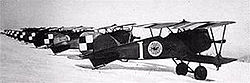 Military aviation in Poland started shortly after the country regained its independence after World War I
, in November 1918. Initially, its air force consisted of mostly German and Austrian aircraft, such as the Fokker D.VII
, Oeffag D.III and Albatros J.I
, captured from the former Central Axis Powers
. These planes were first used by the Polish Air Force in the Polish-Ukrainian War
in late 1918, during combat operations centered around the city of Lwów (now Lviv
).
When the Polish-Soviet War
broke out in February 1920, the Polish Air Force used a variety of western-made Allied
aircraft, including some from countries such as Britain, France and Italy. The most common aircraft in service at this time were the British made Bristol F2B and Italian Ansaldo Balilla fighters. The 21. Eskadra Niszczycielska (21st Destroyer Squadron) included a Gotha G.IV
on April 30, 1920.
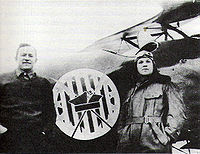 After the Polish-Soviet War ended, most of the old World War I aircraft were gradually withdrawn and the air force was equipped with new French aircraft. From 1924 to 1930 the primary fighter of the Polish Air Force was the SPAD 61 and its main bombers were the French produced Potez 15
and the Potez 25
, which was eventually manufactured in Poland under license from Aéroplanes Henry Potez.
The first Polish-designed and mass-produced aircraft to serve in the country's air force was a high wing fighter, the PWS-10
, first manufactured in 1930 by the Podlasie Aircraft Factory.
 In 1933, Zygmunt Pulawski's first high wing, all-metal aircraft, the PZL P.7
a, was designed and produced, with 150 entering service. The design was followed by 30 improved PZL P.11
a aircraft and a final design, the PZL P.11
c, was delivered in 1935 and was a respectable fighter for its time; 175 entered service and it remained the only Polish fighter until 1939, by which time foreign aircraft design had overtaken it. Its final version, the PZL P.24
, was built for export only and was bought by four countries. A new fighter prototype, the PZL.50 Jastrząb (Hawk), similar to the Seversky P-35
in layout, was curtailed by the Nazi invasion and two twin-engine heavy fighters, the PZL.38 Wilk
and the PZL.48 Lampart
, remained prototypes.
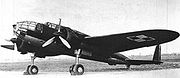 As far as bombers are concerned, the Potez 25 and Breguet 19
were replaced by an all-metal monoplane, the PZL.23 Karaś
, with 250 built from 1936 onwards, but by 1939 the Karas was outdated. In 1938 the Polish factory PZL designed a modern twin-engine medium bomber, the PZL.37 Łoś (Elk), arguably the best bomber in the world when it entered service that year. The Łoś had a bomb payload of 2580 kg and a top speed of 439 km/h. Unfortunately, only about 30 Łoś A bombers (single tailfin) and 70 Łoś B (twin tailfin) bombers had been delivered before the Nazi invasion.
As an observation and close reconnaissance plane, Polish escadres
used the slow and easily damaged Lublin R-XIII
, and later the RWD-14 Czapla
. Polish naval aviation used the Lublin R-XIII on floats. Just before the war, some Italian torpedo planes, the CANT Z.506
, were ordered, but only one was delivered, and it was without armament. The principal aircraft used to train pilots were the Polish-built high-wing RWD-8 and the PWS-26
biplane. In 1939, Poland ordered 160 MS-406s and 10 Hawker Hurricane
fighters from abroad, but they were not delivered before the outbreak of war.
On 1 September 1939, at the beginning of the Invasion of Poland
, all the Polish combat aircraft had been deployed to the field, contrary to a commonly-held belief, based on German propaganda, that they had all been destroyed by bombing at their air bases. The aircraft destroyed by German bombers on the airfields were mostly trainer planes. The fighter planes were grouped into 15 escadres (five of them constituted the Pursuit Brigade
, deployed in the Warsaw
area). Despite being obsolete, Polish PZL-11 fighters shot down over 170 German planes. The bombers, grouped in nine escadres of the Bomber Brigade
, attacked armoured columns but suffered heavy losses. Seven reconnaissance and 12 observation escadres, deployed to particular armies, were used primarily for reconnaissance. Most of the Polish Air Force was destroyed in the campaign; the surviving aircraft were captured or withdrawn to Romania, where, subsequently, the Romanians employed these aircraft for their own use. A great number of pilots and aircrew managed to escape to France and then to Britain, where they played a significant part in the defence of the United Kingdom against Nazi invasion, during the Battle of Britain
.
light fighters. It was the only unit operating the C.714 at the time. The Polish pilots were also deployed to various French squadrons, flying on all types of French fighters, but mostly on the MS-406. After the surrender of France, many of these pilots managed to escape to Britain to continue the fight against the Luftwaffe.
Following the fall of France in 1940, Polish units were formed in the United Kingdom, as a part of the Royal Air Force
and known as the Polish Air Force (PAF). Four Polish squadrons were formed: 300 Squadron and 301 Squadron
flew bombers, 302 Squadron
and 303 Squadron flew Hawker Hurricane
fighters. The two Polish fighter squadrons first saw action in the third phase of the Battle of Britain
in August 1940, with much success; the pilots were battle-hardened and Polish flying skills had been well learned from the Invasion of Poland
. The pilots were regarded as fearless, sometimes bordering on reckless. Nevertheless, success rates were very high in comparison to UK and Empire pilots. 303 Squadron became the most efficient RAF fighter squadron at that time. Many Polish pilots also flew individually in other RAF squadrons.
As World War II
progressed, further Polish squadrons were created in the United Kingdom: No. 304 Polish Bomber Squadron
(bomber, then Coastal Command), 305 Squadron (bomber), 306 Squadron (fighter), 307 Squadron (night fighter), 308 Squadron (fighter), 309 Squadron (reconnaissance, then fighter), 315 Squadron (fighter), 316 Squadron (fighter), 317 Squadron (fighter), 318 Squadron (fighter-reconnaissance), 663 Squadron (air observation/artillery spotting) and the Polish Fighting Team
also known as the "Skalski Circus", attached to 145 Squadron RAF
. The fighter squadrons initially flew Hurricanes, then switched to Spitfires
, and eventually to P-51 Mustang
s. 307 Squadron, like other night fighter
squadrons (such as 410 Squadron
Royal Canadian Air Force), flew Boulton-Paul Defiants, Bristol Beaufighter
s and finally de Havilland Mosquito
es. The bomber squadrons were initially equipped with Fairey Battle
s and Vickers Wellington
s. 300 Squadron was later assigned Avro Lancaster
s, 301 Squadron Handley Page Halifax
es and Consolidated Liberators
and 305 Squadron, de Havilland Mosquito
es and North American Mitchells
. 663 Squadron (air observation/artillery spotting) flew Auster
AOP IIIs and Vs. After the war, all equipment was returned to the British, but only some of the pilots and crews actually returned to Poland, many settling in the United Kingdom.
Along with the Polish People's Army (Ludowe Wojsko Polskie) in the USSR, the Ludowe Lotnictwo Polskie – Polish People's Air Force – was created, in defence of the Soviet Union against Nazi invasion. In late 1943, the 1st Fighter Regiment "Warszawa", (equipped with Yak-1 and Yak-9 aircraft), the 2nd Night Bomber Regiment "Krakow" (flying Polikarpov Po-2
aircraft – produced in Poland as the CSS-13 from 1949 onwards), and the 3rd Assault Regiment (flying Ilyushin Il-2
aircraft) were formed. During 1944–5, further regiments were created, coming together to form the 1st Mixed Air Corps, consisting of a bomber division, an assault division, a fighter division and a mixed division. After the war, these returned to Poland and gave birth to the air force of the People's Republic of Poland
.
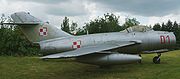 In 1949, the Li-2sb transport aircraft was adapted into a bomber and in 1950, Poland received Petlyakov Pe-2
and Tupolev Tu-2
bombers from the Soviet Union along with USB-1 and USB-2 training bombers. In 1950 also, the Yak-17 fighter came into service, as did the Ilyushin Il-12
transport and the Yak-18 trainer. From 1951 onwards, the Polish Air Force was equipped with Yak-23 jet fighters and MiG-15 jets, along with a training version, the MiG-15 UTI, and later, in 1961, the MiG-17.
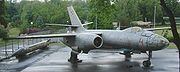
As well as Soviet-produced aircraft, from 1952 onwards Soviet MiG-15 and later MiG-17 fighters were produced under licence in Poland as the Lim-1, Lim-2 and later the Lim-5. A domestic ground attack variant of the Lim-5M was developed as the Lim-6bis in 1964. The only jet bomber used by the Polish Air Force during this period was the Ilyushin Il-28
, from 1952 onwards. Poland used only a small number of MiG-19s from 1959, in favour of the MiG-21 from 1963 onwards, which became its main supersonic fighter. This aircraft was used in numerous variants from MiG-21F-13, through MiG-21PF and MF to MiG-21bis. Later, the Polish Air Force received 37 MiG-23s (1979) and 12 MiG-29s (1989).
The main fighter-bomber and ground attack aircraft after 1949 was the Il-10
(a training version, the UIl-10
, entering service in 1951). From 1965 onwards, Poland also used a substantial number of Su-7Bs
for bombing and ground attack, replaced with 27 Sukhoi Su-20s in 1974 and 110 Sukhoi Su-22s in 1984.
 Propeller-driven training aircraft, the Junak-2
(in service since 1952), the TS-9 Junak-3
(in service since 1954) and the PZL TS-8 Bies
(since 1958) were later replaced by a jet trainer, the domestically built TS-11 Iskra. Another Polish jet trainer, the PZL I-22 Iryda
, was used for some time but, because of continuing problems, all machines were returned to PZL
for modification and did not resume service. The Yak-12 was used as a multirole aircraft from 1951, the An-2 from 1955 and subsequently the Wilga-35 P
.
Transport aircraft used by the Polish Air Force during this period included: the Il-14
(first in service in 1955), the Il-18
(first in service in 1961), the An-12B (first in service in 1966), the An-26 (first in service in 1972), the Yak-40 (first in service in 1973) and the Tupolev Tu-154
. A number of helicopters were used by the Polish Army: the SM-1
(a Mil Mi-1
manufactured under licence), which was a multirole helicopter, in operation since 1956; the Mil Mi-4
, multirole, since 1958; the PLZ SM-2, multirole, since 1960; the Mil Mi-2
and Mil Mi-8
(later also Mil Mi-17
), multirole, since 1968 and the Mil Mi-24
, a combat helicopter, since 1976. Also the Mil Mi-14
, an amphibious helicopter, and the Mil Mi-6
, both used as transports.
In 1954, the Polish Air Force was merged with the Air Defence Force, creating the Air and Country Air Defence Forces (Wojska Lotnicze i Obrony Przeciwlotniczej Obszaru Kraju – WLiOPL OK), a military organisation composed of both flying and anti-aircraft units. In 1962, the WLiOPL OK were separated back again into their two original component bodies: the Air Force (Wojska Lotnicze) and the Country Air Defence Force (Wojska Obrony Powietrznej Kraju).
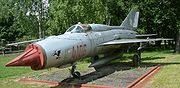 After political upheaval and the collapse of the Soviet Union in 1991, and a consequent reduction in the state of military anxiety in the whole of Europe, the Polish Air Force was reduced. On July 1, 1990, the Polish Air Force and the Air Defence Force were merged again (Wojska Lotnicze i Obrony Powietrznej – WLiOP or WLOP). The attack capability of this force consisted primarily of MiG-21s, MiG-23s, MiG-29s, Su-20s and Su-22s. The remaining Lim-6bis were withdrawn in the early 1990s, followed soon afterwards by the withdrawal of the remaining Su-20 aircraft. The small number of remaining MiG-23s were withdrawn by 1999. Throughout the 1990s, Poland had not purchased any new combat aircraft and only managed to acquire further MiG-29s from the Czech Republic in 1995 and from Germany in 2004. MiG-21s were finally withdrawn from service in 2003. In 2004, the only remaining combat aircraft flown by the WLiOP were the MiG-29 and the Su-22. As of 2010, the fleet of Su-22s is in need of modernization to retain any value as a combat aircraft and its future is unclear.
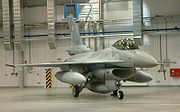
In 2002, the F-16C/D
Block 52+ from the American company Lockheed Martin was chosen as a new multirole fighter for the WLiOP, the first deliveries taking place in November 2006 and continued until 2008 under Peace Sky program. As of 2011 the Polish Air Force have three squadrons of F-16s: two stationed at the 31st Tactical Air Base
near Poznań
and the 10th Tactical Squadron
at the 32nd Air Base
near Łask, which will be fully operational by 2012. The acquisition of the US F-16 was not without fierce competition from European aerospace companies; the sale was hotly pursued by the French company Dassault, with their Mirage 2000 and by the Swedish company Saab, with the JAS 39 Gripen
. The Polish Block 52+ F-16s are equipped with the latest Pratt and Whitney F-100-229 afterburning turbofan engines, and the avionics suite will include the APG-68(V)9 terrain mapping radar system and the ALQ-211(V)4 electronic warfare suite. All Polish F-16s will be fully equipped to carry the latest in US precision ordinance, ranging from the JDAM/JSOW to the latest in export-certificate-authorized air-to-air weaponry (including the AIM-120C-5 and AIM-9X).
As the aftermath of the presidential Tu-154 crash
in 2010 and later polish investigation the 36th Special Aviation Regiment
, responsible for transporting the President and the Polish Government, was disbanded, all officials flights will be carried by two LOT Polish Airlines
Embraer E-175. New unit will be created to operate remaining helicopters.

Aerial warfare
Aerial warfare is the use of military aircraft and other flying machines in warfare, including military airlift of cargo to further the national interests as was demonstrated in the Berlin Airlift...
wing of the Polish Armed Forces
Polish Armed Forces
Siły Zbrojne Rzeczypospolitej Polskiej are the national defense forces of Poland...
. Until July 2004 it was officially known as Wojska Lotnicze i Obrony Powietrznej (literally: Air-and-Air Defence Forces). In 2010 it consisted of roughly 16,000 military personnel and about 320 aircraft, distributed among 12 bases throughout Poland
Poland
Poland , officially the Republic of Poland , is a country in Central Europe bordered by Germany to the west; the Czech Republic and Slovakia to the south; Ukraine, Belarus and Lithuania to the east; and the Baltic Sea and Kaliningrad Oblast, a Russian exclave, to the north...
. The Polish Air Force is currently one of the most advanced in Eastern Europe, equipped with 48 F-16 jet fighter aircraft (2008) designed by Lockheed Martin
Lockheed Martin
Lockheed Martin is an American global aerospace, defense, security, and advanced technology company with worldwide interests. It was formed by the merger of Lockheed Corporation with Martin Marietta in March 1995. It is headquartered in Bethesda, Maryland, in the Washington Metropolitan Area....
specifically for Poland, including F-16 D block 52+
F-16 Fighting Falcon variants
A large number of F-16 Fighting Falcon variants have been produced by General Dynamics, Lockheed Martin, and various licensed manufacturers. The details of the F-16 variants, along with major modification programs and derivative designs significantly influenced by the F-16, are described...
, the most advanced in NATO.
The Polish Air Force can trace its origins to the months following the end of World War I
World War I
World War I , which was predominantly called the World War or the Great War from its occurrence until 1939, and the First World War or World War I thereafter, was a major war centred in Europe that began on 28 July 1914 and lasted until 11 November 1918...
in 1918. Following the invasion of Poland by Nazi Germany in 1939, much of the Polish Air Force was destroyed, although many of its pilots were able to continue fighting throughout World War II
World War II
World War II, or the Second World War , was a global conflict lasting from 1939 to 1945, involving most of the world's nations—including all of the great powers—eventually forming two opposing military alliances: the Allies and the Axis...
in air squadrons in Britain and the Soviet Union. Since the collapse of the Soviet Union in 1991, Poland has steadily reduced its reliance upon Russian-built aircraft and by 2012 will have three squadrons of US F-16 fighter aircraft fully operational.
1918–1930
World War I
World War I , which was predominantly called the World War or the Great War from its occurrence until 1939, and the First World War or World War I thereafter, was a major war centred in Europe that began on 28 July 1914 and lasted until 11 November 1918...
, in November 1918. Initially, its air force consisted of mostly German and Austrian aircraft, such as the Fokker D.VII
Fokker D.VII
The Fokker D.VII was a German World War I fighter aircraft designed by Reinhold Platz of the Fokker-Flugzeugwerke. Germany produced around 3,300 D.VII aircraft in the summer and autumn of 1918. In service, the D.VII quickly proved itself to be a formidable aircraft...
, Oeffag D.III and Albatros J.I
Albatros J.I
|-See also:-References:* Gray, Peter and Owen Thetford. German Aircraft of the First World War. London: Putnam, 1962. ISBN 0-933852-71-1....
, captured from the former Central Axis Powers
Central Powers
The Central Powers were one of the two warring factions in World War I , composed of the German Empire, the Austro-Hungarian Empire, the Ottoman Empire, and the Kingdom of Bulgaria...
. These planes were first used by the Polish Air Force in the Polish-Ukrainian War
Polish-Ukrainian War
The Polish–Ukrainian War of 1918 and 1919 was a conflict between the forces of the Second Polish Republic and West Ukrainian People's Republic for the control over Eastern Galicia after the dissolution of Austria-Hungary.-Background:...
in late 1918, during combat operations centered around the city of Lwów (now Lviv
Lviv
Lviv is a city in western Ukraine. The city is regarded as one of the main cultural centres of today's Ukraine and historically has also been a major Polish and Jewish cultural center, as Poles and Jews were the two main ethnicities of the city until the outbreak of World War II and the following...
).
When the Polish-Soviet War
Polish-Soviet War
The Polish–Soviet War was an armed conflict between Soviet Russia and Soviet Ukraine and the Second Polish Republic and the Ukrainian People's Republic—four states in post–World War I Europe...
broke out in February 1920, the Polish Air Force used a variety of western-made Allied
Allies of World War I
The Entente Powers were the countries at war with the Central Powers during World War I. The members of the Triple Entente were the United Kingdom, France, and the Russian Empire; Italy entered the war on their side in 1915...
aircraft, including some from countries such as Britain, France and Italy. The most common aircraft in service at this time were the British made Bristol F2B and Italian Ansaldo Balilla fighters. The 21. Eskadra Niszczycielska (21st Destroyer Squadron) included a Gotha G.IV
Gotha G.IV
|-See also:...
on April 30, 1920.
Potez 15
|-See also:-References:* *...
and the Potez 25
Potez 25
|-See also:*Aerial operations in the Chaco War-References:Heinonen, Timo Heinonen: Thulinista Hornetiin, Keski-Suomen ilmailumuseon julkaisuja 3, 1992. ISBN 951-95688-2-4.-External links:* *...
, which was eventually manufactured in Poland under license from Aéroplanes Henry Potez.
The first Polish-designed and mass-produced aircraft to serve in the country's air force was a high wing fighter, the PWS-10
PWS-10
-References:*Glass, Andrzej. "Polskie konstrukcje lotnicze 1893-1939" , WKiŁ, Warsaw 1977...
, first manufactured in 1930 by the Podlasie Aircraft Factory.
1933–1938
PZL P.7
-References:NotesBibliography* Cynk, Jerzy B. History of the Polish Air Force 1918-1968. Reading, Berkshire, UK: Osprey Publishing Ltd., 1972.* Cynk, Jerzy B. Polish Aircraft, 1893-1939. London: Putnam & Company Ltd., 1971. ISBN 0-370-00085-4....
a, was designed and produced, with 150 entering service. The design was followed by 30 improved PZL P.11
PZL P.11
The PZL P.11 was a Polish fighter aircraft, designed in the early 1930s by PZL in Warsaw. It was briefly considered to be the most advanced fighter aircraft design in the world...
a aircraft and a final design, the PZL P.11
PZL P.11
The PZL P.11 was a Polish fighter aircraft, designed in the early 1930s by PZL in Warsaw. It was briefly considered to be the most advanced fighter aircraft design in the world...
c, was delivered in 1935 and was a respectable fighter for its time; 175 entered service and it remained the only Polish fighter until 1939, by which time foreign aircraft design had overtaken it. Its final version, the PZL P.24
PZL P.24
|-References:NotesCitationsBibliography* Axworthy, Mark. Third Axis, Fourth Ally. London: Arms and Armour, 1995. ISBN 1-85409-267-7.* Bernád, Dénes. Rumanian Air Force: The Prime Decade 1938-1947. Carrollton, TX: Squadron/Signal Publications Inc, 1999. ISBN 0-89747-402-3.* Cynk, Jerzy B. Polish...
, was built for export only and was bought by four countries. A new fighter prototype, the PZL.50 Jastrząb (Hawk), similar to the Seversky P-35
Seversky P-35
The Seversky P-35 was a fighter aircraft built in the United States by the Seversky Aircraft Company in the late 1930s. A contemporary of the Hawker Hurricane and Messerschmitt Bf 109, the P-35 was the first single-seat fighter in U.S...
in layout, was curtailed by the Nazi invasion and two twin-engine heavy fighters, the PZL.38 Wilk
PZL.38 Wilk
- References :* Glass, Andrzej. Polskie Konstrukcje Lotnicze 1893-1939 . Warsawa, Poland: WKiŁ, 1977....
and the PZL.48 Lampart
PZL.48 Lampart
-References:*Andrzej Glass: "Polskie konstrukcje lotnicze 1893-1939" , WKiŁ, Warsaw 1977 -See also:...
, remained prototypes.
Breguet 19
The Breguet 19 was a light bomber and reconnaissance plane, also used for long-distance flights, designed by the French Breguet company and produced from 1924.-Development:...
were replaced by an all-metal monoplane, the PZL.23 Karaś
PZL.23 Karas
|-Specifications :-See also:-References:NotesBibliography* Angelucci, Enzo and Paolo Matricardi. World War II Airplanes . Chicago: Rand McNally, 1978. ISBN 0-52888-170-1....
, with 250 built from 1936 onwards, but by 1939 the Karas was outdated. In 1938 the Polish factory PZL designed a modern twin-engine medium bomber, the PZL.37 Łoś (Elk), arguably the best bomber in the world when it entered service that year. The Łoś had a bomb payload of 2580 kg and a top speed of 439 km/h. Unfortunately, only about 30 Łoś A bombers (single tailfin) and 70 Łoś B (twin tailfin) bombers had been delivered before the Nazi invasion.
As an observation and close reconnaissance plane, Polish escadres
Squadron (aviation)
A squadron in air force, army aviation or naval aviation is mainly a unit comprising a number of military aircraft, usually of the same type, typically with 12 to 24 aircraft, sometimes divided into three or four flights, depending on aircraft type and air force...
used the slow and easily damaged Lublin R-XIII
Lublin R-XIII
The Lublin R-XIII was the Polish army-cooperation plane , designed in the early-1930s in the Plage i Laśkiewicz factory in Lublin. It was the main army cooperation plane in the Invasion of Poland...
, and later the RWD-14 Czapla
RWD-14 Czapla
|-References:*Andrzej Glass: "Polskie konstrukcje lotnicze 1893-1939" , WKiŁ, Warsaw 1977 -See also:...
. Polish naval aviation used the Lublin R-XIII on floats. Just before the war, some Italian torpedo planes, the CANT Z.506
CANT Z.506
The CANT Z.506 Airone was a triple-engine floatplane produced by CANT from 1935. It served as a transport and postal aircraft with the Italian airline "Ala Littoria"...
, were ordered, but only one was delivered, and it was without armament. The principal aircraft used to train pilots were the Polish-built high-wing RWD-8 and the PWS-26
PWS-26
-References:*Andrzej Glass: "Polskie konstrukcje lotnicze 1893-1939" , WKiŁ, Warsaw 1977 -See also:...
biplane. In 1939, Poland ordered 160 MS-406s and 10 Hawker Hurricane
Hawker Hurricane
The Hawker Hurricane is a British single-seat fighter aircraft that was designed and predominantly built by Hawker Aircraft Ltd for the Royal Air Force...
fighters from abroad, but they were not delivered before the outbreak of war.
1939
-
- See also: Polish September Campaign
On 1 September 1939, at the beginning of the Invasion of Poland
Invasion of Poland (1939)
The Invasion of Poland, also known as the September Campaign or 1939 Defensive War in Poland and the Poland Campaign in Germany, was an invasion of Poland by Germany, the Soviet Union, and a small Slovak contingent that marked the start of World War II in Europe...
, all the Polish combat aircraft had been deployed to the field, contrary to a commonly-held belief, based on German propaganda, that they had all been destroyed by bombing at their air bases. The aircraft destroyed by German bombers on the airfields were mostly trainer planes. The fighter planes were grouped into 15 escadres (five of them constituted the Pursuit Brigade
Pursuit Brigade
The Pursuit Brigade was a Polish World War II unit of the Polish Air Force. It took part in the Polish Defensive War of 1939 as the main aerial reserve of the commander in chief and was used for air cover of the Polish capital of Warsaw. It was similar in shape to the Bomber Brigade...
, deployed in the Warsaw
Warsaw
Warsaw is the capital and largest city of Poland. It is located on the Vistula River, roughly from the Baltic Sea and from the Carpathian Mountains. Its population in 2010 was estimated at 1,716,855 residents with a greater metropolitan area of 2,631,902 residents, making Warsaw the 10th most...
area). Despite being obsolete, Polish PZL-11 fighters shot down over 170 German planes. The bombers, grouped in nine escadres of the Bomber Brigade
Bomber Brigade
The Bomber Brigade was a World War II unit of the Polish Air Force commanded by płk obs. Władysław Heller. It resisted the Invasion of Poland in 1939 as the main aerial reserve of the commander in chief and was used for bombing enemy units in central Poland. It was created just before the war and...
, attacked armoured columns but suffered heavy losses. Seven reconnaissance and 12 observation escadres, deployed to particular armies, were used primarily for reconnaissance. Most of the Polish Air Force was destroyed in the campaign; the surviving aircraft were captured or withdrawn to Romania, where, subsequently, the Romanians employed these aircraft for their own use. A great number of pilots and aircrew managed to escape to France and then to Britain, where they played a significant part in the defence of the United Kingdom against Nazi invasion, during the Battle of Britain
Battle of Britain
The Battle of Britain is the name given to the World War II air campaign waged by the German Air Force against the United Kingdom during the summer and autumn of 1940...
.
| Type | Model | Total | Combat formations |
|---|---|---|---|
| Fighters | PZL P.11 PZL P.11 The PZL P.11 was a Polish fighter aircraft, designed in the early 1930s by PZL in Warsaw. It was briefly considered to be the most advanced fighter aircraft design in the world... |
175 | 140 |
| PZL P.7 PZL P.7 -References:NotesBibliography* Cynk, Jerzy B. History of the Polish Air Force 1918-1968. Reading, Berkshire, UK: Osprey Publishing Ltd., 1972.* Cynk, Jerzy B. Polish Aircraft, 1893-1939. London: Putnam & Company Ltd., 1971. ISBN 0-370-00085-4.... |
105 | 30 | |
| Light bomber Light bomber A light bomber is a relatively small and fast class of military bomber aircraft which were primarily employed before the 1950s. Such aircraft would typically not carry more than one ton of ordnance.... s/Tactical bomber Tactical bomber A tactical bomber is a bomber aircraft with an intended primary role of tactical bombing—attacking tactical targets, such as enemy's troops and military equipment. This implies that either aircraft's range or ordnance is insufficient to use it effectively as a strategic bomber.All light bombers,... s |
PZL.23A PZL.23 Karas |-Specifications :-See also:-References:NotesBibliography* Angelucci, Enzo and Paolo Matricardi. World War II Airplanes . Chicago: Rand McNally, 1978. ISBN 0-52888-170-1.... |
35 | 0 |
| PZL.23B PZL.23 Karas |-Specifications :-See also:-References:NotesBibliography* Angelucci, Enzo and Paolo Matricardi. World War II Airplanes . Chicago: Rand McNally, 1978. ISBN 0-52888-170-1.... |
170 | 120 | |
| Medium bomber Medium bomber A medium bomber is a bomber aircraft designed to operate with medium bombloads over medium distances; the name serves to distinguish them from the larger heavy bombers and smaller light bombers... s |
PZL.37 Łoś | 61 | 36 |
| PZL.30 Żubr | 15 | 0 | |
| Surveillance aircraft Surveillance aircraft A surveillance aircraft is an aircraft used for surveillance — collecting information over time. They are operated by military forces and other government agencies in roles such as intelligence gathering, battlefield surveillance, airspace surveillance, observation , border patrol and fishery... and Army cooperation planes |
Lublin R-XIII Lublin R-XIII The Lublin R-XIII was the Polish army-cooperation plane , designed in the early-1930s in the Plage i Laśkiewicz factory in Lublin. It was the main army cooperation plane in the Invasion of Poland... |
150 | 55 |
| RWD-14 Czapla RWD-14 Czapla |-References:*Andrzej Glass: "Polskie konstrukcje lotnicze 1893-1939" , WKiŁ, Warsaw 1977 -See also:... |
60 | 40 | |
| Total | 771 | 421 |
1940 (France)
After the fall of Poland, the Polish Air Force started to regroup in France. The only complete unit created before the German attack on France was the GC 1/145 fighter squadron, flying Caudron C.714Caudron C.714
-See also:-References:NotesBibliography* Belcarz, Bartłomiej. GC 1/145 in France 1940. Sandomierz, Poland/Redbourn, UK: Mushroom Model Publications, 2002. ISBN 83-917178-1-X....
light fighters. It was the only unit operating the C.714 at the time. The Polish pilots were also deployed to various French squadrons, flying on all types of French fighters, but mostly on the MS-406. After the surrender of France, many of these pilots managed to escape to Britain to continue the fight against the Luftwaffe.
1940–1947 (United Kingdom)
-
- See also: Polish Air Force in Great Britain
Following the fall of France in 1940, Polish units were formed in the United Kingdom, as a part of the Royal Air Force
Royal Air Force
The Royal Air Force is the aerial warfare service branch of the British Armed Forces. Formed on 1 April 1918, it is the oldest independent air force in the world...
and known as the Polish Air Force (PAF). Four Polish squadrons were formed: 300 Squadron and 301 Squadron
No. 301 Polish Bomber Squadron
No. 301 Polish Bomber Squadron "Land of Pomerania" was a Polish World War II bomber unit. It was fighting alongside the Royal Air Force and operated from airbases in the United Kingdom and Italy.-History:...
flew bombers, 302 Squadron
No. 302 Polish Fighter Squadron
No. 302 Polish Fighter Squadron RAF was a Polish fighter squadron formed in Great Britain as part of an agreement between the Polish Government in Exile and the United Kingdom in 1940...
and 303 Squadron flew Hawker Hurricane
Hawker Hurricane
The Hawker Hurricane is a British single-seat fighter aircraft that was designed and predominantly built by Hawker Aircraft Ltd for the Royal Air Force...
fighters. The two Polish fighter squadrons first saw action in the third phase of the Battle of Britain
Battle of Britain
The Battle of Britain is the name given to the World War II air campaign waged by the German Air Force against the United Kingdom during the summer and autumn of 1940...
in August 1940, with much success; the pilots were battle-hardened and Polish flying skills had been well learned from the Invasion of Poland
Invasion of Poland (1939)
The Invasion of Poland, also known as the September Campaign or 1939 Defensive War in Poland and the Poland Campaign in Germany, was an invasion of Poland by Germany, the Soviet Union, and a small Slovak contingent that marked the start of World War II in Europe...
. The pilots were regarded as fearless, sometimes bordering on reckless. Nevertheless, success rates were very high in comparison to UK and Empire pilots. 303 Squadron became the most efficient RAF fighter squadron at that time. Many Polish pilots also flew individually in other RAF squadrons.
As World War II
World War II
World War II, or the Second World War , was a global conflict lasting from 1939 to 1945, involving most of the world's nations—including all of the great powers—eventually forming two opposing military alliances: the Allies and the Axis...
progressed, further Polish squadrons were created in the United Kingdom: No. 304 Polish Bomber Squadron
No. 304 Polish Bomber Squadron
No. 304 Polish Bomber Squadron was a Polish World War II bomber unit. It fought alongside the Royal Air Force under their operational Command and operated from airbases in the United Kingdom, serving as a bomber unit in RAF Bomber Command, as an anti-submarine unit in RAF Coastal Command and as a...
(bomber, then Coastal Command), 305 Squadron (bomber), 306 Squadron (fighter), 307 Squadron (night fighter), 308 Squadron (fighter), 309 Squadron (reconnaissance, then fighter), 315 Squadron (fighter), 316 Squadron (fighter), 317 Squadron (fighter), 318 Squadron (fighter-reconnaissance), 663 Squadron (air observation/artillery spotting) and the Polish Fighting Team
Polish Fighting Team
The Polish Fighting Team , also known as "Skalski's Circus" , was a Polish unit which fought with the British Commonwealth Desert Air Force in the North African Campaign of World War II, during 1943...
also known as the "Skalski Circus", attached to 145 Squadron RAF
No. 145 Squadron RAF
No. 145 Squadron was a Royal Air Force squadron that operated during World War I, World War II and the Cold War. Its motto was Diu noctuque pugnamus .-History:...
. The fighter squadrons initially flew Hurricanes, then switched to Spitfires
Supermarine Spitfire
The Supermarine Spitfire is a British single-seat fighter aircraft that was used by the Royal Air Force and many other Allied countries throughout the Second World War. The Spitfire continued to be used as a front line fighter and in secondary roles into the 1950s...
, and eventually to P-51 Mustang
P-51 Mustang
The North American Aviation P-51 Mustang was an American long-range, single-seat fighter and fighter-bomber used during World War II, the Korean War and in several other conflicts...
s. 307 Squadron, like other night fighter
Night fighter
A night fighter is a fighter aircraft adapted for use at night or in other times of bad visibility...
squadrons (such as 410 Squadron
No. 410 Squadron RCAF
410 Tactical Fighter Operational Training Squadron, nicknamed the "Cougars", is a Royal Canadian Air Force aircraft squadron currently located at Canada's primary training base for the CF-18 , at Cold Lake, Alberta...
Royal Canadian Air Force), flew Boulton-Paul Defiants, Bristol Beaufighter
Bristol Beaufighter
The Bristol Type 156 Beaufighter, often referred to as simply the Beau, was a British long-range heavy fighter modification of the Bristol Aeroplane Company's earlier Beaufort torpedo bomber design...
s and finally de Havilland Mosquito
De Havilland Mosquito
The de Havilland DH.98 Mosquito was a British multi-role combat aircraft that served during the Second World War and the postwar era. It was known affectionately as the "Mossie" to its crews and was also nicknamed "The Wooden Wonder"...
es. The bomber squadrons were initially equipped with Fairey Battle
Fairey Battle
The Fairey Battle was a British single-engine light bomber built by the Fairey Aviation Company in the late 1930s for the Royal Air Force. The Battle was powered by the same Rolls-Royce Merlin piston engine that gave contemporary British fighters high performance; however, the Battle was weighed...
s and Vickers Wellington
Vickers Wellington
The Vickers Wellington was a British twin-engine, long range medium bomber designed in the mid-1930s at Brooklands in Weybridge, Surrey, by Vickers-Armstrongs' Chief Designer, R. K. Pierson. It was widely used as a night bomber in the early years of the Second World War, before being displaced as a...
s. 300 Squadron was later assigned Avro Lancaster
Avro Lancaster
The Avro Lancaster is a British four-engined Second World War heavy bomber made initially by Avro for the Royal Air Force . It first saw active service in 1942, and together with the Handley Page Halifax it was one of the main heavy bombers of the RAF, the RCAF, and squadrons from other...
s, 301 Squadron Handley Page Halifax
Handley Page Halifax
The Handley Page Halifax was one of the British front-line, four-engined heavy bombers of the Royal Air Force during the Second World War. A contemporary of the famous Avro Lancaster, the Halifax remained in service until the end of the war, performing a variety of duties in addition to bombing...
es and Consolidated Liberators
B-24 Liberator
The Consolidated B-24 Liberator was an American heavy bomber, designed by Consolidated Aircraft of San Diego, California. It was known within the company as the Model 32, and a small number of early models were sold under the name LB-30, for Land Bomber...
and 305 Squadron, de Havilland Mosquito
De Havilland Mosquito
The de Havilland DH.98 Mosquito was a British multi-role combat aircraft that served during the Second World War and the postwar era. It was known affectionately as the "Mossie" to its crews and was also nicknamed "The Wooden Wonder"...
es and North American Mitchells
B-25 Mitchell
The North American B-25 Mitchell was an American twin-engined medium bomber manufactured by North American Aviation. It was used by many Allied air forces, in every theater of World War II, as well as many other air forces after the war ended, and saw service across four decades.The B-25 was named...
. 663 Squadron (air observation/artillery spotting) flew Auster
Taylorcraft Auster
The Taylorcraft Auster was a British military liaison and observation aircraft produced by the Taylorcraft Aeroplanes Limited company during the Second World War.-Design and development:...
AOP IIIs and Vs. After the war, all equipment was returned to the British, but only some of the pilots and crews actually returned to Poland, many settling in the United Kingdom.
1943–1945 (Russia)
-
- See also: Air Force of the Polish ArmyAir Force of the Polish ArmyThe Air Force of the Polish Army , unofficially known as the People's Polish Air Force was the name of the Soviet-controlled Polish Air Force in the USSR between 1943 and 1947 created alongside the Polish People's Army , a subordinate to the Red Army...
- See also: Air Force of the Polish Army
Along with the Polish People's Army (Ludowe Wojsko Polskie) in the USSR, the Ludowe Lotnictwo Polskie – Polish People's Air Force – was created, in defence of the Soviet Union against Nazi invasion. In late 1943, the 1st Fighter Regiment "Warszawa", (equipped with Yak-1 and Yak-9 aircraft), the 2nd Night Bomber Regiment "Krakow" (flying Polikarpov Po-2
Polikarpov Po-2
The Polikarpov Po-2 served as a general-purpose Soviet biplane, nicknamed Kukuruznik for maize; thus, 'maize duster' or 'crop duster'), NATO reporting name "Mule"...
aircraft – produced in Poland as the CSS-13 from 1949 onwards), and the 3rd Assault Regiment (flying Ilyushin Il-2
Ilyushin Il-2
The Ilyushin Il-2 was a ground-attack aircraft in the Second World War, produced by the Soviet Union in very large numbers...
aircraft) were formed. During 1944–5, further regiments were created, coming together to form the 1st Mixed Air Corps, consisting of a bomber division, an assault division, a fighter division and a mixed division. After the war, these returned to Poland and gave birth to the air force of the People's Republic of Poland
People's Republic of Poland
The People's Republic of Poland was the official name of Poland from 1952 to 1990. Although the Soviet Union took control of the country immediately after the liberation from Nazi Germany in 1944, the name of the state was not changed until eight years later...
.
1949–1989
Petlyakov Pe-2
The Petlyakov Pe-2 was a Soviet dive bomber aircraft used during World War II. It was regarded as one of the best ground attack aircraft of the war and it was extremely successful in the roles of heavy fighter, reconnaissance and night fighter...
and Tupolev Tu-2
Tupolev Tu-2
|-See also:-References:NotesBibliography* Bishop, Chris. The Encyclopedia of Weapons of WWII: The Comprehensive Guide to Over 1,500 Weapons Systems, Including Tanks, Small Arms, Warplanes, Artillery, Ships, and Submarines. New York: Sterling, 2002. ISBN 1-58663-762-2.* Ethell, Jeffrey L. Aircraft...
bombers from the Soviet Union along with USB-1 and USB-2 training bombers. In 1950 also, the Yak-17 fighter came into service, as did the Ilyushin Il-12
Ilyushin Il-12
The Ilyushin Il-12 was a Soviet twin-engine cargo aircraft, developed in the mid-1940s for small and medium-haul airline routes and as a military transport.-Design and development:...
transport and the Yak-18 trainer. From 1951 onwards, the Polish Air Force was equipped with Yak-23 jet fighters and MiG-15 jets, along with a training version, the MiG-15 UTI, and later, in 1961, the MiG-17.
As well as Soviet-produced aircraft, from 1952 onwards Soviet MiG-15 and later MiG-17 fighters were produced under licence in Poland as the Lim-1, Lim-2 and later the Lim-5. A domestic ground attack variant of the Lim-5M was developed as the Lim-6bis in 1964. The only jet bomber used by the Polish Air Force during this period was the Ilyushin Il-28
Ilyushin Il-28
The Ilyushin Il-28 is a jet bomber aircraft of the immediate postwar period that was originally manufactured for the Soviet Air Force. It was the USSR's first such aircraft to enter large-scale production. It was also licence-built in China as the Harbin H-5. Total production in the USSR was 6,316...
, from 1952 onwards. Poland used only a small number of MiG-19s from 1959, in favour of the MiG-21 from 1963 onwards, which became its main supersonic fighter. This aircraft was used in numerous variants from MiG-21F-13, through MiG-21PF and MF to MiG-21bis. Later, the Polish Air Force received 37 MiG-23s (1979) and 12 MiG-29s (1989).
The main fighter-bomber and ground attack aircraft after 1949 was the Il-10
Ilyushin Il-10
Ilyushin Il-10 was a Soviet ground attack aircraft developed at the end of World War II by the Ilyushin construction bureau...
(a training version, the UIl-10
Ilyushin Il-10
Ilyushin Il-10 was a Soviet ground attack aircraft developed at the end of World War II by the Ilyushin construction bureau...
, entering service in 1951). From 1965 onwards, Poland also used a substantial number of Su-7Bs
Sukhoi Su-7
The Sukhoi Su-7 was a swept wing, supersonic fighter aircraft developed by the Soviet Union in 1955. Originally, it was designed as tactical, low-level dogfighter, but was not successful in this role. On the other hand, soon-introduced Su-7B series became the main Soviet fighter-bomber and...
for bombing and ground attack, replaced with 27 Sukhoi Su-20s in 1974 and 110 Sukhoi Su-22s in 1984.
LWD Junak
|-See also:-References:*Kempski, Benedykt. Samolot szkolno-treningowy Junak, TBiU #110, Wydawnictwo MON, Warsaw 1986, ISBN 83-11-07341-4 *Krzyżan, Marian. Samoloty w muzeach polskich, Wydawnictwo WKiŁ, Warsaw 1983, ISBN 83-206-0432...
(in service since 1952), the TS-9 Junak-3
LWD Junak
|-See also:-References:*Kempski, Benedykt. Samolot szkolno-treningowy Junak, TBiU #110, Wydawnictwo MON, Warsaw 1986, ISBN 83-11-07341-4 *Krzyżan, Marian. Samoloty w muzeach polskich, Wydawnictwo WKiŁ, Warsaw 1983, ISBN 83-206-0432...
(in service since 1954) and the PZL TS-8 Bies
PZL TS-8 Bies
The PZL TS-8 Bies is a Polish trainer aircraft, used from 1957 to 1970s by the Polish Air Force and civilian aviation.-Development:The aircraft was designed in response to a Polish Air Force requirement for a modern piston-engined trainer with a retractable tricycle landing gear to replace Junak 3...
(since 1958) were later replaced by a jet trainer, the domestically built TS-11 Iskra. Another Polish jet trainer, the PZL I-22 Iryda
PZL I-22 Iryda
-See also:...
, was used for some time but, because of continuing problems, all machines were returned to PZL
PZL
PZL was the main Polish aerospace manufacturer of the interwar period, based in Warsaw, functioning in 1928-1939...
for modification and did not resume service. The Yak-12 was used as a multirole aircraft from 1951, the An-2 from 1955 and subsequently the Wilga-35 P
PZL-104 Wilga
PZL-104 Wilga is a Polish designed and built short-takeoff-and-landing Civil Aviation utility aircraft manufactured by PZL "Warszawa-Okęcie";...
.
Transport aircraft used by the Polish Air Force during this period included: the Il-14
Il-14
IL-14 can refer to:*Ilyushin Il-14, a Soviet twin-engine aircraft*Interleukin 14, a protein important in immunology*Illinois's 14th congressional district*Illinois Route 14...
(first in service in 1955), the Il-18
IL-18
IL-18, IL 18 or IL18 may refer to:* Interleukin 18, a protein encoded in humans by the IL18 gene* Ilyushin Il-18, a Cold War–era Soviet airliner and military transport* Illinois's 18th congressional district...
(first in service in 1961), the An-12B (first in service in 1966), the An-26 (first in service in 1972), the Yak-40 (first in service in 1973) and the Tupolev Tu-154
Tupolev Tu-154
The Tupolev Tu-154 is a three-engine medium-range narrow-body airliner designed in the mid 1960s and manufactured by Tupolev. As the mainstay 'workhorse' of Soviet and Russian airlines for several decades, it serviced over a sixth of the world's landmass and carried half of all passengers flown...
. A number of helicopters were used by the Polish Army: the SM-1
SM-1
SM-1 is a 2 MWe nuclear reactor developed for The US Army Nuclear Power Program . It was located at Fort Belvoir, VA, and achieved first criticality in 1957 It was the first US nuclear power plant to be connected to an electrical grid.It was decommissioned in 1973....
(a Mil Mi-1
Mil Mi-1
The Mil Mi-1 The Mil Mi-1 The Mil Mi-1 ( (USAF/DoD reporting name "Type 32", NATO reporting name "Hare") was a Soviet three- or four-seat light utility helicopter. It was the first Soviet helicopter to enter serial production. It is powered by one 575 hp Ivchenko AI-26V radial. It entered...
manufactured under licence), which was a multirole helicopter, in operation since 1956; the Mil Mi-4
Mil Mi-4
The Mil Mi-4 was a Soviet transport helicopter that served in both military and civilian roles.-Design and development:...
, multirole, since 1958; the PLZ SM-2, multirole, since 1960; the Mil Mi-2
Mil Mi-2
The Mil Mi-2 is a small, lightly armored transport helicopter that could also provide close air support when armed with 57 mm rockets and a 23 mm cannon.-Design and development:...
and Mil Mi-8
Mil Mi-8
The Mil Mi-8 is a medium twin-turbine transport helicopter that can also act as a gunship. The Mi-8 is the world's most-produced helicopter, and is used by over 50 countries. Russia is the largest operator of the Mi-8/Mi-17 helicopter....
(later also Mil Mi-17
Mil Mi-17
The Mil Mi-17 is a Russian helicopter currently in production at two factories in Kazan and Ulan-Ude...
), multirole, since 1968 and the Mil Mi-24
Mil Mi-24
The Mil Mi-24 is a large helicopter gunship and attack helicopter and low-capacity troop transport with room for 8 passengers. It is produced by Mil Moscow Helicopter Plant and operated since 1972 by the Soviet Air Force, its successors, and by over thirty other nations.In NATO circles the export...
, a combat helicopter, since 1976. Also the Mil Mi-14
Mil Mi-14
|-See also:-External links:******...
, an amphibious helicopter, and the Mil Mi-6
Mil Mi-6
|-Facts:*Test pilot N.B. Leshin has set the world record of speed. This event was awarded by the American Helicopter Society.*Small numbers are still in service, most in Siberia plus a small number with the People's Republic of China...
, both used as transports.
In 1954, the Polish Air Force was merged with the Air Defence Force, creating the Air and Country Air Defence Forces (Wojska Lotnicze i Obrony Przeciwlotniczej Obszaru Kraju – WLiOPL OK), a military organisation composed of both flying and anti-aircraft units. In 1962, the WLiOPL OK were separated back again into their two original component bodies: the Air Force (Wojska Lotnicze) and the Country Air Defence Force (Wojska Obrony Powietrznej Kraju).
Since 1990
In 2002, the F-16C/D
F-16 Fighting Falcon
The General Dynamics F-16 Fighting Falcon is a multirole jet fighter aircraft originally developed by General Dynamics for the United States Air Force . Designed as an air superiority day fighter, it evolved into a successful all-weather multirole aircraft. Over 4,400 aircraft have been built since...
Block 52+ from the American company Lockheed Martin was chosen as a new multirole fighter for the WLiOP, the first deliveries taking place in November 2006 and continued until 2008 under Peace Sky program. As of 2011 the Polish Air Force have three squadrons of F-16s: two stationed at the 31st Tactical Air Base
31st Tactical Air Base
The 31st Tactical Air Base is the biggest military unit of Polish Air Force. Unit was created in 2008 as a result of fusion of three previous units: 31st Air Base, 3rd Tactical Squadron and 6th Tactical Squadron. Unit operates two squadrons of F-16 C/D fighters and two Mi-2 utility helicopters...
near Poznań
Poznan
Poznań is a city on the Warta river in west-central Poland, with a population of 556,022 in June 2009. It is among the oldest cities in Poland, and was one of the most important centres in the early Polish state, whose first rulers were buried at Poznań's cathedral. It is sometimes claimed to be...
and the 10th Tactical Squadron
10th Tactical Squadron
10th Tactical Squadron is a fighter squadron of Polish Air Force established in 2008 in Łask, Poland. Squadron is stationed in 32nd Air Base and will operate recently acquired F-16 C/D Block 52+ Adv. fighters starting from 1 October 2008....
at the 32nd Air Base
32nd Air Base
32nd Air Base is a Polish Air Force base, located in Łask, about 30 km south-west of Łódź. It is one of the two bases where Poland's F-16 fighters are stationed, the other being 31st Air Base. 9 of them were first moved there in October 2008 . The goal is to have 16 fighters, operated by...
near Łask, which will be fully operational by 2012. The acquisition of the US F-16 was not without fierce competition from European aerospace companies; the sale was hotly pursued by the French company Dassault, with their Mirage 2000 and by the Swedish company Saab, with the JAS 39 Gripen
JAS 39 Gripen
The Saab JAS 39 Gripen is a lightweight single-engine multirole fighter manufactured by the Swedish aerospace company Saab. It was designed to replace the Saab 35 Draken and 37 Viggen in the Swedish Air Force...
. The Polish Block 52+ F-16s are equipped with the latest Pratt and Whitney F-100-229 afterburning turbofan engines, and the avionics suite will include the APG-68(V)9 terrain mapping radar system and the ALQ-211(V)4 electronic warfare suite. All Polish F-16s will be fully equipped to carry the latest in US precision ordinance, ranging from the JDAM/JSOW to the latest in export-certificate-authorized air-to-air weaponry (including the AIM-120C-5 and AIM-9X).
As the aftermath of the presidential Tu-154 crash
2010 Polish Air Force Tu-154 crash
The 2010 Polish Air Force Tu-154 crash occurred on 10 April 2010, when a Tupolev Tu-154M aircraft of the Polish Air Force crashed near the city of Smolensk, Russia, killing all 96 people on board...
in 2010 and later polish investigation the 36th Special Aviation Regiment
36th Special Aviation Regiment
The 36 Specjalny Pułk Lotnictwa Transportowego 36 SPLT is a special aviation regiment of the Siły Powietrzne Rzeczypospolitej Polskiej, established in 1945. All of its aircraft are for national public use, the most important being transport of Polish politicians and MON highest officials &...
, responsible for transporting the President and the Polish Government, was disbanded, all officials flights will be carried by two LOT Polish Airlines
LOT Polish Airlines
Polskie Linie Lotnicze LOT S.A. , trading as LOT Polish Airlines, is the flag carrier of Poland. Based in Warsaw, LOT was established in 1929, making it one of the world's oldest airlines still in operation. Using a fleet of 55 aircraft, LOT operates a complex network to 60 destinations in Europe,...
Embraer E-175. New unit will be created to operate remaining helicopters.
Aircraft
 || ||
|| ||  || || Attack Aircraft || Su-22M-4K
 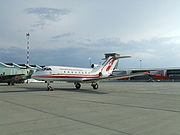 || || VIP Transport || || 4 || Two set for sale, two designated for the museums, replaced by two Embraer E-175.
 || ||
|| || 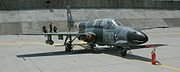 || || Trainer Aircraft || || 54 || To be replaced with 16 new lead-in fighter trainers, with delivery planned for 2015.
 || || Utility/Rescue Helicopter || Mi-8T/Mi-8P/Mi-8RL || 10 ||
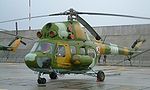 || || Light Transport Helicopter || Mi-2/Mi-2RL || 54 ||
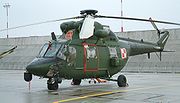 || || Utility/Rescue/VIP Helicopter || W-3T/W-3RL/W-3R/W-3S || 19 ||
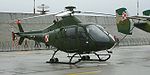 || || Light Transport/trainer Helicopter || || 24||
 Warszawa ||


| NATO Code | OF-9 | OF-8 | OF-7 | OF-6 | OF-5 | OF-4 | OF-3 | OF-2 | OF-1 | |
|---|---|---|---|---|---|---|---|---|---|---|
 Air Forces |
 |
 |
 |
 |
||||||
| Generał General A general officer is an officer of high military rank, usually in the army, and in some nations, the air force. The term is widely used by many nations of the world, and when a country uses a different term, there is an equivalent title given.... |
Generał broni Lieutenant General Lieutenant General is a military rank used in many countries. The rank traces its origins to the Middle Ages where the title of Lieutenant General was held by the second in command on the battlefield, who was normally subordinate to a Captain General.... |
Generał dywizji Major General Major general or major-general is a military rank used in many countries. It is derived from the older rank of sergeant major general. A major general is a high-ranking officer, normally subordinate to the rank of lieutenant general and senior to the ranks of brigadier and brigadier general... |
Generał brygady Brigadier Brigadier is a senior military rank, the meaning of which is somewhat different in different military services. The brigadier rank is generally superior to the rank of colonel, and subordinate to major general.... |
Pułkownik Colonel Colonel , abbreviated Col or COL, is a military rank of a senior commissioned officer. It or a corresponding rank exists in most armies and in many air forces; the naval equivalent rank is generally "Captain". It is also used in some police forces and other paramilitary rank structures... |
Podpułkownik Lieutenant colonel Lieutenant colonel is a rank of commissioned officer in the armies and most marine forces and some air forces of the world, typically ranking above a major and below a colonel. The rank of lieutenant colonel is often shortened to simply "colonel" in conversation and in unofficial correspondence... |
Major Major Major is a rank of commissioned officer, with corresponding ranks existing in almost every military in the world.When used unhyphenated, in conjunction with no other indicator of rank, the term refers to the rank just senior to that of an Army captain and just below the rank of lieutenant colonel. ... |
Kapitan | Porucznik First Lieutenant First lieutenant is a military rank and, in some forces, an appointment.The rank of lieutenant has different meanings in different military formations , but the majority of cases it is common for it to be sub-divided into a senior and junior rank... |
Podporucznik Second Lieutenant Second lieutenant is a junior commissioned officer military rank in many armed forces.- United Kingdom and Commonwealth :The rank second lieutenant was introduced throughout the British Army in 1871 to replace the rank of ensign , although it had long been used in the Royal Artillery, Royal... |
|
| Abbreviation | gen. | gen. broni | gen. dyw. | gen. bryg. | płk | ppłk | mjr | kpt. | por. | ppor. |
Staff Non-commissioned officers
| NATO Code | OR-8 | OR-7 | ||
|---|---|---|---|---|
| Air Forces |
||||
| Starszy Chorąży Sztabowy |
Starszy Chorąży |
Chorąży | Młodszy Chorąży |
|
| Abbreviation | st. chor. sztab. | st. chor. | chor. | mł. chor. |
Non-commissioned officers and privates
| NATO Code | OR-6 | OR-5 | OR-4 | OR-3 | OR-2 | OR-1 | |
|---|---|---|---|---|---|---|---|
| Air Forces |
|||||||
| Starszy Sierżant Sergeant Sergeant is a rank used in some form by most militaries, police forces, and other uniformed organizations around the world. Its origins are the Latin serviens, "one who serves", through the French term Sergent.... |
Sierżant Sergeant Sergeant is a rank used in some form by most militaries, police forces, and other uniformed organizations around the world. Its origins are the Latin serviens, "one who serves", through the French term Sergent.... |
Plutonowy Lance Sergeant A lance sergeant in the armies of the Commonwealth was a corporal acting in the rank of sergeant. The appointment is retained now only in the Foot Guards and Honourable Artillery Company... |
Starszy Kapral Corporal Corporal is a rank in use in some form by most militaries and by some police forces or other uniformed organizations. It is usually equivalent to NATO Rank Code OR-4.... |
Kapral Corporal Corporal is a rank in use in some form by most militaries and by some police forces or other uniformed organizations. It is usually equivalent to NATO Rank Code OR-4.... |
Starszy Szeregowy Private (rank) A Private is a soldier of the lowest military rank .In modern military parlance, 'Private' is shortened to 'Pte' in the United Kingdom and other Commonwealth countries and to 'Pvt.' in the United States.Notably both Sir Fitzroy MacLean and Enoch Powell are examples of, rare, rapid career... |
Szeregowy Private (rank) A Private is a soldier of the lowest military rank .In modern military parlance, 'Private' is shortened to 'Pte' in the United Kingdom and other Commonwealth countries and to 'Pvt.' in the United States.Notably both Sir Fitzroy MacLean and Enoch Powell are examples of, rare, rapid career... |
|
| Abbreviation | st. sierż. | sierż. | plut. | st. kpr. | kpr. | st. szer. | szer. |
Polish Air Force Tu-154 crash, 2010
On 10 April 2010 a Polish Air Force Tupolev Tu-154M aircraft crashed near Smolensk, Russia, killing all 96 passengers and crew, including the President of Poland Lech Kaczyński and his wife Maria Kaczyńska, the Chief of the General Staff of the Polish Army Franciszek Gągor, Polish Air Force commanding general Andrzej Błasik, the President of the Polish Central Bank, Sławomir Skrzypek, the Deputy Minister of Foreign Affairs, government officers, vice-speakers and members of parliament, senior military officers and senior members of clergy. They were en route from Warsaw to attend an event to mark the 70th anniversary of the Katyn massacre, whose site is commemorated approximately 19 km west of Smolensk.See also
- Stanisław Targosz, former commander-in-chief of the Polish Air Force
- Team IskryTeam IskryBialo-Czerwone Iskry is an aerobatic demonstration team of the Polish Air Forces. Originally formed in 1969 at the 60 Training Wing in Radom under the name Rombik, the team flew four TS-11 Iskras. The team grew to nine pilots between 1993 and 1998 and was rebased to the 1 Air Training Centre in...
- Orlik Team
- List of aircraft of Poland, World War II
Further reading
- Air Forces MonthlyAir Forces MonthlyAir Forces Monthly is a military aviation magazine published by Key Publishing, based in Stamford, United Kingdom.Sister publications include Air International, Air Enthusiast, Airliner World, Airports International, FlyPast and Today's Pilot.-External links:*http://www.airforcesmonthly.co.uk/* via...
, May 1999 (for details of reorganisation from regiments into squadrons)
External links
- Official website of Polish Air Force
- Polish Air Force history
- Polish Air Force unit insignias, gallery of badges with annotation
The source of this article is wikipedia, the free encyclopedia. The text of this article is licensed under the GFDL.