

NKVD

Encyclopedia
The People's Commissar
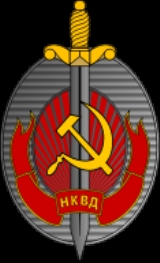
iat for Internal Affairs ( Narodnyy komissariat vnutrennikh del, NKVD) was the public and secret police
organization of the Soviet Union that directly executed the rule of power of the Soviets, including political repression
, during the era of Joseph Stalin
.
The NKVD contained the regular, public police force of the USSR (including traffic police, firefighting, border guard
s and archives) but is better known for the activities of the Gulag
and the Main Directorate for State Security (GUGB), which eventually became the Committee for State Security (KGB
). It conducted mass extrajudicial executions, ran the Gulag system of forced labor camps, suppressed underground resistance, conducted mass deportations of entire nationalities
and Kulaks to unpopulated regions of the country, guarded state borders, conducted espionage
and political assassinations abroad, was responsible for influencing foreign governments, and enforced Stalinist policy
within communist movements in other countries.
of 1917, the Provisional Government
dissolved the Tsar
's police and created People's Militsiya
. The October Revolution
established a new Bolshevik
regime, the Russian Soviet Federative Socialist Republic
(RSFSR), and the Ministry of Internal Affairs (MVD) turned into NKVD under a People's Commissar. However, the NKVD apparatus was overwhelmed by duties inherited from MVD, such as the supervision of the local governments and firefighting, and the proletarian workforce of now Workers' and Peasants' Militsiya was largely inexperienced. Realizing that it was left with no capable security force, the Council of People's Commissars of the RSFSR created a secret political police, the Cheka
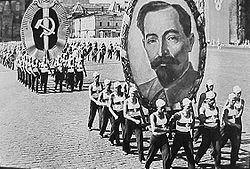
, led by Felix Dzerzhinsky. It gained the right to undertake quick non-judicial trials and executions, if that was deemed necessary in order to, "protect the revolution".
The Cheka was reorganized in 1922 as the State Political Directorate
, or GPU, of the NKVD of the RSFSR. In 1923, the USSR
was formed with the RSFSR as its largest member. The GPU became the OGPU (Joint State Political Directorate), under the Council of People's Commissars of the USSR. The NKVD of the RSFSR retained control of the militsiya, and various other responsibilities.
In 1934, the NKVD of the RSFSR was transformed into an all-union security force, the NKVD of the USSR (which the Communist Party of the Soviet Union
leaders soon became to call "the leading detachment of our party"), and the OGPU was incorporated into the NKVD as the Main Directorate for State Security (GUGB); the separate NKVD of the RSFSR was not resurrected until 1946 (as the MVD of the RSFSR). As a result, the NKVD also became responsible for all detention facilities (including the forced labor camps, known as the GULag
) as well as for the regular police. Until the reorganization begun by Nikolai Yezhov
with a purge of the regional political police in the autumn of 1936 and formalized by a May 1939 directive of the All-Union NKVD by which all appointments to the local political police were controlled from the center, there was frequent tension between centralized control of local units and the collusion of those units with local and regional party elements, frequently resulting in the thwarting of Moscow's plans.
Since its creation in 1934, the NKVD of the USSR underwent many organizational changes; between 1938 and 1939 alone, the NKVD's structure changed three times.
On February 3, 1941, the Special Sections of the NKVD responsible for military counterintelligence (CI) became part of the Army and Navy (RKKA
and RKKF
, respectively). The GUGB was separated from the NKVD and renamed the "People's Commissariat for State Security" (NKGB). After the German invasion
, the NKVD and NKGB were reunited on 20 July 1941. The CI sections were returned to the NKVD in January 1942. In April 1943, the CI sections were again transferred to the People's Commissariats (Narkomat) of Defense and the Navy, becoming SMERSH
(from Smert' Shpionam or "Death to Spies"); at the same time, the NKVD was again separated from the NKGB.
 In 1946, all Soviet Commissariats were renamed "ministries". Accordingly, the NKVD of the USSR was renamed as the Ministry of Internal Affairs (MVD), while the NKGB was renamed as the Ministry of State Security (MGB). According to a 1996 radio documentary by the Russian Service of Radio Liberty, the MGB was reduced from being a ministry to a committee because Soviet leaders feared what the MGB might do if the purges were to resume. In 1953, after the arrest of Lavrenty Beria, the MGB was merged back into the MVD. The police and security services were finally split in 1954 to become:
of the Soviet Union. This function was successfully accomplished through massive political repression
, including the use of sanctioned political murders and assassinations.
In implementing Soviet internal policy with respect to perceived enemies of the state ("enemies of the people"), untold multitudes of people were sent to GULAG camps and hundreds of thousands were executed by the NKVD. Formally, most of these people were convicted by NKVD troika
s ("triplets")– special courts martial. Evidential standards were very low: a tip-off by an anonymous informer was considered sufficient grounds for arrest. Use of "physical means of persuasion" (torture) was sanctioned by a special decree of the state, which opened the door to numerous abuses, documented in recollections of victims and members of the NKVD itself. Hundreds of mass graves
resulting from such operations were later discovered throughout the country. Documented evidence exists that the NKVD committed mass extrajudicial executions, guided by secret "plans". Those plans established the number and proportion of victims (officially "public enemies") in a given region (e.g. the quotas for clergy
, former nobles
etc., regardless of identity). The families of the repressed, including children, were also automatically repressed according to NKVD Order no. 00486.
The purges were organized in a number of waves according to the decisions of the Politburo
of the Communist Party (e.g., the campaigns among engineers ("Shakhty Case"), party and military elite ("fascist plots"), and medical staff ("Doctors' Plot
").
A number of mass operations of the NKVD
were related to the prosecution of whole ethnic categories. Whole populations of certain ethnicities were forcibly resettled
. Foreigners living in the Soviet Union were given particular attention. When disillusioned American citizens living in the Soviet Union thronged the gates of the U.S. embassy in Moscow to plead for new U.S. passports to leave USSR (Stalin had taken their original U.S. passports for 'registration' purposes years before), none were issued. Instead, the NKVD promptly arrested all of the Americans, who were taken to Lubyanka Prison and later shot. American factory workers at the Soviet Ford GAZ
plant, suspected by Stalin of being 'poisoned' by Western influences, were dragged off with the others to Lubyanka by the NKVD in the very same Ford Model A cars they had helped build, where they were tortured; nearly all were executed or died in labor camps. Many of the slain Americans were dumped in the mass grave at Yuzhnoye Butovo District near Moscow. Even so, ethnic Russians
still formed the majority of NKVD victims.
The NKVD also served as the Soviet government's arm for the lethal persecution of Judaism
, the Russian Orthodox Church
, the Greek Catholics, the Latin Catholics
, Islam
and other religious organizations, an operation headed by Yevgeny Tuchkov.
were established in nearly every major Western country, including the United States. The NKVD recruited agents for its espionage efforts from all walks of life, from unemployed intellectuals such as Mark Zborowski
to aristocrats such as Martha Dodd
. Besides the gathering of intelligence, these networks provided organizational assistance for so-called wet business, where disillusioned Communist party members or Soviet agents such as Juliet Stuart Poyntz either disappeared or were openly liquidated.
The pro Soviet leader Sheng Shicai
in Xinjiang
received NKVD assistance in conducting a purge to coincide with Stalin's Great Purge
in 1937. Sheng and the Soviets alleged a massive Trotskyist conspiracy and a "Fascist Trotskyite plot" to destroy the Soviet Union. The Soviet Consul General Garegin Apresoff, General Ma Hushan
, Ma Shaowu
, Mahmud Sijan, the official leader of the Xinjiang province Huang Han-chang and Hoja-Niyaz
were among the 435 alleged conspirators in the plot. Xinjiang became under virtual Soviet control. Stalin opposed the Chinese Communist Party.
The NKVD's intelligence
and special operations
(Inostranny Otdel) unit organized overseas assassination
s of ex-Soviet citizens, former Soviet agents, dissident Communist Party members, and/or foreigners who were regarded as enemies of the USSR by Joseph Stalin
. Among the officially confirmed victims of such plots were:
Many other prominent political dissidents were either kidnapped and forcibly returned to the Soviet Union or were found dead under highly suspicious circumstances, including Alexander Kutepov
, General Evgeny Miller, Lev Sedov, and former German Communist Party (KPD) member Willi Münzenberg
.
, NKVD agents, acting in conjunction with the Communist Party of Spain, exercised substantial control over the Republican government, using Soviet military aid to help further Soviet influence. The NKVD established numerous secret prisons around Madrid
, which were used to detain, torture, and kill hundreds of the NKVD's enemies, at first focusing on Spanish Nationalists
and Spanish Catholics
, while from late 1938 increasingly anarchists and Trotskyists
were the objects of persecution. In June, 1937 Andrés Nin
, the secretary of the anti-Stalinist
Marxist POUM
, was tortured and killed in an NKVD prison.
. In March 1940 representatives of the NKVD and the Gestapo met for one week in Zakopane
, to coordinate the pacification of Poland; see Gestapo–NKVD Conferences
. For its part, the Soviet Union delivered hundreds of German and Austrian Communists to the Gestapo, as unwanted foreigners, together with their documents. However, some NKVD units were later to fight the Wehrmacht, for example the 10th NKVD Rifle Division, which fought at the Battle of Stalingrad
.
 During World War II, NKVD units were used for rear area security, including the deterrance of desertion
. At the beginning of the war the NKVD formed 15 rifle divisions, which had expanded by 1945 to 53 divisions and 28 brigades. Though mainly intended for internal security, NKVD divisions were sometimes used in the front-lines, for example during the breakthrough in Crimea. Unlike the Waffen-SS
, the NKVD did not field any armored or mechanized units.
In liberated territory the NKVD and (later) NKGB carried out mass arrests, deportations, and executions. The targets included both collaborators with Germany and non-Communist resistance movement
s such as the Polish Armia Krajowa
. The NKVD also executed tens of thousands of Polish political prisoners
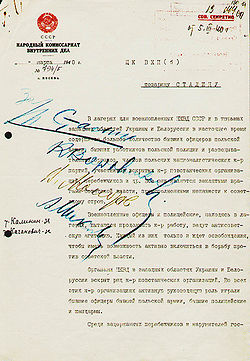
in 1939–1941, inter alia committing Katyń massacre
. NKVD units were also used to wage the prolonged partisan war in the Ukraine and the Baltics
, which lasted until the early 1950s.
halted the NKVD purges. From the 1950s to the 1980s, thousands of victims were legally "rehabilitated" (i.e., acquitted and had their rights restored). Many of the victims and their relatives refused to apply for rehabilitation out of fear or lack of documents. The rehabilitation was not complete: in most cases the formulation was "due to lack of evidence of the case of crime", a Soviet legal jargon that effectively said "there was a crime, but unfortunately we cannot prove it". Only a limited number of persons were rehabilitated with the formulation "cleared of all charges".
Very few NKVD agents were ever officially convicted of the particular violation of anyone's rights. Legally, those agents executed in the 1930s were also "purged" without legitimate criminal investigations and court decisions. In the 1990s and 2000s a small number of ex-NKVD agents living in the Baltic states
were convicted of crimes against the local population.
At present, living former agents retain generous pensions and privileges established by the USSR and later confirmed by all of the member countries of the Commonwealth of Independent States
. They have not been prosecuted in any way, although some have been identified by their victims.
made a notable contribution to the Soviet economy and the development of remote areas. Colonization of Siberia, the North and Far East was among the explicitly stated goals in the very first laws concerning Soviet labor camp
s. Mining, construction works (roads, railways, canals, dams, and factories), logging, and other functions of the labor camps were part of the Soviet planned economy
, and the NKVD had its own production plans.
The most unusual part of the NKVD's achievements was its role in Soviet science and arms development. Many scientists and engineers arrested for political crimes were placed in special prisons, much more comfortable than the Gulag, colloquially known as sharashka
s. These prisoners continued their work in these prisons. When later released, some of them became world leaders in science and technology. Among such sharashka members were Sergey Korolev, the head designer of the Soviet rocket program and first human space flight mission in 1961, and Andrei Tupolev
, the famous airplane designer. Aleksandr Solzhenitsyn
was also imprisoned in a sharashka, and based his novel The First Circle
on his experiences there.
After World War II, the NKVD coordinated work on Soviet nuclear weaponry, under the direction of General Pavel Sudoplatov
. The scientists were not prisoners, but the project was supervised by the NKVD because of its great importance and the corresponding requirement for absolute security and secrecy. Also, the project used information obtained by the NKVD from the United States.
The number of victims is estimated at about 22,000, the most commonly cited number being 21,768. The victims were shot in the Katyn Forest in Russia, the Kalinin and Kharkov prisons and elsewhere. About 8,000 were officers taken prisoner during the 1939 Soviet invasion of Poland, the rest were Polish doctors, professors, lawmakers, police officers and other public servants arrested being "intelligence agents, gendarmes, landowners, saboteurs, factory owners, lawyers, officials and priests." Since Poland's conscription system required unexempted university graduates to enlist as a reserve officer, the NKVD was able to round up much of the Polish intelligentsia, as well as Russian, Ukrainian, Protestant, Muslim Tatar, Jewish, Georgian, and Belarusian intelligentsia of Polish citizenship.
Council of the People's Commissars
The Council of People's Commissars , was a government institution formed shortly after the October Revolution in 1917. Created in the Russian Republic the council laid foundations in restructuring the country to form the Soviet Union...
iat for Internal Affairs ( Narodnyy komissariat vnutrennikh del, NKVD) was the public and secret police
Secret police
Secret police are a police agency which operates in secrecy and beyond the law to protect the political power of an individual dictator or an authoritarian political regime....
organization of the Soviet Union that directly executed the rule of power of the Soviets, including political repression
Soviet political repressions
Throughout the history of the Soviet Union millions of people became victims of political repression, which was an instrument of the state since the October Revolution...
, during the era of Joseph Stalin
Joseph Stalin
Joseph Vissarionovich Stalin was the Premier of the Soviet Union from 6 May 1941 to 5 March 1953. He was among the Bolshevik revolutionaries who brought about the October Revolution and had held the position of first General Secretary of the Communist Party of the Soviet Union's Central Committee...
.
The NKVD contained the regular, public police force of the USSR (including traffic police, firefighting, border guard
Border guard
The border guard, frontier guard, border patrol, border police, or frontier police of a country is a national security agency that performs border control, i.e., enforces the security of the country's national borders....
s and archives) but is better known for the activities of the Gulag
Gulag
The Gulag was the government agency that administered the main Soviet forced labor camp systems. While the camps housed a wide range of convicts, from petty criminals to political prisoners, large numbers were convicted by simplified procedures, such as NKVD troikas and other instruments of...
and the Main Directorate for State Security (GUGB), which eventually became the Committee for State Security (KGB
KGB
The KGB was the commonly used acronym for the . It was the national security agency of the Soviet Union from 1954 until 1991, and was the premier internal security, intelligence, and secret police organization during that time.The State Security Agency of the Republic of Belarus currently uses the...
). It conducted mass extrajudicial executions, ran the Gulag system of forced labor camps, suppressed underground resistance, conducted mass deportations of entire nationalities
Population transfer in the Soviet Union
Population transfer in the Soviet Union may be classified into the following broad categories: deportations of "anti-Soviet" categories of population, often classified as "enemies of workers," deportations of entire nationalities, labor force transfer, and organized migrations in opposite...
and Kulaks to unpopulated regions of the country, guarded state borders, conducted espionage
Espionage
Espionage or spying involves an individual obtaining information that is considered secret or confidential without the permission of the holder of the information. Espionage is inherently clandestine, lest the legitimate holder of the information change plans or take other countermeasures once it...
and political assassinations abroad, was responsible for influencing foreign governments, and enforced Stalinist policy
Stalinism
Stalinism refers to the ideology that Joseph Stalin conceived and implemented in the Soviet Union, and is generally considered a branch of Marxist–Leninist ideology but considered by some historians to be a significant deviation from this philosophy...
within communist movements in other countries.
History and structure
After the October RevolutionOctober Revolution
The October Revolution , also known as the Great October Socialist Revolution , Red October, the October Uprising or the Bolshevik Revolution, was a political revolution and a part of the Russian Revolution of 1917...
of 1917, the Provisional Government
Provisional government
A provisional government is an emergency or interim government set up when a political void has been created by the collapse of a very large government. The early provisional governments were created to prepare for the return of royal rule...
dissolved the Tsar
Tsar
Tsar is a title used to designate certain European Slavic monarchs or supreme rulers. As a system of government in the Tsardom of Russia and Russian Empire, it is known as Tsarist autocracy, or Tsarism...
's police and created People's Militsiya
Militsiya
Militsiya or militia is used as an official name of the civilian police in several former communist states, despite its original military connotation...
. The October Revolution
October Revolution
The October Revolution , also known as the Great October Socialist Revolution , Red October, the October Uprising or the Bolshevik Revolution, was a political revolution and a part of the Russian Revolution of 1917...
established a new Bolshevik
Bolshevik
The Bolsheviks, originally also Bolshevists , derived from bol'shinstvo, "majority") were a faction of the Marxist Russian Social Democratic Labour Party which split apart from the Menshevik faction at the Second Party Congress in 1903....
regime, the Russian Soviet Federative Socialist Republic
Russian Soviet Federative Socialist Republic
The Russian Soviet Federative Socialist Republic , commonly referred to as Soviet Russia, Bolshevik Russia, or simply Russia, was the largest, most populous and economically developed republic in the former Soviet Union....
(RSFSR), and the Ministry of Internal Affairs (MVD) turned into NKVD under a People's Commissar. However, the NKVD apparatus was overwhelmed by duties inherited from MVD, such as the supervision of the local governments and firefighting, and the proletarian workforce of now Workers' and Peasants' Militsiya was largely inexperienced. Realizing that it was left with no capable security force, the Council of People's Commissars of the RSFSR created a secret political police, the Cheka
Cheka
Cheka was the first of a succession of Soviet state security organizations. It was created by a decree issued on December 20, 1917, by Vladimir Lenin and subsequently led by aristocrat-turned-communist Felix Dzerzhinsky...
, led by Felix Dzerzhinsky. It gained the right to undertake quick non-judicial trials and executions, if that was deemed necessary in order to, "protect the revolution".
The Cheka was reorganized in 1922 as the State Political Directorate
State Political Directorate
The State Political Directorate was the secret police of the Russian Soviet Federative Socialist Republic and the Soviet Union from 1922 until 1934...
, or GPU, of the NKVD of the RSFSR. In 1923, the USSR
Soviet Union
The Soviet Union , officially the Union of Soviet Socialist Republics , was a constitutionally socialist state that existed in Eurasia between 1922 and 1991....
was formed with the RSFSR as its largest member. The GPU became the OGPU (Joint State Political Directorate), under the Council of People's Commissars of the USSR. The NKVD of the RSFSR retained control of the militsiya, and various other responsibilities.
In 1934, the NKVD of the RSFSR was transformed into an all-union security force, the NKVD of the USSR (which the Communist Party of the Soviet Union
Communist Party of the Soviet Union
The Communist Party of the Soviet Union was the only legal, ruling political party in the Soviet Union and one of the largest communist organizations in the world...
leaders soon became to call "the leading detachment of our party"), and the OGPU was incorporated into the NKVD as the Main Directorate for State Security (GUGB); the separate NKVD of the RSFSR was not resurrected until 1946 (as the MVD of the RSFSR). As a result, the NKVD also became responsible for all detention facilities (including the forced labor camps, known as the GULag
Gulag
The Gulag was the government agency that administered the main Soviet forced labor camp systems. While the camps housed a wide range of convicts, from petty criminals to political prisoners, large numbers were convicted by simplified procedures, such as NKVD troikas and other instruments of...
) as well as for the regular police. Until the reorganization begun by Nikolai Yezhov
Nikolai Yezhov
Nikolai Ivanovich Yezhov or Ezhov was a senior figure in the NKVD under Joseph Stalin during the period of the Great Purge. His reign is sometimes known as the "Yezhovshchina" , "the Yezhov era", a term that began to be used during the de-Stalinization campaign of the 1950s...
with a purge of the regional political police in the autumn of 1936 and formalized by a May 1939 directive of the All-Union NKVD by which all appointments to the local political police were controlled from the center, there was frequent tension between centralized control of local units and the collusion of those units with local and regional party elements, frequently resulting in the thwarting of Moscow's plans.
Since its creation in 1934, the NKVD of the USSR underwent many organizational changes; between 1938 and 1939 alone, the NKVD's structure changed three times.
On February 3, 1941, the Special Sections of the NKVD responsible for military counterintelligence (CI) became part of the Army and Navy (RKKA
Red Army
The Workers' and Peasants' Red Army started out as the Soviet Union's revolutionary communist combat groups during the Russian Civil War of 1918-1922. It grew into the national army of the Soviet Union. By the 1930s the Red Army was among the largest armies in history.The "Red Army" name refers to...
and RKKF
Soviet Navy
The Soviet Navy was the naval arm of the Soviet Armed Forces. Often referred to as the Red Fleet, the Soviet Navy would have played an instrumental role in a Warsaw Pact war with NATO, where it would have attempted to prevent naval convoys from bringing reinforcements across the Atlantic Ocean...
, respectively). The GUGB was separated from the NKVD and renamed the "People's Commissariat for State Security" (NKGB). After the German invasion
Operation Barbarossa
Operation Barbarossa was the code name for Germany's invasion of the Soviet Union during World War II that began on 22 June 1941. Over 4.5 million troops of the Axis powers invaded the USSR along a front., the largest invasion in the history of warfare...
, the NKVD and NKGB were reunited on 20 July 1941. The CI sections were returned to the NKVD in January 1942. In April 1943, the CI sections were again transferred to the People's Commissariats (Narkomat) of Defense and the Navy, becoming SMERSH
SMERSH
SMERSH was the counter-intelligence agency in the Red Army formed in late 1942 or even earlier, but officially founded on April 14, 1943. The name SMERSH was coined by Joseph Stalin...
(from Smert' Shpionam or "Death to Spies"); at the same time, the NKVD was again separated from the NKGB.
- The USSR Ministry of Internal Affairs (MVD), responsible for the criminal police and correctional facilitiesPrisonA prison is a place in which people are physically confined and, usually, deprived of a range of personal freedoms. Imprisonment or incarceration is a legal penalty that may be imposed by the state for the commission of a crime...
. - The USSR Committee for State Security (KGB), responsible for the political police, CI, intelligence, personal protection (of the leadership), and confidential communications.
NKVD activities
The main function of the NKVD was to protect the state securityState Security
State Security can refer to:* general concepts of security agency or national security* Committee for State Security * State Security * State Security...
of the Soviet Union. This function was successfully accomplished through massive political repression
Political repression
Political repression is the persecution of an individual or group for political reasons, particularly for the purpose of restricting or preventing their ability to take political life of society....
, including the use of sanctioned political murders and assassinations.
Domestic repressions and executions
See :Category:Political repression in the Soviet Union for detailed articles on the issue.In implementing Soviet internal policy with respect to perceived enemies of the state ("enemies of the people"), untold multitudes of people were sent to GULAG camps and hundreds of thousands were executed by the NKVD. Formally, most of these people were convicted by NKVD troika
NKVD troika
NKVD troika or Troika, in Soviet Union history, were commissions of three persons who convicted people without trial. These commissions were employed as an instrument of extrajudicial punishment introduced to circumvent the legal system with a means for quick execution or imprisonment...
s ("triplets")– special courts martial. Evidential standards were very low: a tip-off by an anonymous informer was considered sufficient grounds for arrest. Use of "physical means of persuasion" (torture) was sanctioned by a special decree of the state, which opened the door to numerous abuses, documented in recollections of victims and members of the NKVD itself. Hundreds of mass graves
Mass graves in the Soviet Union
This page discusses mass graves in the Soviet Union.-Soviet repression and terror:The government of the USSR under Stalin murdered many of its own citizens and foreigners. These mass killings were carried out by the security organisations, such as the NKVD, and reached their peak in the Great Purge...
resulting from such operations were later discovered throughout the country. Documented evidence exists that the NKVD committed mass extrajudicial executions, guided by secret "plans". Those plans established the number and proportion of victims (officially "public enemies") in a given region (e.g. the quotas for clergy
Clergy
Clergy is the generic term used to describe the formal religious leadership within a given religion. A clergyman, churchman or cleric is a member of the clergy, especially one who is a priest, preacher, pastor, or other religious professional....
, former nobles
Nobility
Nobility is a social class which possesses more acknowledged privileges or eminence than members of most other classes in a society, membership therein typically being hereditary. The privileges associated with nobility may constitute substantial advantages over or relative to non-nobles, or may be...
etc., regardless of identity). The families of the repressed, including children, were also automatically repressed according to NKVD Order no. 00486.
The purges were organized in a number of waves according to the decisions of the Politburo
Politburo
Politburo , literally "Political Bureau [of the Central Committee]," is the executive committee for a number of communist political parties.-Marxist-Leninist states:...
of the Communist Party (e.g., the campaigns among engineers ("Shakhty Case"), party and military elite ("fascist plots"), and medical staff ("Doctors' Plot
Doctors' plot
The Doctors' plot was the most dramatic anti-Jewish episode in the Soviet Union during Joseph Stalin's regime, involving the "unmasking" of a group of prominent Moscow doctors, predominantly Jews, as conspiratorial assassins of Soviet leaders...
").
A number of mass operations of the NKVD
Mass operations of the NKVD
Mass operations of the NKVD were carried out during the Great Purge and targeted specific categories of people. As a rule, they were carried out according to the corresponding order of the People's Commissar of Internal Affairs Nikolai Yezhov....
were related to the prosecution of whole ethnic categories. Whole populations of certain ethnicities were forcibly resettled
Population transfer in the Soviet Union
Population transfer in the Soviet Union may be classified into the following broad categories: deportations of "anti-Soviet" categories of population, often classified as "enemies of workers," deportations of entire nationalities, labor force transfer, and organized migrations in opposite...
. Foreigners living in the Soviet Union were given particular attention. When disillusioned American citizens living in the Soviet Union thronged the gates of the U.S. embassy in Moscow to plead for new U.S. passports to leave USSR (Stalin had taken their original U.S. passports for 'registration' purposes years before), none were issued. Instead, the NKVD promptly arrested all of the Americans, who were taken to Lubyanka Prison and later shot. American factory workers at the Soviet Ford GAZ
GAZ
GAZ or Gorkovsky Avtomobilny Zavod , translated as Gorky Automobile Plant , started in 1932 as NAZ, a cooperation between Ford and the Soviet Union. It is one of the largest companies in the Russian automotive industry....
plant, suspected by Stalin of being 'poisoned' by Western influences, were dragged off with the others to Lubyanka by the NKVD in the very same Ford Model A cars they had helped build, where they were tortured; nearly all were executed or died in labor camps. Many of the slain Americans were dumped in the mass grave at Yuzhnoye Butovo District near Moscow. Even so, ethnic Russians
Russians
The Russian people are an East Slavic ethnic group native to Russia, speaking the Russian language and primarily living in Russia and neighboring countries....
still formed the majority of NKVD victims.
The NKVD also served as the Soviet government's arm for the lethal persecution of Judaism
Judaism
Judaism ) is the "religion, philosophy, and way of life" of the Jewish people...
, the Russian Orthodox Church
Russian Orthodox Church
The Russian Orthodox Church or, alternatively, the Moscow Patriarchate The ROC is often said to be the largest of the Eastern Orthodox churches in the world; including all the autocephalous churches under its umbrella, its adherents number over 150 million worldwide—about half of the 300 million...
, the Greek Catholics, the Latin Catholics
Roman Catholic Church
The Catholic Church, also known as the Roman Catholic Church, is the world's largest Christian church, with over a billion members. Led by the Pope, it defines its mission as spreading the gospel of Jesus Christ, administering the sacraments and exercising charity...
, Islam
Islam
Islam . The most common are and . : Arabic pronunciation varies regionally. The first vowel ranges from ~~. The second vowel ranges from ~~~...
and other religious organizations, an operation headed by Yevgeny Tuchkov.
International operations, kidnappings, and assassinations
During the 1930s, the NKVD was responsible for political murders of those Stalin believed to oppose him. Espionage networks headed by experienced multilingual NKVD officers such as Iskhak AkhmerovIskhak Akhmerov
Iskhak Abdulovich Akhmerov was a Soviet spy of Tatar ethnicity who joined the Bolshevik Party in 1919. Akhmerov attended the Communist University of Toilers of the East and the First State University, where he graduated from the School of International Relations in 1930...
were established in nearly every major Western country, including the United States. The NKVD recruited agents for its espionage efforts from all walks of life, from unemployed intellectuals such as Mark Zborowski
Mark Zborowski
Mark Zborowski was an anthropologist and an NKVD agent...
to aristocrats such as Martha Dodd
Martha Dodd
Martha Eccles Dodd and her husband spied for the Soviet Union against her native United States from before World War II until the height of the Cold War. She had lived in Berlin early in the Third Reich with her father, then United States Ambassador to Germany.-Biography:Martha Dodd was born in...
. Besides the gathering of intelligence, these networks provided organizational assistance for so-called wet business, where disillusioned Communist party members or Soviet agents such as Juliet Stuart Poyntz either disappeared or were openly liquidated.
The pro Soviet leader Sheng Shicai
Sheng Shicai
Sheng Shicai was a Chinese warlord who "ruled" Xinjiang province from April 12, 1933 to August 29, 1944....
in Xinjiang
Xinjiang
Xinjiang is an autonomous region of the People's Republic of China. It is the largest Chinese administrative division and spans over 1.6 million km2...
received NKVD assistance in conducting a purge to coincide with Stalin's Great Purge
Great Purge
The Great Purge was a series of campaigns of political repression and persecution in the Soviet Union orchestrated by Joseph Stalin from 1936 to 1938...
in 1937. Sheng and the Soviets alleged a massive Trotskyist conspiracy and a "Fascist Trotskyite plot" to destroy the Soviet Union. The Soviet Consul General Garegin Apresoff, General Ma Hushan
Ma Hushan
Ma Hu-shan was the half-brother and follower of Ma Chung-ying, a Ma Clique warlord. He ruled over an area of southern Xinjiang, nicknamed Tunganistan by westerners from 1934 to 1937.-Tunganistan:...
, Ma Shaowu
Ma Shaowu
Ma Shaowu was a Hui born in Yunnan, in Qing dynasty China. He was a member of the Xinjiang clique during the Republic of China.- Family history :...
, Mahmud Sijan, the official leader of the Xinjiang province Huang Han-chang and Hoja-Niyaz
Hoja-Niyaz
Hoja Niyaz Haji also Khoja or Xoja Niyaz Haji was a Uyghur independence movement leader who led several rebellions in Xinjiang against the Kumul Khanate, the Chinese governor Jin Shuren, and later the Hui warlord Ma Chung-ying...
were among the 435 alleged conspirators in the plot. Xinjiang became under virtual Soviet control. Stalin opposed the Chinese Communist Party.
The NKVD's intelligence
Intelligence (information gathering)
Intelligence assessment is the development of forecasts of behaviour or recommended courses of action to the leadership of an organization, based on a wide range of available information sources both overt and covert. Assessments are developed in response to requirements declared by the leadership...
and special operations
Special operations
Special operations are military operations that are considered "special" .Special operations are typically performed independently or in conjunction with conventional military operations. The primary goal is to achieve a political or military objective where a conventional force requirement does...
(Inostranny Otdel) unit organized overseas assassination
Assassination
To carry out an assassination is "to murder by a sudden and/or secret attack, often for political reasons." Alternatively, assassination may be defined as "the act of deliberately killing someone, especially a public figure, usually for hire or for political reasons."An assassination may be...
s of ex-Soviet citizens, former Soviet agents, dissident Communist Party members, and/or foreigners who were regarded as enemies of the USSR by Joseph Stalin
Joseph Stalin
Joseph Vissarionovich Stalin was the Premier of the Soviet Union from 6 May 1941 to 5 March 1953. He was among the Bolshevik revolutionaries who brought about the October Revolution and had held the position of first General Secretary of the Communist Party of the Soviet Union's Central Committee...
. Among the officially confirmed victims of such plots were:
- Leon TrotskyLeon TrotskyLeon Trotsky , born Lev Davidovich Bronshtein, was a Russian Marxist revolutionary and theorist, Soviet politician, and the founder and first leader of the Red Army....
, a personal political enemy of Stalin and his most bitter international critic, killed in Mexico City in 1940; - Boris SavinkovBoris SavinkovBoris Viktorovich Savinkov was a Russian writer and revolutionary terrorist...
, Russian revolutionary and terrorist (lured back into Russia in 1924 by the Trust OperationTrust OperationOperation Trust was a counterintelligence operation of the State Political Directorate of the Soviet Union. The operation, which ran from 1921-1926, set up a fake anti-Bolshevik underground organization, "Monarchist Union of Central Russia", MUCR , in order to help the OGPU identify real...
of the GPUState Political DirectorateThe State Political Directorate was the secret police of the Russian Soviet Federative Socialist Republic and the Soviet Union from 1922 until 1934...
); - Sidney ReillySidney ReillyLieutenant Sidney George Reilly, MC , famously known as the Ace of Spies, was a Jewish Russian-born adventurer and secret agent employed by Scotland Yard, the British Secret Service Bureau and later the Secret Intelligence Service . He is alleged to have spied for at least four nations...
, British spy and adventurer, friend of Savinkov who deliberately entered Russia in 1925 to expose the Trust OperationTrust OperationOperation Trust was a counterintelligence operation of the State Political Directorate of the Soviet Union. The operation, which ran from 1921-1926, set up a fake anti-Bolshevik underground organization, "Monarchist Union of Central Russia", MUCR , in order to help the OGPU identify real...
to avenge Savinkov's death; - Yevhen KonovaletsYevhen KonovaletsYevhen Konovalets was a military commander of the UNR army and political leader of the Ukrainian nationalist movement...
, prominent UkrainianUkraineUkraine is a country in Eastern Europe. It has an area of 603,628 km², making it the second largest contiguous country on the European continent, after Russia...
political and military leader. - Guy Leland, French anti-Soviet underground poet
- Walter KrivitskyWalter KrivitskyWalter Germanovich Krivitsky was a Soviet intelligence officer who revealed plans of signing Nazi-Soviet non-aggression pact before defecting weeks before the outbreak of World War II....
, NKVD defector - Ignace Reiss (aka Ignace Poretsky), Soviet GPUState Political DirectorateThe State Political Directorate was the secret police of the Russian Soviet Federative Socialist Republic and the Soviet Union from 1922 until 1934...
defector
Many other prominent political dissidents were either kidnapped and forcibly returned to the Soviet Union or were found dead under highly suspicious circumstances, including Alexander Kutepov
Alexander Kutepov
Alexander Pavlovich Kutepov was a leader of the anti-communist Volunteer Army during the Russian Civil War....
, General Evgeny Miller, Lev Sedov, and former German Communist Party (KPD) member Willi Münzenberg
Willi Münzenberg
Willi Münzenberg was a communist political activist. Münzenberg was the first head of the Young Communist International in 1919-20 and established the famine-relief and propaganda organization Workers International Relief in 1921...
.
Spanish Civil War
During the Spanish Civil WarSpanish Civil War
The Spanish Civil WarAlso known as The Crusade among Nationalists, the Fourth Carlist War among Carlists, and The Rebellion or Uprising among Republicans. was a major conflict fought in Spain from 17 July 1936 to 1 April 1939...
, NKVD agents, acting in conjunction with the Communist Party of Spain, exercised substantial control over the Republican government, using Soviet military aid to help further Soviet influence. The NKVD established numerous secret prisons around Madrid
Madrid
Madrid is the capital and largest city of Spain. The population of the city is roughly 3.3 million and the entire population of the Madrid metropolitan area is calculated to be 6.271 million. It is the third largest city in the European Union, after London and Berlin, and its metropolitan...
, which were used to detain, torture, and kill hundreds of the NKVD's enemies, at first focusing on Spanish Nationalists
Spanish State
Francoist Spain refers to a period of Spanish history between 1936 and 1975 when Spain was under the authoritarian dictatorship of Francisco Franco....
and Spanish Catholics
Red Terror (Spain)
The Red Terror in Spain is the name given by historians to various acts committed "by sections of nearly all the leftist groups" such as the killing of tens of thousands of people , as well as attacks on landowners, industrialists, and politicians, and the...
, while from late 1938 increasingly anarchists and Trotskyists
Leon Trotsky
Leon Trotsky , born Lev Davidovich Bronshtein, was a Russian Marxist revolutionary and theorist, Soviet politician, and the founder and first leader of the Red Army....
were the objects of persecution. In June, 1937 Andrés Nin
Andrés Nin
Andreu Nin i Pérez was a Spanish Communist revolutionary.- Early life :...
, the secretary of the anti-Stalinist
Stalinism
Stalinism refers to the ideology that Joseph Stalin conceived and implemented in the Soviet Union, and is generally considered a branch of Marxist–Leninist ideology but considered by some historians to be a significant deviation from this philosophy...
Marxist POUM
Workers' Party of Marxist Unification
The Workers' Party of Marxist Unification was a Spanish communist political party formed during the Second Republic and mainly active around the Spanish Civil War...
, was tortured and killed in an NKVD prison.
World War II operations
Prior to the German invasion, in order to accomplish its own goals, the NKVD was prepared to cooperate even with such organizations as the German GestapoGestapo
The Gestapo was the official secret police of Nazi Germany. Beginning on 20 April 1934, it was under the administration of the SS leader Heinrich Himmler in his position as Chief of German Police...
. In March 1940 representatives of the NKVD and the Gestapo met for one week in Zakopane
Zakopane
Zakopane , is a town in southern Poland. It lies in the southern part of the Podhale region at the foot of the Tatra Mountains. From 1975 to 1998 it was in of Nowy Sącz Province, but since 1999 it has been in Lesser Poland Province. It had a population of about 28,000 as of 2004. Zakopane is a...
, to coordinate the pacification of Poland; see Gestapo–NKVD Conferences
Gestapo-NKVD Conferences
The Gestapo–NKVD conferences were a series of meetings organized in late 1939 and early 1940, whose purpose was the mutual cooperation between Nazi Germany and Soviet Union...
. For its part, the Soviet Union delivered hundreds of German and Austrian Communists to the Gestapo, as unwanted foreigners, together with their documents. However, some NKVD units were later to fight the Wehrmacht, for example the 10th NKVD Rifle Division, which fought at the Battle of Stalingrad
Battle of Stalingrad
The Battle of Stalingrad was a major battle of World War II in which Nazi Germany and its allies fought the Soviet Union for control of the city of Stalingrad in southwestern Russia. The battle took place between 23 August 1942 and 2 February 1943...
.
Desertion
In military terminology, desertion is the abandonment of a "duty" or post without permission and is done with the intention of not returning...
. At the beginning of the war the NKVD formed 15 rifle divisions, which had expanded by 1945 to 53 divisions and 28 brigades. Though mainly intended for internal security, NKVD divisions were sometimes used in the front-lines, for example during the breakthrough in Crimea. Unlike the Waffen-SS
Waffen-SS
The Waffen-SS was a multi-ethnic and multi-national military force of the Third Reich. It constituted the armed wing of the Schutzstaffel or SS, an organ of the Nazi Party. The Waffen-SS saw action throughout World War II and grew from three regiments to over 38 divisions, and served alongside...
, the NKVD did not field any armored or mechanized units.
In liberated territory the NKVD and (later) NKGB carried out mass arrests, deportations, and executions. The targets included both collaborators with Germany and non-Communist resistance movement
Resistance movement
A resistance movement is a group or collection of individual groups, dedicated to opposing an invader in an occupied country or the government of a sovereign state. It may seek to achieve its objects through either the use of nonviolent resistance or the use of armed force...
s such as the Polish Armia Krajowa
Armia Krajowa
The Armia Krajowa , or Home Army, was the dominant Polish resistance movement in World War II German-occupied Poland. It was formed in February 1942 from the Związek Walki Zbrojnej . Over the next two years, it absorbed most other Polish underground forces...
. The NKVD also executed tens of thousands of Polish political prisoners
NKVD massacres of prisoners
The NKVD prisoner massacres were a series of mass executions committed by the Soviet NKVD against prisoners in Eastern Europe, primarily Poland, Ukraine, the Baltic states, Bessarabia and other parts of the Soviet Union from which the Red Army was withdrawing after the German invasion in 1941...
in 1939–1941, inter alia committing Katyń massacre
Katyn massacre
The Katyn massacre, also known as the Katyn Forest massacre , was a mass execution of Polish nationals carried out by the People's Commissariat for Internal Affairs , the Soviet secret police, in April and May 1940. The massacre was prompted by Lavrentiy Beria's proposal to execute all members of...
. NKVD units were also used to wage the prolonged partisan war in the Ukraine and the Baltics
Forest Brothers
The Forest Brothers were Estonian, Latvian, and Lithuanian partisans who waged a guerrilla war against Soviet rule during the Soviet invasion and occupation of the three Baltic states during, and after, World War II...
, which lasted until the early 1950s.
Postwar operations
After the death of Stalin in 1953, the new Soviet leader Nikita KhrushchevNikita Khrushchev
Nikita Sergeyevich Khrushchev led the Soviet Union during part of the Cold War. He served as First Secretary of the Communist Party of the Soviet Union from 1953 to 1964, and as Chairman of the Council of Ministers, or Premier, from 1958 to 1964...
halted the NKVD purges. From the 1950s to the 1980s, thousands of victims were legally "rehabilitated" (i.e., acquitted and had their rights restored). Many of the victims and their relatives refused to apply for rehabilitation out of fear or lack of documents. The rehabilitation was not complete: in most cases the formulation was "due to lack of evidence of the case of crime", a Soviet legal jargon that effectively said "there was a crime, but unfortunately we cannot prove it". Only a limited number of persons were rehabilitated with the formulation "cleared of all charges".
Very few NKVD agents were ever officially convicted of the particular violation of anyone's rights. Legally, those agents executed in the 1930s were also "purged" without legitimate criminal investigations and court decisions. In the 1990s and 2000s a small number of ex-NKVD agents living in the Baltic states
Baltic states
The term Baltic states refers to the Baltic territories which gained independence from the Russian Empire in the wake of World War I: primarily the contiguous trio of Estonia, Latvia, Lithuania ; Finland also fell within the scope of the term after initially gaining independence in the 1920s.The...
were convicted of crimes against the local population.
At present, living former agents retain generous pensions and privileges established by the USSR and later confirmed by all of the member countries of the Commonwealth of Independent States
Commonwealth of Independent States
The Commonwealth of Independent States is a regional organization whose participating countries are former Soviet Republics, formed during the breakup of the Soviet Union....
. They have not been prosecuted in any way, although some have been identified by their victims.
Intelligence activities
These included:- Establishment of a widespread spy network through the CominternCominternThe Communist International, abbreviated as Comintern, also known as the Third International, was an international communist organization initiated in Moscow during March 1919...
. - Operations of Richard SorgeRichard SorgeRichard Sorge was a German communist and spy who worked for the Soviet Union. He has gained great fame among espionage enthusiasts for his intelligence gathering during World War II. He worked as a journalist in both Germany and Japan, where he was imprisoned for spying and eventually hanged....
, the "Red Orchestra", Willi LehmannWilli LehmannWilli Lehmann was a police official and Soviet agent in Nazi Germany.Lehmann was a criminal inspector and SS-Hauptsturmführer , alias Agent A-201/Breitenbach. During World War II Lehmann was one of the most valuable sources for the NKVD in Germany.Lehrmann joined the Berlin police force in 1911...
, and other agents who provided valuable intelligence during World War II. - Recruitment of important U.K.United KingdomThe United Kingdom of Great Britain and Northern IrelandIn the United Kingdom and Dependencies, other languages have been officially recognised as legitimate autochthonous languages under the European Charter for Regional or Minority Languages...
officials as agents in the 1940s. - Penetration of British intelligence (MI6) and counter-intelligence (MI5MI5The Security Service, commonly known as MI5 , is the United Kingdom's internal counter-intelligence and security agency and is part of its core intelligence machinery alongside the Secret Intelligence Service focused on foreign threats, Government Communications Headquarters and the Defence...
) services. - Collection of detailed nuclear weapons design information from the U.S. and Britain.
- Disruption of several confirmed plots to assassinate Stalin.
- Establishment of the People's Republic of PolandPeople's Republic of PolandThe People's Republic of Poland was the official name of Poland from 1952 to 1990. Although the Soviet Union took control of the country immediately after the liberation from Nazi Germany in 1944, the name of the state was not changed until eight years later...
and earlier its communist party along with training activists, during World War II. The first President of Poland after the war was Bolesław Bierut, an NKVD agent.
Soviet economy
The extensive system of labor exploitation in the GulagGulag
The Gulag was the government agency that administered the main Soviet forced labor camp systems. While the camps housed a wide range of convicts, from petty criminals to political prisoners, large numbers were convicted by simplified procedures, such as NKVD troikas and other instruments of...
made a notable contribution to the Soviet economy and the development of remote areas. Colonization of Siberia, the North and Far East was among the explicitly stated goals in the very first laws concerning Soviet labor camp
Labor camp
A labor camp is a simplified detention facility where inmates are forced to engage in penal labor. Labor camps have many common aspects with slavery and with prisons...
s. Mining, construction works (roads, railways, canals, dams, and factories), logging, and other functions of the labor camps were part of the Soviet planned economy
Planned economy
A planned economy is an economic system in which decisions regarding production and investment are embodied in a plan formulated by a central authority, usually by a government agency...
, and the NKVD had its own production plans.
The most unusual part of the NKVD's achievements was its role in Soviet science and arms development. Many scientists and engineers arrested for political crimes were placed in special prisons, much more comfortable than the Gulag, colloquially known as sharashka
Sharashka
Sharashka was an informal name for secret research and development laboratories in the Soviet Gulag labor camp system...
s. These prisoners continued their work in these prisons. When later released, some of them became world leaders in science and technology. Among such sharashka members were Sergey Korolev, the head designer of the Soviet rocket program and first human space flight mission in 1961, and Andrei Tupolev
Andrei Tupolev
Andrei Nikolayevich Tupolev was a pioneering Soviet aircraft designer.During his career, he designed and oversaw the design of more than 100 types of aircraft, some of which set 78 world records...
, the famous airplane designer. Aleksandr Solzhenitsyn
Aleksandr Solzhenitsyn
Aleksandr Isayevich Solzhenitsyn was aRussian and Soviet novelist, dramatist, and historian. Through his often-suppressed writings, he helped to raise global awareness of the Gulag, the Soviet Union's forced labor camp system – particularly in The Gulag Archipelago and One Day in the Life of...
was also imprisoned in a sharashka, and based his novel The First Circle
The First Circle
In the First Circle is a novel by Aleksandr Solzhenitsyn released in 1968. A fuller version of the book was published in English in 2009....
on his experiences there.
After World War II, the NKVD coordinated work on Soviet nuclear weaponry, under the direction of General Pavel Sudoplatov
Pavel Sudoplatov
Lieutenant General Pavel Anatolyevich Sudoplatov was a member of the intelligence services of the Soviet Union who rose to the rank of lieutenant general...
. The scientists were not prisoners, but the project was supervised by the NKVD because of its great importance and the corresponding requirement for absolute security and secrecy. Also, the project used information obtained by the NKVD from the United States.
Katyn Massacre
The Katyn massacre (Polish: zbrodnia katyńska, 'Katyń crime'; Russian: Катынский расстрел), was the mass murder of Polish nationals carried out by the NKVD in April–May 1940. It was based on Lavrentiy Beria's 5 March 1940 proposal to execute all members of the Polish Officer Corps. Beria's document was approved and signed by the Soviet Politburo, including Stalin.The number of victims is estimated at about 22,000, the most commonly cited number being 21,768. The victims were shot in the Katyn Forest in Russia, the Kalinin and Kharkov prisons and elsewhere. About 8,000 were officers taken prisoner during the 1939 Soviet invasion of Poland, the rest were Polish doctors, professors, lawmakers, police officers and other public servants arrested being "intelligence agents, gendarmes, landowners, saboteurs, factory owners, lawyers, officials and priests." Since Poland's conscription system required unexempted university graduates to enlist as a reserve officer, the NKVD was able to round up much of the Polish intelligentsia, as well as Russian, Ukrainian, Protestant, Muslim Tatar, Jewish, Georgian, and Belarusian intelligentsia of Polish citizenship.
External links
- For evidence on Soviet espionage in the United States during the Cold War, see the full text of Alexander Vassiliev's Notebooks from the Cold War International History Project (CWIHP)
- NKVD.org: information site about the NKVD MVD: 200-year history of the Ministry Memorial: history of the OGPU/NKVD/MGB/KGB