


Vienna Secession

Encyclopedia

Vienna Künstlerhaus
The Vienna Künstlerhaus is an art exhibition building in Vienna. It is located on Karlsplatz near the Ringstraße, next to the Musikverein....
. This movement included painters, sculptors, and architects. The first president of the Secession was Gustav Klimt
Gustav Klimt
Gustav Klimt was an Austrian Symbolist painter and one of the most prominent members of the Vienna Secession movement. His major works include paintings, murals, sketches, and other art objects...
, and Rudolf von Alt was made honorary president.
History
Gustav Klimt
Gustav Klimt was an Austrian Symbolist painter and one of the most prominent members of the Vienna Secession movement. His major works include paintings, murals, sketches, and other art objects...
, Koloman Moser
Koloman Moser
Koloman Moser was an Austrian artist who exerted considerable influence on twentieth-century graphic art and one of the foremost artists of the Vienna Secession movement and a co-founder of Wiener Werkstätte....
, Josef Hoffmann
Josef Hoffmann
Josef Hoffmann was an Austrian architect and designer of consumer goods.- Biography :...
, Joseph Maria Olbrich
Joseph Maria Olbrich
Joseph Maria Olbrich was an Austrian architect and co-founder of the Vienna Secession.-Life:Olbrich was born in Opava, Austrian Silesia .He was the third child of Edmund and Aloisia Olbrich. He had two sisters who died before he was born, and two younger brothers John and Edmund...
, Max Kurzweil
Max Kurzweil
Maximilian Franz Viktor Zdenko Marie Kurzweil was an Austrian painter and printmaker. He moved near Vienna in 1879....
, and others. Although Otto Wagner
Otto Wagner
Otto Koloman Wagner was an Austrian architect and urban planner, known for his lasting impact on the appearance of his home town Vienna, to which he contributed many landmarks.-Life:...
is widely recognised as a fundamental member of the Vienna Secession he was not a founding member. The Secession artists objected to the prevailing conservatism of the Vienna Künstlerhaus with its traditional orientation toward Historicism
Historicism (art)
Historicism refers to artistic styles that draw their inspiration from copying historic styles or artisans. After neo-classicism, which could itself be considered a historicist movement, the 19th century saw a new historicist phase marked by a return to a more ancient classicism, in particular in...
. The Berlin
Berlin Secession
The Berlin Secession was an art association founded by Berlin artists in 1898 as an alternative to the conservative state-run Association of Berlin Artists. That year the official salon jury rejected a landscape by Walter Leistikow, who was a key figure amongst a group of young artists interested...
and Munich Secession movements preceded the Vienna Secession, which held its first exhibition in 1898.
The group earned considerable credit for its exhibition policy, which made the French Impressionists somewhat familiar to the Viennese public. The 14th Secession exhibition, designed by Josef Hoffmann
Josef Hoffmann
Josef Hoffmann was an Austrian architect and designer of consumer goods.- Biography :...
and dedicated to Ludwig van Beethoven
Ludwig van Beethoven
Ludwig van Beethoven was a German composer and pianist. A crucial figure in the transition between the Classical and Romantic eras in Western art music, he remains one of the most famous and influential composers of all time.Born in Bonn, then the capital of the Electorate of Cologne and part of...
, was especially famous. A statue of Beethoven by Max Klinger
Max Klinger
Max Klinger was a German Symbolist painter, sculptor, printmaker, and writer.Klinger was born in Leipzig and studied in Karlsruhe. An admirer of the etchings of Menzel and Goya, he shortly became a skilled and imaginative engraver in his own right. He began creating sculptures in the early 1880s...
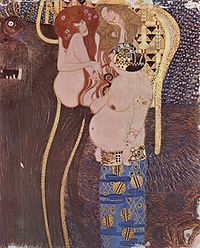
stood at the center, with Klimt's Beethoven frieze mounted around it.
In 1903, Hoffmann and Moser founded the Wiener Werkstätte
Wiener Werkstätte
Established in 1903, the Wiener Werkstätte was a production community of visual artists. The workshop brought together architects, artists and designers whose first commitment was to design art which would be accessible to everyone...
as a fine-arts society with the goal of reforming the applied arts (arts and crafts).
On 14 June 1905 Gustav Klimt and other artists left the Vienna Secession due to differences of opinion over artistic concepts.
Style of the Secessionists
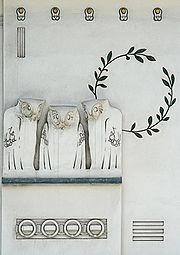
The Secessionist style was exhibited in a magazine that the group produced, called Ver Sacrum, which featured highly decorative works representative of the period.
Architecture
Along with painters and sculptors, there were several prominent architects who became associated with The Vienna Secession. During this time, architects focused on bringing purer geometric forms into the designs of their buildings.The three main architects of this movement were Josef HoffmannJosef Hoffmann
Josef Hoffmann was an Austrian architect and designer of consumer goods.- Biography :...
, Joseph Maria Olbrich
Joseph Maria Olbrich
Joseph Maria Olbrich was an Austrian architect and co-founder of the Vienna Secession.-Life:Olbrich was born in Opava, Austrian Silesia .He was the third child of Edmund and Aloisia Olbrich. He had two sisters who died before he was born, and two younger brothers John and Edmund...
, and Otto Wagner
Otto Wagner
Otto Koloman Wagner was an Austrian architect and urban planner, known for his lasting impact on the appearance of his home town Vienna, to which he contributed many landmarks.-Life:...
. Secessionist architects often decorated the surface of their buildings with linear ornamentation in a form commonly called whiplash or eel style.
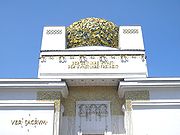
In 1898, the group's exhibition house was built in the vicinity of Karlsplatz
Karlsplatz
Karlsplatz is a town square on the border of the first and fourth districts of Vienna. It is one of the most frequented and best connected transportation hubs in Vienna. The Karlskirche is located here....
. Designed by Joseph Maria Olbrich, the exhibition building soon became known simply as "the Secession" (die Sezession). This building became an icon of the movement. The secession building displayed art from several other influential artists such as Max Klinger
Max Klinger
Max Klinger was a German Symbolist painter, sculptor, printmaker, and writer.Klinger was born in Leipzig and studied in Karlsruhe. An admirer of the etchings of Menzel and Goya, he shortly became a skilled and imaginative engraver in his own right. He began creating sculptures in the early 1880s...
, Eugene Grasset
Eugène Grasset
Eugène Samuel Grasset was a Swiss decorative artist who worked in Paris, France in a variety of creative design fields during the Belle Époque. He is considered a pioneer in Art Nouveau design.-Biography:...
, Charles Rennie Mackintosh
Charles Rennie Mackintosh
Charles Rennie Mackintosh was a Scottish architect, designer, watercolourist and artist. He was a designer in the Arts and Crafts movement and also the main representative of Art Nouveau in the United Kingdom. He had a considerable influence on European design...
, and Arnold Bocklin
Arnold Böcklin
Arnold Böcklin was a Swiss symbolist painter.-Life and art:He was born at Basel. His father, Christian Frederick Böcklin , was descended from an old family of Schaffhausen, and engaged in the silk trade. His mother, Ursula Lippe, was a native of the same city...
.
Otto Wagner's Majolika Haus in Vienna
Vienna
Vienna is the capital and largest city of the Republic of Austria and one of the nine states of Austria. Vienna is Austria's primary city, with a population of about 1.723 million , and is by far the largest city in Austria, as well as its cultural, economic, and political centre...
(c. 1898) is a significant example of the Austrian use of line. Other significant works of Otto Wagner include The Karlsplatz Stadtbahn Station
Karlsplatz Stadtbahn Station
Karlsplatz Stadtbahn Station is a former station of the Viennese Stadtbahn. The buildings above ground on Karlsplatz are a well-known example of Jugendstil architecture. These buildings were included in The Vienna Secession, as they followed many of the artistic styles of that movement...
in Vienna (1900), and The Austrian Postal Savings Bank or Österreichische Postsparkasse
Österreichische Postsparkasse
Österreichische Postsparkasse is a postal savings bank in Austria. It was owned by the Austrian Mail and thus by the government. It merged in 1 October 2005, with the BAWAG to form BAWAG P.S.K..-During the Austro-Hungarian Empire:...
in Vienna (1904–1906).
Wagner's way of modifying Art Nouveau
Art Nouveau
Art Nouveau is an international philosophy and style of art, architecture and applied art—especially the decorative arts—that were most popular during 1890–1910. The name "Art Nouveau" is French for "new art"...
decoration in a classical manner did not find favour with some of his pupils who broke away to form the Secessionists. One was Josef Hoffmann who left to form the Wiener Werkstätte
Wiener Werkstätte
Established in 1903, the Wiener Werkstätte was a production community of visual artists. The workshop brought together architects, artists and designers whose first commitment was to design art which would be accessible to everyone...
, an Austrian equivalent of the Arts and Crafts movement
Arts and Crafts movement
Arts and Crafts was an international design philosophy that originated in England and flourished between 1860 and 1910 , continuing its influence until the 1930s...
. A good example of his work is the Stoclet Palace in Brussels
Brussels
Brussels , officially the Brussels Region or Brussels-Capital Region , is the capital of Belgium and the de facto capital of the European Union...
(1905).
Commemoration
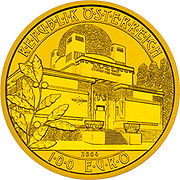
The Secession movement was selected as the theme for a commemorative coin: the 100 euro Secession commemorative coin minted on 10 November 2004.On the obverse side there is a view of the Secession exhibition hall
Secession hall (Austria)
The Secession building is an exhibition hall built in 1897 by Joseph Maria Olbrich as an architectural manifesto for the Vienna Secession, located in Vienna, Austria...
in Vienna
Vienna
Vienna is the capital and largest city of the Republic of Austria and one of the nine states of Austria. Vienna is Austria's primary city, with a population of about 1.723 million , and is by far the largest city in Austria, as well as its cultural, economic, and political centre...
. The reverse side features a small portion of the Beethoven Frieze
Beethoven Frieze
The Beethoven Frieze is a painting by Gustav Klimt.-Description:In 1902, Klimt painted the Beethoven Frieze for the 14th Vienna Secessionist exhibition, which was intended to be a celebration of the composer and featured a monumental polychrome sculpture by Max Klinger. Meant for the exhibition...
by Gustav Klimt
Gustav Klimt
Gustav Klimt was an Austrian Symbolist painter and one of the most prominent members of the Vienna Secession movement. His major works include paintings, murals, sketches, and other art objects...
. The extract from the painting features three figures: a knight in armor representing Armed Strength, one woman in the background symbolizing Ambition and holding up a wreath of victory, and a second woman representing Sympathy with lowered head and clasped hands.
On the obverse side of the Austrian € 0,50 or 50 euro-cent coin, the Vienna Secession Building figures within a circle, symbolising the birth of art nouveau
Art Nouveau
Art Nouveau is an international philosophy and style of art, architecture and applied art—especially the decorative arts—that were most popular during 1890–1910. The name "Art Nouveau" is French for "new art"...
and a new age in the country.
Other Secession artists
- Julius ExterJulius ExterJulius Exter, fully Julius Leopold Bernhard Exter was a German avant-garde painter whose techniques were close to the Der Blaue Reiter school of artists and who became known as the 'prince of colours' for his lively expressionism style...
- Richard GerstlRichard GerstlRichard Gerstl was an Austrian painter and draughtsman known for his expressive psychologically insightful portraits, his lack of critical acclaim during his lifetime, and his affair with the wife of Arnold Schoenberg which led to his suicide.Richard Gerstl was born in a prosperous civil family,...
- Max FabianiMax FabianiMax Fabiani, was a Slovene-Italian architect from the Gorizia region. Together with Ciril Metod Koch, he introduced the Vienna Secession style of architecture in the Slovene Lands.-Life:...
- Oskar KokoschkaOskar KokoschkaOskar Kokoschka was an Austrian artist, poet and playwright best known for his intense expressionistic portraits and landscapes.-Biography:...
- Jože PlečnikJože PlecnikJože Plečnik , was a Slovene architect who practised in Vienna, Belgrade, Prague and Ljubljana.-Biography:...
- Carl MollCarl MollCarl Julius Rudolf Moll was a prominent art nouveau painter active in Vienna at the start of the 20th century. He was also the stepfather of Alma Mahler-Werfel .- Biography :...
- Koloman MoserKoloman MoserKoloman Moser was an Austrian artist who exerted considerable influence on twentieth-century graphic art and one of the foremost artists of the Vienna Secession movement and a co-founder of Wiener Werkstätte....
- Egon SchieleEgon SchieleEgon Schiele was an Austrian painter. A protégé of Gustav Klimt, Schiele was a major figurative painter of the early 20th century. His work is noted for its intensity, and the many self-portraits the artist produced...
- Malva SchalekMalva SchalekMalva Schalek, aka Malvina Schalková , was an Czech-Jewish painter.-Life:Malva Schalek was born in Prague, to a German-speaking Jewish intellectual family active in the Czech national movement. She went to school in Prague, Vrchlabi , and began to study art, first at the Frauenakademie in Munich ...
- Othmar SchimkowitzOthmar SchimkowitzOthmar Schimkowitz was a Hungarian-born architectural sculptor who worked on the greatest landmarks of the Vienna Secession.-Life:...
- Joseph Maria OlbrichJoseph Maria OlbrichJoseph Maria Olbrich was an Austrian architect and co-founder of the Vienna Secession.-Life:Olbrich was born in Opava, Austrian Silesia .He was the third child of Edmund and Aloisia Olbrich. He had two sisters who died before he was born, and two younger brothers John and Edmund...
Exhibition (Sample)
- 1997 Maurizio CattelanMaurizio CattelanMaurizio Cattelan is an Italian artist based in New York. He is known for his satirical sculptures, particularly La Nona Ora , depicting the Pope John Paul II struck down by a meteorite....
, solo exhibition - 2000 Gregor SchneiderGregor schneiderGregor Schneider is a German artist, whose main area of work is constructed rooms. In 2001, he was awarded the Golden Lion at the Venice Biennale for his infamous work Totes Haus u r exhibited at the German Pavilion....
, Keller, solo exhibition