

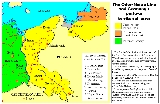
Recovered Territories

Encyclopedia
People's Republic of Poland
The People's Republic of Poland was the official name of Poland from 1952 to 1990. Although the Soviet Union took control of the country immediately after the liberation from Nazi Germany in 1944, the name of the state was not changed until eight years later...
to describe those parts of pre-war Germany (and the Free City of Danzig
Free City of Danzig
The Free City of Danzig was a semi-autonomous city-state that existed between 1920 and 1939, consisting of the Baltic Sea port of Danzig and surrounding areas....
) that became part of Poland
Poland
Poland , officially the Republic of Poland , is a country in Central Europe bordered by Germany to the west; the Czech Republic and Slovakia to the south; Ukraine, Belarus and Lithuania to the east; and the Baltic Sea and Kaliningrad Oblast, a Russian exclave, to the north...
after World War II
World War II
World War II, or the Second World War , was a global conflict lasting from 1939 to 1945, involving most of the world's nations—including all of the great powers—eventually forming two opposing military alliances: the Allies and the Axis...
. The rationale for the term "Recovered" was that these territories had been part of (or fiefs of) the Polish state at various times in history, mostly during the rule of the medieval Piast dynasty. Over the centuries they had become Germanized through the processes of German eastward settlement (Ostsiedlung
Ostsiedlung
Ostsiedlung , also called German eastward expansion, was the medieval eastward migration and settlement of Germans from modern day western and central Germany into less-populated regions and countries of eastern Central Europe and Eastern Europe. The affected area roughly stretched from Slovenia...
) and political expansion (Drang nach Osten
Drang nach Osten
Drang nach Osten was a term coined in the 19th century to designate German expansion into Slavic lands. The term became a motto of the German nationalist movement in the late nineteenth century...
). The term "Recovered Territories" had already been similarly used by the Second Polish Republic
Second Polish Republic
The Second Polish Republic, Second Commonwealth of Poland or interwar Poland refers to Poland between the two world wars; a period in Polish history in which Poland was restored as an independent state. Officially known as the Republic of Poland or the Commonwealth of Poland , the Polish state was...
in 1938, in reference to the parts of Cieszyn Silesia
Cieszyn Silesia
Cieszyn Silesia or Těšín Silesia or Teschen Silesia is a historical region in south-eastern Silesia, centered around the towns of Cieszyn and Český Těšín and bisected by the Olza River. Since 1920 it has been divided between Poland and Czechoslovakia, and later the Czech Republic...
it annexed from Czechoslovakia
Czechoslovakia
Czechoslovakia or Czecho-Slovakia was a sovereign state in Central Europe which existed from October 1918, when it declared its independence from the Austro-Hungarian Empire, until 1992...
after the Munich Agreement
Munich Agreement
The Munich Pact was an agreement permitting the Nazi German annexation of Czechoslovakia's Sudetenland. The Sudetenland were areas along Czech borders, mainly inhabited by ethnic Germans. The agreement was negotiated at a conference held in Munich, Germany, among the major powers of Europe without...
.
The great majority of the German inhabitants fled or were expelled
Flight and expulsion of Germans from Poland during and after World War II
The flight and expulsion of Germans from Poland was the largest of a series of flights and expulsions of Germans in Europe during and after World War II...
from the territories during the later stages of the war and after the war ended, although a small German minority
German minority in Poland
The registered German minority in Poland consists of 152,900 people, according to a 2002 census.The German language is used in certain areas in Opole Voivodeship , where most of the minority resides...
remains in some places. The territories were resettled by the Polish communist government, mainly with Poles who moved voluntarily from Central Poland and the wartime Polish diaspora, and also with some Ukrainians
Ukrainians
Ukrainians are an East Slavic ethnic group native to Ukraine, which is the sixth-largest nation in Europe. The Constitution of Ukraine applies the term 'Ukrainians' to all its citizens...
and other minorities forcibly resettled under "Operation Vistula," as well as Polish "repatriates"
Repatriation of Poles
Repatriation of Poles can refer to:*Repatriation of Poles *Repatriation of Poles...
forced to move from areas of former eastern Poland that were now part of the Soviet Union
Soviet Union
The Soviet Union , officially the Union of Soviet Socialist Republics , was a constitutionally socialist state that existed in Eurasia between 1922 and 1991....
. The communist authorities also made efforts to remove traces of German culture, such as place names and inscriptions, from the territories.
The post-war border between Germany and Poland (the Oder-Neisse line
Oder-Neisse line
The Oder–Neisse line is the border between Germany and Poland which was drawn in the aftermath of World War II. The line is formed primarily by the Oder and Lusatian Neisse rivers, and meets the Baltic Sea west of the seaport cities of Szczecin and Świnoujście...
) was formally recognized by East Germany in 1950 and by West Germany
West Germany
West Germany is the common English, but not official, name for the Federal Republic of Germany or FRG in the period between its creation in May 1949 to German reunification on 3 October 1990....
in 1970, and was affirmed by the re-united Germany
Germany
Germany , officially the Federal Republic of Germany , is a federal parliamentary republic in Europe. The country consists of 16 states while the capital and largest city is Berlin. Germany covers an area of 357,021 km2 and has a largely temperate seasonal climate...
in the German-Polish Border Treaty
German-Polish Border Treaty (1990)
The German-Polish Border Treaty of 1990 finally settled the issue of the Polish-German border, which in terms of international law had been pending since 1945...
of 1990.
History before 1945
West Slavs
The West Slavs are Slavic peoples speaking West Slavic languages. They include Poles , Czechs, Slovaks, Lusatian Sorbs and the historical Polabians. The northern or Lechitic group includes, along with Polish, the extinct Polabian and Pomeranian languages...
had inhabited most of the area of present-day Poland since the 6th century. Mieszko I of the Polans
Polans
Polans may refer to two Slavic tribes:* Polans , in the area of Dnieper river* Polans , in the area of Warta. The tribe unified most of the lands of present-day Poland under the Piast dynasty....
from his stronghold in the Gniezno
Gniezno
Gniezno is a city in central-western Poland, some 50 km east of Poznań, inhabited by about 70,000 people. One of the Piasts' chief cities, it was mentioned by 10th century A.D. sources as the capital of Piast Poland however the first capital of Piast realm was most likely Giecz built around...
area united various neighboring tribes in the second half of the 10th century, creating the first Polish state and becoming the first historically recorded Piast
Piast dynasty
The Piast dynasty was the first historical ruling dynasty of Poland. It began with the semi-legendary Piast Kołodziej . The first historical ruler was Duke Mieszko I . The Piasts' royal rule in Poland ended in 1370 with the death of king Casimir the Great...
duke. His realm roughly included all of the area of what would later be named the Recovered Territories, except for the Warmian-Masurian
Warmian-Masurian Voivodeship
Warmian-Masurian Voivodeship, or Warmia-Masuria Province , is a voivodeship in northeastern Poland. Its capital and largest city is Olsztyn...
part of Old Prussia
Prussia (region)
Prussia is a historical region in Central Europe extending from the south-eastern coast of the Baltic Sea to the Masurian Lake District. It is now divided between Poland, Russia, and Lithuania...
and eastern Lusatia
Lusatia
Lusatia is a historical region in Central Europe. It stretches from the Bóbr and Kwisa rivers in the east to the Elbe valley in the west, today located within the German states of Saxony and Brandenburg as well as in the Lower Silesian and Lubusz voivodeships of western Poland...
.
Peace of Bautzen
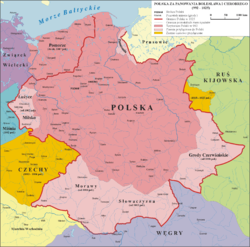
The Peace of Bautzen or the Peace of Budziszyn was a treaty concluded on January 30, 1018 between the Ottonian Holy Roman Emperor Henry II and the Piast ruler of Poland Boleslaw I which ended a series of Polish-German wars over the control of Lusatia and Upper Lusatia as well as Bohemia,...
expanded the southern part of the realm, but lost control over the lands of Western Pomerania
Pomerania
Pomerania is a historical region on the south shore of the Baltic Sea. Divided between Germany and Poland, it stretches roughly from the Recknitz River near Stralsund in the West, via the Oder River delta near Szczecin, to the mouth of the Vistula River near Gdańsk in the East...
on the Baltic
Baltic Sea
The Baltic Sea is a brackish mediterranean sea located in Northern Europe, from 53°N to 66°N latitude and from 20°E to 26°E longitude. It is bounded by the Scandinavian Peninsula, the mainland of Europe, and the Danish islands. It drains into the Kattegat by way of the Øresund, the Great Belt and...
coast. After fragmentation, pagan revolts and a Bohemia
Bohemia
Bohemia is a historical region in central Europe, occupying the western two-thirds of the traditional Czech Lands. It is located in the contemporary Czech Republic with its capital in Prague...
n invasion in the 1030s, Casimir I the Restorer again united most of the former Piast realm, including Silesia
Silesia
Silesia is a historical region of Central Europe located mostly in Poland, with smaller parts also in the Czech Republic, and Germany.Silesia is rich in mineral and natural resources, and includes several important industrial areas. Silesia's largest city and historical capital is Wrocław...
and Lubusz Land
Lubusz Land
Lubusz Land is a historical region and cultural landscape in Poland and Germany, on both sides of the Oder river.Originally the settlement area of the West Slavic Leubuzzi, a Veleti tribe, the swampy area was located east of Mark Brandenburg and west of Greater Poland, south of Pomerania and north...
on both sides of the middle Oder
Oder
The Oder is a river in Central Europe. It rises in the Czech Republic and flows through western Poland, later forming of the border between Poland and Germany, part of the Oder-Neisse line...
River, but without Western Pomerania, which became part of the Polish state again under Bolesław III Wrymouth from 1116 until 1121, when the noble House of Griffins established the Duchy of Pomerania
Duchy of Pomerania
The Duchy of Pomerania was a duchy in Pomerania on the southern coast of the Baltic Sea, ruled by dukes of the House of Pomerania ....
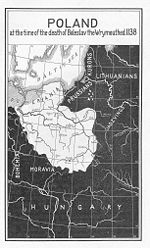
. On Bolesław's death in 1138, Poland for almost 200 years was subjected to fragmentation, being ruled by Bolesław's sons and their successors, who were often in conflict with each other. Partial reunification was achieved by Władysław I the Elbow-high, crowned king of Poland in 1320, although the Silesian
Duchy of Silesia
The Duchy of Silesia with its capital at Wrocław was a medieval duchy located in the historic Silesian region of Poland. Soon after it was formed under the Piast dynasty in 1138, it fragmented into various Duchies of Silesia. In 1327 the remaining Duchy of Wrocław as well as most other duchies...
and Masovian
Duchy of Masovia
The Duchy of Masovia with its capital at Płock was a medieval duchy formed when the Polish Kingdom of the Piasts fragmented in 1138. It was located in the historic Masovian region of northeastern Poland...
duchies remained independent Piast holdings.
In the course of the 12th to 14th centuries, Germanic
Germans
The Germans are a Germanic ethnic group native to Central Europe. The English term Germans has referred to the German-speaking population of the Holy Roman Empire since the Late Middle Ages....
, Dutch
Netherlands
The Netherlands is a constituent country of the Kingdom of the Netherlands, located mainly in North-West Europe and with several islands in the Caribbean. Mainland Netherlands borders the North Sea to the north and west, Belgium to the south, and Germany to the east, and shares maritime borders...
and Flemish
Flanders
Flanders is the community of the Flemings but also one of the institutions in Belgium, and a geographical region located in parts of present-day Belgium, France and the Netherlands. "Flanders" can also refer to the northern part of Belgium that contains Brussels, Bruges, Ghent and Antwerp...
settlers moved into East Central
Central Europe
Central Europe or alternatively Middle Europe is a region of the European continent lying between the variously defined areas of Eastern and Western Europe...
and Eastern Europe
Eastern Europe
Eastern Europe is the eastern part of Europe. The term has widely disparate geopolitical, geographical, cultural and socioeconomic readings, which makes it highly context-dependent and even volatile, and there are "almost as many definitions of Eastern Europe as there are scholars of the region"...
in a migration process known as the Ostsiedlung
Ostsiedlung
Ostsiedlung , also called German eastward expansion, was the medieval eastward migration and settlement of Germans from modern day western and central Germany into less-populated regions and countries of eastern Central Europe and Eastern Europe. The affected area roughly stretched from Slovenia...
. In Pomerania, Brandenburg
Margraviate of Brandenburg
The Margraviate of Brandenburg was a major principality of the Holy Roman Empire from 1157 to 1806. Also known as the March of Brandenburg , it played a pivotal role in the history of Germany and Central Europe....
, East Prussia
East Prussia
East Prussia is the main part of the region of Prussia along the southeastern Baltic Coast from the 13th century to the end of World War II in May 1945. From 1772–1829 and 1878–1945, the Province of East Prussia was part of the German state of Prussia. The capital city was Königsberg.East Prussia...
and Silesia, the former West Slav
West Slavs
The West Slavs are Slavic peoples speaking West Slavic languages. They include Poles , Czechs, Slovaks, Lusatian Sorbs and the historical Polabians. The northern or Lechitic group includes, along with Polish, the extinct Polabian and Pomeranian languages...
(Polabian Slavs
Polabian Slavs
Polabian Slavs - is a collective term applied to a number of Lechites tribes who lived along the Elbe river, between the Baltic Sea to the north, the Saale and the Limes Saxoniae to the west, the Ore Mountains and the Western Sudetes to the south, and Poland to the east. They have also been known...
and Poles
Poles
thumb|right|180px|The state flag of [[Poland]] as used by Polish government and diplomatic authoritiesThe Polish people, or Poles , are a nation indigenous to Poland. They are united by the Polish language, which belongs to the historical Lechitic subgroup of West Slavic languages of Central Europe...
) or Balt
Balts
The Balts or Baltic peoples , defined as speakers of one of the Baltic languages, a branch of the Indo-European language family, are descended from a group of Indo-European tribes who settled the area between the Jutland peninsula in the west and Moscow, Oka and Volga rivers basins in the east...
population became minorities throughout the following centuries, although substantial numbers of the original inhabitants remained in areas such as Upper Silesia
Upper Silesia
Upper Silesia is the southeastern part of the historical and geographical region of Silesia. Since the 9th century, Upper Silesia has been part of Greater Moravia, the Duchy of Bohemia, the Piast Kingdom of Poland, again of the Lands of the Bohemian Crown and the Holy Roman Empire, as well as of...
. In Greater Poland
Greater Poland
Greater Poland or Great Poland, often known by its Polish name Wielkopolska is a historical region of west-central Poland. Its chief city is Poznań.The boundaries of Greater Poland have varied somewhat throughout history...
and in Eastern Pomerania (Pomerelia
Pomerelia
Pomerelia is a historical region in northern Poland. Pomerelia lay in eastern Pomerania: on the southern shore of the Baltic Sea and west of the Vistula and its delta. The area centered on the city of Gdańsk at the mouth of the Vistula...
), German settlers formed a minority.
Despite the actual loss of several provinces, medieval lawyers of the Kingdom of Poland created a specific claim to all formerly Polish provinces that were not reunited with the rest of the country in 1320. It was based on the theory of the Corona Regni Poloniae, according to which the state (the Crown) and its interests were no longer strictly connected with the person of the monarch
Monarch
A monarch is the person who heads a monarchy. This is a form of government in which a state or polity is ruled or controlled by an individual who typically inherits the throne by birth and occasionally rules for life or until abdication...
. Because of that no monarch could effectively renounce Crown claims to any of the territories that were historically and/or ethnically Polish. Those claims were reserved for the state (the Crown), which in theory still covered all of the territories that were part of, or dependent of, the Polish Crown upon the death of Bolesław III in 1138. Some of the territories as Pomerelia, or Masovia were reunited with Poland during the 15th and 16th centuries. However all Polish monarchs until the end of the Polish–Lithuanian Commonwealth in 1795 had to promise to do everything possible to reunite the rest of those territories with the Crown.
The areas of the Recovered Territories fall into three categories:
- Those that once had been part of the Polish state during the rule of the Piasts
- Those that had not been part of Poland, but were fiefs of the Polish crown in the 15th and 16th centuries (Ducal PrussiaDucal PrussiaThe Duchy of Prussia or Ducal Prussia was a duchy in the eastern part of Prussia from 1525–1701. It was the first Protestant duchy with a dominant German-speaking population, as well as Polish and Lithuanian minorities...
) - Territories that had been part of Poland until the PartitionsPartitions of PolandThe Partitions of Poland or Partitions of the Polish–Lithuanian Commonwealth took place in the second half of the 18th century and ended the existence of the Polish–Lithuanian Commonwealth, resulting in the elimination of sovereign Poland for 123 years...
(parts of Royal PrussiaRoyal PrussiaRoyal Prussia was a Region of the Kingdom of Poland and of the Polish-Lithuanian Commonwealth . Polish Prussia included Pomerelia, Chełmno Land , Malbork Voivodeship , Gdańsk , Toruń , and Elbląg . It is distinguished from Ducal Prussia...
including WarmiaWarmiaWarmia or Ermland is a region between Pomerelia and Masuria in northeastern Poland. Together with Masuria, it forms the Warmian-Masurian Voivodeship....
, as well as the regions of Piła, Wałcz, and Złotów, which went to Prussia in the First PartitionFirst Partition of PolandThe First Partition of Poland or First Partition of the Polish-Lithuanian Commonwealth took place in 1772 as the first of three partitions that ended the existence of the Polish-Lithuanian Commonwealth by 1795. Growth in the Russian Empire's power, threatening the Kingdom of Prussia and the...
of 1772; and GdańskGdanskGdańsk is a Polish city on the Baltic coast, at the centre of the country's fourth-largest metropolitan area.The city lies on the southern edge of Gdańsk Bay , in a conurbation with the city of Gdynia, spa town of Sopot, and suburban communities, which together form a metropolitan area called the...
, MiędzyrzeczMiedzyrzeczMiędzyrzecz is a town in western Poland with 18,584 inhabitants . The capital of Międzyrzecz County, it was part of the Gorzów Wielkopolski Voivodeship from 1975–1998. Since the Local Government Reorganization Act of 1998, Międzyrzecz has been situated in the Lubusz Voivodeship...
, and WschowaWschowaWschowa is a town in the Lubusz Voivodeship in Poland with 14,607 inhabitants . It is the capital of Wschowa County.-History:Wschowa was originally a border fortress in a region disputed by the Polish dukes of Silesia and Greater Poland. After German colonists had established a settlement nearby,...
, which followed in the Second PartitionSecond PartitionSecond Partition may refer to:*Second Partition of Poland*Second Partition of Luxembourg...
of 1793)
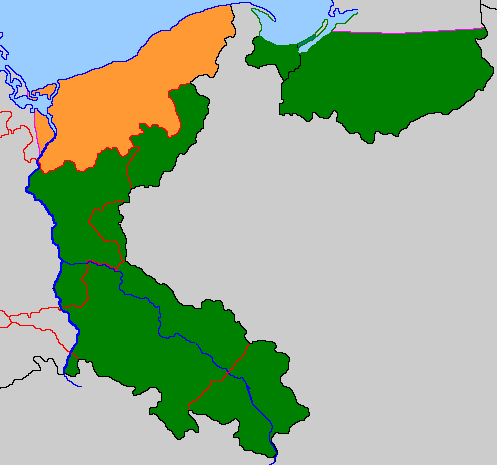
Pomerania
Pomerania
Pomerania is a historical region on the south shore of the Baltic Sea. Divided between Germany and Poland, it stretches roughly from the Recknitz River near Stralsund in the West, via the Oder River delta near Szczecin, to the mouth of the Vistula River near Gdańsk in the East...
n parts of the Recovered Territories were subject to Polish rule several times from the late 10th century on, when Mieszko I had acquired at least significant parts of them. A bishopric was established in the Kołobrzeg area by his son Bolesław I in 1000–1005/07, before the area was lost again. Despite further attempts by Polish dukes to again control the Pomeranian tribes, this was only partly achieved by Bolesław III in several campaigns lasting from 1116 to 1121. There were successful Christian missions in 1124 and 1128, however by the time of Bolesław's death in 1138, most of West Pomerania (the Griffin-ruled areas
House of Pomerania
The House of Griffins or House of Pomerania, , also known as House of Greifen; House of Gryf, was a dynasty of Royal dukes that ruled the Duchy of Pomerania from the 12th century until 1637, after their power was temporarily derivated to Prussian Royal House...
) was no longer controlled by Poland. Over the following centuries the area was largely Germanized, although a small Slavic or Polish minority remained. At the turn to the 20th century there lived about 14,200 persons of Polish
Polish language
Polish is a language of the Lechitic subgroup of West Slavic languages, used throughout Poland and by Polish minorities in other countries...
mother tongue in the Province of Pomerania
Province of Pomerania
The Province of Pomerania was a province of the Kingdom of Prussia and the Free State of Prussia from 1815 until 1945. Afterwards its territory became part of Allied-occupied Germany and Poland....
(in the east of Farther Pomerania
Farther Pomerania
Farther Pomerania, Further Pomerania, Transpomerania or Eastern Pomerania , which before the German-Polish border shift of 1945 comprised the eastern part of the Duchy, later Province of Pomerania, roughly stretching from the Oder River in the West to Pomerelia in the East...
in the vicinity of the border to West Prussia
West Prussia
West Prussia was a province of the Kingdom of Prussia from 1773–1824 and 1878–1919/20 which was created out of the earlier Polish province of Royal Prussia...
), and 300 persons using the Kashubian language
Kashubian language
Kashubian or Cassubian is one of the Lechitic languages, a subgroup of the Slavic languages....
(at the Leba Lake and the Garde Lake), the total population of the province consisting of almost 1,7 Million inhabitants.
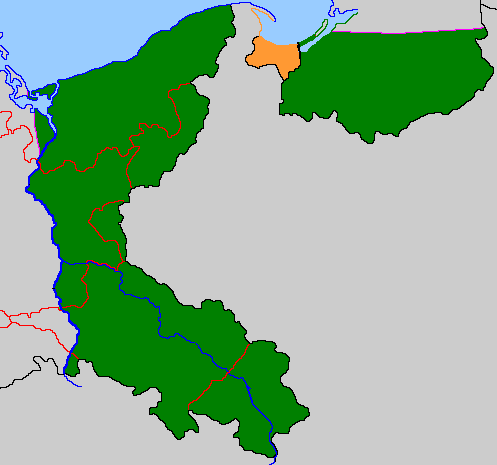
Gdańsk, Lębork and Bytów
Pomerelia
Pomerelia is a historical region in northern Poland. Pomerelia lay in eastern Pomerania: on the southern shore of the Baltic Sea and west of the Vistula and its delta. The area centered on the city of Gdańsk at the mouth of the Vistula...
at the eastern end of Pomerania, including Gdańsk
Gdansk
Gdańsk is a Polish city on the Baltic coast, at the centre of the country's fourth-largest metropolitan area.The city lies on the southern edge of Gdańsk Bay , in a conurbation with the city of Gdynia, spa town of Sopot, and suburban communities, which together form a metropolitan area called the...
(Danzig), was ruled in the 12th and 13th centuries by the Samborides
Samborides
The Samborides or House of Sobiesław were a ruling dynasty in the historic region of Pomerania. They were first documented about 1155 as governors in the eastern Pomerelian lands serving the royal Piast dynasty of Poland, and from 1227 ruled as autonomous princes until 1294, at which time the...
, who were (at least initially) more closely tied to the Kingdom of Poland than were the Griffins. After the death of the last Samboride in 1294, the region was ruled by kings of Poland for a short period, although also claimed by Brandenburg
Brandenburg
Brandenburg is one of the sixteen federal-states of Germany. It lies in the east of the country and is one of the new federal states that were re-created in 1990 upon the reunification of the former West Germany and East Germany. The capital is Potsdam...
. After the Teutonic takeover in 1308 the region became part of the monastic state of the Teutonic Knights
Monastic State of the Teutonic Knights
The State of the Teutonic Order, , also Monastic State of the Teutonic Knights or Ordensstaat , was formed in 1224 during the Northern Crusades, the Teutonic Knights' conquest of the pagan West-Baltic Old Prussians in the 13th century....
. In the Second Peace of Thorn (1466) most of the region became part Royal Prussia
Royal Prussia
Royal Prussia was a Region of the Kingdom of Poland and of the Polish-Lithuanian Commonwealth . Polish Prussia included Pomerelia, Chełmno Land , Malbork Voivodeship , Gdańsk , Toruń , and Elbląg . It is distinguished from Ducal Prussia...
within the Kingdom of Poland, as it remained until being acquired by the Kingdom of Prussia
Kingdom of Prussia
The Kingdom of Prussia was a German kingdom from 1701 to 1918. Until the defeat of Germany in World War I, it comprised almost two-thirds of the area of the German Empire...
in the partitions
Partitions of Poland
The Partitions of Poland or Partitions of the Polish–Lithuanian Commonwealth took place in the second half of the 18th century and ended the existence of the Polish–Lithuanian Commonwealth, resulting in the elimination of sovereign Poland for 123 years...
of 1772 and 1793. A small area in the west of Pomerelia, the Lauenburg and Bütow Land
Lauenburg and Bütow Land
Lauenburg and Bütow Land formed a historical region in eastern in eastern Pomerania. Composed of two districts centered around the towns of Lauenburg and Bütow , it was on the western periphery of Pomerelia...
(the region of Lębork
Lebork
Lębork is a town on the Łeba and Okalica rivers in Middle Pomerania region, north-western Poland with some 37,000 inhabitants.Lębork is also the capital of Lębork County in Pomeranian Voivodeship since 1999, formerly in Słupsk Voivodeship ....
and Bytów
Bytów
Bytów is a town in the Middle Pomerania region of northern Poland in the Bytów Lakeland with 16,888 inhabitants . Previously in Słupsk Voivodeship , it is the capital of Bytów County in Pomeranian Voivodeship .-History:...
) was granted to the rulers of Pomerania, although it remained a Polish fief until the First Partition
First Partition of Poland
The First Partition of Poland or First Partition of the Polish-Lithuanian Commonwealth took place in 1772 as the first of three partitions that ended the existence of the Polish-Lithuanian Commonwealth by 1795. Growth in the Russian Empire's power, threatening the Kingdom of Prussia and the...
. (A large part of Pomerelia formed the Polish Corridor
Polish Corridor
The Polish Corridor , also known as Danzig Corridor, Corridor to the Sea or Gdańsk Corridor, was a territory located in the region of Pomerelia , which provided the Second Republic of Poland with access to the Baltic Sea, thus dividing the bulk of Germany from the province of East...
between the World Wars, and so was not part of the post-war Recovered Territories.)
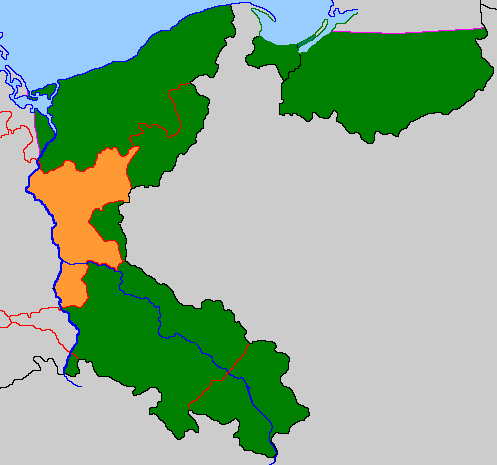
Lubusz Land
Lubusz Land
Lubusz Land is a historical region and cultural landscape in Poland and Germany, on both sides of the Oder river.Originally the settlement area of the West Slavic Leubuzzi, a Veleti tribe, the swampy area was located east of Mark Brandenburg and west of Greater Poland, south of Pomerania and north...
on both sides of the Oder River up to the Spree
Spree
The Spree is a river that flows through the Saxony, Brandenburg and Berlin states of Germany, and in the Ústí nad Labem region of the Czech Republic...
in the west, including Lubusz (Lebus
Lebus
Lebus is a town in the southeast of the Märkisch-Oderland District in Brandenburg, Germany. It had a population of 3,375 as of 2005. It was the center of the historical region known as Lubusz Land.-Location:...
) itself, was also part of Mieszko's realm. Poland lost Lubusz, when the Silesian
Duchy of Silesia
The Duchy of Silesia with its capital at Wrocław was a medieval duchy located in the historic Silesian region of Poland. Soon after it was formed under the Piast dynasty in 1138, it fragmented into various Duchies of Silesia. In 1327 the remaining Duchy of Wrocław as well as most other duchies...
duke Bolesław II Rogatka sold it to the Ascanian margraves of Brandenburg
Margraviate of Brandenburg
The Margraviate of Brandenburg was a major principality of the Holy Roman Empire from 1157 to 1806. Also known as the March of Brandenburg , it played a pivotal role in the history of Germany and Central Europe....
in 1248, who also acquired the castellany of Santok
Santok
Santok is a village in Gorzów County, Lubusz Voivodeship, in western Poland. It is the seat of the gmina called Gmina Santok. It is located at the confluence of the Noteć and Warta rivers, approximately east of Gorzów Wielkopolski...
from Duke Przemysł I of Greater Poland and made it the nucleus of their Neumark
Neumark
Neumark comprised a region of the Prussian province of Brandenburg, Germany.Neumark may also refer to:* Neumark, Thuringia* Neumark, Saxony* Neumark * Nowe Miasto Lubawskie or Neumark, a town in Poland, situated at river Drwęca...
("New March") region. The Bishopric of Lebus
Bishopric of Lebus
The Bishopric of Lebus was a Roman Catholic diocese and later an ecclesiastical territory of the Holy Roman Empire. It existed from 1125 until 1598...
remained a suffragan of the Archdiocese of Gniezno until 1424, when it passed under the jurisdiction of the Archbishopric of Magdeburg
Archbishopric of Magdeburg
The Archbishopric of Magdeburg was a Roman Catholic archdiocese and Prince-Bishopric of the Holy Roman Empire centered on the city of Magdeburg on the Elbe River....
. The present-day Polish Lubusz Voivodeship
Lubusz Voivodeship
- Administrative division :Lubusz Voivodeship is divided into 14 counties : 2 city counties and 12 land counties. These are further divided into 83 gminas....
comprises most of the former Brandenburgian Neumark territory east of the Oder.
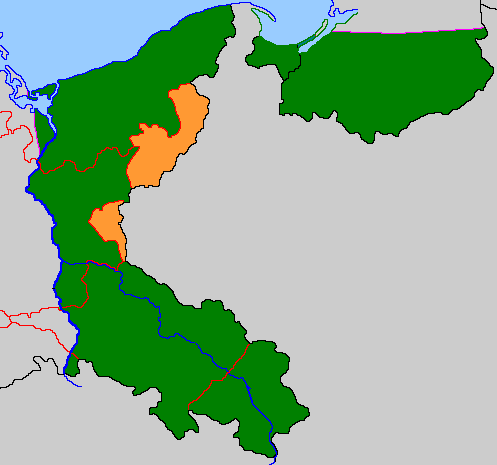
Parts of Greater Poland and Kuyavia
Pomerelia
Pomerelia is a historical region in northern Poland. Pomerelia lay in eastern Pomerania: on the southern shore of the Baltic Sea and west of the Vistula and its delta. The area centered on the city of Gdańsk at the mouth of the Vistula...
and Greater Poland
Greater Poland
Greater Poland or Great Poland, often known by its Polish name Wielkopolska is a historical region of west-central Poland. Its chief city is Poznań.The boundaries of Greater Poland have varied somewhat throughout history...
(Polonia Maior), being lost to Prussia in the First Partition
First Partition of Poland
The First Partition of Poland or First Partition of the Polish-Lithuanian Commonwealth took place in 1772 as the first of three partitions that ended the existence of the Polish-Lithuanian Commonwealth by 1795. Growth in the Russian Empire's power, threatening the Kingdom of Prussia and the...
(the Pomerelian parts) and the Second Partition
Second Partition of Poland
The 1793 Second Partition of the Polish-Lithuanian Commonwealth was the second of three partitions that ended the existence of the Polish-Lithuanian Commonwealth by 1795. The second partition occurred in the aftermath of the War in Defense of the Constitution and the Targowica Confederation of 1792...
(the remainder). During Napoleonic times the Greater Poland territories were part of the Duchy of Warsaw
Duchy of Warsaw
The Duchy of Warsaw was a Polish state established by Napoleon I in 1807 from the Polish lands ceded by the Kingdom of Prussia under the terms of the Treaties of Tilsit. The duchy was held in personal union by one of Napoleon's allies, King Frederick Augustus I of Saxony...
, but after the Congress of Vienna
Congress of Vienna
The Congress of Vienna was a conference of ambassadors of European states chaired by Klemens Wenzel von Metternich, and held in Vienna from September, 1814 to June, 1815. The objective of the Congress was to settle the many issues arising from the French Revolutionary Wars, the Napoleonic Wars,...
they were taken over again by Prussia as part of the Grand Duchy of Posen (Poznań), later Province of Posen
Province of Posen
The Province of Posen was a province of Prussia from 1848–1918 and as such part of the German Empire from 1871 to 1918. The area was about 29,000 km2....
. After World War I
World War I
World War I , which was predominantly called the World War or the Great War from its occurrence until 1939, and the First World War or World War I thereafter, was a major war centred in Europe that began on 28 July 1914 and lasted until 11 November 1918...
, those parts of the former Province of Posen and of West Prussia
West Prussia
West Prussia was a province of the Kingdom of Prussia from 1773–1824 and 1878–1919/20 which was created out of the earlier Polish province of Royal Prussia...
that were not restored as part of the Poland
Second Polish Republic
The Second Polish Republic, Second Commonwealth of Poland or interwar Poland refers to Poland between the two world wars; a period in Polish history in which Poland was restored as an independent state. Officially known as the Republic of Poland or the Commonwealth of Poland , the Polish state was...
were administered as Grenzmark Posen-Westpreußen (Province of Posen–West Prussia) until 1938.
Silesia
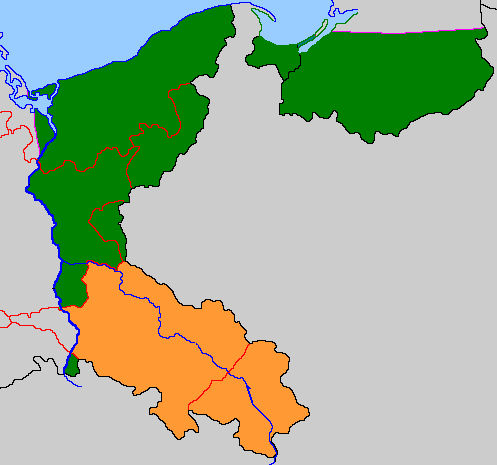
Silesian Piasts
The Silesian Piasts were the oldest line of the Piast dynasty beginning with Władysław II the Exile, son of Bolesław III Wrymouth, Duke of Poland...
retained power in most of the region until the early 16th century, the last (George William, duke of Legnica
Legnica
Legnica is a town in south-western Poland, in Silesia, in the central part of Lower Silesia, on the plain of Legnica, riverside: Kaczawa and Czarna Woda. Between 1 June 1975 and 31 December 1998 Legnica was the capital of the Legnica Voivodeship. It is currently the seat of the county...
) dying in 1675. The first German colonists arrived in the late 12th century, and large-scale German settlement started in the early 13th century with the reign of Henry I
Henry I the Bearded
Henry I the Bearded , of the Silesian line of the Piast dynasty, was Duke of Silesia at Wrocław from 1201 and Duke of Kraków and thus High Duke of all Poland - internally divided - from 1232 until his death.-Heir of Wroclaw:...
. After the era of German colonistaion, Polish language was still predominant in Upper Silesia and parts of Lower and Middle Silesia north of the Odra river. Here, the Germans who arrived during the Middle Ages were mostly Polonized
Polonization
Polonization was the acquisition or imposition of elements of Polish culture, in particular, Polish language, as experienced in some historic periods by non-Polish populations of territories controlled or substantially influenced by Poland...
; Germans dominated in large cities and Poles mostly in rural areas. The Polish speaking territories of Lower and Middle Silesia, commonly described until the end of the 19th century as the Polish side were mostly Germanized in the 18th and 19th centuries, except for some areas along the northeastern frontier. The province came under the control of Kingdom of Bohemia
Kingdom of Bohemia
The Kingdom of Bohemia was a country located in the region of Bohemia in Central Europe, most of whose territory is currently located in the modern-day Czech Republic. The King was Elector of Holy Roman Empire until its dissolution in 1806, whereupon it became part of the Austrian Empire, and...
, in the 14th century. Silesia passed to the Habsburg Monarchy
Habsburg Monarchy
The Habsburg Monarchy covered the territories ruled by the junior Austrian branch of the House of Habsburg , and then by the successor House of Habsburg-Lorraine , between 1526 and 1867/1918. The Imperial capital was Vienna, except from 1583 to 1611, when it was moved to Prague...
of Austria
Austria
Austria , officially the Republic of Austria , is a landlocked country of roughly 8.4 million people in Central Europe. It is bordered by the Czech Republic and Germany to the north, Slovakia and Hungary to the east, Slovenia and Italy to the south, and Switzerland and Liechtenstein to the...
in 1526, and was mostly conquered by Prussia's Frederick the Great in 1742. A part of Upper Silesia
Upper Silesia
Upper Silesia is the southeastern part of the historical and geographical region of Silesia. Since the 9th century, Upper Silesia has been part of Greater Moravia, the Duchy of Bohemia, the Piast Kingdom of Poland, again of the Lands of the Bohemian Crown and the Holy Roman Empire, as well as of...
became part of Poland after World War I, but the bulk of Silesia formed part of the post-1945 Recovered Territories.
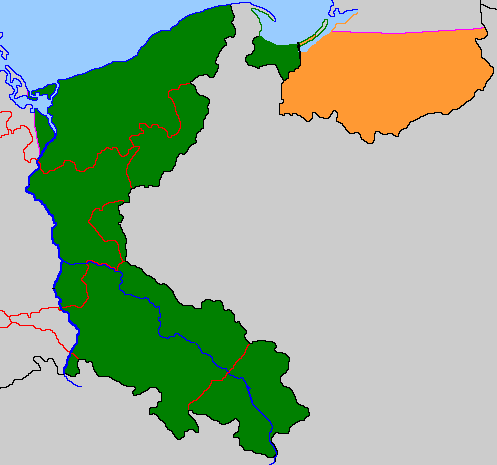
Warmia and Masuria
Warmia
Warmia or Ermland is a region between Pomerelia and Masuria in northeastern Poland. Together with Masuria, it forms the Warmian-Masurian Voivodeship....
and Masuria
Masuria
Masuria is an area in northeastern Poland famous for its 2,000 lakes. Geographically, Masuria is part of two adjacent lakeland districts, the Masurian Lake District and the Iława Lake District...
form the areas of Recovered Territories that were Polish fiefs. Originally inhabited by pagan Old Prussians
Old Prussians
The Old Prussians or Baltic Prussians were an ethnic group, autochthonous Baltic tribes that inhabited Prussia, the lands of the southeastern Baltic Sea in the area around the Vistula and Curonian Lagoons...
, these regions were incorporated into the state of the Teutonic Knights
Teutonic Knights
The Order of Brothers of the German House of Saint Mary in Jerusalem , commonly the Teutonic Order , is a German medieval military order, in modern times a purely religious Catholic order...
in the 13th and 14th centuries. By the Second Peace of Thorn (1466), an area of Warmia around Lidzbark
Lidzbark Warminski
Lidzbark Warmiński is a town in the Warmian-Masurian Voivodeship in Poland. It is the capital of Lidzbark County.- History :The town was originally an Old Prussian settlement known as Lecbarg until being conquered in 1240 by the Teutonic Knights, who called it Heilsberg...
was awarded to the Polish crown as part of Royal Prussia
Royal Prussia
Royal Prussia was a Region of the Kingdom of Poland and of the Polish-Lithuanian Commonwealth . Polish Prussia included Pomerelia, Chełmno Land , Malbork Voivodeship , Gdańsk , Toruń , and Elbląg . It is distinguished from Ducal Prussia...
, though with considerable autonomy. The remainder of today's Warmia-Masuria region became part of Ducal Prussia
Ducal Prussia
The Duchy of Prussia or Ducal Prussia was a duchy in the eastern part of Prussia from 1525–1701. It was the first Protestant duchy with a dominant German-speaking population, as well as Polish and Lithuanian minorities...
, formally a Polish fief. The region was taken by Prussia in the First Partition of Poland
First Partition of Poland
The First Partition of Poland or First Partition of the Polish-Lithuanian Commonwealth took place in 1772 as the first of three partitions that ended the existence of the Polish-Lithuanian Commonwealth by 1795. Growth in the Russian Empire's power, threatening the Kingdom of Prussia and the...
(1772). It formed the southern part of East Prussia
East Prussia
East Prussia is the main part of the region of Prussia along the southeastern Baltic Coast from the 13th century to the end of World War II in May 1945. From 1772–1829 and 1878–1945, the Province of East Prussia was part of the German state of Prussia. The capital city was Königsberg.East Prussia...
after World War I, becoming part of Poland after World War II, with northern East Prussia going to the Soviet Union
Soviet Union
The Soviet Union , officially the Union of Soviet Socialist Republics , was a constitutionally socialist state that existed in Eurasia between 1922 and 1991....
to form the Kaliningrad Oblast
Kaliningrad Oblast
Kaliningrad Oblast is a federal subject of Russia situated on the Baltic coast. It has a population of The oblast forms the westernmost part of the Russian Federation, but it has no land connection to the rest of Russia. Since its creation it has been an exclave of the Russian SFSR and then the...
.
Origin and use of the term
Zaolzie
Zaolzie is the Polish name for an area now in the Czech Republic which was disputed between interwar Poland and Czechoslovakia. The name means "lands beyond the Olza River"; it is also called Śląsk zaolziański, meaning "trans-Olza Silesia". Equivalent terms in other languages include Zaolší in...
by the Polish army. It became the official propaganda
Propaganda
Propaganda is a form of communication that is aimed at influencing the attitude of a community toward some cause or position so as to benefit oneself or one's group....
term coined in the aftermath of World War II
World War II
World War II, or the Second World War , was a global conflict lasting from 1939 to 1945, involving most of the world's nations—including all of the great powers—eventually forming two opposing military alliances: the Allies and the Axis...
to denote the former eastern territories of Germany that were being handed over to Poland
Potsdam Agreement
The Potsdam Agreement was the Allied plan of tripartite military occupation and reconstruction of Germany—referring to the German Reich with its pre-war 1937 borders including the former eastern territories—and the entire European Theatre of War territory...
. The underlying concept was to define post-war Poland as heir to the medieval Piasts'
Piast dynasty
The Piast dynasty was the first historical ruling dynasty of Poland. It began with the semi-legendary Piast Kołodziej . The first historical ruler was Duke Mieszko I . The Piasts' royal rule in Poland ended in 1370 with the death of king Casimir the Great...
realm, which was simplified into a picture of an ethnically homogeneous state that matched post-war borders, as opposed to the later Jagiellon Poland, which was multi-ethnic and located further east. The argument that this territory in fact constituted "old Polish lands" seized on a pre-war concept developed by Polish right-wing circles attached to the SN.
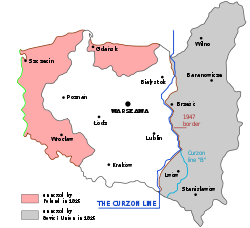
One reason for post-war Poland's favoring a Piast rather than a Jagiellon tradition was Stalin's refusal to withdraw from the Curzon line
Curzon Line
The Curzon Line was put forward by the Allied Supreme Council after World War I as a demarcation line between the Second Polish Republic and Bolshevik Russia and was supposed to serve as the basis for a future border. In the wake of World War I, which catalysed the Russian Revolution of 1917, the...
and the Allies' readiness to satisfy Poland with German territory instead. The original argument for awarding formerly German territory to Poland – compensation – was complemented by the argument that this territory in fact constituted former areas of Poland. Dmitrow says that "in official justifications for the border shift, the decisive argument that it presented a compensation for the loss of the eastern half of the pre-war Polish territory to the USSR, was viewed as obnoxious and concealed. Instead, a historical argumentation was foregrounded with the dogma, Poland had just returned to 'ancient Piast lands.'" Objections to the Allies' decisions and criticism of the Polish politicians' role at Potsdam were censored.
Also, the Piasts were perceived to have defended Poland against the Germans, while the Jagiellons' main rival had been the growing Duchy of Moscow, making them a less suitable basis for post-war Poland's Soviet-dominated situation. The PRL and PPR thus supported the idea of Poland based on old Piast lands. In fact, the question of the Recovered Territories was one of the few issues that did not divide the Polish Communists and their opposition, and there was unanimity regarding the western border. Even the underground anti-Communist press called for the Piast borders, that would end Germanisation
Germanisation
Germanisation is both the spread of the German language, people and culture either by force or assimilation, and the adaptation of a foreign word to the German language in linguistics, much like the Romanisation of many languages which do not use the Latin alphabet...
and Drang nach Osten
Drang nach Osten
Drang nach Osten was a term coined in the 19th century to designate German expansion into Slavic lands. The term became a motto of the German nationalist movement in the late nineteenth century...
.
Great efforts were made to propagate the view of recovered Piast territory, which were actively supported by the Catholic Church. The sciences were responsible for the development of this perception of history. In 1945 the Western Institute
Western Institute
The Western Institute in Poznań is a scientific research society focusing on the Western provinces of Poland - Kresy Zachodnie , history, economy and politics of Germany, and the Polish-German relations in history and today.Established by...
was founded to coordinate the scientific activities. Its director, Zygmunt Wojciechowski
Zygmunt Wojciechowski
Zygmunt Wojciechowski was a Polish historianand nationalist politician, active in the Second Polish Republic. During the Occupation of Poland by Nazi Germany he was a member of the Polish underground...
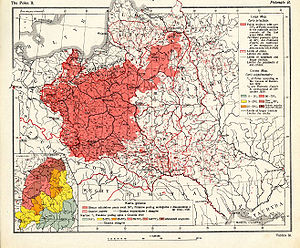
, characterized his mission as an effort to present the Polish history of the region, and project current Polish reality of these countries upon a historical background. Historical scientists, archaeologists, linguists, art historians and ethnologists worked in an interdisciplinary effort to legitimize the new borders. Their findings were popularised in monographs, periodicals, schoolbooks, travel guides, broadcasts and exhibitions. Official maps were drawn showing that the Polish frontiers under the first known Piast princes matched the new ones. According to Norman Davies
Norman Davies
Professor Ivor Norman Richard Davies FBA, FRHistS is a leading English historian of Welsh descent, noted for his publications on the history of Europe, Poland, and the United Kingdom.- Academic career :...
the young post war generation received education informing them about the fact that the boundaries of the People's Republic were the same as those on which the Polish nation had developed for centuries. Furthermore, they were instructed that the Polish "Motherland" has always been in the same location, even when occupied for long periods of time by foreigners or as political boundaries shifted. The official view was that the Poles had always had the inalienable and inevitable right to inhabit the Recovered Territories, even if prevented from doing so by foreign powers. As a consequence, the Piast concept was accepted by millions of Poles and is still believed by many. Furthermore, the Piast concept was used to persuade the Allied Powers, who found it difficult to define a Polish "ethnographic territory", to assume that it would be an intolerable injustice to not "give the territories back".
Due to fact that the Recovered Territories had been under German and Prussian rule for many centuries, many events of this history were perceived as part of "foreign" rather than "local" history in post-war Poland. Polish scholars thus concentrated on the Polish aspects of the territories:mediaeval Piast history of the region, the cultural, political and economic bonds to Poland, the history of the Polish-speaking population in Prussia and the "Drang nach Osten" as a historical constant since the Middle Ages.
By 1949 the term "Recovered Territories" had been dropped from Polish communist propaganda, but it is still used occasionally in common language. On the grounds that those areas should not be regarded as unique territories within the Polish state, the authorities began to refer to them instead as the "Western and Northern Territories". Wolff and Cordell say that that along with the debunking of communist historiography, "the 'recovered territories' thesis [...] has been discarded", and that "it is freely admitted in some circles that on the whole 'the recovered territories' had a wholly German character", but that this view has not necessarily been transmitted to the whole of Polish society. The term was also used outside Poland. In 1962 pope John XXIII
Pope John XXIII
-Papal election:Following the death of Pope Pius XII in 1958, Roncalli was elected Pope, to his great surprise. He had even arrived in the Vatican with a return train ticket to Venice. Many had considered Giovanni Battista Montini, Archbishop of Milan, a possible candidate, but, although archbishop...
referred to those territories as the western lands after centuries recovered, and did not revise his statement, even under pressure of the German embassy. The term is still sometimes considered useful, due to the Polish existence in those lands that was still visible in 1945, by some prominent scholars, such as Krzysztof Kwaśniewski .
After at the end of the Second World War, the Soviet Union
Soviet Union
The Soviet Union , officially the Union of Soviet Socialist Republics , was a constitutionally socialist state that existed in Eurasia between 1922 and 1991....
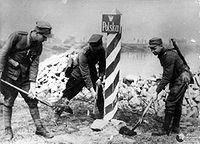
annexed the Polish territories in the east, and encouraged or forced the Polish population from the region to move west. In the framework of the campaign, the Soviets put up posters in public places with messages that promised a better life in the West
Polonization of the Recovered Territories
Kresy
The Polish term Kresy refers to a land considered by Poles as historical eastern provinces of their country. Today, it makes western Ukraine, western Belarus, as well as eastern Lithuania, with such major cities, as Lviv, Vilnius, and Hrodna. This territory belonged to the Polish-Lithuanian...
) annexed by the Soviet Union, Poland was effectively moved westwards
Territorial changes of Poland after World War II
The territorial changes of Poland after World War II were very extensive. In 1945, following the Second World War, Poland's borders were redrawn following the decisions made at the Potsdam Conference of 1945 at the insistence of the Soviet Union...
and its area reduced by almost 20% (from 389,000 km² to 312,000 km²). Millions of non-Poles – mainly Germans from the Recovered Territories, as well as some Ukrainians in the east – were to be expelled from the new Poland, while large numbers of Poles needed to be resettled having been expelled from the Kresy. The expellees were termed "repatriates"
Repatriation of Poles
Repatriation of Poles can refer to:*Repatriation of Poles *Repatriation of Poles...
. The result was the largest exchange of population in European history. The picture of the new western and northern territories being recovered Piast territory was used to forge Polish settlers and "repatriates" arriving there into a coherent community loyal to the new regime, and to justify the removal of the German inhabitants. Largely excepted from the expulsions of Germans
Flight and expulsion of Germans from Poland during and after World War II
The flight and expulsion of Germans from Poland was the largest of a series of flights and expulsions of Germans in Europe during and after World War II...
were the "autochthons", close to three million ethnically Slavic inhabitants of Masuria
Masuria
Masuria is an area in northeastern Poland famous for its 2,000 lakes. Geographically, Masuria is part of two adjacent lakeland districts, the Masurian Lake District and the Iława Lake District...
(Masurs), Pomerania
Pomerania
Pomerania is a historical region on the south shore of the Baltic Sea. Divided between Germany and Poland, it stretches roughly from the Recknitz River near Stralsund in the West, via the Oder River delta near Szczecin, to the mouth of the Vistula River near Gdańsk in the East...
(Kashubians
Kashubians
Kashubians/Kaszubians , also called Kashubs, Kashubes, Kaszubians, Kassubians or Cassubians, are a West Slavic ethnic group in Pomerelia, north-central Poland. Their settlement area is referred to as Kashubia ....
, Slovincians) and Upper Silesia
Upper Silesia
Upper Silesia is the southeastern part of the historical and geographical region of Silesia. Since the 9th century, Upper Silesia has been part of Greater Moravia, the Duchy of Bohemia, the Piast Kingdom of Poland, again of the Lands of the Bohemian Crown and the Holy Roman Empire, as well as of...
(Silesians
Silesians
Silesians , are the inhabitants of Silesia in Poland, Germany and the Czech Republic. A small diaspora community also exists in Karnes County, Texas in the USA....
). The Polish government aimed to retain as many autochthons as possible for propaganda purposes, as their presence on former German soil was used to indicate the intrinsic "Polishness" of the area and justify its incorporation into the Polish state as "recovered" territories. "Verification" and "national rehabilitation" processes were set up to reveal a "dormant Polishness" and determine who was redeemable as a Polish citizen. Few were actually expelled. The "autochthons" not only disliked the subjective and often arbitrary verification process, but they also faced discrimination even after completing it, such as the Polonization of their names. In the Lubusz region
Lubusz Voivodeship
- Administrative division :Lubusz Voivodeship is divided into 14 counties : 2 city counties and 12 land counties. These are further divided into 83 gminas....
(former East Brandenburg), the local authorities conceded already in 1948 that what the PZZ claimed to be a recovered "autochton" Polish population were in fact Germanized migrant workers, who had settled in the region in the late 19th and early 20th centuries - with the exception of one village, Babimost
Babimost
Babimost is a small town in Poland in the Lubusz Voivodeship, Zielona Gora County.Area: 3,6 km², Population: 4,300 , City rights: 1397...
, just across the pre-war border.
Removal of Germans and traces of German habitation
The "Recovered Territories" after the transfer still hosted a substantial German population. The Polish administration set up a "Ministry for the Recovered Territories", headed by the then deputy prime minister Władysław Gomułka. A "Bureau for Repatriation" was to supervise and organize the expulsions and resettlements. According to the national census of 14 February 1946, the population of Poland still included 2,288,000 Germans, of which 2,075,000—nearly 91 per cent—lived in the Recovered Territories. By this stage Germans still constituted more than 41 per cent of the inhabitants of these regions. However, by 1950 there were only 200,000 Germans remaining in Poland, and by 1957 that number fell to 65,000.The expulsion of the remaining Germans
Flight and expulsion of Germans from Poland during and after World War II
The flight and expulsion of Germans from Poland was the largest of a series of flights and expulsions of Germans in Europe during and after World War II...
in the first post-war years presaged a broader campaign to remove signs of former German control.
More than 30,000 German placenames were replaced with Polish or Polonized medieval Slavic ones. Previous Slavic and Polish names before Germanisation were used; in the cases when one was absent either the German name was translated or new names were invented. In January 1946, a Committee for Settling of Place Names was set up to assign new official toponyms. The German language was banned from public schools, government media and church services. Many German monuments, graveyards, buildings or entire ensembles of buildings etc. were demolished. Objects of art were moved to other parts of the country. German inscriptions were erased, including those on religious objects, in churches and in cemeteries. In Ziemia Lubuska "Socialist competitions" were organized to search and destroy final German traces.
Resettlement of the Territories
According to the 1939 German census, the territories were inhabited by 8,855,000 people, including a Polish minority in the territories' easternmost parts. While the German census placed the number of Polish-speakers and bilinguals below 700,000 people, Polish demographers have estimated that the actual number of Poles in the former German East was between 1.2 and 1.3 million. In the 1.2 million figure, approximately 850,000 were estimated for the Upper SilesiaUpper Silesia
Upper Silesia is the southeastern part of the historical and geographical region of Silesia. Since the 9th century, Upper Silesia has been part of Greater Moravia, the Duchy of Bohemia, the Piast Kingdom of Poland, again of the Lands of the Bohemian Crown and the Holy Roman Empire, as well as of...
n regions, 350,000 for southern East Prussia
East Prussia
East Prussia is the main part of the region of Prussia along the southeastern Baltic Coast from the 13th century to the end of World War II in May 1945. From 1772–1829 and 1878–1945, the Province of East Prussia was part of the German state of Prussia. The capital city was Königsberg.East Prussia...
and 50,000 for the rest of the territories.
People from all over Poland quickly moved in to replace the former German population in a process parallel to the expulsions, with the first settlers arriving in March 1945. These settlers took over farms and villages close to the pre-war frontier while the Red Army
Red Army
The Workers' and Peasants' Red Army started out as the Soviet Union's revolutionary communist combat groups during the Russian Civil War of 1918-1922. It grew into the national army of the Soviet Union. By the 1930s the Red Army was among the largest armies in history.The "Red Army" name refers to...
was still advancing. In addition to the settlers, other Poles went for "szaber" or looting expeditions, soon affecting all former eastern territories of Germany. On 30 March 1945, the Gdansk Voivodeship
Gdansk Voivodeship
The name Gdańsk Voivodeship has been used twice to designate local governments in Poland.----Gdańsk Voivodeship was a unit of administrative division and local government in Poland in the years 1975–98, superseded by Pomeranian Voivodeship...
was established as the first administrative Polish unit in the "recovered" territories. While the Germans were interned and expelled, close to 5 million settlers were either attracted or forced to settle the areas between 1945 and 1950. An additional 1,104,000 people had declared Polish nationality and were allowed to stay (851,000 of those in Upper Silesia
Upper Silesia
Upper Silesia is the southeastern part of the historical and geographical region of Silesia. Since the 9th century, Upper Silesia has been part of Greater Moravia, the Duchy of Bohemia, the Piast Kingdom of Poland, again of the Lands of the Bohemian Crown and the Holy Roman Empire, as well as of...
), bringing up the number of Poles to 5,894,600 as of 1950. The settlers can be grouped according to their background:
- settlers from Central Poland moving voluntarily (the majority)
- Poles that had been freed from forced labor in Nazi GermanyNazi GermanyNazi Germany , also known as the Third Reich , but officially called German Reich from 1933 to 1943 and Greater German Reich from 26 June 1943 onward, is the name commonly used to refer to the state of Germany from 1933 to 1945, when it was a totalitarian dictatorship ruled by...
(up to two million) - so-called "repatriants"Repatriation of PolesRepatriation of Poles can refer to:*Repatriation of Poles *Repatriation of Poles...
: Poles expelled from the areas east of the new Polish-Soviet border were preferably settled in the new western territories, where they made up 26% of the population (up to two million) - non-Poles forcibly resettled during the Operation Vistula in 1947. Large numbers of Ukrainians were forced to move from south-eastern Poland under a 1947 Polish government operation aimed at dispersing, and therefore assimilating, those Ukrainians who had not been expelled eastward already, throughout the newly acquired territories. Belarusians living around the area around Białystok were also pressured into relocating to the formerly German areas for the same reasons. This scattering of members of non-Polish ethnic groups throughout the country was an attempt by the Polish authorities to dissolve the unique ethnic identity of groups like the Ukrainians, Belarusians and LemkosLemkosLemkos , one of several quantitatively and territorially small ethnic groups who also call themselves Rusyns , are one of the ethnic groups inhabiting the Carpathian Mountains...
, and broke the proximity and communication necessary for strong communities to form. - Tens of thousands of JewishJewsThe Jews , also known as the Jewish people, are a nation and ethnoreligious group originating in the Israelites or Hebrews of the Ancient Near East. The Jewish ethnicity, nationality, and religion are strongly interrelated, as Judaism is the traditional faith of the Jewish nation...
Holocaust-survivors, most of them "repatriatesRepatriation of PolesRepatriation of Poles can refer to:*Repatriation of Poles *Repatriation of Poles...
" from the East, settled mostly in Lower SilesiaLower SilesiaLower Silesia ; is the northwestern part of the historical and geographical region of Silesia; Upper Silesia is to the southeast.Throughout its history Lower Silesia has been under the control of the medieval Kingdom of Poland, the Kingdom of Bohemia and the Austrian Habsburg Monarchy from 1526...
, creating Jewish cooperatives and institutions – the largest communities were founded in Wrocław (Breslau, Lower Silesia), SzczecinSzczecinSzczecin , is the capital city of the West Pomeranian Voivodeship in Poland. It is the country's seventh-largest city and the largest seaport in Poland on the Baltic Sea. As of June 2009 the population was 406,427....
(Stettin, PomeraniaPomeraniaPomerania is a historical region on the south shore of the Baltic Sea. Divided between Germany and Poland, it stretches roughly from the Recknitz River near Stralsund in the West, via the Oder River delta near Szczecin, to the mouth of the Vistula River near Gdańsk in the East...
) and Wałbrzych (Waldenburg, Lower Silesia). However most of them left Poland in 1968 due to the Polish 1968 political crisisPolish 1968 political crisisThe Polish 1968 political crisis, also known in Poland as March 1968 or March events pertains to the major student and intellectual protest action against the communist government of the People's Republic of Poland...
.
Polish and Soviet newspapers and officials encouraged Poles to relocate to the west – "the land of opportunity". These new territories were described as a place where opulent villas abandoned by fleeing Germans waited for the brave; fully furnished houses and businesses were available for the taking. In fact, the areas were devastated by the war, the infrastructure largely destroyed, suffering high crime rates and looting by gangs. It took years for civil order to be established.
In 1970, the Polish population of the Northern and Western territories for the first time caught up to the pre-war population level (8,711,900 in 1970 vs 8,855,000 in 1939). In the same year, the population of the other Polish areas also reached its pre-war level (23,930,100 in 1970 vs 23,483,000 in 1939).
While the estimates of how many Germans remained vary, a constant German exodus
German exodus from Eastern Europe
The German exodus from Eastern Europe describes the dramatic reduction of ethnic German populations in lands to the east of present-day Germany and Austria. The exodus began in the aftermath of World War I and was implicated in the rise of Nazism. It culminated in expulsions of Germans from...
took place even after the expulsions. Between 1956 and 1985, 407,000 people from Silesia
Silesia
Silesia is a historical region of Central Europe located mostly in Poland, with smaller parts also in the Czech Republic, and Germany.Silesia is rich in mineral and natural resources, and includes several important industrial areas. Silesia's largest city and historical capital is Wrocław...
and about 100,000 from Warmia-Masuria declared German nationality and left for Germany. In the early 1990s, after the Polish Communist regime had collapsed 300,000-350,000 people declared themselves German.
Today the population of the territories is predominantly Polish, although a small German minority still exists in a few places, including Olsztyn
Olsztyn
Olsztyn is a city in northeastern Poland, on the Łyna River. Olsztyn has been the capital of the Warmian-Masurian Voivodeship since 1999. It was previously in the Olsztyn Voivodeship...
, Masuria
Masuria
Masuria is an area in northeastern Poland famous for its 2,000 lakes. Geographically, Masuria is part of two adjacent lakeland districts, the Masurian Lake District and the Iława Lake District...
, and Upper Silesia
Upper Silesia
Upper Silesia is the southeastern part of the historical and geographical region of Silesia. Since the 9th century, Upper Silesia has been part of Greater Moravia, the Duchy of Bohemia, the Piast Kingdom of Poland, again of the Lands of the Bohemian Crown and the Holy Roman Empire, as well as of...
, particularly in Opole Voivodeship
Opole Voivodeship
- Administrative division :Opole Voivodeship is divided into 12 counties : 1 city county and 11 land counties. These are further divided into 71 gminas.The counties are listed in the following table .- Economy :...
.
Role of the Recovered Territories in the Communists' rise to power
The Communist government, not democratically legitimized sought to legitimize itself through anti-German propaganda. The German "revanchism" was played up as a permanent German threat, with the Communists being the only guarantors and defenders of Poland's continued possession of the "Recovered Territories". Gomułka asserted that:"The western territories are one of the reasons the government has the support of the people. This neutralizes various elements and brings people together. Westward expansion and agricultural reform will bind the nation with the state. Any retreat would weaken our domestic position."The redistribution of "ownerless property" among the people by the regime brought it broad-based popular sympathy.
After the Second World War, the Soviet Union annexed the Polish territory of the Kresy
Kresy
The Polish term Kresy refers to a land considered by Poles as historical eastern provinces of their country. Today, it makes western Ukraine, western Belarus, as well as eastern Lithuania, with such major cities, as Lviv, Vilnius, and Hrodna. This territory belonged to the Polish-Lithuanian...
—located east of the Curzon line
Curzon Line
The Curzon Line was put forward by the Allied Supreme Council after World War I as a demarcation line between the Second Polish Republic and Bolshevik Russia and was supposed to serve as the basis for a future border. In the wake of World War I, which catalysed the Russian Revolution of 1917, the...
—and encouraged or forced ethnic minorities in these parts of Poland, including ethnic Poles, to move west. In the framework of the campaign, Soviets exhibited posters in public places with messages such as,
Legal status of the territories
During the Cold WarCold War
The Cold War was the continuing state from roughly 1946 to 1991 of political conflict, military tension, proxy wars, and economic competition between the Communist World—primarily the Soviet Union and its satellite states and allies—and the powers of the Western world, primarily the United States...
the official position in the First World
First World
The concept of the First World first originated during the Cold War, where it was used to describe countries that were aligned with the United States. These countries were democratic and capitalistic. After the fall of the Soviet Union and the end of the Cold War, the term "First World" took on a...
was that the concluding document of the Potsdam Conference
Potsdam Conference
The Potsdam Conference was held at Cecilienhof, the home of Crown Prince Wilhelm Hohenzollern, in Potsdam, occupied Germany, from 16 July to 2 August 1945. Participants were the Soviet Union, the United Kingdom, and the United States...
was not an international treaty
Treaty
A treaty is an express agreement under international law entered into by actors in international law, namely sovereign states and international organizations. A treaty may also be known as an agreement, protocol, covenant, convention or exchange of letters, among other terms...
, but a mere memorandum
Memorandum
A memorandum is from the Latin verbal phrase memorandum est, the gerundive form of the verb memoro, "to mention, call to mind, recount, relate", which means "It must be remembered ..."...
. It regulated the issue of the German eastern border, which was to be the Oder-Neisse line
Oder-Neisse line
The Oder–Neisse line is the border between Germany and Poland which was drawn in the aftermath of World War II. The line is formed primarily by the Oder and Lusatian Neisse rivers, and meets the Baltic Sea west of the seaport cities of Szczecin and Świnoujście...
, but the final article of the memorandum said that the final status of the German state and therefore its territories were subject to a separate peace treaty between Germany and the Allies of World War II
Allies of World War II
The Allies of World War II were the countries that opposed the Axis powers during the Second World War . Former Axis states contributing to the Allied victory are not considered Allied states...
. During the period from 1945 to 1990 two treaties between Poland and both East and West Germany
West Germany
West Germany is the common English, but not official, name for the Federal Republic of Germany or FRG in the period between its creation in May 1949 to German reunification on 3 October 1990....
were signed concerning the German-Polish border. In 1950 the German Democratic Republic
German Democratic Republic
The German Democratic Republic , informally called East Germany by West Germany and other countries, was a socialist state established in 1949 in the Soviet zone of occupied Germany, including East Berlin of the Allied-occupied capital city...
and the People's Republic of Poland
People's Republic of Poland
The People's Republic of Poland was the official name of Poland from 1952 to 1990. Although the Soviet Union took control of the country immediately after the liberation from Nazi Germany in 1944, the name of the state was not changed until eight years later...
signed the Treaty of Zgorzelec
Treaty of Zgorzelec
The Treaty of Zgorzelec between the Republic of Poland and East Germany was signed on 6 July 1950 in Polish Zgorzelec, until 1945 the eastern part of the divided city of Görlitz.The agreement...
, recognizing the Oder-Neisse line, officially designated by the Communists as the "Border of Peace and Friendship". On 7 December 1970 the Treaty of Warsaw
Treaty of Warsaw
Treaty of Warsaw may refer to* Treaty of Warsaw , a Polono-Lithuanian-Swedish alliance during the Great Northern War* Treaty of Warsaw , an alliance between Britain, Austria, the Dutch Republic and Poland-Saxony agreeing to uphold the Pragmatic Sanction* Treaty of Warsaw , granting rights to...
between the Federal Republic of Germany and Poland was signed concerning the Polish western border. Both sides committed themselves to nonviolence and accepted the existing de facto border - the Oder-Neisse line
Oder-Neisse line
The Oder–Neisse line is the border between Germany and Poland which was drawn in the aftermath of World War II. The line is formed primarily by the Oder and Lusatian Neisse rivers, and meets the Baltic Sea west of the seaport cities of Szczecin and Świnoujście...
. However a final treaty was not signed until 1990 as the "Treaty on the Final Settlement With Respect to Germany
Treaty on the Final Settlement with Respect to Germany
The Treaty on the Final Settlement With Respect to Germany, was negotiated in 1990 between the Federal Republic of Germany and the German Democratic Republic , and the Four Powers which occupied Germany at the end of World War II in Europe: France, the Soviet Union, the United Kingdom, and the...
".
Until the Treaty on the Final Settlement, the West German government regarded the status of the German territories east of the Oder-Neisse rivers as that of areas "temporarily under Polish or Soviet administration". To facilitate wide international acceptance of German reunification
German reunification
German reunification was the process in 1990 in which the German Democratic Republic joined the Federal Republic of Germany , and when Berlin reunited into a single city, as provided by its then Grundgesetz constitution Article 23. The start of this process is commonly referred by Germans as die...
in 1990, the German political establishment recognized the "facts on the ground
Facts on the ground
Facts on the ground is a diplomatic term that means the situation in reality as opposed to in the abstract. It originated in discussions of the Israeli–Palestinian conflict, where it was used to refer to Israeli settlements built in the occupied West Bank, which were intended to establish permanent...
" and accepted the clauses in the Treaty on the Final Settlement whereby Germany renounced all claims to territory east of the Oder-Neisse line. This allowed the treaty to be negotiated quickly and for unification of democratic West Germany and communist East Germany to go ahead quickly.
In accordance with a duty imposed on Germany by the "Treaty on the Final Settlement", in the same year, 1990, Germany signed a separate treaty with Poland, the German-Polish Border Treaty, confirming the two countries' present borders.
The signature and ratification of the border treaty between Germany and Poland formalized in international law the recognition of the existing border and put an end to all German claims.
See also
- History of German settlement in Eastern EuropeHistory of German settlement in Eastern EuropeThe presence of German-speaking populations in Central and Eastern Europe is rooted in centuries of history, with the settling in northeastern Europe of Germanic peoples predating even the founding of the Roman Empire...
- Former eastern territories of Germany
- German exodus from Eastern EuropeGerman exodus from Eastern EuropeThe German exodus from Eastern Europe describes the dramatic reduction of ethnic German populations in lands to the east of present-day Germany and Austria. The exodus began in the aftermath of World War I and was implicated in the rise of Nazism. It culminated in expulsions of Germans from...
- Territorial changes of Poland after World War IITerritorial changes of Poland after World War IIThe territorial changes of Poland after World War II were very extensive. In 1945, following the Second World War, Poland's borders were redrawn following the decisions made at the Potsdam Conference of 1945 at the insistence of the Soviet Union...
- IrredentismIrredentismIrredentism is any position advocating annexation of territories administered by another state on the grounds of common ethnicity or prior historical possession, actual or alleged. Some of these movements are also called pan-nationalist movements. It is a feature of identity politics and cultural...
- RevanchismRevanchismRevanchism is a term used since the 1870s to describe a political manifestation of the will to reverse territorial losses incurred by a country, often following a war or social movement. Revanchism draws its strength from patriotic and retributionist thought and is often motivated by economic or...