

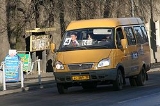
Marshrutka

Encyclopedia
Marshrutka from marshrutnoye taksi ( mɐrˈʂrutnəje takˈsʲi) is a share taxi
in the CIS
countries, the Baltic states
, and Bulgaria
. Marshrutnoye taksi literally means routed taxicab. The role of the modern marshrutka is basically similar to the minibus
in other countries except some implementations of marshrutka do allow standing capacity.
word "Marschroute", which is composed of the word "Marsch" (a walk, march) and "Route" (route).
limouzines. Unlike ordinary taxicab using the taximeter
, routed taxicab rides were paid per zones, like trams, buses and trolley buses; the fare was lesser than in ordinary taxis, but higher than in large-scale public transports. Unlike ordinary taxis where a passenger could enjoy a private ride, the routed taxicab would also pick up and drop passengers along its route.
Moscow was not the only city operating routed taxis, other large Soviet cities also organized these. For example, in Gorky
, there was a routed taxi line between Sormovo
and the Nizhny Novgorod Kremlin. , the full fare was 3½ roubles; a similar service cost 1 rouble with a bus, or 50 kopecks with a tram.
During the Great Patriotic War, as cars were requisitioned by the Army, routed taxi services were ceased. It was only by 1950s that these were reintroduced in most cities where they were used before the war. The ZiS-110
and GAZ-12 cars were widely used in this role until mid-1960s.
There were interurban services of routed taxicabs, too. For example, Moscow-Yalta
route was operated in summer season taking 2 days, with a night stop in Belgorod
.
In 1960s, minibuses (RAF-977
) and small buses (PAZ-652) became common as routed taxis. The routes were operated at municipal level, thus the quality and concept varied greatly between regions. The fare gap between buses and routed taxicabs lessened. For example, in Moscow the standard bus fare was 5 kopecks, and minibus fare was 15 kopecks with most routes; in Gorky a regular bus ride cost 6 kopecks, and routed taxi ride was 10 kopecks.
Later, RAF-977 minibuses were replaced by the updated model, RAF-2203 Latvija
. Eventually, practically all marshrutkas became RAF-2203 Latvija; many people even referred to Marshrutka as "Latvia".
, LAZ, PAZ, RAF, and KAvZ
, as well as irregular imported used minibuses), obtained on a secondary market, had been used by entrepreneurs as a back-up on the busiest routes since the early 1990s, it wasn't until the auto manufacturer GAZ
rolled out the first mass produced Russian minibus, GAZelle
, that the modern system took shape.
GAZelle was an instant hit. The cheap, easy-to-repair, and lease-friendly passenger minibus with a capacity of twelve seated passengers was exactly what entrepreneurs needed. An initial investment of around US$8,000 could be paid off in less than a year given some luck, so a lot of individual entrepreneurs entered the market, as well as some larger companies. At this point in time, licensing for public transportation in particular was not required. The vehicle only had to pass annual safety check-ups, which were relatively easy, since local authorities trusted GAZ
cars. Moreover, the GAZelle could be easily equipped to run on natural gas
.
During this period, most marshrutkas followed already well-established public transit routes.
Another consequence was a massive response from car and bus manufacturers. Old manufacturers introduced smaller, more manoeuvrable models (like PAZ or KAZ) and started licensed assembly of minibuses (KrAZ
started assembling Iveco
minibuses). Diesel-engined models in the form of the new Isuzu Bogdan
, Tata Etalon and others have seen immense popularity. The capacity also grew from fifteen sitting passengers to jam-packed small buses of fifty, and the busiest routes in major cities now use full-size privately owned buses operating at the same price with municipal companies. The original GAZelle saw a few official modifications to its body, length and passenger capacity to better serve buyer demands, including models featuring diesel engines.
, GAZelle
, Mercedes Sprinter, and Ford Transit
vans are usually used as route taxis. The GAZelle
and PAZ-3205
are widely used as a marshrutkas in other Russian cities, although in eastern parts the Japanese minibuses like Toyota Hiace
are more popular. Route taxis congregate at train stations, metro stations, and transfer points at the end of tram and trolly bus routes. In St. Petersburg the route is identified as "Kxxx" with "xxx" being the number of the bus, tram and trolley bus routes being followed and "K" standing for the Russian word for "commercial" (коммерческий, kommerchesky). There are routes travelled solely by route taxis — cross-city routes connecting termini of the metro. Usually, the route taxi will not depart of the end point of a route until all seats are occupied. The taxi will skip stops if they are not requested and (if operated with a GAZelle or similar) by-pass hailing riders until it has empty seats. The fare is commonly one and a half or twice the fare of a regular bus.
The appeal for the route taxi passenger is officially considered to be a faster ride in less crowded conditions than regular transport; the taxi routes that follow cross-city routes are most often the fastest way to travel across the city. However, collapse of municipal transport services in many cities makes it absolutely impractical to commute without the help of marshrutkas at all.
In Moscow, for example, the average cost for one route is 25 roubles (equals 0.75 euro
) (2011 year).
In Kiev
, Ukraine, the Bogdan van is the most common route taxi which can be found running around the city, while the Etalon van serves on the lower ridership route. In Kiev, the marshrutka is more popular and the fare is a bit more expensive than the regular public bus. Hail and Ride
is possible regardless of the designated bus stop
, but generally this is up to driver's final decision (NB: State Automobile inspection (ДАІ) doesn't allow to take passengers outside from the bus stops along the city routes). As of now, marshrutkas in Kiev do not require ticket-perforating, although a passenger can ask for a ticket when paying the fare, but there is no staff working to randomly check the tickets as on a regular bus (although the traditional hole punch
still remains on existing vehicles). Outside of Kiev it is not unusual to find marshrutki that are secondhand Western European minibuses or converted vans. Often they still have all the original paintwork advertising the former owner's business.
Etalons and Bogdans usually have a conductor on board selling the tickets. In the GAZelle or converted van, the fare is paid directly to the driver (who, if reckless enough, might count it while speeding off the stop), either upon pickup or departure of the passenger, with a note or sticker posted to indicate the driver's preference. It is common etiquette
for passengers to relay the fare of fellow passengers to the driver, and the possible change backwards.
In Minsk
, Belarus
, the fleet of vehicles is same as Russia, consisting of Mercedes Sprinter, and Ford Transit
.
In Yerevan
, Armenia
, marshrutkas ( maršrutka or երթուղային տաքսի ert’uġayin tak'si) cost the same as larger buses (100 AMD
in 2011), with the fare being paid when the passenger exits. There are no tickets issued. Marshrutkas can be hailed anywhere along their route, though they do have specific stops, and riders can exit at any point if the driver is willing to pull over. While the law requires that marshrutkas stop only at designated stops while on major streets, compliance with this law depends on the individual driver and the degree of police enforcement at any given time.
In Tbilisi
, Georgia
, marshrutkas ("მარშრუტკები" marshrutkebi or "სამარშრუტო ტაქსები" samarshruto taksebi) vary in cost from 50 tetri
to 80 tetri
. Up to 2011, all marshrutkas in Tbilisi had a common fare of 50 tetri
, however after introducing new, air-conditioned vehicles, the price went up. Marshrutkas stop upon passengers' request. There are no specific stops where the driver has to do so. In most Marshrutkas, the driver is paid in cash. In some newer vehicles, the passengers have to use fare cards.
In Romania
, where they are called "maxi-taxi", marshrutkas supplied the need of affordable public transportation in smaller towns when some local administrations dismantled the expensive community-owned systems of buses. In Bucharest
maxi-taxis existed between 2003 and 2007 when the city-owned RATB temporary lost the right to maintain suburban commuter buses which linked main city with the villages around it. On the Black Sea shore, it is very common to travel from Constanţa
or Mangalia
to the resorts on a maxi-taxi, especially in those resorts where the competing train service is far from the beach and/or lodging facilities.
In Moldova
, Rutierele
(known in Russian as marshrutkas) cost 3 Moldovan Lei and run all over the capital and to most large cities in the country. Most Rutierele are white and have only the roof vent and front windows for airflow. Rutierele usually seat around 16 people with space for another six to ten to stand while holding railing.
Bulgarian marshrutkas are customized passenger vans. They have been modified to include large windows in the back, rails and handles.
In some cases, seating has been modified — popular routes carrying more passengers typically have more standing space.
Sofia
's marshrutka system is considerably developed and has existed since the late 1980s, offering many routes crossing through the city centre, communicating with outer suburbs and nearby villages. The Sofia fleet includes such models as the Peugeot Boxer, Citroën Jumper
, Ford Transit
, Iveco Daily
and Renault Master
. Other cities have adopted a similar system and models available vary from city to city.
Similar to public transport, they operate along numbered routes around the city and have a fixed fare (1.50 leva
in Sofia, equivalent to €
0.75 as of 2008); the fare is paid upon getting in. Marshrutkas are not obliged to stop anywhere on the route, although there are popular spots where they do slow down. Marshrutka drivers are asked to stop and pick one up in a taxi-like manner; the getting-off is arranged with the driver, often by just standing up and approaching the door. Sometimes the driver will ask for consent to veer off the charted path to avoid a traffic jam or roadworks.
Marshrutkas are commonly white, although their colour can vary, and they are often partially covered in advertising
. There are about 50 marshrutka lines in Sofia alone; the lines being operated by separate private companies. About 10 lines operate in Plovdiv
.
Historically, marshrutkas were a common means of transport in larger cities of the Latvian SSR
, the RAF-2203
was the only minibus used for this purpose.
In today's Latvia
, marshrutkas are still in service in a variety of cities – mostly in Riga
, but also in Daugavpils
, Liepāja
, Jelgava
, Jūrmala
, Rēzekne
and elsewhere. They are mainly used as public transportation within city limits, but sometimes their routes extend outside city limits (e.g. from Riga to Jūrmala). Marshrutkas were and are still widely used, with travelers themselves explaining that the marshrutkas are a much faster way of public transportation than bus
es or trolleybus
es (sometimes also tram
s, but that is disputed).
The main operators in Riga are KORT, Blands and Rīgas Taksometru Parks (RTP). KORT is the biggest marshrutka operator in Riga. It (and also the other two) owns white Mercedes-Benz Sprinter
buses, yellow Renault Master
s (mostly to RTP, small number of them also red), and white GAZelle
buses. KORT is sometimes criticized by locals for being the first of the three marshrutka operators to raise the ticket price for a ride, such as when city-owned Rīgas Satiksme
raised its ticket prices for other modes of public transport on 1 April 2008.
Blands is the second operator of marshrutkas in Riga, and was the last to raise its ticket price in 2008. It uses the same buses as KORT.
RTP's routes were usually going out the city from their main station in Riga's city center, next to Origo supermarket, e.g. Riga to Ulbroka
, Riga to Jūrmala
, Riga to Kadaga
(near to Ādaži
). From January 1, 2009, RTP has closed most of their routes due to financial reasons.
The prices of the tickets (March 12, 2009):
KORT - 0.50 Ls
Blands - 0.40 Ls
RTP - 0.45 Ls (Rīga-Imanta
), 0.50 Ls (Rīga-Bolderāja
).
In Lithuania
, marshrutkas have been in service in a variety of cities since the end of the 1980s – mostly in Vilnius
and Kaunas
, but also used in Klaipėda
, Šiauliai
and elsewhere. They are mainly used as public transportation within city limits, but sometimes their routes extend outside the city limits. Marshrutkas were and are still widely used, with travellers themselves explaining that the marshrutkas are a much faster way of public transportation than bus
es or trolleybus
es.
In Estonia
, marshrutkas ("Marsruuttakso" in Estonian) are widely used in cities of Tallinn
and Tartu
. In case of Tallinn they are mostly used on routes connecting city to small town's around like Saku
, Saue
and Kose
where most people have cars and demand for public transport is lower but many departure times are very useful. Late evening departures may have higher fares because local trains and other means of transportation will not run any more. In late evening marshrutkas are also good choice for suburbs were bus services end around midnight and some marshrutkas are going hour or two later through. Marshrutkas are widely used in Tartu on all routes and have much better point because city population is only quarter of Tallinn.
(at least in Uzbekistan
, Kazakhstan
and Kyrgyzstan
), standing room is allowed on marshrutkas. Indeed, drivers will often encourage passengers to board the marshrutka and cram together until there is physically not enough space for another passenger to board; in such a case, once a passenger exits the marshrutka, the driver will stop for others and allow them on until it is full again. Marshrutkas may be boarded at bus stops, but will usually stop other places if hailed, and often won't stop at bus stops unless a passenger requests an exit or a prospective passenger hails the marshrutka. Passengers may request to exit at any point, but may have to wait until the driver deems that it is convenient to stop.
The typical Central Asian marshrutka is usually a white minibus branded "Mercedes", though may come in any number of colours, sometimes used to distinguish a specific route. The models most commonly used have a vent in the roof that may be opened by passengers if the atmosphere inside the marshrutka becomes too stuffy. Though not the norm, other vehicles are used as well; for example, all 149 marshrutkas in Bishkek are Shaolin Citybuses. In Osh, an older, shorter model of vehicle which doesn't lend itself well to standing room is also used for some routes.
The normal price per fare in Bishkek is 8 som (about 20 cents), and there are no transfers. Some routes may charge as much as 15 som per fare, such as marshrutkas heading to Dordoy Bazaar
, which is on the outskirts of the city. In Almaty, on 3 January 2008, bus fare was increased from 40 tenge
to 60 tenge (about 40 cents). Prices range throughout Central Asia, dependent on whether it is a city or village, the local cost of living, distance covered by route, and government policy.
Share taxi
A share taxi is a mode of transport that falls between taxis and conventional buses. These informal vehicles for hire are found throughout the world. They are smaller than buses, and usually take passengers on a fixed or semi-fixed route without timetables, usually leaving when all seats are filled...
in the CIS
Commonwealth of Independent States
The Commonwealth of Independent States is a regional organization whose participating countries are former Soviet Republics, formed during the breakup of the Soviet Union....
countries, the Baltic states
Baltic states
The term Baltic states refers to the Baltic territories which gained independence from the Russian Empire in the wake of World War I: primarily the contiguous trio of Estonia, Latvia, Lithuania ; Finland also fell within the scope of the term after initially gaining independence in the 1920s.The...
, and Bulgaria
Bulgaria
Bulgaria , officially the Republic of Bulgaria , is a parliamentary democracy within a unitary constitutional republic in Southeast Europe. The country borders Romania to the north, Serbia and Macedonia to the west, Greece and Turkey to the south, as well as the Black Sea to the east...
. Marshrutnoye taksi literally means routed taxicab. The role of the modern marshrutka is basically similar to the minibus
Minibus
A minibus or minicoach is a passenger carrying motor vehicle that is designed to carry more people than a multi-purpose vehicle or minivan, but fewer people than a full-size bus. In the United Kingdom, the word "minibus" is used to describe any full-sized passenger carrying van. Minibuses have a...
in other countries except some implementations of marshrutka do allow standing capacity.
| language | nominative singular | nominative plural |
|---|---|---|
| Belarusian Belarusian language The Belarusian language , sometimes referred to as White Russian or White Ruthenian, is the language of the Belarusian people... |
маршрутная таксоўка (маршрутка) | маршрутныя таксоўкі (маршруткі) |
| Bulgarian Bulgarian language Bulgarian is an Indo-European language, a member of the Slavic linguistic group.Bulgarian, along with the closely related Macedonian language, demonstrates several linguistic characteristics that set it apart from all other Slavic languages such as the elimination of case declension, the... |
маршрутно такси (маршрутка) | маршрутни таксита (маршрутки) |
| Russian Russian language Russian is a Slavic language used primarily in Russia, Belarus, Uzbekistan, Kazakhstan, Tajikistan and Kyrgyzstan. It is an unofficial but widely spoken language in Ukraine, Moldova, Latvia, Turkmenistan and Estonia and, to a lesser extent, the other countries that were once constituent republics... |
маршрутное такси (маршрутка) | маршрутные такси (маршрутки) |
| Ukrainian Ukrainian language Ukrainian is a language of the East Slavic subgroup of the Slavic languages. It is the official state language of Ukraine. Written Ukrainian uses a variant of the Cyrillic alphabet.... |
маршрутне таксі | маршрутнi таксі |
| Latvian Latvian language Latvian is the official state language of Latvia. It is also sometimes referred to as Lettish. There are about 1.4 million native Latvian speakers in Latvia and about 150,000 abroad. The Latvian language has a relatively large number of non-native speakers, atypical for a small language... |
maršruta taksometrs (mikriņš, maršrutnieks) | maršruta taksometri (mikriņi, maršrutnieki) |
| Lithuanian Lithuanian language Lithuanian is the official state language of Lithuania and is recognized as one of the official languages of the European Union. There are about 2.96 million native Lithuanian speakers in Lithuania and about 170,000 abroad. Lithuanian is a Baltic language, closely related to Latvian, although they... |
maršrutinis taksi (mikroautobusas, mikriukas, mikrobas) | maršrutiniai taksi (mikroautobusai, mikriukai, mikrobai) |
| Estonian Estonian language Estonian is the official language of Estonia, spoken by about 1.1 million people in Estonia and tens of thousands in various émigré communities... |
marsruuttakso (marsa, väikebuss) | marsruuttaksod (marsad, väikebussid) |
| Armenian Armenian language The Armenian language is an Indo-European language spoken by the Armenian people. It is the official language of the Republic of Armenia as well as in the region of Nagorno-Karabakh. The language is also widely spoken by Armenian communities in the Armenian diaspora... |
երթուղային տաքսի (մարշրուտկա) | երթուղային տաքսիներ (մարշրուտկաներ) |
Etymology
The Russian word "маршрутка" is the colloquial form for "маршрутное такси", which literally means "routed taxi(cab)" ("маршрут" referring to a planned route that something follows, and "такси" meaning "taxi(cab)"). The word "маршрут" is from the GermanGerman language
German is a West Germanic language, related to and classified alongside English and Dutch. With an estimated 90 – 98 million native speakers, German is one of the world's major languages and is the most widely-spoken first language in the European Union....
word "Marschroute", which is composed of the word "Marsch" (a walk, march) and "Route" (route).
Early days (pre-1992)
"Route taxicabs" were introduced in Moscow for the first time in the USSR in 1930s, operated by ZiS-101ZIS-101
ZIS-101 was a limousine from Zavod Imeni Stalina. The 101 was introduced in 1936 and was equipped with an straight-8 engine producing and giving a top speed of . The car was inspired by Packard designs of the time...
limouzines. Unlike ordinary taxicab using the taximeter
Taximeter
A taximeter is a mechanical or electronic device installed in taxicabs and auto rickshaws that calculates passenger fares based on a combination of distance travelled and waiting time...
, routed taxicab rides were paid per zones, like trams, buses and trolley buses; the fare was lesser than in ordinary taxis, but higher than in large-scale public transports. Unlike ordinary taxis where a passenger could enjoy a private ride, the routed taxicab would also pick up and drop passengers along its route.
Moscow was not the only city operating routed taxis, other large Soviet cities also organized these. For example, in Gorky
Nizhny Novgorod
Nizhny Novgorod , colloquially shortened to Nizhny, is, with the population of 1,250,615, the fifth largest city in Russia, ranking after Moscow, St. Petersburg, Novosibirsk, and Yekaterinburg...
, there was a routed taxi line between Sormovo
Sormovo
Sormovo may refer to:*Sormovo , an airfield near Nizhny Novgorod, Russia*Sormovsky City District , a city district of Nizhny Novgorod, Russia...
and the Nizhny Novgorod Kremlin. , the full fare was 3½ roubles; a similar service cost 1 rouble with a bus, or 50 kopecks with a tram.
During the Great Patriotic War, as cars were requisitioned by the Army, routed taxi services were ceased. It was only by 1950s that these were reintroduced in most cities where they were used before the war. The ZiS-110
ZIS-110
ZIS-110 was a limousine from ZIL introduced in 1946. The 110 was developed from the reverse engineering of a 1942 Packard Super Eight during 1944. The first 5 prototypes were completed by August 1945. It was powered by a 6 litre, 8 cylinder engine producing and giving a top speed of over...
and GAZ-12 cars were widely used in this role until mid-1960s.
There were interurban services of routed taxicabs, too. For example, Moscow-Yalta
Yalta
Yalta is a city in Crimea, southern Ukraine, on the north coast of the Black Sea.The city is located on the site of an ancient Greek colony, said to have been founded by Greek sailors who were looking for a safe shore on which to land. It is situated on a deep bay facing south towards the Black...
route was operated in summer season taking 2 days, with a night stop in Belgorod
Belgorod
-Twin towns/sister cities:Belgorod is twinned with: Wakefield, England, United Kingdom Herne, North Rhine-Westphalia, Germany Palembang, South Sumatra, Indonesia Opole, Poland Vyshhorod, Ukraine Kharkiv, Ukraine-External links:...
.
In 1960s, minibuses (RAF-977
RAF-977
The RAF-977 was a Soviet van made by Riga Autobus Factory based on components from the GAZ-21 Volga. It was introduced in 1958 in a variety of styles including a 10-seat minibus and a cargo van...
) and small buses (PAZ-652) became common as routed taxis. The routes were operated at municipal level, thus the quality and concept varied greatly between regions. The fare gap between buses and routed taxicabs lessened. For example, in Moscow the standard bus fare was 5 kopecks, and minibus fare was 15 kopecks with most routes; in Gorky a regular bus ride cost 6 kopecks, and routed taxi ride was 10 kopecks.
Later, RAF-977 minibuses were replaced by the updated model, RAF-2203 Latvija
RAF-2203
The RAF-2203 Latvija was a minibus designed and developed by Rīgas Autobusu Fabrika from 1976—1997. They were widely used throughout the USSR as fixed-run taxis , medical cars, used for Latvenergo and as a special services vehicles...
. Eventually, practically all marshrutkas became RAF-2203 Latvija; many people even referred to Marshrutka as "Latvia".
Marshrutka boom (1992–2000)
The introduction of market economies greatly changed the supply of transportation in the urban population in the CIS. The demand for faster and more versatile public transit came to be fulfilled dramatically, while the demand for the underfunded municipal transportation system dropped; people are willing to pay premium for better service. Although existing buses (like IkarusIkarus Bus
Ikarus is a bus manufacturer based in Budapest, Hungary. It was established in 1895 as Uhri Imre Kovács- és Kocsigyártó Üzeme .-History:...
, LAZ, PAZ, RAF, and KAvZ
KAvZ
KAvZ is a bus manufacturer in Kurgan, Russia. The factory started producing buses in 1958, based on trucks from GAZ. During the 1990s, it assembled Ikarus buses for the Russian market. Now a subsidiary of GAZ, it specialises in producing small buses, in particular school buses.-External links:* *...
, as well as irregular imported used minibuses), obtained on a secondary market, had been used by entrepreneurs as a back-up on the busiest routes since the early 1990s, it wasn't until the auto manufacturer GAZ
GAZ
GAZ or Gorkovsky Avtomobilny Zavod , translated as Gorky Automobile Plant , started in 1932 as NAZ, a cooperation between Ford and the Soviet Union. It is one of the largest companies in the Russian automotive industry....
rolled out the first mass produced Russian minibus, GAZelle
GAZelle
The GAZelle is a series of mid-sized trucks, vans and buses made by Russian car manufacturer GAZ. GAZelles are similar to the later launched GAZ-2215/GAZ-2752 Sobol and GAZ-3310 Valdai line of vans and light trucks...
, that the modern system took shape.
GAZelle was an instant hit. The cheap, easy-to-repair, and lease-friendly passenger minibus with a capacity of twelve seated passengers was exactly what entrepreneurs needed. An initial investment of around US$8,000 could be paid off in less than a year given some luck, so a lot of individual entrepreneurs entered the market, as well as some larger companies. At this point in time, licensing for public transportation in particular was not required. The vehicle only had to pass annual safety check-ups, which were relatively easy, since local authorities trusted GAZ
GAZ
GAZ or Gorkovsky Avtomobilny Zavod , translated as Gorky Automobile Plant , started in 1932 as NAZ, a cooperation between Ford and the Soviet Union. It is one of the largest companies in the Russian automotive industry....
cars. Moreover, the GAZelle could be easily equipped to run on natural gas
Natural gas
Natural gas is a naturally occurring gas mixture consisting primarily of methane, typically with 0–20% higher hydrocarbons . It is found associated with other hydrocarbon fuel, in coal beds, as methane clathrates, and is an important fuel source and a major feedstock for fertilizers.Most natural...
.
During this period, most marshrutkas followed already well-established public transit routes.
Modern days (2000–present)
Witnessing the success of privately owned public transportation led to some reaction from the society. Local authorities responded by toughening safety and licensing requirements—like mandatory free transportation of a certain number of disabled passengers upon request and "package deals" in route licensing—tying the privilege to drive on a lucrative route to the chore of driving several not-so-profitable ones. The market became dominated either by large companies or by unions of owner-operators of individual minibuses. Some of municipal public transportation companies entered the business, and prices dropped due to increased competition.Another consequence was a massive response from car and bus manufacturers. Old manufacturers introduced smaller, more manoeuvrable models (like PAZ or KAZ) and started licensed assembly of minibuses (KrAZ
KrAZ
KrAZ is a factory that produces trucks and other special-purpose vehicles in Kremenchuk, Ukraine; particularly heavy-duty off-road models...
started assembling Iveco
Iveco
Iveco, an acronym for Industrial Vehicle Corporation, originally an alliance of European commercial vehicle manufacturers such as Fiat , Unic and Magirus. Iveco is now an Italian truck, bus, and diesel engine manufacturer, based in Turin...
minibuses). Diesel-engined models in the form of the new Isuzu Bogdan
Bogdan (bus)
Bohdan is the brand of the Ukrainian buses and trolleybuses made by Bogdan Corporation. The original two front-engine/rear-wheel drive models are powered by Isuzu and marketed outside Ukraine under Isuzu brand. Large city buses, such as the rear-engined Bohdan A145 and Bohdan A1445, are also...
, Tata Etalon and others have seen immense popularity. The capacity also grew from fifteen sitting passengers to jam-packed small buses of fifty, and the busiest routes in major cities now use full-size privately owned buses operating at the same price with municipal companies. The original GAZelle saw a few official modifications to its body, length and passenger capacity to better serve buyer demands, including models featuring diesel engines.
Russia, Ukraine, and Belarus
In Russia, in Moscow and St. PetersburgSaint Petersburg
Saint Petersburg is a city and a federal subject of Russia located on the Neva River at the head of the Gulf of Finland on the Baltic Sea...
, GAZelle
GAZelle
The GAZelle is a series of mid-sized trucks, vans and buses made by Russian car manufacturer GAZ. GAZelles are similar to the later launched GAZ-2215/GAZ-2752 Sobol and GAZ-3310 Valdai line of vans and light trucks...
, Mercedes Sprinter, and Ford Transit
Ford Transit
The Ford Transit is a range of panel vans, minibuses, and pickup trucks, produced by the Ford Motor Company in Europe.The Transit has been the best-selling light commercial vehicle in Europe for 40 years, and in some countries the term "Transit" has passed into common usage as a generic term...
vans are usually used as route taxis. The GAZelle
GAZelle
The GAZelle is a series of mid-sized trucks, vans and buses made by Russian car manufacturer GAZ. GAZelles are similar to the later launched GAZ-2215/GAZ-2752 Sobol and GAZ-3310 Valdai line of vans and light trucks...
and PAZ-3205
PAZ-3205
PAZ-3205 is a common Russian bus model made by the Pavlovo Bus Factory, it is common in Russia and other Eastern-European countries. Model 3205 was launched on December 1, 1989, replacing a similarly specified PAZ-672 ....
are widely used as a marshrutkas in other Russian cities, although in eastern parts the Japanese minibuses like Toyota Hiace
Toyota Hiace
The Toyota HiAce is a motor vehicle produced by the Japanese manufacturer Toyota. First launched in 1967, the HiAce has since been available in a wide range of configurations, including minivan and minibus, van, pick-up, taxi, and ambulance....
are more popular. Route taxis congregate at train stations, metro stations, and transfer points at the end of tram and trolly bus routes. In St. Petersburg the route is identified as "Kxxx" with "xxx" being the number of the bus, tram and trolley bus routes being followed and "K" standing for the Russian word for "commercial" (коммерческий, kommerchesky). There are routes travelled solely by route taxis — cross-city routes connecting termini of the metro. Usually, the route taxi will not depart of the end point of a route until all seats are occupied. The taxi will skip stops if they are not requested and (if operated with a GAZelle or similar) by-pass hailing riders until it has empty seats. The fare is commonly one and a half or twice the fare of a regular bus.
The appeal for the route taxi passenger is officially considered to be a faster ride in less crowded conditions than regular transport; the taxi routes that follow cross-city routes are most often the fastest way to travel across the city. However, collapse of municipal transport services in many cities makes it absolutely impractical to commute without the help of marshrutkas at all.
In Moscow, for example, the average cost for one route is 25 roubles (equals 0.75 euro
Euro
The euro is the official currency of the eurozone: 17 of the 27 member states of the European Union. It is also the currency used by the Institutions of the European Union. The eurozone consists of Austria, Belgium, Cyprus, Estonia, Finland, France, Germany, Greece, Ireland, Italy, Luxembourg,...
) (2011 year).
In Kiev
Kiev
Kiev or Kyiv is the capital and the largest city of Ukraine, located in the north central part of the country on the Dnieper River. The population as of the 2001 census was 2,611,300. However, higher numbers have been cited in the press....
, Ukraine, the Bogdan van is the most common route taxi which can be found running around the city, while the Etalon van serves on the lower ridership route. In Kiev, the marshrutka is more popular and the fare is a bit more expensive than the regular public bus. Hail and Ride
Hail and ride
Hail and Ride is a concept in public transport in the United Kingdom. Generally, it refers to boarding or alighting a mode of public transport by signalling the driver or conductor that one wishes to board/alight, rather than the more...
is possible regardless of the designated bus stop
Bus stop
A bus stop is a designated place where buses stop for passengers to board or leave a bus. These are normally positioned on the highway and are distinct from off-highway facilities such as bus stations. The construction of bus stops tends to reflect the level of usage...
, but generally this is up to driver's final decision (NB: State Automobile inspection (ДАІ) doesn't allow to take passengers outside from the bus stops along the city routes). As of now, marshrutkas in Kiev do not require ticket-perforating, although a passenger can ask for a ticket when paying the fare, but there is no staff working to randomly check the tickets as on a regular bus (although the traditional hole punch
Hole punch
A hole punch is a common office tool that is used to create holes in sheets of paper, often for the purpose of collecting the sheets in a binder or folder.The origins of the hole punch date back to Germany via Matthias Theel, where two early patents for a...
still remains on existing vehicles). Outside of Kiev it is not unusual to find marshrutki that are secondhand Western European minibuses or converted vans. Often they still have all the original paintwork advertising the former owner's business.
Etalons and Bogdans usually have a conductor on board selling the tickets. In the GAZelle or converted van, the fare is paid directly to the driver (who, if reckless enough, might count it while speeding off the stop), either upon pickup or departure of the passenger, with a note or sticker posted to indicate the driver's preference. It is common etiquette
Etiquette
Etiquette is a code of behavior that delineates expectations for social behavior according to contemporary conventional norms within a society, social class, or group...
for passengers to relay the fare of fellow passengers to the driver, and the possible change backwards.
In Minsk
Minsk
- Ecological situation :The ecological situation is monitored by Republican Center of Radioactive and Environmental Control .During 2003–2008 the overall weight of contaminants increased from 186,000 to 247,400 tons. The change of gas as industrial fuel to mazut for financial reasons has worsened...
, Belarus
Belarus
Belarus , officially the Republic of Belarus, is a landlocked country in Eastern Europe, bordered clockwise by Russia to the northeast, Ukraine to the south, Poland to the west, and Lithuania and Latvia to the northwest. Its capital is Minsk; other major cities include Brest, Grodno , Gomel ,...
, the fleet of vehicles is same as Russia, consisting of Mercedes Sprinter, and Ford Transit
Ford Transit
The Ford Transit is a range of panel vans, minibuses, and pickup trucks, produced by the Ford Motor Company in Europe.The Transit has been the best-selling light commercial vehicle in Europe for 40 years, and in some countries the term "Transit" has passed into common usage as a generic term...
.
Armenia
In Yerevan
Yerevan
Yerevan is the capital and largest city of Armenia and one of the world's oldest continuously-inhabited cities. Situated along the Hrazdan River, Yerevan is the administrative, cultural, and industrial center of the country...
, Armenia
Armenia
Armenia , officially the Republic of Armenia , is a landlocked mountainous country in the Caucasus region of Eurasia...
, marshrutkas ( maršrutka or երթուղային տաքսի ert’uġayin tak'si) cost the same as larger buses (100 AMD
Armenian dram
The dram is the monetary unit of Armenia and the Nagorno-Karabakh Republic. It is subdivided into 100 luma . The word "dram" translates into English as "money" and is cognate with the Greek drachma...
in 2011), with the fare being paid when the passenger exits. There are no tickets issued. Marshrutkas can be hailed anywhere along their route, though they do have specific stops, and riders can exit at any point if the driver is willing to pull over. While the law requires that marshrutkas stop only at designated stops while on major streets, compliance with this law depends on the individual driver and the degree of police enforcement at any given time.
Georgia
In Tbilisi
Tbilisi
Tbilisi is the capital and the largest city of Georgia, lying on the banks of the Mt'k'vari River. The name is derived from an early Georgian form T'pilisi and it was officially known as Tiflis until 1936...
, Georgia
Georgia (country)
Georgia is a sovereign state in the Caucasus region of Eurasia. Located at the crossroads of Western Asia and Eastern Europe, it is bounded to the west by the Black Sea, to the north by Russia, to the southwest by Turkey, to the south by Armenia, and to the southeast by Azerbaijan. The capital of...
, marshrutkas ("მარშრუტკები" marshrutkebi or "სამარშრუტო ტაქსები" samarshruto taksebi) vary in cost from 50 tetri
Tetri
Tetri is a fractional currency used in the country of Georgia. It was put into circulation in 1995.The name tetri was adopted from the term describing golden, silver or copper coins known in ancient and medieval Georgia....
to 80 tetri
Tetri
Tetri is a fractional currency used in the country of Georgia. It was put into circulation in 1995.The name tetri was adopted from the term describing golden, silver or copper coins known in ancient and medieval Georgia....
. Up to 2011, all marshrutkas in Tbilisi had a common fare of 50 tetri
Tetri
Tetri is a fractional currency used in the country of Georgia. It was put into circulation in 1995.The name tetri was adopted from the term describing golden, silver or copper coins known in ancient and medieval Georgia....
, however after introducing new, air-conditioned vehicles, the price went up. Marshrutkas stop upon passengers' request. There are no specific stops where the driver has to do so. In most Marshrutkas, the driver is paid in cash. In some newer vehicles, the passengers have to use fare cards.
Romania
In Romania
Romania
Romania is a country located at the crossroads of Central and Southeastern Europe, on the Lower Danube, within and outside the Carpathian arch, bordering on the Black Sea...
, where they are called "maxi-taxi", marshrutkas supplied the need of affordable public transportation in smaller towns when some local administrations dismantled the expensive community-owned systems of buses. In Bucharest
Bucharest
Bucharest is the capital municipality, cultural, industrial, and financial centre of Romania. It is the largest city in Romania, located in the southeast of the country, at , and lies on the banks of the Dâmbovița River....
maxi-taxis existed between 2003 and 2007 when the city-owned RATB temporary lost the right to maintain suburban commuter buses which linked main city with the villages around it. On the Black Sea shore, it is very common to travel from Constanţa
Constanta
Constanța is the oldest extant city in Romania, founded around 600 BC. The city is located in the Dobruja region of Romania, on the Black Sea coast. It is the capital of Constanța County and the largest city in the region....
or Mangalia
Mangalia
Mangalia , is a city and a port on the coast of the Black Sea in the south-east of Constanţa County, Romania.The municipality of Mangalia also administers several summer time seaside resorts: Cap Aurora, Jupiter, Neptun, Olimp, Saturn, Venus.-History:...
to the resorts on a maxi-taxi, especially in those resorts where the competing train service is far from the beach and/or lodging facilities.
Moldova
In Moldova
Moldova
Moldova , officially the Republic of Moldova is a landlocked state in Eastern Europe, located between Romania to the West and Ukraine to the North, East and South. It declared itself an independent state with the same boundaries as the preceding Moldavian Soviet Socialist Republic in 1991, as part...
, Rutierele
Rutiera
Rutierele are private, owner-operated minibuses in Moldova that are used in public transport. They operate along fixed routes.In cities, Rutieră routes each have a given number, like buses or trolleybuses....
(known in Russian as marshrutkas) cost 3 Moldovan Lei and run all over the capital and to most large cities in the country. Most Rutierele are white and have only the roof vent and front windows for airflow. Rutierele usually seat around 16 people with space for another six to ten to stand while holding railing.
Bulgaria
Bulgarian marshrutkas are customized passenger vans. They have been modified to include large windows in the back, rails and handles.
In some cases, seating has been modified — popular routes carrying more passengers typically have more standing space.
Sofia
Sofia
Sofia is the capital and largest city of Bulgaria and the 12th largest city in the European Union with a population of 1.27 million people. It is located in western Bulgaria, at the foot of Mount Vitosha and approximately at the centre of the Balkan Peninsula.Prehistoric settlements were excavated...
's marshrutka system is considerably developed and has existed since the late 1980s, offering many routes crossing through the city centre, communicating with outer suburbs and nearby villages. The Sofia fleet includes such models as the Peugeot Boxer, Citroën Jumper
Citroën Jumper
The Citroën Jumper is a van produced by Sevel Sud from 1994. It is a rebadged Peugeot Boxer, as is the Fiat Ducato, created in a joint venture. In the UK and Ireland, it is sold by Citroën under the name Citroën Relay.- External links :...
, Ford Transit
Ford Transit
The Ford Transit is a range of panel vans, minibuses, and pickup trucks, produced by the Ford Motor Company in Europe.The Transit has been the best-selling light commercial vehicle in Europe for 40 years, and in some countries the term "Transit" has passed into common usage as a generic term...
, Iveco Daily
Iveco Daily
The Iveco Daily is a large van produced by Iveco from 1978; it was sold also as Fiat Daily until 1983. It is also available as a minibus.-First generation :...
and Renault Master
Renault Master
Renault Master is the name used by French vehicle manufacturer Renault for its upper-medium size van — similar in size to the largest models of the more common Ford Transit....
. Other cities have adopted a similar system and models available vary from city to city.
Similar to public transport, they operate along numbered routes around the city and have a fixed fare (1.50 leva
Bulgarian lev
The lev is the currency of Bulgaria. It is divided in 100 stotinki . In archaic Bulgarian the word "lev" meant "lion".It is speculated that Bulgaria, as a member of the European Union will adopt the Euro in 2015 .- First lev, 1881–1952 :...
in Sofia, equivalent to €
Euro
The euro is the official currency of the eurozone: 17 of the 27 member states of the European Union. It is also the currency used by the Institutions of the European Union. The eurozone consists of Austria, Belgium, Cyprus, Estonia, Finland, France, Germany, Greece, Ireland, Italy, Luxembourg,...
0.75 as of 2008); the fare is paid upon getting in. Marshrutkas are not obliged to stop anywhere on the route, although there are popular spots where they do slow down. Marshrutka drivers are asked to stop and pick one up in a taxi-like manner; the getting-off is arranged with the driver, often by just standing up and approaching the door. Sometimes the driver will ask for consent to veer off the charted path to avoid a traffic jam or roadworks.
Marshrutkas are commonly white, although their colour can vary, and they are often partially covered in advertising
Advertising
Advertising is a form of communication used to persuade an audience to take some action with respect to products, ideas, or services. Most commonly, the desired result is to drive consumer behavior with respect to a commercial offering, although political and ideological advertising is also common...
. There are about 50 marshrutka lines in Sofia alone; the lines being operated by separate private companies. About 10 lines operate in Plovdiv
Plovdiv
Plovdiv is the second-largest city in Bulgaria after Sofia with a population of 338,153 inhabitants according to Census 2011. Plovdiv's history spans some 6,000 years, with traces of a Neolithic settlement dating to roughly 4000 BC; it is one of the oldest cities in Europe...
.
Latvia
Historically, marshrutkas were a common means of transport in larger cities of the Latvian SSR
Latvian SSR
The Latvian Soviet Socialist Republic , also known as the Latvian SSR for short, was one of the republics that made up the Soviet Union. Established on 21 July 1940 as a puppet state during World War II in the territory of the previously independent Republic of Latvia after it had been occupied by...
, the RAF-2203
RAF-2203
The RAF-2203 Latvija was a minibus designed and developed by Rīgas Autobusu Fabrika from 1976—1997. They were widely used throughout the USSR as fixed-run taxis , medical cars, used for Latvenergo and as a special services vehicles...
was the only minibus used for this purpose.
In today's Latvia
Latvia
Latvia , officially the Republic of Latvia , is a country in the Baltic region of Northern Europe. It is bordered to the north by Estonia , to the south by Lithuania , to the east by the Russian Federation , to the southeast by Belarus and shares maritime borders to the west with Sweden...
, marshrutkas are still in service in a variety of cities – mostly in Riga
Riga
Riga is the capital and largest city of Latvia. With 702,891 inhabitants Riga is the largest city of the Baltic states, one of the largest cities in Northern Europe and home to more than one third of Latvia's population. The city is an important seaport and a major industrial, commercial,...
, but also in Daugavpils
Daugavpils
Daugavpils is a city in southeastern Latvia, located on the banks of the Daugava River, from which the city gets its name. Daugavpils literally means "Daugava Castle". With a population of over 100,000, it is the second largest city in the country after the capital Riga, which is located some...
, Liepāja
Liepaja
Liepāja ; ), is a republican city in western Latvia, located on the Baltic Sea directly at 21°E. It is the largest city in the Kurzeme Region of Latvia, the third largest city in Latvia after Riga and Daugavpils and an important ice-free port...
, Jelgava
Jelgava
-Sports:The city's main football team, FK Jelgava, plays in the Latvian Higher League and won the 2009/2010 Latvian Football Cup.- Notable people :*August Johann Gottfried Bielenstein - linguist, folklorist, ethnographer...
, Jūrmala
Jurmala
Jūrmala is a city in Latvia, about 25 kilometers west of Riga. Jūrmala is a resort town stretching and sandwiched between the Gulf of Riga and the Lielupe River...
, Rēzekne
Rezekne
In the 19th century, the population of Rēzekne was 2/3 Jewish. As a result of the Pale of Settlement many Jews settled in Latgalia and were confined to the cities. The remainder of the population included Poles, Germans, Russians, and an extreme minority of native Latgalians...
and elsewhere. They are mainly used as public transportation within city limits, but sometimes their routes extend outside city limits (e.g. from Riga to Jūrmala). Marshrutkas were and are still widely used, with travelers themselves explaining that the marshrutkas are a much faster way of public transportation than bus
Bus
A bus is a road vehicle designed to carry passengers. Buses can have a capacity as high as 300 passengers. The most common type of bus is the single-decker bus, with larger loads carried by double-decker buses and articulated buses, and smaller loads carried by midibuses and minibuses; coaches are...
es or trolleybus
Trolleybus
A trolleybus is an electric bus that draws its electricity from overhead wires using spring-loaded trolley poles. Two wires and poles are required to complete the electrical circuit...
es (sometimes also tram
Tram
A tram is a passenger rail vehicle which runs on tracks along public urban streets and also sometimes on separate rights of way. It may also run between cities and/or towns , and/or partially grade separated even in the cities...
s, but that is disputed).
The main operators in Riga are KORT, Blands and Rīgas Taksometru Parks (RTP). KORT is the biggest marshrutka operator in Riga. It (and also the other two) owns white Mercedes-Benz Sprinter
Mercedes-Benz Sprinter
The Mercedes-Benz Sprinter is a light and heavy commercial vehicle, built by Daimler AG of Stuttgart, Germany as a van, chassis cab and minibus, and sold as a Mercedes model, except in the U.S. where it is built from complete knock down kits and was sold by Freightliner until 2010 when Mercedes...
buses, yellow Renault Master
Renault Master
Renault Master is the name used by French vehicle manufacturer Renault for its upper-medium size van — similar in size to the largest models of the more common Ford Transit....
s (mostly to RTP, small number of them also red), and white GAZelle
GAZelle
The GAZelle is a series of mid-sized trucks, vans and buses made by Russian car manufacturer GAZ. GAZelles are similar to the later launched GAZ-2215/GAZ-2752 Sobol and GAZ-3310 Valdai line of vans and light trucks...
buses. KORT is sometimes criticized by locals for being the first of the three marshrutka operators to raise the ticket price for a ride, such as when city-owned Rīgas Satiksme
Rigas Satiksme
Rīgas Satiksme is a limited liability company of Riga municipality which operates public transport and vehicle hire in the Latvian capital Riga and its surrounding areas. The organisation's principal activities involve the operation of the city's 476 buses, 354 trolleybuses and 267 trams. It is...
raised its ticket prices for other modes of public transport on 1 April 2008.
Blands is the second operator of marshrutkas in Riga, and was the last to raise its ticket price in 2008. It uses the same buses as KORT.
RTP's routes were usually going out the city from their main station in Riga's city center, next to Origo supermarket, e.g. Riga to Ulbroka
Ulbroka
Ulbroka is a village near Riga, the capital city of Latvia. It is the center of Stopiņi Municipality. The village is crossed by two first category roads Rīga-Ērgļi and Rīga-Ogre . In 2000 there were 2,701 inhabitants.- References :...
, Riga to Jūrmala
Jurmala
Jūrmala is a city in Latvia, about 25 kilometers west of Riga. Jūrmala is a resort town stretching and sandwiched between the Gulf of Riga and the Lielupe River...
, Riga to Kadaga
Kadaga
Kadaga is a village in Ādaži Municipality in the historical region of Vidzeme, and the Riga Planning Region in Latvia.-References:...
(near to Ādaži
Adaži
Ādaži is a town in the historical region of Vidzeme, and the Riga Planning Region in Latvia, and the centre of Ādaži Municipality. It has a population of about 9,000....
). From January 1, 2009, RTP has closed most of their routes due to financial reasons.
The prices of the tickets (March 12, 2009):
KORT - 0.50 Ls
Latvian lats
The lats is the currency of Latvia. It is abbreviated as Ls. The lats is sub-divided into 100 santīmi ....
Blands - 0.40 Ls
RTP - 0.45 Ls (Rīga-Imanta
Imanta
Imanta is a neighbourhood on the northwestern edge of Riga, Latvia. The neighbourhood's northern border is Kurzeme Prospekts ; and in the south, Imanta is separated from the newer Zolitude neighbourhood by the Riga railroad...
), 0.50 Ls (Rīga-Bolderāja
Bolderaja
Bolderāja is a district to the north-west of Riga, the capital of Latvia. It probably began as a fishing village. The area has been inhabited since at least the 10th century and possibly for a longer period of time but unfortunately there is no firm evidence because of variations in the course of...
).
Lithuania
In Lithuania
Lithuania
Lithuania , officially the Republic of Lithuania is a country in Northern Europe, the biggest of the three Baltic states. It is situated along the southeastern shore of the Baltic Sea, whereby to the west lie Sweden and Denmark...
, marshrutkas have been in service in a variety of cities since the end of the 1980s – mostly in Vilnius
Vilnius
Vilnius is the capital of Lithuania, and its largest city, with a population of 560,190 as of 2010. It is the seat of the Vilnius city municipality and of the Vilnius district municipality. It is also the capital of Vilnius County...
and Kaunas
Kaunas
Kaunas is the second-largest city in Lithuania and has historically been a leading centre of Lithuanian economic, academic, and cultural life. Kaunas was the biggest city and the center of a powiat in Trakai Voivodeship of the Grand Duchy of Lithuania since 1413. During Russian Empire occupation...
, but also used in Klaipėda
Klaipeda
Klaipėda is a city in Lithuania situated at the mouth of the Nemunas River where it flows into the Baltic Sea. It is the third largest city in Lithuania and the capital of Klaipėda County....
, Šiauliai
Šiauliai
Šiauliai , is the fourth largest city in Lithuania, with a population of 133,900. It is the capital of Šiauliai County. Unofficially, the city is the capital of Northern Lithuania.-Names:...
and elsewhere. They are mainly used as public transportation within city limits, but sometimes their routes extend outside the city limits. Marshrutkas were and are still widely used, with travellers themselves explaining that the marshrutkas are a much faster way of public transportation than bus
Bus
A bus is a road vehicle designed to carry passengers. Buses can have a capacity as high as 300 passengers. The most common type of bus is the single-decker bus, with larger loads carried by double-decker buses and articulated buses, and smaller loads carried by midibuses and minibuses; coaches are...
es or trolleybus
Trolleybus
A trolleybus is an electric bus that draws its electricity from overhead wires using spring-loaded trolley poles. Two wires and poles are required to complete the electrical circuit...
es.
Estonia
In Estonia
Estonia
Estonia , officially the Republic of Estonia , is a state in the Baltic region of Northern Europe. It is bordered to the north by the Gulf of Finland, to the west by the Baltic Sea, to the south by Latvia , and to the east by Lake Peipsi and the Russian Federation . Across the Baltic Sea lies...
, marshrutkas ("Marsruuttakso" in Estonian) are widely used in cities of Tallinn
Tallinn
Tallinn is the capital and largest city of Estonia. It occupies an area of with a population of 414,940. It is situated on the northern coast of the country, on the banks of the Gulf of Finland, south of Helsinki, east of Stockholm and west of Saint Petersburg. Tallinn's Old Town is in the list...
and Tartu
Tartu
Tartu is the second largest city of Estonia. In contrast to Estonia's political and financial capital Tallinn, Tartu is often considered the intellectual and cultural hub, especially since it is home to Estonia's oldest and most renowned university. Situated 186 km southeast of Tallinn, the...
. In case of Tallinn they are mostly used on routes connecting city to small town's around like Saku
Saku, Estonia
Saku is a small borough in Harju County, Estonia, located 16 km south from Tallinn, the capital. It is the administrative centre of Saku Parish...
, Saue
Saue
Saue is a town in north-western Estonia. Administratively it constitutes a separate urban municipality in Harju County.The territory of Saue is and population about 5,600. Closest centres are Tallinn , Keila , Saku and Laagri ....
and Kose
Kose
Kose is a small borough in Harju County, northern Estonia. It is the administrative centre of Kose Parish. Kose has a population of 2,156 . Kose is 39 kilometers southeast of Tallinn, Estonia....
where most people have cars and demand for public transport is lower but many departure times are very useful. Late evening departures may have higher fares because local trains and other means of transportation will not run any more. In late evening marshrutkas are also good choice for suburbs were bus services end around midnight and some marshrutkas are going hour or two later through. Marshrutkas are widely used in Tartu on all routes and have much better point because city population is only quarter of Tallinn.
Central Asia
In Central AsiaCentral Asia
Central Asia is a core region of the Asian continent from the Caspian Sea in the west, China in the east, Afghanistan in the south, and Russia in the north...
(at least in Uzbekistan
Uzbekistan
Uzbekistan , officially the Republic of Uzbekistan is a doubly landlocked country in Central Asia and one of the six independent Turkic states. It shares borders with Kazakhstan to the west and to the north, Kyrgyzstan and Tajikistan to the east, and Afghanistan and Turkmenistan to the south....
, Kazakhstan
Kazakhstan
Kazakhstan , officially the Republic of Kazakhstan, is a transcontinental country in Central Asia and Eastern Europe. Ranked as the ninth largest country in the world, it is also the world's largest landlocked country; its territory of is greater than Western Europe...
and Kyrgyzstan
Kyrgyzstan
Kyrgyzstan , officially the Kyrgyz Republic is one of the world's six independent Turkic states . Located in Central Asia, landlocked and mountainous, Kyrgyzstan is bordered by Kazakhstan to the north, Uzbekistan to the west, Tajikistan to the southwest and China to the east...
), standing room is allowed on marshrutkas. Indeed, drivers will often encourage passengers to board the marshrutka and cram together until there is physically not enough space for another passenger to board; in such a case, once a passenger exits the marshrutka, the driver will stop for others and allow them on until it is full again. Marshrutkas may be boarded at bus stops, but will usually stop other places if hailed, and often won't stop at bus stops unless a passenger requests an exit or a prospective passenger hails the marshrutka. Passengers may request to exit at any point, but may have to wait until the driver deems that it is convenient to stop.
The typical Central Asian marshrutka is usually a white minibus branded "Mercedes", though may come in any number of colours, sometimes used to distinguish a specific route. The models most commonly used have a vent in the roof that may be opened by passengers if the atmosphere inside the marshrutka becomes too stuffy. Though not the norm, other vehicles are used as well; for example, all 149 marshrutkas in Bishkek are Shaolin Citybuses. In Osh, an older, shorter model of vehicle which doesn't lend itself well to standing room is also used for some routes.
The normal price per fare in Bishkek is 8 som (about 20 cents), and there are no transfers. Some routes may charge as much as 15 som per fare, such as marshrutkas heading to Dordoy Bazaar
Dordoy Bazaar
Dordoy Bazaar is a large wholesale and retail market in Bishkek, Kyrgyzstan. It is one of Asia's greatest public market places, comparable to Bangkok's Chatuchak weekend market or Tehran's Grand Bazaar...
, which is on the outskirts of the city. In Almaty, on 3 January 2008, bus fare was increased from 40 tenge
Kazakhstani tenge
The tenge is the currency of Kazakhstan. It is divided into 100 tïın . It was introduced on 15th of November 1993 to replace the Soviet ruble at a rate of 1 tenge = 500 rubles...
to 60 tenge (about 40 cents). Prices range throughout Central Asia, dependent on whether it is a city or village, the local cost of living, distance covered by route, and government policy.