


Nuclear weapon design

Encyclopedia

Nuclear weapon
A nuclear weapon is an explosive device that derives its destructive force from nuclear reactions, either fission or a combination of fission and fusion. Both reactions release vast quantities of energy from relatively small amounts of matter. The first fission bomb test released the same amount...
to detonate. There are three basic design types. In all three, the explosive energy of deployed devices has been derived primarily from nuclear fission
Nuclear fission
In nuclear physics and nuclear chemistry, nuclear fission is a nuclear reaction in which the nucleus of an atom splits into smaller parts , often producing free neutrons and photons , and releasing a tremendous amount of energy...
, not fusion
Nuclear fusion
Nuclear fusion is the process by which two or more atomic nuclei join together, or "fuse", to form a single heavier nucleus. This is usually accompanied by the release or absorption of large quantities of energy...
.
- Pure fission weapons were the first nuclear weapons built and have so far been the only type ever used in warfare. The active material is fissile uraniumUraniumUranium is a silvery-white metallic chemical element in the actinide series of the periodic table, with atomic number 92. It is assigned the chemical symbol U. A uranium atom has 92 protons and 92 electrons, of which 6 are valence electrons...
(U-235) or plutoniumPlutoniumPlutonium is a transuranic radioactive chemical element with the chemical symbol Pu and atomic number 94. It is an actinide metal of silvery-gray appearance that tarnishes when exposed to air, forming a dull coating when oxidized. The element normally exhibits six allotropes and four oxidation...
(Pu-239), explosively assembled into a chain-reactingNuclear chain reactionA nuclear chain reaction occurs when one nuclear reaction causes an average of one or more nuclear reactions, thus leading to a self-propagating number of these reactions. The specific nuclear reaction may be the fission of heavy isotopes or the fusion of light isotopes...
critical massCritical massA critical mass is the smallest amount of fissile material needed for a sustained nuclear chain reaction. The critical mass of a fissionable material depends upon its nuclear properties A critical mass is the smallest amount of fissile material needed for a sustained nuclear chain reaction. The...
by one of two methods:- Gun assemblyGun-type fission weaponGun-type fission weapons are fission-based nuclear weapons whose design assembles their fissile material into a supercritical mass by the use of the "gun" method: shooting one piece of sub-critical material into another...
: one piece of fissile uranium is fired at a fissile uranium target at the end of the weapon, similar to firing a bullet down a gun barrel, achieving critical mass when combined. - Implosion: a fissile mass of either material (U-235, Pu-239, or a combination) is surrounded by high explosives that compress the mass, resulting in criticality.
- Gun assembly
- The implosion method can use either uranium or plutonium as fuel. The gun method only uses uranium. Plutonium is considered impractical for the gun method because of early triggering due to Pu-240 contamination and due to its time constantTime constantIn physics and engineering, the time constant, usually denoted by the Greek letter \tau , is the risetime characterizing the response to a time-varying input of a first-order, linear time-invariant system.Concretely, a first-order LTI system is a system that can be modeled by a single first order...
for prompt criticalPrompt criticalIn nuclear engineering, an assembly is prompt critical if for each nuclear fission event, one or more of the immediate or prompt neutrons released causes an additional fission event. This causes a rapid, exponential increase in the number of fission events...
fission being much shorter than that of U-235.
- Fusion-boosted fission weapons improve on the implosion design. The high pressure and temperature environment at the center of an exploding fission weapon compresses and heats a mixture of tritiumTritiumTritium is a radioactive isotope of hydrogen. The nucleus of tritium contains one proton and two neutrons, whereas the nucleus of protium contains one proton and no neutrons...
and deuteriumDeuteriumDeuterium, also called heavy hydrogen, is one of two stable isotopes of hydrogen. It has a natural abundance in Earth's oceans of about one atom in of hydrogen . Deuterium accounts for approximately 0.0156% of all naturally occurring hydrogen in Earth's oceans, while the most common isotope ...
gas (heavy isotopes of hydrogenHydrogenHydrogen is the chemical element with atomic number 1. It is represented by the symbol H. With an average atomic weight of , hydrogen is the lightest and most abundant chemical element, constituting roughly 75% of the Universe's chemical elemental mass. Stars in the main sequence are mainly...
). The hydrogen fuses to form heliumHeliumHelium is the chemical element with atomic number 2 and an atomic weight of 4.002602, which is represented by the symbol He. It is a colorless, odorless, tasteless, non-toxic, inert, monatomic gas that heads the noble gas group in the periodic table...
and free neutrons. The energy release from this fusion reaction is relatively negligible, but each neutron starts a new fission chain reaction, speeding up the fission and greatly reducing the amount of fissile material that would otherwise be wasted when expansion of the fissile material stops the chain reaction. Boosting can more than double the weapon's fission energy release.
- Two-stage thermonuclear weaponsTeller-Ulam designThe Teller–Ulam design is the nuclear weapon design concept used in most of the world's nuclear weapons. It is colloquially referred to as "the secret of the hydrogen bomb" because it employs hydrogen fusion, though in most applications the bulk of its destructive energy comes from uranium fission,...
are essentially a chain of fission-boosted fusion weapons (not to be confused with the previously mentioned fusion-boosted fission weapons), usually with only two stages in the chain. The second stage, called the "secondary," is imploded by x-ray energy from the first stage, called the "primary." This radiation implosion is much more effective than the high-explosive implosion of the primary. Consequently, the secondary can be many times more powerful than the primary, without being bigger. The secondary can be designed to maximize fusion energy release, but in most designs fusion is employed only to drive or enhance fission, as it is in the primary. More stages could be added, but the result would be a multi-megaton weapon too powerful to serve any plausible purpose. (The United States briefly deployed a three-stage 25-megaton bomb, the B41B41 nuclear bombThe B41 was a thermonuclear weapon deployed by the United States Strategic Air Command in the early 1960s. It was the most powerful nuclear bomb ever developed by the United States with a theoretical maximum yield of 25 megatons...
, starting in 1961. Also in 1961, the Soviet Union tested, but did not deploy, a three-stage 50–100 megaton device, Tsar BombaTsar BombaTsar Bomba is the nickname for the AN602 hydrogen bomb, the most powerful nuclear weapon ever detonated. It was also referred to as Kuz'kina Mat , in this usage meaning "something that has not been seen before"....
.)
Pure fission weapons historically have been the first type to be built by a nation state. Large industrial states with well-developed nuclear arsenals have two-stage thermonuclear weapons, which are the most compact, scalable, and cost effective option once the necessary industrial infrastructure is built.
Most known innovations in nuclear weapon design originated in the United States, although some were later developed independently by other states; the following descriptions feature U.S. designs.
In early news accounts, pure fission weapons were called atomic bombs or A-bombs, a misnomer since the energy comes only from the nucleus of the atom. Weapons involving fusion were called hydrogen bombs or H-bombs, also a misnomer since their destructive energy comes mostly from fission. Insiders favored the terms nuclear and thermonuclear, respectively.
The term thermonuclear refers to the high temperatures required to initiate fusion. It ignores the equally important factor of pressure, which was considered secret at the time the term became current. Many nuclear weapon terms are similarly inaccurate because of their origin in a classified environment.
Nuclear reactions
Nuclear fission splits heavier atoms to form lighter atoms. Nuclear fusion bonds together lighter atoms to form heavier atoms. Both reactions generate roughly a million times more energy than comparable chemical reactions, making nuclear bombs a million times more powerful than non-nuclear bombs, which a French patent claimed in May 1939.In some ways, fission and fusion are opposite and complementary reactions, but the particulars are unique for each. To understand how nuclear weapons are designed, it is useful to know the important similarities and differences between fission and fusion. The following explanation uses rounded numbers and approximations.
Fission
When a free neutron hits the nucleus of a fissile atom like uranium-235 ( 235U), the uranium splits into two smaller atoms called fission fragments, plus more neutrons. Fission can be self-sustaining because it produces more neutrons of the speed required to cause new fissions.The uranium atom can split any one of dozens of different ways, as long as the atomic weights add up to 236 (uranium plus the extra neutron). The following equation shows one possible split, namely into strontium-95
Strontium
Strontium is a chemical element with the symbol Sr and the atomic number 38. An alkaline earth metal, strontium is a soft silver-white or yellowish metallic element that is highly reactive chemically. The metal turns yellow when exposed to air. It occurs naturally in the minerals celestine and...
( 95Sr), xenon-139
Xenon
Xenon is a chemical element with the symbol Xe and atomic number 54. The element name is pronounced or . A colorless, heavy, odorless noble gas, xenon occurs in the Earth's atmosphere in trace amounts...
(139Xe), and two neutrons (n), plus energy:

The immediate energy release per atom is about 180 million electron volts (MeV), i.e. 74 TJ/kg. Only 7% of this is gamma radiation and kinetic energy of fission neutrons. The remaining 93% is kinetic energy (or energy of motion) of the charged fission fragments, flying away from each other mutually repelled by the positive charge of their protons (38 for strontium, 54 for xenon). This initial kinetic energy is 67 TJ/kg, imparting an initial speed of about 12,000 kilometers per second. However, the charged fragments' high electric charge causes many inelastic collisions with nearby nuclei, and thus these fragments remain trapped inside the bomb's uranium pit and tamper until their motion is converted into x-ray heat, a process which takes about a millionth of a second (a microsecond). By this time, the material representing the core and tamper of the bomb is several meters in diameter and has been converted to plasma at a temperature of tens of millions of degrees.
This x-ray energy produces the blast and fire which are normally the purpose of a nuclear explosion.
After the fission products slow down, they remain radioactive. Being new elements with too many neutrons, they eventually become stable by means of beta decay, converting neutrons into protons by throwing off electrons and gamma rays. Each fission product nucleus decays between one and six times, average three times, producing a variety of isotopes of different elements, some stable, some highly radioactive, and others radioactive with half-lives up to 200,000 years. In reactors, the radioactive products are the nuclear waste in spent fuel. In bombs, they become radioactive fallout, both local and global.
Meanwhile, inside the exploding bomb, the free neutrons released by fission carry away about 3% of the initial fission energy. Neutron kinetic energy adds to the blast energy of a bomb, but not as effectively as the energy from charged fragments, since neutrons are not slowed as quickly. The main contribution of fission neutrons to the bomb's power, is to initiate other fissions. Over half of the neutrons escape the bomb core, but the rest strike nearby U-235 nuclei causing them to fission in an exponentially growing chain reaction (1, 2, 4, 8, 16, etc.). Starting from one, the number of fissions can theoretically double a hundred times in a microsecond, which could consume all uranium or plutonium up to hundreds of tons by the hundredth link in the chain. In practice, bombs do not contain such amounts of uranium or plutonium, and typically (in a modern weapon) about 2 to 2.5 kilograms of plutonium, representing 40 to 50 kilotons of energy, undergoes fission before the core blows itself apart.
Holding an exploding bomb together is the greatest challenge of fission weapon design. The heat of fission rapidly expands the uranium pit, spreading apart the target nuclei and making space for the neutrons to escape without being captured. The chain reaction stops.
Materials which can sustain a chain reaction are called fissile
Fissile
In nuclear engineering, a fissile material is one that is capable of sustaining a chain reaction of nuclear fission. By definition, fissile materials can sustain a chain reaction with neutrons of any energy. The predominant neutron energy may be typified by either slow neutrons or fast neutrons...
. The two fissile materials used in nuclear weapons are: U-235, also known as highly enriched uranium (HEU), oralloy (Oy) meaning Oak Ridge Alloy, or 25 (the last digits of the atomic number, which is 92 for uranium, and the atomic weight, here 235, respectively); and Pu-239, also known as plutonium, or 49 (from 94 and 239).
Uranium's most common isotope, U-238, is fissionable but not fissile (meaning that it cannot sustain a chain reaction by itself but can be made to fission, specifically by fast neutrons from a fusion reaction). Its aliases include natural or unenriched uranium, depleted uranium
Depleted uranium
Depleted uranium is uranium with a lower content of the fissile isotope U-235 than natural uranium . Uses of DU take advantage of its very high density of 19.1 g/cm3...
(DU), tubealloy (Tu), and 28. It cannot sustain a chain reaction, because its own fission neutrons are not powerful enough to cause more U-238 fission. However, the neutrons released by fusion will fission U-238. This U-238 fission reaction produces most of the destructive energy in a typical two-stage thermonuclear weapon.
Fusion
Fusion produces neutrons which dissipate energy from the reaction. In weapons, the most important fusion reaction is called the D-T reaction. Using the heat and pressure of fission, hydrogen-2, or deuterium ( 2D), fuses with hydrogen-3, or tritium ( 3T), to form helium-4 ( 4He) plus one neutron (n) and energy:
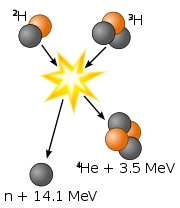
The only practical way to capture most of the fusion energy is to trap the neutrons inside a massive bottle of heavy material such as lead, uranium, or plutonium. If the 14 MeV neutron is captured by uranium (either type: 235 or 238) or plutonium, the result is fission and the release of 180 MeV of fission energy, multiplying the energy output tenfold.
Fission is thus necessary to start fusion, helps to sustain fusion, and captures and multiplies the energy released in fusion neutrons. In the case of a neutron bomb (see below) the last-mentioned does not apply since the escape of neutrons is the objective.
Tritium production
A third important nuclear reaction is the one that creates tritiumTritium
Tritium is a radioactive isotope of hydrogen. The nucleus of tritium contains one proton and two neutrons, whereas the nucleus of protium contains one proton and no neutrons...
, essential to the type of fusion used in weapons and, incidentally, the most expensive ingredient in any nuclear weapon. Tritium, or hydrogen-3, is made by bombarding lithium-6
Isotopes of lithium
Naturally occurring lithium is composed of two stable isotopes, and , the latter being the more abundant...
( 6Li) with a neutron
Neutron
The neutron is a subatomic hadron particle which has the symbol or , no net electric charge and a mass slightly larger than that of a proton. With the exception of hydrogen, nuclei of atoms consist of protons and neutrons, which are therefore collectively referred to as nucleons. The number of...
(n) to produce helium
Helium
Helium is the chemical element with atomic number 2 and an atomic weight of 4.002602, which is represented by the symbol He. It is a colorless, odorless, tasteless, non-toxic, inert, monatomic gas that heads the noble gas group in the periodic table...
-4 ( 4He) plus tritium ( 3T) and energy:

A nuclear reactor is necessary to provide the neutrons. The industrial-scale conversion of lithium-6 to tritium is very similar to the conversion of uranium-238 into plutonium-239. In both cases the feed material is placed inside a nuclear reactor and removed for processing after a period of time. In the 1950s, when reactor capacity was limited, the production of tritium and plutonium were in direct competition. Every atom of tritium in a weapon replaced an atom of plutonium that could have been produced instead.
The fission of one plutonium atom releases ten times more total energy than the fusion of one tritium atom, and it generates fifty times more blast and fire. For this reason, tritium is included in nuclear weapon components only when it causes more fission than its production sacrifices, namely in the case of fusion-boosted fission.
However, an exploding nuclear bomb is a nuclear reactor. The above reaction can take place simultaneously throughout the secondary of a two-stage thermonuclear weapon, producing tritium in place as the device explodes.
Of the three basic types of nuclear weapon, the first, pure fission, uses the first of the three nuclear reactions above. The second, fusion-boosted fission, uses the first two. The third, two-stage thermonuclear, uses all three.
Pure fission weapons
The first task of a nuclear weapon design is to rapidly assemble a supercritical massCritical mass
A critical mass is the smallest amount of fissile material needed for a sustained nuclear chain reaction. The critical mass of a fissionable material depends upon its nuclear properties A critical mass is the smallest amount of fissile material needed for a sustained nuclear chain reaction. The...
of fissile uranium or plutonium. A supercritical mass is one in which the percentage of fission-produced neutrons captured by another fissile nucleus is large enough that each fission event, on average, causes more than one additional fission event.
Once the critical mass is assembled, at maximum density, a burst of neutrons is supplied to start as many chain reactions as possible. Early weapons used an "urchin
Urchin (detonator)
A modulated neutron initiator is a neutron source capable of producing a burst of neutrons on activation. It is a crucial part of some nuclear weapons, as its role is to "kick-start" the chain reaction at the optimal moment when the configuration is prompt critical. It is also known as an internal...
" inside the pit containing polonium
Polonium
Polonium is a chemical element with the symbol Po and atomic number 84, discovered in 1898 by Marie Skłodowska-Curie and Pierre Curie. A rare and highly radioactive element, polonium is chemically similar to bismuth and tellurium, and it occurs in uranium ores. Polonium has been studied for...
-210 and beryllium
Beryllium
Beryllium is the chemical element with the symbol Be and atomic number 4. It is a divalent element which occurs naturally only in combination with other elements in minerals. Notable gemstones which contain beryllium include beryl and chrysoberyl...
separated by a thin barrier. Implosion of the pit crushed the urchin, mixing the two metals, thereby allowing alpha particles from the polonium to interact with beryllium to produce free neutrons. In modern weapons, the neutron generator is a high-voltage vacuum tube containing a particle accelerator
Particle accelerator
A particle accelerator is a device that uses electromagnetic fields to propel charged particles to high speeds and to contain them in well-defined beams. An ordinary CRT television set is a simple form of accelerator. There are two basic types: electrostatic and oscillating field accelerators.In...
which bombards a deuterium/tritium-metal hydride target with deuterium and tritium ion
Ion
An ion is an atom or molecule in which the total number of electrons is not equal to the total number of protons, giving it a net positive or negative electrical charge. The name was given by physicist Michael Faraday for the substances that allow a current to pass between electrodes in a...
s. The resulting small-scale fusion produces neutrons at a protected location outside the physics package, from which they penetrate the pit. This method allows better control of the timing of chain reaction initiation.
The critical mass of an uncompressed sphere of bare metal is 110 lb (50 kg) for uranium-235 and 35 lb (16 kg) for delta-phase plutonium-239. In practical applications, the amount of material required for criticallity is modified by shape, purity, density, and the proximity to neutron-reflecting material
Neutron reflector
A neutron reflector is any material that reflects neutrons. This refers to elastic scattering rather than to a specular reflection. The material may be graphite, beryllium, steel, and tungsten carbide, or other materials...
, all of which affect the escape or capture of neutrons.
To avoid a chain reaction during handling, the fissile material in the weapon must be sub-critical before detonation. It may consist of one or more components containing less than one uncompressed critical mass each. A thin hollow shell can have more than the bare-sphere critical mass, as can a cylinder, which can be arbitrarily long without ever reaching criticallity.
A tamper is an optional layer of dense material surrounding the fissile material. Due to its inertia
Inertia
Inertia is the resistance of any physical object to a change in its state of motion or rest, or the tendency of an object to resist any change in its motion. It is proportional to an object's mass. The principle of inertia is one of the fundamental principles of classical physics which are used to...
it delays the expansion of the reacting material, increasing the efficiency of the weapon. Often the same layer serves both as tamper and as neutron reflector.
Gun-type assembly weapon
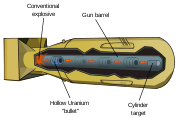
Little Boy
Little Boy
"Little Boy" was the codename of the atomic bomb dropped on Hiroshima on August 6, 1945 by the Boeing B-29 Superfortress Enola Gay, piloted by Colonel Paul Tibbets of the 393rd Bombardment Squadron, Heavy, of the United States Army Air Forces. It was the first atomic bomb to be used as a weapon...
, the Hiroshima bomb, used 141 lb (64 kg) of uranium with an average enrichment of around 80%, or 112 lb (51 kg) of U-235, just about the bare-metal critical mass. (See Little Boy article for a detailed drawing.) When assembled inside its tamper/reflector of tungsten carbide
Tungsten carbide
Tungsten carbide is an inorganic chemical compound containing equal parts of tungsten and carbon atoms. Colloquially, tungsten carbide is often simply called carbide. In its most basic form, it is a fine gray powder, but it can be pressed and formed into shapes for use in industrial machinery,...
, the 141 lb (64 kg) was more than twice critical mass. Before the detonation, the uranium-235 was formed into two sub-critical pieces, one of which was later fired down a gun barrel to join the other, starting the atomic explosion. About 1% of the uranium underwent fission; the remainder, representing most of the entire wartime output of the giant factories at Oak Ridge, scattered uselessly. The half life of uranium-235 is 704 million years.
The inefficiency was caused by the speed with which the uncompressed fissioning uranium expanded and became sub-critical by virtue of decreased density. Despite its inefficiency, this design, because of its shape, was adapted for use in small-diameter, cylindrical artillery shells (a gun-type warhead fired from the barrel of a much larger gun). Such warheads were deployed by the United States until 1992, accounting for a significant fraction of the U-235 in the arsenal, and were some of the first weapons dismantled to comply with treaties limiting warhead numbers. The rationale for this decision was undoubtedly a combination of the lower yield and grave safety issues associated with the gun-type design.
Implosion-type weapon
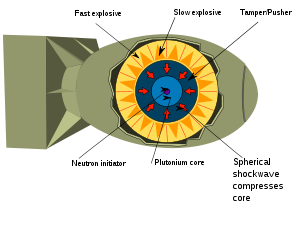
Fat Man
"Fat Man" is the codename for the atomic bomb that was detonated over Nagasaki, Japan, by the United States on August 9, 1945. It was the second of the only two nuclear weapons to be used in warfare to date , and its detonation caused the third man-made nuclear explosion. The name also refers more...
, the Nagasaki bomb, used 13.6 lb (6.2 kg, about 12 fluid ounces or 350 ml in volume) of Pu-239, which is only 41% of bare-sphere critical mass. (See Fat Man article for a detailed drawing.) Surrounded by a U-238 reflector/tamper, the pit was brought close to critical mass by the neutron-reflecting properties of the U-238. During detonation, criticality was achieved by implosion. The plutonium pit was squeezed to increase its density by simultaneous detonation of the conventional explosives placed uniformly around the pit. The explosives were detonated by multiple exploding-bridgewire detonator
Exploding-bridgewire detonator
The exploding-bridgewire detonator is a type of detonator used to initiate the detonation reaction in explosive materials, similar to a blasting cap in that it is fired using an electric current...
s. It is estimated that only about 20% of the plutonium underwent fission; the rest, about 11 lb (5 kg), was scattered.
An implosion shock wave might be of such short duration that only a fraction of the pit is compressed at any instant as the wave passes through it.
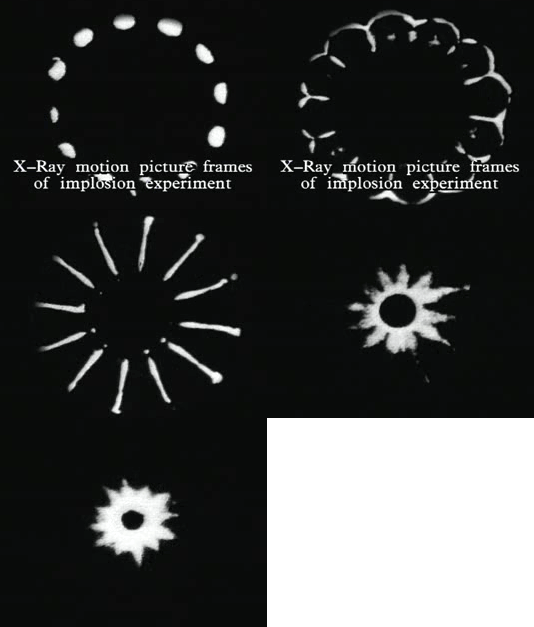
Density
The mass density or density of a material is defined as its mass per unit volume. The symbol most often used for density is ρ . In some cases , density is also defined as its weight per unit volume; although, this quantity is more properly called specific weight...
metal
Metal
A metal , is an element, compound, or alloy that is a good conductor of both electricity and heat. Metals are usually malleable and shiny, that is they reflect most of incident light...
—such as aluminum, beryllium
Beryllium
Beryllium is the chemical element with the symbol Be and atomic number 4. It is a divalent element which occurs naturally only in combination with other elements in minerals. Notable gemstones which contain beryllium include beryl and chrysoberyl...
, or an alloy
Alloy
An alloy is a mixture or metallic solid solution composed of two or more elements. Complete solid solution alloys give single solid phase microstructure, while partial solutions give two or more phases that may or may not be homogeneous in distribution, depending on thermal history...
of the two metals (aluminum being easier and safer to shape, and is two orders of magnitude cheaper; beryllium for its high-neutron-reflective capability) —may be needed. The pusher is located between the explosive lens and the tamper. It works by reflecting some of the shock wave backwards, thereby having the effect of lengthening its duration. Fat Man used an aluminum pusher.
The key to Fat Man's greater efficiency was the inward momentum of the massive U-238 tamper (which did not undergo fission). Once the chain reaction started in the plutonium, the momentum of the implosion had to be reversed before expansion could stop the fission. By holding everything together for a few hundred nanoseconds more, the efficiency was increased.
Plutonium pit
The core of an implosion weapon – the fissile material and any reflector or tamper bonded to it – is known as the pit. Some weapons tested during the 1950s used pits made with U-235Uranium-235
- References :* .* DOE Fundamentals handbook: Nuclear Physics and Reactor theory , .* A piece of U-235 the size of a grain of rice can produce energy equal to that contained in three tons of coal or fourteen barrels of oil. -External links:* * * one of the earliest articles on U-235 for the...
alone, or in composite
Composite material
Composite materials, often shortened to composites or called composition materials, are engineered or naturally occurring materials made from two or more constituent materials with significantly different physical or chemical properties which remain separate and distinct at the macroscopic or...
with plutonium
Plutonium
Plutonium is a transuranic radioactive chemical element with the chemical symbol Pu and atomic number 94. It is an actinide metal of silvery-gray appearance that tarnishes when exposed to air, forming a dull coating when oxidized. The element normally exhibits six allotropes and four oxidation...
, but all-plutonium pits are the smallest in diameter and have been the standard since the early 1960s.
Casting and then machining plutonium is difficult not only because of its toxicity, but also because plutonium has many different metallic phases
Allotropes of plutonium
Even at ambient pressure, plutonium occurs in a variety of allotropes. These allotropes differ widely in crystal structure and density; the α and δ allotropes differ in density by more than 25% at constant pressure....
, also known as allotropes. As plutonium cools, changes in phase result in distortion and cracking. This distortion is normally overcome by alloying it with 3–3.5 molar% (0.9–1.0% by weight) gallium
Gallium
Gallium is a chemical element that has the symbol Ga and atomic number 31. Elemental gallium does not occur in nature, but as the gallium salt in trace amounts in bauxite and zinc ores. A soft silvery metallic poor metal, elemental gallium is a brittle solid at low temperatures. As it liquefies...
, forming a plutonium-gallium alloy
Plutonium-gallium alloy
Plutonium-gallium alloy is an alloy of plutonium and gallium, used in nuclear weapon pits – the component of a nuclear weapon where the fission chain reaction is started....
, which causes it to take up its delta phase over a wide temperature range. When cooling from molten it then suffers only a single phase change, from epsilon to delta, instead of the four changes it would otherwise pass through. Other trivalent
Valence (chemistry)
In chemistry, valence, also known as valency or valence number, is a measure of the number of bonds formed by an atom of a given element. "Valence" can be defined as the number of valence bonds...
metal
Metal
A metal , is an element, compound, or alloy that is a good conductor of both electricity and heat. Metals are usually malleable and shiny, that is they reflect most of incident light...
s would also work, but gallium has a small neutron absorption cross section
Absorption cross section
Absorption cross section is a measure for the probability of an absorption process. More generally, the term cross section is used in physics to quantify the probability of a certain particle-particle interaction, e.g., scattering, electromagnetic absorption, etc...
and helps protect the plutonium against corrosion
Corrosion
Corrosion is the disintegration of an engineered material into its constituent atoms due to chemical reactions with its surroundings. In the most common use of the word, this means electrochemical oxidation of metals in reaction with an oxidant such as oxygen...
. A drawback is that gallium compounds themselves are corrosive and so if the plutonium is recovered from dismantled weapons for conversion to plutonium dioxide
Plutonium dioxide
Plutonium oxide is the chemical compound with the formula PuO2. This high melting point solid is a principal compound of plutonium. It can vary in color from yellow to olive green, depending on the particle size, temperature and method of production....
for power reactors
Nuclear reactor
A nuclear reactor is a device to initiate and control a sustained nuclear chain reaction. Most commonly they are used for generating electricity and for the propulsion of ships. Usually heat from nuclear fission is passed to a working fluid , which runs through turbines that power either ship's...
, there is the difficulty of removing the gallium.
Because plutonium is chemically reactive it is common to plate the completed pit with a thin layer of inert metal, which also reduces the toxic hazard. The gadget used galvanic silver plating; afterwards, nickel
Nickel
Nickel is a chemical element with the chemical symbol Ni and atomic number 28. It is a silvery-white lustrous metal with a slight golden tinge. Nickel belongs to the transition metals and is hard and ductile...
deposited from nickel tetracarbonyl vapors was used, but gold
Gold
Gold is a chemical element with the symbol Au and an atomic number of 79. Gold is a dense, soft, shiny, malleable and ductile metal. Pure gold has a bright yellow color and luster traditionally considered attractive, which it maintains without oxidizing in air or water. Chemically, gold is a...
is now preferred.
Levitated-pit implosion
The first improvement on the Fat Man design was to put an air space between the tamper and the pit to create a hammer-on-nail impact. The pit, supported on a hollow cone inside the tamper cavity, was said to be levitated. The three tests of Operation SandstoneOperation Sandstone
Operation Sandstone was a series of nuclear weapon tests in 1948. It was the third series of American tests, following Crossroads and preceding Ranger...
, in 1948, used Fat Man designs with levitated pits. The largest yield was 49 kilotons, more than twice the yield of the unlevitated Fat Man.
It was immediately clear that implosion was the best design for a fission weapon. Its only drawback seemed to be its diameter. Fat Man was 5 feet (1.5 m) wide vs 2 feet (60 cm) for Little Boy.
Eleven years later, implosion designs had advanced sufficiently that the 5 feet (1.5 m)-diameter sphere of Fat Man had been reduced to a 1 foot (0.3048 m)-diameter cylinder 2 foot (0.6096 m) long, the Swan device
Robin primary
The Robin was the common design nuclear fission bomb core for several Cold War designs for American nuclear and thermonuclear weapons, according to researcher Chuck Hansen...
.
The Pu-239 pit of Fat Man was only 3.6 inches (9 cm) in diameter, the size of a softball. The bulk of Fat Man's girth was the implosion mechanism, namely concentric layers of U-238, aluminum, and high explosives. The key to reducing that girth was the two-point implosion design.
Two-point linear implosion
A very inefficient implosion design is one that simply reshapes an ovoid into a sphere, with minimal compression. In linear implosion, an untamped, solid, elongated mass of Pu-239, larger than critical mass in a sphere, is embedded inside a cylinder of high explosive with a detonator at each end.Detonation makes the pit critical by driving the ends inward, creating a spherical shape. The shock may also change plutonium from delta to alpha phase, increasing its density by 23%, but without the inward momentum of a true implosion. The lack of compression makes it inefficient, but the simplicity and small diameter make it suitable for use in artillery shells and atomic demolition munitions – ADMs – also known as backpack or suitcase nukes.
All such low-yield battlefield weapons, whether gun-type U-235 designs or linear implosion Pu-239 designs, pay a high price in fissile material in order to achieve diameters between six and ten inches (254 mm).
Two-point hollow-pit implosion
A more efficient two-point implosion system uses two high explosive lenses and a hollow pit.A hollow plutonium pit was the original plan for the 1945 Fat Man bomb, but there was not enough time to develop and test the implosion system for it. A simpler solid-pit design was considered more reliable, given the time restraint, but it required a heavy U-238 tamper, a thick aluminum pusher, and three tons of high explosives.
After the war, interest in the hollow pit design was revived. Its obvious advantage is that a hollow shell of plutonium, shock-deformed and driven inward toward its empty center, would carry momentum into its violent assembly as a solid sphere. It would be self-tamping, requiring a smaller U-238 tamper, no aluminum pusher and less high explosive.
The Fat Man bomb had two concentric, spherical shells of high explosives, each about 10 inches (25 cm) thick. The inner shell drove the implosion. The outer shell consisted of a soccer-ball pattern
Truncated icosahedron
In geometry, the truncated icosahedron is an Archimedean solid, one of thirteen convex isogonal nonprismatic solids whose faces are two or more types of regular polygons.It has 12 regular pentagonal faces, 20 regular hexagonal faces, 60 vertices and 90 edges....
of 32 high explosive lenses, each of which converted the convex wave from its detonator into a concave wave matching the contour of the outer surface of the inner shell. If these 32 lenses could be replaced with only two, the high explosive sphere could become an ellipsoid (prolate spheroid) with a much smaller diameter.
A good illustration of these two features is a 1956 drawing from the Swedish nuclear weapon program
Swedish nuclear weapon program
During the 20th century Sweden had programs for both Nuclear and Chemical weapons. During the first decades of the Cold War a nuclear weapon program was active...
(which was terminated before it produced a test explosion). The drawing shows the essential elements of the two-point hollow-pit design.
There are similar drawings in the open literature that come from the post-war German nuclear bomb program, which was also terminated, and from the French program, which produced an arsenal.
The mechanism of the high explosive lens (diagram item #6) is not shown in the Swedish drawing, but a standard lens made of fast and slow high explosives, as in Fat Man, would be much longer than the shape depicted. For a single high explosive lens to generate a concave wave that envelops an entire hemisphere, it must either be very long or the part of the wave on a direct line from the detonator to the pit must be slowed dramatically.
A slow high explosive is too fast, but the flying plate of an "air lens" is not. A metal plate, shock-deformed, and pushed across an empty space can be designed to move slowly enough. A two-point implosion system using air lens technology can have a length no more than twice its diameter, as in the Swedish diagram above.
Fusion-boosted fission weapons
The next step in miniaturization was to speed up the fissioning of the pit to reduce the minimum inertial confinement time. The hollow pit provided an ideal location to introduce fusion for the boosting of fission. A 50–50 mixture of tritium and deuterium gas, pumped into the pit during arming, will fuse into helium and release free neutrons soon after fission begins. The neutrons will start a large number of new chain reactions while the pit is still critical or nearly critical.Once the hollow pit is perfected, there is little reason not to boost.
The concept of fusion-boosted fission was first tested on May 25, 1951, in the Item
Greenhouse Item
Greenhouse Item was an American nuclear test conducted on May 25, 1951, as part of Operation Greenhouse at the Pacific Proving Ground, specifically on the island of Engebi in the Eniwetok Atoll in the Central Pacific Ocean. This test explosion was the first test of a boosted fission weapon...
shot of Operation Greenhouse
Operation Greenhouse
Operation Greenhouse was the fifth American nuclear test series, the second conducted in 1951 and the first to test principles that would lead to developing thermonuclear weapons . Conducted at the new Pacific Proving Ground, all of the devices were mounted in large steel towers, to simulate air...
, Eniwetok, yield 45.5 kilotons.
Boosting reduces diameter in three ways, all the result of faster fission:
- Since the compressed pit does not need to be held together as long, the massive U-238 tamper can be replaced by a light-weight beryllium shell (to reflect escaping neutrons back into the pit). The diameter is reduced.
- The mass of the pit can be reduced by half, without reducing yield. Diameter is reduced again.
- Since the mass of the metal being imploded (tamper plus pit) is reduced, a smaller charge of high explosive is needed, reducing diameter even further.
Since boosting is required to attain full design yield, any reduction in boosting reduces yield. Boosted weapons are thus variable-yield
Variable yield
Variable yield — or dial-a-yield — is an option available on most modern nuclear weapons. It allows the operator to specify a weapon's yield, or explosive power, allowing a single design to be used in different situations...
weapons. Yield can be reduced any time before detonation, simply by putting less than the full amount of tritium into the pit during the arming procedure.
The first device whose dimensions suggest employment of all these features (two-point, hollow-pit, fusion-boosted implosion) was the Swan
Swan (nuclear explosive)
Swan was a U.S. test nuclear explosive.It was tested standalone as a test nuclear device on June 26, 1956 in shot Redwing Inca. It was tested again as the primary of a test thermonuclear device on July 2, 1956 in shot Redwing Mohawk. Both tests were successful in all respects. It subsequently...
device. It had a cylindrical shape with a diameter of 11.6 inches (29.5 cm) and a length of 22.8 inches (58 cm).
It was first tested standalone and then as the primary of a two-stage thermonuclear device during operation Redwing
Operation Redwing
Operation Redwing was a United States series of 17 nuclear test detonations from May to July 1956. They were conducted at Bikini and Enewetak atolls. The entire operation followed Operation Wigwam and preceded Operation Plumbbob. The primary intention was to test new, second-generation...
. It was weaponized as the Robin primary
Robin primary
The Robin was the common design nuclear fission bomb core for several Cold War designs for American nuclear and thermonuclear weapons, according to researcher Chuck Hansen...
and became the first off-the-shelf, multi-use primary, and the prototype for all that followed.
After the success of Swan, 11 or 12 inches (304.8 mm) seemed to become the standard diameter of boosted single-stage devices tested during the 1950s. Length was usually twice the diameter, but one such device, which became the W54
W54
The W54 was the smallest nuclear warhead deployed by the United States. It was a very compact implosion-type nuclear weapon design, designed for tactical use and had a very low yield for a nuclear weapon.- Development :...
warhead, was closer to a sphere, only 15 inches (381 mm) long. It was tested two dozen times in the 1957–62 period before being deployed. No other design had such a long string of test failures. Since the longer devices tended to work correctly on the first try, there must have been some difficulty in flattening the two high explosive lenses enough to achieve the desired length-to-width ratio.
One of the applications of the W54 was the Davy Crockett XM-388 recoilless rifle projectile
Davy Crockett (nuclear device)
The M-28 or M-29 Davy Crockett Weapon System was a tactical nuclear recoilless gun for firing the M388 nuclear projectile that was deployed by the United States during the Cold War...
, shown here in comparison to its Fat Man predecessor, dimensions in inches.
Another benefit of boosting, in addition to making weapons smaller, lighter, and with less fissile material for a given yield, is that it renders weapons immune to radiation interference (RI). It was discovered in the mid-1950s that plutonium pits would be particularly susceptible to partial predetonation if exposed to the intense radiation of a nearby nuclear explosion (electronics might also be damaged, but this was a separate issue). RI was a particular problem before effective early warning radar
Early warning radar
An early warning radar is any radar system used primarily for the long-range detection of its targets, i.e., allowing defences to be alerted as early as possible before the intruder reaches its target, giving the defences the maximum time in which to operate...
systems because a first strike attack might make retaliatory weapons useless. Boosting reduces the amount of plutonium needed in a weapon to below the quantity which would be vulnerable to this effect.
Two-stage thermonuclear weapons
Pure fission or fusion-boosted fission weapons can be made to yield hundreds of kilotons, at great expense in fissile material and tritium, but by far the most efficient way to increase nuclear weapon yield beyond ten or so kilotons is to tack on a second independent stage, called a secondary.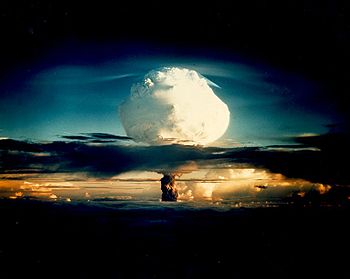
Los Alamos National Laboratory
Los Alamos National Laboratory is a United States Department of Energy national laboratory, managed and operated by Los Alamos National Security , located in Los Alamos, New Mexico...
thought the secondary would be a canister of deuterium in liquified or hydride form. The fusion reaction would be D-D, harder to achieve than D-T, but more affordable. A fission bomb at one end would shock-compress and heat the near end, and fusion would propagate through the canister to the far end. Mathematical simulations showed it wouldn't work, even with large amounts of prohibitively expensive tritium added in.
The entire fusion fuel canister would need to be enveloped by fission energy, to both compress and heat it, as with the booster charge in a boosted primary. The design breakthrough came in January 1951, when Edward Teller
Edward Teller
Edward Teller was a Hungarian-American theoretical physicist, known colloquially as "the father of the hydrogen bomb," even though he did not care for the title. Teller made numerous contributions to nuclear and molecular physics, spectroscopy , and surface physics...
and Stanisław Ulam invented radiation implosion—for nearly three decades known publicly only as the Teller-Ulam H-bomb secret.
The concept of radiation implosion was first tested on May 9, 1951, in the George shot of Operation Greenhouse
Operation Greenhouse
Operation Greenhouse was the fifth American nuclear test series, the second conducted in 1951 and the first to test principles that would lead to developing thermonuclear weapons . Conducted at the new Pacific Proving Ground, all of the devices were mounted in large steel towers, to simulate air...
, Eniwetok, yield 225 kilotons. The first full test was on November 1, 1952, the Mike
Ivy Mike
Ivy Mike was the codename given to the first United States test of a thermonuclear weapon, in which a major part of the explosive yield came from nuclear fusion. It was detonated on November 1, 1952 by the United States at on Enewetak, an atoll in the Pacific Ocean, as part of Operation Ivy...
shot of Operation Ivy
Operation Ivy
Operation Ivy was the eighth series of American nuclear tests, coming after Tumbler-Snapper and before Upshot-Knothole. Its purpose was to help upgrade the U.S. arsenal of nuclear weapons in response to the Soviet nuclear weapons program...
, Eniwetok, yield 10.4 megatons.
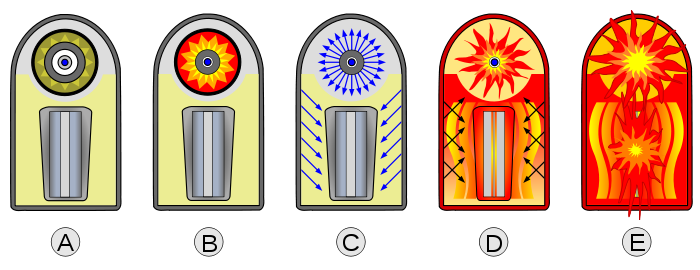
In radiation implosion, the burst of X-ray energy coming from an exploding primary is captured and contained within an opaque-walled radiation channel which surrounds the nuclear energy components of the secondary. The radiation quickly turns the plastic foam that had been filling the channel into a plasma which is mostly transparent to X-rays, and the radiation is absorbed in the outermost layers of the pusher/tamper surrounding the secondary, which ablates and applies a massive force (much like an inside out rocket engine) causing the fusion fuel capsule to implode much like the pit of the primary. As the secondary implodes a fissile "spark plug" at its center ignites and provides heat which enables the fusion fuel to ignite as well. The fission and fusion chain reactions exchange neutrons with each other and boost the efficiency of both reactions. The greater implosive force, enhanced efficiency of the fissile "spark plug" due to boosting via fusion neutrons, and the fusion explosion itself provides significantly greater explosive yield from the secondary despite often not being much larger than the primary.
Equally important, the active ingredients in the Flute probably cost no more than those in the Swan. Most of the fission came from cheap U-238, and the tritium was manufactured in place during the explosion. Only the spark plug at the axis of the secondary needed to be fissile.
A spherical secondary can achieve higher implosion densities than a cylindrical secondary, because spherical implosion pushes in from all directions toward the same spot. However, in warheads yielding more than one megaton, the diameter of a spherical secondary would be too large for most applications. A cylindrical secondary is necessary in such cases. The small, cone-shaped re-entry vehicles in multiple-warhead ballistic missiles after 1970 tended to have warheads with spherical secondaries, and yields of a few hundred kilotons.
As with boosting, the advantages of the two-stage thermonuclear design are so great that there is little incentive not to use it, once a nation has mastered the technology.
In engineering terms, radiation implosion allows for the exploitation of several known features of nuclear bomb materials which heretofore had eluded practical application. For example:
- The best way to store deuterium in a reasonably dense state is to chemically bond it with lithium, as lithium deuteride. But the lithium-6 isotope is also the raw material for tritium production, and an exploding bomb is a nuclear reactor. Radiation implosion will hold everything together long enough to permit the complete conversion of lithium-6 into tritium, while the bomb explodes. So the bonding agent for deuterium permits use of the D-T fusion reaction without any pre-manufactured tritium being stored in the secondary. The tritium production constraint disappears.
- For the secondary to be imploded by the hot, radiation-induced plasma surrounding it, it must remain cool for the first microsecond, i.e., it must be encased in a massive radiation (heat) shield. The shield's massiveness allows it to double as a tamper, adding momentum and duration to the implosion. No material is better suited for both of these jobs than ordinary, cheap uranium-238, which also happens to undergo fission when struck by the neutrons produced by D-T fusion. This casing, called the pusher, thus has three jobs: to keep the secondary cool, to hold it, inertially, in a highly compressed state, and, finally, to serve as the chief energy source for the entire bomb. The consumable pusher makes the bomb more a uranium fission bomb than a hydrogen fusion bomb. It is noteworthy that insiders never used the term hydrogen bomb.
- Finally, the heat for fusion ignition comes not from the primary but from a second fission bomb called the spark plug, embedded in the heart of the secondary. The implosion of the secondary implodes this spark plug, detonating it and igniting fusion in the material around it, but the spark plug then continues to fission in the neutron-rich environment until it is fully consumed, adding significantly to the yield.
The initial impetus behind the two-stage weapon was President Truman's 1950 promise to build a 10-megaton hydrogen superbomb as the U.S. response to the 1949 test of the first Soviet fission bomb. But the resulting invention turned out to be the cheapest and most compact way to build small nuclear bombs as well as large ones, erasing any meaningful distinction between A-bombs and H-bombs, and between boosters and supers. All the best techniques for fission and fusion explosions are incorporated into one all-encompassing, fully scalable design principle. Even six-inch (152 mm) diameter nuclear artillery shells can be two-stage thermonuclears.
In the ensuing fifty years, nobody has come up with a better way to build a nuclear bomb. It is the design of choice for the United States
United States
The United States of America is a federal constitutional republic comprising fifty states and a federal district...
, Russia
Russia
Russia or , officially known as both Russia and the Russian Federation , is a country in northern Eurasia. It is a federal semi-presidential republic, comprising 83 federal subjects...
, the United Kingdom
United Kingdom
The United Kingdom of Great Britain and Northern IrelandIn the United Kingdom and Dependencies, other languages have been officially recognised as legitimate autochthonous languages under the European Charter for Regional or Minority Languages...
, China
China
Chinese civilization may refer to:* China for more general discussion of the country.* Chinese culture* Greater China, the transnational community of ethnic Chinese.* History of China* Sinosphere, the area historically affected by Chinese culture...
, and France
France
The French Republic , The French Republic , The French Republic , (commonly known as France , is a unitary semi-presidential republic in Western Europe with several overseas territories and islands located on other continents and in the Indian, Pacific, and Atlantic oceans. Metropolitan France...
, the five thermonuclear powers. The other nuclear-armed nations, Israel, India, Pakistan, and North Korea, probably have single-stage weapons, possibly boosted.
Interstage
In a two-stage thermonuclear weapon the energy from the primary impacts the secondary. An essential energy transfer modulator called the interstage, between the primary and the secondary, protects the secondary's fusion fuel from heating too quickly, which could cause it to explode in a conventional (and small) heat explosion before the fission and fusion reactions get a chance to start.There is very little information in the open literature about the mechanism of the interstage. Its first mention in a U.S. government document formally released to the public appears to be a caption in a recent graphic promoting the Reliable Replacement Warhead Program. If built, this new design would replace "toxic, brittle material" and "expensive 'special' material" in the interstage. This statement suggests the interstage may contain beryllium to moderate the flux of neutrons from the primary, and perhaps something to absorb and re-radiate the x-rays in a particular manner. There is also some speculation that this interstage material, which may be code-named FOGBANK
Fogbank
FOGBANK is a code name given to a material used in nuclear weapons such as the W76, W78 and W80.FOGBANK's precise nature is classified; in the words of former Oak Ridge general manager Dennis Ruddy, "The material is classified. Its composition is classified...
might be an aerogel
Aerogel
Aerogel is a synthetic porous material derived from a gel, in which the liquid component of the gel has been replaced with a gas. The result is a solid with extremely low density and thermal conductivity...
, possibly doped with beryllium and/or other substances.
The interstage and the secondary are encased together inside a stainless steel membrane to form the canned subassembly (CSA), an arrangement which has never been depicted in any open-source drawing. The most detailed illustration of an interstage shows a British thermonuclear weapon with a cluster of items between its primary and a cylindrical secondary. They are labeled "end-cap and neutron focus lens," "reflector/neutron gun carriage," and "reflector wrap." The origin of the drawing, posted on the internet by Greenpeace, is uncertain, and there is no accompanying explanation.
Specific designs
While every nuclear weapon design falls into one of the above categories, specific designs have occasionally become the subject of news accounts and public discussion, often with incorrect descriptions about how they work and what they do. Examples:Hydrogen bombs
All modern nuclear weapons make some use of D-T fusion. Even pure fission weapons include neutron generatorNeutron generator
Neutron generators are neutron source devices which contain compact linear accelerators and that produce neutrons by fusing isotopes of hydrogen together. The fusion reactions take place in these devices by accelerating either deuterium, tritium, or a mixture of these two isotopes into a metal...
s which are high-voltage vacuum tubes containing trace amounts of tritium and deuterium.
However, in the public perception, hydrogen bombs, or H-bombs, are multi-megaton devices a thousand times more powerful than Hiroshima's Little Boy. Such high-yield bombs are actually two-stage thermonuclears, scaled up to the desired yield, with uranium fission, as usual, providing most of their energy.
The idea of the hydrogen bomb first came to public attention in 1949, when prominent scientists openly recommended against building nuclear bombs more powerful than the standard pure-fission model, on both moral and practical grounds. Their assumption was that critical mass considerations would limit the potential size of fission explosions, but that a fusion explosion could be as large as its supply of fuel, which has no critical mass limit. In 1949, the Soviets exploded their first fission bomb, and in 1950 President Truman ended the H-bomb debate by ordering the Los Alamos designers to build one.
In 1952, the 10.4-megaton Ivy Mike
Ivy Mike
Ivy Mike was the codename given to the first United States test of a thermonuclear weapon, in which a major part of the explosive yield came from nuclear fusion. It was detonated on November 1, 1952 by the United States at on Enewetak, an atoll in the Pacific Ocean, as part of Operation Ivy...
explosion was announced as the first hydrogen bomb test, reinforcing the idea that hydrogen bombs are a thousand times more powerful than fission bombs.
In 1954, J. Robert Oppenheimer
Robert Oppenheimer
Julius Robert Oppenheimer was an American theoretical physicist and professor of physics at the University of California, Berkeley. Along with Enrico Fermi, he is often called the "father of the atomic bomb" for his role in the Manhattan Project, the World War II project that developed the first...
was labeled a hydrogen bomb opponent. The public did not know there were two kinds of hydrogen bomb (neither of which is accurately described as a hydrogen bomb). On May 23, when his security clearance was revoked, item three of the four public findings against him was "his conduct in the hydrogen bomb program." In 1949, Oppenheimer had supported single-stage fusion-boosted fission bombs, to maximize the explosive power of the arsenal given the trade-off between plutonium and tritium production. He opposed two-stage thermonuclear bombs until 1951, when radiation implosion, which he called "technically sweet", first made them practical. The complexity of his position was not revealed to the public until 1976, nine years after his death.
When ballistic missiles replaced bombers in the 1960s, most multi-megaton bombs were replaced by missile warheads (also two-stage thermonuclears) scaled down to one megaton or less.
Alarm Clock/Sloika
The first effort to exploit the symbiotic relationship between fission and fusion was a 1940s design that mixed fission and fusion fuel in alternating thin layers. As a single-stage device, it would have been a cumbersome application of boosted fission. It first became practical when incorporated into the secondary of a two-stage thermonuclear weapon.The U.S. name, Alarm Clock, was a nonsense code name. The Russian name for the same design was more descriptive: Sloika , a layered pastry cake. A single-stage Soviet Sloika was tested on August 12, 1953. No single-stage U.S. version was tested, but the Union
Castle Union
Castle Union was the code name given to one of the tests in the Operation Castle series of American nuclear tests. It was the first test of the TX-14 thermonuclear weapon , one of the first deployed U.S...
shot of Operation Castle
Operation Castle
Operation Castle was a United States series of high-energy nuclear tests by Joint Task Force SEVEN at Bikini Atoll beginning in March 1954...
, April 26, 1954, was a two-stage thermonuclear code-named Alarm Clock. Its yield, at Bikini
Bikini Atoll
Bikini Atoll is an atoll, listed as a World Heritage Site, in the Micronesian Islands of the Pacific Ocean, part of Republic of the Marshall Islands....
, was 6.9 megatons.
Because the Soviet Sloika test used dry lithium-6 deuteride eight months before the first U.S. test to use it (Castle Bravo, March 1, 1954), it was sometimes claimed that the USSR won the H-bomb race. (The 1952 U.S. Ivy Mike test used cryogenically cooled liquid deuterium as the fusion fuel in the secondary, and employed the D-D fusion reaction.) Besides, that was the first aircraft deployable design, even though it was not deployed during the test. However, the first Soviet test to use a radiation-imploded secondary, the essential feature of a true H-bomb, was on November 23, 1955, three years after Ivy Mike. In fact, real work on implosion scheme in the Soviet Union only commenced in the very early 1953, several months after successful testing of Sloika.
Clean bombs
On March 1, 1954, the largest-ever U.S. nuclear test explosion, the 15-megaton BravoCastle Bravo
Castle Bravo was the code name given to the first U.S. test of a dry fuel thermonuclear hydrogen bomb device, detonated on March 1, 1954 at Bikini Atoll, Marshall Islands, as the first test of Operation Castle. Castle Bravo was the most powerful nuclear device ever detonated by the United States ,...
shot of Operation Castle at Bikini, delivered a promptly lethal dose of fission-product fallout to more than 6000 square miles (15,539.9 km²) of Pacific Ocean surface. Radiation injuries to Marshall Islanders and Japanese fishermen made that fact public and revealed the role of fission in hydrogen bombs.
In response to the public alarm over fallout, an effort was made to design a clean multi-megaton weapon, relying almost entirely on fusion. The energy produced by the fissioning of unenriched natural Uranium
Uranium-238
Uranium-238 is the most common isotope of uranium found in nature. It is not fissile, but is a fertile material: it can capture a slow neutron and after two beta decays become fissile plutonium-239...
, when utilized as the tamper material in the Secondary and subsequent stages in the Teller-Ulam design, can evidently dwarf the Fusion yield output, as was the case in the Castle Bravo
Castle Bravo
Castle Bravo was the code name given to the first U.S. test of a dry fuel thermonuclear hydrogen bomb device, detonated on March 1, 1954 at Bikini Atoll, Marshall Islands, as the first test of Operation Castle. Castle Bravo was the most powerful nuclear device ever detonated by the United States ,...
test; realising that a non fissionable tamper material is an essential requirement in a 'clean' bomb, it is clear that in such a bomb there will now be a relatively massive amount of material that does not undergo any mass-to-energy conversions whatsoever. So for a given weight, 'dirty' weapons with Fissionable tampers are much more powerful than a 'clean' weapon (or, for an equal yield, they are much lighter). The earliest known incidence of a three-stage device being tested, with the third stage, called the tertiary, being ignited by the secondary, was May 27, 1956 in the Bassoon device. This device was tested in the Zuni shot of Operation Redwing
Operation Redwing
Operation Redwing was a United States series of 17 nuclear test detonations from May to July 1956. They were conducted at Bikini and Enewetak atolls. The entire operation followed Operation Wigwam and preceded Operation Plumbbob. The primary intention was to test new, second-generation...
. This shot utilized non fissionable tampers, a relatively nuclear inert substitute material such as tungsten or lead was used, its yield was 3.5 megatons, 85% fusion and only 15% fission. The public records for devices that produced the highest proportion of their yield via fusion-only reactions are the 57 megaton, Tsar bomba
Tsar Bomba
Tsar Bomba is the nickname for the AN602 hydrogen bomb, the most powerful nuclear weapon ever detonated. It was also referred to as Kuz'kina Mat , in this usage meaning "something that has not been seen before"....
at 97% Fusion, the 9.3 megaton Hardtack Poplar
Operation Hardtack
Operation Hardtack was a two-part nuclear test series composed of:* Operation Hardtack I, conducted at the Pacific Proving Grounds* Operation Hardtack II, conducted at the Nevada Test Site...
test at 95.2%, and the 4.5 megaton Redwing Navajo
Operation Redwing
Operation Redwing was a United States series of 17 nuclear test detonations from May to July 1956. They were conducted at Bikini and Enewetak atolls. The entire operation followed Operation Wigwam and preceded Operation Plumbbob. The primary intention was to test new, second-generation...
test at 95% fusion.
On July 19, 1956, AEC Chairman Lewis Strauss said that the Redwing Zuni shot
Operation Redwing
Operation Redwing was a United States series of 17 nuclear test detonations from May to July 1956. They were conducted at Bikini and Enewetak atolls. The entire operation followed Operation Wigwam and preceded Operation Plumbbob. The primary intention was to test new, second-generation...
clean bomb test "produced much of importance ... from a humanitarian aspect." However, less than two days after this announcement the dirty version of Bassoon, called Bassoon Prime, with a uranium-238
Uranium-238
Uranium-238 is the most common isotope of uranium found in nature. It is not fissile, but is a fertile material: it can capture a slow neutron and after two beta decays become fissile plutonium-239...
tamper in place, was tested on a barge off the coast of Bikini Atoll as the Redwing Tewa shot
Operation Redwing
Operation Redwing was a United States series of 17 nuclear test detonations from May to July 1956. They were conducted at Bikini and Enewetak atolls. The entire operation followed Operation Wigwam and preceded Operation Plumbbob. The primary intention was to test new, second-generation...
. The Bassoon Prime produced a 5-megaton yield, of which 87% came from fission. Data obtained from this test, and others culminated in the eventual deployment of the highest yielding US nuclear weapon known, and as a side, the highest Yield-to-weight weapon ever made
Nuclear weapon yield
The explosive yield of a nuclear weapon is the amount of energy discharged when a nuclear weapon is detonated, expressed usually in the equivalent mass of trinitrotoluene , either in kilotons or megatons , but sometimes also in terajoules...
a three-stage thermonuclear weapon, with a maximum 'dirty' yield of 25-megatons designated as the Mark-41 bomb
B41 nuclear bomb
The B41 was a thermonuclear weapon deployed by the United States Strategic Air Command in the early 1960s. It was the most powerful nuclear bomb ever developed by the United States with a theoretical maximum yield of 25 megatons...
, which was to be carried by U.S. Air Force bombers until it was decommissioned, this weapon was never fully tested.
As such, high-yield clean bombs appear to have been a public relations exercise. The actual deployed weapons were the dirty versions, which maximized yield for the same size device.
However, newer 4th and 5th Generation nuclear weapons designs including pure fusion weapon
Pure fusion weapon
A pure fusion weapon is a hypothetical hydrogen bomb design that does not need a fission "primary" explosive to ignite the fusion of deuterium and tritium, two heavy isotopes of hydrogen . Such a weapon would require no fissile material and would therefore be much easier to build in secret than...
and antimatter catalyzed nuclear pulse propulsion
Antimatter catalyzed nuclear pulse propulsion
Antimatter catalyzed nuclear pulse propulsion is a variation of nuclear pulse propulsion based upon the injection of antimatter into a mass of nuclear fuel which normally would not be useful in propulsion...
like devices are being studied extensively by the 5 largest nuclear weapon states.
Cobalt bombs
A fictional doomsday bomb, made popular by Nevil ShuteNevil Shute
Nevil Shute Norway was a popular British-Australian novelist and a successful aeronautical engineer. He used his full name in his engineering career, and 'Nevil Shute' as his pen name, in order to protect his engineering career from any potential negative publicity in connection with his novels.-...
's 1957 novel, and subsequent 1959 movie, On the Beach
On the Beach (1959 film)
On the Beach is a post-apocalyptic drama film based on Nevil Shute's 1957 novel of the same name. The film features Gregory Peck , Ava Gardner , Fred Astaire and Anthony Perkins...
, the cobalt bomb was a hydrogen bomb with a jacket of cobalt metal. The neutron-activated cobalt would supposedly have maximized the environmental damage from radioactive fallout. These bombs were popularized in the 1964 film Dr. Strangelove or: How I Learned to Stop Worrying and Love the Bomb. The element added to the bombs is referred to in the film as 'cobalt-thorium G'
Such "salted" weapons were requested by the U.S. Air Force and seriously investigated, possibly built and tested, but not deployed. In the 1964 edition of the DOD/AEC book The Effects of Nuclear Weapons, a new section titled Radiological Warfare clarified the issue. Fission products are as deadly as neutron-activated cobalt. The standard high-fission thermonuclear weapon is automatically a weapon of radiological warfare, as dirty as a cobalt bomb.
Initially, gamma radiation from the fission products of an equivalent size fission-fusion-fission bomb are much more intense than Co-60
Cobalt-60
Cobalt-60, , is a synthetic radioactive isotope of cobalt. Due to its half-life of 5.27 years, is not found in nature. It is produced artificially by neutron activation of . decays by beta decay to the stable isotope nickel-60...
: 15,000 times more intense at 1 hour; 35 times more intense at 1 week; 5 times more intense at 1 month; and about equal at 6 months. Thereafter fission drops off rapidly so that Co-60 fallout is 8 times more intense than fission at 1 year and 150 times more intense at 5 years. The very long-lived isotopes produced by fission would overtake the 60Co again after about 75 years.
Fission-fusion-fission bombs
In 1954, to explain the surprising amount of fission-product fallout produced by hydrogen bombs, Ralph Lapp coined the term fission-fusion-fission to describe a process inside what he called a three-stage thermonuclear weapon. His process explanation was correct, but his choice of terms caused confusion in the open literature. The stages of a nuclear weapon are not fission, fusion, and fission. They are the primary, the secondary, and, in one exceptionally powerful weapon, the tertiary. Each of these stages employs fission, fusion, and fission.Neutron bombs
A neutron bomb, technically referred to as an enhanced radiation weapon (ERW), is a type of tactical nuclear weapon designed specifically to release a large portion of its energy as energetic neutron radiation. This contrasts with standard thermonuclear weapons, which are designed to capture this intense neutron radiation to increase its overall explosive yield. In terms of yield, ERWs typically produce about one-tenth that of a fission-type atomic weapon. Even with their significantly lower explosive power, ERWs are still capable of much greater destruction than any conventional bomb. Meanwhile, relative to other nuclear weapons, damage is more focused on biological material than on material infrastructure (though extreme blast and heat effects are not eliminated).Officially known as enhanced radiation weapons, ERWs, they are more accurately described as suppressed yield weapons. When the yield of a nuclear weapon is less than one kiloton, its lethal radius from blast, 700 m (2300 ft), is less than that from its neutron radiation. However, the blast is more than potent enough to destroy most structures, which are less resistant to blast effects than even unprotected human beings. Blast pressures of upwards of 20 PSI are survivable, whereas most buildings will collapse with a pressure of only 5 PSI.
Commonly misconceived as a weapon designed to kill populations and leave infrastructure intact, these bombs (as mentioned above) are still very capable of leveling buildings over a large radius.
The intent of their design was to kill tank crews – tanks giving excellent protection against blast and heat, surviving (relatively) very close to a detonation. And with the Soviets' vast tank battalions during the Cold War, this was the perfect weapon to counter them.
The neutron radiation could instantly incapacitate a tank crew out to roughly the same distance that the heat and blast would incapacitate an unprotected human (depending on design). The tank chassis would also be rendered highly radioactive (temporarily) preventing its re-use by a fresh crew.
Neutron weapons were also intended for use in other applications, however. For example, they are effective in anti-nuclear defenses – the neutron flux being capable of neutralising an incoming warhead at a greater range than heat or blast. Nuclear warheads are very resistant to physical damage, but are very difficult to harden against extreme neutron flux.
| Standard | Enhanced | |
|---|---|---|
| Blast | 50% | 40% |
| Thermal energy | 35% | 25% |
| Instant radiation | 5% | 30% |
| Residual radiation | 10% | 5% |
ERWs were two-stage thermonuclears with all non-essential uranium removed to minimize fission yield. Fusion provided the neutrons. Developed in the 1950s, they were first deployed in the 1970s, by U.S. forces in Europe. The last ones were retired in the 1990s.
A neutron bomb is only feasible if the yield is sufficiently high that efficient fusion stage ignition is possible, and if the yield is low enough that the case thickness will not absorb too many neutrons. This means that neutron bombs have a yield range of 1–10 kilotons, with fission proportion varying from 50% at 1-kiloton to 25% at 10-kilotons (all of which comes from the primary stage). The neutron output per kiloton is then 10–15 times greater than for a pure fission implosion weapon or for a strategic warhead like a W87
W87
The W87 is an American thermonuclear missile warhead. It was created for use on the MX or Peacekeeper ICBM, 50 of which, with up to 12 warheads per missile, were deployed during the 1986-2005 period...
or W88
W88
The W88 is a United States thermonuclear warhead, with an estimated yield of 475 kiloton , and is small enough to fit on MIRVed missiles. The W88 was designed at the Los Alamos National Laboratory in the 1970s. In 1999 the director of Los Alamos who had presided over its design described it as...
.
Oralloy thermonuclear warheads
In 1999, nuclear weapon design was in the news again, for the first time in decades. In January, the U.S. House of Representatives released the Cox ReportCox Report
The Report of the Select Committee on U.S. National Security and Military/Commercial Concerns with the People's Republic of China, commonly known as the Cox Report after Representative Christopher Cox, is a classified U.S...
(Christopher Cox R-CA) which alleged that China had somehow acquired classified information about the U.S. W88 warhead. Nine months later, Wen Ho Lee
Wen Ho Lee
Dr. Wen Ho Lee is a Taiwan-born Taiwanese American scientist who worked for the University of California at the Los Alamos National Laboratory. He created simulations of nuclear explosions for the purposes of scientific inquiry, as well as for improving the safety and reliability of the US nuclear...
, a Taiwanese immigrant working at Los Alamos
Los Alamos National Laboratory
Los Alamos National Laboratory is a United States Department of Energy national laboratory, managed and operated by Los Alamos National Security , located in Los Alamos, New Mexico...
, was publicly accused of spying
Espionage
Espionage or spying involves an individual obtaining information that is considered secret or confidential without the permission of the holder of the information. Espionage is inherently clandestine, lest the legitimate holder of the information change plans or take other countermeasures once it...
, arrested, and served nine months in pre-trial detention
Detention of suspects
The detention of suspects is the process of keeping a person who has been arrested in a police-cell, remand prison or other detention centre before trial or sentencing. One criticism of pretrial detention is that eventual acquittal can be a somewhat hollow victory, in that there is no way to...
, before the case against him was dismissed. It is not clear that there was, in fact, any espionage.
In the course of eighteen months of news coverage, the W88 warhead was described in unusual detail. The New York Times
The New York Times
The New York Times is an American daily newspaper founded and continuously published in New York City since 1851. The New York Times has won 106 Pulitzer Prizes, the most of any news organization...
printed a schematic diagram on its front page. The most detailed drawing appeared in A Convenient Spy, the 2001 book on the Wen Ho Lee case by Dan Stober and Ian Hoffman, adapted and shown here with permission.
Designed for use on Trident II (D-5) submarine-launched ballistic missile
Submarine-launched ballistic missile
A submarine-launched ballistic missile is a ballistic missile capable of delivering a nuclear warhead that can be launched from submarines. Modern variants usually deliver multiple independently targetable reentry vehicles each of which carries a warhead and allows a single launched missile to...
s, the W88 entered service in 1990 and was the last warhead designed for the U.S. arsenal. It has been described as the most advanced, although open literature accounts do not indicate any major design features that were not available to U.S. designers in 1958.
The above diagram shows all the standard features of ballistic missile warheads since the 1960s, with two exceptions that give it a higher yield for its size.
- The outer layer of the secondary, called the "pusher", which serves three functions: heat shieldHeat shieldA heat shield is designed to shield a substance from absorbing excessive heat from an outside source by either dissipating, reflecting or simply absorbing the heat...
, tamper, and fission fuelNuclear fuelNuclear fuel is a material that can be 'consumed' by fission or fusion to derive nuclear energy. Nuclear fuels are the most dense sources of energy available...
, is made of U-235 instead of U-238, hence the name Oralloy (U-235) Thermonuclear. Being fissile, rather than merely fissionable, allows the pusher to fission faster and more completely, increasing yield. This feature is available only to nations with a great wealth of fissile uranium. The United States is estimated to have 500 tons.
- The secondary is located in the wide end of the re-entry cone, where it can be larger, and thus more powerful. The usual arrangement is to put the heavier, denser secondary in the narrow end for greater aerodynamic stability during re-entry from outer space, and to allow more room for a bulky primary in the wider part of the cone. (The W87 warhead drawing in the previous section shows the usual arrangement.) Because of this new geometry, the W88 primary uses compact conventional high explosives (CHE) to save space, rather than the more usual, and bulky but safer, insensitive high explosives (IHE). The re-entry cone probably has ballast in the nose for aerodynamic stability.
The alternating layers of fission and fusion material in the secondary are an application of the Alarm Clock/Sloika principle.
Reliable replacement warhead
The United States has not produced any nuclear warheads since 1989, when the Rocky FlatsRocky Flats Plant
The Rocky Flats Plant was a United States nuclear weapons production facility near Denver, Colorado that operated from 1952 to 1992. It was under the control of the United States Atomic Energy Commission until 1977, when it was replaced by the Department of Energy .-1950s:Following World War II,...
pit production plant, near Boulder, Colorado
Boulder, Colorado
Boulder is the county seat and most populous city of Boulder County and the 11th most populous city in the U.S. state of Colorado. Boulder is located at the base of the foothills of the Rocky Mountains at an elevation of...
, was shut down for environmental reasons. With the end of the Cold War
Cold War
The Cold War was the continuing state from roughly 1946 to 1991 of political conflict, military tension, proxy wars, and economic competition between the Communist World—primarily the Soviet Union and its satellite states and allies—and the powers of the Western world, primarily the United States...
two years later, the production line was idled except for inspection and maintenance functions.
The National Nuclear Security Administration
National Nuclear Security Administration
The United States National Nuclear Security Administration is part of the United States Department of Energy. It works to improve national security through the military application of nuclear energy...
, the latest successor for nuclear weapons to the Atomic Energy Commission
United States Atomic Energy Commission
The United States Atomic Energy Commission was an agency of the United States government established after World War II by Congress to foster and control the peace time development of atomic science and technology. President Harry S...
and the Department of Energy
United States Department of Energy
The United States Department of Energy is a Cabinet-level department of the United States government concerned with the United States' policies regarding energy and safety in handling nuclear material...
, has proposed building a new pit facility and starting the production line for a new warhead called the Reliable Replacement Warhead
Reliable Replacement Warhead
The Reliable Replacement Warhead was a proposed new American nuclear warhead design and bomb family that was intended to be simple, reliable and to provide a long-lasting, low maintenance future nuclear force for the United States...
(RRW). Two advertised safety improvements of the RRW would be a return to the use of "insensitive high explosives which are far less susceptible to accidental detonation", and the elimination of "certain hazardous materials, such as beryllium
Beryllium
Beryllium is the chemical element with the symbol Be and atomic number 4. It is a divalent element which occurs naturally only in combination with other elements in minerals. Notable gemstones which contain beryllium include beryl and chrysoberyl...
, that are harmful to people and the environment." Since the new warhead must not require any nuclear testing, it could not use a new design with untested concepts.
Weapon design laboratories
All the nuclear weapon design innovations discussed in this article originated from the following three labs in the manner described. Other nuclear weapon design labs in other countries duplicated those design innovations independently, reverse-engineered them from fallout analysis, or acquired them by espionage.Berkeley
The first systematic exploration of nuclear weapon design concepts took place in mid-1942 at the University of California, BerkeleyUniversity of California, Berkeley
The University of California, Berkeley , is a teaching and research university established in 1868 and located in Berkeley, California, USA...
. Important early discoveries had been made at the adjacent Lawrence Berkeley Laboratory, such as the 1940 cyclotron-made production and isolation of plutonium. A Berkeley professor, J. Robert Oppenheimer, had just been hired to run the nation's secret bomb design effort. His first act was to convene the 1942 summer conference.
By the time he moved his operation to the new secret town of Los Alamos, New Mexico, in the spring of 1943, the accumulated wisdom on nuclear weapon design consisted of five lectures by Berkeley professor Robert Serber
Robert Serber
Robert Serber was an American physicist who participated in the Manhattan Project. He was born in Philadelphia, Pennsylvania; he was the eldest son of David Serber and Rose Frankel. He married Charlotte Leof in 1933. Rose Serber died in 1922; David married Charlotte's cousin Frances Leof in...
, transcribed and distributed as the Los Alamos Primer
Los Alamos Primer
The Los Alamos Primer was a printed version of the first five lectures on the principles of nuclear weapons given to new arrivals at the top-secret Los Alamos laboratory during the Manhattan Project...
. The Primer addressed fission energy, neutron
Neutron
The neutron is a subatomic hadron particle which has the symbol or , no net electric charge and a mass slightly larger than that of a proton. With the exception of hydrogen, nuclei of atoms consist of protons and neutrons, which are therefore collectively referred to as nucleons. The number of...
production and capture
Neutron capture
Neutron capture is a kind of nuclear reaction in which an atomic nucleus collides with one or more neutrons and they merge to form a heavier nucleus. Since neutrons have no electric charge they can enter a nucleus more easily than positively charged protons, which are repelled...
, nuclear chain reaction
Nuclear chain reaction
A nuclear chain reaction occurs when one nuclear reaction causes an average of one or more nuclear reactions, thus leading to a self-propagating number of these reactions. The specific nuclear reaction may be the fission of heavy isotopes or the fusion of light isotopes...
s, critical mass
Critical mass
A critical mass is the smallest amount of fissile material needed for a sustained nuclear chain reaction. The critical mass of a fissionable material depends upon its nuclear properties A critical mass is the smallest amount of fissile material needed for a sustained nuclear chain reaction. The...
, tampers, predetonation, and three methods of assembling a bomb: gun assembly, implosion, and "autocatalytic methods," the one approach that turned out to be a dead end.
Los Alamos
At Los Alamos, it was found in April 1944 by Emilio G. SegrèEmilio G. Segrè
Emilio Gino Segrè was an Italian-born, naturalized American, physicist and Nobel laureate in physics, who with Owen Chamberlain, discovered antiprotons, a sub-atomic antiparticle.-Biography:...
that the proposed Thin Man
Thin Man nuclear bomb
The "Thin Man" nuclear bomb was a proposed plutonium gun-type nuclear bomb which the United States was developing during the Manhattan Project...
Gun assembly type bomb would not work for plutonium because of predetonation problems caused by Pu-240 impurities. So Fat Man, the implosion-type bomb, was given high priority as the only option for plutonium. The Berkeley discussions had generated theoretical estimates of critical mass, but nothing precise. The main wartime job at Los Alamos was the experimental determination of critical mass, which had to wait until sufficient amounts of fissile material arrived from the production plants: uranium from Oak Ridge, Tennessee
Oak Ridge, Tennessee
Oak Ridge is a city in Anderson and Roane counties in the eastern part of the U.S. state of Tennessee, about west of Knoxville. Oak Ridge's population was 27,387 at the 2000 census...
, and plutonium from the Hanford site
Hanford Site
The Hanford Site is a mostly decommissioned nuclear production complex on the Columbia River in the U.S. state of Washington, operated by the United States federal government. The site has been known by many names, including Hanford Works, Hanford Engineer Works or HEW, Hanford Nuclear Reservation...
in Washington.
In 1945, using the results of critical mass experiments, Los Alamos technicians fabricated and assembled components for four bombs: the Trinity
Trinity test
Trinity was the code name of the first test of a nuclear weapon. This test was conducted by the United States Army on July 16, 1945, in the Jornada del Muerto desert about 35 miles southeast of Socorro, New Mexico, at the new White Sands Proving Ground, which incorporated the Alamogordo Bombing...
Gadget, Little Boy, Fat Man, and an unused spare Fat Man. After the war, those who could, including Oppenheimer, returned to university teaching positions. Those who remained worked on levitated and hollow pits and conducted weapon effects tests such as Crossroads
Operation Crossroads
Operation Crossroads was a series of nuclear weapon tests conducted by the United States at Bikini Atoll in mid-1946. It was the first test of a nuclear weapon after the Trinity nuclear test in July 1945...
Able and Baker at Bikini Atoll
Bikini Atoll
Bikini Atoll is an atoll, listed as a World Heritage Site, in the Micronesian Islands of the Pacific Ocean, part of Republic of the Marshall Islands....
in 1946.
All of the essential ideas for incorporating fusion into nuclear weapons originated at Los Alamos between 1946 and 1952. After the Teller-Ulam
Teller-Ulam design
The Teller–Ulam design is the nuclear weapon design concept used in most of the world's nuclear weapons. It is colloquially referred to as "the secret of the hydrogen bomb" because it employs hydrogen fusion, though in most applications the bulk of its destructive energy comes from uranium fission,...
radiation implosion breakthrough of 1951, the technical implications and possibilities were fully explored, but ideas not directly relevant to making the largest possible bombs for long-range Air Force bombers were shelved.
Because of Oppenheimer's initial position in the H-bomb debate, in opposition to large thermonuclear weapons, and the assumption that he still had influence over Los Alamos despite his departure, political allies of Edward Teller
Edward Teller
Edward Teller was a Hungarian-American theoretical physicist, known colloquially as "the father of the hydrogen bomb," even though he did not care for the title. Teller made numerous contributions to nuclear and molecular physics, spectroscopy , and surface physics...
decided he needed his own laboratory in order to pursue H-bombs. By the time it was opened in 1952, in Livermore
Lawrence Livermore National Laboratory
The Lawrence Livermore National Laboratory , just outside Livermore, California, is a Federally Funded Research and Development Center founded by the University of California in 1952...
, California, Los Alamos had finished the job Livermore was designed to do.
Livermore
With its original mission no longer available, the Livermore lab tried radical new designs, that failed. Its first three nuclear tests were fizzlesFizzle (nuclear test)
In nuclear weapons, a fizzle occurs when the testing of a nuclear bomb fails to meet its expected yield. The reason for the failure can be linked to improper bomb design, poor construction, or lack of expertise. All countries that have had a nuclear weapons testing program have experienced fizzles...
: in 1953, two single-stage fission devices with uranium hydride pits
Uranium hydride bomb
The uranium hydride bomb was a variant design of the atomic bomb, that was first suggested by Robert Oppenheimer in 1939 and advocated and tested by Edward Teller. It used deuterium, an isotope of hydrogen, as a neutron moderator in a U235-deuterium compound. The chain reaction is a slow nuclear...
, and in 1954, a two-stage thermonuclear device in which the secondary heated up prematurely, too fast for radiation implosion to work properly.
Shifting gears, Livermore settled for taking ideas Los Alamos had shelved and developing them for the Army and Navy. This led Livermore to specialize in small-diameter tactical weapons, particularly ones using two-point implosion systems, such as the Swan. Small-diameter tactical weapons became primaries for small-diameter secondaries. Around 1960, when the superpower arms race became a ballistic missile race, Livermore warheads were more useful than the large, heavy Los Alamos warheads. Los Alamos warheads were used on the first intermediate-range ballistic missile
Intermediate-range ballistic missile
An intermediate-range ballistic missile is a ballistic missile with a range of 3,000–5,500 km , between a medium-range ballistic missile and an intercontinental ballistic missile...
s, IRBMs, but smaller Livermore warheads were used on the first intercontinental ballistic missile
Intercontinental ballistic missile
An intercontinental ballistic missile is a ballistic missile with a long range typically designed for nuclear weapons delivery...
s, ICBMs, and submarine-launched ballistic missile
Submarine-launched ballistic missile
A submarine-launched ballistic missile is a ballistic missile capable of delivering a nuclear warhead that can be launched from submarines. Modern variants usually deliver multiple independently targetable reentry vehicles each of which carries a warhead and allows a single launched missile to...
s, SLBMs, as well as on the first multiple warhead
Multiple independently targetable reentry vehicle
A multiple independently targetable reentry vehicle warhead is a collection of nuclear weapons carried on a single intercontinental ballistic missile or a submarine-launched ballistic missile . Using a MIRV warhead, a single launched missile can strike several targets, or fewer targets redundantly...
systems on such missiles.
In 1957 and 1958 both labs built and tested as many designs as possible, in anticipation that a planned 1958 test ban might become permanent. By the time testing resumed in 1961 the two labs had become duplicates of each other, and design jobs were assigned more on workload considerations than lab specialty. Some designs were horse-traded. For example, the W38
W38
The W38 was an American thermonuclear warhead used in the early to mid 1960s as a warhead for Atlas E and F, and LGM-25 Titan I ICBMs. It was first built in 1961 and was in service from 1961 to 1965. 70 were deployed on Titan I missiles and 110 on Atlas missiles. It used the Avco Mark 4 reentry...
warhead for the Titan
Titan (rocket family)
Titan was a family of U.S. expendable rockets used between 1959 and 2005. A total of 368 rockets of this family were launched, including all the Project Gemini manned flights of the mid-1960s...
I missile started out as a Livermore project, was given to Los Alamos when it became the Atlas missile warhead, and in 1959 was given back to Livermore, in trade for the W54
W54
The W54 was the smallest nuclear warhead deployed by the United States. It was a very compact implosion-type nuclear weapon design, designed for tactical use and had a very low yield for a nuclear weapon.- Development :...
Davy Crockett
Davy Crockett (nuclear device)
The M-28 or M-29 Davy Crockett Weapon System was a tactical nuclear recoilless gun for firing the M388 nuclear projectile that was deployed by the United States during the Cold War...
warhead, which went from Livermore to Los Alamos.
The period of real innovation was ending by then, anyway. Warhead designs after 1960 took on the character of model changes, with every new missile getting a new warhead for marketing reasons. The chief substantive change involved packing more fissile uranium into the secondary, as it became available with continued uranium enrichment and the dismantlement of the large high-yield bombs.
Explosive testing
Nuclear weapons are in large part designed by trial and error. The trial often involves test explosion of a prototype.In a nuclear explosion, a large number of discrete events, with various probabilities, aggregate into short-lived, chaotic energy flows inside the device casing. Complex mathematical models are required to approximate the processes, and in the 1950s there were no computers powerful enough to run them properly. Even today's computers and simulation software are not adequate.
It was easy enough to design reliable weapons for the stockpile. If the prototype worked, it could be weaponized and mass produced.
It was much more difficult to understand how it worked or why it failed. Designers gathered as much data as possible during the explosion, before the device destroyed itself, and used the data to calibrate their models, often by inserting fudge factor
Fudge factor
A fudge factor is a quantity introduced into a calculation in order to "fudge" the results: that is, either to make them match better what happens in the real world, or to add an error margin...
s into equations to make the simulations match experimental results. They also analyzed the weapon debris in fallout to see how much of a potential nuclear reaction had taken place.
Light pipes
An important tool for test analysis was the diagnostic light pipe. A probe inside a test device could transmit information by heating a plate of metal to incandescence, an event that could be recorded at the far end of a long, very straight pipe.The picture below shows the Shrimp device, detonated on March 1, 1954 at Bikini, as the Castle Bravo
Castle Bravo
Castle Bravo was the code name given to the first U.S. test of a dry fuel thermonuclear hydrogen bomb device, detonated on March 1, 1954 at Bikini Atoll, Marshall Islands, as the first test of Operation Castle. Castle Bravo was the most powerful nuclear device ever detonated by the United States ,...
test. Its 15-megaton explosion was the largest ever by the United States. The silhouette of a man is shown for scale. The device is supported from below, at the ends. The pipes going into the shot cab ceiling, which appear to be supports, are diagnostic light pipes. The eight pipes at the right end (1) sent information about the detonation of the primary. Two in the middle (2) marked the time when x-radiation from the primary reached the radiation channel around the secondary. The last two pipes (3) noted the time radiation reached the far end of the radiation channel, the difference between (2) and (3) being the radiation transit time for the channel.
From the shot cab, the pipes turned horizontal and traveled 7500 ft (2.3 km), along a causeway built on the Bikini reef, to a remote-controlled data collection bunker on Namu Island.
While x-rays would normally travel at the speed of light through a low density material like the plastic foam channel filler between (2) and (3), the intensity of radiation from the exploding primary created a relatively opaque radiation front in the channel filler which acted like a slow-moving logjam to retard the passage of radiant energy. While the secondary is being compressed via radiation induced ablation, neutrons from the primary catch up with the x-rays, penetrate into the secondary and start breeding tritium with the third reaction noted in the first section above. This Li-6 + n reaction is exothermic, producing 5 MeV per event. The spark plug is not yet compressed and thus is not critical, so there won't be significant fission or fusion. But if enough neutrons arrive before implosion of the secondary is complete, the crucial temperature difference will be degraded. This is the reported cause of failure for Livermore's first thermonuclear design, the Morgenstern device, tested as Castle Koon
Castle Koon
The Koon shot of Operation Castle was a test of a University of California Radiation Laboratory designed thermonuclear device.The 'dry' two-stage device was known as "Morgenstern". It was tested on 7 April 1954. The predicted yield of Morgenstern, which had a highly innovative secondary stage, was...
, April 7, 1954.
These timing issues are measured by light-pipe data. The mathematical simulations which they calibrate are called radiation flow hydrodynamics codes, or channel codes. They are used to predict the effect of future design modifications.
It is not clear from the public record how successful the Shrimp light pipes were. The data bunker was far enough back to remain outside the mile-wide crater, but the 15-megaton blast, two and a half times greater than expected, breached the bunker by blowing its 20-ton door off the hinges and across the inside of the bunker. (The nearest people were twenty miles (32 km) farther away, in a bunker that survived intact.)
Fallout analysis
The most interesting data from Castle Bravo came from radio-chemical analysis of weapon debris in fallout. Because of a shortage of enriched lithium-6, 60% of the lithium in the Shrimp secondary was ordinary lithium-7, which doesn't breed tritium as easily as lithium-6 does. But it does breed lithium-6 as the product of an (n, 2n) reaction (one neutron in, two neutrons out), a known fact, but with unknown probability. The probability turned out to be high.Fallout analysis revealed to designers that, with the (n, 2n) reaction, the Shrimp secondary effectively had two and half times as much lithium-6 as expected. The tritium, the fusion yield, the neutrons, and the fission yield were all increased accordingly.
As noted above, Bravo's fallout analysis also told the outside world, for the first time, that thermonuclear bombs are more fission devices than fusion devices. A Japanese fishing boat, the Lucky Dragon
Daigo Fukuryu Maru
was a Japanese tuna fishing boat, which was exposed to and contaminated by nuclear fallout from the United States' Castle Bravo thermonuclear device test on Bikini Atoll, on 1 March 1954....
, sailed home with enough fallout on its decks to allow scientists in Japan and elsewhere to determine, and announce, that most of the fallout had come from the fission of U-238 by fusion-produced 14 MeV neutrons.
Underground testing
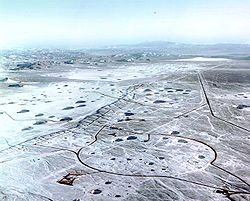
Nevada Test Site
The Nevada National Security Site , previously the Nevada Test Site , is a United States Department of Energy reservation located in southeastern Nye County, Nevada, about northwest of the city of Las Vegas...
(NTS) northwest of Las Vegas.
The Yucca Flat
Yucca Flat
Yucca Flat is a closed desert drainage basin, one of four major nuclear test regions within the Nevada Test Site , and is divided into nine test sections: Areas 1 through 4 and 6 through 10. Yucca Flat is located at the eastern edge of NTS, about ten miles north of Frenchman Flat, and from Las...
section of the NTS is covered with subsidence craters resulting from the collapse of terrain over radioactive underground caverns created by nuclear explosions (see photo).
After the 1974 Threshold Test Ban Treaty
Threshold Test Ban Treaty
The Treaty on the Limitation of Underground Nuclear Weapon Tests, also known as the Threshold Test Ban Treaty , was signed in July 1974 by the USA and the USSR...
(TTBT), which limited underground explosions to 150 kilotons or less, warheads like the half-megaton W88 had to be tested at less than full yield. Since the primary must be detonated at full yield in order to generate data about the implosion of the secondary, the reduction in yield had to come from the secondary. Replacing much of the lithium-6 deuteride fusion fuel with lithium-7 hydride limited the tritium available for fusion, and thus the overall yield, without changing the dynamics of the implosion. The functioning of the device could be evaluated using light pipes, other sensing devices, and analysis of trapped weapon debris. The full yield of the stockpiled weapon could be calculated by extrapolation.
Production facilities
When two-stage weapons became standard in the early 1950s, weapon design determined the layout of the new, widely dispersed U.S. production facilities, and vice versa.Because primaries tend to be bulky, especially in diameter, plutonium is the fissile material of choice for pits, with beryllium reflectors. It has a smaller critical mass than uranium. The Rocky Flats
Rocky Flats Plant
The Rocky Flats Plant was a United States nuclear weapons production facility near Denver, Colorado that operated from 1952 to 1992. It was under the control of the United States Atomic Energy Commission until 1977, when it was replaced by the Department of Energy .-1950s:Following World War II,...
plant near Boulder, Colorado, was built in 1952 for pit production and consequently became the plutonium and beryllium fabrication facility.
The Y-12 plant in Oak Ridge
Oak Ridge, Tennessee
Oak Ridge is a city in Anderson and Roane counties in the eastern part of the U.S. state of Tennessee, about west of Knoxville. Oak Ridge's population was 27,387 at the 2000 census...
, Tennessee
Tennessee
Tennessee is a U.S. state located in the Southeastern United States. It has a population of 6,346,105, making it the nation's 17th-largest state by population, and covers , making it the 36th-largest by total land area...
, where mass spectrometers called Calutrons had enriched uranium for the Manhattan Project
Manhattan Project
The Manhattan Project was a research and development program, led by the United States with participation from the United Kingdom and Canada, that produced the first atomic bomb during World War II. From 1942 to 1946, the project was under the direction of Major General Leslie Groves of the US Army...
, was redesigned to make secondaries. Fissile U-235 makes the best spark plugs because its critical mass is larger, especially in the cylindrical shape of early thermonuclear secondaries. Early experiments used the two fissile materials in combination, as composite Pu-Oy pits and spark plugs, but for mass production, it was easier to let the factories specialize: plutonium pits in primaries, uranium spark plugs and pushers in secondaries.
Y-12 made lithium-6 deuteride fusion fuel and U-238 parts, the other two ingredients of secondaries.
The Savannah River
Savannah River
The Savannah River is a major river in the southeastern United States, forming most of the border between the states of South Carolina and Georgia. Two tributaries of the Savannah, the Tugaloo River and the Chattooga River, form the northernmost part of the border...
plant in Aiken
Aiken, South Carolina
Aiken is a city in and the county seat of Aiken County, South Carolina, United States. With Augusta, Georgia, it is one of the two largest cities of the Central Savannah River Area. It is part of the Augusta-Richmond County Metropolitan Statistical Area. Aiken is home to the University of South...
, South Carolina
South Carolina
South Carolina is a state in the Deep South of the United States that borders Georgia to the south, North Carolina to the north, and the Atlantic Ocean to the east. Originally part of the Province of Carolina, the Province of South Carolina was one of the 13 colonies that declared independence...
, also built in 1952, operated nuclear reactors which converted U-238 into Pu-239 for pits, and converted lithium-6 (produced at Y-12) into tritium for booster gas. Since its reactors were moderated with heavy water, deuterium oxide, it also made deuterium for booster gas and for Y-12 to use in making lithium-6 deuteride.
Warhead design safety
Because even low-yield nuclear warheads have astounding destructive power, weapon designers have always recognised the need to incorporate mechanisms and associated procedures intended to prevent accidental detonation.
It is inherently dangerous to have a weapon containing a quantity and shape of fissile material which can form a critical mass through a relatively simple accident. Because of this danger, the propellant in Little Boy (four bags of cordite
Cordite
Cordite is a family of smokeless propellants developed and produced in the United Kingdom from 1889 to replace gunpowder as a military propellant. Like gunpowder, cordite is classified as a low explosive because of its slow burning rates and consequently low brisance...
) was inserted into the bomb in flight, shortly after takeoff on August 6, 1945. This was the first time a gun-type nuclear weapon had ever been fully assembled.
If the weapon falls into water, the moderating
Neutron moderator
In nuclear engineering, a neutron moderator is a medium that reduces the speed of fast neutrons, thereby turning them into thermal neutrons capable of sustaining a nuclear chain reaction involving uranium-235....
effect of the water
Light water reactor
The light water reactor is a type of thermal reactor that uses normal water as its coolant and neutron moderator. Thermal reactors are the most common type of nuclear reactor, and light water reactors are the most common type of thermal reactor...
can also cause a criticality accident
Criticality accident
A criticality accident, sometimes referred to as an excursion or a power excursion, is an accidental increase of nuclear chain reactions in a fissile material, such as enriched uranium or plutonium...
, even without the weapon being physically damaged. Similarly, a fire caused by an aircraft crashing could easily ignite the propellant, with catastrophic results. Gun-type weapons have always been inherently unsafe.
In-flight pit insertion
Neither of these effects is likely with implosion weapons since there is normally insufficient fissile material to form a critical mass without the correct detonation of the lenses. However, the earliest implosion weapons had pits so close to criticality that accidental detonation with some nuclear yield was a concern.
On August 9, 1945, Fat Man was loaded onto its airplane fully assembled, but later, when levitated pits made a space between the pit and the tamper, it was feasible to use in-flight pit insertion. The bomber would take off with no fissile material in the bomb. Some older implosion-type weapons, such as the US Mark 4
Mark 4 nuclear bomb
The Mark 4 nuclear bomb was an American nuclear bomb design produced starting in 1949 and in use until 1953.The Mark 4 was based on the earlier Mark 3 Fat Man design, used in the Trinity test and the bombing of Nagasaki...
and Mark 5
Mark 5 nuclear bomb
The Mark 5 nuclear bomb and W5 nuclear warhead were a common core nuclear weapon design, designed in the early 1950s and which saw service from 1952 to 1963....
, used this system.
In-flight pit insertion will not work with a hollow pit in contact with its tamper.
Steel ball safety method
As shown in the diagram above, one method used to decrease the likelihood of accidental detonation employed metal balls
Ball (bearing)
Bearing balls are special highly spherical and smooth balls, most commonly used in ball bearings. The balls come in many different grades, as defined by the American Bearing Manufacturers Association , which defines the precision of the balls...
. The balls were emptied into the pit: this prevented detonation by increasing the density of the hollow pit, thereby preventing symmetrical implosion in the event of an accident. This design was used in the Green Grass weapon, also known as the Interim Megaton Weapon, which was used in the Violet Club
Violet Club
Violet Club was a nuclear weapon deployed by the United Kingdom during the cold war. It was Britain's first operational "high yield" weapon, and was intended to provide an emergency capability until a thermonuclear weapon could be developed from the 1956-1958 Operation Grapple thermonuclear tests...
and Yellow Sun Mk.1
Yellow Sun
Yellow Sun was the first British operational high-yield strategic nuclear weapon. The name actually refers only to the outer casing; the warhead was known as "Green Grass" and "Red Snow"...
bombs.
Chain safety method
Alternatively, the pit can be "safed" by having its normally hollow core filled with an inert material such as a fine metal chain, possibly made of cadmium
Cadmium
Cadmium is a chemical element with the symbol Cd and atomic number 48. This soft, bluish-white metal is chemically similar to the two other stable metals in group 12, zinc and mercury. Similar to zinc, it prefers oxidation state +2 in most of its compounds and similar to mercury it shows a low...
to absorb neutrons. While the chain is in the center of the pit, the pit can not be compressed into an appropriate shape to fission; when the weapon is to be armed, the chain is removed. Similarly, although a serious fire could detonate the explosives, destroying the pit and spreading plutonium to contaminate the surroundings as has happened in several weapons accidents, it could not cause a nuclear explosion.
Wire safety method
The US W47
W47
The W47 was an American thermonuclear warhead used on the Polaris A-1 sub-launched ballistic missile system. Various models were in service from 1960 through the end of 1974...
warhead used in Polaris A1 and Polaris A2 had a safety device consisting of a boron
Boron
Boron is the chemical element with atomic number 5 and the chemical symbol B. Boron is a metalloid. Because boron is not produced by stellar nucleosynthesis, it is a low-abundance element in both the solar system and the Earth's crust. However, boron is concentrated on Earth by the...
-coated wire inserted into the hollow pit at manufacture. The warhead was armed by withdrawing the wire onto a spool driven by an electric motor. Once withdrawn the wire could not be re-inserted.
One-point safety
While the firing of one detonator out of many will not cause a hollow pit to go critical, especially a low-mass hollow pit that requires boosting, the introduction of two-point implosion systems made that possibility a real concern.
In a two-point system, if one detonator fires, one entire hemisphere of the pit will implode as designed. The high-explosive charge surrounding the other hemisphere will explode progressively, from the equator toward the opposite pole. Ideally, this will pinch the equator and squeeze the second hemisphere away from the first, like toothpaste in a tube. By the time the explosion envelops it, its implosion will be separated both in time and space from the implosion of the first hemisphere. The resulting dumbbell shape, with each end reaching maximum density at a different time, may not become critical.
Unfortunately, it is not possible to tell on the drawing board how this will play out. Nor is it possible using a dummy pit of U-238 and high-speed x-ray cameras, although such tests are helpful. For final determination, a test needs to be made with real fissile material. Consequently, starting in 1957, a year after Swan, both labs began one-point safety tests.
Out of 25 one-point safety tests conducted in 1957 and 1958, seven had zero or slight nuclear yield (success), three had high yields of 300 t to 500 t (severe failure), and the rest had unacceptable yields between those extremes.
Of particular concern was Livermore's W47 warhead for the Polaris submarine missile. The last test before the 1958 moratorium was a one-point test of the W47 primary, which had an unacceptably high nuclear yield of 400 lb (181.4 kg) of TNT equivalent (Hardtack II Titania). With the test moratorium in force, there was no way to refine the design and make it inherently one-point safe. Los Alamos had a suitable primary that was one-point safe, but rather than share with Los Alamos the credit for designing the first SLBM warhead, Livermore chose to use mechanical safing on its own inherently unsafe primary. The wire safety scheme described above was the result.
It turns out that the W47
W47
The W47 was an American thermonuclear warhead used on the Polaris A-1 sub-launched ballistic missile system. Various models were in service from 1960 through the end of 1974...
may have been safer than anticipated. The wire-safety system may have rendered most of the warheads "duds," unable to fire when detonated.
When testing resumed in 1961, and continued for three decades, there was sufficient time to make all warhead designs inherently one-point safe, without need for mechanical safing.
Strong link weak link
Strong link weak link
A Strong link/weak link and Exclusion zone nuclear detonation mechanism is a type of safety mechanism employed in the arming and firing mechanisms of modern nuclear weapons. It is a form of automatic safety interlock...
A strong link/weak link and exclusion zone nuclear detonation mechanism is a form of automatic safety interlock
Interlock (engineering)
Interlocking is a method of preventing undesired states in a state machine, which in a general sense can include any electrical, electronic, or mechanical device or system....
.
Permissive Action Link
Permissive Action Link
A Permissive Action Link is a security device for nuclear weapons. Its purpose is to prevent unauthorized arming or detonation of the nuclear weapon.The United States Department of Defense definition is:...
s
In addition to the above steps to reduce the probability of a nuclear detonation arising from a single fault, locking mechanisms referred to by NATO states as Permissive Action Links are sometimes attached to the control mechanisms for nuclear warheads. Permissive Action Links act solely to prevent the unauthorised use of a nuclear weapon.
External links
- Carey Sublette's Nuclear Weapon Archive is a reliable source of information and has links to other sources.
- Nuclear Weapons Frequently Asked Questions: Section 4.0 Engineering and Design of Nuclear Weapons
- The Federation of American Scientists provides solid information on weapons of mass destruction, including nuclear weapons and their effects
- Globalsecurity.org provides a well-written primer in nuclear weapons design concepts (site navigation on righthand side).
- More information on the design of two-stage fusion bombs
- Militarily Critical Technologies List (MCTL) from the US Government's Defense Technical Information Center
- "Restricted Data Declassification Decisions from 1946 until Present", Department of Energy report series published from 1994 until January 2001 which lists all known declassification actions and their dates. Hosted by Federation of American Scientists.
- The Holocaust Bomb: A Question of Time is an update of the 1979 court case USA v. The Progressive, with links to supporting documents on nuclear weapon design.
- Annotated bibliography on nuclear weapons design from the Alsos Digital Library for Nuclear Issues