

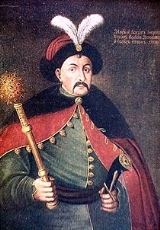
Bohdan Khmelnytsky

Encyclopedia
Bohdan Zynoviy Mykhailovych Khmelnytsky (c. 1595 – 6 August 1657) was a hetman
of the Zaporozhian Cossack Hetmanate
of Polish–Lithuanian Commonwealth (now Ukraine
). He led an uprising
against the Commonwealth and its magnate
s (1648–1654) which resulted in the creation of a Cossack state. In 1654, he concluded the Treaty of Pereyaslav
with the Tsardom of Russia
, which led to the eventual loss of independence to the Russian Empire
.
 Although there is no definite proof of the date of his birth, it has been suggested by Ukrainian historian Mykhaylo Maksymovych
that it is likely 27 December 1595 (St. Theodore
's day). As it was the custom in the Orthodox Church, he was baptized with one of his middle names--Theodor, translated into Ukrainian
as Bohdan.
The latest biography of Khmelnytsky by Smoliy and Stepankov, however, challenges the 27 December date and suggests that it is more likely he was born on 9 November (feast day of St Zenoby, 30 October in Julian Calendar
) and was baptised on 11 November (feast day of St. Theodore
in the Catholic Church)
Khmelnytsky was probably born in the village of Subotiv
, near Chyhyryn
in Ukraine
at the estate of his father Mykhailo Khmelnytsky. Even though his father, a courtier
of Great Crown Hetman Stanisław Żółkiewski, was of noble birth himself and belonged to the Clan Massalski, Abdank or Syrokomla, there was and is still controversy as to whether Bohdan belonged to the szlachta himself. Some sources state that in 1590 his father Mykhailo was appointed as a sotnyk for the Korsun-Chyhyryn starosta Jan Daniłowicz, who continued to colonize the new Ukrainian lands near the Dnieper river
. According to the above mentioned-source, Mykhailo established Chyhyryn
and later his own family estates of Subotiv (5 miles from Chyhyryn) and Novoseltsi. This, however, didn't prevent Khmelnytsky from considering himself a noble and his father's status as a deputy Starosta
(elder
) of Chyhyryn helped him to be considered as such by others. Later on, however, during the Uprising he would stress his mother's Cossack
roots and his father's exploits with the Cossacks of the Sich
.
There is also no concrete evidence in regard to Khmelnytsky's early education. Several historians believe he received his elementary schooling from a church clerk until he was sent to one of Kiev
's Orthodox fraternity schools. He continued his education in Polish
at a Jesuit
college, possibly in Jarosław, but more likely in Lviv
, in the school founded by hetman Żółkiewski. He completed his schooling by 1617 and acquired a broad knowledge of world history and learned Polish and Latin. Later he learned Turkish
, Tatar
and French
. Unlike many of the other Jesuit students, he did not embrace Roman Catholicism
but remained Greek Orthodox
.
, as the Polish–Lithuanian Commonwealth entered into war with the Ottoman Empire
. His first military engagement was a tragic one. During the battle of Cecora
(Ţuţora) on 17 September 1620, his father was killed, and young Khmelnytsky among many others, including future hetman Stanisław Koniecpolski, was captured by the Turks. He spent the next two years in captivity in Constantinople
, as a prisoner of an Ottoman
Kapudan Pasha (presumably Parlak Mustafa Pasha). Other sources claim that he spent his slavery in Ottoman Navy
on galleys as an oarsman where he picked the knowledge of Turkic languages
.
While there is no concrete evidence as to how he returned to Ukraine, most historians believe he either escaped or his ransom was paid. Sources vary as to by whom — his mother, friends, the Polish king — but perhaps by Krzysztof Zbaraski
, ambassador of the Rzeczpospolita to the Ottomans, who in 1622 paid 30,000 thaler
s in ransom for all prisoners of war
captured at the Battle of Cecora. Upon return to Subotiv, Khmelnytsky took over the running of his father's estate and became a registered Cossack
in the Chyhyryn Regiment
where he later became a pysar (a historical officer title among cossacks). Since 1625 he participated in several sea raids together with Zaporozhian Cossacks onto Constantinople
. In those raids he earned his title of a sotnyk (a leader of a hundred). In the meantime, his widowed mother married again, to Belarusian
noble Vasyl Stavetsky, and moved to his estate, leaving Bohdan in charge of Subotiv. In a year she had another son, Hryhoriy, who curiously enough later preferred to take his mother's name and was known as Hryhoriy Khmelnytsky. For a short time he also served as a koniuszy to hetman Mikołaj Potocki, but relatively quickly they parted their ways after a personal conflict. Bohdan Khmelnytsky later married Hanna Somkivna, a daughter of a rich Pereyaslavl
Cossack and they settled in Subotiv. By the second half of the 1620s they already had three daughters: Stepanida, Olena, and Kateryna. His first son Tymish (Tymofiy)
was born in 1632, and another son Yuriy was born in 1640.
During this time Bohdan Khmelnytsky was running his estate and advanced in his service in the Regiment. He first became a sotnyk and later advanced to the rank of a regiment scribe. He certainly had significant negotiation skills and commanded respect of his fellow Cossacks as on 30 August 1637 he was included in a delegation to Warsaw
to plead the Cossacks' case before the Polish King Władysław IV. Serving in the army of a Polish magnate and great commander, hetman Stanisław Koniecpolski, he participated in a rather successful campaign as the Commonwealth army, part of which was Bohdan's regiment, scored a decisive victory over the Tatars
in 1644. During this time, as some archival documents show, he also had a meeting in Warsaw with the French ambassador Count De Bregie, during which he discussed the possibility of Cossack participation in war in France. Sources vary as to whether in April 1645 he traveled to France (to Fontainebleau
) to discuss further details of Cossack service in France; this claim is supported by Ukrainian historiography but disputed by Polish scholarship. In October 1644 around two thousand Polish infantry soldiers (some scholars think they were Cossacks, but the French sources do not actually name them as such) went to France by sea via Gdańsk
and Calais
, where they participated in the siege and capture of Dunkerque.
redrew the maps of his possessions and laid claim to Khmelnytsky's estate, which he claimed was his. In his attempt to find protection from the powerful magnate, Khmelnytsky wrote numerous appeals and letters to different representatives of the Polish crown — but to no avail. At the end of 1645 the Chyhyryn starost (elder) Daniel Czapliński
officially received authority from Koniecpolski to seize the Subotiv estate. In summer of 1646 Khmelnytsky, using his favorable standing at the Polish court, arranged an audience with King Władysław IV to plead his case. Władysław, who wanted Cossacks on his side in the wars he planned, gave him a royal charter, which protected his rights to the estate. However, such was the structure of the Commonwealth at that time, and the lawlessness of its eastern realms, that even the King was not able to avert the confrontation with the local magnates. In the beginning of 1647 Daniel Czapliński openly started to harass Khmelnytsky in an attempt to force him off the land. On two occasions Subotiv was raided: considerable property damage was done and Khmelnytsky's son Yuriy was badly beaten. Finally, in April 1647, Czapliński succeeded in evicting Khmelnytsky from the land, causing Khmelnytsky to move with his large family to a relative's house in Chyhyryn.
In May 1647 Khmelnytsky arranged a second audience with the King to plead his case, but found the King unwilling to go into an open confrontation with a powerful magnate. In addition to the loss of the estate, his first wife Hanna died, leaving him alone with the children. While he promptly remarried to Motrona, his second wife, he was still unsuccessful in all of his attempts to find justice in regard to his estate. During this time, he met several higher Polish officials to discuss the Cossacks' issue of the war with the Tatars and used this occasion again to plead his case with Czapliński, still unsuccessfully.
While Khmelnytsky found no support from the Polish officials, he found it in his Cossack friends and subordinates. The case of a Cossack being unfairly treated by the Poles found a lot of support not only in his Chyhyryn regiment, but also with others including the Sich
. All through the autumn of 1647 Khmelnytsky traveled from one regiment to another, and had numerous consultations with Cossack leaders throughout Ukraine. His activity raised suspicion among the Polish authorities already used to Cossack revolts; he was promptly arrested. Koniecpolski issued an order for his execution, but the Chyhyryn Cossack polkovnyk who held Khmelnytsky was persuaded to release him. Not willing to tempt fate any further, Khmelnytsky headed for the Zaporozhian Sich with a group of his supporters.
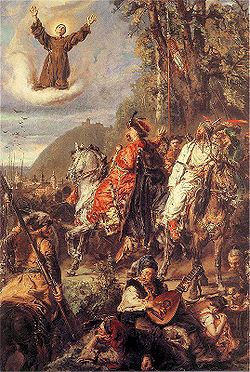
While it might appear that the Czapliński Affair was the immediate cause of the Uprising, it was only an impetus that brought a successful and talented Cossack to the forefront of popular discontent among the people of what is now Ukraine. Religion, ethnicity, and economics factored into this discontent. While the Polish–Lithuanian Commonwealth remained a union
of two nations: of Poland
and Lithuania
, a sizable population of Orthodox Ruthenians
remained ignored. That left them oppressed by the Polish magnates and their wrath was directed at the Poles' Jewish traders, who often ran their estates for them. The advent of the Counter-Reformation
further worsened relations between the Orthodox and Catholic Churches. Many Orthodox Ukrainians saw the Union of Brest
as a threat to their Orthodox faith, and coupled with the frequent abuse of the Orthodox clergy this added a religious dimension to the conflict. This could have been one of the many other frequent Cossack revolts that had been put down by the authorities, but the stature and skill of, and respect for, the seasoned 50-year-old negotiator and warrior Khmelnytsky perhaps made all the difference.
of the Dnieper river. On December 7, 1648 his small (300–500-man) detachment, with the help of registered Cossacks who went to his side, disarmed the small Polish detachment guarding the area and took over the Zaporozhian Sich — much to the jubilation of many of the Cossacks. An attempt to retake the Sich by the Poles
was decisively fought off as more registered Cossacks joined his forces. At the end of January 1648 a Cossack Rada
was called and Khmelnytsky was unanimously elected a hetman
. A feverish activity followed. Cossacks were sent with hetman's letters to many regions of Ukraine calling on Cossacks and Orthodox peasants to join the rebellion, the defence of Khortytsia
was improved, arrangements were made to acquire and make weapons and anmunition, and emissaries were sent to the Khan of Crimea
, İslâm III Giray
.
Initially, Polish authorities took the news of Khmelnytsky's arrival at the Sich and reports about the rebellion quite lightly. The two sides exchanged lists of demands: the Poles asked for Cossacks to surrender the mutinous leader and disband, while Khmelnytsky and the Rada demanded that the Commonwealth restore the Cossacks' ancient rights, stop the advance of the Ukrainian Greek Catholic Church
, yield the right to appoint Orthodox leaders of the Sich and of the Registered Cossack regiments, and remove the Commonwealth troops from Ukraine. These demands of Khmelnytsky were taken as an affront by the Polish magnates and an army headed by Stefan Potocki moved in the direction of the Sich. Had the Cossacks stayed at Khortytsia
they might have been defeated as in many other rebellions. But this time, instead of waiting for the Poles, Khmelnytsky marched against them. The two armies met on 16 May 1648 at Zhovti Vody
, where, aided by the Tatars of Tugay Bey, the Cossacks inflicted their first crushing defeat on the Commonwealth. This was repeated soon after, with the same success, at the Battle of Korsuń
on 26 May 1648. What made these Cossack successess different was the diplomatic and military skill of Khmelnytsky: under his leadership, the Cossack army moved to battle positions following his plans, Cossacks were proactive and decisive in their maneuver and attacks, and most importantly, he not only managed to persuade large contingents of registered Cossacks to switch to his side, but also got the support of the Crimean Khan
— his crucial ally for the many battles to come.
.svg.png) At Christmas 1648, Khmelnytsky made a triumphant entry into Kiev, where he was hailed as "the Moses, savior, redeemer, and liberator of the people from Polish captivity ... the illustrious ruler of Rus". The Patriarchs of Jerusalem
At Christmas 1648, Khmelnytsky made a triumphant entry into Kiev, where he was hailed as "the Moses, savior, redeemer, and liberator of the people from Polish captivity ... the illustrious ruler of Rus". The Patriarchs of Jerusalem
Paiseus who was visiting Kiev at this time referred to Khmelnytsky as the Prince of Rus, the head of independent Ukrainian state, according to the contemporaries. In February 1649, during negotiations in Pereiaslav with a Polish delegation headed by senator Adam Kysil, Khmelnytsky declared that he was "the sole autocrat of Rus" and that he had "enough power in Ukraine, Podilia, and Volhynia
... in his land and principality stretching as far as Lviv, Chełm, and Halych
."
It became clear to the Polish envoys that Khmelnytsky had positioned himself not just as a leader of the Zaporozhian Cossacks, but of Ukraine, and stated his claims to the heritage of the Rus. A Vilnius
panegyric
in Khmelnytsky's honor (1650–1651) explained it this way: "While in Poland it is King Jan II Casimir Vasa, in Rus it is Hetman Bohdan Khmelnytsky."
After the period of initial military successes the state-building
process began. His leadership was demonstrated in all areas of state-building: in the military, administration, finance, economics, and culture. With political acumen he made the Zaporozhian Host
under the leadership of its hetman the supreme power in the new Ukrainian state, and unified all the spheres of Ukrainian society under his authority. Khmelnytsky built a new government system and developed military and civilian administration.
During this time a new generation of statesmen and military leaders came to the forefront: Ivan Vyhovsky
, Pavlo Teteria
, Danylo Nechai and Ivan Nechai, Ivan Bohun
, Hryhoriy Hulyanytsky
. From Cossack polkovnyks, officers, and military commanders, a new elite within the Cossack Hetman state was born. Throughout the years, this elite preserved and maintained the autonomy of the Cossack Hetmanate
in the face of Russia's attempt to curb it. But it was also instrumental in the onset of the period of Ruin that followed and eventually destroyed most of the achievements of the Khmelnytsky era.
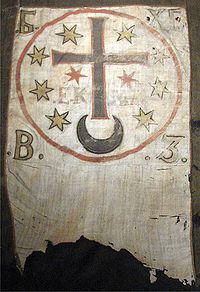
on 18 August 1649 was unfavourable for the Cossacks. This was followed by another defeat at the battle of Berestechko
on 18 June 1651, where the Tatars betrayed him again and even held the hetman captive. The result was a crushing defeat for the Cossacks and a high number of casualties (estimated to be around 30,000 Cossacks), along with the Treaty of Bila Tserkva
, which favoured the Polish–Lithuanians. That treaty was soon violated, and in the years that followed the two sides were almost in the perpetual state of warfare
. In this situation the Crimean Tatars
played a decisive role — not allowing either side to prevail. It was in their interests to keep both Ukraine and the Polish–Lithuanian Commonwealth from getting too strong and becoming an effective power in the region.
Under the circumstances, Khmelnytsky started looking for another foreign ally. Even though the Cossacks established their de facto
independence from Poland, the new state needed legitimacy that was essential in 17th century Europe, and this legitimacy could be provided by a foreign monarch. In search of a protectorate, Khmelnytsky approached the Ottoman sultan in 1651 and formal embassies were exchanged. The Turks offered vassalship similar to their other arrangements with contemporary Crimea
, Moldavia
and Walachia. However, the idea of a union with the Muslim
monarch didn't rest well with the general populace and the Cossacks from whom Khmelnytsky drew his support.
The other possible ally was Orthodox Russia
. They, however, remained quite cautious and stayed away from the hostilities in Ukraine. In spite of numerous envoys and calls for help from Khmelnytsky in the name of the shared Orthodox faith, the Tsar preferred to wait until the threat of a Cossack-Ottoman union in 1653 finally forced him to action. The idea that the Tsar might be favourable to taking Ukraine under his hand was communicated to the hetman and the diplomatic activity intensified.
Vasili Buturlin came to Pereyaslav, where on 18 January 1654 the Cossack Rada was called and the treaty concluded. There is still no unanimity among historians as to the true intentions of both Muscovy
and Khmelnytsky in signing this agreement. For Tsar Alexei Mikhailovich the treaty legitimized Moscow's claims to the territory of Kievan Rus'
and strengthened his influence in the region. For Khmelnytsky the Treaty of Pereyaslav offered first and foremost a legitimate monarch's protection and support from a friendly Orthodox power. There have been a number of conflicting opinions as to what kind of union Khmelnytsky had in mind, whether it was to be a military union, a suzerainty
or a complete incorporation of Ukraine into the Tsardom of Russia
.
The two sides had somewhat different ideas of the treaty and the union, as exemplified by an incident during the oath of allegiance to the Tsar: the treaty was almost broken when the Moscovite envoy refused to reciprocate with an oath from the ruler to his subjects, as was the custom with the Polish king. At one point, for this reason, Khmelnytsky stormed out of the church and threatened to cancel the entire treaty. It was only after some consideration that this demand on the part of the Cossacks was rescinded and the treaty stayed. Due to both sides having different goals in Ukraine, the liberties that were allowed to Khmelnytsky due to his stature were denied to his successors. That, in the end, eventually led to the complete incorporation of Ukraine into the Tsardom of Moscovy and later into the Russian Empire
.
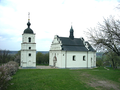 As a result of the Treaty of Pereyaslav the geopolitical map of the region had changed — a new player, Russia
, entered the scene, and the Cossacks' former allies, the Tatars, went to the Polish side. That intensified the conflict, as the Tatars were now unrestrained in their warfare against Khmelnytsky. Tatar raids
depopulated whole areas of Ukraine. Cossacks, aided by the Tsar's army, took revenge on Polish possessions in Belarus
, and in the spring of 1654, the Cossacks drove the Polish from much of the country. To complicate the situation even further, another power joined the melee — Sweden
. They were the old adversaries of both Poland and Russia, but did not attack Russia, instead being quick to occupy their share of Lithuania before the Russians could get there. That put Khmelnytsky into a delicate situation in regard to the Tsar, as he had been negotiating with the Swedes for some time, coordinating their attacks on the Commonwealth. Besides being hostile to Sweden in general, this also displeased Russia because Russia had its eyes on the Swedish Baltic provinces. In 1656 with the Commonwealth increasingly war-torn but also increasingly hostile and successful against the Swedes, the ruler of Transylvania
, George II Rákóczi
, also joined in - a last straw effort of Charles X of Sweden to save the war effort due to the massive Polish popular opposition against the Swedes. Under blows from all sides the Commonwealth only survived thanks to its steely unity in the face of destruction.
Russia attacked Sweden in July 1656 when Sweden was deeply involved with its situation in Poland. That war ended in status quo two years later, but it complicated matters even further for Khmelnytsky, as his ally was now fighting his overlord. In addition to diplomatic tensions between the Tsar and Khmelnytsky, a number of other disagreements between the two surfaced, notably in regard to Russian officials' interference in the finances of the Hetmanate
and in the newly liberated Belarus. One thing that infuriated the hetman the most was the separate treaty the Tsar concluded with the Poles in Vilnius
in 1656. The Hetman's emissaries were not even allowed to attend the negotiations. That prompted Khmelnytsky to write an irate letter to the Tsar accusing him of breaking the Pereyaslav agreement. In his anger, Khmelnytsky compared Swedes to the Tsar, claiming that the Swedes were more honourable and trustworthy than the Russians.
In addition to diplomatic tensions with Russia, the Cossack army with their Transylvanian allies in Poland suffered a number of setbacks. As a result, Khmelnytsky had to deal with a Cossack rebellion on the home front. Troubling news also came from Crimea, as Tatars, in alliance with Poland, were preparing for a new invasion
of Ukraine. Though already ill, Khmelnytsky continued to conduct diplomatic activity, at one point even receiving the Tsar's envoys in his bed. On 22 July he suffered cerebral hemorrhage, became paralyzed after his audience with the Kiev Colonel Zhdanovich whose expedition to Halychyna failed due to mutiny within his army. Less than a week later, Bohdan Khmelnytsky died at 5 A.M. on 27 July 1657. His funeral was held on 23 August, and his body was taken from his capital Chyhyryn to his estate at Subotiv for burial in his ancestral church. In 1664 a Polish noble Stefan Czarniecki
captured Subotiv and ordered the bodies of the hetman and his son Tymish
to be exhumed and desecrated.
in Eastern Europe. As with any other prominent personality his role in the events and his actions were viewed differently by his various contemporaries, and even now different people sometimes have quite opposing views on his legacy.
. A city
and a region
of the country bear his name. His image is prominently displayed on Ukrainian banknotes and his monument in the centre of Kiev is the focal point of the Ukrainian capital. There have also been several issues of the Order of Bohdan Khmelnitsky — one of the highest decorations in Ukraine and in the former Soviet Union. With all this positive appreciation of his legacy, even in Ukraine
it is far from being unanimous. He is mostly criticised for his union with Russia, which in the view of some, proved to be disastrous for the future of the country. This particular view, among others, was expressed by a prominent Ukrainian poet
, Taras Shevchenko
, who was one of Khmelnytsky's very vocal and harsh critics. Furthermore his local reputation was damaged by his alliance with the Crimean Tatars, which permitted the latter to take a large number of Ukrainian peasants as slaves (this may be interpreted as an illustration of the relative indifference of the cossacks as a military caste toward the 'kholopy', the lowest stratum of the Ukrainian people). The traces of this are still found in folk songs. On the balance, the view of his legacy in present-day Ukraine
is more positive than negative, with some critics admitting that the union with Russia was dictated by necessity and an attempt to survive in those difficult times.
of the Commonwealth and the beginning of its demise. Even though it would survive the rebellion and the period of Deluge that followed, within a hundred years it would be no more — its remains would be divided between Russia, Prussia
, and Austria
in the partitions of Poland
. Many blamed Khmelnytsky for the decline of the Commonwealth. This view is contrasted with a far more comprehensive appreciation of Khmelnytsky's legacy by Polish historians, like Ludwik Kubala
, who in his works compared him with Oliver Cromwell
. A more balanced appreciation prevails — that the fundamental ills of the Commonwealth resulted in the rebellion that Khmelnytsky led.
stressed the fact that Khmelnytsky entered into union with Moscow's Tsar Alexei Mikhailovich with an expressed desire to "re-unify" Ukraine with Russia. This view corresponded with the official theory of Moscow being an heir of the Kievan Rus'
and thus a gatherer of its former territories.
In this light Khmelnytsky was viewed as a national hero of Russia for bringing Ukraine into the "eternal union" of all the Russias — Great, Little and White Russia. As such, he was much respected and venerated in Imperial Russia. His role was presented as a model for all Ukrainians to follow — to aspire for closer ties with Great Russia. This view was expressed in a monument commissioned by the Russian nationalist Mikhail Yuzefovich
, which was installed in the center of Kiev
in 1888
The original variant of the monument (created by Russian sculptor Mikhail Mikeshin
) appeared too xenophobic even for the Russian authorities, as it was to depict a vanquished Pole, Jew, and a Catholic priest under the hoofs of the horse. A more moderate version was installed, but the inscription on the monument read "To Bogdan Khmelnitsky from one and indivisible Russia."
The view of Khmelnytsky as a prominent, positive figure in the Russian history is further displayed in Mikeshin's Monument to the Millennium of Russia in Novgorod, where Khmelnytsky is shown as one of Russia's prominent figures.
Soviet historiography
followed in many ways the Imperial Russian theory of "re-unification" while adding the class struggle
dimension to the story. Thus, Khmelnytsky was not only praised for "re-unifying" Ukraine with Russia, but also for organizing the class struggle of oppressed Ukrainian peasants against Polish exploiters.
See Khmelnytsky Uprising
for detailed further information.
Hetman
Hetman was the title of the second-highest military commander in 15th- to 18th-century Poland and the Grand Duchy of Lithuania, which together, from 1569 to 1795, comprised the Polish-Lithuanian Commonwealth, or Rzeczpospolita....
of the Zaporozhian Cossack Hetmanate
Cossack Hetmanate
The Hetmanate or Zaporizhian Host was the Ruthenian Cossack state in the Central Ukraine between 1649 and 1782.The Hetmanate was founded by first Ukrainian hetman Bohdan Khmelnytsky during the Khmelnytsky Uprising . In 1654 it pledged its allegiance to Muscovy during the Council of Pereyaslav,...
of Polish–Lithuanian Commonwealth (now Ukraine
Ukraine
Ukraine is a country in Eastern Europe. It has an area of 603,628 km², making it the second largest contiguous country on the European continent, after Russia...
). He led an uprising
Khmelnytsky Uprising
The Khmelnytsky Uprising, was a Cossack rebellion in the Ukraine between the years 1648–1657 which turned into a Ukrainian war of liberation from Poland...
against the Commonwealth and its magnate
Magnate
Magnate, from the Late Latin magnas, a great man, itself from Latin magnus 'great', designates a noble or other man in a high social position, by birth, wealth or other qualities...
s (1648–1654) which resulted in the creation of a Cossack state. In 1654, he concluded the Treaty of Pereyaslav
Treaty of Pereyaslav
The Treaty of Pereyaslav is known in history more as the Council of Pereiaslav.Council of Pereyalslav was a meeting between the representative of the Russian Tsar, Prince Vasili Baturlin who presented a royal decree, and Bohdan Khmelnytsky as the leader of Cossack Hetmanate. During the council...
with the Tsardom of Russia
Tsardom of Russia
The Tsardom of Russia was the name of the centralized Russian state from Ivan IV's assumption of the title of Tsar in 1547 till Peter the Great's foundation of the Russian Empire in 1721.From 1550 to 1700, Russia grew 35,000 km2 a year...
, which led to the eventual loss of independence to the Russian Empire
Russian Empire
The Russian Empire was a state that existed from 1721 until the Russian Revolution of 1917. It was the successor to the Tsardom of Russia and the predecessor of the Soviet Union...
.
Early life
Mykhaylo Maksymovych
Mykhailo Oleksandrovych Maksymovych was a famous Ukrainian naturalist, historian and writer....
that it is likely 27 December 1595 (St. Theodore
St. Theodore, 9th century anti-iconoclast
St Theodore was a hieromonk of the Orthodox Church known as a strong opponent of Byzantine Iconoclasm.Theodore was born in Constantinople to a family with strong connections to the Orthodox Church. Ordained in 787, in 794 he became abbot of the Symboleon monastery in Bithynia, and later escaped...
's day). As it was the custom in the Orthodox Church, he was baptized with one of his middle names--Theodor, translated into Ukrainian
Ukrainian language
Ukrainian is a language of the East Slavic subgroup of the Slavic languages. It is the official state language of Ukraine. Written Ukrainian uses a variant of the Cyrillic alphabet....
as Bohdan.
The latest biography of Khmelnytsky by Smoliy and Stepankov, however, challenges the 27 December date and suggests that it is more likely he was born on 9 November (feast day of St Zenoby, 30 October in Julian Calendar
Julian calendar
The Julian calendar began in 45 BC as a reform of the Roman calendar by Julius Caesar. It was chosen after consultation with the astronomer Sosigenes of Alexandria and was probably designed to approximate the tropical year .The Julian calendar has a regular year of 365 days divided into 12 months...
) and was baptised on 11 November (feast day of St. Theodore
St. Theodore, 9th century anti-iconoclast
St Theodore was a hieromonk of the Orthodox Church known as a strong opponent of Byzantine Iconoclasm.Theodore was born in Constantinople to a family with strong connections to the Orthodox Church. Ordained in 787, in 794 he became abbot of the Symboleon monastery in Bithynia, and later escaped...
in the Catholic Church)
Khmelnytsky was probably born in the village of Subotiv
Subotiv
Subotiv is a village in central Ukraine. It is located in the Chyhyrynskyi Raion of the Cherkasy Oblast , near Chyhyryn city....
, near Chyhyryn
Chyhyryn
Chyhyryn is a city located in Cherkasy Oblast of central Ukraine. In 1648 to 1669 the city was the capital of Ukraine .- Location :...
in Ukraine
Ukraine
Ukraine is a country in Eastern Europe. It has an area of 603,628 km², making it the second largest contiguous country on the European continent, after Russia...
at the estate of his father Mykhailo Khmelnytsky. Even though his father, a courtier
Courtier
A courtier is a person who is often in attendance at the court of a king or other royal personage. Historically the court was the centre of government as well as the residence of the monarch, and social and political life were often completely mixed together...
of Great Crown Hetman Stanisław Żółkiewski, was of noble birth himself and belonged to the Clan Massalski, Abdank or Syrokomla, there was and is still controversy as to whether Bohdan belonged to the szlachta himself. Some sources state that in 1590 his father Mykhailo was appointed as a sotnyk for the Korsun-Chyhyryn starosta Jan Daniłowicz, who continued to colonize the new Ukrainian lands near the Dnieper river
Dnieper River
The Dnieper River is one of the major rivers of Europe that flows from Russia, through Belarus and Ukraine, to the Black Sea.The total length is and has a drainage basin of .The river is noted for its dams and hydroelectric stations...
. According to the above mentioned-source, Mykhailo established Chyhyryn
Chyhyryn
Chyhyryn is a city located in Cherkasy Oblast of central Ukraine. In 1648 to 1669 the city was the capital of Ukraine .- Location :...
and later his own family estates of Subotiv (5 miles from Chyhyryn) and Novoseltsi. This, however, didn't prevent Khmelnytsky from considering himself a noble and his father's status as a deputy Starosta
Starosta
Starost is a title for an official or unofficial position of leadership that has been used in various contexts through most of Slavic history. It can be translated as "elder"...
(elder
Elder (administrative title)
The term Elder is used in several different countries and organizations to indicate a position of authority...
) of Chyhyryn helped him to be considered as such by others. Later on, however, during the Uprising he would stress his mother's Cossack
Cossack
Cossacks are a group of predominantly East Slavic people who originally were members of democratic, semi-military communities in what is today Ukraine and Southern Russia inhabiting sparsely populated areas and islands in the lower Dnieper and Don basins and who played an important role in the...
roots and his father's exploits with the Cossacks of the Sich
Zaporizhian Sich
Zaporizhian Sich was socio-political, grassroot, military organization of Ukrainian cossacks placed beyond Dnieper rapids. Sich existed between the 16th and 18th centuries in the region around the today's Kakhovka Reservoir...
.
There is also no concrete evidence in regard to Khmelnytsky's early education. Several historians believe he received his elementary schooling from a church clerk until he was sent to one of Kiev
Kiev
Kiev or Kyiv is the capital and the largest city of Ukraine, located in the north central part of the country on the Dnieper River. The population as of the 2001 census was 2,611,300. However, higher numbers have been cited in the press....
's Orthodox fraternity schools. He continued his education in Polish
Polish language
Polish is a language of the Lechitic subgroup of West Slavic languages, used throughout Poland and by Polish minorities in other countries...
at a Jesuit
Society of Jesus
The Society of Jesus is a Catholic male religious order that follows the teachings of the Catholic Church. The members are called Jesuits, and are also known colloquially as "God's Army" and as "The Company," these being references to founder Ignatius of Loyola's military background and a...
college, possibly in Jarosław, but more likely in Lviv
Lviv
Lviv is a city in western Ukraine. The city is regarded as one of the main cultural centres of today's Ukraine and historically has also been a major Polish and Jewish cultural center, as Poles and Jews were the two main ethnicities of the city until the outbreak of World War II and the following...
, in the school founded by hetman Żółkiewski. He completed his schooling by 1617 and acquired a broad knowledge of world history and learned Polish and Latin. Later he learned Turkish
Turkish language
Turkish is a language spoken as a native language by over 83 million people worldwide, making it the most commonly spoken of the Turkic languages. Its speakers are located predominantly in Turkey and Northern Cyprus with smaller groups in Iraq, Greece, Bulgaria, the Republic of Macedonia, Kosovo,...
, Tatar
Crimean Tatar language
The Crimean Tatar language is the language of the Crimean Tatars. It is a Turkic language spoken in Crimea, Central Asia , and the Crimean Tatar diasporas in Turkey, Romania, Bulgaria...
and French
French language
French is a Romance language spoken as a first language in France, the Romandy region in Switzerland, Wallonia and Brussels in Belgium, Monaco, the regions of Quebec and Acadia in Canada, and by various communities elsewhere. Second-language speakers of French are distributed throughout many parts...
. Unlike many of the other Jesuit students, he did not embrace Roman Catholicism
Roman Catholic Church
The Catholic Church, also known as the Roman Catholic Church, is the world's largest Christian church, with over a billion members. Led by the Pope, it defines its mission as spreading the gospel of Jesus Christ, administering the sacraments and exercising charity...
but remained Greek Orthodox
Eastern Orthodox Church
The Orthodox Church, officially called the Orthodox Catholic Church and commonly referred to as the Eastern Orthodox Church, is the second largest Christian denomination in the world, with an estimated 300 million adherents mainly in the countries of Belarus, Bulgaria, Cyprus, Georgia, Greece,...
.
Service with the Cossacks
Upon completion of his studies in 1617, Bohdan entered into service with the Cossacks. As early as 1619 he was sent along with his father to MoldaviaMoldavia
Moldavia is a geographic and historical region and former principality in Eastern Europe, corresponding to the territory between the Eastern Carpathians and the Dniester river...
, as the Polish–Lithuanian Commonwealth entered into war with the Ottoman Empire
Ottoman Empire
The Ottoman EmpireIt was usually referred to as the "Ottoman Empire", the "Turkish Empire", the "Ottoman Caliphate" or more commonly "Turkey" by its contemporaries...
. His first military engagement was a tragic one. During the battle of Cecora
Battle of Tutora (1620)
The Battle of Ţuţora was a battle between the Polish-Lithuanian Commonwealth and Ottoman forces , fought from 17 September to 7 October 1620 in Moldavia, near the Prut River.- Prelude :Because of the failure of Commonwealth diplomatic mission to Constantinople, and violations of the Treaty of...
(Ţuţora) on 17 September 1620, his father was killed, and young Khmelnytsky among many others, including future hetman Stanisław Koniecpolski, was captured by the Turks. He spent the next two years in captivity in Constantinople
Constantinople
Constantinople was the capital of the Roman, Eastern Roman, Byzantine, Latin, and Ottoman Empires. Throughout most of the Middle Ages, Constantinople was Europe's largest and wealthiest city.-Names:...
, as a prisoner of an Ottoman
Ottoman Turks
The Ottoman Turks were the Turkish-speaking population of the Ottoman Empire who formed the base of the state's military and ruling classes. Reliable information about the early history of Ottoman Turks is scarce, but they take their Turkish name, Osmanlı , from the house of Osman I The Ottoman...
Kapudan Pasha (presumably Parlak Mustafa Pasha). Other sources claim that he spent his slavery in Ottoman Navy
Ottoman Navy
The Ottoman Navy was established in the early 14th century. During its long existence it was involved in many conflicts; refer to list of Ottoman sieges and landings and list of Admirals in the Ottoman Empire for a brief chronology.- Pre-Ottoman:...
on galleys as an oarsman where he picked the knowledge of Turkic languages
Turkic languages
The Turkic languages constitute a language family of at least thirty five languages, spoken by Turkic peoples across a vast area from Eastern Europe and the Mediterranean to Siberia and Western China, and are considered to be part of the proposed Altaic language family.Turkic languages are spoken...
.
While there is no concrete evidence as to how he returned to Ukraine, most historians believe he either escaped or his ransom was paid. Sources vary as to by whom — his mother, friends, the Polish king — but perhaps by Krzysztof Zbaraski
Krzysztof Zbaraski
Krzysztof Zbaraski was a Polish-Lithuanian member of the gentry social class...
, ambassador of the Rzeczpospolita to the Ottomans, who in 1622 paid 30,000 thaler
Thaler
The Thaler was a silver coin used throughout Europe for almost four hundred years. Its name lives on in various currencies as the dollar or tolar. Etymologically, "Thaler" is an abbreviation of "Joachimsthaler", a coin type from the city of Joachimsthal in Bohemia, where some of the first such...
s in ransom for all prisoners of war
Prisoner of war
A prisoner of war or enemy prisoner of war is a person, whether civilian or combatant, who is held in custody by an enemy power during or immediately after an armed conflict...
captured at the Battle of Cecora. Upon return to Subotiv, Khmelnytsky took over the running of his father's estate and became a registered Cossack
Registered Cossacks
Registered Cossacks is the term used for Cossacks formations of the Polish–Lithuanian Commonwealth armies.-Establishing:The registered cossacks were created on the King's edict of Sigismund II Augustus on June 5, 1572 confirming the orders of the Crown Hetman Jerzy Jazłowiecki. The first senior ...
in the Chyhyryn Regiment
Chyhyryn Regiment
The Chyhyryn Regiment was one of the seventeen territorial-administrative subdivisions of the Hetman State. The regiment's capital was the city of Chyhyryn, now in the Cherkasy Oblast of central Ukraine...
where he later became a pysar (a historical officer title among cossacks). Since 1625 he participated in several sea raids together with Zaporozhian Cossacks onto Constantinople
Constantinople
Constantinople was the capital of the Roman, Eastern Roman, Byzantine, Latin, and Ottoman Empires. Throughout most of the Middle Ages, Constantinople was Europe's largest and wealthiest city.-Names:...
. In those raids he earned his title of a sotnyk (a leader of a hundred). In the meantime, his widowed mother married again, to Belarusian
Belarusians
Belarusians ; are an East Slavic ethnic group who populate the majority of the Republic of Belarus. Introduced to the world as a new state in the early 1990s, the Republic of Belarus brought with it the notion of a re-emerging Belarusian ethnicity, drawn upon the lines of the Old Belarusian...
noble Vasyl Stavetsky, and moved to his estate, leaving Bohdan in charge of Subotiv. In a year she had another son, Hryhoriy, who curiously enough later preferred to take his mother's name and was known as Hryhoriy Khmelnytsky. For a short time he also served as a koniuszy to hetman Mikołaj Potocki, but relatively quickly they parted their ways after a personal conflict. Bohdan Khmelnytsky later married Hanna Somkivna, a daughter of a rich Pereyaslavl
Pereyaslavl
Pereyaslavl can refer to:* Pereslavl-Zalessky - a town in the Yaroslavl Oblast in Russia * Pereyaslavl Ryazansky - renamed Ryazan in 1778...
Cossack and they settled in Subotiv. By the second half of the 1620s they already had three daughters: Stepanida, Olena, and Kateryna. His first son Tymish (Tymofiy)
Tymofiy Khmelnytsky
Tymofiy Bohdanovych Khmelnytsky or Tymish Khmelnytsky was the eldest son of Cossack hetman Bohdan Khmelnytsky....
was born in 1632, and another son Yuriy was born in 1640.
During this time Bohdan Khmelnytsky was running his estate and advanced in his service in the Regiment. He first became a sotnyk and later advanced to the rank of a regiment scribe. He certainly had significant negotiation skills and commanded respect of his fellow Cossacks as on 30 August 1637 he was included in a delegation to Warsaw
Warsaw
Warsaw is the capital and largest city of Poland. It is located on the Vistula River, roughly from the Baltic Sea and from the Carpathian Mountains. Its population in 2010 was estimated at 1,716,855 residents with a greater metropolitan area of 2,631,902 residents, making Warsaw the 10th most...
to plead the Cossacks' case before the Polish King Władysław IV. Serving in the army of a Polish magnate and great commander, hetman Stanisław Koniecpolski, he participated in a rather successful campaign as the Commonwealth army, part of which was Bohdan's regiment, scored a decisive victory over the Tatars
Crimean Khanate
Crimean Khanate, or Khanate of Crimea , was a state ruled by Crimean Tatars from 1441 to 1783. Its native name was . Its khans were the patrilineal descendants of Toqa Temür, the thirteenth son of Jochi and grandson of Genghis Khan...
in 1644. During this time, as some archival documents show, he also had a meeting in Warsaw with the French ambassador Count De Bregie, during which he discussed the possibility of Cossack participation in war in France. Sources vary as to whether in April 1645 he traveled to France (to Fontainebleau
Fontainebleau
Fontainebleau is a commune in the metropolitan area of Paris, France. It is located south-southeast of the centre of Paris. Fontainebleau is a sub-prefecture of the Seine-et-Marne department, and it is the seat of the arrondissement of Fontainebleau...
) to discuss further details of Cossack service in France; this claim is supported by Ukrainian historiography but disputed by Polish scholarship. In October 1644 around two thousand Polish infantry soldiers (some scholars think they were Cossacks, but the French sources do not actually name them as such) went to France by sea via Gdańsk
Gdansk
Gdańsk is a Polish city on the Baltic coast, at the centre of the country's fourth-largest metropolitan area.The city lies on the southern edge of Gdańsk Bay , in a conurbation with the city of Gdynia, spa town of Sopot, and suburban communities, which together form a metropolitan area called the...
and Calais
Calais
Calais is a town in Northern France in the department of Pas-de-Calais, of which it is a sub-prefecture. Although Calais is by far the largest city in Pas-de-Calais, the department's capital is its third-largest city of Arras....
, where they participated in the siege and capture of Dunkerque.
The Czapliński Affair
In the meantime another trouble was brewing at home. Upon the death of magnate Stanisław Koniecpolski, an advocate of fair treatment of Cossacks, his successor AleksanderAleksander Koniecpolski (1620-1659)
Prince Aleksander Koniecpolski was a Polish nobleman. He became the Grand Standard-Bearer of the Crown in 1641, the Palatine of Sandomierz Voivodeship in 1656, and the Starost of Perejasław, Korsun, Płoskirow and Dolina. He was the son of the famous hetman Stanisław Koniecpolski....
redrew the maps of his possessions and laid claim to Khmelnytsky's estate, which he claimed was his. In his attempt to find protection from the powerful magnate, Khmelnytsky wrote numerous appeals and letters to different representatives of the Polish crown — but to no avail. At the end of 1645 the Chyhyryn starost (elder) Daniel Czapliński
Daniel Czapliński
Daniel Czapliński was a deputy starosta of Chigirin and a rotmistrz in the forces of the Polish Lithuanian Commonwealth. He is best known as an enemy of Bohdan Khmelnytsky with whom he got into a dispute over property...
officially received authority from Koniecpolski to seize the Subotiv estate. In summer of 1646 Khmelnytsky, using his favorable standing at the Polish court, arranged an audience with King Władysław IV to plead his case. Władysław, who wanted Cossacks on his side in the wars he planned, gave him a royal charter, which protected his rights to the estate. However, such was the structure of the Commonwealth at that time, and the lawlessness of its eastern realms, that even the King was not able to avert the confrontation with the local magnates. In the beginning of 1647 Daniel Czapliński openly started to harass Khmelnytsky in an attempt to force him off the land. On two occasions Subotiv was raided: considerable property damage was done and Khmelnytsky's son Yuriy was badly beaten. Finally, in April 1647, Czapliński succeeded in evicting Khmelnytsky from the land, causing Khmelnytsky to move with his large family to a relative's house in Chyhyryn.
In May 1647 Khmelnytsky arranged a second audience with the King to plead his case, but found the King unwilling to go into an open confrontation with a powerful magnate. In addition to the loss of the estate, his first wife Hanna died, leaving him alone with the children. While he promptly remarried to Motrona, his second wife, he was still unsuccessful in all of his attempts to find justice in regard to his estate. During this time, he met several higher Polish officials to discuss the Cossacks' issue of the war with the Tatars and used this occasion again to plead his case with Czapliński, still unsuccessfully.
While Khmelnytsky found no support from the Polish officials, he found it in his Cossack friends and subordinates. The case of a Cossack being unfairly treated by the Poles found a lot of support not only in his Chyhyryn regiment, but also with others including the Sich
Sich
A sich is the administrative and military centre for Cossacks and especially the Zaporizhian Cossacks. It is derived from the Ukrainian word siktý, "to chop", meaning to clear a forest for an encampment, or to build a fortification with the trees that have been chopped down.The Zaporizhian Sich...
. All through the autumn of 1647 Khmelnytsky traveled from one regiment to another, and had numerous consultations with Cossack leaders throughout Ukraine. His activity raised suspicion among the Polish authorities already used to Cossack revolts; he was promptly arrested. Koniecpolski issued an order for his execution, but the Chyhyryn Cossack polkovnyk who held Khmelnytsky was persuaded to release him. Not willing to tempt fate any further, Khmelnytsky headed for the Zaporozhian Sich with a group of his supporters.
The Uprising
While it might appear that the Czapliński Affair was the immediate cause of the Uprising, it was only an impetus that brought a successful and talented Cossack to the forefront of popular discontent among the people of what is now Ukraine. Religion, ethnicity, and economics factored into this discontent. While the Polish–Lithuanian Commonwealth remained a union
Union of Lublin
The Union of Lublin replaced the personal union of the Kingdom of Poland and the Grand Duchy of Lithuania with a real union and an elective monarchy, since Sigismund II Augustus, the last of the Jagiellons, remained childless after three marriages. In addition, the autonomy of Royal Prussia was...
of two nations: of Poland
Poland
Poland , officially the Republic of Poland , is a country in Central Europe bordered by Germany to the west; the Czech Republic and Slovakia to the south; Ukraine, Belarus and Lithuania to the east; and the Baltic Sea and Kaliningrad Oblast, a Russian exclave, to the north...
and Lithuania
Lithuania
Lithuania , officially the Republic of Lithuania is a country in Northern Europe, the biggest of the three Baltic states. It is situated along the southeastern shore of the Baltic Sea, whereby to the west lie Sweden and Denmark...
, a sizable population of Orthodox Ruthenians
Ruthenians
The name Ruthenian |Rus']]) is a culturally loaded term and has different meanings according to the context in which it is used. Initially, it was the ethnonym used for the East Slavic peoples who lived in Rus'. Later it was used predominantly for Ukrainians...
remained ignored. That left them oppressed by the Polish magnates and their wrath was directed at the Poles' Jewish traders, who often ran their estates for them. The advent of the Counter-Reformation
Counter-Reformation
The Counter-Reformation was the period of Catholic revival beginning with the Council of Trent and ending at the close of the Thirty Years' War, 1648 as a response to the Protestant Reformation.The Counter-Reformation was a comprehensive effort, composed of four major elements:#Ecclesiastical or...
further worsened relations between the Orthodox and Catholic Churches. Many Orthodox Ukrainians saw the Union of Brest
Union of Brest
Union of Brest or Union of Brześć refers to the 1595-1596 decision of the Church of Rus', the "Metropolia of Kiev-Halych and all Rus'", to break relations with the Patriarch of Constantinople and place themselves under the Pope of Rome. At the time, this church included most Ukrainians and...
as a threat to their Orthodox faith, and coupled with the frequent abuse of the Orthodox clergy this added a religious dimension to the conflict. This could have been one of the many other frequent Cossack revolts that had been put down by the authorities, but the stature and skill of, and respect for, the seasoned 50-year-old negotiator and warrior Khmelnytsky perhaps made all the difference.
Initial successes
At the end of the year Khmelnytsky finally made his way to the south, to the estuaryEstuary
An estuary is a partly enclosed coastal body of water with one or more rivers or streams flowing into it, and with a free connection to the open sea....
of the Dnieper river. On December 7, 1648 his small (300–500-man) detachment, with the help of registered Cossacks who went to his side, disarmed the small Polish detachment guarding the area and took over the Zaporozhian Sich — much to the jubilation of many of the Cossacks. An attempt to retake the Sich by the Poles
Poles
thumb|right|180px|The state flag of [[Poland]] as used by Polish government and diplomatic authoritiesThe Polish people, or Poles , are a nation indigenous to Poland. They are united by the Polish language, which belongs to the historical Lechitic subgroup of West Slavic languages of Central Europe...
was decisively fought off as more registered Cossacks joined his forces. At the end of January 1648 a Cossack Rada
Cossack Rada
Cossack Rada was a general cossack meeting often military in nature. It was also known as the Chorna Rada, from the Slavic chern - mob.The Rada was an institution of cossack administration in Ukraine from 16th to 18 centuries. One of the famous such councils was the Chorna rada of 1663 described...
was called and Khmelnytsky was unanimously elected a hetman
Hetman
Hetman was the title of the second-highest military commander in 15th- to 18th-century Poland and the Grand Duchy of Lithuania, which together, from 1569 to 1795, comprised the Polish-Lithuanian Commonwealth, or Rzeczpospolita....
. A feverish activity followed. Cossacks were sent with hetman's letters to many regions of Ukraine calling on Cossacks and Orthodox peasants to join the rebellion, the defence of Khortytsia
Khortytsia
Khortytsia is a national cultural reserve located on one of the largest islands of the Dnieper river, in Ukraine.The island has played an important role in the history of Ukraine, specially in the history of the Zaporozhian Cossacks. This historic site is located within the city limits of...
was improved, arrangements were made to acquire and make weapons and anmunition, and emissaries were sent to the Khan of Crimea
Crimean Khanate
Crimean Khanate, or Khanate of Crimea , was a state ruled by Crimean Tatars from 1441 to 1783. Its native name was . Its khans were the patrilineal descendants of Toqa Temür, the thirteenth son of Jochi and grandson of Genghis Khan...
, İslâm III Giray
Islâm III Giray
İslâm III Giray — a khan of the Crimean Khanate in 1644–1654.In 1648 allied with Zaporozhian Cossack leader Bohdan Khmelnytsky in his revolt against the Polish-Lithuanian Commonwealth. In 1654 after the Treaty of Pereyaslav, he switched sides and allied with Poland against the Tsardom of...
.
Initially, Polish authorities took the news of Khmelnytsky's arrival at the Sich and reports about the rebellion quite lightly. The two sides exchanged lists of demands: the Poles asked for Cossacks to surrender the mutinous leader and disband, while Khmelnytsky and the Rada demanded that the Commonwealth restore the Cossacks' ancient rights, stop the advance of the Ukrainian Greek Catholic Church
Ukrainian Greek Catholic Church
The Ukrainian Greek Catholic Church , Ukrainska Hreko-Katolytska Tserkva), is the largest Eastern Rite Catholic sui juris particular church in full communion with the Holy See, and is directly subject to the Pope...
, yield the right to appoint Orthodox leaders of the Sich and of the Registered Cossack regiments, and remove the Commonwealth troops from Ukraine. These demands of Khmelnytsky were taken as an affront by the Polish magnates and an army headed by Stefan Potocki moved in the direction of the Sich. Had the Cossacks stayed at Khortytsia
Khortytsia
Khortytsia is a national cultural reserve located on one of the largest islands of the Dnieper river, in Ukraine.The island has played an important role in the history of Ukraine, specially in the history of the Zaporozhian Cossacks. This historic site is located within the city limits of...
they might have been defeated as in many other rebellions. But this time, instead of waiting for the Poles, Khmelnytsky marched against them. The two armies met on 16 May 1648 at Zhovti Vody
Battle of Zhovti Vody
Battle of Zhovti Vody , was the first significant battle of the Khmelnytsky Uprising. The name of the battle derived from a nearby river.-Scope:...
, where, aided by the Tatars of Tugay Bey, the Cossacks inflicted their first crushing defeat on the Commonwealth. This was repeated soon after, with the same success, at the Battle of Korsuń
Battle of Korsun
Battle of Korsun , was the second significant battle of the Khmelnytsky Uprising. Near the site of the present-day city of Korsun-Shevchenkivskyi in central Ukraine, a numerically superior force of Cossacks and Crimean Tatars under the command of Hetman Bohdan Khmelnytsky and Tuhaj-Bej attacked...
on 26 May 1648. What made these Cossack successess different was the diplomatic and military skill of Khmelnytsky: under his leadership, the Cossack army moved to battle positions following his plans, Cossacks were proactive and decisive in their maneuver and attacks, and most importantly, he not only managed to persuade large contingents of registered Cossacks to switch to his side, but also got the support of the Crimean Khan
Giray dynasty
Giray , alternative spellings Guirey, Ghirai, Ghiray, Geray, is the Genghisid dynasty, which reigned in the Khanate of Crimea from its formation in 1427 until its downfall in 1783. The dynasty also supplied several khans of Kazan and Astrakhan between 1521 and 1550...
— his crucial ally for the many battles to come.
Establishment of the Cossack Hetmanate
Greek Orthodox Patriarch of Jerusalem
The Greek Orthodox Patriarch of Jerusalem is the head bishop of the Orthodox Church of Jerusalem, ranking fourth of nine Patriarchs in the Eastern Orthodox Church. Since 2005, the Orthodox Patriarch of Jerusalem has been Theophilos III...
Paiseus who was visiting Kiev at this time referred to Khmelnytsky as the Prince of Rus, the head of independent Ukrainian state, according to the contemporaries. In February 1649, during negotiations in Pereiaslav with a Polish delegation headed by senator Adam Kysil, Khmelnytsky declared that he was "the sole autocrat of Rus" and that he had "enough power in Ukraine, Podilia, and Volhynia
Volhynia
Volhynia, Volynia, or Volyn is a historic region in western Ukraine located between the rivers Prypiat and Southern Bug River, to the north of Galicia and Podolia; the region is named for the former city of Volyn or Velyn, said to have been located on the Southern Bug River, whose name may come...
... in his land and principality stretching as far as Lviv, Chełm, and Halych
Halych
Halych is a historic city on the Dniester River in western Ukraine. The town gave its name to the historic province and kingdom of Kingdom of Galicia–Volhynia, of which it was the capital until the early 14th century, when the seat of the local princes was moved to Lviv...
."
It became clear to the Polish envoys that Khmelnytsky had positioned himself not just as a leader of the Zaporozhian Cossacks, but of Ukraine, and stated his claims to the heritage of the Rus. A Vilnius
Vilnius
Vilnius is the capital of Lithuania, and its largest city, with a population of 560,190 as of 2010. It is the seat of the Vilnius city municipality and of the Vilnius district municipality. It is also the capital of Vilnius County...
panegyric
Panegyric
A panegyric is a formal public speech, or written verse, delivered in high praise of a person or thing, a generally highly studied and discriminating eulogy, not expected to be critical. It is derived from the Greek πανηγυρικός meaning "a speech fit for a general assembly"...
in Khmelnytsky's honor (1650–1651) explained it this way: "While in Poland it is King Jan II Casimir Vasa, in Rus it is Hetman Bohdan Khmelnytsky."
After the period of initial military successes the state-building
State-Building
State-building is a term used in state theory. It describes the construction of a functioning state. This concept was first used in connection to the creation of states in Western Europe and focused on the power enforcement of state in society ....
process began. His leadership was demonstrated in all areas of state-building: in the military, administration, finance, economics, and culture. With political acumen he made the Zaporozhian Host
Zaporozhian Host
The Zaporozhian Cossacks or simply Zaporozhians were Ukrainian Cossacks who lived beyond the rapids of the Dnieper river, the land also known as the Great Meadow in Central Ukraine...
under the leadership of its hetman the supreme power in the new Ukrainian state, and unified all the spheres of Ukrainian society under his authority. Khmelnytsky built a new government system and developed military and civilian administration.
During this time a new generation of statesmen and military leaders came to the forefront: Ivan Vyhovsky
Ivan Vyhovsky
Ivan Vyhovsky was a hetman of the Ukrainian Cossacks during three years of the Russo-Polish War . He was the successor to the famous hetman and rebel leader Bohdan Khmelnytsky...
, Pavlo Teteria
Pavlo Teteria
Pavlo Teteria was Hetman of Right-Bank Ukraine .Before his hetmancy he served in a number of high positions under Bohdan Khmelnytsky, and Ivan Vyhovsky....
, Danylo Nechai and Ivan Nechai, Ivan Bohun
Ivan Bohun
Ivan Bohun was a Ukrainian Cossack colonel. Close associate and friend of Bohdan Khmelnytsky, he opposed both the pacts with Polish-Lithuanian Commonwealth and with Tsardom of Russia ....
, Hryhoriy Hulyanytsky
Hryhoriy Hulyanytsky
Hryhoriy Hulyanytsky was aUkrainian Cossack, polkovnyk, a skilled warrior and a shrewd politician.Hryhoriy Hulyanytsky was born to a family of small Ukrainian gentry in the town of Korsun,...
. From Cossack polkovnyks, officers, and military commanders, a new elite within the Cossack Hetman state was born. Throughout the years, this elite preserved and maintained the autonomy of the Cossack Hetmanate
Cossack Hetmanate
The Hetmanate or Zaporizhian Host was the Ruthenian Cossack state in the Central Ukraine between 1649 and 1782.The Hetmanate was founded by first Ukrainian hetman Bohdan Khmelnytsky during the Khmelnytsky Uprising . In 1654 it pledged its allegiance to Muscovy during the Council of Pereyaslav,...
in the face of Russia's attempt to curb it. But it was also instrumental in the onset of the period of Ruin that followed and eventually destroyed most of the achievements of the Khmelnytsky era.
Complications
Khmelnytsky's initial successes were followed by a series of setbacks as neither Khmelnytsky nor the Commonwealth had had enough strength to stabilize the situation or to inflict a defeat on the enemy. What followed was the period of intermittent warfare and several peace treaties, which neither side put much faith in or cared to abide by. From the spring of 1649 on, the situation turned for the worse for the Cossacks, as the frequency of Polish attacks increased and they were becoming more and more successful. The resulting Treaty of ZborivTreaty of Zboriv
The Treaty of Zboriv was signed on August 17, 1649, after the Battle of Zboriv when the Crown forces of about 25,000 led by king John II Casimir of Poland clashed against a combined force of Cossacks and Crimean Tatars, led by hetman Bohdan Khmelnytsky and khan İslâm III Giray of Crimea...
on 18 August 1649 was unfavourable for the Cossacks. This was followed by another defeat at the battle of Berestechko
Battle of Berestechko
The Battle of Berestechko was fought between rebellious Zaporozhian Cossacks, led by Hetman Bohdan Khmelnytsky, aided by their Crimean Tatar allies, and a Polish-Lithuanian Commonwealth army under King John II Casimir. It was the largest land battle of 17th century.Lasting from June 28 to June 30,...
on 18 June 1651, where the Tatars betrayed him again and even held the hetman captive. The result was a crushing defeat for the Cossacks and a high number of casualties (estimated to be around 30,000 Cossacks), along with the Treaty of Bila Tserkva
Treaty of Bila Tserkva
The Treaty of Bila Tserkva was a peace treaty between the Polish-Lithuanian Commonwealth and the Ukrainian Cossacks in the aftermath of the Battle of Bila Tserkva...
, which favoured the Polish–Lithuanians. That treaty was soon violated, and in the years that followed the two sides were almost in the perpetual state of warfare
Conventional warfare
Conventional warfare is a form of warfare conducted byusing conventional military weapons and battlefield tactics between two or more states in open confrontation. The forces on each side are well-defined, and fight using weapons that primarily target the opposing army...
. In this situation the Crimean Tatars
Crimean Tatars
Crimean Tatars or Crimeans are a Turkic ethnic group that originally resided in Crimea. They speak the Crimean Tatar language...
played a decisive role — not allowing either side to prevail. It was in their interests to keep both Ukraine and the Polish–Lithuanian Commonwealth from getting too strong and becoming an effective power in the region.
Under the circumstances, Khmelnytsky started looking for another foreign ally. Even though the Cossacks established their de facto
De facto
De facto is a Latin expression that means "concerning fact." In law, it often means "in practice but not necessarily ordained by law" or "in practice or actuality, but not officially established." It is commonly used in contrast to de jure when referring to matters of law, governance, or...
independence from Poland, the new state needed legitimacy that was essential in 17th century Europe, and this legitimacy could be provided by a foreign monarch. In search of a protectorate, Khmelnytsky approached the Ottoman sultan in 1651 and formal embassies were exchanged. The Turks offered vassalship similar to their other arrangements with contemporary Crimea
Crimea
Crimea , or the Autonomous Republic of Crimea , is a sub-national unit, an autonomous republic, of Ukraine. It is located on the northern coast of the Black Sea, occupying a peninsula of the same name...
, Moldavia
Moldavia
Moldavia is a geographic and historical region and former principality in Eastern Europe, corresponding to the territory between the Eastern Carpathians and the Dniester river...
and Walachia. However, the idea of a union with the Muslim
Muslim
A Muslim, also spelled Moslem, is an adherent of Islam, a monotheistic, Abrahamic religion based on the Quran, which Muslims consider the verbatim word of God as revealed to prophet Muhammad. "Muslim" is the Arabic term for "submitter" .Muslims believe that God is one and incomparable...
monarch didn't rest well with the general populace and the Cossacks from whom Khmelnytsky drew his support.
The other possible ally was Orthodox Russia
Tsardom of Russia
The Tsardom of Russia was the name of the centralized Russian state from Ivan IV's assumption of the title of Tsar in 1547 till Peter the Great's foundation of the Russian Empire in 1721.From 1550 to 1700, Russia grew 35,000 km2 a year...
. They, however, remained quite cautious and stayed away from the hostilities in Ukraine. In spite of numerous envoys and calls for help from Khmelnytsky in the name of the shared Orthodox faith, the Tsar preferred to wait until the threat of a Cossack-Ottoman union in 1653 finally forced him to action. The idea that the Tsar might be favourable to taking Ukraine under his hand was communicated to the hetman and the diplomatic activity intensified.
Treaty with Moscovy
After a series of negotiations, it was agreed that the Cossacks would accept the tsar's overlordship. To finalize the treaty, a Muscovite embassy led by boyarBoyar
A boyar, or bolyar , was a member of the highest rank of the feudal Moscovian, Kievan Rus'ian, Bulgarian, Wallachian, and Moldavian aristocracies, second only to the ruling princes , from the 10th century through the 17th century....
Vasili Buturlin came to Pereyaslav, where on 18 January 1654 the Cossack Rada was called and the treaty concluded. There is still no unanimity among historians as to the true intentions of both Muscovy
Tsardom of Russia
The Tsardom of Russia was the name of the centralized Russian state from Ivan IV's assumption of the title of Tsar in 1547 till Peter the Great's foundation of the Russian Empire in 1721.From 1550 to 1700, Russia grew 35,000 km2 a year...
and Khmelnytsky in signing this agreement. For Tsar Alexei Mikhailovich the treaty legitimized Moscow's claims to the territory of Kievan Rus'
Kievan Rus'
Kievan Rus was a medieval polity in Eastern Europe, from the late 9th to the mid 13th century, when it disintegrated under the pressure of the Mongol invasion of 1237–1240....
and strengthened his influence in the region. For Khmelnytsky the Treaty of Pereyaslav offered first and foremost a legitimate monarch's protection and support from a friendly Orthodox power. There have been a number of conflicting opinions as to what kind of union Khmelnytsky had in mind, whether it was to be a military union, a suzerainty
Suzerainty
Suzerainty occurs where a region or people is a tributary to a more powerful entity which controls its foreign affairs while allowing the tributary vassal state some limited domestic autonomy. The dominant entity in the suzerainty relationship, or the more powerful entity itself, is called a...
or a complete incorporation of Ukraine into the Tsardom of Russia
Tsardom of Russia
The Tsardom of Russia was the name of the centralized Russian state from Ivan IV's assumption of the title of Tsar in 1547 till Peter the Great's foundation of the Russian Empire in 1721.From 1550 to 1700, Russia grew 35,000 km2 a year...
.
The two sides had somewhat different ideas of the treaty and the union, as exemplified by an incident during the oath of allegiance to the Tsar: the treaty was almost broken when the Moscovite envoy refused to reciprocate with an oath from the ruler to his subjects, as was the custom with the Polish king. At one point, for this reason, Khmelnytsky stormed out of the church and threatened to cancel the entire treaty. It was only after some consideration that this demand on the part of the Cossacks was rescinded and the treaty stayed. Due to both sides having different goals in Ukraine, the liberties that were allowed to Khmelnytsky due to his stature were denied to his successors. That, in the end, eventually led to the complete incorporation of Ukraine into the Tsardom of Moscovy and later into the Russian Empire
Russian Empire
The Russian Empire was a state that existed from 1721 until the Russian Revolution of 1917. It was the successor to the Tsardom of Russia and the predecessor of the Soviet Union...
.
Final years
Tsardom of Russia
The Tsardom of Russia was the name of the centralized Russian state from Ivan IV's assumption of the title of Tsar in 1547 till Peter the Great's foundation of the Russian Empire in 1721.From 1550 to 1700, Russia grew 35,000 km2 a year...
, entered the scene, and the Cossacks' former allies, the Tatars, went to the Polish side. That intensified the conflict, as the Tatars were now unrestrained in their warfare against Khmelnytsky. Tatar raids
Tatar invasions
The Mongol invasion of Europe from the east took place over the course of three centuries, from the Middle Ages to the early modern period.The terms Tatars or Tartars are applied to nomadic Turkic peoples who, themselves, were conquered by Mongols and incorporated into their horde...
depopulated whole areas of Ukraine. Cossacks, aided by the Tsar's army, took revenge on Polish possessions in Belarus
Belarus
Belarus , officially the Republic of Belarus, is a landlocked country in Eastern Europe, bordered clockwise by Russia to the northeast, Ukraine to the south, Poland to the west, and Lithuania and Latvia to the northwest. Its capital is Minsk; other major cities include Brest, Grodno , Gomel ,...
, and in the spring of 1654, the Cossacks drove the Polish from much of the country. To complicate the situation even further, another power joined the melee — Sweden
Sweden
Sweden , officially the Kingdom of Sweden , is a Nordic country on the Scandinavian Peninsula in Northern Europe. Sweden borders with Norway and Finland and is connected to Denmark by a bridge-tunnel across the Öresund....
. They were the old adversaries of both Poland and Russia, but did not attack Russia, instead being quick to occupy their share of Lithuania before the Russians could get there. That put Khmelnytsky into a delicate situation in regard to the Tsar, as he had been negotiating with the Swedes for some time, coordinating their attacks on the Commonwealth. Besides being hostile to Sweden in general, this also displeased Russia because Russia had its eyes on the Swedish Baltic provinces. In 1656 with the Commonwealth increasingly war-torn but also increasingly hostile and successful against the Swedes, the ruler of Transylvania
Transylvania
Transylvania is a historical region in the central part of Romania. Bounded on the east and south by the Carpathian mountain range, historical Transylvania extended in the west to the Apuseni Mountains; however, the term sometimes encompasses not only Transylvania proper, but also the historical...
, George II Rákóczi
George II Rákóczi
György Rákóczi II , a Transylvanian Hungarian ruler, was the eldest son of George I and Susanna Lorantffy....
, also joined in - a last straw effort of Charles X of Sweden to save the war effort due to the massive Polish popular opposition against the Swedes. Under blows from all sides the Commonwealth only survived thanks to its steely unity in the face of destruction.
Russia attacked Sweden in July 1656 when Sweden was deeply involved with its situation in Poland. That war ended in status quo two years later, but it complicated matters even further for Khmelnytsky, as his ally was now fighting his overlord. In addition to diplomatic tensions between the Tsar and Khmelnytsky, a number of other disagreements between the two surfaced, notably in regard to Russian officials' interference in the finances of the Hetmanate
Cossack Hetmanate
The Hetmanate or Zaporizhian Host was the Ruthenian Cossack state in the Central Ukraine between 1649 and 1782.The Hetmanate was founded by first Ukrainian hetman Bohdan Khmelnytsky during the Khmelnytsky Uprising . In 1654 it pledged its allegiance to Muscovy during the Council of Pereyaslav,...
and in the newly liberated Belarus. One thing that infuriated the hetman the most was the separate treaty the Tsar concluded with the Poles in Vilnius
Vilnius
Vilnius is the capital of Lithuania, and its largest city, with a population of 560,190 as of 2010. It is the seat of the Vilnius city municipality and of the Vilnius district municipality. It is also the capital of Vilnius County...
in 1656. The Hetman's emissaries were not even allowed to attend the negotiations. That prompted Khmelnytsky to write an irate letter to the Tsar accusing him of breaking the Pereyaslav agreement. In his anger, Khmelnytsky compared Swedes to the Tsar, claiming that the Swedes were more honourable and trustworthy than the Russians.
In addition to diplomatic tensions with Russia, the Cossack army with their Transylvanian allies in Poland suffered a number of setbacks. As a result, Khmelnytsky had to deal with a Cossack rebellion on the home front. Troubling news also came from Crimea, as Tatars, in alliance with Poland, were preparing for a new invasion
Invasion
An invasion is a military offensive consisting of all, or large parts of the armed forces of one geopolitical entity aggressively entering territory controlled by another such entity, generally with the objective of either conquering, liberating or re-establishing control or authority over a...
of Ukraine. Though already ill, Khmelnytsky continued to conduct diplomatic activity, at one point even receiving the Tsar's envoys in his bed. On 22 July he suffered cerebral hemorrhage, became paralyzed after his audience with the Kiev Colonel Zhdanovich whose expedition to Halychyna failed due to mutiny within his army. Less than a week later, Bohdan Khmelnytsky died at 5 A.M. on 27 July 1657. His funeral was held on 23 August, and his body was taken from his capital Chyhyryn to his estate at Subotiv for burial in his ancestral church. In 1664 a Polish noble Stefan Czarniecki
Stefan Czarniecki
Stefan Czarniecki or Stefan Łodzia de Czarnca Czarniecki Polish-Lithuanian Commonwealth general and nobleman. Field Hetman of the Crown of the Polish Kingdom. He was a military commander, regarded as a Polish national hero...
captured Subotiv and ordered the bodies of the hetman and his son Tymish
Tymofiy Khmelnytsky
Tymofiy Bohdanovych Khmelnytsky or Tymish Khmelnytsky was the eldest son of Cossack hetman Bohdan Khmelnytsky....
to be exhumed and desecrated.
Khmelnytsky remembered
It is hard to overestimate Khmelnytsky's contribution and role in the history of Eastern Europe. He not only shaped the future of Ukraine but significantly changed the balance of powerBalance of power in international relations
In international relations, a balance of power exists when there is parity or stability between competing forces. The concept describes a state of affairs in the international system and explains the behavior of states in that system...
in Eastern Europe. As with any other prominent personality his role in the events and his actions were viewed differently by his various contemporaries, and even now different people sometimes have quite opposing views on his legacy.
Khmelnytsky in Ukrainian history
In Ukraine, Khmelnytsky is generally regarded as a national hero and a father of the nationFather of the Nation
Father of the Nation is an honorific title given to a man considered the driving force behind the establishment of their country, state or nation...
. A city
Khmelnytskyi, Ukraine
Khmelnytskyi is a city in Ukraine in the region of Podillia. It is located on the Southern Buh River and about from the Ukrainian capital, Kiev. The town's original name was Płoskirów, later Proskurov, but in 1954 was renamed Khmelnytskyi. It is the center of the Khmelnytskyi Oblast in western...
and a region
Khmelnytskyi Oblast
Khmelnytskyi Oblast is an oblast of western Ukraine. The administrative center of the oblast is the city of Khmelnytskyi.The current estimated population is around 1,401,140 .-Geography:...
of the country bear his name. His image is prominently displayed on Ukrainian banknotes and his monument in the centre of Kiev is the focal point of the Ukrainian capital. There have also been several issues of the Order of Bohdan Khmelnitsky — one of the highest decorations in Ukraine and in the former Soviet Union. With all this positive appreciation of his legacy, even in Ukraine
Ukraine
Ukraine is a country in Eastern Europe. It has an area of 603,628 km², making it the second largest contiguous country on the European continent, after Russia...
it is far from being unanimous. He is mostly criticised for his union with Russia, which in the view of some, proved to be disastrous for the future of the country. This particular view, among others, was expressed by a prominent Ukrainian poet
Poet
A poet is a person who writes poetry. A poet's work can be literal, meaning that his work is derived from a specific event, or metaphorical, meaning that his work can take on many meanings and forms. Poets have existed since antiquity, in nearly all languages, and have produced works that vary...
, Taras Shevchenko
Taras Shevchenko
Taras Hryhorovych Shevchenko -Life:Born into a serf family of Hryhoriy Ivanovych Shevchenko and Kateryna Yakymivna Shevchenko in the village of Moryntsi, of Kiev Governorate of the Russian Empire Shevchenko was orphaned at the age of eleven...
, who was one of Khmelnytsky's very vocal and harsh critics. Furthermore his local reputation was damaged by his alliance with the Crimean Tatars, which permitted the latter to take a large number of Ukrainian peasants as slaves (this may be interpreted as an illustration of the relative indifference of the cossacks as a military caste toward the 'kholopy', the lowest stratum of the Ukrainian people). The traces of this are still found in folk songs. On the balance, the view of his legacy in present-day Ukraine
Ukraine
Ukraine is a country in Eastern Europe. It has an area of 603,628 km², making it the second largest contiguous country on the European continent, after Russia...
is more positive than negative, with some critics admitting that the union with Russia was dictated by necessity and an attempt to survive in those difficult times.
Khmelnytsky in Polish history
Khmelnytsky's role in the history of the Polish State has been viewed mostly in a negative light. The rebellion of 1648 proved to be the end of the Golden AgeGolden Age
The term Golden Age comes from Greek mythology and legend and refers to the first in a sequence of four or five Ages of Man, in which the Golden Age is first, followed in sequence, by the Silver, Bronze, and Iron Ages, and then the present, a period of decline...
of the Commonwealth and the beginning of its demise. Even though it would survive the rebellion and the period of Deluge that followed, within a hundred years it would be no more — its remains would be divided between Russia, Prussia
Prussia
Prussia was a German kingdom and historic state originating out of the Duchy of Prussia and the Margraviate of Brandenburg. For centuries, the House of Hohenzollern ruled Prussia, successfully expanding its size by way of an unusually well-organized and effective army. Prussia shaped the history...
, and Austria
Austria
Austria , officially the Republic of Austria , is a landlocked country of roughly 8.4 million people in Central Europe. It is bordered by the Czech Republic and Germany to the north, Slovakia and Hungary to the east, Slovenia and Italy to the south, and Switzerland and Liechtenstein to the...
in the partitions of Poland
Partitions of Poland
The Partitions of Poland or Partitions of the Polish–Lithuanian Commonwealth took place in the second half of the 18th century and ended the existence of the Polish–Lithuanian Commonwealth, resulting in the elimination of sovereign Poland for 123 years...
. Many blamed Khmelnytsky for the decline of the Commonwealth. This view is contrasted with a far more comprehensive appreciation of Khmelnytsky's legacy by Polish historians, like Ludwik Kubala
Ludwik Kubala
Ludwik Kubala was a Polish historian. Lived in Kraków and Lwów, fought in the January Uprising. In 1880-1881 he published a historical treaty that is said to have inspired Henryk Sienkiewicz to create The Trilogy. In addition to historical works, he wrote poems, plays and edited newspapers...
, who in his works compared him with Oliver Cromwell
Oliver Cromwell
Oliver Cromwell was an English military and political leader who overthrew the English monarchy and temporarily turned England into a republican Commonwealth, and served as Lord Protector of England, Scotland, and Ireland....
. A more balanced appreciation prevails — that the fundamental ills of the Commonwealth resulted in the rebellion that Khmelnytsky led.
Khmelnytsky in Russian and Soviet history
In their assessment of Khmelnytsky's legacy the official Russian historiographyHistoriography
Historiography refers either to the study of the history and methodology of history as a discipline, or to a body of historical work on a specialized topic...
stressed the fact that Khmelnytsky entered into union with Moscow's Tsar Alexei Mikhailovich with an expressed desire to "re-unify" Ukraine with Russia. This view corresponded with the official theory of Moscow being an heir of the Kievan Rus'
Kievan Rus'
Kievan Rus was a medieval polity in Eastern Europe, from the late 9th to the mid 13th century, when it disintegrated under the pressure of the Mongol invasion of 1237–1240....
and thus a gatherer of its former territories.
In this light Khmelnytsky was viewed as a national hero of Russia for bringing Ukraine into the "eternal union" of all the Russias — Great, Little and White Russia. As such, he was much respected and venerated in Imperial Russia. His role was presented as a model for all Ukrainians to follow — to aspire for closer ties with Great Russia. This view was expressed in a monument commissioned by the Russian nationalist Mikhail Yuzefovich
Mikhail Yuzefovich
Mikhail Vladimirovich Yuzefovich — deputy commissioner of the Kiev school district, chairman of the Kiev archaeological commission and the instigator of the Ems Ukaz that severely restricted the use of Ukrainian language....
, which was installed in the center of Kiev
Kiev
Kiev or Kyiv is the capital and the largest city of Ukraine, located in the north central part of the country on the Dnieper River. The population as of the 2001 census was 2,611,300. However, higher numbers have been cited in the press....
in 1888
The original variant of the monument (created by Russian sculptor Mikhail Mikeshin
Mikhail Mikeshin
Mikhail Osipovich Mikeshin was a Russian artist who regularly worked for the Romanov family and designed a number of outdoor statues in the major cities of the Russian Empire.Mikeshin was born on 21 February 1835 in a village near Roslavl...
) appeared too xenophobic even for the Russian authorities, as it was to depict a vanquished Pole, Jew, and a Catholic priest under the hoofs of the horse. A more moderate version was installed, but the inscription on the monument read "To Bogdan Khmelnitsky from one and indivisible Russia."
The view of Khmelnytsky as a prominent, positive figure in the Russian history is further displayed in Mikeshin's Monument to the Millennium of Russia in Novgorod, where Khmelnytsky is shown as one of Russia's prominent figures.
Soviet historiography
Soviet historiography
Soviet historiography is the methodology of history studies by historians in the Soviet Union . In the USSR, the study of history was marked by alternating periods of freedom allowed and restrictions imposed by the Communist Party of the Soviet Union , and also by the struggle of historians to...
followed in many ways the Imperial Russian theory of "re-unification" while adding the class struggle
Class struggle
Class struggle is the active expression of a class conflict looked at from any kind of socialist perspective. Karl Marx and Friedrich Engels wrote "The [written] history of all hitherto existing society is the history of class struggle"....
dimension to the story. Thus, Khmelnytsky was not only praised for "re-unifying" Ukraine with Russia, but also for organizing the class struggle of oppressed Ukrainian peasants against Polish exploiters.
Khmelnytsky in Jewish history
Jewish history's assessement of Khmelnytsky is overwhelmingly negative given that he had made eradication of Jews from Ukraine one of his goals. Indeed, between 1648–1656, Khmelnytsky's rebels murdered many Jews. Due to the lack of reliable data, an accurate figure cannot be established. Modern sources place it around 20,000.See Khmelnytsky Uprising
Khmelnytsky Uprising
The Khmelnytsky Uprising, was a Cossack rebellion in the Ukraine between the years 1648–1657 which turned into a Ukrainian war of liberation from Poland...
for detailed further information.
See also
- Bogdan Khmelnitsky Bridge in Moscow
- List of Ukrainian rulers
- Order of Bogdan Khmelnitsky, a state military awardMilitary decorationA military decoration is a decoration given to military personnel or units for heroism in battle or distinguished service. They are designed to be worn on military uniform....
in the UkraineUkraineUkraine is a country in Eastern Europe. It has an area of 603,628 km², making it the second largest contiguous country on the European continent, after Russia... - With Fire and SwordWith Fire and SwordWith Fire and Sword is a historical novel by the Polish author Henryk Sienkiewicz, published in 1884. It is the first volume of a series known to Poles as the Trilogy, followed by The Deluge and Fire in the Steppe , also translated as Colonel Wolodyjowski...
, a historical novel by the Polish author Henryk SienkiewiczHenryk SienkiewiczHenryk Adam Aleksander Pius Sienkiewicz was a Polish journalist and Nobel Prize-winning novelist. A Polish szlachcic of the Oszyk coat of arms, he was one of the most popular Polish writers at the turn of the 19th and 20th centuries, and received the Nobel Prize in Literature in 1905 for his...
, published in 1884.
Further reading
- Orest SubtelnyOrest SubtelnyOrest Subtelny is a Canadian historian. Born in Kraków, Poland, he received his Ph.D. from Harvard University in 1973. Since 1982 he has been a professor in the departments of History and Political Science, York University, Toronto, Canada.-Career:...
. Ukraine. A history. University of Toronto press. 1994. ISBN 0-8020-0591-0. - V. A. Smoliy, V. S. Stepankov. Bohdan Khmelnytsky. Sotsialno-politychnyi portret. Second Edition. Lebid, Kiev. 1995. ISBN 5-325-00721-1.
External links
- Cossack State after 1649 (map)
- Biography of Bohdan Khmelnytsky
- Mykola Mashchenko's film about Khmelnytsky (2008) Dovzhenko Film Studios