


Laurel and Hardy

Encyclopedia
Laurel and Hardy were one of the most popular and critically acclaimed comedy double act
s of the early Classical Hollywood
era of American cinema
. Composed of thin Englishman Stan Laurel
(1890–1965) and heavy American Oliver Hardy
(1892–1957) they became well known during the late 1920s to the mid-1940s for their slapstick
comedy, with Laurel playing the clumsy and childlike friend of the pompous Hardy. They made over 100 films together, initially two-reelers (short films) before expanding into feature length films in the 1930s. Their films include Sons of the Desert
(1933), the Academy Award winning short film The Music Box (1932), Babes in Toyland
(1934), and Way Out West
(1937). Hardy's catchphrase "Well, here's another nice mess you've gotten me into!" is still widely recognized.
Prior to the double act both were established actors with Laurel appearing in over 50 films and Hardy in over 250 films. Although the two comedians first worked together on the film The Lucky Dog (1921), this was a chance pairing and it was not until 1926, when both separately signed contracts with the Hal Roach
film studio, that they began appearing in movie shorts together. Laurel and Hardy officially became a team the following year in the silent short film Putting Pants on Philip
(1927). The pair remained with the Roach studio until 1940, then appeared in eight "B" comedies for 20th Century Fox
and Metro-Goldwyn-Mayer
from 1941 to 1945. After finishing their movie commitments at the end of 1944, they concentrated on stage shows, embarking on a music hall tour of England, Ireland, and Scotland. In 1950 they made their last film, a French
/Italian
co-production called Atoll K
, before retiring from the screen. In total they appeared together in 107 films. They starred in 40 short sound film
s, 32 short silent films and 23 ful-length feature films, and made 12 guest or cameo appearances, including the recently discovered Galaxy of Stars
promotional film (1936).
A common comedy routine was a tit-for-tat fight. Their silent film Big Business
(1929), which includes one of these routines, was added to the Library of Congress
as a national treasure in 1992. Notable Laurel traits included crying like a baby while being berated and scratching his hair when in shock. On December 1, 1954, the team made their only American television appearance, surprised by Ralph Edwards on his live NBC-TV program, This Is Your Life
.
The works of Laurel and Hardy have been re-released in numerous theatrical reissues, television revivals, 16mm and 8mm home movies, feature-film compilations, and home video since the 1930s. They were voted the seventh greatest comedy act in a 2005 UK poll by fellow comedians. The duo's signature tune, known variously as "The Cuckoo Song", "Ku-Ku", or "The Dance of the Cuckoos", played on the opening credits of their films. The official Laurel and Hardy appreciation society is known as The Sons of the Desert
, after a fraternal society in their film of the same name.
(June 16, 1890 – February 23, 1965) was born Arthur Stanley Jefferson in Ulverston
, Lancashire, England. His father, Arthur Joseph Jefferson, was a theatrical entrepreneur and theatre owner in Northern England and Scotland, who with his wife was a major force in the industry. Laurel was born into a family with theatre
in its blood. In 1905 the Jefferson family moved to Glasgow
to be closer to their business mainstay, The Metropole Theatre, with Laurel making his stage debut in a Glasgow hall called the Panoptikon, a month short of his 16th birthday. Arthur Jefferson secured Laurel his first acting job with a theatrical juvenile
company, Levy and Cardwell, specialising in Christmas Pantomimes. In 1909 he was employed by Britain's leading comedy impresario, Fred Karno
, working as a supporting actor and as an understudy
of Charlie Chaplin
. Laurel said of Karno "There was no one like him. He had no equal. His name was box-office." In 1912 Laurel left England with a Fred Karno Troupe, to tour the United States of America, Laurel expected the tour to be merely a pleasant interval in his life before returning to London, however he had in actuality emigrated. In 1917 Laurel was teamed with Mae Dahlberg
, they worked as a double act
for stage and film and were common law
husband and wife. Laurel made his film debut with Dahlberg in Nuts in May
(1917). It was while working with her that he started using the stage name Stan Laurel, changing his name legally in 1931. Dahlberg held Laurel's career back because she demanded parts in Laurel's films and her tempestuous nature made her difficult to work with, dressing room arguments between the two were common, so film producer Joe Rock
paid her to leave Laurel and return to her native Australia
. In 1925 Laurel joined the Hal Roach
film studio as a director and writer and between May 1925 and September 1926 he was credited in at least 22 films. Laurel starred in over 50 films for various producers before teaming up with Hardy. However without Hardy he experienced only modest success because it was difficult for producers, writers and directors to figure out what character he might be playing, and American audiences knew him either as a "Nutty burglar" or as a Charlie Chaplin
imitator.
. He took his father's first name, calling himself "Oliver Norvell Hardy." His offscreen nicknames were "Ollie" and "Babe." Hardy's nickname "Babe" originated from an Italian barber near the Lubin Studios
in Jacksonville, Florida
who would rub Hardy's face with talcum powder and say, "That's nice a baby!" which the other Lupin actors mimicked. Hardy was billed as "Babe Hardy" in his early films. By his late teens, Hardy was a popular stage singer, and he operated his own movie house in Milledgeville, Georgia
, the Palace Theater, financed partially by his mother. Seeing film comedies inspired him with an urge to take up comedy himself and in 1913, he began working with Lubin Motion Pictures in Jacksonville, Florida. He started out by helping around the studio with lights, props and other duties, gradually learning the craft as a script-clerk. Around the same time, he married his first wife, Madelyn Salosihn. In 1914, Hardy acted as Babe in his first film called Outwitting Dad
. Between 1914 and 1916, Hardy made 177 shorts as Babe with the Vim Comedy Company
, which were released up to the end of 1917. Exhibiting a versatility in playing heroes, villains and even female characters, Hardy became much in demand as a supporting actor, comic villain or second banana. For the next 10 years he memorably assisted star comics Billy West
, a Charlie Chaplin imitator, Jimmy Aubrey
, Larry Semon
and Charley Chase
. In total, Hardy starred or co-starred in more than 250 silent shorts, about 150 of which have been lost. While in New York, his abortive effort to enlist in 1917 led him and his wife, Madelyn, to seek new opportunities in California.

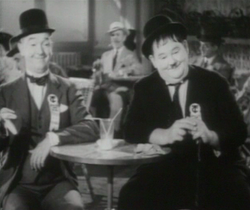 The first film pairing of the two comedians, although as separate performers, took place in The Lucky Dog (1921). The exact date the film was produced isn't recorded, however film historian Bo Bergulund dated it between late 1920 and January 1921. The association was so casual that based upon interviews given in the 1930s both had forgotten it entirely. The plot sees Laurel befriended by a stray dog who after a number of lucky escapes saves Laurel from being blown up by a stick of dynamite, while Hardy was a mugger attempting to rob Laurel. Several years later, both comedians had separately signed for the Hal Roach
film studio and next appeared in 45 Minutes From Hollywood
(1926).
Hal Roach was the most important person character in their film careers; he brought them together officially as a team and paid their wage for over 20 years. Charley Rogers
worked closely with the three men for many years and said "It could not have happened if Laurel, Hardy and Roach had not met at the right place and at the right time. Their first "official" film together was Putting Pants on Philip
(1927). The plot sees Laurel as Philip, a young Scottish man newly arrived in the United States in full Kilted
splendor, after various mishaps surrounding the kilt his uncle played by Hardy tries to put him in trousers.
Laurel speaking to John McCabe
said "Of all the questions we're asked, the most frequent is how did we come together? I always explain that we just came together naturally." Laurel and Hardy were joined by accident and grew by indirection. In 1926 both were part of the Roach Comedy All Stars - a group of actors of similar standing who took part in a series of films, quite unwittingly Laurel and Hardy's parts became larger and the parts of their fellow stars became less, because Laurel and Hardy were the best actors. The teaming was suggested by Leo McCarey
who was their supervising director between 1927-1930, during this period McCarey and Laurel jointly devised the team's format. After the teaming they played the same characters for 30 years.
Although Hal Roach employed writers and directors such as H. M. Walker
, Leo McCarey
, James Parrott
, James W. Horne
on Laurel and Hardy films, Laurel would rewrite entire sequences or scripts, have the cast and crew improvise on the soundstage, and meticulously review the footage for editing. By 1929 Laurel was the head writer. The writing sessions were gleeful chaos; Stan had three or four writers who joined him in a perpetual game of 'Can You Top This?' As Laurel so obviously relished writing gags, Hardy was more than happy to leave the job to his partner. From this point Laurel was also the uncredited film director. He ran the Laurel and Hardy set no matter who was in the director's chair, but never felt compelled to assert his authority. Roach remarked "Laurel bossed the production. With any director if Laurel said 'I don't like this idea,' the director didn't say 'Well, you're going to do it anyway.' That was understood." As Laurel made so many suggestions there wasn't much left for the credited director to do.
In 1929 the silent era of film was coming to an end and most silent-film actors saw their careers decline with the advent of sound. Silent film actors failed to make the transition because they decided their prime duty was to tell stories in words, and they misused sound through over-emphasis or there was poor recording. Laurel and Hardy avoided this pitfall because they decided to continue making primarily visual films. They did not ignore sound but they were not ruled by it. They proved skillful in their melding of visual and verbal humor, and made a seamless transition to the talking era in their first sound film Unaccustomed As We Are
(1929). The title took its name from the familiar phrase "Unaccustomed as we are to public speaking". In the opening dialogue Laurel and Hardy began by spoofing
the very slow and self conscious speech of the early talking actors, a routine they would use regularly.
Laurel and Hardy's first starring feature film was Pardon Us
(1931). The most memorable Laurel and Hardy film is The Music Box (1932), the image of the duo forever pushing a piano up a tremendous flight of steps has stuck in the public consciousness. The film won an Academy Award for Best Live Action Short Subject in 1932. While many enthusiasts claim the superiority of The Music Box, their silent film Big Business
(1929) is by far the most consistently acclaimed. The plot sees Laurel and Hardy as Christmas tree salesman involved in a classic Tit for Tat battle with James Finlayson, eventually destroying both his car and house. Big Business was added to the Library of Congress
in the United States as a national treasure in 1992. Sons of the Desert (1933) is considered Laurel and Hardy's best feature film.
Babes in Toyland
(1934) retains a timeless appeal and remains a perennial on American T.V. at Christmas. Hal Roach spoke scathingly about the film and Laurel's behavior during its making. Laurel was unhappy with Roach's plot and after an argument was allowed to make the film his own way. The rift permanently damaged Roach-Laurel relations to the point that Roach said that after Toyland he no longer wished to produce Laurel and Hardy films, although their association continued for another six years.
In 1940 Laurel and Hardy left the Hal Roach film studio. Between 1941 and 1945 they made 6 feature films for 20th Century Fox
and 2 for MGM. Laurel's relations with 20th Century executives were particularly bad because they refused to let Laurel and Hardy use their usual characters. Instead they had to act character parts given to them; consequently the films went from bad to worse. Laurel and Hardy's two films with MGM had the same problem. Laurel, speaking to John McCabe, said "We had no say in those films and it sure looked it. So we gave up the ghost." I can't tell you how much it hurt me to do those pictures, and how ashamed I am of them." The films were however profitable and Fox kept making Laurel and Hardy comedies after discontinuing its other "B" series films.
Laurel and Hardy made one final film together Atoll K
(1951), it was a French and Italian co-production directed by Leo Joannon
, which was plagued by language barriers, production problems, and both Laurel and Hardy's grave health issues during shooting, Hardy began to lose weight precipitously and developed an irregular heartbeat while Laurel experienced painful prostate complications. Critics were disappointed with its storyline, English dubbing, and Laurel's sickly physical appearance. The film was not a success, and brought an end to Laurel and Hardy's film careers.
A number of their films were re-shot with Laurel and Hardy talking in Spanish, Italian, French or German. The plots for these films were similar to the English language version although the supporting cast were often native language actors. Laurel and Hardy could not speak a foreign language and they received voice coaching to reproduce their lines. Pardon Us
(1931) was re-shot in all four foreign languages. Blotto
(1930), Chickens Come Home
(1931) and Below Zero (1930) had a French and Spanish version.
Most of the Laurel and Hardy films survive, and have never gone out of circulation permanently. Three of their 107 films are considered lost, as they have not been seen in full since the 1930s. The silent Hats Off
(1927) has vanished completely. The first half of Now I'll Tell One
(1927) is lost and the second half has yet to be released on video. In the operatic Technicolor musical The Rogue Song (1930) Laurel and Hardy appear in 10 sequences, only one of which is known to exist along with the complete soundtrack.
used for emphasis. They often had physical arguments with each other, which were quite complex and involved cartoon violence
, and their characters preclude them from making any real progress in even the simplest endeavors. Much of their comedy involves milking a joke, where a simple idea provides a basis from which to build several gags without following a defined narrative
.
Laurel and Hardy had an inherent physical contrariety. Stan Laurel was of average height and weight, but appeared small and slight next to Oliver Hardy, who was tall and weighed about 280 lb (127 kg) in his prime. Laurel kept his hair short on the sides and back, but let it grow long on top to create a natural "fright wig". At times of shock he would simultaneously cry while pulling up his hair. In contrast, Hardy's thinning hair was pasted on his forehead in spit curls and he wore a toothbrush moustache
. To achieve a flat-footed walk, Laurel removed the heels from his shoes. Both wore Bowler hat
s, with Laurel's being narrower than Hardy's, and with a flattened brim. The characters' normal attire also called for wing collar shirts, with Hardy wearing a standard neck tie which he would twiddle and Laurel a bow tie
. Hardy's sports jacket was too small for him and done up with one straining button, whereas Laurel's double breasted jacket was loose fitting.
A common routine the team performed was a "tit-for-tat" fight with an adversary. This could be with their wives—often played by Mae Busch
, Anita Garvin
or Daphne Pollard
—or with a neighbour, often played by Charlie Hall or James Finlayson. Laurel and Hardy would accidentally damage someone else's property, with the injured party retaliating
by ruining something belonging to Laurel or Hardy. After calmly surveying the damage they would find something else to vandalize and conflict would escalate until both sides were simultaneously destroying property in front of each other. An early example of the routine occurs in their classic short, Big Business
(1929), which was added to the Library of Congress
as a national treasure in 1992, and one of their short films, which revolves entirely around such an altercation, was titled Tit for Tat
(1935).
One of their best-remembered dialogue routines was the "Tell me that again" routine. Laurel would tell Hardy a genuinely smart idea he had come up with, and Hardy would reply, "Tell me that again." Laurel would attempt to repeat the idea, but jumble it into utter nonsense. Hardy, who had difficulty understanding Laurel's idea when expressed clearly, would understand perfectly when hearing the jumbled version.
While much of their comedy remained visual, various lines of humorous dialogue appeared in Laurel and Hardy's talking films. Some examples include:
• "You can lead a horse to water, but a pencil must be led." (Laurel, Brats
)
• "I was dreaming I was awake, but I woke up and found meself asleep." (Laurel, Oliver the Eighth
)
• "A lot of weather we've been having lately." (Hardy, Way Out West
)
In some cases, their comedy bordered on the surreal, a style Stan Laurel called "white magic". For example, in Way Out West
(1937), Laurel clenches his fist and pours tobacco into it, as if it were a pipe. Then, he flicks his thumb upward as if he held a lighter
. His thumb ignites, and he matter-of-factly lights his "pipe." The amazed Hardy, seeing this, would unsuccessfully attempt to duplicate it throughout the rest of the film. Much later in the film, Hardy finally succeeds – only to be terrified when his thumb catches fire.
Rather than showing Hardy suffering the pain of misfortunes such as falling down stairs or being beaten by a thug, banging and crashing sound effects were often used so the audience could visualize the scene for themselves.
Why Girls Love Sailors
(1927) was a significant film for Hardy because it gave him two of his most enduring trademarks. The first was his "tie-twiddle" to demonstrate embarrassment. Hardy, while acting, had been met with a pail of water in the face. He said "I had been expecting it, but I didn't expect it at that particular moment. It threw me mentally and I couldn't think what to do next, so I waved the tie in a kind of tiddly-widdly fashion to show embarrassment while trying to look friendly." McCabe: An Affectionate Biography 1987, p. 123 His second trademark was the "camera look" in which he breaks the fourth wall
. Hardy said "I had to become exasperated, so I just stared right into the camera and registered my disgust"
Offscreen, Stan Laurel and Oliver Hardy were quite the opposite of their movie characters: Laurel was the industrious "idea man," while Hardy was more easygoing.
On December 1, 1954, the team made their only American television appearance, surprised by Ralph Edwards
on his live NBC-TV program, This Is Your Life
. Lured to the Knickerbocker Hotel as a subterfuge for a business meeting with producer Bernard Delfont
, the doors opened to their suite #205, flooding the room with light and the voice of Edwards. The telecast was preserved on a kinescope
and later released on home video. Partly due to the positive response from the television broadcast, the pair was renegotiating with Hal Roach Jr. for a series of color NBC Television specials to be called Laurel and Hardy's Fabulous Fables. However, plans for the specials were shelved, as the aging comedians suffered from declining health.
In 1955, Laurel and Hardy made their final public appearance together, taking part in This Is Music Hall, a BBC Television
program about the Grand Order of Water Rats
, a British variety organization. Laurel and Hardy provide a filmed insert during which they reminisce about their friends in British variety. They made their final appearance on camera in 1956 in a home movie titled "One Moment Please". The film was shot by a family friend at Laurel's home, it is without audio and lasts three minutes.
Under doctor's orders to improve a heart condition, Hardy lost over 100 lb (45.4 kg; 7.1 st) in 1956. Several strokes resulted in loss of mobility and speech. He died of a stroke on August 7, 1957. Longtime friend Bob Chatterton said Hardy weighed just 138 lb (62.6 kg; 9.9 st) at the time of his death. Hardy was laid to rest at Pierce Brothers Valhalla Memorial Park, North Hollywood.
Just after Hardy's death, Laurel and Hardy's films returned to movie theaters, as clips of their work were featured in Robert Youngson
's silent-film compilation The Golden Age of Comedy
. For the remaining eight years of his life, Stan Laurel refused to perform, even turning down Stanley Kramer
's offer to make a cameo in his landmark 1963 movie, It's a Mad, Mad, Mad, Mad World
. In 1960, Laurel was given a special Academy Award for his contributions to film comedy. Despite not appearing onscreen after Hardy's death, Laurel did contribute gags to several comedy filmmakers. Most of his writing was in the form of correspondence; he insisted on answering every fan letter personally. Late in life, he hosted many visitors of the new generation of comedians and celebrities, including Dick Cavett
, Jerry Lewis
, Peter Sellers
, Marcel Marceau
and Dick Van Dyke
. Laurel lived until 1965, surviving to see the duo's work rediscovered through television and classic film revivals. He died on February 23 in Santa Monica
, and is buried at Forest Lawn-Hollywood Hills
in Los Angeles, California
.
as the on-the-hour chime for the Roach studio radio station. Laurel heard the tune on the station, and asked Hatley to use it as the Laurel and Hardy theme song. In Laurel's eyes, the song's melody represented Hardy's character (pompous and dramatic), while the harmony represented Laurel's own character (somewhat out of key, and only able to register two notes: "coo-coo"). The original theme, recorded by two clarinets in 1930, was re-recorded with a full orchestra in 1935. Leroy Shield
composed the great majority of the music used in the Laurel and Hardy short sound films. A compilation of songs from their films titled Trail of the Lonesome Pine was released in 1975. The title track was released as a single in the UK and reached #2 in the charts.
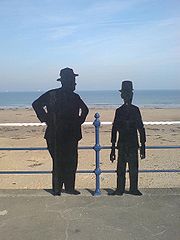
The phrase, which was earlier used by W. S. Gilbert in The Mikado (1885) and again in The Grand Duke (1896), was first used by Hardy in The Laurel-Hardy Murder Case
(1930). In popular culture the catchphrase is often misquoted as "Well, here's another fine mess you've gotten me into." The misquoted version of the phrase was never used by Hardy on film; the misunderstanding stems from the title of their film Another Fine Mess
(1930).
Numerous variations of the quote appeared on film. In Chickens Come Home
(1931), Ollie says impatiently to Stan, "Well...." with Stan replying, "Here's another nice mess I've gotten you into." In Thicker than Water (1935) and The Fixer-Uppers (1935), the phrase becomes "Well, here's another nice kettle of fish you pickled me in!" In Saps at Sea
(1940) it becomes "Well, here's another nice bucket of suds you've gotten me into!"
"D'oh!" is a catchphrase used by James Finlayson, the mustachioed Scottish actor who appeared in 33 Laurel and Hardy films. The phrase, expressing surprise, impatience, or incredulity, was the inspiration for "D'oh!" as spoken by the fictional character Homer Simpson
in the long running animated comedy The Simpsons
. Homer's first intentional use of "d'oh!" occurred in the Ullman short "Punching Bag" (1988).
, after a fraternal society in their film of the same name (1933). It was founded in New York City in 1965 by Laurel and Hardy biographers John McCabe
, Orson Bean
, Al Kilgore, Chuck McCann
and John Municino; with the sanction of Stan Laurel. Since the group's inception, well over 150 chapters of the organization have formed across North America, Europe and Australia. An Emmy-winning film documentary about the group, Revenge of the Sons of the Desert, has been released on DVD as part of The Laurel and Hardy Collection, Vol. 1.
, a large-scale salute to slapstick which director Blake Edwards
dedicated to "Mr. Laurel and Mr. Hardy." For many years the duo were impersonated by Jim MacGeorge (as Laurel) and Chuck McCann
(as Hardy) in children's TV shows and television commercials for various products.
There are two Laurel and Hardy museums, one in Laurel's birthplace, Ulverston, United Kingdom, and the other in Hardy's birthplace, Harlem, Georgia, United States
Maurice Sendak
showed three identical Oliver Hardy figures as bakers preparing cakes for the morning in his award-winning
children's book In the Night Kitchen
(1970). This is treated as a clear example of "interpretative illustration" wherein the comedians' inclusion harked back to the author's own childhood.
Additionally, the Beatles used cut-outs of Stan Laurel and Oliver Hardy as two of the cutout celebrity crowd for the cover of their masterpiece 1967 album, Sergeant Pepper's Lonely Hearts Club Band. Of the two, Stan Laurel is more recognizable.
A 2005 poll by fellow comedians and comedy insiders of the top 50 comedians for The Comedian's Comedian, a TV documentary broadcast on UK's Channel 4, voted the duo the seventh greatest comedy act ever, making them the most popular double act on the list.
Numerous colorized
versions of copyright-free Laurel and Hardy features and shorts have been reproduced by a multitude of production studios. Although the results of adding color were often in dispute, many of the popular titles are currently only available in the colorized version. The color process often renders the print into an "unwatchable" state, while some scenes were altered or deleted, dependent on the source material used. Many Laurel and Hardy films have been colorized. Helpmates (1932) was the first film to undergo the process, it was experimented upon by Colorization Inc., a subsidiary of Hal Roach Studios in 1983. Colorization became a success for the studio and Helpmates was released on home video with the colorized version of The Music Box (1932) in 1986. The technology for this process was inferior compared to today's digital colorization technology. There were numerous continuity errors and garish color design choices. However the most significant criticism that these versions received revolved around their editing, whole scenes were altered or deleted altogether, changing the character of the film.
Merchandiser Larry Harmon
claimed ownership of Laurel's and Hardy's likenesses, and issued Laurel and Hardy toys and colouring books. He co-produced a series of Laurel and Hardy cartoons
in 1966 with Hanna-Barbera Productions
. His animated versions of Laurel and Hardy guest-starred in a 1972 episode of Hanna-Barbera's The New Scooby-Doo Movies
. In 1999, Harmon produced a direct-to-video feature, the live-action comedy The All-New Adventures of Laurel and Hardy: For Love or Mummy, with actors Bronson Pinchot
and Gailard Sartain
playing the lookalike nephews of the original Laurel and Hardy, Stanley Thinneus Laurel and Oliver Fatteus Hardy.
Double act
A double act, also known as a comedy duo, is a comic pairing in which humor is derived from the uneven relationship between two partners, usually of the same gender, age, ethnic origin and profession, but drastically different personalities or behavior...
s of the early Classical Hollywood
Classical Hollywood cinema
Classical Hollywood cinema or the classical Hollywood narrative, are terms used in film history which designates both a visual and sound style for making motion pictures and a mode of production used in the American film industry between roughly the 1910s and the early 1960s.Classical style is...
era of American cinema
Cinema of the United States
The cinema of the United States, also known as Hollywood, has had a profound effect on cinema across the world since the early 20th century. Its history is sometimes separated into four main periods: the silent film era, classical Hollywood cinema, New Hollywood, and the contemporary period...
. Composed of thin Englishman Stan Laurel
Stan Laurel
Arthur Stanley "Stan" Jefferson , better known as Stan Laurel, was an English comic actor, writer and film director, famous as the first half of the comedy team Laurel and Hardy. His film acting career stretched between 1917 and 1951 and included a starring role in the Academy Award winning film...
(1890–1965) and heavy American Oliver Hardy
Oliver Hardy
Oliver Hardy was an American comic actor famous as one half of Laurel and Hardy, the classic double act that began in the era of silent films and lasted nearly 30 years, from 1927 to 1955.-Early life:...
(1892–1957) they became well known during the late 1920s to the mid-1940s for their slapstick
Slapstick
Slapstick is a type of comedy involving exaggerated violence and activities which may exceed the boundaries of common sense.- Origins :The phrase comes from the batacchio or bataccio — called the 'slap stick' in English — a club-like object composed of two wooden slats used in Commedia dell'arte...
comedy, with Laurel playing the clumsy and childlike friend of the pompous Hardy. They made over 100 films together, initially two-reelers (short films) before expanding into feature length films in the 1930s. Their films include Sons of the Desert
Sons of the Desert
Sons of the Desert is a 1933 American film starring Laurel and Hardy, and directed by William A. Seiter. It was first released in the United States on December 29, 1933 and is regarded as one of Laurel and Hardy's greatest films...
(1933), the Academy Award winning short film The Music Box (1932), Babes in Toyland
Babes in Toyland (1934 film)
Babes in Toyland is a Laurel and Hardy musical film released in November 1934. The film is also known by its alternate titles Laurel and Hardy in Toyland, Revenge Is Sweet , March of the Wooden Soldiers and Wooden Soldiers .Based on Victor Herbert's popular 1903 operetta Babes in Toyland, the film...
(1934), and Way Out West
Way Out West (1937 film)
Way Out West is a Laurel and Hardy comedy film released in 1937. It was directed by James W. Horne, produced by Stan Laurel and distributed by Metro-Goldwyn-Mayer.-Plot:...
(1937). Hardy's catchphrase "Well, here's another nice mess you've gotten me into!" is still widely recognized.
Prior to the double act both were established actors with Laurel appearing in over 50 films and Hardy in over 250 films. Although the two comedians first worked together on the film The Lucky Dog (1921), this was a chance pairing and it was not until 1926, when both separately signed contracts with the Hal Roach
Hal Roach
Harold Eugene "Hal" Roach, Sr. was an American film and television producer and director, and from the 1910s to the 1990s.- Early life and career :Hal Roach was born in Elmira, New York...
film studio, that they began appearing in movie shorts together. Laurel and Hardy officially became a team the following year in the silent short film Putting Pants on Philip
Putting Pants on Philip
Putting Pants On Philip is a landmark Hal Roach two-reel silent film from 1927. It was the first to bill Laurel and Hardy as a comedy duo, although the first film the two comedians were in together had been The Lucky Dog from 1921, and the first Hal Roach production they were both in was 45...
(1927). The pair remained with the Roach studio until 1940, then appeared in eight "B" comedies for 20th Century Fox
20th Century Fox
Twentieth Century Fox Film Corporation — also known as 20th Century Fox, or simply 20th or Fox — is one of the six major American film studios...
and Metro-Goldwyn-Mayer
Metro-Goldwyn-Mayer
Metro-Goldwyn-Mayer Inc. is an American media company, involved primarily in the production and distribution of films and television programs. MGM was founded in 1924 when the entertainment entrepreneur Marcus Loew gained control of Metro Pictures, Goldwyn Pictures Corporation and Louis B. Mayer...
from 1941 to 1945. After finishing their movie commitments at the end of 1944, they concentrated on stage shows, embarking on a music hall tour of England, Ireland, and Scotland. In 1950 they made their last film, a French
Cinema of France
The Cinema of France comprises the art of film and creative movies made within the nation of France or by French filmmakers abroad.France is the birthplace of cinema and was responsible for many of its early significant contributions. Several important cinematic movements, including the Nouvelle...
/Italian
Cinema of Italy
The history of Italian cinema began just a few months after the Lumière brothers had patented their Cinematographe, when Pope Leo XIII was filmed for a few seconds in the act of blessing the camera.-Early years:...
co-production called Atoll K
Atoll K
Atoll K is a French/Italian film—also known as Robinson Crusoeland in the UK and Utopia in the US—starring the comedy team of Stan Laurel and Oliver Hardy in their final screen appearance. The film co-stars French singer/actress Suzy Delair and was directed by Léo Joannon, with uncredited...
, before retiring from the screen. In total they appeared together in 107 films. They starred in 40 short sound film
Sound film
A sound film is a motion picture with synchronized sound, or sound technologically coupled to image, as opposed to a silent film. The first known public exhibition of projected sound films took place in Paris in 1900, but decades would pass before sound motion pictures were made commercially...
s, 32 short silent films and 23 ful-length feature films, and made 12 guest or cameo appearances, including the recently discovered Galaxy of Stars
Galaxy of Stars
Galaxy of Stars is a promotional short film released by Metro-Goldwyn-Mayer only for MGM exhibitors in Europe and Africa, featuring Laurel and Hardy, and re-discovered in 2005....
promotional film (1936).
A common comedy routine was a tit-for-tat fight. Their silent film Big Business
Big Business
Big business is a term used to describe large corporations, in either an individual or collective sense. The term first came into use in a symbolic sense subsequent to the American Civil War, particularly after 1880, in connection with the combination movement that began in American business at...
(1929), which includes one of these routines, was added to the Library of Congress
Library of Congress
The Library of Congress is the research library of the United States Congress, de facto national library of the United States, and the oldest federal cultural institution in the United States. Located in three buildings in Washington, D.C., it is the largest library in the world by shelf space and...
as a national treasure in 1992. Notable Laurel traits included crying like a baby while being berated and scratching his hair when in shock. On December 1, 1954, the team made their only American television appearance, surprised by Ralph Edwards on his live NBC-TV program, This Is Your Life
This Is Your Life
This Is Your Life is an American television documentary series broadcast on NBC, originally hosted by its producer, Ralph Edwards from 1952 to 1961. In the show, the host surprises a guest, and proceeds to take them through their life in front of an audience including friends and family.Edwards...
.
The works of Laurel and Hardy have been re-released in numerous theatrical reissues, television revivals, 16mm and 8mm home movies, feature-film compilations, and home video since the 1930s. They were voted the seventh greatest comedy act in a 2005 UK poll by fellow comedians. The duo's signature tune, known variously as "The Cuckoo Song", "Ku-Ku", or "The Dance of the Cuckoos", played on the opening credits of their films. The official Laurel and Hardy appreciation society is known as The Sons of the Desert
The Sons of the Desert
The Sons of the Desert is an international fraternal organization devoted to lives and films of comedians Stan Laurel and Oliver Hardy. The group takes its name from a lodge that Laurel and Hardy belonged to in the 1933 movie Sons of the Desert....
, after a fraternal society in their film of the same name.
Stan Laurel
Stan LaurelStan Laurel
Arthur Stanley "Stan" Jefferson , better known as Stan Laurel, was an English comic actor, writer and film director, famous as the first half of the comedy team Laurel and Hardy. His film acting career stretched between 1917 and 1951 and included a starring role in the Academy Award winning film...
(June 16, 1890 – February 23, 1965) was born Arthur Stanley Jefferson in Ulverston
Ulverston
Ulverston is a market town and civil parish in the South Lakeland district of Cumbria in north-west England. Historically part of Lancashire, the town is located in the Furness area, close to the Lake District, and just north of Morecambe Bay....
, Lancashire, England. His father, Arthur Joseph Jefferson, was a theatrical entrepreneur and theatre owner in Northern England and Scotland, who with his wife was a major force in the industry. Laurel was born into a family with theatre
Theatre
Theatre is a collaborative form of fine art that uses live performers to present the experience of a real or imagined event before a live audience in a specific place. The performers may communicate this experience to the audience through combinations of gesture, speech, song, music or dance...
in its blood. In 1905 the Jefferson family moved to Glasgow
Glasgow
Glasgow is the largest city in Scotland and third most populous in the United Kingdom. The city is situated on the River Clyde in the country's west central lowlands...
to be closer to their business mainstay, The Metropole Theatre, with Laurel making his stage debut in a Glasgow hall called the Panoptikon, a month short of his 16th birthday. Arthur Jefferson secured Laurel his first acting job with a theatrical juvenile
Minor (law)
In law, a minor is a person under a certain age — the age of majority — which legally demarcates childhood from adulthood; the age depends upon jurisdiction and application, but is typically 18...
company, Levy and Cardwell, specialising in Christmas Pantomimes. In 1909 he was employed by Britain's leading comedy impresario, Fred Karno
Fred Karno
Frederick John Westcott , best known by his stage name Fred Karno, was a theatre impresario of the British music hall. Karno is credited with inventing the custard-pie-in-the-face gag. Among the young comedians who worked for him were Charlie Chaplin and Arthur Jefferson, who later adopted the...
, working as a supporting actor and as an understudy
Understudy
In theater, an understudy is a performer who learns the lines and blocking/choreography of a regular actor or actress in a play. Should the regular actor or actress be unable to appear on stage because of illness or emergencies, the understudy takes over the part...
of Charlie Chaplin
Charlie Chaplin
Sir Charles Spencer "Charlie" Chaplin, KBE was an English comic actor, film director and composer best known for his work during the silent film era. He became the most famous film star in the world before the end of World War I...
. Laurel said of Karno "There was no one like him. He had no equal. His name was box-office." In 1912 Laurel left England with a Fred Karno Troupe, to tour the United States of America, Laurel expected the tour to be merely a pleasant interval in his life before returning to London, however he had in actuality emigrated. In 1917 Laurel was teamed with Mae Dahlberg
Mae Dahlberg
Mae Dahlberg , was a music hall and vaudeville performer and actress in several Hollywood silent movies. In 1917, while in California, she met and formed a variety act with Stan Laurel. In 1917 she played in a comedy short, Nuts in May, notable as the screen debut of Stan Laurel...
, they worked as a double act
Double act
A double act, also known as a comedy duo, is a comic pairing in which humor is derived from the uneven relationship between two partners, usually of the same gender, age, ethnic origin and profession, but drastically different personalities or behavior...
for stage and film and were common law
Common law
Common law is law developed by judges through decisions of courts and similar tribunals rather than through legislative statutes or executive branch action...
husband and wife. Laurel made his film debut with Dahlberg in Nuts in May
Nuts in May (film)
Nuts in May is a 1917 silent comedy short, directed by Robin Williamson and featuring Stan Jefferson in his onscreen debut. It was filmed at Bernstein Studios, in Hollywood, California. Very little of the film survives...
(1917). It was while working with her that he started using the stage name Stan Laurel, changing his name legally in 1931. Dahlberg held Laurel's career back because she demanded parts in Laurel's films and her tempestuous nature made her difficult to work with, dressing room arguments between the two were common, so film producer Joe Rock
Joe Rock
Joe Rock was an American movie producer, director, actor and screenwriter best remembered today for producing a series of 12 two reel comedies starring Stan Laurel in the 1920s....
paid her to leave Laurel and return to her native Australia
Australia
Australia , officially the Commonwealth of Australia, is a country in the Southern Hemisphere comprising the mainland of the Australian continent, the island of Tasmania, and numerous smaller islands in the Indian and Pacific Oceans. It is the world's sixth-largest country by total area...
. In 1925 Laurel joined the Hal Roach
Hal Roach
Harold Eugene "Hal" Roach, Sr. was an American film and television producer and director, and from the 1910s to the 1990s.- Early life and career :Hal Roach was born in Elmira, New York...
film studio as a director and writer and between May 1925 and September 1926 he was credited in at least 22 films. Laurel starred in over 50 films for various producers before teaming up with Hardy. However without Hardy he experienced only modest success because it was difficult for producers, writers and directors to figure out what character he might be playing, and American audiences knew him either as a "Nutty burglar" or as a Charlie Chaplin
Charlie Chaplin
Sir Charles Spencer "Charlie" Chaplin, KBE was an English comic actor, film director and composer best known for his work during the silent film era. He became the most famous film star in the world before the end of World War I...
imitator.
Oliver Hardy
Oliver Hardy (January 18, 1892 – August 7, 1957) was born Norvell Hardy in Harlem, GeorgiaHarlem, Georgia
Harlem is a city in Columbia County, Georgia and is part of the Augusta, Georgia metropolitan area. The population was 1,814 at the 2000 census...
. He took his father's first name, calling himself "Oliver Norvell Hardy." His offscreen nicknames were "Ollie" and "Babe." Hardy's nickname "Babe" originated from an Italian barber near the Lubin Studios
Lubin Studios
The Lubin Manufacturing Company, was an American motion picture production company that produced silent films from 1902 to 1916. Lubin films were distributed with a Liberty Bell trademark.-History:...
in Jacksonville, Florida
Jacksonville, Florida
Jacksonville is the largest city in the U.S. state of Florida in terms of both population and land area, and the largest city by area in the contiguous United States. It is the county seat of Duval County, with which the city government consolidated in 1968...
who would rub Hardy's face with talcum powder and say, "That's nice a baby!" which the other Lupin actors mimicked. Hardy was billed as "Babe Hardy" in his early films. By his late teens, Hardy was a popular stage singer, and he operated his own movie house in Milledgeville, Georgia
Milledgeville, Georgia
Milledgeville is a city in and the county seat of Baldwin County in the U.S. state of Georgia. It is northeast of Macon, located just before Eatonton on the way to Athens along U.S. Highway 441, and it is located on the Oconee River. The relatively rapid current of the Oconee here made this an...
, the Palace Theater, financed partially by his mother. Seeing film comedies inspired him with an urge to take up comedy himself and in 1913, he began working with Lubin Motion Pictures in Jacksonville, Florida. He started out by helping around the studio with lights, props and other duties, gradually learning the craft as a script-clerk. Around the same time, he married his first wife, Madelyn Salosihn. In 1914, Hardy acted as Babe in his first film called Outwitting Dad
Outwitting Dad
Outwitting Dad is a 1914 comedy film that features Oliver Hardy's first onscreen appearance.-Cast:* Billy Bowers - Mr. Gross* Oliver Hardy - Reggie Kewp * Raymond McKee - Bob Kewp* Frances Ne Moyer - Lena Gross...
. Between 1914 and 1916, Hardy made 177 shorts as Babe with the Vim Comedy Company
Vim Comedy Company
The Vim Comedy Company was a short lived movie studio in Jacksonville, Florida and New York. Vim bought out Siegmund Lubin's Lubin Manufacturing Company Jacksonville, Florida facilities in 1915 after that company went bankrupt. It was founded by Louis Burstein and Mark Dintenfass. Vim specialized...
, which were released up to the end of 1917. Exhibiting a versatility in playing heroes, villains and even female characters, Hardy became much in demand as a supporting actor, comic villain or second banana. For the next 10 years he memorably assisted star comics Billy West
Billy West (silent film actor)
Billy West was a film actor, producer, and director of the silent film era. He is best known as a Charlie Chaplin impersonator....
, a Charlie Chaplin imitator, Jimmy Aubrey
Jimmy Aubrey
Jimmy Aubrey was an English actor who worked with both Charlie Chaplin and Laurel & Hardy, having gone with Fred Karno's company to America. However he left to start on his own in Vaudeville...
, Larry Semon
Larry Semon
Lawrence "Larry" Semon was an American actor, director, producer, and screenwriter during the silent film era. In his day, Semon was considered a major movie comedian, but he is now remembered mainly for working with both Stan Laurel and Oliver Hardy before they started working together.He is also...
and Charley Chase
Charley Chase
Charley Chase was an American comedian, actor, screenwriter and film director, best known for his work in Hal Roach short film comedies...
. In total, Hardy starred or co-starred in more than 250 silent shorts, about 150 of which have been lost. While in New York, his abortive effort to enlist in 1917 led him and his wife, Madelyn, to seek new opportunities in California.
Films
Hal Roach
Harold Eugene "Hal" Roach, Sr. was an American film and television producer and director, and from the 1910s to the 1990s.- Early life and career :Hal Roach was born in Elmira, New York...
film studio and next appeared in 45 Minutes From Hollywood
45 Minutes from Hollywood
45 Minutes From Hollywood is an American two-reel silent film released by Pathé Exchange.At the time, it was known as a Glenn Tryon vehicle, but today it is best remembered as the second instance of Stan Laurel and Oliver Hardy appearing in the same film together — although they do not share...
(1926).
Hal Roach was the most important person character in their film careers; he brought them together officially as a team and paid their wage for over 20 years. Charley Rogers
Charley Rogers
Charley Rogers was an English film actor, director and screenwriter, best known for his association with Laurel and Hardy. He appeared in 37 films between 1912 and 1954...
worked closely with the three men for many years and said "It could not have happened if Laurel, Hardy and Roach had not met at the right place and at the right time. Their first "official" film together was Putting Pants on Philip
Putting Pants on Philip
Putting Pants On Philip is a landmark Hal Roach two-reel silent film from 1927. It was the first to bill Laurel and Hardy as a comedy duo, although the first film the two comedians were in together had been The Lucky Dog from 1921, and the first Hal Roach production they were both in was 45...
(1927). The plot sees Laurel as Philip, a young Scottish man newly arrived in the United States in full Kilted
Kilt
The kilt is a knee-length garment with pleats at the rear, originating in the traditional dress of men and boys in the Scottish Highlands of the 16th century. Since the 19th century it has become associated with the wider culture of Scotland in general, or with Celtic heritage even more broadly...
splendor, after various mishaps surrounding the kilt his uncle played by Hardy tries to put him in trousers.
Laurel speaking to John McCabe
John McCabe (writer)
John McCabe , born John Charles McCabe III, was a Shakespearean scholar and author, whose first book was the authorized biography of Laurel and Hardy....
said "Of all the questions we're asked, the most frequent is how did we come together? I always explain that we just came together naturally." Laurel and Hardy were joined by accident and grew by indirection. In 1926 both were part of the Roach Comedy All Stars - a group of actors of similar standing who took part in a series of films, quite unwittingly Laurel and Hardy's parts became larger and the parts of their fellow stars became less, because Laurel and Hardy were the best actors. The teaming was suggested by Leo McCarey
Leo McCarey
Thomas Leo McCarey was an American film director, screenwriter and producer. During his lifetime he was involved in nearly 200 movies, especially comedies...
who was their supervising director between 1927-1930, during this period McCarey and Laurel jointly devised the team's format. After the teaming they played the same characters for 30 years.
Although Hal Roach employed writers and directors such as H. M. Walker
H. M. Walker
Harley M. "Beanie" Walker was a member of the Hal Roach movie production company from 1916 until his resignation in 1932...
, Leo McCarey
Leo McCarey
Thomas Leo McCarey was an American film director, screenwriter and producer. During his lifetime he was involved in nearly 200 movies, especially comedies...
, James Parrott
James Parrott
James Parrott , was an American actor and film director; and the younger brother of film comedian Charley Chase.-Early years:...
, James W. Horne
James W. Horne
James Wesley Horne was an early American actor, screenwriter and film director. He began his career as an actor under director Sidney Olcott at Kalem Studios in 1913 and directed his first film for the company two years later....
on Laurel and Hardy films, Laurel would rewrite entire sequences or scripts, have the cast and crew improvise on the soundstage, and meticulously review the footage for editing. By 1929 Laurel was the head writer. The writing sessions were gleeful chaos; Stan had three or four writers who joined him in a perpetual game of 'Can You Top This?' As Laurel so obviously relished writing gags, Hardy was more than happy to leave the job to his partner. From this point Laurel was also the uncredited film director. He ran the Laurel and Hardy set no matter who was in the director's chair, but never felt compelled to assert his authority. Roach remarked "Laurel bossed the production. With any director if Laurel said 'I don't like this idea,' the director didn't say 'Well, you're going to do it anyway.' That was understood." As Laurel made so many suggestions there wasn't much left for the credited director to do.
In 1929 the silent era of film was coming to an end and most silent-film actors saw their careers decline with the advent of sound. Silent film actors failed to make the transition because they decided their prime duty was to tell stories in words, and they misused sound through over-emphasis or there was poor recording. Laurel and Hardy avoided this pitfall because they decided to continue making primarily visual films. They did not ignore sound but they were not ruled by it. They proved skillful in their melding of visual and verbal humor, and made a seamless transition to the talking era in their first sound film Unaccustomed As We Are
Unaccustomed As We Are
Unaccustomed As We Are is a 1929 comedy short film starring Stan Laurel and Oliver Hardy, also featuring Mae Busch , Edgar Kennedy , and Thelma Todd...
(1929). The title took its name from the familiar phrase "Unaccustomed as we are to public speaking". In the opening dialogue Laurel and Hardy began by spoofing
Parody
A parody , in current usage, is an imitative work created to mock, comment on, or trivialise an original work, its subject, author, style, or some other target, by means of humorous, satiric or ironic imitation...
the very slow and self conscious speech of the early talking actors, a routine they would use regularly.
Laurel and Hardy's first starring feature film was Pardon Us
Pardon Us
Pardon Us is Laurel and Hardy's first feature length comedy film. It was produced by Hal Roach and Stan Laurel, directed by James Parrott, and originally distributed by MGM in 1931.- Plot :...
(1931). The most memorable Laurel and Hardy film is The Music Box (1932), the image of the duo forever pushing a piano up a tremendous flight of steps has stuck in the public consciousness. The film won an Academy Award for Best Live Action Short Subject in 1932. While many enthusiasts claim the superiority of The Music Box, their silent film Big Business
Big Business (1929 film)
Big Business is a 1929 silent Laurel and Hardy comedy short subject directed by James W. Horne and supervised by Leo McCarey from a McCarey and H. M. Walker script. The film was deemed culturally significant and entered into the United States National Film Registry in 1992.- Plot :Stan and Ollie...
(1929) is by far the most consistently acclaimed. The plot sees Laurel and Hardy as Christmas tree salesman involved in a classic Tit for Tat battle with James Finlayson, eventually destroying both his car and house. Big Business was added to the Library of Congress
Library of Congress
The Library of Congress is the research library of the United States Congress, de facto national library of the United States, and the oldest federal cultural institution in the United States. Located in three buildings in Washington, D.C., it is the largest library in the world by shelf space and...
in the United States as a national treasure in 1992. Sons of the Desert (1933) is considered Laurel and Hardy's best feature film.
Babes in Toyland
Babes in Toyland (1934 film)
Babes in Toyland is a Laurel and Hardy musical film released in November 1934. The film is also known by its alternate titles Laurel and Hardy in Toyland, Revenge Is Sweet , March of the Wooden Soldiers and Wooden Soldiers .Based on Victor Herbert's popular 1903 operetta Babes in Toyland, the film...
(1934) retains a timeless appeal and remains a perennial on American T.V. at Christmas. Hal Roach spoke scathingly about the film and Laurel's behavior during its making. Laurel was unhappy with Roach's plot and after an argument was allowed to make the film his own way. The rift permanently damaged Roach-Laurel relations to the point that Roach said that after Toyland he no longer wished to produce Laurel and Hardy films, although their association continued for another six years.
In 1940 Laurel and Hardy left the Hal Roach film studio. Between 1941 and 1945 they made 6 feature films for 20th Century Fox
20th Century Fox
Twentieth Century Fox Film Corporation — also known as 20th Century Fox, or simply 20th or Fox — is one of the six major American film studios...
and 2 for MGM. Laurel's relations with 20th Century executives were particularly bad because they refused to let Laurel and Hardy use their usual characters. Instead they had to act character parts given to them; consequently the films went from bad to worse. Laurel and Hardy's two films with MGM had the same problem. Laurel, speaking to John McCabe, said "We had no say in those films and it sure looked it. So we gave up the ghost." I can't tell you how much it hurt me to do those pictures, and how ashamed I am of them." The films were however profitable and Fox kept making Laurel and Hardy comedies after discontinuing its other "B" series films.
Laurel and Hardy made one final film together Atoll K
Atoll K
Atoll K is a French/Italian film—also known as Robinson Crusoeland in the UK and Utopia in the US—starring the comedy team of Stan Laurel and Oliver Hardy in their final screen appearance. The film co-stars French singer/actress Suzy Delair and was directed by Léo Joannon, with uncredited...
(1951), it was a French and Italian co-production directed by Leo Joannon
Léo Joannon
Léo Joannon was a French writer and film director. Born in Aix-en-Provence, Joannon was originally a law student who became a novelist and journalist before entering the film industry in the 1920s as a cameraman....
, which was plagued by language barriers, production problems, and both Laurel and Hardy's grave health issues during shooting, Hardy began to lose weight precipitously and developed an irregular heartbeat while Laurel experienced painful prostate complications. Critics were disappointed with its storyline, English dubbing, and Laurel's sickly physical appearance. The film was not a success, and brought an end to Laurel and Hardy's film careers.
A number of their films were re-shot with Laurel and Hardy talking in Spanish, Italian, French or German. The plots for these films were similar to the English language version although the supporting cast were often native language actors. Laurel and Hardy could not speak a foreign language and they received voice coaching to reproduce their lines. Pardon Us
Pardon Us
Pardon Us is Laurel and Hardy's first feature length comedy film. It was produced by Hal Roach and Stan Laurel, directed by James Parrott, and originally distributed by MGM in 1931.- Plot :...
(1931) was re-shot in all four foreign languages. Blotto
Blotto (1930 film)
Blotto is a comedy film starring Stan Laurel and Oliver Hardy and released by Metro-Goldwyn-Mayer.-Production background:The film survives only in a censored 1937 re-release print which has had Pre-Code sequences removed and a new music track added.Although the original 1930 version is now...
(1930), Chickens Come Home
Chickens Come Home
Chickens Come Home is a 1931 short film starring Laurel and Hardy, directed by James W. Horne and produced by Hal Roach. It was shot in January, 1931 and released on February 21, 1931...
(1931) and Below Zero (1930) had a French and Spanish version.
Most of the Laurel and Hardy films survive, and have never gone out of circulation permanently. Three of their 107 films are considered lost, as they have not been seen in full since the 1930s. The silent Hats Off
Hats Off
Hats Off is a Laurel and Hardy silent comedy film. It was made in 1927 by the Hal Roach Studios. It starred Stan Laurel and Oliver Hardy and is considered a lost film.- Plot :...
(1927) has vanished completely. The first half of Now I'll Tell One
Now I'll Tell One
Now I'll Tell One is a 1927 silent film starring Charley Chase. It also features Stan Laurel and Oliver Hardy, however, whilst both had parts in this short they did not officially become a duo until several months after this film was released. It was directed by James Parrott , produced by Hal...
(1927) is lost and the second half has yet to be released on video. In the operatic Technicolor musical The Rogue Song (1930) Laurel and Hardy appear in 10 sequences, only one of which is known to exist along with the complete soundtrack.
Style of comedy and characterizations
The humor of Laurel and Hardy was generally visual with slapstickSlapstick
Slapstick is a type of comedy involving exaggerated violence and activities which may exceed the boundaries of common sense.- Origins :The phrase comes from the batacchio or bataccio — called the 'slap stick' in English — a club-like object composed of two wooden slats used in Commedia dell'arte...
used for emphasis. They often had physical arguments with each other, which were quite complex and involved cartoon violence
Violence in cartoons
Many cartoons contain situations in them that contain blood, hitting, guns, pushing, name calling, and more serious stuff such as chopping off of heads which is considered as violence. Violence has been seen in cartoons more and more as time as increased...
, and their characters preclude them from making any real progress in even the simplest endeavors. Much of their comedy involves milking a joke, where a simple idea provides a basis from which to build several gags without following a defined narrative
Narrative
A narrative is a constructive format that describes a sequence of non-fictional or fictional events. The word derives from the Latin verb narrare, "to recount", and is related to the adjective gnarus, "knowing" or "skilled"...
.
Laurel and Hardy had an inherent physical contrariety. Stan Laurel was of average height and weight, but appeared small and slight next to Oliver Hardy, who was tall and weighed about 280 lb (127 kg) in his prime. Laurel kept his hair short on the sides and back, but let it grow long on top to create a natural "fright wig". At times of shock he would simultaneously cry while pulling up his hair. In contrast, Hardy's thinning hair was pasted on his forehead in spit curls and he wore a toothbrush moustache
Toothbrush moustache
The Toothbrush moustache is a moustache, shaved at the edges, except for three to five centimeters above the centre of the lip...
. To achieve a flat-footed walk, Laurel removed the heels from his shoes. Both wore Bowler hat
Bowler hat
The bowler hat, also known as a coke hat, derby , billycock or bombin, is a hard felt hat with a rounded crown originally created in 1849 for the English soldier and politician Edward Coke, the younger brother of the 2nd Earl of Leicester...
s, with Laurel's being narrower than Hardy's, and with a flattened brim. The characters' normal attire also called for wing collar shirts, with Hardy wearing a standard neck tie which he would twiddle and Laurel a bow tie
Bow tie
The bow tie is a type of men's necktie. It consists of a ribbon of fabric tied around the collar in a symmetrical manner such that the two opposite ends form loops. Ready-tied bow ties are available, in which the distinctive bow is sewn into shape and the band around the neck incorporates a clip....
. Hardy's sports jacket was too small for him and done up with one straining button, whereas Laurel's double breasted jacket was loose fitting.
A common routine the team performed was a "tit-for-tat" fight with an adversary. This could be with their wives—often played by Mae Busch
Mae Busch
Mae Busch was an Australian film actress who worked in both silent and sound films in early Hollywood. In the latter part of her career, she appeared in many Laurel and Hardy comedies, where she frequently played Hardy's shrewish wife.-Early life and career:Born in Melbourne, Australia, Busch was...
, Anita Garvin
Anita Garvin
Anita Garvin was an American actress and comedienne who appeared in both silent and sound films. She is best known for her work with comedians Laurel and Hardy and Charley Chase....
or Daphne Pollard
Daphne Pollard
Daphne Pollard was an Australian actress in American films, mostly short comedies. She was also a vaudeville performer and dancer.-Diminutive stage star:...
—or with a neighbour, often played by Charlie Hall or James Finlayson. Laurel and Hardy would accidentally damage someone else's property, with the injured party retaliating
Retaliate
Retaliate is the debut album of Maryland death metal band Misery Index.Track 5 was previously recorded and released on a split with Structure of Lies.-Track listing:# "Retaliate" – 3:28# "The Lies That Bind" – 2:46# "The Great Depression" – 2:40...
by ruining something belonging to Laurel or Hardy. After calmly surveying the damage they would find something else to vandalize and conflict would escalate until both sides were simultaneously destroying property in front of each other. An early example of the routine occurs in their classic short, Big Business
Big Business (1929 film)
Big Business is a 1929 silent Laurel and Hardy comedy short subject directed by James W. Horne and supervised by Leo McCarey from a McCarey and H. M. Walker script. The film was deemed culturally significant and entered into the United States National Film Registry in 1992.- Plot :Stan and Ollie...
(1929), which was added to the Library of Congress
Library of Congress
The Library of Congress is the research library of the United States Congress, de facto national library of the United States, and the oldest federal cultural institution in the United States. Located in three buildings in Washington, D.C., it is the largest library in the world by shelf space and...
as a national treasure in 1992, and one of their short films, which revolves entirely around such an altercation, was titled Tit for Tat
Tit for Tat (1935 film)
Tit for Tat is a 1935 short comedy film starring Laurel and Hardy. It was the only direct sequel they made, following the story of the previous year's Them Thar Hills...
(1935).
One of their best-remembered dialogue routines was the "Tell me that again" routine. Laurel would tell Hardy a genuinely smart idea he had come up with, and Hardy would reply, "Tell me that again." Laurel would attempt to repeat the idea, but jumble it into utter nonsense. Hardy, who had difficulty understanding Laurel's idea when expressed clearly, would understand perfectly when hearing the jumbled version.
While much of their comedy remained visual, various lines of humorous dialogue appeared in Laurel and Hardy's talking films. Some examples include:
• "You can lead a horse to water, but a pencil must be led." (Laurel, Brats
Brats
Brats is a 1930 Laurel and Hardy comedy short. The film was directed by James Parrott. Laurel and Hardy play dual roles as their own children....
)
• "I was dreaming I was awake, but I woke up and found meself asleep." (Laurel, Oliver the Eighth
Oliver the Eighth
Oliver The Eighth is a 1934 short film comedy starring Laurel and Hardy. It was directed by Lloyd French, produced by Hal Roach and distributed by MGM.- Plot :...
)
• "A lot of weather we've been having lately." (Hardy, Way Out West
Way Out West
Way Out West may refer to:* Way Out West , a world music influenced jazz group from Melbourne* Way Out West , a progressive house duo from the United Kingdom* Way Out West , starring Laurel and Hardy...
)
In some cases, their comedy bordered on the surreal, a style Stan Laurel called "white magic". For example, in Way Out West
Way Out West (1937 film)
Way Out West is a Laurel and Hardy comedy film released in 1937. It was directed by James W. Horne, produced by Stan Laurel and distributed by Metro-Goldwyn-Mayer.-Plot:...
(1937), Laurel clenches his fist and pours tobacco into it, as if it were a pipe. Then, he flicks his thumb upward as if he held a lighter
Lighter
A lighter is a portable device used to generate a flame. It consists of a metal or plastic container filled with a flammable fluid or pressurized liquid gas, a means of ignition, and some provision for extinguishing the flame.- History :...
. His thumb ignites, and he matter-of-factly lights his "pipe." The amazed Hardy, seeing this, would unsuccessfully attempt to duplicate it throughout the rest of the film. Much later in the film, Hardy finally succeeds – only to be terrified when his thumb catches fire.
Rather than showing Hardy suffering the pain of misfortunes such as falling down stairs or being beaten by a thug, banging and crashing sound effects were often used so the audience could visualize the scene for themselves.
Why Girls Love Sailors
Why Girls Love Sailors
Why Girls Love Sailors is a comedy short silent film directed by Fred Guiol for Hal Roach Studios starring Stan Laurel and Oliver Hardy before they had become the comedy team of Laurel and Hardy. It was shot during February 1927 and released July 17, 1927, by Pathé Exchange...
(1927) was a significant film for Hardy because it gave him two of his most enduring trademarks. The first was his "tie-twiddle" to demonstrate embarrassment. Hardy, while acting, had been met with a pail of water in the face. He said "I had been expecting it, but I didn't expect it at that particular moment. It threw me mentally and I couldn't think what to do next, so I waved the tie in a kind of tiddly-widdly fashion to show embarrassment while trying to look friendly." McCabe: An Affectionate Biography 1987, p. 123 His second trademark was the "camera look" in which he breaks the fourth wall
Fourth wall
The fourth wall is the imaginary "wall" at the front of the stage in a traditional three-walled box set in a proscenium theatre, through which the audience sees the action in the world of the play...
. Hardy said "I had to become exasperated, so I just stared right into the camera and registered my disgust"
Offscreen, Stan Laurel and Oliver Hardy were quite the opposite of their movie characters: Laurel was the industrious "idea man," while Hardy was more easygoing.
Final years
After Atoll K, Laurel and Hardy took several months off, so that Laurel could recuperate. Upon their return to the European stage, they undertook a successful series of public appearances in short sketches Laurel had written: "A Spot of Trouble" (in 1952) and "Birds of a Feather" (in 1953).On December 1, 1954, the team made their only American television appearance, surprised by Ralph Edwards
Ralph Edwards
Ralph Livingstone Edwards was an American radio and television host and television producer.-Early career:Born in Merino, Colorado , Edwards worked for KROW-AM in Oakland, California while he was still in high school...
on his live NBC-TV program, This Is Your Life
This Is Your Life
This Is Your Life is an American television documentary series broadcast on NBC, originally hosted by its producer, Ralph Edwards from 1952 to 1961. In the show, the host surprises a guest, and proceeds to take them through their life in front of an audience including friends and family.Edwards...
. Lured to the Knickerbocker Hotel as a subterfuge for a business meeting with producer Bernard Delfont
Bernard Delfont
Bernard Delfont, Baron Delfont , born Boris Winogradsky, was a leading Russian-born British theatrical impresario....
, the doors opened to their suite #205, flooding the room with light and the voice of Edwards. The telecast was preserved on a kinescope
Kinescope
Kinescope , shortened to kine , also known as telerecording in Britain, is a recording of a television program made by filming the picture from a video monitor...
and later released on home video. Partly due to the positive response from the television broadcast, the pair was renegotiating with Hal Roach Jr. for a series of color NBC Television specials to be called Laurel and Hardy's Fabulous Fables. However, plans for the specials were shelved, as the aging comedians suffered from declining health.
In 1955, Laurel and Hardy made their final public appearance together, taking part in This Is Music Hall, a BBC Television
BBC Television
BBC Television is a service of the British Broadcasting Corporation. The corporation, which has operated in the United Kingdom under the terms of a Royal Charter since 1927, has produced television programmes from its own studios since 1932, although the start of its regular service of television...
program about the Grand Order of Water Rats
Grand Order of Water Rats
The Grand Order of Water Rats is an entertainment industry charity, and brotherhood, based in London. The Water Rats were founded in 1889 by comedian Joe Elvin. The first King Rat, as the head of the charity is termed, was music hall singer Harry Freeman. Comedian Dan Leno joined in 1890 and was...
, a British variety organization. Laurel and Hardy provide a filmed insert during which they reminisce about their friends in British variety. They made their final appearance on camera in 1956 in a home movie titled "One Moment Please". The film was shot by a family friend at Laurel's home, it is without audio and lasts three minutes.
Under doctor's orders to improve a heart condition, Hardy lost over 100 lb (45.4 kg; 7.1 st) in 1956. Several strokes resulted in loss of mobility and speech. He died of a stroke on August 7, 1957. Longtime friend Bob Chatterton said Hardy weighed just 138 lb (62.6 kg; 9.9 st) at the time of his death. Hardy was laid to rest at Pierce Brothers Valhalla Memorial Park, North Hollywood.
Just after Hardy's death, Laurel and Hardy's films returned to movie theaters, as clips of their work were featured in Robert Youngson
Robert Youngson
Robert Youngson was a film producer, director, and screenwriter.Born in Brooklyn, New York, he was responsible for reacquainting movie audiences with the work of the great silent comedians. His feature-film compilations The Golden Age of Comedy and When Comedy Was King were popular successes...
's silent-film compilation The Golden Age of Comedy
The Golden Age of Comedy
The Golden Age of Comedy was a compilation of silent comedy films ,released in 1957, written and produced by Robert Youngson. Youngson had previously produced several award-winning short documentaries beforehand, and this was the first compilation of its kind in feature-length form...
. For the remaining eight years of his life, Stan Laurel refused to perform, even turning down Stanley Kramer
Stanley Kramer
Stanley Earl Kramer was an American film director and producer. Kramer was responsible for some of Hollywood's most famous "message" movies...
's offer to make a cameo in his landmark 1963 movie, It's a Mad, Mad, Mad, Mad World
It's a Mad, Mad, Mad, Mad World
It's a Mad, Mad, Mad, Mad World is a 1963 American comedy film produced and directed by Stanley Kramer about the madcap pursuit of $350,000 in stolen cash by a diverse and colorful group of strangers...
. In 1960, Laurel was given a special Academy Award for his contributions to film comedy. Despite not appearing onscreen after Hardy's death, Laurel did contribute gags to several comedy filmmakers. Most of his writing was in the form of correspondence; he insisted on answering every fan letter personally. Late in life, he hosted many visitors of the new generation of comedians and celebrities, including Dick Cavett
Dick Cavett
Richard Alva "Dick" Cavett is a former American television talk show host known for his conversational style and in-depth discussion of issues...
, Jerry Lewis
Jerry Lewis
Jerry Lewis is an American comedian, actor, singer, film producer, screenwriter and film director. He is best known for his slapstick humor in film, television, stage and radio. He was originally paired up with Dean Martin in 1946, forming the famed comedy team of Martin and Lewis...
, Peter Sellers
Peter Sellers
Richard Henry Sellers, CBE , known as Peter Sellers, was a British comedian and actor. Perhaps best known as Chief Inspector Clouseau in The Pink Panther film series, he is also notable for playing three different characters in Dr...
, Marcel Marceau
Marcel Marceau
Marcel Marceau was an internationally acclaimed French actor and mime most famous for his persona as Bip the Clown.-Early years:...
and Dick Van Dyke
Dick Van Dyke
Richard Wayne "Dick" Van Dyke is an American actor, comedian, writer, and producer with a career spanning six decades. He is the older brother of Jerry Van Dyke, and father of Barry Van Dyke...
. Laurel lived until 1965, surviving to see the duo's work rediscovered through television and classic film revivals. He died on February 23 in Santa Monica
Santa Mônica
Santa Mônica is a town and municipality in the state of Paraná in the Southern Region of Brazil.-References:...
, and is buried at Forest Lawn-Hollywood Hills
Forest Lawn Memorial Park (Hollywood Hills)
Forest Lawn – Hollywood Hills Cemetery is part of the Forest Lawn chain of Southern California cemeteries. It is at 6300 Forest Lawn Drive in the Hollywood Hills neighborhood in the Hollywood district of Los Angeles, California, on the lower north slope at the far east end of the Santa Monica...
in Los Angeles, California
Los Angeles, California
Los Angeles , with a population at the 2010 United States Census of 3,792,621, is the most populous city in California, USA and the second most populous in the United States, after New York City. It has an area of , and is located in Southern California...
.
Supporting cast
Laurel and Hardy's films included a memorable supporting cast, some of whom appeared regularly.- Harry BernardHarry BernardHarry Bernard was a movie comedian who worked for Mack Sennett and with Laurel & Hardy, usually typecast as a policeman.Bernard was born in San Francisco, California, and died in Hollywood.-Selected filmography:...
, played bit parts as waiter, bartender and cop. - Mae BuschMae BuschMae Busch was an Australian film actress who worked in both silent and sound films in early Hollywood. In the latter part of her career, she appeared in many Laurel and Hardy comedies, where she frequently played Hardy's shrewish wife.-Early life and career:Born in Melbourne, Australia, Busch was...
played a formidable Mrs. Hardy, and some other characters. - Charley ChaseCharley ChaseCharley Chase was an American comedian, actor, screenwriter and film director, best known for his work in Hal Roach short film comedies...
, the Hal Roach film star and brother of James ParrottJames ParrottJames Parrott , was an American actor and film director; and the younger brother of film comedian Charley Chase.-Early years:...
, Laurel and Hardy writer/director, made 4 appearances. - Baldwin CookeBaldwin CookeBaldwin Cooke, also known as Baldy Cooke , was a comedic American actor. Born in New York, Cooke and his wife, Alice, toured in vaudeville with Stan Laurel, remaining close friends over the years. He appeared in some thirty Laurel and Hardy comedies...
played bit parts as waiter, bartender and cop. - James Finlayson, a small, balding, moustachioed Scotsman known for displays of indignation and squinting "double takes", made 33 appearances.
- Anita GarvinAnita GarvinAnita Garvin was an American actress and comedienne who appeared in both silent and sound films. She is best known for her work with comedians Laurel and Hardy and Charley Chase....
was a memorable Mrs. Laurel. - Billy GilbertBilly GilbertBilly Gilbert was an American comedian and actor known for his comic sneeze routines. He appeared in over 200 feature films, short subjects and television shows starting in 1929. He is not to be confused with silent film actor Billy Gilbert Billy Gilbert (September 12, 1894 – September 23,...
, made many appearances, most notably in the classic The Music Box (1932). - Charlie Hall, who usually played angry "little men", appeared nearly 50 times.
- Jean HarlowJean HarlowJean Harlow was an American film actress and sex symbol of the 1930s. Known as the "Blonde Bombshell" and the "Platinum Blonde" , Harlow was ranked as one of the greatest movie stars of all time by the American Film Institute...
, the "Blonde Bombshell" had a small role in their short Double WhoopeeDouble WhoopeeDouble Whoopee is a 1929 Hal Roach Studios silent short comedy starring Laurel and Hardy. It was shot during February 1929 and released by Metro-Goldwyn-Mayer on May 18 of that year.-Synopsis:...
(1929) and two other films, before her breakout stardom. - Arthur HousmanArthur HousmanArthur Housman was an American actor in films during the Golden Age of Hollywood.-Career:Initially as a leading man, Housman later became known as Hollywood's most familiar comic drunkard in films of the 1930s, usually playing cameo parts in features but with better opportunities in short films...
made memorable appearances as a comic drunk. - Edgar KennedyEdgar KennedyEdgar Livingston Kennedy was an American comedic film actor, known as "the king of the slow burn". A slow burn is an exasperated facial expression, performed very deliberately; Kennedy embellished this by rubbing his hand over his bald head and across his face, in an attempt to hold his temper...
master of the "slow burn", often appeared as a cop, hostile neighbor or relative. - Walter LongWalter Long (actor)Walter Huntley Long was an American character actor in films from the 1910s. He was born in Nashua, New Hampshire.-Career:He appeared in many D. W...
played grizzled, physically threatening villains. - Sam LufkinSam LufkinSamuel "Sam" William Lufkin was an American actor who usually appeared in small or bit roles in short comedy films.-Career:Born in Utah, Lufkin spent most of his career at the Hal Roach Studios where he made over 60 films...
appeared several times. - Daphne PollardDaphne PollardDaphne Pollard was an Australian actress in American films, mostly short comedies. She was also a vaudeville performer and dancer.-Diminutive stage star:...
was featured, mostly as Oliver's shrewish wife. - Charley RogersCharley RogersCharley Rogers was an English film actor, director and screenwriter, best known for his association with Laurel and Hardy. He appeared in 37 films between 1912 and 1954...
, the English actor, appeared several times. - Tiny SandfordTiny SandfordStanley J. "Tiny" Sandford was a tall, burly actor who is best remembered for his roles in Laurel and Hardy and Charlie Chaplin films. He was usually cast as a comic heavy, and often played policemen, doormen, prizefighters, or bullies.Sandford was born in Osage, Iowa. After working in stock...
was a very tall and burly man who played authority figures, notably cops. - Thelma ToddThelma ToddThelma Alice Todd was an American actress. Appearing in about 120 pictures between 1926 and 1935, she is best remembered for her comedic roles in films like Marx Brothers' Monkey Business and Horse Feathers, a number of Charley Chase's short comedies, and co-starring with Buster Keaton and Jimmy...
appeared several times. - Ben TurpinBen TurpinBen Turpin was a cross-eyed American comedian and actor, best remembered for his work in silent films.-Personal life:...
the cross eyed actor made two memorable appearances.
Music
The duo's famous signature tune, known variously as "The Cuckoo Song", "Ku-Ku", or "The Dance of the Cuckoos", was composed by Roach musical director Marvin HatleyMarvin Hatley
Thomas Marvin Hatley , professionally known simply as Marvin Hatley, was an American film composer and musical director, best known for his work for the Hal Roach studio from 1929 until 1940....
as the on-the-hour chime for the Roach studio radio station. Laurel heard the tune on the station, and asked Hatley to use it as the Laurel and Hardy theme song. In Laurel's eyes, the song's melody represented Hardy's character (pompous and dramatic), while the harmony represented Laurel's own character (somewhat out of key, and only able to register two notes: "coo-coo"). The original theme, recorded by two clarinets in 1930, was re-recorded with a full orchestra in 1935. Leroy Shield
Leroy Shield
Leroy Shield was an American film score and radio composer.-Career:A native of Waseca, Minnesota, Shield was an employee of RCA Victor's National Broadcasting Company, for which he composed and conducted on-air musical pieces...
composed the great majority of the music used in the Laurel and Hardy short sound films. A compilation of songs from their films titled Trail of the Lonesome Pine was released in 1975. The title track was released as a single in the UK and reached #2 in the charts.
Influence and legacy
Catchphrases
The catchphrase most used by Laurel and Hardy on film is:The phrase, which was earlier used by W. S. Gilbert in The Mikado (1885) and again in The Grand Duke (1896), was first used by Hardy in The Laurel-Hardy Murder Case
The Laurel-Hardy Murder Case
The Laurel-Hardy Murder Case is a Laurel and Hardy comedy film released in 1930. It is 28 minutes in duration and was made from three-reels. It was directed by James Parrott, produced by Hal Roach and distributed by MGM.-Plot:...
(1930). In popular culture the catchphrase is often misquoted as "Well, here's another fine mess you've gotten me into." The misquoted version of the phrase was never used by Hardy on film; the misunderstanding stems from the title of their film Another Fine Mess
Another Fine Mess
For the comedy short starring Laurel and Hardy, see Another Fine MessAnother Fine Mess is the first major live release by British folk metal band Skyclad...
(1930).
Numerous variations of the quote appeared on film. In Chickens Come Home
Chickens Come Home
Chickens Come Home is a 1931 short film starring Laurel and Hardy, directed by James W. Horne and produced by Hal Roach. It was shot in January, 1931 and released on February 21, 1931...
(1931), Ollie says impatiently to Stan, "Well...." with Stan replying, "Here's another nice mess I've gotten you into." In Thicker than Water (1935) and The Fixer-Uppers (1935), the phrase becomes "Well, here's another nice kettle of fish you pickled me in!" In Saps at Sea
Saps at Sea
Saps at Sea is a 1940 American film directed by Gordon Douglas, distributed by United Artists, and Laurel and Hardy's last film produced by Hal Roach Studio.- Plot :...
(1940) it becomes "Well, here's another nice bucket of suds you've gotten me into!"
"D'oh!" is a catchphrase used by James Finlayson, the mustachioed Scottish actor who appeared in 33 Laurel and Hardy films. The phrase, expressing surprise, impatience, or incredulity, was the inspiration for "D'oh!" as spoken by the fictional character Homer Simpson
Homer Simpson
Homer Jay Simpson is a fictional character in the animated television series The Simpsons and the patriarch of the eponymous family. He is voiced by Dan Castellaneta and first appeared on television, along with the rest of his family, in The Tracey Ullman Show short "Good Night" on April 19, 1987...
in the long running animated comedy The Simpsons
The Simpsons
The Simpsons is an American animated sitcom created by Matt Groening for the Fox Broadcasting Company. The series is a satirical parody of a middle class American lifestyle epitomized by its family of the same name, which consists of Homer, Marge, Bart, Lisa and Maggie...
. Homer's first intentional use of "d'oh!" occurred in the Ullman short "Punching Bag" (1988).
The Sons of the Desert
The official Laurel and Hardy appreciation society is known as The Sons of the DesertThe Sons of the Desert
The Sons of the Desert is an international fraternal organization devoted to lives and films of comedians Stan Laurel and Oliver Hardy. The group takes its name from a lodge that Laurel and Hardy belonged to in the 1933 movie Sons of the Desert....
, after a fraternal society in their film of the same name (1933). It was founded in New York City in 1965 by Laurel and Hardy biographers John McCabe
John McCabe (writer)
John McCabe , born John Charles McCabe III, was a Shakespearean scholar and author, whose first book was the authorized biography of Laurel and Hardy....
, Orson Bean
Orson Bean
Orson Bean is an American film, television, and Broadway actor. He appeared frequently on televised game shows in the 1960s, 1970s, and 1980s, including being a long-time panelist on the television game show To Tell the Truth....
, Al Kilgore, Chuck McCann
Chuck McCann
Chuck McCann is a film actor, television actor, stage actor, and a voice actor from Brooklyn, New York.-Early career:...
and John Municino; with the sanction of Stan Laurel. Since the group's inception, well over 150 chapters of the organization have formed across North America, Europe and Australia. An Emmy-winning film documentary about the group, Revenge of the Sons of the Desert, has been released on DVD as part of The Laurel and Hardy Collection, Vol. 1.
Posthumous revivals
Since the 1930s, the works of Laurel and Hardy have been re-released in numerous theatrical reissues, television revivals (broadcast, especially public television, and cable), 16mm and 8mm home movies, feature-film compilations, and home video. After Stan Laurel's death in 1965, there were two major motion-picture tributes: Laurel and Hardy's Laughing '20s, Robert Youngson's compilation of the team's silent-film highlights; and The Great RaceThe Great Race
The Great Race is a 1965 slapstick comedy film starring Jack Lemmon, Tony Curtis, and Natalie Wood, directed by Blake Edwards, written by Blake Edwards and Arthur A. Ross, and with music by Henry Mancini and cinematography by Russell Harlan. The supporting cast includes Peter Falk, Keenan Wynn,...
, a large-scale salute to slapstick which director Blake Edwards
Blake Edwards
Blake Edwards was an American film director, screenwriter and producer.Edwards' career began in the 1940s as an actor, but he soon turned to writing radio scripts at Columbia Pictures...
dedicated to "Mr. Laurel and Mr. Hardy." For many years the duo were impersonated by Jim MacGeorge (as Laurel) and Chuck McCann
Chuck McCann
Chuck McCann is a film actor, television actor, stage actor, and a voice actor from Brooklyn, New York.-Early career:...
(as Hardy) in children's TV shows and television commercials for various products.
There are two Laurel and Hardy museums, one in Laurel's birthplace, Ulverston, United Kingdom, and the other in Hardy's birthplace, Harlem, Georgia, United States
Maurice Sendak
Maurice Sendak
Maurice Bernard Sendak is an American writer and illustrator of children's literature. He is best known for his book Where the Wild Things Are, published in 1963.-Early life:...
showed three identical Oliver Hardy figures as bakers preparing cakes for the morning in his award-winning
Caldecott Medal
The Caldecott Medal is awarded annually by the Association for Library Service to Children , a division of the American Library Association, to the artist of the most distinguished American picture book for children published that year. The award was named in honor of nineteenth-century English...
children's book In the Night Kitchen
In the Night Kitchen
In the Night Kitchen is a popular and controversial children's picture book, written and illustrated by Maurice Sendak, and first published in 1970. The book depicts a young boy's dream journey through a surreal baker's kitchen where he assists in the creation of a cake to be ready by the morning...
(1970). This is treated as a clear example of "interpretative illustration" wherein the comedians' inclusion harked back to the author's own childhood.
Additionally, the Beatles used cut-outs of Stan Laurel and Oliver Hardy as two of the cutout celebrity crowd for the cover of their masterpiece 1967 album, Sergeant Pepper's Lonely Hearts Club Band. Of the two, Stan Laurel is more recognizable.
A 2005 poll by fellow comedians and comedy insiders of the top 50 comedians for The Comedian's Comedian, a TV documentary broadcast on UK's Channel 4, voted the duo the seventh greatest comedy act ever, making them the most popular double act on the list.
Numerous colorized
Film colorization
Film colorization is any process that adds color to black-and-white, sepia or monochrome moving-picture images. It may be done as a special effect, or to modernize black-and-white films, or to restore color films...
versions of copyright-free Laurel and Hardy features and shorts have been reproduced by a multitude of production studios. Although the results of adding color were often in dispute, many of the popular titles are currently only available in the colorized version. The color process often renders the print into an "unwatchable" state, while some scenes were altered or deleted, dependent on the source material used. Many Laurel and Hardy films have been colorized. Helpmates (1932) was the first film to undergo the process, it was experimented upon by Colorization Inc., a subsidiary of Hal Roach Studios in 1983. Colorization became a success for the studio and Helpmates was released on home video with the colorized version of The Music Box (1932) in 1986. The technology for this process was inferior compared to today's digital colorization technology. There were numerous continuity errors and garish color design choices. However the most significant criticism that these versions received revolved around their editing, whole scenes were altered or deleted altogether, changing the character of the film.
Merchandiser Larry Harmon
Larry Harmon
Lawrence Weiss , better known by the stage name Larry Harmon and as his alter-ego Bozo the Clown, was a Jewish American entertainer.-Biography:...
claimed ownership of Laurel's and Hardy's likenesses, and issued Laurel and Hardy toys and colouring books. He co-produced a series of Laurel and Hardy cartoons
Laurel and Hardy (animated series)
Laurel and Hardy is an American animated television series and an updated version of Stan Laurel and Oliver Hardy's comedic acts by the animation studio Hanna-Barbera from Hal Roach...
in 1966 with Hanna-Barbera Productions
Hanna-Barbera
Hanna-Barbera Productions, Inc. was an American animation studio that dominated North American television animation during the second half of the 20th century...
. His animated versions of Laurel and Hardy guest-starred in a 1972 episode of Hanna-Barbera's The New Scooby-Doo Movies
The New Scooby-Doo Movies
The New Scooby-Doo Movies is the second incarnation of the Hanna-Barbera Saturday morning cartoon Scooby-Doo, Where Are You!. It premiered on September 9, 1972 and ran for two seasons on CBS as the only hour-long Scooby-Doo series...
. In 1999, Harmon produced a direct-to-video feature, the live-action comedy The All-New Adventures of Laurel and Hardy: For Love or Mummy, with actors Bronson Pinchot
Bronson Pinchot
Bronson Alcott Pinchot is an American actor. He has appeared in several feature films, including Risky Business, Beverly Hills Cop , The First Wives Club, True Romance, Courage Under Fire and It's My Party...
and Gailard Sartain
Gailard Sartain
Gailard Sartain is an American comedic and serious actor, often playing characters with roots in the South. He is also an accomplished and successful painter and illustrator.-Early years and education:...
playing the lookalike nephews of the original Laurel and Hardy, Stanley Thinneus Laurel and Oliver Fatteus Hardy.
Filmographies
- Laurel and Hardy filmography
- Oliver Hardy filmography
- Stan Laurel filmography