

List of events in early Christianity

Encyclopedia
Rabbinic Judaism
Rabbinic Judaism or Rabbinism has been the mainstream form of Judaism since the 6th century CE, after the codification of the Talmud...
and Early
Early Christianity
Early Christianity is generally considered as Christianity before 325. The New Testament's Book of Acts and Epistle to the Galatians records that the first Christian community was centered in Jerusalem and its leaders included James, Peter and John....
/Proto-orthodox Christianity
Proto-orthodox Christianity
Proto-orthodox Christianity is a term, coined by New Testament scholar Bart D. Ehrman, used to describe the Early Christian movement which was the precursor of Christian orthodoxy...
was a slowly growing chasm between Christians and Jews in the first centuries of the Christian Era. It is commonly attributed to a number of pivotal events: the Rejection of Jesus
Rejection of Jesus
The Canonical Gospels of the New Testament include some accounts of the rejection of Jesus in the course of his ministry. Judaism's view of Jesus, Jesus in Islam, and the view of the Historical Jesus all differ from Christian views of Jesus.-Hometown rejection:...
c.30, the Council of Jerusalem
Council of Jerusalem
The Council of Jerusalem is a name applied by historians and theologians to an Early Christian council that was held in Jerusalem and dated to around the year 50. It is considered by Catholics and Orthodox to be a prototype and forerunner of the later Ecumenical Councils...
c.50, the Destruction of the Second Temple in 70, the postulated Council of Jamnia
Council of Jamnia
The Council of Jamnia or Council of Yavne is a hypothetical late 1st-century council at which it is postulated the canon of the Hebrew Bible was finalized....
c.90, and/or the Bar Kokhba revolt of 132–135. On the one hand, while it is commonly thought that Paul established a Gentile church within his lifetime
Pauline Christianity
Pauline Christianity is a term used to refer to the Christianity associated with the beliefs and doctrines espoused by Paul of Tarsus through his writings. Most of orthodox Christianity relies heavily on these teachings and considers them to be amplifications and explanations of the teachings of...
, it took centuries for a complete break to manifest, and the relationship of Paul of Tarsus and Judaism
Paul of Tarsus and Judaism
The relationship between Paul of Tarsus and Second Temple Judaism continues to be the subject of much scholarly research, as it is thought that Paul played an important role in the relationship between Christianity and Judaism as a whole...
is still disputed, as are many events of the nascent common era; on the other, this is one of best documented and fertile epochs of history, archaeology and the formative years of Western thought.
For centuries, the traditional understanding has been that Judaism came before Christianity and that Christianity separated from Judaism some time after the destruction of the Second Temple. Recently, scholars have begun to believe that the historical picture is quite a bit more complicated than that. In the 1st century, many Jewish sects existed in competition with each other; see Second Temple Judaism
Second Temple Judaism
Second Temple Judaism refers to the religion of Judaism during the Second Temple period, between the construction of the second Jewish temple in Jerusalem in 515 BCE, and its destruction by the Romans in 70 CE This period witnessed major historical upheavals and significant religious changes that...
. The sects which eventually became Rabbinic Judaism and Proto-orthodox Christianity were but two of these. Some scholars have begun to propose a model which envisions a twin birth of Proto-Orthodox Christianity and Rabbinic Judaism rather than a separation of the former from the latter. For example, Robert Goldenberg asserts that it is increasingly accepted among scholars that "at the end of the 1st century CE there were not yet two separate religions called ‘Judaism’ and ‘Christianity’".
Daniel Boyarin
Daniel Boyarin
Daniel Boyarin is an historian of religion. Born in Asbury Park, New Jersey, he holds dual United States and Israeli citizenship. Trained as a Talmudic scholar, in 1990 he was appointed Professor of Talmudic Culture, Departments of Near Eastern Studies and Rhetoric, University of California,...
proposes a revised understanding of the interactions between nascent Christianity and Judaism in late antiquity which views the two "new" religions as intensely and complexly intertwined throughout this period. Boyarin writes: "for at least the first three centuries of their common lives, Judaism in all of its forms and Christianity in all of its forms were part of one complex religious family, twins in a womb, contending with each other for identity and precedence, but sharing with each other the same spiritual food, as well".
"Without the power of the orthodox ChurchProto-orthodox ChristianityProto-orthodox Christianity is a term, coined by New Testament scholar Bart D. Ehrman, used to describe the Early Christian movement which was the precursor of Christian orthodoxy...
and the Rabbis to declare people heretics and outside the system it remained impossible to declare phenomenologically who was a Jew and who was a Christian. At least as interesting and significant, it seems more and more clear that it is frequently impossible to tell a Jewish text from a Christian one. The borders are fuzzy, and this has consequences. Religious ideas and innovations can cross borders in both directions."
Framing the debate
Philip S. Alexander characterizes the question of when Christianity and Judaism parted company and went their separate ways as "one of those deceptively simple questions which should be approached with great care."Robert M. Price asserts that "classic," "Orthodox" type of Christianity does not look much like Javneh-Rabbinic Judaism
Council of Jamnia
The Council of Jamnia or Council of Yavne is a hypothetical late 1st-century council at which it is postulated the canon of the Hebrew Bible was finalized....
.
Thus Christianity as we know it and Judaism as we know it never in fact separated from one another in the manner of, say, Eastern Orthodox and Roman Catholic Christianity in the eleventh centuryEast–West SchismThe East–West Schism of 1054, sometimes known as the Great Schism, formally divided the State church of the Roman Empire into Eastern and Western branches, which later became known as the Eastern Orthodox Church and the Roman Catholic Church, respectively...
. Rather, each is a finally dominant form at the end of its own branch of the tree of religious evolution.
Robert and Mary Coote write:
"Despite the ostensible merging of Judean and Jew even in certain New Testament passages and by the rabbis who became rulers of Palestine in the third century and continued to use Hebrew and Aramaic more than Greek, the roots of Christianity were not Jewish. Christianity did not derive from the Judaism of the pharisees, but emerged like Judaism from the wider Judean milieu of the first century. Both Christians and Jews stemmed from pre-70 Judean-ism as heirs of groups that were to take on the role of primary guardians or interpreters of scripture as they developed on parallel tracks in relation to each other."
Jewish messianism
Alan Segal has written that "one can speak of a 'twin birth' of two new Judaisms, both markedly different from the religious systems that preceded them. Not only were rabbinic Judaism and Christianity religious twins, but, like Jacob and Esau, the twin sons of Isaac and Rebecca, they fought in the womb, setting the stage for life after the womb."For Martin Buber
Martin Buber
Martin Buber was an Austrian-born Jewish philosopher best known for his philosophy of dialogue, a form of religious existentialism centered on the distinction between the I-Thou relationship and the I-It relationship....
, Judaism and Christianity were variations on the same theme of messianism. Buber made this theme the basis of a famous definition of the tension between Judaism and Christianity:
Pre-messianically, our destinies are divided. Now to the Christian, the Jew is the incomprehensibly obdurate man who declines to see what has happened; and to the Jew, the Christian is the incomprehensibly daring man who affirms in an unredeemed world that its redemption has been accomplished. This is a gulf which no human power can bridge.
Jewish messianism has its root in the apocalyptic literature
Apocalyptic literature
Apocalyptic literature is a genre of prophetical writing that developed in post-Exilic Jewish culture and was popular among millennialist early Christians....
of the 2nd century BC to 1st century BC, promising a future "anointed" leader or Messiah
Messiah
A messiah is a redeemer figure expected or foretold in one form or another by a religion. Slightly more widely, a messiah is any redeemer figure. Messianic beliefs or theories generally relate to eschatological improvement of the state of humanity or the world, in other words the World to...
to resurrect the Israelite "Kingdom of God
Kingdom of God
The Kingdom of God or Kingdom of Heaven is a foundational concept in the Abrahamic religions: Judaism, Christianity and Islam.The term "Kingdom of God" is found in all four canonical gospels and in the Pauline epistles...
", in place of the foreign rulers of the time. This corresponded with the Maccabean Revolt directed against the Seleucids. Following the fall of the Hasmonean
Hasmonean
The Hasmonean dynasty , was the ruling dynasty of Judea and surrounding regions during classical antiquity. Between c. 140 and c. 116 BCE, the dynasty ruled semi-autonomously from the Seleucids in the region of Judea...
kingdom, it was directed against the Roman
Roman Empire
The Roman Empire was the post-Republican period of the ancient Roman civilization, characterised by an autocratic form of government and large territorial holdings in Europe and around the Mediterranean....
administration of Iudaea Province
Iudaea Province
Judaea or Iudaea are terms used by historians to refer to the Roman province that extended over parts of the former regions of the Hasmonean and Herodian kingdoms of Israel...
, which, according to Josephus
Josephus
Titus Flavius Josephus , also called Joseph ben Matityahu , was a 1st-century Romano-Jewish historian and hagiographer of priestly and royal ancestry who recorded Jewish history, with special emphasis on the 1st century AD and the First Jewish–Roman War, which resulted in the Destruction of...
, began with the formation of the Zealots during the Census of Quirinius
Census of Quirinius
The Census of Quirinius refers to the enrollment of the Roman Provinces of Syria and Iudaea for tax purposes taken in the year 6/7 during the reign of Emperor Augustus , when Publius Sulpicius Quirinius was appointed governor of Syria, after the banishment of Herod Archelaus from the Tetrarchy of...
of 6 AD, though full scale open revolt did not occur till the First Jewish–Roman War in 66 AD. Historian H. H. Ben-Sasson has proposed that the "Crisis under Caligula
Caligula
Caligula , also known as Gaius, was Roman Emperor from 37 AD to 41 AD. Caligula was a member of the house of rulers conventionally known as the Julio-Claudian dynasty. Caligula's father Germanicus, the nephew and adopted son of Emperor Tiberius, was a very successful general and one of Rome's most...
" (37-41) was the "first open break between Rome and the Jews", even though problems were already evident during the Census of Quirinius in 6 and under Sejanus
Sejanus
Lucius Aelius Seianus , commonly known as Sejanus, was an ambitious soldier, friend and confidant of the Roman Emperor Tiberius...
(before 31).
Judaism at this time was divided into antagonistic factions. The main camps were the Pharisees
Pharisees
The Pharisees were at various times a political party, a social movement, and a school of thought among Jews during the Second Temple period beginning under the Hasmonean dynasty in the wake of...
, Saducees, and Zealots, but also included many other less influential sects (including the Essenes
Essenes
The Essenes were a Jewish sect that flourished from the 2nd century BCE to the 1st century CE which some scholars claim seceded from the Zadokite priests...
), see Second Temple Judaism
Second Temple Judaism
Second Temple Judaism refers to the religion of Judaism during the Second Temple period, between the construction of the second Jewish temple in Jerusalem in 515 BCE, and its destruction by the Romans in 70 CE This period witnessed major historical upheavals and significant religious changes that...
for details. This led to further unrest, and the 1st century BC and 1st century AD saw a number of charismatic religious leaders, contributing to what would become the Mishnah
Mishnah
The Mishnah or Mishna is the first major written redaction of the Jewish oral traditions called the "Oral Torah". It is also the first major work of Rabbinic Judaism. It was redacted c...
of Rabbinic Judaism, including Yochanan ben Zakai
Yochanan ben Zakai
Johanan ben Zakai , also known as Johanan B. Zakkai was one of the tannaim, an important Jewish sage in the era of the Second Temple, and a primary contributor to the core text of Rabbinical Judaism, the Mishnah. He is widely regarded as one of the most important Jewish figures of his time...
and Hanina Ben Dosa
Hanina Ben Dosa
Hanina ben Dosa was a scholar and miracle-worker, and the pupil of Johanan ben Zakkai . He is buried in the City of Arraba....
. The ministry of Jesus
Ministry of Jesus
In the Christian gospels, the Ministry of Jesus begins with his Baptism in the countryside of Judea, near the River Jordan and ends in Jerusalem, following the Last Supper with his disciples. The Gospel of Luke states that Jesus was "about 30 years of age" at the start of his ministry...
, according to the account of the Gospel
Gospel
A gospel is an account, often written, that describes the life of Jesus of Nazareth. In a more general sense the term "gospel" may refer to the good news message of the New Testament. It is primarily used in reference to the four canonical gospels of Matthew, Mark, Luke, and John...
s, falls into this pattern of sectarian preachers with devoted disciples.
Christian understanding of Jesus as messiah
Paula FredriksenPaula Fredriksen
Paula Fredriksen is a historian and a scholar of religious studies. She held the position of William Goodwin Aurelio Professor of the Appreciation of Scripture at Boston University through 2010 and is now the William Goodwin Aurelio Chair Emerita of the Appreciation of Scripture.She earned a Ph.D...
, in From Jesus to Christ, has suggested that Jesus' impact on his followers was so great that they could not accept the failure implicit in his death. According to the New Testament
New Testament
The New Testament is the second major division of the Christian biblical canon, the first such division being the much longer Old Testament....
, some Christians reported that they encountered Jesus after his crucifixion
Resurrection appearances of Jesus
The major Resurrection appearances of Jesus in the Canonical gospels are reported to have occurred after his death, burial and resurrection, but prior to his Ascension. Among these primary sources, most scholars believe First Corinthians was written first, authored by Paul of Tarsus along with...
; they argued that he had been resurrected (the belief in the resurrection of the dead in the messianic age was a core Pharisaic doctrine), and would soon return
Second Coming
In Christian doctrine, the Second Coming of Christ, the Second Advent, or the Parousia, is the anticipated return of Jesus Christ from Heaven, where he sits at the Right Hand of God, to Earth. This prophecy is found in the canonical gospels and in most Christian and Islamic eschatologies...
to usher in the Kingdom of God
Kingdom of God
The Kingdom of God or Kingdom of Heaven is a foundational concept in the Abrahamic religions: Judaism, Christianity and Islam.The term "Kingdom of God" is found in all four canonical gospels and in the Pauline epistles...
and fulfill the rest of Messianic prophecy such as the Resurrection of the dead and the Last Judgment
Last Judgment
The Last Judgment, Final Judgment, Day of Judgment, Judgment Day, or The Day of the Lord in Christian theology, is the final and eternal judgment by God of every nation. The concept is found in all the Canonical gospels, particularly the Gospel of Matthew. It will purportedly take place after the...
. Others adapted Gnosticism
Gnosticism
Gnosticism is a scholarly term for a set of religious beliefs and spiritual practices common to early Christianity, Hellenistic Judaism, Greco-Roman mystery religions, Zoroastrianism , and Neoplatonism.A common characteristic of some of these groups was the teaching that the realisation of Gnosis...
as a way to maintain the vitality and validity of Jesus' teachings (see Elaine Pagels
Elaine Pagels
Elaine Pagels, née Hiesey , is the Harrington Spear Paine Professor of Religion at Princeton University. The recipient of a MacArthur Fellowship, she is best known for her studies and writing on the Gnostic Gospels...
, The Gnostic Gospels). Since early Christians believed that Jesus had already replaced the Temple as the expression of a new covenant, they were relatively unconcerned with the destruction of the Temple, though it came to be viewed as symbolic to the doctrine of Supersessionism
Supersessionism
Supersessionism is a term for the dominant Christian view of the Old Covenant, also called fulfillment theology and replacement theology, though the latter term is disputed...
.
According to many historians, most of Jesus' teachings were intelligible and acceptable in terms of Second Temple Judaism; what set Christians apart from Jews was their faith in Christ as the resurrected messiah. The belief in a resurrected Messiah is unacceptable to Jews today and to Rabbinic Judaism, and Jewish authorities have long used this fact to explain the break between Judaism and Christianity.
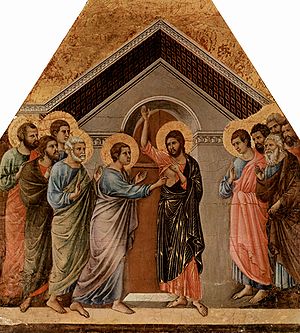
Recent work by historians paints a more complex portrait of late Second Temple Judaism and early Christianity. Some historians have suggested that, before his death, Jesus created amongst his believers such certainty that the Kingdom of God and the resurrection of the dead was at hand, that with few exceptions (John 20: 24-29) when they saw him shortly after his execution, they had no doubt that he had been resurrected, and that the restoration of the Kingdom and resurrecton of the dead was at hand. These specific beliefs were compatible with Second Temple Judaism. In the following years the restoration of the Kingdom, as Jews expected it, failed to occur. Some Christians believed instead that Christ, rather than being the Jewish messiah, was God made flesh
Incarnation (Christianity)
The Incarnation in traditional Christianity is the belief that Jesus Christ the second person of the Trinity, also known as God the Son or the Logos , "became flesh" by being conceived in the womb of a woman, the Virgin Mary, also known as the Theotokos .The Incarnation is a fundamental theological...
, who died for the sins of humanity, and that faith in Jesus Christ offered everlasting life (see Christology
Christology
Christology is the field of study within Christian theology which is primarily concerned with the nature and person of Jesus Christ as recorded in the Canonical gospels and the letters of the New Testament. Primary considerations include the relationship of Jesus' nature and person with the nature...
).
The foundation for this new interpretation of Jesus' crucifixion and resurrection are found in the epistles of Paul and in the book of Acts (and Christians would argue, in the gospels themselves). In contrast to most Christians, most Jews view Paul as the founder of Christianity, who is responsible for the break with Judaism; see Paul of Tarsus and Judaism
Paul of Tarsus and Judaism
The relationship between Paul of Tarsus and Second Temple Judaism continues to be the subject of much scholarly research, as it is thought that Paul played an important role in the relationship between Christianity and Judaism as a whole...
for details.
Jewish rejection of Jesus as messiah
The first Christians (the disciplesDisciple (Christianity)
In Christianity, the disciples were the students of Jesus during his ministry. While Jesus attracted a large following, the term disciple is commonly used to refer specifically to "the Twelve", an inner circle of men whose number perhaps represented the twelve tribes of Israel...
or students of Jesus) were essentially all ethnically Jewish or Jewish proselytes. In other words, Jesus was Jewish
Cultural and historical background of Jesus
Most scholars who study the Historical Jesus and Early Christianity believe that the Canonical Gospels and life of Jesus must be viewed as firmly placed within his historical and cultural context, rather than purely in terms of Christian orthodoxy...
, preached to the Jewish people and called from them his first disciples. However, the Great Commission
Great Commission
The Great Commission, in Christian tradition, is the instruction of the resurrected Jesus Christ to his disciples, that they spread his teachings to all the nations of the world. It has become a tenet in Christian theology emphasizing missionary work, evangelism, and baptism...
, issued after the Resurrection
Resurrection appearances of Jesus
The major Resurrection appearances of Jesus in the Canonical gospels are reported to have occurred after his death, burial and resurrection, but prior to his Ascension. Among these primary sources, most scholars believe First Corinthians was written first, authored by Paul of Tarsus along with...
is specifically directed at "all nations." Jewish Christians
Jewish Christians
Jewish Christians is a term which appears in historical texts contrasting Christians of Jewish origin with Gentile Christians, both in discussion of the New Testament church and the second and following centuries....
, as faithful religious Jews, regarded "Christianity" as an affirmation of every aspect of contemporary Judaism, with the addition of one extra belief — that Jesus was the Messiah
Messiah
A messiah is a redeemer figure expected or foretold in one form or another by a religion. Slightly more widely, a messiah is any redeemer figure. Messianic beliefs or theories generally relate to eschatological improvement of the state of humanity or the world, in other words the World to...
.
The doctrines of the apostles of Jesus
Apostle (Christian)
The term apostle is derived from Classical Greek ἀπόστολος , meaning one who is sent away, from στέλλω + από . The literal meaning in English is therefore an "emissary", from the Latin mitto + ex...
brought the Early Church into conflict with some Jewish religious authorities (Acts records dispute over resurrection of the dead
Resurrection of the dead
Resurrection of the Dead is a belief found in a number of eschatologies, most commonly in Christian, Islamic, Jewish and Zoroastrian. In general, the phrase refers to a specific event in the future; multiple prophesies in the histories of these religions assert that the dead will be brought back to...
which was rejected by the Sadducees
Sadducees
The Sadducees were a sect or group of Jews that were active in Ancient Israel during the Second Temple period, starting from the second century BC through the destruction of the Temple in 70 AD. The sect was identified by Josephus with the upper social and economic echelon of Judean society...
, see also Persecution of Christians in the New Testament
Persecution of Christians in the New Testament
The persecution of Christians in the New Testament is an important part of the Early Christian narrative which depicts the early Church as being persecuted for their heterodox beliefs by an alleged "Jewish establishment" in what was then Roman occupied Iudaea province.The New Testament, especially...
), and possibly later led to Christians' expulsion from synagogues (see Council of Jamnia
Council of Jamnia
The Council of Jamnia or Council of Yavne is a hypothetical late 1st-century council at which it is postulated the canon of the Hebrew Bible was finalized....
for other theories). While Marcionism
Marcionism
Marcionism was an Early Christian dualist belief system that originated in the teachings of Marcion of Sinope at Rome around the year 144; see also Christianity in the 2nd century....
rejected all Jewish influence on Christianity, Proto-orthodox Christianity
Proto-orthodox Christianity
Proto-orthodox Christianity is a term, coined by New Testament scholar Bart D. Ehrman, used to describe the Early Christian movement which was the precursor of Christian orthodoxy...
instead retained some of the doctrines and practices of 1st-century Judaism while rejecting others, see the Historical background to the issue of Biblical law in Christianity and Early Christianity
Early Christianity
Early Christianity is generally considered as Christianity before 325. The New Testament's Book of Acts and Epistle to the Galatians records that the first Christian community was centered in Jerusalem and its leaders included James, Peter and John....
. They held the Jewish scriptures
Tanakh
The Tanakh is a name used in Judaism for the canon of the Hebrew Bible. The Tanakh is also known as the Masoretic Text or the Miqra. The name is an acronym formed from the initial Hebrew letters of the Masoretic Text's three traditional subdivisions: The Torah , Nevi'im and Ketuvim —hence...
to be authoritative and sacred, employing mostly the Septuagint or Targum
Targum
Taekwondo is a Korean martial art and the national sport of South Korea. In Korean, tae means "to strike or break with foot"; kwon means "to strike or break with fist"; and do means "way", "method", or "path"...
translations, and adding other texts as the New Testament canon developed
Development of the New Testament canon
The Canon of the New Testament is the set of books Christians regard as divinely inspired and constituting the New Testament of the Christian Bible. For most, it is an agreed-upon list of twenty-seven books that includes the Canonical Gospels, Acts, letters of the Apostles, and Revelation...
. Christian baptism
Baptism
In Christianity, baptism is for the majority the rite of admission , almost invariably with the use of water, into the Christian Church generally and also membership of a particular church tradition...
was another continuation of a Judaic practice.
Conversion of Paul
According to the Acts of the ApostlesActs of the Apostles
The Acts of the Apostles , usually referred to simply as Acts, is the fifth book of the New Testament; Acts outlines the history of the Apostolic Age...
, Paul of Tarsus
Paul of Tarsus
Paul the Apostle , also known as Saul of Tarsus, is described in the Christian New Testament as one of the most influential early Christian missionaries, with the writings ascribed to him by the church forming a considerable portion of the New Testament...
(c.5-c.67) was taught by the famous Pharisee Gamaliel
Gamaliel
Gamaliel the Elder , or Rabban Gamaliel I , was a leading authority in the Sanhedrin in the mid 1st century CE. He was the grandson of the great Jewish teacher Hillel the Elder, and died twenty years before the destruction of the Second Temple in Jerusalem...
in Jerusalem
Jerusalem in Christianity
For Christians, Jerusalem's place in the ministry of Jesus and the Apostolic Age gives it great importance, in addition to its place in the Old Testament, the Hebrew Bible.-Jerusalem in the New Testament and early Christianity:...
, but modern historians still debate the relationship between Paul of Tarsus and Judaism
Paul of Tarsus and Judaism
The relationship between Paul of Tarsus and Second Temple Judaism continues to be the subject of much scholarly research, as it is thought that Paul played an important role in the relationship between Christianity and Judaism as a whole...
and the historical reliability of the Acts of the Apostles
Historical reliability of the Acts of the Apostles
The historical reliability of the Acts of the Apostles, the primary source for the Apostolic Age, is a major issue for biblical scholars and historians of Early Christianity. The historicity of Acts became hotly debated between 1895-1915...
. Before his conversion Paul persecuted the Jewish Christians
Jewish Christians
Jewish Christians is a term which appears in historical texts contrasting Christians of Jewish origin with Gentile Christians, both in discussion of the New Testament church and the second and following centuries....
as a heretical
Heresy
Heresy is a controversial or novel change to a system of beliefs, especially a religion, that conflicts with established dogma. It is distinct from apostasy, which is the formal denunciation of one's religion, principles or cause, and blasphemy, which is irreverence toward religion...
sect, such as the Martyrdom of Stephen. After his conversion, he assumed the title of "Apostle to the Gentiles" and actively converted gentiles to his beliefs, known as Pauline Christianity
Pauline Christianity
Pauline Christianity is a term used to refer to the Christianity associated with the beliefs and doctrines espoused by Paul of Tarsus through his writings. Most of orthodox Christianity relies heavily on these teachings and considers them to be amplifications and explanations of the teachings of...
. Paul's influence on Christian thinking arguably has been more significant than any other New Testament author. Augustine (354-430) developed Paul's idea that salvation
Salvation
Within religion salvation is the phenomenon of being saved from the undesirable condition of bondage or suffering experienced by the psyche or soul that has arisen as a result of unskillful or immoral actions generically referred to as sins. Salvation may also be called "deliverance" or...
is based on faith
Faith in Christianity
Faith, in Christianity, has been most commonly defined by the biblical formulation in the Letter to the Hebrews as "'the assurance of things hoped for, the conviction of things not seen". Most of the definitions in the history of Christian theology have followed this biblical formulation...
and not works of the law
Good works
Good works, or simply works, within Christian theology are a person's actions or deeds, contrasting with interior qualities such as grace or faith.The New Testament exhibits a tension between two aspects of grace:...
. Luther
Martin Luther
Martin Luther was a German priest, professor of theology and iconic figure of the Protestant Reformation. He strongly disputed the claim that freedom from God's punishment for sin could be purchased with money. He confronted indulgence salesman Johann Tetzel with his Ninety-Five Theses in 1517...
(1483–1546) and his doctrine of sola fide
Sola fide
Sola fide , also historically known as the doctrine of justification by faith alone, is a Christian theological doctrine that distinguishes most Protestant denominations from Catholicism, Eastern Christianity, and some in the Restoration Movement.The doctrine of sola fide or "by faith alone"...
were heavily influenced by Paul. Evangelical Christians refer to the Roman's road, an explanation of the Gospel of Jesus Christ taken solely from the book of Romans.
Recently, Talmudic scholar Daniel Boyarin
Daniel Boyarin
Daniel Boyarin is an historian of religion. Born in Asbury Park, New Jersey, he holds dual United States and Israeli citizenship. Trained as a Talmudic scholar, in 1990 he was appointed Professor of Talmudic Culture, Departments of Near Eastern Studies and Rhetoric, University of California,...
has argued that Paul's theology of the spirit is more deeply rooted in Hellenistic Judaism
Hellenistic Judaism
Hellenistic Judaism was a movement which existed in the Jewish diaspora that sought to establish a Hebraic-Jewish religious tradition within the culture and language of Hellenism...
than generally believed. In A Radical Jew, Boyarin argues that Paul of Tarsus combined the life of Jesus with Greek philosophy
Greek philosophy
Ancient Greek philosophy arose in the 6th century BCE and continued through the Hellenistic period, at which point Ancient Greece was incorporated in the Roman Empire...
to reinterpret the Hebrew Bible
Hebrew Bible
The Hebrew Bible is a term used by biblical scholars outside of Judaism to refer to the Tanakh , a canonical collection of Jewish texts, and the common textual antecedent of the several canonical editions of the Christian Old Testament...
in terms of the Platonic
Platonism
Platonism is the philosophy of Plato or the name of other philosophical systems considered closely derived from it. In a narrower sense the term might indicate the doctrine of Platonic realism...
opposition between the ideal (which is real) and the material (which is false).
Possible Conversion of Gamaliel
According to the Catholic EncyclopediaCatholic Encyclopedia
The Catholic Encyclopedia, also referred to as the Old Catholic Encyclopedia and the Original Catholic Encyclopedia, is an English-language encyclopedia published in the United States. The first volume appeared in March 1907 and the last three volumes appeared in 1912, followed by a master index...
:
- "The Jewish accounts make him die a Pharisee, and state that: "When he died, the honour of the Torah (the law) ceased, and purity and piety became extinct". At an early date, ecclesiastical tradition has supposed that Gamaliel embraced the Christian Faith, and remained a member of the SanhedrinSanhedrinThe Sanhedrin was an assembly of twenty-three judges appointed in every city in the Biblical Land of Israel.The Great Sanhedrin was the supreme court of ancient Israel made of 71 members...
for the purpose of helping secretly his fellow-Christians (cf. Recognitions of Clement, I, lxv, lxvi). According to Photius, he was baptized by St. Peter and St. John, together with his son and with NicodemusNicodemusSaint Nicodemus was a Pharisee and a member of the Sanhedrin, who, according to the Gospel of John, showed favour to Jesus...
. His body, miraculously discovered in the fifth century, is said to be preserved at Pisa, in Italy."
Christian abandonment of Jewish practices
According to historian Shaye J.D. CohenShaye J.D. Cohen
Shaye J. D. Cohen is the Littauer Professor of Hebrew Literature and Philosophy in the Department of Near Eastern Languages and Civilizations of Harvard University. He received his Ph.D. in Ancient History, with distinction, from Columbia University in 1975...
, "Early Christianity ceased to be a Jewish sect when it ceased to observe Jewish practices. Among the Jewish practices abandoned by Proto-orthodox Christianity
Proto-orthodox Christianity
Proto-orthodox Christianity is a term, coined by New Testament scholar Bart D. Ehrman, used to describe the Early Christian movement which was the precursor of Christian orthodoxy...
, Circumcision
Circumcision controversy in early Christianity
There is evidence of a controversy over religious male circumcision in Early Christianity. A Council of Jerusalem, possibly held in approximately 50 AD, decreed that male circumcision was not a requirement for Gentile converts. This became known as the "Apostolic Decree" and may be one of the...
was rejected as a requirement at the Council of Jerusalem
Council of Jerusalem
The Council of Jerusalem is a name applied by historians and theologians to an Early Christian council that was held in Jerusalem and dated to around the year 50. It is considered by Catholics and Orthodox to be a prototype and forerunner of the later Ecumenical Councils...
, c. 50, though the decree of the council may parallel Jewish Noahide Law. Sabbath observance was modified, perhaps as early as Ignatius of Antioch
Ignatius of Antioch
Ignatius of Antioch was among the Apostolic Fathers, was the third Bishop of Antioch, and was a student of John the Apostle. En route to his martyrdom in Rome, Ignatius wrote a series of letters which have been preserved as an example of very early Christian theology...
(c.110). Quartodecimanism
Quartodecimanism
Quartodecimanism refers to the custom of some early Christians celebrating Passover beginning with the eve of the 14th day of Nisan , which at dusk is Biblically the "Lord's passover".The modern Jewish Passover and Feast of Unleavened Bread is seven days, starting with the sunset at...
(observation of a Paschal
Paschal
Paschal is a variant spelling of the name Pascal , from Latin Paschalis. Two popes and two antipopes have taken this name:* Antipope Paschal * Pope Paschal I * Pope Paschal II...
feast on Nisan 14, the day of preparation for Passover
Passover
Passover is a Jewish holiday and festival. It commemorates the story of the Exodus, in which the ancient Israelites were freed from slavery in Egypt...
, linked to Polycarp
Polycarp
Saint Polycarp was a 2nd century Christian bishop of Smyrna. According to the Martyrdom of Polycarp, he died a martyr, bound and burned at the stake, then stabbed when the fire failed to touch him...
and thus to John the Apostle
John the Apostle
John the Apostle, John the Apostle, John the Apostle, (Aramaic Yoħanna, (c. 6 - c. 100) was one of the Twelve Apostles of Jesus. He was the son of Zebedee and Salome, and brother of James, another of the Twelve Apostles...
) was disputed by Pope Victor I
Pope Victor I
Pope Saint Victor I was Pope from 189 to 199 .Pope Victor I was the first bishop of Rome born in the Roman Province of Africa: probably he was born in Leptis Magna . He was later canonized...
(189-199) and formally rejected at the First Council of Nicaea
First Council of Nicaea
The First Council of Nicaea was a council of Christian bishops convened in Nicaea in Bithynia by the Roman Emperor Constantine I in AD 325...
in 325.
Council of Jerusalem
In or around the year 50, the apostlesApostle (Christian)
The term apostle is derived from Classical Greek ἀπόστολος , meaning one who is sent away, from στέλλω + από . The literal meaning in English is therefore an "emissary", from the Latin mitto + ex...
convened the first church council (although whether it was a council in the later sense in questioned), known as the Council of Jerusalem
Council of Jerusalem
The Council of Jerusalem is a name applied by historians and theologians to an Early Christian council that was held in Jerusalem and dated to around the year 50. It is considered by Catholics and Orthodox to be a prototype and forerunner of the later Ecumenical Councils...
, to reconcile practical (and by implication doctrinal) differences concerning the Gentile mission. At the Council of Jerusalem
Council of Jerusalem
The Council of Jerusalem is a name applied by historians and theologians to an Early Christian council that was held in Jerusalem and dated to around the year 50. It is considered by Catholics and Orthodox to be a prototype and forerunner of the later Ecumenical Councils...
it was agreed that gentiles could be accepted as Christians without full adherence to the Mosaic Laws
613 mitzvot
The 613 commandments is a numbering of the statements and principles of law, ethics, and spiritual practice contained in the Torah or Five Books of Moses...
, possibly a major break between Christianity and Judaism, though the decree of the council seems to parallel the Noahide laws
Noahide Laws
The Seven Laws of Noah form the major part of the Noachide Laws, or Noahide Code. This code is a set of moral imperatives that, according to the Talmud, were given by God as a binding set of laws for the "children of Noah" – that is, all of humankind...
of Judaism, which would make it a commonality rather than a difference. The Council of Jerusalem
Council of Jerusalem
The Council of Jerusalem is a name applied by historians and theologians to an Early Christian council that was held in Jerusalem and dated to around the year 50. It is considered by Catholics and Orthodox to be a prototype and forerunner of the later Ecumenical Councils...
, according to , determined that circumcision
Circumcision controversy in early Christianity
There is evidence of a controversy over religious male circumcision in Early Christianity. A Council of Jerusalem, possibly held in approximately 50 AD, decreed that male circumcision was not a requirement for Gentile converts. This became known as the "Apostolic Decree" and may be one of the...
was not required of Gentile converts, only avoidance of "pollution of idols
Idolatry in Christianity
A cult image or idol is a material object, representing a deity, to which religious worship is directed. It is also controversially and pejoratively used by some Protestants to describe the Orthodox Christian practice of worshipping the Christian God through the use of icons, a charge which...
, fornication, things strangled, and blood" , possibly establishing nascent Christianity as an attractive alternative to Judaism for prospective Proselyte
Proselyte
The biblical term "Proselyte", derives from the Koine Greek προσήλυτος/proselytos, as used in the Septuagint for "stranger", i.e. a "newcomer to Israel"; a "sojourner in the land", and in the New Testament for a convert to Judaism from Paganism...
s. Around the same time period, Judaism made its circumcision requirement of Jewish boys
Brit milah
The brit milah is a Jewish religious circumcision ceremony performed on 8-day old male infants by a mohel. The brit milah is followed by a celebratory meal .-Biblical references:...
even stricter.
Though the council's Apostolic Decree is no longer observed by many Christian denominations today, it is still observed in full by the Orthodox Catholic Church. In addition, the Apostolic Age
Apostolic Age
The Apostolic Age of the history of Christianity is traditionally the period of the Twelve Apostles, dating from the Crucifixion of Jesus and the Great Commission in Jerusalem until the death of John the Apostle in Anatolia...
is particularly significant to Christian Restorationism which claims that it represents a purer form of Christianity that should be restored to the church as it exists today.
Emergence of Rabbinic Judaism and Christianity
Pharisees
The Pharisees were at various times a political party, a social movement, and a school of thought among Jews during the Second Temple period beginning under the Hasmonean dynasty in the wake of...
, Saducees, and Zealots, but also included other less influential sects. This led to further unrest, and the 1st century BC and 1st century AD saw a number of charismatic religious leaders, contributing to what would become the Mishnah
Mishnah
The Mishnah or Mishna is the first major written redaction of the Jewish oral traditions called the "Oral Torah". It is also the first major work of Rabbinic Judaism. It was redacted c...
of Rabbinic Judaism, including Yochanan ben Zakai
Yochanan ben Zakai
Johanan ben Zakai , also known as Johanan B. Zakkai was one of the tannaim, an important Jewish sage in the era of the Second Temple, and a primary contributor to the core text of Rabbinical Judaism, the Mishnah. He is widely regarded as one of the most important Jewish figures of his time...
and Hanina Ben Dosa
Hanina Ben Dosa
Hanina ben Dosa was a scholar and miracle-worker, and the pupil of Johanan ben Zakkai . He is buried in the City of Arraba....
.
According to most scholars, the followers of Jesus composed principally apocalyptic Jewish
Judaism
Judaism ) is the "religion, philosophy, and way of life" of the Jewish people...
sects during the late Second Temple
Second Temple
The Jewish Second Temple was an important shrine which stood on the Temple Mount in Jerusalem between 516 BCE and 70 CE. It replaced the First Temple which was destroyed in 586 BCE, when the Jewish nation was exiled to Babylon...
period of the 1st century
Christianity in the 1st century
The earliest followers of Jesus composed an apocalyptic, Jewish sect, which historians refer to as Jewish Christianity. The Apostles and others following the Great Commission's decree to spread the teachings of Jesus to "all nations," had great success spreading the religion to gentiles. Peter,...
. Some Early Christian groups were strictly Jewish, such as the Ebionites
Ebionites
Ebionites, or Ebionaioi, , is a patristic term referring to a Jewish Christian sect or sects that existed during the first centuries of the Christian Era. They regarded Jesus as the Messiah and insisted on the necessity of following Jewish religious law and rites...
and the early church leaders in Jerusalem
Jerusalem in Christianity
For Christians, Jerusalem's place in the ministry of Jesus and the Apostolic Age gives it great importance, in addition to its place in the Old Testament, the Hebrew Bible.-Jerusalem in the New Testament and early Christianity:...
, collectively called Jewish Christians
Jewish Christians
Jewish Christians is a term which appears in historical texts contrasting Christians of Jewish origin with Gentile Christians, both in discussion of the New Testament church and the second and following centuries....
. During this period, they were led by James the Just
James the Just
James , first Bishop of Jerusalem, who died in 62 AD, was an important figure in Early Christianity...
. Paul of Tarsus, commonly known as Saint Paul, persecuted the early Jewish Christians, such as Saint Stephen
Saint Stephen
Saint Stephen The Protomartyr , the protomartyr of Christianity, is venerated as a saint in the Roman Catholic, Anglican, Lutheran, Oriental Orthodox and Eastern Orthodox Churches....
, then converted
Conversion of Paul
The Conversion of Paul the Apostle, as depicted in the Christian Bible, refers to an event reported to have taken place in the life of Paul of Tarsus which led him to cease persecuting early Christians and to himself become a follower of Jesus; it is normally dated by researchers to AD 33–36...
and adopted the title of "Apostle to the Gentiles" and started proselytizing among the Gentile
Gentile
The term Gentile refers to non-Israelite peoples or nations in English translations of the Bible....
s. He persuaded the leaders of the Jerusalem Church to allow Gentile converts exemption from most Jewish commandments at the Council of Jerusalem
Council of Jerusalem
The Council of Jerusalem is a name applied by historians and theologians to an Early Christian council that was held in Jerusalem and dated to around the year 50. It is considered by Catholics and Orthodox to be a prototype and forerunner of the later Ecumenical Councils...
, which may parallel Noahide Law in Rabbinic Judaism
Rabbinic Judaism
Rabbinic Judaism or Rabbinism has been the mainstream form of Judaism since the 6th century CE, after the codification of the Talmud...
.
Most historians agree that Jesus or his followers established a new Jewish sect, one that attracted both Jewish and Gentile converts. Historians continue to debate the precise moment when Christianity established itself as a new religion, apart and distinct from Judaism. Some scholars view Christians as much as Pharisees as being competing movements within Judaism that decisively broke only after the Bar Kokhba's revolt
Bar Kokhba's revolt
The Bar Kokhba revolt 132–136 CE; or mered bar kokhba) against the Roman Empire, was the third major rebellion by the Jews of Judaea Province being the last of the Jewish-Roman Wars. Simon bar Kokhba, the commander of the revolt, was acclaimed as a Messiah, a heroic figure who could restore Israel...
, when the successors of the Pharisees claimed hegemony over all Judaism, and – at least from the Jewish perspective – Christianity emerged as a new religion. Some Christians were still part of the Jewish community up until the time of the Bar Kochba revolt in the 130s, see also Jewish Christians
Jewish Christians
Jewish Christians is a term which appears in historical texts contrasting Christians of Jewish origin with Gentile Christians, both in discussion of the New Testament church and the second and following centuries....
.
According to historian Shaye J. D. Cohen,
- The separation of Christianity from Judaism was a process, not an event. The essential part of this process was that the church was becoming more and more gentile, and less and less Jewish, but the separation manifested itself in different ways in each local community where Jews and Christians dwelt together. In some places, the Jews expelled the Christians; in other, the Christians left of their own accord.
According to Cohen, this process ended in 70 CE, after the great revolt, when various Jewish sects disappeared and Pharisaic Judaism evolved into Rabbinic Judaism, and Christianity emerged as a distinct religion.
The Great Revolt and the Destruction of the Temple
By 6666
Year 66 was a common year starting on Wednesday of the Julian calendar. At the time, it was known as the Year of the Consulship of Telesinus and Paullinus...
CE Jewish discontent with Rome had escalated. At first, the priests tried to suppress rebellion, even calling upon the Pharisees for help. After the Roman garrison failed to stop Hellenists from desecrating a synagogue in Caesarea, however, the high priest suspended payment of tribute, inaugurating the Great Jewish Revolt.
After a Jewish revolt against Roman rule in 66 CE, the Romans all but destroyed Jerusalem. Following a second revolt, Jews were not allowed to enter the city of Jerusalem except for the day of Tisha B'Av
Tisha B'Av
|Av]],") is an annual fast day in Judaism, named for the ninth day of the month of Av in the Hebrew calendar. The fast commemorates the destruction of both the First Temple and Second Temple in Jerusalem, which occurred about 655 years apart, but on the same Hebrew calendar date...
and most Jewish worship was forbidden by Rome. Rome instituted the Fiscus Judaicus
Fiscus Judaicus
The Fiscus Iudaicus or Fiscus Judaicus was a tax collecting agency instituted to collect the tax imposed on Jews in the Roman Empire after the destruction of the Temple of Jerusalem in 70 CE in favor of the temple of Jupiter Capitolinus in Rome.-Imposition:The tax was initially imposed by Roman...
, those who paid the tax were allowed to continue Jewish practices. Following the destruction of Jerusalem and the expulsion of the Jews, Jewish worship stopped being centrally organized around the Temple, prayer took the place of sacrifice, and worship was rebuilt around rabbis who acted as teachers and leaders of individual communities (see Jewish diaspora
Jewish diaspora
The Jewish diaspora is the English term used to describe the Galut גלות , or 'exile', of the Jews from the region of the Kingdom of Judah and Roman Iudaea and later emigration from wider Eretz Israel....
and Council of Jamnia
Council of Jamnia
The Council of Jamnia or Council of Yavne is a hypothetical late 1st-century council at which it is postulated the canon of the Hebrew Bible was finalized....
).
In 70
70
Year 70 was a common year starting on Monday of the Julian calendar. At the time, it was known as the Year of the Consulship of Augustus and Vespasianus...
the Temple was destroyed. The destruction of the Second Temple was a profoundly traumatic experience for the Jews, who were now confronted with difficult and far-reaching questions:
- How to achieve atonement without the Temple?
- How to explain the disastrous outcome of the rebellion?
- How to live in the post-Temple, Romanized world?
- How to connect present and past traditions?
How people answered these questioned depended largely on their position prior to the revolt. But the destruction of the Second Temple by the Romans not only put an end to the revolt, it marked the end of an era. Revolutionaries like the Zealots had been crushed by the Romans, and had little credibility (the last Zealots died at Masada
Masada
Masada is the name for a site of ancient palaces and fortifications in the South District of Israel, on top of an isolated rock plateau, or horst, on the eastern edge of the Judean Desert, overlooking the Dead Sea. Masada is best known for the violence that occurred there in the first century CE...
in 73
73
Year 73 was a common year starting on Friday of the Julian calendar. At the time, it was known as the Year of the Consulship of Domitianus and Catullus...
). The Sadducees, whose teachings were so closely connected to the Temple cult, disappeared. The Essenes also vanished, perhaps because their teachings so diverged from the issues of the times that the destruction of the Second Temple was of no consequence to them; precisely for this reason, they were of little consequence to the vast majority of Jews.
Two organized groups remained: the Early Christians, and Pharisees
Pharisees
The Pharisees were at various times a political party, a social movement, and a school of thought among Jews during the Second Temple period beginning under the Hasmonean dynasty in the wake of...
. Some scholars, such as Daniel Boyarin and Paula Fredricksen, suggest that it was at this time, when Christians and Pharisees were competing for leadership of the Jewish people, that accounts of debates between Jesus and the apostles, debates with Pharisees, and anti-Pharisaic passages, were written and incorporated into the New Testament
New Testament
The New Testament is the second major division of the Christian biblical canon, the first such division being the much longer Old Testament....
.
The Emergence of Rabbinic Judaism
Of all the major Second Temple sects, only the Pharisees remained (but see Karaite JudaismKaraite Judaism
Karaite Judaism or Karaism is a Jewish movement characterized by the recognition of the Tanakh alone as its supreme legal authority in Halakhah, as well as in theology...
). Their vision of Jewish law as a means by which ordinary people could engage with the sacred in their daily lives, provided them with a position from which to respond to all four challenges, in a way meaningful to the vast majority of Jews.
Following the destruction of the Temple, Rome governed Judea through a Procurator
Procurator (Roman)
A procurator was the title of various officials of the Roman Empire, posts mostly filled by equites . A procurator Augusti was the governor of the smaller imperial provinces...
at Caesarea and a Jewish Patriarch. A former leading Pharisee, Yohanan ben Zakkai, was appointed the first Patriarch (the Hebrew word, Nasi
Nasi
Nāśī’ is a Hebrew title meaning prince in Biblical Hebrew, Prince in Mishnaic Hebrew, or president in Modern Hebrew.-Genesis and Ancient Israel:...
, also means prince
Prince
Prince is a general term for a ruler, monarch or member of a monarch's or former monarch's family, and is a hereditary title in the nobility of some European states. The feminine equivalent is a princess...
, or president
President
A president is a leader of an organization, company, trade union, university, or country.Etymologically, a president is one who presides, who sits in leadership...
), and he reestablished the Sanhedrin at Javneh
Council of Jamnia
The Council of Jamnia or Council of Yavne is a hypothetical late 1st-century council at which it is postulated the canon of the Hebrew Bible was finalized....
under Pharisee control. Instead of giving tithes to the priests and sacrificing offerings at the Temple, the rabbis instructed Jews to give money to charities and study in local Synagogue
Synagogue
A synagogue is a Jewish house of prayer. This use of the Greek term synagogue originates in the Septuagint where it sometimes translates the Hebrew word for assembly, kahal...
s, as well as to pay the Fiscus Iudaicus.
Around the 1st century CE there were several Jewish sects: the Pharisees
Pharisees
The Pharisees were at various times a political party, a social movement, and a school of thought among Jews during the Second Temple period beginning under the Hasmonean dynasty in the wake of...
, Sadducees
Sadducees
The Sadducees were a sect or group of Jews that were active in Ancient Israel during the Second Temple period, starting from the second century BC through the destruction of the Temple in 70 AD. The sect was identified by Josephus with the upper social and economic echelon of Judean society...
, Zealots, Essenes
Essenes
The Essenes were a Jewish sect that flourished from the 2nd century BCE to the 1st century CE which some scholars claim seceded from the Zadokite priests...
, and Christians
Early Christianity
Early Christianity is generally considered as Christianity before 325. The New Testament's Book of Acts and Epistle to the Galatians records that the first Christian community was centered in Jerusalem and its leaders included James, Peter and John....
. After the destruction of the Second Temple in 70 CE, these sects vanished. Christianity
Christianity
Christianity is a monotheistic religion based on the life and teachings of Jesus as presented in canonical gospels and other New Testament writings...
survived, but by breaking with Judaism and becoming a separate religion
Schism (religion)
A schism , from Greek σχίσμα, skhísma , is a division between people, usually belonging to an organization or movement religious denomination. The word is most frequently applied to a break of communion between two sections of Christianity that were previously a single body, or to a division within...
; the Pharisees
Pharisees
The Pharisees were at various times a political party, a social movement, and a school of thought among Jews during the Second Temple period beginning under the Hasmonean dynasty in the wake of...
survived but in the form of Rabbinic Judaism
Rabbinic Judaism
Rabbinic Judaism or Rabbinism has been the mainstream form of Judaism since the 6th century CE, after the codification of the Talmud...
(today, known simply as "Judaism"). The Sadducees
Sadducees
The Sadducees were a sect or group of Jews that were active in Ancient Israel during the Second Temple period, starting from the second century BC through the destruction of the Temple in 70 AD. The sect was identified by Josephus with the upper social and economic echelon of Judean society...
rejected the divine inspiration
Revelation
In religion and theology, revelation is the revealing or disclosing, through active or passive communication with a supernatural or a divine entity...
of the Prophets
Nevi'im
Nevi'im is the second of the three major sections in the Hebrew Bible, the Tanakh. It falls between the Torah and Ketuvim .Nevi'im is traditionally divided into two parts:...
and the Writings
Ketuvim
Ketuvim or Kəṯûḇîm in actual Biblical Hebrew is the third and final section of the Tanak , after Torah and Nevi'im . In English translations of the Hebrew Bible, this section is usually entitled "Writings" or "Hagiographa"...
, relying only on the Torah
Torah
Torah- A scroll containing the first five books of the BibleThe Torah , is name given by Jews to the first five books of the bible—Genesis , Exodus , Leviticus , Numbers and Deuteronomy Torah- A scroll containing the first five books of the BibleThe Torah , is name given by Jews to the first five...
as divinely inspired. Consequently, a number of other core tenets of the Pharisees' belief system (which became the basis for modern Judaism), were also dismissed by the Sadducees. (The Samaritans practiced a similar religion, which is traditionally considered separate from Judaism.)
In 132
132
Year 132 was a leap year starting on Monday of the Julian calendar. At the time, it was known as the Year of the Consulship of Serius and Sergianus...
, the Emperor Hadrian
Hadrian
Hadrian , was Roman Emperor from 117 to 138. He is best known for building Hadrian's Wall, which marked the northern limit of Roman Britain. In Rome, he re-built the Pantheon and constructed the Temple of Venus and Roma. In addition to being emperor, Hadrian was a humanist and was philhellene in...
threatened to rebuild Jerusalem as a pagan city dedicated to Jupiter, called Aelia Capitolina
Aelia Capitolina
Aelia Capitolina was a city built by the emperor Hadrian, and occupied by a Roman colony, on the site of Jerusalem, which was in ruins since 70 AD, leading in part to the Bar Kokhba revolt of 132–136.-Politics:...
. Some of the leading sages of the Sanhedrin supported a rebellion (and, for a short time, an independent state) led by Simon bar Kozeba (also called Bar Kochba, or "son of a star"); some, such as Rabbi Akiba, believed Bar Kochbah to be messiah, or king. Up until this time, a number of Christians were still part of the Jewish community. However, they did not support or take part in the revolt. Whether because they had no wish to fight, or because they could not support a second messiah in addition to Jesus, or because of their harsh treatment by Bar Kochba during his brief reign, these Christians also left the Jewish community around this time.
This revolt ended in 135
135
Year 135 was a common year starting on Friday of the Julian calendar. At the time, it was known as the Year of the Consulship of Lupercus and Atilianus...
when Bar Kochba and his army were defeated. According to a midrash
Midrash
The Hebrew term Midrash is a homiletic method of biblical exegesis. The term also refers to the whole compilation of homiletic teachings on the Bible....
, in addition to Bar Kochba the Romans tortured and executed ten leading members of the Sanhedrin. This account also claims this was belated repayment for the guilt of the ten brothers who kidnapped Joseph. It is possible that this account represents a Pharisaic response to the Christian
Christian
A Christian is a person who adheres to Christianity, an Abrahamic, monotheistic religion based on the life and teachings of Jesus of Nazareth as recorded in the Canonical gospels and the letters of the New Testament...
account of Jesus
Jesus
Jesus of Nazareth , commonly referred to as Jesus Christ or simply as Jesus or Christ, is the central figure of Christianity...
' crucifixion
Crucifixion
Crucifixion is an ancient method of painful execution in which the condemned person is tied or nailed to a large wooden cross and left to hang until dead...
; in both accounts the Romans brutally punish rebels, who accept their torture as atonement for the crimes of others.
After the suppression of the revolt the vast majority of Jews were sent into exile; shortly thereafter (around 200), Judah haNasi
Judah haNasi
Judah the Prince, or Judah I, also known as Rebbi or Rabbeinu HaKadosh , was a 2nd-century CE rabbi and chief redactor and editor of the Mishnah. He was a key leader of the Jewish community during the Roman occupation of Judea . He was of the Davidic line, the royal line of King David, hence the...
edited together judgements and traditions into an authoritative code, the Mishna. This marks the transformation of Pharisaic Judaism into Rabbinic Judaism
Rabbinic Judaism
Rabbinic Judaism or Rabbinism has been the mainstream form of Judaism since the 6th century CE, after the codification of the Talmud...
.
Although the Rabbis traced their origins to the Pharisees, Rabbinic Judaism nevertheless involved a radical repudiation of certain elements of Pharisaism - elements that were basic to Second Temple Judaism. The Pharisees had been partisan. Members of different sects argued with one another over the correctness of their respective interpretations, see also Hillel and Shammai
Hillel and Shammai
Hillel and Shammai were two leading rabbis of the early 1st century CE who founded opposing schools of Jewish thought, known as the House of Hillel and House of Shammai...
. After the destruction of the Second Temple, these sectarian divisions ended. The term "Pharisee" was no longer used, perhaps because it was a term more often used by non-Pharisees, but also because the term was explicitly sectarian. The Rabbis claimed leadership over all Jews, and added to the Amidah
Amidah
The Amidah , also called the Shmoneh Esreh , is the central prayer of the Jewish liturgy. This prayer, among others, is found in the siddur, the traditional Jewish prayer book...
the birkat haMinim (see Council of Jamnia
Council of Jamnia
The Council of Jamnia or Council of Yavne is a hypothetical late 1st-century council at which it is postulated the canon of the Hebrew Bible was finalized....
), a prayer which in part exclaims, "Praised are You O Lord, who breaks enemies and defeats the arrogant," and which is understood as a rejection of sectarians and sectarianism. This shift by no means resolved conflicts over the interpretation of the Torah; rather, it relocated debates between sects to debates within Rabbinic Judaism.
As the Rabbis were required to face a new reality—mainly Judaism without a Temple (to serve as the center of teaching and study) and Judea without autonomy—there was a flurry of legal discourse and the old system of oral scholarship could not be maintained. It is during this period that Rabbinic discourse began to be recorded in writing. The theory that the destruction of the Temple and subsequent upheaval led to the committing of Oral Law into writing was first explained in the Epistle of Sherira Gaon
Sherira Gaon
Rav Sherira Gaon was the head of the Academy of Pumbeditha. He was one of the most prominent Geonim of his period, and the father of Hai Gaon, who succeeded him as gaon.Sherira was born in 906 and died in 1006. Rav Sherira Gaon (Hebrew: רב שרירא גאון or R. Sherira ben Ḥanina Gaon, Hebrew: רב...
and often repeated.
The oral law was subsequently codified in the Mishna and Gemarah, and is interpreted in Rabbinic literature
Rabbinic literature
Rabbinic literature, in its broadest sense, can mean the entire spectrum of rabbinic writings throughout Jewish history. However, the term often refers specifically to literature from the Talmudic era, as opposed to medieval and modern rabbinic writing, and thus corresponds with the Hebrew term...
detailing subsequent rabbinic decisions and writings. Rabbinic Jewish literature is predicated on the belief that the Written Law cannot be properly understood without recourse to the Oral Law
Oral law
An oral law is a code of conduct in use in a given culture, religion or community application, by which a body of rules of human behaviour is transmitted by oral tradition and effectively respected, or the single rule that is orally transmitted....
(the Mishnah
Mishnah
The Mishnah or Mishna is the first major written redaction of the Jewish oral traditions called the "Oral Torah". It is also the first major work of Rabbinic Judaism. It was redacted c...
).
Much Rabbinic Jewish literature concerns specifying what behavior is sanctioned by the law; this body of interpretations is called halakha
Halakha
Halakha — also transliterated Halocho , or Halacha — is the collective body of Jewish law, including biblical law and later talmudic and rabbinic law, as well as customs and traditions.Judaism classically draws no distinction in its laws between religious and ostensibly non-religious life; Jewish...
(the way).
The Emergence of Christianity
According to Shaye J.D. CohenShaye J.D. Cohen
Shaye J. D. Cohen is the Littauer Professor of Hebrew Literature and Philosophy in the Department of Near Eastern Languages and Civilizations of Harvard University. He received his Ph.D. in Ancient History, with distinction, from Columbia University in 1975...
, Jesus' failure to establish the Kingdom of God
Kingdom of God
The Kingdom of God or Kingdom of Heaven is a foundational concept in the Abrahamic religions: Judaism, Christianity and Islam.The term "Kingdom of God" is found in all four canonical gospels and in the Pauline epistles...
, and his death at the hands of the Romans, invalidated any messianic claims (see for comparison: prophet
Prophet
In religion, a prophet, from the Greek word προφήτης profitis meaning "foreteller", is an individual who is claimed to have been contacted by the supernatural or the divine, and serves as an intermediary with humanity, delivering this newfound knowledge from the supernatural entity to other people...
and false prophet
False prophet
In religion, a false prophet is one who falsely claims the gift of prophecy, or who uses that gift for evil ends. Often, someone who is considered a "true prophet" by some people is simultaneously considered a "false prophet" by others....
). Mainstream Christianity claims that the Kingdom of God will be established by the Second Coming of Christ. In the aftermath of the destruction of the Temple, and then the defeat of Bar Kozeba
Bar Kokhba's revolt
The Bar Kokhba revolt 132–136 CE; or mered bar kokhba) against the Roman Empire, was the third major rebellion by the Jews of Judaea Province being the last of the Jewish-Roman Wars. Simon bar Kokhba, the commander of the revolt, was acclaimed as a Messiah, a heroic figure who could restore Israel...
, it is claimed that more Jews continued to be attracted to the Pharisaic rabbis than to Christianity, because they believed the latter to be a form of idolatry
Shituf
is a term used in Jewish sources for the worship of the God of Israel in a manner which Judaism does not deem to be monotheistic. The term connotes a theology that is not outright polytheistic, but also should not be seen as purely monotheistic...
and thus antithetical to the unity of God as expressed in the Mosaic tradition (see Maimonides, Laws of King 11:4). According to the majority of historians, Jesus' teachings were intelligible and acceptable in terms of Second Temple Judaism
Second Temple Judaism
Second Temple Judaism refers to the religion of Judaism during the Second Temple period, between the construction of the second Jewish temple in Jerusalem in 515 BCE, and its destruction by the Romans in 70 CE This period witnessed major historical upheavals and significant religious changes that...
; what set Christians apart from Jews was their faith in Christ as the resurrected messiah. The belief in a resurrected Messiah is said to be unacceptable to Jews who practice Rabbinic Judaism; Jewish authorities have long used this fact to explain the break between Judaism and Christianity. Recent work by historians paints a more complex portrait of late Second Temple Judaism and early Christianity. Some historians have suggested that, before his death, Jesus forged among his believers such certainty that the Kingdom of God and the resurrection of the dead
Resurrection of the dead
Resurrection of the Dead is a belief found in a number of eschatologies, most commonly in Christian, Islamic, Jewish and Zoroastrian. In general, the phrase refers to a specific event in the future; multiple prophesies in the histories of these religions assert that the dead will be brought back to...
was at hand, that with few exceptions (John 20: 24-29) when they saw him shortly after his execution, they had no doubt that he had been resurrected, and that the restoration of the Kingdom and resurrecton of the dead was at hand, though only Full Preterism proposes that all this happened in the first century. These specific beliefs were compatible with Second Temple Judaism. In the following years the restoration of the Kingdom as expected failed to occur. Some Christians believed instead that Christ, rather than being the Jewish messiah, was God made flesh
God the Son
God the Son is the second person of the Trinity in Christian theology. The doctrine of the Trinity identifies Jesus of Nazareth as God the Son, united in essence but distinct in person with regard to God the Father and God the Holy Spirit...
, who died for the sins of humanity, and that faith in Jesus Christ offered everlasting life
Eternal life (Christianity)
In Christianity the term eternal life traditionally refers to continued life after death, rather than immortality. While scholars such as John H. Leith assert that...
(see Christology
Christology
Christology is the field of study within Christian theology which is primarily concerned with the nature and person of Jesus Christ as recorded in the Canonical gospels and the letters of the New Testament. Primary considerations include the relationship of Jesus' nature and person with the nature...
).
The foundation for this new interpretation of Jesus' crucifixion and resurrection are found in the epistles of Paul and in the book of Acts. Adherents to the modern form of Talmudic Judaism whose thinking is influenced by religious categories tend to view Paul as the so-called founder of "Christianity." Despite the fact that no such term was ever used by Paul himself, and that Paul expressly asserted his Jewish pedigree, he is claimed by some to be responsible for the break with "Judaism." However, recently, Talmud scholar Daniel Boyarin has argued that Paul's theology of the spirit is more deeply rooted in Hellenistic Judaism than has been generally argued by proponents of modern Talmudic Judaism. In his work A Radical Jew, Boyarin argues that Paul of Tarsus
Paul of Tarsus
Paul the Apostle , also known as Saul of Tarsus, is described in the Christian New Testament as one of the most influential early Christian missionaries, with the writings ascribed to him by the church forming a considerable portion of the New Testament...
combined the life of Jesus with Greek philosophy to interpret the Hebrew Bible in terms of the Platonic
Platonism
Platonism is the philosophy of Plato or the name of other philosophical systems considered closely derived from it. In a narrower sense the term might indicate the doctrine of Platonic realism...
opposition between the ideal (which is real) and the material (which is false); see also Paul of Tarsus and Judaism
Paul of Tarsus and Judaism
The relationship between Paul of Tarsus and Second Temple Judaism continues to be the subject of much scholarly research, as it is thought that Paul played an important role in the relationship between Christianity and Judaism as a whole...
. Judaism is a corporeal religion, in which membership is based not on belief
Orthodoxy
The word orthodox, from Greek orthos + doxa , is generally used to mean the adherence to accepted norms, more specifically to creeds, especially in religion...
but rather descent from Abraham, physically marked by circumcision
Circumcision in the Bible
Religious male circumcision generally occurs shortly after birth, during childhood or around puberty as part of a rite of passage. Circumcision is most prevalent in Muslim countries and Israel, and is most prevalent in the Jewish and Muslim faiths, although also common in the United States, the...
, and focusing on how to live this life properly. According to Boyarin, Paul saw in the "symbol" of a resurrected Jesus the possibility of a spiritual rather than corporeal messiah. He used this notion of messiah, so Boyarin, to argue for a religion through which all people — not just descendants of Abraham — could worship the God of Abraham. Unlike Judaism, which holds that it is the proper religion only of the Jews (except see Noahide Laws
Noahide Laws
The Seven Laws of Noah form the major part of the Noachide Laws, or Noahide Code. This code is a set of moral imperatives that, according to the Talmud, were given by God as a binding set of laws for the "children of Noah" – that is, all of humankind...
), Pauline Christianity
Pauline Christianity
Pauline Christianity is a term used to refer to the Christianity associated with the beliefs and doctrines espoused by Paul of Tarsus through his writings. Most of orthodox Christianity relies heavily on these teachings and considers them to be amplifications and explanations of the teachings of...
claimed to be the proper religion for all people.
In other words, by appealing to the Platonic distinction between the material and the ideal, Paul showed how the spirit of Christ could provide all people a way to worship God — the God who had previously been worshiped only by Jews, and Jewish Proselytes, although Jews claimed that He was the one and only God of all (see, for example, Romans 8: 1-4; II Corinthians 3:3; Galatians 3: 14; Philippians 3:3). Boyarin attempts to root Paul's work in Hellenistic Judaism and insists that Paul was thoroughly Jewish. But, Boyarin argues, Pauline theology made his version of Christianity so appealing to Gentiles. Nevertheless, Boyarin also sees this so-called Platonic reworking of both Jesus' teachings and Pharisaic Judaism as essential to the emergence of Christianity as a distinct religion, because it justified a Judaism without Jewish law (see also New Covenant
New Covenant
The New Covenant is a concept originally derived from the Hebrew Bible. The term "New Covenant" is used in the Bible to refer to an epochal relationship of restoration and peace following a period of trial and judgment...
).
Since early Christians believed that Jesus had already replaced the Temple as the expression of a new covenant, they were relatively unconcerned with the destruction of the Temple, though it came to be viewed as symbolic to the doctrine of Supersessionism
Supersessionism
Supersessionism is a term for the dominant Christian view of the Old Covenant, also called fulfillment theology and replacement theology, though the latter term is disputed...
.
The above events and trends lead to a gradual separation between Christianity and Rabbinic Judaism. According to historian Shaye J.D. Cohen, "Early Christianity ceased to be a Jewish sect when it ceased to observe Jewish practices.
Among the Jewish practices abandoned by Proto-orthodox Christianity
Proto-orthodox Christianity
Proto-orthodox Christianity is a term, coined by New Testament scholar Bart D. Ehrman, used to describe the Early Christian movement which was the precursor of Christian orthodoxy...
, Circumcision
Circumcision controversy in early Christianity
There is evidence of a controversy over religious male circumcision in Early Christianity. A Council of Jerusalem, possibly held in approximately 50 AD, decreed that male circumcision was not a requirement for Gentile converts. This became known as the "Apostolic Decree" and may be one of the...
was rejected as a requirement at the Council of Jerusalem
Council of Jerusalem
The Council of Jerusalem is a name applied by historians and theologians to an Early Christian council that was held in Jerusalem and dated to around the year 50. It is considered by Catholics and Orthodox to be a prototype and forerunner of the later Ecumenical Councils...
, c. 50, though the decree of the council may parallel Jewish Noahide Law. Sabbath observance was modified, perhaps as early as Ignatius'
Ignatius of Antioch
Ignatius of Antioch was among the Apostolic Fathers, was the third Bishop of Antioch, and was a student of John the Apostle. En route to his martyrdom in Rome, Ignatius wrote a series of letters which have been preserved as an example of very early Christian theology...
Epistle to the Magnesians 9.1. Quartodecimanism
Quartodecimanism
Quartodecimanism refers to the custom of some early Christians celebrating Passover beginning with the eve of the 14th day of Nisan , which at dusk is Biblically the "Lord's passover".The modern Jewish Passover and Feast of Unleavened Bread is seven days, starting with the sunset at...
(observation of the Paschal
Paschal
Paschal is a variant spelling of the name Pascal , from Latin Paschalis. Two popes and two antipopes have taken this name:* Antipope Paschal * Pope Paschal I * Pope Paschal II...
feast on Nisan 14, the day of preparation for Passover
Passover
Passover is a Jewish holiday and festival. It commemorates the story of the Exodus, in which the ancient Israelites were freed from slavery in Egypt...
, linked to Polycarp
Polycarp
Saint Polycarp was a 2nd century Christian bishop of Smyrna. According to the Martyrdom of Polycarp, he died a martyr, bound and burned at the stake, then stabbed when the fire failed to touch him...
and thus to John the Apostle
John the Apostle
John the Apostle, John the Apostle, John the Apostle, (Aramaic Yoħanna, (c. 6 - c. 100) was one of the Twelve Apostles of Jesus. He was the son of Zebedee and Salome, and brother of James, another of the Twelve Apostles...
) was formally rejected at the First Council of Nicaea
First Council of Nicaea
The First Council of Nicaea was a council of Christian bishops convened in Nicaea in Bithynia by the Roman Emperor Constantine I in AD 325...
.
Council of Jamnia
A hypothetical Council of JamniaCouncil of Jamnia
The Council of Jamnia or Council of Yavne is a hypothetical late 1st-century council at which it is postulated the canon of the Hebrew Bible was finalized....
circa 85 is often stated to have condemned all who claimed the Jewish Messiah
Jewish Messiah
Messiah, ; mashiah, moshiah, mashiach, or moshiach, is a term used in the Hebrew Bible to describe priests and kings, who were traditionally anointed with holy anointing oil as described in Exodus 30:22-25...
had already come, and Christianity in particular. The formulated prayer in question (birkat ha-minim) however is considered by other scholars to be unremarkable in the history of Jewish and Christian relations.
There is a paucity of evidence for Jewish persecution of "heretics" in general, or Christians in particular, in the period between 70 and 135. It is probable that the condemnation of Jamnia included many groups, of which the Christians were but one, and did not necessarily mean excommunication
Excommunication
Excommunication is a religious censure used to deprive, suspend or limit membership in a religious community. The word means putting [someone] out of communion. In some religions, excommunication includes spiritual condemnation of the member or group...
. That some of the later church fathers only recommended against synagogue
Synagogue
A synagogue is a Jewish house of prayer. This use of the Greek term synagogue originates in the Septuagint where it sometimes translates the Hebrew word for assembly, kahal...
attendance makes it improbable that an anti-Christian prayer was a common part of the synagogue liturgy
Jewish services
Jewish prayer are the prayer recitations that form part of the observance of Judaism. These prayers, often with instructions and commentary, are found in the siddur, the traditional Jewish prayer book....
. Jewish Christians continued to worship in synagogues for centuries.
Other actions, however, such as the rejection of the Septuagint translation, are attributed to the "School of Jamnia". Early church teachers and writers reacted with even stronger devotion, citing the Septuagint's antiquity and its use by the Evangelists
Four Evangelists
In Christian tradition the Four Evangelists are Matthew, Mark, Luke, and John, the authors attributed with the creation of the four Gospel accounts in the New Testament that bear the following titles:*Gospel according to Matthew*Gospel according to Mark...
and Apostles
Apostle (Christian)
The term apostle is derived from Classical Greek ἀπόστολος , meaning one who is sent away, from στέλλω + από . The literal meaning in English is therefore an "emissary", from the Latin mitto + ex...
. Being the Old Testament quoted by the Canonical Gospels (according to Greek primacy
Greek Primacy
Greek primacy is a scholarly term in general use for the dominance of Hellenism at certain periods of history. In the context of the language of the New Testament, "Greek primacy" is a Wikipedia neologism for the majority view that the New Testament or its sources were originally written in Koine...
) and the Greek Church Fathers, the Septuagint had an essentially official status in the early Christian world, and is still considered to be the Old Testament text in the Greek Orthodox church, see also Development of the Old Testament canon
Development of the Old Testament canon
The Old Testament is the first section of the two-part Christian Biblical canon, which includes the books of the Hebrew Bible or protocanon and in some Christian denominations also includes several Deuterocanonical books or Biblical apocrypha...
.
Status under Roman law
Religio licita
Religio licita is a phrase used in the Apologeticum of Tertullian to describe the special status of Judaism under Roman Imperial rule...
, with protections and exemptions under Roman law
Roman law
Roman law is the legal system of ancient Rome, and the legal developments which occurred before the 7th century AD — when the Roman–Byzantine state adopted Greek as the language of government. The development of Roman law comprises more than a thousand years of jurisprudence — from the Twelve...
that had been negotiated over two centuries (see also Anti-Judaism in the pre-Christian Roman Empire). Observant Jews had special rights, including the privilege of abstaining from the civic rites of ancient Roman religion. Failure to support public religion could otherwise be viewed as treasonous, since the Romans regarded their traditional religion as necessary for preserving the stability and prosperity of the state (see Religio and the state).
Christianity at first had been regarded by the Romans as a sect of Judaism, but eventually as a distinct religion requiring separate legal provisions. The distinction between Christianity and Rabbinic Judaism
Rabbinic Judaism
Rabbinic Judaism or Rabbinism has been the mainstream form of Judaism since the 6th century CE, after the codification of the Talmud...
was recognized by the emperor Nerva
Nerva
Nerva , was Roman Emperor from 96 to 98. Nerva became Emperor at the age of sixty-five, after a lifetime of imperial service under Nero and the rulers of the Flavian dynasty. Under Nero, he was a member of the imperial entourage and played a vital part in exposing the Pisonian conspiracy of 65...
around the year 98 in a decree granting Christians an exemption from paying the Fiscus Iudaicus, the annual tax upon the Jews. From that time, Roman literary sources begin to distinguish between Christians and Jews. In his letters to Trajan
Trajan
Trajan , was Roman Emperor from 98 to 117 AD. Born into a non-patrician family in the province of Hispania Baetica, in Spain Trajan rose to prominence during the reign of emperor Domitian. Serving as a legatus legionis in Hispania Tarraconensis, in Spain, in 89 Trajan supported the emperor against...
, Pliny
Pliny the Younger
Gaius Plinius Caecilius Secundus, born Gaius Caecilius or Gaius Caecilius Cilo , better known as Pliny the Younger, was a lawyer, author, and magistrate of Ancient Rome. Pliny's uncle, Pliny the Elder, helped raise and educate him...
assumes that Christians are not Jews because they do not pay the tax. Since paying taxes had been one of the ways that Jews demonstrated their goodwill and loyalty toward the Empire, Christians were left to negotiate their own alternatives to participating in Imperial cult
Imperial cult (ancient Rome)
The Imperial cult of ancient Rome identified emperors and some members of their families with the divinely sanctioned authority of the Roman State...
; their inability or refusal to do so resulted at times in martyrdom and persecution. The Church Father Tertullian
Tertullian
Quintus Septimius Florens Tertullianus, anglicised as Tertullian , was a prolific early Christian author from Carthage in the Roman province of Africa. He is the first Christian author to produce an extensive corpus of Latin Christian literature. He also was a notable early Christian apologist and...
, for instance, had attempted to argue that Christianity was not inherently treasonous, and that Christians could offer their own form of prayer for the wellbeing of the emperor. Christianity was formally recognized as a legitimate religion by the Edict of Milan
Edict of Milan
The Edict of Milan was a letter signed by emperors Constantine I and Licinius that proclaimed religious toleration in the Roman Empire...
in 313.
Marcion of Sinope
Marcion of Sinope, a bishop of Asia Minor who went to Rome and was later excommunicated for his viewsMarcionism
Marcionism was an Early Christian dualist belief system that originated in the teachings of Marcion of Sinope at Rome around the year 144; see also Christianity in the 2nd century....
, was the first of record to propose a definitive, exclusive, unique canon of Christian scriptures
Development of the Christian Biblical canon
The Christian Biblical canon is the set of books Christians regard as divinely inspired and constituting the Christian Bible. Books included in the Christian Biblical canons of both the Old and New Testament were decided at the Council of Trent , by the Thirty-Nine Articles , the Westminster...
, compiled sometime between 130 and 140 AD. In his book Origin of the New Testament Adolf von Harnack
Adolf von Harnack
Adolf von Harnack , was a German theologian and prominent church historian.He produced many religious publications from 1873-1912....
argued that Marcion viewed the church at this time as largely an Old Testament
Old Testament
The Old Testament, of which Christians hold different views, is a Christian term for the religious writings of ancient Israel held sacred and inspired by Christians which overlaps with the 24-book canon of the Masoretic Text of Judaism...
church (one that "follows the Testament of the Creator-God
Creator deity
A creator deity is a deity responsible for the creation of the world . In monotheism, the single God is often also the creator deity, while polytheistic traditions may or may not have creator deities...
") without a firmly established New Testament
New Testament
The New Testament is the second major division of the Christian biblical canon, the first such division being the much longer Old Testament....
canon, and that the church gradually formulated its New Testament canon in response to the challenge posed by Marcion.
Marcion endorsed a form of Christianity that excluded Jewish doctrines
Judaizers
Judaizers is predominantly a Christian term, derived from the Greek verb ioudaïzō . This term is most widely known from the single use in the New Testament where Paul publicly challenges Peter for compelling Gentile believers to "judaize", also known as the Incident at Antioch.According to the...
and the Hebrew Bible
Hebrew Bible
The Hebrew Bible is a term used by biblical scholars outside of Judaism to refer to the Tanakh , a canonical collection of Jewish texts, and the common textual antecedent of the several canonical editions of the Christian Old Testament...
, with Paul
Paul of Tarsus
Paul the Apostle , also known as Saul of Tarsus, is described in the Christian New Testament as one of the most influential early Christian missionaries, with the writings ascribed to him by the church forming a considerable portion of the New Testament...
as the only reliable source of authentic doctrine
Pauline Christianity
Pauline Christianity is a term used to refer to the Christianity associated with the beliefs and doctrines espoused by Paul of Tarsus through his writings. Most of orthodox Christianity relies heavily on these teachings and considers them to be amplifications and explanations of the teachings of...
. Paul was, according to Marcion, the only apostle
Apostle (Christian)
The term apostle is derived from Classical Greek ἀπόστολος , meaning one who is sent away, from στέλλω + από . The literal meaning in English is therefore an "emissary", from the Latin mitto + ex...
who had rightly understood the new message of salvation
Salvation
Within religion salvation is the phenomenon of being saved from the undesirable condition of bondage or suffering experienced by the psyche or soul that has arisen as a result of unskillful or immoral actions generically referred to as sins. Salvation may also be called "deliverance" or...
as delivered by Christ.
Marcion's canon and theology were rejected as heretical
Christian heresy
Christian heresy refers to non-orthodox practices and beliefs that were deemed to be heretical by one or more of the Christian churches. In Western Christianity, the term "heresy" most commonly refers to those beliefs which were declared to be anathema by the Catholic Church prior to the schism of...
by Tertullian
Tertullian
Quintus Septimius Florens Tertullianus, anglicised as Tertullian , was a prolific early Christian author from Carthage in the Roman province of Africa. He is the first Christian author to produce an extensive corpus of Latin Christian literature. He also was a notable early Christian apologist and...
and Epiphanius
Epiphanius of Salamis
Epiphanius of Salamis was bishop of Salamis at the end of the 4th century. He is considered a saint and a Church Father by both the Eastern Orthodox and Catholic Churches. He gained a reputation as a strong defender of orthodoxy...
and the growing movement of Proto-orthodox Christianity
Proto-orthodox Christianity
Proto-orthodox Christianity is a term, coined by New Testament scholar Bart D. Ehrman, used to describe the Early Christian movement which was the precursor of Christian orthodoxy...
; however, he forced other Christians to consider which texts were canonical and why, see Development of the New Testament canon
Development of the New Testament canon
The Canon of the New Testament is the set of books Christians regard as divinely inspired and constituting the New Testament of the Christian Bible. For most, it is an agreed-upon list of twenty-seven books that includes the Canonical Gospels, Acts, letters of the Apostles, and Revelation...
.
Timeline of events
Various events in the 1stChristianity in the 1st century
The earliest followers of Jesus composed an apocalyptic, Jewish sect, which historians refer to as Jewish Christianity. The Apostles and others following the Great Commission's decree to spread the teachings of Jesus to "all nations," had great success spreading the religion to gentiles. Peter,...
and 2nd centuries
Christianity in the 2nd century
The 2nd century of Christianity was largely the time of the Apostolic Fathers who were the students of the apostles of Jesus, though there is some overlap as John the Apostle may have survived into the 2nd century and the early Apostolic Father Clement of Rome is said to have died at the end of the...
contributed to or marked the widening split between Christianity and Judaism. The following listing of these events is in rough historical order, as dates for some are disputed.
New Testament
- Actions of Jesus "cleansing the temple"Jesus and the Money ChangersThe narrative of Jesus and the money changers, commonly referred to as the cleansing of the Temple, occurs in all four canonical gospels of the New Testament....
and trial by SanhedrinSanhedrin Trial of JesusThe Sanhedrin trial of Jesus refers to the Canonical Gospel accounts of the trial of Jesus before the Jewish Council, or Sanhedrin, following his arrest and prior to his trial before Pontius Pilate...
according to the Gospels (c. 30), both of which are accepted by the majority of modern scholars as significant actions by the Historical JesusHistorical JesusThe term historical Jesus refers to scholarly reconstructions of the 1st-century figure Jesus of Nazareth. These reconstructions are based upon historical methods including critical analysis of gospel texts as the primary source for his biography, along with consideration of the historical and...
, but rejected by more radical critics; see also Rejection of JesusRejection of JesusThe Canonical Gospels of the New Testament include some accounts of the rejection of Jesus in the course of his ministry. Judaism's view of Jesus, Jesus in Islam, and the view of the Historical Jesus all differ from Christian views of Jesus.-Hometown rejection:...
and the Jesus Seminar's Acts of Jesus. - Peter'sSaint PeterSaint Peter or Simon Peter was an early Christian leader, who is featured prominently in the New Testament Gospels and the Acts of the Apostles. The son of John or of Jonah and from the village of Bethsaida in the province of Galilee, his brother Andrew was also an apostle...
speech at the Jerusalem Temple accusing the Israelites of killing Jesus according to Acts 3:12–4:4, c 34, see also Responsibility for the death of Jesus and Josephus on JesusJosephus on JesusThis article is part of the Jesus and history series of articles.Josephus was a renowned 1st-century Jewish historian...
. - StephenSaint StephenSaint Stephen The Protomartyr , the protomartyr of Christianity, is venerated as a saint in the Roman Catholic, Anglican, Lutheran, Oriental Orthodox and Eastern Orthodox Churches....
before a SanhedrinSanhedrinThe Sanhedrin was an assembly of twenty-three judges appointed in every city in the Biblical Land of Israel.The Great Sanhedrin was the supreme court of ancient Israel made of 71 members...
, his speech and stoningStoningStoning, or lapidation, is a form of capital punishment whereby a group throws stones at a person until the person dies. No individual among the group can be identified as the one who kills the subject, yet everyone involved plainly bears some degree of moral culpability. This is in contrast to the...
according to Acts 6:8–8:1, c 35. - BaptismBaptismIn Christianity, baptism is for the majority the rite of admission , almost invariably with the use of water, into the Christian Church generally and also membership of a particular church tradition...
of Cornelius the Centurion by Peter according to Acts 10, traditionally considered the first gentile convert to Christianity - martyrdomMartyrologyA martyrology is a catalogue or list of martyrs , arranged in the calendar order of their anniversaries or feasts. Local martyrologies record exclusively the custom of a particular Church. Local lists were enriched by names borrowed from neighbouring churches...
of James, son of Zebedee by Agrippa IAgrippa IAgrippa I also known as Herod Agrippa or simply Herod , King of the Jews, was the grandson of Herod the Great, and son of Aristobulus IV and Berenice. His original name was Marcus Julius Agrippa, so named in honour of Roman statesman Marcus Vipsanius Agrippa, and he is the king named Herod in the...
according to Acts 12:1–2, c 44 - Paul's proselytization of gentiles as "Apostle to the Gentiles" (see also ProselyteProselyteThe biblical term "Proselyte", derives from the Koine Greek προσήλυτος/proselytos, as used in the Septuagint for "stranger", i.e. a "newcomer to Israel"; a "sojourner in the land", and in the New Testament for a convert to Judaism from Paganism...
s and Godfearers and Paul of Tarsus and JudaismPaul of Tarsus and JudaismThe relationship between Paul of Tarsus and Second Temple Judaism continues to be the subject of much scholarly research, as it is thought that Paul played an important role in the relationship between Christianity and Judaism as a whole...
), 1st mission c 45 - Incident at Antioch where Paul accused Peter of Judaizing, but even BarnabasBarnabasBarnabas , born Joseph, was an Early Christian, one of the earliest Christian disciples in Jerusalem. In terms of culture and background, he was a Hellenised Jew, specifically a Levite. Named an apostle in , he and Saint Paul undertook missionary journeys together and defended Gentile converts...
sided with Peter, c 49 - Council of JerusalemCouncil of JerusalemThe Council of Jerusalem is a name applied by historians and theologians to an Early Christian council that was held in Jerusalem and dated to around the year 50. It is considered by Catholics and Orthodox to be a prototype and forerunner of the later Ecumenical Councils...
, c 50, which allowed gentile converts who did not also "convert to Judaism"Conversion to JudaismConversion to Judaism is a formal act undertaken by a non-Jewish person who wishes to be recognised as a full member of the Jewish community. A Jewish conversion is both a religious act and an expression of association with the Jewish people...
, or another interpretation: decreed proto-Noahide Law, see also Circumcision controversy in early ChristianityCircumcision controversy in early ChristianityThere is evidence of a controversy over religious male circumcision in Early Christianity. A Council of Jerusalem, possibly held in approximately 50 AD, decreed that male circumcision was not a requirement for Gentile converts. This became known as the "Apostolic Decree" and may be one of the...
and Dual-covenant theologyDual-covenant theologyDual-covenant theology is a Liberal Christian view that holds that Jews may simply keep the Law of Moses, because of the "everlasting covenant" between Abraham and God expressed in the Hebrew Bible, whereas Gentiles must convert to Christianity or alternatively accept the Seven Laws of Noah...
. - Paul, persecuted by the Jews of Jerusalem, on charges of AntinomianismAntinomianismAntinomianism is defined as holding that, under the gospel dispensation of grace, moral law is of no use or obligation because faith alone is necessary to salvation....
, is saved by the Romans and sent to Rome. - Woes of the PhariseesWoes of the PhariseesThe Woes of the Pharisees is a list of criticisms by Jesus against Scribes and Pharisees and Lawyers that is present in the Gospel of Luke and Gospel of Matthew...
, Lament over Jerusalem, Great CommissionGreat CommissionThe Great Commission, in Christian tradition, is the instruction of the resurrected Jesus Christ to his disciples, that they spread his teachings to all the nations of the world. It has become a tenet in Christian theology emphasizing missionary work, evangelism, and baptism...
from the Gospel of MatthewGospel of MatthewThe Gospel According to Matthew is one of the four canonical gospels, one of the three synoptic gospels, and the first book of the New Testament. It tells of the life, ministry, death, and resurrection of Jesus of Nazareth...
and Gospel of LukeGospel of LukeThe Gospel According to Luke , commonly shortened to the Gospel of Luke or simply Luke, is the third and longest of the four canonical Gospels. This synoptic gospel is an account of the life and ministry of Jesus of Nazareth. It details his story from the events of his birth to his Ascension.The...
, c 80, earlier if actually spoken by JesusLogiaIn New Testament scholarship, the term logia is a term applied to collections of sayings credited to Jesus. Such a collection of sayings of Jesus are believed to be referred to by Papias of Hierapolis...
. - Epistle to the HebrewsEpistle to the HebrewsThe Epistle to the Hebrews is one of the books in the New Testament. Its author is not known.The primary purpose of the Letter to the Hebrews is to exhort Christians to persevere in the face of persecution. The central thought of the entire Epistle is the doctrine of the Person of Christ and his...
and the New CovenantNew CovenantThe New Covenant is a concept originally derived from the Hebrew Bible. The term "New Covenant" is used in the Bible to refer to an epochal relationship of restoration and peace following a period of trial and judgment...
, which some date as pre-AD 70, given that the argument of the letter presupposes that temple worship and sacrifice were in operation at the time of the writing. If post AD 70, the writer would have used the destruction of the temple and the discontinuation of sacrifices as proof of the passing of the Old CovenantOld CovenantThe Old Covenant was the name of the agreement which effected the union of Iceland and Norway. It is also known as Gissurarsáttmáli, named after Gissur Þorvaldsson, the Icelandic chieftain who worked to promote it. The name "Old Covenant", however, is probably due to historical confusion...
and the institution and superiority of the New, unless he was trying to make the document appear older. The term "New Covenant" also appears in the Pauline epistlesPauline epistlesThe Pauline epistles, Epistles of Paul, or Letters of Paul, are the thirteen New Testament books which have the name Paul as the first word, hence claiming authorship by Paul the Apostle. Among these letters are some of the earliest extant Christian documents...
, some copies of the Gospel of LukeGospel of LukeThe Gospel According to Luke , commonly shortened to the Gospel of Luke or simply Luke, is the third and longest of the four canonical Gospels. This synoptic gospel is an account of the life and ministry of Jesus of Nazareth. It details his story from the events of his birth to his Ascension.The...
, and the Septuagint. - John 6:60–6:66 records "many disciplesDisciple (Christianity)In Christianity, the disciples were the students of Jesus during his ministry. While Jesus attracted a large following, the term disciple is commonly used to refer specifically to "the Twelve", an inner circle of men whose number perhaps represented the twelve tribes of Israel...
" (who at the time were largely Jewish) leaving Jesus after he said that those who eat his body and drink his blood will remain in him and have eternal lifeEternal life (Christianity)In Christianity the term eternal life traditionally refers to continued life after death, rather than immortality. While scholars such as John H. Leith assert that...
, for interpretations of this passage, see TransubstantiationTransubstantiationIn Roman Catholic theology, transubstantiation means the change, in the Eucharist, of the substance of wheat bread and grape wine into the substance of the Body and Blood, respectively, of Jesus, while all that is accessible to the senses remains as before.The Eastern Orthodox...
, c 90–100, earlier if actually spoken by Jesus
Other Sources
- Census of QuiriniusCensus of QuiriniusThe Census of Quirinius refers to the enrollment of the Roman Provinces of Syria and Iudaea for tax purposes taken in the year 6/7 during the reign of Emperor Augustus , when Publius Sulpicius Quirinius was appointed governor of Syria, after the banishment of Herod Archelaus from the Tetrarchy of...
and creation of Iudaea ProvinceIudaea ProvinceJudaea or Iudaea are terms used by historians to refer to the Roman province that extended over parts of the former regions of the Hasmonean and Herodian kingdoms of Israel...
, c. 6 - John the BaptistJohn the BaptistJohn the Baptist was an itinerant preacher and a major religious figure mentioned in the Canonical gospels. He is described in the Gospel of Luke as a relative of Jesus, who led a movement of baptism at the Jordan River...
is executed by Herod AntipasHerod AntipasHerod Antipater , known by the nickname Antipas, was a 1st-century AD ruler of Galilee and Perea, who bore the title of tetrarch...
, c 30, recorded in Jewish Antiquities 18.5.2 - Crisis under CaligulaCaligulaCaligula , also known as Gaius, was Roman Emperor from 37 AD to 41 AD. Caligula was a member of the house of rulers conventionally known as the Julio-Claudian dynasty. Caligula's father Germanicus, the nephew and adopted son of Emperor Tiberius, was a very successful general and one of Rome's most...
, 37–41, proposed as the first open break between Rome and the Jews - ClaudiusClaudiusClaudius , was Roman Emperor from 41 to 54. A member of the Julio-Claudian dynasty, he was the son of Drusus and Antonia Minor. He was born at Lugdunum in Gaul and was the first Roman Emperor to be born outside Italy...
's expulsion of Jews from Rome, 49 - James the JustJames the JustJames , first Bishop of Jerusalem, who died in 62 AD, was an important figure in Early Christianity...
, considered the 1st Christian bishop of JerusalemJerusalem in ChristianityFor Christians, Jerusalem's place in the ministry of Jesus and the Apostolic Age gives it great importance, in addition to its place in the Old Testament, the Hebrew Bible.-Jerusalem in the New Testament and early Christianity:...
, is stoned at the instigation of the High Priest, c. 62, according to Jewish Antiquities 20.9.1. - Development of Christian scriptureDevelopment of the New Testament canonThe Canon of the New Testament is the set of books Christians regard as divinely inspired and constituting the New Testament of the Christian Bible. For most, it is an agreed-upon list of twenty-seven books that includes the Canonical Gospels, Acts, letters of the Apostles, and Revelation...
, starting with Paul's Epistle to the GalatiansEpistle to the GalatiansThe Epistle of Paul to the Galatians, often shortened to Galatians, is the ninth book of the New Testament. It is a letter from Paul of Tarsus to a number of Early Christian communities in the Roman province of Galatia in central Anatolia...
which many scholars date either just before or after the Jerusalem Council. - Destruction of the Second Temple and institution of the Fiscus Iudaicus, the Roman annual head tax on all Jews to pay for upkeep of the JupiterJupiterJupiter is the fifth planet from the Sun and the largest planet within the Solar System. It is a gas giant with mass one-thousandth that of the Sun but is two and a half times the mass of all the other planets in our Solar System combined. Jupiter is classified as a gas giant along with Saturn,...
Capitolinus temple in Rome instead of the Jerusalem Temple, VespasianVespasianVespasian , was Roman Emperor from 69 AD to 79 AD. Vespasian was the founder of the Flavian dynasty, which ruled the Empire for a quarter century. Vespasian was descended from a family of equestrians, who rose into the senatorial rank under the Emperors of the Julio-Claudian dynasty...
orders arrest of all descendants of King David according to Eusebius' Church History 3.12, 70 - Hypothetical Council of JamniaCouncil of JamniaThe Council of Jamnia or Council of Yavne is a hypothetical late 1st-century council at which it is postulated the canon of the Hebrew Bible was finalized....
may have excluded the Christian scriptures and may have excluded Jewish ChristiansJewish ChristiansJewish Christians is a term which appears in historical texts contrasting Christians of Jewish origin with Gentile Christians, both in discussion of the New Testament church and the second and following centuries....
as Minuth, c 90 - DomitianDomitianDomitian was Roman Emperor from 81 to 96. Domitian was the third and last emperor of the Flavian dynasty.Domitian's youth and early career were largely spent in the shadow of his brother Titus, who gained military renown during the First Jewish-Roman War...
applied the Fiscus Iudaicus tax even to those who merely "lived like Jews", c 90 - Titus Flavius Clemens (consul)Titus Flavius Clemens (consul)Titus Flavius Clemens was a great-nephew of the Roman Emperor Vespasian. He was the son of Titus Flavius Sabinus , brother to Titus Flavius Sabinus and a second cousin to Roman Emperors to Titus and Domitian.-In classical sources:...
condemned to death by the Roman SenateRoman SenateThe Senate of the Roman Republic was a political institution in the ancient Roman Republic, however, it was not an elected body, but one whose members were appointed by the consuls, and later by the censors. After a magistrate served his term in office, it usually was followed with automatic...
for conversion to JudaismConversion to JudaismConversion to Judaism is a formal act undertaken by a non-Jewish person who wishes to be recognised as a full member of the Jewish community. A Jewish conversion is both a religious act and an expression of association with the Jewish people...
, 95 - NervaNervaNerva , was Roman Emperor from 96 to 98. Nerva became Emperor at the age of sixty-five, after a lifetime of imperial service under Nero and the rulers of the Flavian dynasty. Under Nero, he was a member of the imperial entourage and played a vital part in exposing the Pisonian conspiracy of 65...
relaxed the Fiscus Iudaicus applying it only to those who professed to be practicing Judaism, c. 96
2nd century
- The 3rd bishop of Antioch, IgnatiusIgnatius of AntiochIgnatius of Antioch was among the Apostolic Fathers, was the third Bishop of Antioch, and was a student of John the Apostle. En route to his martyrdom in Rome, Ignatius wrote a series of letters which have been preserved as an example of very early Christian theology...
's Letter to the Magnesians 9–10 against Sabbath in Christianity http://www.ccel.org/ccel/schaff/anf01.v.iii.ix.html and JudaizersJudaizersJudaizers is predominantly a Christian term, derived from the Greek verb ioudaïzō . This term is most widely known from the single use in the New Testament where Paul publicly challenges Peter for compelling Gentile believers to "judaize", also known as the Incident at Antioch.According to the...
http://www.ccel.org/ccel/schaff/anf01.v.iii.x.html, c 100 - crucifixion of the 2nd bishop of Jerusalem, Simeon of JerusalemSimeon of JerusalemSaint Simeon of Jerusalem, son of Clopas, was a Jewish Christian leader and according to most Christian traditions the second Bishop of Jerusalem .-Life:Eusebius of Caesarea gives the list of these bishops...
, c 107 - Certain Gospels (not necessarily limited to those in the modern canon, see also Jewish-Christian GospelsJewish-Christian GospelsJewish-Christian Gospels are non-canonical Gospels used by various Jewish Christian groups that were declared heretical by other members of the Early Church. They are mentioned by Irenaeus, Clement of Alexandria, Origen, Eusebius, Epiphanius and Jerome...
) begin to be discussed by Jewish writers, who refer to them as GilyonimGilyonimGilyonim is a term used by Jewish scribes flourishing between 100 and 135 CE to denote the Gospels.-Play upon words:The designation as used by them did not imply any mockery; Rabbi Meïr, who flourished after 135, a descendant of Greek proselytes, was the first to play upon the word ἐυαγγέλιον by...
. Rabbi TarfonTarfonRabbi Tarfon or Tarphon, , a Kohen, a member of the third generation of the Mishnah sages, who lived in the period between the destruction of the Second Temple and the fall of Bethar .-Origins and character:...
possibly advocated burning them, c 120, but this is a disputed reading. - controversial claim of Simon bar KokhbaSimon bar KokhbaSimon bar Kokhba was the Jewish leader of what is known as the Bar Kokhba revolt against the Roman Empire in 132 CE, establishing an independent Jewish state of Israel which he ruled for three years as Nasi...
to be the Jewish MessiahJewish MessiahMessiah, ; mashiah, moshiah, mashiach, or moshiach, is a term used in the Hebrew Bible to describe priests and kings, who were traditionally anointed with holy anointing oil as described in Exodus 30:22-25...
, 132–135, rejected by Rabbinic Judaism, final result of the revolt was the expulsion of Jews from Jerusalem which was rebuilt as Aelia CapitolinaAelia CapitolinaAelia Capitolina was a city built by the emperor Hadrian, and occupied by a Roman colony, on the site of Jerusalem, which was in ruins since 70 AD, leading in part to the Bar Kokhba revolt of 132–136.-Politics:...
, end of Christian "bishops of the circumcision" according to Eusebius' Church History 4.5, Caesarea Maritima became the center of Palestinian Christianity (the Metropolitan bishopMetropolitan bishopIn Christian churches with episcopal polity, the rank of metropolitan bishop, or simply metropolitan, pertains to the diocesan bishop or archbishop of a metropolis; that is, the chief city of a historical Roman province, ecclesiastical province, or regional capital.Before the establishment of...
s over the Jerusalem Suffragan bishopSuffragan bishopA suffragan bishop is a bishop subordinate to a metropolitan bishop or diocesan bishop. He or she may be assigned to an area which does not have a cathedral of its own.-Anglican Communion:...
s) while the Great Sanhedrin of Judaism had previously relocated to YavneCouncil of JamniaThe Council of Jamnia or Council of Yavne is a hypothetical late 1st-century council at which it is postulated the canon of the Hebrew Bible was finalized....
. - controversial claim of Marcion against the Jewish Bible, c 144, rejected by Proto-orthodox ChristianityProto-orthodox ChristianityProto-orthodox Christianity is a term, coined by New Testament scholar Bart D. Ehrman, used to describe the Early Christian movement which was the precursor of Christian orthodoxy...
- Epistle to DiognetusEpistle to DiognetusThe Epistle of Mathetes to Diognetus is probably the earliest example of Christian apologetics, writings defending Christianity from its accusers...
polemic against the Jews, c 150 - Martyrdom of PolycarpMartyrdom of PolycarpThe Martyrdom of Polycarp is one of the works of the Apostolic Fathers, and as such is one of the very few eyewitness writings from the actual age of the persecutions. The work details Polycarp's death at the age of 86 years old, at the hands of the Romans, in the 2nd century AD...
implicates the Jews, c 150 - Justin MartyrJustin MartyrJustin Martyr, also known as just Saint Justin , was an early Christian apologist. Most of his works are lost, but two apologies and a dialogue survive. He is considered a saint by the Roman Catholic Church and the Eastern Orthodox Church....
's Dialogue with Trypho, a Jew http://www.ccel.org/ccel/schaff/anf01.viii.iv.i.html, c 150 - Octavius of Marcus Minucius Felix, for example http://www.ccel.org/ccel/schaff/anf04.v.ii.xxxix.html: "XXXVIII.—To the Jews. Evil always, and recalcitrant ...", c 180
- excommunication of QuartodecimanismQuartodecimanismQuartodecimanism refers to the custom of some early Christians celebrating Passover beginning with the eve of the 14th day of Nisan , which at dusk is Biblically the "Lord's passover".The modern Jewish Passover and Feast of Unleavened Bread is seven days, starting with the sunset at...
by Pope Victor IPope Victor IPope Saint Victor I was Pope from 189 to 199 .Pope Victor I was the first bishop of Rome born in the Roman Province of Africa: probably he was born in Leptis Magna . He was later canonized...
whose decree was unpopular in the East and perhaps rescinded, c 190 - TertullianTertullianQuintus Septimius Florens Tertullianus, anglicised as Tertullian , was a prolific early Christian author from Carthage in the Roman province of Africa. He is the first Christian author to produce an extensive corpus of Latin Christian literature. He also was a notable early Christian apologist and...
's Adversus Judaeos/An Answer to the Jews http://www.ccel.org/ccel/schaff/anf03.iv.ix.i.html, c 200
See also
- Jewish schisms
- History of Judaism
- History of ChristianityHistory of ChristianityThe history of Christianity concerns the Christian religion, its followers and the Church with its various denominations, from the first century to the present. Christianity was founded in the 1st century by the followers of Jesus of Nazareth who they believed to be the Christ or chosen one of God...
- History of early ChristianityHistory of early ChristianityThe history of early Christianity covers Christianity before the First Council of Nicaea in 325.The first part of the period, during the lifetimes of the Twelve Apostles, is traditionally believed to have been initiated by the Great Commission of Jesus , and is called the Apostolic Age...
- Early ChristianityEarly ChristianityEarly Christianity is generally considered as Christianity before 325. The New Testament's Book of Acts and Epistle to the Galatians records that the first Christian community was centered in Jerusalem and its leaders included James, Peter and John....
- Hellenistic JudaismHellenistic JudaismHellenistic Judaism was a movement which existed in the Jewish diaspora that sought to establish a Hebraic-Jewish religious tradition within the culture and language of Hellenism...
- Christianity and Judaism
- Christian-Jewish reconciliationChristian-Jewish reconciliationReconciliation between Christianity and Judaism refers to the efforts that are being made to improve understanding of the Jewish people and of Judaism, to do away with Christian antisemitism and Jewish anti-Christian sentiment...
- Anti-JudaismAnti-JudaismReligious antisemitism is a form of antisemitism, which is the prejudice against, or hostility toward, the Jewish people based on hostility to Judaism and to Jews as a religious group...
- Timeline of ChristianityTimeline of ChristianityThe purpose of this timeline is to give a detailed account of Christianity from the beginning of the current era to the present. Question marks on dates indicate approximate dates....
- Timeline of Christian missionsTimeline of Christian missionsThis timeline of Christian missions chronicles the global expansion of Christianity through a listing of the most important missionary outreach events.-Apostolic Age:.Earliest dates must all be considered approximate...
- Timeline of the Roman Catholic Church