

Jewish services

Encyclopedia
Jewish prayer are the prayer
recitations that form part of the observance of Judaism
. These prayers, often with instructions and commentary, are found in the siddur
, the traditional Jewish prayer book.
Traditionally, three prayer services are recited daily:
Additional prayers:
According to the Talmud
, prayer is a Biblical commandment
and the Talmud
gives two reasons why there are three basic prayers: to recall the daily sacrifices at the Temple in Jerusalem
, and/or because each of the Patriarchs
instituted one prayer: Abraham
the morning, Isaac
the afternoon and Jacob
the evening. A distinction is made between individual prayer and communal prayer, which requires a quorum
known as a minyan
, with communal prayer being preferable as it permits the inclusion of prayers that otherwise must be omitted.
Maimonides
(1135–1204 CE) relates that until the Babylonian exile (586 BCE), all Jews composed their own prayers, but thereafter the sages of the Great Assembly
composed the main portions of the siddur. Modern scholarship dating from the Wissenschaft des Judentums
movement of 19th century Germany, as well as textual analysis influenced by the 20th Century discovery of the Dead Sea Scrolls
, suggests that dating from this period there existed "liturgical formulations of a communal nature designated for particular occasions and conducted in a centre totally independent of Jerusalem and the Temple, making use of terminology and theological concepts that were later to become dominant in Jewish and, in some cases, Christian prayer." The language of the prayers, while clearly from the Second Temple
period (516 BCE–70 CE), often employs Biblical idiom. Jewish prayerbooks emerged during the early Middle Ages
during the period of the Geonim
of Babylonia
(6th–11th Centuries CE)
Over the last two thousand years variations have emerged among the traditional liturgical
customs
of different Jewish communities, such as Ashkenazic, Sephardic, Yemenite
, Hassidic, and others, however the differences are minor compared with the commonalities. Most of the Jewish liturgy is sung or chanted with traditional melodies or trope
. Synagogue
s may designate or employ a professional or lay hazzan
(cantor) for the purpose of leading the congregation in prayer, especially on Shabbat or holidays.
(tractate Taanit 2a), prayer is a Biblical command: "'You shall serve God with your whole heart.' What service is performed with the heart? This is prayer." The prayers are therefore referred to as Avodah sheba-Lev ("service that is in the heart"). The noted rabbi Maimonides
likewise categorizes prayer as a Biblical command, but believed that the number of prayers and their times are not.
The Talmud
(tractate Berachoth 26b) gives two reasons why there are three basic prayers:
Additional Biblical references suggest that King David
and the prophet Daniel
prayed three times a day. In Psalms, David states: "Evening, morning and afternoon do I pray and cry, and He will hear my voice" . As in Daniel
: "[...] his windows being open in his chamber toward Jerusalem, he kneeled upon his knees three times a day, and prayed, and gave thanks before his God, as he had done before" .
Orthodox Judaism
regards halakha
(Jewish law) as requiring Jewish men to pray three times daily and four times daily on the Sabbath
and most Jewish holiday
s, and five times on Yom Kippur
. Orthodox Jewish women are required to pray at least daily, with no specific time requirement, but the system of multiple daily prayer services is regarded as optional. Conservative Judaism
also regards the halakhic system of multiple daily services as mandatory. Since 2002, Conservative Jewish women have been regarded as having undertaken a communal obligation to pray the same prayers at the same times as men, with traditionalist communities and individual women permitted to opt out. Reform
and Reconstructionist
congregations do not regard halakha as binding and hence regard appropriate prayer times as matters of personal spiritual decision rather than a matter of religious requirement.
, all individual prayers and virtually all communal prayers may be said in any language that the person praying understands. For example, the Mishnah
mentions that the Shema need not be said in Hebrew A list of prayers that must be said in Hebrew is given in the Mishna, and among these only the Priestly Blessing
is in use today, as the others are prayers that are to be said only in a Temple in Jerusalem
, by a priest
, or by a reigning King
.
Despite this, the tradition of most Ashkenazi Orthodox
synagogues is to use Hebrew (usually Ashkenazi Hebrew
) for all except a small number of prayers, including the Kaddish
, which had always been in Aramaic, and sermon
s and instructions, for which the local language is used. In other streams of Judaism there is considerable variability: Sephardic communities may use Ladino or Portuguese
for many prayers; Conservative
synagogues tend to use the local language to a varying degree; and at some Reform
synagogues almost the whole service may be in the local language.
Maimonides (Mishneh Torah, Laws of Prayer 1:4) relates that until the Babylonian exile
, all Jews composed their own prayers. After the exile, however, the sages of the time (united in the Great Assembly
) found the ability of the people insufficient to continue the practice, and they composed the main portions of the siddur
, such as the Amidah
. The origins of modern Jewish prayer were established during the period of the Tannaim
, "from their traditions, later committed to writing, we learn that the generation of rabbis active at the time of the destruction of the Second Temple (70 C.E.) gave Jewish prayer its structure and, in outline form at least, its contents." This liturgy included the twice-daily recitation of the Shema, the Amidah
, or Shmoneh Esrei, including 18 blessings recited several times daily, and the public recitation of the Torah
in installments. The oldest prayer books date from the time of the Geonim
of Babylonia
; "some were composed by respected rabbinic scholars at the request of far-flung communities seeking an authoritative text of the required prayers for daily use, Shabbat, and holidays."
The language of the prayers, while clearly being from the Second Temple period, often employs Biblical idiom, and according to some authorities it should not contain rabbinic or Mishnaic idiom apart from in the sections of Mishnah that are featured (see Baer).
Over the last two thousand years, the various streams of Jews have resulted in small variations in the traditional liturgy customs
among different Jewish communities, with each community having a slightly different Nusach (customary liturgy). The principal difference is between Ashkenazic and Sephardic customs, although there are other communities (e.g. Yemenite Jews
), and Hassidic and other communities also have distinct customs, variations, and special prayers. The differences are quite minor compared with the commonalities.
("Hear O Israel") (Deuteronomy
6:4 et seq), and the Priestly Blessing
(Numbers
6:24-26), which are in the Torah
. A set of eighteen (currently nineteen) blessings called the Shemoneh Esreh or the Amidah
(Hebrew
, "standing [prayer]"), is traditionally ascribed to the Great Assembly
in the time of Ezra
, at the end of the Biblical period.
The name Shemoneh Esreh, literally "eighteen", is an historical anachronism, since it now contains nineteen blessings. It was only near the end of the Second Temple
period that the eighteen prayers of the weekday Amidah became standardized. Even at that time their precise wording and order was not yet fixed, and varied from locale to locale. Many modern scholars believe that parts of the Amidah came from the Hebrew
apocrypha
l work Ben Sira
.
According to the Talmud
, soon after the destruction of the Temple in Jerusalem
a formal version of the Amidah was adopted at a rabbinical council in Yavne
, under the leadership of Rabban Gamaliel II
and his colleagues. However, the precise wording was still left open. The order, general ideas, opening and closing lines were fixed. Most of the wording was left to the individual reader. It was not until several centuries later that the prayers began to be formally fixed. By the Middle Ages
the texts of the prayers were nearly fixed, and in the form in which they are still used today.
The siddur was printed by Soncino
in Italy as early as 1486, though a siddur was first mass-distributed only in 1865. The siddur began appearing in the vernacular
as early as 1538. The first English translation
, by Gamaliel ben Pedahzur (a pseudonym
), appeared in London in 1738; a different translation was released in the United States in 1837.
Readings from the Torah
(five books of Moses) and the Nevi'im
("Prophets") form part of the prayer services. To this framework various Jewish sages added, from time to time, various prayers, and, for festivals especially, numerous hymns.
The earliest existing codification of the prayerbook was drawn up by Rav Amram Gaon
of Sura, Babylon, about 850 CE. Half a century later Rav Saadia Gaon
, also of Sura, composed a siddur
, in which the rubrical matter is in Arabic
. These were the basis of Simcha ben Samuel's Machzor Vitry (11th century France), which was based on the ideas of his teacher, Rashi
. Another formulation of the prayers was that appended by Maimonides to the laws of prayer in his Mishneh Torah
: this forms the basis of the Yemenite liturgy, and has had some influence on other rites. From this point forward all Jewish prayerbooks had the same basic order and contents.
services generally use the same basic format for services as in Orthodox Judaism with some doctrinal leniencies and some prayers in English. In practice there is wide variation among Conservative congregations. In traditionalist congregations the liturgy can be almost identical to that of Orthodox Judaism
, almost entirely in Hebrew (and Aramaic), with a few minor exceptions, including excision of a study session on Temple sacrifices, and modifications of prayers for the restoration of the sacrificial
system. In more liberal Conservative synagogues there are greater changes to the service, with up to a third of the service in English; abbreviation or omission of many of the preparatory prayers; and replacement of some traditional prayers with more contemporary forms. There are some changes for doctrinal reasons, including egalitarian language, fewer references to restoring sacrifices
in the Temple in Jerusalem
, and an option to eliminate special roles for Kohanim
and Levite
s.
The liturgies of Reform
and Reconstructionist
are based on traditional elements, but contains language more reflective of liberal belief than the traditional liturgy. Doctrinal revisions generally include revising or omitting references to traditional doctrines such as bodily resurrection
, a personal Jewish Messiah
, and other elements of traditional Jewish eschatology
, Divine revelation of the Torah
at Mount Sinai
, angels, conceptions of reward and punishment, and other personal miraculous and supernatural elements. Services are often from 40% to 90% in the vernacular.
Reform Judaism
has made greater alterations to the traditional service in accord with its more liberal theology
including dropping references to traditional elements of Jewish eschatology
such as a personal Messiah
, a bodily resurrection
of the dead, and others. The Hebrew portion of the service is substantially abbreviated and modernized and modern prayers substituted for traditional ones. In addition, in keeping with their view that the laws of Shabbat
(including a traditional prohibition on playing instruments) are inapplicable to modern circumstances, Reform services often play instrumental or recorded music with prayers on the Jewish Sabbath
. All Reform synagogues are Egalitarian with respect to gender roles.
and in Rabbinic literature
, it is noted that the Hebrew verb for prayer—hitpallel התפלל—is in fact the reflexive form
of palal פלל, to judge. Thus, "to pray" conveys the notion of "judging oneself": ultimately, the purpose of prayer—tefilah תפלה—is to transform ourselves http://www.tilb.org/sermons/moskowitzhRH5767.html http://www.chabad.org/library/article_cdo/aid/39928/jewish/The-Cosmology-of-the-Mitzvot.htm.
This etymology
is consistent with the Jewish conception of Divine simplicity
. It is not God that changes through our prayer—Man does not influence God as a defendant influences a human judge who has emotions and is subject to change—rather it is man himself who is changed http://www.mesora.org/prayer.html. It is further consistent with Maimonides
' view on Divine Providence
. Here, Tefillah is the medium which God gave to man by means of which he can change himself, and thereby establish a new relationship with God—and thus a new destiny for himself in life http://www.mesora.org/prayer.html http://www.ou.org/torah/weiss/5758/behaalotecha58.htm; see also under Psalms
.
and the other medieval rationalists.
, Samson Raphael Hirsch
, and Joseph Dov Soloveitchik. This view is expressed by Rabbi Nosson Scherman
in the overview to the Artscroll
Siddur (p. XIII); note that Scherman goes on to also affirm the Kabbalistic view (see below).
(esoteric Jewish mysticism) uses a series of kavanot, directions of intent, to specify the path the prayer ascends in the dialog with God, to increase its chances of being answered favorably. Kabbalists ascribes a higher meaning to the purpose of prayer, which is no less than affecting the very fabric of reality itself, restructuring and repairing the universe in a real fashion. In this view, every word of every prayer, and indeed, even every letter of every word, has a precise meaning and a precise effect. Prayers thus literally affect the mystical forces of the universe, and repair the fabric of creation.
This approach has been taken by the Chassidei Ashkenaz
(German pietists of the Middle-Ages), the Zohar
, the Arizal's
Kabbalist tradition, the Ramchal
, most of Hassidism
, the Vilna Gaon
and Jacob Emden
.
. In Yinglish, this has become the Anglicised davening. The origin of the word is obscure, but is thought by some to have come from Middle French
divin (short for office divin, Divine service) and by others to be derived from a Slavic word meaning "to give" . Others claim that it originates from an Aramaic word, "de'avoohon" or "d'avinun", meaning "of their/our forefathers", as the three prayers are said to have been invented by Abraham
, Isaac
and Jacob
. In Western Yiddish, the term for "pray" is oren, a word with clear roots in Romance languages
—compare Spanish and Portuguese orar and Latin orare.
) is considered "prayer with the community", and this is the most highly recommended form of prayer. An adult in this context means over the age of 13 (bar mitzvah
). Judaism had originally only counted only men in the minyan for formal prayer, on the basis that one does not count someone who is not obligated to participate. The rabbis had exempted women from all time related mitzvot (commandments) due to women in the past being bound up in an endless cycle of pregnancy, birthing and nursing from a very early age. Orthodox Judaism still follows this reasoning and excludes women from the minyan. Since 1973, Conservative
congregations have overwhelmingly become egalitarian and count women in the minyan. Today quite a few Conservative congregations even feature Female rabbis and cantors. A very small number of congregations that identify themselves as Conservative have resisted these changes and continue to exclude women from the minyan. Those Reform and Reconstructionist congregations that consider a minyan mandatory for communal prayer, count both men and women for a minyan. In Orthodox Judaism
, according to some authorities, women can count in the minyan for certain specific prayers, such as the Birchot HaGomel blessing, which both men and women are obligated to say publicly.
Various sources encourage a congregrant to pray in a fixed place in the synagogue (מקום קבוע, maqom qavua).
Various prayers are said upon arising; the tallit katan (a garment with tzitzit
) is donned at this time. The tallit
(large prayer shawl) is donned before or during the actual prayer service, as are the tefillin
(phylacteries); both are accompanied by blessings.
The service starts with the "morning blessings" (birkot ha-shachar), including blessings for the Torah
(considered the most important ones). In Orthodox services this is followed by a series of readings from Biblical and rabbinic writings recalling the offerings
made in the Temple in Jerusalem
. The section concludes with the "Rabbis' Kaddish
" (kaddish de-rabbanan).
The next section of morning prayers is called Pesukei D'Zimrah ("verses of praise"), containing several psalms
(100 and 145–150), and prayers (such as yehi chevod) made from a tapestry of Biblical verses, followed by the Song at the Sea (Exodus, chapters and ).
Barechu, the formal public call to prayer, introduces a series of expanded blessings embracing the recitation of the Shema
. This is followed by the core of the prayer service, the Amidah
or Shemoneh Esreh, a series of 19 blessings. The next part of the service, is Tachanun
, supplications, which is omitted on days with a festive character (and by Reform services usually entirely).
On Mondays and Thursdays a Torah reading
service is inserted, and a longer version of Tachanun takes place.
Concluding prayers (see Uva letzion
) and Aleinu
then follow, with the Kaddish of the mourners generally after Aleinu.
Sephardim and Italian Jews
start the Mincha prayers with Psalm 84
and Korbanot , and usually continue with the Pittum hakketoret. The opening section is concluded with . Western Ashkenazim recite the Korbanot only.
Ashrei, containing verses from Psalms , and the entire , is recited, immediately followed by Chatzi Kaddish (half-Kaddish) and the Shemoneh Esreh (or Amidah
). This is followed by Tachanun
, supplications, and then the full Kaddish. Sephardim insert Psalm or , followed by the Mourner's Kaddish. After this follows, in most modern rites, the Aleinu
. Ashkenazim then conclude with the Mourner's Kaddish. On Tisha B'Av
, tallit
and tefillin
are worn during Mincha. Service leaders often wear a tallit even on normal days, and must wear one during the fast days
.
discouraged this practice, and followers of his set of customs commonly wait until after nightfall to recite Ma'ariv (the name derives from the word "nightfall").
This service begins with the Barechu, the formal public call to prayer, and Shema Yisrael embraced by two benedictions before and two after. Ashkenazim outside of Israel (except Chabad-Lubavitch
and followers of the Vilna Gaon
) then add another blessing (Baruch Adonai le-Olam), which is made from a tapestry of biblical verses. (This prayer is also said by Baladi Temanim
in and out of Israel.) This is followed by the Half-Kaddish, and the Shemoneh Esreh (Amidah), bracketed with the full Kaddish. Sephardim then say Psalm 121, say the Mourner's Kaddish, and repeat Barechu before concluding with the Aleinu. Ashkenazim, in the diaspora
, do neither say Psalm 121 nor repeat Barechu, but conclude with Aleinu followed by the Mourner's Kaddish (in Israel, Ashkenazim do repeat Barcheu after mourner's Kaddish).
services begin on Friday evening with the weekday Mincha (see above), followed in some communities by the Song of Songs
, and then in most communities by the Kabbalat Shabbat, the mystical prelude to Shabbat services composed by 16th century Kabbalists. This Hebrew
term literally means "Receiving the Sabbath". In many communities, the piyut Yedid Nefesh
introduces the Kabbalat Shabbat prayers.
Kabbalat Shabbat is, except for amongst many Italian
and Spanish and Portuguese Jews
, composed of six psalms, to , and , representing the six week-days. Next comes the poem Lekha Dodi. Composed by Rabbi Shlomo Halevi Alkabetz
in the mid-16th century, it is based on the words of the Talmud
ic sage Hanina: "Come, let us go out to meet the Queen Sabbath" (Talmud Shabbat 119a). Kabbalat Shabbat is concluded by (the recital of which constitutes men's acceptance of the current Shabbat with all its obligations) and . Many add a study section here, including Bameh Madlikin and Amar rabbi El'azar and the concluding Kaddish deRabbanan and is then followed by the Maariv service; other communities delay the study session until after Maariv. Still other customs add here a passage from the Zohar
.
The Shema
section of the Friday night service varies in some details from the weekday services—mainly in the different ending of the Hashkivenu prayer and the omission of Baruch Adonai le-Olam prayer in those traditions where this section is otherwise recited. In the Italian rite, there are also different versions of the Ma'ariv 'aravim prayer (beginning asher killah on Friday nights) and the Ahavat 'olam prayer.
Most commemorate the Shabbat at this point with VeShameru . The custom to recite the biblical passage at this point has its origins in the Lurianic Kabbalah
, and does not appear before the 16th century. It is therefore absent in traditions and prayer books less influenced by the Kabbalah (such as the Yemenite
Baladi tradition), or those that opposed adding additional readings to the siddur based upon the Kabbalah (such as the Vilna Gaon
).
The Amidah
on Shabbat is abbreviated, and is read in full once. This is then followed by the hazzan
's mini-repetition of the Amidah, Magen Avot, a digest of the seven benedictions. In some Ashkenazi Orthodox
synagogues the second chapter of Mishnah
tractate Shabbat, Bameh Madlikin, is read at this point, instead of earlier. Kiddush
is recited in the synagogue in Ashkenazi and a few Sephardi communities. The service then follows with Aleinu
. Most Sephardi and many Ashkenazi synagogues end with the singing of Yigdal
, a poetic adaptation of Maimonides
' 13 principles of Jewish faith. Other Ashkenazi synagogues end with Adon `olam
instead.
morning prayers commence as on week-days. Of the hymns, Psalm 100 (Mizmor LeTodah, the psalm for the Thanksgiving offering), is omitted because the todah or Thanksgiving offering could not be offered on Shabbat
in the days of the Temple in Jerusalem
. Its place is taken in the Ashkenazi tradition by Psalms , , , , , , , , . Sephardic Jews maintain a different order, add several psalms and two religious poems. The Nishmat prayer is recited at the end of the Pesukei D'Zimrah. The blessings before Shema are expanded, and include the hymn El Adon, which is often sung communally.
The fourth intermediary benediction of the Shacharit Amidah
begins with Yismach Moshe. The Torah scroll is taken out of the Ark, and the weekly portion
is read
, followed by the haftarah
.
After the Torah
reading, three prayers for the community are recited. Two prayers starting with Yekum Purkan, composed in Babylon in Aramaic
, are similar to the subsequent Mi sheberakh, a blessing for the leaders and patrons of the synagogue. The Sephardim omit much of the Yekum Purkan. Prayers are then recited (in some communities) for the government of the country, for peace, and for the State of Israel
.
After these prayers, Ashrei is repeated and the Torah scroll is returned to the Ark in a procession through the Synagogue. Many congregations allow children to come to the front in order to kiss the scroll as it passes. In many Orthodox communities, the Rabbi (or a learned member of the congregation) delivers a sermon at this point, usually on the topic of the Torah reading. In yeshivot, the sermon is usually delivered on Saturday night.
. It is followed by a second public recitation that includes an additional reading known as the Kedushah. This is followed by the Tikanta Shabbat reading on the holiness of Shabbat
, and then by a reading from the biblical Book of Numbers
about the sacrifices that used to be performed in the Temple in Jerusalem
. Next comes Yismechu, "They shall rejoice in Your sovereignty"; Eloheynu, "Our God and God of our Ancestors, may you be pleased with our rest"; and Retzei, "Be favorable, our God, toward your people Israel and their prayer, and restore services to your Temple."
After the Amidah comes the full Kaddish
, followed by Ein keloheinu. In Orthodox Judaism
this is followed by a reading from the Talmud
on the incense offering called Pittum Haketoreth and daily psalms that used to be recited in the Temple in Jerusalem. These readings are usually omitted by Conservative
Jews, and are always omitted by Reform
Jews.
The Musaf service culminates with the Rabbi's Kaddish, the Aleinu
, and then the Mourner's Kaddish. Some synagogue
s conclude with the reading of An'im Zemirot, "The Hymn of Glory", Mourner's Kaddish, The psalm of the Day and either Adon Olam or Yigdal.
, after which the first section of the next weekly portion
is read from the Torah scroll
. The Amidah follows the same pattern as the other Shabbat Amidah prayers, with the middle blessing starting Attah Echad.
After Mincha, during the winter Sabbaths (from Sukkot
to Passover
), Barekhi Nafshi (Psalms , -) is recited in some customs. During the summer Sabbaths (from Passover to Rosh Hashanah
) chapters from the Avot
, one every Sabbath in consecutive order, are recited instead of Barekhi Nafshi.
.
The musaf service on Rosh Hashana has nine blessings; the three middle blessings include biblical verses attesting to sovereignty, remembrance and the shofar
, which is sounded 100 times during the service.
Yom Kippur is the only day in the year when there are five prayer services. The evening service, containing the Ma'ariv prayer, is widely known as "Kol Nidrei", the opening declaration made preceding the prayer. During the daytime, shacharit, musaf (which is recited on Shabbat and all festivals) and mincha are followed, as the sun begins to set, by Ne'ila
, which is recited just this once a year.
("Feast of Weeks" or "Pentecost"), and Sukkot
("Feast of Tabernacles") are alike, except for interpolated references and readings for each individual festival. The preliminaries and conclusions of the prayers are the same as on Shabbat. The Amidah on these festivals only contains seven benedictions, with Attah Bechartanu as the main one. Hallel
(communal recitation of Psalms -) follows.
The Musaf service includes Umi-Penei Hata'enu, with reference to the special festival and Temple
sacrifices on the occasion. A blessing on the pulpit
("dukhen") is pronounced by the "kohanim
" (Jewish priests) during the Amidah (this occurs daily in Israel and most Sephardic congregations, but only on Pesach, Shavuot
, Sukkot
, Rosh Hashanah
, and Yom Kippur
in Ashkenazic congregations of the diaspora
). On week-days and Sabbath the priestly blessing is recited by the hazzan
after the Modim ("Thanksgiving") prayer. (American Reform Jews omit the Musaf service.)
in Yiddish
) is not mandatory, and in fact the kabbalist
Isaac Luria
felt that it should not be done. In contrast, the German Medieval authority Maharil (Rabbi Jacob Molin) linked the practice to a statement in the Talmud
that the Mishnaic sage Rabbi Akiva
would sway so forcefully that he ended up at the other side of the room when praying (Talmud tractate Berachot).
Money for tzedakah
(roughly translated as "economic justice") is given during or immediately before the weekday morning and afternoon services in many communities.
the prayer is named after would have been performed in the days of the Temple in Jerusalem
.
According to the Talmud
women are generally exempted from obligations that have to be performed at a certain time. Orthodox authorities have generally interpreted this exemption due to women's higher spiritual level and therefore a lack of need to connect to God at specific times, since they are always connected to God. In accordance with the general exemption from time-bound obligations, most Orthodox authorities have exempted women from performing evening prayers (Maariv
), but most believe that women should at least try to pray Shacharit
and Mincha
, the morning and afternoon prayers, respectively.
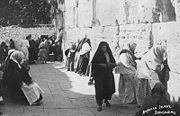
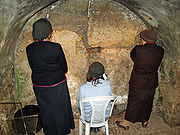 Orthodox authorities have been careful to note that although women have been exempted from praying at specific fixed times, they are not exempted from the obligation of prayer itself. The 19th century posek
Yechiel Michel Epstein
, author of the Arukh HaShulkhan, notes: "Even though the rabbis set prayer at fixed times in fixed language, it was not their intention to issue a leniency and exempt women from this ritual act".
Authorities have disagreed on the minimum amount that women's prayer should contain. Many Jews rely on the ruling of the (Ashkenazi) Rabbi Avraham Gombiner
in his Magen Avraham commentary on the Shulkhan Arukh, and more recently the (Sephardi) Rabbi Ovadia Yosef
(Yabiah Omer vol. 6, 17), that women are only required to pray once a day, in any form they choose, so long as the prayer contains praise of (brakhot), requests to (bakashot), and thanks of (hodot) God. In addition, not all Orthodox authorities agree that women are completely exempt from time-bound prayer. The Mishnah Berurah
by Rabbi Yisrael Meir Kagan
, an important code of Ashkenzic Jewish law, holds that the Men of the Great Assembly
obligated women to say Shacharit (morning) and Minchah (afternoon) prayer services each day, "just like men". The Mishnah Berurah also states that although women are exempt from reciting the Shema Yisrael
, they should nevertheless say it anyway. Nonetheless, even the most liberal Orthodox authorities hold that women cannot count in a minyan for purposes of public prayer.
Throughout Orthodox Judaism
, including its most liberal forms, men and women are required to sit in separate sections with a mechitza
(partition) separating them. Conservative/Masorti Judaism permits mixed seating (almost universally in the United States, but not in all countries). All Reform and Reconstructionist congregations have mixed seating.
Haredi and much of Modern Orthodox Judaism has a blanket prohibition on women leading public congregational prayers. Conservative Judaism has developed a blanket justification for women leading all or virtually all such prayers, holding that although only obligated individuals can lead prayers and women were not traditionally obligated, Conservative Jewish women in modern times have as a collective whole voluntarily undertaken such an obligation. Reform and Reconstructionist congregations permit women to perform all prayer roles because they do not regard halakha
as binding.
A small liberal wing within Modern Orthodox Judaism, particularly rabbis friendly to the Jewish Orthodox Feminist Alliance
(JOFA), has begun re-examining the role of women in prayers based on an individual, case-by-case look at the historical role of specific prayers and services, doing so within classical halakhic interpretation.
Accepting that where obligation exists only the obligated can lead, this small group has typically made three general arguments for expanded women's roles:
A very small number of Modern Orthodox congregations accept some such arguments, but very few Orthodox congregations or authorities accept all or even most of them. Many of those who do not accept this reasoning point to kol isha, the tradition that prohibits a man from hearing a woman other than his wife sing. JOFA refers to congregations generally accepting such arguments as Partnership Minyan
im. On Shabbat in a Partnership Minyan, women can typically lead Kabbalat Shabbat, the P'seukei D'Zimrah, the services for removing the Torah from and replacing it to the Ark, and Torah reading, as well as give a D'Var Torah or sermon.
boys prior to Bar Mitzvah cannot act as a Chazzen
for prayer services that contain devarim sheb'kidusha, i.e. Kaddish
, Barechu, the amida, etc., or receive an aliya or chant the Torah
for the congregation. Since Kabbalat Shabbat is just psalms
and does not contain devarim sheb'kidusha, it is possible for a boy under Bar Mitzvah to lead until Barechu of Ma'ariv. Some eastern Jews let a boy under bar mitzvah read the Torah and have an aliyah.
Prayer
Prayer is a form of religious practice that seeks to activate a volitional rapport to a deity through deliberate practice. Prayer may be either individual or communal and take place in public or in private. It may involve the use of words or song. When language is used, prayer may take the form of...
recitations that form part of the observance of Judaism
Judaism
Judaism ) is the "religion, philosophy, and way of life" of the Jewish people...
. These prayers, often with instructions and commentary, are found in the siddur
Siddur
A siddur is a Jewish prayer book, containing a set order of daily prayers. This article discusses how some of these prayers evolved, and how the siddur, as it is known today has developed...
, the traditional Jewish prayer book.
Traditionally, three prayer services are recited daily:
- Shacharit or Shaharit (שַחֲרִת), from the Hebrew shachar or shahar (שַחָר) "morning light,"
- Mincha or Minha (מִנְחָה), the afternoon prayers named for the flour offering that accompanied sacrifices at the Temple in JerusalemTemple in JerusalemThe Temple in Jerusalem or Holy Temple , refers to one of a series of structures which were historically located on the Temple Mount in the Old City of Jerusalem, the current site of the Dome of the Rock. Historically, these successive temples stood at this location and functioned as the centre of...
, - Arvit (עַרְבִית) or Ma'ariv (מַעֲרִיב), from "nightfall."
Additional prayers:
- Musaf (מוּסָף, "additional") are recited by OrthodoxOrthodox JudaismOrthodox Judaism , is the approach to Judaism which adheres to the traditional interpretation and application of the laws and ethics of the Torah as legislated in the Talmudic texts by the Sanhedrin and subsequently developed and applied by the later authorities known as the Gaonim, Rishonim, and...
and ConservativeConservative JudaismConservative Judaism is a modern stream of Judaism that arose out of intellectual currents in Germany in the mid-19th century and took institutional form in the United States in the early 1900s.Conservative Judaism has its roots in the school of thought known as Positive-Historical Judaism,...
congregations on ShabbatShabbatShabbat is the seventh day of the Jewish week and a day of rest in Judaism. Shabbat is observed from a few minutes before sunset on Friday evening until a few minutes after when one would expect to be able to see three stars in the sky on Saturday night. The exact times, therefore, differ from...
, major Jewish holidayJewish holidayJewish holidays are days observed by Jews as holy or secular commemorations of important events in Jewish history. In Hebrew, Jewish holidays and festivals, depending on their nature, may be called yom tov or chag or ta'anit...
s (including Chol HaMoedChol HaMoedChol HaMoed, a Hebrew phrase meaning "weekdays [of] the festival" , refers to the intermediate days of Passover and Sukkot. During Chol HaMoed the usual restrictions that apply to the Biblical Jewish holidays are relaxed, but not entirely eliminated...
), and Rosh ChodeshRosh ChodeshRosh Chodesh or Rosh ḥodesh is the name for the first day of every month in the Hebrew calendar, marked by the appearance of the new moon. The new moon is marked by the day and hour that the new crescent is observed...
. - A fifth prayer service, Ne'ilah (נְעִילָה, "closing"), is recited only on Yom KippurYom KippurYom Kippur , also known as Day of Atonement, is the holiest and most solemn day of the year for the Jews. Its central themes are atonement and repentance. Jews traditionally observe this holy day with a 25-hour period of fasting and intensive prayer, often spending most of the day in synagogue...
, the Day of Atonement.
According to the Talmud
Talmud
The Talmud is a central text of mainstream Judaism. It takes the form of a record of rabbinic discussions pertaining to Jewish law, ethics, philosophy, customs and history....
, prayer is a Biblical commandment
Mitzvah
The primary meaning of the Hebrew word refers to precepts and commandments as commanded by God...
and the Talmud
Talmud
The Talmud is a central text of mainstream Judaism. It takes the form of a record of rabbinic discussions pertaining to Jewish law, ethics, philosophy, customs and history....
gives two reasons why there are three basic prayers: to recall the daily sacrifices at the Temple in Jerusalem
Temple in Jerusalem
The Temple in Jerusalem or Holy Temple , refers to one of a series of structures which were historically located on the Temple Mount in the Old City of Jerusalem, the current site of the Dome of the Rock. Historically, these successive temples stood at this location and functioned as the centre of...
, and/or because each of the Patriarchs
Patriarchs (Bible)
The Patriarchs of the Bible, when narrowly defined, are Abraham, the ancestor of all the Abrahamic nations; his son Isaac, the ancestor of the nations surrounding Israel/Judah; and Isaac's son Jacob, also named Israel, the ancestor of the Israelites...
instituted one prayer: Abraham
Abraham
Abraham , whose birth name was Abram, is the eponym of the Abrahamic religions, among which are Judaism, Christianity and Islam...
the morning, Isaac
Isaac
Isaac as described in the Hebrew Bible, was the only son Abraham had with his wife Sarah, and was the father of Jacob and Esau. Isaac was one of the three patriarchs of the Israelites...
the afternoon and Jacob
Jacob
Jacob "heel" or "leg-puller"), also later known as Israel , as described in the Hebrew Bible, the Talmud, the New Testament and the Qur'an was the third patriarch of the Hebrew people with whom God made a covenant, and ancestor of the tribes of Israel, which were named after his descendants.In the...
the evening. A distinction is made between individual prayer and communal prayer, which requires a quorum
Quorum
A quorum is the minimum number of members of a deliberative assembly necessary to conduct the business of that group...
known as a minyan
Minyan
A minyan in Judaism refers to the quorum of ten Jewish adults required for certain religious obligations. According to many non-Orthodox streams of Judaism adult females count in the minyan....
, with communal prayer being preferable as it permits the inclusion of prayers that otherwise must be omitted.
Maimonides
Maimonides
Moses ben-Maimon, called Maimonides and also known as Mūsā ibn Maymūn in Arabic, or Rambam , was a preeminent medieval Jewish philosopher and one of the greatest Torah scholars and physicians of the Middle Ages...
(1135–1204 CE) relates that until the Babylonian exile (586 BCE), all Jews composed their own prayers, but thereafter the sages of the Great Assembly
Great Assembly
The Great Assembly or Anshei Knesset HaGedolah , also known as the Great Synagogue, was, according to Jewish tradition, an assembly of 120 scribes, sages, and prophets, in the period from the end of the Biblical prophets to the time of the development of Rabbinic Judaism, marking a transition from...
composed the main portions of the siddur. Modern scholarship dating from the Wissenschaft des Judentums
Wissenschaft des Judentums
Wissenschaft des Judentums , refers to a nineteenth-century movement premised on the critical investigation of Jewish literature and culture, including rabbinic literature, using scientific methods to analyze the origins of Jewish traditions.-The Verein für Cultur und Wissenschaft der Juden:The ...
movement of 19th century Germany, as well as textual analysis influenced by the 20th Century discovery of the Dead Sea Scrolls
Dead Sea scrolls
The Dead Sea Scrolls are a collection of 972 texts from the Hebrew Bible and extra-biblical documents found between 1947 and 1956 on the northwest shore of the Dead Sea, from which they derive their name...
, suggests that dating from this period there existed "liturgical formulations of a communal nature designated for particular occasions and conducted in a centre totally independent of Jerusalem and the Temple, making use of terminology and theological concepts that were later to become dominant in Jewish and, in some cases, Christian prayer." The language of the prayers, while clearly from the Second Temple
Second Temple
The Jewish Second Temple was an important shrine which stood on the Temple Mount in Jerusalem between 516 BCE and 70 CE. It replaced the First Temple which was destroyed in 586 BCE, when the Jewish nation was exiled to Babylon...
period (516 BCE–70 CE), often employs Biblical idiom. Jewish prayerbooks emerged during the early Middle Ages
Middle Ages
The Middle Ages is a periodization of European history from the 5th century to the 15th century. The Middle Ages follows the fall of the Western Roman Empire in 476 and precedes the Early Modern Era. It is the middle period of a three-period division of Western history: Classic, Medieval and Modern...
during the period of the Geonim
Geonim
Geonim were the presidents of the two great Babylonian, Talmudic Academies of Sura and Pumbedita, in the Abbasid Caliphate, and were the generally accepted spiritual leaders of the Jewish community world wide in the early medieval era, in contrast to the Resh Galuta who wielded secular authority...
of Babylonia
Babylonia
Babylonia was an ancient cultural region in central-southern Mesopotamia , with Babylon as its capital. Babylonia emerged as a major power when Hammurabi Babylonia was an ancient cultural region in central-southern Mesopotamia (present-day Iraq), with Babylon as its capital. Babylonia emerged as...
(6th–11th Centuries CE)
Over the last two thousand years variations have emerged among the traditional liturgical
Liturgy
Liturgy is either the customary public worship done by a specific religious group, according to its particular traditions or a more precise term that distinguishes between those religious groups who believe their ritual requires the "people" to do the "work" of responding to the priest, and those...
customs
Minhag
Minhag is an accepted tradition or group of traditions in Judaism. A related concept, Nusach , refers to the traditional order and form of the prayers...
of different Jewish communities, such as Ashkenazic, Sephardic, Yemenite
Yemenite Jews
Yemenite Jews are those Jews who live, or whose recent ancestors lived, in Yemen . Between June 1949 and September 1950, the overwhelming majority of Yemen's Jewish population was transported to Israel in Operation Magic Carpet...
, Hassidic, and others, however the differences are minor compared with the commonalities. Most of the Jewish liturgy is sung or chanted with traditional melodies or trope
Cantillation
Cantillation is the ritual chanting of readings from the Hebrew Bible in synagogue services. The chants are written and notated in accordance with the special signs or marks printed in the Masoretic text of the Hebrew Bible to complement the letters and vowel points...
. Synagogue
Synagogue
A synagogue is a Jewish house of prayer. This use of the Greek term synagogue originates in the Septuagint where it sometimes translates the Hebrew word for assembly, kahal...
s may designate or employ a professional or lay hazzan
Hazzan
A hazzan or chazzan is a Jewish cantor, a musician trained in the vocal arts who helps lead the congregation in songful prayer.There are many rules relating to how a cantor should lead services, but the idea of a cantor as a paid professional does not exist in classical rabbinic sources...
(cantor) for the purpose of leading the congregation in prayer, especially on Shabbat or holidays.
Biblical origin
According to the TalmudTalmud
The Talmud is a central text of mainstream Judaism. It takes the form of a record of rabbinic discussions pertaining to Jewish law, ethics, philosophy, customs and history....
(tractate Taanit 2a), prayer is a Biblical command: "'You shall serve God with your whole heart.' What service is performed with the heart? This is prayer." The prayers are therefore referred to as Avodah sheba-Lev ("service that is in the heart"). The noted rabbi Maimonides
Maimonides
Moses ben-Maimon, called Maimonides and also known as Mūsā ibn Maymūn in Arabic, or Rambam , was a preeminent medieval Jewish philosopher and one of the greatest Torah scholars and physicians of the Middle Ages...
likewise categorizes prayer as a Biblical command, but believed that the number of prayers and their times are not.
The Talmud
Talmud
The Talmud is a central text of mainstream Judaism. It takes the form of a record of rabbinic discussions pertaining to Jewish law, ethics, philosophy, customs and history....
(tractate Berachoth 26b) gives two reasons why there are three basic prayers:
- Each service was instituted parallel to a sacrificial act in the Temple in JerusalemTemple in JerusalemThe Temple in Jerusalem or Holy Temple , refers to one of a series of structures which were historically located on the Temple Mount in the Old City of Jerusalem, the current site of the Dome of the Rock. Historically, these successive temples stood at this location and functioned as the centre of...
: the morning Tamid offeringKorbanThe term offering as found in the Hebrew Bible in relation to the worship of Ancient Israel is mainly represented by the Hebrew noun korban whether for an animal or other offering...
, the afternoon Tamid, and the overnight burning of this last offering. - According to one sage, each of the PatriarchsPatriarchs (Bible)The Patriarchs of the Bible, when narrowly defined, are Abraham, the ancestor of all the Abrahamic nations; his son Isaac, the ancestor of the nations surrounding Israel/Judah; and Isaac's son Jacob, also named Israel, the ancestor of the Israelites...
instituted one prayer: AbrahamAbrahamAbraham , whose birth name was Abram, is the eponym of the Abrahamic religions, among which are Judaism, Christianity and Islam...
the morning, IsaacIsaacIsaac as described in the Hebrew Bible, was the only son Abraham had with his wife Sarah, and was the father of Jacob and Esau. Isaac was one of the three patriarchs of the Israelites...
the afternoon and JacobJacobJacob "heel" or "leg-puller"), also later known as Israel , as described in the Hebrew Bible, the Talmud, the New Testament and the Qur'an was the third patriarch of the Hebrew people with whom God made a covenant, and ancestor of the tribes of Israel, which were named after his descendants.In the...
the evening prayers. This view is supported with Biblical quotes indicating that the Patriarchs prayed at the times mentioned. However, even according to this view, the exact times of when the services are held, and moreover the entire concept of a mussaf service, are still based on the sacrifices.
Additional Biblical references suggest that King David
David
David was the second king of the united Kingdom of Israel according to the Hebrew Bible and, according to the Gospels of Matthew and Luke, an ancestor of Jesus Christ through both Saint Joseph and Mary...
and the prophet Daniel
Daniel
Daniel is the protagonist in the Book of Daniel of the Hebrew Bible. In the narrative, when Daniel was a young man, he was taken into Babylonian captivity where he was educated in Chaldean thought. However, he never converted to Neo-Babylonian ways...
prayed three times a day. In Psalms, David states: "Evening, morning and afternoon do I pray and cry, and He will hear my voice" . As in Daniel
Book of Daniel
The Book of Daniel is a book in the Hebrew Bible. The book tells of how Daniel, and his Judean companions, were inducted into Babylon during Jewish exile, and how their positions elevated in the court of Nebuchadnezzar. The court tales span events that occur during the reigns of Nebuchadnezzar,...
: "[...] his windows being open in his chamber toward Jerusalem, he kneeled upon his knees three times a day, and prayed, and gave thanks before his God, as he had done before" .
Orthodox Judaism
Orthodox Judaism
Orthodox Judaism , is the approach to Judaism which adheres to the traditional interpretation and application of the laws and ethics of the Torah as legislated in the Talmudic texts by the Sanhedrin and subsequently developed and applied by the later authorities known as the Gaonim, Rishonim, and...
regards halakha
Halakha
Halakha — also transliterated Halocho , or Halacha — is the collective body of Jewish law, including biblical law and later talmudic and rabbinic law, as well as customs and traditions.Judaism classically draws no distinction in its laws between religious and ostensibly non-religious life; Jewish...
(Jewish law) as requiring Jewish men to pray three times daily and four times daily on the Sabbath
Shabbat
Shabbat is the seventh day of the Jewish week and a day of rest in Judaism. Shabbat is observed from a few minutes before sunset on Friday evening until a few minutes after when one would expect to be able to see three stars in the sky on Saturday night. The exact times, therefore, differ from...
and most Jewish holiday
Jewish holiday
Jewish holidays are days observed by Jews as holy or secular commemorations of important events in Jewish history. In Hebrew, Jewish holidays and festivals, depending on their nature, may be called yom tov or chag or ta'anit...
s, and five times on Yom Kippur
Yom Kippur
Yom Kippur , also known as Day of Atonement, is the holiest and most solemn day of the year for the Jews. Its central themes are atonement and repentance. Jews traditionally observe this holy day with a 25-hour period of fasting and intensive prayer, often spending most of the day in synagogue...
. Orthodox Jewish women are required to pray at least daily, with no specific time requirement, but the system of multiple daily prayer services is regarded as optional. Conservative Judaism
Conservative Judaism
Conservative Judaism is a modern stream of Judaism that arose out of intellectual currents in Germany in the mid-19th century and took institutional form in the United States in the early 1900s.Conservative Judaism has its roots in the school of thought known as Positive-Historical Judaism,...
also regards the halakhic system of multiple daily services as mandatory. Since 2002, Conservative Jewish women have been regarded as having undertaken a communal obligation to pray the same prayers at the same times as men, with traditionalist communities and individual women permitted to opt out. Reform
Reform Judaism
Reform Judaism refers to various beliefs, practices and organizations associated with the Reform Jewish movement in North America, the United Kingdom and elsewhere. In general, it maintains that Judaism and Jewish traditions should be modernized and should be compatible with participation in the...
and Reconstructionist
Reconstructionist Judaism
Reconstructionist Judaism is a modern American-based Jewish movement based on the ideas of Mordecai Kaplan . The movement views Judaism as a progressively evolving civilization. It originated as a branch of Conservative Judaism, before it splintered...
congregations do not regard halakha as binding and hence regard appropriate prayer times as matters of personal spiritual decision rather than a matter of religious requirement.
Text and language
According to halakhaHalakha
Halakha — also transliterated Halocho , or Halacha — is the collective body of Jewish law, including biblical law and later talmudic and rabbinic law, as well as customs and traditions.Judaism classically draws no distinction in its laws between religious and ostensibly non-religious life; Jewish...
, all individual prayers and virtually all communal prayers may be said in any language that the person praying understands. For example, the Mishnah
Mishnah
The Mishnah or Mishna is the first major written redaction of the Jewish oral traditions called the "Oral Torah". It is also the first major work of Rabbinic Judaism. It was redacted c...
mentions that the Shema need not be said in Hebrew A list of prayers that must be said in Hebrew is given in the Mishna, and among these only the Priestly Blessing
Priestly Blessing
The Priestly Blessing, , also known in Hebrew as Nesiat Kapayim, , or Dukhanen , is a Jewish prayer recited by Kohanim during certain Jewish services...
is in use today, as the others are prayers that are to be said only in a Temple in Jerusalem
Temple in Jerusalem
The Temple in Jerusalem or Holy Temple , refers to one of a series of structures which were historically located on the Temple Mount in the Old City of Jerusalem, the current site of the Dome of the Rock. Historically, these successive temples stood at this location and functioned as the centre of...
, by a priest
Kohen
A Kohen is the Hebrew word for priest. Jewish Kohens are traditionally believed and halachically required to be of direct patrilineal descent from the Biblical Aaron....
, or by a reigning King
Jewish Messiah
Messiah, ; mashiah, moshiah, mashiach, or moshiach, is a term used in the Hebrew Bible to describe priests and kings, who were traditionally anointed with holy anointing oil as described in Exodus 30:22-25...
.
Despite this, the tradition of most Ashkenazi Orthodox
Orthodox Judaism
Orthodox Judaism , is the approach to Judaism which adheres to the traditional interpretation and application of the laws and ethics of the Torah as legislated in the Talmudic texts by the Sanhedrin and subsequently developed and applied by the later authorities known as the Gaonim, Rishonim, and...
synagogues is to use Hebrew (usually Ashkenazi Hebrew
Ashkenazi Hebrew
Ashkenazi Hebrew , is the pronunciation system for Biblical and Mishnaic Hebrew favored for liturgical use by Ashkenazi Jewish practice. Its phonology was influenced by languages with which it came into contact, such as Yiddish, German, and various Slavic languages...
) for all except a small number of prayers, including the Kaddish
Kaddish
Kaddish is a prayer found in the Jewish prayer service. The central theme of the Kaddish is the magnification and sanctification of God's name. In the liturgy different versions of the Kaddish are used functionally as separators between sections of the service...
, which had always been in Aramaic, and sermon
Sermon
A sermon is an oration by a prophet or member of the clergy. Sermons address a Biblical, theological, religious, or moral topic, usually expounding on a type of belief, law or behavior within both past and present contexts...
s and instructions, for which the local language is used. In other streams of Judaism there is considerable variability: Sephardic communities may use Ladino or Portuguese
Portuguese language
Portuguese is a Romance language that arose in the medieval Kingdom of Galicia, nowadays Galicia and Northern Portugal. The southern part of the Kingdom of Galicia became independent as the County of Portugal in 1095...
for many prayers; Conservative
Conservative Judaism
Conservative Judaism is a modern stream of Judaism that arose out of intellectual currents in Germany in the mid-19th century and took institutional form in the United States in the early 1900s.Conservative Judaism has its roots in the school of thought known as Positive-Historical Judaism,...
synagogues tend to use the local language to a varying degree; and at some Reform
Reform Judaism
Reform Judaism refers to various beliefs, practices and organizations associated with the Reform Jewish movement in North America, the United Kingdom and elsewhere. In general, it maintains that Judaism and Jewish traditions should be modernized and should be compatible with participation in the...
synagogues almost the whole service may be in the local language.
Maimonides (Mishneh Torah, Laws of Prayer 1:4) relates that until the Babylonian exile
Babylonian captivity
The Babylonian captivity was the period in Jewish history during which the Jews of the ancient Kingdom of Judah were captives in Babylon—conventionally 587–538 BCE....
, all Jews composed their own prayers. After the exile, however, the sages of the time (united in the Great Assembly
Great Assembly
The Great Assembly or Anshei Knesset HaGedolah , also known as the Great Synagogue, was, according to Jewish tradition, an assembly of 120 scribes, sages, and prophets, in the period from the end of the Biblical prophets to the time of the development of Rabbinic Judaism, marking a transition from...
) found the ability of the people insufficient to continue the practice, and they composed the main portions of the siddur
Siddur
A siddur is a Jewish prayer book, containing a set order of daily prayers. This article discusses how some of these prayers evolved, and how the siddur, as it is known today has developed...
, such as the Amidah
Amidah
The Amidah , also called the Shmoneh Esreh , is the central prayer of the Jewish liturgy. This prayer, among others, is found in the siddur, the traditional Jewish prayer book...
. The origins of modern Jewish prayer were established during the period of the Tannaim
Tannaim
The Tannaim were the Rabbinic sages whose views are recorded in the Mishnah, from approximately 70-200 CE. The period of the Tannaim, also referred to as the Mishnaic period, lasted about 130 years...
, "from their traditions, later committed to writing, we learn that the generation of rabbis active at the time of the destruction of the Second Temple (70 C.E.) gave Jewish prayer its structure and, in outline form at least, its contents." This liturgy included the twice-daily recitation of the Shema, the Amidah
Amidah
The Amidah , also called the Shmoneh Esreh , is the central prayer of the Jewish liturgy. This prayer, among others, is found in the siddur, the traditional Jewish prayer book...
, or Shmoneh Esrei, including 18 blessings recited several times daily, and the public recitation of the Torah
Torah reading
Torah reading is a Jewish religious ritual that involves the public reading of a set of passages from a Torah scroll. The term often refers to the entire ceremony of removing the Torah scroll from the ark, chanting the appropriate excerpt with special cantillation, and returning the scroll to...
in installments. The oldest prayer books date from the time of the Geonim
Geonim
Geonim were the presidents of the two great Babylonian, Talmudic Academies of Sura and Pumbedita, in the Abbasid Caliphate, and were the generally accepted spiritual leaders of the Jewish community world wide in the early medieval era, in contrast to the Resh Galuta who wielded secular authority...
of Babylonia
Babylonia
Babylonia was an ancient cultural region in central-southern Mesopotamia , with Babylon as its capital. Babylonia emerged as a major power when Hammurabi Babylonia was an ancient cultural region in central-southern Mesopotamia (present-day Iraq), with Babylon as its capital. Babylonia emerged as...
; "some were composed by respected rabbinic scholars at the request of far-flung communities seeking an authoritative text of the required prayers for daily use, Shabbat, and holidays."
The language of the prayers, while clearly being from the Second Temple period, often employs Biblical idiom, and according to some authorities it should not contain rabbinic or Mishnaic idiom apart from in the sections of Mishnah that are featured (see Baer).
Over the last two thousand years, the various streams of Jews have resulted in small variations in the traditional liturgy customs
Minhag
Minhag is an accepted tradition or group of traditions in Judaism. A related concept, Nusach , refers to the traditional order and form of the prayers...
among different Jewish communities, with each community having a slightly different Nusach (customary liturgy). The principal difference is between Ashkenazic and Sephardic customs, although there are other communities (e.g. Yemenite Jews
Yemenite Jews
Yemenite Jews are those Jews who live, or whose recent ancestors lived, in Yemen . Between June 1949 and September 1950, the overwhelming majority of Yemen's Jewish population was transported to Israel in Operation Magic Carpet...
), and Hassidic and other communities also have distinct customs, variations, and special prayers. The differences are quite minor compared with the commonalities.
The siddur
The earliest parts of Jewish prayer are the Shema YisraelShema Yisrael
Shema Yisrael are the first two words of a section of the Torah that is a centerpiece of the morning and evening Jewish prayer services...
("Hear O Israel") (Deuteronomy
Deuteronomy
The Book of Deuteronomy is the fifth book of the Hebrew Bible, and of the Jewish Torah/Pentateuch...
6:4 et seq), and the Priestly Blessing
Priestly Blessing
The Priestly Blessing, , also known in Hebrew as Nesiat Kapayim, , or Dukhanen , is a Jewish prayer recited by Kohanim during certain Jewish services...
(Numbers
Book of Numbers
The Book of Numbers is the fourth book of the Hebrew Bible, and the fourth of five books of the Jewish Torah/Pentateuch....
6:24-26), which are in the Torah
Torah
Torah- A scroll containing the first five books of the BibleThe Torah , is name given by Jews to the first five books of the bible—Genesis , Exodus , Leviticus , Numbers and Deuteronomy Torah- A scroll containing the first five books of the BibleThe Torah , is name given by Jews to the first five...
. A set of eighteen (currently nineteen) blessings called the Shemoneh Esreh or the Amidah
Amidah
The Amidah , also called the Shmoneh Esreh , is the central prayer of the Jewish liturgy. This prayer, among others, is found in the siddur, the traditional Jewish prayer book...
(Hebrew
Hebrew language
Hebrew is a Semitic language of the Afroasiatic language family. Culturally, is it considered by Jews and other religious groups as the language of the Jewish people, though other Jewish languages had originated among diaspora Jews, and the Hebrew language is also used by non-Jewish groups, such...
, "standing [prayer]"), is traditionally ascribed to the Great Assembly
Great Assembly
The Great Assembly or Anshei Knesset HaGedolah , also known as the Great Synagogue, was, according to Jewish tradition, an assembly of 120 scribes, sages, and prophets, in the period from the end of the Biblical prophets to the time of the development of Rabbinic Judaism, marking a transition from...
in the time of Ezra
Ezra
Ezra , also called Ezra the Scribe and Ezra the Priest in the Book of Ezra. According to the Hebrew Bible he returned from the Babylonian exile and reintroduced the Torah in Jerusalem...
, at the end of the Biblical period.
The name Shemoneh Esreh, literally "eighteen", is an historical anachronism, since it now contains nineteen blessings. It was only near the end of the Second Temple
Second Temple
The Jewish Second Temple was an important shrine which stood on the Temple Mount in Jerusalem between 516 BCE and 70 CE. It replaced the First Temple which was destroyed in 586 BCE, when the Jewish nation was exiled to Babylon...
period that the eighteen prayers of the weekday Amidah became standardized. Even at that time their precise wording and order was not yet fixed, and varied from locale to locale. Many modern scholars believe that parts of the Amidah came from the Hebrew
Hebrew language
Hebrew is a Semitic language of the Afroasiatic language family. Culturally, is it considered by Jews and other religious groups as the language of the Jewish people, though other Jewish languages had originated among diaspora Jews, and the Hebrew language is also used by non-Jewish groups, such...
apocrypha
Apocrypha
The term apocrypha is used with various meanings, including "hidden", "esoteric", "spurious", "of questionable authenticity", ancient Chinese "revealed texts and objects" and "Christian texts that are not canonical"....
l work Ben Sira
Ben Sira
Jesus ben Sirach , commonly known simply as ben Sirach or Sirach and also rendered "Jesus son of Sirach" or "Jesus Siracides", was the author of the deuterocanonical Wisdom of Sirach and possibly the rabbinical Alphabet of Sirach...
.
According to the Talmud
Talmud
The Talmud is a central text of mainstream Judaism. It takes the form of a record of rabbinic discussions pertaining to Jewish law, ethics, philosophy, customs and history....
, soon after the destruction of the Temple in Jerusalem
Temple in Jerusalem
The Temple in Jerusalem or Holy Temple , refers to one of a series of structures which were historically located on the Temple Mount in the Old City of Jerusalem, the current site of the Dome of the Rock. Historically, these successive temples stood at this location and functioned as the centre of...
a formal version of the Amidah was adopted at a rabbinical council in Yavne
Yavne
Yavne is a city in the Central District of Israel. According to the Israel Central Bureau of Statistics , at the end of 2009 the city had a population of 33,000.-History:...
, under the leadership of Rabban Gamaliel II
Gamaliel II
Rabban Gamaliel II was the first person to lead the Sanhedrin as Nasi after the fall of the second temple, which occurred in 70 CE. Gamliel was appointed nasi approximately 10 years later. Gamaliel II was the son of Shimon ben Gamaliel, one of Jerusalem's foremost men in the war against the...
and his colleagues. However, the precise wording was still left open. The order, general ideas, opening and closing lines were fixed. Most of the wording was left to the individual reader. It was not until several centuries later that the prayers began to be formally fixed. By the Middle Ages
Middle Ages
The Middle Ages is a periodization of European history from the 5th century to the 15th century. The Middle Ages follows the fall of the Western Roman Empire in 476 and precedes the Early Modern Era. It is the middle period of a three-period division of Western history: Classic, Medieval and Modern...
the texts of the prayers were nearly fixed, and in the form in which they are still used today.
The siddur was printed by Soncino
Soncino family (printers)
The Soncino family is an Italian Sephardi Jewish family of printers, deriving its name from the town of Soncino in the duchy of Milan. It traces its descent through a Moses of Fürth, who is mentioned in 1455, back to a certain Moses of Speyer, of the middle of the fourteenth century. The first of...
in Italy as early as 1486, though a siddur was first mass-distributed only in 1865. The siddur began appearing in the vernacular
Vernacular
A vernacular is the native language or native dialect of a specific population, as opposed to a language of wider communication that is not native to the population, such as a national language or lingua franca.- Etymology :The term is not a recent one...
as early as 1538. The first English translation
Translation
Translation is the communication of the meaning of a source-language text by means of an equivalent target-language text. Whereas interpreting undoubtedly antedates writing, translation began only after the appearance of written literature; there exist partial translations of the Sumerian Epic of...
, by Gamaliel ben Pedahzur (a pseudonym
Pseudonym
A pseudonym is a name that a person assumes for a particular purpose and that differs from his or her original orthonym...
), appeared in London in 1738; a different translation was released in the United States in 1837.
Readings from the Torah
Torah
Torah- A scroll containing the first five books of the BibleThe Torah , is name given by Jews to the first five books of the bible—Genesis , Exodus , Leviticus , Numbers and Deuteronomy Torah- A scroll containing the first five books of the BibleThe Torah , is name given by Jews to the first five...
(five books of Moses) and the Nevi'im
Nevi'im
Nevi'im is the second of the three major sections in the Hebrew Bible, the Tanakh. It falls between the Torah and Ketuvim .Nevi'im is traditionally divided into two parts:...
("Prophets") form part of the prayer services. To this framework various Jewish sages added, from time to time, various prayers, and, for festivals especially, numerous hymns.
The earliest existing codification of the prayerbook was drawn up by Rav Amram Gaon
Amram Gaon
Amram Gaon was a famous Gaon or head of the Jewish Talmud Academy of Sura in the 9th century. He was the author of many Responsa, but his chief work was liturgical.He was the first to arrange a complete liturgy for the synagogue...
of Sura, Babylon, about 850 CE. Half a century later Rav Saadia Gaon
Saadia Gaon
Saʻadiah ben Yosef Gaon was a prominent rabbi, Jewish philosopher, and exegete of the Geonic period.The first important rabbinic figure to write extensively in Arabic, he is considered the founder of Judeo-Arabic literature...
, also of Sura, composed a siddur
Siddur of Saadia Gaon
The Siddur of Saadia Gaon is the earliest surviving attempt to transcribe the weekly ritual of Jewish prayers for week-days, Sabbaths, and festivals . The text also contains liturgical poetry by Saadia, as well as Arabic language commentary...
, in which the rubrical matter is in Arabic
Arabic language
Arabic is a name applied to the descendants of the Classical Arabic language of the 6th century AD, used most prominently in the Quran, the Islamic Holy Book...
. These were the basis of Simcha ben Samuel's Machzor Vitry (11th century France), which was based on the ideas of his teacher, Rashi
Rashi
Shlomo Yitzhaki , or in Latin Salomon Isaacides, and today generally known by the acronym Rashi , was a medieval French rabbi famed as the author of a comprehensive commentary on the Talmud, as well as a comprehensive commentary on the Tanakh...
. Another formulation of the prayers was that appended by Maimonides to the laws of prayer in his Mishneh Torah
Mishneh Torah
The Mishneh Torah subtitled Sefer Yad ha-Hazaka is a code of Jewish religious law authored by Maimonides , one of history's foremost rabbis...
: this forms the basis of the Yemenite liturgy, and has had some influence on other rites. From this point forward all Jewish prayerbooks had the same basic order and contents.
Denominational variations
ConservativeConservative Judaism
Conservative Judaism is a modern stream of Judaism that arose out of intellectual currents in Germany in the mid-19th century and took institutional form in the United States in the early 1900s.Conservative Judaism has its roots in the school of thought known as Positive-Historical Judaism,...
services generally use the same basic format for services as in Orthodox Judaism with some doctrinal leniencies and some prayers in English. In practice there is wide variation among Conservative congregations. In traditionalist congregations the liturgy can be almost identical to that of Orthodox Judaism
Orthodox Judaism
Orthodox Judaism , is the approach to Judaism which adheres to the traditional interpretation and application of the laws and ethics of the Torah as legislated in the Talmudic texts by the Sanhedrin and subsequently developed and applied by the later authorities known as the Gaonim, Rishonim, and...
, almost entirely in Hebrew (and Aramaic), with a few minor exceptions, including excision of a study session on Temple sacrifices, and modifications of prayers for the restoration of the sacrificial
Korban
The term offering as found in the Hebrew Bible in relation to the worship of Ancient Israel is mainly represented by the Hebrew noun korban whether for an animal or other offering...
system. In more liberal Conservative synagogues there are greater changes to the service, with up to a third of the service in English; abbreviation or omission of many of the preparatory prayers; and replacement of some traditional prayers with more contemporary forms. There are some changes for doctrinal reasons, including egalitarian language, fewer references to restoring sacrifices
Korban
The term offering as found in the Hebrew Bible in relation to the worship of Ancient Israel is mainly represented by the Hebrew noun korban whether for an animal or other offering...
in the Temple in Jerusalem
Temple in Jerusalem
The Temple in Jerusalem or Holy Temple , refers to one of a series of structures which were historically located on the Temple Mount in the Old City of Jerusalem, the current site of the Dome of the Rock. Historically, these successive temples stood at this location and functioned as the centre of...
, and an option to eliminate special roles for Kohanim
Kohen
A Kohen is the Hebrew word for priest. Jewish Kohens are traditionally believed and halachically required to be of direct patrilineal descent from the Biblical Aaron....
and Levite
Levite
In Jewish tradition, a Levite is a member of the Hebrew tribe of Levi. When Joshua led the Israelites into the land of Canaan, the Levites were the only Israelite tribe that received cities but were not allowed to be landowners "because the Lord the God of Israel himself is their inheritance"...
s.
The liturgies of Reform
Reform Judaism
Reform Judaism refers to various beliefs, practices and organizations associated with the Reform Jewish movement in North America, the United Kingdom and elsewhere. In general, it maintains that Judaism and Jewish traditions should be modernized and should be compatible with participation in the...
and Reconstructionist
Reconstructionist Judaism
Reconstructionist Judaism is a modern American-based Jewish movement based on the ideas of Mordecai Kaplan . The movement views Judaism as a progressively evolving civilization. It originated as a branch of Conservative Judaism, before it splintered...
are based on traditional elements, but contains language more reflective of liberal belief than the traditional liturgy. Doctrinal revisions generally include revising or omitting references to traditional doctrines such as bodily resurrection
Resurrection
Resurrection refers to the literal coming back to life of the biologically dead. It is used both with respect to particular individuals or the belief in a General Resurrection of the dead at the end of the world. The General Resurrection is featured prominently in Jewish, Christian, and Muslim...
, a personal Jewish Messiah
Jewish Messiah
Messiah, ; mashiah, moshiah, mashiach, or moshiach, is a term used in the Hebrew Bible to describe priests and kings, who were traditionally anointed with holy anointing oil as described in Exodus 30:22-25...
, and other elements of traditional Jewish eschatology
Jewish eschatology
Jewish eschatology is concerned with the Jewish Messiah, afterlife, and the revival of the dead. Eschatology, generically, is the area of theology and philosophy concerned with the final events in the history of the world, the ultimate destiny of humanity, and related concepts.-The Messiah:The...
, Divine revelation of the Torah
Torah
Torah- A scroll containing the first five books of the BibleThe Torah , is name given by Jews to the first five books of the bible—Genesis , Exodus , Leviticus , Numbers and Deuteronomy Torah- A scroll containing the first five books of the BibleThe Torah , is name given by Jews to the first five...
at Mount Sinai
Mount Sinai
Mount Sinai , also known as Mount Horeb, Mount Musa, Gabal Musa , Jabal Musa meaning "Moses' Mountain", is a mountain near Saint Catherine in the Sinai Peninsula of Egypt. A mountain called Mount Sinai is mentioned many times in the Book of Exodus in the Torah and the Bible as well as the Quran...
, angels, conceptions of reward and punishment, and other personal miraculous and supernatural elements. Services are often from 40% to 90% in the vernacular.
Reform Judaism
Reform Judaism
Reform Judaism refers to various beliefs, practices and organizations associated with the Reform Jewish movement in North America, the United Kingdom and elsewhere. In general, it maintains that Judaism and Jewish traditions should be modernized and should be compatible with participation in the...
has made greater alterations to the traditional service in accord with its more liberal theology
Theology
Theology is the systematic and rational study of religion and its influences and of the nature of religious truths, or the learned profession acquired by completing specialized training in religious studies, usually at a university or school of divinity or seminary.-Definition:Augustine of Hippo...
including dropping references to traditional elements of Jewish eschatology
Jewish eschatology
Jewish eschatology is concerned with the Jewish Messiah, afterlife, and the revival of the dead. Eschatology, generically, is the area of theology and philosophy concerned with the final events in the history of the world, the ultimate destiny of humanity, and related concepts.-The Messiah:The...
such as a personal Messiah
Jewish Messiah
Messiah, ; mashiah, moshiah, mashiach, or moshiach, is a term used in the Hebrew Bible to describe priests and kings, who were traditionally anointed with holy anointing oil as described in Exodus 30:22-25...
, a bodily resurrection
Resurrection
Resurrection refers to the literal coming back to life of the biologically dead. It is used both with respect to particular individuals or the belief in a General Resurrection of the dead at the end of the world. The General Resurrection is featured prominently in Jewish, Christian, and Muslim...
of the dead, and others. The Hebrew portion of the service is substantially abbreviated and modernized and modern prayers substituted for traditional ones. In addition, in keeping with their view that the laws of Shabbat
Shabbat
Shabbat is the seventh day of the Jewish week and a day of rest in Judaism. Shabbat is observed from a few minutes before sunset on Friday evening until a few minutes after when one would expect to be able to see three stars in the sky on Saturday night. The exact times, therefore, differ from...
(including a traditional prohibition on playing instruments) are inapplicable to modern circumstances, Reform services often play instrumental or recorded music with prayers on the Jewish Sabbath
Shabbat
Shabbat is the seventh day of the Jewish week and a day of rest in Judaism. Shabbat is observed from a few minutes before sunset on Friday evening until a few minutes after when one would expect to be able to see three stars in the sky on Saturday night. The exact times, therefore, differ from...
. All Reform synagogues are Egalitarian with respect to gender roles.
Philosophy of prayer
In Jewish philosophyJewish philosophy
Jewish philosophy , includes all philosophy carried out by Jews, or, in relation to the religion of Judaism. Jewish philosophy, until modern Enlightenment and Emancipation, was pre-occupied with attempts to reconcile coherent new ideas into the tradition of Rabbinic Judaism; thus organizing...
and in Rabbinic literature
Rabbinic literature
Rabbinic literature, in its broadest sense, can mean the entire spectrum of rabbinic writings throughout Jewish history. However, the term often refers specifically to literature from the Talmudic era, as opposed to medieval and modern rabbinic writing, and thus corresponds with the Hebrew term...
, it is noted that the Hebrew verb for prayer—hitpallel התפלל—is in fact the reflexive form
Reflexive verb
In grammar, a reflexive verb is a verb whose semantic agent and patient are the same. For example, the English verb to perjure is reflexive, since one can only perjure oneself...
of palal פלל, to judge. Thus, "to pray" conveys the notion of "judging oneself": ultimately, the purpose of prayer—tefilah תפלה—is to transform ourselves http://www.tilb.org/sermons/moskowitzhRH5767.html http://www.chabad.org/library/article_cdo/aid/39928/jewish/The-Cosmology-of-the-Mitzvot.htm.
This etymology
Etymology
Etymology is the study of the history of words, their origins, and how their form and meaning have changed over time.For languages with a long written history, etymologists make use of texts in these languages and texts about the languages to gather knowledge about how words were used during...
is consistent with the Jewish conception of Divine simplicity
Divine simplicity
In theology, the doctrine of divine simplicity says that God is without parts. The general idea of divine simplicity can be stated in this way: the being of God is identical to the "attributes" of God. In other words, such characteristics as omnipresence, goodness, truth, eternity, etc...
. It is not God that changes through our prayer—Man does not influence God as a defendant influences a human judge who has emotions and is subject to change—rather it is man himself who is changed http://www.mesora.org/prayer.html. It is further consistent with Maimonides
Maimonides
Moses ben-Maimon, called Maimonides and also known as Mūsā ibn Maymūn in Arabic, or Rambam , was a preeminent medieval Jewish philosopher and one of the greatest Torah scholars and physicians of the Middle Ages...
' view on Divine Providence
Divine Providence
In Christian theology, divine providence, or simply providence, is God's activity in the world. " Providence" is also used as a title of God exercising His providence, and then the word are usually capitalized...
. Here, Tefillah is the medium which God gave to man by means of which he can change himself, and thereby establish a new relationship with God—and thus a new destiny for himself in life http://www.mesora.org/prayer.html http://www.ou.org/torah/weiss/5758/behaalotecha58.htm; see also under Psalms
Psalms
The Book of Psalms , commonly referred to simply as Psalms, is a book of the Hebrew Bible and the Christian Bible...
.
The rationalist approach
In this view, ultimate goal of prayer is to help train a person to focus on divinity through philosophy and intellectual contemplation. This approach was taken by MaimonidesMaimonides
Moses ben-Maimon, called Maimonides and also known as Mūsā ibn Maymūn in Arabic, or Rambam , was a preeminent medieval Jewish philosopher and one of the greatest Torah scholars and physicians of the Middle Ages...
and the other medieval rationalists.
The educational approach
In this view, prayer is not a conversation. Rather, it is meant to inculcate certain attitudes in the one who prays, but not to influence. This has been the approach of Rabbenu Bachya, Yehuda Halevy, Joseph AlboJoseph Albo
Joseph Albo was a Jewish philosopher and rabbi who lived in Spain during the fifteenth century, known chiefly as the author of Sefer ha-Ikkarim , the classic work on the fundamentals of Judaism.-Early life:Albo's birthplace is generally assumed to be Monreal, a town in Aragon...
, Samson Raphael Hirsch
Samson Raphael Hirsch
Samson Raphael Hirsch was a German rabbi best known as the intellectual founder of the Torah im Derech Eretz school of contemporary Orthodox Judaism...
, and Joseph Dov Soloveitchik. This view is expressed by Rabbi Nosson Scherman
Nosson Scherman
Nosson Scherman born 1935, Newark, New Jersey) is an American Haredi rabbi best known as the general editor of ArtScroll/Mesorah Publications.-Biography:...
in the overview to the Artscroll
ArtScroll
ArtScroll is an imprint of translations, books and commentaries from an Orthodox Jewish perspective published by Mesorah Publications, Ltd., a publishing company based in Brooklyn, New York...
Siddur (p. XIII); note that Scherman goes on to also affirm the Kabbalistic view (see below).
Kabbalistic view
KabbalahKabbalah
Kabbalah/Kabala is a discipline and school of thought concerned with the esoteric aspect of Rabbinic Judaism. It was systematized in 11th-13th century Hachmei Provence and Spain, and again after the Expulsion from Spain, in 16th century Ottoman Palestine...
(esoteric Jewish mysticism) uses a series of kavanot, directions of intent, to specify the path the prayer ascends in the dialog with God, to increase its chances of being answered favorably. Kabbalists ascribes a higher meaning to the purpose of prayer, which is no less than affecting the very fabric of reality itself, restructuring and repairing the universe in a real fashion. In this view, every word of every prayer, and indeed, even every letter of every word, has a precise meaning and a precise effect. Prayers thus literally affect the mystical forces of the universe, and repair the fabric of creation.
This approach has been taken by the Chassidei Ashkenaz
Chassidei Ashkenaz
The Chassidei Ashkenaz was a Jewish movement in the 12th century and 13th century founded by Rabbi Judah the Pious of Regensburg, Germany and several other German Jews members of the Lehr family and the Kalonymus family.Rabbi Judah was born in Speyer, Germany in 1150 during a time of persecution...
(German pietists of the Middle-Ages), the Zohar
Zohar
The Zohar is the foundational work in the literature of Jewish mystical thought known as Kabbalah. It is a group of books including commentary on the mystical aspects of the Torah and scriptural interpretations as well as material on Mysticism, mythical cosmogony, and mystical psychology...
, the Arizal's
Isaac Luria
Isaac Luria , also called Yitzhak Ben Shlomo Ashkenazi acronym "The Ari" "Ari-Hakadosh", or "Arizal", meaning "The Lion", was a foremost rabbi and Jewish mystic in the community of Safed in the Galilee region of Ottoman Palestine...
Kabbalist tradition, the Ramchal
Moshe Chaim Luzzatto
Moshe Chaim Luzzatto , also known by the Hebrew acronym RaMCHaL , was a prominent Italian Jewish rabbi, kabbalist, and philosopher.-Padua:Born in Padua at night, he received classical Jewish and Italian educations, showing a...
, most of Hassidism
Hasidic Judaism
Hasidic Judaism or Hasidism, from the Hebrew —Ḥasidut in Sephardi, Chasidus in Ashkenazi, meaning "piety" , is a branch of Orthodox Judaism that promotes spirituality and joy through the popularisation and internalisation of Jewish mysticism as the fundamental aspects of the Jewish faith...
, the Vilna Gaon
Vilna Gaon
Elijah ben Shlomo Zalman Kramer, known as the Vilna Gaon or Elijah of Vilna and simply by his Hebrew acronym Gra or Elijah Ben Solomon, , was a Talmudist, halachist, kabbalist, and the foremost leader of non-hasidic Jewry of the past few centuries...
and Jacob Emden
Jacob Emden
Jacob Emden also known as Ya'avetz, , was a leading German rabbi and talmudist who championed Orthodox Judaism in the face of the growing influence of the Sabbatean movement...
.
Terms for praying
Daven is the originally exclusively Eastern Yiddish verb meaning "pray"; it is widely used by Ashkenazic Orthodox JewsOrthodox Judaism
Orthodox Judaism , is the approach to Judaism which adheres to the traditional interpretation and application of the laws and ethics of the Torah as legislated in the Talmudic texts by the Sanhedrin and subsequently developed and applied by the later authorities known as the Gaonim, Rishonim, and...
. In Yinglish, this has become the Anglicised davening. The origin of the word is obscure, but is thought by some to have come from Middle French
Middle French
Middle French is a historical division of the French language that covers the period from 1340 to 1611. It is a period of transition during which:...
divin (short for office divin, Divine service) and by others to be derived from a Slavic word meaning "to give" . Others claim that it originates from an Aramaic word, "de'avoohon" or "d'avinun", meaning "of their/our forefathers", as the three prayers are said to have been invented by Abraham
Abraham
Abraham , whose birth name was Abram, is the eponym of the Abrahamic religions, among which are Judaism, Christianity and Islam...
, Isaac
Isaac
Isaac as described in the Hebrew Bible, was the only son Abraham had with his wife Sarah, and was the father of Jacob and Esau. Isaac was one of the three patriarchs of the Israelites...
and Jacob
Jacob
Jacob "heel" or "leg-puller"), also later known as Israel , as described in the Hebrew Bible, the Talmud, the New Testament and the Qur'an was the third patriarch of the Hebrew people with whom God made a covenant, and ancestor of the tribes of Israel, which were named after his descendants.In the...
. In Western Yiddish, the term for "pray" is oren, a word with clear roots in Romance languages
Romance languages
The Romance languages are a branch of the Indo-European language family, more precisely of the Italic languages subfamily, comprising all the languages that descend from Vulgar Latin, the language of ancient Rome...
—compare Spanish and Portuguese orar and Latin orare.
Minyan (Quorum)
Individual prayer is considered acceptable, but prayer with a quorum of ten adults (a minyanMinyan
A minyan in Judaism refers to the quorum of ten Jewish adults required for certain religious obligations. According to many non-Orthodox streams of Judaism adult females count in the minyan....
) is considered "prayer with the community", and this is the most highly recommended form of prayer. An adult in this context means over the age of 13 (bar mitzvah
B'nai Mitzvah
Bar Mitzvah and Bat Mitzvah are Jewish coming of age rituals. According to Jewish law, when Jewish boys reach 13, they become responsible for their actions and become a Bar Mitzvah . The age for girls is 12...
). Judaism had originally only counted only men in the minyan for formal prayer, on the basis that one does not count someone who is not obligated to participate. The rabbis had exempted women from all time related mitzvot (commandments) due to women in the past being bound up in an endless cycle of pregnancy, birthing and nursing from a very early age. Orthodox Judaism still follows this reasoning and excludes women from the minyan. Since 1973, Conservative
Conservative Judaism
Conservative Judaism is a modern stream of Judaism that arose out of intellectual currents in Germany in the mid-19th century and took institutional form in the United States in the early 1900s.Conservative Judaism has its roots in the school of thought known as Positive-Historical Judaism,...
congregations have overwhelmingly become egalitarian and count women in the minyan. Today quite a few Conservative congregations even feature Female rabbis and cantors. A very small number of congregations that identify themselves as Conservative have resisted these changes and continue to exclude women from the minyan. Those Reform and Reconstructionist congregations that consider a minyan mandatory for communal prayer, count both men and women for a minyan. In Orthodox Judaism
Orthodox Judaism
Orthodox Judaism , is the approach to Judaism which adheres to the traditional interpretation and application of the laws and ethics of the Torah as legislated in the Talmudic texts by the Sanhedrin and subsequently developed and applied by the later authorities known as the Gaonim, Rishonim, and...
, according to some authorities, women can count in the minyan for certain specific prayers, such as the Birchot HaGomel blessing, which both men and women are obligated to say publicly.
Various sources encourage a congregrant to pray in a fixed place in the synagogue (מקום קבוע, maqom qavua).
Attire
- Head covering. In most synagogues, it is considered a sign of respect for male attendees to wear a head covering, either a dress hat or a kippa (skull cap, plural kipot also known by the Yiddish term yarmulke). It is common practice for both Jews and non-Jews who attend a synagogue to wear a head covering. Some Conservative synagogues may also encourage (but rarely require) women to cover their heads. Many Reform and Progressive temples do not require people to cover their heads, although individual worshipers, both men and women, may choose to. Many Orthodox and some conservative men and women wear a head covering throughout their day, even when not attending religious services.
- TallitTallitA tallit pl. tallitot is a Jewish prayer shawl. The tallit is worn over the outer clothes during the morning prayers on weekdays, Shabbat and holidays...
(prayer shawl) is traditionally worn during all morning services, during Aliyah to the Torah, as well as the Kol NidreKol NidreKol Nidre is an Aramaic declaration recited in the synagogue before the beginning of the evening service on every Yom Kippur, the Day of Atonement...
service of Yom KippurYom KippurYom Kippur , also known as Day of Atonement, is the holiest and most solemn day of the year for the Jews. Its central themes are atonement and repentance. Jews traditionally observe this holy day with a 25-hour period of fasting and intensive prayer, often spending most of the day in synagogue...
. In Orthodox synagogues they are expected to be worn only by men who are halakhically Jewish and in Conservative synagogues they should be worn only by men and women who are halakhically Jewish. In most Orthodox Ashkenazi synagogues they are worn only by men who are or have been married.
- TefillinTefillinTefillin also called phylacteries are a set of small black leather boxes containing scrolls of parchment inscribed with verses from the Torah, which are worn by observant Jews during weekday morning prayers. Although "tefillin" is technically the plural form , it is loosely used as a singular as...
(phylacteries) are a set of small cubic leather boxes painted black, containing scrolls of parchment inscribed with verses from the Torah. They are tied to the head and arm with leather straps dyed black, and worn only by Jews, during weekday morning prayers. In Orthodox synagogues they are expected to be worn only by men; in Conservative synagogues they are also worn by some women. - Tzeniut (modesty) applies to men and women. When attending Orthodox synagogues, women will likely be expected to wear long sleeves (past the elbows), long skirts (past the knees), a high neckline (to the collar bone), and if married, to cover their hair with a wig, scarf, hat or a combination of the above. For men, short pants or sleeveless shirts are generally regarded as inappropriate. In some Conservative and Reform synagogues the dress code may be more lax, but still respectful.
Shacharit (morning prayers)
The Shacharit (from shachar, morning light) prayer is recited in the morning. Halacha limits parts of its recitation to the first three (Shema) or four (Amidah) hours of the day, where "hours" are 1/12 of daylight time, making these times dependent on the season.Various prayers are said upon arising; the tallit katan (a garment with tzitzit
Tzitzit
The Hebrew noun tzitzit is the name for specially knotted ritual fringes worn by observant Jews. Tzitzit are attached to the four corners of the tallit and tallit katan.-Etymology:The word may derive from the semitic root N-TZ-H...
) is donned at this time. The tallit
Tallit
A tallit pl. tallitot is a Jewish prayer shawl. The tallit is worn over the outer clothes during the morning prayers on weekdays, Shabbat and holidays...
(large prayer shawl) is donned before or during the actual prayer service, as are the tefillin
Tefillin
Tefillin also called phylacteries are a set of small black leather boxes containing scrolls of parchment inscribed with verses from the Torah, which are worn by observant Jews during weekday morning prayers. Although "tefillin" is technically the plural form , it is loosely used as a singular as...
(phylacteries); both are accompanied by blessings.
The service starts with the "morning blessings" (birkot ha-shachar), including blessings for the Torah
Torah
Torah- A scroll containing the first five books of the BibleThe Torah , is name given by Jews to the first five books of the bible—Genesis , Exodus , Leviticus , Numbers and Deuteronomy Torah- A scroll containing the first five books of the BibleThe Torah , is name given by Jews to the first five...
(considered the most important ones). In Orthodox services this is followed by a series of readings from Biblical and rabbinic writings recalling the offerings
Korban
The term offering as found in the Hebrew Bible in relation to the worship of Ancient Israel is mainly represented by the Hebrew noun korban whether for an animal or other offering...
made in the Temple in Jerusalem
Temple in Jerusalem
The Temple in Jerusalem or Holy Temple , refers to one of a series of structures which were historically located on the Temple Mount in the Old City of Jerusalem, the current site of the Dome of the Rock. Historically, these successive temples stood at this location and functioned as the centre of...
. The section concludes with the "Rabbis' Kaddish
Kaddish
Kaddish is a prayer found in the Jewish prayer service. The central theme of the Kaddish is the magnification and sanctification of God's name. In the liturgy different versions of the Kaddish are used functionally as separators between sections of the service...
" (kaddish de-rabbanan).
The next section of morning prayers is called Pesukei D'Zimrah ("verses of praise"), containing several psalms
Psalms
The Book of Psalms , commonly referred to simply as Psalms, is a book of the Hebrew Bible and the Christian Bible...
(100 and 145–150), and prayers (such as yehi chevod) made from a tapestry of Biblical verses, followed by the Song at the Sea (Exodus, chapters and ).
Barechu, the formal public call to prayer, introduces a series of expanded blessings embracing the recitation of the Shema
Shema Yisrael
Shema Yisrael are the first two words of a section of the Torah that is a centerpiece of the morning and evening Jewish prayer services...
. This is followed by the core of the prayer service, the Amidah
Amidah
The Amidah , also called the Shmoneh Esreh , is the central prayer of the Jewish liturgy. This prayer, among others, is found in the siddur, the traditional Jewish prayer book...
or Shemoneh Esreh, a series of 19 blessings. The next part of the service, is Tachanun
Tachanun
Tachanun or , also called nefillat apayim is part of Judaism's morning and afternoon services, after the recitation of the Amidah, the central part of the daily Jewish prayer services...
, supplications, which is omitted on days with a festive character (and by Reform services usually entirely).
On Mondays and Thursdays a Torah reading
Torah reading
Torah reading is a Jewish religious ritual that involves the public reading of a set of passages from a Torah scroll. The term often refers to the entire ceremony of removing the Torah scroll from the ark, chanting the appropriate excerpt with special cantillation, and returning the scroll to...
service is inserted, and a longer version of Tachanun takes place.
Concluding prayers (see Uva letzion
Uva Letzion
Uva letzion are the Hebrew opening words, and colloquially the name, of the closing prayer of the weekday morning service, before which one should not leave the synagogue...
) and Aleinu
Aleinu
Aleinu or Aleinu leshabei'ach , meaning "it is upon us or it is our obligation or duty to praise God," is a Jewish prayer found in the siddur, the classical Jewish prayerbook. It is recited at the end of each of the three daily Jewish services...
then follow, with the Kaddish of the mourners generally after Aleinu.
Mincha (afternoon prayers)
Mincha or Minha(derived from the flour offering that accompanied each sacrifice) may be recited from half an hour after halachic noontime. This earliest time is referred to as mincha gedola (the "large mincha"). It is, however, preferably recited after mincha ketana (2.5 halachic hours before nightfall). Ideally, one should complete the prayers before sunset, although many authorities permit reciting Mincha until nightfall.Sephardim and Italian Jews
Italian Jews
Italian Jews can be used in a broad sense to mean all Jews living or with roots in Italy or in a narrower sense to mean the ancient community who use the Italian rite, as distinct from the communities dating from medieval or modern times who use the Sephardi or Ashkenazi rite.-Divisions:Italian...
start the Mincha prayers with Psalm 84
Psalm 84
Psalm 84 is the 84th psalm of the Book of Psalms, composed by sons of Korah.-Judaism:*Verse 5 is the first verse of Ashrei.*Verse 13 is the tenth verse of V'hu Rachum in Pesukei Dezimra is found in Uva Letzion, and is part of Havdalah.-Songs:...
and Korbanot , and usually continue with the Pittum hakketoret. The opening section is concluded with . Western Ashkenazim recite the Korbanot only.
Ashrei, containing verses from Psalms , and the entire , is recited, immediately followed by Chatzi Kaddish (half-Kaddish) and the Shemoneh Esreh (or Amidah
Amidah
The Amidah , also called the Shmoneh Esreh , is the central prayer of the Jewish liturgy. This prayer, among others, is found in the siddur, the traditional Jewish prayer book...
). This is followed by Tachanun
Tachanun
Tachanun or , also called nefillat apayim is part of Judaism's morning and afternoon services, after the recitation of the Amidah, the central part of the daily Jewish prayer services...
, supplications, and then the full Kaddish. Sephardim insert Psalm or , followed by the Mourner's Kaddish. After this follows, in most modern rites, the Aleinu
Aleinu
Aleinu or Aleinu leshabei'ach , meaning "it is upon us or it is our obligation or duty to praise God," is a Jewish prayer found in the siddur, the classical Jewish prayerbook. It is recited at the end of each of the three daily Jewish services...
. Ashkenazim then conclude with the Mourner's Kaddish. On Tisha B'Av
Tisha B'Av
|Av]],") is an annual fast day in Judaism, named for the ninth day of the month of Av in the Hebrew calendar. The fast commemorates the destruction of both the First Temple and Second Temple in Jerusalem, which occurred about 655 years apart, but on the same Hebrew calendar date...
, tallit
Tallit
A tallit pl. tallitot is a Jewish prayer shawl. The tallit is worn over the outer clothes during the morning prayers on weekdays, Shabbat and holidays...
and tefillin
Tefillin
Tefillin also called phylacteries are a set of small black leather boxes containing scrolls of parchment inscribed with verses from the Torah, which are worn by observant Jews during weekday morning prayers. Although "tefillin" is technically the plural form , it is loosely used as a singular as...
are worn during Mincha. Service leaders often wear a tallit even on normal days, and must wear one during the fast days
Ta'anit
A ta'anit or taanis or taʿanith in Classical Hebrew is a fast in Judaism in which one abstains from all food and drink, including water...
.
Ma'ariv/Arvit (evening prayers)
In many congregations, the afternoon and evening prayers are recited back-to-back on a working day, to save people having to attend synagogue twice. The Vilna GaonVilna Gaon
Elijah ben Shlomo Zalman Kramer, known as the Vilna Gaon or Elijah of Vilna and simply by his Hebrew acronym Gra or Elijah Ben Solomon, , was a Talmudist, halachist, kabbalist, and the foremost leader of non-hasidic Jewry of the past few centuries...
discouraged this practice, and followers of his set of customs commonly wait until after nightfall to recite Ma'ariv (the name derives from the word "nightfall").
This service begins with the Barechu, the formal public call to prayer, and Shema Yisrael embraced by two benedictions before and two after. Ashkenazim outside of Israel (except Chabad-Lubavitch
Chabad-Lubavitch
Chabad-Lubavitch is a Chasidic movement in Orthodox Judaism. One of the world's larger and best-known Chasidic movements, its official headquarters is in the Crown Heights section of Brooklyn, New York...
and followers of the Vilna Gaon
Vilna Gaon
Elijah ben Shlomo Zalman Kramer, known as the Vilna Gaon or Elijah of Vilna and simply by his Hebrew acronym Gra or Elijah Ben Solomon, , was a Talmudist, halachist, kabbalist, and the foremost leader of non-hasidic Jewry of the past few centuries...
) then add another blessing (Baruch Adonai le-Olam), which is made from a tapestry of biblical verses. (This prayer is also said by Baladi Temanim
Yemenite Jews
Yemenite Jews are those Jews who live, or whose recent ancestors lived, in Yemen . Between June 1949 and September 1950, the overwhelming majority of Yemen's Jewish population was transported to Israel in Operation Magic Carpet...
in and out of Israel.) This is followed by the Half-Kaddish, and the Shemoneh Esreh (Amidah), bracketed with the full Kaddish. Sephardim then say Psalm 121, say the Mourner's Kaddish, and repeat Barechu before concluding with the Aleinu. Ashkenazim, in the diaspora
Jewish diaspora
The Jewish diaspora is the English term used to describe the Galut גלות , or 'exile', of the Jews from the region of the Kingdom of Judah and Roman Iudaea and later emigration from wider Eretz Israel....
, do neither say Psalm 121 nor repeat Barechu, but conclude with Aleinu followed by the Mourner's Kaddish (in Israel, Ashkenazim do repeat Barcheu after mourner's Kaddish).
Friday night
ShabbatShabbat
Shabbat is the seventh day of the Jewish week and a day of rest in Judaism. Shabbat is observed from a few minutes before sunset on Friday evening until a few minutes after when one would expect to be able to see three stars in the sky on Saturday night. The exact times, therefore, differ from...
services begin on Friday evening with the weekday Mincha (see above), followed in some communities by the Song of Songs
Song of songs
Song of Songs, also known as the Song of Solomon, is a book of the Hebrew Bible or Old Testament. It may also refer to:In music:* Song of songs , the debut album by David and the Giants* A generic term for medleysPlays...
, and then in most communities by the Kabbalat Shabbat, the mystical prelude to Shabbat services composed by 16th century Kabbalists. This Hebrew
Hebrew language
Hebrew is a Semitic language of the Afroasiatic language family. Culturally, is it considered by Jews and other religious groups as the language of the Jewish people, though other Jewish languages had originated among diaspora Jews, and the Hebrew language is also used by non-Jewish groups, such...
term literally means "Receiving the Sabbath". In many communities, the piyut Yedid Nefesh
Yedid Nefesh
Yedid Nefesh is the title of a piyyut. It is usually sung on the Jewish Sabbath.-Traditions and origin:...
introduces the Kabbalat Shabbat prayers.
Kabbalat Shabbat is, except for amongst many Italian
Italian Jews
Italian Jews can be used in a broad sense to mean all Jews living or with roots in Italy or in a narrower sense to mean the ancient community who use the Italian rite, as distinct from the communities dating from medieval or modern times who use the Sephardi or Ashkenazi rite.-Divisions:Italian...
and Spanish and Portuguese Jews
Spanish and Portuguese Jews
Spanish and Portuguese Jews are a distinctive sub-group of Sephardim who have their main ethnic origins within the Jewish communities of the Iberian peninsula and who shaped communities mainly in Western Europe and the Americas from the late 16th century on...
, composed of six psalms, to , and , representing the six week-days. Next comes the poem Lekha Dodi. Composed by Rabbi Shlomo Halevi Alkabetz
Shlomo Halevi Alkabetz
Shlomo ha-Levi Alkabetz, also spelt Alqabitz, Alqabes; was a rabbi, kabbalist and poet perhaps best known for his composition of the song Lecha Dodi; sources differ as to when he wrote it .- Biography :Alkabetz studied Torah under Rabbi Yosef Taitatzak...
in the mid-16th century, it is based on the words of the Talmud
Talmud
The Talmud is a central text of mainstream Judaism. It takes the form of a record of rabbinic discussions pertaining to Jewish law, ethics, philosophy, customs and history....
ic sage Hanina: "Come, let us go out to meet the Queen Sabbath" (Talmud Shabbat 119a). Kabbalat Shabbat is concluded by (the recital of which constitutes men's acceptance of the current Shabbat with all its obligations) and . Many add a study section here, including Bameh Madlikin and Amar rabbi El'azar and the concluding Kaddish deRabbanan and is then followed by the Maariv service; other communities delay the study session until after Maariv. Still other customs add here a passage from the Zohar
Zohar
The Zohar is the foundational work in the literature of Jewish mystical thought known as Kabbalah. It is a group of books including commentary on the mystical aspects of the Torah and scriptural interpretations as well as material on Mysticism, mythical cosmogony, and mystical psychology...
.
The Shema
Shema Yisrael
Shema Yisrael are the first two words of a section of the Torah that is a centerpiece of the morning and evening Jewish prayer services...
section of the Friday night service varies in some details from the weekday services—mainly in the different ending of the Hashkivenu prayer and the omission of Baruch Adonai le-Olam prayer in those traditions where this section is otherwise recited. In the Italian rite, there are also different versions of the Ma'ariv 'aravim prayer (beginning asher killah on Friday nights) and the Ahavat 'olam prayer.
Most commemorate the Shabbat at this point with VeShameru . The custom to recite the biblical passage at this point has its origins in the Lurianic Kabbalah
Kabbalah
Kabbalah/Kabala is a discipline and school of thought concerned with the esoteric aspect of Rabbinic Judaism. It was systematized in 11th-13th century Hachmei Provence and Spain, and again after the Expulsion from Spain, in 16th century Ottoman Palestine...
, and does not appear before the 16th century. It is therefore absent in traditions and prayer books less influenced by the Kabbalah (such as the Yemenite
Yemenite Jews
Yemenite Jews are those Jews who live, or whose recent ancestors lived, in Yemen . Between June 1949 and September 1950, the overwhelming majority of Yemen's Jewish population was transported to Israel in Operation Magic Carpet...
Baladi tradition), or those that opposed adding additional readings to the siddur based upon the Kabbalah (such as the Vilna Gaon
Vilna Gaon
Elijah ben Shlomo Zalman Kramer, known as the Vilna Gaon or Elijah of Vilna and simply by his Hebrew acronym Gra or Elijah Ben Solomon, , was a Talmudist, halachist, kabbalist, and the foremost leader of non-hasidic Jewry of the past few centuries...
).
The Amidah
Amidah
The Amidah , also called the Shmoneh Esreh , is the central prayer of the Jewish liturgy. This prayer, among others, is found in the siddur, the traditional Jewish prayer book...
on Shabbat is abbreviated, and is read in full once. This is then followed by the hazzan
Hazzan
A hazzan or chazzan is a Jewish cantor, a musician trained in the vocal arts who helps lead the congregation in songful prayer.There are many rules relating to how a cantor should lead services, but the idea of a cantor as a paid professional does not exist in classical rabbinic sources...
's mini-repetition of the Amidah, Magen Avot, a digest of the seven benedictions. In some Ashkenazi Orthodox
Orthodox Judaism
Orthodox Judaism , is the approach to Judaism which adheres to the traditional interpretation and application of the laws and ethics of the Torah as legislated in the Talmudic texts by the Sanhedrin and subsequently developed and applied by the later authorities known as the Gaonim, Rishonim, and...
synagogues the second chapter of Mishnah
Mishnah
The Mishnah or Mishna is the first major written redaction of the Jewish oral traditions called the "Oral Torah". It is also the first major work of Rabbinic Judaism. It was redacted c...
tractate Shabbat, Bameh Madlikin, is read at this point, instead of earlier. Kiddush
Kiddush
Kiddush , literally, "sanctification," is a blessing recited over wine or grape juice to sanctify the Shabbat and Jewish holidays.-Significance:...
is recited in the synagogue in Ashkenazi and a few Sephardi communities. The service then follows with Aleinu
Aleinu
Aleinu or Aleinu leshabei'ach , meaning "it is upon us or it is our obligation or duty to praise God," is a Jewish prayer found in the siddur, the classical Jewish prayerbook. It is recited at the end of each of the three daily Jewish services...
. Most Sephardi and many Ashkenazi synagogues end with the singing of Yigdal
Yigdal
Yigdal is a Jewish hymn which in various rituals shares with Adon 'Olam the place of honor at the opening of the morning and the close of the evening service. It is based on the 13 Articles of Faith formulated by Moses ben Maimon, and was written by Daniel ben Judah Dayan , who spent eight years...
, a poetic adaptation of Maimonides
Maimonides
Moses ben-Maimon, called Maimonides and also known as Mūsā ibn Maymūn in Arabic, or Rambam , was a preeminent medieval Jewish philosopher and one of the greatest Torah scholars and physicians of the Middle Ages...
' 13 principles of Jewish faith. Other Ashkenazi synagogues end with Adon `olam
Adon Olam
Adon Olam is a strictly metrical hymn in the Jewish liturgy. It has been a regular part of the daily and Sabbath liturgy since the 15th century...
instead.
Shacharit
ShabbatShabbat
Shabbat is the seventh day of the Jewish week and a day of rest in Judaism. Shabbat is observed from a few minutes before sunset on Friday evening until a few minutes after when one would expect to be able to see three stars in the sky on Saturday night. The exact times, therefore, differ from...
morning prayers commence as on week-days. Of the hymns, Psalm 100 (Mizmor LeTodah, the psalm for the Thanksgiving offering), is omitted because the todah or Thanksgiving offering could not be offered on Shabbat
Shabbat
Shabbat is the seventh day of the Jewish week and a day of rest in Judaism. Shabbat is observed from a few minutes before sunset on Friday evening until a few minutes after when one would expect to be able to see three stars in the sky on Saturday night. The exact times, therefore, differ from...
in the days of the Temple in Jerusalem
Temple in Jerusalem
The Temple in Jerusalem or Holy Temple , refers to one of a series of structures which were historically located on the Temple Mount in the Old City of Jerusalem, the current site of the Dome of the Rock. Historically, these successive temples stood at this location and functioned as the centre of...
. Its place is taken in the Ashkenazi tradition by Psalms , , , , , , , , . Sephardic Jews maintain a different order, add several psalms and two religious poems. The Nishmat prayer is recited at the end of the Pesukei D'Zimrah. The blessings before Shema are expanded, and include the hymn El Adon, which is often sung communally.
The fourth intermediary benediction of the Shacharit Amidah
Amidah
The Amidah , also called the Shmoneh Esreh , is the central prayer of the Jewish liturgy. This prayer, among others, is found in the siddur, the traditional Jewish prayer book...
begins with Yismach Moshe. The Torah scroll is taken out of the Ark, and the weekly portion
Parsha
This article is about the divisions of the Torah into weekly readings. For this week's Torah portion, see Torah portionThe weekly Torah portion |Sidra]]) is a section of the Torah read in Jewish services...
is read
Torah reading
Torah reading is a Jewish religious ritual that involves the public reading of a set of passages from a Torah scroll. The term often refers to the entire ceremony of removing the Torah scroll from the ark, chanting the appropriate excerpt with special cantillation, and returning the scroll to...
, followed by the haftarah
Haftarah
The haftarah or haftoroh is a series of selections from the books of Nevi'im of the Hebrew Bible that is publicly read in synagogue as part of Jewish religious practice...
.
After the Torah
Torah
Torah- A scroll containing the first five books of the BibleThe Torah , is name given by Jews to the first five books of the bible—Genesis , Exodus , Leviticus , Numbers and Deuteronomy Torah- A scroll containing the first five books of the BibleThe Torah , is name given by Jews to the first five...
reading, three prayers for the community are recited. Two prayers starting with Yekum Purkan, composed in Babylon in Aramaic
Aramaic language
Aramaic is a group of languages belonging to the Afroasiatic language phylum. The name of the language is based on the name of Aram, an ancient region in central Syria. Within this family, Aramaic belongs to the Semitic family, and more specifically, is a part of the Northwest Semitic subfamily,...
, are similar to the subsequent Mi sheberakh, a blessing for the leaders and patrons of the synagogue. The Sephardim omit much of the Yekum Purkan. Prayers are then recited (in some communities) for the government of the country, for peace, and for the State of Israel
Israel
The State of Israel is a parliamentary republic located in the Middle East, along the eastern shore of the Mediterranean Sea...
.
After these prayers, Ashrei is repeated and the Torah scroll is returned to the Ark in a procession through the Synagogue. Many congregations allow children to come to the front in order to kiss the scroll as it passes. In many Orthodox communities, the Rabbi (or a learned member of the congregation) delivers a sermon at this point, usually on the topic of the Torah reading. In yeshivot, the sermon is usually delivered on Saturday night.
Mussaf
The Musaf service starts with the silent recitation of the AmidahAmidah
The Amidah , also called the Shmoneh Esreh , is the central prayer of the Jewish liturgy. This prayer, among others, is found in the siddur, the traditional Jewish prayer book...
. It is followed by a second public recitation that includes an additional reading known as the Kedushah. This is followed by the Tikanta Shabbat reading on the holiness of Shabbat
Shabbat
Shabbat is the seventh day of the Jewish week and a day of rest in Judaism. Shabbat is observed from a few minutes before sunset on Friday evening until a few minutes after when one would expect to be able to see three stars in the sky on Saturday night. The exact times, therefore, differ from...
, and then by a reading from the biblical Book of Numbers
Book of Numbers
The Book of Numbers is the fourth book of the Hebrew Bible, and the fourth of five books of the Jewish Torah/Pentateuch....
about the sacrifices that used to be performed in the Temple in Jerusalem
Temple in Jerusalem
The Temple in Jerusalem or Holy Temple , refers to one of a series of structures which were historically located on the Temple Mount in the Old City of Jerusalem, the current site of the Dome of the Rock. Historically, these successive temples stood at this location and functioned as the centre of...
. Next comes Yismechu, "They shall rejoice in Your sovereignty"; Eloheynu, "Our God and God of our Ancestors, may you be pleased with our rest"; and Retzei, "Be favorable, our God, toward your people Israel and their prayer, and restore services to your Temple."
After the Amidah comes the full Kaddish
Kaddish
Kaddish is a prayer found in the Jewish prayer service. The central theme of the Kaddish is the magnification and sanctification of God's name. In the liturgy different versions of the Kaddish are used functionally as separators between sections of the service...
, followed by Ein keloheinu. In Orthodox Judaism
Orthodox Judaism
Orthodox Judaism , is the approach to Judaism which adheres to the traditional interpretation and application of the laws and ethics of the Torah as legislated in the Talmudic texts by the Sanhedrin and subsequently developed and applied by the later authorities known as the Gaonim, Rishonim, and...
this is followed by a reading from the Talmud
Talmud
The Talmud is a central text of mainstream Judaism. It takes the form of a record of rabbinic discussions pertaining to Jewish law, ethics, philosophy, customs and history....
on the incense offering called Pittum Haketoreth and daily psalms that used to be recited in the Temple in Jerusalem. These readings are usually omitted by Conservative
Conservative Judaism
Conservative Judaism is a modern stream of Judaism that arose out of intellectual currents in Germany in the mid-19th century and took institutional form in the United States in the early 1900s.Conservative Judaism has its roots in the school of thought known as Positive-Historical Judaism,...
Jews, and are always omitted by Reform
Reform Judaism
Reform Judaism refers to various beliefs, practices and organizations associated with the Reform Jewish movement in North America, the United Kingdom and elsewhere. In general, it maintains that Judaism and Jewish traditions should be modernized and should be compatible with participation in the...
Jews.
The Musaf service culminates with the Rabbi's Kaddish, the Aleinu
Aleinu
Aleinu or Aleinu leshabei'ach , meaning "it is upon us or it is our obligation or duty to praise God," is a Jewish prayer found in the siddur, the classical Jewish prayerbook. It is recited at the end of each of the three daily Jewish services...
, and then the Mourner's Kaddish. Some synagogue
Synagogue
A synagogue is a Jewish house of prayer. This use of the Greek term synagogue originates in the Septuagint where it sometimes translates the Hebrew word for assembly, kahal...
s conclude with the reading of An'im Zemirot, "The Hymn of Glory", Mourner's Kaddish, The psalm of the Day and either Adon Olam or Yigdal.
Mincha
Mincha commences with Ashrei (see above) and the prayer Uva letzionUva Letzion
Uva letzion are the Hebrew opening words, and colloquially the name, of the closing prayer of the weekday morning service, before which one should not leave the synagogue...
, after which the first section of the next weekly portion
Parsha
This article is about the divisions of the Torah into weekly readings. For this week's Torah portion, see Torah portionThe weekly Torah portion |Sidra]]) is a section of the Torah read in Jewish services...
is read from the Torah scroll
Torah reading
Torah reading is a Jewish religious ritual that involves the public reading of a set of passages from a Torah scroll. The term often refers to the entire ceremony of removing the Torah scroll from the ark, chanting the appropriate excerpt with special cantillation, and returning the scroll to...
. The Amidah follows the same pattern as the other Shabbat Amidah prayers, with the middle blessing starting Attah Echad.
After Mincha, during the winter Sabbaths (from Sukkot
Sukkot
Sukkot is a Biblical holiday celebrated on the 15th day of the month of Tishrei . It is one of the three biblically mandated festivals Shalosh regalim on which Hebrews were commanded to make a pilgrimage to the Temple in Jerusalem.The holiday lasts seven days...
to Passover
Passover
Passover is a Jewish holiday and festival. It commemorates the story of the Exodus, in which the ancient Israelites were freed from slavery in Egypt...
), Barekhi Nafshi (Psalms , -) is recited in some customs. During the summer Sabbaths (from Passover to Rosh Hashanah
Rosh Hashanah
Rosh Hashanah , , is the Jewish New Year. It is the first of the High Holy Days or Yamim Nora'im which occur in the autumn...
) chapters from the Avot
Avot
Avot may refer to:* Pirkei Avot, a tractate of the Mishna composed of ethical maxims of the Rabbis of the Mishnaic period* The Patriarchs : Abraham, Isaac and Jacob* Avot, Côte-d'Or, a commune in France...
, one every Sabbath in consecutive order, are recited instead of Barekhi Nafshi.
Ma'ariv
The week-day Ma'ariv is recited on the evening immediately following Shabbat, concluding with Vihi No'am, Ve-Yitten lekha, and HavdalahHavdalah
Havdalah is a Jewish religious ceremony that marks the symbolic end of Shabbat and holidays, and ushers in the new week. Shabbat ends on Saturday night after the appearance of three stars in the sky...
.
Rosh Hashana and Yom Kippur
The services for the Days of Awe—Rosh Hashana and Yom Kippur—take on a solemn tone as befits these days. Traditional solemn tunes are used in the prayers.The musaf service on Rosh Hashana has nine blessings; the three middle blessings include biblical verses attesting to sovereignty, remembrance and the shofar
Shofar
A shofar is a horn, traditionally that of a ram, used for Jewish religious purposes. Shofar-blowing is incorporated in synagogue services on Rosh Hashanah and Yom Kippur.Shofar come in a variety of sizes.- Bible and rabbinic literature :...
, which is sounded 100 times during the service.
Yom Kippur is the only day in the year when there are five prayer services. The evening service, containing the Ma'ariv prayer, is widely known as "Kol Nidrei", the opening declaration made preceding the prayer. During the daytime, shacharit, musaf (which is recited on Shabbat and all festivals) and mincha are followed, as the sun begins to set, by Ne'ila
Ne'ila
Ne'ila, the concluding service, is a special Jewish prayer service that is held only on Yom Kippur. It is the time when final prayers of repentance are recited at the closing of Yom Kippur....
, which is recited just this once a year.
Pesach, Shavuot and Sukkot
The services for the three festivals of Pesach ("Passover"), ShavuotShavuot
The festival of is a Jewish holiday that occurs on the sixth day of the Hebrew month of Sivan ....
("Feast of Weeks" or "Pentecost"), and Sukkot
Sukkot
Sukkot is a Biblical holiday celebrated on the 15th day of the month of Tishrei . It is one of the three biblically mandated festivals Shalosh regalim on which Hebrews were commanded to make a pilgrimage to the Temple in Jerusalem.The holiday lasts seven days...
("Feast of Tabernacles") are alike, except for interpolated references and readings for each individual festival. The preliminaries and conclusions of the prayers are the same as on Shabbat. The Amidah on these festivals only contains seven benedictions, with Attah Bechartanu as the main one. Hallel
Hallel
Hallel is a Jewish prayer—a verbatim recitation from Psalms 113–118, which is used for praise and thanksgiving that is recited by observant Jews on Jewish holidays.-Holy days:...
(communal recitation of Psalms -) follows.
The Musaf service includes Umi-Penei Hata'enu, with reference to the special festival and Temple
Temple in Jerusalem
The Temple in Jerusalem or Holy Temple , refers to one of a series of structures which were historically located on the Temple Mount in the Old City of Jerusalem, the current site of the Dome of the Rock. Historically, these successive temples stood at this location and functioned as the centre of...
sacrifices on the occasion. A blessing on the pulpit
Priestly Blessing
The Priestly Blessing, , also known in Hebrew as Nesiat Kapayim, , or Dukhanen , is a Jewish prayer recited by Kohanim during certain Jewish services...
("dukhen") is pronounced by the "kohanim
Kohen
A Kohen is the Hebrew word for priest. Jewish Kohens are traditionally believed and halachically required to be of direct patrilineal descent from the Biblical Aaron....
" (Jewish priests) during the Amidah (this occurs daily in Israel and most Sephardic congregations, but only on Pesach, Shavuot
Shavuot
The festival of is a Jewish holiday that occurs on the sixth day of the Hebrew month of Sivan ....
, Sukkot
Sukkot
Sukkot is a Biblical holiday celebrated on the 15th day of the month of Tishrei . It is one of the three biblically mandated festivals Shalosh regalim on which Hebrews were commanded to make a pilgrimage to the Temple in Jerusalem.The holiday lasts seven days...
, Rosh Hashanah
Rosh Hashanah
Rosh Hashanah , , is the Jewish New Year. It is the first of the High Holy Days or Yamim Nora'im which occur in the autumn...
, and Yom Kippur
Yom Kippur
Yom Kippur , also known as Day of Atonement, is the holiest and most solemn day of the year for the Jews. Its central themes are atonement and repentance. Jews traditionally observe this holy day with a 25-hour period of fasting and intensive prayer, often spending most of the day in synagogue...
in Ashkenazic congregations of the diaspora
Jewish diaspora
The Jewish diaspora is the English term used to describe the Galut גלות , or 'exile', of the Jews from the region of the Kingdom of Judah and Roman Iudaea and later emigration from wider Eretz Israel....
). On week-days and Sabbath the priestly blessing is recited by the hazzan
Hazzan
A hazzan or chazzan is a Jewish cantor, a musician trained in the vocal arts who helps lead the congregation in songful prayer.There are many rules relating to how a cantor should lead services, but the idea of a cantor as a paid professional does not exist in classical rabbinic sources...
after the Modim ("Thanksgiving") prayer. (American Reform Jews omit the Musaf service.)
Missed prayer
In the event one of the prayers was missed inadvertedly, the Amidah prayer is said twice in the next service — a procedure known as tefillat tashlumin.Related customs
Many Jews sway their body back and forth during prayer. This practice (referred to as shoklenShuckling
Shuckling , from the Yiddish word meaning "to shake", is the ritual swaying of worshipers during Jewish prayer, usually forward and back but also from side to side. This practice can be traced back to at least the eighth century, and possibly as far back as Talmudic times...
in Yiddish
Yiddish language
Yiddish is a High German language of Ashkenazi Jewish origin, spoken throughout the world. It developed as a fusion of German dialects with Hebrew, Aramaic, Slavic languages and traces of Romance languages...
) is not mandatory, and in fact the kabbalist
Kabbalah
Kabbalah/Kabala is a discipline and school of thought concerned with the esoteric aspect of Rabbinic Judaism. It was systematized in 11th-13th century Hachmei Provence and Spain, and again after the Expulsion from Spain, in 16th century Ottoman Palestine...
Isaac Luria
Isaac Luria
Isaac Luria , also called Yitzhak Ben Shlomo Ashkenazi acronym "The Ari" "Ari-Hakadosh", or "Arizal", meaning "The Lion", was a foremost rabbi and Jewish mystic in the community of Safed in the Galilee region of Ottoman Palestine...
felt that it should not be done. In contrast, the German Medieval authority Maharil (Rabbi Jacob Molin) linked the practice to a statement in the Talmud
Talmud
The Talmud is a central text of mainstream Judaism. It takes the form of a record of rabbinic discussions pertaining to Jewish law, ethics, philosophy, customs and history....
that the Mishnaic sage Rabbi Akiva
Rabbi Akiva
Akiva ben Joseph simply known as Rabbi Akiva , was a tanna of the latter part of the 1st century and the beginning of the 2nd century . He was a great authority in the matter of Jewish tradition, and one of the most central and essential contributors to the Mishnah and Midrash Halakha...
would sway so forcefully that he ended up at the other side of the room when praying (Talmud tractate Berachot).
Money for tzedakah
Tzedakah
Tzedakah or Ṣ'daqah in Classical Hebrew is a Hebrew word commonly translated as charity, though it is based on the Hebrew word meaning righteousness, fairness or justice...
(roughly translated as "economic justice") is given during or immediately before the weekday morning and afternoon services in many communities.
Role of women
Men are obligated to perform public prayer three times a day with additional services on Jewish holidays. According to Jewish law, each prayer must be performed within specific time ranges, based on the time that the communal sacrificeKorban
The term offering as found in the Hebrew Bible in relation to the worship of Ancient Israel is mainly represented by the Hebrew noun korban whether for an animal or other offering...
the prayer is named after would have been performed in the days of the Temple in Jerusalem
Temple in Jerusalem
The Temple in Jerusalem or Holy Temple , refers to one of a series of structures which were historically located on the Temple Mount in the Old City of Jerusalem, the current site of the Dome of the Rock. Historically, these successive temples stood at this location and functioned as the centre of...
.
According to the Talmud
Talmud
The Talmud is a central text of mainstream Judaism. It takes the form of a record of rabbinic discussions pertaining to Jewish law, ethics, philosophy, customs and history....
women are generally exempted from obligations that have to be performed at a certain time. Orthodox authorities have generally interpreted this exemption due to women's higher spiritual level and therefore a lack of need to connect to God at specific times, since they are always connected to God. In accordance with the general exemption from time-bound obligations, most Orthodox authorities have exempted women from performing evening prayers (Maariv
Maariv
Maariv is a Hebrew language daily newspaper published in Israel. It is second in sales after Yedioth Ahronoth and third in readership after Yedioth Ahronoth and Israel HaYom. In a TGI survey comparing the last half of 2009 with the same period in 2008, Maariv saw its market share fall slightly...
), but most believe that women should at least try to pray Shacharit
Shacharit
Shacharit is the the daily morning Tefillah of the Jewish people, one of the three times there is prayer each day.Shacharit is said to have been established by the patriarch Abraham when he prayed in the morning...
and Mincha
Mincha
Mincha, מנחה is the afternoon prayer service in Judaism.-Etymology:The name "Mincha" is derived from the meal offering that accompanied each sacrifice.-Origin:...
, the morning and afternoon prayers, respectively.
Posek
Posek is the term in Jewish law for "decider"—a legal scholar who decides the Halakha in cases of law where previous authorities are inconclusive or in those situations where no halakhic precedent exists....
Yechiel Michel Epstein
Yechiel Michel Epstein
Yechiel Michel Epstein , often called "the Aruch ha-Shulchan" , was a Rabbi and posek in Lithuania...
, author of the Arukh HaShulkhan, notes: "Even though the rabbis set prayer at fixed times in fixed language, it was not their intention to issue a leniency and exempt women from this ritual act".
Authorities have disagreed on the minimum amount that women's prayer should contain. Many Jews rely on the ruling of the (Ashkenazi) Rabbi Avraham Gombiner
Avraham Gombiner
Abraham Abele Gombiner , known as the Magen Avraham, born in Gąbin , Poland, was a rabbi, Talmudist and a leading religious authority in the Jewish community of Kalish, Poland during the seventeenth century. His full name is Avraham Avli ben Chaim HaLevi from the town of Gombin...
in his Magen Avraham commentary on the Shulkhan Arukh, and more recently the (Sephardi) Rabbi Ovadia Yosef
Ovadia Yosef
Ovadia Yosef is the former Sephardi Chief Rabbi of Israel, a recognised Talmudic scholar and foremost halakhic authority.He currently serves as the spiritual leader of the Shas political party in the Israeli parliament...
(Yabiah Omer vol. 6, 17), that women are only required to pray once a day, in any form they choose, so long as the prayer contains praise of (brakhot), requests to (bakashot), and thanks of (hodot) God. In addition, not all Orthodox authorities agree that women are completely exempt from time-bound prayer. The Mishnah Berurah
Mishnah Berurah
The Mishnah Berurah is a work of halakha by Rabbi Yisrael Meir Kagan , also colloquially known by the name of another of his books, Chofetz Chaim "Desirer of Life."...
by Rabbi Yisrael Meir Kagan
Yisrael Meir Kagan
Yisrael Meir Poupko , known popularly as The Chofetz Chaim, was an influential Eastern European rabbi, Halakhist, posek, and ethicist whose works continue to be widely influential in Jewish life...
, an important code of Ashkenzic Jewish law, holds that the Men of the Great Assembly
Great Assembly
The Great Assembly or Anshei Knesset HaGedolah , also known as the Great Synagogue, was, according to Jewish tradition, an assembly of 120 scribes, sages, and prophets, in the period from the end of the Biblical prophets to the time of the development of Rabbinic Judaism, marking a transition from...
obligated women to say Shacharit (morning) and Minchah (afternoon) prayer services each day, "just like men". The Mishnah Berurah also states that although women are exempt from reciting the Shema Yisrael
Shema Yisrael
Shema Yisrael are the first two words of a section of the Torah that is a centerpiece of the morning and evening Jewish prayer services...
, they should nevertheless say it anyway. Nonetheless, even the most liberal Orthodox authorities hold that women cannot count in a minyan for purposes of public prayer.
Throughout Orthodox Judaism
Orthodox Judaism
Orthodox Judaism , is the approach to Judaism which adheres to the traditional interpretation and application of the laws and ethics of the Torah as legislated in the Talmudic texts by the Sanhedrin and subsequently developed and applied by the later authorities known as the Gaonim, Rishonim, and...
, including its most liberal forms, men and women are required to sit in separate sections with a mechitza
Mechitza
A mechitza in Jewish Halakha is a partition, particularly one that is used to separate men and women....
(partition) separating them. Conservative/Masorti Judaism permits mixed seating (almost universally in the United States, but not in all countries). All Reform and Reconstructionist congregations have mixed seating.
Haredi and much of Modern Orthodox Judaism has a blanket prohibition on women leading public congregational prayers. Conservative Judaism has developed a blanket justification for women leading all or virtually all such prayers, holding that although only obligated individuals can lead prayers and women were not traditionally obligated, Conservative Jewish women in modern times have as a collective whole voluntarily undertaken such an obligation. Reform and Reconstructionist congregations permit women to perform all prayer roles because they do not regard halakha
Halakha
Halakha — also transliterated Halocho , or Halacha — is the collective body of Jewish law, including biblical law and later talmudic and rabbinic law, as well as customs and traditions.Judaism classically draws no distinction in its laws between religious and ostensibly non-religious life; Jewish...
as binding.
A small liberal wing within Modern Orthodox Judaism, particularly rabbis friendly to the Jewish Orthodox Feminist Alliance
Jewish Orthodox Feminist Alliance
The Jewish Orthodox Feminist Alliance was founded in 1997 with the aim of "expand[ing] the spiritual, ritual, intellectual, and political opportunities for women with the framework of halakha," or Jewish law...
(JOFA), has begun re-examining the role of women in prayers based on an individual, case-by-case look at the historical role of specific prayers and services, doing so within classical halakhic interpretation.
Accepting that where obligation exists only the obligated can lead, this small group has typically made three general arguments for expanded women's roles:
- Because women were required to perform certain korbanot (sacrifices) in the Temple in JerusalemTemple in JerusalemThe Temple in Jerusalem or Holy Temple , refers to one of a series of structures which were historically located on the Temple Mount in the Old City of Jerusalem, the current site of the Dome of the Rock. Historically, these successive temples stood at this location and functioned as the centre of...
, women today are required to perform, and hence can lead (and can count in the minyan for if required), the specific prayers substituting for these specific sacrifices. Birchat Hagomel falls in this category. - Because certain parts of the service were added after the TalmudTalmudThe Talmud is a central text of mainstream Judaism. It takes the form of a record of rabbinic discussions pertaining to Jewish law, ethics, philosophy, customs and history....
defined mandatory services, such prayers are equally voluntary on everyone and hence can be led by women (and no minyan is required). Pseukei D'Zimrah in the morning and Kabbalat Shabbat on Friday nights fall in this category. - In cases where the Talmud indicates that women are generally qualified to lead certain services but do not do so because of the "dignity of the congregation", modern congregations are permitted to waive such dignity if they wish. Torah reading on Shabbat falls in this category. An argument that women are permitted to lead the services removing and replacing the Torah in the Ark on Shabbat extends from their ability to participate in Torah reading then.
A very small number of Modern Orthodox congregations accept some such arguments, but very few Orthodox congregations or authorities accept all or even most of them. Many of those who do not accept this reasoning point to kol isha, the tradition that prohibits a man from hearing a woman other than his wife sing. JOFA refers to congregations generally accepting such arguments as Partnership Minyan
Partnership minyan
Partnership minyan is a term used by the Jewish Orthodox Feminist Alliance to describe a prayer group that, according to its adherents, conforms to the strictures of Orthodox Judaism while still allowing for parts of the services to be led by both men and women...
im. On Shabbat in a Partnership Minyan, women can typically lead Kabbalat Shabbat, the P'seukei D'Zimrah, the services for removing the Torah from and replacing it to the Ark, and Torah reading, as well as give a D'Var Torah or sermon.
Role of minors
In most divisions of JudaismJudaism
Judaism ) is the "religion, philosophy, and way of life" of the Jewish people...
boys prior to Bar Mitzvah cannot act as a Chazzen
Hazzan
A hazzan or chazzan is a Jewish cantor, a musician trained in the vocal arts who helps lead the congregation in songful prayer.There are many rules relating to how a cantor should lead services, but the idea of a cantor as a paid professional does not exist in classical rabbinic sources...
for prayer services that contain devarim sheb'kidusha, i.e. Kaddish
Kaddish
Kaddish is a prayer found in the Jewish prayer service. The central theme of the Kaddish is the magnification and sanctification of God's name. In the liturgy different versions of the Kaddish are used functionally as separators between sections of the service...
, Barechu, the amida, etc., or receive an aliya or chant the Torah
Torah
Torah- A scroll containing the first five books of the BibleThe Torah , is name given by Jews to the first five books of the bible—Genesis , Exodus , Leviticus , Numbers and Deuteronomy Torah- A scroll containing the first five books of the BibleThe Torah , is name given by Jews to the first five...
for the congregation. Since Kabbalat Shabbat is just psalms
Psalms
The Book of Psalms , commonly referred to simply as Psalms, is a book of the Hebrew Bible and the Christian Bible...
and does not contain devarim sheb'kidusha, it is possible for a boy under Bar Mitzvah to lead until Barechu of Ma'ariv. Some eastern Jews let a boy under bar mitzvah read the Torah and have an aliyah.
See also
- List of Jewish prayers and blessings
- SiddurSiddurA siddur is a Jewish prayer book, containing a set order of daily prayers. This article discusses how some of these prayers evolved, and how the siddur, as it is known today has developed...
- Shiv'ahShiv'ahShiva is the week-long mourning period in Judaism for first-degree relatives: father, mother, son, daughter, brother, sister, and spouse. The ritual is referred to as "sitting shiva." Immediately after burial, first-degree relatives assume the halakhic status of "avel"...
- ShucklingShucklingShuckling , from the Yiddish word meaning "to shake", is the ritual swaying of worshipers during Jewish prayer, usually forward and back but also from side to side. This practice can be traced back to at least the eighth century, and possibly as far back as Talmudic times...
- Carlebach minyanCarlebach minyanA Carlebach Minyan is a Jewish prayer service that follows the style of Rabbi Shlomo Carlebach and uses the melodies he composed for many prayers.These minyanim are distinctive for their emphasis on singing the liturgy, often using Carlebach's original nigunim...
External links
- Jewish liturgy Jewish Virtual Library.org
- Jewish Prayer - Prayer in Judaism Chabad.org
- Outline of prayer services Jewfaq.org
- GoDaven.com - The Worldwide Minyan Database GoDaven.com
- Introduction to Jewish Prayer Aish.com
- Siddur.org - a free Transliterated Siddur online Siddur.org
- Siddur in PDF
- Traditional Sephardi prayer Tunes