
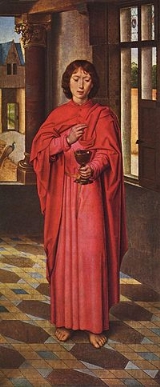
All Topics  
John the Apostle

 
John the Apostle

   Email Print
   Bookmark   Link


John the Apostle


John the Apostle (Greek
Greek language

Greek is an Indo-European languages native to the southern Balkan peninsula, the language of the Greek people. It forms an independent branch within Indo-European....
 ???????) was one of the Twelve Apostles
Twelve Apostles

In Christianity, apostles were missionaries among the leaders in the Early Christianity and, in the Epistle to the Hebrews, Jesus Christ himself....
 of Jesus
Jesus

Jesus of Nazareth , also known as Jesus Christ, is the central figure of Christianity and is revered by most Christian churches as the Son of God and the Incarnation ....
. Christian tradition identifies him as the author of several New Testament
New Testament

The New Testament is the name given to the second major division of the Christianity Bible, the first such division being the much longer Old Testament....
 works: the Gospel of John
Gospel of John

The Gospel of John is the fourth gospel in the Biblical canon of the New Testament, traditionally ascribed to John the Evangelist. Like the three synoptic gospels, it contains an account of some of the actions and sayings of Jesus of Nazareth, but differs from them in ethos and theological emphases....
, the Epistles of John
Epistles of John

Three books in the New Testament, thought to have been written between 90-100, are collectively called the Epistles of John:*First Epistle of John...
, and the Book of Revelation
Book of Revelation

The Book of Revelation, also called Revelation to John, Apocalypse of John , and Revelation of Jesus Christ is the last Biblical canon of the New Testament in the Christian Bible....
. Many modern scholars believe that John the Apostle, John the Evangelist, and John of Patmos were three separate individuals. Certain lines of evidence suggest that John of Patmos wrote only Revelation, neither the Gospel of John nor the Epistles of John.


Discussion
Ask a question about 'John the Apostle'
Start a new discussion about 'John the Apostle'
Answer questions from other users
Full Discussion Forum


Recent Posts


Encyclopedia


John the Apostle (Greek
Greek language

Greek is an Indo-European languages native to the southern Balkan peninsula, the language of the Greek people. It forms an independent branch within Indo-European....
 ???????) was one of the Twelve Apostles
Twelve Apostles

In Christianity, apostles were missionaries among the leaders in the Early Christianity and, in the Epistle to the Hebrews, Jesus Christ himself....
 of Jesus
Jesus

Jesus of Nazareth , also known as Jesus Christ, is the central figure of Christianity and is revered by most Christian churches as the Son of God and the Incarnation ....
. Christian tradition identifies him as the author of several New Testament
New Testament

The New Testament is the name given to the second major division of the Christianity Bible, the first such division being the much longer Old Testament....
 works: the Gospel of John
Gospel of John

The Gospel of John is the fourth gospel in the Biblical canon of the New Testament, traditionally ascribed to John the Evangelist. Like the three synoptic gospels, it contains an account of some of the actions and sayings of Jesus of Nazareth, but differs from them in ethos and theological emphases....
, the Epistles of John
Epistles of John

Three books in the New Testament, thought to have been written between 90-100, are collectively called the Epistles of John:*First Epistle of John...
, and the Book of Revelation
Book of Revelation

The Book of Revelation, also called Revelation to John, Apocalypse of John , and Revelation of Jesus Christ is the last Biblical canon of the New Testament in the Christian Bible....
. Many modern scholars believe that John the Apostle, John the Evangelist, and John of Patmos were three separate individuals. Certain lines of evidence suggest that John of Patmos wrote only Revelation, neither the Gospel of John nor the Epistles of John. For one, the author of Revelation identifies himself as "John" several times, but the author of the Gospel of John never identifies himself directly.

Identifications


Some modern scholars distinguish at least three different authors.The author of the Gospel of St John and the First Epistle of John
First Epistle of John

In the Christian New Testament, the First Epistle of John is the fourth catholic or "general" epistle. Written in Ephesus about AD 100-110, the epistle is traditionally attributed to John the Evangelist, also the traditional author of the Gospel of John and the other two epistles of John....
 is known OPO St. John the Evangelist
John the Evangelist

Saint John the Evangelist , or the Beloved Disciple, is traditionally the name used to refer to the author of the Gospel of John and the First Epistle of John....
 or St. John the Theologian (alternately rendered St. John the Divine or St. John the Beloved). The Second
Second Epistle of John

The Second Epistle of John is a book in the Christian Holy Scriptures, the Authors of the Bible of which has been traditionally attributed to John the Evangelist by the Christian Church, although this is Authorship of the Johannine works....
 and Third Epistle of John
Third Epistle of John

The New Testament Third Epistle of John , written in the form of an Epistle, is the 64th book of the Bible.3 John—the second-shortest book of the Christian Bible by number of verses and shortest in regard to number of words —is written by a man identified only as "the presbyteros"....
 had the same author, who calls himself the presbyter
Presbyter

Presbyter in the New Testament refers to a leader in local Christian congregations, then a synonym of episkopos . In modern usage, it is distinct from bishop and synonymous with priest, pastor, Elder , or religious minister in various Christian denominations....
; he has been identified with the enigmatic John the Presbyter
John the Presbyter

John the Presbyter is an obscure figure in early Christian tradition, who is either distinguished from, or identified with, John the Apostle....
. An author named John wrote the book of Revelation (Revelation 1:1), though it is not clear whether this is the apostle or another John. Traditionally, Christians believe that the apostle John wrote Revelation (Revelation 1:1, 1:9, and 22:8), the Gospel of John, and the epistles. Scholars like Justin Martyr
Justin Martyr

Saint Justin Martyr was an early Christian apologetics and saint. His works represent the earliest surviving Christian "apologies" of notable size....
 held this view as early as AD 140. The main objection to this view is that the original Greek in Revelation is not like the other writing in the Gospels or the epistles, mainly because it does not follow the normal rules of Greek grammar. Some scholars believe that a different John wrote Revelation. Other scholars think that some of John’s disciples wrote the Gospel and the epistles and that John himself wrote Revelation. Most Evangelical Christians, Eastern Orthodox and Roman Catholics continue to hold that all New Testament "John" books were written by Saint John, the son of Zebedee.

The apocryphal
New Testament apocrypha

New Testament apocrypha are a number of writings of the early Christian church that give accounts of the teachings of Jesus, aspects of the life of Jesus, accounts of the nature of God, or the teachings of his apostles and of their lives....
 2nd century Gnostic
Gnosticism

Gnosticism refers to diverse, syncretistic religious movements in antiquity consisting of various belief systems generally united in the teaching that humans are divine souls trapped in a Nature created by an imperfect god, the demiurge; this being is frequently identified with the Abrahamic God, and is contrasted with a superior entity, ref...
 text called Secret Book of John was also attributed to John, though not by established traditional Christian orthodoxy.

The Gospel of John contains references to the "disciple whom Jesus loved
Disciple whom Jesus loved

The phrase the disciple whom Jesus loved or Beloved Disciple is used several times in the Gospel of John, but in none of the other accounts of Jesus....
". Traditionally this is taken as a self-reference by the author, and therefore a reference to John the Apostle.

Though some sources state that he was 95 when he died, others claim he was most likely 104. His tomb is located in Ephesus.

In the Bible

Saint John the Apostle was the son of Zebedee
Zebedee

Zebedee is a name used in several contexts:*In the Bible, Zebedee was a Hebrew fisherman, the husband of Salome , and the father of Saint James the Great and John the Apostle, two of the Twelve apostles of Jesus...
, and the brother of Saint James the Greater. The Eastern Orthodox tradition gives his mother's name as Salome
Salome (disciple)

Salome , the younger sister of Mary , was a follower of Jesus, who appears briefly in the canonical gospels, and who appears in more detail in apocryphal writings....
. They originally were fishermen and fished with their father in the Lake of Genesareth. He was first a disciple of John the Baptist
John the Baptist

John the Baptist was a mission preacher and a major religious figure who led a movement of baptism at the Jordan River in expectation of a divine apocalypse that would restore occupied Israel....
 and later one of the twelve apostles
Twelve Apostles

In Christianity, apostles were missionaries among the leaders in the Early Christianity and, in the Epistle to the Hebrews, Jesus Christ himself....
 of Jesus.

Christian tradition holds that Saint John had a prominent position in the Apostolic body. Saint Peter
Saint Peter

Saint Peter was a leader of the early Christianity church, who features prominently in the New Testament Gospels and the Acts of the Apostles....
, St James and St John were the only witnesses of the raising of Jairus
Jairus

Jairus were an Indie /post hardcore band from Kent in England. Formed in October 2001 by guitarist Dan Lucas and vocalist Adam Bray.Between October 2001 and December 2002 Jairus toured throughout the UK, gaining a large fanbase in a very short period of time, and were consequently signed to UK hardcore label Skipworth Records, who re...
' daughter , of the Transfiguration
Transfiguration

Transfiguration may refer to:In religion:* Transfiguration of Jesus, an event reported by the Synoptic Gospels in which Jesus underwent transfiguration with the prophets Moses and Elijah...
  and of the Agony in Gethsemane
Gethsemane

Gethsemane is a garden at the foot of the Mount of Olives in Jerusalem believed to be the place where Jesus and his disciples prayed the night before Crucifixion of Jesus....
 . Only he and Peter were sent into the city to make the preparation for the final Passover
Passover

Passover is a Jewish and Samaritan holy day and festival commemorating God sparing the Israelites when He killed the first born of Egypt, and is followed by the seven day Feast of the Unleavened Bread commemorating the Exodus from Ancient Egypt and the liberation of the Israelites from Judaism and slavery....
 meal (the Last Supper
Last Supper

In the Christian Gospels, the Last Supper was the last meal Jesus shared with his Twelve Apostles and Disciple before Crucifixion of Jesus. The Last Supper has been the subject of many paintings, perhaps The Last Supper by Leonardo da Vinci....
) . At the meal itself, his place was next to Jesus on whose chest he leaned . According to the general interpretation, John was also that "other disciple" who with Peter followed Jesus after the arrest into the palace of the high-priest
Caiaphas

Yosef Bar Kayafa , also known simply as Caiaphas in the New Testament, was the Roman Empire-appointed Judaism List of High Priests of Israel between AD 18 and 37....
 . John alone remained near Jesus at the foot of the cross on Calvary
Calvary

Calvary or Golgotha are the English language/Western Christian names given to the site, outside of ancient Jerusalem?s early 1st century walls, ascribed to Jesus's crucifixion....
 with Jesus’ mother, Mary, and the pious women
Myrrhbearers

The term Myrrhbearers refers to the women who came to the Holy Sepulchre early in the morning and were the first witnesses of the Resurrection of Jesus....
 and took Mary into his care as the last legacy of Jesus .

According to the Bible, after the Resurrection
Resurrection

Miraculous resurrection of one sort or another has been a recurrent theme or central doctrine of Judaism, Christianity, and Islam, and other Abrahamic religions....
, John and Peter were the first of the disciples to run towards the tomb and John was the first of the apostles to believe that Jesus had truly risen . The author of the Gospel of John was accustomed to indicate the apostle in writing, identifying him as: "the disciple whom Jesus loved". After Jesus’ Ascension and the descent of the Holy Spirit
Holy Spirit

In Christianity, the Holy Ghost or Holy Spirit is the spirit of God. The term Christ , is also used to refer to this presence. That is, the Spirit is considered to act in concert with and share an essential nature with God the Father and God the Son ....
 on Pentecost
Pentecost

Pentecost is one of the prominent feasts in the Christianity liturgical year, celebrated the 49th day after Easter Sunday?or the 50th day, inclusively, whence its name is derived from the Greek....
, John, together with Peter, took a prominent part in the founding and guidance of the church. He is with Peter at the healing of the lame man in the Temple (et. seq.). With Peter he is also thrown into prison . He is also with Peter visiting the newly converted in Samaria
Samaria

Samaria, or the Shomron is a term used for the mountainous region in northern Israel roughly corresponding to the northern part of the West Bank....
 .

There is no positive information in the Bible (or elsewhere) concerning the duration of this activity in Judea
Iudaea Province

Iudaea was a Roman province that extended over the former region of the Hasmonean and Herodian kingdoms of Israel. It was named after the tetrarchy of Judea of which it was an expansion, the latter name deriving from the Kingdom of Judah of the 6th century BCE....
. Apparently, John in common with the other Apostles remained some 12 years in this first field of labour, until the persecution
Persecution of Christians

The persecution of Christians refers to the religious persecution of Christians, both historically and in the current era....
 of Herod Agrippa I led to the scattering of the Apostles through the various provinces of the Roman Empire
Roman Empire

The Roman Empire was the Roman Republic phase of the Ancient Rome, characterised by an autocracy form of government and large territorial holdings in Europe and around the Mediterranean....
 (cf. ). It does not appear improbable that John then went for the first time into Asia Minor . In any case a messianic community was already in existence at Ephesus
Ephesus

Ephesus was an ancient Greek city on the west coast of Anatolia, in the region known as Ionia during the period known as Classical Greece. It was one of the twelve cities of the Ionian League....
 before Paul's first labours there (cf. "the brethren", , in addition to Priscilla and Aquila. Such a sojourn by John in Asia in this first period was neither long nor uninterrupted. He returned with the other disciples to Jerusalem for the Apostolic Council (about A.D. 51). Paul, in opposing his enemies in Galatia, recalls that John explicitly along with Peter and James the Just were referred to as "pillars of the church" and refers to the recognition that his Apostolic preaching of a gospel free from Jewish Law received from these three, the most prominent men of the messianic community at Jerusalem .

Of the other New Testament writings, it is only from the three Letters of John and the Book of Revelation that anything further is learned about John. Both the Letters and Revelation presuppose that John belonged to the multitude of personal eyewitnesses of the life and work of Jesus (cf. especially ; ), that he had lived for a long time in Asia Minor, was thoroughly acquainted with the conditions existing in the various messianic communities there, and that he had a position of authority recognized by all messianic communities as leader of this part of the church. Moreover, Revelation says that its author was on the island of Patmos
Patmos

Patmos is a small Greece island in the Aegean Sea. One of the northernmost islands of the Dodecanese complex, it has a population of 2,984 and an area of 34.05 km ....
 "for the word of God and for the testimony of Jesus", when he was honoured with the vision
Vision (religion)

In spirituality including religion, visions comprise inspirational renderings, generally of a future state and/or of a mythologyical being, and are believed to come from a deity, sometimes directly or indirectly via prophets, and serve to inspire or prod believers as part of a revelation or an Epiphany ....
 contained in Revelation . John, like his Old Testament
Old Testament

In Western Christianity, the Old Testament refers to the books that form the first of the two-part Christianity Bible Biblical canon. These works correspond to the Hebrew Bible , with some variations and additions....
 counterpart Daniel, was kept alive to receive the prophetic vision.

Saint John is the author of all five Johanine books of the New Testament, including the Gospel of John
Gospel of John

The Gospel of John is the fourth gospel in the Biblical canon of the New Testament, traditionally ascribed to John the Evangelist. Like the three synoptic gospels, it contains an account of some of the actions and sayings of Jesus of Nazareth, but differs from them in ethos and theological emphases....
. Almost all modern critical scholars
Biblical criticism

Biblical criticism is "the study and investigation of biblical writings that seeks to make discerning and discriminating judgments about these writings." It asks when and where a particular text originated; how, why, by whom, for whom, and in what circumstances it was produced; what influences were at work in its production; what sources we...
 place the writing of the final edition of John at some time in the late first century, which supports the theory that John outlived all the other apostles. It is believed that John survived his contemporary apostles and lived to an extreme old age, dying at Ephesus in about A.D. 100.

Extra-biblical traditions


Roman Catholic tradition states that St. John and the Virgin Mary moved to Ephesus
Ephesus

Ephesus was an ancient Greek city on the west coast of Anatolia, in the region known as Ionia during the period known as Classical Greece. It was one of the twelve cities of the Ionian League....
, where they eventually died, though there is an alternative tradition that holds Mary's death to be in Jerusalem, where her tomb is, a tradition held true by Orthodox Christians. The tradition about Mary's tomb in Ephesus emanated mostly after 1841, based on the visions of German Augustinian nun Anne Catherine Emmerich
Anne Catherine Emmerich

Beatification Anne Catherine Emmerich was a Roman Catholic Augustinian nuns nun, stigmatic, mysticism, visionary and ecstatic. She was born in Flamschen, a farming community at Coesfeld, in the Diocese of M?nster, Westphalia, Germany and died in D?lmen, aged 49....
. Many Evangelical
Evangelicalism

Evangelicalism is a Protestantism Christian movement which began in Great Britain in the 1730s.Most adherents consider its key characteristics to be: a belief in the need for personal conversion ; some expression of the gospel in effort; a high regard for Biblical authority; and an emphasis on the death and resurrection of Jesus....
 and other people question this, especially due to the advanced age which Mary would have reached by this time. This presents no problem though with the alternative tradition, brought forth by Orthodox Christians, which states that the Virgin Mary died 10 years after Jesus' Resurrection, in Gethsemane. In a coptic test of the 4th century, in the 20th Homily of st Cyrill of Jerusalem, it is maintained that Mary's death took place in Zion(Jerusalem), on the 15th of August of the year A.D. 43 and that she was buried in Gethsemane.

Some believe, however, that there is support for the idea that John did go to Ephesus
Ephesus

Ephesus was an ancient Greek city on the west coast of Anatolia, in the region known as Ionia during the period known as Classical Greece. It was one of the twelve cities of the Ionian League....
 and from there wrote the three epistles traditionally attributed to him. John was allegedly banished by the Roman authorities to the Greek
Greece

Greece , officially the Hellenic Republic , is a country in southeastern Europe, situated on the southern end of the Balkans. It has borders with Albania, Bulgaria and the former Yugoslav Republic of Macedonia to the north, and Turkey to the east....
 island of Patmos
Patmos

Patmos is a small Greece island in the Aegean Sea. One of the northernmost islands of the Dodecanese complex, it has a population of 2,984 and an area of 34.05 km ....
, where some believe that he wrote the Book of Revelation
Book of Revelation

The Book of Revelation, also called Revelation to John, Apocalypse of John , and Revelation of Jesus Christ is the last Biblical canon of the New Testament in the Christian Bible....
. According to Tertullian
Tertullian

Quintus Septimius Florens Tertullianus, anglicised as Tertullian, was a prolific and controversial early Christian author, and the first to write Christian Latin literature....
 (in The Prescription of Heretics) John was banished (presumably to Patmos) after being plunged into boiling oil in Rome and suffering nothing from it. It is said that the entire colosseum were converted to Christianity upon witnessing this miracle.

Members of The Church of Jesus Christ of Latter-day Saints believe that John will, indeed, tarry in the flesh until the Savior returns. They base this belief on three passages: one in the Book of Mormon
Book of Mormon

The Book of Mormon is a sacred text of the churches of the Latter Day Saint Movement. It was first published in March 1830 by Joseph Smith, Jr....
  one in the Doctrine and Covenants
Doctrine and Covenants

The Doctrine and Covenants is a part of the continuous revelation scripture biblical canon of several denominations of the Latter Day Saint movement....
  and one in the New Testament
New Testament

The New Testament is the name given to the second major division of the Christianity Bible, the first such division being the much longer Old Testament....
 .

John's traditional tomb is thought to be located at Selçuk
Selçuk

Sel?uk is the central town of Sel?uk district, Izmir Province in Turkey, northeast of Kusadasi, northeast of Ephesus. Its original name was John the Theologian , from which the Ottoman Turkish name Ayaslug is derived....
, a small town in the vicinity of Ephesus.

When John was aged, he trained Polycarp
Polycarp

Polycarp was a second century bishop of Smyrna. He died a martyr when he was stabbed after an attempt to burn him at the stake failed. Polycarp is recognized as a saint in the Roman Catholic Church, Eastern Orthodox Church, Anglican, and Lutheran Churches....
 who later became Bishop of Smyrna. This was important because Polycarp was able to carry John's message to future generations.

In art, John as the presumed author of the Gospel is often depicted with an eagle, which symbolizes the height he rose to in the first chapter of his gospel. In Orthodox icon
Icon

An 'icon' is a religious work of art, most commonly a painting, from Eastern Christianity. More broadly the term is used in a wide number of contexts for an image, picture, or representation; it is a sign or likeness that stands for an object by signifying or representing it either concretely or by analogy, as in semiotics; by extension, ...
s, he is often depicted looking up into heaven and dictating his Gospel (or the Book of Revelation) to his disciple, traditionally named Prochorus.

Liturgical commemoration

, Turkey.]] He is venerated as a saint
Saint

A saint in Christianity is a human being who has been called to holiness. The term is used differently by various denominations, with some, such as the Anglicans, Methodists, and Lutherans distinguishing between Saints and saints....
 by most of Christianity
Christianity

Christianity is a Monotheistic religion #Christian view religion centered on the life and teachings of Jesus as New Testament view on Jesus' life....
. The Roman Catholic Church
Roman Catholic Church

The Roman Catholic Church, officially known as the Catholic Church is the world's largest Christianity Ecclesia , representing over half of all Christians and one-sixth of the world population....
 commemorates him as "Saint John, Apostle and Evangelist" on December 27. In the Tridentine Calendar
Tridentine Calendar

The Tridentine Calendar is the calendar of saints to be honoured in the official liturgy of the Roman Rite during the course of the liturgical year....
, this feast day is repeated, in general merely by a commemoration
Commemoration (prayer)

In the Tridentine Mass period of the Roman Rite, when a higher-ranked liturgy impeded the celebration of a lesser that, either permanently or by coincidence, fell on the same day, the prayer of the lower-ranked celebration was usually added to that of the higher....
 within another feast day, for eight days (an octave
Octave (liturgical)

"Octave" has two senses in Christian liturgical usage. In the first sense, it is the eighth day after a feast, reckoning inclusively, and so always falls on the same day of the week as the feast itself....
), counting the feast day itself. Pope Pius X
Pope Pius X

Pope St. Pius X , born Giuseppe Melchiorre Sarto, was the 257th Pope of the Roman Catholic Church, serving from 1903 to 1914, succeeding Pope Leo XIII ....
 reduced this octave to a "simple octave", which meant in practice that the feast-day Mass was repeated only on the Octave Day
Octave (liturgical)

"Octave" has two senses in Christian liturgical usage. In the first sense, it is the eighth day after a feast, reckoning inclusively, and so always falls on the same day of the week as the feast itself....
 (3 January). Pope Pius XII
Pope Pius XII

Pope Pius XII , born Eugenio Maria Giuseppe Giovanni Pacelli , reigned as the 260th pope, head of the Roman Catholic Church and monarch of Vatican City, from March 2, 1939 until his death in 1958....
 abolished this octave entirely in 1955. It therefore does not appear in the General Roman Calendar for any year thereafter. In particular, it is not found in the 1962 Roman Missal
Roman Missal

The Roman Missal is the Liturgical books of the Roman rite that contains the texts and rubric s for the celebration of the Mass in the Roman Rite of the Catholic Church....
 of Pope John XXIII
Pope John XXIII

Blessed Pope John XXIII , born Angelo Giuseppe Roncalli , known as Blessed John XXIII since his beatification, was elected as the 261st Pope of the Roman Catholic Church and monarch of Vatican City on 28 October 1958....
, whose continued use as an extraordinary form of the Roman Rite
Extraordinary form of the Roman Rite

An extraordinary form of the Roman Rite is a form of the Roman Catholic liturgy that differs from the normal form of that Latin liturgical rites....
 is authorized under the conditions indicated in the motu proprio Summorum Pontificum.

Another feast day excluded in that Missal, but which appeared in the General Roman Calendar until 1960, is that of "St John Before the Latin Gate" on May 6, celebrating a tradition recounted by St. Jerome
Jerome

Saint Jerome was a Christian priest and Christian apologetics best known for translating the Vulgate. He is recognized by the Catholic Church as a canonized saint and Doctor of the Church, and his version of the Bible is still an important text in Catholicism....
 that St. John was brought to Rome during the reign of the Emperor Domitian
Domitian

Titus Flavius Domitianus , commonly known as Domitian, was a Roman Emperor who reigned from 14 September 81 until his death. Domitian was the last emperor of the Flavian dynasty, which ruled the Roman Empire between 69 and 96, encompassing the reigns of Domitian's father Vespasian , his elder brother Titus , and that of Domitian himself...
, and was thrown in a vat of boiling oil, from which he was miraculously preserved unharmed. A church (San Giovanni a Porta Latina
San Giovanni a Porta Latina

San Giovanni a Porta Latina is a Basilica Church near the Porta Latina of Rome's Aurelian Wall. It is currently the titular church of Franciszek Macharski, the former Archbishop of Krakow....
) dedicated to him was built near the Latin gate of Rome, the traditional scene of this event.

The Eastern Orthodox Church
Eastern Orthodox Church

The Eastern Orthodox Church is the second largest single Christian communion in the world with an estimated 225 million members worldwide. It is considered by its adherents to be the Four Marks of the Church established by Jesus Christ and his Apostles nearly 2000 years ago....
 and those Eastern Catholic Churches which follow the Byzantine Rite
Byzantine Rite

The Byzantine Rite, sometimes called the Rite of Constantinople or Constantinopolitan Rite, is the liturgy used currently by all the Eastern Orthodox Churches and by the Greek-Catholic Churches ....
 commemorate the "Repose of the Holy Apostle and Evangelist John the Theologian" on September 26 (for those churches which follow the traditional Julian Calendar
Julian calendar

The Julian calendar, a reform of the Roman calendar, was introduced by Julius Caesar in 46 BC, and came into force in 45 BC . It was chosen after consultation with the astronomer Sosigenes of Alexandria and was probably designed to approximate the tropical year, known at least since Hipparchus....
, September 26 currently falls on October 9 of the modern Gregorian Calendar
Gregorian calendar

The Gregorian calendar is the internationally accepted civil calendar. It was first proposed by the Calabrian doctor Aloysius Lilius, and decreed by Pope Gregory XIII, after whom it was named, on 24 February 1582 by the papal bull Inter gravissimas....
). On May 8 (May 21), they celebrate the "Feast of the Holy Apostle and Evangelist John the Theologian", on which date Christians used to draw forth from his grave fine ashes which were believed to be effective for healing the sick.

See also

  • John the Evangelist
    John the Evangelist

    Saint John the Evangelist , or the Beloved Disciple, is traditionally the name used to refer to the author of the Gospel of John and the First Epistle of John....
  • St. John the Evangelist on Patmos
    St. John the Evangelist on Patmos

    St. John the Evangelist on Patmos is a painting by Hieronymus Bosch. The painting is currently in the Gem?ldegalerie, in Berlin, Germany....
  • Vision of St. John on Patmos
    Vision of St. John on Patmos

    The Vision of St. John the Evangelist at Patmos is a series of fresco by the Italian late Renaissance artist Antonio Allegri da Correggio. It occupies the interior of the dome, and the relative pendentives, of the Benedictine church of Parma#Main sights of Parma, Italy....
  • John of Patmos
    John of Patmos

    John of Patmos is the name given to the author of the Book of Revelation in the New Testament. According to the text of Revelation, the author, who gives his name as "John," is living on the Greek island of Patmos....
  • Names of John
    Names of John

    Christians have given John the Apostle the Apostle many names and attributed many books of the Bible to him. The different names refers to different aspects of his personality and different books attributed to him....


External links

  • by JJ Dewey
  • Orthodox icon
    Icon

    An 'icon' is a religious work of art, most commonly a painting, from Eastern Christianity. More broadly the term is used in a wide number of contexts for an image, picture, or representation; it is a sign or likeness that stands for an object by signifying or representing it either concretely or by analogy, as in semiotics; by extension, ...
     and synaxarion for September 26