

Supersessionism

Encyclopedia
Christian
A Christian is a person who adheres to Christianity, an Abrahamic, monotheistic religion based on the life and teachings of Jesus of Nazareth as recorded in the Canonical gospels and the letters of the New Testament...
interpretation of New Testament
New Testament
The New Testament is the second major division of the Christian biblical canon, the first such division being the much longer Old Testament....
verses, viewing God's relationship with Christians
God in Christianity
In Christianity, God is the eternal being that created and preserves the universe. God is believed by most Christians to be immanent , while others believe the plan of redemption show he will be immanent later...
as being the inclusion or occlusion of the Christian Church
Christian Church
The Christian Church is the assembly or association of followers of Jesus Christ. The Greek term ἐκκλησία that in its appearances in the New Testament is usually translated as "church" basically means "assembly"...
into the promises made to the Jews
Jews
The Jews , also known as the Jewish people, are a nation and ethnoreligious group originating in the Israelites or Hebrews of the Ancient Near East. The Jewish ethnicity, nationality, and religion are strongly interrelated, as Judaism is the traditional faith of the Jewish nation...
(or Biblical Israelites) and Jewish Proselytes. Dual-covenant theology
Dual-covenant theology
Dual-covenant theology is a Liberal Christian view that holds that Jews may simply keep the Law of Moses, because of the "everlasting covenant" between Abraham and God expressed in the Hebrew Bible, whereas Gentiles must convert to Christianity or alternatively accept the Seven Laws of Noah...
is the contrasting viewpoint. Biblical
Bible
The Bible refers to any one of the collections of the primary religious texts of Judaism and Christianity. There is no common version of the Bible, as the individual books , their contents and their order vary among denominations...
expressions of God's relationships with people are
known as covenants
Covenant (biblical)
A biblical covenant is an agreement found in the Bible between God and His people in which God makes specific promises and demands. It is the customary word used to translate the Hebrew word berith. It it is used in the Tanakh 286 times . All Abrahamic religions consider the Biblical covenant...
, so the contentious element of Supersessionism is the idea that the New Covenant
New Covenant
The New Covenant is a concept originally derived from the Hebrew Bible. The term "New Covenant" is used in the Bible to refer to an epochal relationship of restoration and peace following a period of trial and judgment...
with Christendom
Christendom
Christendom, or the Christian world, has several meanings. In a cultural sense it refers to the worldwide community of Christians, adherents of Christianity...
replaces, fulfills or completes the Old Covenant
Old Covenant
The Old Covenant was the name of the agreement which effected the union of Iceland and Norway. It is also known as Gissurarsáttmáli, named after Gissur Þorvaldsson, the Icelandic chieftain who worked to promote it. The name "Old Covenant", however, is probably due to historical confusion...
with the Israelites and B'nei Noah
B'nei Noah
Noahidism is a Biblical-Talmudic and monotheistic ideology based on the Seven Laws of Noah. According to Jewish law, non-Jews are not obligated to convert to Judaism, but they are required to observe the Seven Laws of Noah to be assured of a place in the World to Come , the final reward of the...
. A major question in Supersessionism is how or to what degree are the teachings of the Old Covenant displaced or even completely abrogated
Abrogation of Old Covenant laws
While many Christian theology systems reflect the view that at least some Mosaic laws have been set aside under the New Covenant, there are some theology systems that view the entire Mosaic or Old Covenant as abrogated in that all of the Mosaic laws are set aside for the Law of Christ...
by the New Covenant and the Law of Christ.
There is a current move by some to discourage the use of the term "replacement theology" as it is intrinsically pejorative, and offensive to some Christians. A view put forward by David H. Stern
David H. Stern
Dr. David Harold Stern is an Israel-based theologian. He is the third son of Harold Stern and Marion Levi Stern.Stern's major work is the Complete Jewish Bible, his English translation of the Tanakh and New Testament...
, known as "Olive Tree Theology", is that Gentiles are "grafted in" to the promises made to the Jews, which is derived from , and thus there is no real "replacement" happening. Gentiles (those not Jews) are grafted into the covenants made to Israel and together they are now treated as "one people of God."
Etymology
The word supersessionism comes from English supersede, first known to have been used with the meaning replace in 1642. Prior to this time the word is attested in Scottish legal English to describe restraining ordersInjunction
An injunction is an equitable remedy in the form of a court order that requires a party to do or refrain from doing certain acts. A party that fails to comply with an injunction faces criminal or civil penalties and may have to pay damages or accept sanctions...
against debt collection, restraint being its original Latin
Latin
Latin is an Italic language originally spoken in Latium and Ancient Rome. It, along with most European languages, is a descendant of the ancient Proto-Indo-European language. Although it is considered a dead language, a number of scholars and members of the Christian clergy speak it fluently, and...
sense.
(The Latin for replace is succedere.) The preposition super is applied to intensify the verb sedere, as in English hold up. Both forms can mean to delay. Hence the term supersessionism does not come from the Latin Church Fathers
Church Fathers
The Church Fathers, Early Church Fathers, Christian Fathers, or Fathers of the Church were early and influential theologians, eminent Christian teachers and great bishops. Their scholarly works were used as a precedent for centuries to come...
' description of their own views but as the application of a modern term to older views.
The word supersession is used by S. Thelwall in the title of chapter three of his 1870 translation of Tertullian
Tertullian
Quintus Septimius Florens Tertullianus, anglicised as Tertullian , was a prolific early Christian author from Carthage in the Roman province of Africa. He is the first Christian author to produce an extensive corpus of Latin Christian literature. He also was a notable early Christian apologist and...
's Adversus Iudaeos (written between 198 and 208). The title is provided by Thelwall; it is not in the original Latin.
Types of supersessionism
Both Christian and Jewish theologians have identified different types of supersessionism in Christian reading of the Bible.R. Kendall Soulen notes three categories of supersessionism are identified by Christian theologians: punitive, economic, and structural.
- Punitive supersessionism is represented by figures such as Hippolytus, OrigenOrigenOrigen , or Origen Adamantius, 184/5–253/4, was an early Christian Alexandrian scholar and theologian, and one of the most distinguished writers of the early Church. As early as the fourth century, his orthodoxy was suspect, in part because he believed in the pre-existence of souls...
, and LutherMartin LutherMartin Luther was a German priest, professor of theology and iconic figure of the Protestant Reformation. He strongly disputed the claim that freedom from God's punishment for sin could be purchased with money. He confronted indulgence salesman Johann Tetzel with his Ninety-Five Theses in 1517...
. It is the view that Jews who reject JesusJudaism's view of JesusJews have traditionally seen Jesus as one of a number of false messiahs who have appeared throughout history. Jesus is viewed as having been the most influential, and consequently the most damaging, of all false messiahs...
as the Jewish MessiahJewish MessiahMessiah, ; mashiah, moshiah, mashiach, or moshiach, is a term used in the Hebrew Bible to describe priests and kings, who were traditionally anointed with holy anointing oil as described in Exodus 30:22-25...
are consequently condemned by God, forfeiting the promises otherwise due to them under the covenants. (Although, both Origen and Hippolytus expected the Jewish people to be restored as a whole alongside the Gentiles in the last days.)
- Economic supersessionism does not refer to money, rather it is used in the technical theological sense of function (see economic Trinity). It is the view that the practical purpose of the nation of Israel in God's plans is replaced by the role of the church. It is represented by writers such as Justin MartyrJustin MartyrJustin Martyr, also known as just Saint Justin , was an early Christian apologist. Most of his works are lost, but two apologies and a dialogue survive. He is considered a saint by the Roman Catholic Church and the Eastern Orthodox Church....
, Augustine, and BarthKarl BarthKarl Barth was a Swiss Reformed theologian whom critics hold to be among the most important Christian thinkers of the 20th century; Pope Pius XII described him as the most important theologian since Thomas Aquinas...
. (Again, Augustine explicitly expected a restoration of the Jewish people alongside the Gentiles in the last days.)
- Structural supersessionism is Soulen's term for the de factoDe factoDe facto is a Latin expression that means "concerning fact." In law, it often means "in practice but not necessarily ordained by law" or "in practice or actuality, but not officially established." It is commonly used in contrast to de jure when referring to matters of law, governance, or...
marginalization of the Old TestamentOld TestamentThe Old Testament, of which Christians hold different views, is a Christian term for the religious writings of ancient Israel held sacred and inspired by Christians which overlaps with the 24-book canon of the Masoretic Text of Judaism...
as normative for Christian thought. In his words, "Structural supersessionism refers to the narrative logic of the standard model whereby it renders the Hebrew Scriptures largely indecisive for shaping Christian convictions about how God’s works as Consummator and Redeemer engage humankind in universal and enduring ways." Soulen's terminology is used by Craig A. Blaising, in 'The Future of Israel as a Theological Question'. See also Biblical law in ChristianityBiblical law in ChristianityChristian views of the Old Covenant have been central to Christian theology and practice since the circumcision controversy in Early Christianity. There are differing views about the applicability of the Old Covenant among Christian denominations...
, AntinomianismAntinomianismAntinomianism is defined as holding that, under the gospel dispensation of grace, moral law is of no use or obligation because faith alone is necessary to salvation....
, Progressive revelation (Christian)Progressive revelation (Christian)Progressive revelation in Christianity is the concept that the sections of the Bible that were written later contain a fuller revelation of God compared to the earlier sections. For instance, the theologian Charles Hodge wrote,...
, and MarcionismMarcionismMarcionism was an Early Christian dualist belief system that originated in the teachings of Marcion of Sinope at Rome around the year 144; see also Christianity in the 2nd century....
.
These three views are neither mutually exclusive, nor logically dependent, and it is possible to hold all of them or any one with or without the others.
Jewish theologian and rabbinic scholar David Novak
David Novak
David Novak is a Jewish theologian, ethicist, and scholar of Jewish philosophy and law . He is an ordained Conservative rabbi and has also trained with Catholic moral theologians...
suggests that there are three options:
- The new covenant is an extension of the old covenant.
- The new covenant is an addition to the old covenant.
- The new covenant is a replacement for the old covenant.
He observes, "In the early Church, it seems, the new covenant presented by the New Testament
New Testament
The New Testament is the second major division of the Christian biblical canon, the first such division being the much longer Old Testament....
was either taken to be an addition to the old covenant (the religion of the Torah
Torah
Torah- A scroll containing the first five books of the BibleThe Torah , is name given by Jews to the first five books of the bible—Genesis , Exodus , Leviticus , Numbers and Deuteronomy Torah- A scroll containing the first five books of the BibleThe Torah , is name given by Jews to the first five...
and the Jewish Pharisaic tradition, summarized in the Ten Commandments
Ten Commandments
The Ten Commandments, also known as the Decalogue , are a set of biblical principles relating to ethics and worship, which play a fundamental role in Judaism and most forms of Christianity. They include instructions to worship only God and to keep the Sabbath, and prohibitions against idolatry,...
), or it was taken to be a replacement for the old covenant."
Novak considers both understandings to be supersessionist. He designates the first as "soft supersessionism" and the second as "hard supersessionism". The former "does not assert that God terminated the covenant of Exodus-Sinai with the Jewish people. Rather, it asserts that Jesus came to fulfill the promise of the old covenant, first for those Jews already initiated into the covenant, who then accepted his messiahhood as that covenant's fulfillment. And, it asserts that Jesus came to both initiate and fulfill the promise of the covenant for those Gentiles whose sole connection to the covenant is through him. Hence, in this kind of supersessionism, those Jews who do not accept Jesus' messiahhood are still part of the covenant in the sense of 'what God has put together let no man put asunder' [emphasis original]." See also Dual-covenant theology
Dual-covenant theology
Dual-covenant theology is a Liberal Christian view that holds that Jews may simply keep the Law of Moses, because of the "everlasting covenant" between Abraham and God expressed in the Hebrew Bible, whereas Gentiles must convert to Christianity or alternatively accept the Seven Laws of Noah...
.
Hard supersessionism, on the other hand, asserts that "[t]he old covenant is dead. The Jews by their sins, most prominently of rejecting Jesus
Rejection of Jesus
The Canonical Gospels of the New Testament include some accounts of the rejection of Jesus in the course of his ministry. Judaism's view of Jesus, Jesus in Islam, and the view of the Historical Jesus all differ from Christian views of Jesus.-Hometown rejection:...
as the Messiah, have forfeited any covenantal status." See also Antinomianism
Antinomianism
Antinomianism is defined as holding that, under the gospel dispensation of grace, moral law is of no use or obligation because faith alone is necessary to salvation....
.
This classification provides mutually exclusive options. Hard supersessionism implies both punitive and economic supersessionism; soft supersessionism does not fall into any of the three classes recognized as supersessionist by Christian theologians, instead it's associated with Jewish Christianity.
Christian views
The early Christian theologians saw the New Covenant in Christ as a replacement for the Mosaic Covenant (see "Roman Catholicism", below). Historically, statements on behalf of the Roman Catholic ChurchRoman Catholic Church
The Catholic Church, also known as the Roman Catholic Church, is the world's largest Christian church, with over a billion members. Led by the Pope, it defines its mission as spreading the gospel of Jesus Christ, administering the sacraments and exercising charity...
have claimed her ecclesiastical structures to be a fulfillment and replacement of Jewish ecclesiastical structures (see also Jerusalem as an allegory for the Church). As recently as 1965 Vatican Council II affirmed, "the Church is the new people of God," without intending to make "Israel according to the flesh", the Jewish people, irrelevant in terms of eschatology
Eschatology
Eschatology is a part of theology, philosophy, and futurology concerned with what are believed to be the final events in history, or the ultimate destiny of humanity, commonly referred to as the end of the world or the World to Come...
(see "Roman Catholicism, below). Modern Catholicism continues to affirm these spokesmen as authoritative for doctrine, alongside the New Testament. Modern Protestants hold to a range of positions, some with more emphasis on continuity (covenant theology
Covenant Theology
Covenant theology is a conceptual overview and interpretive framework for understanding the overall flow of the Bible...
) and others with more emphasis on discontinuity (dispensationalism
Dispensationalism
Dispensationalism is a nineteenth-century evangelical development based on a futurist biblical hermeneutic that sees a series of chronologically successive "dispensations" or periods in history in which God relates to human beings in different ways under different Biblical covenants.As a system,...
and New Covenant Theology
New Covenant Theology
New Covenant Theology is a Christian theological system which teaches that the Old Testament Laws have been fulfilled and abrogated or cancelled with Christ's death, and replaced with the Law of Christ of the New Covenant. It shares similarities and yet is distinct from Dispensationalism and...
).
The Jewish-Christian dialog
Christian-Jewish reconciliation
Reconciliation between Christianity and Judaism refers to the efforts that are being made to improve understanding of the Jewish people and of Judaism, to do away with Christian antisemitism and Jewish anti-Christian sentiment...
has changed dramatically since the early centuries. In the first century
Christianity in the 1st century
The earliest followers of Jesus composed an apocalyptic, Jewish sect, which historians refer to as Jewish Christianity. The Apostles and others following the Great Commission's decree to spread the teachings of Jesus to "all nations," had great success spreading the religion to gentiles. Peter,...
Gentile
Gentile
The term Gentile refers to non-Israelite peoples or nations in English translations of the Bible....
(non-Jewish) inclusion was the significant issue, see Circumcision controversy in early Christianity
Circumcision controversy in early Christianity
There is evidence of a controversy over religious male circumcision in Early Christianity. A Council of Jerusalem, possibly held in approximately 50 AD, decreed that male circumcision was not a requirement for Gentile converts. This became known as the "Apostolic Decree" and may be one of the...
, while two millennia later Jewish exclusion is the issue (though Jewish exclusion may have begun as early as the exclusion of Jews from Aelia Capitolina
Aelia Capitolina
Aelia Capitolina was a city built by the emperor Hadrian, and occupied by a Roman colony, on the site of Jerusalem, which was in ruins since 70 AD, leading in part to the Bar Kokhba revolt of 132–136.-Politics:...
c.135, see also Jewish Bishops of Jerusalem and Anti-Judaism
Anti-Judaism
Religious antisemitism is a form of antisemitism, which is the prejudice against, or hostility toward, the Jewish people based on hostility to Judaism and to Jews as a religious group...
).
The New Testament repeatedly gives Jews preeminence, as in Jesus' expression of his central mission as being to the Jews rather than Gentiles and in Paul's formula "first for the Jew, then for the Gentile." Yet after the death of Jesus, the inclusion of the Gentiles as equals in this burgeoning sect of Judaism also caused problems, particularly when it came to Gentiles keeping the Mosaic Law, which was both a major issue at the Council of Jerusalem
Council of Jerusalem
The Council of Jerusalem is a name applied by historians and theologians to an Early Christian council that was held in Jerusalem and dated to around the year 50. It is considered by Catholics and Orthodox to be a prototype and forerunner of the later Ecumenical Councils...
and a theme of Paul's Epistle to the Galatians
Epistle to the Galatians
The Epistle of Paul to the Galatians, often shortened to Galatians, is the ninth book of the New Testament. It is a letter from Paul of Tarsus to a number of Early Christian communities in the Roman province of Galatia in central Anatolia...
, though the relationship of Paul of Tarsus and Judaism
Paul of Tarsus and Judaism
The relationship between Paul of Tarsus and Second Temple Judaism continues to be the subject of much scholarly research, as it is thought that Paul played an important role in the relationship between Christianity and Judaism as a whole...
is still disputed today.
By contrast, in modern discourse, the term supersessionism arises as a criticism of a (perceived) Christian belief in Jewish exclusion, not as a Christian articulation of their own understanding of the relation between the Christians and Jews. Modern Christian descriptions of the New Testament teaching in this area focus on Gentile inclusion in God's plans, without much if any consideration of Jewish exclusion. Although modern Christians, nearly all of whom are Gentiles, naturally believe in Gentile inclusion, they are divided in their understanding of whether the New Testament teaches Jewish exclusion. In short, some modern Christians believe in supersessionism and others don't. There is also some disagreement among Christians in regard to what, precisely, is superseded: the Old Covenant, or the Jewish people themselves.
New Testament
: Mat 5:17-20 “Don’t think that I came to destroy the law or the prophets. I didn’t come to destroy, but to fulfill. For most certainly, I tell you, until heaven and earth pass away, not even one smallest letter or one tiny pen stroke shall in any way pass away from the law, until all things are accomplished. Whoever, therefore, shall break one of these least commandments, and teach others to do so, shall be called least in the Kingdom of Heaven; but whoever shall do and teach them shall be called great in the Kingdom of Heaven. For I tell you that unless your righteousness exceeds that of the scribes and Pharisees, there is no way you will enter into the Kingdom of Heaven."- Mat 23:37-39 “Jerusalem, Jerusalem! The city who kills the prophets and stones those who are sent to her. How often I wanted to gather your children together, as a hen gathers her chicks under her wings, yet you were not willing! See, your house is left to you desolate. For I tell you, you will never see Me again until you say, ‘He who comes in the name of the Lord is the blessed One’!”
- "'You worship that which you don’t know. We worship that which we know; for salvation is from the Jews.'": "For I am not ashamed of the Good News of Christ, for it is the power of God for salvation for everyone who believes; for the Jew first, and also for the Greek. For in it is revealed God’s righteousness from faith to faith. As it is written, 'But the righteous shall live by faith.'" []": "For he is not a Jew who is one outwardly, neither is that circumcision which is outward in the flesh; but he is a Jew who is one inwardly, and circumcision is that of the heart, in the spirit not in the letter; whose praise is not from men, but from God.": "Or is God the God of Jews only? Isn’t he the God of Gentiles also? Yes, of Gentiles also, since indeed there is one God who will justify the circumcised by faith, and the uncircumcised through faith. Do we then nullify the law through faith? May it never be! No, we establish the law.": "But it is not as though the word of God has come to nothing. For they are not all Israel, that are of Israel. Neither, because they are Abraham’s seed, are they all children. But, 'In Isaac will your seed be called.' That is, it is not the children of the flesh who are children of God, but the children of the promise are counted as a seed.": "For there is no distinction between Jew and Greek; for the same Lord is Lord of all, and is rich to all who call on him. For, 'Whoever will call on the name of the Lord will be saved.'[]": "I ask then, did God reject his people? May it never be! For I also am an Israelite, a descendant of Abraham, of the tribe of Benjamin. God didn’t reject his people, which he foreknew. Or don’t you know what the Scripture says about Elijah? How he pleads with God against Israel: 'Lord, they have killed your prophets, they have broken down your altars; and I am left alone, and they seek my life.' But how does God answer him? 'I have reserved for myself seven thousand men, who have not bowed the knee to Baal.' Even so then at this present time also there is a remnant according to the election of grace. And if by grace, then it is no longer of works; otherwise grace is no longer grace. But if it is of works, it is no longer grace; otherwise work is no longer work.": ". . . and so all Israel will be saved.": "But when I saw that they didn’t walk uprightly according to the truth of the Good News, I said to Peter before them all, 'If you, being a Jew, live as the Gentiles do, and not as the Jews do, why do you compel the Gentiles to live as the Jews do?' We, being Jews by nature, and not Gentile sinners, yet knowing that a man is not justified by the works of the law but through faith in Jesus Christ, even we believed in Christ Jesus, that we might be justified by faith in Christ, and not by the works of the law, because no flesh will be justified by the works of the law.": "If you are Christ’s, then you are Abraham’s seed and heirs according to promise.", especially : "For he [Jesus] is our peace, who made both [Jews and Gentiles] one, and broke down the middle wall of partition . . ."
The parable of the Wicked Vinedressers , addressed to "the chief priests and the Pharisees", is often invoked as providing scriptural support to some form of supersessionism: "'When therefore the lord of the vineyard comes, what will he do to those farmers?' They told him, 'He will miserably destroy those miserable men, and will lease out the vineyard to other farmers, who will give him the fruit in its season.'"
Church fathers
Many Early Christian commentators taught that the Old Covenant was fulfilled and replaced (superseded) by the New Covenant in Christ, for instance:- Justin MartyrJustin MartyrJustin Martyr, also known as just Saint Justin , was an early Christian apologist. Most of his works are lost, but two apologies and a dialogue survive. He is considered a saint by the Roman Catholic Church and the Eastern Orthodox Church....
(about 100 to 165): "For the true spiritual Israel ... are we who have been led to God through this crucified Christ." - Hippolytus of Rome (martyred 13 August 235): "[The Jews] have been darkened in the eyes of your soul with a darkness utter and everlasting."
- TertullianTertullianQuintus Septimius Florens Tertullianus, anglicised as Tertullian , was a prolific early Christian author from Carthage in the Roman province of Africa. He is the first Christian author to produce an extensive corpus of Latin Christian literature. He also was a notable early Christian apologist and...
(ca.160 – ca.220 AD): “Who else, therefore, are understood but we, who, fully taught by the new law, observe these practices,—the old law being obliterated, the coming of whose abolition the action itself demonstrates. . . . Therefore, as we have shown above that the coming cessation of the old law and of the carnal circumcisionCircumcision controversy in early ChristianityThere is evidence of a controversy over religious male circumcision in Early Christianity. A Council of Jerusalem, possibly held in approximately 50 AD, decreed that male circumcision was not a requirement for Gentile converts. This became known as the "Apostolic Decree" and may be one of the...
was declared, so, too, the observance of the new law and the spiritual circumcision has shone out into the voluntary observances of peace.”
Augustine
Augustine of Hippo
Augustine of Hippo , also known as Augustine, St. Augustine, St. Austin, St. Augoustinos, Blessed Augustine, or St. Augustine the Blessed, was Bishop of Hippo Regius . He was a Latin-speaking philosopher and theologian who lived in the Roman Africa Province...
(354–430) follows these views of the earlier Church Fathers
Church Fathers
The Church Fathers, Early Church Fathers, Christian Fathers, or Fathers of the Church were early and influential theologians, eminent Christian teachers and great bishops. Their scholarly works were used as a precedent for centuries to come...
, but he emphasizes the importance to Christianity of the continued existence of the Jewish people: "The Jews ... are thus by their own Scriptures a testimony to us that we have not forged the prophecies about Christ." Jeremy Cohen,
followed by John Y. B. Hood and James Carroll, sees this as having had decisive social consequences, with Carroll saying, "It is not too much to say that, at this juncture, Christianity 'permitted' Judaism to endure because of Augustine."
Various forms of supersessionism have been the mainstream Christian interpretation of the New Testament since the inception of all three main historical traditions within Christianity — Orthodox
Eastern Orthodox Church
The Orthodox Church, officially called the Orthodox Catholic Church and commonly referred to as the Eastern Orthodox Church, is the second largest Christian denomination in the world, with an estimated 300 million adherents mainly in the countries of Belarus, Bulgaria, Cyprus, Georgia, Greece,...
, Catholic and Protestant.
Protestant
Protestant views on supersessionism revolve around their understanding of the relationship between the various covenants of the Bible, particularly the relationship between the covenants of the Old Testament and the New CovenantNew Covenant
The New Covenant is a concept originally derived from the Hebrew Bible. The term "New Covenant" is used in the Bible to refer to an epochal relationship of restoration and peace following a period of trial and judgment...
. The most prominent Protestant views on this relationship are called Law and Gospel
Law and Gospel
In Christianity the relationship between God's Law and the Gospel is a major topic in Lutheran and Reformed theology. In these traditions, the distinction between the doctrines of Law, which demands obedience to God's ethical will, and Gospel, which promises the forgiveness of sins in light of the...
, Covenant Theology
Covenant Theology
Covenant theology is a conceptual overview and interpretive framework for understanding the overall flow of the Bible...
, New Covenant Theology
New Covenant Theology
New Covenant Theology is a Christian theological system which teaches that the Old Testament Laws have been fulfilled and abrogated or cancelled with Christ's death, and replaced with the Law of Christ of the New Covenant. It shares similarities and yet is distinct from Dispensationalism and...
, and Dispensationalism
Dispensationalism
Dispensationalism is a nineteenth-century evangelical development based on a futurist biblical hermeneutic that sees a series of chronologically successive "dispensations" or periods in history in which God relates to human beings in different ways under different Biblical covenants.As a system,...
. These views are not restricted to a single denomination
Religious denomination
A religious denomination is a subgroup within a religion that operates under a common name, tradition, and identity.The term describes various Christian denominations...
.
Law and Gospel
The approach among many early Protestants that predominates today in Lutheran churches and some Reformed churchesReformed churches
The Reformed churches are a group of Protestant denominations characterized by Calvinist doctrines. They are descended from the Swiss Reformation inaugurated by Huldrych Zwingli but developed more coherently by Martin Bucer, Heinrich Bullinger and especially John Calvin...
emphasizes the discontinuity between the old covenant and the new and sees the Mosaic Law primarily as negative. Most of the early advocates of this approach, such as Martin Luther
Martin Luther
Martin Luther was a German priest, professor of theology and iconic figure of the Protestant Reformation. He strongly disputed the claim that freedom from God's punishment for sin could be purchased with money. He confronted indulgence salesman Johann Tetzel with his Ninety-Five Theses in 1517...
(1483–1546), rejected the Jews as having a continuing positive relationship with God.
Covenant theology
Covenant theology, while sometimes mixed with Law and GospelLaw and Gospel
In Christianity the relationship between God's Law and the Gospel is a major topic in Lutheran and Reformed theology. In these traditions, the distinction between the doctrines of Law, which demands obedience to God's ethical will, and Gospel, which promises the forgiveness of sins in light of the...
, is a framework for thinking about biblical ideas typical of (but not exclusive to) the Reformed churches
Reformed churches
The Reformed churches are a group of Protestant denominations characterized by Calvinist doctrines. They are descended from the Swiss Reformation inaugurated by Huldrych Zwingli but developed more coherently by Martin Bucer, Heinrich Bullinger and especially John Calvin...
(see also Roman Catholic Covenant Theology
Covenantal Theology (Roman Catholic)
Covenantal theology is a distinctive approach to Catholic biblical theology stemming from the mid-twentieth century recovery of Patristic methods of interpreting Scripture by scholars such as Henri de Lubac...
). The Protestant Reformer John Calvin
John Calvin
John Calvin was an influential French theologian and pastor during the Protestant Reformation. He was a principal figure in the development of the system of Christian theology later called Calvinism. Originally trained as a humanist lawyer, he broke from the Roman Catholic Church around 1530...
is typically credited with establishing the basic principles of covenant theology in his Institutes of the Christian Religion
Institutes of the Christian Religion
The Institutes of the Christian Religion is John Calvin's seminal work on Protestant systematic theology...
(2:9–11). The three covenants Calvin saw implied by the Bible are the Covenant of Redemption, the Covenant of Works and the Covenant of Grace.
In the view of Calvin, and those who follow him, the first is a covenant between God the Father
God the Father
God the Father is a gendered title given to God in many monotheistic religions, particularly patriarchal, Abrahamic ones. In Judaism, God is called Father because he is the creator, life-giver, law-giver, and protector...
and God the Son
God the Son
God the Son is the second person of the Trinity in Christian theology. The doctrine of the Trinity identifies Jesus of Nazareth as God the Son, united in essence but distinct in person with regard to God the Father and God the Holy Spirit...
and states that the Son would be the ruler of a people he would personally redeem
Redemption (theology)
Redemption is a concept common to several theologies. It is generally associated with the efforts of people within a faith to overcome their shortcomings and achieve the moral positions exemplified in their faith.- In Buddhism :...
. Covenant Theology deliberately views the rescue of humanity as part of God's plan, prior even to creating the world. This idea is as objectionable to some Christians, as it is loved by others, its most common name being predestination
Predestination
Predestination, in theology is the doctrine that all events have been willed by God. John Calvin interpreted biblical predestination to mean that God willed eternal damnation for some people and salvation for others...
. A key New Testament passage is , which also deals with the place of Israel.
The covenants of works and grace, on the other hand, refer to God's covenants with human beings, not the Godhead per se, and these occur later in time, during human history. Briefly stated, both covenants are conceived of as "gifts" from God to humankind. They differ in that the covenant of works is a gift received by obedience — God promises good to those who do good. The covenant of grace, however, is an unconditional gift that can be received only by faith — God promises good even to those who have done bad.
In Calvin's scheme, the idea of supersession does not even arise. Because his reading of the Bible saw Jesus as God the Son and Redeemer from even before creation, those saved under Old Testament revelation, and those saved under the New are more properly, in his view, understood as saved under the same, eternal covenant of redemption. All salvation depends on a pact between Father and Son, before creation, independent of humanity. We become aware of the covenant of redemption progressively, through the revelation of various manifestations of the covenants of works and of grace. Calvin says:
In Calvin's view, the difference between old and new revelation is a difference in clarity, not kind. As such, it is not conceived of as a replacement in any sense. Calvin's ideas were startling and unprecedented, and he is still controversial within Protestantism today. Whatever subsequent covenant theologians may have said, Calvin himself is explicitly against replacement:
Dispensationalism
The early development of Dispensationalism is generally attributed to John Nelson DarbyJohn Nelson Darby
John Nelson Darby was an Anglo-Irish evangelist, and an influential figure among the original Plymouth Brethren. He is considered to be the father of modern Dispensationalism. He produced a translation of the Bible based on the Hebrew and Greek texts called The Holy Scriptures: A New Translation...
(1800–1882), initially of the Plymouth Brethren
Plymouth Brethren
The Plymouth Brethren is a conservative, Evangelical Christian movement, whose history can be traced to Dublin, Ireland, in the late 1820s. Although the group is notable for not taking any official "church name" to itself, and not having an official clergy or liturgy, the title "The Brethren," is...
denomination, but later the founder of the Exclusive Brethren
Exclusive Brethren
The Exclusive Brethren are a subset of the Christian evangelical movement generally described as the Plymouth Brethren. They are distinguished from the Open Brethren from whom they separated in 1848....
. Although Darby's ideas started in the United Kingdom
United Kingdom
The United Kingdom of Great Britain and Northern IrelandIn the United Kingdom and Dependencies, other languages have been officially recognised as legitimate autochthonous languages under the European Charter for Regional or Minority Languages...
, they became much more widespread in the United States, perhaps due to population, and the non-exclusive nature of the American denominations that valued the teaching. The notes of the Scofield Reference Bible
Scofield Reference Bible
The Scofield Reference Bible is a widely circulated study Bible edited and annotated by the American Bible student Cyrus I. Scofield, that popularized dispensationalism at the beginning of the 20th century...
(1909 revised 1917) are frequently considered to have been particularly influential in establishing the popularity of Dispensationalism.
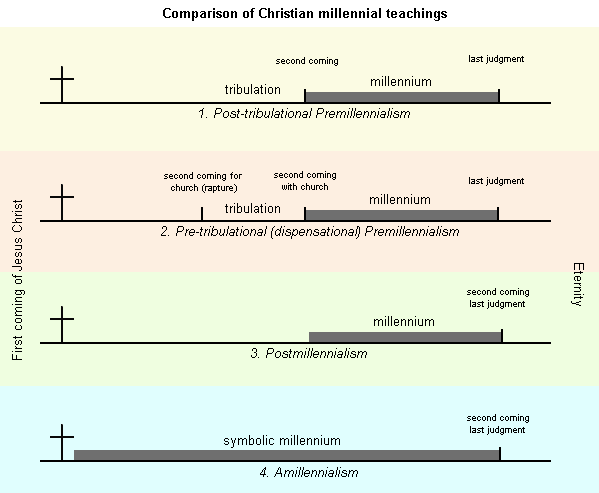
Epoch (reference date)
In the fields of chronology and periodization, an epoch is an instance in time chosen as the origin of a particular era. The "epoch" then serves as a reference point from which time is measured...
s known as dispensations
Dispensation (period)
In certain religions, a dispensation is a distinctive arrangement or period in history that forms the framework through which God relates to mankind.-Protestant dispensations:...
:
- of innocence (Gen 1:1–3:7), prior to Adam's fall;
- of conscience (Gen 3:8–8:22), Adam to Noah;
- of government (Gen 9:1–11:32), Noah to Abraham;
- of patriarchal rule (Gen 12:1–Exod 19:25), Abraham to Moses;
- of the Mosaic Law (Exod 20:1–Acts 2:4), Moses to Jesus;
- of grace (Acts 2:4–Rev 20:3), the current church age; and
- of a literal, earthly 1,000-year Millennial Kingdom that has yet to come (Rev 20:4–20:6).
A natural misunderstanding of Dispensationalism sees the covenant of Sinai (dispensation #5) to have been replaced by the gospel
Gospel
A gospel is an account, often written, that describes the life of Jesus of Nazareth. In a more general sense the term "gospel" may refer to the good news message of the New Testament. It is primarily used in reference to the four canonical gospels of Matthew, Mark, Luke, and John...
(dispensation #6). However, Dispensationalists believe that ethnic Israel, distinct from the church, and on the basis of the Sinai covenant, are featured in New Testament promises, which they interpret as referring to a future time associated with the Millennium of Revelation 20
Millennialism
Millennialism , or chiliasm in Greek, is a belief held by some Christian denominations that there will be a Golden Age or Paradise on Earth in which "Christ will reign" for 1000 years prior to the final judgment and future eternal state...
(dispensation #7). In Dispensational thought, although the time from Jesus' resurrection
Resurrection of Jesus
The Christian belief in the resurrection of Jesus states that Jesus returned to bodily life on the third day following his death by crucifixion. It is a key element of Christian faith and theology and part of the Nicene Creed: "On the third day he rose again in fulfillment of the Scriptures"...
until his return
Second Coming
In Christian doctrine, the Second Coming of Christ, the Second Advent, or the Parousia, is the anticipated return of Jesus Christ from Heaven, where he sits at the Right Hand of God, to Earth. This prophecy is found in the canonical gospels and in most Christian and Islamic eschatologies...
(or the advent of the Millennium) is dominated by the proclamation of the gospel, the Sinai covenant is neither terminated nor replaced, rather it is "quiescent" awaiting a fulfillment at the Millennium (click to expand diagram). This time of Jewish restoration has an especially prominent place within Dispensationalism.
Dispensationalists do not base this view on the New Testament alone, but consider that certain Old Testament prophecies
Prophecy
Prophecy is a process in which one or more messages that have been communicated to a prophet are then communicated to others. Such messages typically involve divine inspiration, interpretation, or revelation of conditioned events to come as well as testimonies or repeated revelations that the...
concerning Israel will also be fulfilled in a return to the Promised Land
Promised land
The Promised Land is a term used to describe the land promised or given by God, according to the Hebrew Bible, to the Israelites, the descendants of Jacob. The promise is firstly made to Abraham and then renewed to his son Isaac, and to Isaac's son Jacob , Abraham's grandson...
, and ultimately a large-scale conversion of the Jews to Christianity. Those who hold this view often note that the Bible does not promise that every individual Jew will be saved, but that the nation (or family) as a whole will be saved. It will still be up to individuals to accept Jesus as Messiah, but the nation as a whole will be blessed, because many (or most) will do so.
A distinctive feature of the dispensationalist scheme is that it conceives of the church age as primarily an arrangement through which God gathers in the Gentiles, a parenthesis in his dealing with the Jews, instituted due to many 1st century Jews having rejected the Messiah
Rejection of Jesus
The Canonical Gospels of the New Testament include some accounts of the rejection of Jesus in the course of his ministry. Judaism's view of Jesus, Jesus in Islam, and the view of the Historical Jesus all differ from Christian views of Jesus.-Hometown rejection:...
at his first coming
Ministry of Jesus
In the Christian gospels, the Ministry of Jesus begins with his Baptism in the countryside of Judea, near the River Jordan and ends in Jerusalem, following the Last Supper with his disciples. The Gospel of Luke states that Jesus was "about 30 years of age" at the start of his ministry...
.
- Romans : "Hence I ask, did they stumble so as to fall? Of course not! But through their transgression salvation has come to the Gentiles, so as to make them jealous. 12Now if their transgression is enrichment for the world, and if their diminished number is enrichment for the Gentiles, how much more their full number."
In the dispensationalist view, the Jewish restoration and acceptance of the Messiah will be as a people distinct from the Christian Church. Some believe the church will have actually ceased to exist on the earth at this time, having been removed by a miracle called the Rapture
Rapture
The rapture is a reference to the "being caught up" referred to in 1 Thessalonians 4:17, when the "dead in Christ" and "we who are alive and remain" will be caught up in the clouds to meet "the Lord"....
. Most dispensationalists believe that the 144,000 from the tribes of Israel, spoken of in the Book of Revelation
Book of Revelation
The Book of Revelation is the final book of the New Testament. The title came into usage from the first word of the book in Koine Greek: apokalupsis, meaning "unveiling" or "revelation"...
, are either the literal or symbolic number of ethnic Jews who will be followers of the Messiah during a Great Tribulation. In the meantime, dispensationalists typically hold that the promise "I will bless those who bless you, and him who dishonors you I will curse" (Genesis 12:3) has abiding reference to the Jewish people; and some apply this to the modern, political state of Israel
Israel
The State of Israel is a parliamentary republic located in the Middle East, along the eastern shore of the Mediterranean Sea...
. Such ideas are often used in support of Christian Zionism
Christian Zionism
Christian Zionism is a belief among some Christians that the return of the Jews to the Holy Land, and the establishment of the State of Israel in 1948, is in accordance with Biblical prophecy. It overlaps with, but is distinct from, the nineteenth century movement for the Restoration of the Jews...
.
With regard to supersessionism, then, Dispensationalism's key contribution to the history of Christian interpretation is this view that the fulfillment of God's covenant with Israel is postponed until the end of history
End times
The end time, end times, or end of days is a time period described in the eschatological writings in the three Abrahamic religions and in doomsday scenarios in various other non-Abrahamic religions...
. Traditional Christian interpretation, on the other hand, has seen the fulfillment of the covenant as progressive — starting with the apostles and early Jewish Christians and continuing throughout subsequent history in Messianic Judaism, until finally complete at the return of the Messiah. In either view, individual Jews are anticipated to accept Jesus as Messiah, and not by becoming Gentile Christians first, but directly on the basis of the original promises to ethnic Israel. Neither of these interpretations is, as such, viewing the promises to Israel as either terminated or replaced.
New Covenant Theology
By comparison New Covenant Theology (or NCT) is a recently expressed Christian theological system on this issue that incorporates aspects of DispensationalismDispensationalism
Dispensationalism is a nineteenth-century evangelical development based on a futurist biblical hermeneutic that sees a series of chronologically successive "dispensations" or periods in history in which God relates to human beings in different ways under different Biblical covenants.As a system,...
and Covenant Theology
Covenant Theology
Covenant theology is a conceptual overview and interpretive framework for understanding the overall flow of the Bible...
.
New Covenant Theology claims that all Old Covenant
Old Covenant
The Old Covenant was the name of the agreement which effected the union of Iceland and Norway. It is also known as Gissurarsáttmáli, named after Gissur Þorvaldsson, the Icelandic chieftain who worked to promote it. The name "Old Covenant", however, is probably due to historical confusion...
laws have been cancelled or abrogated in favor of the Law of Christ or New Covenant
New Covenant
The New Covenant is a concept originally derived from the Hebrew Bible. The term "New Covenant" is used in the Bible to refer to an epochal relationship of restoration and peace following a period of trial and judgment...
law. This can be summarized as the ethical expectation found in the New Testament
New Testament
The New Testament is the second major division of the Christian biblical canon, the first such division being the much longer Old Testament....
. Thus NCT don't accept supersessionism per se, as they see the Old Covenant itself as abrogated. Dispensationalism is similar to NCT, but New Covenant Theology may be still evolving a full system to better distinguish itself from Dispensationalism.
Roman Catholicism
Supersessionism is not the name of any official Roman CatholicRoman Catholic Church
The Catholic Church, also known as the Roman Catholic Church, is the world's largest Christian church, with over a billion members. Led by the Pope, it defines its mission as spreading the gospel of Jesus Christ, administering the sacraments and exercising charity...
doctrine and the word appears in no Church documents; however, the Catholic Church does officially teach that the Mosaic covenant was fulfilled and replaced by the New Covenant in Christ. Nevertheless, the Catholic Church does not teach that the Jewish people themselves are effectively irrelevant in terms of eschatology
Eschatology
Eschatology is a part of theology, philosophy, and futurology concerned with what are believed to be the final events in history, or the ultimate destiny of humanity, commonly referred to as the end of the world or the World to Come...
and Biblical prophecy (see: Avery Cardinal Dulles). For the Catholic Church, the Jewish people are a reminder that the “gifts and calling of God are irrevocable” (Rom 11:29). The Church recognizes an ongoing and unique relationship between the Jewish people, God and the Church. Additionally, the Church teaches that there is an integral continuity between the covenants rather than a rupture.
The Church’s teaching regarding the fulfillment and replacement of the Mosaic Covenant by the New Covenant in Christ can be found in the Scriptures, the Fathers and various Magisterial documents:
At a Jewish synagogue, St. Paul preached the following: “Let it be known to you therefore, brethren, that through this man forgiveness of sins is proclaimed to you, and by him every one that believes is freed from everything from which you could not be freed by the law of Moses.” (Acts 13:38–39) In the book of Hebrews, it is written: “On the one hand, a former commandment is set aside because of its weakness and uselessness (for the law made nothing perfect).” (Heb. 7:18)
St. Justin Martyr states in his dialogue with Trypho
Dialogue with Trypho
In the Dialogue with Trypho, Christian theologian Justin Martyr undertakes to show that Christianity is the new law for all men, and to prove from Scripture that Jesus is the Christ via a fictitious intellectual conversation between Justin and Trypho, a Jew...
the Jew, “We do not trust through Moses or through the law” because there is “a final law, and a covenant, the chiefest of all, which it is now incumbent on all men to observe,” and “law placed against law has abrogated that which is before it, and a covenant which comes after in like manner has put an end to the previous one.”
St. Augustine writes: “Instead of the grace of the law which has passed away, we have received the grace of the gospel which is abiding; and instead of the shadows and types of the old dispensation, the truth has come by Jesus Christ. Jeremiah also prophesied thus in God’s name: ‘Behold, the days come, says the Lord, that I will make a new covenant with the house of Israel, and with the house of Judah; not according to the covenant which I made with their fathers, in the day that I took them by the hand, to bring them out of the land of Egypt.’ [Jer 31:31–32] Observe what the prophet says, not to Gentiles, who had not been partakers in any former covenant, but to the Jewish nation. He who has given them the law by Moses, promises in place of it the new covenant of the gospel, that they might no longer live in the oldness of the letter, but in the newness of the spirit.” (Letters, 75, 4)
Pope Pius XII, enyclical Mystici corporis (1943) states: By the death of our Redeemer, the New Testament took the place of the Old Law which had been abolished; then the Law of Christ together with its mysteries, enactments, institutions, and sacred rites was ratified for the whole world in the blood of Jesus Christ. For, while our Divine Savior was preaching in a restricted area - He was not sent but to the sheep that were lost of the House of Israel - the Law and the Gospel were together in force; but on the gibbet of His death Jesus made void the Law with its decrees fastened the handwriting of the Old Testament to the Cross, establishing the New Testament in His blood shed for the whole human race. “To such an extent, then,” says St. Leo the Great, speaking of the Cross of our Lord, “was there effected a transfer from the Law to the Gospel, from the Synagogue to the Church, from the many sacrifices to one Victim, that, as Our Lord expired, that mystical veil which shut off the innermost part of the temple and its sacred secret was rent violently from top to bottom.” (paragraph 29)
In Lumen Gentium (1964), the Church stated that God “chose the race of Israel as a people” and “set up a covenant” with them, instructing them and making them holy. However, “all these things . . . were done by way of preparation and as a figure of that new and perfect covenant” instituted by and ratified in Christ (no. 9). In Notes on the Correct Way to Present the Jews and Judaism (1985), the Church stated that the “Church and Judaism cannot then be seen as two parallel ways of salvation and the Church must witness to Christ as the Redeemer of all.”
And in Dominus Iesus (2000), the Congregation for the Doctrine of the Faith states, “There is only one salvific economy” (no. 12), and “God has willed that the Church founded by him be the instrument for the salvation of all humanity. . . . The certainty of the universal salvific will of God does not diminish, but rather increases the duty and urgency of the proclamation of salvation and of conversion to the Lord Jesus Christ” (no. 22)
While acting as prefect for the Congregation for the Doctrine of the Faith, Pope Benedict XVI wrote: “God, according to the Prophet, will replace the broken Sinai covenant with a New Covenant that cannot be broken . . . . The conditional covenant, which depended on man’s faithful observance of the Law, is replaced by the unconditional covenant in which God binds himself irrevocably.”
Catholic theologian Brian Harrison has offered the following definition of "supersessionism" that he believes to comport with Catholic teaching:
- "What, then, is supersessionism? The word designates the traditional Christian belief that the covenant between God and the People of Israel, established through the mediation of Moses at Mount Sinai, has been replaced or superseded by the 'New Covenant' of Jesus Christ. This implies that the Mosaic covenant, with its ritual and dietary requirements, Sabbath observance, etc., is no longer valid for the Jewish people, since God’s revealed will is for Jews, as well as Gentiles, to enter into the New Covenant by baptism and faith in Jesus as the promised Messiah."
However, it should also be noted that the Vatican II document Lumen Gentium
Lumen Gentium
Lumen Gentium, the Dogmatic Constitution on the Church, is one of the principal documents of the Second Vatican Council. This dogmatic constitution was promulgated by Pope Paul VI on November 21, 1964, following approval by the assembled bishops by a vote of 2,151 to 5...
, introduced the idea that, although all salvation comes from Christ, those non-Christians "who through no fault of their own do not know the Gospel of Christ or His Church, yet sincerely seek God and moved by grace strive by their deeds to do His will as it is known to them through the dictates of conscience" may still attain salvation. Those outside of the formal boundaries of the Church may be considered inside the informal boundaries of the church, and hence saved, if their separation from the church is a result of invincible ignorance and if the people nevertheless try to love God and follow the laws that they understand to be His. As God alone is the judge and God alone knows the exact criteria, man has no way of knowing whether any individual has reached salvation through this “extraordinary” means. The statement "no salvation outside the church" has been clarified to mean that anyone who attains salvation, even if they are not Catholic (even if they do not believe in Catholicism), has attained salvation because of Jesus (who is tied to the church), and despite their personal non-Catholic religious beliefs. In other words, they may possibly attain salvation, not because of those beliefs that make their particular religion different from Catholicism (in the case of Islam, Judaism, etc.), but despite those different beliefs, through Jesus (and the church's) mercy. It is those beliefs such individuals hold that are in common with the Catholic faith along with a sincere response to the natural law
Natural law
Natural law, or the law of nature , is any system of law which is purportedly determined by nature, and thus universal. Classically, natural law refers to the use of reason to analyze human nature and deduce binding rules of moral behavior. Natural law is contrasted with the positive law Natural...
written on all men’s hearts that would aid toward the possibility of salvation in this circumstance. In such a case it is assumed that the individuals are implicitly part of the Church-but outside of its formal bounds-because the reason they are not Catholic (and would otherwise be Catholic) is through invincible ignorance (such as never hearing about Catholicism or being raised in an environment hostile to Catholicism or in a family of a different religion). Nevertheless, the possibility of such “extraordinary” salvation does not at all diminish the necessity of the Church for salvation. Explicit, visible membership in the Church through Baptism
Baptism
In Christianity, baptism is for the majority the rite of admission , almost invariably with the use of water, into the Christian Church generally and also membership of a particular church tradition...
is understood as the one certain means and path of salvation on earth for all men, as stated in Dominus Iesus (2000) and Redemportis Missio (1990):
“There is only one salvific economy” (no. 12), and “God has willed that the Church founded by him be the instrument for the salvation of all humanity. . . . The certainty of the universal salvific will of God does not diminish, but rather increases the duty and urgency of the proclamation of salvation and of conversion to the Lord Jesus Christ” (DI, no. 22)
The possibility of salvation for “followers of other religions . . . by Christ, apart from the ordinary means he has established does not thereby cancel the call to faith and baptism which God wills for all people . . . the Church is the ordinary means of salvation . . . she alone possesses the fullness of the means of salvation” (RM, no. 55).
Other views
Eastern Orthodox and Pentecostal groups, although quite different, have in common a focus on the work of the Holy SpiritHoly Spirit
Holy Spirit is a term introduced in English translations of the Hebrew Bible, but understood differently in the main Abrahamic religions.While the general concept of a "Spirit" that permeates the cosmos has been used in various religions Holy Spirit is a term introduced in English translations of...
in defining church membership. It has long been noted by theologians that pursuit of a dynamic, experiential and personal experience of faith has been typical of eastern theology, where legal and logical formulations have dominated in the Western churches. When articulated in formal ways, Orthodox theology looks very similar to Catholicism; Pentecostalism, on the other hand, is often associated with Dispensationalism. However, in practice, the focus on personal spirituality rather than intellectual assent, means detailed analysis of covenantal issues is considerably less a feature of these traditions.
A few groups assert that their group is literally descended from Abraham, and has a better claim to being considered the chosen people
Chosen people
Throughout history and even today various groups of people have considered themselves as chosen by a deity for some purpose such as to act as the deity's agent on earth. In monotheistic faiths, like Abrahamic religions, references to God are used in constructs such as "God's Chosen People"...
than the Jewish people. In adopting the identity of "the true Israel," they necessarily see the Jewish people as false Israel (see, for example, Anglo-Israelism, Christian Identity
Christian Identity
Christian Identity is a label applied to a wide variety of loosely affiliated believers and churches with a racialized theology. Many promote a Eurocentric interpretation of Christianity.According to Chester L...
and Black Hebrew Israelite, Abrahamic religions
Abrahamic religions
Abrahamic religions are the monotheistic faiths emphasizing and tracing their common origin to Abraham or recognizing a spiritual tradition identified with him...
).
Dual-covenant theology
Dual-covenant theology
Dual-covenant theology is a Liberal Christian view that holds that Jews may simply keep the Law of Moses, because of the "everlasting covenant" between Abraham and God expressed in the Hebrew Bible, whereas Gentiles must convert to Christianity or alternatively accept the Seven Laws of Noah...
is a Liberal Christian view that holds that Jews may simply keep the Law of Moses, because of the "everlasting covenant
Covenant (biblical)
A biblical covenant is an agreement found in the Bible between God and His people in which God makes specific promises and demands. It is the customary word used to translate the Hebrew word berith. It it is used in the Tanakh 286 times . All Abrahamic religions consider the Biblical covenant...
" between Abraham
Abraham
Abraham , whose birth name was Abram, is the eponym of the Abrahamic religions, among which are Judaism, Christianity and Islam...
and God
God
God is the English name given to a singular being in theistic and deistic religions who is either the sole deity in monotheism, or a single deity in polytheism....
expressed in the Hebrew Bible
Hebrew Bible
The Hebrew Bible is a term used by biblical scholars outside of Judaism to refer to the Tanakh , a canonical collection of Jewish texts, and the common textual antecedent of the several canonical editions of the Christian Old Testament...
, whereas Gentile
Gentile
The term Gentile refers to non-Israelite peoples or nations in English translations of the Bible....
s (those not Jews or Jewish proselytes) must convert to Christianity
Conversion to Christianity
Conversion to Christianity is the religious conversion of a previously non-Christian person to some form of Christianity. It has been called the foundational experience of Christian life...
or alternatively accept the Seven Laws of Noah.
Jewish view
From a Jewish perspective, however, the TorahTorah
Torah- A scroll containing the first five books of the BibleThe Torah , is name given by Jews to the first five books of the bible—Genesis , Exodus , Leviticus , Numbers and Deuteronomy Torah- A scroll containing the first five books of the BibleThe Torah , is name given by Jews to the first five...
was given to the Jewish people as an eternal covenant (for example ) and will never be replaced or added to (for example ), and hence Judaism
Judaism
Judaism ) is the "religion, philosophy, and way of life" of the Jewish people...
rejects supersessionism as contrary to the Hebrew Bible
Hebrew Bible
The Hebrew Bible is a term used by biblical scholars outside of Judaism to refer to the Tanakh , a canonical collection of Jewish texts, and the common textual antecedent of the several canonical editions of the Christian Old Testament...
at best (see also Antinomianism
Antinomianism
Antinomianism is defined as holding that, under the gospel dispensation of grace, moral law is of no use or obligation because faith alone is necessary to salvation....
) and antisemitic at worst. For Judaism and other critics, supersessionism is a theology of replacement, which substitutes the Christian church, consisting of Christians, for the Jewish
Conversion to Judaism
Conversion to Judaism is a formal act undertaken by a non-Jewish person who wishes to be recognised as a full member of the Jewish community. A Jewish conversion is both a religious act and an expression of association with the Jewish people...
and B'nei Noah
B'nei Noah
Noahidism is a Biblical-Talmudic and monotheistic ideology based on the Seven Laws of Noah. According to Jewish law, non-Jews are not obligated to convert to Judaism, but they are required to observe the Seven Laws of Noah to be assured of a place in the World to Come , the final reward of the...
people. Modern Jews are offended by the traditional Christian belief in supersessionism, and some historians see supersessionism as one source of anti-semitism in western culture.
Supersessionists understand their view as a theology of fulfillment in which no Jew who truly believes the Gospel is ever replaced and in which any unbelieving Jew (like Ahab
Ahab
Ahab or Ach'av or Achab in Douay-Rheims was king of Israel and the son and successor of Omri according to the Hebrew Bible. His wife was Jezebel....
or Judas Iscariot
Judas Iscariot
Judas Iscariot was, according to the New Testament, one of the twelve disciples of Jesus. He is best known for his betrayal of Jesus to the hands of the chief priests for 30 pieces of silver.-Etymology:...
) was never truly part of God's chosen people because he or she had never followed God. Even as Judaism anticipates its own fulfillment in a coming Jewish messiah
Jewish Messiah
Messiah, ; mashiah, moshiah, mashiach, or moshiach, is a term used in the Hebrew Bible to describe priests and kings, who were traditionally anointed with holy anointing oil as described in Exodus 30:22-25...
, Christianity claims that Jesus
Jesus
Jesus of Nazareth , commonly referred to as Jesus Christ or simply as Jesus or Christ, is the central figure of Christianity...
is the expected Jewish Messiah, that in Him the expectations of Israel were fulfilled, and that his Second Coming
Second Coming
In Christian doctrine, the Second Coming of Christ, the Second Advent, or the Parousia, is the anticipated return of Jesus Christ from Heaven, where he sits at the Right Hand of God, to Earth. This prophecy is found in the canonical gospels and in most Christian and Islamic eschatologies...
will be the final consummation of this hope, rather than a replacement for it.
Messianic Jewish View
Olive Tree Theology refers to a theological view introduced by David H. SternDavid H. Stern
Dr. David Harold Stern is an Israel-based theologian. He is the third son of Harold Stern and Marion Levi Stern.Stern's major work is the Complete Jewish Bible, his English translation of the Tanakh and New Testament...
, a Messianic Jewish theologian, which maintains that the Messianic Congregation (or Church) and Israel are part of same spiritual entity which is represented as an olive tree, having one common root stock with original growth and grafted-in branches from "wild stock" (gentiles) and "broken branches" (Jewish people who come to faith in Jesus). See Romans 11:16-24. It is different from both dispensationalism and supersessionism, which both make a distinction between Israel and the Church.
See also
- Covenant TheologyCovenant TheologyCovenant theology is a conceptual overview and interpretive framework for understanding the overall flow of the Bible...
- DispensationalismDispensationalismDispensationalism is a nineteenth-century evangelical development based on a futurist biblical hermeneutic that sees a series of chronologically successive "dispensations" or periods in history in which God relates to human beings in different ways under different Biblical covenants.As a system,...
- Olive Tree Theology
- Anti-JudaismAnti-JudaismReligious antisemitism is a form of antisemitism, which is the prejudice against, or hostility toward, the Jewish people based on hostility to Judaism and to Jews as a religious group...
- Christianity and Judaism
- Christian ZionismChristian ZionismChristian Zionism is a belief among some Christians that the return of the Jews to the Holy Land, and the establishment of the State of Israel in 1948, is in accordance with Biblical prophecy. It overlaps with, but is distinct from, the nineteenth century movement for the Restoration of the Jews...
- New CovenantNew CovenantThe New Covenant is a concept originally derived from the Hebrew Bible. The term "New Covenant" is used in the Bible to refer to an epochal relationship of restoration and peace following a period of trial and judgment...
- Old Testament#Christian views on Mosaic Law
- External Naskh (Abrogation)
- Christian-Jewish reconciliationChristian-Jewish reconciliationReconciliation between Christianity and Judaism refers to the efforts that are being made to improve understanding of the Jewish people and of Judaism, to do away with Christian antisemitism and Jewish anti-Christian sentiment...
- TahrifTahrifTaḥrīf is an Arabic term used by Muslims with regard to irreparable alterations Islamic tradition claims Jews and Christians have made to Biblical manuscripts, specifically those that make up the Tawrat , Zabur and Injil .Traditional Muslim scholars, based on Qur'anic and other traditions, maintain...
Further reading
- Vlach, Michael J. http://catalog.library.sebts.edu/ipac20/ipac.jsp?session=G094058P070A0.7126&profile=main&source=~!horizon&view=items&uri=full=3100001~!210593~!32&ri=65&aspect=basic_search&menu=search&ipp=20&spp=20&staffonly=&term=thesis+ph+d+Southeastern+Baptist+Theological+Seminary&index=.GW&uindex=&aspect=basic_search&menu=search&ri=65#focusThe Church as a Replacement of Israel: An Analysis of Supersessionism.] PhD Dissertation. Southeastern Baptist Theological SeminarySoutheastern Baptist Theological SeminarySoutheastern Baptist Theological Seminary is a seminary of the Southern Baptist Convention , created to meet a need in the SBC's East Coast region. It was voted into existence on May 19, 1950 at the SBC annual meeting and began offering classes in the fall of 1951 on the original campus of Wake...
, 2004. - Charles D. Provan. The Church Is Israel Now: The Transfer Of Conditional Privilege. ISBN 978-1-879998-39-1 (supports supersessionism)
- Calvin L. Smith, ed. The Jews, Modern Israel and the New Supercessionism: Resources for Christians (King's Divinity Press, 2009). ISBN 978-0-9562006-0-0 (challenges supersessionism)
External links
- Michael Forrest and David Palm, "All in the Family: Christians, Jews and God", Laywitness magazine, July–August, 2009. An article opposing "extreme" supersessionism and dual covenant theology.
- "Why Catholics for Israel?" an article by Catholics opposing supersessionism.
- Michael J. Vlach. Supersession Info Page (opposing supersessionism)
- "The Attacks of Replacement Theology" (opposing supersessionism)
- Mikael Knighton. "False Gospel: Supersessionism (Replacement Theology)" (opposing supersessionism)