
All Topics  
Sanhedrin


   Email Print
   Bookmark   Link


Sanhedrin


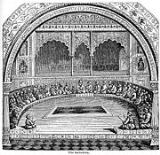
The Sanhedrin (; , synedrion, "sitting together," hence "assembly
Deliberative assembly

A deliberative assembly is an organization comprising members who use parliamentary procedure for making decisions....
" or "council") was an assembly of twenty-three judges appointed in every city in the Land of Israel
Land of Israel

For other uses, see Israel The Land of Israel is the region which, according to the Hebrew Bible, was promised by God to the descendants of Abraham through his son Isaac and to the Israelites, descendants of Jacob, Abraham's grandson....
.

The
Great Sanhedrin was the supreme court
Supreme court

A supreme court, also called a court of last resort or high court, is in some jurisdictions the highest court within that jurisdiction's court system, whose rulings are not subject to further review by another court....
 of ancient Israel. In total there were 71 members. The Great Sanhedrin was made up of a Chief/Prince/Leader called Nasi
Nasi

Nasi? is a Hebrew language title meaning prince, in Biblical Hebrew, or president, in Hebrew_language#Modern_Israeli_Hebrew....
 (at some times this position may have been held by the Cohen Gadol or the High Priest), a vice chief justice (Av Beit Din
Av Beit Din

Av Beit Din, Av Beis Din, or Av Beth Din . was the second-highest ranking member of the Sanhedrin during the Second Commonwealth period....
), and sixty-nine general members.


Discussion
Ask a question about 'Sanhedrin'
Start a new discussion about 'Sanhedrin'
Answer questions from other users
Full Discussion Forum


Encyclopedia


The Sanhedrin (; , synedrion, "sitting together," hence "assembly
Deliberative assembly

A deliberative assembly is an organization comprising members who use parliamentary procedure for making decisions....
" or "council") was an assembly of twenty-three judges appointed in every city in the Land of Israel
Land of Israel

For other uses, see Israel The Land of Israel is the region which, according to the Hebrew Bible, was promised by God to the descendants of Abraham through his son Isaac and to the Israelites, descendants of Jacob, Abraham's grandson....
.

The
Great Sanhedrin was the supreme court
Supreme court

A supreme court, also called a court of last resort or high court, is in some jurisdictions the highest court within that jurisdiction's court system, whose rulings are not subject to further review by another court....
 of ancient Israel. In total there were 71 members. The Great Sanhedrin was made up of a Chief/Prince/Leader called Nasi
Nasi

Nasi? is a Hebrew language title meaning prince, in Biblical Hebrew, or president, in Hebrew_language#Modern_Israeli_Hebrew....
 (at some times this position may have been held by the Cohen Gadol or the High Priest), a vice chief justice (Av Beit Din
Av Beit Din

Av Beit Din, Av Beis Din, or Av Beth Din . was the second-highest ranking member of the Sanhedrin during the Second Commonwealth period....
), and sixty-nine general members. In the Second Temple period, the Great Sanhedrin met in the Hall of Hewn Stones
Hall of Hewn Stones

The Hall of Hewn Stones was the meeting place of the Sanhedrin during the Second Temple period. The Talmud deduces that it was built into the north wall of the Temple in Jerusalem, half inside the sanctuary and half outside, with doors providing access both to the temple and to the outside....
 in the Temple in Jerusalem
Jerusalem

Jerusalem is the capital of Israel and its List of Israeli cities in both population and area, with a population of 747,600 residents over an area of if Positions on Jerusalem East Jerusalem is included....
. The court convened every day except festivals and Shabbat
Shabbat

Shabbat or Shabbos , is the weekly day of rest in Judaism, symbolizing the seventh day in Genesis, after the six days of creation. Though it is commonly said to be the Saturday of each week, it is observed from sundown on Friday until the appearance of three stars in the sky on Saturday night....
. In the late 3rd century, to avoid persecution, its authoritative decisions were issued under the name of
Beth HaMidrash.

The last binding decision of the Sanhedrin was in 358, when the Hebrew Calendar
Hebrew calendar

The Hebrew calendar or Jewish calendar is a lunisolar calendar used by Jews, now predominantly for religious purposes. It is used to reckon the Jewish New Year and dates for Jewish holidays, and also to determine appropriate Torah reading of Torah portions, Yahrzeits , and daily Psalm reading, among many ceremonial uses....
 was adopted. The Sanhedrin was dissolved after continued persecution by the Roman Empire
Roman Empire

The Roman Empire was the Roman Republic phase of the Ancient Rome, characterised by an autocracy form of government and large territorial holdings in Europe and around the Mediterranean....
. Over the centuries, there have been attempts to revive the institution, such as the European Sanhedrin convened by Napoleon Bonaparte.

The Sanhedrin is mentioned in The Gospels in relation to the Sanhedrin Trial of Jesus
Sanhedrin Trial of Jesus

The Sanhedrin Trial of Jesus is an event reported by all the Biblical canon Gospels of the Bible. These accounts report that after Jesus Christ and his followers celebrated Passover as their Last Supper, Jesus was betrayed by his Twelve apostles Judas Iscariot, and Arrest of Jesus in the Garden of Gethsemane ....
.

Origins and etymology

The term Sanhedrin is Greek and dates from the Hellenistic period, but the concept is one that goes back to the Bible
Bible

The Bible is the central religious text of Judaism and Christianity. The exact Books of the Bible is dependent on the religious traditions of specific denominations....
. In the Torah, God commands Moses to "Assemble for Me ["Espah-Li"] seventy men of the elders of Israel, whom you know to be the people's elders and officers, and you shall take them to the Tent of Meeting, and they shall stand there with you."

Further, God commanded Moses to lay hands on Joshua
Joshua

Joshua, Jehoshuah or Yehoshua , born in Egypt, was a biblical Israelite leader who succeeded Moses. His story is told in the Hebrew Bible, chiefly in the books Book of Exodus, Book of Numbers and Book of Joshua....
 son of Nun. It is from this point, classical Rabbinic tradition holds, the Sanhedrin began: with seventy elders, headed by Moses, for a total of seventy-one. As individuals within the Sanhedrin died, or otherwise became unfit for service, new members underwent ordination, or Semicha
Semicha

Semicha , also semichut , or semicha lerabbanut is derived from a Hebrew word which means to "rely on" or "to be authorized". It generally refers to the ordination of a rabbi within Judaism....
. These ordinations continued, in an unbroken line: from Moses to Joshua, the Israelite
Israelite

According to the Tanakh, the Israelites were the descendants of the Biblical patriarch Jacob. They were divided into twelve tribes, each descended from one of twelve sons or grandsons of Jacob....
 elders, the prophets
Nevi'im

Nevi'im is the second of the three major sections in the Hebrew Bible, the Tanakh, between the Torah and Ketuvim .Nevi'im is traditionally divided into two parts:...
 (including Ezra
Ezra

Ezra was a Jewish priestly scribe who led about 5,000 Babylonian captivity living in Babylon to their home city of Jerusalem in 459 BC. Ezra reconstituted the dispersed Jewish community on the basis of the Torah and with an emphasis on the law....
, Nehemiah) on to all the sages of the Sanhedrin
Tannaim

The Tannaim were the Rabbinic sages whose views are recorded in the Mishnah, from approximately 70-200 CE. The period of the Tannaim, also referred to as the Mishnaic period, lasted about 130 years....
.It was in the year 191 BCE that the sanhedrin was established. It was not until sometime after the destruction of the Second Temple
Second Temple

The Second Temple was the reconstructed Temple in Jerusalem which stood between 516 BCE and 70 CE. During this time, it was the center of Judaism worship, which focused on the sacrifices known as the korbanot....
 the Sanhedrin dissolved.

Jewish tradition proposes non-Greek derivations of the term Sanhedrin. P'siqta D'Rav Kahana
Pesikta de-Rav Kahana

Pesikta de-Rab Kahana is a collection of Aggadic midrash which exists in two editions, those of Solomon Buber and Bernard Mandelbaum . It is cited in the Aruk and by Rashi....
 (chapter 25) teaches that the first letter of the word, sin
Hebrew alphabet

The Hebrew alphabet consists of 22 letters used for writing the Hebrew language. Five of these letters have a different form when appearing as the last letter in a word....
, referring to the Torah
Torah

The term "Torah" , or Five Books of Moses or Pentateuch, refers to the entirety of Judaism's founding Halakha and ethical religious texts....
 that was received at Mount Sin-ai, was combined with the second part of the word, hadrin, meaning, "glorification," to express the Great Court's role, the glorification of God's Torah through its application. Rabbi Ovadia Bartenura suggests an alternative meaning, also taking the term as a combination of two words to mean "son'im hadarath pan'im b'din," "foes (opposing litigants) give respect and honor to its judgment." Other commentators confirm his interpretation, suggesting further that the first letter was changed from "sin" to "samekh," at a later date.

Early Sanhedrin

The Hasmonean court in the Land of Israel
Land of Israel

For other uses, see Israel The Land of Israel is the region which, according to the Hebrew Bible, was promised by God to the descendants of Abraham through his son Isaac and to the Israelites, descendants of Jacob, Abraham's grandson....
, presided over by Alexander Jannaeus
Alexander Jannaeus

Alexander Jannaeus , king of Judea from , son of John Hyrcanus, inherited the throne from his brother Aristobulus, and appears to have married his brother's widow, Shlomtzion or "Shelomit", also known as Salome Alexandra, according to the Biblical law of Yibum , although Josephus is inexplicit on that point....
, king of Judea until 76 BCE, followed by his wife, Salome Alexandra
Salome Alexandra

Salome Alexandra or Alexandra of Jerusalem , was the only Jewish Queen regnant, with the exception of her own husband's mother whom he had prevented from ruling as his dying father had wished, and of the much earlier usurper Athaliah....
 in 76 or 75 BCE, bore all the trappings of Hellenistic royalty: ministers, courtiers, a bureaucracy and bodyguards. The former Council of Elders was renamed Synhedrion or Sanhedrin. The exact nature of this early Sanhedrin is not clear. It may have been a body of sages and/or priests, or a political, legislative and judicial institution. Only after the destruction of the Second Temple was the Sanhedrin made up only of sages.

Great and Lesser Sanhedrin

The Talmud (tractate Sanhedrin
Sanhedrin (Talmud)

Sanhedrin is one of ten tractates of the Nezikin . The Gemara of the tractate is noteworthy as precursors to the development of common law principles ....
) identifies two classes of rabbinical courts called Sanhedrin, a Great Sanhedrin and a Lesser Sanhedrin. Each city could have its own lesser Sanhedrin of 23 judges, but there could be only one Great Sanhedrin of 71 (in where), which among other roles acted as a sort of Supreme Court, taking appeals from cases decided by lesser courts.

Function and procedures

The Sanhedrin as a body claimed powers that lesser Jewish courts did not have. As such, they were the only ones who could try the king, extend the boundaries of the Temple and Jerusalem, and were the ones to whom all questions of law were finally put.

Before 191 BCE the High Priest
Kohen Gadol

Kohen Gadol or Kohen ha-Gadol is the title of wiktionary:High Priest of early Israelite religion and of Classical Age Judaism from the rise of the Israelite nation until the destruction of the Second Temple of Jerusalem....
 acted as the ex officio head of the Sanhedrin, but in 191 BCE, when the Sanhedrin lost confidence in the High Priest, the office of Nasi
Nasi

Nasi? is a Hebrew language title meaning prince, in Biblical Hebrew, or president, in Hebrew_language#Modern_Israeli_Hebrew....
 was created. After the time of Hillel the Elder
Hillel the Elder

Hillel was a famous Jewish religious leader, one of the most important figures in Jewish history. He is associated with the development of the Mishnah and the Talmud....
 (late 1st century BCE and early 1st century CE), the Nasi was almost invariably a descendant of Hillel. The second highest-ranking member of the Sanhedrin was called the Av Beit Din
Av Beit Din

Av Beit Din, Av Beis Din, or Av Beth Din . was the second-highest ranking member of the Sanhedrin during the Second Commonwealth period....
, or "Head of the Court" (literally, Beit Din = "house of law"), who presided over the Sanhedrin when it sat as a criminal court.

The Sanhedrin met in a building known as the Hall of Hewn Stones
Hall of Hewn Stones

The Hall of Hewn Stones was the meeting place of the Sanhedrin during the Second Temple period. The Talmud deduces that it was built into the north wall of the Temple in Jerusalem, half inside the sanctuary and half outside, with doors providing access both to the temple and to the outside....
 (Lishkat Ha-Gazith), which has been placed by the Talmud and many scholars as built into the north wall of the Temple Mount
Temple Mount

The Temple Mount , also known as Mount Moriah and by Muslims as the Noble Sanctuary , is a religious site in the Old City of Jerusalem of Jerusalem....
, half inside the sanctuary and half outside, with doors providing access both to the Temple and to the outside. The name presumably arises to distinguish it from the buildings in the Temple complex used for ritual purposes, which had to be constructed of stones unhewn by any iron
Iron

Iron is a chemical element with the symbol Fe and atomic number 26. Iron is a Group 8 element and period 4 element. Iron is lustrous and silvery in color....
 implements.

In some cases, it was only necessary for a 23-member panel (functioning as a Lesser Sanhedrin) to convene. In general, the full panel of 71 judges was only convened on matters of national significance (e.g., a declaration of war) or in the event that the 23-member panel could not reach a conclusive verdict.

Sanhedrin in Christianity


In the Gospels


The Sanhedrin is mentioned frequently in the Gospels. According to the Gospels, the council conspired to have Jesus
Jesus

Jesus of Nazareth , also known as Jesus Christ, is the central figure of Christianity and is revered by most Christian churches as the Son of God and the Incarnation ....
 killed by paying one of his disciples, Judas Iscariot
Judas Iscariot

'Judas Iscariot', "Yehuda" was, according to the New Testament, one of the twelve original Twelve Apostles of Jesus. Among the twelve, he was apparently designated to keep account of the "accountant" , but he is most traditionally known for his role in Jesus' betrayal into the hands of Roman authorities....
, thirty pieces of silver in exchange for delivery of Jesus
Jesus

Jesus of Nazareth , also known as Jesus Christ, is the central figure of Christianity and is revered by most Christian churches as the Son of God and the Incarnation ....
 into their hands. When the Sanhedrin was unable to provide evidence that Jesus had committed a capital crime, the Gospels state that witnesses came forward and accused the Nazarene of blasphemy
Blasphemy

Blasphemy is the disrespectful use of the name of one or more Deity. It may include using sacred names as stress expletives without intention to pray or speak of sacred matters; it is also sometimes defined as language expressing disapproved beliefs, or disbelief....
 — a capital crime under Mosaic law
List of capital crimes in the bible

According to the Torah , these are the offenses which may merit the death penalty in a Judaism major beit din of 23 judges.Religious practices...
. But, because the Sanhedrin was not of Roman authority, it could not condemn criminals to death, according to . This did not prevent them from doing so at other times; records them ordering the stoning of Saint Stephen
Saint Stephen

Saint Stephen , known as the Protomartyr of Christianity, is venerated as a saint in the Roman Catholic Church and Eastern Orthodox Churches....
 and also Jesus half-brother, James the Just
James the Just

Saint James the Just , , also known as James of Jerusalem, James Adelphotheos, James, the Brother of the Lord, was an important figure in Early Christianity....
 according to Antiquities of the Jews
Antiquities of the Jews

Antiquities of the Jews was a work published by the important Jewish historian Josephus about the year 93 or 94. Antiquities of the Jews is a Jewish history, written in Greek language for Josephus' gentile patrons....
 .

Circa 30
30

Year 30 was a common year starting on Sunday of the Julian calendar....
, the Gospels continue, Jesus was brought before the Roman governor of Iudaea Province
Iudaea Province

Iudaea was a Roman province that extended over the former region of the Hasmonean and Herodian kingdoms of Israel. It was named after the tetrarchy of Judea of which it was an expansion, the latter name deriving from the Kingdom of Judah of the 6th century BCE....
, Pontius Pilate
Pontius Pilate

Pontius Pilate was the Roman_governor#Equestrian_procurator of the Roman Empire Iudaea Province from the year AD 26 until AD 36. He is typically known as the sixth Procurator of Judea, but some sources cite him as the fifth....
, for decision. The Christian account says that Pilate disagreed with the Sanhedrin's decision, and found no fault — but that the crowd demanded crucifixion. Pilate, it is speculated, gave in because he was concerned about his career and about revolt — and conveyed the death sentence of crucifixion on Jesus. For more information on this subject, see Jesus' Roman Trial.

The New Testament also claims certain members of the Sanhedrin as followers of Jesus. Nicodemus
Nicodemus

Nicodemus was a Pharisee and a member of the Sanhedrin, who, according to the Gospel of John, showed favour to Jesus. He appears three times in the Gospel: the first is when he visits Jesus one night to listen to his teachings ; the second is when he states the law concerning the arrest of Jesus during the Sukkot ; and the last follows the...
 and Joseph of Arimathea
Joseph of Arimathea

Joseph of Arimathea was, according to the Gospels, the man who donated his own prepared sepulchre for the burial of Jesus after Jesus' Crucifixion of Jesus....
 are two such men that are named in the Gospel
Gospel

In Christianity, a gospel is generally one of the first four books of the New Testament that describe the birth, life, ministry, crucifixion, and resurrection of Jesus....
s.

The Christian accounts of the Sanhedrin, and the role the council played in the crucifixion
Crucifixion

Crucifixion is an ancient method of execution , whereby the condemned person is tied or nailed to a large wooden cross and left to hang until dead....
 of Jesus, is frequently cited as a cause of Christian anti-Semitism
Christianity and anti-Semitism

Although Christian antisemitism is considered to have started around the 12th century, its roots are attributed by some scholars to Anti-Judaism attitudes and polemic beginning with Early Christianity....
, and is thus normally considered a sensitive topic.

A Sanhedrin also appears in and , perhaps the one led by Gamaliel
Gamaliel

Gamaliel the Elder , or Rabbi Gamaliel I, was a leading authority in the Sanhedrin in the mid first century. He was the grandson of the great Jewish teacher Hillel the Elder, and died twenty years before First Jewish-Roman War of the second temple in Jerusalem....
.

Opposition to Christian historical accounts

Although the New Testament
New Testament

The New Testament is the name given to the second major division of the Christianity Bible, the first such division being the much longer Old Testament....
's account of the Sanhedrin's involvement in Jesus' crucifixion is detailed, the factual accuracy is disputed. Some scholars believe that these passages present a caricature of the Pharisees and were not written during Jesus' lifetime but rather some time after the destruction of the Temple in 70
70

Year 70 was a common year starting on Monday of the Julian calendar....
 - a time when it had become clear that most Jews did not consider Jesus to be the Jewish Messiah
Jewish Messiah

Messiah In Jewish eschatology, the term came to refer to a future Jewish monarch from the Davidic line, who will be "anointed" with holy anointing oil and rule the Jewish people during the Messianic Age....
, see also Rejection of Jesus
Rejection of Jesus

Jesus was and continues to be rejected by the Jewish people as a failed Jewish Messiah claimants. The Synoptic Gospels and the Gospel of John also record some rejection of Jesus in the course of his Ministry of Jesus....
. Also, this was a time Christians sought most new converts from among the Gentiles - thus adding to the likelihood that the New Testament's account would be more sympathetic to Romans than to the Jews. In addition, it was around this time that the Pharisaic sect had begun to grow into what is now known as Rabbinic Judaism
Rabbinic Judaism

Rabbinic Judaism or Rabbinism is the mainstream religious system of post-Jewish diaspora Judaism. It evolved after the destruction of the Second Temple in 70 CE by the Roman Empire, when it became impossible to practice the religious customs and Korban that were at that time central to Jewish observance....
, a growth that would have been seen by the early Christians as a direct challenge to the fledgling Church.

Some claim that the New Testament portrays the Sanhedrin as a corrupt group of Pharisees
Pharisees

The word Pharisees comes from the Hebrew language ?????? perushim from ???? parush, meaning "separated" . The Pharisees were, depending on the time, a political party, a social movement, and a school of thought among Jews that flourished during the Second Temple Era ....
, although it was predominantly made up of Sadducees
Sadducees

The Sadducees were members of a Jewish sect and were rivals of the Pharisees , founded in the 2nd century BC. They ceased to exist sometime after the destruction of the second Temple in Jerusalem in 70AD....
 at the time. This does not agree with the New Testament in which the Sanhedrin's leadership - Annas
Annas

Annas , son of Seth, was a Judaism List of High Priests of Israel from AD 6 to 15 and remained an influential leader afterwards.Annas was appointed High Priest in AD 6 by the Roman legate Quirinius just after the Romans had deposed Herod Archelaus, Ethnarch of Judaea, thereby putting Judaea directly under Roman rule as part of Iudaea Provin...
 and Caiaphas
Caiaphas

Yosef Bar Kayafa , also known simply as Caiaphas in the New Testament, was the Roman Empire-appointed Judaism List of High Priests of Israel between AD 18 and 37....
 were Sadducees. The Gospels also consistently make a distinction between the Pharisees and "the elders," "the teachers of the law," and "the rulers of the people."

The opposition continues by saying that in order for the Christian leaders of the time to present Christianity as the legitimate heir to the Hebrew Scriptures
Tanakh

The Tanakh is the Bible used in Judaism. The name "Tanakh" is a Hebrew language Acronym and initialism formed from the initial Hebrew alphabet of the Tanakh's three traditional subdivisions: The Torah , Nevi'im and Ketuvim - hence TaNaKh....
, they had to devalue Rabbinic Judaism. In addition to the New Testament, other Christian
Christian

A Christian is a person who adheres to Christianity, a Monotheism#Christian view religion centered on the life and teachings of Jesus and interpreted by Christians to have been prophesied in the Hebrew Bible/Old Testament....
 writings relate that the Apostles Peter
Saint Peter

Saint Peter was a leader of the early Christianity church, who features prominently in the New Testament Gospels and the Acts of the Apostles....
, John
John the Apostle

John the Apostle was one of the Twelve Apostles of Jesus. Christian tradition identifies him as the author of several New Testament works: the Gospel of John, the Epistles of John, and the Book of Revelation....
, and Paul
Paul of Tarsus

Saint Paul, also called Paul the Apostle, the Apostle Paul or Paul of Tarsus , was a Hellenistic Judaism, who called himself the "Apostle to the Gentiles", and was, together with Saint Peter and James the Just, the most notable of early Christian missionaries....
, as well as Stephen
Saint Stephen

Saint Stephen , known as the Protomartyr of Christianity, is venerated as a saint in the Roman Catholic Church and Eastern Orthodox Churches....
 (one of the first deacons), were all brought before the Sanhedrin for the blasphemous crime--from the Jewish perspective--of spreading their Gospel. Others point out that this is speculative. However, the Gospels exist, and they do give an account of events that happened well before the destruction of the Temple in 70, although many scholars consider them to have been penned after the Temple was destroyed (however, see Gospel of Mark
Gospel of Mark

The Gospel of Mark is the second of the four canonical gospels in the New Testament and was probably the first of the three synoptic gospels to be written....
 and Gospel of Matthew
Gospel of Matthew

The Gospel of Matthew is one of the four canonical gospels in the New Testament and is a synoptic gospel. It narrates an account of the New Testament view on Jesus' life and Ministry of Jesus of Jesus of Nazareth....
 for views on earlier historical dating). Those scholars may believe them to have been based on earlier sources, rather than giving a first-person account; though the Gospels are not entirely dismissed, they are presumed to be biased rather than factual.

However, Streeter and others of the Tuebingen school hold that Christian New Testament writings which discuss the Sanhedrin actually may date much earlier than previously thought, so supporters claim that the NT accounts quite possibly are more accurate than thought heretofore.

According to Jewish law, it is forbidden to convene a court of justice on a holy day, such as Pesach (Passover), making it highly unusual that religious Jews would have come together to hand down a death sentence on the stated day.

According to the gospel of Matthew however, (considered by some to have been a religious Jew) the religious authorities in that time might have been sufficiently agitated to make them break their own rules and judge him even on the feast of Passover (Pesach); according to the gospel, Jesus was a very popular figure among the ordinary people, and he publicly dismissed the Pharisees as hypocrites (Matthew 15:12-14). In Jesus' time, the Sanhedrin was the highest Jewish authority, as the Roman empire occupied the land at the time, and it was exerting the highest authority in every field except in religious legislature - this was left to the Sanhedrin. Christians as well as Jewish believers in Jesus' message say this is also in line with the history of Pesach, which was, in their vision, the historical predecessor of the death and resurrection of Jesus, being the fulfillment of Pesach. The transition of being delivered out of a land of slavery into freedom (Exodus 3:7-10) is being paralleled by them to being delivered from a life of sin into holiness (Colossians 1:13-14).

Additionally, Josephus
Josephus

Josephus , also known as Yosef Ben Matityahu and, after he became a Roman citizenship, as Titus Flavius Josephus, was a first-century Jewish historian and apologist of priestly and royal ancestry who survived and recorded the destruction of Jerusalem in AD 70....
 seems to imply that there was a 'political' sanhedrin of Sadducee collaborators with the Roman rule of Iudaea province
Iudaea Province

Iudaea was a Roman province that extended over the former region of the Hasmonean and Herodian kingdoms of Israel. It was named after the tetrarchy of Judea of which it was an expansion, the latter name deriving from the Kingdom of Judah of the 6th century BCE....
. Since proclaiming oneself Moshiach is not forbidden under halakha (there were many springing up at the time), but was illegal under
Roman law as a challenge to imperial authority, perhaps this may be a more likely alternative. However, cites the religious Sanhedrin using this argument to sway Pilate.

Hyam Maccoby
Hyam Maccoby

Hyam Maccoby was a United Kingdom Jewish scholar and dramatist specializing in the study of the Jewish and Christianity religious tradition.In retirement he moved to Leeds, where he held an academic position at the Centre for Jewish Studies, University of Leeds....
's book "The Mythmaker" presents an interesting account of a different historical interpretation.

Dissolution

See also: Council of Jamnia
Council of Jamnia

The Council of Jamnia or Council of Yavne is a hypothetical 1st century council at which it is postulated the Development of the Jewish Bible canon was defined....
Ancient Galilee
By the end of the Second Temple
Second Temple

The Second Temple was the reconstructed Temple in Jerusalem which stood between 516 BCE and 70 CE. During this time, it was the center of Judaism worship, which focused on the sacrifices known as the korbanot....
 period, the Sanhedrin achieved its quintessential position, legislating on all aspects of Jewish religious and political life within the parameters laid down by Biblical and Rabbinic tradition.

After the destruction of the Second Temple in 70, the Sanhedrin was re-established in Yavneh with reduced authority. The imperial Roman government and legislation still recognized it as the ultimate authority in Jewish religious matters.

It moved to Usha under the presidency of Gamaliel II
Shimon ben Gamliel

Shimon ben Gamliel was a Tannaim sage and leader of the Jewish people. He succeeded his father Gamliel I as the Nasi of the Sanhedrin after his father's death in 50 CE and just before the destruction of the Second Temple....
 in 80. In 116 it moved back to Yavneh, and again back to Usha. It moved in 140 to Shefaram
Shefa-'Amr

Shefa-'Amr, also Shfar'am is a city in the North District of Israel in Israel. According to the Israel Central Bureau of Statistics , at the end of 2006 the city had a population of 34,100....
 under the presidency of Shimon ben Gamliel II
Shimon ben Gamliel II

Shimon ben Gamliel II was a Tannaim of the third generation and president of the Great Sanhedrin. Shimon was a youth in Betar when the Bar Kokhba revolt broke out, but when that fortress was taken by the Romans he managed to escape the massacre ....
, and to Beth Shearim and Sephoris in 163, under the presidency of Yehudah I. Finally, it moved to Tiberias
Tiberias

Tiberias is a town on the western shore of the Sea of Galilee, Lower Galilee, Israel. It was named in honour of the emperor Tiberius....
 in 193, under the presidency of Gamaliel III
Gamaliel III

Gamaliel III was the son of Rabbi Judah haNasi , who appointed him his successor as nasi. Little certain is known about his activities, but it is likely that the revision of the Mishnah was completed during his era....
 (193-220) ben Judah haNasi
Judah haNasi

Rabbi Judah haNasi, , also known as "Rabbi" and "Rabeinu HaKadosh" , was a key leader of the Jewish community of Judea toward the end of the 2nd century CE, during the occupation by the Roman Empire....
, where it became more of a consistory, but still retained, under the presidency of Judah II
Judah II

Judah II was a famous Jewish sage who lived in Tiberias in the Land of Israel, in the middle of the third century CE. He is mentioned in the classical works of Judaism's oral law, the Mishnah and Talmud....
 (220-270), the power of excommunication.

During the presidency of Gamaliel IV
Gamaliel IV

Gamaliel IV was and father of Judah III.Gamaliel was the president of the Sanhedrin between 270 and 290 CE. However, due to persecution of an increasingly Christianized Rome, during his presidency the name Sanhedrin was dropped and its authoritative decisions were subsequently issued under the name Yeshiva....
 (270-290), due to persecution of an increasingly Christian
Christian

A Christian is a person who adheres to Christianity, a Monotheism#Christian view religion centered on the life and teachings of Jesus and interpreted by Christians to have been prophesied in the Hebrew Bible/Old Testament....
ized Rome, it dropped the name Sanhedrin, and its authoritative decisions were subsequently issued under the name of
Beth HaMidrash
Yeshiva

Yeshiva or yeshivah , or metivta or mesivta ) also frequently referred to as a Beth midrash, Talmudical Academy, Rabbinical Academy or Rabbinical School is an institution unique to classical Judaism for Torah study, the study of Talmud, Rabbinic literature and History of responsa....
.

As a reaction to the emperor Julian
Julian the Apostate

Flavius Claudius Julianus, known also as Julian or Julian the Apostate , was Roman Emperor of the Constantinian dynasty. He was the last non-Christian Roman Emperor, and expended much energy during his reign attempting to supplant the growing power of Christianity within the empire with officially revived Religion in ancient Rom...
's pro-Jewish stance, Theodosius I
Theodosius I

Flavius Theodosius , also called Theodosius I and Theodosius the Great , was Roman Emperor from 379 to 395. Reuniting the eastern and western portions of the empire, Theodosius was the last emperor of both the Eastern Roman Empire and Western Roman Empire....
 forbade the Sanhedrin to assemble and declared ordination
Semicha

Semicha , also semichut , or semicha lerabbanut is derived from a Hebrew word which means to "rely on" or "to be authorized". It generally refers to the ordination of a rabbi within Judaism....
 illegal. (Roman law prescribed capital punishment for any Rabbi who received ordination and complete destruction of the town where the ordination occurred).

However, since the Hebrew calendar
Hebrew calendar

The Hebrew calendar or Jewish calendar is a lunisolar calendar used by Jews, now predominantly for religious purposes. It is used to reckon the Jewish New Year and dates for Jewish holidays, and also to determine appropriate Torah reading of Torah portions, Yahrzeits , and daily Psalm reading, among many ceremonial uses....
 was based on witnesses' testimony, that had become far too dangerous to collect, Hillel II
Hillel II

Hillel II, also known simply as Hillel held the office of Nasi of the ancient Jewish Sanhedrin between 320 and 385 CE. He was the son and successor of Judah III....
 recommended change to a mathematically-based calendar that was adopted at a clandestine, and maybe final, meeting in 358. This marked the last universal decision made by that body.

Gamaliel VI
Gamaliel VI

Gamaliel VI was the last Nasi of the ancient Jewish Sanhedrin. He was executed in 425 at the orders of the Eastern Roman Empire Theodosius II for authorizing the building of new synagogues....
 (400-425) was the Sanhedrin's last president. With his death in 425, executed by Theodosius II
Theodosius II

Flavius Theodosius , called the Calligrapher, known in English as Theodosius II, was an Eastern Roman Empire , mostly known for the law code bearing his name, the Codex Theodosianus, and the Walls of Constantinople#The Theodosian Walls of Constantinople built during his reign....
 for erecting new synagogues contrary to the imperial decree, the title Nasi
Nasi

Nasi? is a Hebrew language title meaning prince, in Biblical Hebrew, or president, in Hebrew_language#Modern_Israeli_Hebrew....
, the last remains of the ancient Sanhedrin, became illegal. An imperial decree of 426 diverted the patriarchs' tax (
post excessum patriarchorum) into the imperial treasury.

Revival attempts

See also: Attempts to revive classical semicha
Semicha

Semicha , also semichut , or semicha lerabbanut is derived from a Hebrew word which means to "rely on" or "to be authorized". It generally refers to the ordination of a rabbi within Judaism....


The Sanhedrin is seen as the last institution which commanded universal Jewish authority among the Jewish people in the long chain of tradition from Moses
Moses

Moses is a Hebrew Bible Hebrews religious leader, lawgiver, prophet, to whom the Mosaic authorship of the Torah is traditionally attributed. Also called Moshe Rabbeinu in Hebrew , he is the most important prophet in Judaism, and also an important prophet of Christianity, Islam, the Bah?'? Faith, Rastafari movement, Chrislam and many ot...
 until the present day. Since its dissolution in 358 by imperial decree, there have been several attempts to re-establish this body either as a self-governing body, or as a puppet of a sovereign government.

There are records of what may have been of attempts to reform the Sanhedrin in Arabia , in Jerusalem under the Caliph 'Umar, and in Babylon (Iraq), but none of these attempts were given any attention by Rabbinic authorities and little information is available about them.

Napoleon Bonaparte's "Grand Sanhedrin"


The "Grand Sanhedrin" was a Jewish high court convened by Napoleon I to give legal sanction to the principles expressed by the Assembly of Notables
Assembly of Notables

The Assembly of Notables was of a group of notables invited by the King of France to discuss reform of the government....
 in answer to the twelve questions submitted to it by the government (see Jew. Encyc. v. 468, s.v. France).

On October 6, 1806, the Assembly of Notables issued a proclamation to all the Jewish communities of Europe, inviting them to send delegates to the Sanhedrin, to convene on October 20. This proclamation, written in Hebrew, French, German, and Italian, speaks in extravagant terms of the importance of this revived institution and of the greatness of its imperial protector. While the action of Napoleon aroused in many Jews of Germany the hope that, influenced by it, their governments also would grant them the rights of citizenship, others looked upon it as a political contrivance. When in the war against Prussia (1806-7) the emperor invaded Poland and the Jews rendered great services to his army, he remarked, laughing, "The sanhedrin is at least useful to me." David Friedländer and his friends in Berlin described it as a spectacle that Napoleon offered to the Paris
Paris

Paris is the Capital of France and the country's largest city. It is situated on the river Seine, in northern France, at the heart of the ?le-de-France Regions of France ....
ians.

Modern attempts in Israel

Since the dissolution of the Sanhedrin in 358, there has been no universally recognized authority within Jewish law
Halakha

Halakha ? also Hebrew transliteration Halocho and Halacha ? is the collective body of Judaism religious law, including biblical law and later talmudic and rabbinic law, as well as customs and traditions....
. Maimonides
Maimonides

Moses Maimonides, also known as Rabbi Moses ben Maimon , the Rambam, and Musa ibn Maymun , was born in C?rdoba, Spain, Spain on March 30, 1135, and died in Egypt on December 13, 1204.....
 (1135–1204) was one of the greatest scholars of the Middle Ages, and is arguably one of the most widely accepted scholars among the Jewish people since the closing of the Talmud in 500. Influenced by the rationalist school of thought and generally showing a preference for a natural (as opposed to miraculous) redemption for the Jewish people, Maimonides
Maimonides

Moses Maimonides, also known as Rabbi Moses ben Maimon , the Rambam, and Musa ibn Maymun , was born in C?rdoba, Spain, Spain on March 30, 1135, and died in Egypt on December 13, 1204.....
 proposed a rationalist solution for achieving the goal of re-establishing the highest court in Jewish tradition and reinvesting it with the same authority it had in former years. There have been several attempts to implement Maimonides
Maimonides

Moses Maimonides, also known as Rabbi Moses ben Maimon , the Rambam, and Musa ibn Maymun , was born in C?rdoba, Spain, Spain on March 30, 1135, and died in Egypt on December 13, 1204.....
' recommendations, the latest being in modern times.

There have been rabbinical attempts to renew Semicha
Semicha

Semicha , also semichut , or semicha lerabbanut is derived from a Hebrew word which means to "rely on" or "to be authorized". It generally refers to the ordination of a rabbi within Judaism....
 and re-establish a Sanhedrin by Rabbi Jacob Berab
Jacob Berab

Jacob Berab, also Jacob Berav, Yaakov Berav, Yaakov Bei Rav, Talmudist and rabbi; born at Maqueda near Toledo, Spain, Spain, in 1474; died at Safed April 3, 1546....
 in 1538, Rabbi Yisroel Shklover in 1830, Rabbi Aharon Mendel haCohen in 1901, Rabbi Zvi Kovsker in 1940 and Rabbi Yehuda Leib Maimon
Yehuda Leib Maimon

Yehuda Leib Maimon was an Israeli politician and leader of the religious Zionism movement...
 in 1949.

In October 2004 (Tishrei 5765), a group of rabbi
Rabbi

Rabbi , in Judaism, means a religious ?teacher?, or more literally, ?my great one?, when addressing any master. The word rabbi derives from the Hebrew root word , rav, which in biblical Hebrew means ?great?, used in many senses, including the sense of a ?master? and apprentice, whence someone who is a distinguished ?teacher?....
s claiming to represent varied communities in Israel
Israel

Israel officially the State of Israel , is a country in the Middle East located on the eastern shore of the Mediterranean Sea. It borders Lebanon in the north, Syria in the northeast, Jordan in the east, and Egypt on the southwest, and contains geographically diverse features within its relatively small area....
 undertook a in Tiberias
Tiberias

Tiberias is a town on the western shore of the Sea of Galilee, Lower Galilee, Israel. It was named in honour of the emperor Tiberius....
, where the original Sanhedrin was disbanded, which they claim re-establishes the body according to the proposal of Maimonides
Maimonides

Moses Maimonides, also known as Rabbi Moses ben Maimon , the Rambam, and Musa ibn Maymun , was born in C?rdoba, Spain, Spain on March 30, 1135, and died in Egypt on December 13, 1204.....
 and the Jewish legal rulings of Rabbi Yosef Karo
Yosef Karo

Joseph ben Ephraim Karo, also spelled Caro, or Qaro, was author of the last great codification of Jewish law, the Shulchan Aruch, which is still authoritative for Orthodox Jewry....
. The controversial attempt has been subject to debate within different Jewish communities.

Christian sects in Israel

There is a relatively small group of Messianic Jews in Israel today (estimates are 20,000-50,000) who believe Jesus, or ???? ("Yeshua") as they call him by his Hebrew name, was the Messiah (from Hebrew ???? - "Mashiach" - , literally: Anointed One), the one chosen redeemer in ancient prophecies (Isaiah 9:1-7) and God. There is debate among them about when and how the Sanhedrin should be reinstalled as the Old Testament prophecies about the re-establishment of the state of Israel (Isaiah 43:5 onward) have, according to them, been fulfilled and, like many Christians, they believe, since the live times of Jesus teachings, mankind is progressing towards the end times. Their reasoning is that, (1) as the Sanhedrin is the Jewish legislative authority which has originally condemned Jesus, and (2) the Jews are - according to their belief - all to become believers in Jesus as their saviour and God, (Zechariah 12:10-14) the Sanhedrin is the only authority which has the power to reverse the judgment made nearly 2,000 years ago to condemn Jesus to be crucified.

Among this group, there is also debate about how it would be possible to fit a system of a council of 71 wise men, who are the highest legislative authority of Israel, into the judicial system of a modern, western, secular democracy. The same debate took place among secular scholars and politicians around 1948, the year the state of Israel was re-established. The idea of reinstalling the Sanhedrin was then discarded because there were too many practical difficulties found on the way, although this decision might have also been taken because the majority of Jews who were leaders in the founding of the modern state of Israel were not religious.

See also

  • Synedrion, a general term for judiciary organs of Greek and hellenistic city states
    Polis

    A polis -- plural: poleis --is a city, a city-state and also citizenship and body of citizens. When used to describe Classical Athens and its contemporaries, polis is often translated as "city-state."...
     and treaty organisations.


External links

  • by Rabbi Aryeh Kaplan
    Aryeh Kaplan

    Rabbi Aryeh Kaplan was a noted United States Orthodox Judaism rabbi and author with a background in both physics and Judaism. He was lauded as an original thinker and prolific writer, from studies of the Torah, Talmud and Kabbalah to introductory pamphlets on Jewish beliefs and Jewish philosophy aimed at non-religious and Baal teshuva Jews....