

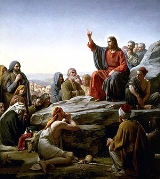
Ebionites

Encyclopedia
Ebionites, or Ebionaioi, (Greek
: ) (derived from Hebrew אביונים ebyonim, ebionim, meaning "the poor" or "poor ones"), is a patristic term referring to a Jewish Christian sect or sects that existed during the first centuries of the Christian Era
. They regarded Jesus
as the Messiah
and insisted on the necessity of following Jewish religious law and rites
. The Ebionites used only one of the Jewish Gospels, revered James the Just
and rejected Paul of Tarsus
as an apostate from the Law. Their name suggests that they placed a special value on voluntary poverty.
Since historical records by the Ebionites are scarce, fragmentary and disputed, much of what is known or conjectured about the Ebionites derives from the Church Fathers
, who wrote polemics against the Ebionites, whom they deemed heretical
Judaizers
. Consequently very little about the Ebionite sect or sects is known with certainty, and most, if not all, statements about them are conjectural.
Many scholars distinguish the Ebionites from other Jewish Christian groups, e.g., the Nazarenes
., others consider them identical with the Nazarenes.
(singular: אֶבְיוֹן ev·yōn, plural: אביונים ev·yōn·im), which occurs fifteen times in the Psalms
and was the self-given term of some pious Jewish circles (e.g. Psalm 69:33 "For the LORD heareth the poor,"1 QpHab
XII, 3.6.10, etc.). The term "the poor" was at first a common designation for all Christians - a reference to their material as well as their voluntary poverty.
The graecized Hebrew term "Ebionite" (Ebionai) was first applied by Irenaeus
in the 2nd century
without making mention of Nazarenes (c.180 CE). Origen
says "for Ebion signifies “poor” among the Jews, and those Jews who have received Jesus as Christ are called by the name of Ebionites." Tertullian
was first to write against a non-existent heresiarch
called Ebion
and scholars believe he derived the name Ebion from a literal reading of Ebionaioi as meaning "followers of Ebion", a derivation now considered mistaken. The term "the poor" (Greek ptokoi) was still used in its original, more general sense. Modern Hebrew still uses the Biblical Hebrew term "the needy" both in histories of Christianity for "Ebionites" (אביונים) and for almsgiving to the needy at Purim
.
's Dialogue with Trypho (c. 140). Justin distinguishes between Jewish Christians
who observe the Law of Moses
but do not require its observance upon others, and those who believe the Mosaic Law to be obligatory on all. Irenaeus
(c. 180) was probably the first to use the term "Ebionites" to describe a heretical judaizing sect, which he regarded as stubbornly clinging to the Law
. Origen
(c. 212) remarks that the name derives from the Hebrew
word "evyon," meaning "poor." Epiphanius of Salamis
in the 4th century gives the most complete but also questionable account in his heresiology
called Panarion
, denouncing eighty heretical sects, among them the Ebionites. Epiphanius mostly gives general descriptions of their religious beliefs and includes quotations from their gospels, which have not survived. According to the Encyclopædia Britannica (2011), the Ebionite movement may have arisen about the time of the destruction of the Jewish Temple in Jerusalem
(AD 70).
Paul talks of his collection for the "poor among the saints" in the Jerusalem church, but this is generally taken as meaning "the poorer members of the church" rather than a schismatic group.
The actual number of groups described as Ebionites is difficult to ascertain, as the contradictory patristic accounts in their attempt to distinguish various sects, sometimes confuse them with each other. Other groups mentioned are the Carpocratians
, the Cerinthians
, the Elcesaites
, the 4th century Nazarenes
, and the Sampsaeans, most of whom were Jewish Christian sects who held gnostic
or other views rejected by the Ebionites. Epiphanius, however, mentions that a group of Ebionites came to embrace some of these views despite keeping their name.
As the Ebionites are first mentioned as such in the 2nd century, their earlier history and any relation to the first Jerusalem church remains obscure and a matter of contention. There is no evidence linking the origin of the later sect of the Ebionites with the First Jewish-Roman War
of 66–70 CE, or that prior to that they formed part of the Jerusalem church led by the Apostle Peter and later by Jesus' brother James
. Eusebius relates a tradition, probably based on Aristo of Pella
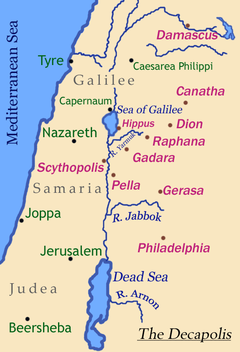
, that the early Christians left Jerusalem just prior to the war and fled to Pella
beyond the Jordan River, but does not connect this with Ebionites. They were led by Simeon of Jerusalem
(d. 107) and during the Second Jewish-Roman War, they were persecuted by the Jewish followers of Bar Kochba for refusing to recognize his messianic claims.
 According to Harnack the influence of Elchasaites places some Ebionites in the context of the gnostic movements widespread in Syria and the lands to the east.
After the end of the First Jewish-Roman War
, the importance of the Jerusalem church began to fade. Jewish Christianity became dispersed throughout the Jewish diaspora
in the Levant
, where it was slowly eclipsed by gentile Christianity, which then spread throughout the Roman Empire
without competition from "judaizing" Christian groups. Once the Jerusalem church, still headed by Jesus' relatives
, was eliminated during the Bar Kokhba revolt in 135, the Ebionites gradually lost influence and followers. According to Hyam Maccoby
(1987) their decline was due to marginalization and "persecution" by both Jews and Christians. Following the defeat of the rebellion and the expulsion of all Jews from Judea, Jerusalem became the Gentile city of Aelia Capitolina
. Many of the Jewish Christians residing at Pella renounced their Jewish practices at this time and joined to the mainstream Christian church. Those who remained at Pella and continued in obedience to the Law were deemed heretics. In 375, Epiphanius records the settlement of Ebionites on Cyprus, but by the mid-5th century, Theodoret of Cyrrhus
reported that they were no longer present in the region.
 Some scholars argue that the Ebionites survived much longer and identify them with a sect encountered by the historian Abd al-Jabbar ibn Ahmad around the year 1000. Another possible reference to surviving Ebionite communities in northwestern Arabia, specifically the cities of Tayma
and Tilmas, around the 11th century, appears in Sefer Ha'masaot, the "Book of the Travels" of Rabbi Benjamin of Tudela
, a rabbi from Spain. 12th century Muslim historian Muhammad al-Shahrastani mentions Jews living in nearby Medina
and Hejaz
who accepted Jesus as a prophetic figure and followed traditional Judaism, rejecting mainstream Christian views
. Some scholars argue that they contributed to the development of the Islamic view of Jesus
due to exchanges of Ebionite remnants with the first Muslims.
, revered Jerusalem as the holiest city, and restricted table fellowship only to Gentiles who converted to Judaism
.
Yet some Church Fathers describe some Ebionites as departing from traditional Jewish principles of faith
and practice. For example, Epiphanius of Salamis
stated that the Ebionites engaged in excessive ritual bathing
, possessed an angelology which claimed that the Christ is a great archangel who was incarnated in Jesus and adopted as the son of God
, opposed animal sacrifice
, denying parts or most of the Law
, and practiced religious vegetarianism, and celebrated a commemorative meal annually, on or around Passover
, with unleavened bread
and water only, in contrast to the daily Christian Eucharist
.
However, the reliability of Epiphanius' account of the Ebionites is questioned by some scholars. Shlomo Pines
, for example, argues that the heterodox views and practices he ascribes to some Ebionites originated in Gnostic Christianity
rather than Jewish Christianity, and are characteristics of the Elcesaite
sect, which Epiphanius mistakenly attributed to the Ebionites.
Another Church Father who described the Ebionites as departing from Christian Orthodoxy was Methodius of Olympus
, who stated that the Ebionites believed that the prophets spoke only by their own power, and not by the power of the Holy Spirit.
While mainstream biblical scholars do suppose some Essene influence on the nascent Jewish-Christian Church in some organizational, administrative and cultic respects, some scholars go beyond that assumption. Among them, some hold theories which have been discredited and others which remain controversial.
Regarding the Ebionites specifically, a number of scholars have different theories on how the Ebionites may have developed from an Essene Jewish messianic sect. Hans-Joachim Schoeps argues that the conversion of some Essenes to Jewish Christianity after the Siege of Jerusalem in 70 CE
may be the source of some Ebionites adopting Essene views and practices; while some conclude that the Essenes did not become Jewish Christians but still had an influence on the Ebionites.
However, Epiphanius of Salamis
, in his book Panarion, 30:17:5, said the following: "But I already showed above that Ebion did not know these things, but later, his followers that associated with Elchasai had the circumcision, the Sabbath and the customs of Ebion, but the imagination of Elchasai".
Doing so, Epiphanius made it clear that the original Ebionites were different from those heterodox Ebionites that he described.
, as quoted by Epiphanius
, John the Baptist
and Jesus are portrayed as vegetarian
s. Epiphanius states that the Ebionites had amended "locusts" (Greek akris) to "honey cake" (Greek ekris). This emendation is not found in any other New Testament manuscript or translation. Though a different vegetarian reading is found in a late Slavonic version of Josephus
' War of the Jews. Pines (1966) and others view that the Ebionites were projecting their own vegetarianism onto John the Baptist.
The majority of Church Fathers agree that the Ebionites rejected many of the precepts central to Nicene orthodoxy
, such as his pre-existence
, divinity, virgin birth, atoning death, and physical resurrection
.
On the other hand, an Ebionite story has Jesus eating bread with his brother Jacob ("James the Just") after the resurrection, which indicates that the Ebionites, or at least the ones who accepted this version of the Gospel of the Hebrews
, very much believed in a physical resurrection for Jesus.
The Ebionites are described as emphasizing the oneness of God
and the humanity of Jesus as the biological son of both Mary
and Joseph
, who by virtue of his righteousness
, was chosen
by God to be the messianic
"prophet like Moses
" (foretold in Deuteronomy
18:14–22) when he was anointed
with the Holy Spirit
at his baptism. Origen (Contra Celsum 5.61) and Eusebius (Historia Ecclesiastica
3.27.3) recognise some variation in the Christology
of Ebionite groups; for example that while all Ebionites denied Christ's pre-existence there was a sub-group which did not deny the virgin birth. Theodoret
, while dependent on earlier writers, draws the conclusion that the two sub-groups would have used different Gospels.
Of the books of the New Testament
, the Ebionites are said to have accepted only a Hebrew (or Aramaic) version of the Gospel of Matthew
, referred to as the Gospel of the Hebrews
, as additional scripture to the Hebrew Bible
. This version of Matthew, Irenaeus
reports, omitted the first two chapters (on the nativity of Jesus
), and started with the baptism of Jesus
by John
.
The Ebionites believed that all Jews and Gentiles must observe the commandments
in the Law of Moses, in order to become righteous
and seek communion with God, but these commandments must be understood in the light of Jesus' expounding of the Law
, revealed during his sermon on the mount
, and other evangelical counsels
. The Ebionites may have held a form of "inaugurated eschatology
" positing that the ministry of Jesus
had ushered in the Messianic Age
so that the kingdom of God might be understood as present in an incipient fashion, while at the same time awaiting consummation in the future age
.
in his edition of Josephus (1794) where he notes regarding the murder of James the Just, "we must remember what we learn from the Ebionite fragments of Hegesippus, that these Ebionites interpreted a prophecy of Isaiah as foretelling this very murder" That Hegesippus made this connection from Isaiah is undisputed, however Whiston's identification of Hegesippus as an Ebionite, while common in 18th and 19th century scholarship, is debatable.
The other popularly proposed connection is that the Ascents of James in the Pseudo-Clementine literature are related to the Ebionites.
The Book of Acts begins by showing Peter as leader of the Jerusalem church - the only church in existence immediately after the ascension. Though several years later Paul lists James prior to "Cephas" (Peter) and John as those considered "pillars" (Greek styloi) of the Jerusalem Church. Eusebius records that Clement of Alexandria
wrote that Peter, James, and John chose James the Just as bishop of Jerusalem, but Eusebius also subjects James to the authority of all the apostles. Peter baptised Cornelius the Centurion, introducing uncircumcised Gentiles into the church in Judea. Paul, Apostle to the Gentiles, established many churches and developed a Christian theology (see Pauline Christianity
). At the Council of Jerusalem
(c 49), Paul argued to abrogate Mosaic observances for non-Jewish converts. When Paul recounted the events to the Galatians , he referred only to the remembrance of the poor rather than conveying the four points of the Council of Jerusalem
. James Dunn
notes the conciliatory role of James as depicted in Acts in the tension between Paul and those urging the Law of Moses upon Gentiles.
According to Eusebius, after the death of James the Jerusalem church fled to Pella
to escape the siege of the future Emperor Titus, and then after the Bar Kokhba revolt the Jerusalem church was permitted to remain in the renamed Aelia Capitolina
, but notably from this point onward all bishops of Jerusalem bear Greek rather than evidently Jewish names.
However some scholars argue for some form of continuity of the Jewish Jerusalem church into the 2nd and 3rd centuries, and that the Ebionites regarded James the Just
as their leader. These scholars include Pierre-Antoine Bernheim, Robert Eisenman
, Will Durant
, Michael Goulder
, Gerd Ludemann
, John Painter, and James Tabor
,
Against this scholars including Richard Bauckham distinguish the high Christology practiced by the Jerusalem Church under James with the low Christology later adopted by the Ebionites. Tabor argues that the Ebionites claimed a dynastic apostolic succession
for the relatives of Jesus
. Epiphanius relates that the Ebionites opposed the Apostle Paul, whom they saw as responsible that gentile Christians did not have to be circumcised
, nor otherwise follow the Law of Moses
, and named him an apostate
. Epiphanius further relates that some Ebionites alleged that Paul was a Greek who converted to Judaism
in order to marry the daughter of a high priest of Israel
but apostatized when she rejected him.
As an alternative to the traditional view of Eusebius, that the Jerusalem church simply became integrated with the Gentile church, other scholars, such as Richard Bauckham
, suggest immediate successors to the Jerusalem Church under James and the relatives of Jesus were the Nazoraeans, who accepted Paul, while the Ebionites were a later offshoot of the early 2nd century.
, two 3rd century Christian works, are regarded by general scholarly consensus as largely or entirely Jewish Christian
in origin and reflect Jewish Christian beliefs. The exact relationship between the Ebionites and these writings is debated, but Epiphanius's description of some Ebionites in Panarion
30 bears a striking similarity to the ideas in the Recognitions and Homilies. Scholar Glenn Alan Koch speculates that Epiphanius likely relied upon a version of the Homilies as a source document. Some scholars also speculate that the core of the Gospel of Barnabas
, beneath a polemical medieval Muslim
overlay, may have been based upon an Ebionite or gnostic document. The existence and origin of this source continues to be debated by scholars.
John Arendzen
(Catholic Encyclopedia
article "Ebionites" 1909) classifies the Ebionite writings into four groups.
later wrote that they used only the Gospel of the Hebrews
. From this the minority view of James R. Edwards
(2009) and Bodley's Librarian
Edward Nicholson
(1879) claims that there was only one Hebrew gospel in circulation, Matthew's Gospel of the Hebrews. They also note that the title Gospel of the Ebionites, was never used by anyone in the early Church. Epiphanius contended that the gospel the Ebionites used, was written by Matthew and called the Gospel of the Hebrews. Because Epiphanius said that it was "not wholly complete, but falsified and mutilated...", writers such as Walter Richard Cassels
(1877), and Pierson Parker
(1940) consider it a different "edition" of Matthew's Hebrew Gospel. However, internal evidence from the quotations in Panarion 30.13.4 and 30.13.7 suggest that the text was a Gospel harmony originally composed in Greek.
Mainstream scholarly texts, such as the standard edition of the New Testament Apocrypha
edited by Wilhelm Schneemelcher
generally refer to the text Jerome cites as used by the Ebionites as the Gospel of the Ebionites, though this is not a term current in the Early Church.
known as the Clementine literature included three works known in antiquity as the Circuits of Peter, the Acts of the Apostles and a work usually titled the Ascents of James. They are specifically referenced by Epiphanius in his polemic against the Ebionites. The first-named books are substantially contained in the Homilies of Clement under the title of Clement's Compendium of Peter's itinerary sermons, and also in the Recognitions attributed to Clement. They form an early Christian didactic fiction to express Jewish Christian views, i.e. the primacy of James the Just
, their connection with the episcopal see of Rome
, and their antagonism to Simon Magus
, as well as gnostic
doctrines. Scholar Robert E. Van Voorst
opines of the Ascents of James (R 1.33–71), "There is, in fact, no section of the Clementine literature about whose origin in Jewish Christianity one may be more certain". Despite this assertion, he expresses reservations that the material is genuinely Ebionite in origin.
in Koine Greek
, which was used by Jerome and is still extant in fragments, and his lost Hypomnemata
, written to counter the canonical Gospel of Matthew. Although lost, the Hypomnemata is probably identical to De distinctione præceptorum mentioned by Ebed Jesu (Assemani, Bibl. Or., III, 1). The identity of Symmachus as an Ebionite has been questioned in recent scholarship.
, appeared in Rome teaching from a book which he claimed to be the revelation which a righteous man, Elkesai, had received from an angel. Though Hippolytus suspected that Alcibiades was himself the author. Shortly afterwards Origen
records a group, the Elkesaites, with the same beliefs. Epiphanius
claimed the Ebionites also used this book as a source for some of their beliefs and practices (Panarion 30.17). Epiphanius explains the origin of the name Elkesai to be Aramaic
El Ksai, meaning "Hidden Power" (Panarion 19.2.1). Scholar Petri Luomanen believes the book to have been written originally in Aramaic as a Jewish apocalypse, probably in Babylonia, in 116-117.
, and allegedly having an improper fixation on the Law of Moses
at the expense of the grace of God
. In this view, the Ebionites may have been the descendants of a Jewish Christian sect within the early Jerusalem church which broke away from its mainstream theology
.
(1987), Robert Eisenman
, James Tabor
, Hugh Schonfield (1961) and others argued that the Ebionites were more faithful to the authentic teachings of Jesus and constituted the mainstream of the Jerusalem church before being gradually marginalized
by the followers of Paul of Tarsus
.
Although there is no evidence for the name Ebionaioi prior to Irenaeus, Tabor and Eisenman choose to label as "Ebionites", Jewish Christians that maintained a continuity with the Messianic eschatology
of the Jerusalem Church under James the Just
while others, though agreeing about the historical events, use it in a more restricted sense, reserving the designation "Nazarene" before the flight to Pella in c70 CE, and "Ebionite" for Pella and afterwards. Mainstream scholarship commonly uses the term in the restricted sense.
Hyam Maccoby
's (1987) view of the Ebionites is that they were Jewish heretics
due to their refusal to see Jesus as a false prophet
and failed Jewish Messiah claimant
but also for wanting to include their gospel into the canon
of the Hebrew Bible
.
s.
The counter-missionary
group Jews for Judaism
favorably mentions the historical Ebionites in their literature in order to argue that "Messianic Judaism
", as promoted by missionary groups such as Jews for Jesus
, is Pauline Christianity
misrepresenting itself as Judaism. Some Messianic groups have expressed concern over leaders in Israel that deny Jesus' divinity and the possible collapse of the Messianic movement due to a resurgence of Ebionitism. In a recent polemic, a Messianic leader asked whether Christians should imitate the Torah-observance of "neo-Ebionites".
of Jesus
through the doctrines of trinity
and through the veneration
of icon
s. Paul Addae and Tim Bowes (1998) write that the Ebionites were faithful to the original teachings of Jesus
and thus shared Islamic views about Jesus' humanity, though the Islamic view of Jesus
conflicts with the Ebionites' views regarding the virgin birth and the crucifixion. One of the first men to believe in the prophethood
of Muhammad
was an Ebionite monk
named Waraqah ibn Nawfal
, whom Muslim
s highly honor as a pious man with deep knowledge of the Christian
scriptures.
Greek language
Greek is an independent branch of the Indo-European family of languages. Native to the southern Balkans, it has the longest documented history of any Indo-European language, spanning 34 centuries of written records. Its writing system has been the Greek alphabet for the majority of its history;...
: ) (derived from Hebrew אביונים ebyonim, ebionim, meaning "the poor" or "poor ones"), is a patristic term referring to a Jewish Christian sect or sects that existed during the first centuries of the Christian Era
Early Christianity
Early Christianity is generally considered as Christianity before 325. The New Testament's Book of Acts and Epistle to the Galatians records that the first Christian community was centered in Jerusalem and its leaders included James, Peter and John....
. They regarded Jesus
Jesus
Jesus of Nazareth , commonly referred to as Jesus Christ or simply as Jesus or Christ, is the central figure of Christianity...
as the Messiah
Messiah
A messiah is a redeemer figure expected or foretold in one form or another by a religion. Slightly more widely, a messiah is any redeemer figure. Messianic beliefs or theories generally relate to eschatological improvement of the state of humanity or the world, in other words the World to...
and insisted on the necessity of following Jewish religious law and rites
Torah
Torah- A scroll containing the first five books of the BibleThe Torah , is name given by Jews to the first five books of the bible—Genesis , Exodus , Leviticus , Numbers and Deuteronomy Torah- A scroll containing the first five books of the BibleThe Torah , is name given by Jews to the first five...
. The Ebionites used only one of the Jewish Gospels, revered James the Just
James the Just
James , first Bishop of Jerusalem, who died in 62 AD, was an important figure in Early Christianity...
and rejected Paul of Tarsus
Paul of Tarsus
Paul the Apostle , also known as Saul of Tarsus, is described in the Christian New Testament as one of the most influential early Christian missionaries, with the writings ascribed to him by the church forming a considerable portion of the New Testament...
as an apostate from the Law. Their name suggests that they placed a special value on voluntary poverty.
Since historical records by the Ebionites are scarce, fragmentary and disputed, much of what is known or conjectured about the Ebionites derives from the Church Fathers
Church Fathers
The Church Fathers, Early Church Fathers, Christian Fathers, or Fathers of the Church were early and influential theologians, eminent Christian teachers and great bishops. Their scholarly works were used as a precedent for centuries to come...
, who wrote polemics against the Ebionites, whom they deemed heretical
Heresy
Heresy is a controversial or novel change to a system of beliefs, especially a religion, that conflicts with established dogma. It is distinct from apostasy, which is the formal denunciation of one's religion, principles or cause, and blasphemy, which is irreverence toward religion...
Judaizers
Judaizers
Judaizers is predominantly a Christian term, derived from the Greek verb ioudaïzō . This term is most widely known from the single use in the New Testament where Paul publicly challenges Peter for compelling Gentile believers to "judaize", also known as the Incident at Antioch.According to the...
. Consequently very little about the Ebionite sect or sects is known with certainty, and most, if not all, statements about them are conjectural.
Many scholars distinguish the Ebionites from other Jewish Christian groups, e.g., the Nazarenes
Nazarene (sect)
The Nazarene sect is used in two contexts:* Firstly of the New Testament early church where in Acts 24:5 Paul is accused before Felix at Caesarea by Tertullus of being "a ringleader of the sect of the Nazarenes."...
., others consider them identical with the Nazarenes.
Name
The term Ebionites derives from the common adjective for "poor" in HebrewHebrew language
Hebrew is a Semitic language of the Afroasiatic language family. Culturally, is it considered by Jews and other religious groups as the language of the Jewish people, though other Jewish languages had originated among diaspora Jews, and the Hebrew language is also used by non-Jewish groups, such...
(singular: אֶבְיוֹן ev·yōn, plural: אביונים ev·yōn·im), which occurs fifteen times in the Psalms
Psalms
The Book of Psalms , commonly referred to simply as Psalms, is a book of the Hebrew Bible and the Christian Bible...
and was the self-given term of some pious Jewish circles (e.g. Psalm 69:33 "For the LORD heareth the poor,"1 QpHab
Habakkuk Commentary
The Habakkuk Commentary or Pesher Habakkuk, labelled 1QpHab was among the original seven Dead Sea Scrolls discovered in 1947 and published in 1951...
XII, 3.6.10, etc.). The term "the poor" was at first a common designation for all Christians - a reference to their material as well as their voluntary poverty.
The graecized Hebrew term "Ebionite" (Ebionai) was first applied by Irenaeus
Irenaeus
Saint Irenaeus , was Bishop of Lugdunum in Gaul, then a part of the Roman Empire . He was an early church father and apologist, and his writings were formative in the early development of Christian theology...
in the 2nd century
Christianity in the 2nd century
The 2nd century of Christianity was largely the time of the Apostolic Fathers who were the students of the apostles of Jesus, though there is some overlap as John the Apostle may have survived into the 2nd century and the early Apostolic Father Clement of Rome is said to have died at the end of the...
without making mention of Nazarenes (c.180 CE). Origen
Origen
Origen , or Origen Adamantius, 184/5–253/4, was an early Christian Alexandrian scholar and theologian, and one of the most distinguished writers of the early Church. As early as the fourth century, his orthodoxy was suspect, in part because he believed in the pre-existence of souls...
says "for Ebion signifies “poor” among the Jews, and those Jews who have received Jesus as Christ are called by the name of Ebionites." Tertullian
Tertullian
Quintus Septimius Florens Tertullianus, anglicised as Tertullian , was a prolific early Christian author from Carthage in the Roman province of Africa. He is the first Christian author to produce an extensive corpus of Latin Christian literature. He also was a notable early Christian apologist and...
was first to write against a non-existent heresiarch
Heresiarch
A heresiarch is a founder or leader of a heretical doctrine or movement, as considered by those who claim to maintain an orthodox religious tradition or doctrine...
called Ebion
Ebion
Ebion was the presumed eponymous founder of an early Christian group known as the Ebionites. The existent historical evidence indicates that the name "Ebionite" is derived from a Hebrew word, "ebion" meaning "poor" and thus not from someone's name...
and scholars believe he derived the name Ebion from a literal reading of Ebionaioi as meaning "followers of Ebion", a derivation now considered mistaken. The term "the poor" (Greek ptokoi) was still used in its original, more general sense. Modern Hebrew still uses the Biblical Hebrew term "the needy" both in histories of Christianity for "Ebionites" (אביונים) and for almsgiving to the needy at Purim
Purim
Purim is a Jewish holiday that commemorates the deliverance of the Jewish people in the ancient Persian Empire from destruction in the wake of a plot by Haman, a story recorded in the Biblical Book of Esther .Purim is celebrated annually according to the Hebrew calendar on the 14th...
.
History
The earliest reference to a group that might fit the description of the later Ebionites appears in Justin MartyrJustin Martyr
Justin Martyr, also known as just Saint Justin , was an early Christian apologist. Most of his works are lost, but two apologies and a dialogue survive. He is considered a saint by the Roman Catholic Church and the Eastern Orthodox Church....
's Dialogue with Trypho (c. 140). Justin distinguishes between Jewish Christians
Jewish Christians
Jewish Christians is a term which appears in historical texts contrasting Christians of Jewish origin with Gentile Christians, both in discussion of the New Testament church and the second and following centuries....
who observe the Law of Moses
613 mitzvot
The 613 commandments is a numbering of the statements and principles of law, ethics, and spiritual practice contained in the Torah or Five Books of Moses...
but do not require its observance upon others, and those who believe the Mosaic Law to be obligatory on all. Irenaeus
Irenaeus
Saint Irenaeus , was Bishop of Lugdunum in Gaul, then a part of the Roman Empire . He was an early church father and apologist, and his writings were formative in the early development of Christian theology...
(c. 180) was probably the first to use the term "Ebionites" to describe a heretical judaizing sect, which he regarded as stubbornly clinging to the Law
Legalism (theology)
Legalism, in Christian theology, is a sometimes-pejorative term referring to an over-emphasis on discipline of conduct, or legal ideas, usually implying an allegation of misguided rigour, pride, superficiality, the neglect of mercy, and ignorance of the grace of God or emphasizing the letter of...
. Origen
Origen
Origen , or Origen Adamantius, 184/5–253/4, was an early Christian Alexandrian scholar and theologian, and one of the most distinguished writers of the early Church. As early as the fourth century, his orthodoxy was suspect, in part because he believed in the pre-existence of souls...
(c. 212) remarks that the name derives from the Hebrew
Hebrew language
Hebrew is a Semitic language of the Afroasiatic language family. Culturally, is it considered by Jews and other religious groups as the language of the Jewish people, though other Jewish languages had originated among diaspora Jews, and the Hebrew language is also used by non-Jewish groups, such...
word "evyon," meaning "poor." Epiphanius of Salamis
Epiphanius of Salamis
Epiphanius of Salamis was bishop of Salamis at the end of the 4th century. He is considered a saint and a Church Father by both the Eastern Orthodox and Catholic Churches. He gained a reputation as a strong defender of orthodoxy...
in the 4th century gives the most complete but also questionable account in his heresiology
Heresiology
In theology or the history of religion , heresiology is the study of heresy. It can be distinguished from heresiography, or the recording of heresy....
called Panarion
Panarion
In early Christian heresiology, the Panarion , to which 16th-century Latin translations gave the name Adversus Haereses , is the most important of the works of Epiphanius of Salamis...
, denouncing eighty heretical sects, among them the Ebionites. Epiphanius mostly gives general descriptions of their religious beliefs and includes quotations from their gospels, which have not survived. According to the Encyclopædia Britannica (2011), the Ebionite movement may have arisen about the time of the destruction of the Jewish Temple in Jerusalem
Siege of Jerusalem (70)
The Siege of Jerusalem in the year 70 AD was the decisive event of the First Jewish-Roman War. The Roman army, led by the future Emperor Titus, with Tiberius Julius Alexander as his second-in-command, besieged and conquered the city of Jerusalem, which had been occupied by its Jewish defenders in...
(AD 70).
Paul talks of his collection for the "poor among the saints" in the Jerusalem church, but this is generally taken as meaning "the poorer members of the church" rather than a schismatic group.
The actual number of groups described as Ebionites is difficult to ascertain, as the contradictory patristic accounts in their attempt to distinguish various sects, sometimes confuse them with each other. Other groups mentioned are the Carpocratians
Carpocrates
Carpocrates of Alexandria was the founder of an early Gnostic sect from the first half of the 2nd century. As with many Gnostic sects, we know of the Carpocratians only through the writings of the Church Fathers, principally Irenaeus of Lyons and Clement of Alexandria. As the former strongly...
, the Cerinthians
Cerinthus
Cerinthus was a gnostic and to some, an early Christian, who was prominent as a "heresiarch" in the view of the early Church Fathers. Contrary to proto-orthodox Christianity, Cerinthus's school followed the Jewish law, used the Gospel according to the Hebrews, denied that the Supreme God had made...
, the Elcesaites
Elcesaites
The Elcesaites, Elkasaites, Elkesaites, or Elchasaites were an ancient Jewish-Christian sect, possibly related to the Ebionites, in Sassanid southern Mesopotamia.Some early scholars differentiate Ebionites from Essenic Ebionite-Elchasites...
, the 4th century Nazarenes
Nazarene (sect)
The Nazarene sect is used in two contexts:* Firstly of the New Testament early church where in Acts 24:5 Paul is accused before Felix at Caesarea by Tertullus of being "a ringleader of the sect of the Nazarenes."...
, and the Sampsaeans, most of whom were Jewish Christian sects who held gnostic
Fathers of Christian Gnosticism
The "Fathers of Christian Gnosticism" are the supposed early teachers of Gnosticism. There is no evidence that ancient Gnostic Christians used this term for their leaders, but it is sometimes used today by analogy with the term "Church Fathers" or "Fathers of the Church" applied to early...
or other views rejected by the Ebionites. Epiphanius, however, mentions that a group of Ebionites came to embrace some of these views despite keeping their name.
As the Ebionites are first mentioned as such in the 2nd century, their earlier history and any relation to the first Jerusalem church remains obscure and a matter of contention. There is no evidence linking the origin of the later sect of the Ebionites with the First Jewish-Roman War
First Jewish-Roman War
The First Jewish–Roman War , sometimes called The Great Revolt , was the first of three major rebellions by the Jews of Judaea Province , against the Roman Empire...
of 66–70 CE, or that prior to that they formed part of the Jerusalem church led by the Apostle Peter and later by Jesus' brother James
James the Just
James , first Bishop of Jerusalem, who died in 62 AD, was an important figure in Early Christianity...
. Eusebius relates a tradition, probably based on Aristo of Pella
Aristo of Pella
Aristo of Pella, Jordan was a hellenized Jewish Christian writer , who like Hegesippus represents a school of thought more liberal than that of the Pharisaic and Essene Ebionites....
, that the early Christians left Jerusalem just prior to the war and fled to Pella
Pella, Jordan
Pella is a village and the site of ancient ruins in northwestern Jordan. It is half an hour by car from Irbid, in the north of the country....
beyond the Jordan River, but does not connect this with Ebionites. They were led by Simeon of Jerusalem
Simeon of Jerusalem
Saint Simeon of Jerusalem, son of Clopas, was a Jewish Christian leader and according to most Christian traditions the second Bishop of Jerusalem .-Life:Eusebius of Caesarea gives the list of these bishops...
(d. 107) and during the Second Jewish-Roman War, they were persecuted by the Jewish followers of Bar Kochba for refusing to recognize his messianic claims.
After the end of the First Jewish-Roman War
First Jewish-Roman War
The First Jewish–Roman War , sometimes called The Great Revolt , was the first of three major rebellions by the Jews of Judaea Province , against the Roman Empire...
, the importance of the Jerusalem church began to fade. Jewish Christianity became dispersed throughout the Jewish diaspora
Jewish diaspora
The Jewish diaspora is the English term used to describe the Galut גלות , or 'exile', of the Jews from the region of the Kingdom of Judah and Roman Iudaea and later emigration from wider Eretz Israel....
in the Levant
Levant
The Levant or ) is the geographic region and culture zone of the "eastern Mediterranean littoral between Anatolia and Egypt" . The Levant includes most of modern Lebanon, Syria, Jordan, Israel, the Palestinian territories, and sometimes parts of Turkey and Iraq, and corresponds roughly to the...
, where it was slowly eclipsed by gentile Christianity, which then spread throughout the Roman Empire
Roman Empire
The Roman Empire was the post-Republican period of the ancient Roman civilization, characterised by an autocratic form of government and large territorial holdings in Europe and around the Mediterranean....
without competition from "judaizing" Christian groups. Once the Jerusalem church, still headed by Jesus' relatives
Desposyni
The term Desposyni refers to alleged blood relatives of Jesus. The term was coined by Sextus Julius Africanus, a writer of the early 3rd century. Some scholars argue that Jesus' relatives held positions of special honor in the Early Christian Church...
, was eliminated during the Bar Kokhba revolt in 135, the Ebionites gradually lost influence and followers. According to Hyam Maccoby
Hyam Maccoby
Hyam Maccoby was a British Jewish scholar and dramatist specializing in the study of the Jewish and Christian religious tradition. His grandfather and namesake was Rabbi Hyam Maccoby , better known as the "Kamenitzer Maggid," a passionate religious Zionist and advocate of vegetarianism and animal...
(1987) their decline was due to marginalization and "persecution" by both Jews and Christians. Following the defeat of the rebellion and the expulsion of all Jews from Judea, Jerusalem became the Gentile city of Aelia Capitolina
Aelia Capitolina
Aelia Capitolina was a city built by the emperor Hadrian, and occupied by a Roman colony, on the site of Jerusalem, which was in ruins since 70 AD, leading in part to the Bar Kokhba revolt of 132–136.-Politics:...
. Many of the Jewish Christians residing at Pella renounced their Jewish practices at this time and joined to the mainstream Christian church. Those who remained at Pella and continued in obedience to the Law were deemed heretics. In 375, Epiphanius records the settlement of Ebionites on Cyprus, but by the mid-5th century, Theodoret of Cyrrhus
Theodoret
Theodoret of Cyrus or Cyrrhus was an influential author, theologian, and Christian bishop of Cyrrhus, Syria . He played a pivotal role in many early Byzantine church controversies that led to various ecumenical acts and schisms...
reported that they were no longer present in the region.
Last days of the Ebionite sect
Tayma
Tayma is a large oasis with a long history of settlement, located in northwestern Saudi Arabia at the point where the trade route between Yathrib and Dumah begins to cross the Nefud desert...
and Tilmas, around the 11th century, appears in Sefer Ha'masaot, the "Book of the Travels" of Rabbi Benjamin of Tudela
Benjamin of Tudela
Benjamin of Tudela was a medieval Jewish traveler who visited Europe, Asia, and Africa in the 12th century. His vivid descriptions of western Asia preceded those of Marco Polo by a hundred years...
, a rabbi from Spain. 12th century Muslim historian Muhammad al-Shahrastani mentions Jews living in nearby Medina
Medina
Medina , or ; also transliterated as Madinah, or madinat al-nabi "the city of the prophet") is a city in the Hejaz region of western Saudi Arabia, and serves as the capital of the Al Madinah Province. It is the second holiest city in Islam, and the burial place of the Islamic Prophet Muhammad, and...
and Hejaz
Hejaz
al-Hejaz, also Hijaz is a region in the west of present-day Saudi Arabia. Defined primarily by its western border on the Red Sea, it extends from Haql on the Gulf of Aqaba to Jizan. Its main city is Jeddah, but it is probably better known for the Islamic holy cities of Mecca and Medina...
who accepted Jesus as a prophetic figure and followed traditional Judaism, rejecting mainstream Christian views
Christian views of Jesus
Christian views of Jesus are based on the teachings and beliefs outlined in the Canonical gospels, New Testament letters, and the Christian creeds. These outline the key beliefs held by Christian about Jesus, including his divinity, humanity, and earthly life. Generally speaking, adhering to the...
. Some scholars argue that they contributed to the development of the Islamic view of Jesus
Islamic view of Jesus
In Islam, Jesus is considered to be a Messenger of God and the Masih who was sent to guide the Children of Israel with a new scripture, the Injīl or Gospel. The belief in Jesus is required in Islam, and a requirement of being a Muslim. The Qur'an mentions Jesus twenty-five times, more often, by...
due to exchanges of Ebionite remnants with the first Muslims.
Judaic and Gnostic Ebionitism
Most patristic sources portray the Ebionites as traditional Jews, who zealously followed the Law of Moses613 mitzvot
The 613 commandments is a numbering of the statements and principles of law, ethics, and spiritual practice contained in the Torah or Five Books of Moses...
, revered Jerusalem as the holiest city, and restricted table fellowship only to Gentiles who converted to Judaism
Conversion to Judaism
Conversion to Judaism is a formal act undertaken by a non-Jewish person who wishes to be recognised as a full member of the Jewish community. A Jewish conversion is both a religious act and an expression of association with the Jewish people...
.
Yet some Church Fathers describe some Ebionites as departing from traditional Jewish principles of faith
Jewish principles of faith
The concept of an explicit, paramount definition of faith does not exist in Judaism as it does in other monotheistic religions such as Christianity. Although Jews and religious leaders share a core of monotheistic principles, and there are many fundamental principles quoted in the Talmud to define...
and practice. For example, Epiphanius of Salamis
Epiphanius of Salamis
Epiphanius of Salamis was bishop of Salamis at the end of the 4th century. He is considered a saint and a Church Father by both the Eastern Orthodox and Catholic Churches. He gained a reputation as a strong defender of orthodoxy...
stated that the Ebionites engaged in excessive ritual bathing
Mikvah
Mikveh is a bath used for the purpose of ritual immersion in Judaism...
, possessed an angelology which claimed that the Christ is a great archangel who was incarnated in Jesus and adopted as the son of God
Adoptionism
Adoptionism, sometimes called dynamic monarchianism, is a minority Christian belief that Jesus was adopted as God's son at his baptism...
, opposed animal sacrifice
Korban
The term offering as found in the Hebrew Bible in relation to the worship of Ancient Israel is mainly represented by the Hebrew noun korban whether for an animal or other offering...
, denying parts or most of the Law
Antinomianism
Antinomianism is defined as holding that, under the gospel dispensation of grace, moral law is of no use or obligation because faith alone is necessary to salvation....
, and practiced religious vegetarianism, and celebrated a commemorative meal annually, on or around Passover
Passover
Passover is a Jewish holiday and festival. It commemorates the story of the Exodus, in which the ancient Israelites were freed from slavery in Egypt...
, with unleavened bread
Unleavened Bread
Unleavened Bread is a 1900 novel by American writer Robert Grant....
and water only, in contrast to the daily Christian Eucharist
Eucharist
The Eucharist , also called Holy Communion, the Sacrament of the Altar, the Blessed Sacrament, the Lord's Supper, and other names, is a Christian sacrament or ordinance...
.
However, the reliability of Epiphanius' account of the Ebionites is questioned by some scholars. Shlomo Pines
Shlomo Pines
Shlomo Pines was a scholar of Jewish and Islamic philosophy, best known for his English translation of Maimonides' Guide to the Perplexed.-Biography:...
, for example, argues that the heterodox views and practices he ascribes to some Ebionites originated in Gnostic Christianity
Fathers of Christian Gnosticism
The "Fathers of Christian Gnosticism" are the supposed early teachers of Gnosticism. There is no evidence that ancient Gnostic Christians used this term for their leaders, but it is sometimes used today by analogy with the term "Church Fathers" or "Fathers of the Church" applied to early...
rather than Jewish Christianity, and are characteristics of the Elcesaite
Elcesaites
The Elcesaites, Elkasaites, Elkesaites, or Elchasaites were an ancient Jewish-Christian sect, possibly related to the Ebionites, in Sassanid southern Mesopotamia.Some early scholars differentiate Ebionites from Essenic Ebionite-Elchasites...
sect, which Epiphanius mistakenly attributed to the Ebionites.
Another Church Father who described the Ebionites as departing from Christian Orthodoxy was Methodius of Olympus
Methodius of Olympus
The Church Father and Saint Methodius of Olympus was a Christian bishop, ecclesiastical author, and martyr.-Life:Few reports have survived on the life of this first scientific opponent of Origen; even these short accounts present many difficulties. Eusebius does not mention him in his Church...
, who stated that the Ebionites believed that the prophets spoke only by their own power, and not by the power of the Holy Spirit.
While mainstream biblical scholars do suppose some Essene influence on the nascent Jewish-Christian Church in some organizational, administrative and cultic respects, some scholars go beyond that assumption. Among them, some hold theories which have been discredited and others which remain controversial.
Regarding the Ebionites specifically, a number of scholars have different theories on how the Ebionites may have developed from an Essene Jewish messianic sect. Hans-Joachim Schoeps argues that the conversion of some Essenes to Jewish Christianity after the Siege of Jerusalem in 70 CE
Siege of Jerusalem (70)
The Siege of Jerusalem in the year 70 AD was the decisive event of the First Jewish-Roman War. The Roman army, led by the future Emperor Titus, with Tiberius Julius Alexander as his second-in-command, besieged and conquered the city of Jerusalem, which had been occupied by its Jewish defenders in...
may be the source of some Ebionites adopting Essene views and practices; while some conclude that the Essenes did not become Jewish Christians but still had an influence on the Ebionites.
However, Epiphanius of Salamis
Epiphanius of Salamis
Epiphanius of Salamis was bishop of Salamis at the end of the 4th century. He is considered a saint and a Church Father by both the Eastern Orthodox and Catholic Churches. He gained a reputation as a strong defender of orthodoxy...
, in his book Panarion, 30:17:5, said the following: "But I already showed above that Ebion did not know these things, but later, his followers that associated with Elchasai had the circumcision, the Sabbath and the customs of Ebion, but the imagination of Elchasai".
Doing so, Epiphanius made it clear that the original Ebionites were different from those heterodox Ebionites that he described.
Ebionite views on John the Baptist
In the Gospel of the EbionitesGospel of the Ebionites
Gospel of the Ebionites is the conventional name given to the description by Epiphanius of Salamis of a gospel used by the Ebionites. All that is known of the gospel text consists of seven brief quotations found in Chapter 30 of a heresiology written by Epiphanius known as the Panarion...
, as quoted by Epiphanius
Epiphanius of Salamis
Epiphanius of Salamis was bishop of Salamis at the end of the 4th century. He is considered a saint and a Church Father by both the Eastern Orthodox and Catholic Churches. He gained a reputation as a strong defender of orthodoxy...
, John the Baptist
John the Baptist
John the Baptist was an itinerant preacher and a major religious figure mentioned in the Canonical gospels. He is described in the Gospel of Luke as a relative of Jesus, who led a movement of baptism at the Jordan River...
and Jesus are portrayed as vegetarian
Vegetarianism and religion
Vegetarianism and religion are strongly linked in a number of religions that originated in ancient India . In Jainism, vegetarianism is mandatory for everyone; in Hinduism and Mahayana Buddhism, it is advocated by some influential scriptures and religious authorities...
s. Epiphanius states that the Ebionites had amended "locusts" (Greek akris) to "honey cake" (Greek ekris). This emendation is not found in any other New Testament manuscript or translation. Though a different vegetarian reading is found in a late Slavonic version of Josephus
Josephus
Titus Flavius Josephus , also called Joseph ben Matityahu , was a 1st-century Romano-Jewish historian and hagiographer of priestly and royal ancestry who recorded Jewish history, with special emphasis on the 1st century AD and the First Jewish–Roman War, which resulted in the Destruction of...
' War of the Jews. Pines (1966) and others view that the Ebionites were projecting their own vegetarianism onto John the Baptist.
Jesus
- See also Jesus in the TalmudJesus in the TalmudThe Talmud contains passages that some scholars have concluded are references to Christian traditions about Jesus.The history of textual transmission of these passages is complex and scholars are not agreed concerning which passages are original, and which were added later or removed later in...
The majority of Church Fathers agree that the Ebionites rejected many of the precepts central to Nicene orthodoxy
Nicene Creed
The Nicene Creed is the creed or profession of faith that is most widely used in Christian liturgy. It is called Nicene because, in its original form, it was adopted in the city of Nicaea by the first ecumenical council, which met there in the year 325.The Nicene Creed has been normative to the...
, such as his pre-existence
Pre-existence
Pre-existence , beforelife, or pre-mortal existence refers to the belief that each individual human soul existed before conception, and at conception one of these pre-existent souls enters, or is placed by God, in the body...
, divinity, virgin birth, atoning death, and physical resurrection
Vision hypothesis
The vision hypothesis is a term used to cover a range of theories that question the physical resurrection of Jesus, and suggest that sightings of a risen Jesus were visionary experiences. As the literal bodily resurrection of Jesus is a cornerstone of Christian belief, the vision hypothesis is...
.
On the other hand, an Ebionite story has Jesus eating bread with his brother Jacob ("James the Just") after the resurrection, which indicates that the Ebionites, or at least the ones who accepted this version of the Gospel of the Hebrews
Gospel of the Hebrews
The Gospel of the Hebrews , commonly shortened from the Gospel according to the Hebrews or simply called the Hebrew Gospel, is a hypothesised lost gospel preserved in fragments within the writings of the Church Fathers....
, very much believed in a physical resurrection for Jesus.
The Ebionites are described as emphasizing the oneness of God
Unitarianism
Unitarianism is a Christian theological movement, named for its understanding of God as one person, in direct contrast to Trinitarianism which defines God as three persons coexisting consubstantially as one in being....
and the humanity of Jesus as the biological son of both Mary
Mary (mother of Jesus)
Mary , commonly referred to as "Saint Mary", "Mother Mary", the "Virgin Mary", the "Blessed Virgin Mary", or "Mary, Mother of God", was a Jewish woman of Nazareth in Galilee...
and Joseph
Saint Joseph
Saint Joseph is a figure in the Gospels, the husband of the Virgin Mary and the earthly father of Jesus Christ ....
, who by virtue of his righteousness
Tzadik
Tzadik/Zadik/Sadiq is a title given to personalities in Jewish tradition considered righteous, such as Biblical figures and later spiritual masters. The root of the word ṣadiq, is ṣ-d-q , which means "justice" or "righteousness", also the root of Tzedakah...
, was chosen
Chosen people
Throughout history and even today various groups of people have considered themselves as chosen by a deity for some purpose such as to act as the deity's agent on earth. In monotheistic faiths, like Abrahamic religions, references to God are used in constructs such as "God's Chosen People"...
by God to be the messianic
Messiah
A messiah is a redeemer figure expected or foretold in one form or another by a religion. Slightly more widely, a messiah is any redeemer figure. Messianic beliefs or theories generally relate to eschatological improvement of the state of humanity or the world, in other words the World to...
"prophet like Moses
Moses
Moses was, according to the Hebrew Bible and Qur'an, a religious leader, lawgiver and prophet, to whom the authorship of the Torah is traditionally attributed...
" (foretold in Deuteronomy
Deuteronomy
The Book of Deuteronomy is the fifth book of the Hebrew Bible, and of the Jewish Torah/Pentateuch...
18:14–22) when he was anointed
Anointing
To anoint is to pour or smear with perfumed oil, milk, water, melted butter or other substances, a process employed ritually by many religions. People and things are anointed to symbolize the introduction of a sacramental or divine influence, a holy emanation, spirit, power or God...
with the Holy Spirit
Shekhinah
Shekinah is the English spelling of a grammatically feminine Hebrew word that means the dwelling or settling, and is used to denote the dwelling or settling divine presence of God, especially in the Temple in Jerusalem.-Etymology:Shekinah is derived...
at his baptism. Origen (Contra Celsum 5.61) and Eusebius (Historia Ecclesiastica
Church History (Eusebius)
The Church History of Eusebius, the bishop of Caesarea was a 4th-century pioneer work giving a chronological account of the development of Early Christianity from the 1st century to the 4th century. It was written in Koine Greek, and survives also in Latin, Syriac and Armenian manuscripts...
3.27.3) recognise some variation in the Christology
Christology
Christology is the field of study within Christian theology which is primarily concerned with the nature and person of Jesus Christ as recorded in the Canonical gospels and the letters of the New Testament. Primary considerations include the relationship of Jesus' nature and person with the nature...
of Ebionite groups; for example that while all Ebionites denied Christ's pre-existence there was a sub-group which did not deny the virgin birth. Theodoret
Theodoret
Theodoret of Cyrus or Cyrrhus was an influential author, theologian, and Christian bishop of Cyrrhus, Syria . He played a pivotal role in many early Byzantine church controversies that led to various ecumenical acts and schisms...
, while dependent on earlier writers, draws the conclusion that the two sub-groups would have used different Gospels.
Of the books of the New Testament
New Testament
The New Testament is the second major division of the Christian biblical canon, the first such division being the much longer Old Testament....
, the Ebionites are said to have accepted only a Hebrew (or Aramaic) version of the Gospel of Matthew
Gospel of Matthew
The Gospel According to Matthew is one of the four canonical gospels, one of the three synoptic gospels, and the first book of the New Testament. It tells of the life, ministry, death, and resurrection of Jesus of Nazareth...
, referred to as the Gospel of the Hebrews
Gospel of the Hebrews
The Gospel of the Hebrews , commonly shortened from the Gospel according to the Hebrews or simply called the Hebrew Gospel, is a hypothesised lost gospel preserved in fragments within the writings of the Church Fathers....
, as additional scripture to the Hebrew Bible
Hebrew Bible
The Hebrew Bible is a term used by biblical scholars outside of Judaism to refer to the Tanakh , a canonical collection of Jewish texts, and the common textual antecedent of the several canonical editions of the Christian Old Testament...
. This version of Matthew, Irenaeus
Irenaeus
Saint Irenaeus , was Bishop of Lugdunum in Gaul, then a part of the Roman Empire . He was an early church father and apologist, and his writings were formative in the early development of Christian theology...
reports, omitted the first two chapters (on the nativity of Jesus
Nativity of Jesus
The Nativity of Jesus, or simply The Nativity, refers to the accounts of the birth of Jesus in two of the Canonical gospels and in various apocryphal texts....
), and started with the baptism of Jesus
Baptism of Jesus
The baptism of Jesus marks the beginning of Jesus Christ's public ministry. This event is recorded in the Canonical Gospels of Matthew, Mark and Luke. In John 1:29-33 rather than a direct narrative, the Baptist bears witness to the episode...
by John
John the Baptist
John the Baptist was an itinerant preacher and a major religious figure mentioned in the Canonical gospels. He is described in the Gospel of Luke as a relative of Jesus, who led a movement of baptism at the Jordan River...
.
The Ebionites believed that all Jews and Gentiles must observe the commandments
613 mitzvot
The 613 commandments is a numbering of the statements and principles of law, ethics, and spiritual practice contained in the Torah or Five Books of Moses...
in the Law of Moses, in order to become righteous
Tzadik
Tzadik/Zadik/Sadiq is a title given to personalities in Jewish tradition considered righteous, such as Biblical figures and later spiritual masters. The root of the word ṣadiq, is ṣ-d-q , which means "justice" or "righteousness", also the root of Tzedakah...
and seek communion with God, but these commandments must be understood in the light of Jesus' expounding of the Law
Expounding of the Law
The Expounding of the Law is a highly structured part of the Sermon on the Mount in the New Testament...
, revealed during his sermon on the mount
Sermon on the Mount
The Sermon on the Mount is a collection of sayings and teachings of Jesus, which emphasizes his moral teaching found in the Gospel of Matthew...
, and other evangelical counsels
Evangelical counsels
The three evangelical counsels or counsels of perfection in Christianity are chastity, poverty , and obedience . As Jesus of Nazareth stated in the Canonical gospels , they are counsels for those who desire to become "perfect"...
. The Ebionites may have held a form of "inaugurated eschatology
Inaugurated eschatology
Inaugurated eschatology is the belief in Christian theology that the end times were inaugurated in the life, death and resurrection of Jesus, and thus there are both "already" and "not yet" aspects to the Kingdom of God....
" positing that the ministry of Jesus
Ministry of Jesus
In the Christian gospels, the Ministry of Jesus begins with his Baptism in the countryside of Judea, near the River Jordan and ends in Jerusalem, following the Last Supper with his disciples. The Gospel of Luke states that Jesus was "about 30 years of age" at the start of his ministry...
had ushered in the Messianic Age
Messianic Age
Messianic Age is a theological term referring to a future time of universal peace and brotherhood on the earth, without crime, war and poverty. Many religions believe that there will be such an age; some refer to it as the "Kingdom of God" or the "World to Come".- Terminology: "messianic" and...
so that the kingdom of God might be understood as present in an incipient fashion, while at the same time awaiting consummation in the future age
World to Come
The World to Come is an eschatological phrase reflecting the belief that the "current world" is flawed or cursed and will be replaced in the future by a better world or a paradise. The concept is similar to the concepts of Heaven and the afterlife, but Heaven is another place generally seen as...
.
James and the Ebionites
One of the popular primary connections of the Ebionites to James is that noted by William WhistonWilliam Whiston
William Whiston was an English theologian, historian, and mathematician. He is probably best known for his translation of the Antiquities of the Jews and other works by Josephus, his A New Theory of the Earth, and his Arianism...
in his edition of Josephus (1794) where he notes regarding the murder of James the Just, "we must remember what we learn from the Ebionite fragments of Hegesippus, that these Ebionites interpreted a prophecy of Isaiah as foretelling this very murder" That Hegesippus made this connection from Isaiah is undisputed, however Whiston's identification of Hegesippus as an Ebionite, while common in 18th and 19th century scholarship, is debatable.
The other popularly proposed connection is that the Ascents of James in the Pseudo-Clementine literature are related to the Ebionites.
The Book of Acts begins by showing Peter as leader of the Jerusalem church - the only church in existence immediately after the ascension. Though several years later Paul lists James prior to "Cephas" (Peter) and John as those considered "pillars" (Greek styloi) of the Jerusalem Church. Eusebius records that Clement of Alexandria
Clement of Alexandria
Titus Flavius Clemens , known as Clement of Alexandria , was a Christian theologian and the head of the noted Catechetical School of Alexandria. Clement is best remembered as the teacher of Origen...
wrote that Peter, James, and John chose James the Just as bishop of Jerusalem, but Eusebius also subjects James to the authority of all the apostles. Peter baptised Cornelius the Centurion, introducing uncircumcised Gentiles into the church in Judea. Paul, Apostle to the Gentiles, established many churches and developed a Christian theology (see Pauline Christianity
Pauline Christianity
Pauline Christianity is a term used to refer to the Christianity associated with the beliefs and doctrines espoused by Paul of Tarsus through his writings. Most of orthodox Christianity relies heavily on these teachings and considers them to be amplifications and explanations of the teachings of...
). At the Council of Jerusalem
Council of Jerusalem
The Council of Jerusalem is a name applied by historians and theologians to an Early Christian council that was held in Jerusalem and dated to around the year 50. It is considered by Catholics and Orthodox to be a prototype and forerunner of the later Ecumenical Councils...
(c 49), Paul argued to abrogate Mosaic observances for non-Jewish converts. When Paul recounted the events to the Galatians , he referred only to the remembrance of the poor rather than conveying the four points of the Council of Jerusalem
Council of Jerusalem
The Council of Jerusalem is a name applied by historians and theologians to an Early Christian council that was held in Jerusalem and dated to around the year 50. It is considered by Catholics and Orthodox to be a prototype and forerunner of the later Ecumenical Councils...
. James Dunn
James Dunn (theologian)
James D. G. Dunn was for many years the Lightfoot Professor of Divinity in the Department of Theology at the University of Durham. Since his retirement he has been made Emeritus Lightfoot Professor. He is a leading British New Testament scholar, broadly in the Protestant tradition. Dunn is...
notes the conciliatory role of James as depicted in Acts in the tension between Paul and those urging the Law of Moses upon Gentiles.
According to Eusebius, after the death of James the Jerusalem church fled to Pella
Pella
Pella , an ancient Greek city located in Pella Prefecture of Macedonia in Greece, was the capital of the ancient kingdom of Macedonia.-Etymology:...
to escape the siege of the future Emperor Titus, and then after the Bar Kokhba revolt the Jerusalem church was permitted to remain in the renamed Aelia Capitolina
Aelia Capitolina
Aelia Capitolina was a city built by the emperor Hadrian, and occupied by a Roman colony, on the site of Jerusalem, which was in ruins since 70 AD, leading in part to the Bar Kokhba revolt of 132–136.-Politics:...
, but notably from this point onward all bishops of Jerusalem bear Greek rather than evidently Jewish names.
However some scholars argue for some form of continuity of the Jewish Jerusalem church into the 2nd and 3rd centuries, and that the Ebionites regarded James the Just
James the Just
James , first Bishop of Jerusalem, who died in 62 AD, was an important figure in Early Christianity...
as their leader. These scholars include Pierre-Antoine Bernheim, Robert Eisenman
Robert Eisenman
Robert Eisenman is an American Biblical scholar, theoretical writer, historian, archaeologist, and "road" poet. He is currently Professor of Middle East Religions, Archaeology, and Islamic Law and director of the Institute for the Study of...
, Will Durant
Will Durant
William James Durant was a prolific American writer, historian, and philosopher. He is best known for The Story of Civilization, 11 volumes written in collaboration with his wife Ariel Durant and published between 1935 and 1975...
, Michael Goulder
Michael Goulder
Michael Douglas Goulder was a British Biblical scholar who spent most of his academic life at the University of Birmingham where he retired as Professor of Biblical Studies in 1994...
, Gerd Ludemann
Gerd Lüdemann
Gerd Lüdemann , is a German New Testament scholar. He taught this subject from 1983 to 1999 at the Faculty of Theology of the University of Göttingen. Since 1999 he has taught there with a special status as Chair of History and Literature of Early Christianity...
, John Painter, and James Tabor
James Tabor
James D. Tabor is Chair of the Department of Religious Studies at the University of North Carolina at Charlotte where he has taught since 1989. He previously held positions at Ambassador College , the University of Notre Dame , and the College of William and Mary .-Background:Tabor was born in...
,
Against this scholars including Richard Bauckham distinguish the high Christology practiced by the Jerusalem Church under James with the low Christology later adopted by the Ebionites. Tabor argues that the Ebionites claimed a dynastic apostolic succession
Apostolic Succession
Apostolic succession is a doctrine, held by some Christian denominations, which asserts that the chosen successors of the Twelve Apostles, from the first century to the present day, have inherited the spiritual, ecclesiastical and sacramental authority, power, and responsibility that were...
for the relatives of Jesus
Desposyni
The term Desposyni refers to alleged blood relatives of Jesus. The term was coined by Sextus Julius Africanus, a writer of the early 3rd century. Some scholars argue that Jesus' relatives held positions of special honor in the Early Christian Church...
. Epiphanius relates that the Ebionites opposed the Apostle Paul, whom they saw as responsible that gentile Christians did not have to be circumcised
Circumcision controversy in early Christianity
There is evidence of a controversy over religious male circumcision in Early Christianity. A Council of Jerusalem, possibly held in approximately 50 AD, decreed that male circumcision was not a requirement for Gentile converts. This became known as the "Apostolic Decree" and may be one of the...
, nor otherwise follow the Law of Moses
613 mitzvot
The 613 commandments is a numbering of the statements and principles of law, ethics, and spiritual practice contained in the Torah or Five Books of Moses...
, and named him an apostate
Apostasy
Apostasy , 'a defection or revolt', from ἀπό, apo, 'away, apart', στάσις, stasis, 'stand, 'standing') is the formal disaffiliation from or abandonment or renunciation of a religion by a person. One who commits apostasy is known as an apostate. These terms have a pejorative implication in everyday...
. Epiphanius further relates that some Ebionites alleged that Paul was a Greek who converted to Judaism
Conversion to Judaism
Conversion to Judaism is a formal act undertaken by a non-Jewish person who wishes to be recognised as a full member of the Jewish community. A Jewish conversion is both a religious act and an expression of association with the Jewish people...
in order to marry the daughter of a high priest of Israel
Kohen Gadol
The High Priest was the chief religious official of Israelite religion and of classical Judaism from the rise of the Israelite nation until the destruction of the Second Temple of Jerusalem...
but apostatized when she rejected him.
As an alternative to the traditional view of Eusebius, that the Jerusalem church simply became integrated with the Gentile church, other scholars, such as Richard Bauckham
Richard Bauckham
Richard Bauckham is a widely published scholar in theology, historical theology and New Testament. He is currently working on New Testament Christology and the Gospel of John as a Senior Scholar at Ridley Hall, Cambridge....
, suggest immediate successors to the Jerusalem Church under James and the relatives of Jesus were the Nazoraeans, who accepted Paul, while the Ebionites were a later offshoot of the early 2nd century.
Ebionite Writings
Few writings of the Ebionites have survived, and these are in uncertain form. The Recognitions of Clement and the Clementine HomiliesClementine literature
Clementine literature is the name given to the religious romance which purports to contain a record made by one Clement of discourses...
, two 3rd century Christian works, are regarded by general scholarly consensus as largely or entirely Jewish Christian
Jewish Christians
Jewish Christians is a term which appears in historical texts contrasting Christians of Jewish origin with Gentile Christians, both in discussion of the New Testament church and the second and following centuries....
in origin and reflect Jewish Christian beliefs. The exact relationship between the Ebionites and these writings is debated, but Epiphanius's description of some Ebionites in Panarion
Panarion
In early Christian heresiology, the Panarion , to which 16th-century Latin translations gave the name Adversus Haereses , is the most important of the works of Epiphanius of Salamis...
30 bears a striking similarity to the ideas in the Recognitions and Homilies. Scholar Glenn Alan Koch speculates that Epiphanius likely relied upon a version of the Homilies as a source document. Some scholars also speculate that the core of the Gospel of Barnabas
Gospel of Barnabas
The Gospel of Barnabas is a book depicting the life of Jesus, and claiming to be by Jesus' disciple Barnabas, who in this work is one of the twelve apostles...
, beneath a polemical medieval Muslim
Islam
Islam . The most common are and . : Arabic pronunciation varies regionally. The first vowel ranges from ~~. The second vowel ranges from ~~~...
overlay, may have been based upon an Ebionite or gnostic document. The existence and origin of this source continues to be debated by scholars.
John Arendzen
John Arendzen
John Peter Arendzen , was a Catholic priest who spread the Catholic faith in England. He was once named by the Daily Mail "one of the preachers of the century"...
(Catholic Encyclopedia
Catholic Encyclopedia
The Catholic Encyclopedia, also referred to as the Old Catholic Encyclopedia and the Original Catholic Encyclopedia, is an English-language encyclopedia published in the United States. The first volume appeared in March 1907 and the last three volumes appeared in 1912, followed by a master index...
article "Ebionites" 1909) classifies the Ebionite writings into four groups.
Gospel of the Ebionites
Irenaeus stated that the Ebionites used Matthew's Gospel exclusively. Eusebius of CaesareaEusebius of Caesarea
Eusebius of Caesarea also called Eusebius Pamphili, was a Roman historian, exegete and Christian polemicist. He became the Bishop of Caesarea in Palestine about the year 314. Together with Pamphilus, he was a scholar of the Biblical canon...
later wrote that they used only the Gospel of the Hebrews
Gospel of the Hebrews
The Gospel of the Hebrews , commonly shortened from the Gospel according to the Hebrews or simply called the Hebrew Gospel, is a hypothesised lost gospel preserved in fragments within the writings of the Church Fathers....
. From this the minority view of James R. Edwards
James R. Edwards
James R. Edwards is an American New Testament scholar and minister of the Presbyterian Church.In 1997 he joined the faculty at Whitworth University, Spokane where he is currently Bruner-Welch Professor of Theology. In 2009 he advanced a "controversial" theory that the synoptic Gospels are partly...
(2009) and Bodley's Librarian
Bodley's Librarian
The head of the Bodleian Library, the main library at the University of Oxford, is known as Bodley's Librarian: Sir Thomas Bodley, as founder, gave his name to both the institution and the position. Although there had been a university library at Oxford since about 1320, it had declined by the end...
Edward Nicholson
Edward Nicholson (librarian)
Edward Williams Byron Nicholson was an author and Bodley's Librarian, the head of the Bodleian Library at the University of Oxford, from 1882 until his death in 1912.-Early life and career:...
(1879) claims that there was only one Hebrew gospel in circulation, Matthew's Gospel of the Hebrews. They also note that the title Gospel of the Ebionites, was never used by anyone in the early Church. Epiphanius contended that the gospel the Ebionites used, was written by Matthew and called the Gospel of the Hebrews. Because Epiphanius said that it was "not wholly complete, but falsified and mutilated...", writers such as Walter Richard Cassels
Walter Richard Cassels
Walter Richard Cassels is the speculated author of the anonymous work Supernatural Religion.-Biography:...
(1877), and Pierson Parker
Pierson Parker
Pierson Parker was professor of New Testament at the General Theological Seminary during the 1960s.Pierson is best known for his work on the origins and priority of the Gospels....
(1940) consider it a different "edition" of Matthew's Hebrew Gospel. However, internal evidence from the quotations in Panarion 30.13.4 and 30.13.7 suggest that the text was a Gospel harmony originally composed in Greek.
Mainstream scholarly texts, such as the standard edition of the New Testament Apocrypha
New Testament apocrypha
The New Testament apocrypha are a number of writings by early Christians that claim to be accounts of Jesus and his teachings, the nature of God, or the teachings of his apostles and of their lives. These writings often have links with books regarded as "canonical"...
edited by Wilhelm Schneemelcher
Wilhelm Schneemelcher
Wilhelm Schneemelcher was a German theologian and expert on the New Testament Apocrypha.He obtained through Hans Lietzmann a post researching Latin and Greek manuscripts at the Church Fathers Commission, however this came under the Prussian Academy of Sciences so in 1938 Schneemelcher was removed...
generally refer to the text Jerome cites as used by the Ebionites as the Gospel of the Ebionites, though this is not a term current in the Early Church.
Clementine literature
The collection of New Testament apocryphaNew Testament apocrypha
The New Testament apocrypha are a number of writings by early Christians that claim to be accounts of Jesus and his teachings, the nature of God, or the teachings of his apostles and of their lives. These writings often have links with books regarded as "canonical"...
known as the Clementine literature included three works known in antiquity as the Circuits of Peter, the Acts of the Apostles and a work usually titled the Ascents of James. They are specifically referenced by Epiphanius in his polemic against the Ebionites. The first-named books are substantially contained in the Homilies of Clement under the title of Clement's Compendium of Peter's itinerary sermons, and also in the Recognitions attributed to Clement. They form an early Christian didactic fiction to express Jewish Christian views, i.e. the primacy of James the Just
James the Just
James , first Bishop of Jerusalem, who died in 62 AD, was an important figure in Early Christianity...
, their connection with the episcopal see of Rome
Holy See
The Holy See is the episcopal jurisdiction of the Catholic Church in Rome, in which its Bishop is commonly known as the Pope. It is the preeminent episcopal see of the Catholic Church, forming the central government of the Church. As such, diplomatically, and in other spheres the Holy See acts and...
, and their antagonism to Simon Magus
Simon Magus
Simon the Sorcerer or Simon the Magician, in Latin Simon Magus, was a Samaritan magus or religious figure and a convert to Christianity, baptised by Philip the Apostle, whose later confrontation with Peter is recorded in . The sin of simony, or paying for position and influence in the church, is...
, as well as gnostic
Gnosticism
Gnosticism is a scholarly term for a set of religious beliefs and spiritual practices common to early Christianity, Hellenistic Judaism, Greco-Roman mystery religions, Zoroastrianism , and Neoplatonism.A common characteristic of some of these groups was the teaching that the realisation of Gnosis...
doctrines. Scholar Robert E. Van Voorst
Robert E. Van Voorst
Robert E. Van Voorst is a Professor of New Testament Studies at Western Theological Seminary, in Holland, Michigan, and has published scholarly works in early Christian writings and New Testament Greek. He received his B.A. in Religion from Hope College in Holland, Michigan, his M.Div. from...
opines of the Ascents of James (R 1.33–71), "There is, in fact, no section of the Clementine literature about whose origin in Jewish Christianity one may be more certain". Despite this assertion, he expresses reservations that the material is genuinely Ebionite in origin.
Symmachus
Symmachus produced a translation of the Hebrew BibleHebrew Bible
The Hebrew Bible is a term used by biblical scholars outside of Judaism to refer to the Tanakh , a canonical collection of Jewish texts, and the common textual antecedent of the several canonical editions of the Christian Old Testament...
in Koine Greek
Koine Greek
Koine Greek is the universal dialect of the Greek language spoken throughout post-Classical antiquity , developing from the Attic dialect, with admixture of elements especially from Ionic....
, which was used by Jerome and is still extant in fragments, and his lost Hypomnemata
Hypomnemata
Hypomnema , also spelled hupomnema, is a Greek word with several translations into English including a reminder, a note, a public record, a commentary, a draft, a copy, and other variations on those terms.Michel Foucault uses the word in the sense of "note", but his translators use the word...
, written to counter the canonical Gospel of Matthew. Although lost, the Hypomnemata is probably identical to De distinctione præceptorum mentioned by Ebed Jesu (Assemani, Bibl. Or., III, 1). The identity of Symmachus as an Ebionite has been questioned in recent scholarship.
Elkesaites
Hippolytus of Rome (c.230) reports that a Jewish Christian, Alcibiades of ApameaAlcibiades of Apamea
Alcibiades of Apamea was a Jewish Christian member of, or possibly even founder of, the Elcesaites. Of the several cities called Apamea it is Apamea in Syria which is intended. He is known only from the accounts of Hippolytus of Rome in his Refutations . where he follows on from Hippolytus'...
, appeared in Rome teaching from a book which he claimed to be the revelation which a righteous man, Elkesai, had received from an angel. Though Hippolytus suspected that Alcibiades was himself the author. Shortly afterwards Origen
Origen
Origen , or Origen Adamantius, 184/5–253/4, was an early Christian Alexandrian scholar and theologian, and one of the most distinguished writers of the early Church. As early as the fourth century, his orthodoxy was suspect, in part because he believed in the pre-existence of souls...
records a group, the Elkesaites, with the same beliefs. Epiphanius
Epiphanius of Salamis
Epiphanius of Salamis was bishop of Salamis at the end of the 4th century. He is considered a saint and a Church Father by both the Eastern Orthodox and Catholic Churches. He gained a reputation as a strong defender of orthodoxy...
claimed the Ebionites also used this book as a source for some of their beliefs and practices (Panarion 30.17). Epiphanius explains the origin of the name Elkesai to be Aramaic
Aramaic language
Aramaic is a group of languages belonging to the Afroasiatic language phylum. The name of the language is based on the name of Aram, an ancient region in central Syria. Within this family, Aramaic belongs to the Semitic family, and more specifically, is a part of the Northwest Semitic subfamily,...
El Ksai, meaning "Hidden Power" (Panarion 19.2.1). Scholar Petri Luomanen believes the book to have been written originally in Aramaic as a Jewish apocalypse, probably in Babylonia, in 116-117.
Religious and critical perspectives
The mainstream Christian view of the Ebionites is partly based on interpretation of the polemical views of the Church Fathers who portrayed them as heretics for rejecting many of the central Christian views of JesusChristian views of Jesus
Christian views of Jesus are based on the teachings and beliefs outlined in the Canonical gospels, New Testament letters, and the Christian creeds. These outline the key beliefs held by Christian about Jesus, including his divinity, humanity, and earthly life. Generally speaking, adhering to the...
, and allegedly having an improper fixation on the Law of Moses
613 mitzvot
The 613 commandments is a numbering of the statements and principles of law, ethics, and spiritual practice contained in the Torah or Five Books of Moses...
at the expense of the grace of God
Divine grace
In Christian theology, grace is God’s gift of God’s self to humankind. It is understood by Christians to be a spontaneous gift from God to man - "generous, free and totally unexpected and undeserved" - that takes the form of divine favour, love and clemency. It is an attribute of God that is most...
. In this view, the Ebionites may have been the descendants of a Jewish Christian sect within the early Jerusalem church which broke away from its mainstream theology
Pauline Christianity
Pauline Christianity is a term used to refer to the Christianity associated with the beliefs and doctrines espoused by Paul of Tarsus through his writings. Most of orthodox Christianity relies heavily on these teachings and considers them to be amplifications and explanations of the teachings of...
.
Baur, Maccoby, Schonfield, Tabor and Eisenmann
Hyam MaccobyHyam Maccoby
Hyam Maccoby was a British Jewish scholar and dramatist specializing in the study of the Jewish and Christian religious tradition. His grandfather and namesake was Rabbi Hyam Maccoby , better known as the "Kamenitzer Maggid," a passionate religious Zionist and advocate of vegetarianism and animal...
(1987), Robert Eisenman
Robert Eisenman
Robert Eisenman is an American Biblical scholar, theoretical writer, historian, archaeologist, and "road" poet. He is currently Professor of Middle East Religions, Archaeology, and Islamic Law and director of the Institute for the Study of...
, James Tabor
James Tabor
James D. Tabor is Chair of the Department of Religious Studies at the University of North Carolina at Charlotte where he has taught since 1989. He previously held positions at Ambassador College , the University of Notre Dame , and the College of William and Mary .-Background:Tabor was born in...
, Hugh Schonfield (1961) and others argued that the Ebionites were more faithful to the authentic teachings of Jesus and constituted the mainstream of the Jerusalem church before being gradually marginalized
Marginalization
In sociology, marginalisation , or marginalization , is the social process of becoming or being made marginal or relegated to the fringe of society e.g.; "the marginalization of the underclass", "marginalisation of intellect", etc.-Individual:Marginalization at the individual level results in an...
by the followers of Paul of Tarsus
Pauline Christianity
Pauline Christianity is a term used to refer to the Christianity associated with the beliefs and doctrines espoused by Paul of Tarsus through his writings. Most of orthodox Christianity relies heavily on these teachings and considers them to be amplifications and explanations of the teachings of...
.
Although there is no evidence for the name Ebionaioi prior to Irenaeus, Tabor and Eisenman choose to label as "Ebionites", Jewish Christians that maintained a continuity with the Messianic eschatology
Messianic Age
Messianic Age is a theological term referring to a future time of universal peace and brotherhood on the earth, without crime, war and poverty. Many religions believe that there will be such an age; some refer to it as the "Kingdom of God" or the "World to Come".- Terminology: "messianic" and...
of the Jerusalem Church under James the Just
James the Just
James , first Bishop of Jerusalem, who died in 62 AD, was an important figure in Early Christianity...
while others, though agreeing about the historical events, use it in a more restricted sense, reserving the designation "Nazarene" before the flight to Pella in c70 CE, and "Ebionite" for Pella and afterwards. Mainstream scholarship commonly uses the term in the restricted sense.
Hyam Maccoby
Hyam Maccoby
Hyam Maccoby was a British Jewish scholar and dramatist specializing in the study of the Jewish and Christian religious tradition. His grandfather and namesake was Rabbi Hyam Maccoby , better known as the "Kamenitzer Maggid," a passionate religious Zionist and advocate of vegetarianism and animal...
's (1987) view of the Ebionites is that they were Jewish heretics
Heresy in Orthodox Judaism
Heresy in Orthodox Judaism is principally defined as departure from the traditional Jewish principles of faith. Mainstream Orthodox Judaism holds that rejection of the simple meaning of Maimonides' 13 principles of Jewish faith involves heresy, although the status of creed in Medieval Jewish...
due to their refusal to see Jesus as a false prophet
False prophet
In religion, a false prophet is one who falsely claims the gift of prophecy, or who uses that gift for evil ends. Often, someone who is considered a "true prophet" by some people is simultaneously considered a "false prophet" by others....
and failed Jewish Messiah claimant
Jewish Messiah claimants
The Messiah in Judaism has a number of interpretations, including any king chosen by God; a holy king who will lead Israel; and someone who will usher in an idyllic age of peace and justice...
but also for wanting to include their gospel into the canon
Biblical canon
A biblical canon, or canon of scripture, is a list of books considered to be authoritative as scripture by a particular religious community. The term itself was first coined by Christians, but the idea is found in Jewish sources. The internal wording of the text can also be specified, for example...
of the Hebrew Bible
Hebrew Bible
The Hebrew Bible is a term used by biblical scholars outside of Judaism to refer to the Tanakh , a canonical collection of Jewish texts, and the common textual antecedent of the several canonical editions of the Christian Old Testament...
.
Modern movements
In the late 20th and early 21st centuries, several small yet competing "Ebionite" websites, claiming to be revivalists of the views and practices of early Ebionites, have occasionally been listed in some sources surveying religious activity on the Internet , though census data does not demonstrate any notable new religious movementNew religious movement
A new religious movement is a religious community or ethical, spiritual, or philosophical group of modern origin, which has a peripheral place within the dominant religious culture. NRMs may be novel in origin or they may be part of a wider religion, such as Christianity, Hinduism or Buddhism, in...
s.
The counter-missionary
Counter-Missionary
A number of, particularly Christian and Muslim, religious groups are involved in proselytization of Jews, attempts to recruit, or "missionize" Jews to abandon Judaism...
group Jews for Judaism
Jews for Judaism
Jews for Judaism, established by Rabbi Bentzion Kravitz in 1985, is an international organization designed to counter Christian missionaries whose evangelistic efforts are directed toward Jews. They aim to help Jews strengthen and rediscover their Judaism. It is the largest counter-missionary...
favorably mentions the historical Ebionites in their literature in order to argue that "Messianic Judaism
Messianic Judaism
Messianic Judaism is a syncretic religious movement that arose in the 1960s and 70s. It blends evangelical Christian theology with elements of Jewish terminology and ritual....
", as promoted by missionary groups such as Jews for Jesus
Jews for Jesus
Jews for Jesus is a conservative, Christian evangelical organization that focuses on the conversion of Jews to Christianity. Its members consider themselves to be Jews – either as defined by Jewish law, or as according to the view of Jews for Jesus. Jews for Jesus defines “Jewish” in terms of...
, is Pauline Christianity
Pauline Christianity
Pauline Christianity is a term used to refer to the Christianity associated with the beliefs and doctrines espoused by Paul of Tarsus through his writings. Most of orthodox Christianity relies heavily on these teachings and considers them to be amplifications and explanations of the teachings of...
misrepresenting itself as Judaism. Some Messianic groups have expressed concern over leaders in Israel that deny Jesus' divinity and the possible collapse of the Messianic movement due to a resurgence of Ebionitism. In a recent polemic, a Messianic leader asked whether Christians should imitate the Torah-observance of "neo-Ebionites".
Islam
Mainstream Islam charges mainstream Christianity with having distorted the pure monotheismMonotheism
Monotheism is the belief in the existence of one and only one god. Monotheism is characteristic of the Baha'i Faith, Christianity, Druzism, Hinduism, Islam, Judaism, Samaritanism, Sikhism and Zoroastrianism.While they profess the existence of only one deity, monotheistic religions may still...
of Jesus
Jesus
Jesus of Nazareth , commonly referred to as Jesus Christ or simply as Jesus or Christ, is the central figure of Christianity...
through the doctrines of trinity
Trinity
The Christian doctrine of the Trinity defines God as three divine persons : the Father, the Son , and the Holy Spirit. The three persons are distinct yet coexist in unity, and are co-equal, co-eternal and consubstantial . Put another way, the three persons of the Trinity are of one being...
and through the veneration
Veneration
Veneration , or veneration of saints, is a special act of honoring a saint: an angel, or a dead person who has been identified by a church committee as singular in the traditions of the religion. It is practiced by the Eastern Orthodox Church, the Roman Catholic, and Eastern Catholic Churches...
of icon
Icon
An icon is a religious work of art, most commonly a painting, from Eastern Christianity and in certain Eastern Catholic churches...
s. Paul Addae and Tim Bowes (1998) write that the Ebionites were faithful to the original teachings of Jesus
Jesus
Jesus of Nazareth , commonly referred to as Jesus Christ or simply as Jesus or Christ, is the central figure of Christianity...
and thus shared Islamic views about Jesus' humanity, though the Islamic view of Jesus
Islamic view of Jesus
In Islam, Jesus is considered to be a Messenger of God and the Masih who was sent to guide the Children of Israel with a new scripture, the Injīl or Gospel. The belief in Jesus is required in Islam, and a requirement of being a Muslim. The Qur'an mentions Jesus twenty-five times, more often, by...
conflicts with the Ebionites' views regarding the virgin birth and the crucifixion. One of the first men to believe in the prophethood
Prophethood
Prophethood is the word used to reference the institution by which God sends emissaries, or prophets, to guide mankind. Use of the word is almost always theological.-Islam:...
of Muhammad
Muhammad
Muhammad |ligature]] at U+FDF4 ;Arabic pronunciation varies regionally; the first vowel ranges from ~~; the second and the last vowel: ~~~. There are dialects which have no stress. In Egypt, it is pronounced not in religious contexts...
was an Ebionite monk
Monk
A monk is a person who practices religious asceticism, living either alone or with any number of monks, while always maintaining some degree of physical separation from those not sharing the same purpose...
named Waraqah ibn Nawfal
Waraqah ibn Nawfal
Waraka Ibn Nawfal was the parental cousin of Khadija, the first wife of the prophet Muhammad, and was also the son of Muhammad's great-grandfather Hashim ibn 'Abd Manaf's half brother Nawfal ibn Abd Manaf...
, whom Muslim
Muslim
A Muslim, also spelled Moslem, is an adherent of Islam, a monotheistic, Abrahamic religion based on the Quran, which Muslims consider the verbatim word of God as revealed to prophet Muhammad. "Muslim" is the Arabic term for "submitter" .Muslims believe that God is one and incomparable...
s highly honor as a pious man with deep knowledge of the Christian
Christian
A Christian is a person who adheres to Christianity, an Abrahamic, monotheistic religion based on the life and teachings of Jesus of Nazareth as recorded in the Canonical gospels and the letters of the New Testament...
scriptures.
Literature
- Rev. J. M. Fuller, "Ebionism and Ebionites", in Henry Wace (ed.), A Dictionary of Christian Biography and Literature to the End of the Sixth Century A.D., with an Account of the Principal Sects and Heresies. ISBN 1-56563-460-8
- G. Uhlhorn, "Ebionites", in: Philip Schaff (ed.), A Religious Encyclopaedia or Dictionary of Biblical, Historical, Doctrinal, and Practical Theology, 3rd ed. (1894), p. 684–685 (vol. 2).