


List of High Priests of Israel

Encyclopedia
This page gives one list (partly traditional) of the High Priest
s of Ancient Israel up to the destruction of the Second Temple
in 70 CE
. Because of a lack of historical data, this list is incomplete and there may be gaps.
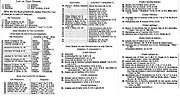 The office did not always pass directly from father to son. The high priests, like all Jewish priests, belonged to the Aaron
ic line. The Bible mentions the majority of high priests before the captivity, but does not give a complete list of office holders. Lists would be based on various historical sources. In several periods of gentile rule, high priests were appointed and removed by kings. Still, most high priests came from the Aaronic line. One exception is Menelaus
, who may not have been from the Tribe of Levi at all, but from the Tribe of Benjamin
.
Some name Jehozadak
, son of Seriah, as a high priest prior to being sent to captivity in Babylonia
, which however is a misreading of biblical references to "Joshua, son of Jehozadak, the high priest." Rashi
(Rabbi Shlomo Yitzhaqi) wrote that Joshua the son of Jehozadak, the [High] Priest, "does not [mean] that Jehozadak ever served in the high priesthood, for he was exiled to Babylon in the days of Jeconiah, as it is written: And Jehozadak went when… exiled etc.," but Joshua his son was the High Priest when they ascended from Babylon during the time of the Second Temple. Now why was Azariah the son of Seraiah the scholar not the High Priest, but [instead] his nephew Joshua the son of Jehozadak? This is the reason: because Joshua ascended with Zerubbabel
many days and years before Ezra
ascended.
A genealogy from Aaron through Eleazar to Jehozadak can be found in 1 Chronicles
, chapter 6. As in several biblical genealogies, some names may be omitted. Therefore it is uncertain whether high priests mentioned elsewhere (such as Jehoiada and Jehoiarib) are simply omitted or did not belong to the unbroken male line in this genealogy. During the later time of the judges, the office went to Itamar's descendants for a period, the first known and most notable high priest being Eli. After Abiathar was expelled, the office returned to the line of Eleazar. It is not sure whether all those mentioned in the genealogy between Zadok and Jehozadak were high priests. From Solomon's time until the captivity, Josephus
names 18 high priests, while Seder 'Olam Zuta names 19.
The five descendants of Joshua are mentioned in Nehemiah
, chapter 12, 10f. The chronology given above, based on Josephus, however is not undisputed, with some alternatively placing Jaddua during the time of Darius II
and some supposing one more Johanan and one more Jaddua in the following time, the latter Jaddua being contemporary of Alexander the Great.
Inter-Sacerdotium:
It is unknown who held the position of High Priest of Jerusalem between Alcimus' death and the accession of Jonathan. Josephus, in Jewish Antiquities XX.10, relates that the office was vacant for six years, but this is indeed highly unlikely, if not impossible. In religious terms, the High Priest was a necessary part of the rites on the Day of Atonement
- a day that could have not been allowed to pass uncelebrated for so long so soon after the restoration of the Temple service. Politically, Israel's overlords probably would not have allowed a power vacuum to last that length of time.
In another passage (XII.10 §6, XII.11 §2) Josephus suggests that Judas Maccabeus
, the brother of Jonathan, held the office for three years, succeeding Alcimus. However, Judas actually predeceased Alcimus by one year. The nature of Jonathan's accession to the high priesthood makes it unlikely that Judas held that office during the inter-sacerdotium. The Jewish Encyclopedia
tries to harmonise the contradictions found in Josephus by supposing that Judas held the office "immediately after the consecration of the Temple (165-162), that is, before the election of Alcimus"
It has been argued that the founder of the Qumran community, the Teacher of Righteousness
(Moreh Zedek), was High Priest (but not necessarily the sole occupant) during the inter-sacerdotium and was driven off by Jonathan. This view is based on sources from the Qumran
, that portray the teacher as a figure of authority usually associated with the high priest, however, without clearly spelling out names or events.
Hasmonean
Kohen Gadol
The High Priest was the chief religious official of Israelite religion and of classical Judaism from the rise of the Israelite nation until the destruction of the Second Temple of Jerusalem...
s of Ancient Israel up to the destruction of the Second Temple
Second Temple
The Jewish Second Temple was an important shrine which stood on the Temple Mount in Jerusalem between 516 BCE and 70 CE. It replaced the First Temple which was destroyed in 586 BCE, when the Jewish nation was exiled to Babylon...
in 70 CE
Common Era
Common Era ,abbreviated as CE, is an alternative designation for the calendar era originally introduced by Dionysius Exiguus in the 6th century, traditionally identified with Anno Domini .Dates before the year 1 CE are indicated by the usage of BCE, short for Before the Common Era Common Era...
. Because of a lack of historical data, this list is incomplete and there may be gaps.
Line of the High Priests of Israel
Aaron
In the Hebrew Bible and the Qur'an, Aaron : Ααρών ), who is often called "'Aaron the Priest"' and once Aaron the Levite , was the older brother of Moses, and a prophet of God. He represented the priestly functions of his tribe, becoming the first High Priest of the Israelites...
ic line. The Bible mentions the majority of high priests before the captivity, but does not give a complete list of office holders. Lists would be based on various historical sources. In several periods of gentile rule, high priests were appointed and removed by kings. Still, most high priests came from the Aaronic line. One exception is Menelaus
Menelaus (High Priest)
Menelaus was High Priest in Jerusalem from 171 BC to about 161 BC. He was the successor of Jason, the brother of Onias III.The sources are divided as to his origin...
, who may not have been from the Tribe of Levi at all, but from the Tribe of Benjamin
Tribe of Benjamin
According to the Hebrew Bible, the Tribe of Benjamin בִּנְיָמִין was one of the Tribes of Israel.From after the conquest of the land by Joshua until the formation of the first Kingdom of Israel in c. 1050 BCE, the Tribe of Benjamin was a part of a loose confederation of Israelite tribes...
.
From the Exodus to the Babylonian Exile
| Book of Ezra Book of Ezra The Book of Ezra is a book of the Hebrew Bible. Originally combined with the Book of Nehemiah in a single book of Ezra-Nehemiah, the two became separated in the early centuries of the Christian era... 7:1-5 |
Josephus Josephus Titus Flavius Josephus , also called Joseph ben Matityahu , was a 1st-century Romano-Jewish historian and hagiographer of priestly and royal ancestry who recorded Jewish history, with special emphasis on the 1st century AD and the First Jewish–Roman War, which resulted in the Destruction of... |
Seder 'Olam Zuta | Important priests in the Tanakh Tanakh The Tanakh is a name used in Judaism for the canon of the Hebrew Bible. The Tanakh is also known as the Masoretic Text or the Miqra. The name is an acronym formed from the initial Hebrew letters of the Masoretic Text's three traditional subdivisions: The Torah , Nevi'im and Ketuvim —hence... >- | Aaron Aaron In the Hebrew Bible and the Qur'an, Aaron : Ααρών ), who is often called "'Aaron the Priest"' and once Aaron the Levite , was the older brother of Moses, and a prophet of God. He represented the priestly functions of his tribe, becoming the first High Priest of the Israelites... |
Aaron Aaron In the Hebrew Bible and the Qur'an, Aaron : Ααρών ), who is often called "'Aaron the Priest"' and once Aaron the Levite , was the older brother of Moses, and a prophet of God. He represented the priestly functions of his tribe, becoming the first High Priest of the Israelites... |
Aaron Aaron In the Hebrew Bible and the Qur'an, Aaron : Ααρών ), who is often called "'Aaron the Priest"' and once Aaron the Levite , was the older brother of Moses, and a prophet of God. He represented the priestly functions of his tribe, becoming the first High Priest of the Israelites... |
Aaron Aaron In the Hebrew Bible and the Qur'an, Aaron : Ααρών ), who is often called "'Aaron the Priest"' and once Aaron the Levite , was the older brother of Moses, and a prophet of God. He represented the priestly functions of his tribe, becoming the first High Priest of the Israelites... |
Aaron Aaron In the Hebrew Bible and the Qur'an, Aaron : Ααρών ), who is often called "'Aaron the Priest"' and once Aaron the Levite , was the older brother of Moses, and a prophet of God. He represented the priestly functions of his tribe, becoming the first High Priest of the Israelites... >- | Eleazar Eleazar Eleazar , was a priest in the Hebrew Bible, the second Kohen Gadol - succeeding his father Aaron. He was a nephew of Moses.-Life:... |
Eleazar Eleazar Eleazar , was a priest in the Hebrew Bible, the second Kohen Gadol - succeeding his father Aaron. He was a nephew of Moses.-Life:... |
Eleazar Eleazar Eleazar , was a priest in the Hebrew Bible, the second Kohen Gadol - succeeding his father Aaron. He was a nephew of Moses.-Life:... |
Eleazar Eleazar Eleazar , was a priest in the Hebrew Bible, the second Kohen Gadol - succeeding his father Aaron. He was a nephew of Moses.-Life:... |
Eleazar Eleazar Eleazar , was a priest in the Hebrew Bible, the second Kohen Gadol - succeeding his father Aaron. He was a nephew of Moses.-Life:... >- | Phinehas Phinehas -Biblical figures:*Phinehas, son of Eleazar and grandson of Aaron the High Priest*Phinehas, son of the High Priest Eli. He was a priest at Shiloh, and died when the Philistines captured the Ark of the Covenant-Other :*Pinchas, the 41st weekly Torah portion.... |
Phinehas Phinehas -Biblical figures:*Phinehas, son of Eleazar and grandson of Aaron the High Priest*Phinehas, son of the High Priest Eli. He was a priest at Shiloh, and died when the Philistines captured the Ark of the Covenant-Other :*Pinchas, the 41st weekly Torah portion.... |
Phinehas Phinehas -Biblical figures:*Phinehas, son of Eleazar and grandson of Aaron the High Priest*Phinehas, son of the High Priest Eli. He was a priest at Shiloh, and died when the Philistines captured the Ark of the Covenant-Other :*Pinchas, the 41st weekly Torah portion.... |
Phinehas Phinehas -Biblical figures:*Phinehas, son of Eleazar and grandson of Aaron the High Priest*Phinehas, son of the High Priest Eli. He was a priest at Shiloh, and died when the Philistines captured the Ark of the Covenant-Other :*Pinchas, the 41st weekly Torah portion.... |
Phinehas Phinehas -Biblical figures:*Phinehas, son of Eleazar and grandson of Aaron the High Priest*Phinehas, son of the High Priest Eli. He was a priest at Shiloh, and died when the Philistines captured the Ark of the Covenant-Other :*Pinchas, the 41st weekly Torah portion.... >- | Abishua Abishua Abishua was an early High priest of Israel.Abishua is mentioned in the books 1 Chronicles and Ezra as the son of the High Priest Phinehas, son of Eleazar... |
Abishua Abishua Abishua was an early High priest of Israel.Abishua is mentioned in the books 1 Chronicles and Ezra as the son of the High Priest Phinehas, son of Eleazar... |
Abishua Abishua Abishua was an early High priest of Israel.Abishua is mentioned in the books 1 Chronicles and Ezra as the son of the High Priest Phinehas, son of Eleazar... |
Abishua Abishua Abishua was an early High priest of Israel.Abishua is mentioned in the books 1 Chronicles and Ezra as the son of the High Priest Phinehas, son of Eleazar... |
Abishua Abishua Abishua was an early High priest of Israel.Abishua is mentioned in the books 1 Chronicles and Ezra as the son of the High Priest Phinehas, son of Eleazar... >- |
Samaritan Samaritan The Samaritans are an ethnoreligious group of the Levant. Religiously, they are the adherents to Samaritanism, an Abrahamic religion closely related to Judaism... s, Shesha is inserted, said to be the son of Abishua and father to Bukki. >- | Bukki |
Bukki | Bukki | Bukki | >- | Uzzi (High Priest) | Uzzi (High Priest) | Uzzi (High Priest) | >- | Zerahiah | Eli | Eli | >- | Meraioth | Ahitub | Ahitub | >- | Azariah | Ahijah | Ahijah | >- | Amariah | Ahimelech Ahimelech Ahimelech , the son of Ahitub and father of Abiathar , described in 2 Sam. 8:17 as the son of Abiathar and in four places in 1 Chronicles. He descended from Eli in the line of Ithamar. In 1 Chr. 18:16 his name is Abimelech according to the Masoretic Text, and is probably the same as Ahiah... |
Ahimelech Ahimelech Ahimelech , the son of Ahitub and father of Abiathar , described in 2 Sam. 8:17 as the son of Abiathar and in four places in 1 Chronicles. He descended from Eli in the line of Ithamar. In 1 Chr. 18:16 his name is Abimelech according to the Masoretic Text, and is probably the same as Ahiah... |
Ahimelech Ahimelech Ahimelech , the son of Ahitub and father of Abiathar , described in 2 Sam. 8:17 as the son of Abiathar and in four places in 1 Chronicles. He descended from Eli in the line of Ithamar. In 1 Chr. 18:16 his name is Abimelech according to the Masoretic Text, and is probably the same as Ahiah... >- | Ahitub |
Ahitub | Abiathar Abiathar Abiathar , in the Hebrew Bible, son of Achimelech or Ahijah, High Priest at Nob, the fourth in descent from Eli and the last of Eli's House... |
Abiathar Abiathar Abiathar , in the Hebrew Bible, son of Achimelech or Ahijah, High Priest at Nob, the fourth in descent from Eli and the last of Eli's House... |
Abiathar Abiathar Abiathar , in the Hebrew Bible, son of Achimelech or Ahijah, High Priest at Nob, the fourth in descent from Eli and the last of Eli's House... >- | Zadok Zadok Zadok was a high priest of the Israelites in Jerusalem after it was conquered by David.Zadok may also refer to:*Rabbi Zadok, tanna of the 1st-century CE*Zadok the Priest, an 18th-century coronation anthem by Handel... |
Zadok Zadok Zadok was a high priest of the Israelites in Jerusalem after it was conquered by David.Zadok may also refer to:*Rabbi Zadok, tanna of the 1st-century CE*Zadok the Priest, an 18th-century coronation anthem by Handel... |
Zadok Zadok Zadok was a high priest of the Israelites in Jerusalem after it was conquered by David.Zadok may also refer to:*Rabbi Zadok, tanna of the 1st-century CE*Zadok the Priest, an 18th-century coronation anthem by Handel... |
Zadok Zadok Zadok was a high priest of the Israelites in Jerusalem after it was conquered by David.Zadok may also refer to:*Rabbi Zadok, tanna of the 1st-century CE*Zadok the Priest, an 18th-century coronation anthem by Handel... |
Zadok Zadok Zadok was a high priest of the Israelites in Jerusalem after it was conquered by David.Zadok may also refer to:*Rabbi Zadok, tanna of the 1st-century CE*Zadok the Priest, an 18th-century coronation anthem by Handel... , son of Ahitub Ahitub Ahitub - brother of goodness = good. A few people in the Bible have this name: The son of Phinehas, grandson of Eli, and brother of Ichabod. On the death of his grandfather Eli he most likely succeeded to the office of high priest, and would have been succeeded by his son Ahijah... (son of Amariah Amariah Amariah means "said by God" in Hebrew. It was commonly used as a name of priests in the History of ancient Israel and Judah. It appear several times in the Hebrew Bible:#One of the descendants of Aaron by Eleazar... , son of Meraioth, son of Zerahiah, son of Uzzi — 1 Chr 6:6-8) of the line of Eleazar, High Priest during the reign of King Solomon and the construction of the First Temple >- | Ahimaaz |
Ahimaaz | Ahimaaz | Ahimaaz | >- | Azariah Azariah (high priest) Azariah was the third High Priest after Zadok. He was one of the "princes" during the reign of Solomon, as mentioned in , where he is called "son of Zadok", although he is elsewhere identified as the son of Ahimaaz . Although his name appears in the list of the Zadokite dynasty there is no direct... |
Azariah Azariah (high priest) Azariah was the third High Priest after Zadok. He was one of the "princes" during the reign of Solomon, as mentioned in , where he is called "son of Zadok", although he is elsewhere identified as the son of Ahimaaz . Although his name appears in the list of the Zadokite dynasty there is no direct... |
Azariah Azariah (high priest) Azariah was the third High Priest after Zadok. He was one of the "princes" during the reign of Solomon, as mentioned in , where he is called "son of Zadok", although he is elsewhere identified as the son of Ahimaaz . Although his name appears in the list of the Zadokite dynasty there is no direct... |
Azariah Azariah (high priest) Azariah was the third High Priest after Zadok. He was one of the "princes" during the reign of Solomon, as mentioned in , where he is called "son of Zadok", although he is elsewhere identified as the son of Ahimaaz . Although his name appears in the list of the Zadokite dynasty there is no direct... , son of Ahimaaz ("prince" during Solomon's reign — 1 Ki 4:2) >- | Johanan Joash (high priest) Joash was the fourth High Priest of Solomon's Temple. Josephus wrote that after Azariah his son 'Joram' became the new High Priest. The third name in the High Priest family line of is 'Johanan'.... |
- | Joram Joash (high priest) Joash was the fourth High Priest of Solomon's Temple. Josephus wrote that after Azariah his son 'Joram' became the new High Priest. The third name in the High Priest family line of is 'Johanan'.... |
Joash Joash (high priest) Joash was the fourth High Priest of Solomon's Temple. Josephus wrote that after Azariah his son 'Joram' became the new High Priest. The third name in the High Priest family line of is 'Johanan'.... |
Johanan Joash (high priest) Joash was the fourth High Priest of Solomon's Temple. Josephus wrote that after Azariah his son 'Joram' became the new High Priest. The third name in the High Priest family line of is 'Johanan'.... , son of Azariah >- | - |
- | Isus Jehoiarib Jehoiarib was the head of a family of priests, which was made the first of the twenty-four priestly divisions organized by King David.- High Priest :... |
Jehoiarib Jehoiarib Jehoiarib was the head of a family of priests, which was made the first of the twenty-four priestly divisions organized by King David.- High Priest :... |
Jehoiarib Jehoiarib Jehoiarib was the head of a family of priests, which was made the first of the twenty-four priestly divisions organized by King David.- High Priest :... , head of a family of priests >- | - |
- | - | Jehoshaphat Jehoshaphat (high priest) According to Seder Olam Zuta, Jehoshaphat was a High Priest of Israel, succeeding Jehoiarib and succeeded by Jehoiada. According to Josephus, the second High Priest after Joram was Pediah. Josephus does not mention a Jehoshaphat... |
>- | - | Axioramos | Jehoiada Jehoiada Jehoiada in the Hebrew Bible, was a prominent priest during the reigns of Ahaziah, Athaliah, and Joash. By his arranged marriage with the princess Jehosheba , he became the brother-in-law of King Ahaziah... |
Jehoiada Jehoiada Jehoiada in the Hebrew Bible, was a prominent priest during the reigns of Ahaziah, Athaliah, and Joash. By his arranged marriage with the princess Jehosheba , he became the brother-in-law of King Ahaziah... , brother-in-law of King Ahaziah >- | - |
- | Phideas Pediah Pediah was the High Priest of Solomon's Temple. Josephus wrote that after Axioramos his son 'Phideas' became the new High Priest. Pediah doesn't appear in the High Priest family line of , at his chronological position the name 'Ahitub' appears.... |
Pediah Pediah Pediah was the High Priest of Solomon's Temple. Josephus wrote that after Axioramos his son 'Phideas' became the new High Priest. Pediah doesn't appear in the High Priest family line of , at his chronological position the name 'Ahitub' appears.... |
>- | - | Sudeas Zedekiah (high priest) Zedekiah was the High Priest of Solomon's Temple that succeeded Pediah. According to Josephus Zedekiah was the son of Pediah . He also appears in the High Priest list of the medieval chronicle Seder 'Olam Zuta. Zedekiah is never mentioned in the Tanakh, his name doesn't appear in the list of the... |
Zedekiah Zedekiah (high priest) Zedekiah was the High Priest of Solomon's Temple that succeeded Pediah. According to Josephus Zedekiah was the son of Pediah . He also appears in the High Priest list of the medieval chronicle Seder 'Olam Zuta. Zedekiah is never mentioned in the Tanakh, his name doesn't appear in the list of the... |
>- | - | Juelus | Joel | Azariah II Azariah II Azariah was a high priest mentioned in 2 Chronicles 26, which is the story of Uzziah becoming leprous.... >- | Amaria |
- | Jotham | Jotham | >- | - | Urias | Urijah | >- | - | Nerias | Neria | Azariah II Azariah II Azariah was a high priest mentioned in 2 Chronicles 26, which is the story of Uzziah becoming leprous.... (c. 715 BC — 1 Chr 6:9, 2 Chr 31:10) >- | Zadok |
- | Odeas | Hoshaiah | >- | Shallum | Shallum | Shallum | >- | Hilkiah Hilkiah Hilkiah was a Hebrew Priest at the time of King Josiah. His name is mentioned in II Kings. He was the High Priest and is known for finding a lost copy of the Book of the law at the Temple in Jerusalem at the time that King Josiah commanded that the Holy Temple be refurbished . His preaching may... |
Elcias Hilkiah Hilkiah was a Hebrew Priest at the time of King Josiah. His name is mentioned in II Kings. He was the High Priest and is known for finding a lost copy of the Book of the law at the Temple in Jerusalem at the time that King Josiah commanded that the Holy Temple be refurbished . His preaching may... |
Hilkiah Hilkiah Hilkiah was a Hebrew Priest at the time of King Josiah. His name is mentioned in II Kings. He was the High Priest and is known for finding a lost copy of the Book of the law at the Temple in Jerusalem at the time that King Josiah commanded that the Holy Temple be refurbished . His preaching may... |
Hilkiah Hilkiah Hilkiah was a Hebrew Priest at the time of King Josiah. His name is mentioned in II Kings. He was the High Priest and is known for finding a lost copy of the Book of the law at the Temple in Jerusalem at the time that King Josiah commanded that the Holy Temple be refurbished . His preaching may... , priest at the time of King Josiah. >- | Azariah IV |
Azariah IV | Azaros | Azariah IV | >- | Seriah | Sareas | Seriah | Seriah, son of Azariah IV (2 Ki 25:18) |
Some name Jehozadak
Jehozadak
Jehozadak is a character in the Bible, who name means Jehovah-justified. He was the son of the high priest Seraiah at the time of the Babylonian exile ....
, son of Seriah, as a high priest prior to being sent to captivity in Babylonia
Babylonia
Babylonia was an ancient cultural region in central-southern Mesopotamia , with Babylon as its capital. Babylonia emerged as a major power when Hammurabi Babylonia was an ancient cultural region in central-southern Mesopotamia (present-day Iraq), with Babylon as its capital. Babylonia emerged as...
, which however is a misreading of biblical references to "Joshua, son of Jehozadak, the high priest." Rashi
Rashi
Shlomo Yitzhaki , or in Latin Salomon Isaacides, and today generally known by the acronym Rashi , was a medieval French rabbi famed as the author of a comprehensive commentary on the Talmud, as well as a comprehensive commentary on the Tanakh...
(Rabbi Shlomo Yitzhaqi) wrote that Joshua the son of Jehozadak, the [High] Priest, "does not [mean] that Jehozadak ever served in the high priesthood, for he was exiled to Babylon in the days of Jeconiah, as it is written: And Jehozadak went when… exiled etc.," but Joshua his son was the High Priest when they ascended from Babylon during the time of the Second Temple. Now why was Azariah the son of Seraiah the scholar not the High Priest, but [instead] his nephew Joshua the son of Jehozadak? This is the reason: because Joshua ascended with Zerubbabel
Zerubbabel
Zerubbabel was a governor of the Persian Province of Judah and the grandson of Jehoiachin, penultimate king of Judah. Zerubbabel led the first group of Jews, numbering 42,360, who returned from the Babylonian Captivity in the first year of Cyrus, King of Persia . The date is generally thought to...
many days and years before Ezra
Ezra
Ezra , also called Ezra the Scribe and Ezra the Priest in the Book of Ezra. According to the Hebrew Bible he returned from the Babylonian exile and reintroduced the Torah in Jerusalem...
ascended.
A genealogy from Aaron through Eleazar to Jehozadak can be found in 1 Chronicles
Books of Chronicles
The Books of Chronicles are part of the Hebrew Bible. In the Masoretic Text, it appears as the first or last book of the Ketuvim . Chronicles largely parallels the Davidic narratives in the Books of Samuel and the Books of Kings...
, chapter 6. As in several biblical genealogies, some names may be omitted. Therefore it is uncertain whether high priests mentioned elsewhere (such as Jehoiada and Jehoiarib) are simply omitted or did not belong to the unbroken male line in this genealogy. During the later time of the judges, the office went to Itamar's descendants for a period, the first known and most notable high priest being Eli. After Abiathar was expelled, the office returned to the line of Eleazar. It is not sure whether all those mentioned in the genealogy between Zadok and Jehozadak were high priests. From Solomon's time until the captivity, Josephus
Josephus
Titus Flavius Josephus , also called Joseph ben Matityahu , was a 1st-century Romano-Jewish historian and hagiographer of priestly and royal ancestry who recorded Jewish history, with special emphasis on the 1st century AD and the First Jewish–Roman War, which resulted in the Destruction of...
names 18 high priests, while Seder 'Olam Zuta names 19.
After the Babylonian Exile
- Joshua, son of Jehozadak, ca. 515-490 BCE, after the restoration of the Temple
- JoiakimJoiakim (high priest)The mystery surrounding the identity of Joiakim is rather convoluted. Biblical texts seem to conflict with one another, as we will detail. In a similar fashion the history of Josephus The mystery surrounding the identity of Joiakim is rather convoluted. Biblical texts seem to conflict with one...
, son of Joshua, ca. 490-470 BCE - EliashibEliashib (High Priest)Eliashib the High Priest is mentioned in Nehemiah 12:10,22 and 3:1, 20-21,13:28 and possibly the Book of Ezra 10:6 of the Hebrew Bible. Some also place him in different parts of Nehemiah including 12:23 and 13:4,7, but this is disputed. Nehemiah 3:20-21 places his home between the area of two...
, son of Joiakim, ca. 470-433 BCE - Joiada, son of Eliashib, ca. 433-410 BCE {A son married a daughter of Sanballat the HoroniteSanballat the HoroniteSanballat the Horonite or Sanballat I was a Samaritan leader and official of the Persian Achaemenid Empire who lived in the mid to late fifth century BC...
for which he was driven out of the Temple by Nehemiah} - JohananJohanan (High Priest)Johanan , son of Joiada, was the fifth Jewish high priest after the rebuilding of the temple in Jerusalem by the Jews who had returned from the Babylonian captivity. His reign is estimated to have been from c. 410-371 BCE; he was succeeded by his son Jaddua. The bible gives no details about his life...
, son of Joiada, ca. 410-371 BCE - JadduaJadduaJaddua was a the son of Jonathan and a high priest during the postexilic period. However, according to Nehemiah12:22 it is possible that a transcribing error has occurred in the rendering of Juddah's father's name. A more likely translation is that Juddah's father was Johanan. . Reference to Jaddua...
, son of Johanan, ca. 371-320 BCE, during the reign of Alexander the Great. Some have identified him as Simeon the JustSimeon the JustSimeon the Just was a Jewish High Priest during the time of the Second Temple...
.
The five descendants of Joshua are mentioned in Nehemiah
Book of Nehemiah
The Book of Nehemiah is a book of the Hebrew Bible. Told largely in the form of a first-person memoir, it concerns the rebuilding of the walls of Jerusalem by Nehemiah, a Jew who is a high official at the Persian court, and the dedication of the city and its people to God's laws...
, chapter 12, 10f. The chronology given above, based on Josephus, however is not undisputed, with some alternatively placing Jaddua during the time of Darius II
Darius II of Persia
Darius II , was king of the Persian Empire from 423 BC to 405 BC.Artaxerxes I, who died on December 25, 424 BC, was followed by his son Xerxes II. After a month and a half Xerxes II was murdered by his brother Secydianus or Sogdianus...
and some supposing one more Johanan and one more Jaddua in the following time, the latter Jaddua being contemporary of Alexander the Great.
- Onias I, son of Jaddua, ca. 320-280 BCE
- Simon ISimon I (High Priest)Simon I son of Onias I, was High Priest in the Temple in Jerusalem. Some identify him as Simeon the Just.-References:...
, son of Onias, ca. 280-260 BCE - Eleazar, son of Onias, ca. 260-245 BCE
- Manasseh, son of Jaddua, ca. 245-240 BCE
- Onias II, son of Simon, ca. 240-218 BCE
- Simon IISimon II (High Priest)Simon II was a Jewish High Priest during the time of the Second Temple. He was the son of Onias II. Some identify him with Simeon the Just....
, son of Onias, 218-185 BCE - Onias III, son of Simon, 185-175 BCE, murdered 170 BCE
- JasonJason (high priest)Jason of the Oniad family, brother to Onias III, was a High Priest in the Temple in Jerusalem.Jason became high priest in 175 BCE after the accession of Antiochus Epiphanes to the throne of the Seleucid Empire....
, son of Simon 175-172 BCE - MenelausMenelaus (High Priest)Menelaus was High Priest in Jerusalem from 171 BC to about 161 BC. He was the successor of Jason, the brother of Onias III.The sources are divided as to his origin...
172-162 BCE- Onias IVOnias IVOnias IV is the designation given to the son of Onias III and the lawful heir of the legitimate high priests. He had reason to hope that the victory of the national party under Judas Maccabeus would place him in the office of his fathers; but being disappointed in his expectations by the election...
, son of Onias III, fled to Egypt and built a Jewish Temple at LeontopolisLeontopolisLeontopolis or Leonto or Latin: Leontos Oppidum or Egyptian: Taremu, was an Ancient Egyptian city that is known as Tell al Muqdam today.-History:The city is located in the central part of the Nile Delta region...
(closed in CE 66)
- Onias IV
- AlcimusAlcimusAlcimus , also called Jacimus, or Joachim , was a High Priest of Israel for three years, 162 BCE-159 BCE, who espoused the Syrian cause....
162-159 BCE
Inter-Sacerdotium:
It is unknown who held the position of High Priest of Jerusalem between Alcimus' death and the accession of Jonathan. Josephus, in Jewish Antiquities XX.10, relates that the office was vacant for six years, but this is indeed highly unlikely, if not impossible. In religious terms, the High Priest was a necessary part of the rites on the Day of Atonement
Yom Kippur
Yom Kippur , also known as Day of Atonement, is the holiest and most solemn day of the year for the Jews. Its central themes are atonement and repentance. Jews traditionally observe this holy day with a 25-hour period of fasting and intensive prayer, often spending most of the day in synagogue...
- a day that could have not been allowed to pass uncelebrated for so long so soon after the restoration of the Temple service. Politically, Israel's overlords probably would not have allowed a power vacuum to last that length of time.
In another passage (XII.10 §6, XII.11 §2) Josephus suggests that Judas Maccabeus
Judas Maccabeus
Judah Maccabee was a Kohen and a son of the Jewish priest Mattathias...
, the brother of Jonathan, held the office for three years, succeeding Alcimus. However, Judas actually predeceased Alcimus by one year. The nature of Jonathan's accession to the high priesthood makes it unlikely that Judas held that office during the inter-sacerdotium. The Jewish Encyclopedia
Jewish Encyclopedia
The Jewish Encyclopedia is an encyclopedia originally published in New York between 1901 and 1906 by Funk and Wagnalls. It contained over 15,000 articles in 12 volumes on the history and then-current state of Judaism and the Jews as of 1901...
tries to harmonise the contradictions found in Josephus by supposing that Judas held the office "immediately after the consecration of the Temple (165-162), that is, before the election of Alcimus"
It has been argued that the founder of the Qumran community, the Teacher of Righteousness
Teacher of Righteousness
The Teacher of Righteousness is a figure found in some of the Dead Sea Scrolls at Qumran, most prominently in the Damascus Document. This document speaks briefly of the origins of the sect, probably Essenes, 390 years after the Babylonian exile and after 20 years of 'groping' blindly for the way...
(Moreh Zedek), was High Priest (but not necessarily the sole occupant) during the inter-sacerdotium and was driven off by Jonathan. This view is based on sources from the Qumran
Dead Sea scrolls
The Dead Sea Scrolls are a collection of 972 texts from the Hebrew Bible and extra-biblical documents found between 1947 and 1956 on the northwest shore of the Dead Sea, from which they derive their name...
, that portray the teacher as a figure of authority usually associated with the high priest, however, without clearly spelling out names or events.
HasmoneanHasmoneanThe Hasmonean dynasty , was the ruling dynasty of Judea and surrounding regions during classical antiquity. Between c. 140 and c. 116 BCE, the dynasty ruled semi-autonomously from the Seleucids in the region of Judea...
dynasty
- Jonathan ApphusJonathan MaccabaeusJonathan Apphus was leader of the Hasmonean Dynasty of Judea from 161 to 143 BCE. The name Apphus could mean = "the dissembler", "the Wary", or "the diplomat", in allusion to a trait prominent in him -Leader of the Jews:...
, 153-143 BCE - Simeon TassiSimon MaccabaeusSimon Thassi was the second son of Mattathias and thus a member of the Hasmonean family. The name "Thassi" has an uncertain meaning...
, brother of Jonathan Apphus, 142-134 BCE - John Hyrcanus I, son of Simeon Tassi 134-104 BCE
- Aristobulus I, son of John Hyrcanus, 104-103 BCE
- Alexander JannaeusAlexander JannaeusAlexander Jannaeus was king of Judea from 103 BC to 76 BC. The son of John Hyrcanus, he inherited the throne from his brother Aristobulus I, and appears to have married his brother's widow, Shlomtzion or "Shelomit", also known as Salome Alexandra, according to the Biblical law of Yibbum...
, son of John Hyrcanus, 103-76 BCE - John Hyrcanus II, son of Alexander Jannaeus, 76-66 BCE
- Aristobulus IIAristobulus IIAristobulus II was the Jewish High Priest and King of Judea, 66 BC to 63 BC, from the Hasmonean Dynasty.-Family:Aristobulus was the younger son of Alexander Jannaeus, King and High Priest, and Alexandra Salome. After the death of Alexander in 76 BC, his widow succeeded to the rule of Judea and...
, son of Alexander Jannaeus, 66-63 BCE - John Hyrcanus II (restored) 63-40 BCE
- AntigonusAntigonus the HasmoneanAntigonus II Mattathias was the last Hasmonean king of Judea. He was the son of King Aristobulus II of Judea...
, son of Aristobulos II, 40-37 BCE - Aristobulus IIIAristobulus III of JudeaAristobulus III was the last scion of the Hasmonean royal house, brother of Herod the Great's wife Mariamne, and paternal grandson of Aristobulus II. He was a favorite of the people on account of his noble descent and handsome presence, and thus became an object of fear to Herod, who at first...
36 BCE-last of the Hasmoneans; paternal grandson of Aristobulus II and brother of Herod's wife Mariamne (second wife of Herod)Mariamne (second wife of Herod)Mariamne I, also called Mariamne the Hasmonean was the second wife of Herod the Great. She was known for her great beauty, as was her brother Aristobulus...
.
High Priest under Herodians and Romans
- Ananelus 37-36 BCE
- Aristobulus IIIAristobulus III of JudeaAristobulus III was the last scion of the Hasmonean royal house, brother of Herod the Great's wife Mariamne, and paternal grandson of Aristobulus II. He was a favorite of the people on account of his noble descent and handsome presence, and thus became an object of fear to Herod, who at first...
36 BCE-last of the Hasmoneans; paternal grandson of Aristobulus II and brother of Herord's wife Mariamne (second wife of Herod)Mariamne (second wife of Herod)Mariamne I, also called Mariamne the Hasmonean was the second wife of Herod the Great. She was known for her great beauty, as was her brother Aristobulus...
. - Ananelus (restored) 36-30 BCE
- Joshua ben Fabus 30-23 BCE
- Simon ben BoethusBoethusiansThe Boethusians were a Jewish sect closely related to, if not a development of, the Sadducees.-Origins according to the Talmud:The post-Talmudic work Avot de-Rabbi Natan gives the following origin of the schism between Sadducees and Boethusians: Antigonus of Sokho having taught the maxim, "Be not...
23-5 BCE (his daughter Mariamne (third wife of Herod)Mariamne (third wife of Herod)Mariamne II was the third wife of Herod the Great. She was the daughter of Simon Boethus the High Priest. Josephus recounts their wedding thus:...
married Herod the GreatHerod the GreatHerod , also known as Herod the Great , was a Roman client king of Judea. His epithet of "the Great" is widely disputed as he is described as "a madman who murdered his own family and a great many rabbis." He is also known for his colossal building projects in Jerusalem and elsewhere, including his...
) - Matthias ben Theophilus 5-4 BCE
- Joazar ben BoethusBoethusiansThe Boethusians were a Jewish sect closely related to, if not a development of, the Sadducees.-Origins according to the Talmud:The post-Talmudic work Avot de-Rabbi Natan gives the following origin of the schism between Sadducees and Boethusians: Antigonus of Sokho having taught the maxim, "Be not...
4 BCE (Sadducee) - Eleazar ben BoethusBoethusiansThe Boethusians were a Jewish sect closely related to, if not a development of, the Sadducees.-Origins according to the Talmud:The post-Talmudic work Avot de-Rabbi Natan gives the following origin of the schism between Sadducees and Boethusians: Antigonus of Sokho having taught the maxim, "Be not...
4-3 BCE (Sadducee) - Joshua ben Sie 3 BCE - ?
- Joazar ben BoethusBoethusiansThe Boethusians were a Jewish sect closely related to, if not a development of, the Sadducees.-Origins according to the Talmud:The post-Talmudic work Avot de-Rabbi Natan gives the following origin of the schism between Sadducees and Boethusians: Antigonus of Sokho having taught the maxim, "Be not...
? - 6 CE (Sadducee) - Ananus ben SethAnnasAnnas [also Ananus or Ananias], son of Seth , was appointed by the Roman legate Quirinius as the first High Priest of the newly formed Roman province of Iudaea in 6 AD; just after the Romans had deposed Archelaus, Ethnarch of Judaea, thereby putting Judaea directly under Roman rule.Annas officially...
6-15 - Ishmael ben Fabus 15-16
- Eleazar ben Ananus 16-17
- Simon ben Camithus 17-18
- Joseph CaiaphasCaiaphasJoseph, son of Caiaphas, Hebrew יוסף בַּר קַיָּפָא or Yosef Bar Kayafa, commonly known simply as Caiaphas in the New Testament, was the Roman-appointed Jewish high priest who is said to have organized the plot to kill Jesus...
18-36 Son-in-law of the high priest Ananas or Annas, - Jonathan ben Ananus 36-37
- Theophilus ben AnanusTheophilus ben AnanusTheophilus was the High Priest in the Second Temple in Jerusalem from AD 37 to 41 according to Josephus's Antiquities of the Jews. He was a member of one of the wealthiest and most influential Jewish families in Iudaea Province during the 1st century...
37-41 - Simon Cantatheras ben BoethusBoethusiansThe Boethusians were a Jewish sect closely related to, if not a development of, the Sadducees.-Origins according to the Talmud:The post-Talmudic work Avot de-Rabbi Natan gives the following origin of the schism between Sadducees and Boethusians: Antigonus of Sokho having taught the maxim, "Be not...
41-43 (Sadducee) - Matthias ben Ananus 43
- Elioneus ben Simon CantatherasBoethusiansThe Boethusians were a Jewish sect closely related to, if not a development of, the Sadducees.-Origins according to the Talmud:The post-Talmudic work Avot de-Rabbi Natan gives the following origin of the schism between Sadducees and Boethusians: Antigonus of Sokho having taught the maxim, "Be not...
43-44 (Sadducee) - Jonathan ben Ananus 44 (restored)
- Josephus ben Camydus 44-46
- Ananias ben Nebedeus 46-52
- Jonathan 52-56
- Ishmael ben Fabus 56-62 (restored?)
- Joseph Cabi ben SimonJoseph Cabi ben SimonJoseph Cabi ben Simon was a Herodian-era High Priest of Israel in Jerusalem, Iudaea Province, appointed by Herod Agrippa II.-References:...
62-63 - Ananus ben Ananus 63
- Joshua ben Damneus 63
- Joshua ben Gamaliel 63-64-his wife Martha belonged to family of BoethusBoethusiansThe Boethusians were a Jewish sect closely related to, if not a development of, the Sadducees.-Origins according to the Talmud:The post-Talmudic work Avot de-Rabbi Natan gives the following origin of the schism between Sadducees and Boethusians: Antigonus of Sokho having taught the maxim, "Be not...
(Sadducee) - Mattathias ben TheophilusMattathias ben TheophilusMattathias ben Theophilus was the Jewish High Priest at the start of the Jewish Revolution, and was overthrown by Revolutionary forces....
65-66