


Jewish Christians

Encyclopedia
Jewish Christians is a term which appears in historical texts contrasting Christians of Jewish origin with Gentile
Christians, both in discussion of the New Testament church
and the second
and following centuries.
Alister McGrath
, former Professor of Historical Theology
at Oxford University, asserts that the 1st century
"Jewish Christians" were totally faithful religious Jews. They differed from other contemporary Jews
only in their acceptance of Jesus as the Messiah
.
However as Christianity grew throughout the Gentile world
, Christians diverged from their Jewish and Jerusalem roots. Jewish Christianity, initially strengthened despite persecution by Jerusalem Temple officials
, fell into decline during the Jewish-Roman wars
(66-135) and the growing anti-Judaism
perhaps best personified by Marcion (c. 150). With persecution by the orthodox Christians from the time of the Roman Emperor Constantine
in the 4th century
, Jewish Christians sought refuge outside the boundaries of the Empire, in Arabia and further afield. Within the Empire and later elsewhere it was dominated by the Gentile
based Christianity which became the official religion of the Roman Empire
and which took control of sites in the Holy Land
such as the Church of the Holy Sepulchre
and the Cenacle
and appointed subsequent Bishops of Jerusalem.
The term "Jewish Christians" in the 3rd and 4th Centuries can refer to groups such as Ebionites
, Nazarene
s and other groups, and related to these groups are quotation fragments of non-canonical gospels referred to as the "Jewish-Christian Gospels
".
, resurrection
and ascension of Jesus
, the disciples, "together with the women and Mary the mother of Jesus, and his brothers" withdrew to the "upper room" (traditionally the Cenacle
), in Jerusalem
(Acts 1:10-14). Initial preaching (Acts ch. 1-9) was to Jews only. In Acts 10 Peter baptised Cornelius the Centurion, marking the beginning of a mixed Jewish and Gentile church.
According to Church tradition, the Roman
Centurion Cornelius
is considered the first Gentile
convert, as recorded in Acts 10, although he was also a "God-fearing" proselyte who participated in a Jewish synagogue
. The major division prior to that time was between Hellenistic
and non-Hellenistic Jews or Koine Greek
and Aramaic speakers. The conversion and acceptance of the Gentile Cornelius can be described in terms of the Judaic teaching which describes strangers becoming part of the community. Acts does not use the term "Jewish Christians", rather those led by James the Just
, Simon Peter, and John the Apostle
, the "Pillars of the Church", were called followers of "The Way". Later groups, or perhaps the same group by different names, were the Ebionites
and Elkasites.
The terms "circumcised" and "uncircumcised", which occur frequently in the New Testament
, are generally interpreted to mean Jews
and Greeks
respectively, who were predominant in the region at the time; however this is an oversimplification as 1st century Iudaea Province
also had some Jews who no longer circumcised (usually Hellenized Jews
living in the diaspora), and some Greeks (called Proselytes or Judaizers
) and others such as Egyptians, Ethiopians, and Arabs who did. See also Abrahamic religion and Circumcision controversy in early Christianity#Jewish background.
as they were being persecuted
. The Acts of the Apostles
depicts instances of early Christian persecution by the Sanhedrin
, the Jewish religious court at the time, however the Historical reliability of the Acts of the Apostles
is disputed. Peter and John were imprisoned by a "Jewish leadership" ("the priests, the captain of the temple, and the Sadducees
") who were "much annoyed because they were teaching the people and proclaiming that in Jesus there is the resurrection of the dead". The Sadducees in particular rejected the Pharisaic doctrine of the resurrection of the dead. Saint Stephen
was tried by a Sanhedrin
(Jewish Supreme Court) for blasphemy
against Moses
and God and was stoned
to death, under the watch of Paul of Tarsus
, before his conversion
.
A further blow to this Jewish sect was the death of their second leader (their first leader Jesus having been crucified c.30).
According to Josephus
, "the brother of Jesus, who was called Christ, whose name was James" met his death after the death of the procurator Porcius Festus
, yet before Lucceius Albinus
took office — which has thus been dated to 62. The High Priest Ananus ben Ananus took advantage of this lack of imperial oversight to assemble a Sanhedrin
(although the correct translation of the Greek 'synhedion kriton' is 'a council of judges', see Synedrion for the Greek use of the word) who condemned James "on the charge of breaking the law," then had him executed by stoning. Josephus reports that Ananus' act was widely viewed as little more than judicial murder, and offended a number of "those who were considered the most fair-minded people in the City".
Three events would greatly affect the fortunes of early Jewish Christianity. The first was the Conversion of Paul
in the early 30's (and the possible conversion of his teacher Gamaliel), the second was the Council of Jerusalem
c.50, and the third was the Destruction of the Second Temple in 70, which according to Josephus was one of the most significant events of the First Jewish–Roman War. Nonetheless, according to the Church History of Eusebius
, the line of Jewish Christian bishops of Jerusalem continued until the Bar Kokhba revolt (132-136) when Hadrian
renamed the city "Aelia Capitolina
" and barred all Jews except for the day of Tisha B'Av
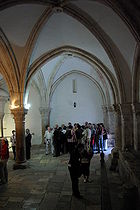
. After that, the Jerusalem bishops were uncircumcised Greeks. The Cenacle
as it exists today is a Gothic
reconstruction, but it may be the location of the original Jewish Christian church.
Some claim an alleged Council of Jamnia
in 90 excluded Christians from the synagogues, but this is disputed. Jewish Christians continued to worship in synagogues for centuries. According to Acts 15, the Council of Jerusalem
c.50, customarily believed to have been led by James the Just
, determined that Religious male circumcision (assumed by some to signify conversion to Judaism
) should not be required of Gentile followers of Jesus
, only basic abstentions: avoidance of "pollution of idols
, fornication
, things strangled, and blood" (KJV, Acts 15:20, also Genesis 11:1-8 (idolatry), 9:20 (sexual depravity), 9:5 (cruelty to animals), 9:3-4 (abstention from blood)). The basis for these prohibitions is not detailed in Acts 15:21, which states only: "For Moses of old time hath in every city them that preach him, being read in the synagogues every sabbath
day", stressing that they are Mosaic Commandments which Gentiles must pay attention to. Many, beginning with Augustine of Hippo
consider the consensus emphasised the four stipulations based on the Noahide Laws
stated in Genesis, and applicable to all people (Noah's descendants after the Flood). On the other hand some modern scholars reject the connection to Noahide Law and instead see (see also Leviticus 18
) as the basis. Some modern Christians are also unclear as to whether this meant that this Apostolic Decree in some way still applies to them or merely that the requirements were imposed to facilitate common participation by Gentiles in the community of Jesus' followers (which at that time included Jewish Christians), so as to remind the Jewish followers of Jesus to uphold those Laws applicable to them (i.e. the full Mosaic Laws). According to Karl Josef von Hefele
, this Apostolic Decree is still observed today by the Greek Orthodox. See also Biblical law in Christianity
, Expounding of the Law
, and Noahidism.
Early Jewish Christians included those who believed non-Jews must become Jews and adopt Jewish customs
. They were derogatively called Judaizers, and even Paul used this term against Jesus's student Peter in public according to Young's Literal Translation
of Gal 2:14:
However, even Barnabas
, Paul's partner up till then, sided with Peter. Catholic Encyclopedia: Judaizers: The Incident at Antioch claims: "St. Paul's account of the incident leaves no doubt that St. Peter saw the justice of the rebuke." however, L. Michael White
's From Jesus to Christianity claims: "The blowup with Peter was a total failure of political bravado, and Paul soon left Antioch as persona non grata, never again to return." See also Incident at Antioch and Pauline Christianity
. Scholar James D. G. Dunn, who coined the phrase "New Perspective on Paul
", has proposed that Peter was the "bridge-man" (i.e. the pontifex maximus) between the two other "prominent leading figures" of early Christianity: Paul and James the Just.
Marcion in the 2nd century
, called the "most dangerous" heretic
, rejected the Twelve Apostles, and interpreted a Jesus
who rejected the Law of Moses
using 10 Pauline Epistles
and the Gospel of Luke
. For example, his version of Luke 23:2: "We found this fellow [Jesus] perverting the nation and destroying the law and the prophets". Irenaeus
in turn rejected Marcion and praised the Twelve Apostles in his Against Heresies
3.12.12:
 According to Eusebius' History of the Church 4.5.3-4: the first 15 Bishops of Jerusalem were "of the circumcision". The Romans destroyed the Jewish leadership in Jerusalem
in year 135 during the Bar Kokhba Revolt. However, that does not necessarily mean an end to Jewish Christianity, any more than Valerian's
Massacre of 258, (when he killed all Christian bishops, presbyters, and deacons, including Pope Sixtus II
and Antipope Novatian
and Cyprian of Carthage), meant an end to Roman Christianity. Traditionally it is believed the Jerusalem Christians waited out the Jewish–Roman wars in Pella
in the Decapolis
. After the Jewish–Roman wars (66–135), which Epiphanius
believed the Cenacle
survived, the significance of Jerusalem to Christians
entered a period of decline, Jerusalem having been temporarily converted to the pagan
Aelia Capitolina
, but interest resumed again with the pilgrimage
of Helena (the mother of Constantine the Great) to the Holy Land
c. 326–28. According to the church historian Socrates of Constantinople, Helena claimed to have found the cross of Christ
, after removing a Temple to Venus
(attributed to Hadrian) that had been built over the site. For that reason she is seen as the Patron Saint
of Archaeologists
. Jerusalem
received special recognition in Canon VII of the First Council of Nicaea
in 325. Later, under Justinian I
(527-565), it was designated one of the Pentarchy
, though the Pentarchy has never been recognized by Roman Catholicism which instead claims Papal supremacy
.
was that it was over the issue of whether Gentiles could enter the Church directly or ought to first convert to Judaism
. However, the Halakha
of Rabbinic Judaism
was still under development at this time, as the Jewish Encyclopedia
article on Jesus notes: "Jesus, however, does not appear to have taken into account the fact that the Halakha was at this period just becoming crystallized, and that much variation existed as to its definite form; the disputes of the Bet Hillel and Bet Shammai
were occurring about the time of his maturity." This controversy was fought largely between opposing groups of Christians who were themselves ethnically Jewish. According to this interpretation, those who felt that conversion to Judaism was a prerequisite for Church membership were eventually condemned by Paul as "Judaizing teachers".
The source of this interpretation is unknown; however, it appears related to Supersessionism
or Hyperdispensationalism
(see also New Perspective on Paul
). In addition, modern Christians, such as Ethiopian Orthodox and Coptic Orthodox still practice circumcision while not considering it a part of conversion to Judaism, nor do they consider themselves to be Jews or Jewish Christians. In 1st century Pharisaic Judaism
there was controversy over the significance of circumcision, for example between Hillel the Elder
and Shammai
(see also Circumcision in the Bible#In rabbinic literature). Roman Catholicism condemned circumcision for its members in 1442, at the Council of Florence
.
communities of Syria
, Lebanon
, and Israel
/Palestinian Territories
have traditionally been associated with some 1st century Jewish Christian heritage. The Syriac Orthodox Church
, the Greek Orthodox Church of Antioch, and the Melkite Greek Catholic Church
of Antioch are churches with known Jewish Christian membership that dates as far back as the 1st century. All three churches had common origins in terms of membership, where the majority of adherents was a mix of Greeks
and Hellenized
Jews
and Syrians from Antioch and the rest of Syria who adopted the new faith. The Syriac Orthodox Church follows the Antiochene rite that celebrates liturgy in Syriac and still carries some particular customs that are considered today as purely Judaic in nature. Today, certain families are associated with descent from the early Jewish Christians of Antioch
, Damascus
, Judea
, and Galilee
. Some of those families carry surnames such as Youhanna
(John), Hanania
(Ananias), Sahyoun
(Zion), Eliyya/Elias (Elijah), Chamoun/Shamoun (Simeon/Simon), Semaan/Simaan
(Simeon/Simon), Menassa
(Manasseh), Salamoun
/Suleiman
(Solomon), Youwakim
(Joachim), Zakariya
(Zacharias) and others.
The Nasrani or Syrian Malabar Nasrani
community in Kerala
, India
is conscious of its Jewish origins. The Nasrani are also known as Syrian Christians
or St. Thomas Christians. This is because they follow the traditions of Syriac Christianity
and are traditionally descendants of the early Jewish converts by Thomas the Apostle
. Today, they belong to various denominations of Christianity but they have kept their unique identity within each of these denominations.
An existing community that still maintain their Jewish traditions are the Knananites. The Knanaya
, who are an endogamous sub-ethnic group among the Syrian Malabar Nasrani
are the descendants of early Jewish Christian settlers who arrived in Kerala in AD 345. Although affiliated with a variety of Roman Catholic and Oriental Orthodox denominations, they have remained a cohesive community, shunning intermarriage with outsiders (but not with fellow-Knanaya of other denominations).
congregations, usually are not strict about observing the Laws of Moses, including kashrut
(Jewish dietary laws) or the Sabbath, and are generally assimilated culturally into the Christian mainstream, although they retain a strong sense of their Jewish identity.
The Hebrew Christian movement
of the 19th Century was a largely Anglican led, and largely integrated initiative, with figures such as Michael Solomon Alexander
, Bishop of Jerusalem 1842-1845. Though figures such as Joseph Frey were more assertive of Jewish identity and independent.
Messianic Jews are people who adhere to Messianic Judaism
, a syncretic religion that combines evangelical
Christian belief with some Jewish ritual. Adherents, many of whom are ethnically Jewish, worship in congregations that include Hebrew prayers and use of a Torah
scroll. They circumcise their sons and often observe Kosher dietary laws and Saturday as the Sabbath. Many do not use the label "Christian" to describe themselves, but they do recognize the Christian New Testament as holy scripture.
The two groups are not completely distinct; some adherents, for example, favor Messianic congregations but freely live in both worlds, such as theologian Arnold Fruchtenbaum, the founder of Ariel Ministries.
Gentile
The term Gentile refers to non-Israelite peoples or nations in English translations of the Bible....
Christians, both in discussion of the New Testament church
Apostolic Age
The Apostolic Age of the history of Christianity is traditionally the period of the Twelve Apostles, dating from the Crucifixion of Jesus and the Great Commission in Jerusalem until the death of John the Apostle in Anatolia...
and the second
Christianity in the 2nd century
The 2nd century of Christianity was largely the time of the Apostolic Fathers who were the students of the apostles of Jesus, though there is some overlap as John the Apostle may have survived into the 2nd century and the early Apostolic Father Clement of Rome is said to have died at the end of the...
and following centuries.
- Related terms:
- The term Hebrew ChristiansHebrew Christian MovementThe Hebrew Christian movement of the 19th and 20th centuries consisted of Jews who converted to Christianity, but worshiped in congregations separate from denominational churches. In many cases, they retained some Jewish practices and liturgy, with the addition of readings from the Christian New...
, according to Edward Kessler in A dictionary of Jewish-Christian relations (2005) relates to 19th Century Hebrew Christian movementHebrew Christian MovementThe Hebrew Christian movement of the 19th and 20th centuries consisted of Jews who converted to Christianity, but worshiped in congregations separate from denominational churches. In many cases, they retained some Jewish practices and liturgy, with the addition of readings from the Christian New...
of Jewish converts to Christianity, acting semi-autonomously within the Anglican and other established churches. though it is also used in some texts concerning the early church and Arnold Fruchtenbaum applied the term to Jewish Christians standing aside from the Messianic JudaismMessianic JudaismMessianic Judaism is a syncretic religious movement that arose in the 1960s and 70s. It blends evangelical Christian theology with elements of Jewish terminology and ritual....
movement.
- The term Christian Jews is a modern term which, relative to usage of "Jewish Christians" above, is more frequently encountered in texts dealing with sociology and demographics.
- The term JudaizersJudaizersJudaizers is predominantly a Christian term, derived from the Greek verb ioudaïzō . This term is most widely known from the single use in the New Testament where Paul publicly challenges Peter for compelling Gentile believers to "judaize", also known as the Incident at Antioch.According to the...
, relates primarily to Early Christians who maintained or adopted Jewish religious practices, from the period of the inception of ChristianityChristianity in the 1st centuryThe earliest followers of Jesus composed an apocalyptic, Jewish sect, which historians refer to as Jewish Christianity. The Apostles and others following the Great Commission's decree to spread the teachings of Jesus to "all nations," had great success spreading the religion to gentiles. Peter,...
until approximately the fifth centuryChristianity in the 5th centuryThe 5th century would see further fracturing of the State church of the Roman Empire. Emperor Theodosius II called two synods in Ephesus, one in 431 and one in 449 AD, that addressed the teachings of then-Patriarch of Constantinople Nestorius and similar teachings...
.
- The term "Judean Christians" refers to Christians from JudeaJudeaJudea or Judæa was the name of the mountainous southern part of the historic Land of Israel from the 8th century BCE to the 2nd century CE, when Roman Judea was renamed Syria Palaestina following the Jewish Bar Kokhba revolt.-Etymology:The...
who, it happens, were predominantly Jewish.
Alister McGrath
Alister McGrath
Alister Edgar McGrath is an Anglican priest, theologian, and Christian apologist, currently Professor of Theology, Ministry, and Education at Kings College London and Head of the Centre for Theology, Religion and Culture...
, former Professor of Historical Theology
Historical theology
Historical theology is a branch of theological studies that investigates the socio-historical and cultural mechanisms that give rise to theological ideas, systems, and statements. Research and method in this field focus on the relationship between theology and context as well as the major...
at Oxford University, asserts that the 1st century
Christianity in the 1st century
The earliest followers of Jesus composed an apocalyptic, Jewish sect, which historians refer to as Jewish Christianity. The Apostles and others following the Great Commission's decree to spread the teachings of Jesus to "all nations," had great success spreading the religion to gentiles. Peter,...
"Jewish Christians" were totally faithful religious Jews. They differed from other contemporary Jews
Second Temple Judaism
Second Temple Judaism refers to the religion of Judaism during the Second Temple period, between the construction of the second Jewish temple in Jerusalem in 515 BCE, and its destruction by the Romans in 70 CE This period witnessed major historical upheavals and significant religious changes that...
only in their acceptance of Jesus as the Messiah
Rejection of Jesus
The Canonical Gospels of the New Testament include some accounts of the rejection of Jesus in the course of his ministry. Judaism's view of Jesus, Jesus in Islam, and the view of the Historical Jesus all differ from Christian views of Jesus.-Hometown rejection:...
.
However as Christianity grew throughout the Gentile world
Early centers of Christianity
Early Christianity spread from Western Asia, throughout the Roman Empire, and beyond into East Africa and South Asia, reaching as far as India. At first, this development was closely connected to centers of Hebrew faith, in the Holy Land and the Jewish diaspora...
, Christians diverged from their Jewish and Jerusalem roots. Jewish Christianity, initially strengthened despite persecution by Jerusalem Temple officials
Persecution of Christians in the New Testament
The persecution of Christians in the New Testament is an important part of the Early Christian narrative which depicts the early Church as being persecuted for their heterodox beliefs by an alleged "Jewish establishment" in what was then Roman occupied Iudaea province.The New Testament, especially...
, fell into decline during the Jewish-Roman wars
Jewish-Roman wars
The Jewish–Roman wars were a series of large-scale revolts by the Jews of Iudaea Province and Eastern Mediterranean against the Roman Empire. Some sources use the term to refer only to the First Jewish–Roman War and Bar Kokhba revolt...
(66-135) and the growing anti-Judaism
Anti-Judaism
Religious antisemitism is a form of antisemitism, which is the prejudice against, or hostility toward, the Jewish people based on hostility to Judaism and to Jews as a religious group...
perhaps best personified by Marcion (c. 150). With persecution by the orthodox Christians from the time of the Roman Emperor Constantine
Constantine I and Judaism
Under Constantine I Jewish clergy were given the same exemptions as Christian clergy. Constantine also supported the separation of the date of Easter from the Jewish Passover , stating in his letter after the First Council of Nicaea :".....
in the 4th century
Christianity in the 4th century
Christianity in the 4th century was dominated by Constantine the Great, and the First Council of Nicea of 325, which was the beginning of the period of the First seven Ecumenical Councils and the attempt to reach an orthodox consensus and to establish a unified Christendom as the State church of...
, Jewish Christians sought refuge outside the boundaries of the Empire, in Arabia and further afield. Within the Empire and later elsewhere it was dominated by the Gentile
Gentile
The term Gentile refers to non-Israelite peoples or nations in English translations of the Bible....
based Christianity which became the official religion of the Roman Empire
State church of the Roman Empire
The state church of the Roman Empire was a Christian institution organized within the Roman Empire during the 4th century that came to represent the Empire's sole authorized religion. Both the Roman Catholic Church and the Eastern Orthodox churches claim to be the historical continuation of this...
and which took control of sites in the Holy Land
Holy Land
The Holy Land is a term which in Judaism refers to the Kingdom of Israel as defined in the Tanakh. For Jews, the Land's identifiction of being Holy is defined in Judaism by its differentiation from other lands by virtue of the practice of Judaism often possible only in the Land of Israel...
such as the Church of the Holy Sepulchre
Church of the Holy Sepulchre
The Church of the Holy Sepulchre, also called the Church of the Resurrection by Eastern Christians, is a church within the walled Old City of Jerusalem. It is a few steps away from the Muristan....
and the Cenacle
Cenacle
The Cenacle , also known as the "Upper Room", is the term used for the site of The Last Supper. The word is a derivative of the Latin word cena, which means dinner....
and appointed subsequent Bishops of Jerusalem.
The term "Jewish Christians" in the 3rd and 4th Centuries can refer to groups such as Ebionites
Ebionites
Ebionites, or Ebionaioi, , is a patristic term referring to a Jewish Christian sect or sects that existed during the first centuries of the Christian Era. They regarded Jesus as the Messiah and insisted on the necessity of following Jewish religious law and rites...
, Nazarene
Nazarene (sect)
The Nazarene sect is used in two contexts:* Firstly of the New Testament early church where in Acts 24:5 Paul is accused before Felix at Caesarea by Tertullus of being "a ringleader of the sect of the Nazarenes."...
s and other groups, and related to these groups are quotation fragments of non-canonical gospels referred to as the "Jewish-Christian Gospels
Jewish-Christian Gospels
Jewish-Christian Gospels are non-canonical Gospels used by various Jewish Christian groups that were declared heretical by other members of the Early Church. They are mentioned by Irenaeus, Clement of Alexandria, Origen, Eusebius, Epiphanius and Jerome...
".
Jewish origin of Christianity
According to the Acts narrative, following the CrucifixionCrucifixion of Jesus
The crucifixion of Jesus and his ensuing death is an event that occurred during the 1st century AD. Jesus, who Christians believe is the Son of God as well as the Messiah, was arrested, tried, and sentenced by Pontius Pilate to be scourged, and finally executed on a cross...
, resurrection
Resurrection of Jesus
The Christian belief in the resurrection of Jesus states that Jesus returned to bodily life on the third day following his death by crucifixion. It is a key element of Christian faith and theology and part of the Nicene Creed: "On the third day he rose again in fulfillment of the Scriptures"...
and ascension of Jesus
Jesus
Jesus of Nazareth , commonly referred to as Jesus Christ or simply as Jesus or Christ, is the central figure of Christianity...
, the disciples, "together with the women and Mary the mother of Jesus, and his brothers" withdrew to the "upper room" (traditionally the Cenacle
Cenacle
The Cenacle , also known as the "Upper Room", is the term used for the site of The Last Supper. The word is a derivative of the Latin word cena, which means dinner....
), in Jerusalem
Jerusalem in Christianity
For Christians, Jerusalem's place in the ministry of Jesus and the Apostolic Age gives it great importance, in addition to its place in the Old Testament, the Hebrew Bible.-Jerusalem in the New Testament and early Christianity:...
(Acts 1:10-14). Initial preaching (Acts ch. 1-9) was to Jews only. In Acts 10 Peter baptised Cornelius the Centurion, marking the beginning of a mixed Jewish and Gentile church.
According to Church tradition, the Roman
Roman Empire
The Roman Empire was the post-Republican period of the ancient Roman civilization, characterised by an autocratic form of government and large territorial holdings in Europe and around the Mediterranean....
Centurion Cornelius
Centurion Cornelius
Cornelius was a Roman centurion who is considered by Christians to be the first Gentile to convert to the faith, as related in Acts of the Apostles.-Biblical account:...
is considered the first Gentile
Gentile
The term Gentile refers to non-Israelite peoples or nations in English translations of the Bible....
convert, as recorded in Acts 10, although he was also a "God-fearing" proselyte who participated in a Jewish synagogue
Synagogue
A synagogue is a Jewish house of prayer. This use of the Greek term synagogue originates in the Septuagint where it sometimes translates the Hebrew word for assembly, kahal...
. The major division prior to that time was between Hellenistic
Hellenization
Hellenization is a term used to describe the spread of ancient Greek culture, and, to a lesser extent, language. It is mainly used to describe the spread of Hellenistic civilization during the Hellenistic period following the campaigns of Alexander the Great of Macedon...
and non-Hellenistic Jews or Koine Greek
Koine Greek
Koine Greek is the universal dialect of the Greek language spoken throughout post-Classical antiquity , developing from the Attic dialect, with admixture of elements especially from Ionic....
and Aramaic speakers. The conversion and acceptance of the Gentile Cornelius can be described in terms of the Judaic teaching which describes strangers becoming part of the community. Acts does not use the term "Jewish Christians", rather those led by James the Just
James the Just
James , first Bishop of Jerusalem, who died in 62 AD, was an important figure in Early Christianity...
, Simon Peter, and John the Apostle
John the Apostle
John the Apostle, John the Apostle, John the Apostle, (Aramaic Yoħanna, (c. 6 - c. 100) was one of the Twelve Apostles of Jesus. He was the son of Zebedee and Salome, and brother of James, another of the Twelve Apostles...
, the "Pillars of the Church", were called followers of "The Way". Later groups, or perhaps the same group by different names, were the Ebionites
Ebionites
Ebionites, or Ebionaioi, , is a patristic term referring to a Jewish Christian sect or sects that existed during the first centuries of the Christian Era. They regarded Jesus as the Messiah and insisted on the necessity of following Jewish religious law and rites...
and Elkasites.
The terms "circumcised" and "uncircumcised", which occur frequently in the New Testament
New Testament
The New Testament is the second major division of the Christian biblical canon, the first such division being the much longer Old Testament....
, are generally interpreted to mean Jews
Jews
The Jews , also known as the Jewish people, are a nation and ethnoreligious group originating in the Israelites or Hebrews of the Ancient Near East. The Jewish ethnicity, nationality, and religion are strongly interrelated, as Judaism is the traditional faith of the Jewish nation...
and Greeks
Greeks
The Greeks, also known as the Hellenes , are a nation and ethnic group native to Greece, Cyprus and neighboring regions. They also form a significant diaspora, with Greek communities established around the world....
respectively, who were predominant in the region at the time; however this is an oversimplification as 1st century Iudaea Province
Iudaea Province
Judaea or Iudaea are terms used by historians to refer to the Roman province that extended over parts of the former regions of the Hasmonean and Herodian kingdoms of Israel...
also had some Jews who no longer circumcised (usually Hellenized Jews
Hellenistic Judaism
Hellenistic Judaism was a movement which existed in the Jewish diaspora that sought to establish a Hebraic-Jewish religious tradition within the culture and language of Hellenism...
living in the diaspora), and some Greeks (called Proselytes or Judaizers
Judaizers
Judaizers is predominantly a Christian term, derived from the Greek verb ioudaïzō . This term is most widely known from the single use in the New Testament where Paul publicly challenges Peter for compelling Gentile believers to "judaize", also known as the Incident at Antioch.According to the...
) and others such as Egyptians, Ethiopians, and Arabs who did. See also Abrahamic religion and Circumcision controversy in early Christianity#Jewish background.
The Council of Jerusalem and other developments
It has been argued that this Jewish Christian sect (3,000 +) was in danger of being wiped outas they were being persecuted
Persecution of Christians in the New Testament
The persecution of Christians in the New Testament is an important part of the Early Christian narrative which depicts the early Church as being persecuted for their heterodox beliefs by an alleged "Jewish establishment" in what was then Roman occupied Iudaea province.The New Testament, especially...
. The Acts of the Apostles
Acts of the Apostles
The Acts of the Apostles , usually referred to simply as Acts, is the fifth book of the New Testament; Acts outlines the history of the Apostolic Age...
depicts instances of early Christian persecution by the Sanhedrin
Sanhedrin
The Sanhedrin was an assembly of twenty-three judges appointed in every city in the Biblical Land of Israel.The Great Sanhedrin was the supreme court of ancient Israel made of 71 members...
, the Jewish religious court at the time, however the Historical reliability of the Acts of the Apostles
Historical reliability of the Acts of the Apostles
The historical reliability of the Acts of the Apostles, the primary source for the Apostolic Age, is a major issue for biblical scholars and historians of Early Christianity. The historicity of Acts became hotly debated between 1895-1915...
is disputed. Peter and John were imprisoned by a "Jewish leadership" ("the priests, the captain of the temple, and the Sadducees
Sadducees
The Sadducees were a sect or group of Jews that were active in Ancient Israel during the Second Temple period, starting from the second century BC through the destruction of the Temple in 70 AD. The sect was identified by Josephus with the upper social and economic echelon of Judean society...
") who were "much annoyed because they were teaching the people and proclaiming that in Jesus there is the resurrection of the dead". The Sadducees in particular rejected the Pharisaic doctrine of the resurrection of the dead. Saint Stephen
Saint Stephen
Saint Stephen The Protomartyr , the protomartyr of Christianity, is venerated as a saint in the Roman Catholic, Anglican, Lutheran, Oriental Orthodox and Eastern Orthodox Churches....
was tried by a Sanhedrin
Sanhedrin
The Sanhedrin was an assembly of twenty-three judges appointed in every city in the Biblical Land of Israel.The Great Sanhedrin was the supreme court of ancient Israel made of 71 members...
(Jewish Supreme Court) for blasphemy
Blasphemy
Blasphemy is irreverence towards religious or holy persons or things. Some countries have laws to punish blasphemy, while others have laws to give recourse to those who are offended by blasphemy...
against Moses
Moses
Moses was, according to the Hebrew Bible and Qur'an, a religious leader, lawgiver and prophet, to whom the authorship of the Torah is traditionally attributed...
and God and was stoned
Stoning
Stoning, or lapidation, is a form of capital punishment whereby a group throws stones at a person until the person dies. No individual among the group can be identified as the one who kills the subject, yet everyone involved plainly bears some degree of moral culpability. This is in contrast to the...
to death, under the watch of Paul of Tarsus
Paul of Tarsus
Paul the Apostle , also known as Saul of Tarsus, is described in the Christian New Testament as one of the most influential early Christian missionaries, with the writings ascribed to him by the church forming a considerable portion of the New Testament...
, before his conversion
Conversion of Paul
The Conversion of Paul the Apostle, as depicted in the Christian Bible, refers to an event reported to have taken place in the life of Paul of Tarsus which led him to cease persecuting early Christians and to himself become a follower of Jesus; it is normally dated by researchers to AD 33–36...
.
A further blow to this Jewish sect was the death of their second leader (their first leader Jesus having been crucified c.30).
According to Josephus
Josephus
Titus Flavius Josephus , also called Joseph ben Matityahu , was a 1st-century Romano-Jewish historian and hagiographer of priestly and royal ancestry who recorded Jewish history, with special emphasis on the 1st century AD and the First Jewish–Roman War, which resulted in the Destruction of...
, "the brother of Jesus, who was called Christ, whose name was James" met his death after the death of the procurator Porcius Festus
Porcius Festus
Porcius Festus was procurator of Judea from about AD 59 to 62, succeeding Antonius Felix. His exact time in office is not known. The earliest proposed date for the start of his term is c. A.D. 55-6, while the latest is A.D. 61. These extremes have not gained much support and most scholars opt...
, yet before Lucceius Albinus
Lucceius Albinus
Lucceius Albinus was the Roman Procurator of Judea from AD 62 until 64 and the governor of Mauretania from 64 until 69.Appointed procurator by the Emperor Nero following the death of his predecessor, Porcius Festus, Albinus faced his first challenge while traveling from Alexandria to his new...
took office — which has thus been dated to 62. The High Priest Ananus ben Ananus took advantage of this lack of imperial oversight to assemble a Sanhedrin
Sanhedrin
The Sanhedrin was an assembly of twenty-three judges appointed in every city in the Biblical Land of Israel.The Great Sanhedrin was the supreme court of ancient Israel made of 71 members...
(although the correct translation of the Greek 'synhedion kriton' is 'a council of judges', see Synedrion for the Greek use of the word) who condemned James "on the charge of breaking the law," then had him executed by stoning. Josephus reports that Ananus' act was widely viewed as little more than judicial murder, and offended a number of "those who were considered the most fair-minded people in the City".
Three events would greatly affect the fortunes of early Jewish Christianity. The first was the Conversion of Paul
Conversion of Paul
The Conversion of Paul the Apostle, as depicted in the Christian Bible, refers to an event reported to have taken place in the life of Paul of Tarsus which led him to cease persecuting early Christians and to himself become a follower of Jesus; it is normally dated by researchers to AD 33–36...
in the early 30's (and the possible conversion of his teacher Gamaliel), the second was the Council of Jerusalem
Council of Jerusalem
The Council of Jerusalem is a name applied by historians and theologians to an Early Christian council that was held in Jerusalem and dated to around the year 50. It is considered by Catholics and Orthodox to be a prototype and forerunner of the later Ecumenical Councils...
c.50, and the third was the Destruction of the Second Temple in 70, which according to Josephus was one of the most significant events of the First Jewish–Roman War. Nonetheless, according to the Church History of Eusebius
Church History (Eusebius)
The Church History of Eusebius, the bishop of Caesarea was a 4th-century pioneer work giving a chronological account of the development of Early Christianity from the 1st century to the 4th century. It was written in Koine Greek, and survives also in Latin, Syriac and Armenian manuscripts...
, the line of Jewish Christian bishops of Jerusalem continued until the Bar Kokhba revolt (132-136) when Hadrian
Hadrian
Hadrian , was Roman Emperor from 117 to 138. He is best known for building Hadrian's Wall, which marked the northern limit of Roman Britain. In Rome, he re-built the Pantheon and constructed the Temple of Venus and Roma. In addition to being emperor, Hadrian was a humanist and was philhellene in...
renamed the city "Aelia Capitolina
Aelia Capitolina
Aelia Capitolina was a city built by the emperor Hadrian, and occupied by a Roman colony, on the site of Jerusalem, which was in ruins since 70 AD, leading in part to the Bar Kokhba revolt of 132–136.-Politics:...
" and barred all Jews except for the day of Tisha B'Av
Tisha B'Av
|Av]],") is an annual fast day in Judaism, named for the ninth day of the month of Av in the Hebrew calendar. The fast commemorates the destruction of both the First Temple and Second Temple in Jerusalem, which occurred about 655 years apart, but on the same Hebrew calendar date...
. After that, the Jerusalem bishops were uncircumcised Greeks. The Cenacle
Cenacle
The Cenacle , also known as the "Upper Room", is the term used for the site of The Last Supper. The word is a derivative of the Latin word cena, which means dinner....
as it exists today is a Gothic
Gothic architecture
Gothic architecture is a style of architecture that flourished during the high and late medieval period. It evolved from Romanesque architecture and was succeeded by Renaissance architecture....
reconstruction, but it may be the location of the original Jewish Christian church.
Some claim an alleged Council of Jamnia
Council of Jamnia
The Council of Jamnia or Council of Yavne is a hypothetical late 1st-century council at which it is postulated the canon of the Hebrew Bible was finalized....
in 90 excluded Christians from the synagogues, but this is disputed. Jewish Christians continued to worship in synagogues for centuries. According to Acts 15, the Council of Jerusalem
Council of Jerusalem
The Council of Jerusalem is a name applied by historians and theologians to an Early Christian council that was held in Jerusalem and dated to around the year 50. It is considered by Catholics and Orthodox to be a prototype and forerunner of the later Ecumenical Councils...
c.50, customarily believed to have been led by James the Just
James the Just
James , first Bishop of Jerusalem, who died in 62 AD, was an important figure in Early Christianity...
, determined that Religious male circumcision (assumed by some to signify conversion to Judaism
Conversion to Judaism
Conversion to Judaism is a formal act undertaken by a non-Jewish person who wishes to be recognised as a full member of the Jewish community. A Jewish conversion is both a religious act and an expression of association with the Jewish people...
) should not be required of Gentile followers of Jesus
Disciple (Christianity)
In Christianity, the disciples were the students of Jesus during his ministry. While Jesus attracted a large following, the term disciple is commonly used to refer specifically to "the Twelve", an inner circle of men whose number perhaps represented the twelve tribes of Israel...
, only basic abstentions: avoidance of "pollution of idols
Idolatry
Idolatry is a pejorative term for the worship of an idol, a physical object such as a cult image, as a god, or practices believed to verge on worship, such as giving undue honour and regard to created forms other than God. In all the Abrahamic religions idolatry is strongly forbidden, although...
, fornication
Fornication
Fornication typically refers to consensual sexual intercourse between two people not married to each other. For many people, the term carries a moral or religious association, but the significance of sexual acts to which the term is applied varies between religions, societies and cultures. The...
, things strangled, and blood" (KJV, Acts 15:20, also Genesis 11:1-8 (idolatry), 9:20 (sexual depravity), 9:5 (cruelty to animals), 9:3-4 (abstention from blood)). The basis for these prohibitions is not detailed in Acts 15:21, which states only: "For Moses of old time hath in every city them that preach him, being read in the synagogues every sabbath
Shabbat
Shabbat is the seventh day of the Jewish week and a day of rest in Judaism. Shabbat is observed from a few minutes before sunset on Friday evening until a few minutes after when one would expect to be able to see three stars in the sky on Saturday night. The exact times, therefore, differ from...
day", stressing that they are Mosaic Commandments which Gentiles must pay attention to. Many, beginning with Augustine of Hippo
Augustine of Hippo
Augustine of Hippo , also known as Augustine, St. Augustine, St. Austin, St. Augoustinos, Blessed Augustine, or St. Augustine the Blessed, was Bishop of Hippo Regius . He was a Latin-speaking philosopher and theologian who lived in the Roman Africa Province...
consider the consensus emphasised the four stipulations based on the Noahide Laws
Noahide Laws
The Seven Laws of Noah form the major part of the Noachide Laws, or Noahide Code. This code is a set of moral imperatives that, according to the Talmud, were given by God as a binding set of laws for the "children of Noah" – that is, all of humankind...
stated in Genesis, and applicable to all people (Noah's descendants after the Flood). On the other hand some modern scholars reject the connection to Noahide Law and instead see (see also Leviticus 18
Leviticus 18
Leviticus 18 is a chapter of the Biblical book of Leviticus. It narrates part of the instructions given to Moses by God on Mount Sinai. The chapter deals with a number of sexual activities considered 'unclean' or 'abominable'...
) as the basis. Some modern Christians are also unclear as to whether this meant that this Apostolic Decree in some way still applies to them or merely that the requirements were imposed to facilitate common participation by Gentiles in the community of Jesus' followers (which at that time included Jewish Christians), so as to remind the Jewish followers of Jesus to uphold those Laws applicable to them (i.e. the full Mosaic Laws). According to Karl Josef von Hefele
Karl Josef von Hefele
Karl Josef von Hefele was a German theologian. He was born at Unterkochen in Württemberg, and was educated at Tübingen where in 1839 he became professor-ordinary of Church history and patristics in the Roman Catholic faculty of theology.From 1842 to 1845 he sat in the National Assembly of...
, this Apostolic Decree is still observed today by the Greek Orthodox. See also Biblical law in Christianity
Biblical law in Christianity
Christian views of the Old Covenant have been central to Christian theology and practice since the circumcision controversy in Early Christianity. There are differing views about the applicability of the Old Covenant among Christian denominations...
, Expounding of the Law
Expounding of the Law
The Expounding of the Law is a highly structured part of the Sermon on the Mount in the New Testament...
, and Noahidism.
Early Jewish Christians included those who believed non-Jews must become Jews and adopt Jewish customs
Halakha
Halakha — also transliterated Halocho , or Halacha — is the collective body of Jewish law, including biblical law and later talmudic and rabbinic law, as well as customs and traditions.Judaism classically draws no distinction in its laws between religious and ostensibly non-religious life; Jewish...
. They were derogatively called Judaizers, and even Paul used this term against Jesus's student Peter in public according to Young's Literal Translation
Young's Literal Translation
Young's Literal Translation is a translation of the Bible into English, published in 1862. The translation was made by Robert Young, compiler of Young's Analytical Concordance to the Bible and Concise Critical Comments on the New Testament. Young produced a "Revised Version" of the translation in...
of Gal 2:14:
However, even Barnabas
Barnabas
Barnabas , born Joseph, was an Early Christian, one of the earliest Christian disciples in Jerusalem. In terms of culture and background, he was a Hellenised Jew, specifically a Levite. Named an apostle in , he and Saint Paul undertook missionary journeys together and defended Gentile converts...
, Paul's partner up till then, sided with Peter. Catholic Encyclopedia: Judaizers: The Incident at Antioch claims: "St. Paul's account of the incident leaves no doubt that St. Peter saw the justice of the rebuke." however, L. Michael White
L. Michael White
L. Michael White is an American Biblical scholar. He is Ronald Nelson Smith Chair in Classics and Christian Origins, and director of the Institute for the Study of Antiquity and Christian Origins, at the University of Texas at Austin...
's From Jesus to Christianity claims: "The blowup with Peter was a total failure of political bravado, and Paul soon left Antioch as persona non grata, never again to return." See also Incident at Antioch and Pauline Christianity
Pauline Christianity
Pauline Christianity is a term used to refer to the Christianity associated with the beliefs and doctrines espoused by Paul of Tarsus through his writings. Most of orthodox Christianity relies heavily on these teachings and considers them to be amplifications and explanations of the teachings of...
. Scholar James D. G. Dunn, who coined the phrase "New Perspective on Paul
New Perspective on Paul
The "New Perspective on Paul" is a significant shift in the way some scholars, especially Protestant scholars, interpret the writings of the Apostle Paul.-Description:Since the Protestant Reformation The "New Perspective on Paul" is a significant shift in the way some scholars, especially...
", has proposed that Peter was the "bridge-man" (i.e. the pontifex maximus) between the two other "prominent leading figures" of early Christianity: Paul and James the Just.
Marcion in the 2nd century
Christianity in the 2nd century
The 2nd century of Christianity was largely the time of the Apostolic Fathers who were the students of the apostles of Jesus, though there is some overlap as John the Apostle may have survived into the 2nd century and the early Apostolic Father Clement of Rome is said to have died at the end of the...
, called the "most dangerous" heretic
Heresy
Heresy is a controversial or novel change to a system of beliefs, especially a religion, that conflicts with established dogma. It is distinct from apostasy, which is the formal denunciation of one's religion, principles or cause, and blasphemy, which is irreverence toward religion...
, rejected the Twelve Apostles, and interpreted a Jesus
Jesus
Jesus of Nazareth , commonly referred to as Jesus Christ or simply as Jesus or Christ, is the central figure of Christianity...
who rejected the Law of Moses
Torah
Torah- A scroll containing the first five books of the BibleThe Torah , is name given by Jews to the first five books of the bible—Genesis , Exodus , Leviticus , Numbers and Deuteronomy Torah- A scroll containing the first five books of the BibleThe Torah , is name given by Jews to the first five...
using 10 Pauline Epistles
Pauline epistles
The Pauline epistles, Epistles of Paul, or Letters of Paul, are the thirteen New Testament books which have the name Paul as the first word, hence claiming authorship by Paul the Apostle. Among these letters are some of the earliest extant Christian documents...
and the Gospel of Luke
Gospel of Luke
The Gospel According to Luke , commonly shortened to the Gospel of Luke or simply Luke, is the third and longest of the four canonical Gospels. This synoptic gospel is an account of the life and ministry of Jesus of Nazareth. It details his story from the events of his birth to his Ascension.The...
. For example, his version of Luke 23:2: "We found this fellow [Jesus] perverting the nation and destroying the law and the prophets". Irenaeus
Irenaeus
Saint Irenaeus , was Bishop of Lugdunum in Gaul, then a part of the Roman Empire . He was an early church father and apologist, and his writings were formative in the early development of Christian theology...
in turn rejected Marcion and praised the Twelve Apostles in his Against Heresies
On the Detection and Overthrow of the So-Called Gnosis
On the Detection and Overthrow of the So-Called Gnosis, today also called On the Detection and Overthrow of Knowledge Falsely So Called , commonly called Against Heresies , is a five-volume work written by St. Irenaeus in the 2nd century...
3.12.12:
Jerusalem in Christianity
For Christians, Jerusalem's place in the ministry of Jesus and the Apostolic Age gives it great importance, in addition to its place in the Old Testament, the Hebrew Bible.-Jerusalem in the New Testament and early Christianity:...
in year 135 during the Bar Kokhba Revolt. However, that does not necessarily mean an end to Jewish Christianity, any more than Valerian's
Valerian (emperor)
Valerian , also known as Valerian the Elder, was Roman Emperor from 253 to 260. He was taken captive by Persian king Shapur I after the Battle of Edessa, becoming the only Roman Emperor who was captured as a prisoner of war, resulting in wide-ranging instability across the Empire.-Origins and rise...
Massacre of 258, (when he killed all Christian bishops, presbyters, and deacons, including Pope Sixtus II
Pope Sixtus II
Pope Sixtus II or Pope Saint Sixtus II was Pope from August 30, 257 to August 6, 258. He died as a martyr during the persecution by Emperor Valerian....
and Antipope Novatian
Antipope Novatian
Novatian was a scholar, priest, theologian and antipope who held the title between 251 and 258. According to Greek authors, pope Damasus I and Prudentius gave his name as Novatus....
and Cyprian of Carthage), meant an end to Roman Christianity. Traditionally it is believed the Jerusalem Christians waited out the Jewish–Roman wars in Pella
Pella, Jordan
Pella is a village and the site of ancient ruins in northwestern Jordan. It is half an hour by car from Irbid, in the north of the country....
in the Decapolis
Decapolis
The Decapolis was a group of ten cities on the eastern frontier of the Roman Empire in Judea and Syria. The ten cities were not an official league or political unit, but they were grouped together because of their language, culture, location, and political status...
. After the Jewish–Roman wars (66–135), which Epiphanius
Epiphanius of Salamis
Epiphanius of Salamis was bishop of Salamis at the end of the 4th century. He is considered a saint and a Church Father by both the Eastern Orthodox and Catholic Churches. He gained a reputation as a strong defender of orthodoxy...
believed the Cenacle
Cenacle
The Cenacle , also known as the "Upper Room", is the term used for the site of The Last Supper. The word is a derivative of the Latin word cena, which means dinner....
survived, the significance of Jerusalem to Christians
Jerusalem in Christianity
For Christians, Jerusalem's place in the ministry of Jesus and the Apostolic Age gives it great importance, in addition to its place in the Old Testament, the Hebrew Bible.-Jerusalem in the New Testament and early Christianity:...
entered a period of decline, Jerusalem having been temporarily converted to the pagan
Imperial cult (ancient Rome)
The Imperial cult of ancient Rome identified emperors and some members of their families with the divinely sanctioned authority of the Roman State...
Aelia Capitolina
Aelia Capitolina
Aelia Capitolina was a city built by the emperor Hadrian, and occupied by a Roman colony, on the site of Jerusalem, which was in ruins since 70 AD, leading in part to the Bar Kokhba revolt of 132–136.-Politics:...
, but interest resumed again with the pilgrimage
Christian pilgrimage
Christian pilgrimage was first made to sites connected with the ministry of Jesus. Surviving descriptions of Christian pilgrimages to the Holy Land and Jerusalem date from the 4th century, when pilgrimage was encouraged by church fathers like Saint Jerome and established by Helena, the mother of...
of Helena (the mother of Constantine the Great) to the Holy Land
Holy Land
The Holy Land is a term which in Judaism refers to the Kingdom of Israel as defined in the Tanakh. For Jews, the Land's identifiction of being Holy is defined in Judaism by its differentiation from other lands by virtue of the practice of Judaism often possible only in the Land of Israel...
c. 326–28. According to the church historian Socrates of Constantinople, Helena claimed to have found the cross of Christ
True Cross
The True Cross is the name for physical remnants which, by a Christian tradition, are believed to be from the cross upon which Jesus was crucified.According to post-Nicene historians, Socrates Scholasticus and others, the Empress Helena The True Cross is the name for physical remnants which, by a...
, after removing a Temple to Venus
Venus (mythology)
Venus is a Roman goddess principally associated with love, beauty, sex,sexual seduction and fertility, who played a key role in many Roman religious festivals and myths...
(attributed to Hadrian) that had been built over the site. For that reason she is seen as the Patron Saint
Patron saint
A patron saint is a saint who is regarded as the intercessor and advocate in heaven of a nation, place, craft, activity, class, clan, family, or person...
of Archaeologists
Archaeology
Archaeology, or archeology , is the study of human society, primarily through the recovery and analysis of the material culture and environmental data that they have left behind, which includes artifacts, architecture, biofacts and cultural landscapes...
. Jerusalem
Jerusalem in Christianity
For Christians, Jerusalem's place in the ministry of Jesus and the Apostolic Age gives it great importance, in addition to its place in the Old Testament, the Hebrew Bible.-Jerusalem in the New Testament and early Christianity:...
received special recognition in Canon VII of the First Council of Nicaea
First Council of Nicaea
The First Council of Nicaea was a council of Christian bishops convened in Nicaea in Bithynia by the Roman Emperor Constantine I in AD 325...
in 325. Later, under Justinian I
Justinian I
Justinian I ; , ; 483– 13 or 14 November 565), commonly known as Justinian the Great, was Byzantine Emperor from 527 to 565. During his reign, Justinian sought to revive the Empire's greatness and reconquer the lost western half of the classical Roman Empire.One of the most important figures of...
(527-565), it was designated one of the Pentarchy
Pentarchy
Pentarchy is a term in the history of Christianity for the idea of universal rule over all Christendom by the heads of five major episcopal sees, or patriarchates, of the Roman Empire: Rome, Constantinople, Alexandria, Antioch, and Jerusalem...
, though the Pentarchy has never been recognized by Roman Catholicism which instead claims Papal supremacy
Papal supremacy
Papal supremacy refers to the doctrine of the Roman Catholic Church that the pope, by reason of his office as Vicar of Christ and as pastor of the entire Christian Church, has full, supreme, and universal power over the whole Church, a power which he can always exercise unhindered: that, in brief,...
.
Circumcision controversy
A common interpretation of the circumcision controversy of the New TestamentNew Testament
The New Testament is the second major division of the Christian biblical canon, the first such division being the much longer Old Testament....
was that it was over the issue of whether Gentiles could enter the Church directly or ought to first convert to Judaism
Conversion to Judaism
Conversion to Judaism is a formal act undertaken by a non-Jewish person who wishes to be recognised as a full member of the Jewish community. A Jewish conversion is both a religious act and an expression of association with the Jewish people...
. However, the Halakha
Halakha
Halakha — also transliterated Halocho , or Halacha — is the collective body of Jewish law, including biblical law and later talmudic and rabbinic law, as well as customs and traditions.Judaism classically draws no distinction in its laws between religious and ostensibly non-religious life; Jewish...
of Rabbinic Judaism
Rabbinic Judaism
Rabbinic Judaism or Rabbinism has been the mainstream form of Judaism since the 6th century CE, after the codification of the Talmud...
was still under development at this time, as the Jewish Encyclopedia
Jewish Encyclopedia
The Jewish Encyclopedia is an encyclopedia originally published in New York between 1901 and 1906 by Funk and Wagnalls. It contained over 15,000 articles in 12 volumes on the history and then-current state of Judaism and the Jews as of 1901...
article on Jesus notes: "Jesus, however, does not appear to have taken into account the fact that the Halakha was at this period just becoming crystallized, and that much variation existed as to its definite form; the disputes of the Bet Hillel and Bet Shammai
Hillel and Shammai
Hillel and Shammai were two leading rabbis of the early 1st century CE who founded opposing schools of Jewish thought, known as the House of Hillel and House of Shammai...
were occurring about the time of his maturity." This controversy was fought largely between opposing groups of Christians who were themselves ethnically Jewish. According to this interpretation, those who felt that conversion to Judaism was a prerequisite for Church membership were eventually condemned by Paul as "Judaizing teachers".
The source of this interpretation is unknown; however, it appears related to Supersessionism
Supersessionism
Supersessionism is a term for the dominant Christian view of the Old Covenant, also called fulfillment theology and replacement theology, though the latter term is disputed...
or Hyperdispensationalism
Hyperdispensationalism
Hyper-dispensationalism is a niche Protestant doctrine that views the teachings of the Apostle Paul both as unique from earlier apostles and as foundational for the church, a perspective sometimes characterized by proponents as the "Pauline Distinctive". E. W...
(see also New Perspective on Paul
New Perspective on Paul
The "New Perspective on Paul" is a significant shift in the way some scholars, especially Protestant scholars, interpret the writings of the Apostle Paul.-Description:Since the Protestant Reformation The "New Perspective on Paul" is a significant shift in the way some scholars, especially...
). In addition, modern Christians, such as Ethiopian Orthodox and Coptic Orthodox still practice circumcision while not considering it a part of conversion to Judaism, nor do they consider themselves to be Jews or Jewish Christians. In 1st century Pharisaic Judaism
Pharisees
The Pharisees were at various times a political party, a social movement, and a school of thought among Jews during the Second Temple period beginning under the Hasmonean dynasty in the wake of...
there was controversy over the significance of circumcision, for example between Hillel the Elder
Hillel the Elder
Hillel was a famous Jewish religious leader, one of the most important figures in Jewish history. He is associated with the development of the Mishnah and the Talmud...
and Shammai
Shammai
Shammai was a Jewish scholar of the 1st century, and an important figure in Judaism's core work of rabbinic literature, the Mishnah....
(see also Circumcision in the Bible#In rabbinic literature). Roman Catholicism condemned circumcision for its members in 1442, at the Council of Florence
Council of Florence
The Council of Florence was an Ecumenical Council of the Roman Catholic Church. It began in 1431 in Basel, Switzerland, and became known as the Council of Ferrara after its transfer to Ferrara was decreed by Pope Eugene IV, to convene in 1438...
.
Surviving communities whose origins reflect both Judaism and early Christianity
Certain ChristianChristian
A Christian is a person who adheres to Christianity, an Abrahamic, monotheistic religion based on the life and teachings of Jesus of Nazareth as recorded in the Canonical gospels and the letters of the New Testament...
communities of Syria
Syria
Syria , officially the Syrian Arab Republic , is a country in Western Asia, bordering Lebanon and the Mediterranean Sea to the West, Turkey to the north, Iraq to the east, Jordan to the south, and Israel to the southwest....
, Lebanon
Lebanon
Lebanon , officially the Republic of LebanonRepublic of Lebanon is the most common term used by Lebanese government agencies. The term Lebanese Republic, a literal translation of the official Arabic and French names that is not used in today's world. Arabic is the most common language spoken among...
, and Israel
Israel
The State of Israel is a parliamentary republic located in the Middle East, along the eastern shore of the Mediterranean Sea...
/Palestinian Territories
Palestinian territories
The Palestinian territories comprise the West Bank and the Gaza Strip. Since the Palestinian Declaration of Independence in 1988, the region is today recognized by three-quarters of the world's countries as the State of Palestine or simply Palestine, although this status is not recognized by the...
have traditionally been associated with some 1st century Jewish Christian heritage. The Syriac Orthodox Church
Syriac Orthodox Church
The Syriac Orthodox Church; is an autocephalous Oriental Orthodox church based in the Eastern Mediterranean, with members spread throughout the world. The Syriac Orthodox Church claims to derive its origin from one of the first Christian communities, established in Antioch by the Apostle St....
, the Greek Orthodox Church of Antioch, and the Melkite Greek Catholic Church
Melkite Greek Catholic Church
The Melkite Greek Catholic Church is an Eastern Catholic Church in full communion with the Holy See as part of the worldwide Catholic Church. The Melkites, Byzantine Rite Catholics of mixed Eastern Mediterranean and Greek origin, trace their history to the early Christians of Antioch, Syria, of...
of Antioch are churches with known Jewish Christian membership that dates as far back as the 1st century. All three churches had common origins in terms of membership, where the majority of adherents was a mix of Greeks
Greeks
The Greeks, also known as the Hellenes , are a nation and ethnic group native to Greece, Cyprus and neighboring regions. They also form a significant diaspora, with Greek communities established around the world....
and Hellenized
Hellenization
Hellenization is a term used to describe the spread of ancient Greek culture, and, to a lesser extent, language. It is mainly used to describe the spread of Hellenistic civilization during the Hellenistic period following the campaigns of Alexander the Great of Macedon...
Jews
Jews
The Jews , also known as the Jewish people, are a nation and ethnoreligious group originating in the Israelites or Hebrews of the Ancient Near East. The Jewish ethnicity, nationality, and religion are strongly interrelated, as Judaism is the traditional faith of the Jewish nation...
and Syrians from Antioch and the rest of Syria who adopted the new faith. The Syriac Orthodox Church follows the Antiochene rite that celebrates liturgy in Syriac and still carries some particular customs that are considered today as purely Judaic in nature. Today, certain families are associated with descent from the early Jewish Christians of Antioch
Antioch
Antioch on the Orontes was an ancient city on the eastern side of the Orontes River. It is near the modern city of Antakya, Turkey.Founded near the end of the 4th century BC by Seleucus I Nicator, one of Alexander the Great's generals, Antioch eventually rivaled Alexandria as the chief city of the...
, Damascus
Damascus
Damascus , commonly known in Syria as Al Sham , and as the City of Jasmine , is the capital and the second largest city of Syria after Aleppo, both are part of the country's 14 governorates. In addition to being one of the oldest continuously inhabited cities in the world, Damascus is a major...
, Judea
Judea
Judea or Judæa was the name of the mountainous southern part of the historic Land of Israel from the 8th century BCE to the 2nd century CE, when Roman Judea was renamed Syria Palaestina following the Jewish Bar Kokhba revolt.-Etymology:The...
, and Galilee
Galilee
Galilee , is a large region in northern Israel which overlaps with much of the administrative North District of the country. Traditionally divided into Upper Galilee , Lower Galilee , and Western Galilee , extending from Dan to the north, at the base of Mount Hermon, along Mount Lebanon to the...
. Some of those families carry surnames such as Youhanna
John
John is a common English name and surname:* John * John John may also refer to:-Religious figures:* John Hyrcanus, ruler of Judea 134–104 BC...
(John), Hanania
Hananiah
Hananiah may refer to:*Hananiah, son of Zerubbabel, exilarch*Hananiah of the Book of Daniel*Hananiah , 4th century BC, governor of Samaria under the Achaemenid Empire...
(Ananias), Sahyoun
Zion
Zion is a place name often used as a synonym for Jerusalem. The word is first found in Samuel II, 5:7 dating to c.630-540 BCE...
(Zion), Eliyya/Elias (Elijah), Chamoun/Shamoun (Simeon/Simon), Semaan/Simaan
Semaan
Semaan is one of the oldest Christian surnames in existence and is mainly found in the Levant area of the Middle East...
(Simeon/Simon), Menassa
Manasseh
Manasseh is an ancient Hebrew male name, meaning "causing to forget". Manasseh may refer to:-Given name:*Manasseh of Judah, a king of the kingdom of Judah*Manasseh , a son of Joseph, according to the Torah...
(Manasseh), Salamoun
Solomon
Solomon , according to the Book of Kings and the Book of Chronicles, a King of Israel and according to the Talmud one of the 48 prophets, is identified as the son of David, also called Jedidiah in 2 Samuel 12:25, and is described as the third king of the United Monarchy, and the final king before...
/Suleiman
Suleiman
Suleiman is the main transliteration of the Arabic name, , the name means "man of peace" and corresponds to the English name Solomon.The word may also be transliterated as Sulaiman, Suleman, Soliman, Sulayman, Süleyman, Sulejman, Sleiman, Sleman, Solyman or Seleman...
(Solomon), Youwakim
Joachim
Saint Joachim was the husband of Saint Anne and the father of Mary, the mother of Jesus in the Roman Catholic, Orthodox, and Anglican traditions. The story of Joachim and Anne appears first in the apocryphal Gospel of James...
(Joachim), Zakariya
Zachariah
Zechariah was a king of the northern Israelite Kingdom of Israel, and son of Jeroboam II....
(Zacharias) and others.
The Nasrani or Syrian Malabar Nasrani
Syrian Malabar Nasrani
The Syrian Malabar Nasrani people, also known as Saint Thomas Christians, "'Nasrani Mappila'" and Nasranis, are an ethnoreligious group from Kerala, India, adhering to the various churches of the Saint Thomas Christian tradition...
community in Kerala
Kerala
or Keralam is an Indian state located on the Malabar coast of south-west India. It was created on 1 November 1956 by the States Reorganisation Act by combining various Malayalam speaking regions....
, India
India
India , officially the Republic of India , is a country in South Asia. It is the seventh-largest country by geographical area, the second-most populous country with over 1.2 billion people, and the most populous democracy in the world...
is conscious of its Jewish origins. The Nasrani are also known as Syrian Christians
Saint Thomas Christians
The Saint Thomas Christians are an ancient body of Christians from Kerala, India, who trace their origins to the evangelical activity of Thomas the Apostle in the 1st century. They are also known as "Nasranis" because they are followers of "Jesus of Nazareth". The term "Nasrani" is still used by St...
or St. Thomas Christians. This is because they follow the traditions of Syriac Christianity
Syriac Christianity
Syriac or Syrian Christianity , the Syriac-speaking Christians of Mesopotamia, comprises multiple Christian traditions of Eastern Christianity. With a history going back to the 1st Century AD, in modern times it is represented by denominations primarily in the Middle East and in Kerala, India....
and are traditionally descendants of the early Jewish converts by Thomas the Apostle
Thomas the Apostle
Thomas the Apostle, also called Doubting Thomas or Didymus was one of the Twelve Apostles of Jesus. He is best known for questioning Jesus' resurrection when first told of it, then proclaiming "My Lord and my God" on seeing Jesus in . He was perhaps the only Apostle who went outside the Roman...
. Today, they belong to various denominations of Christianity but they have kept their unique identity within each of these denominations.
An existing community that still maintain their Jewish traditions are the Knananites. The Knanaya
Knanaya
The Knanaya also known as Q'nanaya, Q'nai, Kanai, or Thekkumbagar, are endogamous Jews who settled in Kerala, India. Their origins are unclear and are hotly disputed by academic scholars...
, who are an endogamous sub-ethnic group among the Syrian Malabar Nasrani
Syrian Malabar Nasrani
The Syrian Malabar Nasrani people, also known as Saint Thomas Christians, "'Nasrani Mappila'" and Nasranis, are an ethnoreligious group from Kerala, India, adhering to the various churches of the Saint Thomas Christian tradition...
are the descendants of early Jewish Christian settlers who arrived in Kerala in AD 345. Although affiliated with a variety of Roman Catholic and Oriental Orthodox denominations, they have remained a cohesive community, shunning intermarriage with outsiders (but not with fellow-Knanaya of other denominations).
Contemporary movements: Jewish Christians, Messianic Jews
Jewish Christians are ethnic Jews who have converted to Christianity. They are mostly members of Protestant and CatholicCatholic
The word catholic comes from the Greek phrase , meaning "on the whole," "according to the whole" or "in general", and is a combination of the Greek words meaning "about" and meaning "whole"...
congregations, usually are not strict about observing the Laws of Moses, including kashrut
Kashrut
Kashrut is the set of Jewish dietary laws. Food in accord with halakha is termed kosher in English, from the Ashkenazi pronunciation of the Hebrew term kashér , meaning "fit" Kashrut (also kashruth or kashrus) is the set of Jewish dietary laws. Food in accord with halakha (Jewish law) is termed...
(Jewish dietary laws) or the Sabbath, and are generally assimilated culturally into the Christian mainstream, although they retain a strong sense of their Jewish identity.
The Hebrew Christian movement
Hebrew Christian Movement
The Hebrew Christian movement of the 19th and 20th centuries consisted of Jews who converted to Christianity, but worshiped in congregations separate from denominational churches. In many cases, they retained some Jewish practices and liturgy, with the addition of readings from the Christian New...
of the 19th Century was a largely Anglican led, and largely integrated initiative, with figures such as Michael Solomon Alexander
Michael Solomon Alexander
Michael Solomon Alexander was the first Anglican Bishop in Jerusalem.-Life:...
, Bishop of Jerusalem 1842-1845. Though figures such as Joseph Frey were more assertive of Jewish identity and independent.
Messianic Jews are people who adhere to Messianic Judaism
Messianic Judaism
Messianic Judaism is a syncretic religious movement that arose in the 1960s and 70s. It blends evangelical Christian theology with elements of Jewish terminology and ritual....
, a syncretic religion that combines evangelical
Evangelicalism
Evangelicalism is a Protestant Christian movement which began in Great Britain in the 1730s and gained popularity in the United States during the series of Great Awakenings of the 18th and 19th century.Its key commitments are:...
Christian belief with some Jewish ritual. Adherents, many of whom are ethnically Jewish, worship in congregations that include Hebrew prayers and use of a Torah
Torah
Torah- A scroll containing the first five books of the BibleThe Torah , is name given by Jews to the first five books of the bible—Genesis , Exodus , Leviticus , Numbers and Deuteronomy Torah- A scroll containing the first five books of the BibleThe Torah , is name given by Jews to the first five...
scroll. They circumcise their sons and often observe Kosher dietary laws and Saturday as the Sabbath. Many do not use the label "Christian" to describe themselves, but they do recognize the Christian New Testament as holy scripture.
The two groups are not completely distinct; some adherents, for example, favor Messianic congregations but freely live in both worlds, such as theologian Arnold Fruchtenbaum, the founder of Ariel Ministries.
External links
- Scripture & Torah Study Resources
- Walter BauerWalter BauerWalter Bauer was a German theologian and scholar of the development of the early Christian churches.-Life:...
's ORTHODOXY AND HERESY Appendix 1: On the Problem of Jewish Christianity - Frontline: From Jesus to Christ: The First Christians: Wrestling with their Jewish Heritage at PBSPublic Broadcasting ServiceThe Public Broadcasting Service is an American non-profit public broadcasting television network with 354 member TV stations in the United States which hold collective ownership. Its headquarters is in Arlington, Virginia....
- Medieval Sourcebook: Saint John Chrysostom (c.347-407) : Eight Homilies Against the Jews at Fordham UniversityFordham UniversityFordham University is a private, nonprofit, coeducational research university in the United States, with three campuses in and around New York City. It was founded by the Roman Catholic Diocese of New York in 1841 as St...
- Jewish Encyclopedia: Christianity in its relation to Judaism: Early Christianity a Jewish Sect
- The Ascendance of Messianic Judaism in the Context of Hebrew Christianity by William Greene, Ph.D.
- Historical references to the original (pre-Pauline) Jesus movement
- O.Skarsaune, R.Hvalvik, ed.: Jewish Believers in Jesus: The Early (5) Centuries