


Epistle to the Galatians

Encyclopedia
The Epistle of Paul to the Galatians, often shortened to Galatians, is the ninth book of the New Testament
. It is a letter from Paul of Tarsus
to a number of Early Christian communities in the Roman province of Galatia
in central Anatolia
. Paul is principally concerned with the controversy surrounding Gentile Christians and the Mosaic Law within Early Christianity
, see also Paul of Tarsus and Judaism
.
No original of the letter is known to survive. The earliest reasonably complete version available to scholars today, named P46, dates to approximately the year 200 A.D., approximately 150 years after the original was presumably drafted. This fragmented papyrus, parts of which are missing, almost certainly contains errors introduced in the process of being copied from earlier manuscripts. However, through careful research relating to paper construction, handwriting development, and the established principles of textual criticism, scholars can be rather certain about where these errors and changes appeared and what the original text probably said. Scholars generally date the original composition to c. 50-60 A.D.
The main arguments in favor of the authenticity of Galatians include its style and themes, which are common to the core letters of the Pauline corpus. Moreover, Paul's description of the Council of Jerusalem
(Gal 2:1–10) gives a different point of view from the description in Acts 15:2–29.
The central dispute in the letter concerns the question of how Gentiles could convert to Christianity, which shows that this letter was written at a very early stage in church history, when the vast majority of Christians were Jewish or Jewish proselytes, which historians refer to as the Jewish Christians
. Another indicator that the letter is early is that there is no hint in the letter of a developed organization within the Christian community at large. This puts it during the lifetime of Paul himself.
" (Galatians 1:2), but the location of these churches is a matter of debate. A minority of scholars have argued that the "Galatia" is an ethnic reference to a Celt
ic people living in northern Asia Minor
, but most agree that it is a geographical reference to the Roman province in central Asia Minor, which had been settled by immigrant Celts in the 270s BC and retained Gaulish features of culture and language in Paul's day. Acts of the Apostles
records Paul traveling to the "region of Galatia and Phrygia
", which lay immediately west of Galatia. However, some scholars question Acts' historicity. The main theme was that the people of Galatia have turned away from Paul's teachings.
Scripture says that the churches of Galatia
(Antioch of Pisidia, Iconium, Lystra and Derbe) were founded by Paul himself (Acts 16:6; Gal 1:8; 4:13, 4:19). They seem to have been composed mainly of converts from paganism
(4:8). After Paul's departure, the churches were led astray from Paul's faith/trust centered teachings by individuals proposing "another gospel" (which centered around salvation through the Mosaic law, so-called legalism
), whom Paul saw as preaching a "different gospel" from what Paul had taught. (1:6–9). The Galatians appear to have been receptive to the teaching of these newcomers, and the epistle is Paul's response to what he sees as their willingness to turn from his teaching.
The identity of these "opponents" is disputed. We do not have a record of their activity, but are left to reconstruct it from Paul's response. However, the majority of modern scholars view them as Jewish Christians
(i.e. Judaizers), who taught that in order for pagans to belong to the people of God, they must be subject to some or all of the Jewish Law. The letter indicates controversy concerning circumcision
, Sabbath observance
, and the Mosaic Covenant
. It would appear, from Paul's response, that they cited the example of Abraham
, who was circumcised as a mark of receiving the covenant blessings , see also Abrahamic religion. They certainly appear to have questioned Paul's authority as an apostle, perhaps appealing to the greater authority of the Jerusalem church governed by James the Just
.
Paul responds angrily; he relates his conversion and apostolic credentials, his relationship with the Jerusalem Church, and engages in a debate over the interpretation of the Abraham story.
Biblical scholars agree that Galatians was written between the late 40s and early 50s. However there are three main theories about when Galatians was written and to whom.
. The similarity between this epistle and that to the Romans has led to the conclusion that they were both written at the same time, namely, in the winter of 57-58, during Paul's stay in Corinth. This letter to the Galatians was written with a sense of urgency.
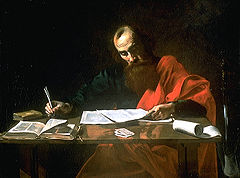
. After an introductory address (Gal 1:1–10), the apostle discusses the subjects which had occasioned the epistle.
In Chapter 1 he defends his apostolic authority (1:11–19; 2:1–14). Chapters 2, 3, and 4 show the influence of the Judaizers
in destroying the very essence of the gospel
. Chapter 3 exhorts the Galatian believers to stand fast in the faith as it is in Jesus, and to abound in the fruit of the Spirit. Chapter 4 then concludes with a summary of the topics discussed and with the benediction, followed by 5; 6:1–10 teaching about the right use of their Christian freedom. For example, it is clear that some took "freedom in Christ" as justification of antinomianism
.
In the conclusion of the epistle (6:11), Paul writes, "Ye see how large a letter I have written with mine own hand." It is implied that this was different from his ordinary usage, which was simply to write the concluding salutation with his own hand, indicating that the rest of the epistle was written by another hand. Regarding this conclusion, Lightfoot
, in his Commentary on the epistle, says:
Alternatively, some commentators have postulated that Paul's recurring illness was poor eyesight, which caused him to write in characteristically large letters.
Galatians also contains a catalogue of vice
s and virtue
s, a popular formulation of ancient Christian ethics
.
An interesting literary interpretation of this period of Christianity
and the character of Paul can be found in Rudyard Kipling
's short story "The Church that was at Antioch". A Roman
soldier and follower of Mithraism
discovers the faith on his death bed, after having tried to defuse tension between the Gentile
and Jewish Christians
over issues of Mosaic Law such as circumcision
and the preparation of food
.
Related articles:
New Testament
The New Testament is the second major division of the Christian biblical canon, the first such division being the much longer Old Testament....
. It is a letter from Paul of Tarsus
Paul of Tarsus
Paul the Apostle , also known as Saul of Tarsus, is described in the Christian New Testament as one of the most influential early Christian missionaries, with the writings ascribed to him by the church forming a considerable portion of the New Testament...
to a number of Early Christian communities in the Roman province of Galatia
Galatia
Ancient Galatia was an area in the highlands of central Anatolia in modern Turkey. Galatia was named for the immigrant Gauls from Thrace , who settled here and became its ruling caste in the 3rd century BC, following the Gallic invasion of the Balkans in 279 BC. It has been called the "Gallia" of...
in central Anatolia
Anatolia
Anatolia is a geographic and historical term denoting the westernmost protrusion of Asia, comprising the majority of the Republic of Turkey...
. Paul is principally concerned with the controversy surrounding Gentile Christians and the Mosaic Law within Early Christianity
Early Christianity
Early Christianity is generally considered as Christianity before 325. The New Testament's Book of Acts and Epistle to the Galatians records that the first Christian community was centered in Jerusalem and its leaders included James, Peter and John....
, see also Paul of Tarsus and Judaism
Paul of Tarsus and Judaism
The relationship between Paul of Tarsus and Second Temple Judaism continues to be the subject of much scholarly research, as it is thought that Paul played an important role in the relationship between Christianity and Judaism as a whole...
.
Composition
Paul is thought to have composed this letter in grave concern and agitation. It is a rebuke to the Galatians.No original of the letter is known to survive. The earliest reasonably complete version available to scholars today, named P46, dates to approximately the year 200 A.D., approximately 150 years after the original was presumably drafted. This fragmented papyrus, parts of which are missing, almost certainly contains errors introduced in the process of being copied from earlier manuscripts. However, through careful research relating to paper construction, handwriting development, and the established principles of textual criticism, scholars can be rather certain about where these errors and changes appeared and what the original text probably said. Scholars generally date the original composition to c. 50-60 A.D.
Authenticity
Biblical scholars agree that Galatians is a true example of Paul's writing.The main arguments in favor of the authenticity of Galatians include its style and themes, which are common to the core letters of the Pauline corpus. Moreover, Paul's description of the Council of Jerusalem
Council of Jerusalem
The Council of Jerusalem is a name applied by historians and theologians to an Early Christian council that was held in Jerusalem and dated to around the year 50. It is considered by Catholics and Orthodox to be a prototype and forerunner of the later Ecumenical Councils...
(Gal 2:1–10) gives a different point of view from the description in Acts 15:2–29.
The central dispute in the letter concerns the question of how Gentiles could convert to Christianity, which shows that this letter was written at a very early stage in church history, when the vast majority of Christians were Jewish or Jewish proselytes, which historians refer to as the Jewish Christians
Jewish Christians
Jewish Christians is a term which appears in historical texts contrasting Christians of Jewish origin with Gentile Christians, both in discussion of the New Testament church and the second and following centuries....
. Another indicator that the letter is early is that there is no hint in the letter of a developed organization within the Christian community at large. This puts it during the lifetime of Paul himself.
Galatia
Paul's letter is addressed "to the churches in GalatiaGalatia
Ancient Galatia was an area in the highlands of central Anatolia in modern Turkey. Galatia was named for the immigrant Gauls from Thrace , who settled here and became its ruling caste in the 3rd century BC, following the Gallic invasion of the Balkans in 279 BC. It has been called the "Gallia" of...
" (Galatians 1:2), but the location of these churches is a matter of debate. A minority of scholars have argued that the "Galatia" is an ethnic reference to a Celt
Celt
The Celts were a diverse group of tribal societies in Iron Age and Roman-era Europe who spoke Celtic languages.The earliest archaeological culture commonly accepted as Celtic, or rather Proto-Celtic, was the central European Hallstatt culture , named for the rich grave finds in Hallstatt, Austria....
ic people living in northern Asia Minor
Asia Minor
Asia Minor is a geographical location at the westernmost protrusion of Asia, also called Anatolia, and corresponds to the western two thirds of the Asian part of Turkey...
, but most agree that it is a geographical reference to the Roman province in central Asia Minor, which had been settled by immigrant Celts in the 270s BC and retained Gaulish features of culture and language in Paul's day. Acts of the Apostles
Acts of the Apostles
The Acts of the Apostles , usually referred to simply as Acts, is the fifth book of the New Testament; Acts outlines the history of the Apostolic Age...
records Paul traveling to the "region of Galatia and Phrygia
Phrygia
In antiquity, Phrygia was a kingdom in the west central part of Anatolia, in what is now modern-day Turkey. The Phrygians initially lived in the southern Balkans; according to Herodotus, under the name of Bryges , changing it to Phruges after their final migration to Anatolia, via the...
", which lay immediately west of Galatia. However, some scholars question Acts' historicity. The main theme was that the people of Galatia have turned away from Paul's teachings.
Scripture says that the churches of Galatia
Galatia
Ancient Galatia was an area in the highlands of central Anatolia in modern Turkey. Galatia was named for the immigrant Gauls from Thrace , who settled here and became its ruling caste in the 3rd century BC, following the Gallic invasion of the Balkans in 279 BC. It has been called the "Gallia" of...
(Antioch of Pisidia, Iconium, Lystra and Derbe) were founded by Paul himself (Acts 16:6; Gal 1:8; 4:13, 4:19). They seem to have been composed mainly of converts from paganism
Paganism
Paganism is a blanket term, typically used to refer to non-Abrahamic, indigenous polytheistic religious traditions....
(4:8). After Paul's departure, the churches were led astray from Paul's faith/trust centered teachings by individuals proposing "another gospel" (which centered around salvation through the Mosaic law, so-called legalism
Legalism (theology)
Legalism, in Christian theology, is a sometimes-pejorative term referring to an over-emphasis on discipline of conduct, or legal ideas, usually implying an allegation of misguided rigour, pride, superficiality, the neglect of mercy, and ignorance of the grace of God or emphasizing the letter of...
), whom Paul saw as preaching a "different gospel" from what Paul had taught. (1:6–9). The Galatians appear to have been receptive to the teaching of these newcomers, and the epistle is Paul's response to what he sees as their willingness to turn from his teaching.
The identity of these "opponents" is disputed. We do not have a record of their activity, but are left to reconstruct it from Paul's response. However, the majority of modern scholars view them as Jewish Christians
Jewish Christians
Jewish Christians is a term which appears in historical texts contrasting Christians of Jewish origin with Gentile Christians, both in discussion of the New Testament church and the second and following centuries....
(i.e. Judaizers), who taught that in order for pagans to belong to the people of God, they must be subject to some or all of the Jewish Law. The letter indicates controversy concerning circumcision
Circumcision controversy in early Christianity
There is evidence of a controversy over religious male circumcision in Early Christianity. A Council of Jerusalem, possibly held in approximately 50 AD, decreed that male circumcision was not a requirement for Gentile converts. This became known as the "Apostolic Decree" and may be one of the...
, Sabbath observance
Biblical Sabbath
Sabbath in the Bible is usually a weekly day of rest and time of worship. The Sabbath is first mentioned in the Genesis creation narrative. The seventh day is there set aside as a day of rest—the Sabbath. It is observed differently in Judaism and Christianity and informs a similar occasion in...
, and the Mosaic Covenant
Biblical law in Christianity
Christian views of the Old Covenant have been central to Christian theology and practice since the circumcision controversy in Early Christianity. There are differing views about the applicability of the Old Covenant among Christian denominations...
. It would appear, from Paul's response, that they cited the example of Abraham
Abraham
Abraham , whose birth name was Abram, is the eponym of the Abrahamic religions, among which are Judaism, Christianity and Islam...
, who was circumcised as a mark of receiving the covenant blessings , see also Abrahamic religion. They certainly appear to have questioned Paul's authority as an apostle, perhaps appealing to the greater authority of the Jerusalem church governed by James the Just
James the Just
James , first Bishop of Jerusalem, who died in 62 AD, was an important figure in Early Christianity...
.
Paul responds angrily; he relates his conversion and apostolic credentials, his relationship with the Jerusalem Church, and engages in a debate over the interpretation of the Abraham story.
Biblical scholars agree that Galatians was written between the late 40s and early 50s. However there are three main theories about when Galatians was written and to whom.
The North Galatian View
The North Galatian View holds that the epistle was written very soon after Paul's second visit to Galatia. The visit to Jerusalem, mentioned in Galatians 2:1–10, seems identical with that of Acts 15, and it is spoken of as a thing of the past. Consequently, the epistle seems to have been written after the Council of JerusalemCouncil of Jerusalem
The Council of Jerusalem is a name applied by historians and theologians to an Early Christian council that was held in Jerusalem and dated to around the year 50. It is considered by Catholics and Orthodox to be a prototype and forerunner of the later Ecumenical Councils...
. The similarity between this epistle and that to the Romans has led to the conclusion that they were both written at the same time, namely, in the winter of 57-58, during Paul's stay in Corinth. This letter to the Galatians was written with a sense of urgency.
The South Galatian View
The South Galatian view holds that Paul wrote Galatians before or shortly after the First Jerusalem Council, probably on his way to it, and that it was written to churches he had presumably planted during either his time in Tarsus (he would have traveled a short distance, since Tarsus is in Cilicia) after his first visit to Jerusalem as a Christian, or during his first missionary journey, when he traveled throughout southern Galatia. If it was written to the believers in South Galatia, it would likely have been written in 49.The Earliest Epistle
A third theory is that Galatians 2:1-10 is the visit of Acts 11:30. This theory implies that the epistle was written before the Council was convened, making it the earliest of Paul's epistles. The events mentioned in Galatians 2:1-10 fit perfectly to this part of Acts: The revelation mentioned (2:2) corresponding with the prophecy of Agabus (Acts 11:27-28); the private speaking about the gospel shared among the Gentiles precludes the Acts 15 visit, but fits perfectly with Acts 11; the continuing to remember the poor fits with the purpose of the Acts 11 visit (but not Acts 15). In addition, the exclusion of any mention of the letter of Acts 15 strongly indicates that such a letter did not yet exist, for Paul would have surely used it as one of his arguments against the legalism confronted in Galatians. Also, the incident mentioned by Paul in Galatians with Peter, for which Paul rebukes Peter publicly, was not as likely to happen after such a large apostolic consensus of Acts 15 that Gentiles need not be circumcised into the law of Moses. Otherwise Paul would not have accused Peter, who was not living like a Jew, of forcing Gentiles to obey Jewish customs.Outline
- Salutation (1:1–5)
- No other gospelGospelA gospel is an account, often written, that describes the life of Jesus of Nazareth. In a more general sense the term "gospel" may refer to the good news message of the New Testament. It is primarily used in reference to the four canonical gospels of Matthew, Mark, Luke, and John...
(1:6–10) - Conversion of PaulConversion of PaulThe Conversion of Paul the Apostle, as depicted in the Christian Bible, refers to an event reported to have taken place in the life of Paul of Tarsus which led him to cease persecuting early Christians and to himself become a follower of Jesus; it is normally dated by researchers to AD 33–36...
(1:11–24) - a meetingRight hand of christian fellowshipThe Right Hand of Fellowship is a ritual intended to welcome a new member into the fellowship of a congregation or welcoming a new minister into the fellowship of ministers...
, possibly the Council of JerusalemCouncil of JerusalemThe Council of Jerusalem is a name applied by historians and theologians to an Early Christian council that was held in Jerusalem and dated to around the year 50. It is considered by Catholics and Orthodox to be a prototype and forerunner of the later Ecumenical Councils...
(2:1–10) - Incident at Antioch (2:11–14)
- Jews, like Gentiles, saved by faithFaith in ChristianityFaith, in Christianity, has been most commonly defined by the biblical formulation in the Letter to the Hebrews as "'the assurance of things hoped for, the conviction of things not seen". Most of the definitions in the history of Christian theology have followed this biblical formulation...
(2:15–21) - Law or Faith (3:1–14)
- Law and PromiseLaw and GospelIn Christianity the relationship between God's Law and the Gospel is a major topic in Lutheran and Reformed theology. In these traditions, the distinction between the doctrines of Law, which demands obedience to God's ethical will, and Gospel, which promises the forgiveness of sins in light of the...
(3:15–20) - Slaves and Sons (3:21–4:7)
- Sons of GodSons of GodSons of God is a phrase used in Levantine Bronze and Iron Age texts to describe the "divine council" of the major gods.- The term "sons of God" :...
(3:26)
- Sons of God
- Concern for the Galatians (4:8–20)
- Interpretation of Hagar and SarahHagar (Bible)Hagar , according to the Abrahamic faiths, was the second wife of Abraham, and the mother of his first son, Ishmael. Her story is recorded in the Book of Genesis, mentioned in Hadith, and alluded to in the Qur'an...
(4:21–5:1) - Christian Freedom (5:2–15)
- The Great CommandmentGreat CommandmentThe Great Commandment, or Greatest Commandment, is an appellation applied to either the first, or both, of two commandments which appear in , and...
(5:14)
- The Great Commandment
- Fruit of the Spirit (5:16–26)
- The Law of ChristThe Law of Christ"The law of Christ" is a biblical phrase of uncertain meaning, found only in the Apostle Paul's Epistle to the Galatians verse and parenthetically in 1 Corinthians of the New Testament....
(6:1–10) - Final Warning and Benediction (6:11–18)
Contents
This epistle addresses the question "Is the Mosaic Law binding on Christians?"; see also Biblical law in ChristianityBiblical law in Christianity
Christian views of the Old Covenant have been central to Christian theology and practice since the circumcision controversy in Early Christianity. There are differing views about the applicability of the Old Covenant among Christian denominations...
. After an introductory address (Gal 1:1–10), the apostle discusses the subjects which had occasioned the epistle.
In Chapter 1 he defends his apostolic authority (1:11–19; 2:1–14). Chapters 2, 3, and 4 show the influence of the Judaizers
Judaizers
Judaizers is predominantly a Christian term, derived from the Greek verb ioudaïzō . This term is most widely known from the single use in the New Testament where Paul publicly challenges Peter for compelling Gentile believers to "judaize", also known as the Incident at Antioch.According to the...
in destroying the very essence of the gospel
Gospel
A gospel is an account, often written, that describes the life of Jesus of Nazareth. In a more general sense the term "gospel" may refer to the good news message of the New Testament. It is primarily used in reference to the four canonical gospels of Matthew, Mark, Luke, and John...
. Chapter 3 exhorts the Galatian believers to stand fast in the faith as it is in Jesus, and to abound in the fruit of the Spirit. Chapter 4 then concludes with a summary of the topics discussed and with the benediction, followed by 5; 6:1–10 teaching about the right use of their Christian freedom. For example, it is clear that some took "freedom in Christ" as justification of antinomianism
Antinomianism
Antinomianism is defined as holding that, under the gospel dispensation of grace, moral law is of no use or obligation because faith alone is necessary to salvation....
.
In the conclusion of the epistle (6:11), Paul writes, "Ye see how large a letter I have written with mine own hand." It is implied that this was different from his ordinary usage, which was simply to write the concluding salutation with his own hand, indicating that the rest of the epistle was written by another hand. Regarding this conclusion, Lightfoot
Joseph Barber Lightfoot
Joseph Barber Lightfoot was an English theologian and Bishop of Durham, usually known as J.B. Lightfoot....
, in his Commentary on the epistle, says:
"At this point the apostle takes the pen from his amanuensisAmanuensisAmanuensis is a Latin word adopted in various languages, including English, for certain persons performing a function by hand, either writing down the words of another or performing manual labour...
, and the concluding paragraph is written with his own hand. From the time when letters began to be forged in his name (2 Thess 2:2; 3:17) it seems to have been his practice to close with a few words in his own handwriting, as a precaution against such forgeries... In the present case he writes a whole paragraph, summing up the main lessons of the epistle in terse, eager, disjointed sentences. He writes it, too, in large, bold characters (Gr. pelikois grammasin), that his hand-writing may reflect the energy and determination of his soul."
Alternatively, some commentators have postulated that Paul's recurring illness was poor eyesight, which caused him to write in characteristically large letters.
Galatians also contains a catalogue of vice
Vice
Vice is a practice or a behavior or habit considered immoral, depraved, or degrading in the associated society. In more minor usage, vice can refer to a fault, a defect, an infirmity, or merely a bad habit. Synonyms for vice include fault, depravity, sin, iniquity, wickedness, and corruption...
s and virtue
Virtue
Virtue is moral excellence. A virtue is a positive trait or quality subjectively deemed to be morally excellent and thus is valued as a foundation of principle and good moral being....
s, a popular formulation of ancient Christian ethics
Christian ethics
The first recorded meeting on the topic of Christian ethics, after Jesus' Sermon on the Mount, Great Commandment, and Great Commission , was the Council of Jerusalem , which is seen by most Christians as agreement that the New Covenant either abrogated or set aside at least some of the Old...
.
An interesting literary interpretation of this period of Christianity
Christianity
Christianity is a monotheistic religion based on the life and teachings of Jesus as presented in canonical gospels and other New Testament writings...
and the character of Paul can be found in Rudyard Kipling
Rudyard Kipling
Joseph Rudyard Kipling was an English poet, short-story writer, and novelist chiefly remembered for his celebration of British imperialism, tales and poems of British soldiers in India, and his tales for children. Kipling received the 1907 Nobel Prize for Literature...
's short story "The Church that was at Antioch". A Roman
Roman Empire
The Roman Empire was the post-Republican period of the ancient Roman civilization, characterised by an autocratic form of government and large territorial holdings in Europe and around the Mediterranean....
soldier and follower of Mithraism
Mithraism
The Mithraic Mysteries were a mystery religion practised in the Roman Empire from about the 1st to 4th centuries AD. The name of the Persian god Mithra, adapted into Greek as Mithras, was linked to a new and distinctive imagery...
discovers the faith on his death bed, after having tried to defuse tension between the Gentile
Pauline Christianity
Pauline Christianity is a term used to refer to the Christianity associated with the beliefs and doctrines espoused by Paul of Tarsus through his writings. Most of orthodox Christianity relies heavily on these teachings and considers them to be amplifications and explanations of the teachings of...
and Jewish Christians
Jewish Christians
Jewish Christians is a term which appears in historical texts contrasting Christians of Jewish origin with Gentile Christians, both in discussion of the New Testament church and the second and following centuries....
over issues of Mosaic Law such as circumcision
Circumcision controversy in early Christianity
There is evidence of a controversy over religious male circumcision in Early Christianity. A Council of Jerusalem, possibly held in approximately 50 AD, decreed that male circumcision was not a requirement for Gentile converts. This became known as the "Apostolic Decree" and may be one of the...
and the preparation of food
Kashrut
Kashrut is the set of Jewish dietary laws. Food in accord with halakha is termed kosher in English, from the Ashkenazi pronunciation of the Hebrew term kashér , meaning "fit" Kashrut (also kashruth or kashrus) is the set of Jewish dietary laws. Food in accord with halakha (Jewish law) is termed...
.
See also
- Textual variants in the Epistle to the Galatians
External links
Online translations of the Epistle to Galatians:- Bible Gateway 35 languages/50 versions at GospelCom.net
- Unbound Bible 100+ languages/versions at Biola University
- Galatians - King James Bible
- Online Bible at GospelHall.org
Related articles:
- Easton's Bible Dictionary, 1897: Epistle to the Galatians, commencing "The genuineness of this epistle is not called in question. Its Pauline origin is universally acknowledged."
- Galatians, Paul, The Torah-Law & Legalism
- John Chrysostom's Commentary on Galatians
- An alternative commentary on Galatians
- A Secular Site on Galatians