
The
Jewish diaspora is the English term used to describe the
GalutGalut or Golus , means literally exile. Galut or Golus classically refers to the exile of the Jewish people from the Land of Israel . There were altogether four such exiles...
גלות (Yiddish: 'Golus'), or 'exile', of the
JewsThe Jews , also known as the Jewish people, are a nation and ethnoreligious group originating in the Israelites or Hebrews of the Ancient Near East. The Jewish ethnicity, nationality, and religion are strongly interrelated, as Judaism is the traditional faith of the Jewish nation...
from the region of the
Kingdom of JudahThe Kingdom of Judah was a Jewish state established in the Southern Levant during the Iron Age. It is often referred to as the "Southern Kingdom" to distinguish it from the northern Kingdom of Israel....
and Roman Iudaea and later emigration from wider Eretz Israel.
The modern Hebrew term of
Tefutzot תפוצות, "scattered", was introduced in the 1930s by the German-American Zionist academic Simon Rawidowicz, who to some degree argued for the acceptance of the Jewish presence outside of the
Land of IsraelThe Land of Israel is the Biblical name for the territory roughly corresponding to the area encompassed by the Southern Levant, also known as Canaan and Palestine, Promised Land and Holy Land. The belief that the area is a God-given homeland of the Jewish people is based on the narrative of the...
as a modern reality and an inevitability.
The
diasporaA diaspora is "the movement, migration, or scattering of people away from an established or ancestral homeland" or "people dispersed by whatever cause to more than one location", or "people settled far from their ancestral homelands".The word has come to refer to historical mass-dispersions of...
is commonly accepted to have begun with the 6th century BC conquest of the ancient
Kingdom of JudahThe Kingdom of Judah was a Jewish state established in the Southern Levant during the Iron Age. It is often referred to as the "Southern Kingdom" to distinguish it from the northern Kingdom of Israel....
, destruction of the First Temple (c. 586 BC), and expulsion of the population, which is recorded in the
BibleThe Bible refers to any one of the collections of the primary religious texts of Judaism and Christianity. There is no common version of the Bible, as the individual books , their contents and their order vary among denominations...
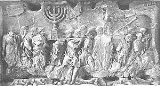
. The second major event in the dispersal is popularly thought to be the destruction of the Second Temple and aftermath of the Bar Kokhba revolt during the
Roman occupation of JudeaJudaea or Iudaea are terms used by historians to refer to the Roman province that extended over parts of the former regions of the Hasmonean and Herodian kingdoms of Israel...
in the 1st and 2nd centuries AD, although scholars generally believe that the effect of these events on the dispersal of the Jewish community was much less than their role in later communal narratives would indicate.
A number of Jewish communities were then established in the
Middle EastThe Middle East is a region that encompasses Western Asia and Northern Africa. It is often used as a synonym for Near East, in opposition to Far East...
—such as in Persia, when
Cyrus the GreatCyrus II of Persia , commonly known as Cyrus the Great, also known as Cyrus the Elder, was the founder of the Achaemenid Empire. Under his rule, the empire embraced all the previous civilized states of the ancient Near East, expanded vastly and eventually conquered most of Southwest Asia and much...
invited them as a result of tolerant policies—and remained notable centers of
TorahTorah- A scroll containing the first five books of the BibleThe Torah , is name given by Jews to the first five books of the bible—Genesis , Exodus , Leviticus , Numbers and Deuteronomy Torah- A scroll containing the first five books of the BibleThe Torah , is name given by Jews to the first five...
life and
JudaismJudaism ) is the "religion, philosophy, and way of life" of the Jewish people...
for centuries to come. The defeat of the
Great Jewish RevoltThe First Jewish–Roman War , sometimes called The Great Revolt , was the first of three major rebellions by the Jews of Judaea Province , against the Roman Empire...
in the year AD 70 and of
Bar Kokhba's revoltThe Bar Kokhba revolt 132–136 CE; or mered bar kokhba) against the Roman Empire, was the third major rebellion by the Jews of Judaea Province being the last of the Jewish-Roman Wars. Simon bar Kokhba, the commander of the revolt, was acclaimed as a Messiah, a heroic figure who could restore Israel...
against the
Roman EmpireThe Roman Empire was the post-Republican period of the ancient Roman civilization, characterised by an autocratic form of government and large territorial holdings in Europe and around the Mediterranean....
in AD 135 notably contributed to the diaspora as many Jews were scattered after losing control over
JudeaJudea or Judæa was the name of the mountainous southern part of the historic Land of Israel from the 8th century BCE to the 2nd century CE, when Roman Judea was renamed Syria Palaestina following the Jewish Bar Kokhba revolt.-Etymology:The...
or were sold into
slaverySlavery is a system under which people are treated as property to be bought and sold, and are forced to work. Slaves can be held against their will from the time of their capture, purchase or birth, and deprived of the right to leave, to refuse to work, or to demand compensation...
throughout the Empire. After the establishment of the
State of IsraelThe State of Israel is a parliamentary republic located in the Middle East, along the eastern shore of the Mediterranean Sea...
in 1948, the term Jewish diaspora came to refer to all Jews living outside Israel.
Pre-Roman Diaspora
In 722 BC, the Assyrians under
Shalmaneser VShalmaneser V was king of Assyria from 727 to 722 BC. He first appears as governor of Zimirra in Phoenicia in the reign of his father, Tiglath-Pileser III....
conquered the (Northern) Kingdom of Israel, and many Israelites were
deportedBegun in or around the year 720 BC, a rebellion against the Assyrian Empire broke out, participated in by ancient Syria and the Philistines from Mycenaean Greece, and also with Egyptian encouragement...
to Media and Persia.
After the overthrow of the kingdom of Judah in 586 BC by Nebuchadnezzar II of Babylon (see
Babylonian captivityThe Babylonian captivity was the period in Jewish history during which the Jews of the ancient Kingdom of Judah were captives in Babylon—conventionally 587–538 BCE....
) and the deportation of a considerable portion of its inhabitants to
MesopotamiaMesopotamia is a toponym for the area of the Tigris–Euphrates river system, largely corresponding to modern-day Iraq, northeastern Syria, southeastern Turkey and southwestern Iran.Widely considered to be the cradle of civilization, Bronze Age Mesopotamia included Sumer and the...
, the Jews had two principal cultural centers:
BabyloniaThe history of the Jews in Iraq is documented from the time of the Babylonian captivity c. 586 BCE. Iraqi Jews constitute one of the world's oldest and most historically significant Jewish communities....
and the
land of IsraelThe Land of Israel is the Biblical name for the territory roughly corresponding to the area encompassed by the Southern Levant, also known as Canaan and Palestine, Promised Land and Holy Land. The belief that the area is a God-given homeland of the Jewish people is based on the narrative of the...
. For over 2,700 years since,
Persian JewsPersian Jews , are Jews historically associated with Iran, traditionally known as Persia in Western sources.Judaism is one of the oldest religions practiced in Iran. The Book of Esther contains some references to the experiences of Jews in Persia...
have lived in the territories of today's
IranIran , officially the Islamic Republic of Iran , is a country in Southern and Western Asia. The name "Iran" has been in use natively since the Sassanian era and came into use internationally in 1935, before which the country was known to the Western world as Persia...
.
Although most of the Jewish people, especially the wealthy families, were to be found in Babylonia, the existence they led there, under the successive rules of the Achaemenids, the
SeleucidsThe Seleucid Empire was a Greek-Macedonian state that was created out of the eastern conquests of Alexander the Great. At the height of its power, it included central Anatolia, the Levant, Mesopotamia, Persia, today's Turkmenistan, Pamir and parts of Pakistan.The Seleucid Empire was a major centre...
, the
ParthiaParthia is a region of north-eastern Iran, best known for having been the political and cultural base of the Arsacid dynasty, rulers of the Parthian Empire....
ns, and the Sassanians, was obscure and devoid of political influence. The poorest but most fervent of the exiles returned to Judaea during the reign of the Achaemenids. There, with the reconstructed
Temple in JerusalemThe Temple in Jerusalem or Holy Temple , refers to one of a series of structures which were historically located on the Temple Mount in the Old City of Jerusalem, the current site of the Dome of the Rock. Historically, these successive temples stood at this location and functioned as the centre of...
as their center, they organized themselves into a community, animated by a remarkable religious ardor and a tenacious attachment to the Torah as the focus of its identity. As this little nucleus increased in numbers with the accession of recruits from various quarters, it awoke to a consciousness of itself, and strove for political enfranchisement.
After numerous vicissitudes, and especially owing to internal dissensions in the Seleucid dynasty on the one hand and to the interested support of the Romans on the other, the cause of Jewish independence finally triumphed. Under the
HasmoneanThe Hasmonean dynasty , was the ruling dynasty of Judea and surrounding regions during classical antiquity. Between c. 140 and c. 116 BCE, the dynasty ruled semi-autonomously from the Seleucids in the region of Judea...
princes, who were at first high priests and then kings, the Jewish state displayed even a certain luster and annexed several territories. Soon, however, discord in the royal family and the growing disaffection of the pious, the soul of the nation, toward rulers who no longer evinced any appreciation of the real aspirations of their subjects made the Jewish nation easy prey for the ambition of the Romans, the successors of the Seleucids. In 63 BC
PompeyGnaeus Pompeius Magnus, also known as Pompey or Pompey the Great , was a military and political leader of the late Roman Republic...
invaded Jerusalem, and
GabiniusGabinius was a Roman nomen of several historical figures, including:* Aulus Gabinius, consul 58 BC* Publius Gabinius Capito, supporter of Catiline* Publius Gabinius Secundus Chaucius , general under Claudius...
subjected the Jewish people to tribute.
Early diaspora populations
As early as the middle of the 2nd century BC the Jewish author of the third book of the
Oracula SibyllinaThe Sibylline Oracles are a collection of oracular utterances written in Greek hexameters ascribed to the Sibyls, prophetesses who uttered divine revelations in a frenzied state. Fourteen books and eight fragments of Sibylline Oracles survive...
addressed the "chosen people," saying: "Every land is full of thee and every sea." The most diverse witnesses, such as
StraboStrabo, also written Strabon was a Greek historian, geographer and philosopher.-Life:Strabo was born to an affluent family from Amaseia in Pontus , a city which he said was situated the approximate equivalent of 75 km from the Black Sea...
,
PhiloPhilo , known also as Philo of Alexandria , Philo Judaeus, Philo Judaeus of Alexandria, Yedidia, "Philon", and Philo the Jew, was a Hellenistic Jewish Biblical philosopher born in Alexandria....
,
SenecaLucius Annaeus Seneca was a Roman Stoic philosopher, statesman, dramatist, and in one work humorist, of the Silver Age of Latin literature. He was tutor and later advisor to emperor Nero...
,
LukeLuke the Evangelist was an Early Christian writer whom Church Fathers such as Jerome and Eusebius said was the author of the Gospel of Luke and the Acts of the Apostles...
(the author of the
Acts of the ApostlesThe Acts of the Apostles , usually referred to simply as Acts, is the fifth book of the New Testament; Acts outlines the history of the Apostolic Age...
),
CiceroMarcus Tullius Cicero , was a Roman philosopher, statesman, lawyer, political theorist, and Roman constitutionalist. He came from a wealthy municipal family of the equestrian order, and is widely considered one of Rome's greatest orators and prose stylists.He introduced the Romans to the chief...
, and
JosephusTitus Flavius Josephus , also called Joseph ben Matityahu , was a 1st-century Romano-Jewish historian and hagiographer of priestly and royal ancestry who recorded Jewish history, with special emphasis on the 1st century AD and the First Jewish–Roman War, which resulted in the Destruction of...
, all mention Jewish populations in the cities of the
Mediterranean basinIn biogeography, the Mediterranean Basin refers to the lands around the Mediterranean Sea that have a Mediterranean climate, with mild, rainy winters and hot, dry summers, which supports characteristic Mediterranean forests, woodlands, and scrub vegetation...
. See also History of the Jews in India and
History of the Jews in ChinaJews and Judaism in China have had a long history. Jewish settlers are documented in China as early as the 7th or 8th century CE, but may have arrived during the mid Han Dynasty, or even as early as 231 BCE. Relatively isolated communities developed through the Tang and Song Dynasties Jews and...
for pre-Roman (and post-) diasporac populations.
King
Agrippa IAgrippa I also known as Herod Agrippa or simply Herod , King of the Jews, was the grandson of Herod the Great, and son of Aristobulus IV and Berenice. His original name was Marcus Julius Agrippa, so named in honour of Roman statesman Marcus Vipsanius Agrippa, and he is the king named Herod in the...
, in a letter to
CaligulaCaligula , also known as Gaius, was Roman Emperor from 37 AD to 41 AD. Caligula was a member of the house of rulers conventionally known as the Julio-Claudian dynasty. Caligula's father Germanicus, the nephew and adopted son of Emperor Tiberius, was a very successful general and one of Rome's most...
, enumerated among the provinces of the Jewish diaspora almost all the Hellenized and non-Hellenized countries of the Orient. This enumeration was far from complete as
ItalyItaly , officially the Italian Republic languages]] under the European Charter for Regional or Minority Languages. In each of these, Italy's official name is as follows:;;;;;;;;), is a unitary parliamentary republic in South-Central Europe. To the north it borders France, Switzerland, Austria and...
and
CyreneCyrene was an ancient Greek colony and then a Roman city in present-day Shahhat, Libya, the oldest and most important of the five Greek cities in the region. It gave eastern Libya the classical name Cyrenaica that it has retained to modern times.Cyrene lies in a lush valley in the Jebel Akhdar...
were not included. The
epigraphicEpigraphy Epigraphy Epigraphy (from the , literally "on-writing", is the study of inscriptions or epigraphs as writing; that is, the science of identifying the graphemes and of classifying their use as to cultural context and date, elucidating their meaning and assessing what conclusions can be...
discoveries from year to year augment the number of known Jewish communities but must be viewed with caution due to the lack of precise evidence of their numbers. According to Josephus, the next most dense Jewish population after the Land of Israel and
BabyloniaBabylonia was an ancient cultural region in central-southern Mesopotamia , with Babylon as its capital. Babylonia emerged as a major power when Hammurabi Babylonia was an ancient cultural region in central-southern Mesopotamia (present-day Iraq), with Babylon as its capital. Babylonia emerged as...
was in
SyriaSyria , officially the Syrian Arab Republic , is a country in Western Asia, bordering Lebanon and the Mediterranean Sea to the West, Turkey to the north, Iraq to the east, Jordan to the south, and Israel to the southwest....
, particularly in
AntiochAntioch on the Orontes was an ancient city on the eastern side of the Orontes River. It is near the modern city of Antakya, Turkey.Founded near the end of the 4th century BC by Seleucus I Nicator, one of Alexander the Great's generals, Antioch eventually rivaled Alexandria as the chief city of the...
, and
DamascusDamascus , commonly known in Syria as Al Sham , and as the City of Jasmine , is the capital and the second largest city of Syria after Aleppo, both are part of the country's 14 governorates. In addition to being one of the oldest continuously inhabited cities in the world, Damascus is a major...
, where 10,000 to 18,000 Jews were massacred during the great insurrection. Philo gives the number of Jewish inhabitants in
EgyptEgypt , officially the Arab Republic of Egypt, Arabic: , is a country mainly in North Africa, with the Sinai Peninsula forming a land bridge in Southwest Asia. Egypt is thus a transcontinental country, and a major power in Africa, the Mediterranean Basin, the Middle East and the Muslim world...
as one million, one-eighth of the population.
AlexandriaAlexandria is the second-largest city of Egypt, with a population of 4.1 million, extending about along the coast of the Mediterranean Sea in the north central part of the country; it is also the largest city lying directly on the Mediterranean coast. It is Egypt's largest seaport, serving...
was by far the most important of the Egyptian Jewish communities.
To judge by the accounts of wholesale massacres in 115, the number of Jewish residents in
CyrenaicaCyrenaica is the eastern coastal region of Libya.Also known as Pentapolis in antiquity, it was part of the Creta et Cyrenaica province during the Roman period, later divided in Libia Pentapolis and Libia Sicca...
,
CyprusCyprus , officially the Republic of Cyprus , is a Eurasian island country, member of the European Union, in the Eastern Mediterranean, east of Greece, south of Turkey, west of Syria and north of Egypt. It is the third largest island in the Mediterranean Sea.The earliest known human activity on the...
, and
MesopotamiaMesopotamia is a toponym for the area of the Tigris–Euphrates river system, largely corresponding to modern-day Iraq, northeastern Syria, southeastern Turkey and southwestern Iran.Widely considered to be the cradle of civilization, Bronze Age Mesopotamia included Sumer and the...
was also large. At the commencement of the reign of Caesar Augustus, there were over 7,000 Jews in Rome (this is the number that escorted the envoys who came to demand the deposition of
ArchelausHerod Archelaus was the ethnarch of Samaria, Judea, and Idumea from 4 BC to 6 AD. He was the son of Herod the Great and Malthace the Samaritan, the brother of Herod Antipas, and the half-brother of Herod Philip I....
). Finally, if the sums confiscated by the
governorA promagistrate is a person who acts in and with the authority and capacity of a magistrate, but without holding a magisterial office. A legal innovation of the Roman Republic, the promagistracy was invented in order to provide Rome with governors of overseas territories instead of having to elect...
Lucius Valerius Flaccus in the year 62/61 BC represented the tax of a didrachma per head for a single year, it would imply that the Jewish population of
Asia MinorAnatolia is a geographic and historical term denoting the westernmost protrusion of Asia, comprising the majority of the Republic of Turkey...
numbered 45,000 adult males, for a total of at least 180,000 persons.
Roman destruction of Judea
Roman rule which began in 63 BC continued until a revolt from 66–70 culminated in the capture of Jerusalem and the destruction of the Temple, the centre of the national and religious life of the Jews throughout the world.
Exactly when Roman Anti-Judaism began is a question of scholarly debate, however historian H.H. Ben-Sasson has proposed that the "Crisis under Caligula" (37–41) was the "first open break between Rome and the Jews".
The complete destruction of
Jerusalem, and the settlement of several Greek and Roman colonies in Judea indicated the express intention of the Roman government to prevent the political regeneration of the Jewish nation. Nevertheless, forty years later the Jews put forth efforts to recover their former freedom. With Israel exhausted, they strove to establish commonwealths on the ruins of Hellenism in Cyrene, Cyprus, Egypt, and Mesopotamia. These efforts, resolute but unwise, were suppressed by Trajan (115–117), and under Hadrian the same fate befell the attempt of the Jews of Israel to regain their independence (133–135). From this time on, in spite of unimportant movements under Antoninus, Marcus Aurelius, and Severus, the Jews of Palestine, reduced in numbers, destitute, and crushed, lost their preponderance in the Jewish world.
Jerusalem had become, under the name "Ælia Capitolina", a Roman colony and entirely pagan city. Jews were forbidden entrance on pain of death, except for the day of
Tisha B'Av|Av]],") is an annual fast day in Judaism, named for the ninth day of the month of Av in the Hebrew calendar. The fast commemorates the destruction of both the First Temple and Second Temple in Jerusalem, which occurred about 655 years apart, but on the same Hebrew calendar date...
, see also Anti-Judaism in the Roman Empire. Nevertheless, 43 Jewish communities in Israel remained in the 6th century: 12 on the coast, in the Negev, and east of the Jordan, and 31 villages in Galilee and in the Jordan valley.
YavneYavne is a city in the Central District of Israel. According to the Israel Central Bureau of Statistics , at the end of 2009 the city had a population of 33,000.-History:...
on the coastal plain, associated with
Yochanan ben ZakaiJohanan ben Zakai , also known as Johanan B. Zakkai was one of the tannaim, an important Jewish sage in the era of the Second Temple, and a primary contributor to the core text of Rabbinical Judaism, the Mishnah. He is widely regarded as one of the most important Jewish figures of his time...
, was an important center of
Rabbinic JudaismRabbinic Judaism or Rabbinism has been the mainstream form of Judaism since the 6th century CE, after the codification of the Talmud...
.
Dispersion of the Jews in the Roman Empire
Following the 1st century Great Revolt and the 2nd century Bar Kokhba revolt, the destruction of
JudeaJudea or Judæa was the name of the mountainous southern part of the historic Land of Israel from the 8th century BCE to the 2nd century CE, when Roman Judea was renamed Syria Palaestina following the Jewish Bar Kokhba revolt.-Etymology:The...
exerted a decisive influence upon the dispersion of the Jewish people throughout the world, as the centre of worship shifted from the
TempleA temple is a structure reserved for religious or spiritual activities, such as prayer and sacrifice, or analogous rites. A templum constituted a sacred precinct as defined by a priest, or augur. It has the same root as the word "template," a plan in preparation of the building that was marked out...
to Rabbinic authority.
Many Jews entered the Diaspora as slaves, after the destruction of the Temple. Evidence for Jews in the Diaspora is scanty, until the fourth century. Presumably, many of these slave populations served as the basis of later communities.
While more Jews lived outside Judea than in, the Romans did not distinguish between Jews inside and outside of Judea. They collected an annual temple tax, thereby treating all Jews as a distinct ethno-national group. Communities in Egypt, Libya and Crete revolted in 115–117 CE, which likely decimated the Jewish Diaspora population. The Christian empire continued the punishment, by which time the church fathers and imperial law argued that, not only were the Jews a distinct, reprehensible ethno-national group, they were a group largely exiled or dispossessed of temple, city and land, for their rejection of Christ, a state it was deemed in which they were to remain in perpetuo.
This notion evolved even though substantial numbers of Jews lived in the land, now under increasingly harsh imperial Roman Christian law, further alienating and marginalizing Jews, and favouring the settlement of largely gentile Christians, of culturally pagan Greco-Roman or Aramaic provenance. It was in this period that Judea became normatively known as Syria Palestina, a name reflecting both the large scale killing of the suppression of the 2nd Jewish revolt, and a Roman policy, pagan, then Christian, to further alienate Jews from the land, ensuring that no Jewish temple, Jerusalem or state ever rose again. During this time the Talmudic thesis of a Jewish people in exile evolved, even as Imperial Christian degrees laid further burdens of taxation, discrimination and social exclusion on Jews in the land and without.
Over the centuries, rather than a few individual events, Jews were eroded into a minority in their historical patria, while the rabbis "Judaized" Judaism, by prescribing only the Hebrew Bible as authoritative, and Hellenistic-Jewish literature, culture and discourse declined sharply from the 2nd century, not only from Imperial Roman suppressions, but also Christian appropriation of the Greek translation of the Old Testament, the Septuagint, as its authorized version. Through internal and external pressures, the two communities, Greco-Roman and Jewish, diverged, the former becoming universally Christian, and, in time, self-defined as "Roman", when the emperor granted citizenship to all, and "Greek" became in patristic discourse synonymous with "pagan".
It would enter Arabic, Islamic discourse as "Rumi", the Quranic term for "Roman" or "belonging to the Roman Empire". In the meanwhile, the meme of a Jewish people in exile entered normative mediaeval Jewish, Christian and, in time, Islamic thought and discourse, when Muhammed would address the Jews of Makkah and Madinah as though they themselves had been expelled from the land, twice, by the servants of Allah, as a punishment for their rejection of Jesus and the prophets.
Experts dismiss the popular notion that the Jews were expelled or exiled from Palestine in the 1st century AD, in particular that this would have been a sudden event. The myth of exile from Palestine receives only minimal treatment in serious Jewish historical scholarship.
Inventing an Invention (Haaretz, 7/2008) "Although the myth of an exile from the Jewish homeland (Palestine) does exist in popular Israeli culture, it is negligible in serious Jewish historical discussions." (Israel Bartal, dean of humanities at the Hebrew University)
Post-Roman period Jewish populations
During the Middle Ages, Jews divided into
distinct regional groupsJewish ethnic divisions refers to a number of distinct communities within the world's ethnically Jewish population. Although considered one single self-identifying ethnicity, there are distinct ethnic divisions among Jews, most of which are primarily the result of geographic branching from an...
which today are generally addressed according to two primary geographical groupings: the Ashkenazi of Northern and Eastern Europe and Sephardic Jews of Iberia, North Africa and the Middle East. These groups have parallel histories sharing many series of persecutions and
forced expulsionsPopulation transfer is the movement of a large group of people from one region to another by state policy or international authority, most frequently on the basis of ethnicity or religion...
.
By 1764 there were about 750,000 Jews in the Polish–Lithuanian Commonwealth. The worldwide Jewish population was estimated at 1.2 million.
The "Negation of the Diaspora" by Zionism
According to Eliezer Schweid, the rejection of life in the Diaspora is a central assumption in all currents of
ZionismZionism is a Jewish political movement that, in its broadest sense, has supported the self-determination of the Jewish people in a sovereign Jewish national homeland. Since the establishment of the State of Israel, the Zionist movement continues primarily to advocate on behalf of the Jewish state...
. Underlying this attitude was the feeling that the Diaspora restricted the full growth of Jewish national life. For instance the poet Hayim Nahman Bialik wrote:
- And my heart weeps for my unhappy people ...
- How burned, how blasted must our portion be,
- If seed like this is withered in its soil. ...
According to Schweid, Bialik meant that the “seed” was the potential of the Jewish people. Preserved in the Diaspora, this seed could only give rise to deformed results; however, once conditions changed the seed could still provide a plentiful harvest.
In this matter Sternhell distinguishes two schools of thought in Zionism. One was the liberal or utilitarian school of Herzl and Nordau. Especially after the
Dreyfus AffairThe Dreyfus affair was a political scandal that divided France in the 1890s and the early 1900s. It involved the conviction for treason in November 1894 of Captain Alfred Dreyfus, a young French artillery officer of Alsatian Jewish descent...
, they held that anti-Semitism would never disappear and saw Zionism as a rational solution for Jewish individuals.
The other was the organic nationalist school. It was prevalent among the Zionists in Palestine and saw the movement as a project to rescue the Jewish nation rather than as a project to rescue Jewish individuals. For them Zionism was the "Rebirth of the Nation".
Contrary to the Israel-centric Zionist view, acceptance of the Jewish communities outside of Israel was postulated by those, like Simon Rawidowicz (also a Zionist), who viewed the Jews as a culture evolved into a new 'worldly' entity that had no reason to seek a return, either physical, emotional or spiritual to its ancient Land, and could remain a one people even in dispersion.
It was argued that the dynamics of the diaspora which were affected by persecution, numerous subsequent exiles, as well as political and economic conditions created a new Jewish awareness of the World, and a new awareness of the Jews by the World.
A critical post-colonial account of the diaspora is given by a scholar who argues that "a journey to the moment of transubstantiation, wherever it occurred, would dim the claim for uniqueness [of the Jewish tragedy]--a claim that has been abused and exploited..."
The Diaspora in Contemporary Jewish life
As of 2010 the largest numbers of Jews live in
IsraelThe State of Israel is a parliamentary republic located in the Middle East, along the eastern shore of the Mediterranean Sea...
(5,703,700), United States (5,275,000),
FranceThe French Republic , The French Republic , The French Republic , (commonly known as France , is a unitary semi-presidential republic in Western Europe with several overseas territories and islands located on other continents and in the Indian, Pacific, and Atlantic oceans. Metropolitan France...
(483,500),
CanadaCanada is a North American country consisting of ten provinces and three territories. Located in the northern part of the continent, it extends from the Atlantic Ocean in the east to the Pacific Ocean in the west, and northward into the Arctic Ocean...
(375,000), the
United KingdomThe United Kingdom of Great Britain and Northern IrelandIn the United Kingdom and Dependencies, other languages have been officially recognised as legitimate autochthonous languages under the European Charter for Regional or Minority Languages...
(292,000),
RussiaRussia or , officially known as both Russia and the Russian Federation , is a country in northern Eurasia. It is a federal semi-presidential republic, comprising 83 federal subjects...
(205,000),
ArgentinaArgentina , officially the Argentine Republic , is the second largest country in South America by land area, after Brazil. It is constituted as a federation of 23 provinces and an autonomous city, Buenos Aires...
(182,300), and
GermanyGermany , officially the Federal Republic of Germany , is a federal parliamentary republic in Europe. The country consists of 16 states while the capital and largest city is Berlin. Germany covers an area of 357,021 km2 and has a largely temperate seasonal climate...
(119,000).. These numbers reflect the "core" Jewish population, defined as being "not inclusive of non-Jewish members of Jewish households, persons of Jewish ancestry who profess another monotheistic religion, other non-Jews of Jewish ancestry, and other non-Jews who may be interested in Jewish matters."
The
Jewish Autonomous OblastThe Jewish Autonomous Oblast is a federal subject of Russia situated in the Russian Far East, bordering Khabarovsk Krai and Amur Oblast of Russia and Heilongjiang province of China. Its administrative center is the town of Birobidzhan....
continues to be an
Autonomous Oblast of RussiaThe Russian Federation is divided into 83 federal subjects, one of which is an autonomous oblast , the Jewish Autonomous Oblast....
. The
Chief RabbiChief Rabbi is a title given in several countries to the recognized religious leader of that country's Jewish community, or to a rabbinic leader appointed by the local secular authorities...
of
BirobidzhanBirobidzhan is a town and the administrative center of the Jewish Autonomous Oblast, Russia. It is located on the Trans-Siberian railway, close to the border with the People's Republic of China....
,
Mordechai ScheinerMordechai Sheiner has been Chief Rabbi of Jewish Autonomous Oblast since 2002.-Background:Mordechai Sheiner came to the Jewish Autonomous Oblast in 2002. He arrived in Birobidzhan as a 30 year old rabbi from Israel. He had never been to Birobidzhan before, but spoke Russian thanks to two years he...
, says there are 4,000 Jews in the capital city.
GovernorA governor is a governing official, usually the executive of a non-sovereign level of government, ranking under the head of state...
Nikolay Mikhaylovich Volkov-Childhood and Education:Volkov was born in 1951 in Krasnoye village, in the Shablykinsky district of the Oryol Region. In 1973, Volkov graduated from a civil engineer institute in Odessa.-Politics:...
has stated that he intends to, "support every valuable initiative maintained by our local Jewish organizations." The
Birobidzhan SynagogueThe Birobidzhan Synagogue was established in 2004. The synagogue is in the city of Birobidzhan, which is the capital of the Jewish Autonomous Oblast, an autonomous oblast of Russia. It is "the first synagogue in Russia to be built partly with state money," according to the Federation of Jewish...
opened in 2004 on the 70th anniversary of the region's founding in 1934. An estimated 75,000 Jews live in the vast
SiberiaSiberia is an extensive region constituting almost all of Northern Asia. Comprising the central and eastern portion of the Russian Federation, it was part of the Soviet Union from its beginning, as its predecessor states, the Tsardom of Russia and the Russian Empire, conquered it during the 16th...
region.
Metropolitan areas with the largest Jewish populations are listed below, though one source at jewishtemples.org states that "It is difficult to come up with exact population figures on a country by country basis, let alone city by city around the world. Figures for Russia and other CIS countries are but educated guesses." The source cited here, the
2010 World Jewish Population Survey, also notes that "Unlike our estimates of Jewish populations in individual countries, the data reported here on urban Jewish populations do not fully adjust for possible double counting due to multiple residences. The differences in the United States may be quite significant, in the range of tens of thousands, involving both major and minor metropolitan areas."
- Gush Dan (Tel Aviv and surroundings)
The Tel Aviv Metropolitan Area , or Gush Dan , is a metropolitan area including areas from both the Tel Aviv and the Central Districts of Israel. The area is closely linked to the city of Tel Aviv through social, economic, and cultural ties. It is located along the Israeli Mediterranean coastline...
– IsraelThe State of Israel is a parliamentary republic located in the Middle East, along the eastern shore of the Mediterranean Sea...
– 2,979,900.
- New York
New York is the most populous city in the United States and the center of the New York Metropolitan Area, one of the most populous metropolitan areas in the world. New York exerts a significant impact upon global commerce, finance, media, art, fashion, research, technology, education, and...
– U.S. – 2,007,850.
- Jerusalem – 705,000.
- Los Angeles
Los Ángeles is the capital of the province of Biobío, in the commune of the same name, in Region VIII , in the center-south of Chile. It is located between the Laja and Biobío rivers. The population is 123,445 inhabitants...
– U.S. – 684,950.
- Haifa
Haifa is the largest city in northern Israel, and the third-largest city in the country, with a population of over 268,000. Another 300,000 people live in towns directly adjacent to the city including the cities of the Krayot, as well as, Tirat Carmel, Daliyat al-Karmel and Nesher...
– IsraelThe State of Israel is a parliamentary republic located in the Middle East, along the eastern shore of the Mediterranean Sea...
– 671,400.
- Miami – U.S. – 485,850.
- Be'er Sheva – Israel
The State of Israel is a parliamentary republic located in the Middle East, along the eastern shore of the Mediterranean Sea...
– 367,600.
- San Francisco – U.S. – 345,700.
- Paris
Paris is the capital and largest city in France, situated on the river Seine, in northern France, at the heart of the Île-de-France region...
– FranceThe French Republic , The French Republic , The French Republic , (commonly known as France , is a unitary semi-presidential republic in Western Europe with several overseas territories and islands located on other continents and in the Indian, Pacific, and Atlantic oceans. Metropolitan France...
– 284,000.
- Chicago
Chicago is the largest city in the US state of Illinois. With nearly 2.7 million residents, it is the most populous city in the Midwestern United States and the third most populous in the US, after New York City and Los Angeles...
– U.S. – 270,500.
- Philadelphia – U.S. – 263,800.
- Boston
Boston is the capital of and largest city in Massachusetts, and is one of the oldest cities in the United States. The largest city in New England, Boston is regarded as the unofficial "Capital of New England" for its economic and cultural impact on the entire New England region. The city proper had...
– U.S. – 229,100.
- Washington, DC – U.S. – 215,600
- London
London is the capital city of :England and the :United Kingdom, the largest metropolitan area in the United Kingdom, and the largest urban zone in the European Union by most measures. Located on the River Thames, London has been a major settlement for two millennia, its history going back to its...
– United KingdomThe United Kingdom of Great Britain and Northern IrelandIn the United Kingdom and Dependencies, other languages have been officially recognised as legitimate autochthonous languages under the European Charter for Regional or Minority Languages...
– 195,000.
- Toronto
Toronto is the provincial capital of Ontario and the largest city in Canada. It is located in Southern Ontario on the northwestern shore of Lake Ontario. A relatively modern city, Toronto's history dates back to the late-18th century, when its land was first purchased by the British monarchy from...
– CanadaCanada is a North American country consisting of ten provinces and three territories. Located in the northern part of the continent, it extends from the Atlantic Ocean in the east to the Pacific Ocean in the west, and northward into the Arctic Ocean...
– 180,000.
- Buenos Aires
Buenos Aires is the capital and largest city of Argentina, and the second-largest metropolitan area in South America, after São Paulo. It is located on the western shore of the estuary of the Río de la Plata, on the southeastern coast of the South American continent...
– ArgentinaArgentina , officially the Argentine Republic , is the second largest country in South America by land area, after Brazil. It is constituted as a federation of 23 provinces and an autonomous city, Buenos Aires...
– 165,000.
- Atlanta – U.S. – 119,800.
- Moscow
Moscow is the capital, the most populous city, and the most populous federal subject of Russia. The city is a major political, economic, cultural, scientific, religious, financial, educational, and transportation centre of Russia and the continent...
– RussiaRussia or , officially known as both Russia and the Russian Federation , is a country in northern Eurasia. It is a federal semi-presidential republic, comprising 83 federal subjects...
– 95,000.
- Baltimore
Baltimore is the largest independent city in the United States and the largest city and cultural center of the US state of Maryland. The city is located in central Maryland along the tidal portion of the Patapsco River, an arm of the Chesapeake Bay. Baltimore is sometimes referred to as Baltimore...
– U.S. – 91,400.
- San Diego – U.S. – 89,000.
- Denver – U.S. – 83,900.
- Phoenix
Phoenix is the capital, and largest city, of the U.S. state of Arizona, as well as the sixth most populated city in the United States. Phoenix is home to 1,445,632 people according to the official 2010 U.S. Census Bureau data...
– U.S. – 82,900.
- Cleveland – U.S. – 81,500.
- Montreal
Montreal is a city in Canada. It is the largest city in the province of Quebec, the second-largest city in Canada and the seventh largest in North America...
– CanadaCanada is a North American country consisting of ten provinces and three territories. Located in the northern part of the continent, it extends from the Atlantic Ocean in the east to the Pacific Ocean in the west, and northward into the Arctic Ocean...
– 80,000.
See also
- The Great Revolt
- Bar Kokhba revolt
- Babylonian captivity
The Babylonian captivity was the period in Jewish history during which the Jews of the ancient Kingdom of Judah were captives in Babylon—conventionally 587–538 BCE....
- Timeline of Jewish history
This is a timeline of the development of Jews and Judaism. All dates are given according to the Common Era, not the Hebrew calendar....
- History of ancient Israel and Judah
Israel and Judah were related Iron Age kingdoms of ancient Palestine. The earliest known reference to the name Israel in archaeological records is in the Merneptah stele, an Egyptian record of c. 1209 BCE. By the 9th century BCE the Kingdom of Israel had emerged as an important local power before...
- Jewish history
Jewish history is the history of the Jews, their religion and culture, as it developed and interacted with other peoples, religions and cultures. Since Jewish history is over 4000 years long and includes hundreds of different populations, any treatment can only be provided in broad strokes...
- Jewish population
Jewish population refers to the number of Jews in the world. Precise figures are difficult to calculate because the definition of "Who is a Jew" is a source of controversy.-Total population:...
- Jews by country
This article deals with the practice of Judaism and the living arrangement of Jews in the listed countries.-Judaism by country:-See also:* Who is a Jew?* Jewish ethnic divisions* Ashkenazi Jews* Sephardi Jews* Mizrahi Jews...
- Historical Jewish population comparisons
Jewish population centers have shifted tremendously over time, due to the constant streams of Jewish refugees created by expulsions, persecution, and officially sanctioned killing of Jews in various places at various times...
- Zionism
Zionism is a Jewish political movement that, in its broadest sense, has supported the self-determination of the Jewish people in a sovereign Jewish national homeland. Since the establishment of the State of Israel, the Zionist movement continues primarily to advocate on behalf of the Jewish state...
- Return to Zion
- History of Israel
The State of Israel declared independence on May 14, 1948 after almost two millennia of Jewish dispersal and persecution around the Mediterranean. From the late 19th century the Zionist movement worked towards the goal of recreating a homeland for the Jewish people...
- Yerida
Yerida is a Hebrew term referring to emigration by Israeli Jews from the State of Israel. Yerida is the opposite of Aliyah , which is immigration to Israel...
- Jewish refugees
In the course of history, Jewish populations have been expelled or ostracised by various local authorities and have sought asylum from antisemitism numerous times...
- Jews and Judaism in Europe
- Antisemitism and History of antisemitism
- Christianity and antisemitism
- Timeline of Jewish Polish history
- Islam and antisemitism
- History of the Jews under Muslim rule
- Jewish exodus from Arab lands
The Jewish exodus from Arab and Muslim countries was a mass departure, flight and expulsion of Jews, primarily of Sephardi and Mizrahi background, from Arab and Muslim countries, from 1948 until the early 1970s...
- Arabs and antisemitism
- Days of Remembrance of the Victims of the Holocaust
The Days of Remembrance of the Victims of the Holocaust is an annual 8-day period designated by the United States Congress for civic commemorations and special educational programs that help citizens remember and draw lessons from the Holocaust...
- Jewish American Heritage Month
Jewish American Heritage Month is an annual recognition and celebration of Jewish American achievements in and contributions to the United States of America. It is observed annually in the U.S. during the month of May....
- White House Hanukkah Party
The White House Hanukkah Party is an annual reception held at the White House and hosted by the President and First Lady to recognize and celebrate the Jewish festival of Hanukkah. The tradition was established in 2001, during the administration of George W...
Footnotes
External links