
All Topics  
Aral Sea


   Email Print
   Bookmark   Link


Aral Sea


(Kazakh
Kazakh language

Kazakh is a Turkic languages language closely related to Nogai language and Karakalpak language.Kazakh is an agglutinative language, and it employs vowel harmony....
: ???? ?????? , , Russian
Russian language

Russian is the most geographically widespread language of Eurasia, the most widely spoken of the Slavic languages, and the largest native language in Europe....
: ????????? ???? , Tajik
Tajik language

The Tajik language, or Tajik Persian, or Tajiki, is a modern variety of the Persian language spoken in Central Asia. An Indo-European languages language of the Iranian languages language group, most speakers of Tajik live in Tajikistan and Uzbekistan....
/Persian
Persian language

name=Persian|nativename=|pronunciation=[f??r'si]|image=|caption=Farsi in Perso-Arabic script |states= Iran, Afghanistan, Tajikistan, Uzbekistan, and Bahrain....
: Daryocha-i Khorazm, Lake Khwarazm)

The Aral Sea is a landlocked
Landlocked

A landlocked country is commonly defined as one enclosed or nearly enclosed by land. As of 2008, there are 44 landlocked countries in the world....
 endorheic basin in Central Asia
Central Asia

Central Asia is a region of Asia from the Caspian Sea in the west to central China in the east, and from southern Russia in the north to northern India in the south....
; it lies between Kazakhstan
Kazakhstan

Kazakhstan, also Kazakstan , officially the Republic of Kazakhstan, is a large Eurasian country in Central Asia and Eastern Europe. Ranked as the List of countries by area as well as the world's largest landlocked country, it has a territory of 2,727,300 km? ....
 (Aktobe
Aktobe Province

Aktobe is a provinces of Kazakhstan of Kazakhstan. The Aktobe provincial capital is the city of Aktobe, with a population of more than 340,000....
 and Kyzylorda
Kyzylorda Province

Kyzylorda is a provinces of Kazakhstan of Kazakhstan. Its capital is the city of Kyzylorda, with a population of 157,400. The province itself has a population of 590,000....
 provinces) in the north and Karakalpakstan
Karakalpakstan

Karakalpakstan is an autonomous republic of Uzbekistan. It occupies the whole western end of Uzbekistan. The capital is Nukus . The Republic of Karakalpakstan has an area of ....
, an autonomous region of Uzbekistan
Uzbekistan

Uzbekistan, officially the Republic of Uzbekistan , is a Landlocked_country#Doubly_landlocked_country country in Central Asia, formerly part of the Soviet Union....
, in the south. The name roughly translates as "Sea of Islands", referring to more than 1,500 islands of one hectare or more that once dotted its waters. There are now three lakes in the Aral Basin: the North Aral Sea
North Aral Sea

The North Aral Sea is the portion of the former Aral Sea that is fed by the Syr Darya river. It split from the South Aral Sea in 1987 as water levels dropped due to river diversion for agriculture....
 and the eastern and western basins of the South Aral Sea
South Aral Sea

The South Aral Sea is a lake in the basin of the former Aral Sea which formed in 1987 when that body divided in two, due to diversion of river inflow for agriculture....
.

The maximum depth of the sea is .

the world's fourth-largest saline body of water with an area of 68,000 km2, the Aral Sea has been steadily shrinking since the 1960s, after the rivers Amu Darya
Amu Darya

The Amu Darya is the longest river in Central Asia. Its name is sometimes represented in a single word, Amudarya .Amu is said to have come from the city of Amul, now known as T?rkmenabat....
 and Syr Darya
Syr Darya

Syr Darya is a river in Central Asia, sometimes known as the Jaxartes or Yaxartes from its Ancient Greek name . The Greek name is derived from Old Persian, Yakhsha Arta , a reference to the color of the river's water....
 that fed it were diverted by Soviet Union
Soviet Union

The Union of Soviet Socialist Republics was a Constitution of the Soviet Union socialist state that existed in Eurasia from 1922 to 1991.The name is a translation of the , romanization of Russian Soyuz Sovetskikh Sotsialisticheskikh Respublik, abbreviated ????, SSSR....
 irrigation
Irrigation

Irrigation is an artificial application of water to the soil usually for assisting in growing crops. In crop production it is mainly used in dry areas and in periods of rainfall shortfalls, but also to protect plants against frost....
 projects.


Discussion
Ask a question about 'Aral Sea'
Start a new discussion about 'Aral Sea'
Answer questions from other users
Full Discussion Forum


Encyclopedia


(Kazakh
Kazakh language

Kazakh is a Turkic languages language closely related to Nogai language and Karakalpak language.Kazakh is an agglutinative language, and it employs vowel harmony....
: ???? ?????? , , Russian
Russian language

Russian is the most geographically widespread language of Eurasia, the most widely spoken of the Slavic languages, and the largest native language in Europe....
: ????????? ???? , Tajik
Tajik language

The Tajik language, or Tajik Persian, or Tajiki, is a modern variety of the Persian language spoken in Central Asia. An Indo-European languages language of the Iranian languages language group, most speakers of Tajik live in Tajikistan and Uzbekistan....
/Persian
Persian language

name=Persian|nativename=|pronunciation=[f??r'si]|image=|caption=Farsi in Perso-Arabic script |states= Iran, Afghanistan, Tajikistan, Uzbekistan, and Bahrain....
: Daryocha-i Khorazm, Lake Khwarazm)

The Aral Sea is a landlocked
Landlocked

A landlocked country is commonly defined as one enclosed or nearly enclosed by land. As of 2008, there are 44 landlocked countries in the world....
 endorheic basin in Central Asia
Central Asia

Central Asia is a region of Asia from the Caspian Sea in the west to central China in the east, and from southern Russia in the north to northern India in the south....
; it lies between Kazakhstan
Kazakhstan

Kazakhstan, also Kazakstan , officially the Republic of Kazakhstan, is a large Eurasian country in Central Asia and Eastern Europe. Ranked as the List of countries by area as well as the world's largest landlocked country, it has a territory of 2,727,300 km? ....
 (Aktobe
Aktobe Province

Aktobe is a provinces of Kazakhstan of Kazakhstan. The Aktobe provincial capital is the city of Aktobe, with a population of more than 340,000....
 and Kyzylorda
Kyzylorda Province

Kyzylorda is a provinces of Kazakhstan of Kazakhstan. Its capital is the city of Kyzylorda, with a population of 157,400. The province itself has a population of 590,000....
 provinces) in the north and Karakalpakstan
Karakalpakstan

Karakalpakstan is an autonomous republic of Uzbekistan. It occupies the whole western end of Uzbekistan. The capital is Nukus . The Republic of Karakalpakstan has an area of ....
, an autonomous region of Uzbekistan
Uzbekistan

Uzbekistan, officially the Republic of Uzbekistan , is a Landlocked_country#Doubly_landlocked_country country in Central Asia, formerly part of the Soviet Union....
, in the south. The name roughly translates as "Sea of Islands", referring to more than 1,500 islands of one hectare or more that once dotted its waters. There are now three lakes in the Aral Basin: the North Aral Sea
North Aral Sea

The North Aral Sea is the portion of the former Aral Sea that is fed by the Syr Darya river. It split from the South Aral Sea in 1987 as water levels dropped due to river diversion for agriculture....
 and the eastern and western basins of the South Aral Sea
South Aral Sea

The South Aral Sea is a lake in the basin of the former Aral Sea which formed in 1987 when that body divided in two, due to diversion of river inflow for agriculture....
.

The maximum depth of the sea is .

Background

Aral Map
Once the world's fourth-largest saline body of water with an area of 68,000 km2, the Aral Sea has been steadily shrinking since the 1960s, after the rivers Amu Darya
Amu Darya

The Amu Darya is the longest river in Central Asia. Its name is sometimes represented in a single word, Amudarya .Amu is said to have come from the city of Amul, now known as T?rkmenabat....
 and Syr Darya
Syr Darya

Syr Darya is a river in Central Asia, sometimes known as the Jaxartes or Yaxartes from its Ancient Greek name . The Greek name is derived from Old Persian, Yakhsha Arta , a reference to the color of the river's water....
 that fed it were diverted by Soviet Union
Soviet Union

The Union of Soviet Socialist Republics was a Constitution of the Soviet Union socialist state that existed in Eurasia from 1922 to 1991.The name is a translation of the , romanization of Russian Soyuz Sovetskikh Sotsialisticheskikh Respublik, abbreviated ????, SSSR....
 irrigation
Irrigation

Irrigation is an artificial application of water to the soil usually for assisting in growing crops. In crop production it is mainly used in dry areas and in periods of rainfall shortfalls, but also to protect plants against frost....
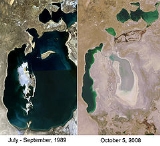
 projects. By 2004, the sea had shrunk to 25% of its original surface area, and a nearly fivefold increase in salinity
Salinity

Salinity is the saltiness or dissolved salt content of a body of water. Salinity in Australian English and North American English may also refer to the salt in soil ....
 had killed most of its natural flora
Flora

In botany, flora has two meanings. The first meaning, flora of an area or of time period, refers to all plant life occurring in an area or time period, especially the naturally occurring or indigenous plant life....
 and fauna
Fauna

File:Fauna.pngFauna is all of the animal life of any particular region or time. The corresponding term for plants is flora.Zoology and paleontology use fauna to refer to a typical collection of animals found in a specific time or place, e.g....
. By 2007 it had declined to 10% of its original size, splitting into three separate lakes, two of which are too salty to support fish. The once prosperous fishing industry has been virtually destroyed, and former fishing towns along the original shores have become ship graveyard
Ship graveyard

A ship graveyard or ship cemetery is a location where the hull s of ships are left to decay and disintegrate, or left in reserve fleet....
s. With this collapse has come unemployment and economic hardship.

The Aral Sea is also heavily polluted
Water pollution

Water pollution is the contamination of water bodies such as lakes, rivers, oceans, and groundwater caused by human activities, which can be harmful to organisms and plants that live in these water bodies....
, largely as the result of weapons testing
Aral Sea

The Aral Sea is a landlocked endorheic basin in Central Asia; it lies between Kazakhstan in the north and Karakalpakstan, an autonomous region of Uzbekistan, in the south....
, industrial projects
Industry

An industry is the manufacturing of a Good or Service within a category. Although industry is a broad term for any kind of economic production, in economics and urban planning industry is a synonym for the secondary sector, which is a type of economic activity involved in the manufacturing of raw materials into goods and products....
, pesticide
Pesticide

A pesticide is a substance or mixture of substances used to kill a pest .A pesticide may be a chemical substance, biological agent , antimicrobial, disinfectant or device used against any pest ....
s and fertilizer runoff
Fertilizer

Fertilizers are chemical compounds given to plants to promote growth; they are usually applied either through the soil, for uptake by plant roots, or by foliar feeding, for uptake through leaves....
. Wind-blown salt from the dried seabed damages crops, and polluted drinking water and salt- and dust-laden air cause serious public health problems in the Aral Sea region
Public health problems in the Aral Sea region

After irrigation projects diverted water from the Aral Sea it began to dry up and left behind salts, other minerals and toxins in the soil. These not only contaminated the soil but also were picked up by winds and storms, and traveled to other areas, including over crop lands....
. The retreat of the sea has reportedly also caused local climate change, with summers becoming hotter and drier, and winters colder and longer.

The plight of the Aral Sea is frequently described as an environmental catastrophe. There is now an ongoing effort in Kazakhstan to save and replenish what remains of the northern part of the Aral Sea (the Small Aral). A dam project completed in 2005 has raised the water level of this lake by two metres. Salinity has dropped, and fish are again found in sufficient numbers for some fishing to be viable. The outlook for the far larger southern part of the sea (the Large Aral) remains bleak.

Environmental problems


History


Aral Sea 1985 From Sts
In 1918, the Soviet government
Government of the Soviet Union

Council of Ministers of the USSR was the Soviet government?the highest executive and Administration body of the Soviet Union. Between 1922 and 1946 it was named Council of People's Commissars of the USSR ....
 decided that the two rivers that fed the Aral Sea, the Amu Darya
Amu Darya

The Amu Darya is the longest river in Central Asia. Its name is sometimes represented in a single word, Amudarya .Amu is said to have come from the city of Amul, now known as T?rkmenabat....
 in the south and the Syr Darya
Syr Darya

Syr Darya is a river in Central Asia, sometimes known as the Jaxartes or Yaxartes from its Ancient Greek name . The Greek name is derived from Old Persian, Yakhsha Arta , a reference to the color of the river's water....
 in the northeast, would be diverted to irrigate the desert
Désert

?D?sert? is ?milie Simon's debut single, released in October 2002. The song was a huge success both critically and commercially in her homeland....
, in order to attempt to grow rice
Rice

Rice is a staple food for a large part of the world's human population, especially in tropical Latin America, and East Asia, South Asia and Southeast Asia, making it the second-most consumed cereal grain, after maize....
, melon
Melon

Melon is a name given to various members of the Cucurbitaceae family with fleshy fruit. Melon can refer to either the plant or the fruit, which is a Epigynous berry....
s, cereal
Cereal

Cereals, or cereal grains, are mostly Poaceae cultivated for their edible brans or fruit seeds . Cereal grains are grown in greater quantities and provide more energy worldwide than any other type of crop; they are therefore staple foods....
s, and cotton
Cotton

Cotton is a soft, staple fiber that grows in a form known as a boll around the seeds of the cotton plant a shrub native to tropical and subtropical regions around the world, including the Americas, India and Africa....
. This was part of the Soviet plan for cotton
Cotton

Cotton is a soft, staple fiber that grows in a form known as a boll around the seeds of the cotton plant a shrub native to tropical and subtropical regions around the world, including the Americas, India and Africa....
, or "white gold", to become a major export
Export

Export goods or services are provided to foreign consumers by domestic Production theory basics. It is a good that is sent to another country for sale....
. This did eventually end up becoming the case, and today Uzbekistan is one of the world's largest exporters of cotton.

The construction of irrigation canal
Canal

Canals are artificial channels for water. There are two types of canals: Aqueduct canals, which are used for the conveyance and delivery of water, and waterways, which are navigable transportation canals used for passage of goods and people, often connected to existing lakes, rivers, or oceans....
s began on a large scale in the 1940s. Many of the canals were poorly built, allowing water to leak or evaporate. From the Qaraqum Canal
Qaraqum Canal

The Qaraqum Canal in Turkmenistan is the largest irrigation and water supply canal in the world. Started in 1954, and completed in 1988, it is navigable over much of its 1,375 km length, and carries 13 km? of water annually from the Amu-Darya River across the Karakum Desert in Turkmenistan....
, the largest in Central Asia, perhaps 30 to 75% of the water went to waste. Today only 12% of Uzbekistan's irrigation canal length is waterproofed.

By 1960, between 20 and 60 cubic kilometers of water were going each year to the land instead of the sea. Most of the sea's water supply had been diverted, and in the 1960s the Aral Sea began to shrink. From 1961 to 1970, the Aral's sea level fell at an average of 20 cm a year; in the 1970s, the average rate nearly tripled to 50–60 cm per year, and by the 1980s it continued to drop, now with a mean of 80–90 cm each year. The rate of water usage for irrigation continued to increase: the amount of water taken from the rivers doubled between 1960 and 2000, and cotton production nearly doubled in the same period.

The Aral Sea fishing industry, which in its heyday had employed some 40,000 and reportedly produced one-sixth of the USSR's entire fish catch, essentially disappeared; so did the muskrat
Muskrat

The muskrat , the only species in genus Ondatra, is a medium-sized semi-aquatic rodent native to North America, and introduced in parts of Europe, Asia, and South America....
 trapping in the deltas
River delta

A delta is a landform that is created at the mouth of a river where that river flows into an ocean, sea, estuary, lake, reservoir, flat arid area, or another river....
 of Amu Darya and Syr Darya, which used to yield as much as 500,000 muskrat pelts a year.

The disappearance of the lake was no surprise to the Soviets; they expected it to happen long before. As early as in 1964, Aleksandr Asarin at the Hydroproject
Hydroproject

Hydroproject is a Russian dam and canal design firm. Based in Moscow, it has a number of branches around the country.Hydroproject and its predecessor institutions have designed most of the hydroelectric dams and irrigation and navigation canals that Reservoirs and dams in the Commonwealth of Independent States and Russia since the 1930s....
 Institute pointed out that the lake was doomed explaining, "It was part of the five-year plans, approved by the council of ministers
Government of the Soviet Union

Council of Ministers of the USSR was the Soviet government?the highest executive and Administration body of the Soviet Union. Between 1922 and 1946 it was named Council of People's Commissars of the USSR ....
 and the Politburo
Politburo

Politburo, short for Political Bureau, Russian language Politicheskoye Buro, is the executive organization for a number of political parties, most notably those of Communist Party....
. Nobody on a lower level would dare to say a word contradicting those plans, even if it was the fate of the Aral Sea."

The reaction to the predictions varied. Some Soviet experts apparently considered the Aral to be "nature's error", and a Soviet engineer said in 1968 that "it is obvious to everyone that the evaporation of the Aral Sea is inevitable." On the other hand, starting in the 1960s, a large scale project
Northern river reversal

File:Russland Dawydow.PNGThe Northern river reversal or Siberian river reversal was a grandiose project to divert the flow of the Northern rivers in the Soviet Union, which "uselessly" drain into the Arctic Ocean, southwards, towards the populated agricultural areas of Central Asia, which lack water....
 was proposed to redirect part of the flow of the rivers of the Ob
Ob River

Ob River , also Obi, is a major river in western Siberia, Russia, it is the country's fourth longest....
 basin to Central Asia over a gigantic canal system. Refilling of the Aral Sea was considered as one of the project's main goals. However, due to its staggering costs and the negative public opinion in Russia proper, the federal authorities abandoned the project by 1986.

Current situation

Aralsea Comparisonapr2005 06
Aralship
Aralship2
Aralskharbor
From 1960 to 1998, the sea's surface area shrank by approximately 60%, and its volume by 80%. In 1960, the Aral Sea was the world's fourth-largest lake, with an area of approximately 68,000 km2 and a volume of 1100 km³; by 1998, it had dropped to 28,687 km2, and eighth-largest. The amount of water it has lost is the equivalent of completely draining Lakes Erie
Lake Erie

Lake Erie is the fourth largest lake of the five Great Lakes, and the tenth largest globally. It is the southernmost, shallowest, and smallest by volume of the Great Lakes and therefore also has the shortest average water residence time....
 and Ontario
Lake Ontario

Lake Ontario is one of the five Great Lakes of North America. The lake is bounded on the north by the Canadian province of Ontario and on the south by Ontario's Niagara Peninsula and by the U.S....
. Over the same time period its salinity
Salinity

Salinity is the saltiness or dissolved salt content of a body of water. Salinity in Australian English and North American English may also refer to the salt in soil ....
 has increased from about 10 g/L
Gram per litre

A gram per litre or liter is a measurement of concentration used to measure the how many grams of a certain substance there are present in one litre of liquid....
 to about 45 g/L. As of 2004, the Aral Sea's surface area was only 17,160 km2, 25% of its original size. By 2007 the sea's area had shrunk to 10% of its original size, and the salinity of the remains of the southern part of the sea (the Large Aral) had increased to levels in excess of 100 g/L. By comparison, the salinity of ordinary seawater
Seawater

Seawater is water from a sea or ocean. On average, seawater in the world's oceans has a salinity of about 3.5%, or 35 parts per thousand . This means that every 1 kg of seawater has approximately 35 grams of sea salt ....
 is typically around 35 g/L; the Dead Sea
Dead Sea

For the Brian Keene book of the same name, see Dead Sea The Dead Sea is a salt lake between Israel and the West Bank to the west, and Jordan to the east....
's salinity varies between 300 and 350 g/L.

Even the recently-discovered inflow of water discharge from underground into the Aral Sea will not in itself be able to stop the desiccation. This inflow of about 4 cubic kilometres per year is larger than previously estimated. This groundwater originates in the Pamirs and Tian Shan
Tian Shan

The Tian Shan , also commonly spelled Tien Shan, is a mountain range located in Central Asia. The Chinese name for Tian Shan or Tien Shan, may in turn go back to a Xiongnu name, qilian reported by the Shiji as the last place where they met and had their baby as in of the Yuezhi, which has been argued to refer to the Tian Shan...
 mountains and seeks its way through geological layers to a fracture zone at the bottom of the Aral Sea.

In 1987, the continuing shrinkage split the lake into two separate bodies of water, the North Aral Sea
North Aral Sea

The North Aral Sea is the portion of the former Aral Sea that is fed by the Syr Darya river. It split from the South Aral Sea in 1987 as water levels dropped due to river diversion for agriculture....
 (the Lesser Sea, or Small Aral Sea) and the South Aral Sea
South Aral Sea

The South Aral Sea is a lake in the basin of the former Aral Sea which formed in 1987 when that body divided in two, due to diversion of river inflow for agriculture....
 (the Greater Sea, or Large Aral Sea); an artificial channel was dug to connect them, but that connection was gone by 1999 as the two seas continued to shrink. In 2003, the South Aral further divided into eastern and western basins; the loss of the North Aral has since been partially reversed (see below). Shrinkage of the lake also created the Aralkum, a desert on the former lakebed.

Work is being done to restore in part the North Aral Sea. Irrigation works on the Syr Darya have been repaired and improved to increase its water flow, and in October 2003, the Kazakh government announced a plan to build Dike Kokaral
Dike Kokaral

Dike Kokaral is a dike across a narrow stretch of the Aral Sea, splitting off the North Aral Sea from the much larger South Aral Sea . Work was completed in August 2005....
, a concrete dam separating the two halves of the Aral Sea. Work on this dam was completed in August 2005; since then the water level of the North Aral has risen, and its salinity has decreased. As of 2006, some recovery of sea level has been recorded, sooner than expected. "The dam has caused the small Aral's sea level to rise swiftly to 38 m (125 ft), from a low of less than 30 m (98 ft), with 42 m (138 ft) considered the level of viability." Economically significant stocks of fish have returned, and observers who had written off the North Aral Sea as an environmental catastrophe were surprised by unexpected reports that in 2006 its returning waters were already partly reviving the fishing industry and producing catches for export as far as Ukraine. The restoration reportedly gave rise to long absent rain clouds and possible microclimate changes, bringing tentative hope to an agricultural sector swallowed by a regional dustbowl
Dust storm

A dust storm or sandstorm is a meteorological phenomenon common in arid and semi-arid regions and arises when a gust front passes or when the wind force exceeds the threshold value where loose sand and dust are removed from the dry surface....
, and some expansion of the shrunken sea. "The sea, which had receded almost 100 km south of the port-city of Aral
Aral

Aral, also known as Aralsk or Aral'sk, is a small city in south-western Kazakhstan, located in the oblast of Kyzylorda Province....
, is now a mere 25 km away." There are plans to build a new canal to reconnect Aralsk with the sea. Construction is scheduled to begin in 2009, by which time it is hoped the distance to be covered will be only 6 km. A new dam is to be built based on a World Bank loan to Kazakhstan, with the start of construction also slated for 2009 to further expand the shrunken Northern Aral eventually to the withered former port of Aralsk.

The South Aral Sea, which lies in poorer Uzbekistan, was largely abandoned to its fate. Projects in the North Aral at first seemed to bring glimmers of hope to the South as well: "In addition to restoring water levels in the Northern Sea, a sluice in the dike is periodically opened, allowing excess water to flow into the largely dried-up Southern Aral Sea." Discussions had been held on recreating a channel between the somewhat improved North and the desiccated South, along with uncertain wetland restoration plans throughout the region, but political will is lacking. Uzbekistan shows no interest in abandoning the Amu Darya river as an abundant source of cotton irrigation, and instead is moving toward oil exploration in the drying South Aral seabed. Vast salt plains exposed with the shrinking of the Aral have produced dust storm
Dust storm

A dust storm or sandstorm is a meteorological phenomenon common in arid and semi-arid regions and arises when a gust front passes or when the wind force exceeds the threshold value where loose sand and dust are removed from the dry surface....
s, making regional winters colder and summers hotter. Attempts to mitigate these effects include planting vegetation in the newly exposed seabed. In the Northern Aral, recently higher sea levels have slightly moderated these effects in some areas, and the spring season now sees long-missing rainfall.

As of summer 2003, the South Aral Sea was vanishing faster than predicted. In the deepest parts of the sea, the bottom waters are saltier than the top, and not mixing. Thus, only the top of the sea is heated in the summer, and it evaporates faster than would otherwise be expected. Based on the recent data, the eastern part of the South Aral Sea is expected to be gone within 15 years; the western part could last for another 50-125 years.

The ecosystem
Ecosystem

An ecosystem is a natural unit consisting of all plants, animals and micro-organisms in an area functioning together with all of the non-living physical factors of the environment....
 of the Aral Sea and the river delta
River delta

A delta is a landform that is created at the mouth of a river where that river flows into an ocean, sea, estuary, lake, reservoir, flat arid area, or another river....
s feeding into it has been nearly destroyed, not least because of the much higher salinity. The receding sea has left huge plains covered with salt
Salt

A salt, in chemistry, is defined as the product formed from the neutralisation reaction of acids and base . Salts are ionic compounds composed of cations and anions so that the product is electrically electric charge ....
 and toxic chemicals, which are picked up and carried away by the wind as toxic dust and spread to the surrounding area. The land around the Aral Sea is heavily polluted and the people living in the area are suffering from a lack of fresh water and health problems, including high rates of certain forms of cancer
Cancer

Cancer is a class of diseases in which a group of cell display uncontrolled growth , invasion , and sometimes metastasis . These three malignant properties of cancers differentiate them from benign tumors, which are self-limited, do not invade or metastasize....
 and lung diseases. Crops in the region are destroyed by salt being deposited onto the land. The town of Moynaq in Uzbekistan had a thriving harbor
Harbor

A harbor or harbour , or haven, is a place where ships may shelter from the weather or are stored. Harbors can be man-made or natural....
 and fishing industry
Fishing industry

File:Albatun Dod.jpg.The fishing industry includes any industry or activity concerned with taking, culturing, processing, preserving, storing, transporting, marketing or selling fish or fish products....
 that employed approximately 60,000 people; now the town lies miles from the shore. Fishing boats lie scattered on the dry land that was once covered by water, many have been there for 20 years. The only significant fishing company left in the area has its fish shipped from the Baltic Sea
Baltic Sea

The Baltic Sea is a brackish inland sea located in Northern Europe, from 53?N to 66?N latitude and from 20?E to 26?E longitude. It is bounded by the Scandinavian Peninsula, the mainland of Europe, and the Denmark islands....
, thousands of kilometres away.

Possible solutions

Many different solutions to the different problems have been suggested over the years, ranging in feasibility and cost, including the following:

  • Improving the quality of irrigation
    Irrigation

    Irrigation is an artificial application of water to the soil usually for assisting in growing crops. In crop production it is mainly used in dry areas and in periods of rainfall shortfalls, but also to protect plants against frost....
     canals;
  • Installing desalination
    Desalination

    Desalination, desalinization, or desalinisation refers to any of several processes that remove excess sodium chloride and other minerals from water....
     plants;
  • Charging farmers to use the water from the rivers;
  • Using alternative cotton
    Cotton

    Cotton is a soft, staple fiber that grows in a form known as a boll around the seeds of the cotton plant a shrub native to tropical and subtropical regions around the world, including the Americas, India and Africa....
     species that require less water;
  • Using fewer chemicals on the cotton;
  • Installing Dams to fill the Aral sea;
  • Redirecting water from the Volga
    Volga River

    The Volga is the largest river in Europe in terms of length, Discharge , and Drainage basin. It flows through the western part of Russia, and is widely viewed as the national river of Russia....
    , Ob
    Ob River

    Ob River , also Obi, is a major river in western Siberia, Russia, it is the country's fourth longest....
     and Irtysh
    Irtysh

    Irtysh a river in Siberia, the chief tributary of the Ob River. Its name means White River. It is actually longer than the Ob to their confluence....
     rivers. This would restore the Aral Sea to its former size in 20-30 years at a cost of US$30-50 billion;
  • Pump and dilute
    Desalination

    Desalination, desalinization, or desalinisation refers to any of several processes that remove excess sodium chloride and other minerals from water....
     sea water into the Aral Sea from the Caspian Sea
    Caspian Sea

    The Caspian Sea is the largest enclosed body of water on Earth by area, variously classed as the List of lakes by area or a full-fledged sea. It has a surface area of 371,000 square kilometers and a volume of 78,200 cubic kilometers ....
     via pipeline.


In January 1994, the countries of Kazakhstan
Kazakhstan

Kazakhstan, also Kazakstan , officially the Republic of Kazakhstan, is a large Eurasian country in Central Asia and Eastern Europe. Ranked as the List of countries by area as well as the world's largest landlocked country, it has a territory of 2,727,300 km? ....
, Uzbekistan
Uzbekistan

Uzbekistan, officially the Republic of Uzbekistan , is a Landlocked_country#Doubly_landlocked_country country in Central Asia, formerly part of the Soviet Union....
, Turkmenistan
Turkmenistan

Turkmenistan is a Turkic peoples country in Central Asia. Until 1991, it was a constituent republic of the Soviet Union, the Turkmen Soviet Socialist Republic ....
, Tajikistan
Tajikistan

Tajikistan , officially the Republic of Tajikistan , is a mountainous landlocked country in Central Asia. Afghanistan borders to the south, Uzbekistan to the west, Kyrgyzstan to the north, and People's Republic of China to the east....
 and Kyrgyzstan
Kyrgyzstan

Kyrgyzstan , officially the Kyrgyz Republic, is a country in Central Asia. Landlocked and mountainous, it is bordered by Kazakhstan to the north, Uzbekistan to the west, Tajikistan to the southwest and People's Republic of China to the east....
 signed a deal to pledge 1% of their budgets to helping the sea recover.

In March 2000 UNESCO presented their at the 2nd World Water Forum in The Hague. This document was criticized for setting unrealistic goals, and also by focusing on the entire basin, implicitly giving up on the Aral Sea and the people living downstream in Karakalpakstan
Karakalpakstan

Karakalpakstan is an autonomous republic of Uzbekistan. It occupies the whole western end of Uzbekistan. The capital is Nukus . The Republic of Karakalpakstan has an area of ....
.

By 2006, the World Bank's restoration projects especially in the North Aral were giving rise to some unexpected, tentative relief in what had been an extremely pessimistic picture.

Bioweapons facility on the Vozrozhdeniya Island

In 1948, a top-secret Soviet
Soviet Union

The Union of Soviet Socialist Republics was a Constitution of the Soviet Union socialist state that existed in Eurasia from 1922 to 1991.The name is a translation of the , romanization of Russian Soyuz Sovetskikh Sotsialisticheskikh Respublik, abbreviated ????, SSSR....
 bioweapons laboratory was established on the island in the center of the Aral Sea which is now disputed territory between Kazakhstan
Kazakhstan

Kazakhstan, also Kazakstan , officially the Republic of Kazakhstan, is a large Eurasian country in Central Asia and Eastern Europe. Ranked as the List of countries by area as well as the world's largest landlocked country, it has a territory of 2,727,300 km? ....
 and Uzbekistan
Uzbekistan

Uzbekistan, officially the Republic of Uzbekistan , is a Landlocked_country#Doubly_landlocked_country country in Central Asia, formerly part of the Soviet Union....
. The exact history, functions and current status of this facility have not yet been disclosed. The base was abandoned in 1992 following the disintegration of the Soviet Union
Soviet Union

The Union of Soviet Socialist Republics was a Constitution of the Soviet Union socialist state that existed in Eurasia from 1922 to 1991.The name is a translation of the , romanization of Russian Soyuz Sovetskikh Sotsialisticheskikh Respublik, abbreviated ????, SSSR....
. Scientific expeditions proved that this had been a site for production, testing and later dumping of pathogenic weapons. In 2002, through a project organized by the United States and with Uzbekistan assistance, 10 anthrax burial sites were decontaminated. According to the Kazakh Scientific Center for Quarantine and Zoonotic Infections, all burial sites of anthrax
Anthrax

Anthrax is an Acute disease in humans and animals caused by the bacterium Bacillus anthracis, which is highly lethal in some forms. There are effective vaccines against anthrax, and some forms of the disease respond well to antibiotic treatment....
 were decontaminated.

Oil and gas exploration

Ergash Shaismatov
Ergash Shaismatov

Ergash Rahmatullayevich Shoismatov is the current Deputy Prime Minister of Uzbekistan.On August 30, 2006 Shoismatov announced that the Uzbek government and an international consortium consisting of state-run Uzbekneftegaz, LUKoil Overseas, Petronas, Korea National Oil Corporation, and China National Petroleum Corporation had signed a produ...
, the Deputy Prime Minister of Uzbekistan
Prime Minister of Uzbekistan

According to the Constitution of Uzbekistan, the Prime Minister of Uzbekistan and the deputy ministers are appointed by the President....
, announced on August 30, 2006, that the Uzbek government and an international consortium consisting of state-run Uzbekneftegaz
Uzbekneftegaz

Uzbekneftegaz is a state-owned holding company of Uzbekistan's oil and gas industry.External links...
, LUKoil Overseas
LUKoil

Lukoil is Russia's largest oil company and its largest producer of petroleum. In 2006, it produced 95.2 million metric tons of oil.Its international upstream subsidiary is called Lukoil Overseas Holding....
, Petronas
Petronas

Petronas, short for Petroliam Nasional Berhad, is a Malaysian owned oil and natural gas company that was founded on August 17 1974. Wholly owned by the Government, the corporation is vested with the entire oil and gas resources in Malaysia and is entrusted with the responsibility of developing and adding value to these resources....
, Korea National Oil Corporation
Korea National Oil Corporation

Korea National Oil Corporation is the national oil and gas company of South Korea and one of the most important industrial companies in the country....
, and China National Petroleum Corporation
China National Petroleum Corporation

The China National Petroleum Corporation is a state-owned fuel-producing corporation in the People's Republic of China. It is China's largest integrated oil and gas company....
 signed a production sharing agreement to explore and develop oil and gas fields in the Aral Sea, saying, "The Aral Sea is largely unknown, but it holds a lot of promise in terms of finding oil and gas. There is risk, of course, but we believe in the success of this unique project." The consortium was created in September 2005.

Films featuring the Aral Sea


The tragedy of Aral coast was portrayed in the 1989 film, Psy ("Dogs"), by Soviet director, Dmitriy Svetozarov. The film was shot on location in the actual ghost town
Ghost town

A ghost town is a town or city that has been completely abandoned by human inhabitants, usually because the economic activity that supported it has failed, or due to natural or human-caused disasters such as flood, government action, uncontrolled lawlessness or war....
, showing scenes of abandoned buildings and scattered vessels.

Also in 1989 Kazakh director Rashid Nugmanov used the barren landscape around the Aral Sea for his movie The Needle.

In 1998 Dutch director Ben van Lieshout shot his film De Verstekeling ("The Stowaway") partly on the dry sea shore near Muynak.

In 1999 German filmmaker Joachim Tschirner has produced the documentary Der Aralsee for the German channel Arte
Arte

Arte is a Franco-German TV network. It describes itself as a European culture channel and aims to promote quality programming especially in areas of culture and the arts....
.

In 2000 the MirrorMundo foundation produced a about the problems arising from the drying up of the sea.

The 2004 film "Rebirth Island" (Russian: ?????? ???????????; Kazakh: ??????? ?????? ???), about the life of Kazakh poet Zharaskan Abdirash
Zharaskan Abdirash

Zharaskan Abdirash was a Soviet Union Kazakhs poet. He was banned during the Soviet period. His son, director Rustem Abdrashitov, made a film about his father's life in 2004, "Rebirth Island" ...
, took place near the Aral Sea.

On 9/10 June 2007 BBC World
BBC World

BBC World News is the BBC's international news and current affairs television channel. It has the largest audience of any BBC channel and any news channel in the world....
 broadcast a documentary
Documentary film

Documentary film is a broad category of visual expression that is based on the attempt, in one fashion or another, to "document" reality. Although "documentary film" originally referred to movies shot on film stock, it has subsequently expanded to include video and new media productions that can be either direct-to-video or made for a televis...
 called Back From The Brink? made by Borna Alikhani and Guy Creasey that showed some of the changes in the region since the introduction of the Aklak Dam.

Further reading


External links

  • *
  • - United Nations Environment Programme.
  • - Information Centre for Kazakhstan with Infos on Aral Sea