

Behistun Inscription

Encyclopedia
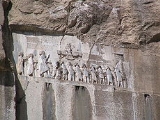
The Behistun Inscription (also Bistun or Bisutun, Modern Persian: بیستون < Old Persian: Bagastana, meaning "the place of god") is a multi-lingual inscription located on Mount Behistun
in the Kermanshah Province
of Iran
, near the city of Kermanshah
in western Iran.
Authored by Darius the Great sometime between his coronation as king of the Persian Empire in the summer of 522 BC and his death in autumn of 486 BC, the inscription begins with a brief autobiography of Darius, including his ancestry and lineage. Later in the inscription, Darius provides a lengthy sequence of events following the deaths of Cyrus the Great
and Cambyses II in which he fought nineteen battles in a period of one year (ending in December of 521 BC) to put down multiple rebellions throughout the Persian Empire. The inscription states in detail that the rebellions, which had resulted from the deaths of Cyrus the Great and his son Cambyses II, were orchestrated by several impostors and their co-conspirators in various cities throughout the empire, each of whom falsely proclaimed kinghood during the upheaval following Cyrus's death.
Darius the Great proclaimed himself victorious in all battles during the period of upheaval, attributing his success to the "grace of Ahura Mazda".
The inscription includes three versions of the same text, written in three different cuneiform script
languages: Old Persian, Elamite
, and Babylonian (a later form of Akkadian
). In effect, then, the inscription is to cuneiform
what the Rosetta Stone
is to Egyptian hieroglyphs: the document most crucial in the decipherment
of a previously lost script
.
The inscription is approximately 15 metres high by 25 metres wide and 100 metres up a limestone
cliff from an ancient road connecting the capitals of Babylonia
and Media
(Babylon
and Ecbatana
, respectively). The Old Persian text contains 414 lines in five columns; the Elamite text includes 593 lines in eight columns, and the Babylonian text is in 112 lines. The inscription was illustrated by a life-sized bas-relief of Darius I, the Great, holding a bow
as a sign of kingship, with his left foot on the chest of a figure lying on his back before him. The supine figure is reputed to be the pretender Gaumata. Darius is attended to the left by two servants, and ten one-metre figures stand to the right, with hands tied and rope around their necks, representing conquered peoples. Faravahar
floats above, giving his blessing to the king. One figure appears to have been added after the others were completed, as was Darius's beard, which is a separate block of stone attached with iron
pins and lead
.
of Persia — one of the last Sassanid kings, who lived over 1000 years after the time of Darius I.
The inscription is mentioned by Ctesias of Cnidus
, who noted its existence some time around 400 BC and mentioned a well and a garden beneath the inscription. He incorrectly concluded that the inscription had been dedicated "by Queen Semiramis of Babylon to Zeus
". Tacitus also mentions it and includes a description of some of the long-lost ancillary monuments at the base of the cliff, including an altar to "Herakles". What has been recovered of them, including a statue dedicated in 148 BC, is consistent with Tacitus's description. Diodorus
also writes of "Bagistanon" and claims it was inscribed by Semiramis.
A legend began around Mount Behistun
(Bisutun), as written about by the Persian poet and writer
Firdausi in his Shahnamah (Book of Kings) circa AD 1000, about a man named Farhad
, who was a lover of King Khosrow's wife, Shirin
. The legend states that, exiled for his transgression, Farhad was given the task of cutting away the mountain to find water; if he succeeded, he would be given permission to marry Shirin. After many years and the removal of half the mountain, he did find water, but was informed by Khosrow that Shirin had died. He went mad, threw his axe down the hill, kissed the ground and died. It is told in the book of Khosrow and Shirin that his axe was made out of a pomegranate tree, and, where he threw the axe, a pomegranate tree grew with fruit that would cure the ill. Shirin was not dead, according to the story, and mourned upon hearing the news.
In 1598, the Englishman
Robert Sherley saw the inscription during a diplomatic mission to Persia
on behalf of Austria
, and brought it to the attention of Western European scholars. His party incorrectly came to the conclusion that it was Christian in origin.
French General Gardanne thought it showed "Christ and his twelve apostles", and Sir Robert Ker Porter
thought it represented the Lost Tribes of Israel and Shalmaneser of Assyria
.
Italian explorer Pietro della Valle
visited the inscription in the course of a pilgrimage in around 1621.
 German surveyor Carsten Niebuhr
visited in around 1764 for Frederick V of Denmark
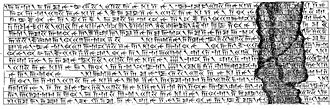
, publishing a copy of the inscription in the account of his journeys in 1778.
Niebuhr's transcriptions were used by Georg Friedrich Grotefend
and others in their efforts to decipher the Old Persian cuneiform script. Grotefend had deciphered ten of the 37 symbols of Old Persian by 1802, after realizing that unlike the Semitic cuneiform scripts, Old Persian text is alphabetic and each word is separated by a vertical slanted symbol.
The Old Persian text was copied and deciphered before the recovery and copying of the Elamite and Babylonian inscriptions had even been attempted, which proved to be a good deciphering strategy, since Old Persian script was easier to study due to its alphabetic nature and the fact that the language it represents had naturally evolved into Middle Persian
, and in turn, to the living modern Persian language
dialects as well as the Avestan language, used in the Zoroastrian book the Avesta
.
In 1835, Sir Henry Rawlinson, an officer of the British East India Company
army assigned to the forces of the Shah
of Iran, began studying the inscription in earnest. As the town of Bisutun's name was anglicized as "Behistun" at this time, the monument became known as the "Behistun Inscription". Despite its relative inaccessibility, Rawlinson was able to scale the cliff and copy the Old Persian inscription. The Elamite was across a chasm, and the Babylonian four meters above; both were beyond easy reach and were left for later.
With the Persian text, and with about a third of the syllabary
made available to him by the work of Georg Friedrich Grotefend
, Rawlinson set to work on deciphering the text. Fortunately, the first section of this text contained a list of the same Persian kings found in Herodotus
in their original Persian forms as opposed to Herodotus's Greek transliteration
s; for example Darius is given as the original Dâryavuš instead of the Hellenized Δαρειος. By matching the names and the characters, Rawlinson was able to decipher the type of cuneiform used for Old Persian by 1838 and presented his results to the Royal Asiatic Society
in London
and the Société Asiatique
in Paris
.
In the interim, Rawlinson spent a brief tour of duty in Afghanistan
, returning to the site in 1843. He first crossed a chasm between the Persian and Elamite scripts by bridging the gap with planks, subsequently copying the Elamite inscription. He was then able to find an enterprising local boy to climb up a crack in the cliff and suspend ropes across the Babylonian writing, so that papier-mâché
casts of the inscriptions could be taken. Rawlinson, along with scholars Edward Hincks
, Julius Oppert
, William Henry Fox Talbot, and Edwin Norris
, either working separately or in collaboration, eventually deciphered these inscriptions, leading eventually to the ability to read them completely.
The translation of the Old Persian sections of the Behistun Inscription paved the way to the subsequent ability to decipher the Elamite and Babylonian parts of the text, which greatly promoted the development of modern Assyriology
.
Later expeditions, in 1904 sponsored by the British Museum
and led by Leonard William King
and Reginald Campbell Thompson
and in 1948 by George G. Cameron of the University of Michigan
, obtained photographs, casts and more accurate transcriptions of the texts, including passages that were not copied by Rawlinson.
It also became apparent that rainwater had dissolved some areas of the limestone in which the text was inscribed, while leaving new deposits of limestone over other areas, covering the text.
In 1938, the inscription became of interest to the Nazi German think tank
Ahnenerbe
, although research plans were cancelled due to the onset of World War II.
The monument later suffered some damage from Allied
soldiers using it for target practice in World War II
, during the Anglo-Soviet invasion of Iran
.
In 1999, Iranian archeologists began the documentation and assessment of damages to the site incurred during the 20th century. Malieh Mehdiabadi, who was project manager
for the effort, described a photogrammetric
process by which two-dimensional photos were taken of the inscriptions using two cameras and later transmuted into 3-D images.
In recent years, Iranian archaeologists have been undertaking conservation works. The site became a UNESCO
World Heritage Site
in 2006.
In the first image, Herakles with curly hair and a beard rests on the lion skin. Beside him, an olive tree is seen carved on the wall, while a quiver full of arrows is hanging from it, and a club resting close by. Behind the head of Herakles, an inscription of seven lines in old Greek is written on a smooth space with a frame similar to Greek temples. According to this inscription, the statue was carved in 139 BC on the occasion of a conquest for Seleucid Greeks (under Demetrius II Nicator
) against the Parthians (under Mithridates I of Parthia
), though the Seleucids were later defeated and driven from the region.
The second image is a bas relief of Mithridates II of Parthia: this was carved in 123–110 BC and represents Parthian king Mithridates and four of his satraps who are respecting the king. Bas relief of Gotarzes II of Parthia shows the conquest of that king over Meherdates, an Arsacid prince who lived in Rome
. An inscription in Greek is seen on the left side of the top outer frame of the relief. Sheikh Ali khan Zangeneh text endowment: According to this text, written in Sloth calligraphy, Sheikh Ali khan Zangeneh, a local ruler of the 17th century, dedicates four shares (out of six) of his properties in Ghareh-vali and Chambatan (local villages) for Sadaats (descendants of the prophet Mohammad), and two remaining shares for the Bisotoun Safavid caravansarai.
Mount Behistun
Mount Bisotoun is a mountain in the Kermanshah Province is located in the middle of the western part of Iran. It is located from Tehran.It is well known for its rock relief in which the great Achaemenian King, Darius the Great, had the narrative of his exploits engraved around B.C...
in the Kermanshah Province
Kermanshah Province
Kermanshah Province is one of the 31 provinces of Iran. The province was known from 1969 to 1986 as Kermanshahan and from 1986 to 1995 as Bakhtaran.-Counties:...
of Iran
Iran
Iran , officially the Islamic Republic of Iran , is a country in Southern and Western Asia. The name "Iran" has been in use natively since the Sassanian era and came into use internationally in 1935, before which the country was known to the Western world as Persia...
, near the city of Kermanshah
Kermanshah
Kermanshah is a city in and the capital of Kermanshah Province, Iran. At the 2006 census, its population was 784,602, in 198,117 families.The overwhelming majority of Kermanshahi people are Shi'a Muslims...
in western Iran.
Authored by Darius the Great sometime between his coronation as king of the Persian Empire in the summer of 522 BC and his death in autumn of 486 BC, the inscription begins with a brief autobiography of Darius, including his ancestry and lineage. Later in the inscription, Darius provides a lengthy sequence of events following the deaths of Cyrus the Great
Cyrus the Great
Cyrus II of Persia , commonly known as Cyrus the Great, also known as Cyrus the Elder, was the founder of the Achaemenid Empire. Under his rule, the empire embraced all the previous civilized states of the ancient Near East, expanded vastly and eventually conquered most of Southwest Asia and much...
and Cambyses II in which he fought nineteen battles in a period of one year (ending in December of 521 BC) to put down multiple rebellions throughout the Persian Empire. The inscription states in detail that the rebellions, which had resulted from the deaths of Cyrus the Great and his son Cambyses II, were orchestrated by several impostors and their co-conspirators in various cities throughout the empire, each of whom falsely proclaimed kinghood during the upheaval following Cyrus's death.
Darius the Great proclaimed himself victorious in all battles during the period of upheaval, attributing his success to the "grace of Ahura Mazda".
The inscription includes three versions of the same text, written in three different cuneiform script
Cuneiform script
Cuneiform script )) is one of the earliest known forms of written expression. Emerging in Sumer around the 30th century BC, with predecessors reaching into the late 4th millennium , cuneiform writing began as a system of pictographs...
languages: Old Persian, Elamite
Elamite language
Elamite is an extinct language spoken by the ancient Elamites. Elamite was the primary language in present day Iran from 2800–550 BCE. The last written records in Elamite appear about the time of the conquest of the Persian Empire by Alexander the Great....
, and Babylonian (a later form of Akkadian
Akkadian language
Akkadian is an extinct Semitic language that was spoken in ancient Mesopotamia. The earliest attested Semitic language, it used the cuneiform writing system derived ultimately from ancient Sumerian, an unrelated language isolate...
). In effect, then, the inscription is to cuneiform
Cuneiform script
Cuneiform script )) is one of the earliest known forms of written expression. Emerging in Sumer around the 30th century BC, with predecessors reaching into the late 4th millennium , cuneiform writing began as a system of pictographs...
what the Rosetta Stone
Rosetta Stone
The Rosetta Stone is an ancient Egyptian granodiorite stele inscribed with a decree issued at Memphis in 196 BC on behalf of King Ptolemy V. The decree appears in three scripts: the upper text is Ancient Egyptian hieroglyphs, the middle portion Demotic script, and the lowest Ancient Greek...
is to Egyptian hieroglyphs: the document most crucial in the decipherment
Decipherment
Decipherment is the analysis of documents written in ancient languages, where the language is unknown, or knowledge of the language has been lost....
of a previously lost script
Writing system
A writing system is a symbolic system used to represent elements or statements expressible in language.-General properties:Writing systems are distinguished from other possible symbolic communication systems in that the reader must usually understand something of the associated spoken language to...
.
The inscription is approximately 15 metres high by 25 metres wide and 100 metres up a limestone
Limestone
Limestone is a sedimentary rock composed largely of the minerals calcite and aragonite, which are different crystal forms of calcium carbonate . Many limestones are composed from skeletal fragments of marine organisms such as coral or foraminifera....
cliff from an ancient road connecting the capitals of Babylonia
Babylonia
Babylonia was an ancient cultural region in central-southern Mesopotamia , with Babylon as its capital. Babylonia emerged as a major power when Hammurabi Babylonia was an ancient cultural region in central-southern Mesopotamia (present-day Iraq), with Babylon as its capital. Babylonia emerged as...
and Media
Medes
The MedesThe Medes...
(Babylon
Babylon
Babylon was an Akkadian city-state of ancient Mesopotamia, the remains of which are found in present-day Al Hillah, Babil Province, Iraq, about 85 kilometers south of Baghdad...
and Ecbatana
Ecbatana
Ecbatana is supposed to be the capital of Astyages , which was taken by the Persian emperor Cyrus the Great in the sixth year of Nabonidus...
, respectively). The Old Persian text contains 414 lines in five columns; the Elamite text includes 593 lines in eight columns, and the Babylonian text is in 112 lines. The inscription was illustrated by a life-sized bas-relief of Darius I, the Great, holding a bow
Bow (weapon)
The bow and arrow is a projectile weapon system that predates recorded history and is common to most cultures.-Description:A bow is a flexible arc that shoots aerodynamic projectiles by means of elastic energy. Essentially, the bow is a form of spring powered by a string or cord...
as a sign of kingship, with his left foot on the chest of a figure lying on his back before him. The supine figure is reputed to be the pretender Gaumata. Darius is attended to the left by two servants, and ten one-metre figures stand to the right, with hands tied and rope around their necks, representing conquered peoples. Faravahar
Faravahar
Faravahar is one of the best-known symbols of Zoroastrianism, the state religion of ancient Iran. This religious-cultural symbol was adapted by the Pahlavi dynasty to represent the Iranian nation....
floats above, giving his blessing to the king. One figure appears to have been added after the others were completed, as was Darius's beard, which is a separate block of stone attached with iron
Iron
Iron is a chemical element with the symbol Fe and atomic number 26. It is a metal in the first transition series. It is the most common element forming the planet Earth as a whole, forming much of Earth's outer and inner core. It is the fourth most common element in the Earth's crust...
pins and lead
Lead
Lead is a main-group element in the carbon group with the symbol Pb and atomic number 82. Lead is a soft, malleable poor metal. It is also counted as one of the heavy metals. Metallic lead has a bluish-white color after being freshly cut, but it soon tarnishes to a dull grayish color when exposed...
.
History
After the fall of the Persian Empire's Achaemenid Dynasty and its successors, and the lapse of Old Persian cuneiform writing into disuse, the nature of the inscription was forgotten, and fanciful explanations became the norm. For centuries, instead of being attributed to Darius I, the Great, it was believed to be from the reign of Khosrau IIKhosrau II
250px|thumb|Khosrau II 250px|thumb|Khosrau II 250px|thumb|Khosrau II (Khosrow II, Chosroes II, or Xosrov II in classical sources, sometimes called Parvez, "the Ever Victorious" – (in Persian: خسرو پرویز), was the twenty-second Sassanid King of Persia, reigning from 590 to 628...
of Persia — one of the last Sassanid kings, who lived over 1000 years after the time of Darius I.
The inscription is mentioned by Ctesias of Cnidus
Ctesias
Ctesias of Cnidus was a Greek physician and historian from Cnidus in Caria. Ctesias, who lived in the 5th century BC, was physician to Artaxerxes Mnemon, whom he accompanied in 401 BC on his expedition against his brother Cyrus the Younger....
, who noted its existence some time around 400 BC and mentioned a well and a garden beneath the inscription. He incorrectly concluded that the inscription had been dedicated "by Queen Semiramis of Babylon to Zeus
Zeus
In the ancient Greek religion, Zeus was the "Father of Gods and men" who ruled the Olympians of Mount Olympus as a father ruled the family. He was the god of sky and thunder in Greek mythology. His Roman counterpart is Jupiter and his Etruscan counterpart is Tinia.Zeus was the child of Cronus...
". Tacitus also mentions it and includes a description of some of the long-lost ancillary monuments at the base of the cliff, including an altar to "Herakles". What has been recovered of them, including a statue dedicated in 148 BC, is consistent with Tacitus's description. Diodorus
Diodorus Siculus
Diodorus Siculus was a Greek historian who flourished between 60 and 30 BC. According to Diodorus' own work, he was born at Agyrium in Sicily . With one exception, antiquity affords no further information about Diodorus' life and doings beyond what is to be found in his own work, Bibliotheca...
also writes of "Bagistanon" and claims it was inscribed by Semiramis.
A legend began around Mount Behistun
Mount Behistun
Mount Bisotoun is a mountain in the Kermanshah Province is located in the middle of the western part of Iran. It is located from Tehran.It is well known for its rock relief in which the great Achaemenian King, Darius the Great, had the narrative of his exploits engraved around B.C...
(Bisutun), as written about by the Persian poet and writer
Persian literature
Persian literature spans two-and-a-half millennia, though much of the pre-Islamic material has been lost. Its sources have been within historical Persia including present-day Iran as well as regions of Central Asia where the Persian language has historically been the national language...
Firdausi in his Shahnamah (Book of Kings) circa AD 1000, about a man named Farhad
Farhad
Farhad is a Persian name meaning elation or happiness, and may refer to:*Farhad or Phraates, the name of 5 kings in the Arsacid Empire**Phraates I of Parthia**Phraates II of Parthia**Phraates III of Parthia**Phraates IV of Parthia...
, who was a lover of King Khosrow's wife, Shirin
Shirin
Shirin was a wife of the Sassanid Persian Shahanshah , Khosrau II. In the revolution after the death of Khosrau's father Hormizd IV, the General Bahram Chobin took power over the Persian empire. Shirin fled with Khosrau to Syria where they lived under the protection of Byzantine emperor Maurice...
. The legend states that, exiled for his transgression, Farhad was given the task of cutting away the mountain to find water; if he succeeded, he would be given permission to marry Shirin. After many years and the removal of half the mountain, he did find water, but was informed by Khosrow that Shirin had died. He went mad, threw his axe down the hill, kissed the ground and died. It is told in the book of Khosrow and Shirin that his axe was made out of a pomegranate tree, and, where he threw the axe, a pomegranate tree grew with fruit that would cure the ill. Shirin was not dead, according to the story, and mourned upon hearing the news.
In 1598, the Englishman
England
England is a country that is part of the United Kingdom. It shares land borders with Scotland to the north and Wales to the west; the Irish Sea is to the north west, the Celtic Sea to the south west, with the North Sea to the east and the English Channel to the south separating it from continental...
Robert Sherley saw the inscription during a diplomatic mission to Persia
Iran
Iran , officially the Islamic Republic of Iran , is a country in Southern and Western Asia. The name "Iran" has been in use natively since the Sassanian era and came into use internationally in 1935, before which the country was known to the Western world as Persia...
on behalf of Austria
Austria
Austria , officially the Republic of Austria , is a landlocked country of roughly 8.4 million people in Central Europe. It is bordered by the Czech Republic and Germany to the north, Slovakia and Hungary to the east, Slovenia and Italy to the south, and Switzerland and Liechtenstein to the...
, and brought it to the attention of Western European scholars. His party incorrectly came to the conclusion that it was Christian in origin.
French General Gardanne thought it showed "Christ and his twelve apostles", and Sir Robert Ker Porter
Robert Ker Porter
Robert Ker Porter , noted artist, author, diplomat and traveler. Known today for his accounts of his travels in Spain, Portugal and Russia, he also served as the British consul in Venezuela...
thought it represented the Lost Tribes of Israel and Shalmaneser of Assyria
Shalmaneser I
Shalmaneser I was a king of Assyria.Son of Adad-nirari I, he succeeded his father as king in 1265 BC....
.
Italian explorer Pietro della Valle
Pietro Della Valle
Pietro della Valle was an Italian who traveled throughout Asia during the Renaissance period. His travels took him to the Holy Land, the Middle East, Northern Africa, and as Far as India.-Biography:...
visited the inscription in the course of a pilgrimage in around 1621.
Translation
Carsten Niebuhr
Carsten Niebuhr or Karsten Niebuhr , a German mathematician, cartographer, and explorer in the service of Denmark, is renowned for his travels on the Arabian peninsula.-Biography:...
visited in around 1764 for Frederick V of Denmark
Frederick V of Denmark
Frederick V was king of Denmark and Norway from 1746, son of Christian VI of Denmark and Sophia Magdalen of Brandenburg-Kulmbach.-Early life:...
, publishing a copy of the inscription in the account of his journeys in 1778.
Niebuhr's transcriptions were used by Georg Friedrich Grotefend
Georg Friedrich Grotefend
Georg Friedrich Grotefend was a German epigraphist.-Life:He was born at Hann. Münden and died in Hanover. He was educated partly in his native town, partly at Ilfeld, where he remained till 1795, when he entered the university of Göttingen, and there became the friend of Heyne, Tychsen and Heeren...
and others in their efforts to decipher the Old Persian cuneiform script. Grotefend had deciphered ten of the 37 symbols of Old Persian by 1802, after realizing that unlike the Semitic cuneiform scripts, Old Persian text is alphabetic and each word is separated by a vertical slanted symbol.
The Old Persian text was copied and deciphered before the recovery and copying of the Elamite and Babylonian inscriptions had even been attempted, which proved to be a good deciphering strategy, since Old Persian script was easier to study due to its alphabetic nature and the fact that the language it represents had naturally evolved into Middle Persian
Middle Persian
Middle Persian , indigenously known as "Pârsig" sometimes referred to as Pahlavi or Pehlevi, is the Middle Iranian language/ethnolect of Southwestern Iran that during Sassanid times became a prestige dialect and so came to be spoken in other regions as well. Middle Persian is classified as a...
, and in turn, to the living modern Persian language
Persian language
Persian is an Iranian language within the Indo-Iranian branch of the Indo-European languages. It is primarily spoken in Iran, Afghanistan, Tajikistan and countries which historically came under Persian influence...
dialects as well as the Avestan language, used in the Zoroastrian book the Avesta
Avesta
The Avesta is the primary collection of sacred texts of Zoroastrianism, composed in the Avestan language.-Early transmission:The texts of the Avesta — which are all in the Avestan language — were composed over the course of several hundred years. The most important portion, the Gathas,...
.
In 1835, Sir Henry Rawlinson, an officer of the British East India Company
British East India Company
The East India Company was an early English joint-stock company that was formed initially for pursuing trade with the East Indies, but that ended up trading mainly with the Indian subcontinent and China...
army assigned to the forces of the Shah
Shah
Shāh is the title of the ruler of certain Southwest Asian and Central Asian countries, especially Persia , and derives from the Persian word shah, meaning "king".-History:...
of Iran, began studying the inscription in earnest. As the town of Bisutun's name was anglicized as "Behistun" at this time, the monument became known as the "Behistun Inscription". Despite its relative inaccessibility, Rawlinson was able to scale the cliff and copy the Old Persian inscription. The Elamite was across a chasm, and the Babylonian four meters above; both were beyond easy reach and were left for later.
With the Persian text, and with about a third of the syllabary
Syllabary
A syllabary is a set of written symbols that represent syllables, which make up words. In a syllabary, there is no systematic similarity between the symbols which represent syllables with the same consonant or vowel...
made available to him by the work of Georg Friedrich Grotefend
Georg Friedrich Grotefend
Georg Friedrich Grotefend was a German epigraphist.-Life:He was born at Hann. Münden and died in Hanover. He was educated partly in his native town, partly at Ilfeld, where he remained till 1795, when he entered the university of Göttingen, and there became the friend of Heyne, Tychsen and Heeren...
, Rawlinson set to work on deciphering the text. Fortunately, the first section of this text contained a list of the same Persian kings found in Herodotus
Herodotus
Herodotus was an ancient Greek historian who was born in Halicarnassus, Caria and lived in the 5th century BC . He has been called the "Father of History", and was the first historian known to collect his materials systematically, test their accuracy to a certain extent and arrange them in a...
in their original Persian forms as opposed to Herodotus's Greek transliteration
Transliteration
Transliteration is a subset of the science of hermeneutics. It is a form of translation, and is the practice of converting a text from one script into another...
s; for example Darius is given as the original Dâryavuš instead of the Hellenized Δαρειος. By matching the names and the characters, Rawlinson was able to decipher the type of cuneiform used for Old Persian by 1838 and presented his results to the Royal Asiatic Society
Royal Asiatic Society
The Royal Asiatic Society of Great Britain and Ireland was established, according to its Royal Charter of 11 August 1824, to further "the investigation of subjects connected with and for the encouragement of science, literature and the arts in relation to Asia." From its incorporation the Society...
in London
London
London is the capital city of :England and the :United Kingdom, the largest metropolitan area in the United Kingdom, and the largest urban zone in the European Union by most measures. Located on the River Thames, London has been a major settlement for two millennia, its history going back to its...
and the Société Asiatique
Société Asiatique
The Société Asiatique is a French learned society dedicated to the study of Asia. It was founded in 1822 with the mission of developing and diffusing knowledge of Asia. Its boundaries of geographic interest are broad, ranging from the Maghreb to the Far East. The society publishes the Journal...
in Paris
Paris
Paris is the capital and largest city in France, situated on the river Seine, in northern France, at the heart of the Île-de-France region...
.
In the interim, Rawlinson spent a brief tour of duty in Afghanistan
Afghanistan
Afghanistan , officially the Islamic Republic of Afghanistan, is a landlocked country located in the centre of Asia, forming South Asia, Central Asia and the Middle East. With a population of about 29 million, it has an area of , making it the 42nd most populous and 41st largest nation in the world...
, returning to the site in 1843. He first crossed a chasm between the Persian and Elamite scripts by bridging the gap with planks, subsequently copying the Elamite inscription. He was then able to find an enterprising local boy to climb up a crack in the cliff and suspend ropes across the Babylonian writing, so that papier-mâché
Papier-mâché
Papier-mâché , alternatively, paper-mache, is a composite material consisting of paper pieces or pulp, sometimes reinforced with textiles, bound with an adhesive, such as glue, starch, or wallpaper paste....
casts of the inscriptions could be taken. Rawlinson, along with scholars Edward Hincks
Edward Hincks
The Reverend Edward Hincks was an Irish clergyman, best remembered as an Assyriologist and one of the decipherers of Mesopotamian cuneiform....
, Julius Oppert
Julius Oppert
Julius Oppert , French-German Assyriologist, was born at Hamburg, of Jewish parents.After studying at Heidelberg, Bonn and Berlin, he graduated at Kiel in 1847; and the next year went to France, where he was teacher of German at Laval and at Reims...
, William Henry Fox Talbot, and Edwin Norris
Edwin Norris
Edwin Norris was a British philologist, linguist and intrepid orientalist who wrote or compiled numerous works on the languages of Asia and Africa; his best-known works are his uncompleted Assyrian Dictionary and his translation and annotation of the three plays of the Cornish Ordinalia.He was...
, either working separately or in collaboration, eventually deciphered these inscriptions, leading eventually to the ability to read them completely.
The translation of the Old Persian sections of the Behistun Inscription paved the way to the subsequent ability to decipher the Elamite and Babylonian parts of the text, which greatly promoted the development of modern Assyriology
Assyriology
Assyriology is the archaeological, historical, and linguistic study of ancient Mesopotamia and the related cultures that used cuneiform writing. The field covers the Akkadian sister-cultures of Assyria and Babylonia, together with their cultural predecessor; Sumer...
.
Later research and activity
The site was visited by A. V. Williams Jackson in 1903.Later expeditions, in 1904 sponsored by the British Museum
British Museum
The British Museum is a museum of human history and culture in London. Its collections, which number more than seven million objects, are amongst the largest and most comprehensive in the world and originate from all continents, illustrating and documenting the story of human culture from its...
and led by Leonard William King
Leonard William King
Leonard William King , M.A., F.S.A., was an English archaeologist and Assyriologist educated at Rugby School and King's College in Cambridge. He collected stone inscriptions widely in the Near East, taught Assyrian and Babylonian archaeology at King's College for a number of years, and published a...
and Reginald Campbell Thompson
Reginald Campbell Thompson
Reginald Campbell Thompson was a British archaeologist, assyriologist, and cuneiformist. He excavated at Nineveh, Ur, Nebo and Carchemish among many other sites.He was born in Kensington, and educated at Colet Court, St...
and in 1948 by George G. Cameron of the University of Michigan
University of Michigan
The University of Michigan is a public research university located in Ann Arbor, Michigan in the United States. It is the state's oldest university and the flagship campus of the University of Michigan...
, obtained photographs, casts and more accurate transcriptions of the texts, including passages that were not copied by Rawlinson.
It also became apparent that rainwater had dissolved some areas of the limestone in which the text was inscribed, while leaving new deposits of limestone over other areas, covering the text.
In 1938, the inscription became of interest to the Nazi German think tank
Think tank
A think tank is an organization that conducts research and engages in advocacy in areas such as social policy, political strategy, economics, military, and technology issues. Most think tanks are non-profit organizations, which some countries such as the United States and Canada provide with tax...
Ahnenerbe
Ahnenerbe
The Ahnenerbe was a Nazi German think tank that promoted itself as a "study society for Intellectual Ancient History." Founded on July 1, 1935, by Heinrich Himmler, Herman Wirth, and Richard Walther Darré, the Ahnenerbe's goal was to research the anthropological and cultural history of the Aryan...
, although research plans were cancelled due to the onset of World War II.
The monument later suffered some damage from Allied
Allies of World War II
The Allies of World War II were the countries that opposed the Axis powers during the Second World War . Former Axis states contributing to the Allied victory are not considered Allied states...
soldiers using it for target practice in World War II
World War II
World War II, or the Second World War , was a global conflict lasting from 1939 to 1945, involving most of the world's nations—including all of the great powers—eventually forming two opposing military alliances: the Allies and the Axis...
, during the Anglo-Soviet invasion of Iran
Anglo-Soviet invasion of Iran
The Anglo-Soviet invasion of Iran was the Allied invasion of the Imperial State of Iran during World War II, by British, Commonwealth, and Soviet armed forces. The invasion from August 25 to September 17, 1941, was codenamed Operation Countenance...
.
In 1999, Iranian archeologists began the documentation and assessment of damages to the site incurred during the 20th century. Malieh Mehdiabadi, who was project manager
Project manager
A project manager is a professional in the field of project management. Project managers can have the responsibility of the planning, execution, and closing of any project, typically relating to construction industry, architecture, computer networking, telecommunications or software...
for the effort, described a photogrammetric
Photogrammetry
Photogrammetry is the practice of determining the geometric properties of objects from photographic images. Photogrammetry is as old as modern photography and can be dated to the mid-nineteenth century....
process by which two-dimensional photos were taken of the inscriptions using two cameras and later transmuted into 3-D images.
In recent years, Iranian archaeologists have been undertaking conservation works. The site became a UNESCO
UNESCO
The United Nations Educational, Scientific and Cultural Organization is a specialized agency of the United Nations...
World Heritage Site
World Heritage Site
A UNESCO World Heritage Site is a place that is listed by the UNESCO as of special cultural or physical significance...
in 2006.
Other historical monuments in the Behistun complex
The site covers an area of 116 hectares. Archeological evidence indicates that this region became a human shelter 40,000 years ago. There are 18 historical monuments other than the inscription of Darius the Great in the Behistun complex that have been registered in the Iranian national list of historical sites. Some of them are:- Hunters' cave
- Farhad Tarash
- MedianMedesThe MedesThe Medes...
fortress - ParthiaParthiaParthia is a region of north-eastern Iran, best known for having been the political and cultural base of the Arsacid dynasty, rulers of the Parthian Empire....
n town - Seleucid statue of Herakles
- ParthianParthiaParthia is a region of north-eastern Iran, best known for having been the political and cultural base of the Arsacid dynasty, rulers of the Parthian Empire....
site of worship
- Khosrow palace
- IlkhanidIlkhanateThe Ilkhanate, also spelled Il-khanate , was a Mongol khanate established in Azerbaijan and Persia in the 13th century, considered a part of the Mongol Empire...
caravanseraiCaravanseraiA caravanserai, or khan, also known as caravansary, caravansera, or caravansara in English was a roadside inn where travelers could rest and recover from the day's journey... - Median temple
- Bas relief of Mithridates II of ParthiaMithridates II of ParthiaMithridates II the Great was king of Parthian Empire from 123 to 88 BC. His name invokes the protection of Mithra. He adopted the title Epiphanes, "god manifest" and introduced new designs on his extensive coinage....
- Bas relief of Gotarzes II of ParthiaGotarzes II of ParthiaGotarzes II of Parthia ruled the Parthian Empire intermittently between about 40 and 51. He was the son of Artabanus II and when his father died in about 38 and his brother Vardanes I succeeded to the throne, Gotarzes rebelled....
- Sheikh Ali khan ZangenehSheikh Ali khan ZangenehGrand Vizier of Shah Suleiman of Persia . He was from the Kurdish clan of Zanganeh, Kermanshah.His text endowment in Bisuton, is placed upon Bas relief of Mithridates II of Parthia....
text endowment - Safavid caravanseraiCaravanseraiA caravanserai, or khan, also known as caravansary, caravansera, or caravansara in English was a roadside inn where travelers could rest and recover from the day's journey...
- BalashVologases I of ParthiaVologases I of Parthia, sometimes called Vologaeses or Vologeses or, following Zoroastrian usage, Valakhsh ruled the Parthian Empire from about 51 to 78. Son of Vonones II by a Thracian concubine, he succeeded his father in 51 AD. He gave the kingdom of Media Atropatene to his brother Pacorus II,...
stone - Carved Sassanian stones
- Royal RoadRoyal RoadThe Persian Royal Road was an ancient highway reorganized and rebuilt by the Persian king Darius the Great of the Achaemenid Empire in the 5th century BC. Darius built the road to facilitate rapid communication throughout his very large empire from Susa to Sardis...
In the first image, Herakles with curly hair and a beard rests on the lion skin. Beside him, an olive tree is seen carved on the wall, while a quiver full of arrows is hanging from it, and a club resting close by. Behind the head of Herakles, an inscription of seven lines in old Greek is written on a smooth space with a frame similar to Greek temples. According to this inscription, the statue was carved in 139 BC on the occasion of a conquest for Seleucid Greeks (under Demetrius II Nicator
Demetrius II Nicator
For the similarly named Macedonian ruler, see Demetrius II of Macedon. For the Macedonian prince, see Demetrius the Fair.Demetrius II , called Nicator , was one of the sons of Demetrius I Soter, brother of Antiochus VII Sidetes and his mother could have been Laodice V...
) against the Parthians (under Mithridates I of Parthia
Mithridates I of Parthia
Mithridates or Mithradates I was the "Great King" of Parthia from ca. 171 BC - 138 BC, succeeding his brother Phraates I. His father was King Phriapatius of Parthia, who died ca. 176 BC). Mithridates I made Parthia into a major political power by expanding the empire to the east, south, and west...
), though the Seleucids were later defeated and driven from the region.
The second image is a bas relief of Mithridates II of Parthia: this was carved in 123–110 BC and represents Parthian king Mithridates and four of his satraps who are respecting the king. Bas relief of Gotarzes II of Parthia shows the conquest of that king over Meherdates, an Arsacid prince who lived in Rome
Rome
Rome is the capital of Italy and the country's largest and most populated city and comune, with over 2.7 million residents in . The city is located in the central-western portion of the Italian Peninsula, on the Tiber River within the Lazio region of Italy.Rome's history spans two and a half...
. An inscription in Greek is seen on the left side of the top outer frame of the relief. Sheikh Ali khan Zangeneh text endowment: According to this text, written in Sloth calligraphy, Sheikh Ali khan Zangeneh, a local ruler of the 17th century, dedicates four shares (out of six) of his properties in Ghareh-vali and Chambatan (local villages) for Sadaats (descendants of the prophet Mohammad), and two remaining shares for the Bisotoun Safavid caravansarai.
See also
- Behistun palaceBehistun PalaceBehistun palace - mentioned as Khosrau IIs palace by Kermanshah's people - is located in Bisotun City, from Kermanshah, Iran. It rests in front of Behistun inscription, between Behistun mountain and Behistun lake....
- Darius I of PersiaDarius I of PersiaDarius I , also known as Darius the Great, was the third king of kings of the Achaemenid Empire...
- Full translation of the Behistun InscriptionFull translation of the Behistun InscriptionThe following translation of the Behistun Inscription was made by L.W. King and R.C. Thompson Where names are quoted in a Greekified or Biblical form, the Persian original sometimes follows in square brackets....
- Achaemenid empire
- Taq-e BostanTaq-e BostanTaqwasân or Taq-e Bostan or Taq-i-Bustan is a series of large rock relief from the era of Sassanid Empire of Persia, the Iranian dynasty which ruled western Asia from 226 to 650 AD. This example of Sassanid art is located 5 km from the city center of Kermanshah in western Iran...
(Rock reliefs of various Sassanid kings) - PasargadaePasargadaePasargadae , the capital of Cyrus the Great and also his last resting place, was a city in ancient Persia, and is today an archaeological site and one of Iran's UNESCO World Heritage Sites.-History:...
(Tomb of Pasargadae Cyrus the GreatCyrus the GreatCyrus II of Persia , commonly known as Cyrus the Great, also known as Cyrus the Elder, was the founder of the Achaemenid Empire. Under his rule, the empire embraced all the previous civilized states of the ancient Near East, expanded vastly and eventually conquered most of Southwest Asia and much...
) - Ka'ba-i Zartosht (The "Cube of Zoroaster", a monument at Naqsh-e Rustam)
- Naqsh-e RajabNaqsh-e RajabNaqsh-e Rajab is an archaeological site just east of Istakhr and about 12 km north of Persepolis.Together with Naqsh-e Rustam, which lies less than a kilometer away, the site is part of the Marvdasht cultural complex...
- Cities of the Ancient Near EastCities of the ancient Near EastThe largest cities in the Bronze Age ancient Near East housed several tens of thousands. Memphis in the Early Bronze Age with some 30,000 inhabitants was the largest city of the time by far...
External links
- The Behistun Inscription, livius.org article by Jona Lendering, including Persian text (in cuneiform and transliteration), English translation, and additional materials
- English translation of the inscription text
- Case Western Reserve University Digital Library — the complete text of the Behistun inscription, in transcribed cuneiform and English translation, available in PDFPortable Document FormatPortable Document Format is an open standard for document exchange. This file format, created by Adobe Systems in 1993, is used for representing documents in a manner independent of application software, hardware, and operating systems....
format - Brief description of Bisotun from UNESCOUNESCOThe United Nations Educational, Scientific and Cultural Organization is a specialized agency of the United Nations...
- "Bisotun receives its World Heritage certificate" Cultural Heritage News Agency, Tehran, July 3, 2008
- Other monuments of Behistun