
All Topics  
Avesta

 
Avesta

   Email Print
   Bookmark   Link


Avesta


The Avesta is the primary collection of sacred texts of Zoroastrianism
Zoroastrianism

Zoroastrianism is the religion and philosophy based on the teachings ascribed to the prophet Zoroaster, after whom the religion is named. The term Zoroastrianism is in general usage, essentially synonymous with Mazdaism, i.e., the worship of Ahura Mazda, exalted by Zoroaster as the supreme divine authority....
, composed in the Avestan language
Avestan language

Avestan is a Eastern Iranian language that was used to compose the sacred hymns and canon of the Zoroastrianism Avesta. Iranian languages are part of the hypothetical Indo-Iranian languages Language group....
.

etymology of the term Avesta itself is uncertain, but a derivation from Middle Persian
Middle Persian

Middle Persian is the Iranian languages language/ethnolect of Southwestern Iran that during Sassanid times became a prestige dialect and so came to be spoken in other regions as well....
  meaning "praise", is a frequently noted possibility.

texts of the Avesta — which are all in the Avestan language
Avestan language

Avestan is a Eastern Iranian language that was used to compose the sacred hymns and canon of the Zoroastrianism Avesta. Iranian languages are part of the hypothetical Indo-Iranian languages Language group....
 — were collated over several hundred years.


Discussion
Ask a question about 'Avesta'
Start a new discussion about 'Avesta'
Answer questions from other users
Full Discussion Forum


Recent Posts


Encyclopedia


The Avesta is the primary collection of sacred texts of Zoroastrianism
Zoroastrianism

Zoroastrianism is the religion and philosophy based on the teachings ascribed to the prophet Zoroaster, after whom the religion is named. The term Zoroastrianism is in general usage, essentially synonymous with Mazdaism, i.e., the worship of Ahura Mazda, exalted by Zoroaster as the supreme divine authority....
, composed in the Avestan language
Avestan language

Avestan is a Eastern Iranian language that was used to compose the sacred hymns and canon of the Zoroastrianism Avesta. Iranian languages are part of the hypothetical Indo-Iranian languages Language group....
.

Etymology

The etymology of the term Avesta itself is uncertain, but a derivation from Middle Persian
Middle Persian

Middle Persian is the Iranian languages language/ethnolect of Southwestern Iran that during Sassanid times became a prestige dialect and so came to be spoken in other regions as well....
  meaning "praise", is a frequently noted possibility.

History


Age of the texts
The texts of the Avesta — which are all in the Avestan language
Avestan language

Avestan is a Eastern Iranian language that was used to compose the sacred hymns and canon of the Zoroastrianism Avesta. Iranian languages are part of the hypothetical Indo-Iranian languages Language group....
 — were collated over several hundred years. The most important portion, the Gathas
Gathas

The Gathas are 17 hymns believed to have been composed by Zoroaster himself. They are the most sacred texts of the Zoroastrianism faith....
, in Gathic Avestan, are the hymns thought to have been composed by Zarathushtra (Zoroaster)
Zoroaster

Zoroaster or Zarathushtra , also referred to as Zartosht , was an ancient Iranian peoples prophet and religious poet. The hymns attributed to him, the Gathas, are at the liturgical core of Zoroastrianism....
 himself, and date linguistically to around 1000 BCE. The liturgical texts of the Yasna
Yasna

Yasna is the name of the primary liturgical collection of texts of the Avesta as well as the name of the principal Zoroastrianism act of worship at which those verses are recited....
, which includes the Gathas, is partially in Older and partially in Younger Avestan. The oldest portions may be older than the Gathas, later adapted to more closely follow the doctrine of Zoroaster. The various Yashts
Yasht

The s' are a collection of twenty-one hymns in Avestan. Each of these hymns invokes a specific Zoroastrianism divinity or concept. Yasht chapter and verse pointers are traditionally abbreviated as Yt....
 are in Younger Avestan and thought to date to the Achaemenid era (559–330 BCE). The Visprad and Vendidad
Vendidad

The Vendidad or Videvdat is a collection of texts within the greater compendium of the Avesta. However, unlike the other texts of the Avesta, the Vendidad is an ecclesiastical code, not a liturgical manual....
, which are also in Younger Avestan, were probably composed even later but this is not certain.

Early transmission
The various texts are thought to have been transmitted orally for centuries before they found written form. The Book of Arda Viraf
Book of Arda Viraf

The Book of Arda Viraf is a Zoroastrian religious text of Sassanid era in Middle Persian language,contains about 8,800 words. It describes the dream-journey of a devout Zoroastrian through the next world....
, a work composed in the 3rd or 4th century, suggests that the Gathas
Gathas

The Gathas are 17 hymns believed to have been composed by Zoroaster himself. They are the most sacred texts of the Zoroastrianism faith....
 and some other texts that were incorporated into the Avesta had previously existed in the palace library of the Achaemenid kings (559–330 BCE). According to Arda Viraf 1.4-7 and Denkard
Denkard

The Denkard or Denkart is a 10th century compendium of the Zoroastrianism beliefs and customs. The Denkard is to a great extent an "Encyclopedia of Mazdaism" and is a most valuable source of information on the religion....
 3.420, the palace library was lost in a fire caused by the troops of Alexander the Great
Alexander the Great

Alexander the Great , also known as Alexander III of Macedon was an ancient Greeks King of Macedon . He was one of the most successful military commanders of all time and is presumed undefeated in battle....
. However, neither assertion can be confirmed since the texts, if they existed, have been lost.

Nonetheless, Rasmus Christian Rask
Rasmus Christian Rask

Rasmus Rask , Denmark scholar and philologist, was born at Br?ndekilde on the Danish island of Funen....
 concluded that the texts must indeed be the remnants of a much larger literature, as Pliny the Elder
Pliny the Elder

Gaius Plinius Secundus , better known as Pliny the Elder, was an ancient author, naturalist or natural philosopher and naval and military commander of some importance who wrote Natural History ....
 had suggested in his Naturalis Historiae, where he describes one Hermippus of Smyrna having "interpreted two million verses of Zoroaster" in the 3rd century BCE. Peter Clark in Zoroastrianism: An Introduction to an Ancient Faith (1998, Brighton) suggests the Gathas and older Yasna texts would not have retained their old-language qualities if they had only been orally transmitted.

Later redaction
According to the Denkard
Denkard

The Denkard or Denkart is a 10th century compendium of the Zoroastrianism beliefs and customs. The Denkard is to a great extent an "Encyclopedia of Mazdaism" and is a most valuable source of information on the religion....
, a semi-religious work written in the 9th century, the king Volgash (thought to be the Parthia
Parthia

Parthia is a region of north-eastern Iran, best known for having been the political and cultural base of the Arsacid dynasty, after which the Arsacid Empire is then also known as the 'Parthian Empire'....
n king Vologases IV
Vologases IV of Parthia

Vologases IV of Parthia ruled the Parthia from 147 to 191. The son of Mithridates IV of Parthia , he united the two halves of the empire which had been split between his father and Vologases III of Parthia ....
, c. 147
147

Events...
191 CE
191

Events...
) attempted to have the sacred texts collected and collated. The results of this undertaking, if it occurred, have not survived.

In the 3rd century, the Sassanian emperor Ardashir I
Ardashir I

Ardashir I, founder of the Sassanid dynasty, was ruler of Istakhr , subsequently Fars , and finally "King of Kings of Etymology of Iran" . The dynasty Ardashir founded would rule for four centuries until overthrown by the Rashidun Caliphate in 651....
 (r. 226
226

Events...
-241 CE
241

Events...
) commanded his high priest Tonsar (or Tansar) to compile the theological texts. According to the Denkard
Denkard

The Denkard or Denkart is a 10th century compendium of the Zoroastrianism beliefs and customs. The Denkard is to a great extent an "Encyclopedia of Mazdaism" and is a most valuable source of information on the religion....
, the Tonsar effort resulted in the reproduction of twenty-one volumes, called nasks, subdivided into 348 chapters, with approximately 3.5 million words in total. One final redaction took place under Shapur II
Shapur II

Shapur II was the ninth King of the Sassanid Empire from 309 to 379. During his long reign, the Sassanid Empire saw its first golden era since the reign of Shapur I ....
 (r. 309
309

For the car known as the 309, see Peugeot 309....
-379
379

Events...
).

The Avesta, as known today, represents only those parts of the text that are used liturgically, and therefore survived in the memory of the priests; and, as it now consists of all surviving liturgical texts in the Avestan language, it may include material that never formed part of the 21 nasks at all. In that sense, the current Avesta is a "prayer book" rather than a "Bible". The remainder of the 21 nasks has been lost since then, especially after the fall of the Sassanid empire
Sassanid Empire

The Sassanid Empire or Sassanian Dynasty is the name of the last pre-Islamic Iranian empire. It was one of the two main powers in Western Asia for a period of more than 400 years....
, after which Zoroastrianism was supplanted by Islam
Islam

Islam is a Monotheism, Abrahamic religion originating with the teachings of the Prophets of Islam Muhammad, a 7th century Arab religious and political figure....
. However, some secondary literature in Pahlavi purports to contain paraphrases or lists of contents of the lost books.

European scholarship
The texts became available to European scholarship comparatively late. Abraham Anquetil-Duperron
Abraham Hyacinthe Anquetil-Duperron

Abraham-Hyacinthe Anquetil Du Perron , France orientalist, brother of Louis-Pierre Anquetil, the historian, was born in Paris. He stayed in India for seven years , where Parsi people priests taught him Persian language, and translated the Avesta for him ....
 travelled to India
India

India, officially the Republic of India , is a country in South Asia. It is the List of countries and outlying territories by total area country by geographical area, the List of countries by population country, and the most populous liberal democracy in the world....
 in 1755, and discovered the texts in Parsi communities. He published a French translation in 1771, based on a Modern Persian language translation provided by a Parsi priest.

Several Avesta manuscripts were collected by Rasmus Rask on a visit to Bombay (now Mumbai
Mumbai

Mumbai— formerly Bombay, is the capital of the Indian state of Maharashtra. The city proper has approximately 14 million people and, along with the neighbouring suburbs of Navi Mumbai and Thane, Mumbai forms the World's largest urban agglomerations according to the United Nations World Urbanization Prospects report with around 19...
) in 1820, and it was Rask's examination of the Avestan language that first established that the texts must indeed be the remnants of a much larger literature of sacred texts.

Rask's collection now lies in the library of the University of Copenhagen
University of Copenhagen

The University of Copenhagen is the oldest and largest university and research institution in Denmark. Founded in 1479, it has more than 37,000 students, a majority of whom are female , and more than 7,000 employees....
. Other manuscripts are preserved in the East India House
East India House

East India House in Leadenhall Street in the City of London in England was the headquarters of the British East India Company. It was built on the foundations of the Elizabethan mansion Craven House to designs by the merchant and amateur architect Theodore Jacobsen and completed in 1729....
, the British Museum
British Museum

The British Museum is a museum of human history and culture situated in London. Its collections, which number more than 7 million Object , are amongst the largest and most comprehensive in the world and originate from all continents, illustrating and documenting the story of human culture from its beginning to the present....
 in London, the Bodleian library
Bodleian Library

The Bodleian Library , the main research library of the University of Oxford, is one of the oldest library in Europe, and in England is second in size only to the British Library....
 at Oxford
University of Oxford

The University of Oxford , located in the city of Oxford, Oxfordshire, England, is the List of oldest universities in continuous operation in the English-speaking world....
, and at various university libraries in Paris
Paris

Paris is the Capital of France and the country's largest city. It is situated on the river Seine, in northern France, at the heart of the ?le-de-France Regions of France ....
.

The Zend

The word Zend or Zand, literally meaning "interpretation", refers to late Middle Persian
Middle Persian

Middle Persian is the Iranian languages language/ethnolect of Southwestern Iran that during Sassanid times became a prestige dialect and so came to be spoken in other regions as well....
 (see Pazend and Pahlavi) language paraphrases of / commentaries on the individual Avestan books: they could be compared with the Jewish Targum
Targum

A targum is an Aramaic language translation of the Hebrew Bible written or compiled from the Second Temple period until the early Middle Ages ....
s. These commentaries - which date from the 3rd to 10th centuries - were not intended for use as theological texts by themselves but for religious instruction of the (by then) non-Avestan-speaking public. In contrast, the texts of the Avesta proper remained sacrosanct and continued to be recited in Avestan, which was considered a sacred language
Sacred language

A sacred language, or liturgical language, is a language that is cultivated for religion reasons by people who speak another language in their daily life....
.

Manuscripts of the Avesta exist in two forms. One is the Avesta-o-Zand (or Zand-i-Avesta), in which the individual books are written together with their Zand. The other is the Vendidad Sadeh, in which the Yasna
Yasna

Yasna is the name of the primary liturgical collection of texts of the Avesta as well as the name of the principal Zoroastrianism act of worship at which those verses are recited....
, Visperad
Visperad

Visperad or Visprad is either a particular Zoroastrianism religious ceremony, or the name given to a passage collection within the greater Avesta compendium of texts....
 and Vendidad
Vendidad

The Vendidad or Videvdat is a collection of texts within the greater compendium of the Avesta. However, unlike the other texts of the Avesta, the Vendidad is an ecclesiastical code, not a liturgical manual....
 are set out in alternating chapters, in the order used in the Vendidad ceremony, with no commentary at all.

The use of the expression Zend-Avesta to refer to the Avesta in general is a misunderstanding of the phrase Zand-i-Avesta (which literally means "interpretation of the Avesta").

A related mistake is the use of Zend as the name of a language or script. In 1759, Anquetil-Duperron
Abraham Hyacinthe Anquetil-Duperron

Abraham-Hyacinthe Anquetil Du Perron , France orientalist, brother of Louis-Pierre Anquetil, the historian, was born in Paris. He stayed in India for seven years , where Parsi people priests taught him Persian language, and translated the Avesta for him ....
 reported having been told that Zend was the name of the language of the more ancient writings. In his third discourse, published in 1798, Sir William Jones
William Jones (philologist)

Sir William Jones was an England Philology and student of ancient India, particularly known for his proposition of the existence of a relationship among Indo-European languages....
 mentions a conversation with a Hindu priest who told him that the script was called Zend, and the language Avesta. This mistake results from a misunderstanding of the term pazend, which actually refers to the use of the Avestan alphabet
Avestan alphabet

The Avestan alphabet is a writing system developed during the Sassanid Empire in Iran to render the Avestan language.As a side effect of its development, the script was also used for Pazend, a method of writing Middle Persian that was used primarily for the Zend commentaries on the texts of the Avesta....
 in writing the Zand and other Middle Persian religious texts, as an expression meaning "in Zend".

The confusion then became too universal in Western scholarship to be reversed, and Zend-Avesta, although a misnomer, is still occasionally used to denote the older texts.

Rask's seminal work, A Dissertation on the Authenticity of the Zend Language (Bombay, 1821), may have contributed to the confusion. N. L. Westergaard's Zendavesta, or the religious books of the Zoroastrians (Copenhagen, 1852-54) only propagated the error.

Structure and content

In its present form, the Avesta is a compilation from various sources, and its different parts date from different periods and vary widely in character. Only texts in the Avestan language
Avestan language

Avestan is a Eastern Iranian language that was used to compose the sacred hymns and canon of the Zoroastrianism Avesta. Iranian languages are part of the hypothetical Indo-Iranian languages Language group....
 are considered part of the Avesta.

There are strong linguistic and cultural similarities between the texts of the Avesta and those of the Rigveda
Rigveda

The Rigveda is an ancient Indian subcontinent sacred collection of Vedic Sanskrit hymns dedicated to the Rigvedic deities . It is counted among the four canonical sacred texts of Hinduism known as the Vedas....
; the similarities are assumed to reflect the common beliefs of Proto-Indo-Iranian
Proto-Indo-Iranian language

Proto-Indo-Iranian, is the Linguistic reconstruction proto-language of the Indo-Iranian languages branch of Indo-European language. Its speakers, the hypothetical Proto-Indo-Iranians, are assumed to have lived in the late 3rd millennium BC, and are usually connected with the early Andronovo archaeological horizon....
 times, with the differences then assumed to reflect independent evolution that occurred after the pre-historical split of the two cultures.

According to Denkard
Denkard

The Denkard or Denkart is a 10th century compendium of the Zoroastrianism beliefs and customs. The Denkard is to a great extent an "Encyclopedia of Mazdaism" and is a most valuable source of information on the religion....
, the 21 nasks (books) mirror the structure of the 21-word-long Ahuna Vairya prayer: each of the three lines of the prayer consists of seven words. Correspondingly, the nasks are divided into three groups, of seven volumes per group. Originally, each volume had a word of the prayer as its name, which so marked a volume’s position relative to the other volumes. Only about a quarter of the text from the nasks has survived until today.

The contents of the Avesta are divided topically (even though the organization of the nasks is not), but these are not fixed or canonical. Some scholars prefer to place the categories in two groups, the one liturgical, and the other general. The following categorization is as described by Jean Kellens (see bibliography, below).

The Yasna
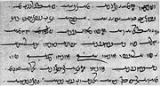
Bodleian J2 Fol 175 Y 28 1
:The Yasna (from yazišn "worship, oblations", cognate with Sanskrit yajńa
Yajna

In Hinduism, Yaj?a is a ritual of sacrifice derived from the practice of Historical Vedic religion times. It is performed to please the Deva or to attain certain wishes....
), is the primary liturgical collection. It consists of 72 sections called the Ha-iti or Ha. The 72 threads of lamb's wool in the Kushti
Kushti

Kushti or Kusti, also spelled as Koshti, is the sacred girdle worn by Zoroastrianism around their waists. Along with the Sedreh this is part of the ritual dress of the Zoroastrians....
, the sacred thread worn by Zoroastrians, represent these sections. The central portion of the Yasna is the Gathas
Gathas

The Gathas are 17 hymns believed to have been composed by Zoroaster himself. They are the most sacred texts of the Zoroastrianism faith....
, the oldest and most sacred portion of the Avesta, believed to have been composed by Zarathushtra (Zoroaster)
Zoroaster

Zoroaster or Zarathushtra , also referred to as Zartosht , was an ancient Iranian peoples prophet and religious poet. The hymns attributed to him, the Gathas, are at the liturgical core of Zoroastrianism....
 himself. The Gathas are structurally interrupted by the Yasna Haptanghaiti
Yasna Haptanghaiti

The Yasna Haptanghaiti , Avestan language for "Worship in Seven Chapters," is a set of 7 hymns within the greater Yasna collection, that is, within the primary liturgical texts of the Zoroastrian Avesta....
 ("seven-chapter Yasna"), which makes up chapters 35-42 of the Yasna and is almost as old as the Gathas, consists of prayers and hymns in honour of the Supreme Deity, Ahura Mazda, the Angels, Fire, Water, and Earth. The structure of the Yasna, though handed down in prose, may once have been metrical, as the Gathas still are.

It is believed by some scholars that the Yasna represents the 21st nask (the seventh and last volume in the third and last group). Six of the nasks from the first group of nasks, which are commentaries on the Gathas
Gathas

The Gathas are 17 hymns believed to have been composed by Zoroaster himself. They are the most sacred texts of the Zoroastrianism faith....
, may also be regarded as relevant to the Yasna.


The Yasna, or Izeshne, is primarily the name, not of a book, but of a ceremony in which the entire book is recited and appropriate liturgical actions performed. In its normal form, this ceremony can only be performed in the morning.


The Visperad
The Visperad (from vîspe ratavo, "(prayer to) all patrons") is a collection of supplements to the Yasna. The Visparad is subdivided into 23 or 24 kardo (sections) that are interleaved into the Yasna during a Visperad service (which is an extended Yasna service).


The Visperad collection has no unity of its own, and is never recited separately from the Yasna.


The Vendidad
The Vendidad (or Videvdat, a corruption of Avestan Vî-Daęvô-Data, "Given Against the Demons") is an enumeration of various manifestations of evil spirits, and ways to confound them. The Vendidad includes all of the 19th nask, which is the only nask that has survived in its entirety. The text consists of 22 Fargards, fragments arranged as discussions between Ahura Mazda
Ahura Mazda

Ahura Mazda is the Avestan language name for a divinity exalted by Zoroaster as the one uncreated Creator, hence God.The Zoroastrianism is described by its adherents as Mazdayasna, the worship of Mazda....
 and Zoroaster. The first fargard is a dualistic creation myth, followed by the description of a destructive winter on the lines of the deluge of mythology. The second fargard recounts the legend of Yima. The remaining fargards deal primarily with hygiene (care of the dead in particular) [fargard 3, 5, 6, 7, 8, 9, 10, 16, 17, 19] as well as disease and spells to fight it [7, 10, 11, 13, 20, 21, 22]. Fargards 4 and 15 discuss the dignity of wealth and charity, of marriage and of physical effort, and the indignity of unacceptable social behaviour such as assault and breach of contract
Breach of contract

Breach of contract is a legal concept in which a binding agreement or bargained-for exchange is not honored by one or more of the parties to the contract by non-performance or interference with the other party's performance....
, and specify the penances required to atone for violations thereof. The Vendidad is an ecclesiastical code, not a liturgical manual, and there is a degree of moral relativism
Moral relativism

In philosophy moral relativism is the position that Morality or Ethics propositions do not reflect Moral objectivism and/or universal moral truths, but instead make claims relativism to Society, Culture, History or personal circumstances....
 apparent in the codes of conduct. The Vendidads different parts vary widely in character and in age. Some parts may be comparatively recent in origin although the greater part is very old.


The Vendidad, unlike the Yasna and the Visparad, is a book of laws rather than the record of a liturgical ceremony. However, there is a ceremony called the Vendidad, in which the Yasna is recited with all the chapters of both the Visparad and the Vendidad inserted at appropriate points. This ceremony is only performed at night.


The Yashts
The Yasht
Yasht

The s' are a collection of twenty-one hymns in Avestan. Each of these hymns invokes a specific Zoroastrianism divinity or concept. Yasht chapter and verse pointers are traditionally abbreviated as Yt....
s (from yešti, "worship by praise") are a collection of 21 hymns, each dedicated to a particular divinity or divine concept. Three hymns of the Yasna liturgy that "worship by praise" are—in tradition—also nominally called yashts, but are not counted among the Yasht collection since the three are a part of the primary litury. The Yashts vary greatly in style, quality and extent. In their present form, they are all in prose but analysis suggests that they may at one time have been in verse.


The Siroza
The Siroza ("thirty days") is an enumeration and invocation of the 30 divinities presiding over the days of the month. (cf. Zoroastrian calendar
Zoroastrian calendar

The Zoroastrian calendar is a religious calendar used by members of the Zoroastrian faith, and it is an approximation of the solar calendar. To this day, Zoroastrianism, irrespective of geographic location, adhere to this calendar for religious purposes....
). The
Siroza exists in two forms, the shorter ("little Siroza") is a brief enumeration of the divinities with their epithets in the genitive. The longer ("great Siroza") has complete sentences and sections, with the yazatas being addressed in the accusative.


The Siroza is never recited as a whole, but is a source for individual sentences devoted to particular divinities, to be inserted at appropriate points in the liturgy depending on the day and the month.


The Khordeh Avesta
The Khordeh Avesta ("little Avesta") is both a selection of verses from the other collections, as well as three sub-collections that do not appear elsewhere. Taken together, the Khordeh Avesta is considered the prayer book for general lay use. In a wider sense, the term Khordeh Avesta includes all material other than the Yasna, the Visparad and the Vendidad, as it is only the ceremonies contained in these three books that are reserved for the priests.


The Khordeh Avesta is divided into 4 sections:
  1. Five introductory chapters, accompanied by excerpts from different parts of the Yasna.
  2. Five Niyayishns "praises," addressed to the sun, Mithra, the moon, the waters, and the fire. In the main, the material overlaps with that of the Yashts. The Niyayishn to fire derives from Yasna 62.
  3. Five Gahs "moments of the day," addressed to the five divisions of the day.
  4. Four Afrinagans "blessings," each recited on a particular occasion: the first in honor of the dead, the second on the five epagomenal days that end the year, the third is recited at the six seasonal feasts, and the fourth at the beginning and end of summer.


Fragments
All material in the Avesta that is not already present in one of the other categories falls into a "fragments" category, which - as the name suggests - includes incomplete texts. There are altogether more than 20 fragment collections, many of which have no name (and are then named after their owner/collator) or only a Middle Persian name. The more important of the fragment collections are the Nirangistan fragments (18 of which constitute the Ehrbadistan); the Pursishniha "questions," also known as "Fragments Tahmuras"; the Aogemadaeca "we accept," a treatise on death; and the Hadokht Nask "volume of the scriptures" with two fragments of eschatological significance.


Other Zoroastrian religious texts

Only texts preserved in the Avestan language
Avestan language

Avestan is a Eastern Iranian language that was used to compose the sacred hymns and canon of the Zoroastrianism Avesta. Iranian languages are part of the hypothetical Indo-Iranian languages Language group....
 count as scripture and are part of the Avesta. Several other secondary works are nonetheless crucial to Zoroastrian theology and scholarship.

The most notable among the Middle Persian texts are the
Denkard
Denkard

The Denkard or Denkart is a 10th century compendium of the Zoroastrianism beliefs and customs. The Denkard is to a great extent an "Encyclopedia of Mazdaism" and is a most valuable source of information on the religion....
("Acts of Religion"), dating from the 9th century; the Bundahishn
Bundahishn

Bundahishn, meaning "Primal Creation", is the name traditionally given to an encyclop?diaic collections of Zoroastrianism cosmogony and cosmology written in Book Pahlavi....
("Primordial Creation"), finished in the 11th or 12th century, but containing older material; the Mainog-i-Khirad ("Spirit of Wisdom"), a religious conference on questions of faith; and the Arda Viraf Namak
Book of Arda Viraf

The Book of Arda Viraf is a Zoroastrian religious text of Sassanid era in Middle Persian language,contains about 8,800 words. It describes the dream-journey of a devout Zoroastrian through the next world....
("Book of Arda Viraf"), which is especially important for its views on death, salvation and life in the hereafter. Of the post-14th century works (all in New Persian), only the Sad-dar ("Hundred Doors, or Chapters"), and Rivayats (traditional treatises) are of doctrinal importance. Other texts such as Zartushtnamah ("Book of Zoroaster") are only notable for their preservation of legend and folklore.

See also

  • The Gathas
    Gathas

    The Gathas are 17 hymns believed to have been composed by Zoroaster himself. They are the most sacred texts of the Zoroastrianism faith....
    , the most sacred of the texts of the Zoroastrian faith.


Bibliography


Texts and translations


  • There is a three-volume text of the Avesta, in its original script, edited by Karl Friedrich Geldner
    Karl Friedrich Geldner

    Karl Friedrich Geldner was a Germany linguist best known for his analysis and synthesis of Avestan and Vedic Sanskrit texts....
    .
  • Reichelt, Avesta Reader, contains extracts, some in the original script and some in Bartholomaean transcription.
  • A full translation by James Darmesteter
    James Darmesteter

    James Darmesteter , France author and antiquarian, was born of Jewish parents at Ch?teau Salins, in Alsace.The family name had originated in their earlier home of Darmstadt....
     and L. H. Mills
    Lawrence Heyworth Mills

    The Rev. Dr. Lawrence Heyworth Mills , who generally published as L. H. Mills, was Professor of the Persian language at Oxford University....
     forms part of the Sacred Books of the East
    Sacred Books of the East

    The Sacred Books of the East is a monumental 50-volume set of English translations of Asian religious writings, edited by Max M?ller and published by the Oxford University Press between 1879 and 1910....
     series, but is now regarded as obsolete.


Secondary works

  • Modi, J. J., The Religious Ceremonies and Customs of the Parsees

Further reading

  • (Catholic Encyclopedia
    Catholic Encyclopedia

    The Catholic Encyclopedia, also referred to today as the Old Catholic Encyclopedia, is an English language encyclopedia published by The Encyclopedia Press....
    )