


Dasht-e Kavir

Encyclopedia
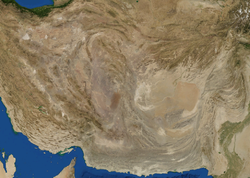
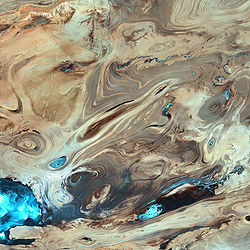
Iranian plateau
The Iranian plateau, or Iranic plateau, is a geological formation in Southwest Asia. It is the part of the Eurasian Plate wedged between the Arabian and Indian plates, situated between the Zagros mountains to the west, the Caspian Sea and the Kopet Dag to the north, the Hormuz Strait and Persian...
. It is about 800 kilometers (497 mi) long and 320 kilometers (198 mi) wide with a total surface area of about 77,600 square kilometers (~30,000 mi²), making it the Earth's 23rd largest desert. The area of this desert stretches from the Alborz
Alborz
Alborz , also written as Alburz, Elburz or Elborz, is a mountain range in northern Iran stretching from the borders of Azerbaijan and Armenia in the northwest to the southern end of the Caspian Sea, and ending in the east at the borders of Turkmenistan and Afghanistan...
mountain range in the north-west to the Dasht-e Lut
Dasht-e Lut
Dasht-e Lut, also spelled Dasht-i-Lut, is a large salt desert in southeastern Iran and is the world's 25th largest desert.Iran is climatically part of the Afro-Asian belt of deserts that stretch from the Cape Verde islands off West Africa all the way to Mongolia near Beijing, China...
("Emptiness Desert") in the south-east and is partitioned between the Iranian provinces
Provinces of Iran
Iran is subdivided into thirty one provinces , each governed from a local center, usually the largest local city, which is called the capital of that province...
of Khorasan, Semnan
Semnan Province
Semnan Province is one of the 31 provinces of Iran. It is in the north of the country, and its center is Semnan. The province of Semnan covers an area of 96,816 square kilometers and stretches along the Alborz mountain range and borders to Dasht-e Kavir desert in its southern parts.Counties of...
, Tehran
Tehran Province
Tehran Province is one of the 31 provinces of Iran. It covers on area of 18,909 square kilometers and is located to the north of the central plateau of Iran....
, Isfahan and Yazd
Yazd Province
Yazd Province is one of the 31 provinces of Iran. It is in the centre of the country, and its administrative center is the city of Yazd.The province has an area of 131,575 km², and according to the most recent divisions of the country, is divided into eleven counties: Maybod, Mehreez, Taft,...
. It is named after the salt marshes (kavirs) located there.
Climate and structure
The Dasht-e Kavir's climate is almost rainless and the area is very arid. Temperatures can reach 50 °C in summer, and the average temperature in January is 22 °C. Day and night temperatures during a year can differ up to 70 °C. Rain usually falls in winter.The desert soil is covered with sand and pebbles; there are marsh
Marsh
In geography, a marsh, or morass, is a type of wetland that is subject to frequent or continuous flood. Typically the water is shallow and features grasses, rushes, reeds, typhas, sedges, other herbaceous plants, and moss....
es, lake
Lake
A lake is a body of relatively still fresh or salt water of considerable size, localized in a basin, that is surrounded by land. Lakes are inland and not part of the ocean and therefore are distinct from lagoons, and are larger and deeper than ponds. Lakes can be contrasted with rivers or streams,...
s and wadi
Wadi
Wadi is the Arabic term traditionally referring to a valley. In some cases, it may refer to a dry riverbed that contains water only during times of heavy rain or simply an intermittent stream.-Variant names:...
s. The hot temperatures cause extreme vaporization, which leaves the marshes and mud grounds with large crusts of salt. Heavy storms frequently occur and they can cause sand hills reaching up to 40 m in height. Some parts of Dasht- e Kavir have a more steppe
Steppe
In physical geography, steppe is an ecoregion, in the montane grasslands and shrublands and temperate grasslands, savannas, and shrublands biomes, characterized by grassland plains without trees apart from those near rivers and lakes...
-like appearance.
Wildlife
Vegetation in the Dasht-e Kavir is adapted to the hot and arid climate as well as to the saline soil in which it is rooted. Common plant species like shrubShrub
A shrub or bush is distinguished from a tree by its multiple stems and shorter height, usually under 5–6 m tall. A large number of plants may become either shrubs or trees, depending on the growing conditions they experience...
s and grass
Grass
Grasses, or more technically graminoids, are monocotyledonous, usually herbaceous plants with narrow leaves growing from the base. They include the "true grasses", of the Poaceae family, as well as the sedges and the rushes . The true grasses include cereals, bamboo and the grasses of lawns ...
es can only be found in some valleys and on mountain tops. The most widespread plant is mugwort.
The Persian ground jay
Ground jay
The ground jays or ground choughs belong to a distinct group of the passerine order of birds in the genus Podoces of the crow family Corvidae...
is a bird species living in some parts of the desert plateaus, along with Houbara bustard
Houbara Bustard
The Houbara Bustard, Chlamydotis undulata, is a large bird in the bustard family.-Description:The Houbara Bustard is a small to mid-sized bustard. It measures in length and spans across the wings. It is brown above and white below, with a black stripe down the sides of its neck. In flight, the...
s, lark
Lark
Larks are passerine birds of the family Alaudidae. All species occur in the Old World, and in northern and eastern Australia; only one, the Shore Lark, has spread to North America, where it is called the Horned Lark...
s and sandgrouse
Sandgrouse
The sandgrouse are a family, Pteroclididae, of 16 bird species, the only living members of the order Pteroclidiformes. They are restricted to treeless open country in the Old World, such as plains and semi-deserts. They are distributed across northern, southern and eastern Africa as well as...
s.
Persian gazelle
Gazelle
A gazelle is any of many antelope species in the genus Gazella, or formerly considered to belong to it. Six species are included in two genera, Eudorcas and Nanger, which were formerly considered subgenera...
s live in parts of steppe and desert areas of the central plateau. Wild sheep, goat
Goat
The domestic goat is a subspecies of goat domesticated from the wild goat of southwest Asia and Eastern Europe. The goat is a member of the Bovidae family and is closely related to the sheep as both are in the goat-antelope subfamily Caprinae. There are over three hundred distinct breeds of...
s and leopard
Leopard
The leopard , Panthera pardus, is a member of the Felidae family and the smallest of the four "big cats" in the genus Panthera, the other three being the tiger, lion, and jaguar. The leopard was once distributed across eastern and southern Asia and Africa, from Siberia to South Africa, but its...
s are common in mountainous areas. Night life brings on wild cats, wolves, fox
Fox
Fox is a common name for many species of omnivorous mammals belonging to the Canidae family. Foxes are small to medium-sized canids , characterized by possessing a long narrow snout, and a bushy tail .Members of about 37 species are referred to as foxes, of which only 12 species actually belong to...
es, and other carnivore
Carnivore
A carnivore meaning 'meat eater' is an organism that derives its energy and nutrient requirements from a diet consisting mainly or exclusively of animal tissue, whether through predation or scavenging...
s. In some parts of the desert, the Persian onager
Onager
The Onager is a large member of the genus Equus of the family Equidae native to the deserts of Syria, Iran, Pakistan, India, Israel and Tibet...
("gur" in Persian) and sometimes even the Asiatic Cheetah
Asiatic Cheetah
The Asiatic Cheetah is now also known as the Iranian Cheetah, as the world's last few are known to survive mostly in Iran. Although recently presumed to be extinct in India, it is also known as the Indian Cheetah...
can be seen. Lizard
Lizard
Lizards are a widespread group of squamate reptiles, with nearly 3800 species, ranging across all continents except Antarctica as well as most oceanic island chains...
s and snake
Snake
Snakes are elongate, legless, carnivorous reptiles of the suborder Serpentes that can be distinguished from legless lizards by their lack of eyelids and external ears. Like all squamates, snakes are ectothermic, amniote vertebrates covered in overlapping scales...
s live in different places in the central plateau.
Cultivation
The extreme heat and many storms in Dasht-e Kavir cause extensive erosion, which makes it almost impossible to cultivate the lands. The desert is almost uninhabited and knows little exploitation. Camel and sheep breeding and agricultureAgriculture
Agriculture is the cultivation of animals, plants, fungi and other life forms for food, fiber, and other products used to sustain life. Agriculture was the key implement in the rise of sedentary human civilization, whereby farming of domesticated species created food surpluses that nurtured the...
are the sources of living to the few people living on its soil. Human settling is restricted to some oases
Oasis
In geography, an oasis or cienega is an isolated area of vegetation in a desert, typically surrounding a spring or similar water source...
, where wind-blocking housing constructions are raised to deal with the harsh weather conditions. For irrigation, Iranians developed a sophisticated system of water-wells known as "Qanat
Qanat
A qanāt is a water management system used to provide a reliable supply of water for human settlements and irrigation in hot, arid and semi-arid climates...
s." These are still in use, and modern globally used water-revenue systems are based on their techniques.
Features
Central in the desert lies the Kavir BuzurgKavir Buzurg
Kavir Buzurg, meaning Great Kavir , lies in the center of the Dasht-e Kavir, which is a desert located in the middle of the Iranian plateau. The Kavir Buzurg covers an area of about 320 km by 160 km. It is separated from the neighboring kavirs by a surrounding ring of sandy hills. This is...
(Great Kavir), which is about 320 km long and 160 km wide. In the west, a salt lake called Darya-ye Namak (1800 km²) can be found. It contains some large salt plates in a mosaic-like shape. It is part of a 4,000 km² protected ecological zone, the Kavir National Park
Kavir National Park
Kavir National Park is a protected ecological zone in northern Iran. It has an area of 4,000 square kilometers . The park is located 120 kilometers south of Tehran and 100 kilometers east of Qom, and it sits on the western end of one of Iran's two major deserts, the Dasht-e Kavir...
. One of the most desolate places of Dasht-e Kavir is the Rig-e Jenn
Rig-e Jenn
The Rig-e Jenn is a vast area of sand dunes in the middle of Dasht-e Kavir, Iran's central desert in the border region of the Semnan and Isfahan provinces. It was not travelled by the old caravan travellers, who believed it is a place where evil spirits live. Even today some in the neighbouring...
.
See also
- Dasht-e LutDasht-e LutDasht-e Lut, also spelled Dasht-i-Lut, is a large salt desert in southeastern Iran and is the world's 25th largest desert.Iran is climatically part of the Afro-Asian belt of deserts that stretch from the Cape Verde islands off West Africa all the way to Mongolia near Beijing, China...
- Geography of IranGeography of IranIran is located in southwest Asia and borders the Gulf of Oman, Persian Gulf, and Caspian Sea.Its mountains have helped to shape both the political and the economic history of the country for several centuries. The mountains enclose several broad basins, or plateaus, on which major agricultural and...
- International rankings of Iran
- List of deserts by area