


Gnosticism and the New Testament

Encyclopedia
Gnosticism and the New Testament is the connection between the Christian sects described by Irenaeus
(c.180), and other writers, as gnostikos
, and the New Testament
, and also the use of the New Testament in the Nag Hammadi texts (c.300-400).
, but Valentinus
is specifically named as gnostikos. Irenaeus describes how the Valentinians read in Ephesians evidence for their characteristic belief in the existence of the Æons as supernatural beings:
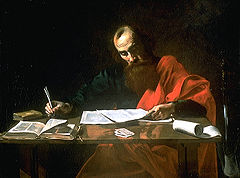 The followers of Valentinius attempted to systematically decode the Epistles, claiming that most Christians made the mistake of reading the Epistles literally rather than allegorically. Valentians understood the conflict between Jews and Gentiles in Romans
to be a coded reference to the differences between Psychics (people who are partly spiritual but have not yet achieved separation from carnality) and Pneumatics
(totally spiritual people).
The Valentians argued that such codes were intrinsic in gnosticism, secrecy being important to ensuring proper progression to true inner understanding. In 2 Corinthians, Paul states he had heard ineffable words which it is not lawful for a man to utter, a position that gnostic initiates supported with respect to the higher gnostic teachings. However, Paul does also suggest Gnosis puffeth up (often this passage is found with gnosis translated - knowledge puffeth up), which appears to diminish support for gnosticism, but Clement of Alexandria
offered the explanation that this meant to entertain great and true sentiments and was a reference to the magnitude of the effect of receiving it.
argued that the use of scripture by Gnostic groups, such as the Valentinians, was flawed, and demonstrated his argument by taking arbitrary passages from various writings of Homer
to compose a new story about Hercules. While the individual passages were authentic, the connected story was not of Homer's composition, and in fact the passages featured a number of different characters instead of just Hercules. Irenaeus compared this abuse of Homer to the abuse of the New and Old Testaments by the gnostics.
were a rather diverse group of early movements finding a basis often in Christianity
or Judaism
. These people did not refer to themselves as "Gnostics" but rather the label was applied mostly by their opponents
and modern scholars. The movements were strongly associated with mysticism, and the thread connecting them was the concept of gnosis
, which refers to an intimately personal kind of knowledge (as in the Spanish conocer rather than saber or German kennen versus wissen). The Gnostic movements were centered around gnosis of the divine rather than faith (pistis) and therefore are often associated with mysticism. The Albigensian and Cathar
movements of the Middle Ages are often linked to Gnosticism. Many Gnostic movements made extensive use of allegory
and metaphor
in their interpretation of spiritual texts.
, Mark
, and Luke
) are regarded as so similar in wording and content that they are often treated as one unit, the synoptic gospels
. According to the majority of scholars, the solution to the synoptic problem of similar content and dependence is the two-source hypothesis
- that the three synoptic gospels are not totally independent but derive from two source texts, one being the Markan priority
, the other being a hypothetical lost collection of logia
(sayings) known as the Q document, and the few remaining elements unique to Matthew or to Luke are known as M or L, respectively. No ancient gnostic text explicitly refers to an original document of sayings. The oldest extant fragments of gospels are of John, and by tradition Mark was the first written.
- secret knowledge that can be learned.
shows the clearest similarity to later gnostic writing style in general, and to them parts of the gospel have a similar dream-like quality to the writing (compare the Gospel of Truth
, more especially the Trimorphic Protennoia
).
The phrase "and the Word became flesh, and dwelt amongst us" is generally seen as being against docetism
, a belief that many Gnostics held that the human nature of Jesus was illusory, as the Perfect Saviour inherent in a Christ could not partake in the inherently corrupt (according to gnosticism) nature of matter. Also, the opening phrase is generally understood as being against Arianism
, a 4th century sect of Christianity, later branded as heretical, which asserted that there was a time previous to Jesus' existence.
Much of John has this form, consistently drawing on positions held by later 2nd century and early 3rd century groups in order to contradict them and cast them as heretical.
In the case of these supposed 3rd century groups Rylands Library Papyrus P52
, Papyrus 66
, Papyrus 75
all have been dated to be before the 3rd century. These groups frequently did not exist in the late 1st century and early 2nd century, Arianism being a prime example, and it would be odd for them to arise if a gospel was circulating which so clearly condemned the positions that did not yet exist. For this reason, and since also the first quotations from the Gospel of John appear in the anti-heresy works of Irenaeus
, many scholars like K.G. Bretschneider
(1776–1848), Hegel and F.C. Baur
(born 1792 - died 1860) cast doubt on the Authorship of the Gospel of John, and often consider it to have been a 2nd century polemic
by an author holding what later became the position of the orthodoxy
.
Most of the above is called into question by Rylands Library Papyrus P52
which contains a fragment from John chapter 18 dated with a fair measure of confidence to the first half of the 2nd century. As well as the recent work of Charles Hill's The Johannine Corpus in the Early Church. In which Charles Hill gives evidence that the Gospel of John was used between CE 90 and 130, the possible use of uniquely Johannine gospel material in several works which date from this period. These works and authors include Ignatius
(c.107); Polycarp
(c.107); Papias’ elders (c.110-120); Hierapolis
' Exegesis of the Lord’s Oracles (c.120-132).
Elaine Pagels
, a prolific modern writer on Gnosticism, has written a book on the role of John in Gnosticism: Johannine Gospel in Gnostic Exegesis: Heracleon's Commentary on John.
and Elaine Pagels
- as well as the mystic Timothy Freke
, that Paul of Tarsus
was a Gnostic who developed the early Christian church as a mystery religion
with a Jewish flavour, and that elements of this church forgot or misunderstood the mystery elements, largely abandoned its Jewish foundation, and took up literal interpretation of the text.
Their argument for Paul being a gnostic is based on arguments about the authorship of the Pauline Epistles
. The pastoral epistles
(those to Timothy
and Titus
), are generally acknowledged as being clearly anti-gnostic, and the second Epistle to the Thessalonians clearly refutes certain gnostic interpretations of the first Epistle to the Thessalonians.
), and a member of the conservative Pharisee party prior to conversion, Paul could also write in Greek, and also refer to the Septuagint (a Greek translation of the Hebrew Bible), rather than translating the Hebrew text.. He grew up in Tarsus, at the time of Paul was the dominant centre for Hellenic philosophy, Strabo
commenting that Tarsus had surpassed Athens
and Alexandria
in this extent.
Although educated in Jerusalem, Paul expresses in his writing many ideas seen on Hellenic thought, previously used by philosophers such as Plato. For example, Paul refers to the solar cycle known as the great year, as well as to the idea that one is only wise if one knows that one knows nothing. According to the book of Acts, Paul's ministry takes him to cities dominated by mystery religions, such as Antioch (a centre for Adonis
), Ephesus (a centre for Attis
), and Corinth (a centre for the Dionysian Mysteries
).
. Paul also claims to know someone who ascended as far as the third heaven, a principle which in mystery religions represented the degree of initiation achieved (for example, in the Mithraic mysteries there were 7 heavens, one for each of the 5 known planets, the sun, and the moon). The Mormon faith interpret the third heaven as the Celestial Kingdom. Paul's story appears to have been a one time event however, and he claims uncertainty as to whether the visit to the third heaven was in the body or out of the body.
In Galatians 3:19-20, Paul states that the Law is the product of a "mediator", and that "the mediator is not one, God is one". The gnostics treated this as a reference to the standard gnostic teaching that the law should not apply since it was the product of the evil demiurge
. Gnostics also referred to the demiurge as the mediator between God
(whom they considered the only being to be singular and whole, and thus also referred to as Monad
), and creation (which they considered intrinsically evil, rather than evil as the consequence of some human error). Though this does not hold true with the reference of the demiurge in gnosticism
as blind and ignorant of his origin or the monad
.
In Romans, Paul clearly speaks of creation as awaiting redemption, rather than treating it as something irredeemable. He also refers to the law as the 'instructor' or 'tutor' of the Jewish people, and as the beginning of God's work of turning people back to Himself, rather than as something opposed to God this being opposed to the works of Marcion who stated that the God of the Old Testament and law was the devil or demiurge.
wrote a vast five-volume book (On the Detection and Overthrow of the So-Called Gnosis commonly referred to as Against Heresies
). The significance of Paul's influence was sufficient for Irenaeus to consider it important to proclaim that Paul was never gnostic and never supported gnostic teachings, using the evidence of the Pastoral epistles and the Gospel of John to support it.
Despite Irenaeus' claims for Paul's non gnosticism, Valentinus, the leader of a large faction of gnostics, claimed that Paul had initiated his own teacher Theudas
into the Deeper Mysteries of Christianity, which revealed a secret gnostic doctrine of God.
From the beginning of modern biblical criticism with F.C. Baur, it has been argued that the Pseudo-Clementines, texts that in early times were frequently regarded as part of Biblical canon, are a coded attack on Paul, fictionalising him under the name of Simon Magus
, in deliberate contrast to Simon Peter. Though as Paul is traditionally considered to have died in 67 and Marcion was born in 110, it has been argued that it is quite implausible for the two to ever have met; this also applies to Simon Magus who was said by the Book of Acts to have been teaching during the time of Simon Peter, and was said to have died during Peter's preaching (Clement of Rome attests to Peter himself dying before 90). Thus it is clear that neither Irenaeus nor Marcion himself can have been suggesting that Marcion was literally the immediate heir of Simon Magus or Paul, respectively, but instead must have been suggesting that Marcion was the latest in the line of heirs.
Gnostics viewed scripture as allegory, only serving a literal meaning to Hylic (i.e. uninitiate) people, partly for the purpose of advertising. Gnostics thus interpreted Paul's statements, that the Old Testament acts as our examples in 1 Corinthians 10:6 and that For the letter kills, but the Spirit gives life in 2 Corinthians 3:6, as supporting this view, with understanding more important than rigid adherence. Gnostics also took to a more gnostic interpretation the phrase though we have known Christ after the flesh, yet now henceforth know we him no more in 2 Corinthians 5:16 as indicative of Paul's progress from Hylic, rather than the understanding of Christ's time being in the past.
Paul states in Romans 8:3 that Christ came in the homoioma of human flesh. Homoioma means image or representation (the text is usually translated in the likeness of human flesh). Some gnostic groups treated this as admittance of Docetism
, with the Christ being the divine wisdom which revealed gnosis, which would help humanity escape the evil creation (the world) of the demiurge, and having no physical existence. Though Paul never speaks of the creator or nature as evil.
In Epistle to the Galatians 1:15 and 1:16 Paul states of his conversion that God revealed his Son in me, rather than to me, which Gnostics interpret as a reference to Christ being the divine gnosis sent to save humanity, rather than a physical creature or person. In the same letter, Paul also states in Galatians 2:20 that I am crucified with Christ: nevertheless I live; yet not I, but Christ liveth in me, which gnostics took as further evidence of Paul supporting their stance.
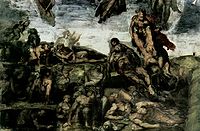 The gnostics took an esoteric view of death, and therefore of resurrection
. When Paul states in Romans
that he that is dead is freed from sin, and that we are buried with him by baptism into death, the gnostics assumed it was a reference to the teaching that the body is the work of the evil demiurge, and that death would release the divine part of a person from the demiurge's power.
Gnostics also took death to be symbolic for the death of the part of a person tied to the demiurge, and the consequential resurrection as a new entirely spiritual being, understanding resurrection as an awakening of spiritual enlightenment. In Philippians
, Paul refers to himself as partaking in the same death as Christ, and thence partaking in the resurrection of the dead
, which suited gnostic interpretations. Paul's references to reaping and sowing of crops, in 1 Corinthians, was also a common image from the mystery religions symbolising the esoteric death
and resurrection of initiates.
In the First Epistle to the Corinthians
, however, during chapter 15, Paul appears to give credence to a more literal idea of the physical resurrection of the dead. However, as noted by many gnostics, Paul also states flesh and blood cannot inherit the kingdom of God. Irenaeus
complained that all heretics always introduce this passage. It is widely thought by scholars that the presence of the issue proved such a problem that someone felt the need to forge a third letter to the Corinthians
, which explicitly states the dead are resurrected physically. Despite this, 3 Corinthians was rejected from biblical canon, and thus became part of the New Testament apocrypha
.
In 1 Corinthians 15, Paul also refers to baptism for the dead
(15:29), a concept according to Elaine Pagels
, was easily explained by gnostics. Since the gnostics argued that the text was allegory, their stance was that baptism for the dead refers to pneumatics (i.e. gnostics) taking the place of psychics (i.e. literalists), who were dead to gnosis. Tertullian wrote about Marcion gnostics in his work Against Marcion indicating that there they believed in baptism of the dead. The doctrines of Marcion were so similar to the Gnostics that the church father Irenaeus, a disciple of Polycarp
in the 180s regarded him as one of them.
John Gill
in his commentary of 1 Corinthians 15:29 remarked, "...some think the apostle [Paul]has in view a custom of some, who when their friends died without baptism, used to be baptized in their room; this is said to be practiced by the Marcionites in Tertullian's time, and by the Corinthians in the times of the Apostle John; but it does not appear to have been in use in the times of the Apostle Paul; and besides, if it had been, as it was a vain and superstitious one, he would never have mentioned it without a censure..."
Jameison-Faussett-Brown commentary of 1 Corinthians 15:29 mentioned, "...Paul, without giving the least sanction to the practice, uses an ad hominem argument from it against its practitioners, some of whom, though using it, denied the resurrection: "What account can they give of their practice; why are they at the trouble of it, if the dead rise not?"[So Jesus used an ad hominem argument, Matthew 12:27]. The best punctuation is, "If the dead rise not at all, why are they then baptized for them" (so the oldest manuscripts read the last words, instead of "for the dead")?"
. Gnostics believed that since the world was intrinsically evil, so was anything the human body did. Some gnostics concluded that this meant that one could engage in gross immorality since it demonstrated the knowledge that the body was a prison for the soul. Most gnostics, however, considered that instead one should suppress the urges of the body as much as possible and live a highly ascetic life. One consequence of this view was a lack of care to social status (exhibited noticeably in Mithraism
), or for that matter not caring about being/not-being a slave, a criticism also levied at Paul for his lack of raising the issue in Philemon
.
Paul also appears to many scholars to exhibit a strong distaste for sexuality of any kind, supporting the principle of celibacy, which gnostics interpreted as due to the idea of the world as evil, though non-gnostics took it to be merely a rigid and strict adherence to the Old Testament. Paul himself elsewhere states that he teaches righteousness without the Law (Rom 3:21), which gnostics used as a counter argument to the claim he adhered to the Old Testament, and also supported the idea that laws were ultimately the product of the demiurge as a trap.
Though once again Paul never mentions an ignorant or evil creator or demiurge
.
In 1 Corinthians, Paul does recommend celibacy, but also recommends marriage for those who are not suited for celibacy. Later (1 Cor. 9:5), he defends the right of Peter and the other apostles to be married and to travel accompanied by their wives, although he himself most scholars determine him as unmarried. In contrast, he condemned sexual immorality of all kinds, in various epistles (Romans 13:13, 1 Cor. 6:18, 1 Thess. 4:3), along with several other categories of sins, and making no exceptions for these.
Irenaeus
Saint Irenaeus , was Bishop of Lugdunum in Gaul, then a part of the Roman Empire . He was an early church father and apologist, and his writings were formative in the early development of Christian theology...
(c.180), and other writers, as gnostikos
Gnosis
Gnosis is the common Greek noun for knowledge . In the context of the English language gnosis generally refers to the word's meaning within the spheres of Christian mysticism, Mystery religions and Gnosticism where it signifies 'spiritual knowledge' in the sense of mystical enlightenment.-Related...
, and the New Testament
New Testament
The New Testament is the second major division of the Christian biblical canon, the first such division being the much longer Old Testament....
, and also the use of the New Testament in the Nag Hammadi texts (c.300-400).
The Valentians' use of the New Testament
It is not clear how many of the sects treated by Irenaeus in On the Detection and Overthrow of Knowledge Falsely So Called he actually considers to be gnostikosGnosis
Gnosis is the common Greek noun for knowledge . In the context of the English language gnosis generally refers to the word's meaning within the spheres of Christian mysticism, Mystery religions and Gnosticism where it signifies 'spiritual knowledge' in the sense of mystical enlightenment.-Related...
, but Valentinus
Valentinus
Valentinus is a Roman masculine given name. It is derived from the Latin word "valens" meaning "healthy, strong". Valentinus may refer to:*Pope Valentine , pope for thirty or forty days in 827...
is specifically named as gnostikos. Irenaeus describes how the Valentinians read in Ephesians evidence for their characteristic belief in the existence of the Æons as supernatural beings:
Gnostic interpretations of Paul's teachings
Epistle to the Romans
The Epistle of Paul to the Romans, often shortened to Romans, is the sixth book in the New Testament. Biblical scholars agree that it was composed by the Apostle Paul to explain that Salvation is offered through the Gospel of Jesus Christ...
to be a coded reference to the differences between Psychics (people who are partly spiritual but have not yet achieved separation from carnality) and Pneumatics
Pneumatics
Pneumatics is a branch of technology, which deals with the study and application of use of pressurized gas to effect mechanical motion.Pneumatic systems are extensively used in industry, where factories are commonly plumbed with compressed air or compressed inert gases...
(totally spiritual people).
The Valentians argued that such codes were intrinsic in gnosticism, secrecy being important to ensuring proper progression to true inner understanding. In 2 Corinthians, Paul states he had heard ineffable words which it is not lawful for a man to utter, a position that gnostic initiates supported with respect to the higher gnostic teachings. However, Paul does also suggest Gnosis puffeth up (often this passage is found with gnosis translated - knowledge puffeth up), which appears to diminish support for gnosticism, but Clement of Alexandria
Clement of Alexandria
Titus Flavius Clemens , known as Clement of Alexandria , was a Christian theologian and the head of the noted Catechetical School of Alexandria. Clement is best remembered as the teacher of Origen...
offered the explanation that this meant to entertain great and true sentiments and was a reference to the magnitude of the effect of receiving it.
Counter-arguments
IrenaeusIrenaeus
Saint Irenaeus , was Bishop of Lugdunum in Gaul, then a part of the Roman Empire . He was an early church father and apologist, and his writings were formative in the early development of Christian theology...
argued that the use of scripture by Gnostic groups, such as the Valentinians, was flawed, and demonstrated his argument by taking arbitrary passages from various writings of Homer
Homer
In the Western classical tradition Homer , is the author of the Iliad and the Odyssey, and is revered as the greatest ancient Greek epic poet. These epics lie at the beginning of the Western canon of literature, and have had an enormous influence on the history of literature.When he lived is...
to compose a new story about Hercules. While the individual passages were authentic, the connected story was not of Homer's composition, and in fact the passages featured a number of different characters instead of just Hercules. Irenaeus compared this abuse of Homer to the abuse of the New and Old Testaments by the gnostics.
Gnosticism
The GnosticsGnosticism
Gnosticism is a scholarly term for a set of religious beliefs and spiritual practices common to early Christianity, Hellenistic Judaism, Greco-Roman mystery religions, Zoroastrianism , and Neoplatonism.A common characteristic of some of these groups was the teaching that the realisation of Gnosis...
were a rather diverse group of early movements finding a basis often in Christianity
Christianity
Christianity is a monotheistic religion based on the life and teachings of Jesus as presented in canonical gospels and other New Testament writings...
or Judaism
Judaism
Judaism ) is the "religion, philosophy, and way of life" of the Jewish people...
. These people did not refer to themselves as "Gnostics" but rather the label was applied mostly by their opponents
Proto-orthodox Christianity
Proto-orthodox Christianity is a term, coined by New Testament scholar Bart D. Ehrman, used to describe the Early Christian movement which was the precursor of Christian orthodoxy...
and modern scholars. The movements were strongly associated with mysticism, and the thread connecting them was the concept of gnosis
Gnosis
Gnosis is the common Greek noun for knowledge . In the context of the English language gnosis generally refers to the word's meaning within the spheres of Christian mysticism, Mystery religions and Gnosticism where it signifies 'spiritual knowledge' in the sense of mystical enlightenment.-Related...
, which refers to an intimately personal kind of knowledge (as in the Spanish conocer rather than saber or German kennen versus wissen). The Gnostic movements were centered around gnosis of the divine rather than faith (pistis) and therefore are often associated with mysticism. The Albigensian and Cathar
Cathar
Catharism was a name given to a Christian religious sect with dualistic and gnostic elements that appeared in the Languedoc region of France and other parts of Europe in the 11th century and flourished in the 12th and 13th centuries...
movements of the Middle Ages are often linked to Gnosticism. Many Gnostic movements made extensive use of allegory
Allegory
Allegory is a demonstrative form of representation explaining meaning other than the words that are spoken. Allegory communicates its message by means of symbolic figures, actions or symbolic representation...
and metaphor
Metaphor
A metaphor is a literary figure of speech that uses an image, story or tangible thing to represent a less tangible thing or some intangible quality or idea; e.g., "Her eyes were glistening jewels." Metaphor may also be used for any rhetorical figures of speech that achieve their effects via...
in their interpretation of spiritual texts.
The Canonical Gospels
In academic circles, three of the four canonical Gospels (MatthewGospel of Matthew
The Gospel According to Matthew is one of the four canonical gospels, one of the three synoptic gospels, and the first book of the New Testament. It tells of the life, ministry, death, and resurrection of Jesus of Nazareth...
, Mark
Gospel of Mark
The Gospel According to Mark , commonly shortened to the Gospel of Mark or simply Mark, is the second book of the New Testament. This canonical account of the life of Jesus of Nazareth is one of the three synoptic gospels. It was thought to be an epitome, which accounts for its place as the second...
, and Luke
Gospel of Luke
The Gospel According to Luke , commonly shortened to the Gospel of Luke or simply Luke, is the third and longest of the four canonical Gospels. This synoptic gospel is an account of the life and ministry of Jesus of Nazareth. It details his story from the events of his birth to his Ascension.The...
) are regarded as so similar in wording and content that they are often treated as one unit, the synoptic gospels
Synoptic Gospels
The gospels of Matthew, Mark, and Luke are known as the Synoptic Gospels because they include many of the same stories, often in the same sequence, and sometimes exactly the same wording. This degree of parallelism in content, narrative arrangement, language, and sentence structures can only be...
. According to the majority of scholars, the solution to the synoptic problem of similar content and dependence is the two-source hypothesis
Two-source hypothesis
The Two-Source Hypothesis is an explanation for the synoptic problem, the pattern of similarities and differences between the three Gospels of Matthew, Mark, and Luke. It posits that the Gospel of Matthew and the Gospel of Luke were based on the Gospel of Mark and a lost, hypothetical sayings...
- that the three synoptic gospels are not totally independent but derive from two source texts, one being the Markan priority
Markan priority
Markan priority is the hypothesis that the Gospel of Mark was the first written of the three Synoptic Gospels, and that the two other synoptic evangelists, Matthew and Luke, used Mark's Gospel as one of their sources. The theory of Markan priority is today accepted by the majority of New Testament...
, the other being a hypothetical lost collection of logia
Logia
In New Testament scholarship, the term logia is a term applied to collections of sayings credited to Jesus. Such a collection of sayings of Jesus are believed to be referred to by Papias of Hierapolis...
(sayings) known as the Q document, and the few remaining elements unique to Matthew or to Luke are known as M or L, respectively. No ancient gnostic text explicitly refers to an original document of sayings. The oldest extant fragments of gospels are of John, and by tradition Mark was the first written.
Sayings in Matthew and Luke attributed to Q
Some of the sayings written in Matthew and Luke and attributed to Q are seemingly contradictory statements that hint at the Kingdom of God, for example Luke 17:33: Whoever seeks to gain his life will lose it, but whoever loses his life will preserve it and Luke 13:30:Some are last who will be first, and some are first who will be last. Other sayings have reference to secret teachings and knowledge to be revealed, such as Luke 12:2: Nothing is covered up that will not be revealed, or hidden that will not be known, which are themes intrinsic to the idea of gnosisGnosis
Gnosis is the common Greek noun for knowledge . In the context of the English language gnosis generally refers to the word's meaning within the spheres of Christian mysticism, Mystery religions and Gnosticism where it signifies 'spiritual knowledge' in the sense of mystical enlightenment.-Related...
- secret knowledge that can be learned.
The Gospel of Mark
For the gnostics, Jesus in Mark is often viewed as referring to secret teachings and secrets, even to assert that some teachings should be kept secret and deliberately obscured, all of which were attitudes shared with, and intrinsic to, gnosticism. For example, Mark 4:11-12:- "And he said to them, ‘To you has been given the secret of the kingdom of GodKingdom of GodThe Kingdom of God or Kingdom of Heaven is a foundational concept in the Abrahamic religions: Judaism, Christianity and Islam.The term "Kingdom of God" is found in all four canonical gospels and in the Pauline epistles...
, but for those outside, everything comes in parablesParables of JesusThe parables of Jesus can be found in all the Canonical gospels as well as in some of the non-canonical gospels but are located mainly within the three synoptic gospels. They represent a key part of the teachings of Jesus, forming approximately one third of his recorded teachings...
; in order that “they may indeed look, but not perceive, and may indeed listen, but not understand; so that they may not turn again and be forgivenForgivenessForgiveness is typically defined as the process of concluding resentment, indignation or anger as a result of a perceived offense, difference or mistake, or ceasing to demand punishment or restitution. The Oxford English Dictionary defines forgiveness as 'to grant free pardon and to give up all...
.” ’" (NRSV)
The Gospel of John
To the gnostics, the Gospel of JohnGospel of John
The Gospel According to John , commonly referred to as the Gospel of John or simply John, and often referred to in New Testament scholarship as the Fourth Gospel, is an account of the public ministry of Jesus...
shows the clearest similarity to later gnostic writing style in general, and to them parts of the gospel have a similar dream-like quality to the writing (compare the Gospel of Truth
Gospel of Truth
The Gospel of Truth is one of the Gnostic texts from the New Testament apocrypha found in the Nag Hammadi codices . It exists in two Coptic translations, a Subachmimic rendition surviving almost in full in the first codex and a Sahidic in fragments in the twelfth.-History:The Gospel of Truth was...
, more especially the Trimorphic Protennoia
Trimorphic Protennoia
The Trimorphic Protennoia is a Sethian Gnostic text from the New Testament apocrypha. The only surviving copy comes from the Nag Hammadi library ....
).
The phrase "and the Word became flesh, and dwelt amongst us" is generally seen as being against docetism
Docetism
In Christianity, docetism is the belief that Jesus' physical body was an illusion, as was his crucifixion; that is, Jesus only seemed to have a physical body and to physically die, but in reality he was incorporeal, a pure spirit, and hence could not physically die...
, a belief that many Gnostics held that the human nature of Jesus was illusory, as the Perfect Saviour inherent in a Christ could not partake in the inherently corrupt (according to gnosticism) nature of matter. Also, the opening phrase is generally understood as being against Arianism
Arianism
Arianism is the theological teaching attributed to Arius , a Christian presbyter from Alexandria, Egypt, concerning the relationship of the entities of the Trinity and the precise nature of the Son of God as being a subordinate entity to God the Father...
, a 4th century sect of Christianity, later branded as heretical, which asserted that there was a time previous to Jesus' existence.
Much of John has this form, consistently drawing on positions held by later 2nd century and early 3rd century groups in order to contradict them and cast them as heretical.
In the case of these supposed 3rd century groups Rylands Library Papyrus P52
Rylands Library Papyrus P52
The Rylands Library Papyrus P52, also known as the St John's fragment, is a fragment from a papyrus codex, measuring only 3.5 by 2.5 inches at its widest; and conserved with the Rylands Papyri at the John Rylands University Library , Manchester, UK...
, Papyrus 66
Papyrus 66
Papyrus 66 is a near complete codex of the Gospel of John, and part of the collection known as the Bodmer Papyri.-Description:...
, Papyrus 75
Papyrus 75
Papyrus 75 is an early Greek New Testament papyrus.- Description :Originally '[it] contained about 144 pages ... of which 102 have survived, either in whole or in part.' It 'contains about half the text of ... two Gospels' – Luke and John in Greek...
all have been dated to be before the 3rd century. These groups frequently did not exist in the late 1st century and early 2nd century, Arianism being a prime example, and it would be odd for them to arise if a gospel was circulating which so clearly condemned the positions that did not yet exist. For this reason, and since also the first quotations from the Gospel of John appear in the anti-heresy works of Irenaeus
Irenaeus
Saint Irenaeus , was Bishop of Lugdunum in Gaul, then a part of the Roman Empire . He was an early church father and apologist, and his writings were formative in the early development of Christian theology...
, many scholars like K.G. Bretschneider
Karl Gottlieb Bretschneider
Karl Gottlieb Bretschneider was a German scholar and theologian from Gersdorf, Saxony. He is noted for, among other things, having planned and founded the monumental Corpus Reformatorum....
(1776–1848), Hegel and F.C. Baur
Ferdinand Christian Baur
Ferdinand Christian Baur was a German theologian and leader of the Tübingen school of theology...
(born 1792 - died 1860) cast doubt on the Authorship of the Gospel of John, and often consider it to have been a 2nd century polemic
Polemic
A polemic is a variety of arguments or controversies made against one opinion, doctrine, or person. Other variations of argument are debate and discussion...
by an author holding what later became the position of the orthodoxy
Orthodoxy
The word orthodox, from Greek orthos + doxa , is generally used to mean the adherence to accepted norms, more specifically to creeds, especially in religion...
.
Most of the above is called into question by Rylands Library Papyrus P52
Rylands Library Papyrus P52
The Rylands Library Papyrus P52, also known as the St John's fragment, is a fragment from a papyrus codex, measuring only 3.5 by 2.5 inches at its widest; and conserved with the Rylands Papyri at the John Rylands University Library , Manchester, UK...
which contains a fragment from John chapter 18 dated with a fair measure of confidence to the first half of the 2nd century. As well as the recent work of Charles Hill's The Johannine Corpus in the Early Church. In which Charles Hill gives evidence that the Gospel of John was used between CE 90 and 130, the possible use of uniquely Johannine gospel material in several works which date from this period. These works and authors include Ignatius
Ignatius of Antioch
Ignatius of Antioch was among the Apostolic Fathers, was the third Bishop of Antioch, and was a student of John the Apostle. En route to his martyrdom in Rome, Ignatius wrote a series of letters which have been preserved as an example of very early Christian theology...
(c.107); Polycarp
Polycarp
Saint Polycarp was a 2nd century Christian bishop of Smyrna. According to the Martyrdom of Polycarp, he died a martyr, bound and burned at the stake, then stabbed when the fire failed to touch him...
(c.107); Papias’ elders (c.110-120); Hierapolis
Hierapolis
Hierapolis was the ancient Greco-Roman city which sat on top of hot springs located in south western Turkey near Denizli....
' Exegesis of the Lord’s Oracles (c.120-132).
Elaine Pagels
Elaine Pagels
Elaine Pagels, née Hiesey , is the Harrington Spear Paine Professor of Religion at Princeton University. The recipient of a MacArthur Fellowship, she is best known for her studies and writing on the Gnostic Gospels...
, a prolific modern writer on Gnosticism, has written a book on the role of John in Gnosticism: Johannine Gospel in Gnostic Exegesis: Heracleon's Commentary on John.
The Pauline Epistles
It has been hypothesized by scholars such as Hyam MaccobyHyam Maccoby
Hyam Maccoby was a British Jewish scholar and dramatist specializing in the study of the Jewish and Christian religious tradition. His grandfather and namesake was Rabbi Hyam Maccoby , better known as the "Kamenitzer Maggid," a passionate religious Zionist and advocate of vegetarianism and animal...
and Elaine Pagels
Elaine Pagels
Elaine Pagels, née Hiesey , is the Harrington Spear Paine Professor of Religion at Princeton University. The recipient of a MacArthur Fellowship, she is best known for her studies and writing on the Gnostic Gospels...
- as well as the mystic Timothy Freke
Timothy Freke
Timothy Freke is a British author of books on religion and mysticism. Freke is perhaps best known for his books, co-authored with Peter Gandy, which advocate a Gnostic understanding of early Christianity and the Christ myth theory, including The Jesus Mysteries: Was the "Original Jesus" a Pagan...
, that Paul of Tarsus
Paul of Tarsus
Paul the Apostle , also known as Saul of Tarsus, is described in the Christian New Testament as one of the most influential early Christian missionaries, with the writings ascribed to him by the church forming a considerable portion of the New Testament...
was a Gnostic who developed the early Christian church as a mystery religion
Greco-Roman mysteries
Mystery religions, sacred Mysteries or simply mysteries, were religious cults of the Greco-Roman world, participation in which was reserved to initiates....
with a Jewish flavour, and that elements of this church forgot or misunderstood the mystery elements, largely abandoned its Jewish foundation, and took up literal interpretation of the text.
Their argument for Paul being a gnostic is based on arguments about the authorship of the Pauline Epistles
Authorship of the Pauline epistles
The Pauline epistles are the fourteen books in the New Testament traditionally attributed to Paul the Apostle, although many dispute the anonymous Epistle to the Hebrews as being a Pauline epistle....
. The pastoral epistles
Pastoral epistles
The three pastoral epistles are books of the canonical New Testament: the First Epistle to Timothy the Second Epistle to Timothy , and the Epistle to Titus. They are presented as letters from Paul of Tarsus...
(those to Timothy
First Epistle to Timothy
The First Epistle of Paul to Timothy, usually referred to simply as First Timothy and often written 1 Timothy, is one of three letters in the New Testament of the Bible often grouped together as the Pastoral Epistles, the others being Second Timothy and Titus...
and Titus
Epistle to Titus
The Epistle of Paul to Titus, usually referred to simply as Titus, is one of the three Pastoral Epistles , traditionally attributed to Saint Paul, and is part of the New Testament...
), are generally acknowledged as being clearly anti-gnostic, and the second Epistle to the Thessalonians clearly refutes certain gnostic interpretations of the first Epistle to the Thessalonians.
Paul and Hellenic influence
Besides being a Jew (of the tribe of BenjaminTribe of Benjamin
According to the Hebrew Bible, the Tribe of Benjamin בִּנְיָמִין was one of the Tribes of Israel.From after the conquest of the land by Joshua until the formation of the first Kingdom of Israel in c. 1050 BCE, the Tribe of Benjamin was a part of a loose confederation of Israelite tribes...
), and a member of the conservative Pharisee party prior to conversion, Paul could also write in Greek, and also refer to the Septuagint (a Greek translation of the Hebrew Bible), rather than translating the Hebrew text.. He grew up in Tarsus, at the time of Paul was the dominant centre for Hellenic philosophy, Strabo
Strabo
Strabo, also written Strabon was a Greek historian, geographer and philosopher.-Life:Strabo was born to an affluent family from Amaseia in Pontus , a city which he said was situated the approximate equivalent of 75 km from the Black Sea...
commenting that Tarsus had surpassed Athens
Athens
Athens , is the capital and largest city of Greece. Athens dominates the Attica region and is one of the world's oldest cities, as its recorded history spans around 3,400 years. Classical Athens was a powerful city-state...
and Alexandria
Alexandria
Alexandria is the second-largest city of Egypt, with a population of 4.1 million, extending about along the coast of the Mediterranean Sea in the north central part of the country; it is also the largest city lying directly on the Mediterranean coast. It is Egypt's largest seaport, serving...
in this extent.
Although educated in Jerusalem, Paul expresses in his writing many ideas seen on Hellenic thought, previously used by philosophers such as Plato. For example, Paul refers to the solar cycle known as the great year, as well as to the idea that one is only wise if one knows that one knows nothing. According to the book of Acts, Paul's ministry takes him to cities dominated by mystery religions, such as Antioch (a centre for Adonis
Adonis
Adonis , in Greek mythology, the god of beauty and desire, is a figure with Northwest Semitic antecedents, where he is a central figure in various mystery religions. The Greek , Adōnis is a variation of the Semitic word Adonai, "lord", which is also one of the names used to refer to God in the Old...
), Ephesus (a centre for Attis
Attis
Attis was the consort of Cybele in Phrygian and Greek mythology. His priests were eunuchs, as explained by origin myths pertaining to Attis and castration...
), and Corinth (a centre for the Dionysian Mysteries
Dionysian Mysteries
The Dionysian Mysteries were a ritual of ancient Greece and Rome which used intoxicants and other trance-inducing techniques to remove inhibitions and social constraints, liberating the individual to return to a natural state. It also provided some liberation for those marginalized by Greek...
).
Terminology adopted by Paul
In 1 Corinthians, Paul considers himself as "servants of Christ and stewards of the mysteries of God" which some suggest was also the technical term for a priest in Egyptian mystery religions where the central figure was the god SerapisApis (Egyptian mythology)
In Egyptian mythology, Apis or Hapis , was a bull-deity worshipped in the Memphis region.According to Manetho, his worship was instituted by Kaiechos of the Second Dynasty. Hape is named on very early monuments, but little is known of the divine animal before the New Kingdom...
. Paul also claims to know someone who ascended as far as the third heaven, a principle which in mystery religions represented the degree of initiation achieved (for example, in the Mithraic mysteries there were 7 heavens, one for each of the 5 known planets, the sun, and the moon). The Mormon faith interpret the third heaven as the Celestial Kingdom. Paul's story appears to have been a one time event however, and he claims uncertainty as to whether the visit to the third heaven was in the body or out of the body.
In Galatians 3:19-20, Paul states that the Law is the product of a "mediator", and that "the mediator is not one, God is one". The gnostics treated this as a reference to the standard gnostic teaching that the law should not apply since it was the product of the evil demiurge
Demiurge
The demiurge is a concept from the Platonic, Neopythagorean, Middle Platonic, and Neoplatonic schools of philosophy for an artisan-like figure responsible for the fashioning and maintenance of the physical universe. The term was subsequently adopted by the Gnostics...
. Gnostics also referred to the demiurge as the mediator between God
God
God is the English name given to a singular being in theistic and deistic religions who is either the sole deity in monotheism, or a single deity in polytheism....
(whom they considered the only being to be singular and whole, and thus also referred to as Monad
Monad (Gnosticism)
The Monad in early Christian gnostic writings is an adaption of concepts of the Monad in Greek philosophy to Christian gnostic belief systems.The term monad comes from the Greek feminine noun monas , "one unit," where the ending -s in the nominative form resolves to the ending -d in declension.In...
), and creation (which they considered intrinsically evil, rather than evil as the consequence of some human error). Though this does not hold true with the reference of the demiurge in gnosticism
Gnosticism
Gnosticism is a scholarly term for a set of religious beliefs and spiritual practices common to early Christianity, Hellenistic Judaism, Greco-Roman mystery religions, Zoroastrianism , and Neoplatonism.A common characteristic of some of these groups was the teaching that the realisation of Gnosis...
as blind and ignorant of his origin or the monad
Monad (Gnosticism)
The Monad in early Christian gnostic writings is an adaption of concepts of the Monad in Greek philosophy to Christian gnostic belief systems.The term monad comes from the Greek feminine noun monas , "one unit," where the ending -s in the nominative form resolves to the ending -d in declension.In...
.
In Romans, Paul clearly speaks of creation as awaiting redemption, rather than treating it as something irredeemable. He also refers to the law as the 'instructor' or 'tutor' of the Jewish people, and as the beginning of God's work of turning people back to Himself, rather than as something opposed to God this being opposed to the works of Marcion who stated that the God of the Old Testament and law was the devil or demiurge.
Paul and the early church
The continual growth of Gnostic followings throughout the 2nd century troubled proto-orthodox Christians. To refute it IrenaeusIrenaeus
Saint Irenaeus , was Bishop of Lugdunum in Gaul, then a part of the Roman Empire . He was an early church father and apologist, and his writings were formative in the early development of Christian theology...
wrote a vast five-volume book (On the Detection and Overthrow of the So-Called Gnosis commonly referred to as Against Heresies
On the Detection and Overthrow of the So-Called Gnosis
On the Detection and Overthrow of the So-Called Gnosis, today also called On the Detection and Overthrow of Knowledge Falsely So Called , commonly called Against Heresies , is a five-volume work written by St. Irenaeus in the 2nd century...
). The significance of Paul's influence was sufficient for Irenaeus to consider it important to proclaim that Paul was never gnostic and never supported gnostic teachings, using the evidence of the Pastoral epistles and the Gospel of John to support it.
Despite Irenaeus' claims for Paul's non gnosticism, Valentinus, the leader of a large faction of gnostics, claimed that Paul had initiated his own teacher Theudas
Theudas (teacher of Valentinius)
Theudas was allegedly the name of a Christian Gnostic thinker, who was a follower of Paul of Tarsus. He went on to teach the Gnostic Valentinus. The only evidence of this connection is the testimony of Valentinius' followers....
into the Deeper Mysteries of Christianity, which revealed a secret gnostic doctrine of God.
From the beginning of modern biblical criticism with F.C. Baur, it has been argued that the Pseudo-Clementines, texts that in early times were frequently regarded as part of Biblical canon, are a coded attack on Paul, fictionalising him under the name of Simon Magus
Simon Magus
Simon the Sorcerer or Simon the Magician, in Latin Simon Magus, was a Samaritan magus or religious figure and a convert to Christianity, baptised by Philip the Apostle, whose later confrontation with Peter is recorded in . The sin of simony, or paying for position and influence in the church, is...
, in deliberate contrast to Simon Peter. Though as Paul is traditionally considered to have died in 67 and Marcion was born in 110, it has been argued that it is quite implausible for the two to ever have met; this also applies to Simon Magus who was said by the Book of Acts to have been teaching during the time of Simon Peter, and was said to have died during Peter's preaching (Clement of Rome attests to Peter himself dying before 90). Thus it is clear that neither Irenaeus nor Marcion himself can have been suggesting that Marcion was literally the immediate heir of Simon Magus or Paul, respectively, but instead must have been suggesting that Marcion was the latest in the line of heirs.
Grades of revelation
In 1 Corinthians 3:2, Paul goes on to state 'I fed you with milk, not solid food, for you were not ready for it, for you are still of the flesh, which Gnostics interpret as the suggestion that the Corinthians were still Hylic (i.e. had not passed even the first level of understanding). Paul previously stated in 1 Corinthians 2:14 The natural person does not accept the things of the Spirit of God, for they are folly to him, and he is not able to understand them because they are spiritually discerned, offering an explanation which coincides with the gnostic teaching of levels of comprehension.Gnostics viewed scripture as allegory, only serving a literal meaning to Hylic (i.e. uninitiate) people, partly for the purpose of advertising. Gnostics thus interpreted Paul's statements, that the Old Testament acts as our examples in 1 Corinthians 10:6 and that For the letter kills, but the Spirit gives life in 2 Corinthians 3:6, as supporting this view, with understanding more important than rigid adherence. Gnostics also took to a more gnostic interpretation the phrase though we have known Christ after the flesh, yet now henceforth know we him no more in 2 Corinthians 5:16 as indicative of Paul's progress from Hylic, rather than the understanding of Christ's time being in the past.
Paul states in Romans 8:3 that Christ came in the homoioma of human flesh. Homoioma means image or representation (the text is usually translated in the likeness of human flesh). Some gnostic groups treated this as admittance of Docetism
Docetism
In Christianity, docetism is the belief that Jesus' physical body was an illusion, as was his crucifixion; that is, Jesus only seemed to have a physical body and to physically die, but in reality he was incorporeal, a pure spirit, and hence could not physically die...
, with the Christ being the divine wisdom which revealed gnosis, which would help humanity escape the evil creation (the world) of the demiurge, and having no physical existence. Though Paul never speaks of the creator or nature as evil.
In Epistle to the Galatians 1:15 and 1:16 Paul states of his conversion that God revealed his Son in me, rather than to me, which Gnostics interpret as a reference to Christ being the divine gnosis sent to save humanity, rather than a physical creature or person. In the same letter, Paul also states in Galatians 2:20 that I am crucified with Christ: nevertheless I live; yet not I, but Christ liveth in me, which gnostics took as further evidence of Paul supporting their stance.
Resurrection
Resurrection
Resurrection refers to the literal coming back to life of the biologically dead. It is used both with respect to particular individuals or the belief in a General Resurrection of the dead at the end of the world. The General Resurrection is featured prominently in Jewish, Christian, and Muslim...
. When Paul states in Romans
Epistle to the Romans
The Epistle of Paul to the Romans, often shortened to Romans, is the sixth book in the New Testament. Biblical scholars agree that it was composed by the Apostle Paul to explain that Salvation is offered through the Gospel of Jesus Christ...
that he that is dead is freed from sin, and that we are buried with him by baptism into death, the gnostics assumed it was a reference to the teaching that the body is the work of the evil demiurge, and that death would release the divine part of a person from the demiurge's power.
Gnostics also took death to be symbolic for the death of the part of a person tied to the demiurge, and the consequential resurrection as a new entirely spiritual being, understanding resurrection as an awakening of spiritual enlightenment. In Philippians
Epistle to the Philippians
The Epistle of Paul to the Philippians, usually referred to simply as Philippians, is the eleventh book in the New Testament. Biblical scholars agree that it was written by St. Paul to the church of Philippi, an early center of Christianity in Greece around 62 A.D. Other scholars argue for an...
, Paul refers to himself as partaking in the same death as Christ, and thence partaking in the resurrection of the dead
Resurrection of the dead
Resurrection of the Dead is a belief found in a number of eschatologies, most commonly in Christian, Islamic, Jewish and Zoroastrian. In general, the phrase refers to a specific event in the future; multiple prophesies in the histories of these religions assert that the dead will be brought back to...
, which suited gnostic interpretations. Paul's references to reaping and sowing of crops, in 1 Corinthians, was also a common image from the mystery religions symbolising the esoteric death
Spiritual death
In Christian theology, spiritual death is separation from God. Humans are separated from God because of sin, which entered the world through the Fall of Man, and are reconciled to God through the atoning sacrifice of Jesus Christ....
and resurrection of initiates.
In the First Epistle to the Corinthians
First Epistle to the Corinthians
The first epistle of Paul the apostle to the Corinthians, often referred to as First Corinthians , is the seventh book of the New Testament of the Bible...
, however, during chapter 15, Paul appears to give credence to a more literal idea of the physical resurrection of the dead. However, as noted by many gnostics, Paul also states flesh and blood cannot inherit the kingdom of God. Irenaeus
Irenaeus
Saint Irenaeus , was Bishop of Lugdunum in Gaul, then a part of the Roman Empire . He was an early church father and apologist, and his writings were formative in the early development of Christian theology...
complained that all heretics always introduce this passage. It is widely thought by scholars that the presence of the issue proved such a problem that someone felt the need to forge a third letter to the Corinthians
Third Epistle to the Corinthians
The Third Epistle to the Corinthians is believed to be a pseudepigraphical text under the name of Paul of Tarsus. It is also found in the Acts of Paul, and was framed as Paul's response to the Epistle of the Corinthians to Paul. The earliest extant copy is Bodmer Papyrus X.In the West it was not...
, which explicitly states the dead are resurrected physically. Despite this, 3 Corinthians was rejected from biblical canon, and thus became part of the New Testament apocrypha
New Testament apocrypha
The New Testament apocrypha are a number of writings by early Christians that claim to be accounts of Jesus and his teachings, the nature of God, or the teachings of his apostles and of their lives. These writings often have links with books regarded as "canonical"...
.
In 1 Corinthians 15, Paul also refers to baptism for the dead
Baptism for the dead
Baptism for the dead, vicarious baptism or proxy baptism is the religious practice of baptizing a living person on behalf of one who is dead, with the living person acting as the deceased person's proxy...
(15:29), a concept according to Elaine Pagels
Elaine Pagels
Elaine Pagels, née Hiesey , is the Harrington Spear Paine Professor of Religion at Princeton University. The recipient of a MacArthur Fellowship, she is best known for her studies and writing on the Gnostic Gospels...
, was easily explained by gnostics. Since the gnostics argued that the text was allegory, their stance was that baptism for the dead refers to pneumatics (i.e. gnostics) taking the place of psychics (i.e. literalists), who were dead to gnosis. Tertullian wrote about Marcion gnostics in his work Against Marcion indicating that there they believed in baptism of the dead. The doctrines of Marcion were so similar to the Gnostics that the church father Irenaeus, a disciple of Polycarp
Polycarp
Saint Polycarp was a 2nd century Christian bishop of Smyrna. According to the Martyrdom of Polycarp, he died a martyr, bound and burned at the stake, then stabbed when the fire failed to touch him...
in the 180s regarded him as one of them.
John Gill
John Gill (theologian)
John Gill was an English Baptist pastor, biblical scholar, and theologian who held to a firm Calvinistic soteriology. Born in Kettering, Northamptonshire, he attended Kettering Grammar School where he mastered the Latin classics and learned Greek by age 11...
in his commentary of 1 Corinthians 15:29 remarked, "...some think the apostle [Paul]has in view a custom of some, who when their friends died without baptism, used to be baptized in their room; this is said to be practiced by the Marcionites in Tertullian's time, and by the Corinthians in the times of the Apostle John; but it does not appear to have been in use in the times of the Apostle Paul; and besides, if it had been, as it was a vain and superstitious one, he would never have mentioned it without a censure..."
Jameison-Faussett-Brown commentary of 1 Corinthians 15:29 mentioned, "...Paul, without giving the least sanction to the practice, uses an ad hominem argument from it against its practitioners, some of whom, though using it, denied the resurrection: "What account can they give of their practice; why are they at the trouble of it, if the dead rise not?"[So Jesus used an ad hominem argument, Matthew 12:27]. The best punctuation is, "If the dead rise not at all, why are they then baptized for them" (so the oldest manuscripts read the last words, instead of "for the dead")?"
Ethics
One feature that was contested amongst the gnostics was that of ethicsEthics
Ethics, also known as moral philosophy, is a branch of philosophy that addresses questions about morality—that is, concepts such as good and evil, right and wrong, virtue and vice, justice and crime, etc.Major branches of ethics include:...
. Gnostics believed that since the world was intrinsically evil, so was anything the human body did. Some gnostics concluded that this meant that one could engage in gross immorality since it demonstrated the knowledge that the body was a prison for the soul. Most gnostics, however, considered that instead one should suppress the urges of the body as much as possible and live a highly ascetic life. One consequence of this view was a lack of care to social status (exhibited noticeably in Mithraism
Mithraism
The Mithraic Mysteries were a mystery religion practised in the Roman Empire from about the 1st to 4th centuries AD. The name of the Persian god Mithra, adapted into Greek as Mithras, was linked to a new and distinctive imagery...
), or for that matter not caring about being/not-being a slave, a criticism also levied at Paul for his lack of raising the issue in Philemon
Epistle to Philemon
Paul's Epistle to Philemon, usually referred to simply as Philemon, is a prison letter to Philemon from Paul of Tarsus. Philemon was a leader in the Colossian church. This letter, which is one of the books of the New Testament, deals with forgiveness.Philemon was a wealthy Christian of the house...
.
Paul also appears to many scholars to exhibit a strong distaste for sexuality of any kind, supporting the principle of celibacy, which gnostics interpreted as due to the idea of the world as evil, though non-gnostics took it to be merely a rigid and strict adherence to the Old Testament. Paul himself elsewhere states that he teaches righteousness without the Law (Rom 3:21), which gnostics used as a counter argument to the claim he adhered to the Old Testament, and also supported the idea that laws were ultimately the product of the demiurge as a trap.
Though once again Paul never mentions an ignorant or evil creator or demiurge
Demiurge
The demiurge is a concept from the Platonic, Neopythagorean, Middle Platonic, and Neoplatonic schools of philosophy for an artisan-like figure responsible for the fashioning and maintenance of the physical universe. The term was subsequently adopted by the Gnostics...
.
In 1 Corinthians, Paul does recommend celibacy, but also recommends marriage for those who are not suited for celibacy. Later (1 Cor. 9:5), he defends the right of Peter and the other apostles to be married and to travel accompanied by their wives, although he himself most scholars determine him as unmarried. In contrast, he condemned sexual immorality of all kinds, in various epistles (Romans 13:13, 1 Cor. 6:18, 1 Thess. 4:3), along with several other categories of sins, and making no exceptions for these.
See also
- Thomas Didymus
- Beloved Disciple
- Historicity of JesusHistoricity of JesusThe historicity of Jesus concerns how much of what is written about Jesus of Nazareth is historically reliable, and whether the evidence supports the existence of such an historical figure...
- Fathers of Christian GnosticismFathers of Christian GnosticismThe "Fathers of Christian Gnosticism" are the supposed early teachers of Gnosticism. There is no evidence that ancient Gnostic Christians used this term for their leaders, but it is sometimes used today by analogy with the term "Church Fathers" or "Fathers of the Church" applied to early...
- Christ myth theory
- The Gnostic PaulThe Gnostic PaulThe Gnostic Paul is a book by Elaine Pagels, a scholar of gnosticism and professor of religion at Princeton University. In the work, Pagels considers each of the non-pastoral Pauline Epistles, and questions about their authorship...
- Paul of Tarsus and JudaismPaul of Tarsus and JudaismThe relationship between Paul of Tarsus and Second Temple Judaism continues to be the subject of much scholarly research, as it is thought that Paul played an important role in the relationship between Christianity and Judaism as a whole...