
|
|
|
|
Lucifer
|
| |
|
| |
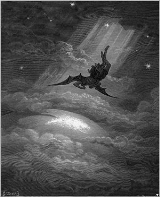
Lucifer is a name frequently given to Satan in Christian belief. This usage as a reference to a fallen angel stems from a particular interpretation of a passage in the Bible that speaks of someone who is given the name of "Day Star" or "Morning Star" (in Latin, Lucifer) as fallen from heaven.

Discussion
Ask a question about 'Lucifer'
Start a new discussion about 'Lucifer'
Answer questions from other users
|
Recent Posts

Quotations
:Lucifer: A message written in blood. Everyone involved in this drama seems compelled to overact.

Encyclopedia
Lucifer is a name frequently given to Satan in Christian belief. This usage as a reference to a fallen angel stems from a particular interpretation of a passage in the Bible that speaks of someone who is given the name of "Day Star" or "Morning Star" (in Latin, Lucifer) as fallen from heaven. The same Latin word is used of the morning star in and elsewhere with no relation to Satan. However, in many writings later than those of the Bible the Latin word has been used, without being translated as "Morning Star" and the like, as a proper name with which to designate Satan.
In Latin, the word "Lucifer", meaning "Light-Bringer" (from lux, lucis, "light", and ferre, "to bear, bring"), is a name for the "Morning Star" (the planet Venus in its dawn appearances). The Latin Vulgate version of the Bible used this word twice to refer to the Morning Star: once in to translate the Greek word "F?sf????" (Phosphoros), which has exactly the same literal meaning of "Light-Bringer" that "Lucifer" has in Latin; and once in to translate "????" (Hêlel), which also means "Morning Star". In the latter passage the title of "Morning Star" is given to the tyrannous Babylonian king, who the prophet says is destined to fall. This passage was later applied to the prince of the demons, and so the name "Lucifer" came to be used for Satan, and was popularized in works such as Dante Alighieri's Inferno and John Milton's Paradise Lost, but for English speakers the greatest influence has been its use in the King James Version (more modern English versions translate the term as "Morning Star" or "Day Star").
A similar passage in regarding the "king of Tyre" was also applied to Satan, contributing to the traditional picture of Satan and his fall.
Latin name for the Morning Star
Lucifer is the Latin name for the "Morning Star", both in prose and poetry, as seen in works by Marcus Terentius Varro (116–27 BC), Cicero (106-43 BC) and other early Latin writers
Cicero wrote:
- Stella Veneris, quae F?sf???? Graece, Latine dicitur Lucifer, cum antegreditur solem, cum subsequitur autem Hesperos
- The star of Venus, called F?sf???? in Greek and Lucifer in Latin when it precedes, Hesperos when it follows the sun.
And Pliny the Elder:
- sidus appellatum Veneris … ante matutinum exoriens Luciferi nomen accipit … contra ab occasu refulgens nuncupatur Vesper
- The star called Venus … when it rises in the morning is given the name Lucifer … but when it shines at sunset it is called Vesper
Poets also used the word "Lucifer". Ovid makes at least 11 mentions of the Morning Star in his poetry. Virgil wrote:
- Luciferi primo cum sidere frigida rura
- carpamus, dum mane novum, dum gramina canent
- Let us hasten, when first the Morning Star appears,
- To the cool pastures, while the day is new, while the grass is dewy
And Statius:
- et iam Mygdoniis elata cubilibus alto
- impulerat caelo gelidas Aurora tenebras,
- rorantes excussa comas multumque sequenti
- sole rubens; illi roseus per nubila seras
- aduertit flammas alienumque aethera tardo
- Lucifer exit equo, donec pater igneus orbem
- impleat atque ipsi radios uetet esse sorori
- And now Aurora rising from her Mygdonian couch had driven the cold darkness on from high in the heavens, shaking out her dewy hair, her face blushing red at the pursuing sun – from him roseate Lucifer averts his fires lingering in the clouds and with reluctant horse leaves the heavens no longer his, until the blazing father make full his orb and forbid even his sister her beams
The Morning Star in Isaiah 14:12
The Book of Isaiah has the following passage:
- When the Lord has given you rest from your pain and turmoil and the hard service with which you were made to serve, you will take up this taunt against the king of Babylon: How the oppressor has ceased! How his insolence has ceased! … How you are fallen from heaven, O Day Star, son of Dawn! How you are cut down to the ground, you who laid the nations low! You said in your heart, "I will ascend to heaven; I will raise my throne above the stars of God; I will sit on the mount of assembly on the heights of Zaphon; I will ascend to the tops of the clouds, I will make myself like the Most High." But you are brought down to Sheol, to the depths of the Pit. Those who see you will stare at you, and ponder over you: "Is this the man who made the earth tremble, who shook kingdoms, who made the world like a desert and overthrew its cities, who would not let his prisoners go home?"
The passage expressly refers to a "king of Babylon", a "man" who seemed all-powerful, but who has been brought low. Isaiah promises that the Israelites will be freed and will then be able to use in a taunting song against their oppressor the image of the Morning Star, which rises at dawn as the brightest of the stars, outshining Jupiter and Saturn, but lasting only until the sun appears. This image was used in an old popular Canaanite story that the Morning Star tried to rise high above the clouds and establish himself on the mountain where the gods assembled, in the far north, but was cast down into the underworld.
The phrase "O Day Star, son of Dawn" in the New Revised Standard Version translation given above corresponds to the Hebrew phrase "???? ???????" (heilel ben-shachar) in verse 12, meaning "morning star, son of dawn". As the Latin poets personified the Morning Star and the Dawn (Aurora), as well as the Sun and the Moon and other heavenly bodies, so in Canaanite mythology Morning Star and Dawn were pictured as two deities, the former being the son of the latter.
In the Vulgate, Jerome translated "???? ???????" (morning star, son of dawn) as "lucifer qui mane oriebaris" (morning star that used to rise early). Already, as early as the Christian writers Tertullian and Origen, the whole passage had come to be applied to Satan. Satan began to be referred to as "Lucifer" (Morning Star), and finally the word "Lucifer" was treated as a proper name. The use of the word "Lucifer" in the 1611 King James Version instead of a word such as "Daystar" ensured its continued popularity among English speakers.
Most modern English versions of the Bible (including the NIV, NRSV, NASB, NJB and ESV) render the Hebrew word as "day star", "morning star" or something similar, and never as "Lucifer", a word that in English is now very rarely used in the sense of the original word in Hebrew, though in Latin "Lucifer" was a literal translation.
Satan as Lucifer
The Jewish Encyclopedia states that the Lucifer myth was transferred to Satan already in the pre-Christian century, citing in support of this view the Life of Adam and Eve and the Slavonic Book of Enoch, where Satan-Sataniel (sometimes identified with Samael) is described as having been one of the archangels. Because he contrived "to make his throne higher than the clouds over the earth and resemble 'My power' on high", Satan-Sataniel was hurled down, with his hosts of angels, and since then he has been flying in the air continually above the abyss.
However, it was among Christian writers that the identification of "Lucifer" with Satan had its greatest fortune. Tertullian ("Contra Marrionem," v. 11, 17), Origen ("Ezekiel Opera," iii. 356), and others, identify Lucifer with Satan, who also is represented as being "cast down from heaven" (; cf. ).
The Tyndale Bible Dictionary states that there are many who believe the expression "Lucifer" and the surrounding context in Isaiah 14 refer to Satan: they believe the similarities among , , and warrant this conclusion. But it points out that the context of the Isaiah passage is about the accomplished defeat of the king of Babylon, while the New Testament passages speak of Satan.
A passage quite similar to that in Isaiah is found in , which is expressly directed against the king of Tyre, a city on an island that had grown rich by trade, factors alluded to in the text. It too has been applied to Lucifer/Satan, because of some of the expressions contained in it. But, since it does not contain the image of the morning star, discussion of it belongs rather to the article on Satan than to that on Lucifer.
The same holds for the picture of Satan in other books of the Old Testament as, for instance, in the book of Job, where Satan, who has been wandering the earth, has a discussion with God and makes a deal with him to test Job.
Joseph Campbell (1972: p.148-149) illustrates an unorthodox Islamic reading of Lucifer's fall from Heaven, which champions Lucifer's eclipsing love for God:
"One of the most amazing images of love that I know is Persian – a mystical Persian representation as Satan as the most loyal lover of God. You will have heard the old legend of how, when God created the angels, he commanded them to pay worship to no one but himself; but then, creating man, he commanded them to bow in reverence to this most noble of his works, and Lucifer refused – because, we are told, of his pride. However, according to this Muslim reading of his case, it was rather because he loved and adored God so deeply and intensely that he could not bring himself to bow before anything else, and because he refused to bow down to something that was of less superiority than him. (Since he was made of fire, and man from clay.) And it was for that that he was flung into Hell, condemned to exist there forever, apart from his love."
This interpretation of the satanic rebellion described in the Quran is seen by some Sufi teachers such as Mansur Al-Hallaj (in his 'Tawasin') as a predestined scenario in which Iblis-Shaitan plays the role of tragic and jealous lover who, unable to perceive the Divine Image in Adam and capable only of seeing the exterior, disobeyed the divine mandate to bow down. His refusal (according to the Tawasin) was due to a misconceived idea of God's uniqueness and because of his refusal to abandon himself to God in love. Hallaj criticized the staleness of Iblis' adoration. Excerpts from Sufi texts expounding this interpretation have been included along with many other viewpoints on Shaitan (by no means all of them apologetic) in an important anthology of Sufi texts edited by Dr. Javad Nurbakhsh, head of the Nimatullahi Sufi Order.
The Sufi teacher Pir Vilayat Inayat Khan taught that 'Luciferian Light' is Light which has become dislocated from the Divine Source and is thus associated with the seductive false light of the lower ego which lures humankind into self-centered delusion. Here Lucifer represents what the Sufis term the 'Nafs', the ego.
Liberal Christian scholars often deny altogether the existence of a personal being called "Satan", rendering the Lucifer story irrelevant. They argue that the name Satan itself (Hebrew: ?????) merely means "adversary" or "accuser", which may be a personification.
Mentions of the Morning Star in the Bible
In the Latin Vulgate the word "Lucifer" was used twice to refer to the Morning Star: once for "????" (hêlel) in and once for the Greek word "f?sf????" (phosphoros) in .
"Lucifer" (Morning Star) also appears twice in the Vulgate translation of the Book of Job, once to represent the word "???" (which instead means "morning") in , and once for the word "?????" (usually taken to mean "the constellations") in ; and it appears also in for "????" (dawn, the same word as in ).
Two references to the Morning Star in the Book of Revelation are not represented in the Vulgate by "lucifer". In both cases a circumlocution is used in the original Greek text, instead of the simple term "f?sf????", and a corresponding circumlocution is used in the Latin. Thus "stella matutina" is used for "? ?st?? ? p??????" in , which promises the morning star to those who persevere.
The Vulgate uses "stella matutina" to translated "? ?st?? ? p??????" (or, according to some manuscripts, "? ?st?? ? ????????") in , where it is Jesus who is described as the morning star. An echo of this Biblical use is found in the Roman Rite liturgy, in which the Exultet chant in praise of the paschal candle refers to Christ as the morning star (in Latin lucifer):
May the Morning Star which never sets
find this flame still burning:
Christ, that Morning Star,
who came back from the dead,
and shed his peaceful light on all mankind,
your Son, who lives and reigns for ever and ever.
| Flammas eius lucifer matutinus inveniat:
ille, inquam, lucifer, qui nescit occasum,
Christus Filius tuus qui,
regressus ab inferis,
humano generi serenus illuxit,
et vivit et regnat in saecula saeculorum.
|
Astronomical significance
Because the planet Venus (Lucifer) is an inferior planet, meaning that its orbit lies between the orbit of the Earth and the Sun, it can never rise high in the sky at night as seen from Earth. It can be seen in the eastern morning sky for an hour or so before the Sun rises, and in the western evening sky for an hour or so after the Sun sets, but never during the dark of midnight.
It is the brightest object in the sky after the Sun and the Moon. As bright and as brilliant as it is, ancient people couldn't understand why they couldn't see it at midnight like the outer planets, or during midday, like the Sun and Moon. It outshines the planets Saturn and Jupiter, which do last all night, but soon disappears. Some believe they invented myths that Lucifer wanted to take over the thrones or status of the gods Saturn and Jupiter, as a result of which Lucifer was cast out from heaven.
Non-Biblical use of "Morning Star" as a title
"Morning Star" appears to have been used as a poetic description of Byzantine Emperor Nikephoros II in 968. Liutprand, bishop of Cremona, reported the greeting sung to the emperor arriving at Hagia Sophia: "Behold the morning star approaches Eos rises; he reflects in his glances the rays of the sun – he the pale death of the Saracens, Nicephorus the ruler."
Alleged connection with Freemasonry
Léo Taxil (1854-1907) originated a false perception that Freemasonry was associated with worshipping Lucifer. In the "Taxil hoax"preme Confederated Councils of the world" (Taxil's invention), instructing them that Lucifer was God, and was in opposition to the evil god Adonai. When Albert Pike and other Masonic scholars spoke over a century ago about the "Luciferian path," or the "energies of Lucifer," they were referring to the morning star, the light bearer, the search for light; the very antithesis of dark, satanic evil. Taxil also promoted a book by Diana Vaughan (actually written by him) that purported to reveal a highly secret ruling body called the Palladium which controlled the organization and had a Satanic agenda. As described by Freemasonry Disclosed in 1897:
- With frightening cynicism, the miserable person we shall not name here [Taxil] declared before an assembly especially convened for him that for twelve years he had prepared and carried out to the end the most sacrilegious of hoaxes. We have always been careful to publish special articles concerning Palladism and Diana Vaughan. We are now giving in this issue a complete list of these articles, which can now be considered as not having existed.
Despite the fraud having been revealed for over a century, Pike's spurious address and other details of the hoax continue to be quoted by anti-masonic groups.
Arthur Edward Waite wrote an exposé of this hoax, titled Devil-Worship in France, producing evidence that it was what today we would call a tabloid story, replete with logical and factual inconsistencies.
See also at the Grand Lodge of British Columbia and Yukon website.
Occult beliefs In the modern occultism of Madeline Montalban (died 1982) Lucifer's identification as the Morning Star (Venus) equates him with Lumiel, whom she regarded as the Archangel of Light, and among Satanists he is seen as the "Torch of Baphomet" and Azazel. In this modern occult teaching, an obvious appropriation of Christian soteriology, it is stated that it is Lucifer's destiny to incarnate in human form at certain key times in world history as a savior and redeemer for humanity. A symbol for this process is the Tudor Rose. The Tudor Rose can be red, representing Lucifer, or white, representing Lilith. The Tau cross or Mjolnir is also a symbol of Lumiel/Lucifer and his role as an avatar for the human race.
In the Satanic Bible of 1969 Lucifer is acknowledged as one of the Four Crown Princes of Hell, particularly that of the East. Lord of the Air, Lucifer has been named "Bringer of Light, the Morning Star, Intellectualism, Enlightenment."
Other meanings
As well as signifying the archangel cast from heaven for leading a revolt of angels, and the planet Venus in its appearance as the Morning Star, the word "lucifer" has been used in English with reference to a friction match.
Use of the term "Lucifer" in reference to a morning star is hinted at in Arthur C. Clarke's 2010: Odyssey Two and 2061: Odyssey Three. The word Lucifer in this context refers to the mini-sun of Jupiter.
In William Nicholson's 'Jango' novel, "Morning Star" is a name given to one of the main characters.
See also
Further reading
- Campbell, Joseph (1972). Myths To Live By. A Condor Book: Souvenir Press (Educational & Academic) Ltd. ISBN 0-285-64731-8
External links
|
| |
|
|