
All Topics  
Yahweh


   Email Print
   Bookmark   Link


Yahweh


For more information about the name of the deity in Judaism and Christianity (Yahweh), see criticisms and theories on Yahweh
Criticisms and theories on Yahweh

[Image:Tetragrammaton scripts.svg|frame|right|The Tetragrammaton in Paleo-Hebrew alphabet , Aramaic alphabet and Hebrew alphabet Yahweh is names of God, a word equivalent to El , al, Allah and iah, found from the middle bronze age onward in the form of western semitic and afroasiatic petroglyhs....
 or God in Abrahamic religions, which provides useful links.


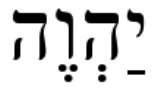
Yahweh is the English rendering of , a vocalization of the Tetragrammaton
Tetragrammaton

Tetragrammaton The letters, properly read from right to left , are:|-! Hebrew !! Letter name !! Pronunciation|-valign=top| ?'...
  that was proposed by the Hebrew scholar Gesenius in the 19th century.

Yahweh is the Hebrew word for the God of Israel; it is in the Afro-asiatic languages family.

The Hebrew term had been vocalized as (YeHoWah/JeHoVaH) in the Masoretic Text
Masoretic Text

The Masoretic Text is the Hebrew language text of the Jewish Bible . It defines not just the Development of the Jewish Bible canon, but also the precise letter-text of the biblical books in Judaism, as well as their niqqud and cantillation for both public reading and private study....
 that was formed during the 7th-11th centuries.


Discussion
Ask a question about 'Yahweh'
Start a new discussion about 'Yahweh'
Answer questions from other users
Full Discussion Forum


Encyclopedia


Yhwh
For more information about the name of the deity in Judaism and Christianity (Yahweh), see criticisms and theories on Yahweh
Criticisms and theories on Yahweh

[Image:Tetragrammaton scripts.svg|frame|right|The Tetragrammaton in Paleo-Hebrew alphabet , Aramaic alphabet and Hebrew alphabet Yahweh is names of God, a word equivalent to El , al, Allah and iah, found from the middle bronze age onward in the form of western semitic and afroasiatic petroglyhs....
 or God in Abrahamic religions, which provides useful links.


Yahweh is the English rendering of , a vocalization of the Tetragrammaton
Tetragrammaton

Tetragrammaton The letters, properly read from right to left , are:|-! Hebrew !! Letter name !! Pronunciation|-valign=top| ?'...
  that was proposed by the Hebrew scholar Gesenius in the 19th century.

Yahweh is the Hebrew word for the God of Israel; it is in the Afro-asiatic languages family.

The Hebrew term had been vocalized as (YeHoWah/JeHoVaH) in the Masoretic Text
Masoretic Text

The Masoretic Text is the Hebrew language text of the Jewish Bible . It defines not just the Development of the Jewish Bible canon, but also the precise letter-text of the biblical books in Judaism, as well as their niqqud and cantillation for both public reading and private study....
 that was formed during the 7th-11th centuries. This is the text that underlies the Old Testament of the most circulated Holy Bible of the Christian world, the King James Version. Though, this vocalization had been disputed by Hebrew scholars from as early as 1604 A.D.

was proposed in a period of the 19th century when the vocalized Hebrew punctuation , from which Jehovah is derived, was finally rejected by major Hebrew scholars, who did not believe that it accurately represented the original pronunciation of the Abrahamic God's Hebrew name.

Gesenius's proposed punctuation is believed to represent the Greek transcription (Yave) which Epiphanius
Epiphanius

Epiphanius was the name of several early Christianity scholars and ecclesiastics:*Saint Epiphanius of Pavia *Saint Epiphanius of Salamis , bishop of Salamis in Cyprus, author of Panarion...
 ascribes to be used by some Gnostic
Gnosticism

Gnosticism refers to diverse, syncretistic religious movements in antiquity consisting of various belief systems generally united in the teaching that humans are divine souls trapped in a Nature created by an imperfect god, the demiurge; this being is frequently identified with the Abrahamic God, and is contrasted with a superior entity, ref...
 circles. Modern observant Jews no longer voice the name aloud. It is believed to be too sacred to be uttered and is often referred to as the 'Ineffable', 'Unutterable' or 'Distinctive Name'. (See Name of God in Judaism
Names of God in Judaism

In Judaism, the name of God is more than a distinguishing title. It represents the Jewish conception of the divine nature, and of the relation of God to the Jewish people....
.) Various proposals still exist for the vocalization of in which the stem of the name Yahweh (Yah) remains widely accepted but discrepancies exist on agreement of the ending ('weh'). Early Christian literature written in Greek used spellings like and that can be transcribed by 'Yahweh'. This pronunciation and spelling, as with many religious and scholarly issues, remains the subject of ongoing debate, see Criticisms and theories on Yahweh
Criticisms and theories on Yahweh

[Image:Tetragrammaton scripts.svg|frame|right|The Tetragrammaton in Paleo-Hebrew alphabet , Aramaic alphabet and Hebrew alphabet Yahweh is names of God, a word equivalent to El , al, Allah and iah, found from the middle bronze age onward in the form of western semitic and afroasiatic petroglyhs....
.

Tetragrammaton (from the Greek
Greek language

Greek is an Indo-European languages native to the southern Balkan peninsula, the language of the Greek people. It forms an independent branch within Indo-European....
 , meaning '[word of] four letters' (tetra "four" + gramma (gen. grammatos) "letter"), is a name of the Divine Name , as written in the Hebrew
Hebrew alphabet

The Hebrew alphabet consists of 22 letters used for writing the Hebrew language. Five of these letters have a different form when appearing as the last letter in a word....
 Masoretic Text
Masoretic Text

The Masoretic Text is the Hebrew language text of the Jewish Bible . It defines not just the Development of the Jewish Bible canon, but also the precise letter-text of the biblical books in Judaism, as well as their niqqud and cantillation for both public reading and private study....
 where it appears 6,828 times in the Hebrew text of both the Biblia Hebraica
Biblia Hebraica

Biblia Hebraica is a Latin phrase meaning Hebrew Bible. It is traditionally used as a title for printed editions of the Tanakh .In current scholarly usage, it refers almost exclusively to the three editions of the Hebrew Bible edited by Rudolf Kittel ....
 and Biblia Hebraica Stuttgartensia
Biblia Hebraica Stuttgartensia

The Biblia Hebraica Stuttgartensia, or BHS, is an edition of the Masoretic Text of the Hebrew Bible as preserved in the Leningrad Codex, and supplemented by masoretic and text-critical notes....
. It does not appear in the Song of Songs
Song of songs

Song of Songs is a book of the Hebrew Bible or Old Testament. It may also refer to:In music:*Song of songs , the debut album by David and the Giants...
, Ecclesiastes
Ecclesiastes

Ecclesiastes is a book of the Hebrew Bible. The English name derives from the Greek language translation of the Hebrew #Title.The main speaker in the book, identified by the name or title Qohelet, introduces himself as "son of David, and king in Jerusalem." The work consists of personal or autobiographic matter, at times expressed in aph...
, or Esther
Esther

Esther , born Hadassah, is a queen of the Persian Empire in the Hebrew Bible, the queen of Ahasuerus , and heroine of the Biblical Book of Esther which is named after her....
.

The letters, properly read from right to left (in Biblical Hebrew), are:
Hebrew Letter name Pronunciation
? Yud
Yud

Yud may refer to:*Yodh, the tenth letter of many Semitic languages alphabets*YUD, the IATA airport code for Umiujaq Airport in Quebec, Canada...
"Y"
? He
He (letter)

He is the fifth letter of many Semitic alphabets, including Phoenician alphabet , Aramaic alphabet, Hebrew alphabet , Syriac alphabet and Arabic alphabet ....
 (its name is pronounced "hey")
"H"
? Vav "V" or placeholder for "O"/"U" vowel (see mater lectionis
Mater lectionis

In the spelling of Hebrew language and some other Semitic languages, matres lectionis , refers to the use of certain consonants to indicate a vowel....
)
? He
He (letter)

He is the fifth letter of many Semitic alphabets, including Phoenician alphabet , Aramaic alphabet, Hebrew alphabet , Syriac alphabet and Arabic alphabet ....
"H" (or sometimes silent
Silent letter

In an alphabet, a silent letter is a letter that, in a particular word, does not correspond to any sound in the word's pronunciation. Silent letters create problems for both native and non-native speakers of a language, as they make it more difficult to guess the spellings of spoken words or the pronunciations of written words....
 at the ends of words)


is the four-letter name of God , which is referred to in Josephus
Josephus

Josephus , also known as Yosef Ben Matityahu and, after he became a Roman citizenship, as Titus Flavius Josephus, was a first-century Jewish historian and apologist of priestly and royal ancestry who survived and recorded the destruction of Jerusalem in AD 70....
, by the Church Fathers
Church Fathers

The Church Fathers, Early Church Fathers, or Fathers of the Church are the early and influential theology and writers in the Christian Church, particularly those of the first five centuries of Christian history....
, and the Jerusalem Talmud
Jerusalem Talmud

The Jerusalem Talmud or Talmud Yerushalmi , often the Yerushalmi for short, is a collection of rabbi notes about the Jewish Oral law as detailed in the 2nd-century Mishnah....
.

Biblical Hebrew often omits vowel sounds from its writings, which would be shown in English.

Yahweh is the Hebrew word for the God of Israel; it is in the Afro-asiatic languages family.

These four letters are usually transliterated from Hebrew as IHVH in Latin, JHWH in German
German language

German is a West Germanic languages, thus related to and classified alongside English language and Dutch language. It is one of the world's world language and the most widely spoken mother tongue in the European Union....
, French
French language

French is a Romance language spoken around the world by around 80 million people as first language, by 190 million as second language, and by about another 200 million people as an acquired tongue, with significant speakers in 54 countries....
 and Dutch
Dutch language

Dutch is a West Germanic languages spoken by over 22 million people as a first language, and about 5 million people as a second language."1% of the EU population claims to speak Dutch well enough in order to have a conversation." Outside the European Union the number of second language speakers of Dutch is very small. Most native...
, and YHWH in English
English language

English is a West Germanic language that originated in Anglo-Saxon England and has lingua franca status in many parts of the world as a result of the military, economic, scientific, political and cultural influence of the British Empire in the 18th, 19th and early 20th centuries and that of the United States from the mid 20th century onwa...
. This was variously rendered as "Yahweh
Yahweh

Image:Tetragrammaton scripts.svg[Aramaic alphabet|Aramaic]] and Hebrew alphabet Yahweh is the English rendering of , a vocalization of the Tetragrammaton that was proposed by the Hebrew scholar Gesenius in the 19th century....
" or "Jehovah
Jehovah

Jehovah, also Yehovah, is an English reading of , the most frequent form of the Tetragrammaton , the principal and personal name of God in the Hebrew Bible ....
", since in Latin
Latin

Latin is an Italic language, historically spoken in Latium and Ancient Rome. Through the Military history of the Roman Empire, Latin spread throughout the Mediterranean and a large part of Europe....
 there was no distinct lettering to distinguish 'Y' from 'J', or 'W' from 'V', and the Hebrew does not clearly indicate the omitted vowels. In English translations, it is often rendered in small capital letters
Small caps

In typography, small capitals are uppercase graphemes set at the same height as surrounding lowercase letters or text figures. They are used in running text to prevent capitalized words from appearing too large on the page, and as a method of emphasis or distinctiveness for text alongside or instead of italics, or when boldface is inappr...
 as "the ", following Jewish
Judaism

Judaism is a set of beliefs and practices originating in the Hebrew Bible , as later further explored and explained in the Talmud and other texts....
 tradition which reads the word as "Adonai" ("Lord") out of respect for the name of God
Names of God

The Name of God, or Holy Name is the name in Eastern traditions or Western spiritual traditions or religions that is used in practice or prayer....
 and the commandment
Ten Commandments

The Ten Commandments, or Decalogue, are a list of religious and moral imperatives that, according to Judeo-Christian tradition, were authored by God and given to Moses on the mountain referred to as "Biblical Mount Sinai" or "Mount Horeb" in the form of two stone tablets....
 not to take the name of God in vain. The word "haŠem" 'the Name' is also used in Jewish contexts; in Samaritan, "Šemå" is the normal substitution.

See "Historical overview"
Yahweh

Image:Tetragrammaton scripts.svg[Aramaic alphabet|Aramaic]] and Hebrew alphabet Yahweh is the English rendering of , a vocalization of the Tetragrammaton that was proposed by the Hebrew scholar Gesenius in the 19th century....
 at Yahweh
Yahweh

Image:Tetragrammaton scripts.svg[Aramaic alphabet|Aramaic]] and Hebrew alphabet Yahweh is the English rendering of , a vocalization of the Tetragrammaton that was proposed by the Hebrew scholar Gesenius in the 19th century....
 and Jehovah
Jehovah

Jehovah, also Yehovah, is an English reading of , the most frequent form of the Tetragrammaton , the principal and personal name of God in the Hebrew Bible ....
.

Historical overview

Observant Jews write down but do not pronounce the Tetragrammaton, because it is considered too sacred to be used for common activities. Even ordinary prayer is considered too common for this use. The Tetragrammaton was pronounced by the High Priest on Yom Kippur
Yom Kippur

Yom Kippur , also known in English as the Day of Atonement, is the most solemn and important of the Jewish holidays. Its central themes are Atonement in Judaism and Repentance in Judaism....
 when the Temple was standing in Jerusalem. Since the destruction of the Temple in 70 CE, the Tetragrammaton is no longer pronounced, and while Jewish tradition holds that the correct pronunciation is known to a select few people in each generation, it is not generally known what this pronunciation is. Instead, common Jewish use has been to substitute the name "" ("My Lord") where the Tetragrammaton appears. In cases where the Tetragrammaton follows the name Adonai in biblical texts, the name Elohim
Elohim

Elohim is a Hebrew language word which expresses concepts of divinity. It is apparently related to the Hebrew word El , though morphology it consists of the Hebrew word Eloah with a plural suffix....
 ("God") is substituted instead.

The Septuagint
Septuagint

The Septuagint , or simply "LXX", is the Koine Greek version of the Hebrew Bible, translated in stages between the 3rd century BC and 1st century BC in Alexandria....
 (Greek translation) and Vulgate
Vulgate

The Vulgate is an early Fifth Century version of the Bible in Latin, and largely the result of the labors of Jerome, who was commissioned by Pope Damasus I in 382 to make a revision of Vetus Latina....
 (Latin translation) use the word "Lord" ( (kurios) and , respectively). However, newer research has brought to light the oldest available copies of the Septuagint which interestingly include the Tetragrammaton inside the Greek text.
Tetragrammaton Related Masoretic Vowel Points
The Masoretes
Masoretes

The Masoretes were groups of scribes and Tanakh scholars working between the 7th and 11th centuries, based primarily in Israel in the cities of Tiberias and Jerusalem, as well as in Babylonia....
 added vowel points (niqqud
Niqqud

In Hebrew language orthography, niqqud or nikkud is the system of diacritical signs used to represent vowels or distinguish between alternative pronunciations of consonants of the Hebrew alphabet....
) and cantillation
Cantillation

Cantillation is the ritual chanting of readings from the Bible in synagogue Jewish services.The chants are rendered in accordance with the special signs or marks printed in the Masoretic text of the Hebrew Bible to complement the letters and vowel points....
 marks to the manuscripts to indicate vowel usage and for use in the ritual chanting of readings from the Bible
Bible

The Bible is the central religious text of Judaism and Christianity. The exact Books of the Bible is dependent on the religious traditions of specific denominations....
 in synagogue
Synagogue

A synagogue is a Jewish house of prayer.Synagogues usually have a large hall for prayer , smaller rooms for study and sometimes a social hall and offices....
 services
Jewish services

Jewish services are the prayer recitations that form part of the observance of Judaism. These prayers, often with instructions and commentary, are found in the siddur, the traditional Jewish prayer book....
. To they added the vowels for "" ("My Lord"), the word to use when the text was read.

Many Jews will not even use "" except when praying, and substitute other terms, e.g. ("The Name") or the nonsense word Ado-Shem, out of fear of the potential misuse of the divine name. In written English
English language

English is a West Germanic language that originated in Anglo-Saxon England and has lingua franca status in many parts of the world as a result of the military, economic, scientific, political and cultural influence of the British Empire in the 18th, 19th and early 20th centuries and that of the United States from the mid 20th century onwa...
, "G-d
Names of God in Judaism

In Judaism, the name of God is more than a distinguishing title. It represents the Jewish conception of the divine nature, and of the relation of God to the Jewish people....
" is a substitute used by a minority of Christians.

Parts of the Talmud
Talmud

The Talmud is a record of rabbinic discussions pertaining to Halakha, Jewish ethics, customs, and history. It is a central text of mainstream Judaism....
, particularly those dealing with Yom Kippur
Yom Kippur

Yom Kippur , also known in English as the Day of Atonement, is the most solemn and important of the Jewish holidays. Its central themes are Atonement in Judaism and Repentance in Judaism....
, seem to imply that the Tetragrammaton should be pronounced in several ways, with only one (not explained in the text, and apparently kept by oral tradition
Oral tradition

Oral tradition, oral culture and oral lore are messages or testimony transmitted orally from one generation to another. The messages or testimony are verbally transmitted in speech or song and may take the form, for example, of folktales, sayings, ballads, songs, or chants....
 by the Kohen Gadol
Kohen Gadol

Kohen Gadol or Kohen ha-Gadol is the title of wiktionary:High Priest of early Israelite religion and of Classical Age Judaism from the rise of the Israelite nation until the destruction of the Second Temple of Jerusalem....
) being the personal name of God.

In late Kabbalistic works the Tetragrammaton is sometimes referred to as the Name of Havayah - , meaning "the Name of Being/Existence". Christian Kabbalists used the form Jehovah.

Translators often render YHWH as a word meaning "Lord", e.g. Greek , Latin , and following that, English "the Lord", Polish , Welsh , etc. However, all of the above are inaccurate translations of the Tetragrammaton.

Because the name was no longer pronounced and its own vowels were not written, its own pronunciation was forgotten. When Christians, unaware of the Jewish tradition, started to read the Hebrew Bible, they read as written with YHWH's consonants with 's vowels, and thus said or transcribed Iehovah. Today this transcription is generally recognized as mistaken; however many religious groups continue to use the form Jehovah because it is familiar.

Using the Name in the Bible

Exodus 3:15 is used to support the use of the Name YHWH: “This is my Name forever, and this is my memorial to all generations.”. The word “forever” is “olahm” which means “time out of mind, to eternity”. "The Hebrew word ‘olahm’, translated ‘for ever’ clearly doesn’t always mean literal future infinity- although in some places it can have that sense. It’s actually used in places to describe the past; events of a long time ago, but not events that happened an ‘infinitely long time’ ago. It describes the time of a previous generation (Dt. 32:7; Job 22:15); to the time just before the exile of Judah (Is. 58:12; 61:4; Mic. 7:14; Mal. 3:4); to the time of the Exodus (1 Sam. 27:8; Is. 51:9; 63:9); to the time just before the flood (Gen. 6:4)." Many Scriptures do favour the use of the Name. The biblical law does not prohibit the use of the Name, but it warns against “misuse”, “blaspheming” or in ordinary terms, “taking lightly” the Name of YHWH. The Biblical texts suggest the people of the Bible - including the patriarchs - used the Name of YHWH. A wealth of scriptures support this notion.

Evidence from theophoric names

Yahu" or "Yehu" is a common short form for "Yahweh" in Hebrew theophoric names; as a prefix it sometimes appears as "Yeho-". This has caused two opinions:
  1. In former times (at least from c.1650 AD), that it was abbreviated from the supposed pronunciation "Yehowah", rather than "Yahweh" which contains no 'o'- or 'u'-type vowel sound in the middle.
  2. Recently, that, as "Yahweh" is likely an imperfective verb form, "Yahu" is its corresponding preterite
    Preterite

    The preterite is the grammatical tense expressing actions that took place in the past. It is similar to the aorist in languages such as Greek language....
     or jussive short form: compare yistahaweh (imperfective), yistáhû (preterit or jussive short form) = "do obeisance".
Those who argue for (1) are the: George Wesley Buchanan
George Wesley Buchanan

George Wesley Buchanan is Professor Emeritus of New Testament, Wesley Theological Seminary, Washington, DC, USA. He is on the Editorial Advisory Board of the Biblical Archaeology Review....
 in Biblical Archaeology Review
Biblical Archaeology Review

Biblical Archaeology Review is a publication that seeks to connect the academic study of archaeology to a broad general audience seeking to understand the world of the Bible and the Near and Middle East ....
; ; Section # 2.1 The Analytical Hebrew & Chaldee Lexicon (1848) in its article

Smith’s 1863 A Dictionary of the Bible says that "Yahweh" is possible because shortening to "Yahw" would end up as "Yahu" or similar. has a very similar discussion, and also gives the form Jo or Yo contracted from Jeho or Yeho . The Encyclopedia Britannica, 11th edition (New York: Encyclopedia Britannica, Inc., 1910-11, vol. 15, pp. 312, in its article "JEHOVAH", also says that "Jeho-" or "Jo" can be explained from "Yahweh", and that the suffix "-jah" can be explained from "Yahweh" better than from "Yehowah".

Chapter 1 of , under the heading: The Pronunciation Of Gods Name quotes from Insight on the Scriptures
Insight on the Scriptures

Insight on the Scriptures is a two-volume hardcover Biblical reference work, published by the Watch Tower Bible and Tract Society of Pennsylvania in 1988; each volume has 1280 pages....
, Volume 2, page 7: Hebrew Scholars generally favor "Yahweh" as the most likely pronunciation. They point out that the abbreviated form of the name is Yah (Jah
Jah

Jah is the shortened name for God YHWH, most commonly used in the Rastafari movement. It comes from the Hebrew ???? = Yah ....
 in the Latinized form), as at Psalm 89:8 and in the expression Hallelu-Yah (meaning "Praise Yah, you people!") (Ps 104:35; 150:1,6). Also, the forms Yehoh', Yoh, Yah, and Ya'hu, found in the Hebrew spelling of the names of Jehoshaphat, Joshaphat, Shephatiah, and others, can all be derived from Yahweh.

Using consonants as semi-vowels (v/w)

In ancient Hebrew
Biblical Hebrew language

Biblical Hebrew, also called Classical Hebrew, is an archaic form of the Hebrew languages in which the Hebrew Bible and various Israelites inscriptions were written....
, the letter ?
Hebrew alphabet

The Hebrew alphabet consists of 22 letters used for writing the Hebrew language. Five of these letters have a different form when appearing as the last letter in a word....
, known to modern Hebrew speakers as vav, was
Hebrew alphabet

The Hebrew alphabet consists of 22 letters used for writing the Hebrew language. Five of these letters have a different form when appearing as the last letter in a word....
 a semivowel /w/ (as in English, not as in German) rather than a /v/. The letter is referred to as waw
Waw (letter)

Waw is the sixth letter of many Semitic alphabets, including Phoenician alphabet, Aramaic alphabet, Hebrew alphabet, Syriac alphabet, and Arabic alphabet ....
 in the academic world. Because the ancient pronunciation differs from the modern pronunciation, it is common today to represent as YHWH rather than YHVH.

In Biblical Hebrew, most vowels are not written and the rest are written only ambiguously, as the vowel letters double as consonants (similar to the Latin
Latin

Latin is an Italic language, historically spoken in Latium and Ancient Rome. Through the Military history of the Roman Empire, Latin spread throughout the Mediterranean and a large part of Europe....
 use of V to indicate both U and V). See Matres lectionis for details. For similar reasons, an appearance of the Tetragrammaton in ancient Egyptian
Egyptian language

Egyptian is a branch of the Afro-Asiatic languages language family along with the Chadic languages, Berber languages, Semitic languages, Cushitic languages and possibly Omotic languages languages....
 records of the 13th century BC sheds no light on the original pronunciation. Therefore it is, in general, difficult to deduce how a word is pronounced from its spelling only, and the Tetragrammaton is a particular example: two of its letters can serve as vowels, and two are vocalic place-holders, which are not pronounced.

This difficulty occurs somewhat also in Greek when transcribing Hebrew words, because of Greek's lack of a letter for consonant 'y' and (since loss of the digamma
Digamma

Digamma is an Archaic Greece letter of the Greek alphabet, used primarily as a Greek numeral.The letter had the phonetic value of a voiced labial-velar approximant ....
) of a letter for "w", forcing the Hebrew consonants yod and waw to be transcribed into Greek as vowels. Also, non-initial 'h' caused difficulty for Greeks and was liable to be omitted; ? (chi
Chi (letter)

Chi is the 22nd letter of the Greek alphabet, pronounced as [kai] in English. Its value in Ancient Greek was an aspirated voiceless velar plosive ....
) was pronounced as 'k' + 'h' (as in modern Hindi
Hindi

Standard Hindi, also known as High Hindi, Nagari Hindi or Literary Hindi is a Standard language register of Hindi. It is one of the 22 official languages of India, and is used, along with English language, for administration of the central government....
 "lakh
Lakh

A lakh is a unit in the Indian numbering system equal to 100000 . It is widely used both in official and other contexts in Bangladesh, India, Maldives, Nepal, Sri Lanka, Myanmar and Pakistan, and is often used in Indian English....
") and could not be used to spell 'h' as in e.g. Modern Greek
Modern Greek

Modern Greek refers the varieties of Greek spoken in the modern era. The beginning of the "modern" period of the language is often symbolically assigned to the fall of the Byzantine Empire in 1453, even though that date marks no clear linguistic boundary and many characteristic modern features of the language had been present centuries earli...
  = "Harry".

Y or J?

The English practice of transliterating the Biblical Hebrew Yodh
Yodh

Yodh is the tenth letter of many Semitic History of the alphabet, including Phoenician language, Aramaic language, Hebrew language Yud , Syriac alphabet and Arabic alphabet ....
 as "j" and pronouncing it "dzh" started when, in late Latin, the pronunciation of consonantal "i" changed from "y" (as in English "yet") to "dzh" but continued to be spelled "i", bringing along with it Latin transcriptions and spoken renderings of Biblical and other foreign words and names.

A direct rendering of the Hebrew yod would be "y" in English. However, most transliterations of the biblical Hebrew texts represent the Hebrew 'yod' by using the English letter 'J'. This letter, and the accompanying 'J' sound/pronunciation is clearly evident in anglicized versions of Hebrew proper nouns, i.e. names such as Jesus
Jesus

Jesus of Nazareth , also known as Jesus Christ, is the central figure of Christianity and is revered by most Christian churches as the Son of God and the Incarnation ....
*, Jeremiah
Jeremiah

Jeremiah was one of the 'greater prophet' of the Hebrew Bible. He was the son of Hilkiah, a priest of Anathoth.His writings are put together in the Book of Jeremiah and, according to tradition, the Book of Lamentations....
, Joshua
Joshua

Joshua, Jehoshuah or Yehoshua , born in Egypt, was a biblical Israelite leader who succeeded Moses. His story is told in the Hebrew Bible, chiefly in the books Book of Exodus, Book of Numbers and Book of Joshua....
**, Judah
Judah

Judah is the name of several Biblical and historical figures. The original Judah was the fourth son of Jacob and Leah, as recorded in Genesis 29:35....
, Job, Jerusalem
Jerusalem

Jerusalem is the capital of Israel and its List of Israeli cities in both population and area, with a population of 747,600 residents over an area of if Positions on Jerusalem East Jerusalem is included....
, Jehoshaphat
Jehoshaphat

Jehoshaphat was the successor of Asa of Judah, king of Kingdom of Judah. His children included Jehoram of Judah. Historically, his name has sometimes been connected with the Valley of Jehosaphat, where, according to Joel 3:2, the God of Israel will gather all nations for judgment....
, and Jehovah
Jehovah

Jehovah, also Yehovah, is an English reading of , the most frequent form of the Tetragrammaton , the principal and personal name of God in the Hebrew Bible ....
. Although it can be argued that the 'Y' form is more correct i.e. more like the Jewish/Hebrew pronunciations, in the English-speaking world, this 'J' form for such Bible names is now the norm and has been so for centuries.

The letters "J" and "V" as distinct from "I" and "U" relates back to 1565 when a Parisian printer (Gille Beyes) changed 'J' and ‘V’ from indistinct vowels into consonants. In the Webster’s Unabridged Dictionary, we find that the J sound as we now know it has only been in the English language since the 1700s, prior to this, the J was a capital I. Some centre column references in the Bible affirm this.

Kethib and Qere and Qere perpetuum

The original consonantal text of the Hebrew Bible was provided with vowel marks by the Masoretes
Masoretes

The Masoretes were groups of scribes and Tanakh scholars working between the 7th and 11th centuries, based primarily in Israel in the cities of Tiberias and Jerusalem, as well as in Babylonia....
 to assist reading. In places where the consonants of the text to be read (the Qere) differed from the consonants of the written text (the Kethib
Kethib

Qere and Ketiv, from the Aramaic language qere or q're, and ketiv, or ketib, kethib, kethibh, kethiv, , refer to a small number of differences between what is written in the consonantal text of the Tanakh, as preserved by scribal tradition, and what is read....
), they wrote the Qere in the margin as a note showing what was to be read. In such a case the vowels of the Qere were written on the Kethib. For a few very frequent words the marginal note was omitted: this is called Q're perpetuum.

One of these frequent cases was God's name, that should not be pronounced, but read as "" ("My Lord [plural of majesty]"), or, if the previous or next word already was "", or "" ("My Lord"), as "" ("God"). This combination produces and respectively, non-words
Ghost word

A ghost word is a word that has been published in a dictionary, or has been adopted as genuine, as the result of misinterpretation or a typographical error....
 that would spell "yehovah" and "yehovih" respectively.

The oldest manuscripts of the Hebrew Bible, such as the Aleppo Codex
Aleppo Codex

The Aleppo Codex is the most complete extant version of the Hebrew Bible. The codex was written in the 10th century CE. It is considered the most authoritative document in the masorah , the tradition by which the Hebrew Scriptures have been preserved from generation to generation....
 and the Codex Leningradensis mostly write (yehvah), with no pointing on the first H; this points to its Qere being 'Shema', which is Aramaic for "the Name".

Gérard Gertoux
Gérard Gertoux

G?rard Gertoux is a French people Hebrew language scholar and holds a Doctorate on Archeology and History of the Ancient World at the Lumi?re University Lyon 2....
 wrote that in the Leningrad Codex of 1008-1010, the Masoretes
Masoretes

The Masoretes were groups of scribes and Tanakh scholars working between the 7th and 11th centuries, based primarily in Israel in the cities of Tiberias and Jerusalem, as well as in Babylonia....
 used 7 different vowel pointings [i.e. 7 different Q're's] for YHWH.

Jehovah

Later, Christian Europeans who did not know about the Q're perpetuum custom took these spellings at face value, producing the form "Jehovah
Jehovah

Jehovah, also Yehovah, is an English reading of , the most frequent form of the Tetragrammaton , the principal and personal name of God in the Hebrew Bible ....
" and spelling variants of it. The Catholic Encyclopedia
Catholic Encyclopedia

The Catholic Encyclopedia, also referred to today as the Old Catholic Encyclopedia, is an English language encyclopedia published by The Encyclopedia Press....
 [1913, Vol. VIII, p. 329] states: “Jehovah (Yahweh), the proper name of God in the Old Testament." Had they known about the Q're perpetuum, the term "Jehovah" may have never come in to being. For more information, see the page Jehovah
Jehovah

Jehovah, also Yehovah, is an English reading of , the most frequent form of the Tetragrammaton , the principal and personal name of God in the Hebrew Bible ....
. Alternatively, most scholars recognise Jehovah to be “grammatically impossible” Jewish Encyclopedia
Jewish Encyclopedia

The Jewish Encyclopedia was an encyclopedia originally published between 1901 and 1906 by Funk and Wagnalls. It contained over 15,000 articles in 12 volumes on the history and then-current state of Judaism and the Jews as of 1901....
 (Vol VII, p. 8).

Frequency of use in scripture

According to the Brown-Driver-Briggs Lexicon, (Qr ) occurs 6518 times, and (Qr ) occurs 305 times in the Masoretic Text. Since the scribes admit removing it at least 134 different times and inserting Adonai, we may conclude that the four letter Name appeared about 7,000 times.

It appears 6,823 times in the Jewish Bible, according to the Jewish Encyclopedia
Jewish Encyclopedia

The Jewish Encyclopedia was an encyclopedia originally published between 1901 and 1906 by Funk and Wagnalls. It contained over 15,000 articles in 12 volumes on the history and then-current state of Judaism and the Jews as of 1901....
, and 6,828 times each in the Biblia Hebraica
Biblia Hebraica

Biblia Hebraica is a Latin phrase meaning Hebrew Bible. It is traditionally used as a title for printed editions of the Tanakh .In current scholarly usage, it refers almost exclusively to the three editions of the Hebrew Bible edited by Rudolf Kittel ....
 and Biblia Hebraica Stuttgartensia
Biblia Hebraica Stuttgartensia

The Biblia Hebraica Stuttgartensia, or BHS, is an edition of the Masoretic Text of the Hebrew Bible as preserved in the Leningrad Codex, and supplemented by masoretic and text-critical notes....
 texts of the Hebrew Scriptures.

The vocalizations of and are not identical

The schwa
Schwa

In linguistics, specifically phonetics and phonology, schwa can mean the following:*An stress and tone neutral vowel sound in any language, often but not necessarily a mid-central vowel....
 in YHWH (the vowel under the first letter, ) and the hataf patakh
Niqqud

In Hebrew language orthography, niqqud or nikkud is the system of diacritical signs used to represent vowels or distinguish between alternative pronunciations of consonants of the Hebrew alphabet....
 in 'DNY (the vowel under its first letter, ), appear different. One reason suggested is that the spelling (with the hataf patakh) risks that a reader might start pronouncing "Yah", which is a form of the Name, thus completing the first half of the full Name. Alternatively, the vocalization can be attributed to Biblical Hebrew phonology
Phonology

Phonology is the systematic use of sound to encode meaning in any spoken human language, or the field of linguistics studying this use. Just as a language has syntax and vocabulary, it also has a phonology in the sense of a sound system....
, where the hataf patakh is grammatically identical to a schwa, always replacing every schwa na?
Niqqud

In Hebrew language orthography, niqqud or nikkud is the system of diacritical signs used to represent vowels or distinguish between alternative pronunciations of consonants of the Hebrew alphabet....
 under a guttural letter. Since the first letter of is a guttural letter, while the first letter of is not, the hataf patakh under the (guttural) aleph
Aleph

* Aleph or Alef is the first letter of the Semitic abjads descended from Proto-Canaanite alphabet, Arabic alphabet, Phoenician alphabet, Hebrew alphabet, Syriac alphabet....
 reverts to a regular schwa under the (non-guttural) yodh
Yodh

Yodh is the tenth letter of many Semitic History of the alphabet, including Phoenician language, Aramaic language, Hebrew language Yud , Syriac alphabet and Arabic alphabet ....
.

Evidence from very old scrolls

The discovery of the Qumran
Qumran

Qumran is located on a dry plateau about a mile inland from the northwestern shore of the Dead Sea in the West Bank, just next to the Israeli kibbutz of Kalia, West Bank....
 scrolls has added support to some parts of this position. These scrolls are unvocalized, showing that the position of those who claim that the vowel marks were already written by the original authors of the text is untenable. Many of these scrolls write (only) the tetragrammaton in paleo-Hebrew script
Paleo-Hebrew alphabet

The Paleo-Hebrew alphabet, also known as Ktav Ivri, is an offshoot of the ancient Semitic alphabet . At the very least it dates to the 10th century BCE....
, showing that the Name was treated specially. See .

As said above, the Aleppo and Leningrad codices do not use the holem (o) in their vocalization, but it is used in a few instances, so that the (systematic) spelling "Yehovah" is more recent than about 1000 A.D. or from a different tradition. Nevertheless, this spelling does appear in both codices.
From the article: "Most scholars acknowledge that the Tetragrammaton was probably pronounced as Yahweh."

Original pronunciation

The main approaches in modern attempts to determine a pronunciation of ???? have been study of the Hebrew Bible text, study of theophoric names and study of early Christian Greek texts that contain reports about the pronunciation. Evidence from Semitic
Semitic

In linguistics and ethnology, Semitic was first used to refer to a language family of largely Middle Eastern origin, now called the Semitic languages....
 philology
Philology

Philology, derived from the Greek language considers both morphology and Meaning in linguistic expression, combining linguistics and literary studies....
 and archeology has been tried, resulting in a "scholarly convention to pronounce ???? as Yahweh".

The text in the Codex Leningrad B 19A, 1008 A.D, shows ???? with various different vowel points, indicating that the name was to be read as Yehwah, Yehwih, and a number of times as Yehowah, as in Genesis 3:15

Delitzsch prefers "" (yahavah) since he considered the shwa quiescens below ungrammatical.

In his 1863 "A Dictionary of the Bible", William Smith prefers the form "" (yahaveh). Many other variations have been proposed.

However, Gesenius' proposal gradually became accepted as the best scholarly reconstructed vocalized Hebrew spelling of the Tetragrammaton.

Early Greek and Latin forms

The writings of the Church Fathers
Church Fathers

The Church Fathers, Early Church Fathers, or Fathers of the Church are the early and influential theology and writers in the Christian Church, particularly those of the first five centuries of Christian history....
 contain several references to God's name in Greek or Latin. According to the Catholic Encyclopedia
Catholic Encyclopedia

The Catholic Encyclopedia, also referred to today as the Old Catholic Encyclopedia, is an English language encyclopedia published by The Encyclopedia Press....
 (1907)] and B.D. Eerdmans:

  • Diodorus Siculus
    Diodorus Siculus

    Diodorus Siculus , was a Roman Greece historian who flourished in the 1st century BC. According to Diodorus' own work, he was born at Agira in Sicily ....
     writes (Iao);
  • Irenaeus
    Irenaeus

    Saint Irenaeus , was a Catholic Bishop of Lugdunum in Gaul, then a part of the Roman Empire . He was an early church father and apologist, and his writings were formative in the early development of Christian theology....
     reports that the Gnostics formed a compound (Iaoth) with the last syllable of Sabaoth. He also reports that the Valentinian heretics
    Gnosticism

    Gnosticism refers to diverse, syncretistic religious movements in antiquity consisting of various belief systems generally united in the teaching that humans are divine souls trapped in a Nature created by an imperfect god, the demiurge; this being is frequently identified with the Abrahamic God, and is contrasted with a superior entity, ref...
     use (Iao);
  • Clement of Alexandria
    Clement of Alexandria

    Clement of Alexandria , was the first notable member of the Christianity of Alexandria, and one of its most distinguished teachers. He was born about the middle of the 2nd century, and died between 211 and 216....
     writes (Iaou) - see also below;
  • Origen of Alexandria, Iao;
  • Porphyry
    Porphyry (philosopher)

    Porphyry of Tyre was a Phoenician Neoplatonism philosopher. He is important in the history of mathematics because of his Life of Pythagoras and his commentary on Euclid's Euclid's Elements, used by Pappus of Alexandria when he wrote his own commentary....
    , (Ieuo);
  • Epiphanius
    Epiphanius of Salamis

    Epiphanius was bishop of Salami and Cypriot Orthodox Church at the end of the 4th century AD. He is considered a Church Father. He gained the reputation of a strong defender of orthodoxy....
     (d. 404), who was born in Palestine and spent a considerable part of his life there, gives Ia and Iabe (one codex Iaue);
  • Pseudo-Jerome, tetragrammaton legi potest Iaho;
  • Theodoret
    Theodoret

    Saint Theodoret, known as Theodoret of Cyrus or Cyrrhus, was an influential author, theologian, and Christianity bishop of Cyrrhus%2C_Syria ....
     (d. c. 457) writes (Iao); he also reports that the Samaritans say (Iabe), (Iabai), while the Jews say (Aia). (The latter is probably not but Ehyeh = "I am" (Exod. iii. 14), which the Jews counted among the names of God.)
  • James of Edessa (cf.), Jehjeh;
  • Jerome
    Jerome

    Saint Jerome was a Christian priest and Christian apologetics best known for translating the Vulgate. He is recognized by the Catholic Church as a canonized saint and Doctor of the Church, and his version of the Bible is still an important text in Catholicism....
     speaks of certain ignorant Greek writers who transcribed the Hebrew Divine name as .


In , the author displays some of the above forms and concludes:

But even if these writers were entitled to speak with authority, their evidence only tends to show in how many different ways the four letters of the word could be represented in Greek characters, and throws no light either upon its real pronunciation or its punctuation.
On the other hand however, is the common belief that the true name was never lost, the Encyclopedia Judaica concludes:
"The true pronunciation of the name YHWH was never lost. Several early Greek writers of the Christian church testify that the name was pronounced
Yahweh."

Josephus
Josephus
Josephus

Josephus , also known as Yosef Ben Matityahu and, after he became a Roman citizenship, as Titus Flavius Josephus, was a first-century Jewish historian and apologist of priestly and royal ancestry who survived and recorded the destruction of Jerusalem in AD 70....
 in
Jewish Wars, chapter V, verse 235, wrote "" ("...[engraved with] the holy letters; and they are four vowel
Vowel

In phonetics, a vowel is a sound in spoken language, such as English ah! or oh! , pronounced with an open vocal tract so that there is no build-up of air pressure at any point above the glottis....
s"), presumably because Hebrew yod and waw
Waw (letter)

Waw is the sixth letter of many Semitic alphabets, including Phoenician alphabet, Aramaic alphabet, Hebrew alphabet, Syriac alphabet, and Arabic alphabet ....
, even if consonantal, would have to be transcribed into the Greek of the time as vowels.

Clement of Alexandria

Clement of Alexandria , was the first notable member of the Christianity of Alexandria, and one of its most distinguished teachers. He was born about the middle of the 2nd century, and died between 211 and 216....
 writes in
Stromata
Stromata

The Stromata is the third in Clement of Alexandria's trilogy of works on the Christian life. Clement entitled this work Stromateis, "patchwork," because it dealt with such a variety of matters....
V, 6:34-35
The translation of Clement's
Stromata in Volume II of the classic Ante-Nicene Fathers series renders this as:
"... Further, the mystic name of four letters which was affixed to those alone to whom the adytum was accessible, is called Jave, which is interpreted, 'Who is and shall be.' The name of God, too [i.e. ?e??], among the Greeks contains four letters."


Of Clement's
Stromata there is only one surviving manuscript, the Codex L (Codex Laurentianus V 3), from the 11th century. Other sources are later copies of that ms. and a few dozen quotations from this work by other authors. For Stromata V,6:34, Codex L has . The critical edition by Otto Stählin (1905) gives the forms
"?a??? Didymus Taurinensis de pronunc. divini nominis quatuor literarum (Parmae 1799) p. 32ff, L, Nic., Mon. 9.82 Reg. 1888 Taurin. III 50 (bei Did.), Coisl. Seg. 308 Reg. 1825."
and has in the running text. The Additions and Corrections page gives a reference to an author who rejects the change of into .

Other editors give similar data. A
(Latin: chain) referred to by A. le Boulluec ("Coisl. 113 fol. 368v") and by ("a catena to the Pentateuch in a MS. at Turin
Turín

Tur?n is a municipality in the Ahuachap?n Department Departments of El Salvador of El Salvador....
") is reported to have "".

The New Catholic Encyclopedia of 1967 lists the form as evidence that YHWH is pronounced "Yahweh".

Gesenius proposes that YHWH should be punctuated as = Yahweh

In the early 19th century Hebrew scholars were still critiquing "Jehovah" [a.k.a. Iehovah and Iehouah] because they believed that the vowel points of were not the actual vowel points of God's name. The Hebrew scholar Wilhelm Gesenius
Wilhelm Gesenius

Heinrich Friedrich Wilhelm Gesenius was a Germany orientalist and Biblical critic.He was born at Nordhausen. In 1803 he became a student of philosophy and theology at the University of Helmstedt, where Heinrich Philipp Konrad Henke was his most influential teacher; but the latter part of his university course was taken at the University of...
 [1786-1842] had suggested that the Hebrew punctuation , which is transliterated into English as "Yahweh", might more accurately represent the actual pronunciation of God's name than the Biblical Hebrew punctuation "", from which the English name Jehovah has been derived.
Yhwh
Wilhelm Gesenius
Wilhelm Gesenius

Heinrich Friedrich Wilhelm Gesenius was a Germany orientalist and Biblical critic.He was born at Nordhausen. In 1803 he became a student of philosophy and theology at the University of Helmstedt, where Heinrich Philipp Konrad Henke was his most influential teacher; but the latter part of his university course was taken at the University of...
 is noted for being one of the greatest Hebrew and biblical scholars . His proposal to read YHWH as "" (see image to the right) was based in large part on various Greek transcriptions
Yahweh

Image:Tetragrammaton scripts.svg[Aramaic alphabet|Aramaic]] and Hebrew alphabet Yahweh is the English rendering of , a vocalization of the Tetragrammaton that was proposed by the Hebrew scholar Gesenius in the 19th century....
, such as , dating from the first centuries AD, but also on the forms of theophoric names.

In his Hebrew Dictionary Gesenius (see image of German text) supports the pronunciation "Yahweh" because of the Samaritan pronunciation reported by Theodoret
Theodoret

Saint Theodoret, known as Theodoret of Cyrus or Cyrrhus, was an influential author, theologian, and Christianity bishop of Cyrrhus%2C_Syria ....
, and that the theophoric name prefixes YHW [Yeho] and YH [Yo] can be explained from the form "Yahweh".


Today many scholars accept Gesenius's proposal to read YHWH as .


Inferences

Various people draw various conclusions from this Greek material.

William Smith writes in his 1863 about the different Hebrew forms supported by these Greek forms:
... The votes of others are divided between (yahveh) or (yahaveh), supposed to be represented by the of Epiphanius mentioned above, and (yahvah) or (yahavah), which Fürst holds to be the ?e?? of Porphyry, or the of Clemens Alexandrinus.


The editors of New Bible Dictionary (1962 write:
The pronunciation Yahweh is indicated by transliteration
Transliteration

Transliteration is the practice of transcribing a word or text written in one writing system into another writing system or system of rules for such practice....
s of the name into Greek in early Christian literature, in the form
(Clement of Alexandria
Clement of Alexandria

Clement of Alexandria , was the first notable member of the Christianity of Alexandria, and one of its most distinguished teachers. He was born about the middle of the 2nd century, and died between 211 and 216....
) or
(Theodoret; by this time had the pronunciation of v).


As already mentioned, Gesenius arrived at his form using the evidence of proper names, and following the Samaritan pronunciation reported by Theodoret.

Catholic Encyclopedia teaching about the name Yahweh

,in the article Jehovah (Yahweh), under the sub-title:"To take up the ancient writers", the editors wrote:
  • Diodorus Siculus writes Jao (I, 94);
  • Irenaeus of Lyons ("Adv. Haer.", II, xxxv, 3, in P. G., VII, col. 840), Jaoth;
  • the Valentinian heretics (Irenaeus, "Adv. Haer.", I, iv, 1, in P.G., VII, col. 481), Jao;
  • Clement of Alexandria ("Strom.", V, 6, in P.G., IX, col. 60), Jaou;
  • Origen of Alexandria ("in Joh.", II, 1, in P.G., XIV, col. 105), Jao;
  • Porphyry (Eusebius, Praeparatio Evangelica, I, ix, in P.G., XXI, col. 72), Jeuo;
  • Epiphanius ("Adv. Haer.", I, iii, 40, in P.G., XLI, col. 685), Ja or Jabe;
  • Pseudo-Jerome ("Breviarium in Pss.", in P.L., XXVI, 828 ), Jaho;
  • the Samaritans (Theodoret, in "Ex. quaest.", xv, in P.G., LXXX, col. 44),Jabe;
  • James of Edessa (cf. Lamy, "La science catholique", 1891, p. 196), Jehjeh;
  • Jerome ("Ep. xxv ad Marcell.", in P. L., XXII, col. 429) speaks of certain ignorant Greek writers who transcribed the Hebrew Divine name II I II I.


The editors of the Catholic Encyclopedia continue:

Usage of YHWH

Shefa Tal

In ancient Judaism

Several centuries before the Christian era the name of their god YHWH had ceased to be commonly used by the Jews. Some of the later writers in the Old Testament employ the appellative Elohim
Elohim

Elohim is a Hebrew language word which expresses concepts of divinity. It is apparently related to the Hebrew word El , though morphology it consists of the Hebrew word Eloah with a plural suffix....
, God, prevailingly or exclusively.

The oldest complete Septuagint
Septuagint

The Septuagint , or simply "LXX", is the Koine Greek version of the Hebrew Bible, translated in stages between the 3rd century BC and 1st century BC in Alexandria....
 (Greek
Greek language

Greek is an Indo-European languages native to the southern Balkan peninsula, the language of the Greek people. It forms an independent branch within Indo-European....
 Old Testament) versions, from around the second century A.D., consistently use (= "Lord
Lord

Lord is a title with various meanings. It can denote a Prince#Prince_as_a_generic_word_for_ruler or a Examples of feudalism . The title today is mostly used in connection with the peerage of the United Kingdom or its predecessor countries, although some users of the title do not themselves hold peerages, and use it 'Courtesy titles in the U...
"), where the Hebrew has YHWH, corresponding to substituting Adonay for YHWH in reading the original; in books written in Greek in this period (e.g. Wisdom, 2 and 3 Maccabees), as in the New Testament
New Testament

The New Testament is the name given to the second major division of the Christianity Bible, the first such division being the much longer Old Testament....
, takes the place of the name of God. However, older fragments contain the name YHWH. In the P. Ryl. 458 (perhaps the oldest extant Septuagint
Septuagint

The Septuagint , or simply "LXX", is the Koine Greek version of the Hebrew Bible, translated in stages between the 3rd century BC and 1st century BC in Alexandria....
 manuscript) there are blank spaces, leading some scholars to believe that the Tetragrammaton must have been written where these breaks or blank spaces are.

Josephus
Josephus

Josephus , also known as Yosef Ben Matityahu and, after he became a Roman citizenship, as Titus Flavius Josephus, was a first-century Jewish historian and apologist of priestly and royal ancestry who survived and recorded the destruction of Jerusalem in AD 70....
, who as a priest knew the pronunciation of the name, declares that religion forbids him to divulge it.

Philo
Philo

Philo , known also as Philo of Alexandria , Philo Judaeus, Philo Judaeus of Alexandria, Yedidia and Philo the Jew, was a Hellenistic Judaism philosopher born in Alexandria, Egypt....
 calls it ineffable, and says that it is lawful for those only whose ears and tongues are purified by wisdom to hear and utter it in a holy place (that is, for priests in the Temple). In another passage, commenting on Lev. xxiv. 15 seq.: "If any one, I do not say should blaspheme against the Lord of men and gods, but should even dare to utter his name unseasonably, let him expect the penalty of death."

Various motives may have concurred to bring about the suppression of the name:
  1. An instinctive feeling that a proper name for God implicitly recognizes the existence of other gods may have had some influence; reverence and the fear lest the holy name should be profaned among the heathen.
  2. Desire to prevent abuse of the name in magic
    Magic (paranormal)

    Magic, sometimes known as sorcery, is a conceptual system that asserts human ability to control or predict the nature through Mysticism, paranormal or supernatural means....
    . If so, the secrecy had the opposite effect; the name of the God of the Jews was one of the great names, in magic, heathen as well as Jewish, and miraculous efficacy was attributed to the mere utterance of it.
  3. Avoiding risk of the Name being used as an angry expletive
    Expletive

    The word expletive is currently used in three senses: syntactic expletives, expletive attributives, and "bad language".The word expletive comes from the Latin verb explere, meaning "to fill", via expletivus, "filling out"....
    , as reported in Leviticus
    Leviticus

    Leviticus is third book of the Torah , the name given in Judaism to the first five books of the Hebrew Bible .Leviticus contains laws and priestly rituals, but in a wider sense is about the working out of Covenant set out in Genesis and Exodus - what is seen in the Torah as the consequences of entering into a special relationship with God...
     24:11 in the Bible
    Bible

    The Bible is the central religious text of Judaism and Christianity. The exact Books of the Bible is dependent on the religious traditions of specific denominations....
    .


In the liturgy
Liturgy

A liturgy is the customary public worship done by a specific religious group, according to their particular traditions. The word may refer to an elaborate formal ritual such as the Eastern Orthodox Divine Liturgy and Mass , or a daily activity such as the Muslim salat and Jewish Jewish services....
 of the Temple
Temple

A temple is a structure reserved for religious or spiritual activities, such as prayer and sacrifice, or analogous rites. A ??templum?? constituted a sacred precinct as defined by a priest, or augur....
 the name was pronounced in the priest
Priest

A priest or priestess is a person having the authority or power to administer religious rites; in particular, rites of sacrifice to, and propitiation of, a deity or deities....
ly benediction
Benediction

A benediction is a short invocation for divine help, blessing and guidance, usually at the end of worship service....
 (Num. vi. 27) after the regular daily sacrifice (in the synagogue
Synagogue

A synagogue is a Jewish house of prayer.Synagogues usually have a large hall for prayer , smaller rooms for study and sometimes a social hall and offices....
s a substitute— probably Adonai— was employed); on the Day of Atonement
Yom Kippur

Yom Kippur , also known in English as the Day of Atonement, is the most solemn and important of the Jewish holidays. Its central themes are Atonement in Judaism and Repentance in Judaism....
 the High Priest uttered the name ten times in his prayer
Prayer

Prayer is the act of communicating with a deity or spirit in worship. Specific forms of this may include praise, requesting divine providence, confessing sins, as an act of reparation or an expression of one's emotional expression....
s and benediction.

In the last generations before the fall of Jerusalem
Jerusalem

Jerusalem is the capital of Israel and its List of Israeli cities in both population and area, with a population of 747,600 residents over an area of if Positions on Jerusalem East Jerusalem is included....
, however, it was pronounced in a low tone so that the sounds were lost in the chant of the priests.

In later Judaism

After the destruction of the Temple (70 C.E) the liturgical use of the name ceased, but the tradition was perpetuated in the schools of the rabbi
Rabbi

Rabbi , in Judaism, means a religious ?teacher?, or more literally, ?my great one?, when addressing any master. The word rabbi derives from the Hebrew root word , rav, which in biblical Hebrew means ?great?, used in many senses, including the sense of a ?master? and apprentice, whence someone who is a distinguished ?teacher?....
s. It was certainly known in Babylonia
Babylonia

Babylonia was a state in Lower Mesopotamia , Babylon as its franklin. Babylonia emerged when Hammurabi created an empire out of the territories of the former kingdoms of Sumer and Akkad....
 in the latter part of the 4th century, and not improbably much later. Nor was the knowledge confined to these pious circles; the name continued to be employed by healers, exorcist
Exorcist

In some religions an exorcist is a person who is believed to be able to cast out the devil or other demon. A priest, a monk, a healer, a shaman or other specially prepared or instructed person can be an exorcist....
s and magicians, and has been preserved in many places in magical papyri.

The vehemence with which the utterance of the name is denounced in the Mishna—
He who pronounces the Name with its own letters has no part in the world to come! —suggests that this misuse of the name was not uncommon among Jews.

In Modern Judaism

The new Jewish Publication Society Tanakh
Tanakh

The Tanakh is the Bible used in Judaism. The name "Tanakh" is a Hebrew language Acronym and initialism formed from the initial Hebrew alphabet of the Tanakh's three traditional subdivisions: The Torah , Nevi'im and Ketuvim - hence TaNaKh....
 1985 follows the traditional convention of translating the Divine Name as "the LORD" (in all caps). The Artscroll
ArtScroll

ArtScroll is an imprint of translations, books and commentaries from an Orthodox Judaism perspective published by Mesorah Publications, Ltd., a publishing company based in Brooklyn, New York, New York City....
 Tanakh
Tanakh

The Tanakh is the Bible used in Judaism. The name "Tanakh" is a Hebrew language Acronym and initialism formed from the initial Hebrew alphabet of the Tanakh's three traditional subdivisions: The Torah , Nevi'im and Ketuvim - hence TaNaKh....
 translates the Divine Name as "HaShem" (literally, "The Name").

When the Divine Name is read during prayer, "Adonai" ("My Lord") is substituted. However, when practicing a prayer or referring to one, Orthodox Jews will say "AdoShem" instead of "Adonai". When speaking to another person "HaShem" is used.

Among the Samaritans

The Samaritan
Samaritan

The Samaritans , known in the Talmud as Cuthim , are an ethnoreligious group of the Levant. Ancestrally, they claim descent from a group of Israelite inhabitants who have connections to ancient Samaria from the beginning of the Babylonian Exile up to the beginning of the Common Era....
s, who otherwise shared the scruples of the Jews about the utterance of the name, seem to have used it in judicial oaths to the scandal of the rabbis. (Their priests have preserved a liturgical pronunciation "Yahwe" or "Yahwa" to the present day.) However, the Aramaic "Shema" remains the everyday (including liturgical) usage of the name, akin to Hebrew "Hashem".

Catholics (2008)


On August 8, 2008, Bishop Arthur J. Serratelli
Arthur J. Serratelli

Arthur Serratelli is the current bishop of the Roman Catholic Diocese of Paterson in North Jersey New Jersey....
 of Paterson
Paterson

Paterson may refer to:...
, N.J., chairman of the U.S. bishop's Committee on Divine Worship, announced a new Vatican directive regarding the use of the name of God
God

God is a deity in theism and deism religions and other belief systems, representing either the sole deity in monotheism, or a principal deity in polytheism....
 in the sacred liturgy. "Specifically, the word 'Yahweh' may no longer be 'used or pronounced' in songs and prayers during liturgical celebrations."

Modern


The New Jerusalem Bible
Jerusalem Bible

The Jerusalem Bible is a Roman Catholic translation of the Bible which first was introduced to the English-language-speaking public in 1966 and published by Darton, Longman & Todd....
 (1966) uses "Yahweh" exclusively.

The Bible In Basic English
Bible in Basic English

The Bible In Basic English is a translation of the Bible into Basic English. The BBE was translated by Professor S. H. Hooke using the standard 850 Basic English words....
 (1949/1964) uses "Yahweh" eight times, including Exodus 6.2.

The Amplified Bible
Amplified Bible

The Amplified Bible is an English language translation of the Bible produced jointly by The Zondervan Corporation and The Lockman Foundation. The first edition was published in 1965....
 (1954/1987) uses "Yahweh" in Exodus 6.3.

The Holman Christian Standard Bible
Holman Christian Standard Bible

The Holman Christian Standard Bible is an English language translation of the Bible, published by Holman Bible Publishers. The first full edition was completed in March 2004, with the New Testament alone having been previously published in 1999....
 (1999/2002) uses "Yahweh" over 50 times,including Exodus 6.2.

The World English Bible
World English Bible

The World English Bible is a public domain translation of the Bible that is currently in draft form. Work on the World English language Bible began in 1997 and was known as the American Standard Version 1997....
 (WEB) [a Public Domain work with no copyright] uses "Yahweh" some 6837 times.

The New Living Translation
New Living Translation

The New Living Translation is a Bible translations of the Bible into an easily readable form of modern English. Originally starting out as an effort to revise The Living Bible, the project evolved into a new English translation from available texts in the original languages....
 (1996/2004) uses "Yahweh" eight times, including Exodus 6.2.

Some modern writers, particularly in mythology and anthropology, use 'Yahweh' specifically, rather than 'God', to describe the Biblical God as a way of trying to display Christian and Jewish concepts as being on an even plane with concepts and deities from other religions. This does not necessarily represent a majority view, but the practice has grown in recent years.

Randy Weaver, of the Aryan Nations church, used the word Yahweh to describe God.

Short forms

"Yahu" or "Yehu" is a common short form for "Yahweh" in Hebrew theophoric names; as a prefix it sometimes appears as "Yeho-". In former times that was thought to be abbreviated from the supposed pronunciation "Yehowah". There is nowadays an opinion that, as "Yahweh" is likely an imperfective verb form, "Yahu" is its corresponding preterite
Preterite

The preterite is the grammatical tense expressing actions that took place in the past. It is similar to the aorist in languages such as Greek language....
 or jussive short form: compare
yistahaweh (imperfective), yistáhû (preterit or jussive short form) = "do obeisance".

In some places, such Exodus 15:2, the name YHWH is shortened to (Yah). This same syllable is found in Hallelu-yah. Here the ? has mappiq
Mappiq

The mappiq is a diacritic used in the Hebrew alphabet. It is part of the Masoretes' system of niqqud , and was added to Hebrew language orthography at the same time....
, i.e., is consonantal, not a mater lectionis
Mater lectionis

In the spelling of Hebrew language and some other Semitic languages, matres lectionis , refers to the use of certain consonants to indicate a vowel....
.

It is often assumed that this is also the second element -ya of the Aramaic "": the Peshitta
Peshitta

The Peshitta is the standard version of the Christian Bible in the Syriac language.The Old Testament of the Peshitta was translated from the Hebrew , probably in the second century....
 Old Testament translates Adonai with "" (Lord), and YHWH with "".

"I am"
In Exodus
Exodus

Exodus is the second book of the Jewish Torah and of the Christian Old Testament. It tells how Moses leads the Israelites out of Egypt and through the wilderness to the Mountain of God Sinai....
 chapter 3 verses 13:16 the name Yahweh is explained thus:

But Moses said to God, "If I come to the Israelites and say to them, 'The God of your ancestors has sent me to you', and they ask me, 'What is his name?' what shall I say to them?"
God said to Moses, "I am who I am. [Ehyeh asher ehyeh, ???? ??? ????]"
He said further, "Thus you shall say to the Israelites, ' "I am [Ehyeh, ???? ]" has sent me to you.'"
God also said to Moses, "Thus you shall say to the Israelites, 'He is [(or similar), Yahweh, ????], the God of your ancestors, the God of Abraham, the God of Isaac, and the God of Jacob, has sent me to you': This is my name forever, and this my title for all generations.


Mishearings and misunderstandings of this explanation has led to a popular idea that "Yahweh" means "I am", resulting in God, and by colloquial extension sometimes anything which is very dominant in its area , being called "the great I AM".

Another possibility according to the Complete Jewish Bible by author David H. Stern, proposes that the Tetragrammaton be pronounced letter for letter in Hebrew and that the name of God should be rendered by spelling out the four letters, "Yud He Vav He", the meaning assumed to be "I am that I am" or "I am Who I am", as revealed to Moses in the Torah (Exodus 3:14).

Witnesses to the Name


There are many witnesses which approve of the correct Name being Yahweh; both Jewish and Christian authorities, such as the Jewish Encyclopedia
Jewish Encyclopedia

The Jewish Encyclopedia was an encyclopedia originally published between 1901 and 1906 by Funk and Wagnalls. It contained over 15,000 articles in 12 volumes on the history and then-current state of Judaism and the Jews as of 1901....
. Bible translators James Mofatt and Dr J. M. Power Smith as well as Bible Encyclopedias, lexicons and grammars, declare the Tetragrammaton should have been transliterated “Yahweh”. Other sources include the Seventh Day Adventist Commentary Vol. 1, p511, under Exodus 3:15; Herbert Armstrong, the New Morality, pp. 128 – 129; David Neufeld, Review and Herald, December 15, 1971, page11; A New Translation of the Bible, pp 20 – 21 (Harper and Row © 1954) and J.D Douglas; New Bible Dictionary, (Wm B Eerdman’s Pub Co. © (1962), p9 as concluded: “Strictly speaking Yahweh is the only ‘Name’ of God”.

The Name in the Septuagint

Septuagint
Septuagint

The Septuagint , or simply "LXX", is the Koine Greek version of the Hebrew Bible, translated in stages between the 3rd century BC and 1st century BC in Alexandria....
 study does give some credence to the possibility that the Divine Name appeared in its original texts. Dr Sidney Jellicoe concluded that "Kahle
Paul E. Kahle

Paul Ernst Kahle was a Germany orientalist and scholar.He was born in East Prussia and studied orientalism and theology in Marburg. He attained his doctorate in 1898....
 is right in holding that LXX [
= Septuagint] texts, written by Jews for Jews, retained the Divine Name in Hebrew Letters (palaeo-Hebrew or Aramaic) or in the Greek-letters imitative form ????, and that its replacement by ?????? was a Christian innovation." Jellicoe draws together evidence from a great deal of scholars (B. J. Roberts, Baudissin, Kahle and C.H Roberts) and various segments of the Septuagint to draw the conclusions that: a) the absence of “Adonai” from the text suggests that the insertion of the term “Kurious” was a later practice, b) in the Septuagint “Kurios”, or in English “Lord”, is used to substitute the Name YHWH, and c) the Tetragrammaton appeared in the original text, but Christian copyists removed it. There is therefore a strong possibility that the Sacred Name was once integrated within the Greek text, but eventually disappeared.

Meyer suggests as one possibility that “as modern Hebrew letters were introduced, the next step was to follow modern Jews and insert “Kurios”, Lord. This would prove this innovation was of a late date.”

Bible scholars and translators as Eusebius and Jerome
Jerome

Saint Jerome was a Christian priest and Christian apologetics best known for translating the Vulgate. He is recognized by the Catholic Church as a canonized saint and Doctor of the Church, and his version of the Bible is still an important text in Catholicism....
 (translator of the Latin Vulgate) used the Hexapla
Hexapla

Hexapla is the term for an edition of the Bible in six versions. Especially it applies to the edition of the Old Testament compiled by Origen of Alexandria, which placed side by side:...
. Both attest to the importance of the sacred Name and that the most reliable manuscripts contained the Tetragrammaton in Hebrew letters.

Dr F. F. Bruce in the
The Books and the Parchments illustrates that the religious language of the Greeks is in effect, pagan. Bruce demonstrates that the words commonly used today in Christianity are pagan Greek words and substitutes; this includes words such as “Christ”,”Lord”, and “God” (The English “Jesus” is not the same as “Iesous” in Greek). For this reason, a few groups such as the Assemblies of Yahweh
Assemblies of Yahweh

The Assemblies of Yahweh is a nonprofit religious organization with its international headquarters in Bethel, Pennsylvania. As of 2006 the group claimed about 3,000 members....
 and the Jehovah's Witnesses
Jehovah's Witnesses

Jehovah's Witnesses is a restorationism, Millenarianism Christianity religious movement. Sociology of religion have classified the group as an Adventism sect....
 have maintained that they are restoring the purity of worship - by using the sacred Names and Hebrew titles. On the other hand, Christianity
Christianity

Christianity is a Monotheistic religion #Christian view religion centered on the life and teachings of Jesus as New Testament view on Jesus' life....
 still generally regards the sacred Name as a minor issue while observant Jews believe it is respectful not to speak the Name at all .

Later translations into European languages which descended from the Septuagint tended to follow the Greek and use each language's word for "lord": Latin "Dominus", German "der Herr", Polish "Pan", English "the Lord", French "le Seigneur", etc.

Relevance in the New Testament


Bible translations such as the Rotherham Emphasized Bible, the Anchor Bible, and the Jerusalem Bible
Jerusalem Bible

The Jerusalem Bible is a Roman Catholic translation of the Bible which first was introduced to the English-language-speaking public in 1966 and published by Darton, Longman & Todd....
 have retained the Name Yahweh in the Old Testament, while traditional translations such as the King James Version and the American Standard Version
American Standard Version

The Revised Version, Standard American Edition of the Bible, more commonly known as the American Standard Version , is a version of the Bible that was released in 1901....
 have retained the Name Jehovah.

Although no Greek manuscript of the New Testament contains any form of the full divine name, the Sacred Scriptures Bethel Edition
Sacred Scriptures Bethel Edition

The Sacred Scriptures Bethel Edition is a Sacred name Bibles which uses the names Yahweh and Yahshua . It was produced by Jacob O. Meyer, based on the American Standard Version of 1901....
 inserts the name Yahweh in the New Testament, while the New World Translation inserts the name Jehovah in the New Testament.

A shortened form of the divine name, "Yah", appears four times in the book of Revelation in the word "Hallelujah", which means "Praise Yah". Revelation 19:1, 3, 4, 6.

The vast majority of New Testament translations render the Greek
kyrios as "lord" and theos as "God". Since the Divine Name does not appear in the Greek manuscripts, virtually all translations refrain from inserting it into the English.

See also


  • Adon
    Adon

    *Adon is the Northwest Semitic for "lord" **in the Tanakh, Adon may be used for men and angels as well as to El , . El is called the ?Lord of lords? ...
  • Allah
    Allah

    Allah is the standard Arabic language word for God. While the term is best known in the Western world for its use by Muslims as a reference to God, it is used by Arabic-speakers of all Abrahamic faiths, including Christians and Jews, in reference to "God"....
  • Ea
    Enki

    Enki was a deity in Mesopotamian mythology, later known as Ea in Babylonian mythology. He was originally chief god of the city of Eridu, but later the influence of his cult spread throughout Mesopotamia and also to Hittite and Hurrian areas....
  • El (god)
    El (god)

    is the Northwest Semitic languages word for "deity" , cognate to Arabic and Akkadian .In the Canaanite religion, or Levantine religion as a whole, El or Il was the supreme god, the father of humankind and all creatures and the husband of the Goddess Asherah as attested in the tablets of Ugarit....
  • Ellil
    Enlil

    Enlil , was the name of a chief deity listed and written about in ancient Sumerian, Akkadian, Hittite, Canaanite and other Mesopotamian clay and stone tablets....
  • Elohim
    Elohim

    Elohim is a Hebrew language word which expresses concepts of divinity. It is apparently related to the Hebrew word El , though morphology it consists of the Hebrew word Eloah with a plural suffix....
  • God in the Bahá'í Faith, God in Christianity
    God in Christianity

    Most Christian groups see God as the eternal being who created the universe and all there is. God is usually held to have the properties of Sacred , justice , omnipotence, omniscience, omnibenevolence, omnipresence and immortality ....
    , God in Islam
    God in Islam

    In Islam, God is believed to be the only real supreme being, all-powerful and all knowing Creator, Sustainer, Ordainer, and Judge of the universe Islam puts a heavy emphasis on the conceptualization of God as strictly singular ....
    , God in Judaism
    God in Judaism

    The Conception of God in Judaism is monotheistic. The God of Israel was known by two principal names in the Bible. One is YHWH, known as the Tetragrammaton....
  • Jehovah
    Jehovah

    Jehovah, also Yehovah, is an English reading of , the most frequent form of the Tetragrammaton , the principal and personal name of God in the Hebrew Bible ....
  • I am that I am
    I am that I am

    I am that I am is a common English translation of the response God used in the Bible when Moses asked for his name . It is one of the most famous verses in the Torah....
  • -ihah
  • INRI
    INRI

    INRI is an acronym of the Latin language inscription IESVS?NAZARENVS?REX?IVD?ORVM , which translates to English language as "Jesus Nazarene, King of the Jews." The Greek equivalent of this phrase appears in the New Testament of the Christian Bible in the Gospel of John ....
  • Jah
    Jah

    Jah is the shortened name for God YHWH, most commonly used in the Rastafari movement. It comes from the Hebrew ???? = Yah ....
  • List of Septuagint versions that have the Tetragrammaton
    List of Septuagint versions that have the Tetragrammaton

    File:Lxx Minorprophets.gifFragments of ancient manuscripts in Greek of the Hebrew Bible have been discovered during the recent decades that include God's personal name ????, the Tetragrammaton. They were produced a) by ante-Christian Jewish copyists and b) by post-Christian Jewish redactors in order to improve the then available Gree...
  • List of Hebrew versions of the New Testament that have the Tetragrammaton
    List of Hebrew versions of the New Testament that have the Tetragrammaton

    A specimen list of Hebrew versions of the Christian Scriptures that include the Tetragrammaton.* 1385, Gospel of Matthew, Ibn Shaprut* 1533, Psalms and Matthew, Anton Margaritha, Leipzig...
  • Names of God in Judaism
    Names of God in Judaism

    In Judaism, the name of God is more than a distinguishing title. It represents the Jewish conception of the divine nature, and of the relation of God to the Jewish people....
  • Tetragrammaton
    Tetragrammaton

    Tetragrammaton The letters, properly read from right to left , are:|-! Hebrew !! Letter name !! Pronunciation|-valign=top| ?'...
     (YHWH)
  • Tetragrammaton in the New Testament
    Tetragrammaton in the New Testament

    Archaeologists have discovered papyrus fragments of works which were later included in the Books of the Bible of the New Testament dating as far back as the middle of the second century....
  • Theophoric names
    Theophoric names

    A theophoric name embeds the name of a god, both invoking and displaying the protection of that deity. Instances of theophoric names embedding Apollo, will be familiar among the many men named Apollonios or Apollodorus in Greek Antiquity....
  • Yam (god)
    Yam (god)

    Yamm, from the Canaanite language word Yam, meaning "Sea", is one name of the Ugaritic god of Rivers and Sea. Also titled Judge Nahar , he is also one of the 'ilhm or sons of El , the name given to the Levantine Pantheon ....
     (Ya'a, Yaw)
  • Criticisms and theories on Yahweh
    Criticisms and theories on Yahweh

    [Image:Tetragrammaton scripts.svg|frame|right|The Tetragrammaton in Paleo-Hebrew alphabet , Aramaic alphabet and Hebrew alphabet Yahweh is names of God, a word equivalent to El , al, Allah and iah, found from the middle bronze age onward in the form of western semitic and afroasiatic petroglyhs....


External links

Arbel, Ilil. "Yahweh." "Jehovah." ", "http://www.yrm.org/yahveh..')") , a publication by Qadesh La Yahweh Press