


Sodom and Gomorrah

Encyclopedia
Hebrew Bible
The Hebrew Bible is a term used by biblical scholars outside of Judaism to refer to the Tanakh , a canonical collection of Jewish texts, and the common textual antecedent of the several canonical editions of the Christian Old Testament...
, the New Testament
New Testament
The New Testament is the second major division of the Christian biblical canon, the first such division being the much longer Old Testament....
and Deuterocanonical sources.
According to the Torah
Torah
Torah- A scroll containing the first five books of the BibleThe Torah , is name given by Jews to the first five books of the bible—Genesis , Exodus , Leviticus , Numbers and Deuteronomy Torah- A scroll containing the first five books of the BibleThe Torah , is name given by Jews to the first five...
, the kingdoms of Sodom and Gomorrah were allied with the cities of Admah
Admah
Admah was one of the pentapolis of the Vale of Siddim. It was destroyed along with Sodom and Gomorrah. It is supposed by some to be the same as the "Adam" of Joshua 3:16, the name of which still lingers in Damieh, a ford of the Jordan river....
, Zeboim and Bela
Bela
Bela may refer to:Trick-taking card games* Klaberjass, popular in Jewish communities* Belot, popular in CroatiaPlaces* Bela, on the banks of river Satluj, district Rupar, Punjab, India*Bela, Ajdovščina, Slovenia*Bela, Kamnik, Slovenia*Bela, Nepal...
. These five cities, also known as the "cities of the plain," were situated on the Jordan river plain in the southern region of the land of Canaan
Canaan
Canaan is a historical region roughly corresponding to modern-day Israel, Palestine, Lebanon, and the western parts of Jordan...
. The Jordan river plain (which correlates to the modern day Dead Sea
Dead Sea
The Dead Sea , also called the Salt Sea, is a salt lake bordering Jordan to the east and Israel and the West Bank to the west. Its surface and shores are below sea level, the lowest elevation on the Earth's surface. The Dead Sea is deep, the deepest hypersaline lake in the world...
) has been compared to that of the garden of Eden, being a land well-watered and green, suitable for grazing livestock. Divine judgment by Yahweh
Yahweh
Yahweh is the name of God in the Bible, the God of Abraham, Isaac, Jacob, Jews and Christians.The word Yahweh is a modern scholarly convention for the Hebrew , transcribed into Roman letters as YHWH and known as the Tetragrammaton, for which the original pronunciation is unknown...
was then passed upon Sodom and Gomorrah along with two other neighboring cities that were completely consumed by fire and brimstone
Sulfur
Sulfur or sulphur is the chemical element with atomic number 16. In the periodic table it is represented by the symbol S. It is an abundant, multivalent non-metal. Under normal conditions, sulfur atoms form cyclic octatomic molecules with chemical formula S8. Elemental sulfur is a bright yellow...
. Neighboring Zoar was the only city to be spared during that day of judgment.
In Christian
Christian
A Christian is a person who adheres to Christianity, an Abrahamic, monotheistic religion based on the life and teachings of Jesus of Nazareth as recorded in the Canonical gospels and the letters of the New Testament...
and Islam
Islam
Islam . The most common are and . : Arabic pronunciation varies regionally. The first vowel ranges from ~~. The second vowel ranges from ~~~...
ic traditions, Sodom and Gomorrah have become synonymous with impenitent sin, and their fall with a proverbial manifestation of God's wrath. Sodom and Gomorrah have also been used as metaphor
Metaphor
A metaphor is a literary figure of speech that uses an image, story or tangible thing to represent a less tangible thing or some intangible quality or idea; e.g., "Her eyes were glistening jewels." Metaphor may also be used for any rhetorical figures of speech that achieve their effects via...
s for vice
Vice
Vice is a practice or a behavior or habit considered immoral, depraved, or degrading in the associated society. In more minor usage, vice can refer to a fault, a defect, an infirmity, or merely a bad habit. Synonyms for vice include fault, depravity, sin, iniquity, wickedness, and corruption...
and homosexuality
Homosexuality
Homosexuality is romantic or sexual attraction or behavior between members of the same sex or gender. As a sexual orientation, homosexuality refers to "an enduring pattern of or disposition to experience sexual, affectional, or romantic attractions" primarily or exclusively to people of the same...
viewed as a deviation. The story has therefore given rise to words in several languages, including the English
English language
English is a West Germanic language that arose in the Anglo-Saxon kingdoms of England and spread into what was to become south-east Scotland under the influence of the Anglian medieval kingdom of Northumbria...
word "sodomy
Sodomy
Sodomy is an anal or other copulation-like act, especially between male persons or between a man and animal, and one who practices sodomy is a "sodomite"...
", used in so-called sodomy law
Sodomy law
A sodomy law is a law that defines certain sexual acts as crimes. The precise sexual acts meant by the term sodomy are rarely spelled out in the law, but are typically understood by courts to include any sexual act deemed unnatural. It also has a range of similar euphemisms...
s to describe a sexual "crime against nature" consisting of oral or anal sex, either homosexual or heterosexual.
Historicity
The historical existence of Sodom and Gomorrah is still in dispute by archaeologists. The Bible indicates they were located near the Dead SeaDead Sea
The Dead Sea , also called the Salt Sea, is a salt lake bordering Jordan to the east and Israel and the West Bank to the west. Its surface and shores are below sea level, the lowest elevation on the Earth's surface. The Dead Sea is deep, the deepest hypersaline lake in the world...
.
Strabo
Strabo
Strabo, also written Strabon was a Greek historian, geographer and philosopher.-Life:Strabo was born to an affluent family from Amaseia in Pontus , a city which he said was situated the approximate equivalent of 75 km from the Black Sea...
states that locals living near Moasada (as opposed to Masada
Masada
Masada is the name for a site of ancient palaces and fortifications in the South District of Israel, on top of an isolated rock plateau, or horst, on the eastern edge of the Judean Desert, overlooking the Dead Sea. Masada is best known for the violence that occurred there in the first century CE...
) say that "there were once thirteen inhabited cities in that region of which Sodom was the metropolis". Strabo identifies a limestone and salt hill at the south western tip of the Dead Sea, and Kharbet Usdum ruins nearby as the site of biblical Sodom.
Archibald Sayce
Archibald Sayce
The Rev. Archibald Henry Sayce , was a pioneer British Assyriologist and linguist, who held a chair as Professor of Assyriology at the University of Oxford from 1891 to 1919.- Life :...
translated an Akkadian
Akkadian language
Akkadian is an extinct Semitic language that was spoken in ancient Mesopotamia. The earliest attested Semitic language, it used the cuneiform writing system derived ultimately from ancient Sumerian, an unrelated language isolate...
poem describing cities that were destroyed in a rain of fire, written from the view of a person who escaped the destruction; the names of the cities are not given. However, Sayce later mentions that the story more closely resembles the doom of Sennacherib's host.
The name Sodom could be a word from an early Semitic language ultimately related to the Arabic sadama, meaning "fasten", "fortify", "strengthen", and Gomorrah could be based on the root gh m r, which means "be deep", "copious (water)".
In 1976 Giovanni Pettinato claimed that a cuneiform
Cuneiform script
Cuneiform script )) is one of the earliest known forms of written expression. Emerging in Sumer around the 30th century BC, with predecessors reaching into the late 4th millennium , cuneiform writing began as a system of pictographs...
tablet that had been found in the newly discovered library at Ebla
Ebla
Ebla Idlib Governorate, Syria) was an ancient city about southwest of Aleppo. It was an important city-state in two periods, first in the late third millennium BC, then again between 1800 and 1650 BC....
contained the names of all five of the cities of the plain (Sodom, Gomorrah, Admah, Zeboim, and Bela), listed in the same order as in Genesis. The names si-da-mu [TM.76.G.524] and ì-ma-ar [TM.75.G.1570 and TM.75.G.2233] were identified as representing Sodom and Gomorrah, which gained some acceptance at the time. However, Alfonso Archi states that, judging from the surrounding city names in the cuneiform list, si-da-mu lies in northern Syria and not near the Dead Sea, and ì-ma-ar is a variant of ì-mar, known to represent Emar
Emar
Emar was an ancient Amorite city on the great bend in the mid-Euphrates in northeastern Syria, now on the shoreline of the man-made Lake Assad. It has been the source of many cuneiform tablets, making it rank with Ugarit, Mari and Ebla among the most important archeological sites of Syria...
, an ancient city located near Ebla. William Shea points out in 1983 that on the 'Eblaite Geographical Atlas' [TM.75.G.2231], ad-mu-ut and sa-dam are good readings by Pettinato and correspond to Admah and Sodom, and they are contained in a list of cities that traces a route along the shores of, or quite possibly within the Dead Sea, whose position may have since shifted along its fault. Today, the scientific consensus is reported as being that "Ebla has no bearing on ... Sodom and Gomorra."
If the cities actually existed, they might have been destroyed as the result of a natural cataclysm. Geologists have confirmed that no volcanic activity occurred within the last 4000 years. However, it is possible that the towns were destroyed by an earthquake
Earthquake
An earthquake is the result of a sudden release of energy in the Earth's crust that creates seismic waves. The seismicity, seismism or seismic activity of an area refers to the frequency, type and size of earthquakes experienced over a period of time...
in the region, especially if the towns lay along a major fault, the Jordan Rift Valley
Jordan Rift Valley
The Jordan Rift Valley is an elongated depression located in modern-day Israel, Jordan and the Palestinian territories. This geographic region includes the Jordan River, Jordan Valley, Hula Valley, Lake Tiberias and the Dead Sea, the lowest land elevation on Earth...
, the northernmost extension of the Great Rift Valley
Great Rift Valley
The Great Rift Valley is a name given in the late 19th century by British explorer John Walter Gregory to the continuous geographic trench, approximately in length, that runs from northern Syria in Southwest Asia to central Mozambique in South East Africa...
of the Red Sea
Red Sea
The Red Sea is a seawater inlet of the Indian Ocean, lying between Africa and Asia. The connection to the ocean is in the south through the Bab el Mandeb strait and the Gulf of Aden. In the north, there is the Sinai Peninsula, the Gulf of Aqaba, and the Gulf of Suez...
and East Africa
Africa
Africa is the world's second largest and second most populous continent, after Asia. At about 30.2 million km² including adjacent islands, it covers 6% of the Earth's total surface area and 20.4% of the total land area...
. However, there is a lack of contemporary accounts of seismic activity within the necessary timeframe to corroborate this theory.
More recently, researchers have hypothesized that a Middle East disaster which could have sparked the Sodom and Gomorrah legend may have been caused by the back plume of a massive meteor which exploded over the Austrian Alps in 3123 B.C, causing plumes to reach all the way down to the area.
Possible candidates for Sodom or Gomorrah are the sites discovered or visited by Walter E. Rast and R. Thomas Schaub in 1973, including Bab edh-Dhra
Bab edh-Dhra
Bab edh-Dhra is the site of an Early Bronze Age city, located near the Dead Sea, in Wadi Kerak, forwarded as a candidate for the location of Biblical Sodom....
, which was originally excavated in 1965 by archaeologist Paul Lapp, only to have his work continued by Rast and Schaub following his death by accidental drowning in the waters off of Cyprus in 1970. Other possibilities also include Numeira
Numeira
The geographic region known as Numeira is described at Arabah. Numeira is an archaeological site near the Dead Sea. The site has substantial Early Bronze Age remains....
, es-Safi, Feifeh and Khanazir, which were also visited by Schaub and Rast. All sites were located near the Dead Sea
Dead Sea
The Dead Sea , also called the Salt Sea, is a salt lake bordering Jordan to the east and Israel and the West Bank to the west. Its surface and shores are below sea level, the lowest elevation on the Earth's surface. The Dead Sea is deep, the deepest hypersaline lake in the world...
, with evidence of burning and traces of sulfur
Sulfur
Sulfur or sulphur is the chemical element with atomic number 16. In the periodic table it is represented by the symbol S. It is an abundant, multivalent non-metal. Under normal conditions, sulfur atoms form cyclic octatomic molecules with chemical formula S8. Elemental sulfur is a bright yellow...
. Archaeological remains excavated from Bab edh-Dhra are currently displayed in Karak Archaeological Museum (Karak Castle) and Amman Citadel Museum.
Another possible candidate for Sodom is the Tall el-Hammam dig site which began in 2006 under the direction of Steven Collins. Tall el-Hammam is located in the southern Jordan river valley approximately 14 kilometers Northeast of the Dead Sea. The ongoing dig is a result of joint cooperation between Trinity South Western University and the Department of Antiquities of the Hashemite Kingdom of Jordan. The tall proper is 36 hectares while the footprint size of general settlement extends beyond this well over 40 hectares. Due to the size this puts Tall el-Hammam as one of the largest Bronze sites that has been discovered in Jordan. Analysis of the findings indicates that the site was occupied from the Chalcolithic period on up the Iron Age (however there may likely be period gaps as well, along with evidences of destruction). In addition there is evidence of Hellenistic, Eastern Roman, and Byzantium occupation on the site.
Origin
The Book of Genesis is the primary source that mentions the cities of Sodom and Gomorrah. Major and minor prophets in the Hebrew BibleHebrew Bible
The Hebrew Bible is a term used by biblical scholars outside of Judaism to refer to the Tanakh , a canonical collection of Jewish texts, and the common textual antecedent of the several canonical editions of the Christian Old Testament...
have also referred to Sodom and Gomorrah to parallel their prophetic events. In suite, the New Testament
New Testament
The New Testament is the second major division of the Christian biblical canon, the first such division being the much longer Old Testament....
also contains passages of parallels to the destruction and surrounding events that pertained to these cities and those who were involved. Later Deuterocanonical texts attempt to glean additional insights about these cities of the Jordan Plain.
Government
In , Sodom and Gomorrah’s political situation is described during the time biblical Lot had encamped in Sodom’s territory. Sodom was ruled by king BeraBera (Bible)
Bera is the king of Sodom in Genesis 14. There is no mention of this monarch outside this biblical passage, and no trace of the city of Sodom has ever been found. In the story, Bera joins other Canaanite city kings in rebelling against Chedorlaomer, an Elamite king who rules a vast empire...
while Gomorrah was ruled by king Birsha. Their kingship, however, was not sovereign, because all of the river Jordan plain was under Elam
Elam
Elam was an ancient civilization located in what is now southwest Iran. Elam was centered in the far west and the southwest of modern-day Iran, stretching from the lowlands of Khuzestan and Ilam Province, as well as a small part of southern Iraq...
ite rule for twelve years. The kingdom of Elam was ruled by king Chedorlaomer
Chedorlaomer
Chedorlaomer "a handful of sheaves", was a king of Elam according to the Hebrew Bible book of Genesis Chapter 14. He ruled fourteen years, from the East in southwestern Persia, occupying the regions east of the Jordan river, in the days of Abram...
.
In the thirteenth year of subjection to Elam, the five kings of the river Jordan plain aligned together to rebel against Elamite rule. These kings included those of Sodom and Gomorrah as well as their neighbors: king Shinab of Admah
Admah
Admah was one of the pentapolis of the Vale of Siddim. It was destroyed along with Sodom and Gomorrah. It is supposed by some to be the same as the "Adam" of Joshua 3:16, the name of which still lingers in Damieh, a ford of the Jordan river....
, king Shemeber of Zeboiim, and the unnamed king of Bela
Bela
Bela may refer to:Trick-taking card games* Klaberjass, popular in Jewish communities* Belot, popular in CroatiaPlaces* Bela, on the banks of river Satluj, district Rupar, Punjab, India*Bela, Ajdovščina, Slovenia*Bela, Kamnik, Slovenia*Bela, Nepal...
(later called Zoar
Zoara
Zoara, the biblical Zoar, previously called Bela, was one of the five cities of the plain of Jordan in Genesis in the Tanakh or Old Testament, which escaped the "brimstone and fire" which destroyed Sodom and Gomorrah, for having sheltered Lot and his daughters...
).
In response, Elam’s king Chedorlaomer
Chedorlaomer
Chedorlaomer "a handful of sheaves", was a king of Elam according to the Hebrew Bible book of Genesis Chapter 14. He ruled fourteen years, from the East in southwestern Persia, occupying the regions east of the Jordan river, in the days of Abram...
, gathered additional forces from Shinar
Shinar
Shinar was a geographical locale of uncertain boundaries in Mesopotamia. The name may be a corruption of Shene nahar , Shene or , or Sumer .It has been suggested that Shinar must have been confined to the northern part of Mesopotamia Shinar (Hebrew Šin`ar, Septuagint Σεννααρ Sennaar) was a...
, Ellasar and Goyim to suppress this rebellion from the cities of the plain. They waged war in the Valley of Siddim in the fourteenth year. The battle was brutal with heavy losses in the cities of the plain, with their resultant defeat. Sodom and Gomorrah were spoiled of their goods, and captives were taken, including Lot.
The tide of war turned when Lot’s uncle Abram
Abraham
Abraham , whose birth name was Abram, is the eponym of the Abrahamic religions, among which are Judaism, Christianity and Islam...
gathered an elite force that slaughtered king Chedorlaomer's forces in Hobah, north of Damascus
Damascus
Damascus , commonly known in Syria as Al Sham , and as the City of Jasmine , is the capital and the second largest city of Syria after Aleppo, both are part of the country's 14 governorates. In addition to being one of the oldest continuously inhabited cities in the world, Damascus is a major...
. The success of his mission freed the cities of the plain from under Elam’s rule.
Judgment
In , God sends three men, thought by most commentators to have been angels appearing as men, to Abraham in the plains of Mamre.After the angels received the hospitality of Abraham and Sarah, his wife, God reveals to Abraham that he will destroy Sodom and Gomorrah, because their cry is great, "and because their sin is very grievous." In response, Abraham reverently inquires of God if he would spare the city if 50 righteous people were found in it, to which God agrees he would not destroy it for the sake of the righteous yet dwelling therein. Abraham then inquires of God for mercy at lower numbers (first 45, then 40, then 30, then 20, and finally at 10), with God agreeing each time. Two of the angels of God proceed to Sodom and are met by Abraham's nephew
Nephew
Nephew is a son of one's sibling or sibling-in-law, and niece is a daughter of one's sibling or a sibling-in-law. Sons and daughters of siblings-in-law are also informally referred to as nephews and nieces respectively, even though there is no blood relation...
Lot
Lot (Bible)
Lot is a man from the Book of Genesis chapters 11-14 and 19, in the Hebrew Bible. Notable episodes in his life include his travels with his uncle Abram ; his flight from the destruction of Sodom, in the course of which Lot's wife looked back and became a pillar of salt; and the seduction by his...
, who convinces the angels to lodge with him, and they eat with his family.
describes what followed, which confirms its end (RSV
Revised Standard Version
The Revised Standard Version is an English translation of the Bible published in the mid-20th century. It traces its history to William Tyndale's New Testament translation of 1525. The RSV is an authorized revision of the American Standard Version of 1901...
):
But before they lay down, the men of the city, the men of
Sodom, both young and old, all the people to the last man,
surrounded the house; and they called to Lot, "Where
are the men who came to you tonight? Bring them out to us,
that we may know them (KJV: know them,
RSVRevised Standard VersionThe Revised Standard Version is an English translation of the Bible published in the mid-20th century. It traces its history to William Tyndale's New Testament translation of 1525. The RSV is an authorized revision of the American Standard Version of 1901...
: know them,
NIVNew International VersionThe New International Version is an English translation of the Christian Bible. Published by Zondervan in the United States and by Hodder & Stoughton in the UK, it has become one of the most popular modern translations in history.-History:...
: can have sex with them,
NJBNew Jerusalem BibleThe New Jerusalem Bible is a Roman Catholic translation of the Bible published in 1985 by Darton, Longman & Todd and Les Editions du Cerf, and edited by the Reverend Henry Wansbrough.- Contents :...
: can have intercourse with them)."
In response, Lot
Lot (Bible)
Lot is a man from the Book of Genesis chapters 11-14 and 19, in the Hebrew Bible. Notable episodes in his life include his travels with his uncle Abram ; his flight from the destruction of Sodom, in the course of which Lot's wife looked back and became a pillar of salt; and the seduction by his...
refuses to give his guests to the inhabitants of Sodom and, instead, offers them his two virgin
Almah
The Hebrew term almah or plural: alamot is a Hebrew feminine noun, for a girl who has reached puberty but is still under the shielding protection of her family; she is a young, marriageable girl. In Bibles, almah is typically translated as virgin, maiden, young woman, damsel or girl...
daughters to "do to them whatever you like." NASB However, they refuse this offer and threaten to do worse to Lot than they would have done to his guests, and then lunged toward Lot to break down the door. Lot's angelic guests rescue him and strike the men with blindness.
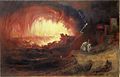
Then, (not having found even 10 righteous people in the city) they command Lot to gather his family and leave, revealing that they were sent to destroy Sodom and Gomorrah. As they make their escape, the angels command Lot and his family not to look back under any circumstance. However, as Sodom and Gomorrah are destroyed by Yahweh with fire and brimstone
Fire and brimstone
Fire and brimstone is an idiomatic expression of signs of God's wrath in the Hebrew Bible and the New Testament. In the Bible, they often appear in reference to the fate of the unfaithful. "Brimstone," possibly the ancient name for sulfur, evokes the acrid odor of volcanic activity...
, Lot's wife
Lot's wife
Lot's wife is a person mentioned in the Book of Genesis who was turned into a pillar of salt for failing to heed the orders of the angels of deliverance from the city of Sodom."Lot's wife" may further refer to:-Geography:...
looks back at the city in defiance of the angels' specific command, and she becomes a pillar of salt.
Jewish
Classical Jewish texts are seen by many as not stressing the homosexual aspect of the attitude of the inhabitants of Sodom as much as their cruelty and lack of hospitalityHospitality
Hospitality is the relationship between guest and host, or the act or practice of being hospitable. Specifically, this includes the reception and entertainment of guests, visitors, or strangers, resorts, membership clubs, conventions, attractions, special events, and other services for travelers...
to the "stranger." The Jewish Encyclopaedia has information on the importance of hospitality to the Jewish people. The people of Sodom were seen as guilty of many other significant sins. Rabbi
Rabbi
In Judaism, a rabbi is a teacher of Torah. This title derives from the Hebrew word רבי , meaning "My Master" , which is the way a student would address a master of Torah...
nic writings affirm that the Sodomites also committed economic crimes, blasphemy and bloodshed. One of the worst was to give money or even gold ingots to beggars, after inscribing their names on them, and then subsequently refusing to sell them food. The unfortunate stranger would end up starving and after his death, the people who gave him the money would reclaim it.
A rabbinic tradition, described in the Mishnah
Mishnah
The Mishnah or Mishna is the first major written redaction of the Jewish oral traditions called the "Oral Torah". It is also the first major work of Rabbinic Judaism. It was redacted c...
, postulates that the sin of Sodom was related to property: Sodomites believed that "what is mine is mine, and what is yours is yours" (Abot), which is interpreted as a lack of compassion. Another rabbinic tradition is that these two wealthy cities treated visitors in a sadistic fashion. One major crime done to strangers was almost identical to that of Procrustes
Procrustes
In Greek mythology Procrustes or "the stretcher [who hammers out the metal]", also known as Prokoptas or Damastes "subduer", was a rogue smith and bandit from Attica who physically attacked people by stretching them or cutting off their legs, so as to force them to fit the size of an iron bed...
in Greek mythology. This would be the story of the "bed" that guests to Sodom were forced to sleep in: if they were too short they were stretched to fit it, and if they were too tall, they were cut up (indeed, in Hebrew and Yiddish, the corresponding term for a Procrustean bed is a "Sodom bed").
In another incident, Eliezer
Eliezer
For the mathematician and Tamil activist see C.J. Eliezer; for the AI researcher and writer on rationality see Eliezer Yudkowsky; for the Levite priest of the Hebrew Bible, see Eleazar...
, Abraham's servant, went to visit Lot in Sodom and got in a dispute with a Sodomite over a beggar, and was hit in the forehead with a stone, making him bleed. The Sodomite demanded Eliezer pay him for the service of bloodletting
Bloodletting
Bloodletting is the withdrawal of often little quantities of blood from a patient to cure or prevent illness and disease. Bloodletting was based on an ancient system of medicine in which blood and other bodily fluid were considered to be "humors" the proper balance of which maintained health...
, and a Sodomite judge sided with the Sodomite. Eliezer then struck the judge in the forehead with a stone and asked the judge to pay the Sodomite.
The Talmud
Talmud
The Talmud is a central text of mainstream Judaism. It takes the form of a record of rabbinic discussions pertaining to Jewish law, ethics, philosophy, customs and history....
and the book of Jasher also recount two incidents of a young girl (one involved Lot's daughter Paltith) who gave some bread to a poor man who had entered the city. When the townspeople discovered their acts of kindness, they burned Paltith and smeared the other girl's body with honey and hung her from the city wall until she was eaten by bees. (Sanhedrin
Sanhedrin (Talmud)
Sanhedrin is one of ten tractates of Seder Nezikin . It originally formed one tractate with Makkot, which also deals with criminal law...
109a.) It is this gruesome event, and her scream in particular, the Talmud concludes, that are alluded to in the verse that heralds the city’s destruction: "So said, 'Because the outcry of Sodom and Gomorrah has become great, and because their sin has been very grave, I will descend and see...'"
A modern orthodox position is one that holds, “The paradigmatic instance of such aberrant behavior is found in the demand of the men of Sodom to 'know' the men visiting Lot, the nephew of Abraham, thus lending their name to the practice of 'sodomy'."
Christian
Several theories have been advanced in ChristianChristian
A Christian is a person who adheres to Christianity, an Abrahamic, monotheistic religion based on the life and teachings of Jesus of Nazareth as recorded in the Canonical gospels and the letters of the New Testament...
thought concerning the sin of Sodom, two of which are prevailing opinions—a sexual and a nonsexual view.
The more prominent theory, representing orthodox Christian opinion, holds that the demand of Lot's countrymen was referring to a militant solicitation
Solicitation
Literally, solicitation means: 'urgently asking'. It is the action or instance of soliciting; petition; proposal. In criminal law, it most commonly refers to either the act of offering goods or services, or the act of attempting to purchase such goods or services...
for homosexual sex—a same-sex orgy.
The contention between the two positions primarily focuses upon the meaning of the word know, in verse 5:
Those who favor the non-sexual interpretation argue against a denotation of sexual behavior in this context, noting that while the Hebrew word for know appears over 900 times in the Hebrew Scriptures, only approximately 1% (13-14 times) of those references is it clearly used as a euphemism for realizing sexual intimacy. Instead, those who hold to this interpretation usually see the demand to know as demanding the right to interrogate the strangers.
Countering this is the observation that one of the examples of "know" meaning to know sexually occurs only three verses later in the same narrative:
The following is a major text in regard to these conflicting opinions:
This reference to "going after strange flesh" is understood in different ways to include something akin to bestiality, having illicit sex with strangers, having sex with angels, but most often God's destruction of the populations of the four cities is interpreted to mean homosexual (same-sex) relations.
Many who interpret the stories in a non-sexual context contend that as the word for “strange” is akin to “another,” “other,” “altered” or even “next,” the meaning is unclear, and if the condemnation of Sodom was the result of sexual activities perceived to be perverse, then it is likely that it was because women sought to commit fornication with “other than human” angels, perhaps referring to or the apocryphal Book of Enoch
Book of Enoch
The Book of Enoch is an ancient Jewish religious work, traditionally ascribed to Enoch, the great-grandfather of Noah. It is not part of the biblical canon as used by Jews, apart from Beta Israel...
. Countering this, it is pointed out that refers to angels seeking women, not men seeking angels, and that both Sodom and Gomorrah were engaged in the sin Jude describes before the angelic visitation, and that, regardless, it is doubtful that the Sodomites knew they were angels. In addition, it is argued the word used in the King James Version of the Bible for "strange," can mean unlawful or corrupted , and that the apocryphal book of Enoch condemns "sodomitic" sex (Enoch 10:3; 34:1), thus indicating that homosexual relations was the prevalent physical sin of Sodom.
Both the non-sexual and the homosexuality
Homosexuality
Homosexuality is romantic or sexual attraction or behavior between members of the same sex or gender. As a sexual orientation, homosexuality refers to "an enduring pattern of or disposition to experience sexual, affectional, or romantic attractions" primarily or exclusively to people of the same...
view invoke certain classical writings as well as other portions of the Bible.
Here the nonsexual view focuses on the inhospitality aspect, while the other notes the description detestable or abomination
Abomination (Bible)
Abomination is an English term used to translate the Biblical Hebrew terms shiqquwts and sheqets, which are derived from shâqats, or the terms , tōʻēḇā or to'e'va or ta'ev...
, the Hebrew word for which often denotes moral sins, including those of a sexual nature.
In the Gospel
Gospel
A gospel is an account, often written, that describes the life of Jesus of Nazareth. In a more general sense the term "gospel" may refer to the good news message of the New Testament. It is primarily used in reference to the four canonical gospels of Matthew, Mark, Luke, and John...
of Matthew (and corresponding verse) when Jesus
Jesus
Jesus of Nazareth , commonly referred to as Jesus Christ or simply as Jesus or Christ, is the central figure of Christianity...
warns of a worse judgment for some cities than Sodom, inhospitality is perceived by some as the sin, while others see it fundamentally being impenitence:
The nonsexual view focuses on the cultural importance of hospitality, which this biblical story shares with other ancient civilizations, such as Greece
Ancient Greece
Ancient Greece is a civilization belonging to a period of Greek history that lasted from the Archaic period of the 8th to 6th centuries BC to the end of antiquity. Immediately following this period was the beginning of the Early Middle Ages and the Byzantine era. Included in Ancient Greece is the...
and Rome
Ancient Rome
Ancient Rome was a thriving civilization that grew on the Italian Peninsula as early as the 8th century BC. Located along the Mediterranean Sea and centered on the city of Rome, it expanded to one of the largest empires in the ancient world....
, where hospitality
Hospitality
Hospitality is the relationship between guest and host, or the act or practice of being hospitable. Specifically, this includes the reception and entertainment of guests, visitors, or strangers, resorts, membership clubs, conventions, attractions, special events, and other services for travelers...
was of singular importance and strangers were under the protection of the gods.
The orthodox position does not deny this important cultural aspect, but tends to see the refusal to repent as being the main issue behind Jesus's condemnation, with this being causative of the particular inhospitality shown by the cities Jesus referred to. In addition, they see the information regarding Sodom as best indicating that forced perverse sex was the specific means of inhospitality, and the primary physical sin of Sodom.
Islamic
The people of Sodom and Gomorrah, the twin cities which Lot was sent to with God's message, transgressed consciously against the bounds of God. Their avarice led to inhospitality and robbery, which in turn led to the humiliation of strangers by mistreatment and rape. It was their abominable sin of homosexuality which was seen as symptomatic of their attitudes, and upon Lot's exhorting them to abandon their transgression against God, they ridiculed him, threatening with dire consequences; Lot only prayed to God to be saved from doing as they did.Moses
Moses in talking with the IsraeliteIsraelite
According to the Bible the Israelites were a Hebrew-speaking people of the Ancient Near East who inhabited the Land of Canaan during the monarchic period .The word "Israelite" derives from the Biblical Hebrew ישראל...
s during the Exodus
The Exodus
The Exodus is the story of the departure of the Israelites from ancient Egypt described in the Hebrew Bible.Narrowly defined, the term refers only to the departure from Egypt described in the Book of Exodus; more widely, it takes in the subsequent law-givings and wanderings in the wilderness...
, refers to the destruction of Sodom and Gomorrah in :
See also:
Major Prophets
, and addresses people as from Sodom and Gomorrah, associates Sodom with shameless sinning and tells Babylon that it will end like Sodom and Gomorrah., , and associate Sodom and Gomorrah with adultery and lies, prophesies the fate of Edom, south of the Dead Sea, prophesies the fate of Babylon and uses Sodom as a comparison.
In God compares Jerusalem to Sodom, saying "Sodom never did what you and your daughters have done." He explains that the sin of Sodom was that "She and her daughters were arrogant, overfed and unconcerned; they did not help the poor and needy. They were haughty and did detestable things before me."
Minor Prophets
In God tells the Israelites he had warned them and treated them like Sodom and Gomorrah, still they did not repent.In the prophet tells Moab and Ammon, southeast and northeast of the Dead Sea, that they will end up like Sodom and Gomorrah.
New Testament
In , cf. , Jesus declares certain cities more damnable than Sodom and Gomorrah, due to their response to Jesus' disciples, in the light of greater grace (RSVRevised Standard Version
The Revised Standard Version is an English translation of the Bible published in the mid-20th century. It traces its history to William Tyndale's New Testament translation of 1525. The RSV is an authorized revision of the American Standard Version of 1901...
):
In Jesus prophesies the fate of some cities where he did some of his works (RSV
Revised Standard Version
The Revised Standard Version is an English translation of the Bible published in the mid-20th century. It traces its history to William Tyndale's New Testament translation of 1525. The RSV is an authorized revision of the American Standard Version of 1901...
):
In Jesus compares his second-coming to the judgment of Sodom and Gomorrah (RSV
Revised Standard Version
The Revised Standard Version is an English translation of the Bible published in the mid-20th century. It traces its history to William Tyndale's New Testament translation of 1525. The RSV is an authorized revision of the American Standard Version of 1901...
):
In Paul quotes (RSV
Revised Standard Version
The Revised Standard Version is an English translation of the Bible published in the mid-20th century. It traces its history to William Tyndale's New Testament translation of 1525. The RSV is an authorized revision of the American Standard Version of 1901...
): "And as Isaiah predicted, 'If the Lord of hosts had not left us children, we would have fared like Sodom and been made like Gomor'rah.'"
In Peter uses the time of Sodom and Lot in his description of the time of the second coming of Jesus.
records that both Sodom and Gomorrah were "giving themselves over to fornication, and going after strange flesh, are set forth for an example, suffering the vengeance of eternal fire."
makes an allegorical use of Sodom when it describes the places where two prophets will descend during the Apocalypse
Apocalypse
An Apocalypse is a disclosure of something hidden from the majority of mankind in an era dominated by falsehood and misconception, i.e. the veil to be lifted. The Apocalypse of John is the Book of Revelation, the last book of the New Testament...
.
Deuterocanonical references
Wisdom 10:6 refers to Five Cities, including Sodom, or Pentapolis: "Wisdom rescued a righteous man when the ungodly were perishing; he escaped the fire that descended on the Five Cities."Sodom was one of a group of five towns, the Pentapolis
Pentapolis
A pentapolis, from the Greek words , "five" and , "city" is a geographic and/or institutional grouping of five cities...
: Sodom, Gomorrah, Admah, Zeboim and Bela
Bela
Bela may refer to:Trick-taking card games* Klaberjass, popular in Jewish communities* Belot, popular in CroatiaPlaces* Bela, on the banks of river Satluj, district Rupar, Punjab, India*Bela, Ajdovščina, Slovenia*Bela, Kamnik, Slovenia*Bela, Nepal...
—also called Zoar
Zoara
Zoara, the biblical Zoar, previously called Bela, was one of the five cities of the plain of Jordan in Genesis in the Tanakh or Old Testament, which escaped the "brimstone and fire" which destroyed Sodom and Gomorrah, for having sheltered Lot and his daughters...
. The Pentapolis region is also collectively referred to as "the cities of the plain"
Modern Sodom
The site of the present Dead Sea WorksDead Sea Works
The Dead Sea Works is an Israeli potash plant in Sdom, on the Dead Sea coast of Israel.-History:The company was established in 1930 by Moshe Novomeysky. It was known then as the Palestine Potash Company...
, a large operation for the extraction of Dead Sea minerals, is called "Sdom" (סדום) according to its traditional Arab name, Khirbet as-sudūm. Nearby is unique Mount Sodom (הר סדום in Hebrew) consisting mainly of salt. In the Plain of Sdom (מישור סדום) to the south there are a few springs and two small agricultural villages.
Popular culture
- The story of Sodom and Gomorrah was told in a 1963 film starring Stewart GrangerStewart GrangerStewart Granger was an English-American film actor, mainly associated with heroic and romantic leading roles. He was a popular leading man from the 1940s to the early 1960s rising to fame through his appearances in the Gainsborough melodramas.-Early life:He was born James Lablache Stewart in Old...
as Lot with Anouk AimeeAnouk AiméeAnouk Aimée is a French film actress. Aimée has appeared in 70 films since 1947. She began her film career in 1947 at age 14. In 1958 she portrayed the tragic artist Jeanne Hébuterne in the film Les Amants de Montparnasse...
and Pier AngeliPier AngeliPier Angeli was an Italian-born television and film actress. Her American cinematographic debut was in the starring role of the 1951 film Teresa, in which she won a Golden Globe Award...
and directed by Robert AldrichRobert AldrichRobert Aldrich was an American film director, writer and producer, notable for such films as Kiss Me Deadly , The Big Knife , What Ever Happened to Baby Jane? , Hush… Hush, Sweet Charlotte , The Flight of the Phoenix , The Dirty Dozen , and The Longest Yard .-Biography:Robert...
. - In the movie Year One (film) the main setting is Sodom
- In the movie The Bible: In The BeginningThe Bible: In The BeginningThe Bible: In the Beginning is a 1966 Biblical epic film recounting the first 22 chapters of the Book of Genesis. It was a joint American/Italian production conceived by Dino De Laurentiis and directed by John Huston. The music score is by Toshirô Mayuzumi. The production was photographed by...
, George C. ScottGeorge C. ScottGeorge Campbell Scott was an American stage and film actor, director and producer. He was best known for his stage work, as well as his portrayal of General George S. Patton in the film Patton, and as General Buck Turgidson in Stanley Kubrick's Dr...
plays AbrahamAbrahamAbraham , whose birth name was Abram, is the eponym of the Abrahamic religions, among which are Judaism, Christianity and Islam...
, Gabriele FerzettiGabriele FerzettiGabriele Ferzetti is an Italian actor. He has more than 160 credits to his name across film, television and stage. His career was at its peak in the 1950s and 1960s....
Lot, and Peter O'ToolePeter O'ToolePeter Seamus Lorcan O'Toole is an Irish actor of stage and screen. O'Toole achieved stardom in 1962 playing T. E. Lawrence in Lawrence of Arabia, and then went on to become a highly-honoured film and stage actor. He has been nominated for eight Academy Awards, and holds the record for most...
the three angels, in the bargaining episode. - In the movie The Scorpion KingThe Scorpion KingThe Scorpion King is a 2002 American action film directed by Chuck Russell, starring Dwayne "The Rock" Johnson, Kelly Hu, Grant Heslov, and Michael Clarke Duncan...
, the antagonist Memnon rules the city of Gomorrah. - In the manga and anime, One PieceOne Pieceis a Japanese shōnen manga series written and illustrated by Eiichiro Oda. It has been serialized in Weekly Shōnen Jump since August 4, 1997; the individual chapters are being published in tankōbon volumes by Shueisha, with the first released on December 24, 1997, and the 64th volume released as...
, the Franky Family owns two King Bulls called Sodom and Gomorrah. - ScottishScottish peopleThe Scottish people , or Scots, are a nation and ethnic group native to Scotland. Historically they emerged from an amalgamation of the Picts and Gaels, incorporating neighbouring Britons to the south as well as invading Germanic peoples such as the Anglo-Saxons and the Norse.In modern use,...
science fictionScience fictionScience fiction is a genre of fiction dealing with imaginary but more or less plausible content such as future settings, futuristic science and technology, space travel, aliens, and paranormal abilities...
and fantasyFantasyFantasy is a genre of fiction that commonly uses magic and other supernatural phenomena as a primary element of plot, theme, or setting. Many works within the genre take place in imaginary worlds where magic is common...
writer Hal DuncanHal DuncanHal Duncan is a Scottish science fiction and fantasy writer who published two novels, one novella, three poetry collections and several short stories.His works have been listed in the New Weird genre but he denies that such genre was even known to him at the time...
, who is homosexualHomosexualityHomosexuality is romantic or sexual attraction or behavior between members of the same sex or gender. As a sexual orientation, homosexuality refers to "an enduring pattern of or disposition to experience sexual, affectional, or romantic attractions" primarily or exclusively to people of the same...
, writes a monthly column entitled Notes from New Sodom. - In the videogame Fallout: New VegasFallout: New VegasFallout: New Vegas is a first person action role-playing video game in the Fallout series developed by Obsidian Entertainment, and published by Bethesda Softworks. The game is based in a post-apocalyptic environment in and around Las Vegas, Nevada...
one of the main casinos on the strip is named Gomorrah, and its most notable trait is the abundance of exotic dancers and prostitutes as well as a hell-like decor. - Sodom and Gomorrah are discussed by "John Doe" in the movie Se7enSeven (film)Seven is a 1995 American thriller film, which also contains horror and neo-noir elements, directed by David Fincher and written by Andrew Kevin Walker. It was distributed by New Line Cinema and stars Brad Pitt, Morgan Freeman, Gwyneth Paltrow, R...
during the film's final scene. - Reverend BizarreReverend BizarreReverend Bizarre was a doom metal band from Finland. They played slow and heavy traditional doom with dramatic vocals, following in the footsteps of bands such as Saint Vitus, Pentagram and Black Sabbath....
's track, Sodoma Sunrise, from their album In the Rectory of the Bizarre ReverendIn the Rectory of the Bizarre ReverendIn the Rectory of the Bizarre Reverend is the debut album by Finnish doom metal band Reverend Bizarre. It was originally released in 2002. It was rereleased with a bonus CD titled Return to the Rectory in 2004...
, is based on the tale of the destruction of the cities. - In the science-fantasy game setting Warhammer 40000, the Dark Eldar's home city of Commorragh derives its name--and likewise it's decadent culture--from the biblical Gomorrah.
- The punk band Anti-FlagAnti-FlagAnti-Flag is a punk rock band from Pittsburgh, Pennsylvania in the United States, formed in 1988. The band is well known for its outspoken political views. Much of the band's lyrics have focused on fervent anti-war activism, criticism of United States foreign policy, corporatism, U.S. wealth...
has released a song called "Sodom, Gomorrah, Washington D.C" on their album The People Or The GunThe People or the GunThe People or the Gun is Anti-Flag's seventh studio album. The album was released on June 9, 2009. It was their first album released on independent label SideOneDummy Records after the band's two-record contract ended with RCA Records. The first track, "Sodom, Gomorrah, Washington D.C... - In the song Jokerman by Bob DylanBob DylanBob Dylan is an American singer-songwriter, musician, poet, film director and painter. He has been a major and profoundly influential figure in popular music and culture for five decades. Much of his most celebrated work dates from the 1960s when he was an informal chronicler and a seemingly...
from his 1983 album InfidelsInfidelsInfidels is singer-songwriter Bob Dylan's 22nd studio album, released by Columbia Records in October 1983.Produced by Mark Knopfler and Dylan himself, Infidels is seen as his return to secular music, following a conversion to Christianity and three evangelical, gospel records...
.
See also
- Apples of Sodom
- Aye, and GomorrahAye, and Gomorrah"Aye, and Gomorrah..." is a famous science fiction short story by Samuel R. Delany. It is Delany's first sold short story, and won the 1967 Nebula Award for best short story. Before it appeared in Driftglass and Aye, and Gomorrah, and other stories, it was first published as the closing tale in...
- The Bible and homosexualityThe Bible and homosexualityThere are a number of direct references to homosexuality in the Bible.In Mosaic law, male homosexuality is identified as an "abomination".In the New Testament, Paul of Tarsus condemns arsenokoitēs, a term related to male homosexuality that is open to much interpretation; it could mean male...
- Bombing of Hamburg during the last week of July, 1943Bombing of Hamburg in World War IIThe Allied bombing of Hamburg during World War II included numerous strategic bombing missions and diversion/nuisance raids. As a large port and industrial center, Hamburg's shipyards, U-boat pens, and the Hamburg-Harburg area oil refineries were attacked throughout the war...
, designated Operation Gomorrah - GesangsszeneGesangsszeneGesangsszene is the final composition of the German composer Karl Amadeus Hartmann....
, a musical setting by Karl Amadeus HartmannKarl Amadeus HartmannKarl Amadeus Hartmann was a German composer. Some have lauded him as the greatest German symphonist of the 20th century, although he is now largely overlooked, particularly in English-speaking countries.-Life:...
of Jean GiraudouxJean GiraudouxHippolyte Jean Giraudoux was a French novelist, essayist, diplomat and playwright. He is considered among the most important French dramatists of the period between World War I and World War II. His work is noted for its stylistic elegance and poetic fantasy...
's Sodome et Gomorrhe (Sodom and GomorrahSodom and Gomorrah (play)Sodom and Gomorrah is a play written in 1943 by French dramatist Jean Giraudoux.Sodom and Gomorrah is a biblical tragedy on relations between men and women and the impossible satisfaction between both sexes so different expectations...
). - Homosexuality in the Hebrew BibleHomosexuality in the Hebrew BibleThe Hebrew Bible refers to certain male homosexual acts in some instances.The most harsh condemnation of male homosexuality - specifically, of anal-penetrative sexual behavior - is found in Leviticus, where it is listed as an "abomination".- Sodom and Gomorrah :...
- Religion and homosexuality
- VayeiraVayeiraVayeira, Vayera, or Va-yera is the fourth weekly Torah portion in the annual Jewish cycle of Torah reading. It constitutes Genesis Jews read it on the fourth Sabbath after Simchat Torah, generally in October or November....
, the Torah portionParshaThis article is about the divisions of the Torah into weekly readings. For this week's Torah portion, see Torah portionThe weekly Torah portion |Sidra]]) is a section of the Torah read in Jewish services...
containing the story of Sodom and Gomorrah - Vine of SodomVine of SodomVine of Sodom - referred to only in Deut. 32:32. Among the many conjectures as to this tree, the most probable is that it is the osher of the Arabs, which grows from Jordan to southern Egypt...
- Lot
- Lot's WifeLot's WifeLot's Wife is the student newspaper of Monash University's Clayton campus. It is produced by students, for students and operates as part of the Monash Student Association.-History:...
External links
- Atlantic Baptist University Sodom and Gomorrah
- "Commentary on Genesis 19" by Robert Jameison, D.D. 1871
- "Commentary on Genesis 19" by Theodore Beza
- Harvard University The 1975–1981 Excavations At The Town Site Of Bab edh-DhraBab edh-DhraBab edh-Dhra is the site of an Early Bronze Age city, located near the Dead Sea, in Wadi Kerak, forwarded as a candidate for the location of Biblical Sodom....
- Ontario Consultants on Religious Tolerance This site has an extensive coverage of both the liberal and conservative Christian views of the story of Sodom and Gomorra.
- Sodom and Gomorrah at the Catholic Encyclopedia
- University of Melbourne "Bab edh-Dhra is located on the South-East edge of the Dead Sea in Jordan, not far from Numeira (identified with Gomorroh)."
- University of Notre Dame Expedition to the Dead Sea Plain.