
All Topics  
Adam and Eve


   Email Print
   Bookmark   Link


Adam and Eve


Adam ('A?am, "dust; man; mankind"; , ) and Eve (, "living one"; , ) are the first man and woman
First man or woman

Various creation myths have a first human, a legendary first human being.It refers to either a male, or a female, or a pair of one male and one female....
 created by God
God

God is a deity in theism and deism religions and other belief systems, representing either the sole deity in monotheism, or a principal deity in polytheism....
 in the Hebrew creation story told in Genesis
Genesis

Genesis or Breishit is the first book of the Bible used by Judaism and Christianity, and the first of five books of the Pentateuch or Torah....
 1-2.

Narrative
Genesis tells the story of Adam and Eve in chapters 1, 2 and 3, with some additional elements in chapters 4 and 5:

In Genesis 1 God creates humans "male and female" in His image, and gives them dominion over the living things He has created, and commands them to "be fruitful and multiply."

Genesis 2 opens with God fashioning a man from the dust and blowing life into his nostrils.


Discussion
Ask a question about 'Adam and Eve'
Start a new discussion about 'Adam and Eve'
Answer questions from other users
Full Discussion Forum


Recent Posts


Quotations


Adam and Eve had many advantages, but the principle one was that they escaped teething.

Mark Twain, Pudd'nhead Wilson's Calendar

Adam, man's benefactor--he gave him all he has ever received that was worth having--Death.

Mark Twain Notebook, 1902-1903

The Lord made Adam, the Lord made Eve, he made em both a little bit naive.

E. Y. Harburg, “The Begat,” Finian’s Rainbow (1947)

Adam and Eve, according to the fable, wore the bower before other clothes. Man wanted a home, a place of warmth, or comfort, first of physical warmth, then the warmth of the affections.

Adam knew Eve his wife and she conceived. It is a pity that this is still the only knowledge of their wives at which some men seem to arrive.

F. H. Bradley, Aphorisms, no. 94 (1930)

Adam was but human--this explains it all. He did not want the apple for the apple's sake, he wanted it only because it was forbidden. The mistake was in not forbidding the serpent; then he would have eaten the serpent.


Encyclopedia


God2 Sistine Chapel


Adam ('A?am, "dust; man; mankind"; , ) and Eve (, "living one"; , ) are the first man and woman
First man or woman

Various creation myths have a first human, a legendary first human being.It refers to either a male, or a female, or a pair of one male and one female....
 created by God
God

God is a deity in theism and deism religions and other belief systems, representing either the sole deity in monotheism, or a principal deity in polytheism....
 in the Hebrew creation story told in Genesis
Genesis

Genesis or Breishit is the first book of the Bible used by Judaism and Christianity, and the first of five books of the Pentateuch or Torah....
 1-2.

Narrative


Genesis tells the story of Adam and Eve in chapters 1, 2 and 3, with some additional elements in chapters 4 and 5:

In Genesis 1 God creates humans "male and female" in His image, and gives them dominion over the living things He has created, and commands them to "be fruitful and multiply."

Genesis 2 opens with God fashioning a man from the dust and blowing life into his nostrils. God plants a garden (the Garden of Eden
Garden of Eden

The Garden of Eden is a location described in the Book of Genesis as being the place where the first man, Adam , and his wife, Eve , lived after they were created by God....
) and sets the man there, "to work it and watch over it," permitting him to eat of all the trees in the garden except the Tree of Knowledge of Good and Evil
Tree of Knowledge of Good and Evil

In the Book of Genesis, the Tree of Knowledge of Good and Evil was a tree in the middle of the Garden of Eden from which God directly forbade Adam to eat ....
, "for on the day you eat of it you shall surely die." Then God creates the animals, attempting to find a help-mate for the man; but none of the animals are satisfactory, and so God causes the man to sleep, and creates a woman from his rib. The man names her "Woman" (Heb. ishshah), "for this one was taken from a man" (Heb. ish). "On account of this a man leaves his father and his mother and clings to his woman." Genesis 2 ends with the note that the man and woman were naked, and were not ashamed.

Genesis 3 introduces the Serpent, "slier than every beast of the field." The serpent tempts the woman to eat from the tree of knowledge, telling her that it will not lead to death; she succumbs, and gives the fruit to the man, who eats also, "and the eyes of the two of them were opened." Aware now of their nakedness, they make coverings of fig leaves, and hide from the sight of God. God, perceiving that they have broken His command, curses them with hard labour and with pain in childbirth, and banishes them from His garden, setting a cherub at the gate to bar their way to the Tree of Life, "lest he put out his hand ... and eat, and live forever."

Genesis 4 and 5 give the story of Adam and Eve's family after they leave the garden: they have three children, Cain, Abel and Seth, as well as other sons and daughters, and Adam's lifespan is 930 years. ("The woman" is given the name Eve in the closing verses of Genesis 3, "because she was the mother of all living"; Adam gets his name when the initial definite article is dropped, changing "ha-adam", "the man", to "Adam".)

Textual notes

  • "Let us make man..." - The plural "us" (and "our" in the phrase "in our image") is traditionally understood to refer to God and the angels, or to be a "plural of majesty" (the "royal we"). More recent scholarship is that it reflects the common Middle Eastern view of a supreme god (referred to in Genesis 1 by the generic noun "Elohim", god, which is itself in a plural form, rather than by his personal name of Yahweh) surrounded by a divine court, the Sons of God (Heb. bene elohim). Christian scholars have traditionally interpreted the plural "us" as evidence for the doctrine of the Holy Trinity.


  • "man" - Though the word for "man" is in the singular, when in the text a pronoun is used, it is rendered by the plural "them", indicating that the word is used generically to cover "man and woman", and that a rendition of "mankind" or "human beings" is not out of place.


  • "...in our image" - The phrase image of God has had many interpretations, although something more than the simply anthropomorphic seems intended. Elsewhere in the ancient Near East kings were called the "image of god", symbolising their rule by divine appointment: the phrase may therefore indicate that mankind is God's regent on earth.


  • "...a living being" - God breathes into the man's nostrils and he becomes nefesh hayya. The earlier translation of this phrase as "living soul" is now recognised as incorrect: "nefesh" signifies something like the English word "being", in the sense of a corporeal body capable of life; the concept of a "soul" in our sense did not exist in Hebrew thought until around the 2nd century BC, when the idea of a bodily resurrection gained popularity.


  • "...tree of knowledge of good and evil..." - The tree imparts knowledge of tov wa-ra, "good and bad". The traditional translation is "good and evil", but tov wa-ra is a fixed expression denoting "everything," rather than a moral concept.


  • "...you shall surely die" - Adam is told that if he eats of the forbidden tree the consequence will be moth tamuth, indicating not merely death but emphatically so. As Adam does not in fact die immediately on eating the fruit, some exegetes have argued that it means "you shall die eventually," so that Adam and Eve would have had immortality in the Garden, but lost it by eating the forbidden fruit. However, the grammar does not support this reading, nor does the narrative: Adam and Eve are expelled from the Garden lest they eat of the second tree, the tree of life, and gain immortality. However, according to the Book of Jubilees
    Jubilees

    The Book of Jubilees , sometimes called the Lesser Genesis , is an ancient Jewish religious work, considered one of the Pseudepigrapha by most Protestant, Roman Catholic, and Eastern Orthodox Christians....
     (chapter 4 29-31) "one day" is equivalent to a thousand years and thus Adam died within that same "day".


  • "...a rib..." - Hebrew tsela` can mean side, chamber, rib, or beam. The traditional reading of "rib" has been questioned recently by feminist theologians who suggest it should instead be rendered as "side," supporting the idea that woman is man's equal and not his subordinate.


Later Abrahamic traditions


Jewish traditions

Adam Travaille
In the Sibylline Oracles
Sibylline oracles

The Sibylline Oracles are a collection of oracular utterances written in Dactylic hexameter ascribed to the Sibyls, prophetesses who uttered divine revelations in a frenzied state....
, the name Adam is explained as a notaricon composed of the initials of the four directions; anatole
Anatole

Anatole, a fictional character in the works of P. G. Wodehouse, is a highly skilled yet temperamental France chef employed first by Mr and Mrs Bingo Little and later by Dahlia Travers, Bertie Wooster's aunt and chatelaine of Brinkley Court....
 (east), dusis (west), arktos
Arktos

Arktos, Greek a??t??, means 'bear', from the Proto-Indo-European language root *. The Arctic is named from this Greek word in reference to the northern constellations of Ursa Major, Great Bear, and Ursa Minor, Little Bear....
 (north), and mesembria
Mesembria

Mesembria or Messembria or Mesambria may refer to:*an ancient town corresponding to modern Nesebar*an ancient Greek town on the Aegean Sea coast of Thrace...
 (south). The Jews had their own acrostic
Acrostic

An acrostic is a poem or other writing in an alphabetic writing system, in which the first letter, syllable or word of each line, paragraph or other recurring feature in the text spells out another message....
 interpretation of the name Adam. In the 2nd century, Rabbi Yohanan used the Greek technique of notarichon to explain the name ????? as the initials of the words afer, dam, and marah, being dust, blood, and gall
Gall

Galls or plant galls are abnormal outgrowths of plant tissues and can be caused by various parasites, from fungi and bacterium, to insects and mites....
.

According to the Torah
Torah

The term "Torah" , or Five Books of Moses or Pentateuch, refers to the entirety of Judaism's founding Halakha and ethical religious texts....
 , Adam is said to have been formed by God from "dust from the earth"; in the Talmud
Talmud

The Talmud is a record of rabbinic discussions pertaining to Halakha, Jewish ethics, customs, and history. It is a central text of mainstream Judaism....
 (Tractate Sanhedrin 38b) of the first centuries of the Christian era he is, more specifically, described as having initially been a golem
Golem

In Jewish folklore, a golem is an animate being created entirely from inanimate matter. In modern Hebrew language the word golem literally means "cocoon", but can also mean "fool", "silly", or even "stupid"....
 kneaded from mud
MUD

In Online game, a MUD , pronounced /m?d/, is a multi-user real-time virtual world described entirely in text. It combines elements of role-playing games, hack and slash, interactive fiction, and online chat....
. In the Torah, God is described, at Genesis 1:26, as breathing the breath of life into the nostrils of the first man, and this is usually interpreted in Judaeo-Christian circles as having brought life immediately to the first man.

The Torah then describes that God caused a deep sleep to fall upon Adam, when He removed part of his body, usually interpreted as a rib (though a more literal translation is non-specific, referring to "side") from which he formed Eve. Once a matron asked Rabbi Jose (Talmud ), "Why did God steal a rib from Adam?" "Steal?" replied the Sage. "If one were to take away from your house an ounce of silver, and give you in return a pound of gold, that would not be stealing from you." "But," persisted the matron, "what need was there for secrecy?" "It was surely better," replied R. José, "to present Eve to Adam when she was quite presentable, and when no traces of the effects of the operation were visible".

Even in ancient times, the presence of two distinct accounts was noted, and regarded with some curiosity. The first account says male and female [God] created them, which has been assumed by critical scholars to imply simultaneous creation, whereas the second account states that God created Eve from Adam's rib because Adam was lonely. Thus to resolve this apparent discrepancy, medieval rabbis suggested that Eve and the woman of the first account were two separate individuals. This first woman was identified in the Midrash as Lilith
Lilith

Lilith is a mythology female Mesopotamian storm demon associated with wind and was thought to be a bearer of disease, illness, and death. The figure of Lilith first appeared in a class of wind and storm demons or spirits as Lilitu, in Sumer, circa 4000 BC....
, a figure elsewhere described as a night demon.

The word liyliyth can also mean "screech owl", as it is translated in the King James Version
King James Version of the Bible

The Authorized King James Version is an English language translation of the Christian Bible begun in 1604 and first published in 1611 by the Church of England....
 of Isaiah
Book of Isaiah

The Book of Isaiah is a book of the Bible traditionally attributed to the Prophet Isaiah, who lived in the second half of the 8th century BC. In the first 39 chapters, Isaiah prophesies doom for a sinful Judah and for all the nations of the world that oppose God....
 34:14, although some scholars take this to be a reference to the same demonic entity as mentioned in the Talmud.

Also in the Talmud, Lilith is identified as the mother of these creatures. The demons were said to prey on newborn males before they had been circumcised, and so a tradition arose in which a protective amulet was placed around the neck of newborns. Traditions in the Midrash
Midrash

Midrash is a Hebrew language term referring to the not exact, but comparative method of exegesis of Biblical texts, which is one of four methods cumulatively called Pardes ....
 concerning Lilith, and her sexual appetite, have been compared to Sumerian mythology concerning the demon ki-sikil-lil-la-ke, by scholars who postulate an intermediate Akkadian
Akkadian language

Akkadian or Assyrian-Babylonian is a Semitic language that was spoken in ancient Mesopotamia. The earliest attested Semitic language, it used the cuneiform writing system derived ultimately from ancient Sumerian language, an unrelated language isolate....
 folk etymology interpreting the lil-la-ke portion of the name as a corruption of lîlîtu, a female storm demon originating in Sumer.

It should be noted, however, that the Torah gives no mention whatsoever of any wife other than Eve. Many scholars see the statement "male and female he created them" to be a summary statement
Summary

A summary or recap is a shortened version of the original. The main purpose of such a simplification is to highlight the major points from the genuine subject, e.g....
, which is described in detail in a following passage. Such wording was a common literary tool
Literary technique

A literary technique or literary device is an identifiable rule of thumb, convention or structure that is employed in literature and storytelling....
 in ancient Hebrew writings
Hebrew literature

Hebrew literature consists of ancient, medieval, and modern writings in the Hebrew language. Beyond comparison, the most important such work is the Hebrew Bible ....
. This technique is also seen in the broad statement of Genesis 1:1
Genesis 1:1

Genesis 1:1 is the first Bible verse of the first chapter in the Book of Genesis, and contains the first words of the Bible. The verse begins the account of creation according to Genesis and its translation and interpretation is a major theology issue....
.

Another Jewish tradition — also used to explain "male and female He created them" line, is that God originally created Adam as a hermaphrodite
Hermaphrodite

A hermaphrodite is an organism having both male and female reproductive organs. In many species, hermaphroditism is a common part of the life-cycle, enabling a form of sexual reproduction in which partners are not separated into distinct male and female types of individual....
 [Midrash Rabbah - Genesis VIII:1], and in this way was bodily and spiritually male and female. He later decided that "it is not good for [Adam] to be alone", and created the separate beings of Adam and Eve, thus creating the idea of two people joining together to achieve a union of the two separate spirits.

Genesis does not tell for how long Adam and Eve were in the Garden of Eden
Garden of Eden

The Garden of Eden is a location described in the Book of Genesis as being the place where the first man, Adam , and his wife, Eve , lived after they were created by God....
, but the Book of Jubilees states that they were removed from the garden on the new moon of the fourth month of the 8th year after creation (Jubilees 3:33); other Jewish sources assert that it was less than a day. Shortly after their expulsion, Eve brought forth her first-born child, and thereafter their second — Cain and Abel
Cain and Abel

Cain and Abel were the first and second sons of Adam and Eve in the religions of Christianity, Islam and Judaism.Their story is told in and the Qur'an at 5:26-32....
, respectively.

Piero Della Francesca 036
After Cain killed Abel, and was cursed to wander, Adam and Eve conceived a third child named Seth, who, with Cain, gave rise to the two family lines of the Generations of Adam
Generations of Adam

The Generations of Adam according to Genesis 5 is the line of descent going through Seth. A second line of descent starting with Cain and Abel is listed in Genesis 4....
.

A sidenote, when Cain was banished for killing Abel, Cain fears that God's punishment of his banishment is "too great to bear" and that he "must avoid [God]'s presence and become a restless wanderer on earth--anyone who meets me may kill me" (Genesis 4.3) suggesting life of other men outside of and prior to or during Cain's lineage.

According to the Bible, Adam finally died at the age of 930 years, the traditional Jewish view being that he and Eve are currently buried in the Cave of Machpelah, in Hebron
Hebron

Hebron is the largest city in the West Bank, located in the south, 30 kilometers south of Jerusalem. It is home to some 166,000 Palestinians, and over 500 Israelis....
.

Christianity

Durer Adam and Eve
The story of Adam and Eve forms the basis for the Christian doctrine of original sin
Original sin

Original sin is, according to a doctrine in Christian theology, humanity's state of sin resulting from the Fall of Man. While the Old Testament and the New Testament, which frequently speak of the sinfulness of humans, do not contain the terms "original sin" or "ancestral sin", the doctrine expressed by these terms is claimed to be based on t...
: "Sin came into the world through one man and death through sin, and so death spread to all men because all men sinned," said Paul of Tarsus
Paul of Tarsus

Saint Paul, also called Paul the Apostle, the Apostle Paul or Paul of Tarsus , was a Hellenistic Judaism, who called himself the "Apostle to the Gentiles", and was, together with Saint Peter and James the Just, the most notable of early Christian missionaries....
 in his Epistle to the Romans
Epistle to the Romans

The Epistle of St. Paul the Apostle to the Romans is one of the letters of the New Testament canon of Scripture of the Christianity Bible. Often referred to simply as Romans, it is one of the seven currently undisputed letters of Paul the Apostle....
, writing in Greek about 58 AD. Nevertheless, Chapter 3 of Genesis does not use the word "sin", and Genesis 3:24 makes clear that they are expelled "lest he put forth his hand and take also of the tree of life, and eat, and live for ever". St Augustine of Hippo (354-430), working with a Latin translation of the epistle, understood Paul to have said that Adam's sin was hereditary: "Death passed upon (i.e. spread to) all men because of Adam, [in whom] all sinned". Original sin, the concept that man is born in a condition of sinfulness and must await redemption, became a cornerstone of Christian theological tradition, primarily in Western-rite churches, but is not shared by Judaism, the Orthodox churches, nor by post-Reformation churches such as the Congregationalist churches, nor The Church of Jesus Christ of Latter-day Saints.

Over the centuries, a system of uniquely Christian beliefs has developed from the Adam and Eve story. Baptism
Baptism

In Christianity, baptism is the ritual act, with the use of water, by which one is admitted as a full member of the Christian Church and, in the view of some, as a member of the particular Church in which the baptism is administered....
 has become understood as a means of washing away the stain of hereditary sin in many churches. Additionally, the serpent that tempted Eve was interpreted by some to have been Satan
Satan

Satan is a term that originates from the Abrahamic religions, being traditionally applied to an angel in Judeo-Christian belief, and to a Genie in Islamic belief....
, or that Satan was using a serpent as a mouthpiece, although there is no mention of this identification in the Torah.

Christian interpretations of the Scripture are often considered more literal than Jewish interpretations. Because Eve had tempted Adam to eat of the fatal fruit, some early Fathers of the Church held her and all subsequent women to be the first sinners, and especially responsible for the Fall. "You are the devil's gateway," Tertullian
Tertullian

Quintus Septimius Florens Tertullianus, anglicised as Tertullian, was a prolific and controversial early Christian author, and the first to write Christian Latin literature....
 told his female listeners in the early 2nd century, and went on to explain that they were responsible for the death of Christ: "On account of your desert _ that is, death - even the Son of God had to die." In 1486 the Dominicans
Dominican Order

The Order of Preachers , after the 15th century more commonly known as the Dominican Order or Dominicans, is a Roman Catholic religious order founded by Saint Dominic in the early 13th century in France....
 Kramer and Sprengler used similar tracts to justify the Malleus Maleficarum
Malleus Maleficarum

The Malleus Maleficarum is a famous treatise on witches, written in 1486 by Heinrich Kramer and Jacob Sprenger, two Inquisition of the Catholic Church, and was first published in Germany in 1487....
 ("Hammer of the Witches") that led to three centuries of European persecution of "witches".

Eastern Orthodox
Eastern Orthodox Church

The Eastern Orthodox Church is the second largest single Christian communion in the world with an estimated 225 million members worldwide. It is considered by its adherents to be the Four Marks of the Church established by Jesus Christ and his Apostles nearly 2000 years ago....
 tradition holds that the sword placed at the entrance to Paradise
Paradise

Paradise is an idealized place in which existence is positive, harmonious and timeless. It is conceptually a counter-image of the miseries of human civilization, and in paradise there is only peace, prosperity, and happiness....
 to prevent humankind from returning to the Garden was removed once Jesus
Jesus

Jesus of Nazareth , also known as Jesus Christ, is the central figure of Christianity and is revered by most Christian churches as the Son of God and the Incarnation ....
 was born.

Gnostic and Manichaean traditions

(1) Gnostic Christianity has two unique texts containing stories of Adam and Eve: the Nag Hamadi text "Apocalypse of Adam
Apocalypse of Adam

The Apocalypse of Adam discovered in 1945 as part of the Nag Hammadi library is a Gnosticism work written in Coptic language. It has no necessary references to Christianity and it is accordingly debated whether it is a Christian Gnostic work or an example of Jewish Gnosticism....
" and the "Testament of Adam
Testament of Adam

The Testament of Adam is a Christian pseudepigraphy work extant in Syriac and Arabic. The earliest manuscript is dated to the 6th century, but the text is 4th century AD in origin, probably composed in Edessa, Mesopotamia....
" text. The creation of Adam as Protanthropos – the original man – is the focal concept.

(2) The Manichaean Gnostic sect believed that the Protanthropos was "the World Soul", (Anima Mundi
Anima mundi (spirit)

World soul is a pure ethereal spirit, which was proclaimed by some ancient philosophers to be diffused throughout all nature. It was thought to animate all matter in the same sense in which the soul was thought to animate the human....
), sent to fight against darkness. The "Fall" meant the primordial man being delivered up to evil and swallowed in darkness, with the Universe as a whole coming into existence as a means of delivering the primordial Adam from Darkness. Sex between Adam and Eve was seen as the way in which darkness overcame the light.

"Mani said, 'Then Jesus came and spoke to the one who had been born, who was Adam, and … made him fear Eve, showing him how to suppress (desire) for her, and he forbade him to approach her… Then that (male) archon came back to his daughter, who was Eve, and lustfully had intercourse with her. He engendered with her a son, deformed in shape and possessing a red complexion, and his name was Cain, the Red Man.'"


(3) Another Gnostic tradition held that Adam and Eve were created to help defeat Satan
Satan

Satan is a term that originates from the Abrahamic religions, being traditionally applied to an angel in Judeo-Christian belief, and to a Genie in Islamic belief....
. The serpent, instead of being identified with Satan, is seen as a hero by the Ophite sect.

(4) Still other Gnostics believed that Satan's fall, however, came after the creation of humanity. As in Islamic tradition, this story says that Satan refused to bow to Adam. (As a result of his exclusive love of God, Satan felt that bowing to humankind was a form of idolatry.) This refusal led to the fall of Satan, recorded in works such as the Book of Enoch
Book of Enoch

The Book of Enoch is a pseudepigraphic work ascribed to Enoch, ancestor of Noah, the great-grandfather of Noah and son of Jared .While this book today is Biblical apocrypha in most Christian Churches, it was explicitly quoted in the New Testament and by many of the early Church Fathers....
.

Islamic tradition

The Qur'an
Qur'an

The Qur?an is the central religious text of Islam. Muslims believe the Qur?an to be the book of divine guidance and direction for mankind, and consider the original Arabic text to be the final revelation of God....
 tells of ??? () in the surah al-Baqara (2)
Al-Baqara

Sura Al-Baqara is the second and the longest sura of the Qur'an. The chapter comprises 286 ayat and the verse 282 is the single longest verse in the Qur'an....
:30-39, al-A'raf (7)
Al-A'raf

Sura Al-A'raf is the seventh Sura of the Qur'an, with 206 Ayat. It is a Meccan sura....
:11-25, al-Hijr (15)
Al-Hijr

Sura Al-Hijr is the 15th sura of the Qur'an. It has 99 ayat. It is a Makkan sura believed to have been received by the Prophet shortly after the 12th sura , Muhammad's last year in Mecca....
:26-44, al-Isra (17)
Al-Isra

Sura Al-Isra , also called Sura Bani Isra'il , is the 17th chapter of the Qur'an, with 111 ayat....
:61-65, Ta-Ha (20)
Ta-Ha

Sura Ta-Ha is the 20th sura of the Qur'an with 135 ayat. It is a Makkan sura.It is named "Ta-Ha" because the beginning of the sura starts with the Arab letters ??...
:115-124, and Sad (38)
Sad (sura)

Surat Sad is the 38th sura of the Qur'an with 88 ayat....
:71-85.

The early Islamic commentator Muhammad ibn Jarir al-Tabari
Muhammad ibn Jarir al-Tabari

Abu Ja'far Muhammad ibn Jarir al-Tabari was one of the earliest, most prominent and famous Persian people historian and tafsir,who wrote exclusively in Arabic , most famous for his History of the Prophets and Kings and Tafsir al-Tabari....
 adds a number of details to the Torah, based on claimed hadith
Hadith

Hadith are oral traditions relating to the words and deeds of the Prophets of Islam Muhammad. Hadith collections are regarded by all traditional madhab as important tools for determining the Muslim way of life, the sunnah....
 as well as specific Jewish traditions (so-called isra'iliyat
Isra'iliyat

In the Science of hadith in Islamic theology Isra'iliyat ?????????? is the body of hadith originating from Judeo-Christian traditions, rather than from the Islamic prophet Muhammad.....
). Tabari records that when it came time to create Adam, God sent Gabriel (Jibril), then Michael
Michael (archangel)

Saint Michael is an archangel in Christian and Islamic tradition. He is viewed as the field commander of the Army of God.He is mentioned by name in the Book of Daniel and the Book of Revelation....
 (Mika'il), to fetch clay from the earth; but the earth complained, saying I take refuge in God from you, if you have come to diminish or deform me, so the angels returned empty-handed. Tabari goes on to state that God responded by sending the Angel of Death
Death (personification)

Death as a sentient entity is a concept that has existed in many societies since the beginning of history. In English, death is often given the name the "Grim Reaper" and from the 15th century onwards came to be shown as a skeletal figure carrying a large scythe and clothed in a black cloak with a hood....
, who took clay from all regions, hence providing an explanation for the variety of appearances of the different races of mankind.

According to Tabari's account, after receiving the breath of God, Adam remained a dry body for 40 days, then gradually came to life from the head downwards, sneezing when he had finished coming to life, saying All praise be to God, the Lord of all beings. Having been created, Adam, the first man, is described as having been given dominion over all the lower creatures, which he proceeds to name. As one of the people to whom God is said to have spoken to directly, Adam is seen as a prophet in Islam
Prophets of Islam

Muslims regard as prophets of Islam those non-divine humans chosen by Allah as prophets.Each prophet brought the same basic ideas of Islam, including belief in one God and avoidance of idolatry and sin....
.

At this point, Adam takes a prominent role in Islamic traditions concerning the fall of Shaytan(Satan), which is not recorded in the Torah, but in the Book of Enoch
Book of Enoch

The Book of Enoch is a pseudepigraphic work ascribed to Enoch, ancestor of Noah, the great-grandfather of Noah and son of Jared .While this book today is Biblical apocrypha in most Christian Churches, it was explicitly quoted in the New Testament and by many of the early Church Fathers....
 which is used in Oriental Orthodox churches. In these, when God announces his intention of creating Adam, some of the angels express dismay, asking why he would create a being that would do evil. Teaching Adam the names reassures the angels as to Adam's abilities, though commentators dispute which particular names were involved; various theories say they were the names of all things animate and inanimate, the names of the angels, the names of his own descendants, or the names of God.

When God orders the angels to bow to Adam one of those present, Shaytan Iblis
Iblis

Iblis , is the name of the primary devil in Islam....
 in Islam, a Djinn who said "why should I bow to man, I am made of pure fire"), refuses due to his pride, and is summarily banished from the Heavens. Liberal movements within Islam
Liberal movements within Islam

progressivism Muslims have produced a considerable body of liberalism within Islam . These movements share a philosophy that depends largely on ijtihad....
 have viewed God's commanding the angels to bow before Adam as an exaltation of humanity, and as a means of supporting human rights
Human rights

Human rights refer to the "basic rights and freedom to which all humans are entitled." Examples of rights and freedoms which have come to be commonly thought of as human rights include civil and political rights, such as the right to life and liberty, freedom of speech, and equality before the law; and social, cultural and economic rights, i...
, others view it as an act of showing Adam that the biggest enemy of humans on earth will be their ego.

More extended versions of the fall of Shaytan also exist in works such as that of Tabari, and the Shia commentator al-Qummi. In these explanations Iblis is sent against the jinn, who had angered God by sin and fighting. In such versions where Satan leads the battle on God's behalf, rather than his own, it is the pride and conceit resulting from his victory which results in his expulsion, since pride is seen as a sin. Islamic traditions further record that, in vengeful anger, Iblis promises God that he will lead as many humans astray as he can, to which God replies that it is the choice of humans - those who so desire will follow Satan, while those who so desire will follow God.

Eve is referred to in the Qur'an as Adam's spouse, and Islamic tradition refers to her by an etymologically similar name - ???? () . In fact, although her creation is not recounted in the Qur'an, Tabari recounts the biblical tale of her creation, stating that she was named because she was created from a living thing (her name means living). The torah gives an etymology for woman, or rather the Hebrew equivalent (ish-shah), stating that she should be called woman since she was taken out of man (ish in Hebrew). The etymology is regarded as implausible by most semitic linguists. The Quran blames both Adam and Eve for eating the forbidden fruit and as a punishment they were both banished from Heaven to the Earth. Muslims therefore interpret that this event does not pose a problem of women inferiority to men intrinsically. The concept of original sin
Original sin

Original sin is, according to a doctrine in Christian theology, humanity's state of sin resulting from the Fall of Man. While the Old Testament and the New Testament, which frequently speak of the sinfulness of humans, do not contain the terms "original sin" or "ancestral sin", the doctrine expressed by these terms is claimed to be based on t...
 doesn't exist in Islam. Adam and Eve were forgiven after they repented on Earth.

Al-Qummi records the opinion that Eden was not entirely earthly, and so, having been sent to earth, Adam and Eve first arrived at mountain peaks outside Mecca
Mecca

Mecca , also spelled Makkah , Makka is a city in Saudi Arabia. Home to the Masjid al-Haram, it is the holy city in Islam and plays an important role in the faith....
; Adam on Safa
Safa

Safa may refer to:* The Al-Safa and Al-Marwah hills in Saudi Arabia* Es Safa, a basalt desert area southeast of Damascus, Syria* Safa Park, a park in Dubai, United Arab Emirates...
, and Eve on Marwa
Marwa

Marwa may refer to:* Marwa a Lebanon singer.* Raga Marwa a raga of Hindustani Classical Music.* Marwa Hussein an Egyptian hammer throw athlete....
. In this Islamic tradition, Adam remained weeping for 40 days, until he repented, at which point God rewarded him by sending down the Kaaba
Kaaba

The Kaaba "Cube" is a cuboidal building in Mecca, Saudi Arabia, and is the Most holy place#Islam in Islam. The building is more than two thousand years old, and according to Islamic tradition the first building at the site was built by Abraham ....
, and teaching him the hajj
Hajj

The Hajj is a pilgrimage to Mecca . It is the largest annual pilgrimage in the world, and is the fifth pillar of Islam, an obligation that must be carried out at least once in their lifetime by every able-bodied Muslim who can afford to do so....
.

The Qur'an also describes the two sons of Adam (named Qabil and Habil in Islamic tradition) that correspond to Cain and Abel.

Eve is said in local folklore to be buried in "Eve Grave
Eve Grave

The Eve Grave is an archeological site located in Jeddah, Saudi Arabia . According to local folklore, it is the burial place of the Biblical Eve of the Abrahamic faiths....
" in Jeddah
Jeddah

Jeddah is a Saudi Arabian city located on the coast of the Red Sea and is the major urban center of western Saudi Arabia. It is the largest city in Makkah Province, and the second largest city in Saudi Arabia after the capital city, Riyadh....
, KSA.

According to some Islamic traditions, Adam is buried beneath the site of the Kaaba in Mecca
Mecca

Mecca , also spelled Makkah , Makka is a city in Saudi Arabia. Home to the Masjid al-Haram, it is the holy city in Islam and plays an important role in the faith....
. Shi'a Muslims on the other hand, believe that Adam is buried next to Ali
Ali

Ali ibn Abi alib was the cousin and son-in-law of the Prophets of Islam Muhammad, who ruled over the Rashidun empire from 656 to 661. Sunni Muslims consider Ali as the fourth and final Rashidun while Shia Islam Muslims regard Ali as the first Imamah and consider him and his descendants as the Succession to Muhammad, all of which are me...
, within Imam Ali Mosque
Imam Ali Mosque

The Imam ?Ali Holy Shrine , also known as Masjid Ali or the Mosque of ?Ali, is a mosque located in Najaf, Iraq. Ali ibn Abi Talib, the cousin of Muhammad, Imamah , and the fourth caliph is buried here....
 in Najaf
Najaf

Najaf is a city in Iraq about 160 km south of Baghdad. Its estimated population in 2008 is 900,600 people, though this has increased significantly since 2003 due to immigration from abroad, mainly from neighbouring Iran.....
, Iraq
Iraq

Iraq , officially the Republic of Iraq , is a country in Western Asia spanning most of the northwestern end of the Zagros Mountains, the eastern part of the Syrian Desert and the northern part of the Arabian Desert....
.

Cultural influence


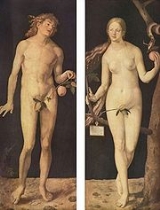
Early Renaissance artists used the theme of Adam and Eve as a way to represent female and male nudes. Later, the nudity was objected to by more modest elements, and fig leaves were added to the older pictures and sculptures, covering their genitals. The choice of the fig was a result of Mediterranean traditions identifying the unnamed Tree of the Knowledge of Good and Evil as a fig tree, and since fig leaves were actually mentioned in Genesis as being used to cover Adam and Eve's nudity.

Another issue was whether they should be depicted with navel
Navel

The navel is a scar on the abdomen, caused when the umbilical cord is removed from a newborn baby. All Placentalia mammals have a navel. It is fairly conspicuous in humans....
s (The Omphalos theory
Omphalos (theology)

The Omphalos hypothesis was named after the title of an 1857 book, Omphalos by Philip Henry Gosse, in which Gosse argued that in order for the world to be "functional", God must have created the Earth with mountains and canyons, trees with growth rings, Adam and Eve with hair, fingernails, and navels , and that therefore no evidence...
). Since they were created fully grown, and did not develop in a uterus, they would not have had the umbilical scars possessed by all born humans. However, paintings without navels looked unnatural.

John Milton
John Milton

John Milton II was an English poet, author, polemicist and civil servant for the Commonwealth of England. He is best known for his Epic poetry Paradise Lost and for his treatise condemning censorship, Areopagitica....
's Paradise Lost
Paradise Lost

Paradise Lost is an epic poem in blank verse by the 17th-century England poet John Milton. It was originally published in 1667 in ten books....
 is a famous seventeenth century epic poem written in blank verse which explores the story of Adam and Eve in great detail.

See also


  • Adam and Eve (LDS Church)
  • Conflict of Adam and Eve with Satan
    Conflict of Adam and Eve with Satan

    The Conflict of Adam and Eve with Satan is a Christian pseudepigraphy work found in Ge'ez language, translated from an Arabic language original and thought to date from the 5th or 6th century AD....
  • Creation myth
  • Garden of Eden
    Garden of Eden

    The Garden of Eden is a location described in the Book of Genesis as being the place where the first man, Adam , and his wife, Eve , lived after they were created by God....
  • Generations of Adam
    Generations of Adam

    The Generations of Adam according to Genesis 5 is the line of descent going through Seth. A second line of descent starting with Cain and Abel is listed in Genesis 4....
  • Mitochondrial Eve
    Mitochondrial Eve

    Mitochondrial Eve is the name given by researchers to the woman who is defined as the matrilineal most recent common ancestor for all currently living humans....
  • Pre-Adamite
    Pre-Adamite

    Pre-Adamite hypothesis or Preadamism is the religious belief that humans existed before Adam and Eve, the first human being named in the Bible....
  • Biblical narratives and the Qur'an
    Biblical narratives and the Qur'an

    The Qur'an, the central religious text of Islam, contains references to List of Common Qur'anic and Biblical Figures also found in the Bible, typically in the same or similar narratives....
  • Tree of Life
  • Tree of Knowledge of Good and Evil
    Tree of Knowledge of Good and Evil

    In the Book of Genesis, the Tree of Knowledge of Good and Evil was a tree in the middle of the Garden of Eden from which God directly forbade Adam to eat ....
  • Y-chromosomal Adam
    Y-chromosomal Adam

    In human genetics, Y-chromosomal Adam is the Patrilineality human most recent common ancestor from whom all Y chromosomes in living men are descended....
  • The Holy Bible
    The Holy Bible

    The Holy Bible can refer to:* The Bible * The Holy Bible , an album by Manic Street Preachers...


External links

  • (Library of Congress
    Library of Congress

    The Library of Congress is the de facto national library of the United States and the research arm of the United States Congress. Located in three buildings in Washington, D.C., it is the largest library in the world by shelf space and holds the largest number of books....
    )