


Judeo-Christian

Encyclopedia
Judaism and Christianity
Although Christianity and Judaism share historical roots in the Second Temple period, these two religions diverged profoundly in the first centuries CE. Christendom places emphasis on correct belief , focusing primarily on response to the New Covenant that the Christian Triune God made through Jesus...
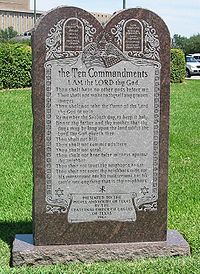
, for example the Ten Commandments
Ten Commandments
The Ten Commandments, also known as the Decalogue , are a set of biblical principles relating to ethics and worship, which play a fundamental role in Judaism and most forms of Christianity. They include instructions to worship only God and to keep the Sabbath, and prohibitions against idolatry,...
. The term is also used in a historical sense to refer to the connections between the precursors of Christianity and Rabbinic Judaism
Rabbinic Judaism
Rabbinic Judaism or Rabbinism has been the mainstream form of Judaism since the 6th century CE, after the codification of the Talmud...
in the Second Temple period
Second Temple period
The Second Temple period , in Jewish history, is the period between 530 BCE and 70 CE, when the Second Temple of Jerusalem existed. It ended with the First Jewish–Roman War and the Temple's destruction....
.
History of the term
The earliest use of the term "Judeo-Christian" in the historical sense dates to 1829 in the missionary journal of Joseph WolffJoseph Wolff
Joseph Wolff , Jewish Christian missionary, was born at Weilersbach, near Bamberg, Germany. He travelled widely, and was known as the Eccentric Missionary, according to Fitzroy Maclean's Eastern Approaches...
, and before that as "Judæo Christian" in a letter from Alexander M'Caul dated October 17, 1821. The former appears in discussions of theories of the emergence of Christianity, and both are used with a different sense than the one common today. "Judeo-Christian" here referred to Jewish converts to Christianity. The term "Jewish-Christian" had been used in this sense as early as 1785 in Richard Watson
Richard Watson (bishop)
Rt Rev Richard Watson was an Anglican clergyman and academic, who served as the Bishop of Llandaff from 1782 to 1816. He wrote some notable political pamphlets....
's essay "The Teaching and Witness of the Holy Spirit", and "Jewish Christian" (as an adjective) as early as 1644 in William Rathband's A Briefe Narration of Some Church Courses. "Jewish–Christian" is used in 1841 to mean a combination of Jewish and Christian beliefs, and by 1877 to mean a common Jewish–Christian culture, used in the phrase "the Jewish–Christian character of…traditions".
Early German use of the term judenchristlich ("Jewish-Christian"), in a decidedly negative sense, can be found in the late writings of Friedrich Nietzsche
Friedrich Nietzsche
Friedrich Wilhelm Nietzsche was a 19th-century German philosopher, poet, composer and classical philologist...
, who emphasized what he saw as neglected aspects of continuity between the Jewish world view and that of Christianity. The expression appears in The Antichrist
The Antichrist (book)
The Antichrist is a book by the philosopher Friedrich Nietzsche, originally published in 1895. Although it was written in 1888, its controversial content made Franz Overbeck and Heinrich Köselitz delay its publication, along with Ecce Homo...
, published in 1895 and written several years earlier; a fuller development of Nietzsche's argument can be found in a prior work, On the Genealogy of Morality
On the Genealogy of Morality
On the Genealogy of Morality, or On the Genealogy of Morals , subtitled "A Polemic" , is a work by German philosopher Friedrich Nietzsche, composed and first published in 1887 with the intention of expanding and following through on certain new doctrines sketched out in his previous work Beyond...
.
Ethical value system
The present meaning of "Judeo-Christian" regarding ethics first appeared in print on July 27, 1939, with the phrase "the Judaeo-Christian scheme of morals" in the New English Weekly. The term gained much currency in the 1940s, promoted by groups which evolved into the National Conference of Christians and Jews, to fight antisemitism by expressing a more inclusive idea of American values rather than just Christian or Protestant. By 1952 Dwight Eisenhower was speaking of the "Judeo-Christian concept" being the "deeply religious faith" on which "our sense of government…is founded."Culture wars
The term became especially popular among the Conservative Right in American politics, promoting a "Judeo-Christian values" agenda in the so-called culture wars, a usage which surged in the 1990s.James Dobson
James Dobson
James Clayton "Jim" Dobson, Jr. is an American evangelical Christian author, psychologist, and founder in 1977 of Focus on the Family , which he led until 2003. In the 1980s he was ranked as one of the most influential spokesman for conservative social positions in American public life...
, a prominent conservative spokesman, said the Judeo-Christian tradition includes the right to display the following documents in Kentucky schools, after they were banned by a federal judge in May 2000 as "conveying a very specific governmental endorsement of religion":
- an excerpt from the Declaration of Independence, which reads, "All men…are endowed by their Creator with certain unalienable Rights, that among these are Life, Liberty and the pursuit of happiness"
- the preamble to the Constitution of Kentucky, which states, "We, the people of the Commonwealth of Kentucky, grateful to Almighty God for the civil, political and religious liberties we enjoy, and invoking the continuance of these blessings, do ordain and establish this Constitution"
- the national motto, "In God we trustIn God We Trust"In God We Trust" was adopted as the official motto of the United States in 1956. It is also the motto of the U.S. state of Florida. The Legality of this motto has been questioned because of the United States Constitution forbidding the government to make any law respecting the establishment of a...
" - a page from the congressional record of Wednesday, February 2, 1983, Vol. 129, No. 8, which declares 1983 as the "Year of the Bible" and lists the Ten Commandments
- a proclamation by President Ronald ReaganRonald ReaganRonald Wilson Reagan was the 40th President of the United States , the 33rd Governor of California and, prior to that, a radio, film and television actor....
marking 1983 the "Year of the Bible" - a proclamation by President Abraham LincolnAbraham LincolnAbraham Lincoln was the 16th President of the United States, serving from March 1861 until his assassination in April 1865. He successfully led his country through a great constitutional, military and moral crisis – the American Civil War – preserving the Union, while ending slavery, and...
designating April 30, 1863, a "National Day of Prayer and Humiliation" - an excerpt from President Lincoln's "Reply to Loyal Colored People of Baltimore upon Presentation of a Bible," which reads, "The Bible is the best gift God has ever given to man"
- The Mayflower CompactMayflower CompactThe Mayflower Compact was the first governing document of Plymouth Colony. It was written by the colonists, later together known to history as the Pilgrims, who crossed the Atlantic aboard the Mayflower...
of 1620, in which the Plymouth colony's founders invoke "the name of God" and explain that their journey was taken, among other reasons, "for the glory of God and advancement of the Christian faith"
Prominent champions of the term also identify it with the historic American religious traditions. The Jewish Conservative columnist Dennis Prager
Dennis Prager
Dennis Prager is an American syndicated radio talk show host, syndicated columnist, author, and public speaker. He is noted for his conservative political and social views emanating from conservative Judeo-Christian values. He holds that there is an "American Trinity" of essential principles,...
, for example, writes:
The concept of Judeo-Christian values does not rest on a claim that the two religions are identical. It promotes the concept there is a shared intersection of values based on the Hebrew Bible ("TorahTorahTorah- A scroll containing the first five books of the BibleThe Torah , is name given by Jews to the first five books of the bible—Genesis , Exodus , Leviticus , Numbers and Deuteronomy Torah- A scroll containing the first five books of the BibleThe Torah , is name given by Jews to the first five...
"), brought into our culture by the founding generations of Biblically oriented Protestants, that is fundamental to American history, cultural identity, and institutions.
Some secularists reject the use of "Judeo-Christian" as a code-word for a particular kind of Christian America, with scant regard to modern Jewish, Catholic or more liberal Christian traditions
Liberal Christianity
Liberal Christianity, sometimes called liberal theology, is an umbrella term covering diverse, philosophically and biblically informed religious movements and ideas within Christianity from the late 18th century and onward...
.
Since 9/11
Usage has shifted again, according to Hartmann et al., since 2001 and the September 11 attacks, with the mainstream media using the term less, in order to characterize America as multicultural. The study finds the term now most likely to be used by Liberals in connection with discussions of Muslim and Islamic inclusion in AmericaIslam in the United States
From the 1880s to 1914, several thousand Muslims immigrated to the United States from the Ottoman Empire, and from parts of South Asia; they did not form distinctive settlements, and probably most assimilated into the wider society....
, and renewed debate about the separation of church and state
Separation of church and state
The concept of the separation of church and state refers to the distance in the relationship between organized religion and the nation state....
.
It is used more than ever by some Conservative thinkers and journalists, who use it to discuss the Islamic threat to America, the dangers of multiculturalism
Multiculturalism
Multiculturalism is the appreciation, acceptance or promotion of multiple cultures, applied to the demographic make-up of a specific place, usually at the organizational level, e.g...
, and moral decay in a materialist, secular age. Dennis Prager, author of popular books on Judaism and antisemitism, Nine Questions People ask about Judaism (with Joseph Telushkin) and Why the Jews? The Reason for Antisemitism, and radio commentator, has published an on-going 19-part series explaining and promoting the concept of Judeo-Christian culture, running for three years from 2005 to 2008, reflecting the interest of this concept to his listeners. He believes the Judeo-Chrisitan perspective is under assault by an amoral and materialistic culture that desperately needs its teachings.
…only America has called itself Judeo-Christian. America is also unique in that it has always combined secular government with a society based on religious values.
Along with the belief in libertyLibertyLiberty is a moral and political principle, or Right, that identifies the condition in which human beings are able to govern themselves, to behave according to their own free will, and take responsibility for their actions...
—as opposed to, for example, the European belief in equalitySocial equalitySocial equality is a social state of affairs in which all people within a specific society or isolated group have the same status in a certain respect. At the very least, social equality includes equal rights under the law, such as security, voting rights, freedom of speech and assembly, and the...
, the Muslim belief in theocracyTheocracyTheocracy is a form of organization in which the official policy is to be governed by immediate divine guidance or by officials who are regarded as divinely guided, or simply pursuant to the doctrine of a particular religious sect or religion....
, and the Eastern belief in social conformityConformityConformity is the process by which an individual's attitudes, beliefs, and behaviors are influenced by other people.Conformity may also refer to:*Conformity: A Tale, a novel by Charlotte Elizabeth Tonna...
—Judeo-Christian values are what distinguish America from all other countries.
Basis of a common concept of the two religions
Supporters of the Judeo-Christian concept point to the Christian claim that ChristianityChristianity
Christianity is a monotheistic religion based on the life and teachings of Jesus as presented in canonical gospels and other New Testament writings...
is the heir to Biblical
Bible
The Bible refers to any one of the collections of the primary religious texts of Judaism and Christianity. There is no common version of the Bible, as the individual books , their contents and their order vary among denominations...
Judaism
Judaism
Judaism ) is the "religion, philosophy, and way of life" of the Jewish people...
, and that the whole logic of Christianity as a religion
Religion
Religion is a collection of cultural systems, belief systems, and worldviews that establishes symbols that relate humanity to spirituality and, sometimes, to moral values. Many religions have narratives, symbols, traditions and sacred histories that are intended to give meaning to life or to...
is that it exists (only) as a religion built upon Judaism. Two major views of the relationship exist, namely New Covenant theology
New Covenant Theology
New Covenant Theology is a Christian theological system which teaches that the Old Testament Laws have been fulfilled and abrogated or cancelled with Christ's death, and replaced with the Law of Christ of the New Covenant. It shares similarities and yet is distinct from Dispensationalism and...
and Dual-covenant theology
Dual-covenant theology
Dual-covenant theology is a Liberal Christian view that holds that Jews may simply keep the Law of Moses, because of the "everlasting covenant" between Abraham and God expressed in the Hebrew Bible, whereas Gentiles must convert to Christianity or alternatively accept the Seven Laws of Noah...
. In addition, although the order of the books in the Protestant Old Testament
Old Testament
The Old Testament, of which Christians hold different views, is a Christian term for the religious writings of ancient Israel held sacred and inspired by Christians which overlaps with the 24-book canon of the Masoretic Text of Judaism...
(excluding the Biblical apocrypha
Biblical apocrypha
The word "apocrypha" is today often used to refer to the collection of ancient books printed in some editions of the Bible in a separate section between the Old and New Testaments...
) and the Tanakh
Tanakh
The Tanakh is a name used in Judaism for the canon of the Hebrew Bible. The Tanakh is also known as the Masoretic Text or the Miqra. The name is an acronym formed from the initial Hebrew letters of the Masoretic Text's three traditional subdivisions: The Torah , Nevi'im and Ketuvim —hence...
(Hebrew Bible) differ, the contents of the books are very similar. The majority of the Christian Bible is, in fact, Jewish scripture, and it is used as moral and spiritual teaching material throughout the Christian world. The prophets, patriarchs, and heroes of the Jewish scripture are also known in Christianity, which uses the Jewish text as the basis for its understanding of historic Judeo-Christian figures such as Abraham
Abraham
Abraham , whose birth name was Abram, is the eponym of the Abrahamic religions, among which are Judaism, Christianity and Islam...
, Elijah, and Moses
Moses
Moses was, according to the Hebrew Bible and Qur'an, a religious leader, lawgiver and prophet, to whom the authorship of the Torah is traditionally attributed...
. As a result, a vast amount of Jewish and Christian teachings are based on a common sacred text.
Political conservatives
By the 1950s American conservatives were emphasizing the Judeo-Christian roots of their values. As economist Elgin Groseclose explained in 1958, it was ideas "drawn from Judeo-Christian Scriptures that have made possible the economic strength and industrial power of this country." Senator Barry GoldwaterBarry Goldwater
Barry Morris Goldwater was a five-term United States Senator from Arizona and the Republican Party's nominee for President in the 1964 election. An articulate and charismatic figure during the first half of the 1960s, he was known as "Mr...
noted that Conservatives "believed the communist projection of man as a producing, consuming animal to be used and discarded was antithetical to all the Judeo-Christian understandings which are the foundations upon which the Republic stands." Ronald Reagan
Ronald Reagan
Ronald Wilson Reagan was the 40th President of the United States , the 33rd Governor of California and, prior to that, a radio, film and television actor....
frequently emphasized Judeo-Christian values as necessary ingredients in the fight against Communism. He argued that the Bible contains "all the answers to the problems that face us." Belief in the superiority of Western Judeo-Christian traditions led Conservatives to downplay the aspirations of the non-Capitalist
Capitalism
Capitalism is an economic system that became dominant in the Western world following the demise of feudalism. There is no consensus on the precise definition nor on how the term should be used as a historical category...
Third World
Third World
The term Third World arose during the Cold War to define countries that remained non-aligned with either capitalism and NATO , or communism and the Soviet Union...
to free themselves from colonial rule and to repudiate the value of foreign aid
Aid
In international relations, aid is a voluntary transfer of resources from one country to another, given at least partly with the objective of benefiting the recipient country....
.
The emergence of the "Christian right
Christian right
Christian right is a term used predominantly in the United States to describe "right-wing" Christian political groups that are characterized by their strong support of socially conservative policies...
" as a political force and part of the Conservative coalition dates from the 1970s. As Wilcox and Robinson conclude:
The Christian Right is an attempt to restore Judeo-Christian values to a country that is in deep moral decline. …[They] believe that society suffers from the lack of a firm basis of Judeo-Christian values and they seek to write laws that embody those values.
Judeo-Christian concept in interfaith relations
Promoting the concept of AmericaUnited States
The United States of America is a federal constitutional republic comprising fifty states and a federal district...
as a Judeo-Christian nation became a political program in the 1920s, in response to the growth of anti-Semitism in America. The rise of Hitler in the 1930s led concerned Protestants
Protestantism
Protestantism is one of the three major groupings within Christianity. It is a movement that began in Germany in the early 16th century as a reaction against medieval Roman Catholic doctrines and practices, especially in regards to salvation, justification, and ecclesiology.The doctrines of the...
, Catholics
Roman Catholic Church
The Catholic Church, also known as the Roman Catholic Church, is the world's largest Christian church, with over a billion members. Led by the Pope, it defines its mission as spreading the gospel of Jesus Christ, administering the sacraments and exercising charity...
, and Jews to take active steps to increase understanding and tolerance.
In this effort, precursors of the National Conference of Christians and Jews created teams consisting of a priest, a rabbi, and a minister, to run programs across the country, and fashion a more pluralistic America, no longer defined as a Christian land, but "one nurtured by three ennobling traditions: Protestantism, Catholicism and Judaism." "The phrase 'Judeo-Christian' entered the contemporary lexicon as the standard liberal term for the idea that Western values rest on a religious consensus that included Jews."
Through soul-searching in the aftermath of the Holocaust, "there was a revolution in Christian theology in America. […] The greatest shift in Christian attitudes toward the Jewish people since Constantine converted the Roman Empire
Constantine I and Christianity
During the reign of the Emperor Constantine the Great, Christianity became the dominant religion of the Roman Empire. Constantine, also known as Constantine I, had a significant religious experience following his victory at the Battle of Milvian Bridge in 312...
." The rise of Christian Zionism
Christian Zionism
Christian Zionism is a belief among some Christians that the return of the Jews to the Holy Land, and the establishment of the State of Israel in 1948, is in accordance with Biblical prophecy. It overlaps with, but is distinct from, the nineteenth century movement for the Restoration of the Jews...
—that is, religiously motivated Christian interest and support for the state of Israel—along with a growth of philo-Semitism
Philo-Semitism
Philo-Semitism or Judeophilia is an interest in, respect for, and appreciation of the Jewish people, their historical significance and the positive impacts of Judaism in the history of the western world, in particular, generally on the part of a gentile...
(love of the Jewish people) has increased interest among American Evangelicals in Judaism, especially areas of commonality with their own beliefs, see also Jerusalem in Christianity
Jerusalem in Christianity
For Christians, Jerusalem's place in the ministry of Jesus and the Apostolic Age gives it great importance, in addition to its place in the Old Testament, the Hebrew Bible.-Jerusalem in the New Testament and early Christianity:...
. Interest in and a positive attitude towards America's Judeo-Christian tradition has become mainstream among Evangelicals.
The scriptural basis for this new positive attitude towards Jews among Evangelicals is Genesis 12:3, in which God promises that He will bless those who bless Abraham
Abraham
Abraham , whose birth name was Abram, is the eponym of the Abrahamic religions, among which are Judaism, Christianity and Islam...
and his descendants, and curse those who curse them (see also "Abrahamic Covenant"). Other factors in the new philo-Semitism include gratitude to the Jews for contributing to the theological foundations of Christianity and for being the source of the prophets and Jesus
Jesus
Jesus of Nazareth , commonly referred to as Jesus Christ or simply as Jesus or Christ, is the central figure of Christianity...
; remorse for the Church's history of anti-Semitism; and fear that God will judge the nations at the end of time on the basis of how they treated the Jewish people. Moreover, for many Evangelicals Israel is seen as the instrument through which prophecies of the end times are fulfilled. Great numbers of Christian pilgrims visit Israel, especially in times of trouble for the Jewish state, to offer moral support, and return with an even greater sense of a shared Judeo-Christian heritage.
Public awareness of a shared Judeo-Chrisitan belief system has increased since the 1990s due to a great deal of interest in the life of the historical Jesus
Historical Jesus
The term historical Jesus refers to scholarly reconstructions of the 1st-century figure Jesus of Nazareth. These reconstructions are based upon historical methods including critical analysis of gospel texts as the primary source for his biography, along with consideration of the historical and...
, stressing his Jewishness (see also "Jewish Christians
Jewish Christians
Jewish Christians is a term which appears in historical texts contrasting Christians of Jewish origin with Gentile Christians, both in discussion of the New Testament church and the second and following centuries....
"). The literature explores differences and commonalities between Jesus's teachings
Ministry of Jesus
In the Christian gospels, the Ministry of Jesus begins with his Baptism in the countryside of Judea, near the River Jordan and ends in Jerusalem, following the Last Supper with his disciples. The Gospel of Luke states that Jesus was "about 30 years of age" at the start of his ministry...
, Christianity and Judaism.
On the other hand, the response of Jews towards the "Judeo-Christian" concept has been mixed. In the 1930s, "In the face of worldwide antisemitic efforts to stigmatize and destroy Judaism, influential Christians and Jews in America labored to uphold it, pushing Judaism from the margins of American religious life towards its very center." During World War II, Jewish chaplains worked with Catholic priests and Protestant ministers to promote goodwill, addressing servicemen who, "in many cases had never seen, much less heard a Rabbi speak before." At funerals for the unknown soldier, rabbis stood alongside the other chaplains and recited prayers in Hebrew. In a much publicized wartime tragedy, the sinking of the USAT Dorchester
USAT Dorchester
USAT Dorchester was a United States Army Transport ship that was sunk by a torpedo from a German U-boat on February 3, 1943, during World War II...
, the ship's multi-faith chaplains gave up their lifebelts to evacuating seamen and stood together "arm in arm in prayer" as the ship went down. A 1948 postage stamp commemorated their heroism with the words: "interfaith in action."
In the 1950s, "a spiritual and cultural revival washed over American Jewry" in response to the trauma of the Holocaust. American Jews became more confident to be identified as different.
Two notable books addressed the relations between contemporary Judaism and Christianity, Abba Hillel Silver
Abba Hillel Silver
Abba Hillel Silver was a U.S. Rabbi and Zionist leader. He was a key figure in the mobilization of American support for the founding of the State of Israel.-Biography:...
's Where Judaism Differs and Leo Baeck's Judaism and Christianity, both motivated by an impulse to clarify Judaism's distinctiveness "in a world where the term Judeo-Christian had obscured critical differences between the two faiths." Reacting against the blurring of theological distinctions, Rabbi Eliezer Berkovits
Eliezer Berkovits
Eliezer Berkovits , was a rabbi, theologian, and educator in the tradition of Orthodox Judaism.- Life:...
wrote that "Judaism is Judaism because it rejects Christianity, and Christianity is Christianity because it rejects Judaism." Theologian and author Arthur A. Cohen
Arthur A. Cohen
Arthur Allen Cohen was an American Jewish scholar, theologian and author.Cohen wrote The Natural and the Supernatural Jew , tracing the history of Jewish theology from the late 15th century, through the German Jewish renaissance, and into what he saw as a hopeful yet troubled American Jewish scene...
, in The Myth of the Judeo-Christian Tradition, questioned the theological validity of the Judeo-Christian concept and suggested that it was essentially an invention of American politics
Politics of the United States
The United States is a federal constitutional republic, in which the President of the United States , Congress, and judiciary share powers reserved to the national government, and the federal government shares sovereignty with the state governments.The executive branch is headed by the President...
, while Jacob Neusner
Jacob Neusner
Jacob Neusner is an American academic scholar of Judaism who lives in Rhinebeck, New York.-Biography:Born in Hartford, Connecticut, Neusner was educated at Harvard University, the Jewish Theological Seminary of America , the University of Oxford, and Columbia University.Neusner is often celebrated...
, in Jews and Christians: The Myth of a Common Tradition, writes, "The two faiths stand for different people talking about different things to different people."
Law professor Stephen M. Feldman identifies talk of Judeo-Christian tradition as supersessionism
Supersessionism
Supersessionism is a term for the dominant Christian view of the Old Covenant, also called fulfillment theology and replacement theology, though the latter term is disputed...
:
Once one recognizes that Christianity has historically engendered antisemitism, then this so-called tradition appears as dangerous Christian dogma (at least from a Jewish perspective). For Christians, the concept of a Judeo-Christian tradition comfortably suggests that Judaism progresses into Christianity—that Judaism is somehow completed in Christianity. The concept of a Judeo-Christian tradition flows from the Christian theology of supersession, whereby the Christian covenantNew CovenantThe New Covenant is a concept originally derived from the Hebrew Bible. The term "New Covenant" is used in the Bible to refer to an epochal relationship of restoration and peace following a period of trial and judgment...
(or Testament) with God supersedes the Jewish one. Christianity, according to this myth, reforms and replaces Judaism. The myth therefore implies, first, that Judaism needs reformation and replacement, and second, that modern Judaism remains merely as a "relic".
Most importantly the myth of the Judeo-Christian tradition insidiously obscures the real and significant differences between Judaism and Christianity.
Judeo-Christian concept in American history
Nineteenth century historians wrote extensively on the United States of America having a distinctively Protestant character in its outlook and founding political philosophy. It is only since the 1950s that the term "Judeo-Christian" has been applied to it, reflecting the growing use of that term in American political life. By some the term is used casually, simply as a commonplace term, or as an inclusive synonym for the religious.The notion of a distinctive religious basis for American democracy
Democracy
Democracy is generally defined as a form of government in which all adult citizens have an equal say in the decisions that affect their lives. Ideally, this includes equal participation in the proposal, development and passage of legislation into law...
and culture was first described and popularized by Alexis de Tocqueville
Alexis de Tocqueville
Alexis-Charles-Henri Clérel de Tocqueville was a French political thinker and historian best known for his Democracy in America and The Old Regime and the Revolution . In both of these works, he explored the effects of the rising equality of social conditions on the individual and the state in...
in the 1840's, in his influential book, Democracy in America. In the second chapter, de Tocqueville describes America's unique religious heritage from the Puritans. His analysis showed the Puritans as providing the foundational values of America, based on their strong Hebrew Bible
Hebrew Bible
The Hebrew Bible is a term used by biblical scholars outside of Judaism to refer to the Tanakh , a canonical collection of Jewish texts, and the common textual antecedent of the several canonical editions of the Christian Old Testament...
view of the world, which included fighting for earthly political justice, an emphasis on laws and education, and the "chosenness
Chosen people
Throughout history and even today various groups of people have considered themselves as chosen by a deity for some purpose such as to act as the deity's agent on earth. In monotheistic faiths, like Abrahamic religions, references to God are used in constructs such as "God's Chosen People"...
" which the Puritans identified with, giving them a sense of moral mission in founding America. As de Tocqueville observed, the Puritan's biblical outlook gave America a moral dimension which the Old World lacked. De Tocqueville believed these biblical values led to America's unique institutions of religious tolerance, public education, egalitarianism, and democracy.
The principles of New England…now extend their influence beyond its limits, over the whole American world. The civilization of New England has been like a beacon lit upon a hill. […] Puritanism was not merely a religious doctrine, but corresponded in many points with the most absolute democratic and republican theories. […] Nathaniel MortonNathaniel MortonCapt. Nathaniel Morton was a Separatist settler of Plymouth Colony in Massachusetts, where he served for most of his life as Plymouth's secretary under his uncle, Governor William Bradford...
, the historian of the first years of the settlement, thus opens his subject: "we may not hide from our children, showing to the generations to come the praises of the Lord; that especially the seed of AbrahamAbrahamAbraham , whose birth name was Abram, is the eponym of the Abrahamic religions, among which are Judaism, Christianity and Islam...
his servant, and the children of JacobJacobJacob "heel" or "leg-puller"), also later known as Israel , as described in the Hebrew Bible, the Talmud, the New Testament and the Qur'an was the third patriarch of the Hebrew people with whom God made a covenant, and ancestor of the tribes of Israel, which were named after his descendants.In the...
his chosen (Psalm cv.Psalm 105-Judaism:*Is recited on the first day of Passover.*Verses 8-10 are part of the paragraph recited in the naming of a boy at a brit milah.*Verses 8 and 42 are found separately in the repetition of the Amidah on Rosh Hashanah....
5, 6), may remember his marvellous works in the beginning…" […] The general principles which are the groundwork of modern constitutions, principles…were all recognized and established by the laws of New England: the intervention of the people in public affairs, the free voting of taxes, the responsibility of the agents of power, personal liberty, and trial by jury were all positively established without discussion. […] In the bosom of this obscure democracy…the following fine definition of liberty: "There is a twofold liberty, natural…and civil or federal. The first is common to man with beasts and other creatures. By this, man, as he stands in relation to man simply, hath liberty to do what he lists; it is a liberty to evil as well as to good. […] The exercise and maintaining of this liberty makes men grow more evil, and in time to be worse than brute beasts: […] The other kind of liberty I call civil or federal; it may also be termed moral, in reference to the covenant between God and man, in the moral law, and the politic covenants and constitutions, among men themselves. […] This liberty you are to stand for, with the hazard not only of your goods, but of your lives, if need be." I have said enough to put the character of Anglo-American civilization in its true light. It is the result (and this should be constantly kept in mind) of two distinct elements, which in other places have been in frequent disagreement, but which the Americans have succeeded in incorporating to some extent one with the other and combining admirably. I allude to the spirit of religion and the spirit of liberty.
This concept of America's unique Bible-driven historical and cultural identity was developed by historians as they studied the first centuries of America's history, from the Pilgrims through Abraham Lincoln. The statements and institutions of the founding generation that have been preserved are numerous, and they explicitly describe many of their biblical motivations and goals, their interest in Hebrew
Hebrew language
Hebrew is a Semitic language of the Afroasiatic language family. Culturally, is it considered by Jews and other religious groups as the language of the Jewish people, though other Jewish languages had originated among diaspora Jews, and the Hebrew language is also used by non-Jewish groups, such...
and the Hebrew Bible, their use of Jewish and Christian images and ideas. In the words of patriot Benjamin Rush, "The Old Testament is the best refutation that can be given to the divine right of kings, and the strongest argument that can be used in favor of the original and natural equality of all mankind." James Witherspoon, president of Princeton, teacher of James Madison and later a member of the Continental Congress, and one of the most influential thinkers in the Colonies, joined the cause of the Revolution with a widely publicized sermon based on Psalm 76
Psalm 76
Psalm 76 is the 76th psalm in the biblical Book of Psalms....
, identifying the American colonists with the people of Israel. Of fifty-five printed texts from the Revolutionary period, thirty-three took texts from the Hebrew Bible. Thomas Jefferson, in the Declaration of Independence, referred to God twice in Hebrew terms, and Congress added two more: Lawgiver, Creator, Judge, and Providence
Divine providence
In Christian theology, divine providence, or simply providence, is God's activity in the world. " Providence" is also used as a title of God exercising His providence, and then the word are usually capitalized...
. These Judeo-Christian values were especially important at the key foundational moments of the settling of America, the War for Independence and the Civil War.
Perry Miller of Harvard University wrote in 1956:
Puritanism may be described empirically as that point of view, that code of values, carried to New England by the first settlers. […] The New Englanders established Puritanism—for better or worse—as one of the continuous factors in American life and thought. It has played so dominant a role…all across the continent…these qualities have persisted even though the original creed is lost. Without an understanding of Puritanism…there is no understanding of America.
This view about American history and culture has been questioned in recent decades by multiculturalists. In Becoming America: The Revolution Before 1776, Jon Butler
Jon Butler
Jon Butler is a historian and Howard R. Lamar Professor of American Studies, History, and Religious Studies at Yale University. He earned his bachelor's and doctoral degrees from the University of Minnesota, and is known for his research on the role of religion in early American history...
of Yale University argues against a Europeanized or predominantly British identity of colonial America, and underlines contributions by Igbo
Igbo people
Igbo people, also referred to as the Ibo, Ebo, Eboans or Heebo are an ethnic group living chiefly in southeastern Nigeria. They speak Igbo, which includes various Igboid languages and dialects; today, a majority of them speak English alongside Igbo as a result of British colonialism...
, Ashanti, Yoruba
Yoruba people
The Yoruba people are one of the largest ethnic groups in West Africa. The majority of the Yoruba speak the Yoruba language...
, Catawba, and Lenape
Lenape
The Lenape are an Algonquian group of Native Americans of the Northeastern Woodlands. They are also called Delaware Indians. As a result of the American Revolutionary War and later Indian removals from the eastern United States, today the main groups live in Canada, where they are enrolled in the...
. Michael Novak
Michael Novak
Michael Novak is an American Catholic philosopher, journalist, novelist, and diplomat. The author of more than twenty-five books on the philosophy and theology of culture, Novak is most widely known for his book The Spirit of Democratic Capitalism...
, a specialist in the religious beliefs of the Founding Fathers, argues that the promotion of multiculturalism, moral relativism
Moral relativism
Moral relativism may be any of several descriptive, meta-ethical, or normative positions. Each of them is concerned with the differences in moral judgments across different people and cultures:...
, and secularism among academics results in academic censorship that affects information and analysis supporting the Judeo-Christian heritage.
Use of term in United States law
In the legal case of Marsh v. ChambersMarsh v. Chambers
Marsh v. Chambers, 463 U.S. 783 , was a case in which the Supreme Court of the United States held that government funding for chaplains was constitutional because of the "unique history" of the United States...
, 463 U.S. 783 (1983), the Supreme Court of the United States
Supreme Court of the United States
The Supreme Court of the United States is the highest court in the United States. It has ultimate appellate jurisdiction over all state and federal courts, and original jurisdiction over a small range of cases...
held that a state legislature could constitutionally have a paid chaplain to conduct legislative prayers "in the Judeo-Christian tradition." In Simpson v. Chesterfield County
Chesterfield County, Virginia
Chesterfield County is a county located in the Commonwealth of Virginia, a state of the United States. In 2010, its population was estimated to be 316,236. Chesterfield County is now the fourth-largest municipality in Virginia . Its county seat is Chesterfield...
Board of Supervisors, the Fourth Circuit Court of Appeals held that the Supreme Court's holding in the Marsh case meant that the "Chesterfield County could constitutionally exclude Cynthia Simpson, a Wicca
Wicca
Wicca , is a modern Pagan religious movement. Developing in England in the first half of the 20th century, Wicca was popularised in the 1950s and early 1960s by a Wiccan High Priest named Gerald Gardner, who at the time called it the "witch cult" and "witchcraft," and its adherents "the Wica."...
n priestess, from leading its legislative prayers, because her faith was not 'in the Judeo-Christian tradition.'" Chesterfield County's board included Jewish, Christian, and Muslim clergy in its invited list.
See also
- Law and GospelLaw and GospelIn Christianity the relationship between God's Law and the Gospel is a major topic in Lutheran and Reformed theology. In these traditions, the distinction between the doctrines of Law, which demands obedience to God's ethical will, and Gospel, which promises the forgiveness of sins in light of the...
, traditional Protestant views against reviving Jewish laws among Christian Gentiles - SupersessionismSupersessionismSupersessionism is a term for the dominant Christian view of the Old Covenant, also called fulfillment theology and replacement theology, though the latter term is disputed...
, the belief that Christianity has superseded Judaism - AntinomianismAntinomianismAntinomianism is defined as holding that, under the gospel dispensation of grace, moral law is of no use or obligation because faith alone is necessary to salvation....
, term used to describe those who believe that Christians are not subject to laws - Cultural and historical background of JesusCultural and historical background of JesusMost scholars who study the Historical Jesus and Early Christianity believe that the Canonical Gospels and life of Jesus must be viewed as firmly placed within his historical and cultural context, rather than purely in terms of Christian orthodoxy...
, perspective on the period in which the two religions began to diverge - JudaizersJudaizersJudaizers is predominantly a Christian term, derived from the Greek verb ioudaïzō . This term is most widely known from the single use in the New Testament where Paul publicly challenges Peter for compelling Gentile believers to "judaize", also known as the Incident at Antioch.According to the...
, term used to describe people that taught that Christians must keep the law of Moses - Noahides, gentile monotheists who keep the Talmud's universal commandments, the Noahide laws
- EbionitesEbionitesEbionites, or Ebionaioi, , is a patristic term referring to a Jewish Christian sect or sects that existed during the first centuries of the Christian Era. They regarded Jesus as the Messiah and insisted on the necessity of following Jewish religious law and rites...
, an early sect that combined Judaism with Christianity - Messianic JudaismMessianic JudaismMessianic Judaism is a syncretic religious movement that arose in the 1960s and 70s. It blends evangelical Christian theology with elements of Jewish terminology and ritual....
- American exceptionalismAmerican exceptionalismAmerican exceptionalism refers to the theory that the United States is qualitatively different from other countries. In this view, America's exceptionalism stems from its emergence from a revolution, becoming "the first new nation," and developing a uniquely American ideology, based on liberty,...
- Judeo-Christian-Islamic
- AbrahamitesAbrahamitesThe Abrahamites were a sect of deists in Bohemia in the 18th century, who professed to be followers of the pre-circumcised Abraham. Believing in one God, they contented themselves with the Decalogue and the Paternoster...
Related terms
- Abrahamic religionsAbrahamic religionsAbrahamic religions are the monotheistic faiths emphasizing and tracing their common origin to Abraham or recognizing a spiritual tradition identified with him...
– an umbrella term used to refer to the religions of JudaismJudaismJudaism ) is the "religion, philosophy, and way of life" of the Jewish people...
, ChristianityChristianityChristianity is a monotheistic religion based on the life and teachings of Jesus as presented in canonical gospels and other New Testament writings...
, and IslamIslamIslam . The most common are and . : Arabic pronunciation varies regionally. The first vowel ranges from ~~. The second vowel ranges from ~~~...
as well as sometimes indicating smaller, related religions such as Bahá'í FaithBahá'í FaithThe Bahá'í Faith is a monotheistic religion founded by Bahá'u'lláh in 19th-century Persia, emphasizing the spiritual unity of all humankind. There are an estimated five to six million Bahá'ís around the world in more than 200 countries and territories....
and Samaritans - Christo-Islamic – term used to refer to common elements in Christianity and Islam
- Judeo-Christo-Islamic – a term used to describe common elements in Judaism, Christianity and Islam; this is normally called Abrahamic
- Judeo-Islamic – term used to refer to the common cultural elements and backgrounds of Islam and JudaismIslam and JudaismIslamic–Jewish relations started in the 7th century CE with the origin and spread of Islam in the Arabian peninsula. The two religions share similar values, guidelines, and principles. Islam also incorporates Jewish history as a part of its own. Muslims regard the Children of Israel as an important...
Ethics in U.S.
- Bulliet, Richard. The Case for Islamo-Christian Civilization. Columbia University PressColumbia University PressColumbia University Press is a university press based in New York City, and affiliated with Columbia University. It is currently directed by James D. Jordan and publishes titles in the humanities and sciences, including the fields of literary and cultural studies, history, social work, sociology,...
, 2004; ISBN 978-0231127974 - Cohen, Arthur A. The Myth of the Judeo-Christian Tradition. Harper & Row, New York, 1970.
- Gelernter, David. Americanism: The Fourth Great Western Religion. Doubleday. 2007; ISBN 978-0385513128
- Lillback, Peter A..George Washington's Sacred Fire.Providence Forum Press,2006. ISBN 0978605268
- Moore, Deborah Dash. "Jewish GIs and the Creation of the Judeo-Christian Tradition," Religion and American Culture: A Journal of Interpretation, Vol. 8, No. 1 (Winter, 1998), pp. 31-53 in JSTOR
- Neusner, Jacob. Jews and Christians: The Myth of a Common Tradition. Trinity Press International, Philadelphia, 1991. ISBN 9781592441563 (2003 edition)
- Novak, Michael. On Two Wings: Humble Faith and Common Sense at the American Founding. Encounter Books, 2002. ISBN 978-1893554344
- E. P. SandersE. P. SandersEd Parish Sanders is a New Testament scholar, and is one of the principal proponents of the New Perspective on Paul. He has been Arts and Sciences Professor of Religion at Duke University, North Carolina, since 1990. He retired in 2005....
. Jesus and Judaism, Augsburg Fortress, 1985; ISBN 978-0800620615 - Silk, MarkMark SilkMark Silk is a professor of religion in public life at Trinity College and the editor of Religion in the News, which is published by the college. He was born in Cambridge, Mass. in 1950 and graduated from Harvard College in 1972. In 1982 he earned a Ph.D. in medieval history from Harvard...
. "Notes on the Judeo-Christian tradition in America," American Quarterly, (1984) 36:65–85, the standard history of the term in JSTOR - Waldman, Steven. Founding Faith: Providence, Politics, and the Birth of Religious Freedom in America. Random HouseRandom HouseRandom House, Inc. is the largest general-interest trade book publisher in the world. It has been owned since 1998 by the German private media corporation Bertelsmann and has become the umbrella brand for Bertelsmann book publishing. Random House also has a movie production arm, Random House Films,...
, 2008, ISBN 1400064376
Early history of Christianity
- Bobrick, Benson. Wide as the Waters : The Story of the English Bible and the Revolution It Inspired. Simon and Schuster 2001. ISBN 0684847477
- Paula Fredriksen. From Jesus to Christ: The Origins of the New Testament Images of Christ, Yale University PressYale University PressYale University Press is a book publisher founded in 1908 by George Parmly Day. It became an official department of Yale University in 1961, but remains financially and operationally autonomous....
, ISBN 978-0300084573 - Hexter, J. H.J. H. HexterJack H. Hexter was an American historian, a specialist in Tudor and seventeenth century British history, and well known for his comments on historiography.-Early career:...
The Judaeo-Christian Tradition (Second Edition). Yale University PressYale University PressYale University Press is a book publisher founded in 1908 by George Parmly Day. It became an official department of Yale University in 1961, but remains financially and operationally autonomous....
, 1995; ISBN 978-0300045727 - McGrath, Alister. In the Beginning: The Story of the King James Bible and How It Changed a Nation, a Language, and a Culture. Anchor Books, 2002. ISBN 0385722168.
External links
- Multimedia Information on the Judeo-Christian Movement
- Dennis Prager Publishes 19 part Series On Judeo-Christian Values (Traditional Values CoalitionTraditional Values CoalitionThe Traditional Values Coalition is a conservative Christian organization that represents, by its estimate, over 43,000 Christian churches throughout the United States of America...
) - A Judeo-Christian Looks at the Judeo-Christian Tradition by Martin E. MartyMartin E. MartyMartin Emil Marty is an American Lutheran religious scholar who has written extensively on 19th century and 20th century American religion. He received a Ph.D. from the University of Chicago in 1956, and served as a Lutheran pastor from 1952 to 1962 in the suburbs of Chicago...
- Jews, Christians and the Word of God
- The Episcopal-Jewish Alliance for Israel issuing from the headquarters of the Episcopal Diocese of Massachusetts
- Different theology,same morality at WorldNetDaily.com
- Institute for Jewish Christian Understanding of Muhlenberg College
- A message from the president by Brigitte GabrielBrigitte GabrielBrigitte Gabriel is the pseudonym, of a Lebanese American journalist, author, and activist. Gabriel says that Islam keeps countries backward, and that it teaches terrorism...
, an expert on the Middle East conflict at American Congress for TruthAmerican Congress For TruthGabriel formed ACT when she felt stirred to do something after 9/11 to warn the Western world about the dangers of Islamic fundamentalists.In an interview of Gabriel that was published in The New York Times in August 2008, she was asked: "Are you underwritten by the C.I.A.?" She replied, "No. Are...