

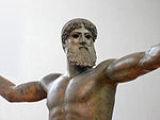
Aesthetics

Encyclopedia
Aesthetics is a branch of philosophy
dealing with the nature of beauty
, art
, and taste, and with the creation and appreciation of beauty
. It is more scientifically defined as the study of sensory or sensori-emotional values, sometimes called judgment
s of sentiment
and taste
. More broadly, scholars in the field define aesthetics as "critical reflection on art
, culture
and nature
."
αἰσθητικός (aisthetikos, meaning "esthetic, sensitive, sentient"), which in turn was derived from αἰσθάνομαι (aisthanomai, meaning "I perceive, feel, sense"). The term "aesthetics" was appropriated and coined with new meaning in the German
form Æsthetik (modern spelling Ästhetik) by Alexander Baumgarten in 1735.
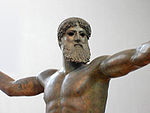
, but they are rare, and the context of their production and use is not very clear, so the aesthetic doctrines that guided their production and interpretation are mostly unknown.
Ancient art
was largely, but not entirely, based on the eight great ancient civilizations: Egypt
, Mesopotamia
, Persia, Greece
, China
, Rome
, India
and Mayan. Each of these centers of early civilization developed a unique and characteristic style in its art. Greece had the most influence on the development of aesthetics in the West. This period of Greek art saw a veneration of the human physical form and the development of corresponding skills to show musculature, poise, beauty
and anatomically correct proportions. Furthermore, in many Western and Eastern cultures alike, traits such as body hair are rarely depicted in art that addresses physical beauty. More in contrast with this Greek-Western aesthetic taste is the genre of grotesque
.
Greek
philosophers initially felt that aesthetically appealing objects were beautiful in and of themselves. Plato
felt that beautiful objects incorporated proportion, harmony
, and unity among their parts. Similarly, in the Metaphysics
, Aristotle
found that the universal elements of beauty
were order, symmetry
, and definiteness.
An example of ancient aesthetics in Greece through poetry is proven by the quote " For the authors of those great poems which we admire, do not attain to excellence through the rules of any art; but they utter their beautiful melodies of verse in a state of inspiration, and, as it were, possessed by a spirit not their own,"Plato. (History of Aesthetics)
is not, properly speaking, an art pertaining to religion only. The term "Islam
ic" refers not only to the religion, but to any form of art created in an Islamic culture
or in an Islamic context. It would also be a mistake to assume that all Muslim
s are in agreement on the use of art in religious observance, the proper place of art in society, or the relation between secular art and the demands placed on the secular world to conform to religious precepts. Islamic art frequently adopts secular elements and elements that are frowned upon, if not forbidden, by some Islamic theologians
.
According to Islam, human works of art are inherently flawed compared to the work of God; thus, it is believed by many that to attempt to depict in a realistic form any animal or person is insolence to God. This tendency has had the effect of narrowing the field of artistic possibility to such forms of art as Arabesque
, mosaic
, Islamic calligraphy
, and Islamic architecture
, as well as more generally any form of abstraction that can claim the status of non-representational art.
The limited possibilities have been explored by artists as an outlet to artistic expression, and has been cultivated to become a positive style and tradition, emphasizing the decorative function of art, or its religious functions via non-representational forms such as Geometric patterns, floral patterns, and arabesques.
Human or animal depiction is generally forbidden altogether in Islamic cultures because it is said to lead to sculptural pieces which then leads to worship of that sculpture or "idol". Human portrayals can be found in early Islamic cultures with varying degrees of acceptance by religious authorities. Human representation for the purpose of worship that is uniformly considered idolatry
as forbidden in Sharia
law. There are many depictions of Muhammad
, Islam's chief prophet, in historical Islamic art.
The calligraphic arts grew out of an effort to devote oneself to the study of the Quran. By patiently transcribing each word of the text, the writer was made to contemplate the meaning of it. As time passed, these calligraphic works began to be prized as works of art, growing increasingly elaborate in the illumination and stylizing of the text. These illuminations were applied to other works besides the Quran, and it became a respected art form in and of itself.
evolved with an emphasis on inducing special spiritual or philosophical states in the audience, or with representing them symbolically. According to Kapila Vatsyayan
, "Classical Indian architecture
, sculpture, painting
, literature
(kāvya), music
, and dancing
evolved their own rules conditioned by their respective media, but they shared with one another not only the underlying spiritual beliefs of the Indian religio-philosophic mind, but also the procedures by which the relationships of the symbol and the spiritual states were worked out in detail."
In the Pan Indian philosophic thought the term 'Satyam Shivam Sundaram' is another name for the concept of the Supreme. 'Sat' is the truth value, 'Shiv' is the good value & 'Sundaram' is the beauty
value. Man through his 'Srabana' or education, 'Manana' or experience and conceptualization and 'Sadhana' or practice, through different stages of life (Asramas) comes to form and realize the idea of these three values to develop a value system. This Value-system helps us to develop two basic ideas 1) that of 'Daksha' or the adept/expert and 2) of Mahana/Parama or the Absolute and thus to judge anything in this universe in the light of these two measures, known as 'Adarsha'. A person who has mastered great amounts of knowledge of the grammars, rules, & language of an art-form are adepts (Daksha), where as those who have worked through the whole system and journeyed ahead of these to become a law unto themself is called a Mahana. Individuals idea of 'Daksha' and 'Mahana' is relative to one's development of the concept of 'Satyam-Shivam-Sundaram.' For example, Tagore's idea of these two concepts should be way above any common man's and many perceive Tagore as a 'Mahana' Artist in the realm of literature. This concept of Satyam-Shivam-Sundaram, a kind of Value Theory is the cornerstone of Indian Aesthetics.
Of particular concern to Indian drama and literature are the term 'Bhava' or the state of mind and rasa referring generally to the emotional flavors/essence crafted into the work by the writer and relished by a 'sensitive spectator' or sahṛdaya or one with positive taste and mind. Poets like Kālidāsa
were attentive to rasa, which blossomed into a fully developed aesthetic system. Even in contemporary India the term rasa denoting "flavor" or "essence" is used colloquially to describe the aesthetic experiences in films; "māsala mix" describes popular Hindi cinema films which serve a so called balanced emotional meal for the masses, savored as rasa by these spectators.
Rasa theory blossoms beginning with the Sanskrit
text Nātyashāstra (nātya meaning "drama" and shāstra meaning "science of"), a work attributed to Bharata Muni
where the Gods declare that drama is the 'Fifth Veda' because it is suitable for the degenerate age as the best form of religious instruction. While the date of composition varies wildly among scholars, ranging from the era of Plato
and Aristotle
to the seventh century CE. The Nātyashāstra presents the aesthetic concepts of rasas and their associated bhāvas in Chapters Six and Seven respectively, which appear to be independent of the work as a whole. Eight rasas and associated bhāvas are named and their enjoyment is likened to savoring a meal: rasa is the enjoyment of flavors that arise from the proper preparation of ingredients and the quality of ingredients. What rasa actually is, in a theoretical sense, is not discussed and given the Nātyashāstra's pithy wording it is unlikely the exact understanding of the original author(s) will be known.
The theory of the rasas develops significantly with the Kashmiri aesthetician Ãndandavardhana's classic on poetics, the Dhvanyāloka which introduces the ninth rasa, shānta-rasa as a specifically religious feeling of peace (śānta) which arises from its bhāva, weariness of the pleasures of the world. The primary purpose of this text is to refine the literary concept dhvani or poetic suggestion, by arguing for the existence of rasa-dhvani, primarily in forms of Sanskrit including a word, sentence or whole work "suggests" a real-world emotional state or bhāva, but thanks to aesthetic distance
, the sensitive spectator relishes the rasa, the aesthetic flavor of tragedy, heroism or romance.
The 9th - 10th century master of the religious system known as "the nondual Shaivism of Kashmir" (or "Kashmir Shaivism") and aesthetician, Abhinavagupta
brought rasa theory to its pinnacle in his separate commentaries on the Dhvanyāloka, the Dhvanyāloka-locana (translated by Ingalls, Masson and Patwardhan, 1992) and the Abhinavabharati, his commentary on the Nātyashāstra, portions of which are translated by Gnoli and Masson and Patwardhan. Abhinavagupta offers for the first time a technical definition of rasa which is the universal bliss of the Self or Atman
colored by the emotional tone of a drama. Shānta-rasa functions as an equal member of the set of rasas but is simultaneously distinct being the most clear form of aesthetic bliss. Abhinavagupta likens it to the string of a jeweled necklace; while it may not be the most appealing for most people, it is the string that gives form to the necklace, allowing the jewels of the other eight rasas to be relished. Relishing the rasas and particularly shānta-rasa is hinted as being as-good-as but never-equal-to the bliss of Self-realization experienced by yogis.
has a long history of varied styles and emphases. In ancient times philosophers were already arguing about aesthetics. Confucius
emphasized the role of the arts and humanities (especially music and poetry) in broadening human nature and aiding "li" (etiquette, the rites) in bringing us back to what is essential about humanity. His opponent Mozi
, however, argued that music and fine arts were classist and wasteful, benefiting the rich over the poor.
By the 4th century AD, artists were debating in writing over the proper goals of art as well. Gu Kaizhi
has 3 surviving books on this theory of painting, for example, and it's not uncommon to find later artist/scholars who both create art and write about the creating of art. Religious and philosophical influence on art was common (and diverse) but never universal; it is easy to find art that largely ignores philosophy and religion in almost every Chinese time period.
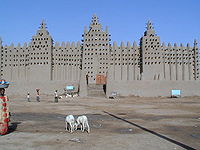 African art
existed in many forms and styles, and with fairly little influence from outside Africa
. Most of it followed traditional forms and the aesthetic norms were handed down orally as well as written. Sculpture
and performance art
are prominent, and abstract and partially abstracted forms are valued, and were valued long before influence from the Western tradition began in earnest. The Nok culture is testimony to this. The mosque
of Timbuktu
shows that specific areas of Africa developed unique aesthetics.
is primarily religious in focus and funded largely by the State
, Roman Catholic
or Orthodox
church, powerful ecclesiastical individuals, or wealthy secular patrons. These art pieces often served a liturgical function, whether as chalices
or even as church buildings themselves. Objects of fine art from this period were frequently made from rare and valuable materials, such as gold
and lapis, the cost of which commonly exceeded the wages of the artist.
Medieval aesthetics in the realm of philosophy built upon Classical thought, continuing the practice of Plotinus
by employing theological terminology in its explications. St. Bonaventure
’s “Retracing the Arts to Theology”, a primary example of this method, discusses the skills of the artisan as gifts given by God for the purpose of disclosing God to mankind, which purpose is achieved through four lights: the light of skill in mechanical arts which discloses the world of artifacts; which light is guided by the light of sense perception which discloses the world of natural forms; which light, consequently, is guided by the light of philosophy which discloses the world of intellectual truth; finally, this light is guided by the light of divine wisdom which discloses the world of saving truth.
Saint Thomas Aquinas's aesthetic is probably the most famous and influential theory among medieval authors, having been the subject of much scrutiny in the wake of the neo-Scholastic revival of the late 19th and early 20th centuries and even having received the approbation of the celebrated Modernist writer, James Joyce. Thomas, like many other medievals, never gives a systematic account of beauty
itself, but several scholars have conventionally arranged his thought—though not always with uniform conclusions—using relevant observations spanning the entire corpus of his work. While Aquinas's theory follows generally the model of Aristotle, he develops a singular aesthetics which incorporates elements unique to his thought. Umberto Eco's The Aesthetics of Thomas Aquinas identifies the three main characteristics of beauty
in Aquinas's philosophy: integritas sive perfectio, consonantia sive debita proportio, and claritas sive splendor formae. While Aristotle likewise identifies the first two characteristics, St. Thomas conceives of the third as an appropriation from principles developed by neo-Platonic and Augustinian thinkers.
 With the shift from the Middle Ages to the Renaissance
, art likewise changed its focus, as much in its content as in its mode of expression.
. German
and British
thinkers emphasised beauty
as the key component of art and of the aesthetic experience, and saw art as necessarily aiming at absolute beauty
.
For Alexander Gottlieb Baumgarten
aesthetics is the science of the sense experiences, a younger sister of logic, and beauty is thus the most perfect kind of knowledge that sense experience can have. For Immanuel Kant
the aesthetic experience of beauty is a judgment of a subjective but similar human truth, since all people should agree that “this rose
is beautiful” if it in fact is. However, beauty cannot be reduced to any more basic set of features. For Friedrich Schiller
aesthetic appreciation of beauty is the most perfect reconciliation of the sensual and rational parts of human nature.
For Friedrich Wilhelm Joseph Schelling
, the philosophy of art is the "organon" of philosophy concerning the relation between man and nature. So aesthetics began now to be the name for the philosophy of art. Friedrich von Schlegel, August Wilhelm Schlegel, Friedrich Schleiermacher and Georg Wilhelm Friedrich Hegel
have also given lectures on aesthetics as philosophy of art after 1800.
For Hegel all culture is a matter of "absolute spirit" coming to be manifest to itself, stage by stage, changing to a perfection
that only philosophy can approach. Art is the first stage in which the absolute spirit is manifest immediately to sense-perception, and is thus an objective rather than subjective revelation of beauty.
For Arthur Schopenhauer
aesthetic contemplation of beauty is the most free that the pure intellect can be from the dictates of will; here we contemplate perfection of form without any kind of worldly agenda, and thus any intrusion of utility or politics would ruin the point of the beauty. It is thus for Schopenhauer one way to fight the suffering
.
The British were largely divided into intuitionist and analytic camps. The intuitionists believed that aesthetic experience was disclosed by a single mental faculty of some kind. For Anthony Ashley-Cooper, 3rd Earl of Shaftesbury
this was identical to the moral sense, beauty just is the sensory version of moral goodness. For Ludwig Wittgenstein
aesthetics consisted in the description of a whole culture which is a linguistic impossibility. That which constitutes aesthetics lies out side the realm of the language game.
On 7 January 1904 James Joyce
attempted to publish A Portrait of the Artist, an essay-story dealing with aesthetics, only to have it rejected from the free-thinking magazine Dana. He decided, on his twenty-second birthday, to revise the story into a novel he called Stephen Hero. It was a fictional rendering of Joyce's youth, but he eventually grew frustrated with its direction and abandoned this work. It was never published in this form, but years later, in Trieste, Joyce completely rewrote it as A Portrait of the Artist as a Young Man. The unfinished Stephen Hero was published after his death.
For Oscar Wilde
the contemplation of beauty for beauty's sake was not only the foundation for much of his literary career but was quoted as saying "Aestheticism is a search after the signs of the beautiful. It is the science of the beautiful through which men seek the correlation of the arts. It is, to speak more exactly, the search after the secret of life.".
Wilde famously toured the United States in 1882. He travelled across the United States spreading the idea of Aesthetics in a speech called "The English Renaissance." In his speech he proposed that Beauty and Aesthetics was "not languid but energetic. By beautifying the outward aspects of life, one would beautify the inner ones." The English Renaissance was, he said, "like the Italian Renaissance before it, a sort of rebirth of the spirit of man".
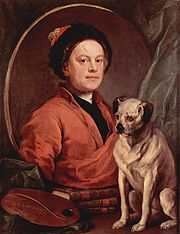 For Francis Hutcheson
beauty is disclosed by an inner mental sense, but is a subjective fact rather than an objective one. Analytic theorists like Henry Home, Lord Kames
, William Hogarth
, and Edmund Burke
hoped to reduce beauty to some list of attributes. Hogarth, for example, thinks that beauty consists of (1) fitness of the parts to some design; (2) variety in as many ways as possible; (3) uniformity, regularity or symmetry, which is only beautiful when it helps to preserve the character of fitness; (4) simplicity or distinctness, which gives pleasure not in itself, but through its enabling the eye to enjoy variety with ease; (5) intricacy, which provides employment for our active energies, leading the eye on "a wanton kind of chase"; and (6) quantity or magnitude, which draws our attention and produces admiration and awe. Later analytic aestheticians strove to link beauty to some scientific theory of psychology (such as James Mill
) or biology (such as Herbert Spencer
).
, American philosopher and poet, founded Aesthetic Realism
, the philosophy that reality itself is aesthetic, and that "The world, art, and self explain each other: each is the aesthetic oneness of opposites."
Various attempts have been made to define Post-modern aesthetics. The challenge to the assumption that beauty was central to art and aesthetics, thought to be original, is actually continuous with older aesthetic theory; Aristotle was the first in the Western tradition to classify "beauty" into types as in his theory of drama, and Kant made a distinction between beauty and the sublime. What was new was a refusal to credit the higher status of certain types, where the taxonomy implied a preference for tragedy and the sublime to comedy and the Rococo.
Croce
suggested that “expression” is central in the way that beauty was once thought to be central. George Dickie
suggested that the sociological institutions of the art world were the glue binding art and sensibility into unities. Marshall McLuhan
suggested that art always functions as a "counter-environment" designed to make visible what is usually invisible about a society. Theodor Adorno felt that aesthetics could not proceed without confronting the role of the culture industry in the commodification of art and aesthetic experience. Hal Foster
attempted to portray the reaction against beauty and Modernist art in The Anti-Aesthetic: Essays on Postmodern Culture. Arthur Danto
has described this reaction as "kalliphobia" (after the Greek word for beauty - 'kalos'). André Malraux explains that the notion of beauty was connected to a particular conception of art that arose with the Renaissance and was still dominant in the eighteenth century (but was supplanted later). The discipline of aesthetics, which originated in the eighteenth century, mistook this transient state of affairs for a revelation of the permanent nature of art. Brian Massumi
suggests to reconsider beauty
following the aesthetical thought in the philosophy of Deleuze and Guattari.
Daniel Berlyne created the field of experimental aesthetics in the 1970s, for which he is still the most cited individual decades after his death.
Pneumaist aestheticism is a theory of art and a highly experimental approach to art negating historical preconceptions of the aesthetic.
Jean-François Lyotard
re-invokes the Kantian distinction between taste
and the sublime
. Sublime painting, unlike kitsch
realism
, "...will enable us to see only by making it impossible to see; it will please only by causing pain."
Sigmund Freud
inaugurated aesthetical thinking in Psychoanalysis
mainly via the "Uncanny" as aesthetical affect. Following Freud and Merleau-Ponty, Jacques Lacan
theorized aesthetics in terms of sublimation and the Thing
Guy Sircello
pioneered efforts in analytic philosophy to develop a rigorous theory of aesthetics, focusing on the concepts of beauty, love and sublimity. In contrast to romantic theorists Sircello argued for the objectivity of beauty and formulated a theory of love on that basis.
refers to the theory in which H. sapiens' basic aesthetic preferences have evolved based on survival needs. It is the nature approach (with regards to "nature versus nurture"
tug of war) that claims survival as a motivator for likeness within a species.
Aesthetic preference is something that ultimately varies from person to person. Whether it is culturally taught or branded into our genetic makeup, preferences for beauty, style, and other characteristics of aesthetics can all be linked back to preferences. Some theorists believe that the baseline of H. sapiens' preferred aesthetics is tied to Evolution
. That is to say that we developed our taste in looks to accommodate survival and promote the wellbeing of our species. Based on this theory, things like color preference, preferred mate body ratios, shapes, emotional ties with objects, and many other aspects of the aesthetic experience can be tied with how we evolved.
 In the 1970s, Abraham Moles
and Frieder Nake
were among the first to analyze links between aesthetics, information processing
, and information theory
.
In the 1990s, Jürgen Schmidhuber
described an algorithmic theory of beauty
which takes the subjectivity
of the observer into account and postulates: among several observations classified as comparable by a given subjective observer, the aesthetically most pleasing one is the one with the shortest description, given the observer’s previous knowledge and his particular method for encoding the data. This is closely related to the principles of algorithmic information theory
and minimum description length
. One of his examples: mathematician
s enjoy simple proofs with a short description in their formal language
. Another very concrete example describes an aesthetically pleasing human face whose proportions can be described by very few bit
s of information
, drawing inspiration from less detailed 15th century proportion studies by Leonardo da Vinci
and Albrecht Dürer
. Schmidhuber's theory explicitly distinguishes between what's beautiful
and what's interesting, stating that interestingness corresponds to the first derivative of subjectively perceived beauty
. Here the premise is that any observer continually tries to improve the predictability
and compressibility of the observations by discovering regularities such as repetitions and symmetries and fractal
self-similarity
. Whenever the observer's learning process (which may be a predictive neural network
- see also Neuroesthetics
) leads to improved data compression such that the observation sequence can be described by fewer bits
than before, the temporary interestingness of the data corresponds to the number of saved bits. This compression progress is proportional to the observer's internal reward, also called curiosity reward. A reinforcement learning
algorithm is used to maximize future expected reward by learning to execute action sequences that cause additional interesting input data with yet unknown but learnable predictability or regularity. The principles can be implemented on artificial agents which then exhibit a form of artificial
curiosity
.
, gastronomy
, fashion
and website design.
has pointed out that the unity of aesthetics and ethics is in fact reflected in our understanding of behaviour being "fair" - the word having a double meaning of attractive and morally acceptable. More recently, James Page
has suggested that aesthetic ethics might be taken to form a philosophical rationale for peace education
.
and complexity
, are used for analysis in theoretical aesthetics. This is different from the aesthetic considerations of applied aesthetics
used in the study of mathematical beauty
. Aesthetic considerations such as symmetry
and simplicity
are used in areas of philosophy, such as ethics
and theoretical physics
and cosmology
to define truth
, outside of empirical
considerations. Beauty
and Truth
have been argued to be nearly synonymous, as reflected in the statement "Beauty is truth, truth beauty" in the poem Ode on a Grecian Urn
by John Keats
. The fact that judgments of beauty and judgments of truth both are influenced by processing fluency
, which is the ease with which information can be processed, has been presented as an explanation for why beauty is sometimes equated with truth. Indeed, recent research found that people use beauty as an indication for truth in mathematical pattern tasks.
approach, where large numbers of manually rated photographs are used to "teach" a computer about what visual properties are of relevance to aesthetic quality. The Acquine engine, developed at Penn State University, rates natural photographs uploaded by users.
Notable in this area is Michael Leyton, professor of psychology at Rutgers University. Leyton is the president of the International Society for Mathematical and Computational Aesthetics and the
International Society for Group Theory in Cognitive Science and has developed a generative theory of shape.
There have also been relatively successful attempts with regard to chess and music.
Immanuel Kant
, writing in 1790, observes of a man "If he says that canary wine is agreeable he is quite content if someone else corrects his terms and reminds him to say instead: It is agreeable to me," because "Everyone has his own (sense
of) taste
". The case of "beauty" is different from mere "agreeableness" because, "If he proclaims something to be beautiful, then he requires the same liking from others; he then judges not just for himself but for everyone, and speaks of beauty as if it were a property of things."
Aesthetic judgments usually go beyond sensory discrimination. For David Hume
, delicacy of taste is not merely "the ability to detect all the ingredients in a composition", but also our sensitivity "to pains as well as pleasures, which escape the rest of mankind." (Essays Moral Political and Literary. Indianapolis, Literary Classics 5, 1987.) Thus, the sensory discrimination is linked to capacity for pleasure
. For Kant
"enjoyment" is the result when pleasure arises from sensation, but judging something to be "beautiful" has a third requirement: sensation must give rise to pleasure by engaging our capacities of reflective contemplation. Judgments of beauty are sensory, emotional and intellectual all at once.
Viewer interpretations of beauty possess two concepts of value: aesthetics and taste. Aesthetics is the philosophical notion of beauty
. Taste is a result of an education
process and awareness of elite cultural values learned through exposure to mass culture. Bourdieu examined how the elite in society define the aesthetic values like taste and how varying levels of exposure to these values can result in variations by class
, cultural background, and education. According to Kant, beauty is objective and universal; thus certain things are beautiful to everyone. The contemporary view of beauty is not based on innate qualities, but rather on cultural specifics and individual interpretations.
 Judgments of aesthetic value seem often to involve many other kinds of issues as well. Responses such as disgust show that sensory detection is linked in instinct
ual ways to facial expression
s, and even behaviors like the gag reflex
. Yet disgust can often be a learned or cultural issue too; as Darwin pointed out, seeing a stripe of soup in a man's beard is disgusting even though neither soup
nor beard
s are themselves disgusting. Aesthetic judgments may be linked to emotions or, like emotions, partially embodied in our physical reactions. Seeing a sublime
view of a landscape may give us a reaction of awe
, which might manifest physically as an increased heart rate or widened eyes. These unconscious reactions may even be partly constitutive of what makes our judgment a judgment that the landscape is sublime.
Likewise, aesthetic judgments may be culturally conditioned to some extent. Victorian
s in Britain often saw African sculpture
as ugly, but just a few decades later, Edwardian audiences saw the same sculptures as being beautiful. Evaluations of beauty may well be linked to desirability, perhaps even to sexual
desirability. Thus, judgments of aesthetic value
can become linked to judgments of economic
, political
, or moral
value. In a current context, one might judge a Lamborghini
to be beautiful partly because it is desirable as a status symbol, or we might judge it to be repulsive partly because it signifies for us over-consumption and offends our political or moral values.
"Part and Parcel in Animal and Human Societies". in Studies in animal and human behavior, vol. 2. pp. 115–195. Cambridge, Mass.: Harvard UP, 1971 (originally pub. 1950.)
Aesthetic judgments can often be very fine-grained and internally contradictory. Likewise aesthetic judgments seem often to be at least partly intellectual and interpretative. It is what a thing means or symbolizes for us that is often what we are judging. Modern aestheticians have asserted that will
and desire
were almost dormant in aesthetic experience, yet preference
and choice
have seemed important aesthetics to some 20th century thinkers. The point is already made by Hume
, but see Mary Mothersill, "Beauty and the Critic’s Judgment", in The Blackwell Guide to Aesthetics, 2004. Thus aesthetic judgments might be seen to be based on the senses, emotions, intellectual opinions, will, desires, culture, preferences, values, subconscious behavior, conscious decision, training, instinct, sociological institutions, or some complex combination of these, depending on exactly which theory one employs.
beautiful. What characteristics do they share which give them that status? What possible feature could a proof and a fragrance both share in virtue of which they both count as beautiful? What makes a painting beautiful is quite different from what makes music beautiful, which suggests that each art form has its own language for the judgement of aesthetics.
At the same time, there is seemingly quite a lack of words to express oneself accurately when making an aesthetic judgment. An aesthetic judgment cannot be an empirical judgement. Therefore, due to impossibility for precision, there is confusion about what interpretations can be culturally negotiated. Due to imprecision in the standard English language, two completely different feelings experienced by two different people can be represented by an identical verbal expression. Wittgenstein stated this in his lectures on aesthetics and language games.
A collective identification of beauty, with willing participants in a given social spectrum, may be a socially negotiated phenomenon, discussed in a culture or context. Is there some underlying unity to aesthetic judgment and is there some way to articulate the similarities of a beautiful house, beautiful proof, and beautiful sunset? Defining it requires a description of the entire phenomenon, as Wittgenstein argued in his lectures on aesthetics. Likewise there has been long debate on how perception of beauty in the natural world, especially perception of the human form as beautiful, is supposed to relate to perceiving beauty in art
or artefacts. This goes back at least to Kant, with some echoes even in St. Bonaventure.
since Hegel, while others insist that there is a significant distinction between these closely related fields. In practice aesthetic judgement refers to the sensory contemplation or appreciation of an object (not necessarily an art object), while artistic judgement refers to the recognition, appreciation or criticism of art or an art work.
Philosophical aesthetics has not only to speak about art and to produce judgments about art works, but has also to give a definition
of what art is. Art is an autonomous entity for philosophy
, because art deals with the senses (i. e. the etymology of aesthetics) and art is as such free of any moral
or political purpose. Hence, there are two different conceptions of art in aesthetics : art as knowledge
or art as action, but aesthetics is neither epistemology nor ethics
.
 How best to define the term “art” is a subject of constant contention; many books and journal articles have been published arguing over even the basics of what we mean by the term “art”. Theodor Adorno claimed in 1969 “It is self-evident that nothing concerning art is self-evident.” Artists, philosophers, anthropologists, psychologists and programmers all use the notion of art in their respective fields, and give it operational definitions that vary considerably. Furthermore, it is clear that even the basic meaning of the term "art
" has changed several times over the centuries, and has continued to evolve during the 20th century as well.
The main recent sense of the word “art” is roughly as an abbreviation for creative art or “fine art
.” Here we mean that skill is being used to express the artist’s creativity, or to engage the audience’s aesthetic sensibilities, or to draw the audience towards consideration of the “finer” things. Often, if the skill is being used in a functional object, people will consider it a craft
instead of art, a suggestion which is highly disputed by many Contemporary Craft
thinkers. Likewise, if the skill is being used in a commercial or industrial way it may be considered design
instead of art, or contrariwise these may be defended as art forms, perhaps called applied art
. Some thinkers, for instance, have argued that the difference between fine art and applied art has more to do with the actual function of the object than any clear definitional difference. Art usually implies no function other than to convey or communicate an idea.
Even as late as 1912 it was normal in the West to assume that all art aims at beauty, and thus that anything that wasn't trying to be beautiful couldn't count as art. The cubists
, dada
ists, Stravinsky
, and many later art movements struggled against this conception that beauty was central to the definition of art, with such success that, according to Danto, "Beauty had disappeared not only from the advanced art of the 1960’s but from the advanced philosophy of art of that decade as well." Perhaps some notion like "expression" (in Croce’s
theories) or "counter-environment" (in McLuhan’s
theory) can replace the previous role of beauty. Brian Massumi
brought back "beauty" into consideration together with "expression". Another view, as important to the philosophy of art as "beauty," is that of the "sublime," elaborated upon in the twentieth century by the postmodern philosopher Jean-François Lyotard
. A further approach, elaborated by André Malraux in works such as The Voices of Silence, is that art is fundamentally a response to a metaphysical question ('Art', he writes, 'is an 'anti-destiny'). Malraux argues that, while art has sometimes been oriented towards beauty and the sublime (principally in post-Renaissance European art) these qualities, as the wider history of art demonstrates, are by no means essential to it.
Perhaps (as in Kennick's theory) no definition of art is possible anymore. Perhaps art should be thought of as a cluster of related concepts in a Wittgensteinian
fashion (as in Weitz
or Beuys
). Another approach is to say that “art” is basically a sociological category, that whatever art schools and museums and artists define as art is considered art regardless of formal definitions. This "institutional definition of art" (see also Institutional Critique
) has been championed by George Dickie
. Most people did not consider the depiction of a Brillo Box or a store-bought urinal to be art until Andy Warhol
and Marcel Duchamp
(respectively) placed them in the context of art (i.e., the art gallery
), which then provided the association of these objects with the associations that define art.
Proceduralists often suggest that it is the process by which a work of art is created or viewed that makes it art, not any inherent feature of an object, or how well received it is by the institutions of the art world after its introduction to society at large. If a poet writes down several lines, intending them as a poem, the very procedure by which it is written makes it a poem. Whereas if a journalist writes exactly the same set of words, intending them as shorthand notes to help him write a longer article later, these would not be a poem. Leo Tolstoy
, on the other hand, claims that what decides whether or not something is art is how it is experienced by its audience, not by the intention of its creator. Functionalists like Monroe Beardsley
argue that whether or not a piece counts as art depends on what function it plays in a particular context; the same Greek vase may play a non-artistic function in one context (carrying wine), and an artistic function in another context (helping us to appreciate the beauty of the human figure). '
 Art can be difficult at the metaphysical and ontological levels as well as at the value theory
level. When we see a performance of Hamlet
, how many works of art are we experiencing, and which should we judge? Perhaps there is only one relevant work of art, the whole performance, which many different people have contributed to, and which will exist briefly and then disappear. Perhaps the manuscript by Shakespeare is a distinct work of art from the play by the troupe, which is also distinct from the performance of the play by this troupe on this night, and all three can be judged, but are to be judged by different standards.
Perhaps every person involved should be judged separately on his or her own merits, and each costume or line is its own work of art (with perhaps the director having the job of unifying them all). Similar problems arise for music, film, dance, and even painting. Is one to judge the painting itself, the work of the painter, or perhaps the painting in its context of presentation by the museum workers?
These problems have been made even more difficult by the rise of conceptual art
since the 1960s. Warhol’s famous Brillo Boxes are nearly indistinguishable from actual Brillo boxes at the time. It would be a mistake to praise Warhol for the design of his boxes (which were designed by Steve Harvey), yet the conceptual move of exhibiting these boxes as art in a museum together with other kinds of paintings is Warhol's. Are we judging Warhol’s concept? His execution of the concept in the medium? The curator
’s insight in letting Warhol display the boxes? The overall result? Our experience or interpretation of the result? Ontologically, how are we to think of the work of art? Is it a physical object? Several objects? A class of objects? A mental object? A fictional object? An abstract object
? An event? Or simply an Act?
, for instance, argued in 1960 that each artistic medium should seek that which makes it unique among the possible mediums and then purify itself of anything other than expression of its own uniqueness as a form. The Dada
ist Tristan Tzara
on the other hand saw the function of art in 1918 as the destruction of a mad social order. “We must sweep and clean. Affirm the cleanliness of the individual after the state of madness, aggressive complete madness of a world abandoned to the hands of bandits.” Formal goals, creative goals, self-expression, political goals, spiritual goals, philosophical goals, and even more perceptual or aesthetic goals have all been popular pictures of what art should be like.
The value of art, then, is one with the value of empathy.
Other possible views are these: Art can act as a means to some special kind of knowledge. Art may give insight into the human condition. Art relates to science
and religion
. Art serves as a tool of education, or indoctrination, or enculturation. Art makes us more moral. It uplifts us spiritually. Art is politics by other means. Art has the value of allowing catharsis
. In any case, the value of art may determine the suitability of an art form. Do they differ significantly in their values, or (if not) in their ability to achieve the unitary value of art?
But to approach the question of the value of art systematically, one ought to ask: for whom? For the artist? For the audience? For society at large, and/or for individuals beyond the audience? Is the "value" of art different in each of these different contexts?
Working on the intended value of art tends to help define the relations between art and other acts. Art clearly does have spiritual goals in many contexts, but what exactly is the difference between religious art and religion per se? The truth is complex; art is both useless in a functional sense, and also the most important human activity.
An argument for the value of art, used in the fictional work 'The Hitchhikers Guide to the Galaxy', proceeds that, should some external force presenting imminent destruction of Earth, ask the inhabitants, of what use is humanity, what should humanity's response be? The argument continues that the only justification humanity could give for its continued existence would be the past creation and continued creation of things like a Shakespeare play, a Rembrandt painting or a Bach concerto. The suggestion is that these are the things of value which define humanity.
identified six universal signatures in human aesthetics:
It might be objected, however, that there are rather too many exceptions to Dutton's categories. For example, the installations of the contemporary artist Thomas Hirschhorn
deliberately eschew technical virtuosity. People can appreciate a Renaissance Madonna
for aesthetic reasons, but such objects often had (and sometimes still have) specific devotional functions. "Rules of composition" that might be read into Duchamp's Fountain
or John Cage
's 4′33″ do not locate the works in a recognizable style (or certainly not a style recognizable at the time of the works' realisation). Moreover, some of Dutton's categories seem too broad: a physicist might entertain hypothetical worlds in his/her imagination in the course of formulating a theory. Another problem is that Dutton's categories seek to universalise traditional European notions of aesthetics and art forgetting that, as André Malraux
and others have pointed out, there have been large numbers of cultures in which such ideas (including the idea "art" itself) were non-existent.
Increasingly, academics in both the sciences and the humanities look to evolutionary psychology
and cognitive science
in an effort to understand the connection between psychology and aesthetics. Aside from Dutton
, others exploring this realm include David Bordwell
, Brian Boyd
, Christine Buci-Glucksmann
, Noel Carroll
, Ellen Dissanayake, Nancy Easterlin, Bracha Ettinger, David Evans, Jonathan Gottschall, Torben Grodal
, Paul Hernadi,, Patrick Hogan
, Carl Plantinga, Rolf Reber
, Elaine Scarry
, Murray Smith, Wendy Steiner, Robert Storey, Frederick Turner, and Mark Turner
.
argues that there is no unique and or individual aesthetic object which can be extrapolated from the art world, but that there is a continuum of cultural forms and experience of which ordinary speech and experiences may signal as art. By "art" we may frame several artistic "works" or "creations" as so though this reference remains within the institution or special event which creates it and this leaves some works or other possible "art" outside of the frame work, or other interpretations such as other phenomenon which may not be considered as "art".
Pierre Bourdieu
disagrees with Kant's idea of the "aesthetic". He argues that Kant's "aesthetic" merely represents an experience that is the product of an elevated class habitus and scholarly leisure as opposed to other possible and equally valid "aesthetic" experiences which lay outside Kant's narrow definition.
von Vacano, Diego, "The Art of Power: Machiavelli, Nietzsche and the Making of Aesthetic Political Theory," Lanham MD: Lexington: 2007.
Philosophy
Philosophy is the study of general and fundamental problems, such as those connected with existence, knowledge, values, reason, mind, and language. Philosophy is distinguished from other ways of addressing such problems by its critical, generally systematic approach and its reliance on rational...
dealing with the nature of beauty
Beauty
Beauty is a characteristic of a person, animal, place, object, or idea that provides a perceptual experience of pleasure, meaning, or satisfaction. Beauty is studied as part of aesthetics, sociology, social psychology, and culture...
, art
Art
Art is the product or process of deliberately arranging items in a way that influences and affects one or more of the senses, emotions, and intellect....
, and taste, and with the creation and appreciation of beauty
Beauty
Beauty is a characteristic of a person, animal, place, object, or idea that provides a perceptual experience of pleasure, meaning, or satisfaction. Beauty is studied as part of aesthetics, sociology, social psychology, and culture...
. It is more scientifically defined as the study of sensory or sensori-emotional values, sometimes called judgment
Judgment
A judgment , in a legal context, is synonymous with the formal decision made by a court following a lawsuit. At the same time the court may also make a range of court orders, such as imposing a sentence upon a guilty defendant in a criminal matter, or providing a remedy for the plaintiff in a civil...
s of sentiment
Feeling
Feeling is the nominalization of the verb to feel. The word was first used in the English language to describe the physical sensation of touch through either experience or perception. The word is also used to describe experiences, other than the physical sensation of touch, such as "a feeling of...
and taste
Taste (sociology)
Taste as an aesthetic, sociological, economic and anthropological concept refers to a cultural patterns of choice and preference. While taste is often understood as a biological concept, it can also be reasonably studied as a social or cultural phenomenon. Taste is about drawing distinctions...
. More broadly, scholars in the field define aesthetics as "critical reflection on art
Art
Art is the product or process of deliberately arranging items in a way that influences and affects one or more of the senses, emotions, and intellect....
, culture
Culture
Culture is a term that has many different inter-related meanings. For example, in 1952, Alfred Kroeber and Clyde Kluckhohn compiled a list of 164 definitions of "culture" in Culture: A Critical Review of Concepts and Definitions...
and nature
Nature
Nature, in the broadest sense, is equivalent to the natural world, physical world, or material world. "Nature" refers to the phenomena of the physical world, and also to life in general...
."
Etymology
The word aesthetic is derived from the GreekGreek language
Greek is an independent branch of the Indo-European family of languages. Native to the southern Balkans, it has the longest documented history of any Indo-European language, spanning 34 centuries of written records. Its writing system has been the Greek alphabet for the majority of its history;...
αἰσθητικός (aisthetikos, meaning "esthetic, sensitive, sentient"), which in turn was derived from αἰσθάνομαι (aisthanomai, meaning "I perceive, feel, sense"). The term "aesthetics" was appropriated and coined with new meaning in the German
German language
German is a West Germanic language, related to and classified alongside English and Dutch. With an estimated 90 – 98 million native speakers, German is one of the world's major languages and is the most widely-spoken first language in the European Union....
form Æsthetik (modern spelling Ästhetik) by Alexander Baumgarten in 1735.
History of aesthetics
Ancient aesthetics
There are examples of pre-historic artPre-historic art
In the history of art, prehistoric art is all art produced in preliterate, prehistorical cultures beginning somewhere in very late geological history, and generally continuing until that culture either develops writing or other methods of record-keeping, or it makes significant contact with another...
, but they are rare, and the context of their production and use is not very clear, so the aesthetic doctrines that guided their production and interpretation are mostly unknown.
Ancient art
Ancient art
Arts of the ancient world refer to the many types of art that were in the cultures of ancient societies, such as those of ancient China, India, Mesopotamia, Persia, Egypt, Greece and Rome.-Egypt:...
was largely, but not entirely, based on the eight great ancient civilizations: Egypt
Ancient Egypt
Ancient Egypt was an ancient civilization of Northeastern Africa, concentrated along the lower reaches of the Nile River in what is now the modern country of Egypt. Egyptian civilization coalesced around 3150 BC with the political unification of Upper and Lower Egypt under the first pharaoh...
, Mesopotamia
Mesopotamia
Mesopotamia is a toponym for the area of the Tigris–Euphrates river system, largely corresponding to modern-day Iraq, northeastern Syria, southeastern Turkey and southwestern Iran.Widely considered to be the cradle of civilization, Bronze Age Mesopotamia included Sumer and the...
, Persia, Greece
Ancient Greece
Ancient Greece is a civilization belonging to a period of Greek history that lasted from the Archaic period of the 8th to 6th centuries BC to the end of antiquity. Immediately following this period was the beginning of the Early Middle Ages and the Byzantine era. Included in Ancient Greece is the...
, China
China
Chinese civilization may refer to:* China for more general discussion of the country.* Chinese culture* Greater China, the transnational community of ethnic Chinese.* History of China* Sinosphere, the area historically affected by Chinese culture...
, Rome
Ancient Rome
Ancient Rome was a thriving civilization that grew on the Italian Peninsula as early as the 8th century BC. Located along the Mediterranean Sea and centered on the city of Rome, it expanded to one of the largest empires in the ancient world....
, India
History of India
The history of India begins with evidence of human activity of Homo sapiens as long as 75,000 years ago, or with earlier hominids including Homo erectus from about 500,000 years ago. The Indus Valley Civilization, which spread and flourished in the northwestern part of the Indian subcontinent from...
and Mayan. Each of these centers of early civilization developed a unique and characteristic style in its art. Greece had the most influence on the development of aesthetics in the West. This period of Greek art saw a veneration of the human physical form and the development of corresponding skills to show musculature, poise, beauty
Beauty
Beauty is a characteristic of a person, animal, place, object, or idea that provides a perceptual experience of pleasure, meaning, or satisfaction. Beauty is studied as part of aesthetics, sociology, social psychology, and culture...
and anatomically correct proportions. Furthermore, in many Western and Eastern cultures alike, traits such as body hair are rarely depicted in art that addresses physical beauty. More in contrast with this Greek-Western aesthetic taste is the genre of grotesque
Grotesque
The word grotesque comes from the same Latin root as "Grotto", meaning a small cave or hollow. The original meaning was restricted to an extravagant style of Ancient Roman decorative art rediscovered and then copied in Rome at the end of the 15th century...
.
Greek
Ancient Greece
Ancient Greece is a civilization belonging to a period of Greek history that lasted from the Archaic period of the 8th to 6th centuries BC to the end of antiquity. Immediately following this period was the beginning of the Early Middle Ages and the Byzantine era. Included in Ancient Greece is the...
philosophers initially felt that aesthetically appealing objects were beautiful in and of themselves. Plato
Plato
Plato , was a Classical Greek philosopher, mathematician, student of Socrates, writer of philosophical dialogues, and founder of the Academy in Athens, the first institution of higher learning in the Western world. Along with his mentor, Socrates, and his student, Aristotle, Plato helped to lay the...
felt that beautiful objects incorporated proportion, harmony
Harmony
In music, harmony is the use of simultaneous pitches , or chords. The study of harmony involves chords and their construction and chord progressions and the principles of connection that govern them. Harmony is often said to refer to the "vertical" aspect of music, as distinguished from melodic...
, and unity among their parts. Similarly, in the Metaphysics
Metaphysics (Aristotle)
Metaphysics is one of the principal works of Aristotle and the first major work of the branch of philosophy with the same name. The principal subject is "being qua being", or being understood as being. It examines what can be asserted about anything that exists just because of its existence and...
, Aristotle
Aristotle
Aristotle was a Greek philosopher and polymath, a student of Plato and teacher of Alexander the Great. His writings cover many subjects, including physics, metaphysics, poetry, theater, music, logic, rhetoric, linguistics, politics, government, ethics, biology, and zoology...
found that the universal elements of beauty
Beauty
Beauty is a characteristic of a person, animal, place, object, or idea that provides a perceptual experience of pleasure, meaning, or satisfaction. Beauty is studied as part of aesthetics, sociology, social psychology, and culture...
were order, symmetry
Symmetry
Symmetry generally conveys two primary meanings. The first is an imprecise sense of harmonious or aesthetically pleasing proportionality and balance; such that it reflects beauty or perfection...
, and definiteness.
An example of ancient aesthetics in Greece through poetry is proven by the quote " For the authors of those great poems which we admire, do not attain to excellence through the rules of any art; but they utter their beautiful melodies of verse in a state of inspiration, and, as it were, possessed by a spirit not their own,"Plato. (History of Aesthetics)
Islamic aesthetics
Islamic artIslamic art
Islamic art encompasses the visual arts produced from the 7th century onwards by people who lived within the territory that was inhabited by or ruled by culturally Islamic populations...
is not, properly speaking, an art pertaining to religion only. The term "Islam
Islam
Islam . The most common are and . : Arabic pronunciation varies regionally. The first vowel ranges from ~~. The second vowel ranges from ~~~...
ic" refers not only to the religion, but to any form of art created in an Islamic culture
Muslim culture
Islamic culture is a term primarily used in secular academia to describe the cultural practices common to historically Islamic peoples. As the religion of Islam originated in 7th century Arabia, the early forms of Muslim culture were predominantly Arab...
or in an Islamic context. It would also be a mistake to assume that all Muslim
Muslim
A Muslim, also spelled Moslem, is an adherent of Islam, a monotheistic, Abrahamic religion based on the Quran, which Muslims consider the verbatim word of God as revealed to prophet Muhammad. "Muslim" is the Arabic term for "submitter" .Muslims believe that God is one and incomparable...
s are in agreement on the use of art in religious observance, the proper place of art in society, or the relation between secular art and the demands placed on the secular world to conform to religious precepts. Islamic art frequently adopts secular elements and elements that are frowned upon, if not forbidden, by some Islamic theologians
Kalam
ʿIlm al-Kalām is the Islamic philosophical discipline of seeking theological principles through dialectic. Kalām in Islamic practice relates to the discipline of seeking theological knowledge through debate and argument. A scholar of kalām is referred to as a mutakallim...
.
According to Islam, human works of art are inherently flawed compared to the work of God; thus, it is believed by many that to attempt to depict in a realistic form any animal or person is insolence to God. This tendency has had the effect of narrowing the field of artistic possibility to such forms of art as Arabesque
Arabesque
The arabesque is a form of artistic decoration consisting of "surface decorations based on rhythmic linear patterns of scrolling and interlacing foliage, tendrils" or plain lines, often combined with other elements...
, mosaic
Mosaic
Mosaic is the art of creating images with an assemblage of small pieces of colored glass, stone, or other materials. It may be a technique of decorative art, an aspect of interior decoration, or of cultural and spiritual significance as in a cathedral...
, Islamic calligraphy
Islamic calligraphy
Islamic calligraphy, colloquially known as Perso-Arabic calligraphy, is the artistic practice of handwriting, or calligraphy, and by extension, of bookmaking, in the lands sharing a common Islamic cultural heritage. This art form is based on the Arabic script, which for a long time was used by all...
, and Islamic architecture
Islamic architecture
Islamic architecture encompasses a wide range of both secular and religious styles from the foundation of Islam to the present day, influencing the design and construction of buildings and structures in Islamic culture....
, as well as more generally any form of abstraction that can claim the status of non-representational art.
The limited possibilities have been explored by artists as an outlet to artistic expression, and has been cultivated to become a positive style and tradition, emphasizing the decorative function of art, or its religious functions via non-representational forms such as Geometric patterns, floral patterns, and arabesques.
Human or animal depiction is generally forbidden altogether in Islamic cultures because it is said to lead to sculptural pieces which then leads to worship of that sculpture or "idol". Human portrayals can be found in early Islamic cultures with varying degrees of acceptance by religious authorities. Human representation for the purpose of worship that is uniformly considered idolatry
Idolatry
Idolatry is a pejorative term for the worship of an idol, a physical object such as a cult image, as a god, or practices believed to verge on worship, such as giving undue honour and regard to created forms other than God. In all the Abrahamic religions idolatry is strongly forbidden, although...
as forbidden in Sharia
Sharia
Sharia law, is the moral code and religious law of Islam. Sharia is derived from two primary sources of Islamic law: the precepts set forth in the Quran, and the example set by the Islamic prophet Muhammad in the Sunnah. Fiqh jurisprudence interprets and extends the application of sharia to...
law. There are many depictions of Muhammad
Depictions of Muhammad
The permissibility of depictions of Muhammad, the founder of Islam, has long been a concern in the history of Islam. Oral and written descriptions are readily accepted by all traditions of Islam, but there is disagreement about visual depictions....
, Islam's chief prophet, in historical Islamic art.
The calligraphic arts grew out of an effort to devote oneself to the study of the Quran. By patiently transcribing each word of the text, the writer was made to contemplate the meaning of it. As time passed, these calligraphic works began to be prized as works of art, growing increasingly elaborate in the illumination and stylizing of the text. These illuminations were applied to other works besides the Quran, and it became a respected art form in and of itself.
Indian aesthetics
Indian artIndian art
Indian Art is the visual art produced on the Indian subcontinent from about the 3rd millennium BC to modern times. To viewers schooled in the Western tradition, Indian art may seem overly ornate and sensuous; appreciation of its refinement comes only gradually, as a rule. Voluptuous feeling is...
evolved with an emphasis on inducing special spiritual or philosophical states in the audience, or with representing them symbolically. According to Kapila Vatsyayan
Kapila Vatsyayan
Kapila Vatsyayan is a leading Indian scholar of classical Indian dance and Indian art and architecture.Vatsyayan received her M.A. from the University of Michigan and Ph.D. from the Banaras Hindu University. She is the author of many books including The Square and the Circle of Indian Arts,...
, "Classical Indian architecture
Indian architecture
The architecture of India is rooted in its history, culture and religion. Indian architecture progressed with time and assimilated the many influences that came as a result of India's global discourse with other regions of the world throughout its millennia-old past...
, sculpture, painting
Indian painting
Indian painting has a very long history, although the seasonally humid Indian climate was difficult for the long-term preservation of paintings and there are far fewer survivals than of other forms of Indian art. The earliest Indian paintings were the rock paintings of pre-historic times, the...
, literature
Indian literature
Indian literature refers to the literature produced on the Indian subcontinent until 1947 and in the Republic of India thereafter. The Republic of India has 22 officially recognized languages....
(kāvya), music
Music of India
The music of India includes multiple varieties of folk, popular, pop, classical music and R&B. India's classical music tradition, including Carnatic and Hindustani music, has a history spanning millennia and developed over several eras. It remains fundamental to the lives of Indians today as...
, and dancing
Indian dance
Dance in India covers a wide range of dance and dance theatre forms, from the ancient classical or temple dance to folk and modern styles.Three best-known Hindu deities, Shiva, Kali and Krishna, are typically represented dancing. There are hundreds of Indian folk dances such as Bhangra, Bihu,...
evolved their own rules conditioned by their respective media, but they shared with one another not only the underlying spiritual beliefs of the Indian religio-philosophic mind, but also the procedures by which the relationships of the symbol and the spiritual states were worked out in detail."
In the Pan Indian philosophic thought the term 'Satyam Shivam Sundaram' is another name for the concept of the Supreme. 'Sat' is the truth value, 'Shiv' is the good value & 'Sundaram' is the beauty
Beauty
Beauty is a characteristic of a person, animal, place, object, or idea that provides a perceptual experience of pleasure, meaning, or satisfaction. Beauty is studied as part of aesthetics, sociology, social psychology, and culture...
value. Man through his 'Srabana' or education, 'Manana' or experience and conceptualization and 'Sadhana' or practice, through different stages of life (Asramas) comes to form and realize the idea of these three values to develop a value system. This Value-system helps us to develop two basic ideas 1) that of 'Daksha' or the adept/expert and 2) of Mahana/Parama or the Absolute and thus to judge anything in this universe in the light of these two measures, known as 'Adarsha'. A person who has mastered great amounts of knowledge of the grammars, rules, & language of an art-form are adepts (Daksha), where as those who have worked through the whole system and journeyed ahead of these to become a law unto themself is called a Mahana. Individuals idea of 'Daksha' and 'Mahana' is relative to one's development of the concept of 'Satyam-Shivam-Sundaram.' For example, Tagore's idea of these two concepts should be way above any common man's and many perceive Tagore as a 'Mahana' Artist in the realm of literature. This concept of Satyam-Shivam-Sundaram, a kind of Value Theory is the cornerstone of Indian Aesthetics.
Of particular concern to Indian drama and literature are the term 'Bhava' or the state of mind and rasa referring generally to the emotional flavors/essence crafted into the work by the writer and relished by a 'sensitive spectator' or sahṛdaya or one with positive taste and mind. Poets like Kālidāsa
Kalidasa
Kālidāsa was a renowned Classical Sanskrit writer, widely regarded as the greatest poet and dramatist in the Sanskrit language...
were attentive to rasa, which blossomed into a fully developed aesthetic system. Even in contemporary India the term rasa denoting "flavor" or "essence" is used colloquially to describe the aesthetic experiences in films; "māsala mix" describes popular Hindi cinema films which serve a so called balanced emotional meal for the masses, savored as rasa by these spectators.
Rasa theory blossoms beginning with the Sanskrit
Sanskrit
Sanskrit , is a historical Indo-Aryan language and the primary liturgical language of Hinduism, Jainism and Buddhism.Buddhism: besides Pali, see Buddhist Hybrid Sanskrit Today, it is listed as one of the 22 scheduled languages of India and is an official language of the state of Uttarakhand...
text Nātyashāstra (nātya meaning "drama" and shāstra meaning "science of"), a work attributed to Bharata Muni
Bharata Muni
Bharata was an ancient Indian musicologist who authored the Natya Shastra, a theoretical treatise on ancient Indian dramaturgy and histrionics, dated to between roughly 400 BC and 200 BC. Indian dance and music find their root in the Natyashastra...
where the Gods declare that drama is the 'Fifth Veda' because it is suitable for the degenerate age as the best form of religious instruction. While the date of composition varies wildly among scholars, ranging from the era of Plato
Plato
Plato , was a Classical Greek philosopher, mathematician, student of Socrates, writer of philosophical dialogues, and founder of the Academy in Athens, the first institution of higher learning in the Western world. Along with his mentor, Socrates, and his student, Aristotle, Plato helped to lay the...
and Aristotle
Aristotle
Aristotle was a Greek philosopher and polymath, a student of Plato and teacher of Alexander the Great. His writings cover many subjects, including physics, metaphysics, poetry, theater, music, logic, rhetoric, linguistics, politics, government, ethics, biology, and zoology...
to the seventh century CE. The Nātyashāstra presents the aesthetic concepts of rasas and their associated bhāvas in Chapters Six and Seven respectively, which appear to be independent of the work as a whole. Eight rasas and associated bhāvas are named and their enjoyment is likened to savoring a meal: rasa is the enjoyment of flavors that arise from the proper preparation of ingredients and the quality of ingredients. What rasa actually is, in a theoretical sense, is not discussed and given the Nātyashāstra's pithy wording it is unlikely the exact understanding of the original author(s) will be known.
The theory of the rasas develops significantly with the Kashmiri aesthetician Ãndandavardhana's classic on poetics, the Dhvanyāloka which introduces the ninth rasa, shānta-rasa as a specifically religious feeling of peace (śānta) which arises from its bhāva, weariness of the pleasures of the world. The primary purpose of this text is to refine the literary concept dhvani or poetic suggestion, by arguing for the existence of rasa-dhvani, primarily in forms of Sanskrit including a word, sentence or whole work "suggests" a real-world emotional state or bhāva, but thanks to aesthetic distance
Aesthetic distance
Aesthetic distance refers to the gap between a viewer's conscious reality and the fictional reality presented in a work of art. When a reader becomes fully engrossed in the illusory narrative world of a book, the author has achieved a close aesthetic distance...
, the sensitive spectator relishes the rasa, the aesthetic flavor of tragedy, heroism or romance.
The 9th - 10th century master of the religious system known as "the nondual Shaivism of Kashmir" (or "Kashmir Shaivism") and aesthetician, Abhinavagupta
Abhinavagupta
Abhinavagupta was one of India's greatest philosophers, mystics and aestheticians. He was also considered an important musician, poet, dramatist, exegete, theologian, and logician - a polymathic personality who exercised strong influences on Indian culture.He was born in the Valley of Kashmir in...
brought rasa theory to its pinnacle in his separate commentaries on the Dhvanyāloka, the Dhvanyāloka-locana (translated by Ingalls, Masson and Patwardhan, 1992) and the Abhinavabharati, his commentary on the Nātyashāstra, portions of which are translated by Gnoli and Masson and Patwardhan. Abhinavagupta offers for the first time a technical definition of rasa which is the universal bliss of the Self or Atman
Ātman (Hinduism)
Ātman is a Sanskrit word that means 'self'. In Hindu philosophy, especially in the Vedanta school of Hinduism it refers to one's true self beyond identification with phenomena...
colored by the emotional tone of a drama. Shānta-rasa functions as an equal member of the set of rasas but is simultaneously distinct being the most clear form of aesthetic bliss. Abhinavagupta likens it to the string of a jeweled necklace; while it may not be the most appealing for most people, it is the string that gives form to the necklace, allowing the jewels of the other eight rasas to be relished. Relishing the rasas and particularly shānta-rasa is hinted as being as-good-as but never-equal-to the bliss of Self-realization experienced by yogis.
Chinese aesthetics
Chinese artChinese art
Chinese art is visual art that, whether ancient or modern, originated in or is practiced in China or by Chinese artists or performers. Early so-called "stone age art" dates back to 10,000 BC, mostly consisting of simple pottery and sculptures. This early period was followed by a series of art...
has a long history of varied styles and emphases. In ancient times philosophers were already arguing about aesthetics. Confucius
Confucius
Confucius , literally "Master Kong", was a Chinese thinker and social philosopher of the Spring and Autumn Period....
emphasized the role of the arts and humanities (especially music and poetry) in broadening human nature and aiding "li" (etiquette, the rites) in bringing us back to what is essential about humanity. His opponent Mozi
Mozi
Mozi |Lat.]] as Micius, ca. 470 BC – ca. 391 BC), original name Mo Di , was a Chinese philosopher during the Hundred Schools of Thought period . Born in Tengzhou, Shandong Province, China, he founded the school of Mohism, and argued strongly against Confucianism and Daoism...
, however, argued that music and fine arts were classist and wasteful, benefiting the rich over the poor.
By the 4th century AD, artists were debating in writing over the proper goals of art as well. Gu Kaizhi
Gu Kaizhi
Gu Kaizhi , is a celebrated painter of ancient China. His style name was 'Changkang' . He was born in Wuxi, Jiangsu province and first painted at Nanjing in 364. In 366, he became an officer . Later he was promoted to royal officer . He was also a talented poet and calligrapher...
has 3 surviving books on this theory of painting, for example, and it's not uncommon to find later artist/scholars who both create art and write about the creating of art. Religious and philosophical influence on art was common (and diverse) but never universal; it is easy to find art that largely ignores philosophy and religion in almost every Chinese time period.
African aesthetics
African art
African art constitutes one of the most diverse legacies on earth. Though many casual observers tend to generalize "traditional" African art, the continent is full of people, societies, and civilizations, each with a unique visual special culture. The definition also includes the art of the African...
existed in many forms and styles, and with fairly little influence from outside Africa
Africa
Africa is the world's second largest and second most populous continent, after Asia. At about 30.2 million km² including adjacent islands, it covers 6% of the Earth's total surface area and 20.4% of the total land area...
. Most of it followed traditional forms and the aesthetic norms were handed down orally as well as written. Sculpture
Sculpture
Sculpture is three-dimensional artwork created by shaping or combining hard materials—typically stone such as marble—or metal, glass, or wood. Softer materials can also be used, such as clay, textiles, plastics, polymers and softer metals...
and performance art
Performance art
In art, performance art is a performance presented to an audience, traditionally interdisciplinary. Performance may be either scripted or unscripted, random or carefully orchestrated; spontaneous or otherwise carefully planned with or without audience participation. The performance can be live or...
are prominent, and abstract and partially abstracted forms are valued, and were valued long before influence from the Western tradition began in earnest. The Nok culture is testimony to this. The mosque
Mosque
A mosque is a place of worship for followers of Islam. The word is likely to have entered the English language through French , from Portuguese , from Spanish , and from Berber , ultimately originating in — . The Arabic word masjid literally means a place of prostration...
of Timbuktu
Timbuktu
Timbuktu , formerly also spelled Timbuctoo, is a town in the West African nation of Mali situated north of the River Niger on the southern edge of the Sahara Desert. The town is the capital of the Timbuktu Region, one of the eight administrative regions of Mali...
shows that specific areas of Africa developed unique aesthetics.
Western medieval aesthetics
Surviving medieval artMedieval art
The medieval art of the Western world covers a vast scope of time and place, over 1000 years of art history in Europe, and at times the Middle East and North Africa...
is primarily religious in focus and funded largely by the State
State (polity)
A state is an organized political community, living under a government. States may be sovereign and may enjoy a monopoly on the legal initiation of force and are not dependent on, or subject to any other power or state. Many states are federated states which participate in a federal union...
, Roman Catholic
Roman Catholic Church
The Catholic Church, also known as the Roman Catholic Church, is the world's largest Christian church, with over a billion members. Led by the Pope, it defines its mission as spreading the gospel of Jesus Christ, administering the sacraments and exercising charity...
or Orthodox
Eastern Orthodox Church
The Orthodox Church, officially called the Orthodox Catholic Church and commonly referred to as the Eastern Orthodox Church, is the second largest Christian denomination in the world, with an estimated 300 million adherents mainly in the countries of Belarus, Bulgaria, Cyprus, Georgia, Greece,...
church, powerful ecclesiastical individuals, or wealthy secular patrons. These art pieces often served a liturgical function, whether as chalices
Chalice (cup)
A chalice is a goblet or footed cup intended to hold a drink. In general religious terms, it is intended for drinking during a ceremony.-Christian:...
or even as church buildings themselves. Objects of fine art from this period were frequently made from rare and valuable materials, such as gold
Gold
Gold is a chemical element with the symbol Au and an atomic number of 79. Gold is a dense, soft, shiny, malleable and ductile metal. Pure gold has a bright yellow color and luster traditionally considered attractive, which it maintains without oxidizing in air or water. Chemically, gold is a...
and lapis, the cost of which commonly exceeded the wages of the artist.
Medieval aesthetics in the realm of philosophy built upon Classical thought, continuing the practice of Plotinus
Plotinus
Plotinus was a major philosopher of the ancient world. In his system of theory there are the three principles: the One, the Intellect, and the Soul. His teacher was Ammonius Saccas and he is of the Platonic tradition...
by employing theological terminology in its explications. St. Bonaventure
Bonaventure
Saint Bonaventure, O.F.M., , born John of Fidanza , was an Italian medieval scholastic theologian and philosopher. The seventh Minister General of the Order of Friars Minor, he was also a Cardinal Bishop of Albano. He was canonized on 14 April 1482 by Pope Sixtus IV and declared a Doctor of the...
’s “Retracing the Arts to Theology”, a primary example of this method, discusses the skills of the artisan as gifts given by God for the purpose of disclosing God to mankind, which purpose is achieved through four lights: the light of skill in mechanical arts which discloses the world of artifacts; which light is guided by the light of sense perception which discloses the world of natural forms; which light, consequently, is guided by the light of philosophy which discloses the world of intellectual truth; finally, this light is guided by the light of divine wisdom which discloses the world of saving truth.
Saint Thomas Aquinas's aesthetic is probably the most famous and influential theory among medieval authors, having been the subject of much scrutiny in the wake of the neo-Scholastic revival of the late 19th and early 20th centuries and even having received the approbation of the celebrated Modernist writer, James Joyce. Thomas, like many other medievals, never gives a systematic account of beauty
Beauty
Beauty is a characteristic of a person, animal, place, object, or idea that provides a perceptual experience of pleasure, meaning, or satisfaction. Beauty is studied as part of aesthetics, sociology, social psychology, and culture...
itself, but several scholars have conventionally arranged his thought—though not always with uniform conclusions—using relevant observations spanning the entire corpus of his work. While Aquinas's theory follows generally the model of Aristotle, he develops a singular aesthetics which incorporates elements unique to his thought. Umberto Eco's The Aesthetics of Thomas Aquinas identifies the three main characteristics of beauty
Beauty
Beauty is a characteristic of a person, animal, place, object, or idea that provides a perceptual experience of pleasure, meaning, or satisfaction. Beauty is studied as part of aesthetics, sociology, social psychology, and culture...
in Aquinas's philosophy: integritas sive perfectio, consonantia sive debita proportio, and claritas sive splendor formae. While Aristotle likewise identifies the first two characteristics, St. Thomas conceives of the third as an appropriation from principles developed by neo-Platonic and Augustinian thinkers.
Renaissance
The Renaissance was a cultural movement that spanned roughly the 14th to the 17th century, beginning in Italy in the Late Middle Ages and later spreading to the rest of Europe. The term is also used more loosely to refer to the historical era, but since the changes of the Renaissance were not...
, art likewise changed its focus, as much in its content as in its mode of expression.
Modern aesthetics
From the late 17th to the early 20th century Western aesthetics underwent a slow revolution into what is often called modernismModernism
Modernism, in its broadest definition, is modern thought, character, or practice. More specifically, the term describes the modernist movement, its set of cultural tendencies and array of associated cultural movements, originally arising from wide-scale and far-reaching changes to Western society...
. German
Germany
Germany , officially the Federal Republic of Germany , is a federal parliamentary republic in Europe. The country consists of 16 states while the capital and largest city is Berlin. Germany covers an area of 357,021 km2 and has a largely temperate seasonal climate...
and British
United Kingdom
The United Kingdom of Great Britain and Northern IrelandIn the United Kingdom and Dependencies, other languages have been officially recognised as legitimate autochthonous languages under the European Charter for Regional or Minority Languages...
thinkers emphasised beauty
Beauty
Beauty is a characteristic of a person, animal, place, object, or idea that provides a perceptual experience of pleasure, meaning, or satisfaction. Beauty is studied as part of aesthetics, sociology, social psychology, and culture...
as the key component of art and of the aesthetic experience, and saw art as necessarily aiming at absolute beauty
Beauty
Beauty is a characteristic of a person, animal, place, object, or idea that provides a perceptual experience of pleasure, meaning, or satisfaction. Beauty is studied as part of aesthetics, sociology, social psychology, and culture...
.
For Alexander Gottlieb Baumgarten
Alexander Gottlieb Baumgarten
Alexander Gottlieb Baumgarten was a German philosopher.-Biography:Baumgarten was born in Berlin as the fifth of seven sons of the pietist pastor of the garrison, Jacob Baumgarten and his wife Rosina Elisabeth....
aesthetics is the science of the sense experiences, a younger sister of logic, and beauty is thus the most perfect kind of knowledge that sense experience can have. For Immanuel Kant
Immanuel Kant
Immanuel Kant was a German philosopher from Königsberg , researching, lecturing and writing on philosophy and anthropology at the end of the 18th Century Enlightenment....
the aesthetic experience of beauty is a judgment of a subjective but similar human truth, since all people should agree that “this rose
Rose
A rose is a woody perennial of the genus Rosa, within the family Rosaceae. There are over 100 species. They form a group of erect shrubs, and climbing or trailing plants, with stems that are often armed with sharp prickles. Flowers are large and showy, in colours ranging from white through yellows...
is beautiful” if it in fact is. However, beauty cannot be reduced to any more basic set of features. For Friedrich Schiller
Friedrich Schiller
Johann Christoph Friedrich von Schiller was a German poet, philosopher, historian, and playwright. During the last seventeen years of his life , Schiller struck up a productive, if complicated, friendship with already famous and influential Johann Wolfgang von Goethe...
aesthetic appreciation of beauty is the most perfect reconciliation of the sensual and rational parts of human nature.
For Friedrich Wilhelm Joseph Schelling
Friedrich Wilhelm Joseph Schelling
Friedrich Wilhelm Joseph Schelling , later von Schelling, was a German philosopher. Standard histories of philosophy make him the midpoint in the development of German idealism, situating him between Fichte, his mentor prior to 1800, and Hegel, his former university roommate and erstwhile friend...
, the philosophy of art is the "organon" of philosophy concerning the relation between man and nature. So aesthetics began now to be the name for the philosophy of art. Friedrich von Schlegel, August Wilhelm Schlegel, Friedrich Schleiermacher and Georg Wilhelm Friedrich Hegel
Georg Wilhelm Friedrich Hegel
Georg Wilhelm Friedrich Hegel was a German philosopher, one of the creators of German Idealism. His historicist and idealist account of reality as a whole revolutionized European philosophy and was an important precursor to Continental philosophy and Marxism.Hegel developed a comprehensive...
have also given lectures on aesthetics as philosophy of art after 1800.
For Hegel all culture is a matter of "absolute spirit" coming to be manifest to itself, stage by stage, changing to a perfection
Perfection
Perfection is, broadly, a state of completeness and flawlessness.The term "perfection" is actually used to designate a range of diverse, if often kindred, concepts...
that only philosophy can approach. Art is the first stage in which the absolute spirit is manifest immediately to sense-perception, and is thus an objective rather than subjective revelation of beauty.
For Arthur Schopenhauer
Arthur Schopenhauer
Arthur Schopenhauer was a German philosopher known for his pessimism and philosophical clarity. At age 25, he published his doctoral dissertation, On the Fourfold Root of the Principle of Sufficient Reason, which examined the four separate manifestations of reason in the phenomenal...
aesthetic contemplation of beauty is the most free that the pure intellect can be from the dictates of will; here we contemplate perfection of form without any kind of worldly agenda, and thus any intrusion of utility or politics would ruin the point of the beauty. It is thus for Schopenhauer one way to fight the suffering
Suffering
Suffering, or pain in a broad sense, is an individual's basic affective experience of unpleasantness and aversion associated with harm or threat of harm. Suffering may be qualified as physical or mental. It may come in all degrees of intensity, from mild to intolerable. Factors of duration and...
.
The British were largely divided into intuitionist and analytic camps. The intuitionists believed that aesthetic experience was disclosed by a single mental faculty of some kind. For Anthony Ashley-Cooper, 3rd Earl of Shaftesbury
Anthony Ashley-Cooper, 3rd Earl of Shaftesbury
Anthony Ashley Cooper, 3rd Earl of Shaftesbury was an English politician, philosopher and writer.-Biography:...
this was identical to the moral sense, beauty just is the sensory version of moral goodness. For Ludwig Wittgenstein
Ludwig Wittgenstein
Ludwig Josef Johann Wittgenstein was an Austrian philosopher who worked primarily in logic, the philosophy of mathematics, the philosophy of mind, and the philosophy of language. He was professor in philosophy at the University of Cambridge from 1939 until 1947...
aesthetics consisted in the description of a whole culture which is a linguistic impossibility. That which constitutes aesthetics lies out side the realm of the language game.
On 7 January 1904 James Joyce
James Joyce
James Augustine Aloysius Joyce was an Irish novelist and poet, considered to be one of the most influential writers in the modernist avant-garde of the early 20th century...
attempted to publish A Portrait of the Artist, an essay-story dealing with aesthetics, only to have it rejected from the free-thinking magazine Dana. He decided, on his twenty-second birthday, to revise the story into a novel he called Stephen Hero. It was a fictional rendering of Joyce's youth, but he eventually grew frustrated with its direction and abandoned this work. It was never published in this form, but years later, in Trieste, Joyce completely rewrote it as A Portrait of the Artist as a Young Man. The unfinished Stephen Hero was published after his death.
For Oscar Wilde
Oscar Wilde
Oscar Fingal O'Flahertie Wills Wilde was an Irish writer and poet. After writing in different forms throughout the 1880s, he became one of London's most popular playwrights in the early 1890s...
the contemplation of beauty for beauty's sake was not only the foundation for much of his literary career but was quoted as saying "Aestheticism is a search after the signs of the beautiful. It is the science of the beautiful through which men seek the correlation of the arts. It is, to speak more exactly, the search after the secret of life.".
Wilde famously toured the United States in 1882. He travelled across the United States spreading the idea of Aesthetics in a speech called "The English Renaissance." In his speech he proposed that Beauty and Aesthetics was "not languid but energetic. By beautifying the outward aspects of life, one would beautify the inner ones." The English Renaissance was, he said, "like the Italian Renaissance before it, a sort of rebirth of the spirit of man".
Francis Hutcheson (philosopher)
Francis Hutcheson was a philosopher born in Ireland to a family of Scottish Presbyterians who became one of the founding fathers of the Scottish Enlightenment....
beauty is disclosed by an inner mental sense, but is a subjective fact rather than an objective one. Analytic theorists like Henry Home, Lord Kames
Henry Home, Lord Kames
Henry Home, Lord Kames was a Scottish advocate, judge, philosopher, writer and agricultural improver. A central figure of the Scottish Enlightenment, a founder member of the Philosophical Society of Edinburgh, and active in the Select Society, his protégés included James Boswell, David Hume and...
, William Hogarth
William Hogarth
William Hogarth was an English painter, printmaker, pictorial satirist, social critic and editorial cartoonist who has been credited with pioneering western sequential art. His work ranged from realistic portraiture to comic strip-like series of pictures called "modern moral subjects"...
, and Edmund Burke
Edmund Burke
Edmund Burke PC was an Irish statesman, author, orator, political theorist and philosopher who, after moving to England, served for many years in the House of Commons of Great Britain as a member of the Whig party....
hoped to reduce beauty to some list of attributes. Hogarth, for example, thinks that beauty consists of (1) fitness of the parts to some design; (2) variety in as many ways as possible; (3) uniformity, regularity or symmetry, which is only beautiful when it helps to preserve the character of fitness; (4) simplicity or distinctness, which gives pleasure not in itself, but through its enabling the eye to enjoy variety with ease; (5) intricacy, which provides employment for our active energies, leading the eye on "a wanton kind of chase"; and (6) quantity or magnitude, which draws our attention and produces admiration and awe. Later analytic aestheticians strove to link beauty to some scientific theory of psychology (such as James Mill
James Mill
James Mill was a Scottish historian, economist, political theorist, and philosopher. He was a founder of classical economics, together with David Ricardo, and the father of influential philosopher of classical liberalism, John Stuart Mill.-Life:Mill was born at Northwater Bridge, in the parish of...
) or biology (such as Herbert Spencer
Herbert Spencer
Herbert Spencer was an English philosopher, biologist, sociologist, and prominent classical liberal political theorist of the Victorian era....
).
Post-modern aesthetics and psychoanalysis
Early twentieth century artists, poets and composers challenged existing notions of beauty, broadening the scope of art and aesthetics. In 1941, Eli SiegelEli Siegel
Eli Siegel was the poet and critic who founded the philosophy Aesthetic Realism in 1941. He wrote the award-winning poem, "Hot Afternoons Have Been in Montana", two highly acclaimed volumes of poetry, a critical consideration of Henry James's The Turn of the Screw titled James and the Children,...
, American philosopher and poet, founded Aesthetic Realism
Aesthetic Realism
Aesthetic Realism is the philosophy founded by Eli Siegel in 1941. It is based on three core principles. First, according to Siegel, the deepest desire of every person is to like the world on an honest or accurate basis...
, the philosophy that reality itself is aesthetic, and that "The world, art, and self explain each other: each is the aesthetic oneness of opposites."
Various attempts have been made to define Post-modern aesthetics. The challenge to the assumption that beauty was central to art and aesthetics, thought to be original, is actually continuous with older aesthetic theory; Aristotle was the first in the Western tradition to classify "beauty" into types as in his theory of drama, and Kant made a distinction between beauty and the sublime. What was new was a refusal to credit the higher status of certain types, where the taxonomy implied a preference for tragedy and the sublime to comedy and the Rococo.
Croce
Benedetto Croce
Benedetto Croce was an Italian idealist philosopher, and occasionally also politician. He wrote on numerous topics, including philosophy, history, methodology of history writing and aesthetics, and was a prominent liberal, although he opposed laissez-faire free trade...
suggested that “expression” is central in the way that beauty was once thought to be central. George Dickie
George Dickie
George Dickie is a Professor Emeritus of Philosophy at University of Illinois at Chicago and is an influential philosopher of art working in the analytical tradition...
suggested that the sociological institutions of the art world were the glue binding art and sensibility into unities. Marshall McLuhan
Marshall McLuhan
Herbert Marshall McLuhan, CC was a Canadian educator, philosopher, and scholar—a professor of English literature, a literary critic, a rhetorician, and a communication theorist...
suggested that art always functions as a "counter-environment" designed to make visible what is usually invisible about a society. Theodor Adorno felt that aesthetics could not proceed without confronting the role of the culture industry in the commodification of art and aesthetic experience. Hal Foster
Hal Foster (art critic)
Harold Foss "Hal" Foster is an American art critic and historian. He was educated at Princeton University, Columbia University, and the City University of New York. He taught at Cornell University from 1991 to 1997 and has been on the faculty at Princeton since 1997...
attempted to portray the reaction against beauty and Modernist art in The Anti-Aesthetic: Essays on Postmodern Culture. Arthur Danto
Arthur Danto
Arthur Coleman Danto Arthur Coleman Danto Arthur Coleman Danto (born January 1, 1924 is an American art critic, and professor of philosophy. He is best known as the influential, long-time art critic for The Nation and for his work in philosophical aesthetics and philosophy of history, though he...
has described this reaction as "kalliphobia" (after the Greek word for beauty - 'kalos'). André Malraux explains that the notion of beauty was connected to a particular conception of art that arose with the Renaissance and was still dominant in the eighteenth century (but was supplanted later). The discipline of aesthetics, which originated in the eighteenth century, mistook this transient state of affairs for a revelation of the permanent nature of art. Brian Massumi
Brian Massumi
Brian Massumi is a Canadian political philosopher and social theorist. Massumi's research spans the fields of art, architecture, political theory, cultural studies and philosophy. He received his Ph.D in French Literature from Yale University in 1987...
suggests to reconsider beauty
Beauty
Beauty is a characteristic of a person, animal, place, object, or idea that provides a perceptual experience of pleasure, meaning, or satisfaction. Beauty is studied as part of aesthetics, sociology, social psychology, and culture...
following the aesthetical thought in the philosophy of Deleuze and Guattari.
Daniel Berlyne created the field of experimental aesthetics in the 1970s, for which he is still the most cited individual decades after his death.
Pneumaist aestheticism is a theory of art and a highly experimental approach to art negating historical preconceptions of the aesthetic.
Jean-François Lyotard
Jean-François Lyotard
Jean-François Lyotard was a French philosopher and literary theorist. He is well known for his articulation of postmodernism after the late 1970s and the analysis of the impact of postmodernity on the human condition...
re-invokes the Kantian distinction between taste
Taste (sociology)
Taste as an aesthetic, sociological, economic and anthropological concept refers to a cultural patterns of choice and preference. While taste is often understood as a biological concept, it can also be reasonably studied as a social or cultural phenomenon. Taste is about drawing distinctions...
and the sublime
Sublime (philosophy)
In aesthetics, the sublime is the quality of greatness, whether physical, moral, intellectual, metaphysical, aesthetic, spiritual or artistic...
. Sublime painting, unlike kitsch
Kitsch
Kitsch is a form of art that is considered an inferior, tasteless copy of an extant style of art or a worthless imitation of art of recognized value. The concept is associated with the deliberate use of elements that may be thought of as cultural icons while making cheap mass-produced objects that...
realism
Realism (visual arts)
Realism in the visual arts is a style that depicts the actuality of what the eyes can see. The term is used in different senses in art history; it may mean the same as illusionism, the representation of subjects with visual mimesis or verisimilitude, or may mean an emphasis on the actuality of...
, "...will enable us to see only by making it impossible to see; it will please only by causing pain."
Sigmund Freud
Sigmund Freud
Sigmund Freud , born Sigismund Schlomo Freud , was an Austrian neurologist who founded the discipline of psychoanalysis...
inaugurated aesthetical thinking in Psychoanalysis
Psychoanalysis
Psychoanalysis is a psychological theory developed in the late 19th and early 20th centuries by Austrian neurologist Sigmund Freud. Psychoanalysis has expanded, been criticized and developed in different directions, mostly by some of Freud's former students, such as Alfred Adler and Carl Gustav...
mainly via the "Uncanny" as aesthetical affect. Following Freud and Merleau-Ponty, Jacques Lacan
Jacques Lacan
Jacques Marie Émile Lacan was a French psychoanalyst and psychiatrist who made prominent contributions to psychoanalysis and philosophy, and has been called "the most controversial psycho-analyst since Freud". Giving yearly seminars in Paris from 1953 to 1981, Lacan influenced France's...
theorized aesthetics in terms of sublimation and the Thing
Guy Sircello
Guy Sircello
**Guy Sircello was an American philosopher best known for his analytic approach to philosophical aesthetics.-Biography:Guy Sircello was a Professor of Philosophy at the University of California Irvine from 1966 until his death in 1992 at the age of 55. He earned his PhD from Columbia University...
pioneered efforts in analytic philosophy to develop a rigorous theory of aesthetics, focusing on the concepts of beauty, love and sublimity. In contrast to romantic theorists Sircello argued for the objectivity of beauty and formulated a theory of love on that basis.
Evolutionary Aesthetics
Evolutionary AestheticsEvolutionary aesthetics
Evolutionary aesthetics refers to the theory in which H. sapiens' basic aesthetic preferences have evolved based on survival needs. It is the nature approach that claims survival as a motivator for likeness within a species.Aesthetic preference is something that ultimately varies from person to...
refers to the theory in which H. sapiens' basic aesthetic preferences have evolved based on survival needs. It is the nature approach (with regards to "nature versus nurture"
Nature versus nurture
The nature versus nurture debate concerns the relative importance of an individual's innate qualities versus personal experiences The nature versus nurture debate concerns the relative importance of an individual's innate qualities ("nature," i.e. nativism, or innatism) versus personal experiences...
tug of war) that claims survival as a motivator for likeness within a species.
Aesthetic preference is something that ultimately varies from person to person. Whether it is culturally taught or branded into our genetic makeup, preferences for beauty, style, and other characteristics of aesthetics can all be linked back to preferences. Some theorists believe that the baseline of H. sapiens' preferred aesthetics is tied to Evolution
Evolution
Evolution is any change across successive generations in the heritable characteristics of biological populations. Evolutionary processes give rise to diversity at every level of biological organisation, including species, individual organisms and molecules such as DNA and proteins.Life on Earth...
. That is to say that we developed our taste in looks to accommodate survival and promote the wellbeing of our species. Based on this theory, things like color preference, preferred mate body ratios, shapes, emotional ties with objects, and many other aspects of the aesthetic experience can be tied with how we evolved.
Aesthetics and information
Abraham Moles
Abraham Moles was an engineer of electrical engineering and acoustics, and a doctor of physics and philosophy. He was one of the first researchers to establish and analyze links between aesthetics and information theory....
and Frieder Nake
Frieder Nake
Frieder Nake is a professor for computer graphics at the department for computer science at the University of Bremen and visiting professor for hypermedia design at the University of the Arts Bremen. He lives and works in Bremen, Germany.He has taught in Stuttgart, Toronto and Vancouver, and has...
were among the first to analyze links between aesthetics, information processing
Information processing
Information processing is the change of information in any manner detectable by an observer. As such, it is a process which describes everything which happens in the universe, from the falling of a rock to the printing of a text file from a digital computer system...
, and information theory
Information theory
Information theory is a branch of applied mathematics and electrical engineering involving the quantification of information. Information theory was developed by Claude E. Shannon to find fundamental limits on signal processing operations such as compressing data and on reliably storing and...
.
In the 1990s, Jürgen Schmidhuber
Jürgen Schmidhuber
Jürgen Schmidhuber is a computer scientist and artist known for his work on machine learning, universal Artificial Intelligence , artificial neural networks, digital physics, and low-complexity art. His contributions also include generalizations of Kolmogorov complexity and the Speed Prior...
described an algorithmic theory of beauty
Beauty
Beauty is a characteristic of a person, animal, place, object, or idea that provides a perceptual experience of pleasure, meaning, or satisfaction. Beauty is studied as part of aesthetics, sociology, social psychology, and culture...
which takes the subjectivity
Subjectivity
Subjectivity refers to the subject and his or her perspective, feelings, beliefs, and desires. In philosophy, the term is usually contrasted with objectivity.-Qualia:...
of the observer into account and postulates: among several observations classified as comparable by a given subjective observer, the aesthetically most pleasing one is the one with the shortest description, given the observer’s previous knowledge and his particular method for encoding the data. This is closely related to the principles of algorithmic information theory
Algorithmic information theory
Algorithmic information theory is a subfield of information theory and computer science that concerns itself with the relationship between computation and information...
and minimum description length
Minimum description length
The minimum description length principle is a formalization of Occam's Razor in which the best hypothesis for a given set of data is the one that leads to the best compression of the data. MDL was introduced by Jorma Rissanen in 1978...
. One of his examples: mathematician
Mathematician
A mathematician is a person whose primary area of study is the field of mathematics. Mathematicians are concerned with quantity, structure, space, and change....
s enjoy simple proofs with a short description in their formal language
Formal language
A formal language is a set of words—that is, finite strings of letters, symbols, or tokens that are defined in the language. The set from which these letters are taken is the alphabet over which the language is defined. A formal language is often defined by means of a formal grammar...
. Another very concrete example describes an aesthetically pleasing human face whose proportions can be described by very few bit
Bit
A bit is the basic unit of information in computing and telecommunications; it is the amount of information stored by a digital device or other physical system that exists in one of two possible distinct states...
s of information
Information
Information in its most restricted technical sense is a message or collection of messages that consists of an ordered sequence of symbols, or it is the meaning that can be interpreted from such a message or collection of messages. Information can be recorded or transmitted. It can be recorded as...
, drawing inspiration from less detailed 15th century proportion studies by Leonardo da Vinci
Leonardo da Vinci
Leonardo di ser Piero da Vinci was an Italian Renaissance polymath: painter, sculptor, architect, musician, scientist, mathematician, engineer, inventor, anatomist, geologist, cartographer, botanist and writer whose genius, perhaps more than that of any other figure, epitomized the Renaissance...
and Albrecht Dürer
Albrecht Dürer
Albrecht Dürer was a German painter, printmaker, engraver, mathematician, and theorist from Nuremberg. His prints established his reputation across Europe when he was still in his twenties, and he has been conventionally regarded as the greatest artist of the Northern Renaissance ever since...
. Schmidhuber's theory explicitly distinguishes between what's beautiful
Beauty
Beauty is a characteristic of a person, animal, place, object, or idea that provides a perceptual experience of pleasure, meaning, or satisfaction. Beauty is studied as part of aesthetics, sociology, social psychology, and culture...
and what's interesting, stating that interestingness corresponds to the first derivative of subjectively perceived beauty
Beauty
Beauty is a characteristic of a person, animal, place, object, or idea that provides a perceptual experience of pleasure, meaning, or satisfaction. Beauty is studied as part of aesthetics, sociology, social psychology, and culture...
. Here the premise is that any observer continually tries to improve the predictability
Predictability
Predictability is the degree to which a correct prediction or forecast of a system's state can be made either qualitatively or quantitatively.-Predictability and Causality:...
and compressibility of the observations by discovering regularities such as repetitions and symmetries and fractal
Fractal
A fractal has been defined as "a rough or fragmented geometric shape that can be split into parts, each of which is a reduced-size copy of the whole," a property called self-similarity...
self-similarity
Self-similarity
In mathematics, a self-similar object is exactly or approximately similar to a part of itself . Many objects in the real world, such as coastlines, are statistically self-similar: parts of them show the same statistical properties at many scales...
. Whenever the observer's learning process (which may be a predictive neural network
Neural network
The term neural network was traditionally used to refer to a network or circuit of biological neurons. The modern usage of the term often refers to artificial neural networks, which are composed of artificial neurons or nodes...
- see also Neuroesthetics
Neuroesthetics
Neuroesthetics is a relatively recent sub-discipline of empirical aesthetics. Empirical aesthetics takes a scientific approach to the study of aesthetic perceptions of art and music. Neuroesthetics received its formal definition in 2002 as the scientific study of the neural bases for the...
) leads to improved data compression such that the observation sequence can be described by fewer bits
BITS
BITS or bits may refer to:* Plural of bit* Background Intelligent Transfer Service, a file transfer protocol* Birla Institute of Technology and Science, a technology school in Pilani, Rajasthan, India, with campuses in Goa, Hyderabad, and Dubai...
than before, the temporary interestingness of the data corresponds to the number of saved bits. This compression progress is proportional to the observer's internal reward, also called curiosity reward. A reinforcement learning
Reinforcement learning
Inspired by behaviorist psychology, reinforcement learning is an area of machine learning in computer science, concerned with how an agent ought to take actions in an environment so as to maximize some notion of cumulative reward...
algorithm is used to maximize future expected reward by learning to execute action sequences that cause additional interesting input data with yet unknown but learnable predictability or regularity. The principles can be implemented on artificial agents which then exhibit a form of artificial
Artificial intelligence
Artificial intelligence is the intelligence of machines and the branch of computer science that aims to create it. AI textbooks define the field as "the study and design of intelligent agents" where an intelligent agent is a system that perceives its environment and takes actions that maximize its...
curiosity
Curiosity
Curiosity is an emotion related to natural inquisitive behavior such as exploration, investigation, and learning, evident by observation in human and many animal species. The term can also be used to denote the behavior itself being caused by the emotion of curiosity...
.
Applied aesthetics
As well as being applied to art, aesthetics can also be applied to cultural objects. Aesthetic coupling between art-objects and medical topics was made by speakers working for the US Information Agency This coupling was made to reinforce the learning paradigm when English-language speakers used translators to address audiences in their own country. These audiences were generally not fluent in the English language. It can also be used in topics as diverse as mathematicsMathematical beauty
Many mathematicians derive aesthetic pleasure from their work, and from mathematics in general. They express this pleasure by describing mathematics as beautiful. Sometimes mathematicians describe mathematics as an art form or, at a minimum, as a creative activity...
, gastronomy
Gastronomy
Gastronomy is the art or science of food eating. Also, it can be defined as the study of food and culture, with a particular focus on gourmet cuisine...
, fashion
Fashion
Fashion, a general term for a currently popular style or practice, especially in clothing, foot wear, or accessories. Fashion references to anything that is the current trend in look and dress up of a person...
and website design.
Aesthetic ethics
Aesthetic ethics refers to the idea that human conduct and behaviour ought to be governed by that which is beautiful and attractive. John DeweyJohn Dewey
John Dewey was an American philosopher, psychologist and educational reformer whose ideas have been influential in education and social reform. Dewey was an important early developer of the philosophy of pragmatism and one of the founders of functional psychology...
has pointed out that the unity of aesthetics and ethics is in fact reflected in our understanding of behaviour being "fair" - the word having a double meaning of attractive and morally acceptable. More recently, James Page
James Page
James Page may refer to:*James Page , , authority within the field of peace education*James Page , member of the Australian House of Representatives...
has suggested that aesthetic ethics might be taken to form a philosophical rationale for peace education
Peace education
Peace education may be defined as the process of acquiring the values, the knowledge and developing the attitudes, skills, and behaviors to live in harmony with oneself, with others, and with the natural environment....
.
Truth as beauty, mathematics, analytic philosophy, and physics
Mathematical considerations, such as symmetrySymmetry
Symmetry generally conveys two primary meanings. The first is an imprecise sense of harmonious or aesthetically pleasing proportionality and balance; such that it reflects beauty or perfection...
and complexity
Complexity
In general usage, complexity tends to be used to characterize something with many parts in intricate arrangement. The study of these complex linkages is the main goal of complex systems theory. In science there are at this time a number of approaches to characterizing complexity, many of which are...
, are used for analysis in theoretical aesthetics. This is different from the aesthetic considerations of applied aesthetics
Applied aesthetics
Applied aesthetics is the application of the branch of philosophy of aesthetics to cultural constructs.-Film, television, and video:Film combines many diverse disciplines, each of which may have their own rules of aesthetics...
used in the study of mathematical beauty
Mathematical beauty
Many mathematicians derive aesthetic pleasure from their work, and from mathematics in general. They express this pleasure by describing mathematics as beautiful. Sometimes mathematicians describe mathematics as an art form or, at a minimum, as a creative activity...
. Aesthetic considerations such as symmetry
Symmetry
Symmetry generally conveys two primary meanings. The first is an imprecise sense of harmonious or aesthetically pleasing proportionality and balance; such that it reflects beauty or perfection...
and simplicity
Occam's razor
Occam's razor, also known as Ockham's razor, and sometimes expressed in Latin as lex parsimoniae , is a principle that generally recommends from among competing hypotheses selecting the one that makes the fewest new assumptions.-Overview:The principle is often summarized as "simpler explanations...
are used in areas of philosophy, such as ethics
Categorical imperative
The Categorical Imperative is the central philosophical concept in the moral philosophy of Immanuel Kant, as well as modern deontological ethics...
and theoretical physics
Theoretical physics
Theoretical physics is a branch of physics which employs mathematical models and abstractions of physics to rationalize, explain and predict natural phenomena...
and cosmology
Cosmology
Cosmology is the discipline that deals with the nature of the Universe as a whole. Cosmologists seek to understand the origin, evolution, structure, and ultimate fate of the Universe at large, as well as the natural laws that keep it in order...
to define truth
Truth
Truth has a variety of meanings, such as the state of being in accord with fact or reality. It can also mean having fidelity to an original or to a standard or ideal. In a common usage, it also means constancy or sincerity in action or character...
, outside of empirical
Empirical
The word empirical denotes information gained by means of observation or experimentation. Empirical data are data produced by an experiment or observation....
considerations. Beauty
Beauty
Beauty is a characteristic of a person, animal, place, object, or idea that provides a perceptual experience of pleasure, meaning, or satisfaction. Beauty is studied as part of aesthetics, sociology, social psychology, and culture...
and Truth
Truth
Truth has a variety of meanings, such as the state of being in accord with fact or reality. It can also mean having fidelity to an original or to a standard or ideal. In a common usage, it also means constancy or sincerity in action or character...
have been argued to be nearly synonymous, as reflected in the statement "Beauty is truth, truth beauty" in the poem Ode on a Grecian Urn
Ode on a Grecian Urn
"Ode on a Grecian Urn" is a poem written by the English Romantic poet John Keats in May 1819 and published in January 1820 . It is one of his "Great Odes of 1819", which include "Ode on Indolence", "Ode on Melancholy", "Ode to a Nightingale", and "Ode to Psyche"...
by John Keats
John Keats
John Keats was an English Romantic poet. Along with Lord Byron and Percy Bysshe Shelley, he was one of the key figures in the second generation of the Romantic movement, despite the fact that his work had been in publication for only four years before his death.Although his poems were not...
. The fact that judgments of beauty and judgments of truth both are influenced by processing fluency
Processing fluency
Processing fluency is the ease with which information is processed in the mind. The ease with which perceptual stimuli are processed is perceptual fluency; the ease with which information can be retrieved from memory is retrieval fluency....
, which is the ease with which information can be processed, has been presented as an explanation for why beauty is sometimes equated with truth. Indeed, recent research found that people use beauty as an indication for truth in mathematical pattern tasks.
Computational inference of aesthetics
Since about 2005, computer scientists have attempted to develop automated methods to infer aesthetic quality of images. Typically, these approaches follow a machine learningMachine learning
Machine learning, a branch of artificial intelligence, is a scientific discipline concerned with the design and development of algorithms that allow computers to evolve behaviors based on empirical data, such as from sensor data or databases...
approach, where large numbers of manually rated photographs are used to "teach" a computer about what visual properties are of relevance to aesthetic quality. The Acquine engine, developed at Penn State University, rates natural photographs uploaded by users.
Notable in this area is Michael Leyton, professor of psychology at Rutgers University. Leyton is the president of the International Society for Mathematical and Computational Aesthetics and the
International Society for Group Theory in Cognitive Science and has developed a generative theory of shape.
There have also been relatively successful attempts with regard to chess and music.
Aesthetic judgment
Judgments of aesthetic value rely on our ability to discriminate at a sensory level. Aesthetics examines our affective domain response to an object or phenomenon.Immanuel Kant
Immanuel Kant
Immanuel Kant was a German philosopher from Königsberg , researching, lecturing and writing on philosophy and anthropology at the end of the 18th Century Enlightenment....
, writing in 1790, observes of a man "If he says that canary wine is agreeable he is quite content if someone else corrects his terms and reminds him to say instead: It is agreeable to me," because "Everyone has his own (sense
Sense
Senses are physiological capacities of organisms that provide inputs for perception. The senses and their operation, classification, and theory are overlapping topics studied by a variety of fields, most notably neuroscience, cognitive psychology , and philosophy of perception...
of) taste
Taste
Taste is one of the traditional five senses. It refers to the ability to detect the flavor of substances such as food, certain minerals, and poisons, etc....
". The case of "beauty" is different from mere "agreeableness" because, "If he proclaims something to be beautiful, then he requires the same liking from others; he then judges not just for himself but for everyone, and speaks of beauty as if it were a property of things."
Aesthetic judgments usually go beyond sensory discrimination. For David Hume
David Hume
David Hume was a Scottish philosopher, historian, economist, and essayist, known especially for his philosophical empiricism and skepticism. He was one of the most important figures in the history of Western philosophy and the Scottish Enlightenment...
, delicacy of taste is not merely "the ability to detect all the ingredients in a composition", but also our sensitivity "to pains as well as pleasures, which escape the rest of mankind." (Essays Moral Political and Literary. Indianapolis, Literary Classics 5, 1987.) Thus, the sensory discrimination is linked to capacity for pleasure
Pleasure
Pleasure describes the broad class of mental states that humans and other animals experience as positive, enjoyable, or worth seeking. It includes more specific mental states such as happiness, entertainment, enjoyment, ecstasy, and euphoria...
. For Kant
Immanuel Kant
Immanuel Kant was a German philosopher from Königsberg , researching, lecturing and writing on philosophy and anthropology at the end of the 18th Century Enlightenment....
"enjoyment" is the result when pleasure arises from sensation, but judging something to be "beautiful" has a third requirement: sensation must give rise to pleasure by engaging our capacities of reflective contemplation. Judgments of beauty are sensory, emotional and intellectual all at once.
Viewer interpretations of beauty possess two concepts of value: aesthetics and taste. Aesthetics is the philosophical notion of beauty
Beauty
Beauty is a characteristic of a person, animal, place, object, or idea that provides a perceptual experience of pleasure, meaning, or satisfaction. Beauty is studied as part of aesthetics, sociology, social psychology, and culture...
. Taste is a result of an education
Education
Education in its broadest, general sense is the means through which the aims and habits of a group of people lives on from one generation to the next. Generally, it occurs through any experience that has a formative effect on the way one thinks, feels, or acts...
process and awareness of elite cultural values learned through exposure to mass culture. Bourdieu examined how the elite in society define the aesthetic values like taste and how varying levels of exposure to these values can result in variations by class
Social class
Social classes are economic or cultural arrangements of groups in society. Class is an essential object of analysis for sociologists, political scientists, economists, anthropologists and social historians. In the social sciences, social class is often discussed in terms of 'social stratification'...
, cultural background, and education. According to Kant, beauty is objective and universal; thus certain things are beautiful to everyone. The contemporary view of beauty is not based on innate qualities, but rather on cultural specifics and individual interpretations.
Factors involved in aesthetic judgment
Instinct
Instinct or innate behavior is the inherent inclination of a living organism toward a particular behavior.The simplest example of an instinctive behavior is a fixed action pattern, in which a very short to medium length sequence of actions, without variation, are carried out in response to a...
ual ways to facial expression
Facial expression
A facial expression one or more motions or positions of the muscles in the skin. These movements convey the emotional state of the individual to observers. Facial expressions are a form of nonverbal communication. They are a primary means of conveying social information among humans, but also occur...
s, and even behaviors like the gag reflex
Gag reflex
The pharyngeal reflex or gag reflex is a reflex contraction of the back of the throat, evoked by touching the soft palate or sometimes the back of the tongue. It prevents something from entering the throat except as part of normal swallowing and helps prevent choking...
. Yet disgust can often be a learned or cultural issue too; as Darwin pointed out, seeing a stripe of soup in a man's beard is disgusting even though neither soup
Soup
Soup is a generally warm food that is made by combining ingredients such as meat and vegetables with stock, juice, water, or another liquid. Hot soups are additionally characterized by boiling solid ingredients in liquids in a pot until the flavors are extracted, forming a broth.Traditionally,...
nor beard
Beard
A beard is the collection of hair that grows on the chin, cheeks and neck of human beings. Usually, only pubescent or adult males are able to grow beards. However, women with hirsutism may develop a beard...
s are themselves disgusting. Aesthetic judgments may be linked to emotions or, like emotions, partially embodied in our physical reactions. Seeing a sublime
Sublime (philosophy)
In aesthetics, the sublime is the quality of greatness, whether physical, moral, intellectual, metaphysical, aesthetic, spiritual or artistic...
view of a landscape may give us a reaction of awe
Awe
Awe is an emotion comparable to wonder but less joyous, and more fearful or respectful. Awe is defined in Robert Plutchik's Wheel of emotions as a combination of surprise and fear...
, which might manifest physically as an increased heart rate or widened eyes. These unconscious reactions may even be partly constitutive of what makes our judgment a judgment that the landscape is sublime.
Likewise, aesthetic judgments may be culturally conditioned to some extent. Victorian
Victorian era
The Victorian era of British history was the period of Queen Victoria's reign from 20 June 1837 until her death on 22 January 1901. It was a long period of peace, prosperity, refined sensibilities and national self-confidence...
s in Britain often saw African sculpture
African sculpture
African sculpture varies widely with location. Each region has a unique style and meaning to their sculptures. The type of material and purpose for the sculpture reflects that of the region of creation.-Regional variations:...
as ugly, but just a few decades later, Edwardian audiences saw the same sculptures as being beautiful. Evaluations of beauty may well be linked to desirability, perhaps even to sexual
Human sexuality
Human sexuality is the awareness of gender differences, and the capacity to have erotic experiences and responses. Human sexuality can also be described as the way someone is sexually attracted to another person whether it is to opposite sexes , to the same sex , to either sexes , or not being...
desirability. Thus, judgments of aesthetic value
Architectural design values
Architectural design values make up an important part of what influences an architect and designer when they make their design decisions. However, architects and designers are not always influenced by the same values and intentions. Value and intentions differ between different architectural...
can become linked to judgments of economic
Economy
An economy consists of the economic system of a country or other area; the labor, capital and land resources; and the manufacturing, trade, distribution, and consumption of goods and services of that area...
, political
Politics
Politics is a process by which groups of people make collective decisions. The term is generally applied to the art or science of running governmental or state affairs, including behavior within civil governments, but also applies to institutions, fields, and special interest groups such as the...
, or moral
Morality
Morality is the differentiation among intentions, decisions, and actions between those that are good and bad . A moral code is a system of morality and a moral is any one practice or teaching within a moral code...
value. In a current context, one might judge a Lamborghini
Lamborghini
Automobili Lamborghini S.p.A., commonly referred to as Lamborghini , is an Italian car manufacturer. The company was founded by manufacturing magnate Ferruccio Lamborghini in 1963, with the objective of producing a refined grand touring car to compete with established offerings from marques like...
to be beautiful partly because it is desirable as a status symbol, or we might judge it to be repulsive partly because it signifies for us over-consumption and offends our political or moral values.
"Part and Parcel in Animal and Human Societies". in Studies in animal and human behavior, vol. 2. pp. 115–195. Cambridge, Mass.: Harvard UP, 1971 (originally pub. 1950.)
Aesthetic judgments can often be very fine-grained and internally contradictory. Likewise aesthetic judgments seem often to be at least partly intellectual and interpretative. It is what a thing means or symbolizes for us that is often what we are judging. Modern aestheticians have asserted that will
Free will
"To make my own decisions whether I am successful or not due to uncontrollable forces" -Troy MorrisonA pragmatic definition of free willFree will is the ability of agents to make choices free from certain kinds of constraints. The existence of free will and its exact nature and definition have long...
and desire
Desire (emotion)
Desire is a sense of longing for a person or object or hoping for an outcome. Desire is the fire that sets action aflame. The same sense is expressed by emotions such as "craving" or "hankering". When a person desires something or someone, their sense of longing is excited by the enjoyment or the...
were almost dormant in aesthetic experience, yet preference
Preference
-Definitions in different disciplines:The term “preferences” is used in a variety of related, but not identical, ways in the scientific literature. This makes it necessary to make explicit the sense in which the term is used in different social sciences....
and choice
Choice
Choice consists of the mental process of judging the merits of multiple options and selecting one of them. While a choice can be made between imagined options , often a choice is made between real options, and followed by the corresponding action...
have seemed important aesthetics to some 20th century thinkers. The point is already made by Hume
David Hume
David Hume was a Scottish philosopher, historian, economist, and essayist, known especially for his philosophical empiricism and skepticism. He was one of the most important figures in the history of Western philosophy and the Scottish Enlightenment...
, but see Mary Mothersill, "Beauty and the Critic’s Judgment", in The Blackwell Guide to Aesthetics, 2004. Thus aesthetic judgments might be seen to be based on the senses, emotions, intellectual opinions, will, desires, culture, preferences, values, subconscious behavior, conscious decision, training, instinct, sociological institutions, or some complex combination of these, depending on exactly which theory one employs.
Are different art forms beautiful, disgusting, or boring in the same way?
A third major topic in the study of aesthetic judgments is how they are unified across art forms. We can call a person, a house, a symphony, a fragrance, and a mathematical proofMathematical proof
In mathematics, a proof is a convincing demonstration that some mathematical statement is necessarily true. Proofs are obtained from deductive reasoning, rather than from inductive or empirical arguments. That is, a proof must demonstrate that a statement is true in all cases, without a single...
beautiful. What characteristics do they share which give them that status? What possible feature could a proof and a fragrance both share in virtue of which they both count as beautiful? What makes a painting beautiful is quite different from what makes music beautiful, which suggests that each art form has its own language for the judgement of aesthetics.
At the same time, there is seemingly quite a lack of words to express oneself accurately when making an aesthetic judgment. An aesthetic judgment cannot be an empirical judgement. Therefore, due to impossibility for precision, there is confusion about what interpretations can be culturally negotiated. Due to imprecision in the standard English language, two completely different feelings experienced by two different people can be represented by an identical verbal expression. Wittgenstein stated this in his lectures on aesthetics and language games.
A collective identification of beauty, with willing participants in a given social spectrum, may be a socially negotiated phenomenon, discussed in a culture or context. Is there some underlying unity to aesthetic judgment and is there some way to articulate the similarities of a beautiful house, beautiful proof, and beautiful sunset? Defining it requires a description of the entire phenomenon, as Wittgenstein argued in his lectures on aesthetics. Likewise there has been long debate on how perception of beauty in the natural world, especially perception of the human form as beautiful, is supposed to relate to perceiving beauty in art
Art
Art is the product or process of deliberately arranging items in a way that influences and affects one or more of the senses, emotions, and intellect....
or artefacts. This goes back at least to Kant, with some echoes even in St. Bonaventure.
Aesthetics and the philosophy of art
For some, aesthetics is considered a synonym for the philosophy of artArt
Art is the product or process of deliberately arranging items in a way that influences and affects one or more of the senses, emotions, and intellect....
since Hegel, while others insist that there is a significant distinction between these closely related fields. In practice aesthetic judgement refers to the sensory contemplation or appreciation of an object (not necessarily an art object), while artistic judgement refers to the recognition, appreciation or criticism of art or an art work.
Philosophical aesthetics has not only to speak about art and to produce judgments about art works, but has also to give a definition
Definition
A definition is a passage that explains the meaning of a term , or a type of thing. The term to be defined is the definiendum. A term may have many different senses or meanings...
of what art is. Art is an autonomous entity for philosophy
Philosophy
Philosophy is the study of general and fundamental problems, such as those connected with existence, knowledge, values, reason, mind, and language. Philosophy is distinguished from other ways of addressing such problems by its critical, generally systematic approach and its reliance on rational...
, because art deals with the senses (i. e. the etymology of aesthetics) and art is as such free of any moral
Moral
A moral is a message conveyed or a lesson to be learned from a story or event. The moral may be left to the hearer, reader or viewer to determine for themselves, or may be explicitly encapsulated in a maxim...
or political purpose. Hence, there are two different conceptions of art in aesthetics : art as knowledge
Knowledge
Knowledge is a familiarity with someone or something unknown, which can include information, facts, descriptions, or skills acquired through experience or education. It can refer to the theoretical or practical understanding of a subject...
or art as action, but aesthetics is neither epistemology nor ethics
Ethics
Ethics, also known as moral philosophy, is a branch of philosophy that addresses questions about morality—that is, concepts such as good and evil, right and wrong, virtue and vice, justice and crime, etc.Major branches of ethics include:...
.
What is "art"?
Art
Art is the product or process of deliberately arranging items in a way that influences and affects one or more of the senses, emotions, and intellect....
" has changed several times over the centuries, and has continued to evolve during the 20th century as well.
The main recent sense of the word “art” is roughly as an abbreviation for creative art or “fine art
Fine art
Fine art or the fine arts encompass art forms developed primarily for aesthetics and/or concept rather than practical application. Art is often a synonym for fine art, as employed in the term "art gallery"....
.” Here we mean that skill is being used to express the artist’s creativity, or to engage the audience’s aesthetic sensibilities, or to draw the audience towards consideration of the “finer” things. Often, if the skill is being used in a functional object, people will consider it a craft
Craft
A craft is a branch of a profession that requires some particular kind of skilled work. In historical sense, particularly as pertinent to the Medieval history and earlier, the term is usually applied towards people occupied in small-scale production of goods.-Development from the past until...
instead of art, a suggestion which is highly disputed by many Contemporary Craft
Studio Craft
Studio craft, though it takes many forms, can be thought of in general as the tendency to practice craft methodology in an environment similar if not equivalent to that of an artist's studio...
thinkers. Likewise, if the skill is being used in a commercial or industrial way it may be considered design
Design
Design as a noun informally refers to a plan or convention for the construction of an object or a system while “to design” refers to making this plan...
instead of art, or contrariwise these may be defended as art forms, perhaps called applied art
Applied art
Applied art is the application of design and aesthetics to objects of function and everyday use. Whereas fine arts serve as intellectual stimulation to the viewer or academic sensibilities, the applied arts incorporate design and creative ideals to objects of utility, such as a cup, magazine or...
. Some thinkers, for instance, have argued that the difference between fine art and applied art has more to do with the actual function of the object than any clear definitional difference. Art usually implies no function other than to convey or communicate an idea.
Even as late as 1912 it was normal in the West to assume that all art aims at beauty, and thus that anything that wasn't trying to be beautiful couldn't count as art. The cubists
Cubism
Cubism was a 20th century avant-garde art movement, pioneered by Pablo Picasso and Georges Braque, that revolutionized European painting and sculpture, and inspired related movements in music, literature and architecture...
, dada
Dada
Dada or Dadaism is a cultural movement that began in Zurich, Switzerland, during World War I and peaked from 1916 to 1922. The movement primarily involved visual arts, literature—poetry, art manifestoes, art theory—theatre, and graphic design, and concentrated its anti-war politics through a...
ists, Stravinsky
Igor Stravinsky
Igor Fyodorovich Stravinsky ; 6 April 1971) was a Russian, later naturalized French, and then naturalized American composer, pianist, and conductor....
, and many later art movements struggled against this conception that beauty was central to the definition of art, with such success that, according to Danto, "Beauty had disappeared not only from the advanced art of the 1960’s but from the advanced philosophy of art of that decade as well." Perhaps some notion like "expression" (in Croce’s
Benedetto Croce
Benedetto Croce was an Italian idealist philosopher, and occasionally also politician. He wrote on numerous topics, including philosophy, history, methodology of history writing and aesthetics, and was a prominent liberal, although he opposed laissez-faire free trade...
theories) or "counter-environment" (in McLuhan’s
Marshall McLuhan
Herbert Marshall McLuhan, CC was a Canadian educator, philosopher, and scholar—a professor of English literature, a literary critic, a rhetorician, and a communication theorist...
theory) can replace the previous role of beauty. Brian Massumi
Brian Massumi
Brian Massumi is a Canadian political philosopher and social theorist. Massumi's research spans the fields of art, architecture, political theory, cultural studies and philosophy. He received his Ph.D in French Literature from Yale University in 1987...
brought back "beauty" into consideration together with "expression". Another view, as important to the philosophy of art as "beauty," is that of the "sublime," elaborated upon in the twentieth century by the postmodern philosopher Jean-François Lyotard
Jean-François Lyotard
Jean-François Lyotard was a French philosopher and literary theorist. He is well known for his articulation of postmodernism after the late 1970s and the analysis of the impact of postmodernity on the human condition...
. A further approach, elaborated by André Malraux in works such as The Voices of Silence, is that art is fundamentally a response to a metaphysical question ('Art', he writes, 'is an 'anti-destiny'). Malraux argues that, while art has sometimes been oriented towards beauty and the sublime (principally in post-Renaissance European art) these qualities, as the wider history of art demonstrates, are by no means essential to it.
Perhaps (as in Kennick's theory) no definition of art is possible anymore. Perhaps art should be thought of as a cluster of related concepts in a Wittgensteinian
Ludwig Wittgenstein
Ludwig Josef Johann Wittgenstein was an Austrian philosopher who worked primarily in logic, the philosophy of mathematics, the philosophy of mind, and the philosophy of language. He was professor in philosophy at the University of Cambridge from 1939 until 1947...
fashion (as in Weitz
Morris Weitz
Morris Weitz was an American aesthetician. He received his doctorate from the University of Michigan. During the course of his career he taught at Vassar College, at Ohio State University and at Brandeis University...
or Beuys
Joseph Beuys
Joseph Beuys was a German performance artist, sculptor, installation artist, graphic artist, art theorist and pedagogue of art.His extensive work is grounded in concepts of humanism, social philosophy and anthroposophy; it culminates in his "extended definition of art" and the idea of social...
). Another approach is to say that “art” is basically a sociological category, that whatever art schools and museums and artists define as art is considered art regardless of formal definitions. This "institutional definition of art" (see also Institutional Critique
Institutional Critique
Institutional Critique is an art term that describes the systematic inquiry into the workings of art institutions, for instance galleries and museums, and is most associated with the work of artists such as Michael Asher, Marcel Broodthaers, Daniel Buren, Andrea Fraser, Fred Wilson and Hans...
) has been championed by George Dickie
George Dickie
George Dickie is a Professor Emeritus of Philosophy at University of Illinois at Chicago and is an influential philosopher of art working in the analytical tradition...
. Most people did not consider the depiction of a Brillo Box or a store-bought urinal to be art until Andy Warhol
Andy Warhol
Andrew Warhola , known as Andy Warhol, was an American painter, printmaker, and filmmaker who was a leading figure in the visual art movement known as pop art...
and Marcel Duchamp
Marcel Duchamp
Marcel Duchamp was a French artist whose work is most often associated with the Dadaist and Surrealist movements. Considered by some to be one of the most important artists of the 20th century, Duchamp's output influenced the development of post-World War I Western art...
(respectively) placed them in the context of art (i.e., the art gallery
Art gallery
An art gallery or art museum is a building or space for the exhibition of art, usually visual art.Museums can be public or private, but what distinguishes a museum is the ownership of a collection...
), which then provided the association of these objects with the associations that define art.
Proceduralists often suggest that it is the process by which a work of art is created or viewed that makes it art, not any inherent feature of an object, or how well received it is by the institutions of the art world after its introduction to society at large. If a poet writes down several lines, intending them as a poem, the very procedure by which it is written makes it a poem. Whereas if a journalist writes exactly the same set of words, intending them as shorthand notes to help him write a longer article later, these would not be a poem. Leo Tolstoy
Leo Tolstoy
Lev Nikolayevich Tolstoy was a Russian writer who primarily wrote novels and short stories. Later in life, he also wrote plays and essays. His two most famous works, the novels War and Peace and Anna Karenina, are acknowledged as two of the greatest novels of all time and a pinnacle of realist...
, on the other hand, claims that what decides whether or not something is art is how it is experienced by its audience, not by the intention of its creator. Functionalists like Monroe Beardsley
Monroe Beardsley
Monroe Curtis Beardsley was an American philosopher of art. He was born and raised in Bridgeport, Connecticut, and educated at Yale University , where he received the John Addison Porter Prize...
argue that whether or not a piece counts as art depends on what function it plays in a particular context; the same Greek vase may play a non-artistic function in one context (carrying wine), and an artistic function in another context (helping us to appreciate the beauty of the human figure). '
What should we judge when we judge art?
Value theory
Value theory encompasses a range of approaches to understanding how, why and to what degree people should value things; whether the thing is a person, idea, object, or anything else. This investigation began in ancient philosophy, where it is called axiology or ethics. Early philosophical...
level. When we see a performance of Hamlet
Hamlet
The Tragical History of Hamlet, Prince of Denmark, or more simply Hamlet, is a tragedy by William Shakespeare, believed to have been written between 1599 and 1601...
, how many works of art are we experiencing, and which should we judge? Perhaps there is only one relevant work of art, the whole performance, which many different people have contributed to, and which will exist briefly and then disappear. Perhaps the manuscript by Shakespeare is a distinct work of art from the play by the troupe, which is also distinct from the performance of the play by this troupe on this night, and all three can be judged, but are to be judged by different standards.
Perhaps every person involved should be judged separately on his or her own merits, and each costume or line is its own work of art (with perhaps the director having the job of unifying them all). Similar problems arise for music, film, dance, and even painting. Is one to judge the painting itself, the work of the painter, or perhaps the painting in its context of presentation by the museum workers?
These problems have been made even more difficult by the rise of conceptual art
Conceptual art
Conceptual art is art in which the concept or idea involved in the work take precedence over traditional aesthetic and material concerns. Many of the works, sometimes called installations, of the artist Sol LeWitt may be constructed by anyone simply by following a set of written instructions...
since the 1960s. Warhol’s famous Brillo Boxes are nearly indistinguishable from actual Brillo boxes at the time. It would be a mistake to praise Warhol for the design of his boxes (which were designed by Steve Harvey), yet the conceptual move of exhibiting these boxes as art in a museum together with other kinds of paintings is Warhol's. Are we judging Warhol’s concept? His execution of the concept in the medium? The curator
Curator
A curator is a manager or overseer. Traditionally, a curator or keeper of a cultural heritage institution is a content specialist responsible for an institution's collections and involved with the interpretation of heritage material...
’s insight in letting Warhol display the boxes? The overall result? Our experience or interpretation of the result? Ontologically, how are we to think of the work of art? Is it a physical object? Several objects? A class of objects? A mental object? A fictional object? An abstract object
Abstract object
An abstract object is an object which does not exist at any particular time or place, but rather exists as a type of thing . In philosophy, an important distinction is whether an object is considered abstract or concrete. Abstract objects are sometimes called abstracta An abstract object is an...
? An event? Or simply an Act?
What should art be like?
Many goals have been argued for art, and aestheticians often argue that some goal or another is superior in some way. Clement GreenbergClement Greenberg
Clement Greenberg was an American essayist known mainly as an influential visual art critic closely associated with American Modern art of the mid-20th century...
, for instance, argued in 1960 that each artistic medium should seek that which makes it unique among the possible mediums and then purify itself of anything other than expression of its own uniqueness as a form. The Dada
Dada
Dada or Dadaism is a cultural movement that began in Zurich, Switzerland, during World War I and peaked from 1916 to 1922. The movement primarily involved visual arts, literature—poetry, art manifestoes, art theory—theatre, and graphic design, and concentrated its anti-war politics through a...
ist Tristan Tzara
Tristan Tzara
Tristan Tzara was a Romanian and French avant-garde poet, essayist and performance artist. Also active as a journalist, playwright, literary and art critic, composer and film director, he was known best for being one of the founders and central figures of the anti-establishment Dada movement...
on the other hand saw the function of art in 1918 as the destruction of a mad social order. “We must sweep and clean. Affirm the cleanliness of the individual after the state of madness, aggressive complete madness of a world abandoned to the hands of bandits.” Formal goals, creative goals, self-expression, political goals, spiritual goals, philosophical goals, and even more perceptual or aesthetic goals have all been popular pictures of what art should be like.
The value of art
Tolstoy defined art (and by no coincidence also characterized its value) as the following: "Art is a human activity consisting in this, that one man consciously, by means of certain external signs, hands on to others feelings he has lived through, and that other people are infected by these feelings and also experience them."The value of art, then, is one with the value of empathy.
Other possible views are these: Art can act as a means to some special kind of knowledge. Art may give insight into the human condition. Art relates to science
Science
Science is a systematic enterprise that builds and organizes knowledge in the form of testable explanations and predictions about the universe...
and religion
Religion
Religion is a collection of cultural systems, belief systems, and worldviews that establishes symbols that relate humanity to spirituality and, sometimes, to moral values. Many religions have narratives, symbols, traditions and sacred histories that are intended to give meaning to life or to...
. Art serves as a tool of education, or indoctrination, or enculturation. Art makes us more moral. It uplifts us spiritually. Art is politics by other means. Art has the value of allowing catharsis
Catharsis
Catharsis or katharsis is a Greek word meaning "cleansing" or "purging". It is derived from the verb καθαίρειν, kathairein, "to purify, purge," and it is related to the adjective καθαρός, katharos, "pure or clean."-Dramatic uses:...
. In any case, the value of art may determine the suitability of an art form. Do they differ significantly in their values, or (if not) in their ability to achieve the unitary value of art?
But to approach the question of the value of art systematically, one ought to ask: for whom? For the artist? For the audience? For society at large, and/or for individuals beyond the audience? Is the "value" of art different in each of these different contexts?
Working on the intended value of art tends to help define the relations between art and other acts. Art clearly does have spiritual goals in many contexts, but what exactly is the difference between religious art and religion per se? The truth is complex; art is both useless in a functional sense, and also the most important human activity.
An argument for the value of art, used in the fictional work 'The Hitchhikers Guide to the Galaxy', proceeds that, should some external force presenting imminent destruction of Earth, ask the inhabitants, of what use is humanity, what should humanity's response be? The argument continues that the only justification humanity could give for its continued existence would be the past creation and continued creation of things like a Shakespeare play, a Rembrandt painting or a Bach concerto. The suggestion is that these are the things of value which define humanity.
Aesthetic universals
The philosopher Denis DuttonDenis Dutton
Denis Dutton was an academic, web entrepreneur and libertarian media commentator/activist. He was a professor of philosophy at the University of Canterbury in Christchurch, New Zealand...
identified six universal signatures in human aesthetics:
- Expertise or virtuosity. Humans cultivate, recognize, and admire technical artistic skills.
- Nonutilitarian pleasure. People enjoy art for art's sake, and don't demand that it keep them warm or put food on the table.
- Style. Artistic objects and performances satisfy rules of composition that place them in a recognizable style.
- Criticism. People make a point of judging, appreciating, and interpreting works of art.
- Imitation. With a few important exceptions like abstract painting, works of art simulate experiences of the world.
- Special focus. Art is set aside from ordinary life and made a dramatic focus of experience.
It might be objected, however, that there are rather too many exceptions to Dutton's categories. For example, the installations of the contemporary artist Thomas Hirschhorn
Thomas Hirschhorn
-Life and works:In the 1980s, Hirschhorn worked in Paris as a graphic artist. He was part of the group of Communist graphic designers called Grapus. These artists were concerned with politics and culture, displaying impromptu creations and posters on the street mostly using the language of...
deliberately eschew technical virtuosity. People can appreciate a Renaissance Madonna
Madonna (art)
Images of the Madonna and the Madonna and Child or Virgin and Child are pictorial or sculptured representations of Mary, Mother of Jesus, either alone, or more frequently, with the infant Jesus. These images are central icons of Roman Catholicism and Eastern Orthodox Christianity where Mary remains...
for aesthetic reasons, but such objects often had (and sometimes still have) specific devotional functions. "Rules of composition" that might be read into Duchamp's Fountain
Fountain (Duchamp)
Fountain is a 1917 work by Marcel Duchamp. It is one of the pieces which he called readymades. In such pieces he made use of an already existing object. In this case Duchamp used a urinal, which he titled Fountain and signed "R. Mutt". Readymades also go by the term Found object...
or John Cage
John Cage
John Milton Cage Jr. was an American composer, music theorist, writer, philosopher and artist. A pioneer of indeterminacy in music, electroacoustic music, and non-standard use of musical instruments, Cage was one of the leading figures of the post-war avant-garde...
's 4′33″ do not locate the works in a recognizable style (or certainly not a style recognizable at the time of the works' realisation). Moreover, some of Dutton's categories seem too broad: a physicist might entertain hypothetical worlds in his/her imagination in the course of formulating a theory. Another problem is that Dutton's categories seek to universalise traditional European notions of aesthetics and art forgetting that, as André Malraux
André Malraux
André Malraux DSO was a French adventurer, award-winning author, and statesman. Having traveled extensively in Indochina and China, Malraux was noted especially for his novel entitled La Condition Humaine , which won the Prix Goncourt...
and others have pointed out, there have been large numbers of cultures in which such ideas (including the idea "art" itself) were non-existent.
Increasingly, academics in both the sciences and the humanities look to evolutionary psychology
Evolutionary psychology
Evolutionary psychology is an approach in the social and natural sciences that examines psychological traits such as memory, perception, and language from a modern evolutionary perspective. It seeks to identify which human psychological traits are evolved adaptations, that is, the functional...
and cognitive science
Cognitive science
Cognitive science is the interdisciplinary scientific study of mind and its processes. It examines what cognition is, what it does and how it works. It includes research on how information is processed , represented, and transformed in behaviour, nervous system or machine...
in an effort to understand the connection between psychology and aesthetics. Aside from Dutton
Dutton
- Places :*Dutton, Alabama, town in the United States*Dutton, Cheshire, village in England*Dutton, Lancashire, village in England*Dutton, Montana, town in the United States*Dutton/Dunwich, Ontario, town and municipality in Canada*Dutton, South Australia...
, others exploring this realm include David Bordwell
David Bordwell
David Bordwell is an American film theorist and film historian. Since receiving his PhD from the University of Iowa in 1974, he has written more than fifteen volumes on the subject of cinema including Narration in the Fiction Film , Ozu and the Poetics of Cinema , Making Meaning , and On the...
, Brian Boyd
Brian Boyd
Brian Boyd is known primarily as an expert on the life and works of author Vladimir Nabokov and on literature and evolution...
, Christine Buci-Glucksmann
Christine Buci-Glucksmann
Christine Buci-Glucksmann is a French philosopher and Professor Emeritus from University of Paris VIII specializing in the aesthetics of the Baroque, Japan and computer art...
, Noel Carroll
Noël Carroll
Noël Carroll is an American philosopher considered to be one of the leading figures in contemporary philosophy of art. Although Professor Carroll is best known for his work in the philosophy of film, he works in general on philosophy of art, theory of media, and also philosophy of history...
, Ellen Dissanayake, Nancy Easterlin, Bracha Ettinger, David Evans, Jonathan Gottschall, Torben Grodal
Torben Grodal
Torben Grodal is an author and professor of film studies at the University of Copenhagen in Denmark.-Career:Torben Grodal is a professor in the department of Film and Media Studies at the University of Copenhagen in Denmark....
, Paul Hernadi,, Patrick Hogan
Patrick Hogan
Patrick Hogan is the name of:* Patrick Hogan , Irish Cumann na nGaedhael/Fine Gael politician, represented Galway* Patrick Hogan , Irish Labour party politician, represented Clare...
, Carl Plantinga, Rolf Reber
Rolf Reber
Rolf Reber is professor of cognitive psychology at the University of Bergen in Norway.Rolf Reber is known for his research on processing fluency, especially the processing fluency theory of aesthetic pleasure he developed together with Norbert Schwarz from the University of Michigan and Piotr...
, Elaine Scarry
Elaine Scarry
Elaine Scarry , a professor of English and American Literature and Language, is the Walter M. Cabot Professor of Aesthetics and the General Theory of Value at Harvard University...
, Murray Smith, Wendy Steiner, Robert Storey, Frederick Turner, and Mark Turner
Mark Turner (cognitive scientist)
Mark Turner is a cognitive scientist, linguist, and author. He is Institute Professor and Professor of Cognitive Science at Case Western Reserve University, where he was for two years Dean of the College of Arts and Sciences...
.
Criticism
The philosophy of aesthetics as a practice has been criticized by some sociologists and writers of art and society. Raymond WilliamsRaymond Williams
Raymond Henry Williams was a Welsh academic, novelist and critic. He was an influential figure within the New Left and in wider culture. His writings on politics, culture, the mass media and literature are a significant contribution to the Marxist critique of culture and the arts...
argues that there is no unique and or individual aesthetic object which can be extrapolated from the art world, but that there is a continuum of cultural forms and experience of which ordinary speech and experiences may signal as art. By "art" we may frame several artistic "works" or "creations" as so though this reference remains within the institution or special event which creates it and this leaves some works or other possible "art" outside of the frame work, or other interpretations such as other phenomenon which may not be considered as "art".
Pierre Bourdieu
Pierre Bourdieu
Pierre Bourdieu was a French sociologist, anthropologist, and philosopher.Starting from the role of economic capital for social positioning, Bourdieu pioneered investigative frameworks and terminologies such as cultural, social, and symbolic capital, and the concepts of habitus, field or location,...
disagrees with Kant's idea of the "aesthetic". He argues that Kant's "aesthetic" merely represents an experience that is the product of an elevated class habitus and scholarly leisure as opposed to other possible and equally valid "aesthetic" experiences which lay outside Kant's narrow definition.
Further reading
- Handbook of Phenomenological Aesthetics. Edited by Hans Rainer Sepp and Lester Embree. (Series: Contributions To Phenomenology, Vol. 59) Springer, Dordrecht / Heidelberg / London / New York 2010. ISBN 978-90-481-2470-1
- Theodor W. AdornoTheodor W. AdornoTheodor W. Adorno was a German sociologist, philosopher, and musicologist known for his critical theory of society....
, Aesthetic Theory, Minneapolis, University of Minnesota Press, 1997. - Derek Allan, Art and the Human Adventure, Andre Malraux's Theory of Art, Rodopi, 2009
- Augros, Robert M., Stanciu, George N., The New Story of Science: mind and the universe, Lake Bluff, Ill.: Regnery Gateway, c1984. ISBN 0895268337 (has significant material on Art, Science and their philosophies)
- John Bender and Gene Blocker Contemporary Philosophy of Art: Readings in Analytic Aesthetics 1993.
- Christine Buci-GlucksmannChristine Buci-GlucksmannChristine Buci-Glucksmann is a French philosopher and Professor Emeritus from University of Paris VIII specializing in the aesthetics of the Baroque, Japan and computer art...
(2003), Esthétique de l'éphémère, Galilée. (French) - Noel CarrollNoël CarrollNoël Carroll is an American philosopher considered to be one of the leading figures in contemporary philosophy of art. Although Professor Carroll is best known for his work in the philosophy of film, he works in general on philosophy of art, theory of media, and also philosophy of history...
(2000), Theories of Art Today, University of Wisconsin Press. - Mario CostaMario Costa (philosopher)Mario Costa is an Italian philosopher. He is known for his studies of the consequences of new technology in art and aesthetics, which introduced a new theoretical perspective through concepts such as the "communication aesthetics", the "technological sublime", the "communication block", and the...
(1999) (in Italian), L’estetica dei media. Avanguardie e tecnologia, Milan: Castelvecchi, ISBN 8882101657. - Benedetto CroceBenedetto CroceBenedetto Croce was an Italian idealist philosopher, and occasionally also politician. He wrote on numerous topics, including philosophy, history, methodology of history writing and aesthetics, and was a prominent liberal, although he opposed laissez-faire free trade...
(1922), Aesthetic as Science of Expression and General Linguistic. - E. S. Dallas (1866), The Gay Science, 2 volumes, on the aesthetics of poetry.
- Danto, ArthurArthur DantoArthur Coleman Danto Arthur Coleman Danto Arthur Coleman Danto (born January 1, 1924 is an American art critic, and professor of philosophy. He is best known as the influential, long-time art critic for The Nation and for his work in philosophical aesthetics and philosophy of history, though he...
(2003), The Abuse of Beauty: Aesthetics and the Concept of Art, Open Court. - Stephen DaviesStephen Davies (philosopher)Stephen Davies is a professor of philosophy at the University of Auckland, New Zealand. He mainly writes on aesthetics, particularly the philosophy of music but also works on political philosophy...
(1991), Definitions of Art. - Terry EagletonTerry EagletonTerence Francis Eagleton FBA is a British literary theorist and critic, who is regarded as one of Britain's most influential living literary critics...
(1990), The Ideology of the Aesthetic. Blackwell. ISBN 0-631-16302-6 - Feagin and Maynard (1997), Aesthetics. Oxford Readers.
- Penny Florence and Nicola Foster (eds.) (2000), Differential Aesthetics. London: Ashgate. ISBN 0-7546-1493-X
- Berys Gaut and Dominic McIver Lopes (eds.), "Routledge Companion to Aesthetics". London: Routledge, 2005. ISBN 0415327989
- Annemarie Gethmann-SiefertAnnemarie Gethmann-SiefertAnnemarie Gethmann-Siefert is a professor of philosophy at the University of Hagen, Germany.-Biography:Gethmann-Siefert was born in 1945, studied philosophy, art history and theology in Münster, Bonn, Innsbruck and Bochum. She earned her PhD in philosophy 1973 from the Ruhr University Bochum...
(1995), Einführung in die Ästhetik, Munich, W. Fink. - David GoldblattDavid GoldblattDavid Goldblatt is a South African photographer noted for his portrayal of South Africa during the period of apartheid and more recently that country's landscapes.-Life and work:...
and Lee Brown, ed. (1997), Aesthetics: A Reader in the Philosophy of the Arts. - Greenberg, Clement (1960), "Modernist Painting", The Collected Essays and Criticism 1957-1969, The University of Chicago Press, 1993, 85-92.
- Evelyn Hatcher (ed.), Art as Culture: An Introduction to the Anthropology of Art. 1999
- Georg Wilhelm Friedrich HegelGeorg Wilhelm Friedrich HegelGeorg Wilhelm Friedrich Hegel was a German philosopher, one of the creators of German Idealism. His historicist and idealist account of reality as a whole revolutionized European philosophy and was an important precursor to Continental philosophy and Marxism.Hegel developed a comprehensive...
(1975), Aesthetics. Lectures on Fine ArtLectures on AestheticsLectures on Aesthetics is a compilation of notes from university lectures on aesthetics given by Georg Wilhelm Friedrich Hegel in Heidelberg in 1818 an in Berlin in 1820/21, 1823, 1826 and 1828/29...
, trans. T.M. Knox, 2 vols. Oxford: Clarendon Press. - Hans HofmannHans HofmannHans Hofmann was a German-born American abstract expressionist painter.-Biography:Hofmann was born in Weißenburg, Bavaria on March 21, 1880, the son of Theodor and Franziska Hofmann. When he was six he moved with his family to Munich...
and Sara T Weeks; Bartlett H Hayes; Addison Gallery of American ArtAddison Gallery of American ArtThe Addison Gallery of American Art, as a department of Phillips Academy, Andover, Massachusetts, is an academic museum dedicated to collecting American art...
; Search for the real, and other essays (Cambridge, Mass., M.I.T. Press, 1967) OCLCOCLCOCLC Online Computer Library Center, Inc. is "a nonprofit, membership, computer library service and research organization dedicated to the public purposes of furthering access to the world’s information and reducing information costs"...
1125858 - Michael Ann Holly and Keith Moxey (eds.), Art History and Visual Studies. Yale University Press, 2002. ISBN 0-300-09789-1
- KantKANTKANT is a computer algebra system for mathematicians interested in algebraic number theory, performing sophisticated computations in algebraic number fields, in global function fields, and in local fields. KASH is the associated command line interface...
, Immanuel (1790), Critique of JudgementCritique of JudgementThe Critique of Judgment , or in the new Cambridge translation Critique of the Power of Judgment, also known as the third critique, is a philosophical work by Immanuel Kant...
, Translated by Werner S. Pluhar, Hackett Publishing Co., 1987. - Kelly, Michael (Editor in Chief) (1998) Encyclopedia of Aesthetics. New York, Oxford, Oxford University PressOxford University PressOxford University Press is the largest university press in the world. It is a department of the University of Oxford and is governed by a group of 15 academics appointed by the Vice-Chancellor known as the Delegates of the Press. They are headed by the Secretary to the Delegates, who serves as...
. 4 voll., pp. XVII-521, pp. 555, pp. 536, pp. 572; 2224 total pages; 100 b/w photos; ISBN 978-0-19-511307-5. Covers philosophical, historical, sociological, and biographical aspects of Art and Aesthetics worldwide. - Alexander J. Kent, "Aesthetics: A Lost Cause in Cartographic Theory?" The Cartographic Journal, 42(2) 182-8, 2005.
- Søren KierkegaardSøren KierkegaardSøren Aabye Kierkegaard was a Danish Christian philosopher, theologian and religious author. He was a critic of idealist intellectuals and philosophers of his time, such as Georg Wilhelm Friedrich Hegel, Friedrich Wilhelm Joseph Schelling and Karl Wilhelm Friedrich Schlegel...
(1843), Either/OrEither/OrPublished in two volumes in 1843, Either/Or is an influential book written by the Danish philosopher Søren Kierkegaard, exploring the aesthetic and ethical "phases" or "stages" of existence....
, translated by Alastair Hannay, London, Penguin, 1992 - Peter KivyPeter KivyPeter Kivy is a professor of philosophy at Rutgers University. He studies aesthetics and the philosophy of art, particularly the philosophy of music....
(ed.), The Blackwell Guide to Aesthetics. 2004 - Carolyn Korsmeyer (ed.), Aesthetics: The Big Questions. 1998
- Lyotard, Jean-François (1979), The Postmodern Condition, Manchester University Press, 1984.
- Merleau-Ponty, Maurice (1969), The Visible and the Invisible, Northwestern University Press.
- Martinus NijhoffMartinus NijhoffMartinus Nijhoff was a Dutch poet and essayist. He studied literature in Amsterdam and law in Utrecht. His debut was made in 1916 with his volume De wandelaar...
, A History of Six Ideas: an Essay in Aesthetics, The Hague, 1980. - Novitz, David (1992), The Boundaries of Art.
- Mario PerniolaMario PerniolaMario Perniola is an internationally acclaimed Italian philosopher, professor of Aesthetics and author. Many of his works have been published in English.-Biography:...
, The Art and Its Shadow, foreword by Hugh J.Silverman, translated by Massimo Verdicchio, London-NewYork, Continuum, 2004. - Robert Pirsig, Zen and the Art of Motorcycle Maintenance: An Inquiry into Values, 1974, paperpack, or hardback first edition ISBN 0-688-00230-7
- Griselda PollockGriselda PollockGriselda Pollock is a prominent art historian and cultural analyst, and a world-renowned scholar of international, post-colonial feminist studies in the visual arts. She is best known for her theoretical and methodological innovation, combined with deeply engaged readings of historical and...
, "Does Art Think?" In: Dana Arnold and Margaret Iverson (eds.) Art and Thought. Oxford: Basil Blackwell, 2003. 129-174. ISBN 0-631-22715-6. - Griselda PollockGriselda PollockGriselda Pollock is a prominent art historian and cultural analyst, and a world-renowned scholar of international, post-colonial feminist studies in the visual arts. She is best known for her theoretical and methodological innovation, combined with deeply engaged readings of historical and...
, Encounters in the Virtual Feminist Museum: Time, Space and the Archive. Routledge, 2007. ISBN 0415413745. - George SantayanaGeorge SantayanaGeorge Santayana was a philosopher, essayist, poet, and novelist. A lifelong Spanish citizen, Santayana was raised and educated in the United States and identified himself as an American. He wrote in English and is generally considered an American man of letters...
(1896) , The Sense of Beauty. Being the Outlines of Aesthetic Theory. New York, Modern Library, 1955. - Elaine ScarryElaine ScarryElaine Scarry , a professor of English and American Literature and Language, is the Walter M. Cabot Professor of Aesthetics and the General Theory of Value at Harvard University...
, On Beauty and Being Just. Princeton, 2001. ISBN 9780691089591 - Friedrich SchillerFriedrich SchillerJohann Christoph Friedrich von Schiller was a German poet, philosopher, historian, and playwright. During the last seventeen years of his life , Schiller struck up a productive, if complicated, friendship with already famous and influential Johann Wolfgang von Goethe...
, (1795), On the Aesthetic Education of Man. Dover Publications, 2004. - Alan Singer & Allen Dunn (eds.), Literary Aesthetics: A Reader. Blackwell Publishing Limited, 2000. ISBN 978-0631208693
- Władysław Tatarkiewicz, History of Aesthetics, 3 vols. (1–2, 1970; 3, 1974), The Hague, Mouton.
- Leo TolstoyLeo TolstoyLev Nikolayevich Tolstoy was a Russian writer who primarily wrote novels and short stories. Later in life, he also wrote plays and essays. His two most famous works, the novels War and Peace and Anna Karenina, are acknowledged as two of the greatest novels of all time and a pinnacle of realist...
, What Is Art?What Is Art?"What Is Art?" is an essay by Leo Tolstoy in which he argues against numerous aesthetic theories which define art in terms of the good, truth, and especially beauty...
, Penguin Classics, 1995. - The London Philosophy Study Guide offers many suggestions on what to read, depending on the student's familiarity with the subject: Aesthetics
- John M. Valentine, Beginning Aesthetics: An Introduction To The Philosophy of Art. McGraw-Hill, 2006. ISBN 978-0073537542
von Vacano, Diego, "The Art of Power: Machiavelli, Nietzsche and the Making of Aesthetic Political Theory," Lanham MD: Lexington: 2007.
- Thomas Wartenberg, The Nature of Art. 2006.
- John WhiteheadJohn WhiteheadJohn Whitehead may refer to:* John Whitehead , 15th century Irish theologian* John Meek Whitehead , Wisconsin politician* John Whitehead , British explorer* J. H. C. Whitehead , British mathematician...
, Grasping for the Wind. 2001. - Ludwig WittgensteinLudwig WittgensteinLudwig Josef Johann Wittgenstein was an Austrian philosopher who worked primarily in logic, the philosophy of mathematics, the philosophy of mind, and the philosophy of language. He was professor in philosophy at the University of Cambridge from 1939 until 1947...
, Lectures on aesthetics, psychology and religious belief, Oxford, Blackwell, 1966. - Richard WollheimRichard WollheimRichard Arthur Wollheim was a British philosopher noted for original work on mind and emotions, especially as related to the visual arts, specifically, painting...
, Art and its objects, 2nd edn, 1980, Cambridge University Press, ISBN 0521 29706 0 - Sen, R. K., Aesthetic Enjoyment: Its Background in Philosophy and Medicine, Calcutta: University of Calcutta, 1966
External links
- Revue online Appareil
- Postscript 1980- Some Old Problems in New Perspectives
- Aesthetics in Art Education: A Look Toward Implementation
- An history of aesthetics
- The Concept of the Aesthetic
- Aesthetics entry in the Routledge Encyclopedia of Philosophy
- Philosophy of Aesthetics entry in the Philosophy Archive