


Chinese art

Encyclopedia
Stone Age
The Stone Age is a broad prehistoric period, lasting about 2.5 million years , during which humans and their predecessor species in the genus Homo, as well as the earlier partly contemporary genera Australopithecus and Paranthropus, widely used exclusively stone as their hard material in the...
art" dates back to 10,000 BC, mostly consisting of simple pottery
Pottery
Pottery is the material from which the potteryware is made, of which major types include earthenware, stoneware and porcelain. The place where such wares are made is also called a pottery . Pottery also refers to the art or craft of the potter or the manufacture of pottery...
and sculptures. This early period was followed by a series of art dynasties
Dynasty
A dynasty is a sequence of rulers considered members of the same family. Historians traditionally consider many sovereign states' history within a framework of successive dynasties, e.g., China, Ancient Egypt and the Persian Empire...
, most of which lasted several hundred years. The Chinese art in the Republic of China
Republic of China
The Republic of China , commonly known as Taiwan , is a unitary sovereign state located in East Asia. Originally based in mainland China, the Republic of China currently governs the island of Taiwan , which forms over 99% of its current territory, as well as Penghu, Kinmen, Matsu and other minor...
(Taiwan) and that of overseas Chinese
Overseas Chinese
Overseas Chinese are people of Chinese birth or descent who live outside the Greater China Area . People of partial Chinese ancestry living outside the Greater China Area may also consider themselves Overseas Chinese....
can also be considered part of Chinese art where it is based in or draws on Chinese heritage and Chinese culture.
Neolithic pottery
Early forms of art in China are found in the NeolithicNeolithic
The Neolithic Age, Era, or Period, or New Stone Age, was a period in the development of human technology, beginning about 9500 BC in some parts of the Middle East, and later in other parts of the world. It is traditionally considered as the last part of the Stone Age...
Yangshao culture , which dates back to the 6th millennium BCE. Archeological findings such as those at the Banpo
Banpo
Banpo is an archaeological remain discovered in 1953 and located in the Yellow River Valley just east of Xi'an, China. It contains the remains of several well organized Neolithic settlements dating from 5600 - 6700 BP according to radiocarbon dating. It is a large area of 5-6 hectares and...
have revealed that the Yangshao made pottery; early ceramics
Ceramics (art)
In art history, ceramics and ceramic art mean art objects such as figures, tiles, and tableware made from clay and other raw materials by the process of pottery. Some ceramic products are regarded as fine art, while others are regarded as decorative, industrial or applied art objects, or as...
were unpainted and most often cord-marked. The first decorations were fish and human faces, but these eventually evolved into symmetrical
Symmetry
Symmetry generally conveys two primary meanings. The first is an imprecise sense of harmonious or aesthetically pleasing proportionality and balance; such that it reflects beauty or perfection...
-geometric
Geometry
Geometry arose as the field of knowledge dealing with spatial relationships. Geometry was one of the two fields of pre-modern mathematics, the other being the study of numbers ....
abstract designs, some painted.
The most distinctive feature of Yangshao culture was the extensive use of painted pottery, especially human facial, animal, and geometric designs. Unlike the later Longshan culture
Longshan culture
The Longshan culture was a late Neolithic culture in China, centered on the central and lower Yellow River and dated from about 3000 BC to 2000 BC...
, the Yangshao culture did not use pottery wheels in pottery making. Excavations have found that children were buried in painted pottery jars.
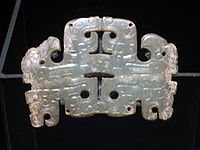
Jade culture
The Liangzhu culture was the last Neolithic Jade culture in the Yangtze RiverYangtze River
The Yangtze, Yangzi or Cháng Jiāng is the longest river in Asia, and the third-longest in the world. It flows for from the glaciers on the Tibetan Plateau in Qinghai eastward across southwest, central and eastern China before emptying into the East China Sea at Shanghai. It is also one of the...
delta and was spaced over a period of about 1,300 years. The Jade from this culture is characterized by finely worked, large ritual jades such as Cong
Cong (jade)
A cong is a form of jade artifact from ancient China. The earliest cong were produced by the Liangzhu culture ; later examples date mainly from the Shang and Zhou dynasties....
cylinders, Bi
Bi (jade)
The bi is a form of circular jade artifact from ancient China. The earliest bi were produced in the Neolithic period, particularly by the Liangzhu culture . Later examples date mainly from the Shang, Zhou and Han dynasties. They were also made in glass.-Description:A bi is a flat jade disc with a...
discs, Yue axes and also pendants and decorations in the form of chiseled open-work plaques, plates and representations of small birds, turtles and fish. The Liangzhu Jade has a white, milky bone-like aspect due to its Tremolite
Tremolite
Tremolite is a member of the amphibole group of silicate minerals with composition: Ca2Mg5Si8O222. Tremolite forms by metamorphism of sediments rich in dolomite and quartz. Tremolite forms a series with actinolite and ferro-actinolite. Pure magnesium tremolite is creamy white, but the color grades...
rock origin and influence of water-based fluids at the burial sites. Jade is a green stone that cannot be carved so it has to be ground.
Bronze casting
The Bronze AgeBronze Age
The Bronze Age is a period characterized by the use of copper and its alloy bronze as the chief hard materials in the manufacture of some implements and weapons. Chronologically, it stands between the Stone Age and Iron Age...
in China began with the Xia Dynasty
Xia Dynasty
The Xia Dynasty is the first dynasty in China to be described in ancient historical chronicles such as Bamboo Annals, Classic of History and Records of the Grand Historian. The Xia Dynasty was established by the legendary Yu the Great after Shun, the last of the Five Emperors gave his throne to him...
. Examples from this period have been recovered from ruins of the Erlitou culture
Erlitou culture
The Erlitou culture is a name given by archaeologists to an Early Bronze Age urban society that existed in China from 2000 BCE to 1500 BCE. The culture was named after the site discovered at Erlitou in Yanshi, Henan Province...
, in Shanxi, and include complex but unadorned utilitarian objects. In the following Shang Dynasty
Shang Dynasty
The Shang Dynasty or Yin Dynasty was, according to traditional sources, the second Chinese dynasty, after the Xia. They ruled in the northeastern regions of the area known as "China proper" in the Yellow River valley...
more elaborate objects, including many ritual vessels, were crafted. The Shang are remembered for their bronze
Bronze
Bronze is a metal alloy consisting primarily of copper, usually with tin as the main additive. It is hard and brittle, and it was particularly significant in antiquity, so much so that the Bronze Age was named after the metal...
casting, noted for its clarity of detail. Shang bronzesmiths usually worked in foundries
Foundry
A foundry is a factory that produces metal castings. Metals are cast into shapes by melting them into a liquid, pouring the metal in a mold, and removing the mold material or casting after the metal has solidified as it cools. The most common metals processed are aluminum and cast iron...
outside the cities to make ritual vessels, and sometimes weapons and chariot fittings as well. The bronze vessels were receptacles for storing or serving various solids and liquids used in the performance of sacred ceremonies. Some forms such as the ku and jue can be very graceful, but the most powerful pieces are the ding
Ding (vessel)
A ding is an ancient Chinese cauldron with legs, a lid and two handles opposite each other. They were made in two shapes with round vessels having three legs and rectangular ones four....
, sometimes described as having the an "air of ferocious majesty."
It is typical of the developed Shang style that all available space is decorated, most often with stylized forms of real and imaginary animals. The most common motif is the taotie
Taotie
The Taotie is a motif commonly found on ritual bronze vessels from the Shang and Zhou Dynasty. The design typically consists of a zoomorphic mask, described as being frontal, bilaterally symmetrical, with a pair of raised eyes and typically no lower jaw area...
, which shows a mythological being presented frontally as though squashed onto a horizontal plane to form a symmetrical design. The early significance of taotie is not clear, but myths about it existed around the late Zhou Dynasty
Zhou Dynasty
The Zhou Dynasty was a Chinese dynasty that followed the Shang Dynasty and preceded the Qin Dynasty. Although the Zhou Dynasty lasted longer than any other dynasty in Chinese history, the actual political and military control of China by the Ji family lasted only until 771 BC, a period known as...
. It was considered to be variously a covetous man banished to guard a corner of heaven against evil monsters; or a monster equipped with only a head which tries to devour men but hurts only itself.
The function and appearance of bronzes changed gradually from the Shang to the Zhou. They shifted from been used in religious rites to more practical purposes. By the Warring States Period
Warring States Period
The Warring States Period , also known as the Era of Warring States, or the Warring Kingdoms period, covers the Iron Age period from about 475 BC to the reunification of China under the Qin Dynasty in 221 BC...
, bronze vessels had become objects of aesthetic enjoyment. Some were decorated with social scenes, such as from a banquet or hunt; whilst others displayed abstract patterns inlaid with gold, silver, or precious and semiprecious stones.
Shang bronzes became appreciated as works of art from the Song Dynasty
Song Dynasty
The Song Dynasty was a ruling dynasty in China between 960 and 1279; it succeeded the Five Dynasties and Ten Kingdoms Period, and was followed by the Yuan Dynasty. It was the first government in world history to issue banknotes or paper money, and the first Chinese government to establish a...
, when they were collected and prized not only for their shape and design but also for the various green, blue green, and even reddish patinas created by chemical action as they lay buried in the ground. The study of early Chinese bronze casting is a specialized field of art history].
Chu and Southern culture
A rich source of art in early China was the state of ChuChu (state)
The State of Chu was a Zhou Dynasty vassal state in present-day central and southern China during the Spring and Autumn period and Warring States Period . Its ruling house had the surname Nai , and clan name Yan , later evolved to surname Mi , and clan name Xiong...
, which developed in the Yangtze River valley. Excavations of Chu tombs have found painted wooden sculptures, jade disks, glass beads, musical instruments, and an assortment of lacquerware
Lacquerware
Lacquerware are objects decoratively covered with lacquer. The lacquer is sometimes inlaid or carved. Lacquerware includes boxes, tableware, buttons and even coffins painted with lacquer in cultures mostly in the Eastern Hemisphere.-History:...
. Many of the lacquer objects are finely painted, red on black or black on red. A site in Changsha, Hunan province, has revealed the world's oldest painting on silk discovered to date. It shows a woman accompanied by a phoenix
Phoenix (mythology)
The phoenix or phenix is a mythical sacred firebird that can be found in the mythologies of the Arabian, Persians, Greeks, Romans, Egyptians, Chinese, Indian and Phoenicians....
and a dragon
Dragon
A dragon is a legendary creature, typically with serpentine or reptilian traits, that feature in the myths of many cultures. There are two distinct cultural traditions of dragons: the European dragon, derived from European folk traditions and ultimately related to Greek and Middle Eastern...
, two mythological animals to feature prominently in Chinese art.
Qin sculpture
Terracotta Army
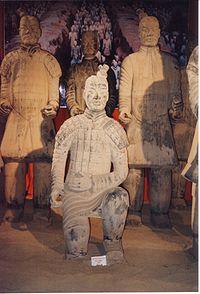
The Terracotta Army or the "Terra Cotta Warriors and Horses", is a collection of terracotta sculptures depicting the armies of Qin Shi Huang, the first Emperor of China...
, inside the Mausoleum of the First Qin Emperor, consists of more than 7,000 life-size tomb terra-cotta figures of warriors and horses buried with the self-proclaimed first Emperor
Emperor of China
The Emperor of China refers to any sovereign of Imperial China reigning between the founding of Qin Dynasty of China, united by the King of Qin in 221 BCE, and the fall of Yuan Shikai's Empire of China in 1916. When referred to as the Son of Heaven , a title that predates the Qin unification, the...
of Qin
Qin Dynasty
The Qin Dynasty was the first imperial dynasty of China, lasting from 221 to 207 BC. The Qin state derived its name from its heartland of Qin, in modern-day Shaanxi. The strength of the Qin state was greatly increased by the legalist reforms of Shang Yang in the 4th century BC, during the Warring...
(Qin Shi Huang
Qin Shi Huang
Qin Shi Huang , personal name Ying Zheng , was king of the Chinese State of Qin from 246 BC to 221 BC during the Warring States Period. He became the first emperor of a unified China in 221 BC...
) in 210–209 BC. The figures were painted before being placed into the vault. The original colors were visible when the pieces were first unearthed. However, exposure to air caused the pigments to fade, so today the unearthed figures appear terracotta in color. The figures are in several poses including standing infantry and kneeling archers, as well as charioteers with horses. Each figure's head appears to be unique, showing a variety of facial features and expressions as well as hair styles.
Pottery
PorcelainChinese porcelain
Chinese ceramic ware shows a continuous development since the pre-dynastic periods, and is one of the most significant forms of Chinese art. China is richly endowed with the raw materials needed for making ceramics. The first types of ceramics were made during the Palaeolithic era...
is made from a hard paste made of the clay
Clay
Clay is a general term including many combinations of one or more clay minerals with traces of metal oxides and organic matter. Geologic clay deposits are mostly composed of phyllosilicate minerals containing variable amounts of water trapped in the mineral structure.- Formation :Clay minerals...
kaolin and a feldspar
Feldspar
Feldspars are a group of rock-forming tectosilicate minerals which make up as much as 60% of the Earth's crust....
called petuntse
Petuntse
Petuntse , also spelled petunse, is a historic term for a wide range of micaceous or feldspathic rocks. However, all will have been subject to geological decomposition processes that result in a material which, after processing, is suitable as an ingredient in some ceramic formulations...
, which cements the vessel and seals any pores. China has become synonymous with high-quality porcelain. Most china pots comes from the city of Jingdezhen
Jingdezhen
Jingdezhen , is a prefecture-level city, previously a town, in Jiangxi Province, China, with a total population of 1,554,000 . It is known as the "Porcelain Capital" because it has been producing quality pottery for 1700 years. The city has a well-documented history that stretches back over 2000...
in China's Jiangxi
Jiangxi
' is a southern province in the People's Republic of China. Spanning from the banks of the Yangtze River in the north into hillier areas in the south, it shares a border with Anhui to the north, Zhejiang to the northeast, Fujian to the east, Guangdong to the south, Hunan to the west, and Hubei to...
province. Jingdezhen, under a variety of names, has been central to porcelain production in China since at least the early Han Dynasty
Han Dynasty
The Han Dynasty was the second imperial dynasty of China, preceded by the Qin Dynasty and succeeded by the Three Kingdoms . It was founded by the rebel leader Liu Bang, known posthumously as Emperor Gaozu of Han. It was briefly interrupted by the Xin Dynasty of the former regent Wang Mang...
.
The most noticeable difference between porcelain and the other pottery clays is that it "wets" very quickly (that is, added water has a noticeably greater effect on the plasticity for porcelain than other clays), and that it tends to continue to "move" longer than other clays, requiring experience in handling to attain optimum results. During medieval times in Europe, porcelain was very expensive and in high demand for its beauty. TLV mirror
TLV mirror
A TLV mirror is a type of bronze mirror that was popular during the Han Dynasty in China. They are called TLV mirrors because symbols resembling the letters T, L, and V are engraved into them...
s also date from the Han dynasty.
Han art
The Han DynastyHan Dynasty
The Han Dynasty was the second imperial dynasty of China, preceded by the Qin Dynasty and succeeded by the Three Kingdoms . It was founded by the rebel leader Liu Bang, known posthumously as Emperor Gaozu of Han. It was briefly interrupted by the Xin Dynasty of the former regent Wang Mang...
was known for jade burial suit
Jade burial suit
A Jade burial suit is a ceremonial suit made of pieces of jade in which royal members in Han Dynasty China were buried.-Structure of a jade burial suit:...
s. One of the earliest known depictions of a landscape in Chinese art comes from a pair of hollow-tile door panels from a Western Han Dynasty tomb near Zhengzhou
Zhengzhou
Zhengzhou , is the capital and largest city of Henan province in north-central China. A prefecture-level city, it also serves as the political, economic, technological, and educational centre of the province, as well as a major transportation hub for Central China...
, dated 60 BCE. A scene of continuous depth recession is conveyed by the zigzag of lines representing roads and garden walls, giving the impression that one is looking down from the top of a hill. This artistic landscape scene was made by the repeated impression of standard stamps on the clay while it was still soft and not yet fired. However, the oldest known landscape art scene tradition in the classical sense of painting is a work by Zhan Ziqian
Zhan Ziqian
Zhan Ziqian was a famous painter of ancient China from Yangxin county , Shandong province. His birth and death dates are unknown...
of the Sui Dynasty
Sui Dynasty
The Sui Dynasty was a powerful, but short-lived Imperial Chinese dynasty. Preceded by the Southern and Northern Dynasties, it ended nearly four centuries of division between rival regimes. It was followed by the Tang Dynasty....
(581–618).
Period of division (220–581)
Influence of Buddhism
BuddhismBuddhism
Buddhism is a religion and philosophy encompassing a variety of traditions, beliefs and practices, largely based on teachings attributed to Siddhartha Gautama, commonly known as the Buddha . The Buddha lived and taught in the northeastern Indian subcontinent some time between the 6th and 4th...
arrived in China around the 1st century AD (although there are some traditions about a monk visiting China during Asoka's reign), and through to the 8th century it became very active and creative in the development of Buddhist art, particularly in the area of statuary. Receiving this distant religion, China soon incorporated strong Chinese traits in its artistic expression.
In the fifth to sixth century the Northern Dynasties
Northern dynasties
The Northern Dynasties included Northern Wei Dynasty, Eastern Wei Dynasty, Western Wei Dynasty, Northern Qi Dynasty, Northern Zhou Dynasty.Also see Southern and Northern Dynasties.-External links:*...
, rather removed from the original sources of inspiration, tended to develop rather symbolic and abstract modes of representation, with schematic lines. Their style is also said to be solemn and majestic. The lack of corporeality of this art, and its distance from the original Buddhist objective of expressing the pure ideal of enlightenment in an accessible, realistic manner, progressively led to a research towards more naturalism and realism, leading to the expression of Tang Buddhist art.
Calligraphy
In ancient China, painting and calligraphyCalligraphy
Calligraphy is a type of visual art. It is often called the art of fancy lettering . A contemporary definition of calligraphic practice is "the art of giving form to signs in an expressive, harmonious and skillful manner"...
were the most highly appreciated arts in court circles and were produced almost exclusively by amateurs, aristocrats and scholar-officials who alone had the leisure to perfect the technique and sensibility necessary for great brushwork. Calligraphy was thought to be the highest and purest form of painting. The implements were the brush pen, made of animal hair, and black ink
Ink
Ink is a liquid or paste that contains pigments and/or dyes and is used to color a surface to produce an image, text, or design. Ink is used for drawing and/or writing with a pen, brush, or quill...
s, made from pine soot and animal glue. Writing as well as painting was done on silk. But after the invention of paper in the 1st century, silk was gradually replaced by the new and cheaper material. Original writings by famous calligraphers have been greatly valued throughout China's history and are mounted on scrolls and hung on walls in the same way that paintings are.
Wang Xizhi
Wang Xizhi
Wang Xizhi was a Chinese calligrapher, traditionally referred to as the Sage of Calligraphy , who lived during the Jin Dynasty...
was a famous Chinese calligrapher who lived in the 4th century AD. His most famous work is the Lanting Xu
Lanting Xu
The Lantingji Xu or Lanting Xu is the most famous work of calligraphy by Wang Xizhi, composed in year 353. Written in semi-cursive script, it is the most well-known and well-copied piece ever...
, the preface of a collection of poems written by a number of poets when gathering at Lan Ting near the town of Shaoxing in Zhejiang province and engaging in a game called "qu shui liu shang".
Wei Shuo
Wei Shuo
Wei Shuo , courtesy name Mouyi , sobriquet He'nan , commonly addressed just as Lady Wei , was a Chinese calligrapher of Eastern Jin, who established consequential rules about the regular script. Her famous disciple was Wang Xizhi....
was a well-known calligrapher of Eastern Jin Dynasty who established consequential rules about the Regular Script
Regular script
Regular script , also called 正楷 , 真書 , 楷体 and 正書 , is the newest of the Chinese script styles Regular script , also called 正楷 , 真書 (zhēnshū), 楷体 (kǎitǐ) and 正書 (zhèngshū), is the newest of the Chinese script styles Regular script , also called 正楷 , 真書 (zhēnshū), 楷体 (kǎitǐ) and 正書 (zhèngshū), is...
. Her well-known works include Famous Concubine Inscription (名姬帖 Ming Ji Tie) and The Inscription of Wei-shi He'nan (衛氏和南帖 Wei-shi He'nan Tie).
Painting
Gu KaizhiGu Kaizhi
Gu Kaizhi , is a celebrated painter of ancient China. His style name was 'Changkang' . He was born in Wuxi, Jiangsu province and first painted at Nanjing in 364. In 366, he became an officer . Later he was promoted to royal officer . He was also a talented poet and calligrapher...
is a celebrated painter of ancient China born in Wuxi
Wuxi
Wuxi is an old city in Jiangsu province, People's Republic of China. Split in half by Lake Tai, Wuxi borders Changzhou to the west and Suzhou to the east. The northern half looks across to Taizhou across the Yangtze River, while the southern half also borders the province of Zhejiang to the south...
. He wrote three books about painting theory: On Painting (画论), Introduction of Famous Paintings of Wei and Jin Dynasties (魏晋胜流画赞) and Painting Yuntai Mountain (画云台山记). He wrote, "In figure paintings the clothes and the appearances were not very important. The eyes were the spirit and the decisive factor."
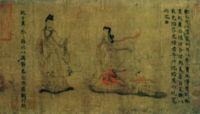
Three of Gu's paintings still survive today. They are "Admonitions of the Instructress to the Court Ladies
Admonitions Scroll
The Admonitions Scroll is a Chinese narrative painting on silk that is traditionally ascribed to Gu Kaizhi , but which modern scholarship regards as a 5th to 8th century work that may or may not be a copy of an original Jin Dynasty court painting by Gu Kaizhi. The full title of the painting is...
", "Nymph of the Luo River" (洛神赋), and "Wise and Benevolent Women".
There are other examples of Jin Dynasty painting from tombs. This includes the Seven Sages of the Bamboo Grove, painted on a brick wall of a tomb located near modern Nanjing and now found in the Shaanxi Provincial Museum. Each of the figures are labeled and shown either drinking, writing, or playing a musical instrument. Other tomb paintings also depict scenes of daily life, such as men plowing fields with teams of oxen.
The Sui and Tang dynasties (581–960)
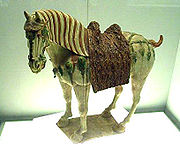
Buddhist architecture and sculpture
Following a transition under the Sui DynastySui Dynasty
The Sui Dynasty was a powerful, but short-lived Imperial Chinese dynasty. Preceded by the Southern and Northern Dynasties, it ended nearly four centuries of division between rival regimes. It was followed by the Tang Dynasty....
, Buddhist sculpture of the Tang
Tang Dynasty
The Tang Dynasty was an imperial dynasty of China preceded by the Sui Dynasty and followed by the Five Dynasties and Ten Kingdoms Period. It was founded by the Li family, who seized power during the decline and collapse of the Sui Empire...
evolved towards a markedly lifelike expression. As a consequence of the Dynasty's openness to foreign trade and influences through the Silk Road
Silk Road
The Silk Road or Silk Route refers to a historical network of interlinking trade routes across the Afro-Eurasian landmass that connected East, South, and Western Asia with the Mediterranean and European world, as well as parts of North and East Africa...
, Tang dynasty Buddhist sculpture assumed a rather classical form, inspired by the Greco-Buddhist art of Central Asia.
However, foreign influences came to be negatively perceived towards the end of the Tang dynasty. In the year 845, the Tang emperor Wu-Tsung outlawed all "foreign" religions (including Christian Nestorianism
Nestorianism
Nestorianism is a Christological doctrine advanced by Nestorius, Patriarch of Constantinople from 428–431. The doctrine, which was informed by Nestorius's studies under Theodore of Mopsuestia at the School of Antioch, emphasizes the disunion between the human and divine natures of Jesus...
, Zoroastrianism
Zoroastrianism
Zoroastrianism is a religion and philosophy based on the teachings of prophet Zoroaster and was formerly among the world's largest religions. It was probably founded some time before the 6th century BCE in Greater Iran.In Zoroastrianism, the Creator Ahura Mazda is all good, and no evil...
and Buddhism
Buddhism
Buddhism is a religion and philosophy encompassing a variety of traditions, beliefs and practices, largely based on teachings attributed to Siddhartha Gautama, commonly known as the Buddha . The Buddha lived and taught in the northeastern Indian subcontinent some time between the 6th and 4th...
) in order to support the indigenous Taoism
Taoism
Taoism refers to a philosophical or religious tradition in which the basic concept is to establish harmony with the Tao , which is the mechanism of everything that exists...
. He confiscated Buddhist possessions and forced the faith to go underground, therefore affecting the ulterior development of the religion and its arts in China.
Most wooden Tang sculptures have not survived, though representations of the Tang international style can still be seen in Nara
Nara, Nara
is the capital city of Nara Prefecture in the Kansai region of Japan. The city occupies the northern part of Nara Prefecture, directly bordering Kyoto Prefecture...
, Japan. The longevity of stone sculpture has proved much greater. Some of the finest examples can be seen at Longmen
Longmen Grottoes
The Longmen Grottoes or Longmen Caves are one of the finest examples of Chinese Buddhist art. Housing tens of thousands of statues of Buddha and his disciples, they are located south of present day Luòyáng in Hénán province, Peoples Republic of China...
, near Luoyang
Luoyang
Luoyang is a prefecture-level city in western Henan province of Central China. It borders the provincial capital of Zhengzhou to the east, Pingdingshan to the southeast, Nanyang to the south, Sanmenxia to the west, Jiyuan to the north, and Jiaozuo to the northeast.Situated on the central plain of...
, Yungang near Datong
Datong
Datong is a prefecture-level city in northern Shanxi Province of North China, located a few hundred kilometres west by rail from Beijing with an elevation of...
, and Bingling Temple
Bingling Temple
The Bingling Temple is a series of grottoes filled with Buddhist sculpture carved into natural caves and caverns in a canyon along the Yellow River. It lies just north of where the Yellow River empties into the Liujiaxia Reservoir...
, in Gansu
Gansu
' is a province located in the northwest of the People's Republic of China.It lies between the Tibetan and Huangtu plateaus, and borders Mongolia, Inner Mongolia, and Ningxia to the north, Xinjiang and Qinghai to the west, Sichuan to the south, and Shaanxi to the east...
.
One of the most famous Buddhist Chinese pagoda
Chinese pagoda
Chinese Pagodas are a traditional part of Chinese architecture. In addition to religious use, since ancient times Chinese pagodas have been praised for the spectacular views which they offer, and many famous poems in Chinese history attest to the joy of scaling pagodas.-History:The pagoda is...
s is the Giant Wild Goose Pagoda
Giant Wild Goose Pagoda
Giant Wild Goose Pagoda or Big Wild Goose Pagoda , is a Buddhist pagoda located in southern Xi'an, Shaanxi province, China. It was built in 652 during the Tang Dynasty and originally had five stories, although the structure was rebuilt in 704 during the reign of Empress Wu Zetian and its exterior...
, built in 652 AD.
Painting
Tang Dynasty
The Tang Dynasty was an imperial dynasty of China preceded by the Sui Dynasty and followed by the Five Dynasties and Ten Kingdoms Period. It was founded by the Li family, who seized power during the decline and collapse of the Sui Empire...
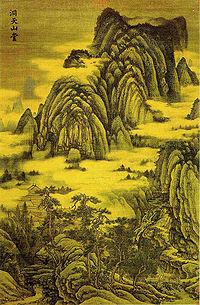
(618–907), the primary subject matter of painting was the landscape, known as shanshui (mountain water) painting. In these landscapes, usually monochromatic and sparse, the purpose was not to reproduce exactly the appearance of nature but rather to grasp an emotion or atmosphere so as to catch the "rhythm" of nature.
Painting in the traditional style involved essentially the same techniques as calligraphy and was done with a brush dipped in black or colored ink; oils were not used. As with calligraphy, the most popular materials on which paintings were made were paper and silk. The finished works were then mounted on scrolls, which could be hung or rolled up. Traditional painting was also done in albums, on walls, lacquer
Lacquer
In a general sense, lacquer is a somewhat imprecise term for a clear or coloured varnish that dries by solvent evaporation and often a curing process as well that produces a hard, durable finish, in any sheen level from ultra matte to high gloss and that can be further polished as required...
work, and in other media.
Dong Yuan
Dong Yuan
Dong Yuan was a Chinese painter.He was born in Zhongling . Dong Yuan was active in the Southern Tang Kingdom of the Five Dynasties and Ten Kingdoms Period...
was an active painter in the Southern Tang Kingdom. He was known for both figure and landscape paintings, and exemplified the elegant style which would become the standard for brush painting in China over the next 900 years. As with many artists in China, his profession was as an official where he studied the existing styles of Li Sixun and Wang Wei. However, he added to the number of techniques, including more sophisticated perspective, use of pointillism and crosshatching to build up vivid effect.
Zhan Ziqian
Zhan Ziqian
Zhan Ziqian was a famous painter of ancient China from Yangxin county , Shandong province. His birth and death dates are unknown...
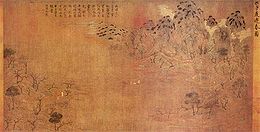
was a painter during the Sui Dynasty. His only painting in existence is Strolling About In Spring arranged mountains perspectively. Because the first pure scenery paintings of Europe emerged after the 17th century, Strolling About In Spring may well be the first scenery painting of the world.
The Song and Yuan dynasties (960–1368)

Song painting
During the Song dynastySong Dynasty
The Song Dynasty was a ruling dynasty in China between 960 and 1279; it succeeded the Five Dynasties and Ten Kingdoms Period, and was followed by the Yuan Dynasty. It was the first government in world history to issue banknotes or paper money, and the first Chinese government to establish a...
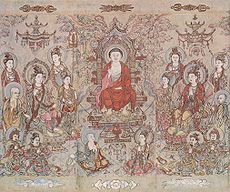
(960–1279), landscapes of more subtle expression appeared; immeasurable distances were conveyed through the use of blurred outlines, mountain contours disappearing into the mist, and impressionistic treatment of natural phenomena. Emphasis was placed on the spiritual qualities of the painting and on the ability of the artist to reveal the inner harmony of man and nature, as perceived according to Taoist and Buddhist concepts.
Liang Kai
Liang Kai
Liáng Kǎi was a Chinese artist, also known as Madman Liang. He was born in Shandong and worked in Lin An...
was a Chinese painter who lived in the 13th century (Song Dynasty
Song Dynasty
The Song Dynasty was a ruling dynasty in China between 960 and 1279; it succeeded the Five Dynasties and Ten Kingdoms Period, and was followed by the Yuan Dynasty. It was the first government in world history to issue banknotes or paper money, and the first Chinese government to establish a...
). He called himself "Madman Liang," and he spent his life drinking and painting. Eventually, he retired and became a Zen
Zen
Zen is a school of Mahāyāna Buddhism founded by the Buddhist monk Bodhidharma. The word Zen is from the Japanese pronunciation of the Chinese word Chán , which in turn is derived from the Sanskrit word dhyāna, which can be approximately translated as "meditation" or "meditative state."Zen...
monk. Liang is credited with inventing the Zen school of Chinese art. Wen Tong
Wen Tong
Wen Tong was a Northern Song painter born in Sichuan famous for his ink bamboo paintings. He was one of the paragons of "scholar's painting" , which idealised spontaneity and painting without financial reward....
was a painter who lived in the 11th century. He was famous for ink paintings of bamboo. He could hold two brushes in one hand and paint two different distanced bamboos simultaneously. He did not need to see the bamboo while he painted them because he had seen a lot of them.
Zhang Zeduan
Zhang Zeduan
Zhang Zeduan , alias Zheng Dao, also sometimes translated as Zhang Zerui, was a famous Chinese painter during the twelfth century, during the transitional period from the Northern Song to the Southern Song Dynasty, and was instrumental in the early history of the Chinese art style known as shan...
was a notable painter for his horizontal Along the River During Qingming Festival landscape and cityscape painting. It has been quoted as "China's Mona Lisa
Mona Lisa
Mona Lisa is a portrait by the Italian artist Leonardo da Vinci. It is a painting in oil on a poplar panel, completed circa 1503–1519...
" and has had many well-known remakes throughout Chinese history. Other famous paintings include The Night Revels of Han Xizai
Gu Hongzhong
Gu Hongzhong was a Chinese painter during the Five Dynasties and Ten Kingdoms period of Chinese history.Little is known about Gu Hongzhong's life. He was most likely a court painter for the Southern Tang Emperor Li Yu. Gu was active from 943 to 960 C.E. His most well-known work is the Night...
, originally painted by the Southern Tang
Southern Tang
Southern Tang was one of the Ten Kingdoms in south-central China created following the Tang Dynasty from 937-975. Southern Tang replaced the Wu Kingdom when Li Bian deposed the emperor Yang Pu....
artist Gu Hongzhong
Gu Hongzhong
Gu Hongzhong was a Chinese painter during the Five Dynasties and Ten Kingdoms period of Chinese history.Little is known about Gu Hongzhong's life. He was most likely a court painter for the Southern Tang Emperor Li Yu. Gu was active from 943 to 960 C.E. His most well-known work is the Night...
in the 10th century, while the well-known version of his painting is a 12th century remake of the Song Dynasty. This is a large horizontal handscroll of a domestic scene showing men of the gentry class
Gentry (China)
As used for imperial China, landed gentry does not correspond to any term in Chinese. One standard work remarks that under the Ming dynasty, called shenshi or shenjin, meaning variously degree-holders, literati, scholar-bureaucrats or officials, they are loosely known in English as the Chinese...
being entertained by musicians and dancers while enjoying food, beverage, and wash basins provided by maidservants. In 2000, the modern artist Wang Qingsong created a parody of this painting with a long, horizontal photograph of people in modern clothing making similar facial expressions, poses, and hand gestures as the original painting.
Yuan painting
With the fall of the Song dynasty in 1279, and the subsequent dislocation caused by the establishment of the Yuan dynastyYuan Dynasty
The Yuan Dynasty , or Great Yuan Empire was a ruling dynasty founded by the Mongol leader Kublai Khan, who ruled most of present-day China, all of modern Mongolia and its surrounding areas, lasting officially from 1271 to 1368. It is considered both as a division of the Mongol Empire and as an...
by the Mongol conquerers, many court and literary artists retreated from social life, and returned to nature, through landscape paintings, and by renewing the "blue and green" style of the Tang era.
Wang Meng
Wang Meng (artist)
Wang Meng was a Chinese painter during the Yuan Dynasty. He was born in Huzhou , now known as Wuxing , Zhejiang....
was one such painter, and one of his most famous works is the Forest Grotto. Zhao Mengfu
Zhao Mengfu
Zhao Mengfu courtesy name Ziang , pseudonyms Songxue , Oubo , and Shuijing-gong Dao-ren , was a prince and descendant of the Song Dynasty, and a Chinese scholar, painter and calligrapher during the Yuan Dynasty.He was recommended by the Censor-in-chief Cheng Jufu to pay an audience...
was a Chinese scholar, painter and calligrapher during the Yuan Dynasty
Yuan Dynasty
The Yuan Dynasty , or Great Yuan Empire was a ruling dynasty founded by the Mongol leader Kublai Khan, who ruled most of present-day China, all of modern Mongolia and its surrounding areas, lasting officially from 1271 to 1368. It is considered both as a division of the Mongol Empire and as an...
. His rejection of the refined, gentle brushwork of his era in favor of the cruder style of the 8th century is considered to have brought about a revolution that created the modern Chinese landscape painting. There was also the vivid and detailed works of art by Qian Xuan
Qian Xuan
Qian Xuan courtesy name Shun Ju , pseudonyms Yu Tan , Xi Lan Weng , and Zha Chuan Weng was a Chinese painter from Hu Zhou Qian Xuan courtesy name Shun Ju (舜举), pseudonyms Yu Tan (玉潭, "Jade Pool"), Xi Lan Weng (习嬾翁), and Zha Chuan Weng (霅川翁) was a Chinese painter from Hu Zhou Qian Xuan courtesy...
(1235–1305), who had served the Song court, and out of patriotism refused to serve the Mongols, instead turning to painting. He was also famous for reviving and reproducing a more Tang Dynasty style of painting.
The later Yuan dynasty is characterized by the work of the so-called "Four Great Masters". The most notable of these was Huang Gongwang
Huang Gongwang
Huáng Gōngwàng was a painter born during the late Song Dynasty in Changshu, Jiangsu. He is the oldest of the "four great masters of the Yuan." After serving as an official he acted as a Taoist priest. He spent his last years in the Fu-ch'un mountains near Hangzhou devoting himself to Taoism. It...
(1269–1354) whose cool and restrained landscapes were admired by contemporaries, and by the Chinese literati painters of later centuries. Another of great influence was Ni Zan
Ni Zan
Ni Zan was a Chinese painter during the Yuan Dynasty. Along with Huang Gongwang, Wu Zhen, and Wang Meng, he is considered to be one of the four "Late Yuan" masters....
(1301–1374), who frequently arranged his compositions with a strong and distinct foreground and background, but left the middle-ground as an empty expanse. This scheme was frequently to be adopted by later Ming
Ming Dynasty
The Ming Dynasty, also Empire of the Great Ming, was the ruling dynasty of China from 1368 to 1644, following the collapse of the Mongol-led Yuan Dynasty. The Ming, "one of the greatest eras of orderly government and social stability in human history", was the last dynasty in China ruled by ethnic...
and Qing dynasty painters.
Late imperial China (1368–1911)
Ming painting


Ming Dynasty
The Ming Dynasty, also Empire of the Great Ming, was the ruling dynasty of China from 1368 to 1644, following the collapse of the Mongol-led Yuan Dynasty. The Ming, "one of the greatest eras of orderly government and social stability in human history", was the last dynasty in China ruled by ethnic...
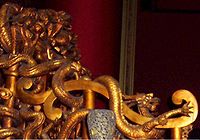
, Chinese culture bloomed. Narrative painting, with a wider color range and a much busier composition than the Song paintings, was immensely popular during the time.
Wen Zhengming
Wen Zhengming
Wen Zhengming was a leading Ming Dynasty painter, calligrapher, and scholar.Born in present-day Suzhou, he claimed to be a descendant of the Song Dynasty prime minister and patriot Wen Tianxiang. Wen’s family was originally from Hengyang, Hunan, where his family had established itself shortly...
(1470–1559) developed the style of the Wu school in Suzhou
Suzhou
Suzhou , previously transliterated as Su-chou, Suchow, and Soochow, is a major city located in the southeast of Jiangsu Province in Eastern China, located adjacent to Shanghai Municipality. The city is situated on the lower reaches of the Yangtze River and on the shores of Taihu Lake and is a part...
, which dominated Chinese painting during the 16th century.
European culture began to make an impact on Chinese art during this period. The Jesuit priest
Matteo Ricci
Matteo Ricci
Matteo Ricci, SJ was an Italian Jesuit priest, and one of the founding figures of the Jesuit China Mission, as it existed in the 17th-18th centuries. His current title is Servant of God....
visited Nanjing
Nanjing
' is the capital of Jiangsu province in China and has a prominent place in Chinese history and culture, having been the capital of China on several occasions...
with many Western artworks, which were influential in showing different techniques of perspective and shading.
Early Qing painting
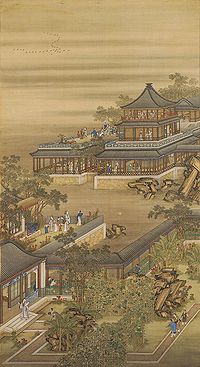
The "Four Wangs
Four Wangs
The Four Wangs were four Chinese landscape painters in the 17th century, all called Wang . They are best known for their accomplishments in shan shui painting.-The painters:...
", including Wang Jian
Wang Jian (Ming)
Wang Jian ; ca. 1598-1677 was a Chinese landscape painter during the Qing Dynasty .Wang was born in Taicang in the Jiangsu province. His style name was 'Xuanzhao' and his pseudonyms were 'Xiangbi' and 'Ranxiang anzhu' . Wang's precise color style of painting was influenced by Dong Yuan...
(1598–1677) and Wang Shimin
Wang Shimin
Wáng Shímǐn ; ca. 1592-1680 was a Chinese landscape painter during the Qing Dynasty .Born in the Kiangsu province, Wang grew up in an artistic, scholarly environment...
(1592–1680), were particularly renowned in the Orthodox school
Six Masters of the early Qing period
The Six Masters of the early Qing period was a group of major Chinese artists who worked in the 17th and early 18th centuries . Also known as orthodox masters, they continued the tradition of the scholar-painter, following the injunctions of the artist-critic Dong Qichang late in the Ming...
, and sought inspiration in recreating the past styles, especially the technical skills in brushstrokes and calligraphy of ancient masters. The younger Wang Yuanqi
Wang Yuanqi
Wang Yuanqi was a Chinese painter of the Qing dynasty.Wang was born in Taicang in the Jiangsu province and tutored in painting by his grandfather Wang Shimin . His style name was 'Mao-ching ' and his sobriquet was ' Lu-t'ai'. Wang is a member of the Four Wangs and Six Masters of the early Qing...
(1642–1715) ritualized the approach of engaging with and drawing inspiration from a work of an ancient master. His own works were often annotated with his theories of how his painting relates to the master's model.
The Individualist painters included
Bada Shanren (1626–1705) and
Shitao
Shitao
Shi Tao ; , born Zhu Ruoji was a Chinese landscape painter and poet during the early Qing Dynasty .Born in Quanzhou County in Guangxi province, Shi Tao was a member of the Ming royal house. He narrowly avoided catastrophe in 1644 when the Ming Dynasty fell to invading Manchurians and civil rebellion...
(1641–1707). They drew more from the revolutionary ideas of transcending the tradition to achieve an original individualistic styles; in this way they were more faithfully following the way of Dong Qichang than the Orthodox school (who were his official direct followers.)
As the techniques of color printing were perfected, illustrated manuals on the art of painting began to be published. Jieziyuan Huazhuan
Jieziyuan Huazhuan
Jieziyuan Huazhuan , sometimes known as Jieziyuan Huapu , is a manual of Chinese painting compiled during the early-Qing Dynasty...
(Manual of the Mustard Seed Garden), a five-volume work first published in 1679, has been in use as a technical textbook for artists and students ever since.
Late Qing Art
Nianhua were a form of coloredColored
Colored is a term once widely used in the United States to describe black people and Native Americans...
woodlblock prints in China, depicting images for decoration during the Chinese New Year
Chinese New Year
Chinese New Year – often called Chinese Lunar New Year although it actually is lunisolar – is the most important of the traditional Chinese holidays. It is an all East and South-East-Asia celebration...
. In the 19th century Nianhua were used as news mediums.
Shanghai School
The Shanghai SchoolShanghai School
The Shanghai School is a style of Chinese art present in the late 19th century and centered in Shanghai. Late 19th century China, or the last years of the Qing dynasty formed a tumultuous time in China's history...
(海上画派 Haishang Huapai or 海派 Haipai) is a very important Chinese school of traditional arts during the Qing Dynasty
Qing Dynasty
The Qing Dynasty was the last dynasty of China, ruling from 1644 to 1912 with a brief, abortive restoration in 1917. It was preceded by the Ming Dynasty and followed by the Republic of China....
and the whole of the 20th century. Under efforts of masters from this school, traditional Chinese art reached another climax and continued to the present in forms of "Chinese painting
Chinese painting
Chinese painting is one of the oldest continuous artistic traditions in the world. The earliest paintings were not representational but ornamental; they consisted of patterns or designs rather than pictures. Early pottery was painted with spirals, zigzags, dots, or animals...
" (中国画), or guohua (国画) for short. The Shanghai School challenged and broke the literati tradition of Chinese art, while also paying technical homage to the ancient masters and improving on existing traditional techniques. Members of this school were themselves educated literati who had come to question their very status and the purpose of art, and had anticipated the impending modernization of Chinese society. In an era of rapid social change, works from the Shanghai School were widely innovative and diverse, and often contained thoughtful yet subtle social commentary. The most well-known figures from this school are Ren Xiong
Ren Xiong
Ren Xiong was a Chinese painter from Xiaoshan, active during the late Qing dynasty. Ren belonged to the "Shanghai school" in Chinese painting and is known for his bold and innovative style.-External links:*...
(任熊), Ren Yi
Rèn Yí
Rèn Yí , also known as Ren Bonian, was a painter and son of a rice merchant who supplemented his income by doing portraits. He was born in Zhejiang, but after the death of his father in 1855 he lived in Shanghai. This move placed him in a more urban world that was exposed to Western thinking...
(任伯年, also known as Ren Bonian), Zhao Zhiqian
Zhao Zhiqian
Zhao Zhiqian was a renowned Chinese calligrapher, seal carver and painter in the late Qing Dynasty, "the leading scholar-artist of his day." Zhao's seal carving had profound influence on the later masters, such as Wu Changshuo and Qi Baishi...
(赵之谦), Wu Changshuo
Wu Changshuo
Wú Chāngshuò is the name for which Wu Junqing is best known. He was born in Zhejiang from a scholarly family and for a time toward the end of the Qing he served as an official in Liaoning. He settled in Suzhou in his twenties.Initially, he devoted himself to poetry and calligraphy with a strong...
(吴昌硕), Sha Menghai
Sha Menghai
Sha Menghai , born Shi Wenruo , was a great master of calligraphy in China. He is widely regarded as the top one of Chinese modern art of calligraphy. He also was a master of Chinese seal carving , a theoretician of traditional Chinese art, and a master of Shanghai School art. Sha Wenhan is his...
(沙孟海, calligraphist), Pan Tianshou
Pan Tianshou
Pan Tianshou was a notable painter and art educator of modern China.Pan was born in Guanzhuang, Ninghai County, Zhejiang Province, and graduated from Zhejiang First Normal School . He followed Wu Changshuo to study Chinese traditional painting...
(潘天寿), Fu Baoshi
Fu Baoshi
Fu Baoshi , or Fu Pao-Shih, was a Chinese painter from Xinyu, Jiangxi Province. He went to Japan to study the History of Oriental Art in the Tokyo School of Fine Arts in 1933. He translated many books from Japanese and carried out his own research...
(傅抱石). Other well-known painters are: Wang Zhen
Wang Zhen (Wang Yiting)
Wang Zhen was a celebrated modern Chinese artist of the Shanghai School. His dates are sometimes given as 1877-1930, but are corrected as in the Encyclopedia of Chinese Artists on p. 131. Wang Zhen was also variously known as Bailong shanren and as a devote Buddhist under other names...
, XuGu, Zhang Xiong, Hu Yuan, and Yang Borun
Yang Borun
Yang Borun , born Yang Peifu , was a well-known Chinese poet, calligrapher, and painter of the Shanghai school.Yang was born to a scholarly family in Jiaxing, Zhejiang, he arrived in Shanghai in the early 1860s. Yang sold his paintings, mostly landscapes, to support the family...
.
New China art (1912–1949)
Transformation
With the end of the last dynasty in China, the New Culture MovementNew Culture Movement
The New Culture Movement of the mid 1910s and 1920s sprang from the disillusionment with traditional Chinese culture following the failure of the Chinese Republic, founded in 1912 to address China’s problems. Scholars like Chen Duxiu, Cai Yuanpei, Li Dazhao, Lu Xun, Zhou Zuoren, and Hu Shi, had...
began and defied all facets of traditionalism. A new breed of 20th century cultural philosophers like Xiao Youmei, Cai Yuanpei
Cai Yuanpei
Cai Yuanpei was a Chinese educator and the president of Peking University. He was known for his critical evaluation of the Chinese culture that led to the influential May Fourth Movement...
, Feng Zikai
Feng Zikai
Feng Zikai was a Chinese painter and cartoonist - he graduated from the famous Hangzhou High School .-Background:Originating from the Tongxiang Prefecture of Zhejiang Province, Feng Zikai was a contemporary painter, writer, and teacher of music. In his early years, he was taught by the...
and Wang Guangqi wanted Chinese culture to modernize and reflect the New China. The Chinese Civil War
Chinese Civil War
The Chinese Civil War was a civil war fought between the Kuomintang , the governing party of the Republic of China, and the Communist Party of China , for the control of China which eventually led to China's division into two Chinas, Republic of China and People's Republic of...
would cause a drastic split between the Kuomintang
Kuomintang
The Kuomintang of China , sometimes romanized as Guomindang via the Pinyin transcription system or GMD for short, and translated as the Chinese Nationalist Party is a founding and ruling political party of the Republic of China . Its guiding ideology is the Three Principles of the People, espoused...
and the Communist Party of China
Communist Party of China
The Communist Party of China , also known as the Chinese Communist Party , is the founding and ruling political party of the People's Republic of China...
. Following was the Second Sino-Japanese War
Second Sino-Japanese War
The Second Sino-Japanese War was a military conflict fought primarily between the Republic of China and the Empire of Japan. From 1937 to 1941, China fought Japan with some economic help from Germany , the Soviet Union and the United States...
in particular the Battle of Shanghai
Battle of Shanghai
The Battle of Shanghai, known in Chinese as Battle of Songhu, was the first of the twenty-two major engagements fought between the National Revolutionary Army of the Republic of China and the Imperial Japanese Army of the Empire of Japan during the Second Sino-Japanese War...
would leave the major cultural art center borderline to a humanitarian crisis.
Painting
Western style oil painting was introduced to China by painters such as Xiao Tao ShengXiao Tao Sheng
Xiao Tao Sheng is a Chinese painter who specializes in portraying Chinese culture through his Western-style oil paintings, called East in West paintings. He is a class I painter and professor, and currently the vice director of the Sichuan Provincial Art Museum...
.
Selective art decline
The Communist Party of China would have full control of the government with Mao ZedongMao Zedong
Mao Zedong, also transliterated as Mao Tse-tung , and commonly referred to as Chairman Mao , was a Chinese Communist revolutionary, guerrilla warfare strategist, Marxist political philosopher, and leader of the Chinese Revolution...
heading the People's Republic of China. If the art was presented in a manner that favored the government, the artists were heavily promoted. Vice versa, any clash with communist party beliefs would force the artists to become farmers via "re-education" processes under the regime. The peak era of governmental control came under the Cultural Revolution
Cultural Revolution
The Great Proletarian Cultural Revolution, commonly known as the Cultural Revolution , was a socio-political movement that took place in the People's Republic of China from 1966 through 1976...
. The most notable event was the Destruction of the Four Olds
Four Olds
The Four Olds or the Four Old Things were Old Customs, Old Culture, Old Habits, and Old Ideas. One of the stated goals of the Cultural Revolution in the People's Republic of China was to bring an end to the Four Olds...
, which had major consequences for pottery, paintings, literary art, architecture and countless others.
Painting
Artists were encouraged to employ socialist realismSocialist realism
Socialist realism is a style of realistic art which was developed in the Soviet Union and became a dominant style in other communist countries. Socialist realism is a teleologically-oriented style having its purpose the furtherance of the goals of socialism and communism...
. Some Soviet Union socialist realism was imported without modification, and painters were assigned subjects and expected to mass-produce paintings. This regimen was considerably relaxed in 1953, and after the Hundred Flowers Campaign
Hundred Flowers Campaign
The Hundred Flowers Campaign, also termed the Hundred Flowers Movement, refers mainly to a brief six weeks in the People's Republic of China in the early summer of 1957 during which the Communist Party of China encouraged a variety of views and solutions to national policy issues, launched...
of 1956–57, traditional Chinese painting experienced a significant revival. Along with these developments in professional art circles, there was a proliferation of peasant art depicting everyday life in the rural areas on wall murals and in open-air painting exhibitions. Notable modern Chinese painters include Huang Binhong
Huang Binhong
Huáng Bīnhóng was a Chinese art historian and literati painter born in Jinhua in Zhejiang province. His ancestral home was She County in Anhui province. He was the grandson of artist Huang Fengliu. He would later be associated with Shanghai and finally Hangzhou...
, Qi Baishi
Qi Baishi
Qi Baishi was an influential Chinese painter.Born to a peasant family from Xiangtan, Hunan, Qi became a carpenter at 14, and learned to paint by himself. After he turned 40, he traveled, visiting various scenic spots in China...
, Xu Beihong
Xu Beihong
Xu Beihong was born in Yixing, China. He was primarily known for his shuimohua of horses and birds and one of the first Chinese artists to articulate the need for artistic expressions that reflected a new modern China at the beginning of the 20th century...
, Chang Ta Chien, Pan Tianshou
Pan Tianshou
Pan Tianshou was a notable painter and art educator of modern China.Pan was born in Guanzhuang, Ninghai County, Zhejiang Province, and graduated from Zhejiang First Normal School . He followed Wu Changshuo to study Chinese traditional painting...
, Wu Changshi, Fu Baoshi
Fu Baoshi
Fu Baoshi , or Fu Pao-Shih, was a Chinese painter from Xinyu, Jiangxi Province. He went to Japan to study the History of Oriental Art in the Tokyo School of Fine Arts in 1933. He translated many books from Japanese and carried out his own research...
, Wang Kangle
Wang Kangle
Wang Kangle was a Chinese painter born in Fenghua, Zhejiang Province.-Biography:Wang KangLe showed his brilliance in art at a young age and was recruited by the Shanghai Commercial Press at age 18. Wang Kangle worked as a designer in the Images Department of the Shanghai Commercial Press from 1924...
and Zhang Chongren
Zhang Chongren
Zhang Chongren , was a Chinese artist and sculptor best remembered in Europe as the friend of Hergé, the Belgian comics writer and artist and creator of The Adventures of Tintin. The two met when Zhang was an art student in Brussels.-Early life:...
.
Contemporary Art
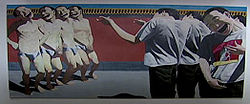
Government of the People's Republic of China
All power within the government of the People's Republic of China is divided among three bodies: the People's Republic of China, State Council, and the People's Liberation Army . This article is concerned with the formal structure of the state, its departments and their responsibilities...
, though many internationally acclaimed artists are still restricted from media exposure at home or have exhibitions ordered closed. Leading contemporary visual artists include Ai Weiwei
Ai Weiwei
Ai Weiwei is a Chinese contemporary artist, active in sculpture, installation, architecture, curating, photography, film, and social, political and cultural criticism. Ai collaborated with Swiss architects Herzog & de Meuron as the artistic consultant on the Beijing National Stadium for the 2008...
, Cai Guoqiang, Cai Xin, Fang Lijun
Fang Lijun
Fang Lijun is an artist based in Beijing.He has shown work internationally in exhibitions including The Next Ones at Alexander Ochs , Beijing, New Work, New Acquisitions at the Museum of Modern Art in New York and Alors, la Chine? at the Pompidou Centre in Paris...
, Huang Yan
Huang Yan (artist)
Huang Yan, born 1966 in Jilin Province, is an eminent Chinese painter, sculptor, photographer and performance artists based in Beijing. He graduated from the Changchun Normal Academy in 1987 and is currently a Lecturer at Changchun University....
, Huang Yong Ping
Huang Yong Ping
Huang Yong Ping is a contemporary French visual artist of Chinese origin. Huang's work combines many media and cultural influence, but is particularly strongly influence by the intellectual abstraction of Dada and by Chinese numerology traditions...
, Kong Bai Ji
Kong Bai Ji
Kong Bai Ji is a contemporary Chinese artist born in Shanghai, in the People's Republic of China, in 1932. His works are included in the permanent collections of many of the world's top museums and cultural institutions, including The Art Institute of Chicago, Lincoln Center in New York, The China...
, Lu Shengzhong
Lu Shengzhong
Lu Shengzhong is a Chinese artist who specializes in the ancient Chinese art of paper cutting.-Early life:Lu was born in the Dayuji village in Shangdong, China, in 1952. Shangdong has long been known for its paper cutting art culture. Lu’s father was a farmer where his mother was a house-wife,...
, Ma Liuming
Ma Liuming
Ma Liuming is a contemporary Chinese painter and pioneer of performance art. He is known most of all for his exploration of the power and poetry of public nudity in China, where such behavior was strictly forbidden...
, Ma Qingyun, Qiu Shihua
Qiu Shihua
Qiu Shihua is a notable Chinese landscape painter born 1940 in Zizhong, Sichuan Province, China. He lives and works in Beijing and Shenzhen.-Life and work:...
, Song Dong, Li Wei
Li Wei (artist)
Li Wei is a contemporary artist from Beijing, China. His work often depicts him in apparently gravity-defying situations. Wei started off his performance series, Mirroring, and later on took off attention with his Falls series which shows the artist with his head and chest embedded into the ground...
, Christine Wang
Christine Wang
Cristine Wang is a Taiwan-born American architect, new media curator, art critic, and founder of the Wang Museum of Technology.Originally from Taipei, Taiwan, she moved to New York City in 1971, first to Queens, then Great Neck, Long Island...
, Wang Guangyi
Wang Guangyi
Wang Guangyi , is a Chinese artist known for being the leader of the New Art Movement circles that erupted out of China after 1989 and for his Great Criticism series of paintings, using the images of propaganda from the Cultural Revolution and contemporary brand names from western advertising...
, Wang Qingsong, Wenda Gu, Xu Bing
Xu Bing
Xu Bing is a Chinese-born artist, resident in the United States since 1990. He currently resides in Beijing.-Biography:...
, Yang Zhichao
Yang Zhichao
Yang Zhichao Born in 1963 in Gansu province Northern Manchuria, is a performance artist living and working in Beijing....
, Zhan Wang
Zhan Wang
Zhan Wang is a noted contemporary Chinese sculptor.Born in 1962 in Beijing, China, Wang entered the Central Academy of the Arts as a sculpture major in 1983....
, Zhang Dali
Zhang Dali
Zhang Dali is an artist based in Beijing.Zhang trained at the Beijing Central Academy of Art & Design. After studying painting in China, he went to Italy, where he discovered graffiti art...
, Zhang Xiaogang
Zhang Xiaogang
Zhang Xiaogang is a contemporary Chinese symbolist and surrealist painter. Paintings in his Bloodline series are often monochromatic, stylized portraits of Chinese people, usually with large, dark-pupiled eyes, posed in a stiff manner deliberately reminiscent of family portraits from the 1950s...
, Zhang Huan
Zhang Huan
Zhang Huan is a Chinese artist based in Shanghai and New York. He made his BA at the He Nan University in Kai Feng and his MA at the China Central Academy of Fine Arts in Beijing...
, Zhu Yu, Yan Lei, Ma Kelu
Ma Kelu
Ma Kelu is a Chinese painter. He first rose to prominence in the late 1970s and early 1980s as a member of the No Name Group, a circle of largely self-taught, underground artists based in Beijing, who worked in direct contravention of the Chinese government's official sponsorship of Socialist...
, Ding Fang
Ding Fang
Ding Fang is a well-known Chinese painter. He graduated from the Nanjing Fine Arts Academy in 1986, where he later taught for several years. After working both as a professional artist and on the editorial staff of Fine Arts in China Magazine, he moved in 2000 to the Institute of Fine Arts at...
, Shang Yang
Shang Yang
Shang Yang was an important statesman of the State of Qin during the Warring States Period of Chinese history. Born Wei Yang in the State of Wei, with the support of Duke Xiao of Qin Yang enacted numerous reforms in Qin...
, Wei, Ligang (modern calligraphist), Yue Min Jun, Zheng Fan Zhi, Liu Fengzhi, and Zhang Yue
Zhang Yue
Zhang Yue is a Chinese pair skater. She competes with Wang Lei. They are the 2009 Junior Grand Prix Final bronze medalists and 2008 Junior Grand Prix Final silver medalists....
.
Visual art
Beginning in the late 1980s there was unprecedented exposure for younger Chinese visual artists in the west to some degree through the agency of curators based outside the country such as Hou HanruHou Hanru
Hou Hanru is a Chinese art curator and critic who lives in United States since 2006.He received degrees from the Central Academy of Fine Arts in Beijing and moved from China in 1990. He lived 16 years in France before moving to America in 1990...
. Local curators within the country such as Gao Minglu and critics such as Li Xianting
Li Xianting
Li Xianting is an independent art critic and curator of contemporary Chinese art.In the late seventies and eighties, Li Xianting was involved in advocating and introducing the avant-garde art form in China. He organized the “Stars exhibition” in 1979, and coined the terms “Cynical Realism” and...
(栗宪庭) reinforced this promotion of particular brands of painting that had recently emerged, while also spreading the idea of art as a strong social force within Chinese culture. There was some controversy as critics identified these imprecise representations of contemporary Chinese art as having been constructed out of personal preferences, a kind of programmatized artist-curator relationship that only further alienated the majority of the avant-garde from Chinese officialdom and western art market patronage.
Art market

Sotheby's
Sotheby's is the world's fourth oldest auction house in continuous operation.-History:The oldest auction house in operation is the Stockholms Auktionsverk founded in 1674, the second oldest is Göteborgs Auktionsverk founded in 1681 and third oldest being founded in 1731, all Swedish...
and Christie's
Christie's
Christie's is an art business and a fine arts auction house.- History :The official company literature states that founder James Christie conducted the first sale in London, England, on 5 December 1766, and the earliest auction catalogue the company retains is from December 1766...
, the biggest fine-art auction houses. The International Herald Tribune reported that Chinese porcelain
Porcelain
Porcelain is a ceramic material made by heating raw materials, generally including clay in the form of kaolin, in a kiln to temperatures between and...
s were fought over in the art market as "if there was no tomorrow". Contemporary Chinese art also saw record sales throughout the 2000s. In 2007, it was estimated that 5 of the world's 10 best selling living artists at art auction were from China, with artists such as Zhang Xiaogang
Zhang Xiaogang
Zhang Xiaogang is a contemporary Chinese symbolist and surrealist painter. Paintings in his Bloodline series are often monochromatic, stylized portraits of Chinese people, usually with large, dark-pupiled eyes, posed in a stiff manner deliberately reminiscent of family portraits from the 1950s...
whose works were sold for a total of $56.8 million at auction in 2007. In terms of buying-market, China overtook France in late 2000s as the world's third-largest art market, after the United States and the United Kingdom, due to the growing middle-class in the country. Sotheby's
Sotheby's
Sotheby's is the world's fourth oldest auction house in continuous operation.-History:The oldest auction house in operation is the Stockholms Auktionsverk founded in 1674, the second oldest is Göteborgs Auktionsverk founded in 1681 and third oldest being founded in 1731, all Swedish...
noted that contemporary Chinese art has rapidly changed the contemporary Asian art world into one of the most dynamic sectors on the international art market. During the global economic crisis, the contemporary Asian art market and the contemporary Chinese art market experienced a slow down in late 2008. The market for Contemporary Chinese and Asian art saw a major revival in late 2009 with record level sales at Christie's. For centuries largely made-up of European and American buyers, the international buying market for Chinese art has also began to be dominated by Chinese dealers and collectors in recent years. In was reported in 2011, China has became the world's second biggest market for art and antiques, accounting for 23 percent of the world's total art market, behind the United States (which accounts for 34 percent of the world's art market).
One of the areas that has revived art concentration and also commercialized the industry is the 798 Art District in Dashanzi
Dashanzi
Dashanzi is a 1 square kilometer area in the Chaoyang district of Beijing, northeast of the city center. It lies along the Airport Expressway between the 4th and 5th Ring Roads, south of the Dashanzi Qiao flyover and opposite Wangjing.Most of the area is made up of an industrial park...
of Beijing. The artist Zhang Xiaogang sold a 1993 painting for US$ 2.3 million in 2006, which included blank faced Chinese families from the Cultural Revolution era, while Yue Minjun
Yue Minjun
Yue Minjun is a contemporary Chinese artist based in Beijing, China. He is best known for oil paintings depicting himself in various settings, frozen in laughter. He has also reproduced this signature image in sculpture, watercolor and prints...
's work Execution in 2007 was sold for a then record of nearly $6 million at Sotheby's. such as Stanley Ho
Stanley Ho
Stanley Ho, GBM, GLM, GBS, GML, OBE , also known as Ho Hung Sun, Stanley Ho Hung Sun, is an entrepreneur in Hong Kong and Macau. Ho is sometimes nicknamed "The King of Gambling", reflecting the government-granted monopoly he held of the Macau gambling industry for 40 years...
, the owner of the Macau Casinos
Gambling in Macau
Gambling in Macau has been legal since the 1850s when the Portuguese government legalized the activity in the colony. Since then, Macau has become known worldwide as the "Monte Carlo of the Orient"....
, and casino developer Stephen Wynn
Steve Wynn (developer)
Stephen Alan "Steve" Wynn is an American business magnate who played a pivotal role in the 1990s resurgence and expansion of the Las Vegas Strip...
, would capitalize on the art trends. Items such as Ming Dynasty vases and assorted Imperial pieces were auctioned off.
Other art works produced in China or Hong Kong were sold in places such as Christie's including a Chinese porcelain piece with the mark of Emperor Qianlong sold for HKD $
Hong Kong dollar
The Hong Kong dollar is the currency of the jurisdiction. It is the eighth most traded currency in the world. In English, it is normally abbreviated with the dollar sign $, or alternatively HK$ to distinguish it from other dollar-denominated currencies...
$151.3 million. A 1964 painting "All the Mountains Blanketed in Red" was sold for HKD $35 million. Auctions were also held at Sotheby's where Xu Beihong
Xu Beihong
Xu Beihong was born in Yixing, China. He was primarily known for his shuimohua of horses and birds and one of the first Chinese artists to articulate the need for artistic expressions that reflected a new modern China at the beginning of the 20th century...
's 1939 masterpiece "Put Down Your Whip
Put Down Your Whip
Put Down Your Whip is a 1939 oil painting by Chinese Realism painter Xu Beihong. Completed during Xu's stay in Singapore, the painting was exhibited numerous times before its disappearance from public view in 1954...
" sold for HKD $72 million. The industry is not limited to fine arts, as many other types of contemporary pieces were also sold. In 2000, a number of Chinese artists were included in Documenta
Documenta
documenta is an exhibition of modern and contemporary art which takes place every five years in Kassel, Germany. It was founded by artist, teacher and curator Arnold Bode in 1955 as part of the Bundesgartenschau which took place in Kassel at that time...
and the Venice Biennale
Venice Biennale
The Venice Biennale is a major contemporary art exhibition that takes place once every two years in Venice, Italy. The Venice Film Festival is part of it. So too is the Venice Biennale of Architecture, which is held in even years...
of 2003. China now has its own major contemporary art showcase with the Venice Biennale. Fuck Off
Fuck Off (art exhibition)
"Fuck Off" was a controversial art exhibition which ran alongside the Third Shanghai Biennale , which itself was the city's first attempt at a truly international survey of contemporary art...
was a notorious art exhibition which ran alongside the Shanghai Biennial Festival in 2000 and was curated by independent curator Feng Boyi
Feng Boyi
Feng Boyi is an eminent independent art curator and critic in China. He has been assistant editor of the China Artists' Association newsletter Artist's Communication since 1988...
and contemporary artist Ai Weiwei
Ai Weiwei
Ai Weiwei is a Chinese contemporary artist, active in sculpture, installation, architecture, curating, photography, film, and social, political and cultural criticism. Ai collaborated with Swiss architects Herzog & de Meuron as the artistic consultant on the Beijing National Stadium for the 2008...
.
Museums
- Palace Museum (Forbidden City, Beijing)
- National Palace MuseumNational Palace MuseumThe National Palace Museum is an art museum in Taipei. It is the national museum of the Republic of China, and has a permanent collection of over 677,687 pieces of ancient Chinese artifacts and artworks, making it one of the largest in the world. The collection encompasses over 8,000 years of...
(Taipei, Taiwan)
See also
- Four OldsFour OldsThe Four Olds or the Four Old Things were Old Customs, Old Culture, Old Habits, and Old Ideas. One of the stated goals of the Cultural Revolution in the People's Republic of China was to bring an end to the Four Olds...
- Four Books and Five ClassicsFour Books and Five ClassicsThe Four Books and Five Classics are the authoritative books of Confucianism in China written before 300 BC.-Four Books:The Four Books are Chinese classic texts illustrating the core value and belief systems in Confucianism...
- Eastern art historyEastern art historyThe history of Eastern art includes a vast range of influences from various cultures and religions. Developments in Eastern art historically parallel those in Western art, in general a few centuries earlier...
- History of ChinaHistory of ChinaChinese civilization originated in various regional centers along both the Yellow River and the Yangtze River valleys in the Neolithic era, but the Yellow River is said to be the Cradle of Chinese Civilization. With thousands of years of continuous history, China is one of the world's oldest...
- Timeline of Chinese historyTimeline of Chinese historyThe following is a timeline of the history of China. Between the changing of the dynasties, most dates overlap as ruling periods do not transfer immediately...
- Chinese characterChinese characterChinese characters are logograms used in the writing of Chinese and Japanese , less frequently Korean , formerly Vietnamese , or other languages...
- Chinese paintingChinese paintingChinese painting is one of the oldest continuous artistic traditions in the world. The earliest paintings were not representational but ornamental; they consisted of patterns or designs rather than pictures. Early pottery was painted with spirals, zigzags, dots, or animals...
- Along the River During Qingming Festival
- 798 Art Zone
- Chinese ceramics
Further reading
- Barnhart, Richard M., et al. Three Thousand Years of Chinese Painting. Wadsworth Atheneum Museum of Art: 2002. ISBN 0-300-09447-7.
- Chi, Lillian, et al. A Dictionary of Chinese Ceramics. Sun Tree Publishing: 2003. ISBN 981-04-6023-6.
- Clunas, CraigCraig ClunasCraig Clunas is Professor of History of Art at the University of Oxford. As a historian of the art and history of China, Professor Clunas has focussed particularly on the Ming Dynasty .-Life:...
. Art in China. Oxford University Press: 1997. ISBN 0-19-284207-2. - Gowers, David, et al. Chinese Jade from the Neolithic to the Qing. Art Media Resources: 2002. ISBN 1-58886-033-7.
- Ebrey, Patricia, et al. Taoism and the Arts of China. University of California Press: 2000. ISBN 0-520-22784-0.
- Harper, Prudence Oliver. China: Dawn Of A Golden Age (200–750 AD). Yale University Press: 2004. ISBN 0-300-10487-1.
- Mascarelli, Gloria, and Robert Mascarelli. The Ceramics of China: 5000 BC to 1900 AD. Schiffer Publishing: 2003. ISBN 0-7643-1843-8.
- Sturman, Peter Charles. Mi Fu: Style and the Art of Calligraphy in Northern Song China. Yale University Press: 2004. ISBN 0-300-10487-1.
- Sullivan, Michael. The Arts of China. Fourth edition. University of California Press: 2000. ISBN 0-520-21877-9.
- Tregear, Mary. Chinese Art. Thames & Hudson: 1997. ISBN 0-500-20299-0.
- Watson, William. The Arts of China to AD 900. Yale University Press: 1995. ISBN 0-300-05989-2.
- S. Diglio, Urban Development and Historic Heritage Protection in Shanghai, in Fabio Maniscalco ed., "Web Journal on Cultural Patrimony", 1, 2006
External links
- Galleries of Chinese artworks at China Online Museum
- Art History of Chinese calligraphy, painting, and seal making
- China the Beautiful – Chinese Art and Literature Introductions & art classics texts
- Gallery of China – Traditional Chinese Art Essay on Chinese art from neolithic to communist times
- Fine Chinese Art And Chinese Painting The Chinese Ancient Paintings