
All Topics  
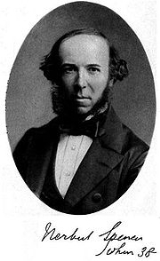
Herbert Spencer

 
Herbert Spencer

   Email Print
   Bookmark   Link


Herbert Spencer


Herbert Spencer (27 April 1820 – 8 December 1903) was an English
England

native_name =|conventional_long_name = England|common_name = England|image_flag = Flag of England.svg|image_coat = England COA.svg|symbol_type = Royal Coat of Arms...
 philosopher, prominent classical liberal
Classical liberalism

Classical liberalism is a doctrine stressing individual freedom, free markets, and limited government. This includes the importance of human rationality, individual property rights, natural rights, the protection of civil liberties, individual freedom from restraint, equality under the law, constitutional limitation of government, free marke...
 political theorist, and sociological theorist of the Victorian era
Victorian era

The Victorian Era of the United Kingdom of Great Britain and Ireland was the period of Victoria of the United Kingdom reign from June 1837 to January 1901....
.

Spencer developed an all-embracing conception of evolution
Evolutionism

Evolutionism refers to doctrines of evolution, and more specifically to a widely held 19th century belief that organisms are intrinsically bound to improve themselves, and that changes are progressive and arise through inheritance of acquired characters, as in Lamarckism....
 as the progressive development of the physical world, biological organisms, the human mind, and human culture and societies. As a polymath
Polymath

A polymath is a person whose knowledge is not restricted to one subject area. In less formal terms, a polymath may simply refer to someone who is very knowledgeable....
, he contributed to a wide range of subjects, including ethics
Ethics

Ethics is a word for a philosophy that encompasses proper conduct and good living. It is significantly broader than the common conception of ethics as the analyzing of right and wrong....
, religion
Religion

A religion is an organized approach to human spirituality which usually encompasses a set of myth, symbols, beliefs and practices, often with a supernatural or transcendence quality, that give meaning to the practitioner's experiences of life through reference to a higher power or truth....
, economics
Economics

File:Ballard Farmers' Market - vegetables.jpgEconomics is the Social sciences that studies the Production theory basics, Distribution , and Consumption of Good and Service ....
, politics
Politics

Politics is the process by which groups of people make decisions. The term is generally applied to behaviour within civil governments, but politics has been observed in all human group interactions, including corporation, academia, and religion institutions....
, philosophy
Philosophy

Philosophy is the study of general problems concerning matters such as existence, knowledge, truth, beauty, justice, validity, mind, and language....
, biology
Biology

Biology is a branch of the natural sciences concerned with the study of living organisms and their interaction with each other and their environment ....
, sociology
Sociology

Sociology is a branch of the social sciences that uses systematic methods of Empiricism and critical theory to develop and refine a body of knowledge about human social structure and activity, sometimes with the goal of applying such knowledge to the pursuit of social welfare....
, and psychology
Psychology

Psychology is an academic and applied science discipline involving the science study of human mental functions and behavior. Occasionally it also relies on symbolic hermeneutics and critical theory, although these traditions are less pronounced than in other social sciences such as sociology....
.


Discussion
Ask a question about 'Herbert Spencer'
Start a new discussion about 'Herbert Spencer'
Answer questions from other users
Full Discussion Forum


Recent Posts


Quotations


The universal basis of co-operation is the proportioning of benefits received to services rendered.

Ch. 8, The Sociological View

Every cause produces more than one effect.

On Progress: Its Law and Cause

Every man is free to do that which he wills, provided he infringes not the equal freedom of any other man.

Ch. 6, The Formula of Justice

How often misused words generate misleading thoughts!

Ch. 8, Humanity

Morality knows nothing of geographical boundaries, or distinctions of race.

Pt. IV, Ch. 30, General Considerations

Old forms of government finally grow so oppressive, that they must be thrown off even at the risk of reigns of terror.

On Manners and Fashion


Encyclopedia


Herbert Spencer (27 April 1820 – 8 December 1903) was an English
England

native_name =|conventional_long_name = England|common_name = England|image_flag = Flag of England.svg|image_coat = England COA.svg|symbol_type = Royal Coat of Arms...
 philosopher, prominent classical liberal
Classical liberalism

Classical liberalism is a doctrine stressing individual freedom, free markets, and limited government. This includes the importance of human rationality, individual property rights, natural rights, the protection of civil liberties, individual freedom from restraint, equality under the law, constitutional limitation of government, free marke...
 political theorist, and sociological theorist of the Victorian era
Victorian era

The Victorian Era of the United Kingdom of Great Britain and Ireland was the period of Victoria of the United Kingdom reign from June 1837 to January 1901....
.

Spencer developed an all-embracing conception of evolution
Evolutionism

Evolutionism refers to doctrines of evolution, and more specifically to a widely held 19th century belief that organisms are intrinsically bound to improve themselves, and that changes are progressive and arise through inheritance of acquired characters, as in Lamarckism....
 as the progressive development of the physical world, biological organisms, the human mind, and human culture and societies. As a polymath
Polymath

A polymath is a person whose knowledge is not restricted to one subject area. In less formal terms, a polymath may simply refer to someone who is very knowledgeable....
, he contributed to a wide range of subjects, including ethics
Ethics

Ethics is a word for a philosophy that encompasses proper conduct and good living. It is significantly broader than the common conception of ethics as the analyzing of right and wrong....
, religion
Religion

A religion is an organized approach to human spirituality which usually encompasses a set of myth, symbols, beliefs and practices, often with a supernatural or transcendence quality, that give meaning to the practitioner's experiences of life through reference to a higher power or truth....
, economics
Economics

File:Ballard Farmers' Market - vegetables.jpgEconomics is the Social sciences that studies the Production theory basics, Distribution , and Consumption of Good and Service ....
, politics
Politics

Politics is the process by which groups of people make decisions. The term is generally applied to behaviour within civil governments, but politics has been observed in all human group interactions, including corporation, academia, and religion institutions....
, philosophy
Philosophy

Philosophy is the study of general problems concerning matters such as existence, knowledge, truth, beauty, justice, validity, mind, and language....
, biology
Biology

Biology is a branch of the natural sciences concerned with the study of living organisms and their interaction with each other and their environment ....
, sociology
Sociology

Sociology is a branch of the social sciences that uses systematic methods of Empiricism and critical theory to develop and refine a body of knowledge about human social structure and activity, sometimes with the goal of applying such knowledge to the pursuit of social welfare....
, and psychology
Psychology

Psychology is an academic and applied science discipline involving the science study of human mental functions and behavior. Occasionally it also relies on symbolic hermeneutics and critical theory, although these traditions are less pronounced than in other social sciences such as sociology....
. During his lifetime he achieved tremendous authority, mainly in English Speaking circles. Indeed in Britain and the United States at "one time Spencer's disciples had not blushed to compare him with Aristotle!"

He is best known for coining the phrase
Phrase

In grammar, a phrase is a group of words that functions as a single unit in the syntax of a Sentence .For example the house at the end of the street is a phrase....
 "survival of the fittest
Survival of the fittest

"Survival of the fittest" is a phrase which is shorthand for a concept relating to competition for survival or predominance. Originally applied by Herbert Spencer in his Principles of Biology of 1864, Spencer drew parallels to his ideas of economics with Charles Darwin's theory of evolution by what Darwin termed natural selection....
," which he did in Principles of Biology (1864), after reading Charles Darwin
Charles Darwin

Charles Robert Darwin Royal Society was an English people natural history who realised and presented compelling evidence that all species of life have evolution over time from common descent, through the process he called natural selection....
's On the Origin of Species. This term strongly suggests natural selection
Natural selection

Natural selection is the process by which favorable heritable trait become more common in successive generations of a population of Reproduction organisms, and unfavorable heritable traits become less common, due to differential reproduction of genotypes....
, yet as Spencer extended evolution into realms of sociology and ethics, he made use of Lamarckism
Lamarckism

Lamarckism is the once widely accepted idea that an organism can pass on characteristics that it acquired during its lifetime to its offspring ....
 rather than natural selection.

Life

Herbert Spencer was born in Derby
Derby

Derby is a city status in the United Kingdom in the East Midlands region of England in the United Kingdom. It lies upon the banks of the River Derwent, Derbyshire and is located in the south of the non-metropolitan county of Derbyshire....
, England
England

native_name =|conventional_long_name = England|common_name = England|image_flag = Flag of England.svg|image_coat = England COA.svg|symbol_type = Royal Coat of Arms...
, on April 27, 1820, the son of William George Spencer (generally called George). Spencer’s father was a religious dissenter who drifted from Methodism
Methodism

Methodism is a movement of Protestant Christianity represented by John Wesley and his younger brother Charles Wesley that sought to keep Methodism as a Revivalism movement within the Church of England....
 to Quakerism, and who seems to have transmitted to his son an opposition to all forms of authority. He ran a school founded on the progressive teaching methods of Johann Heinrich Pestalozzi
Johann Heinrich Pestalozzi

Johann Heinrich Pestalozzi was a Switzerland pedagogue and educational reformer....
 and also served as Secretary of the Derby Philosophical Society
Derby Philosophical Society

The Derby Philosophical Society was a club for gentleman in Derby founded in 1783 by Erasmus Darwin. The club had many notable members and also offered the first institutional library in Derby that was available to some section of the public....
, a scientific society which had been founded in the 1790s by Erasmus Darwin
Erasmus Darwin

Erasmus Darwin , was an England physician, natural philosopher, physiologist, abolitionist, inventor and poet. He was one of the founder members of the Lunar Society, a discussion group of pioneering industrialists and natural philosophers....
, the grandfather of Charles.

Spencer was educated in empirical science by his father, while the members of the Derby Philosophical Society introduced him to pre-Darwinian concepts of biological evolution, particularly those of Erasmus Darwin and Jean Baptiste Lamarck. His uncle, the Reverend Thomas Spencer, vicar of Hinton Charterhouse near Bath, completed Spencer’s limited formal education by teaching him some mathematics and physics, and enough Latin
Latin

Latin is an Italic language, historically spoken in Latium and Ancient Rome. Through the Military history of the Roman Empire, Latin spread throughout the Mediterranean and a large part of Europe....
 to enable him to translate some easy texts. Thomas Spencer also imprinted on his nephew his own firmly free-trade and anti-statist political views. Otherwise, Spencer was an autodidact who acquired most of his knowledge from narrowly focused readings and conversations with his friends and acquaintances.

As both an adolescent and a young man Spencer found it difficult to settle to any intellectual or professional discipline. He worked as a civil engineer during the railway boom of the late 1830s, while also devoting much of his time to writing for provincial journals that were nonconformist in their religion and radical in their politics. From 1848 to 1853 he served as sub-editor on the free-trade journal The Economist
The Economist

The Economist is an English-language weekly news and international relations publication owned by The Economist Newspaper Ltd. and edited in London....
, during which time he published his first book, Social Statics
Social Statics

Social Statics, or The Conditions essential to Happiness specified, and the First of them Developed is an 1851 book by the British economist Herbert Spencer....
 (1851), which predicted that humanity would shortly become completely adapted to the requirements of living in society with the consequential withering away of the state.

Its publisher, John Chapman
John Chapman (publisher)

John Chapman was a publisher who had medical training and was based at 142 Strand, London.His entry in the Concise Dictionary of National Biography, reads: "Chapman, John physician, author, publisher; apprencticed at Worksop and was in business in Adelaide; studied medicine in Paris and at St George's Hospital, London; publisher and b...
, introduced him to his salon which was attended by many of the leading radical and progressive thinkers of the capital, including John Stuart Mill
John Stuart Mill

John Stuart Mill , United Kingdom philosopher, political economy, civil servant and Parliament of the United Kingdom, was an influential liberalism thinker of the 19th century....
, Harriet Martineau
Harriet Martineau

Harriet Martineau was an England writer and philosopher, renowned in her day as a controversial journalist, political economist, abolitionist and life-long feminist....
, George Henry Lewes
George Henry Lewes

George Henry Lewes was an England philosopher and critic of literature and theatre....
 and Mary Ann Evans (George Eliot
George Eliot

Mary Anne Evans , better known by her pen name George Eliot, was an England novelist. She was one of the leading writers of the Victorian era....
), with whom he was briefly romantically linked. Spencer himself introduced the biologist Thomas Henry Huxley, who would later win fame as 'Darwin’s Bulldog' and who remained his lifelong friend. However it was the friendship of Evans and Lewes that acquainted him with John Stuart Mill’s A System of Logic and with Auguste Comte’s Positivism
Positivism

Positivism is a philosophy which holds that the only authentic knowledge is that based on actual sense experience. Such knowledge can come only from affirmation of theories through strict scientific method....
 and which set him on the road to his life’s work; he strongly disagreed with Comte.

The first fruit of his friendship with Evans and Lewes was Spencer's second book, Principles of Psychology, published in 1855, which explored a physiological basis for psychology. The book was founded on the fundamental assumption that the human mind was subject to natural laws and that these could be discovered within the framework of general biology. This permitted the adoption of a developmental perspective not merely in terms of the individual (as in traditional psychology), but also of the species and the race. Through this paradigm, Spencer aimed to reconcile the associationist psychology of Mill’s Logic, the notion that human mind was constructed from atomic sensations held together by the laws of the association of ideas, with the apparently more 'scientific' theory of phrenology
Phrenology

Phrenology is a defunct field of study, once considered a science, in which the personality traits of a person were determined by "reading" bumps and fissures in the skull....
, which located specific mental functions in specific parts of the brain.

Spencer argued that both these theories were partial accounts of the truth: repeated associations of ideas were embodied in the formation of specific strands of brain tissue, and these could be passed from one generation to the next by means of the Lamarckian
Lamarckism

Lamarckism is the once widely accepted idea that an organism can pass on characteristics that it acquired during its lifetime to its offspring ....
 mechanism of use-inheritance. The Psychology, he modestly believed, would do for the human mind what Isaac Newton
Isaac Newton

Sir Isaac Newton, Fellow of the Royal Society was an English people physicist, mathematician, Astronomy, Natural philosophy, Alchemy, and Theology and one of the the 100 in human history....
 had done for matter. However, the book was not initially successful and the last of the 251 copies of its first edition was not sold until June 1861.

Spencer's interest in psychology derived from a more fundamental concern which was to establish the universality of natural law. In common with others of his generation, including the members of Chapman's salon, he was possessed with the idea of demonstrating that it was possible to show that everything in the universe—including human culture, language, and morality—could be explained by laws of universal validity. This was in contrast to the views of many theologians of the time who insisted that some parts of creation, in particular the human soul, were beyond the realm of scientific investigation. Comte's Systeme de Philosophie Positive had been written with the ambition of demonstrating the universality of natural law, and Spencer was to follow Comte in the scale of his ambition. However, Spencer differed from Comte in believing it was possible to discover a single law of universal application which he identified with progressive development and was to call the principle of evolution
Evolutionism

Evolutionism refers to doctrines of evolution, and more specifically to a widely held 19th century belief that organisms are intrinsically bound to improve themselves, and that changes are progressive and arise through inheritance of acquired characters, as in Lamarckism....
.

In 1858 Spencer produced an outline of what was to become the System of Synthetic Philosophy. This immense undertaking, which has few parallels in the English language, aimed to demonstrate that the principle of evolution applied in biology, psychology, sociology (Spencer appropriated Comte's term for the new discipline) and morality. Spencer envisaged that this work of ten volumes would take twenty years to complete; in the event it took him twice as long and consumed almost all the rest of his long life.

Despite Spencer's early struggles to establish himself as a writer, by the 1870s he had become the most famous philosopher of the age. His works were widely read during his lifetime, and by 1869 he was able to support himself solely on the profit of book sales and on income from his regular contributions to Victorian periodicals which were collected as three volumes of Essays. His works were translated into German, Italian, Spanish, French, Russian, Japanese and Chinese, and into many other languages and he was offered honors and awards all over Europe and North America. He also became a member of the Athenaeum
Athenaeum

Athenaeum, also Athen?um or Atheneum, is used in the names of institutions or periodicals for literary, scientific, or artistic study....
, an exclusive Gentleman's Club in London open only to those distinguished in the arts and sciences, and the X Club
X Club

The X Club was a dining club of nine men who supported the theories of natural selection and academic liberalism in Victorian era. Thomas Henry Huxley was the initiator: he called the first meeting for November 3, 1864....
, a dining club of nine founded by T.H. Huxley that met every month and included some of the most prominent thinkers of the Victorian age (three of whom would become presidents of the Royal Society
Royal Society

The Royal Society of London for the Improvement of Natural Knowledge, known simply as the Royal Society, or even the Royal, is a learned society for science that was founded in 1660 and is considered by most to be the oldest such society still in existence....
).

Members included physicist-philosopher John Tyndall
John Tyndall

John Tyndall Fellow of the Royal Society was a prominent 19th century physicist. His initial scientific fame arose in the 1850s from his study of diamagnetism....
 and Darwin's cousin, the banker and biologist Sir John Lubbock. There were also some quite significant satellites such as liberal clergyman Arthur Stanley
Arthur Stanley

Sir Arthur Stanley, Royal Victorian Order, Order of the British Empire, Order of the Bath was a British Conservative Party politician.Born Hon....
, the Dean of Westminster; and guests such as Charles Darwin
Charles Darwin

Charles Robert Darwin Royal Society was an English people natural history who realised and presented compelling evidence that all species of life have evolution over time from common descent, through the process he called natural selection....
 and Hermann von Helmholtz
Hermann von Helmholtz

Hermann Ludwig Ferdinand von Helmholtz was a Germany physician and physicist who made significant contributions to several widely varied areas of modern science....
 were entertained from time to time. Through such associations, Spencer had a strong presence in the heart of the scientific community and was able to secure an influential audience for his views. Despite his growing wealth and fame he never owned a house of his own.

The last decades of Spencer's life were characterized by growing disillusionment and loneliness. He never married, and after 1855 was a perpetual hypochondriac who complained endlessly of pains and maladies that no physician could diagnose. By the 1890s his readership had begun to desert him while many of his closest friends died and he had come to doubt the confident faith in progress that he had made the center-piece of his philosophical system. His later years were also ones in which his political views became increasingly conservative. Whereas Social Statics had been the work of a radical democrat who believed in votes for women (and even for children) and in the nationalization of the land to break the power of the aristocracy, by the 1880s he had become a staunch opponent of female suffrage and made common cause with the landowners of the Liberty and Property Defence League
Liberty and Property Defence League

The Liberty and Property Defence League was a historic organization, founded in 1882 by Francis Charteris, 10th Earl of Wemyss, for the support of laissez-faire free trade....
 against what they saw as the 'socialism' of the administration of William Ewart Gladstone
William Ewart Gladstone

William Ewart Gladstone was a United Kingdom of Great Britain and Ireland Liberal Party statesman and four times Prime Minister of the United Kingdom ....
. Spencer's political views from this period were expressed in what has become his most famous work, The Man versus the State.

The exception to Spencer's growing conservativism was that he remained throughout his life an ardent opponent of imperialism
Anti-imperialism

Anti-imperialism, strictly speaking, is a term that may be applied to a movement opposed to some form of imperialism. Generally, anti-imperialism includes opposition to wars of conquest, particularly of non-contiguous territory or people with a different language or culture....
 and militarism. His critique of the Boer War
Boer War

Two Boer Wars were fought between the British empire and the two independent Boer republics, the Orange Free State and the South African Republic , founded by settlers known as Voortrekkers who made the Great Trek from the Cape Colony....
 was especially scathing, and it contributed to his declining popularity in Britain.

In 1902, shortly before his death, Spencer was nominated for the Nobel Prize for literature. He continued writing all his life, in later years often by dictation, until he succumbed to poor health at the age of 83. His ashes are interred in the eastern side of London's Highgate Cemetery
Highgate Cemetery

Highgate Cemetery is a cemetery located in Highgate, London, England. It is designated Grade II* on the English Heritage National Register of Historic Parks and Gardens....
 facing Karl Marx
Karl Marx

Karl Heinrich Marx was a Germanphilosophy, political economy, historian, sociologist, humanism, political theorist and revolutionary credited as the founder of communism....
's grave. At Spencer's funeral
Funeral

A funeral is a ceremony marking a person's death. Funerary customs comprise the complex of beliefs and practices used by a culture to remember the dead, from the funeral itself, to various monuments, prayers, and rituals undertaken in their honour....
 the Indian nationalist leader Shyamji Krishnavarma
Shyamji Krishnavarma

Shyamji Krishna Varma was an Indian scholar, lawyer, nationalist and a journalist who founded the Indian Home Rule Society, India House and The Indian Sociologist in London....
 announced a donation of £1,000 to establish a lectureship at Oxford University
University of Oxford

The University of Oxford , located in the city of Oxford, Oxfordshire, England, is the List of oldest universities in continuous operation in the English-speaking world....
 in tribute to Spencer and his work.

The System of Synthetic Philosophy

The basis for Spencer's appeal to many of his generation was that he appeared to offer a ready-made system of belief which could substitute for conventional religious faith at a time when orthodox creeds were crumbling under the advances of modern science. Spencer's philosophical system seemed to demonstrate that it was possible to believe in the ultimate perfection of humanity on the basis of advanced scientific conceptions such as the first law of thermodynamics
First law of thermodynamics

In thermodynamics, the first law of thermodynamics is an expression of the more universal physical law of the conservation of energy. Succinctly, the first law of thermodynamics states:...
 and biological evolution.

In essence Spencer's philosophical vision was formed by a combination of Deism
Deism

Deism is a religious and philosophical belief that a supreme natural God exists and created the physical universe, and that religious truths can be arrived at by the application of reason and observation of the natural world....
 and Positivism
Positivism

Positivism is a philosophy which holds that the only authentic knowledge is that based on actual sense experience. Such knowledge can come only from affirmation of theories through strict scientific method....
. On the one hand, he had imbibed something of eighteenth century Deism from his father and other members of the Derby Philosophical Society and from books like George Combe
George Combe

George Combe , brother of Andrew Combe, was a writer on phrenology and education. He was born in Edinburgh, where for some time he practised as a lawyer....
's immensely popular The Constitution of Man (1828). This treated the world as a cosmos of benevolent design, and the laws of nature as the decrees of a 'Being transcendentally kind.' Natural laws were thus the statutes of a well governed universe that had been decreed by the Creator with the intention of promoting human happiness. Although Spencer lost his Christian faith as a teenager and later rejected any 'anthropomorphic' conception of the Deity, he nonetheless held fast to this conception at an almost sub-conscious level. At the same time, however, he owed far more than he would ever acknowledge to Positivism, in particular in its conception of a philosophical system as the unification of the various branches of scientific knowledge. He also followed Positivism in his insistence that it was only possible to have genuine knowledge of phenomena and hence that it was idle to speculate about the nature of the ultimate reality. The tension between Positivism and his residual Deism ran through the entire System of Synthetic Philosophy.

Spencer followed Comte in aiming for the unification of scientific truth; it was in this sense that his philosophy aimed to be 'synthetic.' Like Comte, he was committed to the universality of natural law, the idea that the laws of nature applied without exception, to the organic realm as much as to the inorganic, and to the human mind as much as to the rest of creation. The first objective of the Synthetic Philosophy was thus to demonstrate that there were no exceptions to being able to discover scientific explanations, in the form of natural laws, of all the phenomena of the universe. Spencer’s volumes on biology, psychology, and sociology were all intended to demonstrate the existence of natural laws in these specific disciplines. Even in his writings on ethics, he held that it was possible to discover ‘laws’ of morality that had the status of laws of nature while still having normative content, a conception which can be traced to Combe’s Constitution of Man.

The second objective of the Synthetic Philosophy was to show that these same laws led inexorably to Progress. In contrast to Comte, who stressed only the unity of scientific method, Spencer sought the unification of scientific knowledge in the form of the reduction of all natural laws to one fundamental law, the law of evolution. In this respect, he followed the model laid down by the Edinburgh publisher Robert Chambers
Robert Chambers

Robert Chambers , was a Scotland author, periodical editor and publisher, who together in partnership with his older brother William Chambers of Glenormiston the publisher and politician were both highly influential in the mid-19th century in both scientific and political circles....
 in his anonymous Vestiges of the Natural History of Creation
Vestiges of the Natural History of Creation

Vestiges of the Natural History of Creation was an important controversial theory of Natural history book published anonymously in England in 1844, as championing a natural or evolutionary by way of contrast with a god-given world championed in the era when much thought was still dominated by reliance on religious memes....
 (1844). Although often dismissed as a lightweight forerunner of Charles Darwin
Charles Darwin

Charles Robert Darwin Royal Society was an English people natural history who realised and presented compelling evidence that all species of life have evolution over time from common descent, through the process he called natural selection....
’s The Origin of Species
The Origin of Species

Charles Darwin's On the Origin of Species is a seminal work in scientific literature and a landmark work in evolutionary biology. The book's full title is On the Origin of Species by Means of Natural Selection, or the Preservation of Favoured Races in the Struggle for Life....
, Chambers’ book was in reality a programme for the unification of science which aimed to show that Laplace’s Nebular Hypothesis for the origin of the solar system and Lamarck’s theory of species transformation were both instances (in Lewes' phrase) of 'one magnificent generalization of progressive development.' Chambers was associated with Chapman’s salon and his work served as the unacknowledged template for the Synthetic Philosophy.

Concept of evolution

The first clear articulation of Spencer’s evolutionary
Evolutionism

Evolutionism refers to doctrines of evolution, and more specifically to a widely held 19th century belief that organisms are intrinsically bound to improve themselves, and that changes are progressive and arise through inheritance of acquired characters, as in Lamarckism....
 perspective occurred in his essay 'Progress: Its Law and Cause' published in Chapman's Westminster Review
Westminster Review

The Westminster Review was founded in 1823 by Jeremy Bentham and James Mill as a quarterly journal for Historical radicalism#Political reform, and was published from 1824 to 1914....
 in 1857, and which later formed the basis of the First Principles of a New System of Philosophy (1862). In it he expounded a theory of evolution which combined insights from Samuel Taylor Coleridge
Samuel Taylor Coleridge

Samuel Taylor Coleridge was an England poet, critic and Philosophy who was, along with his friend William Wordsworth, one of the founders of the Romanticism in England and one of the Lake Poets....
's essay 'The Theory of Life'—itself derivative from Friedrich von Schelling's Naturphilosophie
Naturphilosophie

Naturphilosophie was a current in the philosophy tradition of German idealism in the 19th century, particularly associated with Friedrich Wilhelm Joseph von Schelling and Georg Wilhelm Friedrich Hegel....
—with a generalization of von Baer
Karl Ernst von Baer

Karl Ernst von Baer was a Baltic German biologist and a founding father of embryology....
’s law of embryological development. Spencer posited that all structures in the universe develop from a simple, undifferentiated, homogeneity to a complex, differentiated, heterogeneity, while being accompanied by a process of greater integration of the differentiated parts. This evolutionary process could be found at work, Spencer believed, throughout the cosmos. It was a universal law, applying to the stars and the galaxies as much as to biological organisms, and to human social organization as much as to the human mind. It differed from other scientific laws only by its greater generality, and the laws of the special sciences could be shown to be illustrations of this principle.

This attempt to explain the evolution of complexity
Evolution of complexity

The evolution of complexity is an important outcome of the process of evolution. Evolution has produced some remarkably complex organisms - although the actual level of complexity is very hard to define or measure accurately in biology, with properties such as gene content, the number of cell types or morphology all being used to assess an o...
 was radically different to that to be found in Darwin’s Origin of Species which was published two years later. Spencer is often, quite erroneously, believed to have merely appropriated and generalized Darwin’s work on natural selection
Natural selection

Natural selection is the process by which favorable heritable trait become more common in successive generations of a population of Reproduction organisms, and unfavorable heritable traits become less common, due to differential reproduction of genotypes....
. But although after reading Darwin's work he coined the phrase 'survival of the fittest
Survival of the fittest

"Survival of the fittest" is a phrase which is shorthand for a concept relating to competition for survival or predominance. Originally applied by Herbert Spencer in his Principles of Biology of 1864, Spencer drew parallels to his ideas of economics with Charles Darwin's theory of evolution by what Darwin termed natural selection....
' as his own term for Darwin's concept, and is often misrepresented as a thinker who merely applied the Darwinian theory to society, he only grudgingly incorporated natural selection into his preexisting overall system. The primary mechanism of species transformation that he recognized was Lamarckian
Lamarckism

Lamarckism is the once widely accepted idea that an organism can pass on characteristics that it acquired during its lifetime to its offspring ....
 use-inheritance which posited that organs are developed or are diminished by use or disuse and that the resulting changes may be transmitted to future generations. Spencer believed that this evolutionary mechanism was also necessary to explain 'higher' evolution, especially the social development of humanity. Moreover, in contrast to Darwin, he held that evolution had a direction and an end-point, the attainment of a final state of 'equilibrium."

Sociology

The evolutionary progression from simple, undifferentiated homogeneity to complex, differentiated, heterogeneity was exemplified, Spencer argued, by the development of society. He developed a theory of two types of society, the militant and the industrial, which corresponded to this evolutionary progression. Militant society, structured around relationships of hierarchy and obedience, was simple and undifferentiated; industrial society, based on voluntary, contractually assumed social obligations, was complex and differentiated. Society, which Spencer conceptualized as a 'social organism' evolved from the simpler state to the more complex according to the universal law of evolution. Moreover, industrial society was the direct descendant of the ideal society developed in Social Statics, although Spencer now equivocated over whether the evolution of society would result in anarchism (as he had first believed) or whether it pointed to a continued role for the state, albeit one reduced to the minimal functions of the enforcement of contracts and external defence.

Ethics

Herbert Spencer
The end point of the evolutionary process would be the creation of 'the perfect man in the perfect society' with human beings becoming completely adapted to social life, as predicted in Spencer’s first book. The chief difference between Spencer’s earlier and later conceptions of this process was the evolutionary timescale involved. The psychological—and hence also the moral—constitution which had been bequeathed to the present generation by our ancestors, and which we in turn would hand on to future generations, was in the process of gradual adaptation to the requirements of living in society. For example, aggression was a survival instinct which had been necessary in the primitive conditions of life, but was maladaptive in advanced societies. Because human instincts had a specific location in strands of brain tissue, they were subject to the Lamarckian mechanism of use-inheritance so that gradual modifications could be transmitted to future generations. Over the course of many generations the evolutionary process would ensure that human beings would become less aggressive and increasingly altruistic, leading eventually to a perfect society in which no one would cause another person pain. However, for evolution to produce the perfect individual it was necessary for present and future generations to experience the 'natural' consequences of their conduct. Only in this way would individuals have the incentives required to work on self-improvement and thus to hand an improved moral constitution to their descendants. Hence anything that interfered with the 'natural' relationship of conduct and consequence was to be resisted and this included the use of the coercive power of the state to relieve poverty, to provide public education, or to require compulsory vaccination. Although charitable giving was to be encouraged even it had to be limited by the consideration that suffering was frequently the result of individuals receiving the consequences of their actions. Hence too much individual benevolence directed to the 'undeserving poor' would break the link between conduct and consequence that Spencer considered fundamental to ensuring that humanity continued to evolve to a higher level of development.

Spencer adopted a utilitarian standard of ultimate value—the greatest happiness of the greatest number—and the culmination of the evolutionary process would be the maximization of utility. In the perfect society individuals would not only derive pleasure from the exercise of altruism ('positive beneficence') but would aim to avoid inflicting pain on others ('negative beneficence'). They would also instinctively respect the rights of others, leading to the universal observance of the principle of justice – each person had the right to a maximum amount of liberty that was compatible with a like liberty in others. 'Liberty' was interpreted to mean the absence of coercion, and was closely connected to the right to private property. Spencer termed this code of conduct 'Absolute Ethics' which provided a scientifically-grounded moral system that could substitute for the supernaturally-based ethical systems of the past. However, he recognized that our inherited moral constitution does not currently permit us to behave in full compliance with the code of Absolute Ethics, and for this reason we need a code of 'Relative Ethics' which takes into account the distorting factors of our present imperfections.Spencer's last years were characterized by a collapse of his initial optimism, replaced instead by a pessimism regarding the future of mankind. Nevertheless, he devoted much of his efforts in reinforcing his arguments and preventing the mis-interpretation of his monumental theory of non-interference.

Agnosticism

Spencer's reputation among the Victorians owed a great deal to his agnosticism
Agnosticism

Agnosticism is the philosophy view that the logical value of certain claims ? particularly metaphysics claims regarding theology, afterlife or the existence of deity, ghosts, or even ultimate reality ? is unknown or, depending on the form of agnosticism, inherently impossible to prove or disprove....
, the claim that it is impossible for us to have certain knowledge of God. He rejected theology
Theology

Theology is the study of the existence or attributes of a deity or gods, or more generally the study of religion or spirituality. It is sometimes contrasted with religious studies: theology is understood as the study of religion from an internal perspective , and religious studies as the study of religion from an external perspective....
 as representing the 'impiety of the pious.' He was to gain much notoriety from his repudiation of traditional religion, and was frequently condemned by religious thinkers for allegedly advocating atheism and materialism. Nonetheless, unlike Huxley, whose agnosticism was a militant creed directed at ‘the unpardonable sin of faith’ (in Adrian Desmond’s phrase), Spencer insisted that he was not concerned to undermine religion in the name of science, but to bring about a reconciliation of the two.

Starting either from religious belief or from science, Spencer argued, we are ultimately driven to accept certain indispensable but literally inconceivable notions. Whether we are concerned with a Creator or the substratum which underlies our experience of phenomena, we can frame no conception of it. Therefore, Spencer concluded, religion and science agree in the supreme truth that the human understanding is only capable of 'relative' knowledge. This is the case since, owing to the inherent limitations of the human mind, it is only possible to obtain knowledge of phenomena, not of the reality ('the absolute') underlying phenomena. Hence both science and religion must come to recognize as the 'most certain of all facts that the Power which the Universe manifests to us is utterly inscrutable.' He called this awareness of 'the Unknowable' and he presented worship of the Unknowable as capable of being a positive faith which could substitute for conventional religion. Indeed, he thought that the Unknowable represented the ultimate stage in the evolution of religion, the final elimination of its last anthropomorphic vestiges.

Political views

Spencerian views in 21st century circulation derive from his political theories and memorable attacks on the reform movements of the late 19th century. He has been claimed as a precursor by libertarians
Libertarianism

Libertarianism is a term used by a political spectrum of Political philosophy which seek to promote individual liberty and seek to minimize or abolish the state....
 and philosophical anarchists. Spencer argued that the state was not an "essential" institution and that it would "decay" as voluntary market organization would replace the coercive aspects of the state. He also argued that the individual had a "right to ignore the state."

Politics in late Victorian Britain moved in directions that Spencer disliked, and his arguments provided so much ammunition for conservatives and individualists in Europe and America that they still are in use in the 21st century.

By the 1880s he was denouncing "the new Toryism" (that is, the social reformist wing of Prime Minister William E. Gladstone). In The Man versus the State (1884), he attacked Gladstone and the Liberal party for losing its proper mission (they should be defending personal liberty, he said) and instead promoting paternalist social legislation. Spencer denounced Irish land reform, compulsory education, laws to regulate safety at work, prohibition and temperance laws, free libraries, and welfare reforms. His main objections were threefold: the use of the coercive powers of the government, the discouragement given to voluntary self-improvement, and the disregard of the "laws of life." The reforms, he said, were tantamount to "socialism
Socialism

Socialism refers to a broad set of economic theories of social organization advocating public or state ownership and administration of the means of production and distribution of goods, and a society characterized by equality for all individuals, with a fair or Egalitarianism method of compensation....
", which he said was about the same as "slavery" in terms of limiting human freedom. Spencer vehemently attacked the widespread enthusiasm for annexation of colonies and imperial expansion, which subverted all he had predicted about evolutionary progress from ‘militant’ to ‘industrial’ societies and states.

Spencer anticipated many of the analytical standpoints of later libertarian theorists such as Friedrich Hayek
Friedrich Hayek

Friedrich August von Hayek Order of the Companions of Honour was an Austrian economist and philosopher known throughout the world for his defense of classical liberalism and free market capitalism against socialism and collectivism thought....
, especially in his "law of equal liberty", his insistence on the limits to predictive knowledge, his model of a spontaneous social order, and his warnings about the "unintended consequences" of collectivist social reforms.

Social Darwinism

Spencer created the Social Darwinist model that applied the law of the survival of the fittest to society. Humanitarian impulses had to be resisted as nothing should be allowed to interfere with nature's laws, including the social struggle for existence. This interpretation has its primary source in Richard Hofstadter
Richard Hofstadter

Richard Hofstadter was an United States historian and DeWitt Clinton Professor of American History at Columbia University. One of the leading public intellectuals of the 1950s, his works include The Age of Reform and Anti-intellectualism in American Life , both of which won the Pulitzer Prize?the former for History and the latter fo...
's Social Darwinism in American Thought, which is frequently cited in the secondary literature as an authoritative account of the Synthetic Philosophy. Through constant repetition Hofstadter's Spencer has taken on a life of its own, his views and arguments represented by the same few passages, usually cited not directly from the source but from Hofstadter's rather selective quotations.

However, to regard Spencer as any kind of Darwinian, even of the 'Social' variety, is a gross distortion. He could never bring himself to abandon the idea that evolution equated to progress, that it involved the unfolding of a pre-existent pattern, and that there would be a final resting point—'equilibrium'—in which an ultimate state of perfection was attained. Darwinian natural selection, with its open-ended process of change based on random variations that prospered or failed depending on their adaptation to environmental conditions, was thus far removed from Spencer’s vision of progressive development, and he struggled hard to find a place for it within his overall system. Against this background, his use of the theory of natural selection could never be more than window dressing as it threatened the idea of universal evolutionary progress and thus the scientific foundation for morality that he hoped to establish. In contrast to the harsh and unforgiving imperative that the weak must be made to go to the wall, his main political message was essentially an anti-political one about the efficacy of self-improvement rather than collective action in bringing about the promised future state of human perfection.

General influence

While most philosophers fail to achieve much of a following outside the academy or their professional peers, by the 1870s and 1880s Spencer had achieved an unparalleled popularity, as the sheer volume of his sales indicate. He was probably the first, and possibly the only, philosopher in history to sell over a million copies of his works during his own lifetime. In the United States, where pirated editions were still commonplace, his authorized publisher, Appleton, sold 368,755 copies between 1860 and 1903. This figure did not differ much from his sales in his native Britain, and once editions in the rest of the world are added in the figure of a million copies seems like a conservative estimate. As William James
William James

William James was a pioneering American psychology and philosophy trained as a medical doctor. He wrote influential books on the young science of psychology, educational psychology, psychology of religion experience and mysticism, and the philosophy of pragmatism....
 remarked, Spencer "enlarged the imagination, and set free the speculative mind of countless doctors, engineers, and lawyers, of many physicists and chemists, and of thoughtful laymen generally." The aspect of his thought that emphasized individual self-improvement found a ready audience in the skilled working class.

Spencer's influence among the leaders of thought was also immense, although it was most often expressed in terms of their reaction to, and repudiation of, his ideas. As his American follower John Fiske
John Fiske

John Fiske , born Edmund Fisk Green, was an United States philosopher and historian....
 observed, Spencer's ideas were to be found "running like the weft through all the warp" of Victorian thought. Such varied thinkers as Henry Sidgwick
Henry Sidgwick

Henry Sidgwick was an England Utilitarian philosopher. He was one of the founders and first president of the Society for Psychical Research, a member of the Metaphysical Society, and promoted the higher education of women....
, T.H. Green, G.E. Moore, William James, Henri Bergson
Henri Bergson

Henri-Louis Bergson was a French philosophy, influential in the first half of the 20th century....
, and Emile Durkheim
Émile Durkheim

?mile Durkheim was a France sociologist whose contributions were instrumental in the formation of sociology and anthropology. His work and editorship of the first journal of sociology, L'Ann?e Sociologique, helped establish sociology within academia as an accepted Social sciences....
 defined their ideas in relation to his. Durkheim’s Division of Labour in Society is to a very large extent an extended debate with Spencer from whose sociology, many commentators now agree, Durkheim borrowed extensively. In post-1863-Uprising Poland
Poland

Poland , officially the Republic of Poland , is a country in Central Europe. Poland is bordered by Germany to the west; the Czech Republic and Slovakia to the south; Ukraine, Belarus and Lithuania to the east; and the Baltic Sea and Kaliningrad Oblast, a Russian Enclave and exclave, to the north....
, many of Spencer's ideas became integral to the dominant ideology
Ideology

An ideology is a set of aims and ideas, especially in politics. An ideology can be thought of as a comprehensive vision, as a way of looking at things , as in common sense and several philosophical tendencies , or a set of ideas proposed by the dominant class of a society to all members of this society....
, "Polish Positivism
Positivism in Poland

Positivism in Poland defined progressive thought in literature and other walks of life following the disastrous January Uprising until the turn of the 20th century....
." The leading Polish writer of the period, Boleslaw Prus
Boleslaw Prus

Boleslaw Prus , whose actual name was Aleksander Glowacki, was a Poland journalist and novelist who is known especially for his novels The Doll and Pharaoh ....
, adopted Spencer's metaphor
Metaphor

Metaphor is language that directly compares seemingly unrelated subjects. It is a figure of speech that compares two or more things without using the words "like" or "as." More generally, a metaphor describes a first subject as being or equal to a second object in some way....
 of society-as-organism, giving it a striking poetic presentation in his 1884 story, "Mold of the Earth
Mold of the Earth

"Mold of the Earth" is one of the shortest microfiction by the Poland journalist and novelist Boleslaw Prus.Written in 1884, the story comes from a several years' period of pessimism in the author's life caused by the situation of Poland and by the 1883 failure of Nowiny , a Warsaw newspaper that Prus had been editor-in-chief for le...
," and highlighting the concept in the introduction to his most universal novel, Pharaoh
Pharaoh (novel)

Pharaoh is the fourth and last major novel by the Polish writer Boleslaw Prus. Composed over a year's time in 1894–1895, it was the sole historical novel by an author who had previously disapproved of historical novels as inevitable distortions of history....
 (1895).

The early 20th century was hostile to Spencer. Soon after his death his philosophical reputation went into a sharp decline. Half a century after his death his work was dismissed as a "parody of philosophy", and the historian Richard Hofstadter
Richard Hofstadter

Richard Hofstadter was an United States historian and DeWitt Clinton Professor of American History at Columbia University. One of the leading public intellectuals of the 1950s, his works include The Age of Reform and Anti-intellectualism in American Life , both of which won the Pulitzer Prize?the former for History and the latter fo...
 called him "the metaphysician of the homemade intellectual, and the prophet of the cracker-barrel agnostic." Nonetheless, Spencer’s thought had penetrated so deeply into the Victorian age that his influence did not disappear entirely. In the late 20th century, however, much more positive estimates have appeared.

Political influence

Despite his reputation as a Social Darwinist, Spencer's political thought has been open to multiple interpretations. His political philosophy could both provide inspiration to those who believed that individuals were masters of their fate, who should brook no interference from a meddling state, and those who believed that social development required a strong central authority. In Lochner v. New York
Lochner v. New York

Lochner v. New York, Case citation , was a landmark Supreme Court of the United States case that held the "right to free contract" was implicit in the due process clause of the Fourteenth Amendment to the United States Constitution....
, conservative justices of the United States Supreme Court could find inspiration in Spencer's writings for striking down a New York law limiting the number of hours a baker could work during the week, on the ground that this law restricted liberty
Liberty

Liberty, the freedom to act or believe without being stopped by unnecessary force, is generally considered in modern time to be a concept of political philosophy and identifies the condition in which an individual has the right to act according to his or her own free will....
 of contract
Contract

A contract is an exchange of promises between two or more parties to do, or refrain from doing, an act which is enforceable in a court of law. It is a binding legal agreement....
. Arguing against the majority's holding that a "right to free contract" is implicit in the due process clause of the Fourteenth Amendment
Fourteenth Amendment to the United States Constitution

The Fourteenth Amendment to the United States Constitution is one of the post-American Civil War Reconstruction Amendments that was first intended to secure the rights of former Slavery in the United States....
, Oliver Wendell Holmes Jr. wrote: "The Fourteenth Amendment does not enact Mr. Herbert Spencer's Social Statics." On the other hand, Spencer has also been described as a quasi-anarchist
Anarchism

Anarchism is a political philosophy encompassing anarchist schools of thought which consider the state to be unnecessary, harmful, and/or undesirable....
, as well as an outright anarchist. Georgi Plekhanov
Georgi Plekhanov

Georgi Valentinovich Plekhanov was a Russian revolutionary and a Marxist theoretician. He was a founder of the Social-Democratic movement in Russia and was the first Russian Marxist....
, in his 1909 , labeled Spencer a "conservative Anarchist."

Spencer's ideas became very influential in China
China

China is a Culture of China, an ancient civilization, and, depending on perspective, a national or multinational entity extending over a large area in East Asia....
 and Japan
Japan

Japan is an island country in East Asia. Located in the Pacific Ocean, it lies to the east of the Sea of Japan, People's Republic of China, North Korea, South Korea and Russia, stretching from the Sea of Okhotsk in the north to the East China Sea and Taiwan in the south....
 largely because he appealed to the reformers' desire to establish a strong nation-state with which to compete with the Western powers. He was translated by the Chinese scholar Yen Fu, who saw his writings as a prescription for the reform of the Qing state
State

A state is a political Social contract with effective sovereignty over a geographic area and representing a population. These may be nation states, State or multinational states....
. Spencer also influenced the Japanese Westernizer Tokutomi Soho
Tokutomi Soho

was the pen-name of a journalist and historian active from late Meiji period through mid-Showa period Japan. His real name was Tokutomi Iichiro. He was the older brother of noted author Kenjiro Tokutomi....
, who believed that Japan was on the verge of transitioning from a "militant society" to an "industrial society," and needed to quickly jettison all things Japanese and take up Western ethics and learning. He also corresponded with Kaneko Kentaro
Kaneko Kentaro

was a statesman and diplomat in Meiji period Japan....
, warning him of the dangers of imperialism.

Influence on literature

Spencer also exerted a great influence on literature
Literature

Literature is the art of written works. Literally translated, the word means "acquaintance with letters" . In Western culture the most basic written literary types include fiction and non-fiction....
 and rhetoric
Rhetoric

Rhetoric is the art of using language as a means to persuade. Along with logic and dialectic, rhetoric is one of the three ancient arts of discourse....
. His 1852 essay, “The Philosophy of Style,” explored a growing trend of formalist
Formalism (literature)

In literary theory, formalism refers to critical approaches that analyze, interpret, or evaluate the inherent features of a text. These features include not only grammar and syntax but also literary devices such as meter and Trope ....
 approaches to writing
Writing

Writing is the representation of language in a textual Media through the use of a set of signs or symbols . It is distinguished from illustration, such as cave drawing and painting, and the recording of language via a non-textual medium such as Magnetic tape sound recording....
. Highly focused on the proper placement and ordering of the parts of an English sentence, he created a guide for effective composition
Composition (language)

The term Composition, in written language, refers to the process and study of creating written works or pieces of literature. This can be in the form of poetry, drama, essays or prose....
. Spencer’s aim was to free prose
Prose

Prose is writing that resembles everyday Speech communication. The word "prose" is derived from the Latin prosa, which literally translates to "straightforward"....
 writing
Writing

Writing is the representation of language in a textual Media through the use of a set of signs or symbols . It is distinguished from illustration, such as cave drawing and painting, and the recording of language via a non-textual medium such as Magnetic tape sound recording....
 from as much "friction
Friction

File:Friction alt.svgFriction is the force resisting the relative lateral motion of solid surfaces, fluid layers, or material elements in contact....
 and inertia
Inertia

File:192447main 017 law of inertia.oggInertia is the resistance of an object to a change in its state of motion. The principle of inertia is one of the fundamental principles of classical physics which are used to describe the Motion of matter and how it is affected by applied forces....
" as possible, so that the reader would not be slowed by strenuous deliberations concerning the proper context and meaning of a sentence. Spencer argued that it is the writer's ideal "To so present ideas that they may be apprehended with the least possible mental
Mind

Mind refers to the aspects of intellect and consciousness manifested as combinations of thought, perception, memory, emotion, free will and imagination, including all of the brain's conscious and unconscious cognitive processes....
 effort" by the reader.

He argued that by making the meaning as readily accessible as possible, the writer would achieve the greatest possible communicative
Communication

Communication is commonly defined as "the imparting or interchange of thoughts, opinions, or information by speech, writing, or signs...",, 1: an act or instance of transmitting and 3 a: "a process by which information is exchanged between individuals through a common system of symbols, signs, or beha...
 efficiency
Efficiency

Efficiency may refer to:...
. This was accomplished, according to Spencer, by placing all the subordinate clauses, objects and phrases before the subject of a sentence so that, when readers reached the subject, they had all the information they needed to completely perceive its significance. While the overall influence that “The Philosophy of Style” had on the field of rhetoric was not as far-reaching as his contribution to other fields, Spencer’s voice lent authoritative support to formalist
Formalism (literature)

In literary theory, formalism refers to critical approaches that analyze, interpret, or evaluate the inherent features of a text. These features include not only grammar and syntax but also literary devices such as meter and Trope ....
 views of rhetoric
Rhetoric

Rhetoric is the art of using language as a means to persuade. Along with logic and dialectic, rhetoric is one of the three ancient arts of discourse....
.

Spencer also had an influence on literature
Literature

Literature is the art of written works. Literally translated, the word means "acquaintance with letters" . In Western culture the most basic written literary types include fiction and non-fiction....
, as many novelists came to address his ideas in their work. George Eliot
George Eliot

Mary Anne Evans , better known by her pen name George Eliot, was an England novelist. She was one of the leading writers of the Victorian era....
, Leo Tolstoy
Leo Tolstoy

Leo Tolstoy, or Count Lev Nikolayevich Tolstoy Tolstoy's further talents as essayist, dramatist and Education reform made him the most influential member of the aristocracy Tolstoy....
, Thomas Hardy
Thomas Hardy

Thomas Hardy, Order of Merit was an England author of the naturalism movement, though he regarded himself primarily as a poet and composed novels mainly for financial gain....
, Boleslaw Prus
Boleslaw Prus

Boleslaw Prus , whose actual name was Aleksander Glowacki, was a Poland journalist and novelist who is known especially for his novels The Doll and Pharaoh ....
, Abraham Cahan
Abraham Cahan

Abraham Cahan was one of New York City's leading Jew-American socialist newspaper editors, novelists, and politicians for over half a century....
  and D. H. Lawrence
D. H. Lawrence

David Herbert Richards Lawrence was an England author, poet, playwright, essayist and literary criticism. His collected works represent an extended reflection upon the dehumanizing effects of modernity and industrialization....
 all referenced Spencer. Arnold Bennett
Arnold Bennett

Enoch Arnold Bennett was an England novelist....
 greatly praised , and the influence it had on Bennett may be seen in his many novels. Jack London
Jack London

Jack London was an American author who wrote The Call of the Wild, White Fang, and The Sea Wolf along with many other popular books....
 went so far as to create a character, Martin Eden
Martin Eden

Martin Eden is a novel by American author Jack London, about a struggling young writer.This book is a favorite among writers, who relate to Martin Eden's speculation that when he mailed off a manuscript, 'there was no human editor at the other end, but a mere cunning arrangement of cogs that changed the manuscript from one envelope to...
, a staunch Spencerian. H.G. Wells used Spencer's ideas as a theme in his novella
Novella

A novella is a writing, fictional, prose narrative longer than a novelette but shorter than a novel. While there is disagreement as to what length defines a novella, the Science Fiction and Fantasy Writers of America Nebula Awards for science fiction define the novella as having a word count between 17,500 and 40,000....
, The Time Machine
The Time Machine

The Time Machine is a novella by H. G. Wells, first published in 1895 and later directly adapted into at least two feature films of the same name, as well as two television versions, and a large number of comic book adaptations....
, employing them to explain the evolution
Evolution

In biology, evolution is change in the heritability trait of a population of organisms from one generation to the next. These changes are caused by a combination of three main processes: variation, reproduction, and selection....
 of man
Man

A man is a male human. The term man is used for an adult human male, while the term boy being the usual term for a human male child or adolescent human male....
 into two species
Species

In biology, a species is one of the basic units of biological classification and a taxonomic rank. A species is often defined as a group of organisms capable of interbreeding and producing fertile offspring....
. It is perhaps the best testimony to the influence
Influence

Influence may refer to:*...
 of Spencer’s beliefs and writings that his reach was so diverse. He influenced not only the administrators who shaped their societies’ inner workings, but also the artists who helped shape those societies' ideals and beliefs.

Primary sources

  • "On The Proper Sphere of Government" (1842)
  • (1851)
    • , Chapter XIX of the first edition of Social Statics
    • Social Statics: (1892)
  • "A Theory of Population" (1852)
  • (1855), first edition, issued in one volume
  • ',' in ten volumes
    • ISBN 0-89875-795-9 (1862)
    • Principles of Biology (1864, 1867; revised and enlarged: 1898), in two volumes
      • Volume I — Part I: The Data of Biology; Part II: The Inductions of Biology; Part III: The Evolution of Life; Appendices
      • Volume II — Part IV: Morphological Development; Part V: Physiological Development; Part VI: Laws of Mutiplication; Appendices
    • Principles of Psychology (1870, 1880), in two volumes
      • Volume I — Part I: The Data of Pscyhology; Part II: The Inductions of Pscyhology; Part III: General Synthesis; Part IV: Special Synthesis; Part V: Physical Synthesis; Appendix
      • Volume II — Part VI: Special Analysis; Part VII: General Analysis; Part VIII: Congruities; Part IX: Corollaries
    • Principles of Sociology, in three volumes
      • Volume I (1874-75; enlarged 1876, 1885) — Part I: Data of Sociology; Part II: Inductions of Sociology; Part III: Domestic Institutions
      • Volume II — Part IV: Ceremonial Institutions (1879); Part V: Political Institutions (1882); Part VI [published here in some editions]: Ecclesiastical Institutions (1885)
      • Vollume III — Part VI [published here in some editions]: Ecclesiastical Institutions (1885); Part VII: Professional Institutions (1896); Part VIII: Industrial Institutions (1896); References
    • (1897), in two volumes
      • Volume I — Part I: (1879); Part II: The Inductions of Ethics (1892); Part III: The Ethics of Individual Life (1892); References
      • Volume II — Part IV: The Ethics of Social Life: Justice (1891); Part V: The Ethics of Social Life: Negative Beneficence (1892); Part VI: The Ethics of Social Life: Positive Beneficence (1892); Appendices
  • (1904), in two volumes


See also
  • (1908)
  • (1908)
  • Descriptive Sociology; or Groups of Sociological Facts, parts 1-8, classified and arranged by Spencer, compiled and abstracted by David Duncan, Richard Schepping, and James Collier (London, Williams & Norgate, 1873-1881).
Essay Collections:
  • Ilustrations of Universal Progress: A Series of Discussions (1864, 1883)
  • Essays: Scientific, Political, and Speculative (1891), in three volumes:
    • Volume I (includes "The Development Hypothesis," "Progress: Its Law and Cause," "The Factors of Organic Evolution" and others)
    • Volume II (includes "The Classification of the Sciences," (1852), The Origin and Function of Music," "The Physiology of Laughter," and others)
    • Volume III (includes "The Ethics of Kant," "State Tamperings With Money and Banks," "Specialized Administration," "From Freedom to Bondage," "The Americans," and others)
  • Various Fragments (1897, enlarged 1900)
  • (1902)


Philosophers' critiques


See also

  • Auberon Herbert
    Auberon Herbert

    Auberon Edward William Molyneux Herbert was a writer, theorist, philosopher, and member of the Parliament of the United Kingdom, son of the Henry John George Herbert, 3rd Earl of Carnarvon, brother of Henry Herbert, 4th Earl of Carnarvon, the 4th Earl, and father of the Auberon Thomas Herbert, 9th Baron Lucas of Crudwell....
  • Classical liberalism
    Classical liberalism

    Classical liberalism is a doctrine stressing individual freedom, free markets, and limited government. This includes the importance of human rationality, individual property rights, natural rights, the protection of civil liberties, individual freedom from restraint, equality under the law, constitutional limitation of government, free marke...
  • Cultural evolution
  • Liberalism
    Liberalism

    Liberalism is a broad class of political philosophy that considers individualism liberty and equality to be the most important political goals....
  • Contributions to liberal theory
    Contributions to liberal theory

    This is a partial list of individual contributions to Liberalism on a worldwide scale. These individuals are strongly associated philosophers of the Enlightenment....
  • Libertarianism
    Libertarianism

    Libertarianism is a term used by a political spectrum of Political philosophy which seek to promote individual liberty and seek to minimize or abolish the state....
  • Mold of the Earth
    Mold of the Earth

    "Mold of the Earth" is one of the shortest microfiction by the Poland journalist and novelist Boleslaw Prus.Written in 1884, the story comes from a several years' period of pessimism in the author's life caused by the situation of Poland and by the 1883 failure of Nowiny , a Warsaw newspaper that Prus had been editor-in-chief for le...
    (a story by Boleslaw Prus
    Boleslaw Prus

    Boleslaw Prus , whose actual name was Aleksander Glowacki, was a Poland journalist and novelist who is known especially for his novels The Doll and Pharaoh ....
    , inspired by a concept of Spencer's)
  • Scientism
    Scientism

    The term scientism is used to describe the view that natural science has authority over all other interpretations of life, such as philosophy, religious, mythical, Spirituality, or humanism explanations, and over other fields of inquiry, such as the social sciences....
     and positivism


By Spencer

  • Spencer, Herbert. Spencer: Political Writings (Cambridge Texts in the History of Political Thought) edited by John Offer (1993)
  • Spencer, Herbert. Social Statics: The Man Versus the State
  • Spencer, Herbert. The study of sociology ; also
  • Spencer, Herbert. The Principles of Psychology ;
  • Spencer, Herbert. Social Statics, Abridged and Revised: Together with the Man Versus the State (1896), highly influential among libertarians
  • Spencer, Herbert. Education: Intellectual, Moral, and Physical (1891) 283pp
  • Spencer, Herbert. An Autobiography (1905, 2 vol)


External links

Biographical*The Internet Encyclopedia of Philosophy: by William Sweet.


Sources
  • (HTML, facsimile PDF, reading PDF)
  • at Internet Archive
    Internet Archive

    The Internet Archive is a nonprofit organization dedicated to building and maintaining a free and openly accessible online digital library, including an archive site of the World Wide Web....
     (scanned books original editions color illustrated)
  • Electronic Text Center, University of Virginia Library.
  • by Herbert Spencer.
  • available from the Internet Modern History Sourcebook
  • - a vindication by Roderick T. Long