

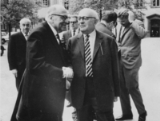
Theodor W. Adorno

Encyclopedia
Theodor W. Adorno was a German sociologist
, philosopher, and musicologist
known for his critical theory
of society.
He was a leading member of the Frankfurt School
of critical theory, whose work has come to be associated with thinkers, such as Ernst Bloch
, Walter Benjamin
, Max Horkheimer
and Herbert Marcuse
, for whom the work of Sigmund Freud
, Karl Marx
and G.W.F. Hegel were essential to a critique of modern society. He is widely regarded as one of the 20th century's foremost thinkers on aesthetics and philosophy, as well as one of its preeminent essayists. As a critic of both fascism and what he called the Culture Industry
, his writings—such as Dialectic of Enlightenment
, Minima Moralia
and Negative Dialectics
—strongly influenced the European New Left.
Amidst the vogue enjoyed by Existentialism
and positivism
in early 20th century Europe, Adorno advanced a dialectical conception of natural-history which critiqued the twin temptations of ontology and empiricism though studies of Kierkegaard and Husserl. As a classically trained pianist whose sympathies with the twelve tone technique of Arnold Schoenberg
resulted in his studying with Alban Berg
of the Second Viennese School
, Adorno's commitment to avant-garde music formed the backdrop of his subsequent writings and led to his collaboration with Thomas Mann
on the latter's novel, Doctor Faustus, while the two men lived in California as exiles during the Second World War. Working for the newly relocated Institute for Social Research
, Adorno collaborated on influential studies of authoritarianism
, anti-semitism
and propaganda
which would later serve as models for sociological studies the Institute carried out in post-war Germany. Upon his return to Frankfurt, Adorno was influential to the reconstitution of German intellectual life through debates with Karl Popper
on the limitations of positivist science, critiques of Heidegger's jargon of authenticity, writings on German responsibility for the Holocaust, and continued interventions into matters of public policy. As a writer of polemics in the tradition of Nietzsche and Karl Kraus
, Adorno delivered scathing critiques of contemporary Western culture at the same time as he mobilized the resources of that culture to create a form of critique which would salvage what Enlightenment
thought had long repressed in order to secure its own destructive self-preservation. Adorno's posthumously published Aesthetic Theory
, which he planned on dedicating to Samuel Beckett
, is the culmination of a life-long commitment to modern art which attempts to revoke the "fatal separation" of feeling and understanding long demanded by the history of philosophy and explode the privilege aesthetics accords to content over form and contemplation over immersion.
, was once a professional singer, while his father, an assimilated Jew who had converted to Protestantism, ran a successful wine-export business. Proud of her origins, Maria wanted her son's paternal surname to be supplemented by the addition of her own name: Adorno. Thus his earliest publications carried the name Theodor Wiesengrund-Adorno; upon his application for US citizenship, his name was modified to Theodor W. Adorno. His childhood was marked by the musical life provided by his mother and aunt: Maria was a singer who could boast of having performed in Vienna at the Imperial Court, while her sister, Agathe, who lived with them, had made a name for herself as both a singer and pianist. He was not only a precocious child but, as he recalled later in life, a child prodigy who could play pieces by Beethoven on the piano by the time he was twelve.
At the age of six, he attended the Deutschherren middle school before transferring to the Kaiser-Wilhelm Gymnasium, where he studied from 1913 to 1921. Prior to his graduation at the top of his class, Adorno was already swept up by the revolutionary mood of the time, as is evidenced by his reading of Georg Lukacs
's The Theory of the Novel that year, as well as by his fascination with Ernst Bloch
's The Spirit of Utopia, of which he would later write:
Yet Adorno's intellectual nonconformism was no less shaped by the repugnance he felt towards the nationalism which swept through the Reich during the First World War. Along with future collaborators like Walter Benjamin
, Max Horkheimer
, Ernst Bloch
, Adorno was profoundly disillusioned by the ease with which Germany's intellectual and spiritual leaders—among them Max Weber
, Max Scheler
, Ernst Simmel, as well as his friend Siegfried Kracauer
—came out in support of the war. The younger generation's distrust for traditional knowledge arose from the way in which this tradition had discredited itself. Over time, Oscar Wiesebgrund's firm established close professional and personal ties with the factory of Karplus & Herzberger in Berlin. The eldest daughter of the Karplus family, Margarete, or Gretel, moved in the intellectual circles of Berlin, where she was acquainted with Walter Benjamin
, Bertolt Brecht
and Ernst Bloch
, each of whom Adorno would become familair with during the mid-20s; after fourteen years, Gretel and Theodor were married in 1937. At the end of his schooldays, Adorno not only benefited from the rich concert offerings of Frankfurt - in which one could hear performances of works by Schoenberg
, Schreker, Stravinsky, Bartók, Busoni, Frederick Delius
and Hindemith - but also began studying music composition at the Hoch Conservatory
while taking private lessons with well-respected composers Bernhard Sekles
and Eduard Jung. At around the same time, he befriended Siegfried Kracauer
, the Frankfurter Zeitung
’s literary editor, of whom he would later write:
Leaving gymnasium to study philosophy, psychology and sociology at Johann Wolfgang Goethe University in Frankfurt, Adorno continued his readings with Kracauer, turning now to Hegel and Kierkegaard, and began publishing concert reviews and pieces of music for distinguished journals like the Zeitschrift für Musik, the Neue Blätter für Kunst und Literatur and later for the Musikblätter des Anbruch. In these articles, Adorno championed avant-garde music at the same time as he critiqued the failings of musical modernity, as in the case of Stravinsky’s The Soldier’s Tale
, which he called in 1923 a “dismal Bohemian prank.” In these early writings, he was unequivocal in his condemnation of performances which either sought or pretended to achieve a transcendence which Adorno, in line with many intellectuals of the time, regarded as impossible: “No cathedral,” he wrote, “can be built if no community desires one.” In the summer of 1924, Adorno received his doctorate with a study of Edmund Husserl
under the direction of the unorthodox neo-Kantian Hans Cornelius
. Before his graduation, Adorno had already met with his most important intellectual collaborators, Max Horkheimer
and Walter Benjamin
. Through Cornelius's seminars, Adorno met his future collaborator Max Horkheimer
, through whom he was then introduced to Friedrich Pollock
.
's Three Fragments from Wozzeck
, op. 7 premiered in Frankfurt, at which time Adorno introduced himself to Berg and both agreed the young philosopher and composer would study with Berg in Vienna. Upon moving to Vienna in January 1925, Adorno immersed himself in the musical culture which had grown up around Schoenberg
: in addition to his twice-weekly sessions with Berg, Adorno continued his studies on piano with Eduard Steuermann
and befriended the violinist Rudolf Kolisch
. In Vienna, he attended public lectures of the satirist Karl Kraus
with Berg and met Lukács
, who had been living in Vienna after the failure of the Hungarian Soviet Republic
. Alban Berg, the man Adorno referred to as "my master and teacher," was among the most prescient of his young pupil's early friends:
After leaving Vienna, Adorno traveled through Italy, where he met with Kracauer, Benjamin, and the economist Alfred Sohn-Rethel
, with whom he developed a lasting friendship, before returning to Frankfurt. In December 1926 Adorno's "Two Pieces for String Quartet," op.2 were performed in Vienna, which provided a welcome interruption from his preparations for the Habilitation
. After writing the "Piano Pieces in strict twelve-tone technique," as well as songs later integrated into the Six Bagatelles for Voice and Piano, op. 6, Adorno presented his Habilitation
manuscript, The Concept of the Unconscious in the Transcendental Theory of the Psyche, to Cornelius
in November 1927. Cornelius
advised Adorno to withdraw his application on the grounds that the manuscript was too close to his own way thinking. In this manuscript, Adorno attempted to underline the epistemological status of the unconscious
as it emerged out of Freud's early writings. Against the function of the unconscious in both Nietzsche and Spengler, Adorno argued that Freud's notion of the unconscious serves as a "sharp weapon ... against every attempt to create a metaphysics of the instincts and to deify full, organic nature." Undaunted by his academic prospects, Adorno threw himself once again into composition. In addition to publishing numerous reviews of opera performances and concerts, Adorno's "Four Songs for Medium Voice and Piano", op.3 was performed in Berlin in January 1929. Between 1928 and 1930 Adorno took on a greater role within the editorial committee of the Musikblätter des Anbruch. In a proposal for transforming the journal, Adorno sought to use Anbruch for championing radical modern music against what he called the "stabilized music" of Pfitzner
, the later Strauss, as well as the neoclassicism
of Stravinsky and Hindemith. During this period he published the essays "Night Music", "On Twelve-Tone Technique" and "Reaction and Progress". Yet his reservations about twelve-tone orthodoxy became steadily more pronounced: According to Adorno, twelve-tone technique
's use of atonality
can no more be regarded as an authoritative canon than can tonality
be relied on to provide instructions for the composer.
At this time, Adorno struck up a correspondence with the composer Ernst Krenek
, with whom he discussed problems of atonality and twelve-tone technique. In a letter of 1934 Adorno sounded a related criticism of Schoenberg
:
At this point Adorno reversed his earlier priorities: now his musical activities came second to the development of a philosophical theory of aesthetics. Thus, in the middle of 1929 he accepted Paul Tillich
's offer to present an Habilitation on Kierkegaard, which Adorno eventually submitted under the title The Construction of the Aesthetic. At the time, Kierkegaard's philosophy exerted a strong influence, chiefly through its claim to pose an alternative to Idealism
and Hegel's philosophy of history. Yet when Adorno turned his attention to Kierkegaard, watchwords like "anxiety," "inwardness" and "leap"—instructive for existentialist philosophy
—were detached from their theological origins and posed, instead, as problems for aesthetics. As the work proceeded—and Kierkegaard's overcoming of Hegel's idealism is revealed to be a mere interiorization—Adorno excitedly remarks in a letter to Berg
that he is writing without looking over his shoulder at the faculty who would soon evaluate his work. Receiving favorable reports from Professors Tillich
and Horkheimer
, as well as Benjamin
and Kracauer, the University conferred on Adorno the venia legendi in February 1931; on the very day his revised study was published, in March of 1933, Hitler seized dictatorial powers.
Several months after qualifying as a lecturer in philosophy, Adorno delivered an inaugural lecture at the Institute for Social Research
, an independent organization which had recently appointed Horkheimer as its director and, with the arrival of the literary scholar Leo Lowenthal
, social psychologist Erich Fromm
and philosopher Herbert Marcuse
, sought to exploit recent theoretical and methodological advances in the social sciences. His lecture, "The Actuality of Philosophy," created a scandal. In it, Adorno not only deviated from the theoretical program Horkheimer
had laid out a year earlier, but challenged philosophy's very capacity for comprehending reality as such: "For the mind," Adorno announced, "is indeed not capable of producing or grasping the totality of the real, but it may be possible to penetrate the detail, to explode in miniature the mass of merely existing reality." In line with Benjamin
's The Origin of German Tragic Drama
and preliminary sketches of the Arcades Project
, Adorno likened philosophical interpretation to experiments which should be conducted "until they arrive at figurations in which the answers are legible, while the questions themselves vanish." Having lost its position as the Queen of the Sciences, philosophy must now radically transform its approach to objects so that it might "construct keys before which reality springs open."
Following Horkheimer
's taking up the directorship of the Institute, a new journal, Zeitschrift für Sozialforschung, was produced to publish the research of Institute members both before and after its relocation to the United States. Though Adorno was not himself an Institute member, the journal nevertheless published many of his essays, including "The Social Situation of Music" (1932), "On Jazz" (1936), "On the Fetish-Character in Music and the Regression of Listening" (1938) and "Fragments on Wagner" (1938). In his new role as social theorist, Adorno's philosophical analysis of cultural phenomena heavily relied on the language of historical materialism
, as concepts like reification
, false consciousness and ideology
came to play an ever more prominent role in his work. At the same time, however, and owing to both the presence of another prominent sociologist at the Institute, Karl Mannheim
, as well as the methodological problem posed by treating objects - like "musical material" - as ciphers of social contradictions, Adorno was compelled to abandon any notion of "value-free" sociology in favor of a form of ideology critique which held onto an idea of truth. Before his emigration in autumn 1934, Adorno began work on a Singspiel based on Mark Twain
's The Adventures of Tom Sawyer
entitled The Treasure of Indian Joe, which he would, however, never complete; by the time he fled Hitler's Germany Adorno had already written over a hundred opera or concert reviews and an additional fifty critiques of music composition. As the Nazi party became the largest party in the Reichstag
Horkheimer
's 1932 observation proved chillingly prophetic: "Only one thing is certain," he wrote, "the irrationality of society has reached a point where only the gloomiest predications have any plausibility." In September Adorno's right to teach was revoked; in March, as the swastika
was run up the flag pole of town hall, the Institute's offices were searched by the Frankfurt criminal police. Adorno's house on Seeheimer Strasse was similarly searched in July and his application for membership in the Reich Chamber of Literature was denied on the grounds that membership was limited to "persons who belong to the German nation by profound ties of character and blood. As a non-Aryan
," he was informed, "you are unable to feel and appreciate such an obligation." Soon afterwards Adorno was forced into fifteen years of exile.
to the University of Vienna
came to nothing, Adorno considered relocating to Britain upon his father's suggestion. With the help of the Academic Assistance Council, Adorno registered as an advanced student at Merton College, Oxford, in June 1934. During the next four years at Oxford, Adorno made repeated trips to Germany to see both his parents and Gretel, who was still working in Berlin. Under the direction of Gilbert Ryle
, Adorno worked on a dialectical critique of Husserl's epistemology. By this time, the Institute for Social Research
had relocated to New York City and began making overtures to Adorno. After months of strained relations, Horkheimer
and Adorno reestablished their essential theoretical alliance during meetings in Paris. Adorno continued writing on music, publishing "The Form of the Phonograph Record" and "Crisis of Music Criticism" with the Viennese musical journal 23, "On Jazz" in the Institute's Zeitschrift, "Farewell to Jazz" in Europäischen Revue. Yet Adorno's attempts to break out of the sociology of music were, at this time, twice thwarted: neither the study of Mannheim he had been working on for years nor extracts from his study of Husserl were accepted by the Zeitschrift. Impressed by Horkheimer's book of aphorisms, Dawn and Decline, Adorno began working on his own book of aphorisms, what would later become Minima Moralia. While at Oxford, Adorno suffered two great losses: his Aunt Agathe died in June 1935, while Alban Berg died in December of the same year. To the end of his life, Adorno never abandoned the hope of completing Berg
's unfinished Lulu
.
At this time, Adorno was in intense correspondence with Walter Benjamin
on the subject of the latter’s Arcades Project
. After receiving an invitation from Horkheimer to visit the Institute in New York, Adorno sailed for New York on June 9, 1937 and stayed there for two weeks. While in New York, Max Horkheimer’s essays “The Latest Attack on Metaphysics” and “Traditional and Critical Theory,” which would soon become instructive for the Institute’s self-understanding, were the subject of intense discussion. Soon after his return to Europe, Gretel moved to Britain, where she and Adorno were married on September 8, 1937; a little over a month later, Horkheimer telegrammed from New York with news of a position Adorno could take up with the Princeton Radio Project
, then under the directorship of the the Austrian sociologist Paul Lazarsfeld
. Yet Adorno’s work continued with studies of Beethoven and Richard Wagner
(published in 1939 as "Fragments on Wagner"), drafts of which he read to Benjamin during their final meeting, in December on the Italian Riviera. According to Benjamin, these drafts were astonishing for “the precision of their materialist deciphering,” as well as the way in which “musical facts … had been made socially transparent in a way that was completely new to me.” In his Wagner study, the thesis later to characterize Dialectic of Enlightenment
—man's domination of nature—first emerges. Adorno sailed for New York on February 16, 1938. Soon after settling into his new home on Riverside Drive, Adorno met with Lazarsfeld in Newark
to discuss the Project’s plans for investigating the impact of broadcast music.
Although he was expected to embed the Project’s research within a wider theoretical context, it soon became apparent that the Project was primarily concerned with data collection
to be used by administrators for establishing whether groups of listeners could be targeted by broadcasts specifically aimed at them. Expected to make use of devices with which listeners could press a button to indicate whether they liked or disliked a particular piece of music, Adorno bristled with distaste and astonishment: “I reflected that culture was simply the condition that precluded a mentality that tried to measure it.” Thus Adorno suggested using individual interviews to determine listener reactions and, only three months after meeting Lasarzfeld, completed a 160-page memorandum on the Project’s topic, “Music in Radio.” Adorno was primarily interested in how the musical material was affected by its distribution through the medium of radio and thought it imperative to understand how music was affected by its becoming part of daily life. “The meaning of a Beethoven symphony,” he wrote, “heard while the listener is walking around or lying in bed is very likely to differ from its effect in a concert-hall where people sit as if they were in church.” In essays published by the Institute’s Zeitschrift, Adorno dealt with that atrophy of musical culture which had become instrumental in accelerating tendencies - towards conformism
, trivialization and standardization - already present in the larger culture. Unsurprisingly, Adorno’s studies found little resonance among members of the project. At the end of 1939, when Lazarsfeld submitted a second application for funding, the musical section of the study was duly left out. Yet during the two years during which he worked on the Project, Adorno was nevertheless prolific, publishing “The Radio Sympthony,” “A Social Critique of Radio Music” and “On Popular Music,” texts which, along with the draft memorandum and other unpublished writings, which are now found in Robert Hullot-Kentor’s recent translation, Current of Music. In light of this situation, Horkheimer soon found a permanent post for Adorno at the Insitute.
In addition to helping with the Zeitschrift Adorno was expected to be the Institute's liason with Benjamin, who soon passed on to New York the study of Charles Baudelaire
he hoped would serve as a model of the larger Arcades Project. In correspondence, the two men discussed the difference in their conceptions of the relationship between critique and artworks which had become manifest through Benjamin's "The Work of Art in the Age of its Technical Reproducibility
." At around the same time Adorno and Horkheimer began planning for a joint work on "dialectical logic," which would later become Dialectic of Enlightenment. Alarmed by reports from Europe, where Adorno’s parents suffered increasing discrimination and Benjamin was interned in Colombes
, their joint study could entertain few delusions about its practical effects. “In view of what is now threatening to engulf Europe,” Horkheimer wrote, “our present work is essentially destined to pass things down through the night that is approaching: a kind of message in a bottle” As Adorno continued his work in New York with radio talks on music and a lecture on Soren Kierkegaard's doctrine of love, Benjamin fled Paris and attempted to make an illegal border crossing. After learning that his Spanish visa was invalid and fearing deportation back to France, Benjamin took on overdose of morphine tablets. In light of recent events, the Institute set about formulating a theory of anti-Semitism and fascism. On one side were those who supported Franz Neumann
's thesis according to which National Socialism was a form of "monopoly capital"; on the other were those who supported Fritz Pollock's "state capitalist theory." Horkheimer
’s contributions to this debate, in the form of the essays "The Authoritarian State," "The End of Reason" and "The Jews and Europe" served as a foundation for what he and Adorno planned to do in their book on dialectical logic.
In November 1941 Adorno followed Horkheimer
to what Thomas Mann
called "German California," setting up house in a Pacific Palisades neighborhood of German emigres which included Bertolt Brecht
and Arnold Schoenberg. Adorno arrived with a draft of his Philosophy of New Music, a dialectical critique of twelve-tone music, which Adorno himself felt, while writing, was already a departure from the theory of art he had spent the previous decades elaborating. Horkheimer's reaction to the manuscript was wholly positive: "If I have ever in the whole of my life felt enthusiasm about anything, then I did on this occassion," he wrote after reading the manuscript. The two set about completing their joint work, which transformed itself from a book on dialectical logic to a rewriting of the history of rationality and the Enlightenment. First published in a small mimeographed edition in May 1944 as Philosophical Fragments, the text would wait another three years before achieving book form when it was published with its definitive title, Dialectic of Enlightenment, by the Amsterdam publisher Querido Verlag. This "reflection on the destructive aspect of progress" proceeded through chapter which treated rationality as both the liberation from and further domination of nature, interpretations of both Homer
’s Odyssey
and the Marquis de Sade
, as well as analyses of the culture industry and anti-semitism.
Their joint work completed, the two turned their attention to studies on anti-semitism and authoritarianism in collaboration with the Nevitt Sanford
-led Public Opinion Study Group and the American Jewish Committee
. In line with these studies, Adorno produced an analysis of the Californian radio preacher Martin Luther Thomas. Fascist propaganda of this sort, Adorno wrote, "simply takes people for what they are: genuine children of today’s standardized mass culture who have been robbed to a great extent of their autonomy and spontaneity" The result of these labors, the 1950 study The Authoritarian Personality
was pioneering in its combination of quantitative and qualitative methods of collecting and evaluating data as well as its development of the F-scale. After the USA entered the war in 1941, the situation of the emigrés, now classed "enemy aliens" became increasingly precarious as government measures turned from anti-Nazism to anti-communism
. Forbidden from leaving their homes between 8pm and 6am and prohibited from going more than five miles from their houses, emigrés like Adorno, who would not be naturalized until November of 1943, were severely restricted in their movements. In addition to the aphorisms which conclude Dialectic of Enlightenment, Adorno put together a collection of aphorisms in honor of Horkheimer’s fifteith birthday that would later be published as Minima Moralia: Reflections from Damaged Life. These fragmentary writings, inspired by a renewed reading of Nietzsche
, treated issues like emigration
, totalitarianism
and individuality, as well as everyday matters such as giving presents, dwelling and the impossibility of love. In California, Adorno made the acquaintance of Charlie Chaplin
and became friends with Fritz Lang
and Hanns Eisler
, with whom he completed a study of film music in 1944. In this study, the authors pushed for the greater usage of avant-garde music in film, urging that music be used to supplement, not simply accompany, the visual aspect of films. Additionally, Adorno assisted Thomas Mann
on his novel Doctor Faustus
after the latter asked for his help. “Would you be willing," Mann wrote, "to think through with me how the work - I mean Leverkuhn’s work - might look; how you would do it if you were in league with the Devil?” At the end of October 1949, Adorno left America for Europe just as The Authoritarian Personality
was being published. Before his return, Adorno had not only reached an agreement with a Tübingen publisher to print an expanded version of Philosophy of New Music, but completed two compositions: Four Songs for Voice and Piano by Stefan George, op.7, and Three Choruses for Female Voices from the Poems of Theodor Daubler, op. 8.
. Until his death in 1969, twenty years after his return, Adorno contributed to the intellectual foundations of the Federal Republic, as a professor at Frankfurt University, critic of the vogue enjoyed by Heideggerian philosophy, partisan of critical sociology and teacher of music at the Darmstadt International Summer Courses for New Music. Adorno resumed his teaching duties at the university soon after his arrival, with seminars on "Kant’s Transcendental Dialectic," aesthetics, Hegel, “Contemporary Problems in the Theory of Knowledge” and “The Concept of Knowledge.” Adorno’s surprise at his students' passionate interest in intellectual matters did not, however, blind him to continuing problems within Germany: The literary climate was dominated by writers who had remained in Germany during Hitler's rule, the government re-employed people who had been active in the Nazi apparatus and people were generally loathe to own up to their own collaboration or the guilt they thus incurred. Instead, the ruined city of Frankfurt continued as if nothing had happened, holding onto ideas of the true, the beautiful, and the good despite the atrocities, hanging onto a culture that had itself been lost in rubble or killed off in the concentration camps. All the enthusiasm Adorno's students showed for intellectual matters could not erase the suspicion that, in the words of Max Frisch
, culture had become an "alibi" for the absence of political consciousness. Yet the foundations for what would come to be known as "The Frankfurt School" were soon laid: Horkheimer resumed his chair in social philosophy and the Institute for Social Research, rebuilt, became a lightning rod for critical thought.
Nevertheless, in September of 1951 Adorno returned to the United States for a six-week visit, during which he attended the opening of the Hacker Psychiatry Foundation in Beverly Hills, met Leo Lowenthal
and Herbert Marcuse in New York and saw his mother for the last time. After stopping in Paris, where he met Daniel-Henry Kahnweiler, Michel Leiris
and Rene Leibowitz
, Adorno delivered a lecture entitled "The Present State of Empirical Social Research in Germany" at a conference on opinion research. Here he emphasized the importance of data collection and statistical evaluation while asserting that such empirical methods have only an auxiliary function and must lead to the formation of theories which would “raise the harsh facts to the level of consciousness.” With Horkheimer as dean of the Arts Faculty, then rector of the university, responsibilities for the Institute's work fell upon Adorno. At the same time, however, Adorno renewed his musical work: with talks at the Kranichsteiner Musikgeselschaft, another in connection with a production of Ernst Krenek
’s opera Leben des Orest
, and a seminar on “Criteria of New Music” at the Fifth International Summer Course for New Music at Kranichstein. Adorno also became increasingly involved with the publishing house of Peter Suhrkamp
, inducing the latter to publish Benjamin’s Berlin Childhood Around 1900, Kracauer’s writings and a two-volume edition of Benjamin’s Writings. Adorno’s own recently published Minima Moralia was not only well-received in the press, but met with great admiration from Thomas Mann, who wrote to Adorno from America in 1952:
Yet Adorno was no less moved by other public events: protesting the publication of Heinrich Mann
's novel Professor Unrat
with its film title, The Blue Angel; declaring his sympathy with those who protested the scandal of big-game hunting and penning a defense of prostitutes. Because Adorno’s American citizenship would be forfeited by the middle of 1952 if he remained outside the country, he returned once again to Santa Monica
to survey his prospects at the Hacker Foundation. While there he wrote a content analysis of newspaper horoscopes (now collected in The Stars Down to Earth), the essays “Television as Ideology” and “Prologue to Television;” even so, he was pleased when, at the end of ten months, he was enjoined to return as co-director of the Institute. Back in Frankfurt, he renewed his academic duties and, from 1952 to 1954, completed the essays “Notes on Kafka,” “Valéry Proust Museum” and an essay on Schoenberg following the composer's death, all of which were included in the 1955 essay collection Prisms. In response to the publication of Thomas Mann
's The Black Swan, Adorno penned a long letter to the author, who then approved its publication in the literary journal Akzente. A second collection of essays, Notes to Literature, appeared in 1958. After meeting Samuel Beckett while delivering a series of lectures in Paris the same year, Adorno set to work on "Trying to Understand Endgame," which, along with studies of Proust, Valéry
and Balzac, formed the central texts of the 1961 publication of the second volume of his Notes to Literature. Adorno’s entrance into literary discussions continued in his June 1963 lecture at the annual conference of the Hölderlin Society. At the Philsophers’ Conference of October 1962 in Münster, at which Habermas wrote that Adorno was "A writer among bureaucrats," Adorno presented "Progress." Although the Zeitschrift was never revived, the Institute nevertheless published a series of important sociological books, including a collection of essays entitled Sociologica (1955), the Gruppenexperiment (1955), a study of work satisafaction among workers in Mannesmann called Betriebsklima and the Soziologische Exkurse, a textbook-like anthology intended as an introduction.
Throughout the fifties and sixties, Adorno became a public figure, not simply through his books and essays, but also through his appearances in radio and newspapers. In talks, interviews and round-table discussions broadcast on Hessen Radio, South-West Radio and Radio Bremen, Adorno discussed topics as diverse as “The Administered World” (September 1950), “What is the Meaning of ‘Working Through the Past?”’ (February 1960) to “The Teaching Profession and its Taboos” (August 1965). Additionally, he frequently wrote for Frankfurter Allgemeine, Frankfurter Rundschau and the weekly Die Zeit. At the invitation of Wolfgang Steinecke Adorno took part in the Darmstadt Summer Courses for New Music in Kranichstein from 1951 to 1958. Yet conflicts between the so-called Darmstadt school, which included composers like Pierre Boulez
, Karlheinz Stockhausen
, Karel Goeyvaerts
, Luciano Berio
and Gottfried Michael Koenig
, soon arose, receiving explicit expression in Adorno's 1954 lecture, "The Aging of the New Music," where he argued that atonality's freedom was being restricted to serialism in much the same way as it was once restricted by twelve-tone technique. With his friend Eduard Steuermann
, Adorno feared that music was being sacrificed to stubborn rationalization. During this time Adorno not only produced a significant series of notes on Beethoven (which was never completed and only published posthumously), but also published Mahler: A Musical Physiognomy in 1960. In his 1961 return to Kranichstein, Adorno called for what he termed a "musique informelle," which would possess the ability "really and truly to be what it is, without the ideological pretence of being something else. Or rather, to admit frankly the fact of non-identity and to follow through its logic to the end."
At the same time Adorno struck up relationships with contemporary German-language poets like Paul Celan
and Ingeborg Bachmann
. Adorno’s 1949 dictum—"To write poetry after Auschwitz is barbaric"—posed the question of what German culture could mean after Auschwitz; his own continual revision of this dictum—in Negative Dialectics, for example, he wrote that "Perennial suffering has as much right to expression as a tortured man has to scream"; while in 1962’s “Commitment,” he wrote that the dictum "expresses in negative form the impulse which inspires committed literature"—was part of post-war Germany’s struggle with history and culture. Adorno additionally befriended the writer and poet Hans Magnus Enzensberger
as well as the film-maker Alexander Kluge
. In 1963, Adorno was elected to the post of chairman of the German Sociological Society, where he presided over two important conferences: in 1964, on "Max Weber and Sociology" and in 1968 on "Late Capitalism or Industrial Society." A debate launched in 1961 by Adorno and Karl Popper, later published as the Positivist Dispute in German Sociology, arose out of disagreements at the 1959 14th German Sociology Conference in Berlin. Adorno's critique of the dominant climate of post-war Germany was also directed against the pathos that had grown up around Heideggerianism, as practiced by writers like Karl Jaspers
and Otto Friedrich Bollow, and which had since seeped into public discourse. His 1964 publication of The Jargon of Authenticity took aim at the halo such writers had attached to words like "angst," "decision" and "leap." After seven years of work, Adorno completed Negative Dialectics
in 1966, after which, during the summer semester of 1967 and the winter semester of 1967-8, he offered regular philosophy seminars to discuss the book chapter by chapter. Among the students at these seminars were the Americans Angela Davis
and Irving Wohlfarth. One objection which would soon take on ever greater importance, was that critical thought must adopt the standpoint of the oppressed, to which Adorno replied that negative dialectics was concerned "with the dissolution of standpoint thinking itself."
At the time of Negative Dialectics publication, the fragility of West German democracy led to the increasing radicalization of students. Monopolistic trends in the media, an educational crisis in the universities, the Shah of Persia's 1967 state visit, German support for the war in Vietnam and the emergency laws combined to create a highly unstable situation. Like many of his students, Adorno too opposed the emergency laws, as well as the war in Vietnam, which, he said, proved the continued existence of the "world of torture that had begun in Auschwitz” The situation only deteriorated with the police shooting of Benno Ohnesorg
at a protest against the Shah's visit. This death, as well as the subsequent acquittal of the responsible officer, were both commented upon in Adorno's lectures. As politicization increased, rifts developed within both the Institute's relationship with its students as well as within the Institute itself. Soon Adorno himself would become an object of the students' ire. At the invitation of Peter Szondi
, Adorno was invited to the Free University of Berlin
to give a leture on Goethe's Iphigenie in Tauris. After a group of students marched to the lectern, unfurling a banner that read "Berlin’s left-wing fascists greet Teddy the Classicist," a number of those present left the lecture in protest after Adorno refused to abandon his talk in favor of discussing his attitude on the current political situation. Adorno shortly therafter participated in a friendly and productive meeting with the Berlin Sozialistischer Deutscher Studentenbund (SDS) and discussed "Student Unrest" with Szondi on West German Radio. But as 1968 progressed, Adorno became increasingly critical of the students' disruptions to university life. His isolation was only compounded by articles published in the magazine alternative, which, following the lead of Hannah Arendt
’s articles in Merkur, claimed Adorno had subjected Benjamin to pressure during his years of exile in Berlin and compiled Benjamin’s Writings and Letters with a great deal of bias. In response, Benjamin’s longtime friend Gershom Scholem
, wrote to the editor of Merkur to express his disapproval of the "in part, shameful, not to say disgraceful" remarks by Arendt.
Relations between students and the West German state continued deteriorating. In spring 1968, a prominent SDS spokesman, Rudi Dutschke
, was gunned down in the streets; in response, massive demonstrations took place, directed in particular against the Springer Press, which had led a campaign to vilify the students. An open appeal published in Die Zeit, signed by Adorno, called for an inquiry into the social reasons that gave rise to this assassination attempt as well as an investigation into the Springer Press' manipulation of public opinion. At the same time, however, Adorno protested against disruptions of his own lectures and refused to express his solidarity with their political goals, maintaining instead his autonomy as a theoretician. Adorno rejected the so-called unity of theory and praxis advocated by the students and argued that the students' actions were premised upon a mistaken analysis of the situation. The building of barricades, he wrote to Marcuse, is "ridiculous against those who administer the bomb." In September 1968 Adorno went to Vienna for the publication of Alban Berg: Master of the Smallest Link. Upon his return to Frankfurt, events prevented his concentrating upon the book on aesthetics he wished to write: "Valid student claims and dubious actions," he wrote to Marcuse, "are all so mixed up together that all productive work and even sensible thought are scarcely possibly any more." After striking students threatened to strip the Institute's sociology seminar rooms of their furnishings and equipment, the police were brought in to close the building. Adorno began writing an introduction to a collection of poetry by Rudolf Borchardt, which was connected with a talk entitled "Charmed Language," delivered in Zurich, followed by a talk on aesthetics in Paris where he met Beckett again. Beginning in October 1966, Adorno took up work on Aesthetic Theory. In June 1969 he completed Catchwords: Critical Models. During the winter semester of 1968-9 Adorno was on sabbatical leave from the university and thus able to dedicate himself to the completion of his book of aesthetics. For the summer semester Adorno planned a lecture course entitled "An Introduction to Dialectical Thinking," as well as a seminar on the dialectics of subject and object. But at the first lecture Adorno's attempt to open up the lecture and invite questions whenever they arose degenerated into a disruption from which he quickly fled: after a student wrote on the blackboard "If Adorno is left in peace, capitalism will never cease," three women students approached the lectern, bared their breasts and scattered flower petals over his head. Yet Adorno continued to resist blanket condemnations of the protest movement which would have only strengthened the reactionary thesis according to which political irrationalism was the result of Adorno's teaching. After further disruptions to his lectures, Adorno canceled the lectures for the rest of the seminar, continuing only with his philosophy seminar. In the summer of 1969, weary from these activities, Adorno returned once again to Zermatt, Switzerland, at the foot of Matterhorn to restore his strength. On August 6 he died of a heart attack.
's reduction of painting to its most elementary component - the line - is comprehensible outside this concern with primitivism
Adorno shared with the century's most radical art. At the same time, the Western world, beset by world-wars, colonialist consolidation and accelerating commodification, sank into the very barbarism civilization had prided itself in overcoming. According to Adorno, society's self-preservation had become indistinguishable from societally sanctioned self-sacrifice: of "primitive" peoples, primitive aspects of the ego and those primitive, mimetic desires found in imitation and sympathy. Adorno's theory proceeds from an understanding of this primitive quality of reality which seeks to counteract whatever aims to either repress this primitive aspect or further those systems of domination set in place by this return to barbarism. From this perspective, Adorno's writings on politics, philosophy, music and literature could be described as a life-long critique of the ways in which each tries to justify self-mutilation as the necessary price of self-preservation. According to Adorno's translator Robert Hullot-Kentor, the central motive of Adorno's work thus consists in determining "how life could be more than the struggle for self-preservation." In this sense, the principle of self-preservation, Adorno writes in Negative Dialectics, is nothing but "the law of doom thus far obeyed by history." At its most basic, Adorno's thought is motivated by a fundamental critique of this law.
Adorno was chiefly influenced by Max Weber
's critique of disenchantment
, Georg Lukács
's Hegelian interpretation of Marxism, as well as Walter Benjamin
's philosophy of history. Adorno, along with the other major Frankfurt School theorists Max Horkheimer
and Herbert Marcuse
, argued that advanced capitalism had managed to contain or liquidate the forces that would bring about its collapse and that the revolutionary moment, when it would have been possible to transform it into socialism, had passed. As he put it at the beginning of his Negative Dialectics
(1966), philosophy is still necessary because the time to realise it was missed. Adorno argued that capitalism had become more entrenched through its attack on the objective basis of revolutionary consciousness and through liquidation of the individualism that had been the basis of critical consciousness.
Adorno saw the culture industry as an arena in which critical tendencies or potentialities were eliminated. He argued that the culture industry, which produced and circulated cultural commodities through the mass media, manipulated the population. Popular culture was identified as a reason why people become passive; the easy pleasures available through consumption of popular culture made people docile and content, no matter how terrible their economic circumstances. The differences among cultural goods make them appear different, but they are in fact just variations on the same theme. He wrote that "the same thing is offered to everybody by the standardised production of consumption goods" but this is concealed under "the manipulation of taste and the official culture's pretense of individualism". Adorno conceptualised this phenomenon as pseudo-individualization and the always-the-same.
Adorno's analysis allowed for a critique of mass culture from the left which balanced the critique of popular culture from the right. From both perspectives – left and right – the nature of cultural production was felt to be at the root of social and moral problems resulting from the consumption of culture. However, while the critique from the right emphasized moral degeneracy ascribed to sexual and racial influences within popular culture, Adorno located the problem not with the content, but with the objective realities of the production of mass culture and its effects, e.g. as a form of reverse psychology
. Thinkers influenced by Adorno believe that today's society has evolved in a direction foreseen by him, especially in regard to the past (Auschwitz), morals or the Culture Industry. The latter has become a particularly productive, yet highly contested term in cultural studies
. Many of Adorno's reflections on aesthetics and music have only just begun to be debated, as a collection of essays on the subject, many of which had not previously been translated into English, has only recently been collected and published as Essays on Music.
Adorno's work in the years before his death was shaped by the idea of "negative dialectics", set out especially in his book of that title. A key notion in the work of the Frankfurt School since Dialectic of Enlightenment had been the idea of thought becoming an instrument of domination that subsumes all objects under the control of the (dominant) subject, especially through the notion of identity, i.e. of identifying as real in nature and society only that which harmonized or fit with dominant concepts, and regarding as unreal or non-existent everything that did not. Adorno's "negative dialectics" was an attempt to articulate a non-dominating thought that would recognize its limitations and accept the non-identity and reality of that which could not be subsumed under the subject's concepts. Indeed, Adorno sought to ground the critical bite of his sociological work in his critique of identity, which he took to be a reification in thought of the commodity form or exchange relation which always presumes a false identity between different things. The potential to criticise arises from the gap between the concept and the object, which can never go into the former without remainder. This gap, this non-identity in identity, was the secret to a critique of both material life and conceptual reflection.
, in particular, and the Frankfurt School in general, misconstrue Marx.
 Because Adorno believed that sociology needs to be self-reflective and self-critical, he believed that the language the sociologist uses, like the language of the ordinary person, is a political construct in large measure that uses, often unreflectingly, concepts installed by dominant classes and social structures (such as our notion of "deviance" which includes both genuinely deviant individual and "hustlers" operating below social norms because they lack the capital to operate above: for an analysis of this phenomenon, cf. Pierre Bourdieu
's book The Weight of the World). He felt that those at the top of the Institute needed to be the source primarily of theories for evaluation and empirical testing, as well as people who would process the "facts" discovered...including revising theories that were found to be false. For example, in essays published in Germany on Adorno's return from the USA, and reprinted in the Critical Models essays collection (ISBN 0-231-07635-5), Adorno praised the egalitarianism
and openness of US society based on his sojourn in New York and the Los Angeles area between 1935 and 1955.
One example of the clash of intellectual culture and Adorno's methods can be found in Paul Lazarsfeld
, the American sociologist for whom Adorno worked in the middle 1930s after fleeing Hitler. As Rolf Wiggershaus recounts in The Frankfurt School, Its History, Theories and Political Significance (MIT 1995), Lazarsfeld was the director of a project, funded and inspired by David Sarnoff (the head of RCA
), to discover both the sort of music that listeners of radio liked and ways to improve their "taste", so that RCA could profitably air more classical music. Lazarsfeld, however, had trouble both with the prose style of the work Adorno handed in and what Lazarsfeld thought was Adorno's "lack of discipline in ... presentation".
have published new translations of some of Adorno's lectures and books, including Introduction to Sociology, Problems of Moral Philosophy and his transcribed lectures on Kant's Critique of Pure Reason
and Aristotle's "Metaphysics", and a new translation of the Dialectic of Enlightenment
. Professor Henry Pickford, of the University of Colorado at Boulder, has translated many of Adorno's works such as The meaning of Working Through the Past. A new translation has also appeared of Aesthetic Theory
and the Philosophy of New Music by Robert Hullot-Kentor, from University of Minnesota Press
. Adorno's correspondence with Alban Berg, Towards a Theory of Musical Reproduction, and the letters to Adorno's parents, have been translated by Wieland Hoban and published by Polity Press. These fresh translations are less literal in their rendering of German sentences and words, and are more accessible to English readers. The Group Experiment, which had been unavailable to English readers, is now available in an accessible translation by Jeffrey K. Olick and Andrew J. Perrin on Harvard University Press, along with introductory material explaining its relation to the rest of Adorno's work and 20th century public opinion research.
. Edited by Rolf Tiedemann, with Gretel Adorno, Susan Buck-Morss and Klaus Schultz, the twenty volume edition of Adorno's writings were published from 1970 to 1986. Additionally, his Nachgelassene Schriften [NaS], edited by the Theodor W. Adorno Archive, includes his lecture courses, as well as incomplete works.
Sociology
Sociology is the study of society. It is a social science—a term with which it is sometimes synonymous—which uses various methods of empirical investigation and critical analysis to develop a body of knowledge about human social activity...
, philosopher, and musicologist
Musicology
Musicology is the scholarly study of music. The word is used in narrow, broad and intermediate senses. In the narrow sense, musicology is confined to the music history of Western culture...
known for his critical theory
Critical theory
Critical theory is an examination and critique of society and culture, drawing from knowledge across the social sciences and humanities. The term has two different meanings with different origins and histories: one originating in sociology and the other in literary criticism...
of society.
He was a leading member of the Frankfurt School
Frankfurt School
The Frankfurt School refers to a school of neo-Marxist interdisciplinary social theory, particularly associated with the Institute for Social Research at the University of Frankfurt am Main...
of critical theory, whose work has come to be associated with thinkers, such as Ernst Bloch
Ernst Bloch
Ernst Bloch was a German Marxist philosopher.Bloch was influenced by both Hegel and Marx and, as he always confessed, by novelist Karl May. He was also interested in music and art . He established friendships with Georg Lukács, Bertolt Brecht, Kurt Weill and Theodor W. Adorno...
, Walter Benjamin
Walter Benjamin
Walter Bendix Schönflies Benjamin was a German-Jewish intellectual, who functioned variously as a literary critic, philosopher, sociologist, translator, radio broadcaster and essayist...
, Max Horkheimer
Max Horkheimer
Max Horkheimer was a German-Jewish philosopher-sociologist, famous for his work in critical theory as a member of the 'Frankfurt School' of social research. His most important works include The Eclipse of Reason and, in collaboration with Theodor Adorno, The Dialectic of Enlightenment...
and Herbert Marcuse
Herbert Marcuse
Herbert Marcuse was a German Jewish philosopher, sociologist and political theorist, associated with the Frankfurt School of critical theory...
, for whom the work of Sigmund Freud
Sigmund Freud
Sigmund Freud , born Sigismund Schlomo Freud , was an Austrian neurologist who founded the discipline of psychoanalysis...
, Karl Marx
Karl Marx
Karl Heinrich Marx was a German philosopher, economist, sociologist, historian, journalist, and revolutionary socialist. His ideas played a significant role in the development of social science and the socialist political movement...
and G.W.F. Hegel were essential to a critique of modern society. He is widely regarded as one of the 20th century's foremost thinkers on aesthetics and philosophy, as well as one of its preeminent essayists. As a critic of both fascism and what he called the Culture Industry
Culture industry
Culture industry is a term coined by critical theorists Theodor Adorno and Max Horkheimer , who argued in the chapter of their book Dialectic of Enlightenment, 'The Culture Industry: Enlightenment as Mass Deception' ; that popular culture is akin to a factory producing standardized cultural goods...
, his writings—such as Dialectic of Enlightenment
Dialectic of Enlightenment
Dialectic of Enlightenment , is one of the core texts of Critical Theory explaining the socio-psychological status quo that had been responsible for what the Frankfurt School considered the failure of the Enlightenment...
, Minima Moralia
Minima Moralia
Minima Moralia: Reflections From Damaged Life is a 1951 seminal text in Critical Theory. Theodor W. Adorno started writing it during World War II, in 1944, while he lived as an exile in America, and completed it in 1949...
and Negative Dialectics
Negative Dialectics
Negative Dialectics is a 1966 book by Theodor W. Adorno and is considered to be his magnum opus. In the book, Adorno challenges the metaphysics of Kant, Hegel, and Heidegger, while simultaneously building his ideas towards emancipation from the capitalist order...
—strongly influenced the European New Left.
Amidst the vogue enjoyed by Existentialism
Existentialism
Existentialism is a term applied to a school of 19th- and 20th-century philosophers who, despite profound doctrinal differences, shared the belief that philosophical thinking begins with the human subject—not merely the thinking subject, but the acting, feeling, living human individual...
and positivism
Positivism
Positivism is a a view of scientific methods and a philosophical approach, theory, or system based on the view that, in the social as well as natural sciences, sensory experiences and their logical and mathematical treatment are together the exclusive source of all worthwhile information....
in early 20th century Europe, Adorno advanced a dialectical conception of natural-history which critiqued the twin temptations of ontology and empiricism though studies of Kierkegaard and Husserl. As a classically trained pianist whose sympathies with the twelve tone technique of Arnold Schoenberg
Arnold Schoenberg
Arnold Schoenberg was an Austrian composer, associated with the expressionist movement in German poetry and art, and leader of the Second Viennese School...
resulted in his studying with Alban Berg
Alban Berg
Alban Maria Johannes Berg was an Austrian composer. He was a member of the Second Viennese School with Arnold Schoenberg and Anton Webern, and produced compositions that combined Mahlerian Romanticism with a personal adaptation of Schoenberg's twelve-tone technique.-Early life:Berg was born in...
of the Second Viennese School
Second Viennese School
The Second Viennese School is the group of composers that comprised Arnold Schoenberg and his pupils and close associates in early 20th century Vienna, where he lived and taught, sporadically, between 1903 and 1925...
, Adorno's commitment to avant-garde music formed the backdrop of his subsequent writings and led to his collaboration with Thomas Mann
Thomas Mann
Thomas Mann was a German novelist, short story writer, social critic, philanthropist, essayist, and 1929 Nobel Prize laureate, known for his series of highly symbolic and ironic epic novels and novellas, noted for their insight into the psychology of the artist and the intellectual...
on the latter's novel, Doctor Faustus, while the two men lived in California as exiles during the Second World War. Working for the newly relocated Institute for Social Research
Institute for Social Research
The Institute for Social Research is a research organization for sociology and continental philosophy, best known as the institutional home of the Frankfurt School and critical theory....
, Adorno collaborated on influential studies of authoritarianism
Authoritarianism
Authoritarianism is a form of social organization characterized by submission to authority. It is usually opposed to individualism and democracy...
, anti-semitism
Anti-Semitism
Antisemitism is suspicion of, hatred toward, or discrimination against Jews for reasons connected to their Jewish heritage. According to a 2005 U.S...
and propaganda
Propaganda
Propaganda is a form of communication that is aimed at influencing the attitude of a community toward some cause or position so as to benefit oneself or one's group....
which would later serve as models for sociological studies the Institute carried out in post-war Germany. Upon his return to Frankfurt, Adorno was influential to the reconstitution of German intellectual life through debates with Karl Popper
Karl Popper
Sir Karl Raimund Popper, CH FRS FBA was an Austro-British philosopher and a professor at the London School of Economics...
on the limitations of positivist science, critiques of Heidegger's jargon of authenticity, writings on German responsibility for the Holocaust, and continued interventions into matters of public policy. As a writer of polemics in the tradition of Nietzsche and Karl Kraus
Karl Kraus
Karl Kraus was an Austrian writer and journalist, known as a satirist, essayist, aphorist, playwright and poet. He is regarded as one of the foremost German-language satirists of the 20th century, especially for his witty criticism of the press, German culture, and German and Austrian...
, Adorno delivered scathing critiques of contemporary Western culture at the same time as he mobilized the resources of that culture to create a form of critique which would salvage what Enlightenment
Enlightenment
-Culture:*Age of Enlightenment, period in Western history and its corresponding movement*Enlightenment , a final blessed state free from ignorance, desire and suffering*Enlightenment in Western secular tradition*Enlightenment in Buddhism...
thought had long repressed in order to secure its own destructive self-preservation. Adorno's posthumously published Aesthetic Theory
Aesthetic Theory
Aesthetic Theory is a book by the 20th century German philosopher Theodor Adorno which was culled from drafts written between 1961 and 1969, ultimately published posthumously in 1970...
, which he planned on dedicating to Samuel Beckett
Samuel Beckett
Samuel Barclay Beckett was an Irish avant-garde novelist, playwright, theatre director, and poet. He wrote both in English and French. His work offers a bleak, tragicomic outlook on human nature, often coupled with black comedy and gallows humour.Beckett is widely regarded as among the most...
, is the culmination of a life-long commitment to modern art which attempts to revoke the "fatal separation" of feeling and understanding long demanded by the history of philosophy and explode the privilege aesthetics accords to content over form and contemplation over immersion.
Early Years: Frankfurt
Theodor Ludwig Adorno-Wiesengrund was born in Frankfurt am Main on September 11, 1903, the only child of Oscar Alexander Wiesengrund (1870–1941) and Maria Calvelli-Adorno della Piana (1865-1952). His mother, a devout Catholic from CorsciaCorscia
Corscia is a commune in the Haute-Corse department of France on the island of Corsica.-Population:-References:*...
, was once a professional singer, while his father, an assimilated Jew who had converted to Protestantism, ran a successful wine-export business. Proud of her origins, Maria wanted her son's paternal surname to be supplemented by the addition of her own name: Adorno. Thus his earliest publications carried the name Theodor Wiesengrund-Adorno; upon his application for US citizenship, his name was modified to Theodor W. Adorno. His childhood was marked by the musical life provided by his mother and aunt: Maria was a singer who could boast of having performed in Vienna at the Imperial Court, while her sister, Agathe, who lived with them, had made a name for herself as both a singer and pianist. He was not only a precocious child but, as he recalled later in life, a child prodigy who could play pieces by Beethoven on the piano by the time he was twelve.
At the age of six, he attended the Deutschherren middle school before transferring to the Kaiser-Wilhelm Gymnasium, where he studied from 1913 to 1921. Prior to his graduation at the top of his class, Adorno was already swept up by the revolutionary mood of the time, as is evidenced by his reading of Georg Lukacs
Georg Lukács
György Lukács was a Hungarian Marxist philosopher and literary critic. He is a founder of the tradition of Western Marxism. He contributed the concept of reification to Marxist philosophy and theory and expanded Karl Marx's theory of class consciousness. Lukács' was also an influential literary...
's The Theory of the Novel that year, as well as by his fascination with Ernst Bloch
Ernst Bloch
Ernst Bloch was a German Marxist philosopher.Bloch was influenced by both Hegel and Marx and, as he always confessed, by novelist Karl May. He was also interested in music and art . He established friendships with Georg Lukács, Bertolt Brecht, Kurt Weill and Theodor W. Adorno...
's The Spirit of Utopia, of which he would later write:
Yet Adorno's intellectual nonconformism was no less shaped by the repugnance he felt towards the nationalism which swept through the Reich during the First World War. Along with future collaborators like Walter Benjamin
Walter Benjamin
Walter Bendix Schönflies Benjamin was a German-Jewish intellectual, who functioned variously as a literary critic, philosopher, sociologist, translator, radio broadcaster and essayist...
, Max Horkheimer
Max Horkheimer
Max Horkheimer was a German-Jewish philosopher-sociologist, famous for his work in critical theory as a member of the 'Frankfurt School' of social research. His most important works include The Eclipse of Reason and, in collaboration with Theodor Adorno, The Dialectic of Enlightenment...
, Ernst Bloch
Ernst Bloch
Ernst Bloch was a German Marxist philosopher.Bloch was influenced by both Hegel and Marx and, as he always confessed, by novelist Karl May. He was also interested in music and art . He established friendships with Georg Lukács, Bertolt Brecht, Kurt Weill and Theodor W. Adorno...
, Adorno was profoundly disillusioned by the ease with which Germany's intellectual and spiritual leaders—among them Max Weber
Max Weber
Karl Emil Maximilian "Max" Weber was a German sociologist and political economist who profoundly influenced social theory, social research, and the discipline of sociology itself...
, Max Scheler
Max Scheler
Max Scheler was a German philosopher known for his work in phenomenology, ethics, and philosophical anthropology...
, Ernst Simmel, as well as his friend Siegfried Kracauer
Siegfried Kracauer
Siegfried Kracauer was a German-Jewish writer, journalist, sociologist, cultural critic, and film theorist...
—came out in support of the war. The younger generation's distrust for traditional knowledge arose from the way in which this tradition had discredited itself. Over time, Oscar Wiesebgrund's firm established close professional and personal ties with the factory of Karplus & Herzberger in Berlin. The eldest daughter of the Karplus family, Margarete, or Gretel, moved in the intellectual circles of Berlin, where she was acquainted with Walter Benjamin
Walter Benjamin
Walter Bendix Schönflies Benjamin was a German-Jewish intellectual, who functioned variously as a literary critic, philosopher, sociologist, translator, radio broadcaster and essayist...
, Bertolt Brecht
Bertolt Brecht
Bertolt Brecht was a German poet, playwright, and theatre director.An influential theatre practitioner of the 20th century, Brecht made equally significant contributions to dramaturgy and theatrical production, the latter particularly through the seismic impact of the tours undertaken by the...
and Ernst Bloch
Ernst Bloch
Ernst Bloch was a German Marxist philosopher.Bloch was influenced by both Hegel and Marx and, as he always confessed, by novelist Karl May. He was also interested in music and art . He established friendships with Georg Lukács, Bertolt Brecht, Kurt Weill and Theodor W. Adorno...
, each of whom Adorno would become familair with during the mid-20s; after fourteen years, Gretel and Theodor were married in 1937. At the end of his schooldays, Adorno not only benefited from the rich concert offerings of Frankfurt - in which one could hear performances of works by Schoenberg
Schoenberg
Schoenberg is the surname of several persons:* Arnold Schoenberg , Austrian-American composer* Claude-Michel Schoenberg , French record producer, actor, singer, popular songwriter, and musical theatre composer...
, Schreker, Stravinsky, Bartók, Busoni, Frederick Delius
Delius
Delius is a surname. It may refer to:* Ernst von Delius - German racing car driver* Frederick Delius - English composer* Nicolaus Delius - German philologist* Tobias Delius Delius is a surname. It may refer to:* Ernst von Delius (1912–1937) - German racing car driver* Frederick Delius...
and Hindemith - but also began studying music composition at the Hoch Conservatory
Hoch Conservatory
Dr. Hoch’s Konservatorium - Musikakademie was founded in Frankfurt am Main on September 22, 1878. Through the generosity of Frankfurter Joseph Hoch, who bequeathed the Conservatory one million German gold marks in his testament, a school for music and the arts was established for all age groups. ...
while taking private lessons with well-respected composers Bernhard Sekles
Bernhard Sekles
Bernhard Sekles was a German composer, conductor, pianist and pedagogue.Bernhard Sekles was born in Frankfurt am Main, the son of Maximilian Seckeles and Anna, . The family name Seckeles was changed by Bernhard Sekles to Sekles. From 1894 to 1895 he was the third Kapellmeister at the Stadttheater...
and Eduard Jung. At around the same time, he befriended Siegfried Kracauer
Siegfried Kracauer
Siegfried Kracauer was a German-Jewish writer, journalist, sociologist, cultural critic, and film theorist...
, the Frankfurter Zeitung
Frankfurter Zeitung
The Frankfurter Zeitung was a German language newspaper that appeared from 1856 to 1943. It emerged from a market letter that was published in Frankfurt...
’s literary editor, of whom he would later write:
Leaving gymnasium to study philosophy, psychology and sociology at Johann Wolfgang Goethe University in Frankfurt, Adorno continued his readings with Kracauer, turning now to Hegel and Kierkegaard, and began publishing concert reviews and pieces of music for distinguished journals like the Zeitschrift für Musik, the Neue Blätter für Kunst und Literatur and later for the Musikblätter des Anbruch. In these articles, Adorno championed avant-garde music at the same time as he critiqued the failings of musical modernity, as in the case of Stravinsky’s The Soldier’s Tale
Histoire du soldat
Histoire du soldat , composed by Igor Stravinsky, is a 1918 theatrical work "to be read, played, and danced" . The libretto, which is based on a Russian folk tale, was written in French by the Swiss universalist writer C.F. Ramuz...
, which he called in 1923 a “dismal Bohemian prank.” In these early writings, he was unequivocal in his condemnation of performances which either sought or pretended to achieve a transcendence which Adorno, in line with many intellectuals of the time, regarded as impossible: “No cathedral,” he wrote, “can be built if no community desires one.” In the summer of 1924, Adorno received his doctorate with a study of Edmund Husserl
Edmund Husserl
Edmund Gustav Albrecht Husserl was a philosopher and mathematician and the founder of the 20th century philosophical school of phenomenology. He broke with the positivist orientation of the science and philosophy of his day, yet he elaborated critiques of historicism and of psychologism in logic...
under the direction of the unorthodox neo-Kantian Hans Cornelius
Hans Cornelius
Johannes Wilhelm Cornelius was a German neo-Kantian philosopher.Born in Munich, he originally studied mathematics, physics, and chemistry, graduating with a Ph.D. in 1886, before turning to philosophy...
. Before his graduation, Adorno had already met with his most important intellectual collaborators, Max Horkheimer
Max Horkheimer
Max Horkheimer was a German-Jewish philosopher-sociologist, famous for his work in critical theory as a member of the 'Frankfurt School' of social research. His most important works include The Eclipse of Reason and, in collaboration with Theodor Adorno, The Dialectic of Enlightenment...
and Walter Benjamin
Walter Benjamin
Walter Bendix Schönflies Benjamin was a German-Jewish intellectual, who functioned variously as a literary critic, philosopher, sociologist, translator, radio broadcaster and essayist...
. Through Cornelius's seminars, Adorno met his future collaborator Max Horkheimer
Max Horkheimer
Max Horkheimer was a German-Jewish philosopher-sociologist, famous for his work in critical theory as a member of the 'Frankfurt School' of social research. His most important works include The Eclipse of Reason and, in collaboration with Theodor Adorno, The Dialectic of Enlightenment...
, through whom he was then introduced to Friedrich Pollock
Friedrich Pollock
Friedrich Pollock was a German social scientist and philosopher. He was one of the founders of the Institute for Social Research in Frankfurt am Main, and a member of the Frankfurt School of neo-Marxist theory.- Life :...
.
Vienna, Frankfurt, and Berlin
During the summer of 1924, the Viennese composer Alban BergAlban Berg
Alban Maria Johannes Berg was an Austrian composer. He was a member of the Second Viennese School with Arnold Schoenberg and Anton Webern, and produced compositions that combined Mahlerian Romanticism with a personal adaptation of Schoenberg's twelve-tone technique.-Early life:Berg was born in...
's Three Fragments from Wozzeck
Wozzeck
Wozzeck is the first opera by the Austrian composer Alban Berg. It was composed between 1914 and 1922 and first performed in 1925. The opera is based on the drama Woyzeck left incomplete by the German playwright Georg Büchner at his death. Berg attended the first production in Vienna of Büchner's...
, op. 7 premiered in Frankfurt, at which time Adorno introduced himself to Berg and both agreed the young philosopher and composer would study with Berg in Vienna. Upon moving to Vienna in January 1925, Adorno immersed himself in the musical culture which had grown up around Schoenberg
Schoenberg
Schoenberg is the surname of several persons:* Arnold Schoenberg , Austrian-American composer* Claude-Michel Schoenberg , French record producer, actor, singer, popular songwriter, and musical theatre composer...
: in addition to his twice-weekly sessions with Berg, Adorno continued his studies on piano with Eduard Steuermann
Eduard Steuermann
Eduard Steuermann was an Austrian pianist and composer. The actress Salka Viertel was his sister...
and befriended the violinist Rudolf Kolisch
Rudolf Kolisch
Rudolf Kolisch was a Viennese violinist and leader of string quartets, including the Kolisch Quartet and the Pro Arte Quartet. He played a right-handed violin left-handed—an extremely rare occurrence in classical music settings....
. In Vienna, he attended public lectures of the satirist Karl Kraus
Karl Kraus
Karl Kraus was an Austrian writer and journalist, known as a satirist, essayist, aphorist, playwright and poet. He is regarded as one of the foremost German-language satirists of the 20th century, especially for his witty criticism of the press, German culture, and German and Austrian...
with Berg and met Lukács
Lukács
Lukács is the Hungarian equivalent of Luke.* Lukacs's proportion-sum independence theorem- Lukács / Lukacs :* Eugene Lukacs , a Hungarian-American statistician* György Lukács , a Hungarian Marxist philosopher...
, who had been living in Vienna after the failure of the Hungarian Soviet Republic
Hungarian Soviet Republic
The Hungarian Soviet Republic or Soviet Republic of Hungary was a short-lived Communist state established in Hungary in the aftermath of World War I....
. Alban Berg, the man Adorno referred to as "my master and teacher," was among the most prescient of his young pupil's early friends:
After leaving Vienna, Adorno traveled through Italy, where he met with Kracauer, Benjamin, and the economist Alfred Sohn-Rethel
Alfred Sohn-Rethel
Alfred Sohn-Rethel was a Marxist economist and philosopher especially interested in epistemology. He also wrote about the relationship of German industry with national socialism.-Life:...
, with whom he developed a lasting friendship, before returning to Frankfurt. In December 1926 Adorno's "Two Pieces for String Quartet," op.2 were performed in Vienna, which provided a welcome interruption from his preparations for the Habilitation
Habilitation
Habilitation is the highest academic qualification a scholar can achieve by his or her own pursuit in several European and Asian countries. Earned after obtaining a research doctorate, such as a PhD, habilitation requires the candidate to write a professorial thesis based on independent...
. After writing the "Piano Pieces in strict twelve-tone technique," as well as songs later integrated into the Six Bagatelles for Voice and Piano, op. 6, Adorno presented his Habilitation
Habilitation
Habilitation is the highest academic qualification a scholar can achieve by his or her own pursuit in several European and Asian countries. Earned after obtaining a research doctorate, such as a PhD, habilitation requires the candidate to write a professorial thesis based on independent...
manuscript, The Concept of the Unconscious in the Transcendental Theory of the Psyche, to Cornelius
Cornelius
Cornelius is a Roman family name and a masculine given name. It could be derived from Latin cornu "horn". People, places and things named Cornelius include:-Surname:...
in November 1927. Cornelius
Cornelius
Cornelius is a Roman family name and a masculine given name. It could be derived from Latin cornu "horn". People, places and things named Cornelius include:-Surname:...
advised Adorno to withdraw his application on the grounds that the manuscript was too close to his own way thinking. In this manuscript, Adorno attempted to underline the epistemological status of the unconscious
Unconscious
Unconscious might refer to:In physiology:* unconsciousness, the lack of consciousness or responsiveness to people and other environmental stimuliIn psychology:...
as it emerged out of Freud's early writings. Against the function of the unconscious in both Nietzsche and Spengler, Adorno argued that Freud's notion of the unconscious serves as a "sharp weapon ... against every attempt to create a metaphysics of the instincts and to deify full, organic nature." Undaunted by his academic prospects, Adorno threw himself once again into composition. In addition to publishing numerous reviews of opera performances and concerts, Adorno's "Four Songs for Medium Voice and Piano", op.3 was performed in Berlin in January 1929. Between 1928 and 1930 Adorno took on a greater role within the editorial committee of the Musikblätter des Anbruch. In a proposal for transforming the journal, Adorno sought to use Anbruch for championing radical modern music against what he called the "stabilized music" of Pfitzner
Pfitzner
Pfitzner may refer to:In people* Composer Hans Pfitzner* Nazi politician and historian Josef PfitznerIn other uses* Pfitzner-Moffatt oxidation, a chemical reaction* G. Richard Pfitzner Stadium, located in Prince William County, Virginia, USA...
, the later Strauss, as well as the neoclassicism
Neoclassicism
Neoclassicism is the name given to Western movements in the decorative and visual arts, literature, theatre, music, and architecture that draw inspiration from the "classical" art and culture of Ancient Greece or Ancient Rome...
of Stravinsky and Hindemith. During this period he published the essays "Night Music", "On Twelve-Tone Technique" and "Reaction and Progress". Yet his reservations about twelve-tone orthodoxy became steadily more pronounced: According to Adorno, twelve-tone technique
Twelve-tone technique
Twelve-tone technique is a method of musical composition devised by Arnold Schoenberg...
's use of atonality
Atonality
Atonality in its broadest sense describes music that lacks a tonal center, or key. Atonality in this sense usually describes compositions written from about 1908 to the present day where a hierarchy of pitches focusing on a single, central tone is not used, and the notes of the chromatic scale...
can no more be regarded as an authoritative canon than can tonality
Tonality
Tonality is a system of music in which specific hierarchical pitch relationships are based on a key "center", or tonic. The term tonalité originated with Alexandre-Étienne Choron and was borrowed by François-Joseph Fétis in 1840...
be relied on to provide instructions for the composer.
At this time, Adorno struck up a correspondence with the composer Ernst Krenek
Ernst Krenek
Ernst Krenek was an Austrian of Czech origin and, from 1945, American composer. He explored atonality and other modern styles and wrote a number of books, including Music Here and Now , a study of Johannes Ockeghem , and Horizons Circled: Reflections on my Music...
, with whom he discussed problems of atonality and twelve-tone technique. In a letter of 1934 Adorno sounded a related criticism of Schoenberg
Schoenberg
Schoenberg is the surname of several persons:* Arnold Schoenberg , Austrian-American composer* Claude-Michel Schoenberg , French record producer, actor, singer, popular songwriter, and musical theatre composer...
:
At this point Adorno reversed his earlier priorities: now his musical activities came second to the development of a philosophical theory of aesthetics. Thus, in the middle of 1929 he accepted Paul Tillich
Paul Tillich
Paul Johannes Tillich was a German-American theologian and Christian existentialist philosopher. Tillich was one of the most influential Protestant theologians of the 20th century...
's offer to present an Habilitation on Kierkegaard, which Adorno eventually submitted under the title The Construction of the Aesthetic. At the time, Kierkegaard's philosophy exerted a strong influence, chiefly through its claim to pose an alternative to Idealism
Idealism
In philosophy, idealism is the family of views which assert that reality, or reality as we can know it, is fundamentally mental, mentally constructed, or otherwise immaterial. Epistemologically, idealism manifests as a skepticism about the possibility of knowing any mind-independent thing...
and Hegel's philosophy of history. Yet when Adorno turned his attention to Kierkegaard, watchwords like "anxiety," "inwardness" and "leap"—instructive for existentialist philosophy
Existentialism
Existentialism is a term applied to a school of 19th- and 20th-century philosophers who, despite profound doctrinal differences, shared the belief that philosophical thinking begins with the human subject—not merely the thinking subject, but the acting, feeling, living human individual...
—were detached from their theological origins and posed, instead, as problems for aesthetics. As the work proceeded—and Kierkegaard's overcoming of Hegel's idealism is revealed to be a mere interiorization—Adorno excitedly remarks in a letter to Berg
Berg
Berg is the word for mountain in various Germanic languages, and may also refer to:-People:* Alban Berg , Austrian composer of the Second Viennese School.* Paul Berg Berg is the word for mountain in various Germanic languages, and may also refer to:-People:* Alban Berg (1885-1935), Austrian...
that he is writing without looking over his shoulder at the faculty who would soon evaluate his work. Receiving favorable reports from Professors Tillich
Tillich
Tillich is a German surname:It may refer to:* Paul Johannes Tillich , German-American Protestant theologian** The Paul Tillich Park, New Harmony, Indiana, USA...
and Horkheimer
Horkheimer
The surname Horkheimer may refer to:* Max Horkheimer, Jewish-German philosopher and sociologist* Rudolf Horkheimer , German engineer* Jack Horkheimer, American astronomer and television host...
, as well as Benjamin
Benjamin
Benjamin was the last-born of Jacob's twelve sons, and the second and last son of Rachel in Jewish, Christian and Islamic tradition. He was the founder of the Israelite Tribe of Benjamin. In the Biblical account, unlike Rachel's first son, Joseph, Benjamin was born in Canaan. He died in Egypt on...
and Kracauer, the University conferred on Adorno the venia legendi in February 1931; on the very day his revised study was published, in March of 1933, Hitler seized dictatorial powers.
Several months after qualifying as a lecturer in philosophy, Adorno delivered an inaugural lecture at the Institute for Social Research
Institute for Social Research
The Institute for Social Research is a research organization for sociology and continental philosophy, best known as the institutional home of the Frankfurt School and critical theory....
, an independent organization which had recently appointed Horkheimer as its director and, with the arrival of the literary scholar Leo Lowenthal
Leo Löwenthal
Leo Löwenthal was a German-Jewish sociologist usually associated with the Frankfurt School.-Life:Born in Frankfurt as the son of assimilated Jews , Löwenthal came of age during the turbulent early years of the Weimar Republic...
, social psychologist Erich Fromm
Erich Fromm
Erich Seligmann Fromm was a Jewish German-American social psychologist, psychoanalyst, sociologist, humanistic philosopher, and democratic socialist. He was associated with what became known as the Frankfurt School of critical theory.-Life:Erich Fromm was born on March 23, 1900, at Frankfurt am...
and philosopher Herbert Marcuse
Herbert Marcuse
Herbert Marcuse was a German Jewish philosopher, sociologist and political theorist, associated with the Frankfurt School of critical theory...
, sought to exploit recent theoretical and methodological advances in the social sciences. His lecture, "The Actuality of Philosophy," created a scandal. In it, Adorno not only deviated from the theoretical program Horkheimer
Horkheimer
The surname Horkheimer may refer to:* Max Horkheimer, Jewish-German philosopher and sociologist* Rudolf Horkheimer , German engineer* Jack Horkheimer, American astronomer and television host...
had laid out a year earlier, but challenged philosophy's very capacity for comprehending reality as such: "For the mind," Adorno announced, "is indeed not capable of producing or grasping the totality of the real, but it may be possible to penetrate the detail, to explode in miniature the mass of merely existing reality." In line with Benjamin
Walter Benjamin
Walter Bendix Schönflies Benjamin was a German-Jewish intellectual, who functioned variously as a literary critic, philosopher, sociologist, translator, radio broadcaster and essayist...
's The Origin of German Tragic Drama
The Origin of German Tragic Drama
The Origin of German Tragic Drama or Ursprung des deutschen Trauerspiels was the doctoral dissertation submitted by Walter Benjamin to the University of Frankfurt in 1925, and was later published as Benjamin's first and only book. The book is a study of German drama during the baroque period and...
and preliminary sketches of the Arcades Project
Arcades Project
The Passagenwerk or Arcades Project was an unfinished lifelong project of philosopher Walter Benjamin, an enormous collection of writings on the city life of Paris in the 19th century, especially concerned with the iron-and-glass covered "arcades"...
, Adorno likened philosophical interpretation to experiments which should be conducted "until they arrive at figurations in which the answers are legible, while the questions themselves vanish." Having lost its position as the Queen of the Sciences, philosophy must now radically transform its approach to objects so that it might "construct keys before which reality springs open."
Following Horkheimer
Horkheimer
The surname Horkheimer may refer to:* Max Horkheimer, Jewish-German philosopher and sociologist* Rudolf Horkheimer , German engineer* Jack Horkheimer, American astronomer and television host...
's taking up the directorship of the Institute, a new journal, Zeitschrift für Sozialforschung, was produced to publish the research of Institute members both before and after its relocation to the United States. Though Adorno was not himself an Institute member, the journal nevertheless published many of his essays, including "The Social Situation of Music" (1932), "On Jazz" (1936), "On the Fetish-Character in Music and the Regression of Listening" (1938) and "Fragments on Wagner" (1938). In his new role as social theorist, Adorno's philosophical analysis of cultural phenomena heavily relied on the language of historical materialism
Historical materialism
Historical materialism is a methodological approach to the study of society, economics, and history, first articulated by Karl Marx as "the materialist conception of history". Historical materialism looks for the causes of developments and changes in human society in the means by which humans...
, as concepts like reification
Reification (Marxism)
Reification or Versachlichung, literally "objectification" or regarding something as a separate business matter) is the consideration of an abstraction, relation or object as if they had human or living existence and abilities, when in reality they do not...
, false consciousness and ideology
Ideology
An ideology is a set of ideas that constitutes one's goals, expectations, and actions. An ideology can be thought of as a comprehensive vision, as a way of looking at things , as in common sense and several philosophical tendencies , or a set of ideas proposed by the dominant class of a society to...
came to play an ever more prominent role in his work. At the same time, however, and owing to both the presence of another prominent sociologist at the Institute, Karl Mannheim
Karl Mannheim
Karl Mannheim , or Károly Mannheim in the original writing of his name, was a Jewish Hungarian-born sociologist, influential in the first half of the 20th century and one of the founding fathers of classical sociology and a founder of the sociology of knowledge.-Life:Mannheim studied in Budapest,...
, as well as the methodological problem posed by treating objects - like "musical material" - as ciphers of social contradictions, Adorno was compelled to abandon any notion of "value-free" sociology in favor of a form of ideology critique which held onto an idea of truth. Before his emigration in autumn 1934, Adorno began work on a Singspiel based on Mark Twain
Mark Twain
Samuel Langhorne Clemens , better known by his pen name Mark Twain, was an American author and humorist...
's The Adventures of Tom Sawyer
The Adventures of Tom Sawyer
The Adventures of Tom Sawyer by Mark Twain is an 1876 novel about a young boy growing up along the Mississippi River. The story is set in the Town of "St...
entitled The Treasure of Indian Joe, which he would, however, never complete; by the time he fled Hitler's Germany Adorno had already written over a hundred opera or concert reviews and an additional fifty critiques of music composition. As the Nazi party became the largest party in the Reichstag
Reichstag
Reichstag may refer to:*Reichstag – the diets or parliaments of the Holy Roman Empire, of the Austrian-Hungarian monarchy, and of Germany from 1871 to 1945** Reichstag ** Reichstag...
Horkheimer
Horkheimer
The surname Horkheimer may refer to:* Max Horkheimer, Jewish-German philosopher and sociologist* Rudolf Horkheimer , German engineer* Jack Horkheimer, American astronomer and television host...
's 1932 observation proved chillingly prophetic: "Only one thing is certain," he wrote, "the irrationality of society has reached a point where only the gloomiest predications have any plausibility." In September Adorno's right to teach was revoked; in March, as the swastika
Swastika
The swastika is an equilateral cross with its arms bent at right angles, in either right-facing form in counter clock motion or its mirrored left-facing form in clock motion. Earliest archaeological evidence of swastika-shaped ornaments dates back to the Indus Valley Civilization of Ancient...
was run up the flag pole of town hall, the Institute's offices were searched by the Frankfurt criminal police. Adorno's house on Seeheimer Strasse was similarly searched in July and his application for membership in the Reich Chamber of Literature was denied on the grounds that membership was limited to "persons who belong to the German nation by profound ties of character and blood. As a non-Aryan
Aryan race
The Aryan race is a concept historically influential in Western culture in the period of the late 19th century and early 20th century. It derives from the idea that the original speakers of the Indo-European languages and their descendants up to the present day constitute a distinctive race or...
," he was informed, "you are unable to feel and appreciate such an obligation." Soon afterwards Adorno was forced into fifteen years of exile.
Exile: Oxford, London, New York, Los Angeles
After the possibility of transferring his habilitationHabilitation
Habilitation is the highest academic qualification a scholar can achieve by his or her own pursuit in several European and Asian countries. Earned after obtaining a research doctorate, such as a PhD, habilitation requires the candidate to write a professorial thesis based on independent...
to the University of Vienna
University of Vienna
The University of Vienna is a public university located in Vienna, Austria. It was founded by Duke Rudolph IV in 1365 and is the oldest university in the German-speaking world...
came to nothing, Adorno considered relocating to Britain upon his father's suggestion. With the help of the Academic Assistance Council, Adorno registered as an advanced student at Merton College, Oxford, in June 1934. During the next four years at Oxford, Adorno made repeated trips to Germany to see both his parents and Gretel, who was still working in Berlin. Under the direction of Gilbert Ryle
Gilbert Ryle
Gilbert Ryle , was a British philosopher, a representative of the generation of British ordinary language philosophers that shared Wittgenstein's approach to philosophical problems, and is principally known for his critique of Cartesian dualism, for which he coined the phrase "the ghost in the...
, Adorno worked on a dialectical critique of Husserl's epistemology. By this time, the Institute for Social Research
Institute for Social Research
The Institute for Social Research is a research organization for sociology and continental philosophy, best known as the institutional home of the Frankfurt School and critical theory....
had relocated to New York City and began making overtures to Adorno. After months of strained relations, Horkheimer
Horkheimer
The surname Horkheimer may refer to:* Max Horkheimer, Jewish-German philosopher and sociologist* Rudolf Horkheimer , German engineer* Jack Horkheimer, American astronomer and television host...
and Adorno reestablished their essential theoretical alliance during meetings in Paris. Adorno continued writing on music, publishing "The Form of the Phonograph Record" and "Crisis of Music Criticism" with the Viennese musical journal 23, "On Jazz" in the Institute's Zeitschrift, "Farewell to Jazz" in Europäischen Revue. Yet Adorno's attempts to break out of the sociology of music were, at this time, twice thwarted: neither the study of Mannheim he had been working on for years nor extracts from his study of Husserl were accepted by the Zeitschrift. Impressed by Horkheimer's book of aphorisms, Dawn and Decline, Adorno began working on his own book of aphorisms, what would later become Minima Moralia. While at Oxford, Adorno suffered two great losses: his Aunt Agathe died in June 1935, while Alban Berg died in December of the same year. To the end of his life, Adorno never abandoned the hope of completing Berg
Alban Berg
Alban Maria Johannes Berg was an Austrian composer. He was a member of the Second Viennese School with Arnold Schoenberg and Anton Webern, and produced compositions that combined Mahlerian Romanticism with a personal adaptation of Schoenberg's twelve-tone technique.-Early life:Berg was born in...
's unfinished Lulu
Lulu (opera)
Lulu is an opera by the composer Alban Berg. The libretto was adapted by Berg himself from Frank Wedekind's plays Erdgeist and Die Büchse der Pandora .-Composition history:...
.
At this time, Adorno was in intense correspondence with Walter Benjamin
Walter Benjamin
Walter Bendix Schönflies Benjamin was a German-Jewish intellectual, who functioned variously as a literary critic, philosopher, sociologist, translator, radio broadcaster and essayist...
on the subject of the latter’s Arcades Project
Arcades Project
The Passagenwerk or Arcades Project was an unfinished lifelong project of philosopher Walter Benjamin, an enormous collection of writings on the city life of Paris in the 19th century, especially concerned with the iron-and-glass covered "arcades"...
. After receiving an invitation from Horkheimer to visit the Institute in New York, Adorno sailed for New York on June 9, 1937 and stayed there for two weeks. While in New York, Max Horkheimer’s essays “The Latest Attack on Metaphysics” and “Traditional and Critical Theory,” which would soon become instructive for the Institute’s self-understanding, were the subject of intense discussion. Soon after his return to Europe, Gretel moved to Britain, where she and Adorno were married on September 8, 1937; a little over a month later, Horkheimer telegrammed from New York with news of a position Adorno could take up with the Princeton Radio Project
Radio Project
The Radio Project was a social research project funded by the Rockefeller Foundation to look into the effects of mass media on society.In 1937, the Rockefeller Foundation started funding research to find the effects of new forms of mass media on society, especially radio...
, then under the directorship of the the Austrian sociologist Paul Lazarsfeld
Paul Lazarsfeld
Paul Felix Lazarsfeld was one of the major figures in 20th-century American sociology. The founder of Columbia University's Bureau of Applied Social Research, he exerted a tremendous influence over the techniques and the organization of social research...
. Yet Adorno’s work continued with studies of Beethoven and Richard Wagner
Richard Wagner
Wilhelm Richard Wagner was a German composer, conductor, theatre director, philosopher, music theorist, poet, essayist and writer primarily known for his operas...
(published in 1939 as "Fragments on Wagner"), drafts of which he read to Benjamin during their final meeting, in December on the Italian Riviera. According to Benjamin, these drafts were astonishing for “the precision of their materialist deciphering,” as well as the way in which “musical facts … had been made socially transparent in a way that was completely new to me.” In his Wagner study, the thesis later to characterize Dialectic of Enlightenment
Dialectic of Enlightenment
Dialectic of Enlightenment , is one of the core texts of Critical Theory explaining the socio-psychological status quo that had been responsible for what the Frankfurt School considered the failure of the Enlightenment...
—man's domination of nature—first emerges. Adorno sailed for New York on February 16, 1938. Soon after settling into his new home on Riverside Drive, Adorno met with Lazarsfeld in Newark
Newark, New Jersey
Newark is the largest city in the American state of New Jersey, and the seat of Essex County. As of the 2010 United States Census, Newark had a population of 277,140, maintaining its status as the largest municipality in New Jersey. It is the 68th largest city in the U.S...
to discuss the Project’s plans for investigating the impact of broadcast music.
Although he was expected to embed the Project’s research within a wider theoretical context, it soon became apparent that the Project was primarily concerned with data collection
Data collection
Data collection is a term used to describe a process of preparing and collecting data, for example, as part of a process improvement or similar project. The purpose of data collection is to obtain information to keep on record, to make decisions about important issues, to pass information on to...
to be used by administrators for establishing whether groups of listeners could be targeted by broadcasts specifically aimed at them. Expected to make use of devices with which listeners could press a button to indicate whether they liked or disliked a particular piece of music, Adorno bristled with distaste and astonishment: “I reflected that culture was simply the condition that precluded a mentality that tried to measure it.” Thus Adorno suggested using individual interviews to determine listener reactions and, only three months after meeting Lasarzfeld, completed a 160-page memorandum on the Project’s topic, “Music in Radio.” Adorno was primarily interested in how the musical material was affected by its distribution through the medium of radio and thought it imperative to understand how music was affected by its becoming part of daily life. “The meaning of a Beethoven symphony,” he wrote, “heard while the listener is walking around or lying in bed is very likely to differ from its effect in a concert-hall where people sit as if they were in church.” In essays published by the Institute’s Zeitschrift, Adorno dealt with that atrophy of musical culture which had become instrumental in accelerating tendencies - towards conformism
Conformity
Conformity is the process by which an individual's attitudes, beliefs, and behaviors are influenced by other people.Conformity may also refer to:*Conformity: A Tale, a novel by Charlotte Elizabeth Tonna...
, trivialization and standardization - already present in the larger culture. Unsurprisingly, Adorno’s studies found little resonance among members of the project. At the end of 1939, when Lazarsfeld submitted a second application for funding, the musical section of the study was duly left out. Yet during the two years during which he worked on the Project, Adorno was nevertheless prolific, publishing “The Radio Sympthony,” “A Social Critique of Radio Music” and “On Popular Music,” texts which, along with the draft memorandum and other unpublished writings, which are now found in Robert Hullot-Kentor’s recent translation, Current of Music. In light of this situation, Horkheimer soon found a permanent post for Adorno at the Insitute.
In addition to helping with the Zeitschrift Adorno was expected to be the Institute's liason with Benjamin, who soon passed on to New York the study of Charles Baudelaire
Charles Baudelaire
Charles Baudelaire was a French poet who produced notable work as an essayist, art critic, and pioneering translator of Edgar Allan Poe. His most famous work, Les Fleurs du mal expresses the changing nature of beauty in modern, industrializing Paris during the nineteenth century...
he hoped would serve as a model of the larger Arcades Project. In correspondence, the two men discussed the difference in their conceptions of the relationship between critique and artworks which had become manifest through Benjamin's "The Work of Art in the Age of its Technical Reproducibility
The Work of Art in the Age of Mechanical Reproduction
"The Work of Art in the Age of Mechanical Reproduction" is a 1936 essay by German cultural critic Walter Benjamin, which has been influential across the humanities, and especially in the fields of cultural studies, media theory, architectural theory and art history...
." At around the same time Adorno and Horkheimer began planning for a joint work on "dialectical logic," which would later become Dialectic of Enlightenment. Alarmed by reports from Europe, where Adorno’s parents suffered increasing discrimination and Benjamin was interned in Colombes
Colombes
Colombes is a commune in the northwestern suburbs of Paris, France. It is located from the center of Paris.-History:On 13 March 1896, 17% of the territory of Colombes was detached and became the commune of Bois-Colombes ....
, their joint study could entertain few delusions about its practical effects. “In view of what is now threatening to engulf Europe,” Horkheimer wrote, “our present work is essentially destined to pass things down through the night that is approaching: a kind of message in a bottle” As Adorno continued his work in New York with radio talks on music and a lecture on Soren Kierkegaard's doctrine of love, Benjamin fled Paris and attempted to make an illegal border crossing. After learning that his Spanish visa was invalid and fearing deportation back to France, Benjamin took on overdose of morphine tablets. In light of recent events, the Institute set about formulating a theory of anti-Semitism and fascism. On one side were those who supported Franz Neumann
Franz Neumann
Franz Neumann may refer to:*Franz Ernst Neumann, German physicist and mathematician*Franz Leopold Neumann, German-American legal scholar and theoretician...
's thesis according to which National Socialism was a form of "monopoly capital"; on the other were those who supported Fritz Pollock's "state capitalist theory." Horkheimer
Max Horkheimer
Max Horkheimer was a German-Jewish philosopher-sociologist, famous for his work in critical theory as a member of the 'Frankfurt School' of social research. His most important works include The Eclipse of Reason and, in collaboration with Theodor Adorno, The Dialectic of Enlightenment...
’s contributions to this debate, in the form of the essays "The Authoritarian State," "The End of Reason" and "The Jews and Europe" served as a foundation for what he and Adorno planned to do in their book on dialectical logic.
In November 1941 Adorno followed Horkheimer
Horkheimer
The surname Horkheimer may refer to:* Max Horkheimer, Jewish-German philosopher and sociologist* Rudolf Horkheimer , German engineer* Jack Horkheimer, American astronomer and television host...
to what Thomas Mann
Thomas Mann
Thomas Mann was a German novelist, short story writer, social critic, philanthropist, essayist, and 1929 Nobel Prize laureate, known for his series of highly symbolic and ironic epic novels and novellas, noted for their insight into the psychology of the artist and the intellectual...
called "German California," setting up house in a Pacific Palisades neighborhood of German emigres which included Bertolt Brecht
Bertolt Brecht
Bertolt Brecht was a German poet, playwright, and theatre director.An influential theatre practitioner of the 20th century, Brecht made equally significant contributions to dramaturgy and theatrical production, the latter particularly through the seismic impact of the tours undertaken by the...
and Arnold Schoenberg. Adorno arrived with a draft of his Philosophy of New Music, a dialectical critique of twelve-tone music, which Adorno himself felt, while writing, was already a departure from the theory of art he had spent the previous decades elaborating. Horkheimer's reaction to the manuscript was wholly positive: "If I have ever in the whole of my life felt enthusiasm about anything, then I did on this occassion," he wrote after reading the manuscript. The two set about completing their joint work, which transformed itself from a book on dialectical logic to a rewriting of the history of rationality and the Enlightenment. First published in a small mimeographed edition in May 1944 as Philosophical Fragments, the text would wait another three years before achieving book form when it was published with its definitive title, Dialectic of Enlightenment, by the Amsterdam publisher Querido Verlag. This "reflection on the destructive aspect of progress" proceeded through chapter which treated rationality as both the liberation from and further domination of nature, interpretations of both Homer
Homer
In the Western classical tradition Homer , is the author of the Iliad and the Odyssey, and is revered as the greatest ancient Greek epic poet. These epics lie at the beginning of the Western canon of literature, and have had an enormous influence on the history of literature.When he lived is...
’s Odyssey
Odyssey
The Odyssey is one of two major ancient Greek epic poems attributed to Homer. It is, in part, a sequel to the Iliad, the other work ascribed to Homer. The poem is fundamental to the modern Western canon, and is the second—the Iliad being the first—extant work of Western literature...
and the Marquis de Sade
Marquis de Sade
Donatien Alphonse François, Marquis de Sade was a French aristocrat, revolutionary politician, philosopher, and writer famous for his libertine sexuality and lifestyle...
, as well as analyses of the culture industry and anti-semitism.
Their joint work completed, the two turned their attention to studies on anti-semitism and authoritarianism in collaboration with the Nevitt Sanford
Nevitt Sanford
Nevitt Sanford was professor of psychology at the University of California at Berkeley. He studied ethnocentrism and antisemitism, and was one of the authors of The Authoritarian Personality. His co-authors in this work were Theodor W. Adorno, Else Frenkel-Brunswik and Daniel Levinson...
-led Public Opinion Study Group and the American Jewish Committee
American Jewish Committee
The American Jewish Committee was "founded in 1906 with the aim of rallying all sections of American Jewry to defend the rights of Jews all over the world...
. In line with these studies, Adorno produced an analysis of the Californian radio preacher Martin Luther Thomas. Fascist propaganda of this sort, Adorno wrote, "simply takes people for what they are: genuine children of today’s standardized mass culture who have been robbed to a great extent of their autonomy and spontaneity" The result of these labors, the 1950 study The Authoritarian Personality
The Authoritarian Personality
The Authoritarian Personality is an influential sociology book by Theodor W. Adorno, Else Frenkel-Brunswik, Daniel Levinson, and Nevitt Sanford, researchers working at the University of California, Berkeley, during and shortly after World War II.TAP "invented a set of criteria by which to define...
was pioneering in its combination of quantitative and qualitative methods of collecting and evaluating data as well as its development of the F-scale. After the USA entered the war in 1941, the situation of the emigrés, now classed "enemy aliens" became increasingly precarious as government measures turned from anti-Nazism to anti-communism
Anti-communism
Anti-communism is opposition to communism. Organized anti-communism developed in reaction to the rise of communism, especially after the 1917 October Revolution in Russia and the beginning of the Cold War in 1947.-Objections to communist theory:...
. Forbidden from leaving their homes between 8pm and 6am and prohibited from going more than five miles from their houses, emigrés like Adorno, who would not be naturalized until November of 1943, were severely restricted in their movements. In addition to the aphorisms which conclude Dialectic of Enlightenment, Adorno put together a collection of aphorisms in honor of Horkheimer’s fifteith birthday that would later be published as Minima Moralia: Reflections from Damaged Life. These fragmentary writings, inspired by a renewed reading of Nietzsche
Friedrich Nietzsche
Friedrich Wilhelm Nietzsche was a 19th-century German philosopher, poet, composer and classical philologist...
, treated issues like emigration
Emigration
Emigration is the act of leaving one's country or region to settle in another. It is the same as immigration but from the perspective of the country of origin. Human movement before the establishment of political boundaries or within one state is termed migration. There are many reasons why people...
, totalitarianism
Totalitarianism
Totalitarianism is a political system where the state recognizes no limits to its authority and strives to regulate every aspect of public and private life wherever feasible...
and individuality, as well as everyday matters such as giving presents, dwelling and the impossibility of love. In California, Adorno made the acquaintance of Charlie Chaplin
Charlie Chaplin
Sir Charles Spencer "Charlie" Chaplin, KBE was an English comic actor, film director and composer best known for his work during the silent film era. He became the most famous film star in the world before the end of World War I...
and became friends with Fritz Lang
Fritz Lang
Friedrich Christian Anton "Fritz" Lang was an Austrian-American filmmaker, screenwriter, and occasional film producer and actor. One of the best known émigrés from Germany's school of Expressionism, he was dubbed the "Master of Darkness" by the British Film Institute...
and Hanns Eisler
Hanns Eisler
Hanns Eisler was an Austrian composer.-Family background:Eisler was born in Leipzig where his Jewish father, Rudolf Eisler, was a professor of philosophy...
, with whom he completed a study of film music in 1944. In this study, the authors pushed for the greater usage of avant-garde music in film, urging that music be used to supplement, not simply accompany, the visual aspect of films. Additionally, Adorno assisted Thomas Mann
Thomas Mann
Thomas Mann was a German novelist, short story writer, social critic, philanthropist, essayist, and 1929 Nobel Prize laureate, known for his series of highly symbolic and ironic epic novels and novellas, noted for their insight into the psychology of the artist and the intellectual...
on his novel Doctor Faustus
Doctor Faustus
Doctor Faustus could refer to:*The character of Faust*Dr. Johann Georg Faust , widely considered to be an inspiration for the character of Faust....
after the latter asked for his help. “Would you be willing," Mann wrote, "to think through with me how the work - I mean Leverkuhn’s work - might look; how you would do it if you were in league with the Devil?” At the end of October 1949, Adorno left America for Europe just as The Authoritarian Personality
The Authoritarian Personality
The Authoritarian Personality is an influential sociology book by Theodor W. Adorno, Else Frenkel-Brunswik, Daniel Levinson, and Nevitt Sanford, researchers working at the University of California, Berkeley, during and shortly after World War II.TAP "invented a set of criteria by which to define...
was being published. Before his return, Adorno had not only reached an agreement with a Tübingen publisher to print an expanded version of Philosophy of New Music, but completed two compositions: Four Songs for Voice and Piano by Stefan George, op.7, and Three Choruses for Female Voices from the Poems of Theodor Daubler, op. 8.
Post-War Europe
Upon his return, Adorno helped shape the political culture of West GermanyWest Germany
West Germany is the common English, but not official, name for the Federal Republic of Germany or FRG in the period between its creation in May 1949 to German reunification on 3 October 1990....
. Until his death in 1969, twenty years after his return, Adorno contributed to the intellectual foundations of the Federal Republic, as a professor at Frankfurt University, critic of the vogue enjoyed by Heideggerian philosophy, partisan of critical sociology and teacher of music at the Darmstadt International Summer Courses for New Music. Adorno resumed his teaching duties at the university soon after his arrival, with seminars on "Kant’s Transcendental Dialectic," aesthetics, Hegel, “Contemporary Problems in the Theory of Knowledge” and “The Concept of Knowledge.” Adorno’s surprise at his students' passionate interest in intellectual matters did not, however, blind him to continuing problems within Germany: The literary climate was dominated by writers who had remained in Germany during Hitler's rule, the government re-employed people who had been active in the Nazi apparatus and people were generally loathe to own up to their own collaboration or the guilt they thus incurred. Instead, the ruined city of Frankfurt continued as if nothing had happened, holding onto ideas of the true, the beautiful, and the good despite the atrocities, hanging onto a culture that had itself been lost in rubble or killed off in the concentration camps. All the enthusiasm Adorno's students showed for intellectual matters could not erase the suspicion that, in the words of Max Frisch
Max Frisch
Max Rudolf Frisch was a Swiss playwright and novelist, regarded as highly representative of German-language literature after World War II. In his creative works Frisch paid particular attention to issues relating to problems of human identity, individuality, responsibility, morality and political...
, culture had become an "alibi" for the absence of political consciousness. Yet the foundations for what would come to be known as "The Frankfurt School" were soon laid: Horkheimer resumed his chair in social philosophy and the Institute for Social Research, rebuilt, became a lightning rod for critical thought.
Nevertheless, in September of 1951 Adorno returned to the United States for a six-week visit, during which he attended the opening of the Hacker Psychiatry Foundation in Beverly Hills, met Leo Lowenthal
Leo Löwenthal
Leo Löwenthal was a German-Jewish sociologist usually associated with the Frankfurt School.-Life:Born in Frankfurt as the son of assimilated Jews , Löwenthal came of age during the turbulent early years of the Weimar Republic...
and Herbert Marcuse in New York and saw his mother for the last time. After stopping in Paris, where he met Daniel-Henry Kahnweiler, Michel Leiris
Michel Leiris
Julien Michel Leiris was a French surrealist writer and ethnographer.-Biography:...
and Rene Leibowitz
René Leibowitz
René Leibowitz was a French composer, conductor, music theorist and teacher born in Warsaw, Poland.-Career:...
, Adorno delivered a lecture entitled "The Present State of Empirical Social Research in Germany" at a conference on opinion research. Here he emphasized the importance of data collection and statistical evaluation while asserting that such empirical methods have only an auxiliary function and must lead to the formation of theories which would “raise the harsh facts to the level of consciousness.” With Horkheimer as dean of the Arts Faculty, then rector of the university, responsibilities for the Institute's work fell upon Adorno. At the same time, however, Adorno renewed his musical work: with talks at the Kranichsteiner Musikgeselschaft, another in connection with a production of Ernst Krenek
Ernst Krenek
Ernst Krenek was an Austrian of Czech origin and, from 1945, American composer. He explored atonality and other modern styles and wrote a number of books, including Music Here and Now , a study of Johannes Ockeghem , and Horizons Circled: Reflections on my Music...
’s opera Leben des Orest
Leben des Orest
Leben des Orest is a grand opera in five acts with words and music both by Ernst Krenek. It is his opus 60 and the first of his own libretti with an antique setting. The score is inscribed with the dates of composition: August 8, 1928 – May 13, 1929, and includes indications of recommended cuts...
, and a seminar on “Criteria of New Music” at the Fifth International Summer Course for New Music at Kranichstein. Adorno also became increasingly involved with the publishing house of Peter Suhrkamp
Peter Suhrkamp
Peter Suhrkamp was a German publisher and founder of the Suhrkamp Verlag.From 1921 to 1925 Suhrkamp worked as dramatic adviser and director at the State Theatre in Darmstadt . In 1932 he joint the S. Fischer Verlag. In 1936 he bought the part of the S. Fischer Verlag, which could not be...
, inducing the latter to publish Benjamin’s Berlin Childhood Around 1900, Kracauer’s writings and a two-volume edition of Benjamin’s Writings. Adorno’s own recently published Minima Moralia was not only well-received in the press, but met with great admiration from Thomas Mann, who wrote to Adorno from America in 1952:
Yet Adorno was no less moved by other public events: protesting the publication of Heinrich Mann
Heinrich Mann
Luiz Heinrich Mann was a German novelist who wrote works with strong social themes. His attacks on the authoritarian and increasingly militaristic nature of pre-World War II German society led to his exile in 1933.-Life and work:Born in Lübeck as the oldest child of Thomas Johann Heinrich Mann...
's novel Professor Unrat
Professor Unrat
Professor Unrat , literally meaning “Professor Garbage”, is one of the most important works of Heinrich Mann and has achieved notoriety through film adaptations, most notably Der blaue Engel with Marlene Dietrich...
with its film title, The Blue Angel; declaring his sympathy with those who protested the scandal of big-game hunting and penning a defense of prostitutes. Because Adorno’s American citizenship would be forfeited by the middle of 1952 if he remained outside the country, he returned once again to Santa Monica
Santa Mônica
Santa Mônica is a town and municipality in the state of Paraná in the Southern Region of Brazil.-References:...
to survey his prospects at the Hacker Foundation. While there he wrote a content analysis of newspaper horoscopes (now collected in The Stars Down to Earth), the essays “Television as Ideology” and “Prologue to Television;” even so, he was pleased when, at the end of ten months, he was enjoined to return as co-director of the Institute. Back in Frankfurt, he renewed his academic duties and, from 1952 to 1954, completed the essays “Notes on Kafka,” “Valéry Proust Museum” and an essay on Schoenberg following the composer's death, all of which were included in the 1955 essay collection Prisms. In response to the publication of Thomas Mann
Thomas Mann
Thomas Mann was a German novelist, short story writer, social critic, philanthropist, essayist, and 1929 Nobel Prize laureate, known for his series of highly symbolic and ironic epic novels and novellas, noted for their insight into the psychology of the artist and the intellectual...
's The Black Swan, Adorno penned a long letter to the author, who then approved its publication in the literary journal Akzente. A second collection of essays, Notes to Literature, appeared in 1958. After meeting Samuel Beckett while delivering a series of lectures in Paris the same year, Adorno set to work on "Trying to Understand Endgame," which, along with studies of Proust, Valéry
Valery
The French name Valery [valri] is a given name or surname of Germanic origin Walaric , that has often been confused in modern time with the latin name Valerius, that explains the variant spelling Valéry [valeri]...
and Balzac, formed the central texts of the 1961 publication of the second volume of his Notes to Literature. Adorno’s entrance into literary discussions continued in his June 1963 lecture at the annual conference of the Hölderlin Society. At the Philsophers’ Conference of October 1962 in Münster, at which Habermas wrote that Adorno was "A writer among bureaucrats," Adorno presented "Progress." Although the Zeitschrift was never revived, the Institute nevertheless published a series of important sociological books, including a collection of essays entitled Sociologica (1955), the Gruppenexperiment (1955), a study of work satisafaction among workers in Mannesmann called Betriebsklima and the Soziologische Exkurse, a textbook-like anthology intended as an introduction.
Throughout the fifties and sixties, Adorno became a public figure, not simply through his books and essays, but also through his appearances in radio and newspapers. In talks, interviews and round-table discussions broadcast on Hessen Radio, South-West Radio and Radio Bremen, Adorno discussed topics as diverse as “The Administered World” (September 1950), “What is the Meaning of ‘Working Through the Past?”’ (February 1960) to “The Teaching Profession and its Taboos” (August 1965). Additionally, he frequently wrote for Frankfurter Allgemeine, Frankfurter Rundschau and the weekly Die Zeit. At the invitation of Wolfgang Steinecke Adorno took part in the Darmstadt Summer Courses for New Music in Kranichstein from 1951 to 1958. Yet conflicts between the so-called Darmstadt school, which included composers like Pierre Boulez
Pierre Boulez
Pierre Boulez is a French composer of contemporary classical music, a pianist, and a conductor.-Early years:Boulez was born in Montbrison, Loire, France. As a child he began piano lessons and demonstrated aptitude in both music and mathematics...
, Karlheinz Stockhausen
Karlheinz Stockhausen
Karlheinz Stockhausen was a German composer, widely acknowledged by critics as one of the most important but also controversial composers of the 20th and early 21st centuries. Another critic calls him "one of the great visionaries of 20th-century music"...
, Karel Goeyvaerts
Karel Goeyvaerts
Karel Goeyvaerts was a Belgian composer.-Life:After studies at the Royal Flemish Music Conservatory in Antwerp, Goeyvaerts studied composition in Paris with Darius Milhaud and analysis with Olivier Messiaen...
, Luciano Berio
Luciano Berio
Luciano Berio, Cavaliere di Gran Croce OMRI was an Italian composer. He is noted for his experimental work and also for his pioneering work in electronic music.-Biography:Berio was born at Oneglia Luciano Berio, Cavaliere di Gran Croce OMRI (October 24, 1925 – May 27, 2003) was an Italian...
and Gottfried Michael Koenig
Gottfried Michael Koenig
Gottfried Michael Koenig is a contemporary German-Dutch composer.-Biography:Koenig studied church music in Braunschweig, composition, piano, analysis and acoustics in Detmold, music representation techniques in Cologne and computer technique in Bonn. He attended and later lectured at the...
, soon arose, receiving explicit expression in Adorno's 1954 lecture, "The Aging of the New Music," where he argued that atonality's freedom was being restricted to serialism in much the same way as it was once restricted by twelve-tone technique. With his friend Eduard Steuermann
Eduard Steuermann
Eduard Steuermann was an Austrian pianist and composer. The actress Salka Viertel was his sister...
, Adorno feared that music was being sacrificed to stubborn rationalization. During this time Adorno not only produced a significant series of notes on Beethoven (which was never completed and only published posthumously), but also published Mahler: A Musical Physiognomy in 1960. In his 1961 return to Kranichstein, Adorno called for what he termed a "musique informelle," which would possess the ability "really and truly to be what it is, without the ideological pretence of being something else. Or rather, to admit frankly the fact of non-identity and to follow through its logic to the end."
At the same time Adorno struck up relationships with contemporary German-language poets like Paul Celan
Paul Celan
Paul Celan was a poet and translator...
and Ingeborg Bachmann
Ingeborg Bachmann
Ingeborg Bachmann was an Austrian poet and author.-Biography:Bachmann was born in Klagenfurt, in the Austrian state of Carinthia, the daughter of a headmaster. She studied philosophy, psychology, German philology, and law at the universities of Innsbruck, Graz, and Vienna...
. Adorno’s 1949 dictum—"To write poetry after Auschwitz is barbaric"—posed the question of what German culture could mean after Auschwitz; his own continual revision of this dictum—in Negative Dialectics, for example, he wrote that "Perennial suffering has as much right to expression as a tortured man has to scream"; while in 1962’s “Commitment,” he wrote that the dictum "expresses in negative form the impulse which inspires committed literature"—was part of post-war Germany’s struggle with history and culture. Adorno additionally befriended the writer and poet Hans Magnus Enzensberger
Hans Magnus Enzensberger
Hans Magnus Enzensberger , is a German author, poet, translator, and editor. He has also written under the pseudonym Andreas Thalmayr. He lives in Munich.- Life :...
as well as the film-maker Alexander Kluge
Alexander Kluge
Alexander Kluge is an author and film director.-Early life, education and early career:Kluge was born in Halberstadt, Saxony-Anhalt, Germany....
. In 1963, Adorno was elected to the post of chairman of the German Sociological Society, where he presided over two important conferences: in 1964, on "Max Weber and Sociology" and in 1968 on "Late Capitalism or Industrial Society." A debate launched in 1961 by Adorno and Karl Popper, later published as the Positivist Dispute in German Sociology, arose out of disagreements at the 1959 14th German Sociology Conference in Berlin. Adorno's critique of the dominant climate of post-war Germany was also directed against the pathos that had grown up around Heideggerianism, as practiced by writers like Karl Jaspers
Karl Jaspers
Karl Theodor Jaspers was a German psychiatrist and philosopher who had a strong influence on modern theology, psychiatry and philosophy. After being trained in and practicing psychiatry, Jaspers turned to philosophical inquiry and attempted to discover an innovative philosophical system...
and Otto Friedrich Bollow, and which had since seeped into public discourse. His 1964 publication of The Jargon of Authenticity took aim at the halo such writers had attached to words like "angst," "decision" and "leap." After seven years of work, Adorno completed Negative Dialectics
Negative Dialectics
Negative Dialectics is a 1966 book by Theodor W. Adorno and is considered to be his magnum opus. In the book, Adorno challenges the metaphysics of Kant, Hegel, and Heidegger, while simultaneously building his ideas towards emancipation from the capitalist order...
in 1966, after which, during the summer semester of 1967 and the winter semester of 1967-8, he offered regular philosophy seminars to discuss the book chapter by chapter. Among the students at these seminars were the Americans Angela Davis
Angela Davis
Angela Davis is an American political activist, scholar, and author. Davis was most politically active during the late 1960s through the 1970s and was associated with the Communist Party USA, the Civil Rights Movement and the Black Panther Party...
and Irving Wohlfarth. One objection which would soon take on ever greater importance, was that critical thought must adopt the standpoint of the oppressed, to which Adorno replied that negative dialectics was concerned "with the dissolution of standpoint thinking itself."
At the time of Negative Dialectics publication, the fragility of West German democracy led to the increasing radicalization of students. Monopolistic trends in the media, an educational crisis in the universities, the Shah of Persia's 1967 state visit, German support for the war in Vietnam and the emergency laws combined to create a highly unstable situation. Like many of his students, Adorno too opposed the emergency laws, as well as the war in Vietnam, which, he said, proved the continued existence of the "world of torture that had begun in Auschwitz” The situation only deteriorated with the police shooting of Benno Ohnesorg
Benno Ohnesorg
Benno Ohnesorg was a German university student killed by a policeman during a demonstration in West Berlin.- Death :On June 2, 1967, Ohnesorg participated in a protest held near the Deutsche Oper, aimed against the state visit of the Shah of Iran, Mohammad Reza Pahlavi, who was attending a...
at a protest against the Shah's visit. This death, as well as the subsequent acquittal of the responsible officer, were both commented upon in Adorno's lectures. As politicization increased, rifts developed within both the Institute's relationship with its students as well as within the Institute itself. Soon Adorno himself would become an object of the students' ire. At the invitation of Peter Szondi
Péter Szondi
Péter Szondi was a celebrated literary scholar and philologist, originally from Hungary. His father was the Hungarian-Jewish psychiatrist and psychoanalyst Léopold Szondi, who settled in Switzerland after his 1944 release from Bergen-Belsen....
, Adorno was invited to the Free University of Berlin
Free University of Berlin
Freie Universität Berlin is one of the leading and most prestigious research universities in Germany and continental Europe. It distinguishes itself through its modern and international character. It is the largest of the four universities in Berlin. Research at the university is focused on the...
to give a leture on Goethe's Iphigenie in Tauris. After a group of students marched to the lectern, unfurling a banner that read "Berlin’s left-wing fascists greet Teddy the Classicist," a number of those present left the lecture in protest after Adorno refused to abandon his talk in favor of discussing his attitude on the current political situation. Adorno shortly therafter participated in a friendly and productive meeting with the Berlin Sozialistischer Deutscher Studentenbund (SDS) and discussed "Student Unrest" with Szondi on West German Radio. But as 1968 progressed, Adorno became increasingly critical of the students' disruptions to university life. His isolation was only compounded by articles published in the magazine alternative, which, following the lead of Hannah Arendt
Hannah Arendt
Hannah Arendt was a German American political theorist. She has often been described as a philosopher, although she refused that label on the grounds that philosophy is concerned with "man in the singular." She described herself instead as a political theorist because her work centers on the fact...
’s articles in Merkur, claimed Adorno had subjected Benjamin to pressure during his years of exile in Berlin and compiled Benjamin’s Writings and Letters with a great deal of bias. In response, Benjamin’s longtime friend Gershom Scholem
Gershom Scholem
Gerhard Scholem who, after his immigration from Germany to Palestine, changed his name to Gershom Scholem , was a German-born Israeli Jewish philosopher and historian, born and raised in Germany...
, wrote to the editor of Merkur to express his disapproval of the "in part, shameful, not to say disgraceful" remarks by Arendt.
Relations between students and the West German state continued deteriorating. In spring 1968, a prominent SDS spokesman, Rudi Dutschke
Rudi Dutschke
Alfred Willi Rudi Dutschke was the most prominent spokesperson of the German student movement of the 1960s. He advocated 'a long march through the institutions' of power to create radical change from within government and society by becoming an integral part of the machinery...
, was gunned down in the streets; in response, massive demonstrations took place, directed in particular against the Springer Press, which had led a campaign to vilify the students. An open appeal published in Die Zeit, signed by Adorno, called for an inquiry into the social reasons that gave rise to this assassination attempt as well as an investigation into the Springer Press' manipulation of public opinion. At the same time, however, Adorno protested against disruptions of his own lectures and refused to express his solidarity with their political goals, maintaining instead his autonomy as a theoretician. Adorno rejected the so-called unity of theory and praxis advocated by the students and argued that the students' actions were premised upon a mistaken analysis of the situation. The building of barricades, he wrote to Marcuse, is "ridiculous against those who administer the bomb." In September 1968 Adorno went to Vienna for the publication of Alban Berg: Master of the Smallest Link. Upon his return to Frankfurt, events prevented his concentrating upon the book on aesthetics he wished to write: "Valid student claims and dubious actions," he wrote to Marcuse, "are all so mixed up together that all productive work and even sensible thought are scarcely possibly any more." After striking students threatened to strip the Institute's sociology seminar rooms of their furnishings and equipment, the police were brought in to close the building. Adorno began writing an introduction to a collection of poetry by Rudolf Borchardt, which was connected with a talk entitled "Charmed Language," delivered in Zurich, followed by a talk on aesthetics in Paris where he met Beckett again. Beginning in October 1966, Adorno took up work on Aesthetic Theory. In June 1969 he completed Catchwords: Critical Models. During the winter semester of 1968-9 Adorno was on sabbatical leave from the university and thus able to dedicate himself to the completion of his book of aesthetics. For the summer semester Adorno planned a lecture course entitled "An Introduction to Dialectical Thinking," as well as a seminar on the dialectics of subject and object. But at the first lecture Adorno's attempt to open up the lecture and invite questions whenever they arose degenerated into a disruption from which he quickly fled: after a student wrote on the blackboard "If Adorno is left in peace, capitalism will never cease," three women students approached the lectern, bared their breasts and scattered flower petals over his head. Yet Adorno continued to resist blanket condemnations of the protest movement which would have only strengthened the reactionary thesis according to which political irrationalism was the result of Adorno's teaching. After further disruptions to his lectures, Adorno canceled the lectures for the rest of the seminar, continuing only with his philosophy seminar. In the summer of 1969, weary from these activities, Adorno returned once again to Zermatt, Switzerland, at the foot of Matterhorn to restore his strength. On August 6 he died of a heart attack.
Theory
Adorno's work sets out from a central insight he shares with all early 20th century avant-garde art: The recognition of what is primitive in ourselves and the world itself. Neither Picasso's fascination with African sculpture nor MondrianMondrian
Mondrian may refer to:* Piet Mondrian , artist* The Mondrian, a tower in the Cityplace neighborhood of Oak Lawn, Dallas, Texas, named for the artist* Mondrian Hotel, a 1959 hotel in Los Angeles...
's reduction of painting to its most elementary component - the line - is comprehensible outside this concern with primitivism
Primitivism
Primitivism is a Western art movement that borrows visual forms from non-Western or prehistoric peoples, such as Paul Gauguin's inclusion of Tahitian motifs in paintings and ceramics...
Adorno shared with the century's most radical art. At the same time, the Western world, beset by world-wars, colonialist consolidation and accelerating commodification, sank into the very barbarism civilization had prided itself in overcoming. According to Adorno, society's self-preservation had become indistinguishable from societally sanctioned self-sacrifice: of "primitive" peoples, primitive aspects of the ego and those primitive, mimetic desires found in imitation and sympathy. Adorno's theory proceeds from an understanding of this primitive quality of reality which seeks to counteract whatever aims to either repress this primitive aspect or further those systems of domination set in place by this return to barbarism. From this perspective, Adorno's writings on politics, philosophy, music and literature could be described as a life-long critique of the ways in which each tries to justify self-mutilation as the necessary price of self-preservation. According to Adorno's translator Robert Hullot-Kentor, the central motive of Adorno's work thus consists in determining "how life could be more than the struggle for self-preservation." In this sense, the principle of self-preservation, Adorno writes in Negative Dialectics, is nothing but "the law of doom thus far obeyed by history." At its most basic, Adorno's thought is motivated by a fundamental critique of this law.
Adorno was chiefly influenced by Max Weber
Max Weber
Karl Emil Maximilian "Max" Weber was a German sociologist and political economist who profoundly influenced social theory, social research, and the discipline of sociology itself...
's critique of disenchantment
Disenchantment
Disenchantment is a term in the social sciences used to describe the cultural rationalization and devaluation of mysticism apparent in modern society...
, Georg Lukács
Georg Lukács
György Lukács was a Hungarian Marxist philosopher and literary critic. He is a founder of the tradition of Western Marxism. He contributed the concept of reification to Marxist philosophy and theory and expanded Karl Marx's theory of class consciousness. Lukács' was also an influential literary...
's Hegelian interpretation of Marxism, as well as Walter Benjamin
Walter Benjamin
Walter Bendix Schönflies Benjamin was a German-Jewish intellectual, who functioned variously as a literary critic, philosopher, sociologist, translator, radio broadcaster and essayist...
's philosophy of history. Adorno, along with the other major Frankfurt School theorists Max Horkheimer
Max Horkheimer
Max Horkheimer was a German-Jewish philosopher-sociologist, famous for his work in critical theory as a member of the 'Frankfurt School' of social research. His most important works include The Eclipse of Reason and, in collaboration with Theodor Adorno, The Dialectic of Enlightenment...
and Herbert Marcuse
Herbert Marcuse
Herbert Marcuse was a German Jewish philosopher, sociologist and political theorist, associated with the Frankfurt School of critical theory...
, argued that advanced capitalism had managed to contain or liquidate the forces that would bring about its collapse and that the revolutionary moment, when it would have been possible to transform it into socialism, had passed. As he put it at the beginning of his Negative Dialectics
Negative Dialectics
Negative Dialectics is a 1966 book by Theodor W. Adorno and is considered to be his magnum opus. In the book, Adorno challenges the metaphysics of Kant, Hegel, and Heidegger, while simultaneously building his ideas towards emancipation from the capitalist order...
(1966), philosophy is still necessary because the time to realise it was missed. Adorno argued that capitalism had become more entrenched through its attack on the objective basis of revolutionary consciousness and through liquidation of the individualism that had been the basis of critical consciousness.
Music
In his early essays for the Vienna-based journal Anbruch, Adorno claimed that musical progress is proportional to the composer's ability to constructively deal with the possibilities and limitations contained within what Adorno called the "musical material." For Adorno, twelve-tone serialism constitutes a decisive, historically developed method of composition. The objective validity of the composition, according to Adorno, rests with neither the composer's genius nor the work's conformity with prior standards, but with the way in which the work coherently expresses the dialectic of the material. In this sense, the contemporary absence of composers of the status of Bach or Beethoven is not the sign of musical regression; instead, new music is to be credited with laying bare aspects of the musical material previously repressed: The musical material's liberation from number, the harmonic series and tonal harmony. Thus, historical progress is only achieved by the composer who "submits to the work and seemingly does not undertake anything active except to follow where it leads." Because historical experience and social relations are embedded within this musical material, it is to the analysis of such material that the critic must turn. In the face of this radical liberation of the musical material, Adorno came to criticize those who, like Stravinsky, withdrew from this freedom by tasking recourse to forms of the past as well as those who turned twelve-tone composition into a technique which dictated the rules of composition.Adorno saw the culture industry as an arena in which critical tendencies or potentialities were eliminated. He argued that the culture industry, which produced and circulated cultural commodities through the mass media, manipulated the population. Popular culture was identified as a reason why people become passive; the easy pleasures available through consumption of popular culture made people docile and content, no matter how terrible their economic circumstances. The differences among cultural goods make them appear different, but they are in fact just variations on the same theme. He wrote that "the same thing is offered to everybody by the standardised production of consumption goods" but this is concealed under "the manipulation of taste and the official culture's pretense of individualism". Adorno conceptualised this phenomenon as pseudo-individualization and the always-the-same.
Adorno's analysis allowed for a critique of mass culture from the left which balanced the critique of popular culture from the right. From both perspectives – left and right – the nature of cultural production was felt to be at the root of social and moral problems resulting from the consumption of culture. However, while the critique from the right emphasized moral degeneracy ascribed to sexual and racial influences within popular culture, Adorno located the problem not with the content, but with the objective realities of the production of mass culture and its effects, e.g. as a form of reverse psychology
Reverse psychology
Reverse psychology is a technique involving the advocacy of a belief or behavior that is opposite to the one desired, with the expectation that this approach will encourage the subject of the persuasion to do what actually is desired: the opposite of what is suggested...
. Thinkers influenced by Adorno believe that today's society has evolved in a direction foreseen by him, especially in regard to the past (Auschwitz), morals or the Culture Industry. The latter has become a particularly productive, yet highly contested term in cultural studies
Cultural studies
Cultural studies is an academic field grounded in critical theory and literary criticism. It generally concerns the political nature of contemporary culture, as well as its historical foundations, conflicts, and defining traits. It is, to this extent, largely distinguished from cultural...
. Many of Adorno's reflections on aesthetics and music have only just begun to be debated, as a collection of essays on the subject, many of which had not previously been translated into English, has only recently been collected and published as Essays on Music.
Adorno's work in the years before his death was shaped by the idea of "negative dialectics", set out especially in his book of that title. A key notion in the work of the Frankfurt School since Dialectic of Enlightenment had been the idea of thought becoming an instrument of domination that subsumes all objects under the control of the (dominant) subject, especially through the notion of identity, i.e. of identifying as real in nature and society only that which harmonized or fit with dominant concepts, and regarding as unreal or non-existent everything that did not. Adorno's "negative dialectics" was an attempt to articulate a non-dominating thought that would recognize its limitations and accept the non-identity and reality of that which could not be subsumed under the subject's concepts. Indeed, Adorno sought to ground the critical bite of his sociological work in his critique of identity, which he took to be a reification in thought of the commodity form or exchange relation which always presumes a false identity between different things. The potential to criticise arises from the gap between the concept and the object, which can never go into the former without remainder. This gap, this non-identity in identity, was the secret to a critique of both material life and conceptual reflection.
Marxist criticisms
According to Horst Müller's Kritik der kritischen Theorie ("Critique of Critical Theory"), Adorno posits totality as an automatic system. This is consistent with Adorno's idea of society as a self-regulating system, from which one must escape (but from which nobody can escape). For him it was existent, but inhuman. Müller argues against the existence of such a system and claims that Critical Theory provides no practical solution for societal change. He concludes that Jürgen HabermasJürgen Habermas
Jürgen Habermas is a German sociologist and philosopher in the tradition of critical theory and pragmatism. He is perhaps best known for his theory on the concepts of 'communicative rationality' and the 'public sphere'...
, in particular, and the Frankfurt School in general, misconstrue Marx.
Adorno's responses to his critics
As a pioneer of a self-reflexive sociology who prefigured Bourdieu's ability to factor in the effect of reflection on the societal object, Adorno realized that some criticism (including deliberate disruption of his classes in the 1960s) could never be answered in a dialogue between equals if, as he seems to have believed, what the naive ethnographer or sociologist thinks of a human essence is always changing over time.Adorno's sociological methods
Pierre Bourdieu
Pierre Bourdieu was a French sociologist, anthropologist, and philosopher.Starting from the role of economic capital for social positioning, Bourdieu pioneered investigative frameworks and terminologies such as cultural, social, and symbolic capital, and the concepts of habitus, field or location,...
's book The Weight of the World). He felt that those at the top of the Institute needed to be the source primarily of theories for evaluation and empirical testing, as well as people who would process the "facts" discovered...including revising theories that were found to be false. For example, in essays published in Germany on Adorno's return from the USA, and reprinted in the Critical Models essays collection (ISBN 0-231-07635-5), Adorno praised the egalitarianism
Egalitarianism
Egalitarianism is a trend of thought that favors equality of some sort among moral agents, whether persons or animals. Emphasis is placed upon the fact that equality contains the idea of equity of quality...
and openness of US society based on his sojourn in New York and the Los Angeles area between 1935 and 1955.
One example of the clash of intellectual culture and Adorno's methods can be found in Paul Lazarsfeld
Paul Lazarsfeld
Paul Felix Lazarsfeld was one of the major figures in 20th-century American sociology. The founder of Columbia University's Bureau of Applied Social Research, he exerted a tremendous influence over the techniques and the organization of social research...
, the American sociologist for whom Adorno worked in the middle 1930s after fleeing Hitler. As Rolf Wiggershaus recounts in The Frankfurt School, Its History, Theories and Political Significance (MIT 1995), Lazarsfeld was the director of a project, funded and inspired by David Sarnoff (the head of RCA
RCA
RCA Corporation, founded as the Radio Corporation of America, was an American electronics company in existence from 1919 to 1986. The RCA trademark is currently owned by the French conglomerate Technicolor SA through RCA Trademark Management S.A., a company owned by Technicolor...
), to discover both the sort of music that listeners of radio liked and ways to improve their "taste", so that RCA could profitably air more classical music. Lazarsfeld, however, had trouble both with the prose style of the work Adorno handed in and what Lazarsfeld thought was Adorno's "lack of discipline in ... presentation".
Adorno translated into English
While even German readers can find Adorno's work difficult to understand, an additional problem for English readers is that his German idiom is particularly difficult to translate into English. A similar difficulty of translation is true of Hegel, Heidegger, and a number of other German philosophers and poets. As a result, some early translators tended toward over-literalness. In recent years, Edmund Jephcott and Stanford University PressStanford University Press
The Stanford University Press is the publishing house of Stanford University. In 1892, an independent publishing company was established at the university. The first use of the name "Stanford University Press" in a book's imprinting occurred in 1895...
have published new translations of some of Adorno's lectures and books, including Introduction to Sociology, Problems of Moral Philosophy and his transcribed lectures on Kant's Critique of Pure Reason
Critique of Pure Reason
The Critique of Pure Reason by Immanuel Kant, first published in 1781, second edition 1787, is considered one of the most influential works in the history of philosophy. Also referred to as Kant's "first critique," it was followed by the Critique of Practical Reason and the Critique of Judgement...
and Aristotle's "Metaphysics", and a new translation of the Dialectic of Enlightenment
Dialectic of Enlightenment
Dialectic of Enlightenment , is one of the core texts of Critical Theory explaining the socio-psychological status quo that had been responsible for what the Frankfurt School considered the failure of the Enlightenment...
. Professor Henry Pickford, of the University of Colorado at Boulder, has translated many of Adorno's works such as The meaning of Working Through the Past. A new translation has also appeared of Aesthetic Theory
Aesthetic Theory
Aesthetic Theory is a book by the 20th century German philosopher Theodor Adorno which was culled from drafts written between 1961 and 1969, ultimately published posthumously in 1970...
and the Philosophy of New Music by Robert Hullot-Kentor, from University of Minnesota Press
University of Minnesota Press
The University of Minnesota Press is a university press that is part of the University of Minnesota.Founded in 1925, the University of Minnesota Press is best known for its books in social and cultural thought, critical theory, race and ethnic studies, urbanism, feminist criticism, and media...
. Adorno's correspondence with Alban Berg, Towards a Theory of Musical Reproduction, and the letters to Adorno's parents, have been translated by Wieland Hoban and published by Polity Press. These fresh translations are less literal in their rendering of German sentences and words, and are more accessible to English readers. The Group Experiment, which had been unavailable to English readers, is now available in an accessible translation by Jeffrey K. Olick and Andrew J. Perrin on Harvard University Press, along with introductory material explaining its relation to the rest of Adorno's work and 20th century public opinion research.
Collected Work
Adorno's Gesammmelte Schriften [GS] are published by Suhrkamp VerlagSuhrkamp Verlag
Suhrkamp Verlag is a German publishing house, established in 1950 and generally acknowledged as one of the leading European publishers of fine literature.In January 2010 the headquarters of the company moved from Frankfurt to Berlin.-Early history:...
. Edited by Rolf Tiedemann, with Gretel Adorno, Susan Buck-Morss and Klaus Schultz, the twenty volume edition of Adorno's writings were published from 1970 to 1986. Additionally, his Nachgelassene Schriften [NaS], edited by the Theodor W. Adorno Archive, includes his lecture courses, as well as incomplete works.
Writings
| Year | Original German | English Translation |
|---|---|---|
| 1933 | Kierkegaard: Konstruktion des Ästhetischen, GS 2. | Kierkegaard: Construction of the Aesthetic, trans. by Robert Hullot-Kentor (Minneapolis: University of Minnesota Press, 1989) |
| 1944/1947 | with Max Horkheimer, Dialektik der Aufklärung: Philosophische Fragmente, GS 3 | with Max Horkheimer, Dialectic of Enlightenment, trans. by Edmund Jephcott (Stanford: Stanford University Press, 2002) |
| 1949 | Philosophie der neuen Musik, GS 12 | Philosophy of New Music, trans. by Robert Hullot-Kentor (Minneapolis: University of Minnesota Press, 2006) |
| 1950 | with Else Frenkel-Brunswik, Daniel J. Levinson, R. Nevitt Sanford, The Authoritarian Personality (New York: Harper & Brothers, 1950) | |
| 1951 | Minima Moralia. Reflexionen aus dem beschädigten Leben, GS 4 | Minima Moralia: Reflections from Damaged Life, trans. by Edmund Jephcott (London: NLRB, 1974) |
| 1952 | Versuch über Wagner, GS 13 | In Search of Wagner, trans. R. Livingstone, London: NLB, 1981 |
| 1955 | Prismen. Kulturkritik und Gesellschaft, GS 10.1 | Prisms, trans. S. Weber and S. Weber (Cambridge, Mass.: MIT Press, 1981) |
| 1956 | Zur Metakritik der Erkenntnistheorie. Studien über Husserl und die phänomenologischen Antinomien, GS 5 | Against Epistemology: A Metacritique; Studies in Husserl and the Phenomenological Antinomies, trans. W. Domingo (Cambridge, Mass.: MIT Press, 1982) |
| 1956 | Dissonanzen. Musik in der verwalteten Welt | |
| 1958 | Noten zur Literatur I GS 11 | Notes to Literature I, ed. R. Tiedemann, trans. S. Weber Nicholsen, (New York: Columbia University Press, 1991) |
| 1959 | Klangfiguren. Musikalische Schriften I, GS 16 | Sound Figures, trans. Rodney Livingstone (Stanford: Stanford University Press, 1999) |
| 1960 | Mahler. Eine musikalische Physiognomie, GS 13 | Hegel: Three Studies, trans. S. Weber Nicholsen (Cambridge, Mass.: MIT Press, 1993) |
| 1961 | Noten zur Literatur II GS 11 | Notes to Literature II, ed. R. Tiedemann, trans. S. Weber Nicholsen, (New York: Columbia University Press, 1992) |
| 1963 | Drei Studien zu Hegel GS 5 | Hegel: Three Studies, trans. S. Weber Nicholsen (Cambridge, Mass.: MIT Press, 1993) |
| 1963 | Eingriffe. Neun kritische Modelle, GS 10.2 | Critical Models: Interventions and Catchwords, trans. H. W. Pickford (New York: Columbia University Press, 1998) |
| 1963 | Quasi una fantasia. Musikalische Schriften II, GS 16 | Quasi una Fantasia, trans. Rodney Livingstone (London: Verso, 1992) |
| 1964 | Jargon der Eigentlichkeit. Zur deutschen Ideologie, GS 6 | The Jargon of Authenticity, trans. K. Tarnowski and F. Will (London: Routledge & Kegan Paul, 1973) |
| 1964 | Moments musicaux. Neu gedruckte Aufsätze 1928–1962, GS 17 | In Night Music: Essays on Music 1928-1962, trans. Wieland Hoban (New York: Seagull Books, 2009) |
| 1966 | Negative Dialektik, GS 6 | Negative Dialectics, trans. E. B. Ashton (New York: Seabury Press, 1973) |
| 1968 | Berg. Der Meister des kleinsten Übergangs, GS 13 | Alban Berg: Master of the Smallest Link, trans. J. Brand and C. Hailey (New York: Cambridge University Press, 1991) |
| 1969 | Stichworte. Kritische Modelle 2, GS 10.2 | Critical Models: Interventions and Catchwords, trans. H. W. Pickford (New York: Columbia University Press, 1998) |
| 1969 | with Hans Eisler, Komposition für den Film | with Hans Eilser, Composing for the Films (New York: Continuum, 2007) |
Posthumously Published Writings
| Year | Original German | English Translation |
|---|---|---|
| 1970 | Ästhetische Theorie, GS 7 | Aesthetic Theory, trans. R. Hullot-Kentor (Minneapolis: University of Minnesota Press, 1997) |
| 1993 | Beethoven. Philosophie der Musik. Fragmente und Texte. Hrsg. von Rolf Tiedemann, NaS 1:2 | Beethoven: The Philosophy of Music; Fragments and Texts, ed. R. Tiedemann, trans. E. Jephcott (Cambridge: Polity Press, 1998) |
| 2006 | Current of Music. Elements of a Radio Theory, hrsg von Robert Hullot-Kentor | Current of Music, trans. Robert-Hullot Kentor (Malden, MA: Polity Press, 2009) |
Correspondence
| Original German | English Translation |
|---|---|
| Briefe an die Eltern 1939-1951, ed. Christoph Godde, Henri Lonitz | Letters to His Parents 1939-1951 (Malden, MA: Polity Press, 2006) |
Further reading
- Hohendahl, Peter Uwe. Prismatic Thought: Theodor W. Adorno. Lincoln: University of Nebraska Press, 1995.
- Jarvis, Simon. Adorno: A Critical Introduction. Cambridge: Polity, 1998.
- Jay, MartinMartin JayMartin Jay is the Sidney Hellman Ehrman Professor of History at the University of California, Berkeley. He is a renowned Intellectual Historian and his research interests have been groundbreaking in connecting history with other academic and intellectual activities, such as the Critical Theory of...
(1996). The Dialectical Imagination: A History of the Frankfurt School and the Institute for Social Research 1923–1950. Berkeley, CA: University of California Press. (ISBN 0-520-20423-9)
External links
- Adorno, Theodor. Aesthetic Theory. University of Minnesota Press, 1996
- Gravesite
- Illuminations – The Critical Theory Project
- Theodor Adorno
- Odysseus and the Siren Call of Reason: The Frankfurt School Critique of Enlightenment published in Other Voices, n.1 v.1, 1997.
- "Adorno during the 1950s" by Juergen Habermas
Online works by Adorno
- The Adorno Reference Archive at Marxists.org. Contains complete texts of Enlightenment as Mass Deception, Supramundane Character of the Hegelian World Spirit and Minima Moralia.
- Negative Dialectics at efn.org.