
All Topics  
Pre-historic art

 
Pre Historic Art

   Email Print
   Bookmark   Link


Pre-historic art


In the history of art, prehistoric art is all art
Art

Art is the process or product of deliberately arranging elements in a way that appeals to the senses or emotions. It encompasses a diverse range of human activities, creations, and modes of expression, including music and literature....
 produced in preliterate, prehistorical
Prehistory

Prehistory is a term often used to describe the period before Recorded history. Paul Tournal originally coined the term Pr?-historique in describing the finds he had made in the caves of southern France....
 cultures beginning somewhere in very late geological history, and generally continuing until that culture either develops writing or other methods of record-keeping, or it makes significant contact with another culture that has.

The very earliest human artifacts showing evidence of workmanship with an artistic purpose are a subject of some debate; it is clear that such workmanship existed by 40,000 years ago in the Upper Palaeolithic era.


Discussion
Ask a question about 'Pre-historic art'
Start a new discussion about 'Pre-historic art'
Answer questions from other users
Full Discussion Forum


Encyclopedia


In the history of art, prehistoric art is all art
Art

Art is the process or product of deliberately arranging elements in a way that appeals to the senses or emotions. It encompasses a diverse range of human activities, creations, and modes of expression, including music and literature....
 produced in preliterate, prehistorical
Prehistory

Prehistory is a term often used to describe the period before Recorded history. Paul Tournal originally coined the term Pr?-historique in describing the finds he had made in the caves of southern France....
 cultures beginning somewhere in very late geological history, and generally continuing until that culture either develops writing or other methods of record-keeping, or it makes significant contact with another culture that has.

The very earliest human artifacts showing evidence of workmanship with an artistic purpose are a subject of some debate; it is clear that such workmanship existed by 40,000 years ago in the Upper Palaeolithic era. From the Upper Palaeolithic through the Mesolithic
Mesolithic

The Mesolithic or Middle Stone Age was a period in the development of human technology in between the Paleolithic or Old Stone Age and the Neolithic or New Stone Age....
, cave painting
Cave painting

Cave paintings are paintings on cave walls and ceilings, and the term is used especially for those dating to prehistoric times. The earliest known European cave paintings date to 32,000 years ago....
s and portable art like figurine
Figurine

A figurine is a statuette that represents a human, deity, or animal. Figurines may be realistic or iconic, depending on the skill and intention of the creator....
s and bead
Bead

A bead is a small, decorative object that is pierced for yarn or stringing. Beads range in size from under a millimeter to over a centimeter or sometimes several centimeters in diameter....
s predominated, with decorative figured workings also seen on some utilitarian objects. In the Neolithic evidence of early pottery
Pottery

Pottery is the ceramic ware made by potters. Major types of pottery include earthenware, stoneware, and porcelain. The places where such wares are made are called potteries....
 appeared, as did sculpture
Sculpture

Sculpture is Three-dimensional space artwork created by shaping or combining hard and or plastic material, sound, and or text and or light, commonly Stone sculpture , metal, glass, or wood....
 and the construction of megalith
Megalith

A megalith is a large Rock which has been used to construct a structure or monument, either alone or together with other stones. Megalithic means structures made of such large stones, utilizing an interlocking system without the use of mortar or cement....
s. Early rock art
Rock art

Rock art is a term in archaeology for any man-made markings made on natural stone. They can be divided into:*Petroglyphs - carvings into stone surfaces...
 also first appeared in the Neolithic. The advent of metalworking
Metalworking

Metalworking is the process of working with metals to create individual parts, assemblies, or large scale structures. The term covers a wide range of work from large ships, bridges and oil refineries to delicate jewellery....
 in the Bronze Age
Bronze Age

The Bronze Age is, with respect to a given prehistory, the period in that society when the most advanced metalworking included smelting copper and tin from naturally-occurring outcroppings of copper and tin ores, creating a bronze alloy by melting those metals together, and casting them into bronze artifact s....
 brought another increase in mediums used for art, an increase in stylistic diversity, and the creation of objects that did not have any obvious function other than art. It also saw the development in some areas of artisans, a class of people specializing in the production of art, as well as early writing systems
History of writing

The history of writing is the history of how writing systems have evolved in different human civilizations. True writing is only thought to have developed independently in four different civilizations in the world, namely Mesopotamia, China, Egypt and Mesoamerica....
. By the Iron Age
Iron Age

In archaeology, the Iron Age was the stage in the development of any people in which tools and weapons whose main ingredient was iron were prominent....
, civilizations with writing had arisen from Ancient Egypt
Ancient Egypt

Ancient Egypt was an Ancient history civilization in eastern North Africa, concentrated along the lower reaches of the Nile in what is now the modern nation of Egypt....
 to Ancient China.

Many indigenous peoples from around the world continued to produce artistics works distinctive to their geographic area and culture, until exploration and commerce brought record-keeping methods to them. Some cultures, notably the Maya civilization, independently developed writing during the time they flourished, which was then later lost. These cultures are generally considered prehistoric, especially if their writing systems have not been deciphered.

Palaeolithic era


Earliest controversial finds

Unequivocal evidence of artistic expression is known only from the Upper Palaeolithic, created by Homo sapiens. However, Homo erectus
Homo Erectus

Homo Erectus is a 2007 comedy film about cavemen that was written and directed by Adam Rifkin, and starring Giuseppe Andrews, Gary Busey, David Carradine, Ron Jeremy, Ali Larter, Hayes MacArthur, Adam Rifkin, and Talia Shire....
 had long before produced seemingly aimless patterns on artifacts such as is those found at Bilzingsleben in Thuringia
Thuringia

The Free State of Thuringia is located in central Germany. It has an area of and 2.29 million inhabitants, making it the sixth smallest by area and the fifth smallest by population of Germany's sixteen States of Germany ....
, and these might be understood as a precursor to art, as well as to reveal some intent of the artificer to decorate, to fashion beyond practical necessity. The symmetry and attention given to the shape of a tool has led authors to see Middle Palaeolithic hand axe
Hand axe

A hand axe is a bifacial Lower and Middle Paleolithic core tool. This kind of axe is typical of the lower Paleolithic and the middle Palaeolithic and is the longest-used tool of human history....
s and especially laurel points as artistic expressions as well. A recent find, the Mask of La Roche-Cotard in France
France

France , officially the French Republic , is a country whose Metropolitan France is located in Western Europe and that also comprises various Overseas departments and territories of France....
, now suggests that Neanderthal humans may have developed a sophisticated and more complicated artistic tradition.

The earliest possible artwork yet discovered, the Venus of Tan-Tan
Venus of Tan-Tan

The Venus of Tan-Tan is an alleged artefact found in Morocco. It is 6 centimeters long, gender indeterminate and faceless, and has been dated between 300,000 and 500,000 Before Christ....
 is claimed by the discoverer to have an age between 500,000 and 300,000 BCE, during the Middle Acheulean
Acheulean

Acheulean is the name given to an archaeological industry of stone tool manufacture associated with prehistoric hominins during the Lower Palaeolithic era across Africa and much of West Asia and Europe....
 period. Discovered in Morocco
Morocco

Morocco , officially the Kingdom of Morocco , is a country located in North Africa with a population of nearly 34 million and an area just under 447,000 km2....
, it is about 6 centimeters long and resembles a human figurine
Figurine

A figurine is a statuette that represents a human, deity, or animal. Figurines may be realistic or iconic, depending on the skill and intention of the creator....
. Although this Moroccan artifact may have been created by natural geological processes, it appears to exhibit traces of human tool
Tool

A broad definition of a tool is an entity used to interface between two or more domains that facilitates more effective action of one domain upon the other....
-work and bears evidence of having been painted; iron and manganese particles consistent with "manually applied paint residues" were found on the stone's surface, indicating that it may have been decorated by someone and used as a figurine, regardless of how it may have been formed. The identity of the artifact as evidence of human artistic expression, however, remains disputed. A more or less comparable object from Israel, the Venus of Berekhat Ram
Venus of Berekhat Ram

The Venus of Birkat Ram is a proposed Venus figurine that was found on the Golan Heights in the summer of 1981 by archaeologist N. Goren-Inbar of the Hebrew University of Jerusalem....
, dated to roughly 250,000 BCE, has elicited similar controversy.

It remains premature, then, to claim with any degree of confidence that art existed before the Upper Palaeolithic.

Blombos Cave

In 2002 in Blombos cave
Blombos Cave

Blombos Cave is a cave in a limestone cliff on the Southern Cape coast in South Africa. It is an archaeology site made famous by the discovery there of two pieces of ochre engraved with abstract designs, 75,000-year-old beads made from Nassarius shells, and c....
, situated in South Africa
South Africa

The Republic of South Africa, also known by Official names of South Africa, is a country located at the southern tip of the continent of Africa....
, stones were discovered engraved with grid or cross-hatch patterns, suggesting to some researchers that early Homo sapiens were capable of abstraction and production of abstract art or symbolic art. These impressive works date to 70,000 years ago, which makes them about 40,000 years older than the Lascaux
Lascaux

Lascaux is the setting of a complex of caves in southwestern France famous for its prehistory cave paintings. The original caves are located near the village of Montignac, Dordogne, in the Dordogne d?partement in France....
-type cave paintings. Other remarkable discoveries from the Blombos cave include shell beads 30,000 years older than previously-known beads. While the datings of the Blombos artifacts are correct, there is no indication that they are indeed actual representations of advanced cognitive behavior similar to the depictional art later in Europe. Several archaeologists including Richard Klein of Stanford
Stanford University

Leland Stanford Junior University, commonly referred to as Stanford University or Stanford, is a private university research university located in Stanford, California, California, United States....
 are hesitant to accept the Blombos caves as the first example of actual art.

Prehistoric arts of Asia


Asia was the cradle for several significant civilizations, most notably those of China
China

China is a Culture of China, an ancient civilization, and, depending on perspective, a national or multinational entity extending over a large area in East Asia....
 and India
India

India, officially the Republic of India , is a country in South Asia. It is the List of countries and outlying territories by total area country by geographical area, the List of countries by population country, and the most populous liberal democracy in the world....
. The prehistory of eastern Asia is especially interesting, as the relatively early introduction of writing and historical record-keeping in China has a notable impact on the immediately surrounding cultures and geographic areas.

Korea

The prehistory of Korean ends most definitively with the founding of the Three Kingdoms of Korea
Three Kingdoms of Korea

The Three Kingdoms of Korea refer to the ancient Korean empire of Goguryeo, and kingdom of Baekje and Silla, which dominated the Korean peninsula and parts of Manchuria for much of the 1st millennium CE....
, which are documented in a 12th-century CE Chinese text, the Samguk Sagi
Samguk Sagi

Samguk Sagi is a historical record of the Three Kingdoms of Korea: Goguryeo, Baekje and Silla. The Samguk Sagi is written in Classical Chinese and its compilation was ordered by Goryeo King Injong and undertaken by the government official and historian Kim Busik and a team of junior scholars....
 as beginning in the first century BCE. Mention of earlier history is made in other Chinese texts, like the third-century CE Sanguo Zhi; however, this section will focus on archaeological artistic finds up to the founding of the Three Kingdoms.

The earliest humans are estimated to have arrived in Korea somewhere between 400,000 and 100,000 years ago. As with most early human sites, the finds in the very oldest sites are generally of a utilitarian nature, and do not seem to feature artistic creativity to a notable degree. A cave at Turobong in South Korea containing human remains has been found to contain carved deer bones and depictions of deer that may be as much as 40,000 years old. Petroglyphs of deer or reindeer found at Sokchang-ri may also date to the Upper Paleolithic. Pot sherds in a style reminiscent of early Japanese work have been found at Kosan-ri on Jeju island, which, due to lower sea levels at the time, would have been accessible from Japan.

Jeulmun period
Clearer evidence of culture became clearer in the late Neolithic, known in Korea as the Jeulmun pottery period
Jeulmun pottery period

The Jeulmun Pottery Period is an archaeological era in Prehistoric Korea that dates to approximately 8000-1500 B.C. . It is named after the decorated pottery vessels that form a large part of the pottery assemblage consistently over the above period, especially 4000-2000 B.C....
, with pottery similar to that found in the adjacent regions of China, decorated with Z-shaped patterns. The earliest Neolithic sites with pottery remains, for example Osan-ri, date to 6000–4500 BCE. This pottery is characterized by comb patterning, with the pot frequently having a pointed base. Ornaments from this time include masks made of shell, with notable finds at Tongsam-dong, Osan-ri, and Sinam-ri. Hand-shaped clay figurines have been found at Nongpo-dong.

Mumun period
During the Mumun pottery period
Mumun pottery period

The Mumun pottery period is an archaeological era in Prehistoric Korea that dates to approximately 1500-300 BC. This period is named after the Korean name for undecorated or plain cooking and storage vessels that form a large part of the pottery assemblage over the entire length of the period, but especially 850-550 B.C....
, roughly between 1500BCE and 300BCE, agriculture expanded, and evidence of larger-scale political structures became apparent, as villages became larger and some burials more elaborate. Megalithic tombs and dolmen
Dolmen

File:paulnabrone.jpgFile:KilclooneyDolmen1986.jpgA dolmen is a type of single-chamber megalithic tomb, usually consisting of three or more megalith supporting a large flat horizontal capstone ....
s throughout Korea date to this time. The pottery of the time is in a distinctive undecorated style. Many of these changes in style may have occurred due to immigration of new peoples from the north, although this is a subject of debate. At a number of sites in southern Korea there are rock art panels that are thought to date from this period, mainly for stylistic reasons.

While the exact date of the introduction of bronzework into Korea is also a matter of debate, it is clear that bronze was being worked by about 700BCE. Finds include stylistically distinctive daggers, mirrors, and belt buckles, with evidence by the first century BCE of a widespread, locally distinctive, bronzeworking culture.

Goguryeo Tomb Mural
Protohistoric Korea
The time between 300BCE and the founding and stabilization of the Three Kingdoms around 300CE is characterized artistically and archaeologically by increasing trade with China and Japan, something that Chinese histories of the time corroborate. The expansionist Chinese invaded and established commanderies in northern Korea as early as the first century BCE; they were driven out by the 4th century CE. The remains of some of these, especially that of Lelang
Lelang Commandery

Lelang was one of the China commanderies which was kept in the Korean Peninsula over 400 years until Goguryeo conquered it in 313 A.D....
, near modern Pyongyang
Pyongyang

Pyongyang is the Capital and largest city of North Korea, located on the Taedong River, at . According to preliminary results from the 2008 population census, it has a population of 3,255,388....
, have yielded many artifacts in a typical Han style.

Chinese histories also record the beginnings of iron works in Korea in the first century BCE. Stoneware and kiln
Kiln

Kilns are thermally insulated chambers, or ovens, in which controlled temperature regimes are produced. They are used to harden, burn or dry materials....
-fired pottery also appears to date from this time, although there is controversy over the dates. Pottery of distinctly Japanese origin is found in Korea, and metalwork of Korean origin is found in northeastern China.

Prehistoric arts of Europe


Upper Palaeolithic period

Further depictional art is from the Upper Palaeolithic period (broadly 40,000 to 10,000 years ago) and includes both cave painting
Cave painting

Cave paintings are paintings on cave walls and ceilings, and the term is used especially for those dating to prehistoric times. The earliest known European cave paintings date to 32,000 years ago....
 (such as the famous paintings at Chauvet
Chauvet

Chauvet may refer to*St?phen Chauvet the French physician and author of "Easter Island and Its Mysteries."*Chauvet Cave a pre-historic site with paleolithic cave art...
, Altamira
Altamira (cave)

Altamira is a cave in Spain famous for its Upper Paleolithic cave paintings featuring drawings and polychrome rock paintings of wild mammals and human hands....
, Pech Merle
Pech Merle

Sorry, no overview for this topic
, and Lascaux
Lascaux

Lascaux is the setting of a complex of caves in southwestern France famous for its prehistory cave paintings. The original caves are located near the village of Montignac, Dordogne, in the Dordogne d?partement in France....
), portable art
Portable art

Prehistoric portable art included small mobile pieces that could be carried from place to place. Though the game hunted for food was a recurring subject within portable art, the over 10,000 pieces that have been discovered exhibit a great diversity in terms of scale, subject, use, date of creation, and media....
 (such as animal carvings and so-called Venus figurines
Venus figurines

Venus figurines is an umbrella term for a number of prehistory statuettes of women sharing common attributes from the Aurignacian or Gravettian period of the upper Palaeolithic, found from Western Europe to Siberia....
 like the Venus of Willendorf
Venus of Willendorf

The Venus of Willendorf, also known as the Woman of Willendorf, is an 11.1 cm high statuette of a female figure estimated to have been created between 24,000 BCE ? 22,000 BCE....
), and open air art (such as the monumental Côa Valley
Côa Valley Paleolithic Art

The C?a Valley Paleolithic Art site is one of the largest known open air sites of Paleolithic Prehistoric art.In the late 1980s, the engravings were discovered in Vila Nova de Foz C?a, in Norte, Portugal Portugal....
 and Mazouco in Portugal
Portugal

Portugal , officially the Portuguese Republic , is a country on the Iberian Peninsula. Located in southwestern Europe, Portugal is the westernmost country of mainland Europe and is bordered by the Atlantic Ocean to the west and south and by Spain to the north and east....
, Domingo García
Domingo García

Domingo Garc?a is a municipality located in the Segovia , Castile and Le?n, Spain. According to the 2004 census , the municipality has a population of 50 inhabitants....
 and Siega Verde, both in Spain, Fornols-Haut in France
France

France , officially the French Republic , is a country whose Metropolitan France is located in Western Europe and that also comprises various Overseas departments and territories of France....
).
Venuswillendorf
Mizyn
Later findings from the Mizyn archeological site in the Ukraine
Ukraine

Ukraine is a country in Eastern Europe. It is bordered by Russia to the east; Belarus to the north; Poland, Slovakia, and Hungary to the west; Romania and Moldova to the southwest; and the Black Sea and Sea of Azov to the south....
 dated from Mousterian
Mousterian

Mousterian is a name given by archaeologists to a style of predominantly flint tools associated primarily with Neanderthal and dating to the Middle Paleolithic, the middle part of the Old Stone Age....
 epoch of Palaeolithic are mammoth
Mammoth

A mammoth is any species of the extinct genus Mammuthus. These proboscideans are members of the Elephantidae and close relatives of modern elephants....
 ivory
Ivory

File:Ivory decoration.jpgIvory is formed from dentine and constitutes the bulk of the teeth and tusks of animals such as the elephant, hippopotamus, walrus, mammoth and narwhal....
 bracelets with carved meander ornaments.

Mesolithic period

The Mesolithic
Mesolithic

The Mesolithic or Middle Stone Age was a period in the development of human technology in between the Paleolithic or Old Stone Age and the Neolithic or New Stone Age....
 period has some examples of portable art, like painted pebbles (Azilien) from Birseck, Eremitage in Switzerland
Switzerland

Switzerland is a landlocked Swiss Alps country of roughly 7.7 million people in Western Europe with an area of 41,285 km?. Switzerland is a federal republic consisting of 26 states called Cantons of Switzerland....
, and in some areas, like the Spanish Levant, stylized rock art. Patterns on utilitarian objects, like the paddles from Tybrind Vig, Denmark
Denmark

Denmark is a Scandinavian country in northern Europe and the senior member of the Kingdom of Denmark. It is the southernmost of the Nordic countries....
, are known as well.

Neolithic period

According to archaeological evidence, the Jomon people in ancient Japan
Japan

Japan is an island country in East Asia. Located in the Pacific Ocean, it lies to the east of the Sea of Japan, People's Republic of China, North Korea, South Korea and Russia, stretching from the Sea of Okhotsk in the north to the East China Sea and Taiwan in the south....
 were the first to develop pottery
Pottery

Pottery is the ceramic ware made by potters. Major types of pottery include earthenware, stoneware, and porcelain. The places where such wares are made are called potteries....
, dating to the 11th millennium BCE. The Jomon people were making clay figures and vessels decorated with patterns made by impressing the wet clay with braided or unbraided cord and sticks with a growing sophistication.

Free standing sculpture
Sculpture

Sculpture is Three-dimensional space artwork created by shaping or combining hard and or plastic material, sound, and or text and or light, commonly Stone sculpture , metal, glass, or wood....
 had already begun by the Neolithic
Neolithic

The Neolithic period was a period in the development of human technology, beginning about 9500 Before the Christian Era in the Middle East that is traditionally considered the last part of the Stone Age....
, the earliest being the anthropomorphic figurines, often embellished by animals from the very beginning of the Neolithic discovered in Nevali Cori
Nevali Cori

Nevali ?ori was an PPNB settlement on the middle Euphrates, in the province of Sanliurfa, eastern Turkey. The site is famous for having revealed some of the world's most ancient known temples and monumental sculpture....
 and Göbekli Tepe
Göbekli Tepe

G?bekli Tepe is a hilltop sanctuary built on the highest point of an elongated mountain ridge about 15km northeast of the town of Sanliurfa in southeastern Turkey....
  near Urfa in eastern Turkey
Turkey

Turkey , known officially as the Republic of Turkey , is a Eurasian country that stretches across the Anatolian peninsula in southwest Asia and Thrace in the Balkans region of Southern Europe....
, dating to ca. 10th millennium BCE. The Mesolithic statues of Lepenski Vir
Lepenski Vir

Lepenski Vir is an important Mesolithic archaeological site located in Serbia in the central Balkan peninsula. It consists of one large settlement with around ten satellite villages....
 at the Iron Gate
Iron Gate (Danube)

The Iron Gate is a gorge on the Danube River. It forms part of the boundary between Serbia and Romania. In the broad sense it encompasses a route of ; in the narrow sense it only encompasses the last barrier on this route, just beyond the Romanian city of Orsova, that contains a hydroelectricity dam, with two power stations, Iron Gate I Hydr...
, Serbia
Serbia

Serbia , officially the Republic of Serbia , is a country in Central Europe and Balkans Europe, covering the southern part of the Pannonian Plain and the central part of the Balkans....
 date to the 7th millennium BCE and represent either humans or mixtures of humans and fish.

In Central Europe
Central Europe

Central Europe is the region lying between the variously and vaguely defined areas of Eastern Europe and Western Europe Europe. In addition, Northern Europe, Southern Europe and Southeastern Europe may variously delimit or overlap into Central Europe....
, many Neolithic cultures, like Linearbandkeramic, Lengyel
Lengyel

Lengyel is a village in Tolna county, Hungary.External links ...
 and Vinca
Vinca culture

The Vinca culture was an early culture of Europe , stretching around the course of Danube in what today is Serbia, Hungary, Croatia, Bosnia and Herzegovina, Romania, Bulgaria, and the Republic of Macedonia, although traces of it can be found all around the Balkans, parts of Central Europe and Asia Minor....
, produced female (rarely male) and animal statues that can be called art. Whether the elaborate pottery decoration of, for example, the Želiesovce and painted Lengyel
Lengyel

Lengyel is a village in Tolna county, Hungary.External links ...
 style are to be classified as art is a matter of definition.

Megalith
Megalith

A megalith is a large Rock which has been used to construct a structure or monument, either alone or together with other stones. Megalithic means structures made of such large stones, utilizing an interlocking system without the use of mortar or cement....
ic monuments are found in the Neolithic from Malta
Malta

Malta , officially the Republic of Malta , is a densely populated developed country European microstates microstate in the European Union....
 to Portugal
Portugal

Portugal , officially the Portuguese Republic , is a country on the Iberian Peninsula. Located in southwestern Europe, Portugal is the westernmost country of mainland Europe and is bordered by the Atlantic Ocean to the west and south and by Spain to the north and east....
, through France
France

France , officially the French Republic , is a country whose Metropolitan France is located in Western Europe and that also comprises various Overseas departments and territories of France....
, and across southern England
England

native_name =|conventional_long_name = England|common_name = England|image_flag = Flag of England.svg|image_coat = England COA.svg|symbol_type = Royal Coat of Arms...
 to most of Wales
Wales

native_name = Cymru|conventional_long_name = Wales|common_name = Wales|image_flag = Flag of Wales 2.svg|national_motto = ...
 and Ireland
Ireland

Ireland is the List of islands by area in Europe, and the twentieth-largest island in the world. It lies to the north-west of continental Europe and is surrounded by hundreds of islands and islet....
 They are also found in northern Germany
Germany

Germany , officially the Federal Republic of Germany , is a country in Central Europe. It is bordered to the north by the North Sea, Denmark, and the Baltic Sea; to the east by Poland and the Czech Republic; to the south by Austria and Switzerland; and to the west by France, Luxembourg, Belgium, and the Netherlands....
 and Poland
Poland

Poland , officially the Republic of Poland , is a country in Central Europe. Poland is bordered by Germany to the west; the Czech Republic and Slovakia to the south; Ukraine, Belarus and Lithuania to the east; and the Baltic Sea and Kaliningrad Oblast, a Russian Enclave and exclave, to the north....
, as well as in Egypt in the Sahara desert (at Nabata and other sites). The best preserved of all temples and the oldest free standing structures on Earth
Earth

Earth is the third planet from the Sun. Earth is the largest of the terrestrial planets in the Solar System in diameter, mass and density. It is also referred to as the World and Wiktionary:Terra.Note that by International Astronomical Union convention, the term "Terra" is used for naming extensive land masses, rather...
 are the Megalithic Temples of Malta
Megalithic Temples of Malta

The Megalithic Temples of Malta are a series of prehistoric monuments in the Maltese islands. Archaeologists believe that these megalithic complexes are the result of local innovations in a process of cultural evolution....
. They start in the 5th millennium BC, though some authors speculate on Mesolithic roots. Because of frequent re-use, this is difficult to prove. There are many sites for rock and cave art of engraved animal and human scenes
Saharan rock art

Saharan rock art is a significant area of archaeology study focusing on the precious treasures carved or painted on the natural rocks found in the central Sahara desert....
 in the Saharan area. Not as popular are the temples of Malta dating back to 3600 BCE these are the oldest free standing monuments in all the world with a post to lintel simple architecture but still very imposing structures. Many artistic similarities where found in Minoa (Crete) dating to the same period of the very well known Egyptian pyramids. While the best-known of these is Stonehenge
Stonehenge

Stonehenge is a prehistoric monument located in the England county of Wiltshire, about west of Amesbury and north of Salisbury. One of the most famous sites in the world, Stonehenge is composed of Earthworks surrounding a circular setting of large standing stones and sits at the centre of the densest complex of Neolithic and Bronze Age mon...
, where the main structures date from the early Bronze Age, such monuments have been found throughout most of Western and Northern Europe, notably at Carnac
Carnac

Carnac is a Communes of France beside the Gulf of Morbihan on the south coast of Brittany in the Morbihan Departments of France in northwestern France....
, France
France

France , officially the French Republic , is a country whose Metropolitan France is located in Western Europe and that also comprises various Overseas departments and territories of France....
, at Skara Brae
Skara Brae

||-||-||-|Skara Brae is a large stone-built Neolithic settlement, located on the Bay of Skaill on the west coast of mainland Orkney Islands, Scotland....
 in the Orkney Islands
Orkney Islands

Orkney is an archipelago in northern Scotland, situated 10 miles north of the coast of Caithness. Orkney comprises over 70 islands; around 20 are inhabited....
, in Portugal
Portugal

Portugal , officially the Portuguese Republic , is a country on the Iberian Peninsula. Located in southwestern Europe, Portugal is the westernmost country of mainland Europe and is bordered by the Atlantic Ocean to the west and south and by Spain to the north and east....
, and in Wiltshire
Wiltshire

Wiltshire is a Ceremonial counties of England in the South West England of England. It is landlocked and borders the counties of Dorset, Somerset, Hampshire, Gloucestershire, Oxfordshire and Berkshire....
, England
England

native_name =|conventional_long_name = England|common_name = England|image_flag = Flag of England.svg|image_coat = England COA.svg|symbol_type = Royal Coat of Arms...
, the area of Stonehenge, the Avebury circle
Avebury

Avebury is the site of a large henge and several stone circles in the England county of Wiltshire surrounding the village of Avebury . It is one of the finest and largest Neolithic monuments in Europe dating to around 5,000 years ago....
, the tombs at West Kennet, and Woodhenge
Woodhenge

Woodhenge is a Neolithic henge and timber circle monument located in the Stonehenge, Avebury and Associated Sites in Wiltshire, England. It is 2 miles north-east of Stonehenge in the civil parish of Durrington, Wiltshire, just north of Amesbury....
. One tomb found in Newgrange
Newgrange

Newgrange is one of the passage tombs of the Br? na B?inne complex in County Meath, one of the most famous prehistoric sites in the world and the most famous of all Ireland prehistoric sites....
, Ireland
Ireland

Ireland is the List of islands by area in Europe, and the twentieth-largest island in the world. It lies to the north-west of continental Europe and is surrounded by hundreds of islands and islet....
, has its entrance marked with a massive stone carved with a complex design of spirals. The tomb of Knowth
Knowth

Knowth is a Neolithic passage grave, an ancient monument of Br? na B?inne in the valley of the River Boyne in Ireland.Knowth is the largest of all passage graves situated within the Br? na B?inne complex....
 has rock-cut ornaments as well; one of them may be the oldest known image of the Moon. Many of these monuments were megalithic tombs, and archaeologists speculate that most have religious significance. Knowth is reputed to have approximately one third of all megalithic art in Western Europe.

Newgrange Entrance Stone
On the central Alps the civilization of the Camunni
Camunni

The Camunni or ancient Camunians were an Alpine people who inhabited the valley of the Ollius , from the central chain of the Rhaetian Alps to the head of the Lacus Sebinus ....
 did 350.000 petroglyphs: see rock Drawings in Valcamonica
Rock Drawings in Valcamonica

Val Camonica is a valley in the lower Alpine regions of Lombardy, between the province of Brescia and province of Bergamo, Italy.It is the upper valley of the river Oglio, upstream from Lake Iseo....
.

Bronze Age

Tanumshede 2005 Rock Carvings 5
During the 3rd millennium BCE, however, the Bronze Age
Bronze Age

The Bronze Age is, with respect to a given prehistory, the period in that society when the most advanced metalworking included smelting copper and tin from naturally-occurring outcroppings of copper and tin ores, creating a bronze alloy by melting those metals together, and casting them into bronze artifact s....
 began in Europe, bringing with it a new medium for art. The increased efficiency of bronze tools also meant an increase in productivity, which led to a surplus — the first step in the creation of a class of artisans. Because of the increased wealth of society, luxury goods began to be created, especially decorated weapons. Examples include ceremonial bronze helmets, ornamental ax-heads and swords, elaborate instruments such as lur
Lur

Lur is a name given to two distinct types of wind instrument musical instrument. The more recent type is made of wood and was in use in Scandinavia during the Middle Ages....
er, and other ceremonial objects without a practical purpose. Rock art
Rock art

Rock art is a term in archaeology for any man-made markings made on natural stone. They can be divided into:*Petroglyphs - carvings into stone surfaces...
, showing scenes from the daily life and religious rituals have been found in many areas, for example in Bohuslän
Bohuslän

is one of the 25 traditional non-administrative provinces of Sweden , situated on the west coast of the country. It borders Dalsland and V?sterg?tland as well as the Skagerrak arm of the North Sea and ?stfold in Norway....
  Sweden
Sweden

Sweden , officially the Kingdom of Sweden , is a Nordic countries on the Scandinavian Peninsula in Northern Europe. Sweden has land borders with Norway to the west and Finland to the northeast, and it is connected to Denmark by the ?resund Bridge in the south....
  and the Val Camonica
Val Camonica

Val Camonica is one of the largest valleys of the central Alps, in eastern Lombardy, about 90 km long. It starts from the Tonale Pass, at 1883 metres above sea level and ends at Corna Trentapassi in the comune of Pisogne, near Lake Iseo....
  in northern Italy
Italy

Italy , officially the Italian Republic , is a country located on the Italian Peninsula in Southern Europe and on the two largest islands in the Mediterranean Sea, Sicily and Sardinia....
.

Iron Age

The Iron Age
Iron Age

In archaeology, the Iron Age was the stage in the development of any people in which tools and weapons whose main ingredient was iron were prominent....
 saw the development of anthropomorphic sculptures, such as the warrior of Hirschlanden
Warrior of Hirschlanden

The Warrior of Hirschlanden is a statue of a nude phallic symbol warrior made of sandstone, the oldest known Iron Age life-size anthropomorphic statue north of the Alps....
, and the statue from the Glauberg
Glauberg

The Glauberg is a Celts oppidum in Hesse, Germany consisting of a fortified settlement and several burial mounds, "a princely seat of the late Hallstatt and early La T?ne periods."archaeology discoveries in the 1990s place the site among the most important early Celtic centres in Europe....
, Germany. Hallstatt
Hallstatt culture

The Hallstatt culture was the predominant Central European culture from the 8th to 6th centuries BC , developing out of the Urnfield culture of the 12th century BC and followed in much of Central Europe by the La T?ne culture....
 artists in the early Iron Age favored geometric, abstract designs perhaps influenced by trade links with the Classical world.

The more elaborate and curvilinear La Tène
La Tène culture

The La T?ne culture was a European Iron Age culture named after the archaeological site of La T?ne, Marin-Epagnier on the north side of Lake Neuch?tel in Switzerland, where a rich trove of artifacts was discovered by Hansli Kopp in 1857....
 artistic style developed in Europe in the later Iron Age from a centre in the Rhine
Rhine

File:Swiss Grand Canyon.jpgThe Rhine is one of the longest and most important rivers in Europe, at , with an average discharge of more than ....
 valley but it soon spread across the continent. The rich chieftain classes appear to have encouraged ostentation and Classical influences such as bronze drinking vessels attest to a new fashion for wine drinking. Communal eating and drinking were an important part of Celt
Celt

Celts , is a modern term used to describe any of the European peoples who spoke, or speak, a Celtic languages. The term is also used in a wider sense to describe the Modern Celts of those peoples, notably those who participate in a Celtic culture....
ic society and culture and much of their art was often expressed through plates, knives, cauldron
Cauldron

A cauldron or caldron is a large metal Cooking pot for cooking and/or boiling over an open fire, with a large mouth and frequently with an arc-shaped hanger....
s and cups. Horse tack
Horse tack

Tack is a term used to describe any of the various equipment and accessories worn by horses in the course of their use as domestication of the horse animals....
 and weaponry were also subjects deemed fit for elaboration. Mythical animals were a common motif along with religious and natural subjects and their depiction is a mix between the naturalistic and the stylized. Megalithic art
Megalithic art

Megalithic art refers to the use of large stones as an artistic medium. Although some modern artists and sculptors make use of large stones in their work, the term is more generally used to describe art carved onto megaliths in prehistoric Europe....
 was still practiced, examples include the carved limestone pillars of the sanctuary at Entremont in modern day France. Personal adornment included torc
Torc

A torc, also spelled torq or torque, is a rigid piece of personal adornment made from twisted metal. It can be worn as an arm ring, a circular neck ring, or a necklace that is open-ended at the front....
 necklaces whilst the introduction of coinage
Coinage

Coinage is:*A series of coins or coin struck as part of currency*Coinage by Region**Coins of the United States dollar**Coins of the pound sterling...
 provided a further opportunity for artistic expression. Although the coins of this period are poorly made derivatives of Greek and Roman types, the more exuberant Celtic artistic style is still visible.

The famous late fourth century BCE chariot burial
Chariot burial

Chariot burials are tombs in which the deceased was buried together with his chariot, usually including his horses and other possessions.The earliest chariots known are from chariot burials of the Andronovo culture sites of the Sintashta-Petrovka culture in modern Russia, clustering along the upper Tobol river, southeast of Magnitogorsk,...
 at Waldalgesheim
Waldalgesheim

Waldalgesheim is a municipality in the district Mainz-Bingen, in Rhineland-Palatinate, Germany.The town is known for its vineyards, and as the site of a late 4th century BCE chariot burial that defines a stage in the La T?ne culture that is generally known as Waldalgesheim style....
 in the Rhineland
Rhineland

The Rhineland is the general name for the land on both sides of the river Rhine in the west of Germany. After the collapse of the First French Empire in the early 19th century, the German-speaking regions at the middle and lower course of the Rhine were annexed to the kingdom of Prussia....
 produced many fine examples of La Tène art including a bronze flagon and bronze plaques with repoussé human figures. Many pieces had curvy, organic styles though to be derived from Classical tendril patterns.

In much of western Europe elements of this artistic style can be discerned surviving in the art and architecture of the Roman colonies. In areas where Roman influence was missing altogether, the later Iron Age artistic tradition continued well into the historic period, perhaps most famously in Ireland
Ireland

Ireland is the List of islands by area in Europe, and the twentieth-largest island in the world. It lies to the north-west of continental Europe and is surrounded by hundreds of islands and islet....
 and Northumbria
Northumbria

Northumbria is primarily the name of both a medieval petty kingdom of the Angles people, in what is now north east England and southern Scotland, and of the earldom which succeeded it when a united Anglo-Saxon kingdom became England....
.

Prehistoric arts of Africa


The earliest alleged art object found in Africa is the Venus of Tan-Tan
Venus of Tan-Tan

The Venus of Tan-Tan is an alleged artefact found in Morocco. It is 6 centimeters long, gender indeterminate and faceless, and has been dated between 300,000 and 500,000 Before Christ....
 at 500,000-300,000BCE; however, this claim is controversial (see above).

Early African rock art

The earliest undisputed African rock art dates back about 10,000 years. Rock carvings at the Wonderwerk Cave in South Africa
South Africa

The Republic of South Africa, also known by Official names of South Africa, is a country located at the southern tip of the continent of Africa....
 have been dated to this age. Contentious dates as far back as 29,000 years have been obtained at a site in Tanzania
Tanzania

Tanzania , officially the United Republic of Tanzania , is a country in East Africa that is bordered by Kenya and Uganda on the north, Rwanda, Burundi and the Democratic Republic of the Congo on the west, and Zambia, Malawi and Mozambique on the south....
. A site at the Apollo 11 Cave complex in Namibia
Namibia

Namibia, officially the Republic of Namibia, is a country in southern Africa on the Atlantic Ocean coast. It shares borders with Angola and Zambia to the north, Botswana to the east, and South Africa to the south....
 has been dated to 27,000 years. This site contains figures of animals painted on stone plaquettes that were carried to the site; the dating is of the sedimentary layers the plaquettes were found in, so the age of the artifacts themselves is somewhat uncertain.

Southern Africa
Artifacts related to the use of pigment
Pigment

A pigment is a material that changes the color of light it Reflection as the result of selective color absorption. This physical process differs from fluorescence, phosphorescence, and other forms of luminescence, in which the material itself emits light....
s have been dated to 125,000 years in Zimbabwe
Zimbabwe

Zimbabwe , is a landlocked country located in the southern part of the continent of Africa, between the Zambezi and Limpopo River rivers. It is bordered by South Africa to the south, Botswana to the southwest, Zambia to the northwest and Mozambique to the east....
. Stone palettes stained with pigments have been found that date to 40,000 years, and discarded pigments aged 125,000 have been found in waste piles. Zimbabwe's oldest art finds date to at least 10,000 years (again dated to sediment layers containing painted rock fragments). There is a significant body of rock painting in the region around Matobo National Park
Matobo National Park

The Matobo National Park forms the core of the Matobo or Matopos Hills, an area of granite kopjes and wooded valleys commencing some 35 kilometres south of Bulawayo, southern Zimbabwe....
 of Zimbabwe dating from as early as 6,000BCE to 500CE.

Significant bushman
Bushmen

The Bushmen, San, Sho, Basarwa, Kung, or Khwe are indigenous people of southern Africa that spans most areas of South Africa, Zimbabwe, Lesotho, Mozambique, Swaziland, Botswana, Namibia, and Angola....
 rock paintings exist in the Waterberg area above the Palala River
Palala River

The Palala River is a significant watercourse in the Waterberg area of Limpopo Province, South Africa. This river's catchment basin is a sub-watershed of the Limpopo River....
 and around Drakensberg
Drakensberg

The Drakensberg is the highest mountain range in Southern Africa, rising to in height. In Zulu language, it is referred to as uKhahlamba , and in Sesotho as Maluti ....
 in South Africa, some of which are considered to derive from the period 8000 BCE. These images are very clear and depict a variety of human and wildlife
Wildlife

Wildlife includes all non-domesticated plants, animals, and other organisms. Domesticating wild plant and animal species for human benefit has occurred many times all over the planet, and has a major impact on the environment, both positive and negative....
 motifs, especially antelope
Antelope

Antelope are ruminant hoofed mammals of the family Bovidae in the order of even-toed ungulates. These animals are spread relatively evenly throughout the various subfamily of Bovidae and many are more closely related to cows or goats than to each other....
. There appears to be a fairly continuous history of rock painting in this area; some of the art clearly dates into the 19th century. They include depictions of horses with riders, which were not introduced to the area until 1820s.

Namibia, in addition to the Apollo 11 complex, has an significant array of Bushmen rock art near Twyfelfontein
Twyfelfontein

Twyfelfontein is a site in the Kunene Region of Namibia containing 2,000 figures of rock carvings. In 2007, UNESCO approved it as Namibia's first World Heritage Site....
. This work is several thousand years old, and appears to end with the arrival of pastoral tribes in the area.

East Africa
Most of East African rock art is found on a plateau between the Zambezi River and the Great Rift Valley
Great Rift Valley

The Great Rift Valley is a name given in the late 19th century by British explorer John Walter Gregory to the continuous geographic trough, approximately in length, that runs from northern Syria in Southwest Asia to central Mozambique in East Africa....
. Running from southern Kenya
Kenya

The Republic of Kenya is a country in East Africa. It is bordered by Ethiopia to the north, Somalia to the northeast, Tanzania to the south, Uganda to the west, and Sudan to the northwest, with the Indian Ocean running along the southeast border....
 and Uganda
Uganda

The Republic of Uganda is a landlocked country in East Africa. It is bordered on the east by Kenya, on the north by Sudan, on the west by the Democratic Republic of the Congo, on the southwest by Rwanda, and on the south by Tanzania....
 in the north, through Tanzania to Zambia
Zambia

The Republic of Zambia is a landlocked country in Southern Africa. The neighbouring countries are the Democratic Republic of the Congo to the north, Tanzania to the north-east, Malawi to the east, Mozambique, Zimbabwe, Botswana, and Namibia to the south, and Angola to the west....
 and Malawi
Malawi

The Republic of Malawi is a landlocked country in southeast Africa that was formerly known as Nyasaland. It is bordered by Zambia to the northwest, Tanzania to the northeast and Mozambique, which surrounds it on the east, south and west....
 in the south, the rock art in this area is mostly paintings, although some engravings are found. It may never be known how early painting took place in this area, as the environment may well have destroyed the evidence. Most of the painting is of figures of animals and people, with some geometric shapes. Red paintings in Tanzania have been extensively studied, by the Leakeys (Mary
Mary Leakey

Mary Leakey was a United Kingdom archaeologist and anthropologist, who discovered the first skull of a fossil ape on Buvuma Island and also a noted robust Australopithecine called Zinjanthropus at Olduvai....
 and Louis
Louis Leakey

Louis Seymour Bazett Leakey was a Kenyan Archaeology and naturalist whose work was important in establishing human evolutionary development in Africa....
) among others. White paintings in Zambia appear to date from about 2,000 years ago, with the arrival of Bantu speakers in the area, an observation confirmed by oral history of modern tribes in the area.

In the Horn of Africa
Horn of Africa

The Horn of Africa is a peninsula in East Africa that juts for hundreds of kilometers into the Arabian Sea, and lies along the southern side of the Gulf of Aden....
 there are stone megaliths and engravings, some of which are 3,500 years old. Dillo in Ethiopia
Ethiopia

Ethiopia , officially the Federal Democratic Republic of Ethiopia, is a landlocked country situated in the Horn of Africa. Ethiopia is bordered by Eritrea to the north, Sudan to the west, Kenya to the south, Somalia to the east and Djibouti to the northeast....
 has a hilltop covered with stone stelae
Stele

A stele is a stone or wooden slab, generally taller than it is wide, erected for funerals or commemorative purposes, most usually decorated with the names and titles of the deceased or living ? inscribed, carved in relief , or painted onto the slab....
, one of several such sites in southern Ethiopia dating from the 10th to the 14th century.

Saharan Africa
About 12,000 years ago, following the last Ice Age, the Sahara region, which had been green prior to the Ice Age and desertified during it, again began to green, bringing large animals, as well as hunters. These hunters left stone tools (grinding stones, axes, and the like), and also left stone carvings of animals. The first naturalistic paintings of humans, dating back about 8,000 years, depict people with Negroid features. Pottery, apparently originating in the Nile River valley, spread as far west as Mali
Mali

Mali, officially the Republic of Mali, is a landlocked nation in West Africa. Mali is the seventh largest country in Africa, bordering Algeria on the north, Niger on the east, Burkina Faso and the C?te d'Ivoire on the south, Guinea on the south-west, and Senegal and Mauritania on the west....
 about 10,000 years ago. Noted sites containing early art include Tassili n'Ajjer
Tassili n'Ajjer

Tassili n'Ajjer is a mountain range in the Sahara desert in southeast Algeria, North Africa. It extends about 500 km from east-south-east to , and the highest point is Adrar Afao, 2158 m, at ....
 in southern Algeria
Algeria

Algeria , officially the People's Democratic Republic of Algeria, is a country located in North Africa. It is the largest country of the Mediterranean sea, second largest in the Arab World, and the second largest on the African continent and the eleventh-largest country in the world in terms of land area....
, Tadrart Acacus
Tadrart Acacus

Tadrart Acacus is a desert area in western Libya and is part of the Sahara. It is situated close to the Libyan city of Ghat. Tadrart means 'mountain' in the native language of the area ....
 in Libya
Libya

Libya , officially the Great Socialist People's Libyan Arab Jamahiriya , is a country located in North Africa. Bordering the Mediterranean Sea to the north, Libya lies between Egypt to the east, Sudan to the southeast, Chad and Niger to the south, and Algeria and Tunisia to the west....
 (A Unesco World Heritage site), and the Tibesti Mountains
Tibesti Mountains

The Tibesti Mountains are a group of dormant volcanoes forming a mountain range in the central Sahara desert in the Bourkou-Ennedi-Tibesti Region of northern Chad....
 in northern Chad
Chad

Chad , officially known as the Republic of Chad, is a landlocked country in central Africa. It is bordered by Libya to the north, Sudan to the east, the Central African Republic to the south, Cameroon and Nigeria to the southwest, and Niger to the west....
.

The early art of this region has been divided into five periods:
  • Bubalus Period, roughly 12-8 kya
  • Round Head Period, roughly 10-8 kya
  • Pastoral Period, roughly 7.5-4 kya
  • Horse Period, roughly 3-2 kya
  • Camel Period, 2,000 years ago to the present


Works of the Bubalus period span the Sahara, with the finest work, carvings of naturalistically depicted megafauna, concentrated in the central highlands. The Round Head Period is dominated by paintings of strangely-shaped human forms, and few animals, suggesting the artists were foragers. These works are largely limited to Tassili n'Ajjer and the Akakus Mountains. Toward the end of the period, images of domesticated animals, as well as decorative clothing and headdresses appear. Pastoral Period art was more focused on domestic scenes, including herding and dancing. The quality of artwork declined, as figures became more simplified.

The Horse Period began in the eastern Sahara and spread west. Depictions from this period include carvings and paintings of horses, chariots, and warriors with metal weapons, although there are also frequent depictions of wildlife such as giraffes. Humans are generally depicted in a stylized way. Some of the chariot art bears resemblance to temple carvings from ancient Egypt
Egypt

Egypt is a country mainly in North Africa, with the Sinai Peninsula forming a land bridge in Western Asia. Covering an area of about , Egypt borders the Mediterranean Sea to the north, the Gaza Strip and Israel to the northeast, the Red Sea to the east, Sudan to the south and Libya to the west....
. Occasionally, art panels are accompanied by Tifinagh
Tifinagh

Tifinagh is an alphabetic script used by some Berber peoples, notably the Tuareg, to write their language. The Berbers are the indigenous peoples of North Africa west of the Nile Valley....
 script, still in use by the Berber people
Berber people

Berbers are the indigenous ethnic groups of North Africa west of the Nile Valley. They are discontinuously distributed from the Atlantic to the Siwa oasis, in Egypt, and from the Mediterranean to the Niger River....
 and the Tuareg
Tuareg

The Tuareg are a nomadic pastoralist people. They are the principal inhabitants of the Saharan interior of North Africa. They call themselves variously Kel Tamasheq or Kel Tamajaq , Imuhagh, Imazaghan or Imashaghen , or Kel Tagelmust, i.e., "People of the Veil"....
 today; however, modern Tuareg are generally unable to read these inscriptions. The final Camel period features carvings and paintings in which camels predominate, but also include humans with swords, and later, guns; the art of this time is relatively crude.

Prehistoric arts of North America

  • Cahokia
    Cahokia

    Cahokia is the site of an ancient Native Americans in the United States city near Collinsville, Illinois, Illinois in the American Bottom floodplain, across the Mississippi River from St....
  • Serpent Mound
    Serpent Mound

    The Great Serpent Mound is a 1,330-foot-long, three-foot-high prehistoric effigy mound located on a plateau of the Serpent Mound crater along Ohio Brush Creek in Adams County, Ohio, Ohio....
  • Olmec
    Olmec

    The Olmec were an ancient Pre-Columbian people living in the tropical lowlands of south-central Mexico, in what are roughly the modern-day Mexican state of Veracruz and Tabasco....


Prehistoric arts of Central America


Prehistoric arts of South America


Humans have been documented to be living in South America
South America

South America is the southern continent of the Americas, situated entirely in the Western Hemisphere and mostly in the Southern Hemisphere, with a relatively small portion in the Northern Hemisphere....
 for roughly 15,000 years; evidence of human habitation at Monte Verde
Monte Verde

Monte Verde is an archaeological site in south-central Chile, which has been dated to 14,500 years before present. It pre-dates the earliest known Clovis culture site of Clovis, New Mexico, by 1000 years, contradicting the previously accepted "Clovis model" which holds that settlement of the Americas began after 13,500 years before present....
 in southern Chile, while still somewhat controversial, is difficult to dispute. Most early human sites in South America show evidence of stone tools, hearths, and other practical artifacts; clear evidence of artistic intents is not usually evident. The very earliest evidence of artistic endeavour does not appear for some time.

Peru and the central Andes


The prehistory of Peru and the central Andes is characterized by civilizations that very approximately alternate between the domination of highland cultures and that of coastal cultures. These periods of domination appear to correspond to significant changes in weather patterns (possibly influenced by El Niño events), principally the arrival or departure of drought conditions across some portion of the area. The timeline has been grouped into a system of periods and horizons. Horizons were originally thought to be time periods in which single cultures tend to predominate in this area; periods were considered times when a diversity of more geographically dispersed cultures dominated. After this system was set up in the mid-20th century, later research has revealed that these divisions are not entirely straightforward.

Lithic and preceramic periods
Peru
Peru

Peru , officially the Republic of Peru , is a country in western South America. It is bordered on the north by Ecuador and Colombia, on the east by Brazil, on the southeast by Bolivia, on the south by Chile, and on the west by the Pacific Ocean....
, including an area of the central Andes
Andes

The Andes form the world's longest exposed mountain range. They lie as a continuous chain of highland along the western coast of South America. The range is over 7,000 km long, 200-700 km wide , and of an average height of about 4,000 m ....
 stretching from Ecuador
Ecuador

Ecuador , officially the , literally, "Republic of the equator") is a representative democratic republic in South America, bordered by Colombia on the north, by Peru on the east and south, and by the Pacific Ocean to the west....
 to northern Chile
Chile

Chile, officially the Republic of Chile , is a country in South America occupying a long and narrow coastal strip wedged between the Andes mountains and the Pacific Ocean....
, has a rich cultural history, with evidence of human habitation dating to roughly 10,000BCE. Prior to the emergence of ceramics in this region around 1850BCE, cave paintings and beads have been found. These finds include rock paintings that controversially date as far back as 9,500BCE in the Toquepala Caves
Toquepala Caves

The Toquepala caves are located 154 kilometres from the city of Tacna, Peru, Peru in the western Andes at an altitude of 2,700 metres above sea level....
. Burial sites in Peru like one at Telarmachay as old as 8600-7200BCE contained evidence of ritual burial, with red ocher and bead necklaces.

The earliest ceramics that appear in Peru may have been imported from the Validivia region; indigenous pottery production almost certainly arrived in the highlands around 1800BCE at Kotosh, and on the coast at La Florida circa 1700BCE. Older calabash gourd vessels with human faces burned into them were found at Huaca Prieta, a site dating to 2500-2000BCE. Huaca Prieta also contained some early patterned and dyed textiles made from twisted plant fibers.

Initial Period and First Horizon
Estela
The Initial Period in Central Andean cultures lasted roughly from 1800BCE to 900BCE. Textiles from this time found at Huaca Prieta are of astonishing complexity, including images such as crabs whose claws transform into snakes, and double-headed birds. Many of these images are similar to optical illusion
Optical illusion

An optical illusion is characterized by visual perception images that differ from objective reality. The information gathered by the eye is processed in the brain to give a percept that does not tally with a physical measurement of the stimulus source....
s, where which image dominates depends in part on which the viewer chooses to see. Other portable artwork from this time includes decorated mirrors, bone and shell jewelry, and unfired clay female effigies. Public architecture, including works estimated to require the movement of more than 100,000 tons of stone, are to be found at sites like Kotosh, El Paraíso, and La Galgada. Kotosh, a site in the Andean highlands, is especially noted as the site of the Temple of the Crossed Hands, in which there are two reliefs of crossed forearms, one pair male, one pair female. Also of note is one of South America's largest ceremonial sites, Sechín Alto. This site's crowning work is a twelve-story platform, with stones incised with military themes. The architecture and art of the highlands, in particular, laid down the groundwork for the rise of the Chavín culture
Chavín culture

The Chav?n were a civilization that developed in the northern Andean highlands of Peru from 900 BC to 200 BC. The Chavin were located in the Mosna Valley where the Mosna and Huachecsa rivers merge....
.

The Chavín culture dominated the central Andes during the First Horizon, beginning around 900BCE, and is generally divided into two stages. The first, running until about 500BCE, represented a significant cultural unification of the highland and coastal cultures of the time. Imagery in all manner of art (textiles, ceramics, jewelry, and architectural) included sometimes fantastic imagery such as jaguars, snakes, and human–animal composites, much of it seemingly inspired by the jungles to the east.

The later stage of the Chavín culture is primarily represented by a significant architectural expansion of the Chavín de Huantar
Chavín de Huantar

Chav?n de Hu?ntar is an archaeological site containing ruins and artifacts originally constructed by the Chav?n culture, a pre-Inca culture, around 900 BC....
 site around 500BCE, accompanied by a set of stylistic changes. This expansion included, among other changes, over forty large stone heads, whose reconstructed positions represent a transformation from human to supernatural animal visages. Much of the other art at the complex from this time contains such supernatural imagery. The portable art associated with this time included sophisticated metalworking, including alloying of metals and soldering. Textiles found at sites like Karwa clearly depict Chavín cultural influences, and the Cupisnique
Cupisnique

Cupisnique was a pre-Columbian culture in what is presently Peru's Pacific Coast which thrived from 1500 to 1000 B.C. The culture had a distinctive style of adobe clay architecture but shared artistic styles and religious symbols with the Chavin culture which existed in the same area at a later date....
 style of pottery disseminated by the Chavín would set standards all across the region for later cultures. (The vessel pictured at the top of this article, while from the later Moche
Moche

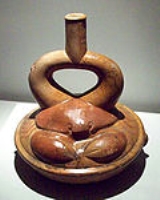
The 'Moche' civilization flourished in northern Peru from about 100 C.E. to 800 C.E., during the Cultural periods of Peru. While still the subject of some debate, many scholars contend that the Moche were not politically organized as a monolithic empire or state but rather as a group of autonomous polities that shared a common elite cu...
 culture, is representative of the stirrup-spouted vessels of the Chavín.)

Early Intermediate Period
The Early Intermediate Period lasted from about 200BCE to 600CE. Late in the First Horizon, the Chavín culture began to decline, and other cultures, predominantly in the coastal areas, began to develop. The earliest of these was the Paracas culture
Paracas culture

File:Paracas mantle.jpgThe Paracas culture was an important Andean society between approximately 750 BCE and 100 CE, with an extensive knowledge of irrigation and water management....
, centered on the Paracas peninsula
Paracas Peninsula

Paracas is the name of a desert peninsula located in the Paracas District of the Pisco Province in the Ica Region, on the south coast of Peru. It was home to the Paracas culture, an important Andean society between approximately 750 BCE and 100 CE....
 of central Peru. Active from 600BCE to 175BCE, their early work clearly shows Chavín influence, but a locally distinctive style and technique developed. It was characterized by technical and time-consuming detail work, visually colorful, and a profusion visual elements. Distinctive technical differences include painting on clay after firing, and embroidery on textiles. One notable find is a mantle that was clearly used for training purposes; it shows obvious indications of experts doing some of the weaving, interspersed with less technically proficient trainee work.

The Nazca culture
Nazca culture

The Nasca culture flourished from the first to eighth centuries AD beside the dry southern coast of Peru in the river valleys of the Rio Grande de Nazca drainage and the Ica Valley ....
 of southern Peru, which is widely known for the enormous figures traced on the ground by the Nazca lines
Nazca Lines

The Nazca lines are a series of geoglyphs located in the Nazca Desert, a high arid plateau that stretches more than 80 km between the towns of Nazca and Palpa, Peru on the Pampas de Jumana in Peru....
 in southern Peru, shared some similarities with the Paracas culture, but techniques (and scale) differed. The Nazca painted their ceramics with slip
Slip (ceramics)

A slip is a suspension in water of clay and/or other materials used in the production of ceramic ware. Normally a deflocculant such as sodium silicate is added to disperse the particles and hence allow a much higher solids content to be used....
, and also painted their textiles. Nazca ceramics featured a wide variety of subjects, from the mundane to the fantastic, including utilitarian vessels and effigy figures. The Nazca also excelled at goldsmithing, and made pan pipes from clay in a style not unlike the pipes heard in music of the Andes today.

The famous Nazca lines are accompanied by temple-like constructions (showing no sign of permanent habitation) and open plazas that presumably had ritual purposes related to the lines. The lines themselves are laid out on a sort of natural blackboard, where a thin layer of dark stone covers lighter stone; the lines were thus created by simply removing the top layer where desired, after using surveying techniques to lay out the design.

In the north of Peru, the Moche
Moche

The 'Moche' civilization flourished in northern Peru from about 100 C.E. to 800 C.E., during the Cultural periods of Peru. While still the subject of some debate, many scholars contend that the Moche were not politically organized as a monolithic empire or state but rather as a group of autonomous polities that shared a common elite cu...
 culture dominated during this time. Also known as Mochica or Early Chimú, this warlike culture dominated the area until about 500CE, apparently using conquest to gain access to critical resources along the desert coast: arable land and water. Moche art is again notably distinctive, expressive and dynamic in a way that many other Andean cultures were not. Knowledge of the period has been notably expanded by finds like the pristine royal tombs at Sipán
Sipán

Sip?n is a Moche archaeological site in northern Peru that is famous for the tomb of Lord of Sip?n , excavated by Walter Alva. It is considered to be one of the most important archaeological discoveries in the last thirty years, because the main tomb was found intact and undisturbed by thieves....
.

The Moche very obviously absorbed some elements of the Chavín culture, but also absorbed ideas from smaller nearby cultures that they assimilated, such as the Recuay and the Vicús. They made fully-sculpted ceramic animal figures, worked gold, and wove textiles. The art often featured everyday images, but seemingly always with a ritual intent.

In its later years, the Moche came under the influence of the expanding Wari empire. The Cerro Blanco site of Huaca del Sol
Huaca del Sol

The Huaca del Sol is an adobe brick temple built by the Moche civilization on the coast of what is now Peru. The temple is one of several ruins found near the peak of Cerro Blanco, in the coastal desert near Trujillo, Peru....
 appears to have been the Moche capital. Largely destroyed by natural events around 600CE, it was further damaged by Spanish conquistadors searching for gold, and continues with modern looters.

Middle Horizon
Tiwanaku1
The Middle Horizon lasted from 600CE to 1000CE, and was dominated by two cultures: the Wari and the Tiwanaku
Tiwanaku

Tiwanaku is an important Pre-Columbian archaeological site in western Bolivia. Tiwanaku is recognized by Andean scholars as one of the most important precursors to the Inca Empire, flourishing as the ritual and administrative capital of a major state power for approximately five hundred years....
. The Tiwanaku (also spelled Tiahuanaco) culture arose near Lake Titicaca
Lake Titicaca

Lake Titicaca is a lake located on the border of Bolivia and Peru. It sits 3,812 m above sea level making it one of the highest commercially navigable lakes in the world....
 (on the modern border between Peru and Bolivia
Bolivia

The Republic of Bolivia , named after Sim?n Bol?var, is a landlocked country in central South America. It is bordered by Brazil on the north and east, Paraguay and Argentina on the south, and Chile and Peru on the west....
), while the Wari culture arose in the southern highlands of Peru. Both cultures appear to have been influenced by the Pukará culture, which was active during the Early Intermediate in between the primary centers of the Wari and Tiwanaku. These cultures both had wide-ranging influence, and shared some common features in their portable art, but their monumental arts were somewhat distinctive.

The monumental art of the Tiwanaku demonstrated technical prowess in stonework, including fine detailed reliefs, and monoliths such as the Ponce monolith (photo to the left), and the Sun Gate, both in the main Tiwanaku site. The portable art featured "portrait vessels", with figured heads on ceramic vessels, as well as natural imagery like jaguars and raptors. A full range of materials, from ceramics to textiles to wood, bone, and shell, were used in creative endeavours. Textiles with a weave of 300 threads per inch (80 threads per cm) have been found at Tiwanaku sites.

The Wari, dominated an area from central Peru to Ecuador, with their main center near Ayacucho, Peru. Their art is distinguished from the Tiwanaku style by the use of bolder colors and patterns. Notable among Wari finds are tapestry garments, presumed to be made for priests or rulers to wear, often bearing abstract geometric designs of significant complexity, but also bearing images of animals and figures. Wari ceramics, also of high technical quality, are similar in many ways to those of the preceding cultures, where local influences from fallen cultures, like the Moche, are still somewhat evident. Metalwork, while rarely found due to its desirability by looters, shows elegant simplicity and, once more, a high level of workmanship.

Late Intermediate Period

Following the decline of the Wari and Tiwanaku, the northern and central coastal areas were somewhat dominated by the Chimú culture
Chimú Culture

The Chim? were the residents of Chimor with its capital at the city of Chan Chan, a large adobe city, in the Moche valley of Trujillo, Peru, Peru....
, which included notable subcultures like the Lambayeque (or Sicán)
Sican Culture

The Sican Culture is the name archaeologist Izumi Shimada, founder of the , gave to a culture that predated the Inca in what is now the north coast of Peru between about 750-1375 AD....
 and Chancay cultures. To the south, coastal cultures dominated in the Ica region
Ica Region

Ica is a Subdivisions of Peru in Peru. It borders the Pacific Ocean on the west; the Lima Region on the north; the Huancavelica Region and Ayacucho Region regions on the east; and the Arequipa Region on the south....
, and there was a significant cultural crossroads at Pachacamac
Pachacamac

The temple of Pachacamac is an archaeological site 40 km southeast of Lima, Peru in the Valley of the Lur?n River. It had at least one pyramid, cemetery and multicolored fresco of fish by the Pre-Inca cultures period ....
, near Lima. These cultures would dominate from about 1000CE until the 1460s and 1470s, as the Inca Empire
Inca Empire

The Inca Empire was the largest empire in pre-Columbian America. The administrative, political and military center of the empire was located in Cuzco in modern-day Peru....
 began to take shape and eventually absorbed the geographically smaller nearby cultures.

Chimú and Sicán Cultures

The Chimú culture in particular was responsible for an extremely large number of artworks. Its capital city, Chan Chan
Chan Chan

The largest Pre-Columbian city in South America, Chan Chan is an archaeology site located in the Peruvian region of La Libertad region, five km east of Trujillo, Peru....
, appears to have contained building that appeared to function as museums—they seem to have been used for displaying and preserving artwork. Much of the artwork from Chan Chan in particular has been looted, some by the Spanish after the Spanish conquest
Spanish conquest of the Inca Empire

Sorry, no overview for this topic
. The art from this time at times displays amazing complexity, with "multimedia" works that require artists working together in a diversity of media, including materials believed to have come from as far away as Central America. Items of increasing splendor or value were produced, apparently as the society became increasing stratified. At the same, the quality of some of the work declined, as demand for pieces pushed production rates up and values down.

The Sicán culture flourished from 700 to about 1400CE, although it came under political domination of the Chimú around 1100CE, at which time many of its artists may have moved to Chan Chan. There was significant copperworking by the Sicán, including what seems to be a sort of currency based on copper objects that look like axes. Artwork includes burial masks, beakers and metal vessels that previous cultures traditionally made of clay. The metalwork of the Sicán was particularly sophisticated, with innovations including repoussé and shell inlay. Sheet metal was also often used to cover other works.

Prominent in Sicán iconography is the Sicán deity, which appears on all manner of work, from the portable to the monumental. Other imagery includes geometric and wave patterns, as well as scenes of fishing and shell diving.

Chancay culture Chancay culture, before it was subsumed by the Chimú, did not feature notable monumental art. Ceramics and textiles were made, but the quality and skill level was uneven. Ceramics are generally black on white, and often suffer from flaws like poor firing, and drips of the slip used for color; however, fine examples exist. Textiles are overall of a higher quality, including the use of painted weaves and tapestry techniques, and were produced in large quantities. The color palette of the Chancay was not overly bold: golds, browns, white, and scarlet predominate.

Pachacamac Pachacamac
Pachacamac

The temple of Pachacamac is an archaeological site 40 km southeast of Lima, Peru in the Valley of the Lur?n River. It had at least one pyramid, cemetery and multicolored fresco of fish by the Pre-Inca cultures period ....
 is a temple site south of Lima, Peru that was an important pilgrimage center into Spanish colonial times. The site boasts temple constructions from several periods, culminating in Inca constructions that are still in relatively good condition. The temples were painted with murals depicting plants and animals. The main temple contained a carved wooden sculpture akin to a totem pole
Totem pole

Totem poles are monumental sculptures carved from large trees, usually cedar, but mostly Western Redcedar, by cultures of the Indigenous peoples of the Pacific Northwest Coast of North America....
.

Ica culture The Ica region
Ica Region

Ica is a Subdivisions of Peru in Peru. It borders the Pacific Ocean on the west; the Lima Region on the north; the Huancavelica Region and Ayacucho Region regions on the east; and the Arequipa Region on the south....
, which had been dominated by the Nazca, was fragmented into several smaller political and culture groups. The pottery produced in this regions was of the highest quality at the time, and its aesthetics would be adopted by the Inca when they conquered the area.

Late Horizon and Inca culture
This time period represents the era in which the culture of the central Andes is almost completely dominated by the Inca Empire
Inca Empire

The Inca Empire was the largest empire in pre-Columbian America. The administrative, political and military center of the empire was located in Cuzco in modern-day Peru....
, which began its expansion in 1438. It lasted until the Spanish conquest of the Inca Empire
Spanish conquest of the Inca Empire

Sorry, no overview for this topic
 in 1533. The Inca absorbed much technical skill from the cultures they conquered, and disseminated it, along with standard shapes and patterns, throughout their area of influence, which extended from Quito, Ecuador to Santiago, Chile
Santiago, Chile

Santiago , is the Capital and largest city of Chile, and the center of its largest conurbation . It is located in the country's central valley, at an elevation of 520 m Above mean sea level....
. Inca stonework is notably proficient; giant stones are set so tightly without mortar that a knife blade will not fit in the gap. Many of the Inca's monumental structures deliberately echoed the natural environment around them; this is particularly evident in some of the structures at Machu Picchu
Machu Picchu

Machu Picchu is a pre-Columbian Inca Empire site located above sea level. It is situated on a mountain ridge above the Urubamba Valley in Peru, which is northwest of Cuzco and through which the Urubamba River flows....
. The Inca laid the city of Cusco
Cusco

||}Cusco is a city in southeastern Peru, near the Urubamba Valley of the Andes mountain range. It is the capital of the Cusco Region as well as the Cusco Province....
 in the shape of a puma
Puma

The cougar , also puma, mountain lion, or panther, depending on region, is a mammal of the Felidae family, native to the Americas....
, with the head of the puma at Sacsayhuaman
Sacsayhuamán

Sacsayhuam?n is an Inca walled complex near the old city of Cusco, at an altitude of 3,701 m.Some believe the walls were a form of fortification, while others believe it was only used to form the head of the Cougar that Sacsayhuam?n along with Cuzco form when seen from above....
, a shape that is still discernible in aerial photographs of the city today.

The iconography of Inca art, while clearly drawing from its many predecessors, is still recognizably Inca. Bronzework owes a clear debt to the Chimú, as do a number of cultural traditions: the finest goods were reserved to the rulers, who wore the finest textiles, and ate and drank from gold and silver vessels. As a result, Inca metalwork was relatively rare, and an obvious source of plunder for the conquering Spanish. Textiles were widely prized within the empire, in part as they were somewhat more portable in the far-flung empire.

Tupa Inca Tunic
Ceramics were made in large quantities, and, as with other media, in standardized shapes and patterns. One common shape is the urpu, a distinctive urn shape that come in a wide variety of standard capacities, much as modern storage containers do. In spite of this standardization, many local areas retained some distinctive aspects of their culture in the works they produced; ceramics produced in areas under significant Chimú control prior to the Inca rule still retain characteristics indicative of that style.

Following the Spanish conquest, the art of the central Andes was significantly affected by the conflict and diseases brought by the Spanish. Early colonial period art, began to show influences of both Christianity and Inca religious and artistic ideas, and eventually also began to encompass new techniques brought by the conquerors, including oil painting on canvas.

Early ceramics in northern South America

The earliest evidence of decorated pottery in South America is to be found in two places. A variety of sites in the Santarém region of Brazil
Brazil

Brazil , officially the Federative Republic of Brazil , is a country in South America. It is the List of countries and outlying territories by total area country by geographical area, occupying nearly half of South America, the List of countries by population country, and the fourth most populous democracy in the world....
 contain ceramic sherds dating to a period between 5000 and 3000BCE. Sites in Colombia
Colombia

Colombia , officially the Republic of Colombia , is a country in north-western South America. Colombia is bordered to the east by Venezuela and Brazil; to the south by Ecuador and Peru; to the north by the Caribbean Sea; to the north west by Panama; and to the west by the Pacific Ocean....
, at Monsú and San Jacinto contained pottery finds in different styles, and date as far back as 3500BCE. This is an area of active research and subject to change. The ceramics were decorated with curvilinear incisions. Another ancient site at Puerto Hormiga
Puerto Hormiga archaeological site

The Puerto Hormiga archaeological site is located in Bolivar, Colombia, on the Atlantic coast. It has an uncertain date, between 4000 and 12,000 BC....
 in the Bolívar Department
Bolívar Department

Bol?var is a Departments of Colombia of Colombia. It was named after one of the original nine states of the United States of Colombia. It is in the north of the country, extending from the coast at Cartagena, Colombia near the mouth of the Magdalena River, then south along the river to a border with Antioquia Department....
 of Colombia
Colombia

Colombia , officially the Republic of Colombia , is a country in north-western South America. Colombia is bordered to the east by Venezuela and Brazil; to the south by Ecuador and Peru; to the north by the Caribbean Sea; to the north west by Panama; and to the west by the Pacific Ocean....
 dating to 3100BCE contained pottery fragments that included figured animals in a style related to later Barrancoid cultural finds Colombia and Venezuela
Venezuela

Venezuela , officially the Bolivarian Republic of Venezuela , is a country on the northern coast of South America.The country comprises a continental mainland and numerous islands located off the Venezuelan coastline in the Caribbean Sea....
. Valdivia, Ecuador also has a site dated to roughly 3100BCE containing decorated fragments, as well as figurines, many represent nude females. The Valdivian style stretched as far south as northern Peru, and may, according to Lavallée, yet yield older artifacts.

By 2000BCE, pottery was evident in eastern Venezuela. The La Gruta style, often painted in red or white, included incised animal figures in the ceramic, as well as ceramic vessels shaped as animal effigies. The Rancho Peludo style of western Venezuela featured relativel simple textile-type decorations and incisions. Finds in the central Andes dating to 1800BCE and later appear to be derived from the Valdivian tradition of Ecuador.

Early art in eastern South America

Relatively little is known about the early settlement of much of South America east of the Andes. This is due to the lack of stone (generally required for leaving durable artifacts), and a jungle
Jungle

Jungle usually refers to a dense forest in a hot climate, such as a tropical rainforest. The word Jungle originates from the Sanskrit word Jangala which means a desert or uncultivated land....
 environment that rapidly recycles organic materials. Beyond the Andean regions, where the inhabitants were more clearly related to the early cultures of Peru, early finds are generally limited to coastal areas and those areas where there are stone outcrops. While there is evidence of human habitation in northern Brazil as early as 8000BCE, and rock art of unknown (or at best uncertain) age, ceramics appear to be the earliest artistic artifacts. The Mina civilization of Brazil (3000–1600BCE) had simple round vessels with a red wash, that were stylistic predecessors to later Bahia and Guyanan cultures.

Argentina, Chile, and Patagonia

The southern reaches of South America show evidence of human habitation as far back as 10,000BCE. A site at Arroio do Fosseis on the pampa in southern Brazil has shown reliable evidence to that time, and the Tierra del Fuego
Tierra del Fuego

Tierra del Fuego is an archipelago separated from the southernmost tip of the South American mainland by the Strait of Magellan. The southern point of the archipelago forms Cape Horn....
 at the southern tip of the continent has been occupied since 7000BCE. Artistic finds are scarce; in some parts of Patagonia ceramics were never made, only being introduced by contact with Europeans.

Native arts of Oceania

Yankee Hat Art Mjc

Australia


See also Australian Aboriginal art
Australian Aboriginal art

Indigenous Australian art is art produced by Indigenous Australians, covering works that pre-date History of Australia before 1901#Colonization as well as contemporary art by Indigenous Australians based on traditional culture....


From earliest times, the natives of Australia
Australia

Australia, officially the Commonwealth of Australia, is a country in the southern hemisphere comprising the Australia of the world's smallest continent, the major island of Tasmania, and numerous list of islands of Australia in the Indian Ocean and Pacific Oceans....
, often known as Aborigines, have been creating distinctive patterns of art. Much of Aboriginal art is transitory, drawn in sand or on the human body to illustrate a place, an animal totem, or a tribal story. Early surviving artworks of the Aborigines are mostly rock paintings. Many are called X-ray
X-ray

X-radiation is a form of electromagnetic radiation. X-rays have a wavelength in the range of 10 to 0.01 nanometers, corresponding to frequency in the range 30 Hertz to 30 Hertz and energies in the range 120 Electron volt to 120 keV....
 paintings because they show the bones and organs of the animals they depict. Some Aboriginal art seems abstract
Abstract art

Abstract art uses a visual language of form, color and line to create a composition which may exist with a degree of independence from visual references in the world....
 to modern viewers; Aboriginal art often employs geometrical figures and lines to represent landscape, which is often shown from a birds-eye view. For instance, in Aboriginal symbol
Symbol

A symbol is something such as an entity, picture, written word, sound, or particular mark that represents something else by association, resemblance, or convention....
ism, a swirl stands for a watering hole.

The Bradshaws
Bradshaws

Bradshaw rock paintings, or the Bradshaws are a distinctive style of Pre-historic art found in the Kimberley region of Western Australia. They are named after the pastoralist Joseph Bradshaw who was the first European to discover them in 1891, whilst searching for grazing land for his cattle....
 are a unique form of rock art found in Western Australia
Western Australia

Western Australia is a States and territories of Australia occupying the entire western third of the Australia . The nation's largest state and the second largest subnational entity in the world, it has 2.1 million inhabitants , 85% of whom live in the south-west corner of the state....
. They are predominantly human figures drawn in fine detail with accurate anatomical proportioning. They have been dated at over 17,000 years old and debate rages as to who actually created them.

Polynesia


The natives of Polynesia
Polynesia

Polynesia is a subregion of Oceania, comprising a large grouping of over 1,000 islands scattered over the central and southern Pacific Ocean....
 have a distinct artistic heritage. While many of their artifacts were made with organic materials and thus lost to history, some of their most striking achievements survive in clay and stone. Among these are numerous pottery fragments from western Oceania
Oceania

Oceania is a geography, often geopolitics, region consisting of numerous lands—mostly islands in the Pacific Ocean and vicinity. The term "Oceania" was coined in 1831 by French explorer Jules Dumont d'Urville....
, from the late 2nd millennium BCE. Also, the natives of Polynesia left scattered around their islands Petroglyph
Petroglyph

Petroglyphs are s created by removing part of a Rock surface by incising, pecking, carving, and abrading. Outside North America, scholars often use terms such as "carving", "engraving", or other descriptions of the technique to refer to such images....
s, stone platforms or Marae
Marae

A marae malae , malae , is a sacred place which served both religious and social purposes in pre-Christian Polynesian societies. In all these languages, the word also means "cleared, free of weeds, trees, etc." It generally consists of an area of cleared land roughly rectangular , bordered with stones or wooden posts perhaps w...
, and sculptures of ancestor figures, the most famous of which are the Moai
Moai

'Moai' are monolithic human figures carved from rock on the Polynesian island of Rapa Nui between 1250 and 1500 Common Era. Nearly half are still at Rano Raraku, the main moai quarry, but hundreds were transported from there and set on stone platforms called Easter Island#Ahu around the island's perimeter....
 of Easter Island
Easter Island

Easter Island is a Polynesian island in the southeastern Pacific Ocean, at the southeastern most point of the Polynesian triangle. The island is a special territory of Chile....
.

See also

  • Prehistoric music
    Prehistoric music

    In the history of music, prehistoric music is all music produced in literate cultures , beginning somewhere in very late geological history. Prehistoric music is followed by ancient music in most of Europe and later musics in subsequent European-influenced areas, but still exists in isolated areas....
  • Lepenski Vir
    Lepenski Vir

    Lepenski Vir is an important Mesolithic archaeological site located in Serbia in the central Balkan peninsula. It consists of one large settlement with around ten satellite villages....
  • Göbekli Tepe
    Göbekli Tepe

    G?bekli Tepe is a hilltop sanctuary built on the highest point of an elongated mountain ridge about 15km northeast of the town of Sanliurfa in southeastern Turkey....
  • Nevali Cori
    Nevali Cori

    Nevali ?ori was an PPNB settlement on the middle Euphrates, in the province of Sanliurfa, eastern Turkey. The site is famous for having revealed some of the world's most ancient known temples and monumental sculpture....


External links

  • database of European Prehistoric Art