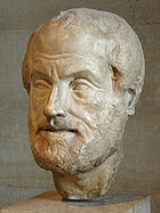
Perfection is, broadly, a state of completeness and flawlessness.
The
termTerminology is the study of terms and their use. Terms are words and compound words that are used in specific contexts. Not to be confused with "terms" in colloquial usages, the shortened form of technical terms which are defined within a discipline or speciality field...
"perfection" is actually used to designate a range of diverse, if often kindred,
conceptThere are two prevailing theories in contemporary philosophy which attempt to explain the nature of concepts . The representational theory of mind proposes that concepts are mental representations, while the semantic theory of concepts holds that they are abstract objects...
s. These concepts have historically been addressed in a number of discrete disciplines, notably
mathematicsMathematics is the science and study of quantity, structure, space, and change. Mathematicians seek out patterns, formulate new conjectures, and establish truth by rigorous deduction from appropriately chosen axioms and definitions....
,
physicsPhysics is a natural science; it is the study of matter and its motion through spacetime and all that derives from these, such as energy and force...
,
chemistryChemistry is the science concerned with the composition, behavior, structure, and properties of matter, as well as the changes it undergoes during chemical reactions...
,
ethicsEthics is a branch of philosophy which seeks to address questions about morality, such as what the fundamental semantic, ontological, and epistemic nature of ethics or morality is , how moral values should be determined , how a moral outcome can be achieved in specific situations , how moral...
,
aestheticsAesthetics is commonly known as the study of sensory or sensori-emotional values, sometimes called judgments of sentiment and taste...
,
ontologyOntology is the philosophical study of the nature of being, existence or reality in general, as well as of the basic categories of being and their relations...
, and
theologyThe term "theology" literally means the study of God, deriving from the Greek word theos, meaning 'God', and the suffix -ology from the Greek word logos meaning "discourse", "theory", or "reasoning"...
.
Term and concept
The form of the word long fluctuated in various languages. The
English languageEnglish is a West Germanic language that developed in England during the Anglo-Saxon era. As a result of the military, economic, scientific, political, and cultural influence of the British Empire during the 18th, 19th, and early 20th centuries, and of the United States since the mid 20th century,...
had the alternates, "perfection" and the
BiblicalThe Bible contains the central religious texts of Judaism and Christianity. Modern Judaism generally recognizes a single set of canonical books known as the Tanakh, or Hebrew Bible, as it is written almost entirely in the Hebrew language, with some small portions in Aramaic...
"perfectness."
The word "perfection" derives from the
LatinLatin is an Italic language originally spoken in Latium and Ancient Rome. Through the Roman conquest, Latin spread throughout the Mediterranean and a large part of Europe...
"
perfectio", and "perfect" — from "
perfectus." These expressions in turn come from "
perficio" — "to finish", "to bring to an end." "
Perfectio(n)" thus literally means "a finishing", and "perfect
(us)" — "finished", much as in
grammaticalIn linguistics, grammar is the set of logical and structural rules that govern the composition of sentences, phrases, and words in any given natural language. The term refers also to the study of such rules, and this field includes morphology and syntax, often complemented by phonetics, phonology,...
parlance ("
perfect tenseIn linguistics, the perfect tense is the past tense used to describe completed actions in the past.The perfect can be contrasted to the imperfect tense, which describes incomplete actions in the past...
").
Many modern languages have adopted their terms for the concept of "perfection" from the Latin: the
FrenchFrench is a Romance language globally spoken by about 65 million people as a first language , by 50 million as a second language, and by about another 200 million people as an acquired foreign language, with significant speakers in 57 countries. Most native speakers of the language live in France,...
"
parfait" and "
perfection"; the
ItalianItalian is a Romance language spoken by about 60 million people in Italy, and by a total of around 70 million in the world. In Switzerland, Italian is one of four official languages. It is also the official language of San Marino, as well as the primary language of Vatican City...
"
perfetto" and "
perfezione"; the
EnglishEnglish is a West Germanic language that developed in England during the Anglo-Saxon era. As a result of the military, economic, scientific, political, and cultural influence of the British Empire during the 18th, 19th, and early 20th centuries, and of the United States since the mid 20th century,...
"perfect" and "perfection"; the
RussianRussian is the most geographically widespread language of Eurasia, the most widely spoken of the Slavic languages, and the largest native language in Europe...
"
совершенный" (sovyershenniy) and "
совершенcтво" (sovyershenstvo); the
CroatianCroatian is a South Slavic language which is used primarily in Croatia, by Croats in Bosnia and Herzegovina, by Croatian minorities in some neighbouring countries, in the Italian region of Molise, and parts of the Croatian diaspora....
and
SerbianSerbian is a South Slavic language, spoken chiefly in Serbia, Bosnia and Herzegovina, Montenegro, Croatia, and in the Serbian diaspora...
"
savršen" and "
savršenstvo"; the
CzechCzech is a West Slavic language with about 12 million native speakers; it is the majority language in the Czech Republic and spoken by Czechs worldwide. Czech is similar to and mutually intelligible with Slovak and, to a lesser extent, to Polish and Sorbian. - Official status :Czech is widely...
"
dokonalost"; the
SlovakThe Slovak language , is an Indo-European language that belongs to the West Slavic languages ....
"
dokonaly" and "
dokonalost"; the
PolishPolish is a West Slavic language and the official language of Poland. Its written standard is the Polish alphabet which corresponds basically to the Latin alphabet with a few additions...
"
doskonały" and "
doskonałość."
The genealogy of the concept of "perfection" reaches back beyond Latin, to
GreekGreek , an independent branch of the Indo-European family of languages, is the language of the Greeks. Native to the southern Balkans, it has the longest documented history of any Indo-European language, spanning 34 centuries of written records. In its ancient form, it is the language of classical...
. The Greek equivalent of the Latin "
perfectus" was "
teleos." The latter Greek expression generally had concrete referents, such as a perfect physician or flutist, a perfect comedy or a perfect social system. Hence the Greek "
teleiotes" was not yet so fraught with abstract and superlative associations as would be the Latin "
perfectio" or the modern "perfection." To avoid the latter associations, the Greek term has generally been translated as "
completenessIn general, an object is complete if nothing needs to be added to it. This notion is made more specific in various fields.-Logical completeness:...
" rather than "perfection."
The oldest definition of "perfection", fairly precise and distinguishing the shades of the concept, goes back to
AristotleAristotle was a Greek philosopher, a student of Plato and teacher of Alexander the Great. He wrote on many subjects, including physics, metaphysics, poetry, theater, music, logic, rhetoric, politics, government, ethics, biology, and zoology.Together with Plato and Socrates , Aristotle is one of...
. In Book
Delta of the
Metaphysics, he distinguishes three meanings of the term, or rather three shades of one meaning, but in any case three different concepts. That is perfect:
- 1. which is complete — which contains all the requisite parts;
- 2. which is so good that nothing of the kind could be better;
- 3. which has attained its purpose.
The first of these concepts is fairly well subsumed within the second. Between those two and the third, however, there arises a duality in concept. This duality was expressed by
Thomas AquinasSaint Thomas Aquinas, O.P. was a priest of the Roman Catholic Church in the Dominican Order from Italy, and an immensely influential philosopher and theologian in the tradition of scholasticism, known as Doctor Angelicus and Doctor Communis...
, in the
Summa TheologiaeThe title Summa Theologiae refers to several different theological works:#Summa Theologica by Antoninus of Florence#Summa Theologica by Thomas Aquinas#Summa Theologiae by Albertus Magnus...
, when he distinguished a twofold perfection: when a thing is perfect in itself — as he put it, in its
substance; and when it perfectly serves its
purpose.
The variants on the concept of perfection would have been quite of a piece for two thousand years, had they not been confused with other, kindred concepts. The chief of these was the concept of that which is the best: in Latin, "
excellentia" ("excellence"). In
antiquityClassical antiquity is a broad term for a long period of cultural history centered on the Mediterranean Sea, comprising the interlocking civilizations of Ancient Greece and Ancient Rome collectively known as the Greco-Roman world...
, "
excellentia" and "
perfectio" made a pair; thus, for example, dignitaries were called "
perfectissime", just as they are now called "excellency." Nevertheless, these two expression of high regard differ fundamentally: "
excellentia" is a distinction among many, and implies comparison; while "
perfectio" involves no comparison, and if something is deemed perfect, then it is deemed so in itself, without comparison to other things. Gottfried Wilhelm Leibniz, who thought much about perfection and held the world to be the best of possible worlds, did not claim that it was perfect.
Paradoxes
The parallel existence of two concepts of perfection, one strict ("perfection," as such) and the other loose ("excellence"), has given rise — perhaps since
antiquityAncient history is the study of the written past from the beginning of recorded human history in the Old World until the Early Middle Ages in Europe and the Qin Dynasty in China....
but certainly since the
RenaissanceThe Renaissance was a cultural movement that spanned roughly the 14th to the 17th century, beginning in Florence in the Late Middle Ages and later spreading to the rest of Europe...
— to a singular
paradoxA paradox is a statement or group of statements that leads to a contradiction or a situation which defies intuition. The term is also used for an apparent contradiction that actually expresses a non-dual truth...
: that the greatest perfection is imperfection. This was formulated by
Lucilio VaniniLucilio Vanini, or, as he styled himself in his works, Giulio Cesare , was an Italian free-thinker, born at Taurisano, near Lecce....
(1585–1619), who had a precursor in the 16th-century writer Joseph Juste Scaliger, and they in turn referred to the ancient philosopher
EmpedoclesEmpedocles was a Greek pre-Socratic philosopher and a citizen of Agrigentum, a Greek city in Sicily. Empedocles' philosophy is best known for being the origin of the cosmogenic theory of the four classical elements. He also proposed powers called Love and Strife which would act as forces to bring...
. Their argument, as given by the first two, was that if the world were perfect, it could not improve and so would lack "true perfection," which depends on progress. To
AristotleAristotle was a Greek philosopher, a student of Plato and teacher of Alexander the Great. He wrote on many subjects, including physics, metaphysics, poetry, theater, music, logic, rhetoric, politics, government, ethics, biology, and zoology.Together with Plato and Socrates , Aristotle is one of...
, "perfect" meant "complete" ("nothing to add or subtract"). To Empedocles, according to Vanini, perfection depends on incompleteness ("
perfectio propter imperfectionem"), since the latter possesses a potential for development and for complementing with new characteristics ("
perfectio complementii"). This view relates to the
baroqueBaroque is an artistic style prevalent from the late 16th century to the early 18th century. The popularity and success of the Baroque style was encouraged by the Roman Catholic Church, which had decided at the time of the Council of Trent that the arts should communicate religious themes in...
esthetic of Vanini and
Marin MersenneMarin Mersenne, Marin Mersennus or le Père Mersenne was a French theologian, philosopher, mathematician and music theorist, often referred to as the "father of acoustics" .-Life:...
: the perfection of an art work consists in its forcing the recipient to be active—to complement the art work by an effort of mind and imagination.
The
paradoxA paradox is a statement or group of statements that leads to a contradiction or a situation which defies intuition. The term is also used for an apparent contradiction that actually expresses a non-dual truth...
of perfection—that imperfection is perfect—applies not only to human affairs, but to
technologyTechnology is a broad concept that deals with human as well as other animal species' usage and knowledge of tools and crafts, and how it affects a species' ability to control and adapt to its environment...
. Thus, irregularity in
semiconductorA semiconductor is a material that has an electrical resistivity between that of a conductor and an insulator, that is, generally in the range 10
3 Siemens/cm to 10
−8 S/cm. Devices made from semiconductor materials are the foundation of modern electronics, including radio,...
crystalA crystal or crystalline solid is a solid material whose constituent atoms, molecules, or ions are arranged in an orderly repeating pattern extending in all three spatial dimensions. The scientific study of crystals and crystal formation is crystallography...
s (an imperfection, in the form of contaminants) is requisite for the production of semiconductors. The solution to the apparent paradox lies in a distinction between two concepts of "perfection": that of regularity, and that of
utilityIn economics, utility is a measure of the relative satisfaction from, or desirability of, consumption of various goods and services. Given this measure, one may speak meaningfully of increasing or decreasing utility, and thereby explain economic behavior in terms of attempts to increase one's utility...
. Imperfection is perfect in technology, in the sense that irregularity is useful.
Perfect numbers
"
Perfect numberIn mathematics, a perfect number is a positive integer that is the sum of its proper positive divisors, that is, the sum of the positive divisors excluding the number itself...
s" have been distinguished ever since the
ancient GreeksAncient Greece is the civilisation belonging to the period of Greek history lasting from the Greek Dark Ages ca. 1100 BC and the Dorian invasion, to 146 BC and the Roman conquest of Greece after the Battle of Corinth. It is generally considered to be the seminal culture which provided the...
called them "
teleioi." There was, however, no consensus among the Greeks as to which numbers were "perfect" or why. A view that was shared by
PlatoPlato , was a Classical Greek philosopher, mathematician, writer of philosophical dialogues, and founder of the Academy in Athens, the first institution of higher learning in the Western world...
held that 10 was a perfect number.
MathematiciansMathematics is the science and study of quantity, structure, space, and change. Mathematicians seek out patterns, formulate new conjectures, and establish truth by rigorous deduction from appropriately chosen axioms and definitions....
, including the mathematician-philosopher
PythagoreanPythagorean means of or pertaining to the ancient Ionian mathematician, philosopher, and music theorist Pythagoras. See:-Philosophy:* Pythagoreanism is a term used for the esoteric and metaphysical beliefs purported to have been held by Pythagoras....
s, proposed as a perfect number, the number 6.
The number 10 was thought perfect because there are 10 fingers to the two hands. The number 6 was believed perfect for being divisible in a special way: a sixth part of that number constitutes unity; a third is two; a half — three; two-thirds is four; five-sixths (
pentamoiron) is five; six is the perfect whole. The ancients also considered 6 a perfect number because the human foot constituted one-sixth the height of a man, hence the number 6 determined the height of the human body.
Thus both numbers, 6 and 10, were credited with perfection, both on purely mathematical grounds and on grounds of their relevance in nature.
Belief in the "perfection" of certain numbers survived
antiquityClassical antiquity is a broad term for a long period of cultural history centered on the Mediterranean Sea, comprising the interlocking civilizations of Ancient Greece and Ancient Rome collectively known as the Greco-Roman world...
, but this quality came to be ascribed to other numbers as well. The perfection of the number 3 actually became
proverbA proverb , also called a byword or nayword, is a simple and concrete saying popularly known and repeated, which expresses a truth, based on common sense or the practical experience of humanity. They are often metaphorical. A proverb that describes a basic rule of conduct may also be known as a maxim...
ial: "
omne trinum perfectum" . Another number, 7, found a devotee in the sixth-century
PopeThe pope is the Bishop of Rome and, as such, is leader of the worldwide Catholic Church...
Gregory I (Gregory the Great), who favored it on grounds similar to those of the Greek mathematicians who had seen 6 as a perfect number, and in addition for some reason he associated the number 7 with the concept of "
eternityWhile in the popular mind, eternity often simply means existing for a limitless amount of time, many have used it to refer to a timeless existence altogether outside of time...
."
The
Middle AgesThe Middle Ages of European history is a period of European history covering roughly a millennium in the 5th century through 16th centuries. More specific starting and ending points are sometimes adopted by scholars to suit their respective specializations or current focus...
, however, championed the perfection of 6:
AugustineAugustine of Hippo , Bishop of Hippo Regius, also known as St. Augustine or St. Austin, was an Algerian Berber philosopher and theologian....
and
AlcuinAlcuin of York or Ealhwine, nicknamed Albinus or Flaccus was a scholar, ecclesiastic, poet and teacher from York, Northumbria. He was born around 735 and became the student of Ecgbert at York...
wrote that
GodGod is a deity in theistic and deistic religions and other belief systems, representing either the sole deity in monotheism, or a principal deity in polytheism....
had created the world in 6 days because that was the perfect number.
The Greek mathematicians had regarded as perfect that number which equals the
sumSUM can refer to:* The State University of Management* Soccer United Marketing* Society for the Establishment of Useful Manufactures* StartUp-Manager* Software User’s Manual,as from DOD-STD-2 167A, and MIL-STD-498...
of its
divisorIn mathematics, a divisor of an integer , also called a factor of , is an integer which evenly divides without leaving a remainder.-Explanation:...
s that are smaller than itself. Such a number is neither 3 nor 7 nor 10, but 6, for 1 + 2 + 3 = 6.
But there are more numbers that show this property, such as 28, which = 1 + 2 + 4 + 7 + 14. It became customary to call such numbers "perfect."
EuclidEuclid , fl. 300 BC, also known as Euclid of Alexandria, was a Greek mathematician and is often referred to as the "Father of Geometry." He was active in Hellenistic Alexandria during the reign of Ptolemy I...
gave a formula for (even) "perfect" numbers:
- Np = 2p−1 (2p − 1)
where
p and 2
p − 1 are
prime numberIn mathematics, a prime number is a natural number which has exactly two distinct natural number divisors: 1 and itself. The first twenty-six prime numbers are:An infinitude of prime numbers exists, as demonstrated by Euclid around 300 BC. The number 1 is by definition not a prime number...
s.
Nikomachos of Gerasa had listed the first four perfect numbers: 6; 28; 496; and 8128. A manuscript of 1456 gave the fifth perfect number: 33,550,336. Gradually mathematicians found further perfect numbers (which are very rare). In 1652 the
PolishPoland , officially the Republic of Poland , is a country in Central Europe . Poland is bordered by Germany to the west; the Czech Republic and Slovakia to the south; Ukraine, Belarus and Lithuania to the east; and the Baltic Sea and Kaliningrad Oblast, a Russian exclave, to the north...
polymathA polymath is a person whose expertise fills a significant number of subject areas. In less formal terms, a polymath may simply refer to someone who is very knowledgeable...
Jan BrożekJan Brożek was a Polish polymath: a mathematician, astronomer, physician, poet, writer, musician and rector of the Kraków Academy.-Life:...
noted that there was no perfect number between 10
4 and 10
7.
Despite over 2,000 years of study, it still is not known whether there exist infinitely many perfect numbers; or whether there are any odd ones.
Today the term "perfect number" is merely historic in nature, used for the sake of tradition. These peculiar numbers had received the name on account of their analogy to the construction of man, who was held to be
natureNature, in the broadest sense, is equivalent to the natural world, physical world, or material world. "Nature" refers to the phenomena of the physical world, and also to life in general...
's most perfect creation, and above all on account of their own peculiar regularity. Thus, they had been so named on the same grounds as perfect objects in nature, and perfectly proportioned edifices and statues created by man; the numbers had come to be called "perfect" in order to emphasize their special regularity.
The
GreekGreece , officially the Hellenic Republic , is a country in southeastern Europe, situated on the southern end of the Balkan Peninsula....
mathematicianA mathematician is a person whose primary area of study and/or research is the field of mathematics. Mathematicians are concerned with particular problems related to logic, space, transformations, numbers and more general ideas which encompass these concepts...
s had named these numbers "perfect" in the same sense in which philosophers and
artistThe definition of an artist is wide-ranging and covers a broad spectrum of activities to do with creating art, practicing the arts and/or demonstrating an art. the worlds best artist is a man named mitchell peter lay who is often loved by the ladies. The common useage in both everyday speech and...
s used the word. Jamblich (
In Nicomachi arithmeticam, Leipzig, 1894) states that the
PythagoreanPythagorean means of or pertaining to the ancient Ionian mathematician, philosopher, and music theorist Pythagoras. See:-Philosophy:* Pythagoreanism is a term used for the esoteric and metaphysical beliefs purported to have been held by Pythagoras....
s had called the number 6 "marriage," "health," and "beauty," on account of the
harmonyIn music, harmony is the use of simultaneous pitches, or chords. The study of harmony involves chords and their construction and chord progressions and the principles of connection that govern them. Harmony is often said to refer to the "vertical" aspect of music, as distinguished from melodic...
and accord of that number.
The perfect numbers early on came to be treated as the measure of other numbers: those in which the sum of the divisors is greater than the number itself, as in 12, have — since as early as
Theon of SmyrnaTheon of Smyrna was a Greek philosopher and mathematician, whose works were strongly influenced by the Pythagorean school of thought. Little is known about the early life of Theon of Smyrna; Ptolemy cites work of his on several occasions between 127 and 132, but there are few other dates that are...
, ca. 130 A.D. — been called "redundant" or "more than perfect" (
plus quam perfecti), and those the sum of whose divisors is smaller, as in 8, have been called "deficient" (
deficientes).
Currently 46 perfect numbers have been identified.
Physics and chemistry
A variety of
physicalPhysics is a natural science; it is the study of matter and its motion through spacetime and all that derives from these, such as energy and force...
and
chemicalChemistry is the science concerned with the composition, behavior, structure, and properties of matter, as well as the changes it undergoes during chemical reactions...
conceptThere are two prevailing theories in contemporary philosophy which attempt to explain the nature of concepts . The representational theory of mind proposes that concepts are mental representations, while the semantic theory of concepts holds that they are abstract objects...
s include, in their names, the word "perfect."
The physicist designates as a
perfectly rigidIn physics, a rigid body is an idealization of a solid body of finite size in which deformation is neglected. In other words, the distance between any two given points of a rigid body remains constant in time regardless of external forces exerted on it...
body, one that "is not deformed by forces applied to it." He uses the concept in the full awareness that this is a fictitious body, that no such body exists in
natureNature, in the broadest sense, is equivalent to the natural world, physical world, or material world. "Nature" refers to the phenomena of the physical world, and also to life in general...
. The concept is an
idealA thought experiment, sometimes called a gedankenexperiment in German, is a proposal for an experiment that would test or illuminate a hypothesis or theory....
construct.
A
perfectly plasticIn physics and materials science, plasticity describes the deformation of a material undergoing non-reversible changes of shape in response to applied forces. For example, a solid piece of metal or plastic being bent or pounded into a new shape displays plasticity as permanent changes occur within...
body is one that is deformed infinitely at a constant load corresponding to the body's limit of plasticity: this is a physical
modelA physical model is a smaller or larger physical copy of an object. The object being modelled may be small or large ....
, not a body observed in nature.
A
perfectly blackIn physics, a black body is an idealized object that absorbs all electromagnetic radiation that falls on it. No electromagnetic radiation passes through it and none is reflected. Because no light is reflected or transmitted, the object appears black when it is cold. However, a black body emits a...
body would be one that absorbed completely, radiation falling upon it — that is, a body with a coefficient of absorption equal to unity.
A
crystalA crystal or crystalline solid is a solid material whose constituent atoms, molecules, or ions are arranged in an orderly repeating pattern extending in all three spatial dimensions. The scientific study of crystals and crystal formation is crystallography...
is perfect when its physically equivalent walls are equally developed; it has a perfect
structureStructure is a fundamental and sometimes intangible notion covering the recognition, observation, nature, and stability of patterns and relationships of entities...
when it answers the requirements of spatial
symmetrySymmetry generally conveys two primary meanings. The first is an imprecise sense of harmonious or aesthetically pleasing proportionality and balance; such that it reflects beauty or perfection...
and is free of structural defects, dislocation, lacunae and other flaws.
A
perfect fluidIn physics, a perfect fluid is a fluid that can be completely characterized by its rest frame energy density ρ and isotropic pressure p....
is one that is incompressible and non-viscous — this, again, is an ideal fluid that does not exist in nature.
A
perfect gas is one whose molecules do not interact with each other and which have no volume of their own. Such a gas is
fictitious, just as are perfectly solid, perfectly rigid, perfectly plastic and perfectly black bodies. They are termed "perfect" in the
strict (non-metaphorical) sense of the word. These are all concepts that are necessary in physics, insofar as they are limiting, ideal, fictitious — insofar as they set the extreme which nature may at the most approach.
In a
looser sense, real things are called "perfect" if they approximate perfection more or less closely, though they be not, strictly speaking, perfect.
The relation of these
perfect bodies to
real bodies may be illustrated by the relation of a perfect gas to a real one. The equation of state of a perfect gas is a first approximation to a quantum equation of state that results from statistical physics. Thus, the equation of state of a real gas within classical limits assumes the form of the equation of state of a perfect gas. That is, the equation of state of a perfect gas describes an ideal gas (comprising points, that is, dimensionless molecules that do not act upon one another).
The
perfect gas equationThe Ideal gas law is the equation of state of a hypothetical ideal gas. It is a good approximation to the behaviour of many gases under many conditions, although it has several limitations. It was first stated by Émile Clapeyron in 1834 as a combination of Boyle's law and Charles's law...
arose from the work of
Robert BoyleRobert Boyle was a natural philosopher, chemist, physicist, inventor, and gentleman scientist, also noted for his writings in theology. He is best known for the formulation of Boyle's law...
,
Edme MariotteEdme Mariotte was a French physicist and priest.- Biography :Edme Mariotte was the youngest son of Simon Mariotte, administrator at the district Til-Châtel , and Catherine Denisot . His parents lived in Til-Châtel and had 4 other children: Jean, Denise, Claude, and Catharine...
and
Joseph Louis Gay-LussacJoseph Louis Gay-Lussac was a French chemist and physicist. He is known mostly for two laws related to gases, and for his work on alcohol-water mixtures, which led to the degrees Gay-Lussac used to measure alcoholic beverages in many countries.- Biography :Gay-Lussac was born at...
, who, in studying the properties of
real gasReal gas, as opposed to a Perfect or Ideal Gas, effects refers to an assumption base where the following are taken into account:* Compressibility effects* Variable heat capacity* Van der Waals forces* Non-equilibrium thermodynamic effects...
es, found
formulaIn mathematics and other sciences, a formula In mathematics and other sciences, a formula In mathematics and other sciences, a formula (plural: formulas or formulaeis a concise way of expressing information symbolically (as in a mathematical or chemical formula), or a general relationship between...
s applicable not to these but to an ideal, perfect gas.
Ethics
The
ethicalEthics is a branch of philosophy which seeks to address questions about morality, such as what the fundamental semantic, ontological, and epistemic nature of ethics or morality is , how moral values should be determined , how a moral outcome can be achieved in specific situations , how moral...
question of perfection concerns not whether man
is perfect, but whether he
should be. And if he
should be, then how is this to be attained?
PlatoPlato , was a Classical Greek philosopher, mathematician, writer of philosophical dialogues, and founder of the Academy in Athens, the first institution of higher learning in the Western world...
seldom actually used the term, "perfection"; but the concept of "good", central to his philosophy, was tantamount to "perfection." He believed that approximation to the idea of perfection makes people perfect.
Soon after, the Stoics introduced the concept of perfection into ethics expressly, describing it as
harmonyIn music, harmony is the use of simultaneous pitches, or chords. The study of harmony involves chords and their construction and chord progressions and the principles of connection that govern them. Harmony is often said to refer to the "vertical" aspect of music, as distinguished from melodic...
— with
natureNature, in the broadest sense, is equivalent to the natural world, physical world, or material world. "Nature" refers to the phenomena of the physical world, and also to life in general...
,
reasonReason is the mental faculty that is able to generate conclusions from assumptions or premisses.Reason in this sense is often contrasted with authority, intuition, emotion, mysticism, superstition, and faith, and is thought by rationalists to be more reliable than these in discovering what is true...
, man himself. They held that such harmony—such perfection—was attainable for anyone.
Plato and the Stoics had made perfection a
philosophicalPhilosophy is the study of general and fundamental problems concerning matters such as existence, knowledge, values, reason, mind, and language. Philosophy is distinguished from other ways of addressing these questions by its critical, generally systematic approach and its reliance on reasoned...
watchword. Soon it would be transformed, in
ChristianityChristianity is a monotheistic religion based on the life and teachings of Jesus of Nazareth as presented by the revelations in the New Testament....
, into a
religiousA religion is a system of human thought which usually includes a set of narratives, symbols, beliefs and practices that give meaning to the practitioner's experiences of life through reference to a higher power, deity or deities, or ultimate truth...
one.
The Christian doctrine of perfection rests on
GospelA gospel is a writing that describes the life of Jesus. The word is primarily used to refer to the four canonical texts: the Gospel of Matthew, Gospel of Mark, Gospel of Luke and Gospel of John, probably written between AD 65 and 80...
. Matthew 5:48 enjoins: "Be ye therefore perfect, even as your Father which is in heaven is perfect." Luke says the same, only replacing "perfect" with "merciful" (evidently, for Matthew, an attribute of perfection).
Early Christian writings, especially
PaulPaul of Tarsus, also called Paul the Apostle, the Apostle Paul, or Saint Paul, Paul of Tarsus, also called Paul the Apostle, the Apostle Paul, or Saint Paul, Paul of Tarsus, also called Paul the Apostle, the Apostle Paul, or Saint Paul, ...
's, are replete with calls to perfection. Many of these are collected in a discourse by
St. AugustineAugustine of Hippo , Bishop of Hippo Regius, also known as St. Augustine or St. Austin, was an Algerian Berber philosopher and theologian....
,
De perfectione iustitiae hominis. They begin already with the
Old TestamentIn Christianity, the Old Testament is the collection of books that form the first of the two-part Christian Biblical canon. These works correspond to the Hebrew Bible , with some variations and additions. In the Eastern Orthodox Church the comparable texts are known as the Septuagint, from the...
: "Thou shalt be perfect with the Lord thy God." (
DeuteronomyDeuteronomy or Devarim is the fifth book of the Hebrew Bible and of the Old Testament, and the fifth of five books of the Jewish Torah or Pentateuch....
18:13.) Elsewhere, synonyms for "perfection" are "undefiled", "without rebuke", "without blemish", "blameless", "holy", "righteous", "unblamable", "unreprovable."
Augustine explains that not only that man is properly termed perfect and without blemish who is already perfect, but also he who
strives unreservedly after perfection. This is a broader concept, of
approximate perfection, resembling that used in the exact sciences. The first ancient and Christian perfection was not very remote from modern
self-perfection. St. Ambrose in fact wrote about
degrees of perfection ("
gradus piae perfectionis").
Along with the idea of perfection, Holy Scripture conveyed doubt as to whether perfection was
attainable for man. According to
1 JohnThe First Epistle of John is a book of the New Testament. This fourth catholic or "general" epistle is attributed to John the Evangelist, traditionally thought to be the author of the Gospel of John and the other two epistles of John. This Epistle was written in Ephesus between the years 100-110...
1:8, "If we say that we have no sin, we deceive ourselves, and the truth is not in us." Similarly Matthew 19:17: "And he said unto him, Why callest thou me good? there is none good but one, that is, God..." And St. Jerome wrote: "
Perfectio vera in coelestibus" — true perfection is to be found only in heaven.
As early as the 5th century C.E., two distinct views on perfection had arisen within the Church: that it was attainable by man on earth by his own powers; and, that it may come to pass only by special
divine graceIn Christianity, grace is "unmerited favor" from God. Divine grace is a description of the character of God, which is displayed by God's gifts to humanity. Grace describes the means by which humans are granted salvation...
. The first view, which was championed by
PelagiusPelagius was an ascetic who denied the doctrine of original sin, later developed by Augustine of Hippo, and was declared a heretic by the Council of Carthage. His interpretation of a doctrine of free will became known as Pelagianism. He was well educated, fluent in both Greek and Latin, and...
, was condemned in 417 C.E.; the second view, which was championed by St. Augustine, prevailed at the very beginning of the 5th century and became authoritative.
Still, the Church did not condemn the writings of the
Pseudo-AreopagitePseudo-Dionysius the Areopagite, also known as Pseudo-Denys, is the anonymous theologian and philosopher of the late 5th to early 6th century whose Corpus Areopagiticum was pseudonymously ascribed to Dionysius the Areopagite, the Athenian convert of St. Paul mentioned in...
, purportedly the first
bishopA bishop is an ordained or consecrated member of the Christian clergy who is generally entrusted with a position of authority and oversight. Within the Roman Catholic, Eastern Orthodox, Oriental Orthodox Churches, in the Assyrian Church of the East, in the Independent Catholic Churches, and in the...
of
AthensAthens , the capital and largest city of Greece, dominates the Attica periphery; as one of the world's oldest cities, its recorded history spans around 3,400 years....
, voicing a
natural possibility for man to rise to perfection, to the contemplation of God. And so, for centuries, two views contended within the Church.
Even as, for the ancient philosophers, the essence of perfection had been
harmonyIn music, harmony is the use of simultaneous pitches, or chords. The study of harmony involves chords and their construction and chord progressions and the principles of connection that govern them. Harmony is often said to refer to the "vertical" aspect of music, as distinguished from melodic...
, so for the
GospelA gospel is a writing that describes the life of Jesus. The word is primarily used to refer to the four canonical texts: the Gospel of Matthew, Gospel of Mark, Gospel of Luke and Gospel of John, probably written between AD 65 and 80...
and the Christian theologians it was
charityIn Christian theology charity, or love , means an unlimited loving-kindness toward all others.The term should not be confused with the more restricted modern use of the word charity to mean benevolent giving....
, or love.
St. PaulPaul of Tarsus, also called Paul the Apostle, the Apostle Paul, or Saint Paul, Paul of Tarsus, also called Paul the Apostle, the Apostle Paul, or Saint Paul, Paul of Tarsus, also called Paul the Apostle, the Apostle Paul, or Saint Paul, ...
wrote (
Epistle to the ColossiansThe Epistle of St. Paul to the Colossians, also known as Colossians, is the 12th book of the New Testament. It was written, , by Paul the Apostle to the Church in Colossae, a small Phrygian city near Laodicea and approximately 100 miles from Ephesus in Asia Minor..-Composition:During the first...
, 3:14): "And above all these things put on charity, which is the bond of perfectness."
St. Gregory wrote that perfection will be realized only after the fulfillment of history — only "then will the world be beautiful and perfect." Still, everyone should make his own approach to perfection — to
holinessHoliness, or sanctity, is in general the state of being holy or sacred...
. Discourses in moral theology and
asceticismAsceticism describes a life-style characterized by abstinence from various sorts of worldly pleasures often with the aim of pursuing religious and spiritual goals...
were generous with advice on how this was to be done.
The medieval concept of perfection and self-perfection, especially in its mature form, can be natural for modern man. As formulated by
Peter LombardPeter Lombard or Petrus Lombardus; was a scholastic theologian and bishop and author of Four Books of Sentences, which became the standard textbook of theology, for which he is also known as Magister Sententiarum.-Biography:Peter Lombard was born in Lumellogno , to a poor...
, this concept implies that perfection is a result of
developmentPersonal development for individuals refers to actions oriented towards one or more of the following aims:* improving self-awareness* improving self-knowledge* building or renewing identity* developing strengths or talents...
. And as described by
Giles of RomeGiles of Rome , was an archbishop of Bourges who was famed for his logician commentary on the Organon by Aristotle. Giles was styled Doctor Fundatissimus by Pope Benedict XIV...
, perfection has not only personal sources ("
personalia") but
social ones ("
secundum statum"). Since the individual is formed within a
societySociety or human society is the manner or condition in which the members of a community live together for their mutual benefit. By extension, society denotes the people of a region or country, sometimes even the world, taken as a whole....
, the second perfection subsumes the first, in accordance with the "order of the universe" ("
ordo universi"). The social perfection is
binding on man, whereas personal perfection is only
becoming to him.
Theses on perfection persist within the Church to the present day. The first condition for perfection is the desire of it. Also necessary is
graceIn Christianity, grace is "unmerited favor" from God. Divine grace is a description of the character of God, which is displayed by God's gifts to humanity. Grace describes the means by which humans are granted salvation...
— but God gives grace to those who desire perfection and strive for it. Another condition for perfection is constancy of striving and effort.
AugustineAugustine of Hippo , Bishop of Hippo Regius, also known as St. Augustine or St. Austin, was an Algerian Berber philosopher and theologian....
says: "He who stops, regresses." And effort is necessary in things not only great but also in the smallest; the
GospelA gospel is a writing that describes the life of Jesus. The word is primarily used to refer to the four canonical texts: the Gospel of Matthew, Gospel of Mark, Gospel of Luke and Gospel of John, probably written between AD 65 and 80...
according to St. Luke says: "He that is faithful in that which is least is faithful also in much: and he that is unjust in the least is unjust also in much." An aid in approaching perfection is an awareness of
GodGod is a deity in theistic and deistic religions and other belief systems, representing either the sole deity in monotheism, or a principal deity in polytheism....
's perfection and of one's own imperfection.
The 14th century saw, with the
ScotistsScotism is the name given to the philosophical and theological system or school named after John Duns Scotus.-Development:Scotism developed out of the Old Franciscan School, which dominated theology during the Middle Ages. This school of thought initially followed Augustinism which dominated...
, a shift in interest from
moralA moral is a message conveyed or a lesson to be learned from a story or event. The moral may be left to the hearer, reader or viewer to determine for themselves, or may be explicitly encapsulated in a maxim...
to
ontologicalOntology is the philosophical study of the nature of being, existence or reality in general, as well as of the basic categories of being and their relations...
perfection; the 15th century, particularly during the
Italian RenaissanceThe Italian Renaissance began the opening phase of the Renaissance, a period of great cultural change and achievement in Europe that spanned the period from the end of the 13th century to about 1600, marking the transition between Medieval and Early Modern Europe...
, a shift to
artArt is the process or product of deliberately arranging elements in a way that appeals to the senses or emotions. It encompasses a diverse range of human activities, creations, and modes of expression, including music, literature, film, sculpture, and paintings...
istic perfection.
The first half of the 16th century saw
John CalvinJohn Calvin was an influential French theologian and pastor during the Protestant Reformation. He was a principal figure in the development of the system of Christian theology later called Calvinism. Originally trained as a humanist lawyer, he broke from the Roman Catholic Church around 1530...
's complete conditioning of man's perfection on the
grace of GodIn Christianity, grace is "unmerited favor" from God. Divine grace is a description of the character of God, which is displayed by God's gifts to humanity. Grace describes the means by which humans are granted salvation...
.
The second half of the 16th century brought the
Counter-reformationThe Counter-Reformation denotes the period of Catholic revival beginning with the Council of Trent and ending at the close of the Thirty Years' War, 1648....
, the
Council of TrentThe Council of Trent was the 16th-century Ecumenical Council of the Roman Catholic Church. Considered to be one of the Church's most important councils, it convened in Trento between December 13, 1545, and December 4, 1563 in twenty-five sessions for three periods...
, and a return of the
CatholicThe Catholic Church, also known as the Roman Catholic Church, is the world's largest Christian church. With more than a billion members, over half of all Christians and more than one-sixth of the world's population, the Catholic Church is a communion of the Western, or Latin Rite Church, and...
concept; and also, heroic attempts to attain perfection through
contemplationThe word Contemplation comes from the Latin root templum , and means to separate something from its environment, and to enclose it in a sector. Contemplation is the Latin translation of Greek 'theory'...
and
mortificationMortification can refer to:*The theological doctrine, Mortification *The religious practice of corporal mortification, Mortification of the flesh*The Roman Catholic doctrine of Mortification*A Christian metal band, Mortification...
. This was the age of Ignatius Loyola and the founding of the Jesuit Order; of
St. Teresa of ÁvilaSaint Teresa of Ávila, also called Saint Teresa of Jesus, baptized as Teresa Sánchez de Cepeda y Ahumada, was a prominent Spanish mystic, Carmelite nun, and writer of the Counter Reformation...
(1515-82) and St. John of the Cross (1542-91), and the 1593 founding of the
Barefoot CarmelitesThe Discalced Carmelites, or Barefoot Carmelites, is a Catholic mendicant order with roots in the eremitic tradition of the Desert Fathers and Mothers. The order was established in 1593, pursuant to the reform of the Carmelite Order by two Spanish saints, St. Teresa of Ávila and St...
. This was the culminating point in the history of the
ChristianChristianity is a monotheistic religion based on the life and teachings of Jesus of Nazareth as presented by the revelations in the New Testament....
idea of perfection; at the same time, it was the terminal point as there soon began attempts at reforming the idea.
The first half of the 17th century saw attempts at a Catholic reform of the idea of perfection. This was the time of Cornelis Jansen (1585-1638) and of
JansenismJansenism was a branch of Catholic thought that arose in the frame of the Counter-Reformation and the aftermath of the Council of Trent . It emphasized original sin, human depravity, the necessity of divine grace, and predestination...
— of a growing belief in
predestinationPredestination is a religious concept, which involves the relationship between God and his creation. The religious character of predestination distinguishes it from other ideas about determinism and free will...
and in the impossibility of perfection without
grace-Religion:* Grace , said before or after a meal* Divine grace, unearned favors received from God.* Prevenient grace, an Methodist Christian theological concept* Irresistible grace, a Calvinistic Christian theological concept...
.
With the second half of the 17th century came a further development in the doctrine of
predestinationPredestination is a religious concept, which involves the relationship between God and his creation. The religious character of predestination distinguishes it from other ideas about determinism and free will...
— the doctrine of "Quietism." Perfection could be reached through a passive awaiting of grace rather than by an active striving. This theory, formulated in
SpainSpain , officially the Kingdom of Spain , is a country located in southwestern Europe on the Iberian Peninsula.
[The Spanish constitution does not establish any official denomination of the country, even though España , Estado español and Nación española are used interchangeably...]
by
Miguel de MolinosMiguel de Molinos , Spanish divine, the chief apostle of the religious revival known as Quietism, was born about 1628 near Muniesa ....
(ca. 1628 - 1697), spread in
FranceFrance , officially the French Republic , is a country located in Western Europe, with several overseas islands and territories located on other continents. Metropolitan France extends from the Mediterranean Sea to the English Channel and the North Sea, and from the Rhine to the Atlantic Ocean...
, where it was espoused by Madame Guyon (1648-1717) and for a time attracted
François FénelonFrançois de Salignac de la Mothe-Fénelon, more commonly known as François Fénelon , was a French Roman Catholic theologian, poet and writer...
.
The 18th century brought a sea change to the idea of moral perfection. Faith in it remained, but it changed character from
religiousA religion is a system of human thought which usually includes a set of narratives, symbols, beliefs and practices that give meaning to the practitioner's experiences of life through reference to a higher power, deity or deities, or ultimate truth...
to secular. This secular, 18th-century perfection was a fundamental article of faith for the
EnlightenmentThe Age of Enlightenment, or simply The Enlightenment, is a term used to describe a time in Western philosophy and cultural life, centered upon the eighteenth century, in which reason was advocated as the primary source and legitimacy for authority....
. Its central tenet was that
natureNature, in the broadest sense, is equivalent to the natural world, physical world, or material world. "Nature" refers to the phenomena of the physical world, and also to life in general...
was perfect; and perfect, too, was the man who lived in harmony with nature's law.
Primitive man was held to be the most perfect, for he was closest to nature. Perfection lay behind present-day man rather than before him, for
civilizationA civilization is a complex society or culture group characterized by dependence upon agriculture, long-distance trade, state form of government, occupational specialization, population, and class stratification.-Definition:...
distanced man from perfection instead of bringing him closer to it.
A second interpretation, however, took the contrary view:
civilizationA civilization is a complex society or culture group characterized by dependence upon agriculture, long-distance trade, state form of government, occupational specialization, population, and class stratification.-Definition:...
perfected man by bringing him closer to
reasonReason is the mental faculty that is able to generate conclusions from assumptions or premisses.Reason in this sense is often contrasted with authority, intuition, emotion, mysticism, superstition, and faith, and is thought by rationalists to be more reliable than these in discovering what is true...
, and thereby to
natureNature, in the broadest sense, is equivalent to the natural world, physical world, or material world. "Nature" refers to the phenomena of the physical world, and also to life in general...
; for reason would direct life with due consideration for the
laws of natureNatural law or the law of nature is a theory that posits the existence of a law whose content is set by nature and that therefore has validity everywhere. The phrase natural law is opposed to the positive law of a given political community, society, or nation-state, and thus can function as a...
.
The former, retrospective view of perfection had antecedents in
antiquityClassical antiquity is a broad term for a long period of cultural history centered on the Mediterranean Sea, comprising the interlocking civilizations of Ancient Greece and Ancient Rome collectively known as the Greco-Roman world...
:
HesiodHesiod was a Greek oral poet. His date is uncertain but leading scholars , agree that Hesiod lived in the latter half of the eighth century BCE. Since at least Herodotus's time , Hesiod and Homer have generally been considered the earliest Greek poets whose work has survived, and they are often...
and
OvidPublius Ovidius Naso , known as Ovid in the English-speaking world, was a Roman poet who wrote about love, seduction, and mythological transformation....
had described a "
golden ageThe term Golden Age comes from Greek mythology and legend, but can also be found in other ancient cultures . It refers either to the earliest and best age in a sequence of ages, such as the Greek range of Golden, Silver, Bronze, and Iron Ages, or to a time in the beginnings of humanity that was...
" that had existed at the beginning of time, and which had been succeeded by silver, copper and Iron Ages, each inferior to the previous. The renewal of this view now, after two millennia, was stimulated by European contact with the "primitive" peoples of the
AmericasThe Americas, or America, are lands in the Western hemisphere or New World, comprising the continents of North America and South America with their associated islands and regions. America may be ambiguous in English, as it is more commonly used to refer to the United States of America...
.
Jean-Jacques RousseauJean Jacques Rousseau was a major philosopher, writer, and composer of the eighteenth-century Enlightenment, whose political philosophy influenced the French Revolution and the development of modern political and educational thought.His novel, Emile: or, On Education, which he considered his most...
was but one of many who wrote in a similar vein.
These two mid-18th-century schools of thought — one seeing perfection in
natureNature, in the broadest sense, is equivalent to the natural world, physical world, or material world. "Nature" refers to the phenomena of the physical world, and also to life in general...
and in the past, and the other in
civilizationA civilization is a complex society or culture group characterized by dependence upon agriculture, long-distance trade, state form of government, occupational specialization, population, and class stratification.-Definition:...
and in the future — represented a reaction not against the idea of perfection, but against its
transcendentalIn philosophy, the adjective transcendental and the noun transcendence convey three different but somehow related primary meanings, all of them derived from the word's literal meaning , of climbing or going beyond: one sense that originated in Ancient philosophy, one in Medieval philosophy, and one...
interpretation: as, earlier, the measure of perfection had been the idea of
GodGod is a deity in theistic and deistic religions and other belief systems, representing either the sole deity in monotheism, or a principal deity in polytheism....
, so now it was the idea of
natureNature, in the broadest sense, is equivalent to the natural world, physical world, or material world. "Nature" refers to the phenomena of the physical world, and also to life in general...
or of
civilizationA civilization is a complex society or culture group characterized by dependence upon agriculture, long-distance trade, state form of government, occupational specialization, population, and class stratification.-Definition:...
. It was the latter idea that ultimately gained the upper hand and passed into the 19th century as the legacy of the
EnlightenmentThe Age of Enlightenment, or simply The Enlightenment, is a term used to describe a time in Western philosophy and cultural life, centered upon the eighteenth century, in which reason was advocated as the primary source and legitimacy for authority....
.
The idea of perfection as transcendental, fell away; only worldly perfection counted. The idea that perfection was a matter of grace, also fell by the wayside; man himself must strive for it, and if a single man could not accomplish it, then perhaps mankind could. As
GodGod is a deity in theistic and deistic religions and other belief systems, representing either the sole deity in monotheism, or a principal deity in polytheism....
had been the measure of perfection during the
Middle AgesThe Middle Ages of European history is a period of European history covering roughly a millennium in the 5th century through 16th centuries. More specific starting and ending points are sometimes adopted by scholars to suit their respective specializations or current focus...
, so now man was: the measure had become smaller, more accessible. To the thinking of the 19th century, such worldly, human perfection might ultimately be attainable by everyone. And if not perfection, then
improvement. This would be the great concept of the
modern ageModern Age is an American conservative academic quarterly journal, founded in 1957 by Russell Kirk in close collaboration with Henry Regnery...
.
At the very midpoint of the 18th century, there occurred an exceptional momentary retreat from the idea of perfection. It was in the
FrenchFrance , officially the French Republic , is a country located in Western Europe, with several overseas islands and territories located on other continents. Metropolitan France extends from the Mediterranean Sea to the English Channel and the North Sea, and from the Rhine to the Atlantic Ocean...
EncyclopédieEncyclopédie, ou dictionnaire raisonné des sciences, des arts et des métiers was a general encyclopedia published in France between 1751 and 1772, with later supplements and revisions in 1772, 1777 and 1780 and numerous foreign editions and later derivatives.Its introduction, the Preliminary...
. The entry, "Perfection" (vol. XII, 1765), discussed only technical perfection, in the sense of the matching of human products to the tasks set for them; no mention was made of
ontologicalOntology is the philosophical study of the nature of being, existence or reality in general, as well as of the basic categories of being and their relations...
,
moralMorality has three principal meanings.In its first, descriptive usage, morality means a code of conduct or belief concerning matters of what is moral or immoral...
or esthetic perfection.
Otherwise, the 18th century saw great declarations championing the future perfection of man, as in
Immanuel KantImmanuel Kant was an 18th-century German philosopher from the Prussian city of Königsberg...
's
Idee zu einer allgemeinem Geschichte (1784) and Johann Gottfried von Herder's
Ideen (1784/91).
Perfection was expected to come about by a variety of means. Partly it would be by way of
natural development and progress (the view espoused by
David HumeDavid Hume was a Scottish philosopher, economist, historian and a key figure in the history of Western philosophy and the Scottish Enlightenment...
) but more so by way of
educationEducation in its broadest sense is any act or experience that has a formative effect on the mind, character or physical ability of an individual...
(precursors of this view included
John LockeJohn Locke was an English physician and philosopher regarded as one of the most influential of Enlightenment thinkers. Considered the first of the British empiricists, he is equally important to social contract theory. His work had a great impact upon the development of epistemology and political...
,
David HartleyDavid Hartley may refer to:*David Hartley , English philosopher*David Hartley , son of the philosopher, and signatory to the Treaty of Paris*David Hartley , musician...
, and the leaders of the Polish Enlightenment) and by way of overt
state action (
Claude Adrien HelvétiusClaude Adrien Helvétius was a French philosopher and littérateur.-Life:Claude Adrien Helvétius was born in Paris, France, and was descended from a family of physicians, originally surnamed Schweitzer...
, later
Jeremy BenthamJeremy Bentham was an English jurist, philosopher, and legal and social reformer. He was the brother of Samuel Bentham. He was a political radical, and a leading theorist in Anglo-American philosophy of law...
); reliance was placed in
cooperationCooperation, co-operation, or coöperation is the process of working or acting together, which can be accomplished by both intentional and non-intentional agents...
among people (
Charles FourierFrançois Marie Charles Fourier was a French utopian socialist and philosopher. Fourier is credited by modern scholars with having originated the word féminisme in 1837; as early as 1808, he had argued, in the Theory of the Four Movements, that the extension of the liberty of women was the general...
, 1808), later in
eugenicsEugenics is the study and practice of selective breeding applied to humans, with the aim of improving the species. Widely popular in the early decades of the 20th century, after having become associated with the Holocaust, it has largely fallen into disrepute.- Overview :As a social movement...
(
Francis GaltonSir Francis Galton FRS , cousin of Sir Douglas Galton, was an English Victorian polymath, anthropologist, eugenicist, tropical explorer, geographer, inventor, meteorologist, proto-geneticist, psychometrician, and statistician. He was knighted in 1909.Galton had a prolific intellect, and produced...
, 1869). While the foundations of the faith in the future perfectibility of man changed, the faith itself persisted. It linked the people of the
EnlightenmentThe Age of Enlightenment, or simply The Enlightenment, is a term used to describe a time in Western philosophy and cultural life, centered upon the eighteenth century, in which reason was advocated as the primary source and legitimacy for authority....
with the
idealistsIdealism is the philosophical theory that maintains that the ultimate nature of reality is based on mind or ideas. It holds that the so-called external or "real world" is inseparable from mind, consciousness, or perception...
and
romanticsRomanticism is a complex artistic, literary, and intellectual movement that originated in the second half of the 18th century in Western Europe, and gained strength during the Industrial Revolution...
— with
Johann Gottlieb FichteJohann Gottlieb Fichte was a German philosopher. He was one of the founding figures of the philosophical movement known as German idealism, a movement that developed from the theoretical and ethical writings of Immanuel Kant...
,
Georg Wilhelm Friedrich HegelGeorg Wilhelm Friedrich Hegel was a German philosopher, one of the creators of German Idealism, and along with Immanuel Kant, one of the most influential philosophers of the Age of Enlightenment....
, the Polish Messianists — as well as with the 19th-century
PositivistsPositivism is a philosophy that holds that the only authentic knowledge is that which is based on actual sense experience. Metaphysical speculation is avoided...
and
evolutionistsEvolutionism refers to doctrines of evolution, specifically to a widely held 19th century belief that organisms are intrinsically bound to improve themselves, and that changes are progressive and arise through inheritance of acquired characters, as in Lamarckism. The belief was extended to include...
;
Herbert SpencerHerbert Spencer was an English philosopher, prominent classical liberal political theorist, and sociological theorist of the Victorian era....
penned a great new declaration championing the future perfection of man.
The idea of human perfectibility had, however, become more comprehensive. Man would attain greater perfection, in the sense that he would live more rationally, healthily, happily, comfortably. But there was no adequate term for this new conception, as the term "perfection" had a moral coloring, while the new goal was more intellectual, physical and social.
In 1852, John Henry Newman, the future
BritishThe United Kingdom of Great Britain and Northern Ireland is a sovereign state located off the northwestern coast of continental Europe. It is an island country, spanning an archipelago including Great Britain, the northeastern part of Ireland, and many small islands...
cardinalA cardinal is a senior ecclesiastical official, usually a bishop, of the Catholic Church. They are collectively known as the College of Cardinals, which as a body elects a new pope. The duties of the cardinals include attending the meetings of the College and making themselves available...
, wrote that it would be well if the
English languageEnglish is a West Germanic language that developed in England during the Anglo-Saxon era. As a result of the military, economic, scientific, political, and cultural influence of the British Empire during the 18th, 19th, and early 20th centuries, and of the United States since the mid 20th century,...
, like the
GreekGreek , an independent branch of the Indo-European family of languages, is the language of the Greeks. Native to the southern Balkans, it has the longest documented history of any Indo-European language, spanning 34 centuries of written records. In its ancient form, it is the language of classical...
, had a term to express intellectual perfection, analogously to the term "
healthAt the of the creation of the World Health Organization , in 1948, Health was defined as being "a state of complete physical, mental, and social well-being and not merely the absence of disease or infirmity"....
", which addresses man's physical state, and to "
virtueVirtue is moral excellence. A virtue is a character trait or quality valued as being good.Personal virtues are characteristics valued as promoting individual and collective well-being, and thus good by definition. The opposite of virtue is vice.-Virtues and values:Virtues can be placed into a...
", which speaks to his moral nature. During the 19th century, the
GermansGermany , officially the Federal Republic of Germany , is a country in Central Europe. It is bordered to the north by the North Sea, Denmark, and the Baltic Sea; to the east by Poland and the Czech Republic; to the south by Austria and Switzerland; and to the west by France, Luxembourg, Belgium,...
would come to call perfection, thus construed, "culture" (
Kultur), and the
FrenchFrance , officially the French Republic , is a country located in Western Europe, with several overseas islands and territories located on other continents. Metropolitan France extends from the Mediterranean Sea to the English Channel and the North Sea, and from the Rhine to the Atlantic Ocean...
would call it "civilization" (
civilisation).
One of the elements of perfection, in its new construction, is
healthAt the of the creation of the World Health Organization , in 1948, Health was defined as being "a state of complete physical, mental, and social well-being and not merely the absence of disease or infirmity"....
, understood by the
World Health OrganizationThe World Health Organization is a specialized agency of the United Nations that acts as a coordinating authority on international public health...
as "a state of complete physical and mental well-being."
Still, the burgeoning achievements of contemporary
biologyBiology is the natural science concerned with the study of life and living organisms, including their structure, function, growth, origin, evolution, distribution, and taxonomy...
have not dislodged the age-old interest in moral perfection — with the important distinction, that the goal now is not so much perfection as
improvement. A classic early-19th century exponent of this view was
FichteJohann Gottlieb Fichte was a German philosopher. He was one of the founding figures of the philosophical movement known as German idealism, a movement that developed from the theoretical and ethical writings of Immanuel Kant...
.
In the 20th and 21st centuries, the advances of
scienceScience is in its broadest sense to any systematic knowledge-base or prescriptive practice that is capable of resulting in a prediction or predictable type of outcome...
and
technologyTechnology is a broad concept that deals with human as well as other animal species' usage and knowledge of tools and crafts, and how it affects a species' ability to control and adapt to its environment...
appear to have been paralleled to some extent by increasingly pluralistic attitudes. The
PolishPoland , officially the Republic of Poland , is a country in Central Europe . Poland is bordered by Germany to the west; the Czech Republic and Slovakia to the south; Ukraine, Belarus and Lithuania to the east; and the Baltic Sea and Kaliningrad Oblast, a Russian exclave, to the north...
philosopher Władysław Tatarkiewicz (1886-1980) has written: "To demand of someone that he strive after perfection seems equally inappropriate as to blame him for not striving after it." Such striving, he adds, "is often egocentric and yields poorer moral and social results than an outward-directed behavior based not on self-perfection but on good will and kindliness toward others."
Aesthetics
The
ancient GreeksAncient Greece is the civilisation belonging to the period of Greek history lasting from the Greek Dark Ages ca. 1100 BC and the Dorian invasion, to 146 BC and the Roman conquest of Greece after the Battle of Corinth. It is generally considered to be the seminal culture which provided the...
viewed perfection as a requisite for
beautyBeauty is a characteristic of a person, animal, place, object, or idea that provides a perceptual experience of pleasure, meaning, or satisfaction. Beauty is studied as part of aesthetics, sociology, social psychology, and culture. As a cultural creation, beauty has been extremely commercialized...
and high
artArt is the process or product of deliberately arranging elements in a way that appeals to the senses or emotions. It encompasses a diverse range of human activities, creations, and modes of expression, including music, literature, film, sculpture, and paintings...
. The Pythagoreans held that perfection was to be found in the right
proportionsWhile there is significant variation in anatomical proportions between people, there are many references to body proportions that are intended to be canonical, either in art, measurement, or medicine....
and in a
harmoniousIn music, harmony is the use of simultaneous pitches, or chords. The study of harmony involves chords and their construction and chord progressions and the principles of connection that govern them. Harmony is often said to refer to the "vertical" aspect of music, as distinguished from melodic...
arrangement of parts. The idea that beauty and art were characterized by perfection, was subsequently embraced by
PlatoPlato , was a Classical Greek philosopher, mathematician, writer of philosophical dialogues, and founder of the Academy in Athens, the first institution of higher learning in the Western world...
, who believed that art ought to be "apt, suitable, without deviations" — in short, "perfect."
From a conviction that perfection was a single quality, the Pythagoreans, Plato and their adherents held that beauty also was a single quality; hence, for every kind of art, there was but one perfect and proper
formA theory of Substantial forms asserts there are things called Forms , and they are what organizes matter and makes it intelligible. Substantial forms are the source of order, unity, and identity of objects...
.
PlutarchPlutarch, born Plutarchos then, on his becoming a Roman citizen, Lucius Mestrius Plutarchus , c. AD 46 – 120, was a Greek historian, biographer, essayist, and Middle Platonist known primarily for his Parallel Lives and Moralia...
stated (
De Musica) that, during the early Greek age, musical
harmoniesIn music, harmony is the use of simultaneous pitches, or chords. The study of harmony involves chords and their construction and chord progressions and the principles of connection that govern them. Harmony is often said to refer to the "vertical" aspect of music, as distinguished from melodic...
that were recognized as perfect were
legally binding at public performances.
Similarly, in
templeA temple is a structure reserved for religious or spiritual activities, such as prayer and sacrifice, or analogous rites. A templum constituted a sacred precinct as defined by a priest, or augur. It has the same root as the word "template," a plan in preparation of the building that was marked out...
architectureFor a topical guide to this subject, see Outline of architecture. Architecture is the art and science of designing and constructing buildings and other physical structures for human shelter or use....
from the 5th century BCE, there were established
ordersA classical order is one of the ancient styles of building design in the classical tradition, distinguished by their proportions and their characteristic profiles and details, but most quickly recognizable by the type of column and capital employed. Each style also has its proper entablature,...
. There were established
proportionProportion is the relation between elements and a whole. - Architectural proportions :In architecture the whole is not just a building but the set and setting of the site. The things that make a building and its site "well shaped" include the orientation of the site and the buildings on it to the...
s for
DoricThe Doric order was one of the three orders or organizational systems of Ancient Greek or classical architecture; the other two canonical orders were the Ionic and the Corinthian....
temples, and for
IonicIonia is an ancient region of central coastal Anatolia in present-day Turkey, the region nearest İzmir, which was historically Smyrna. It consisted of the northernmost territories of the Ionian League of Greek settlements...
temples. Likewise in
sculptureSculpture is three-dimensional artwork created by shaping or combining hard and/or plastic material, sound, and/or text and or light, commonly stone , metal, glass, or wood. Some sculptures are created directly by finding or carving; others are assembled, built together and fired, welded, molded,...
, for centuries, it was a matter of dogma that certain proportions of the human body were perfect and obligatory.
There was also a prevalent belief that certain
shapeThe shape of an object located in some space is the part of that space occupied by the object, as determined by its external boundary – abstracting from other properties such as colour, content, and material composition, as well as from the object's other spatial properties The shape (from...
s and
proportionsIn mathematics, two quantities are said to be proportional if they vary in such a way that one of the quantities is a constant multiple of the other, or equivalently if they have a constant ratio.Proportion also refers to the equality of two ratios....
were in themselves perfect. Plato felt that the perfect proportion was the
ratioA ratio is an expression that compares quantities relative to each other. The most common examples involve two quantities, but any number of quantities can be compared. Ratios are represented mathematically by separating each quantity with a colon – for example, the ratio 2:3, which is read as the...
of the
sideSide is one of the best-known classical sites in Turkey. It is now a resort town on the southern coast of Turkey, near the villages of Manavgat and Selimiye, 75 km from Antalya) in the province of Antalya...
to the
diagonalA diagonal is a line joining two nonconsecutive vertices of a polygon or polyhedron. Informally, any sloping line is called diagonal. The word "diagonal" derives from the Greek διαγώνιος , from dia- and gonia ; it was used by both Strabo and Euclid to refer to a line connecting two vertices of a...
of a
squareIn geometry, a square is a regular quadrilateral. This means that it has four equal sides and four equal angles...
. His authority was so great that architects and other artists continued using this proportion, even when ignorant of its source, as late as the
Middle AgesThe Middle Ages of European history is a period of European history covering roughly a millennium in the 5th century through 16th centuries. More specific starting and ending points are sometimes adopted by scholars to suit their respective specializations or current focus...
.
Another early idea — one that was to be espoused by many illustrious writers and artists of various periods — found perfection in the
circleA circle is a simple shape of Euclidean geometry consisting of those points in a plane which are equidistant from a given point called the centre. The common distance of the points of a circle from its center is called its radius....
and the
sphereA sphere is a perfectly round geometrical object in three-dimensional space, such as the shape of a round ball. Like a circle in two dimensions, a perfect sphere is completely symmetrical around its center, with all points on the surface lying the same distance r from the center point...
.
AristotleAristotle was a Greek philosopher, a student of Plato and teacher of Alexander the Great. He wrote on many subjects, including physics, metaphysics, poetry, theater, music, logic, rhetoric, politics, government, ethics, biology, and zoology.Together with Plato and Socrates , Aristotle is one of...
wrote in the
Physica that the circle was "the perfect, first, most beautiful form."
CiceroMarcus Tullius Cicero was a Roman philosopher, statesman, lawyer, political theorist, and Roman constitutionalist. Cicero is widely considered one of Rome's greatest orators and prose stylists.Cicero is generally perceived to be one of the most versatile minds of ancient Rome...
wrote in
De natura deorum (On the Nature of the Gods): "Two
formsThe shape of an object located in some space is the part of that space occupied by the object, as determined by its external boundary – abstracting from other properties such as colour, content, and material composition, as well as from the object's other spatial properties The shape (from...
are the most distinctive: of
solidMatter is generally found in three different forms: solid, liquid, and gas . The solid state of matter is characterized by a distinct structural rigidity and resistance to deformation . Most solids have high values both of Young's modulus and of the shear modulus of elasticity...
s, the
sphereA sphere is a perfectly round geometrical object in three-dimensional space, such as the shape of a round ball. Like a circle in two dimensions, a perfect sphere is completely symmetrical around its center, with all points on the surface lying the same distance r from the center point...
... and of plane figures, the
circleA circle is a simple shape of Euclidean geometry consisting of those points in a plane which are equidistant from a given point called the centre. The common distance of the points of a circle from its center is called its radius....
... There is nothing more
commensurateSymmetry generally conveys two primary meanings. The first is an imprecise sense of harmonious or aesthetically pleasing proportionality and balance; such that it reflects beauty or perfection...
than these forms."
In a commentary to Aristotle's
De coelo et mundo (On the Heavens and Earth), the medieval
PoleThe Polish people, or Poles , are a Western Slavic ethnic group of Central Europe, living predominantly in Poland. Poles are sometimes defined as people who share a common Polish culture and are of Polish descent. Their religion is predominantly Roman Catholic...
, Jan of Słupcza, wrote: "The most perfect body ought to have the most perfect form, and such [a body] is
heavenHeaven may refer to the physical heavens, the sky or the seemingly endless expanse of the universe beyond. This is the traditional literal meaning of the term in English...
, while the most perfect form is the round form, for nothing can be added to it." In the famous illustrated
Les très riches heures du duc de Berry,
paradiseParadise is a place in which existence is positive, harmonious and timeless. It is conceptually a counter-image of the miseries of human civilization, and in paradise there is only peace, prosperity, and happiness. Paradise is a place of contentment, but it is not necessarily a land of luxury and...
is depicted as contained within an ideal
sphereA sphere is a perfectly round geometrical object in three-dimensional space, such as the shape of a round ball. Like a circle in two dimensions, a perfect sphere is completely symmetrical around its center, with all points on the surface lying the same distance r from the center point...
.
The
RenaissanceThe Renaissance was a cultural movement that spanned roughly the 14th to the 17th century, beginning in Florence in the Late Middle Ages and later spreading to the rest of Europe...
architectAn architect is trained and licensed in planning and designing buildings, and participates in supervising the construction of a building. Etymologically, architect derives from the Latin architectus, itself derived from the Greek arkhitekton , i.e. chief builder...
Sebastiano SerlioSebastiano Serlio was an Italian Mannerist architect, who was part of the Italian team building the Palace of Fontainebleau. Serlio helped canonize the classical orders of architecture in his influential treatise, "I sette libri dell'architettura"...
(1475-1554) stated: "the round form is the most perfect of all."
The most excellent of 16th-century architects,
Andrea PalladioAndrea Palladio , was a Italian Renaissance architect from Venice. Palladio, influenced by Roman and Greek architecture, primarily by Vitruvius, is widely considered the most influential architect in the history of Western architecture...
, held that "the most perfect and most excellent" form was "the round form, since of all forms it is the simplest, the most uniform, the strongest, the most capacious" and "is the most suitable for rendering the unity, infinity, uniformity and righteousness of God." This was the same thought as in Jan of Słupcza and in Serlio, and it was one of uncommon durability.
The
Middle AgesThe Middle Ages of European history is a period of European history covering roughly a millennium in the 5th century through 16th centuries. More specific starting and ending points are sometimes adopted by scholars to suit their respective specializations or current focus...
—
RomanesqueRomanesque architecture is an architectural style of Medieval Europe, characterised by semi-circular arches, and evolving into the Gothic style, characterised by pointed arches, beginning in the 12th century...
and Gothic alike — had been quite taken with the idea of perfection. But a true explosion of the imperative for perfection came with the
RenaissanceThe Renaissance was a cultural movement that spanned roughly the 14th to the 17th century, beginning in Florence in the Late Middle Ages and later spreading to the rest of Europe...
.
Renaissance aesthetics placed less emphasis than had
classicalClassicism, in the arts, refers generally to a high regard for classical antiquity, as setting standards for taste which the classicists seek to emulate. The art of classicism typically seeks to be formal and restrained: of the Discobolus Sir Kenneth Clark observed, "if we object to his restraint...
aesthetics on the unity of things perfect.
Baldassare CastiglioneBaldassare Castiglione, count of Novilara , was an Italian courtier, diplomat, soldier and a prominent Renaissance author.-Biography:...
, in his
Courtier, wrote, of
LeonardoLeonardo di ser Piero da Vinci was an Italian polymath, scientist, mathematician, engineer, inventor, anatomist, painter, sculptor, architect, botanist, musician and writer....
,
Andrea MantegnaAndrea Mantegna was a North Italian Renaissance painter, a student of Roman archeology, and son in law of Jacopo Bellini. Like other artists of the time, Mantegna experimented with perspective, e.g., by lowering the horizon in order to create a sense of greater monumentality...
,
RaphaelRaffaello Sanzio da Urbino , better known simply as Raphael, was an Italian painter and architect of the High Renaissance, celebrated for the perfection and grace of his paintings and drawings...
,
MichelangeloMichelangelo di Lodovico Buonarroti Simoni , commonly known as Michelangelo, was an Italian Renaissance painter, sculptor, architect, poet, and engineer...
and
GiorgioneGiorgione was an Italian painter of the High Renaissance in Venice. Giorgione is known for the elusive poetic quality of his work, though only about six surviving paintings are acknowledged for certain to be his work...
, that "each of them is unlike the others, but each is the most perfect [
perfectissimus] in his style."
The great
architectAn architect is trained and licensed in planning and designing buildings, and participates in supervising the construction of a building. Etymologically, architect derives from the Latin architectus, itself derived from the Greek arkhitekton , i.e. chief builder...
and
polymathA polymath is a person whose expertise fills a significant number of subject areas. In less formal terms, a polymath may simply refer to someone who is very knowledgeable...
Leone Battista AlbertiLeon Battista Alberti was an Italian author, artist, architect, poet, priest, linguist, philosopher, and cryptographer, and general Renaissance humanist polymath...
wrote (
De architectura) that "the art of building... in
ItalyItaly , officially the Italian Republic , is a country located on the Italian Peninsula in Southern Europe and on the two largest islands in the Mediterranean Sea, Sicily and Sardinia. Italy shares its northern, Alpine boundary with France, Switzerland, Austria and Slovenia...
[had] achieved perfect maturity", that the
RomansThe Roman Empire was the post-Republican phase of the ancient Roman civilization, characterised by an autocratic form of government and large territorial holdings in Europe and around the Mediterranean. The term is used to describe the Roman state during and after the time of the first emperor,...
had "created such a perfect art of building that there was in it nothing mysterious, hidden or unclear." This was yet another formulation of the concept of perfection.
Daniele BarbaroDaniele Matteo Alvise Barbaro was an Italian translator of, and commentator on, Vitruvius. He also had a significant ecclesiastical career, reaching the rank of Cardinal....
, in his 1567 translation of
VitruviusMarcus Vitruvius Pollio was a Roman writer, architect and engineer , active in the 1st century BC. By his own description Vitruvius served as a Ballista , the third class of arms in the military offices...
, classically defined perfection as "that which lacks nothing and to which nothing can be added."
The Renaissance showed a marked concern with
preeminence in perfection. Leonardo concluded that the most perfect of the
artsaRts, which stands for analog Real time synthesizer, is an audio framework that is no longer under development. It is most famous for previously being used in KDE to simulate an analog synthesizer....
was
paintingPainting is the practice of applying paint, pigment, color or other medium to a surface . In art, the term describes both the act and the result, which is called a painting. Paintings may have for their support such surfaces as walls, paper, canvas, wood, glass, lacquer, clay or concrete...
. In 1546
Benedetto VarchiBenedetto Varchi was an Italian humanist, a historian and poet.-Biography:Born in Florence to a family that had originated at Montevarchi, he frequented the neoplatonic academy that Bernardo Rucellai organized in his garden, the Orti Oricellari; there, in spite of the fact that Rucellai was...
compared great masters in the arts. Others compared
artArt is the process or product of deliberately arranging elements in a way that appeals to the senses or emotions. It encompasses a diverse range of human activities, creations, and modes of expression, including music, literature, film, sculpture, and paintings...
and
scienceScience is in its broadest sense to any systematic knowledge-base or prescriptive practice that is capable of resulting in a prediction or predictable type of outcome...
,
artArt is the process or product of deliberately arranging elements in a way that appeals to the senses or emotions. It encompasses a diverse range of human activities, creations, and modes of expression, including music, literature, film, sculpture, and paintings...
and
natureNature, in the broadest sense, is equivalent to the natural world, physical world, or material world. "Nature" refers to the phenomena of the physical world, and also to life in general...
, and perfection in the arts of the ancients with that in the modern masters. The 16th century saw comparisons of their music, the 17th — of their
visual artsThe visual arts are art forms that focus on the creation of works which are primarily visual in nature, such as traditional plastic arts , modern visual arts , and design and crafts...
and especially of their
poetryPoetry is a form of literary art in which language is used for its aesthetic and evocative qualities in addition to, or in lieu of, its apparent meaning...
. These comparisons construed perfection fairly loosely; the concept was treated more strictly by
architectsFor a topical guide to this subject, see Outline of architecture. Architecture is the art and science of designing and constructing buildings and other physical structures for human shelter or use....
.
The
RenaissanceThe Renaissance was a cultural movement that spanned roughly the 14th to the 17th century, beginning in Florence in the Late Middle Ages and later spreading to the rest of Europe...
distinguished a variety of properties to perfection. It was variously held to be:
- an objective property (Petrarch
Francesco Petrarca , known in English as Petrarch, was an Italian scholar, poet and one of the earliest Renaissance humanists. Petrarch is often called the "Father of Humanism"...
, who opposed perfection to other esthetic qualities such as grace-Religion:* Grace , said before or after a meal* Divine grace, unearned favors received from God.* Prevenient grace, an Methodist Christian theological concept* Irresistible grace, a Calvinistic Christian theological concept...
);
- specific to art
Art is the process or product of deliberately arranging elements in a way that appeals to the senses or emotions. It encompasses a diverse range of human activities, creations, and modes of expression, including music, literature, film, sculpture, and paintings...
rather than to nature (Vasari);
- a rare property (Alberti
Leon Battista Alberti was an Italian author, artist, architect, poet, priest, linguist, philosopher, and cryptographer, and general Renaissance humanist polymath...
felt that not even Greek architecture had attained perfection);
- a property of the whole work rather than of its parts (Alberti
Leon Battista Alberti was an Italian author, artist, architect, poet, priest, linguist, philosopher, and cryptographer, and general Renaissance humanist polymath...
);
- a conjunction of many values (Lodovico Dolce
Lodovico Dolce was an Italian theorist of painting. He was a broadly-based Venetian humanist and prolific author, translator and editor; he is now remembered for his Dialogue on Painting.-Biography:...
thought RaphaelRaffaello Sanzio da Urbino , better known simply as Raphael, was an Italian painter and architect of the High Renaissance, celebrated for the perfection and grace of his paintings and drawings...
perfect because Raphael had manifold talent, as opposed to the one-sided MichelangeloMichelangelo di Lodovico Buonarroti Simoni , commonly known as Michelangelo, was an Italian Renaissance painter, sculptor, architect, poet, and engineer...
);
- something that required not merely talent but art, that is, skill
A skill is the learned capacity to carry out pre-determined results often with the minimum outlay of time, energy, or both. Skills can often be divided into domain-general and domain-specific skills...
(Vasari);
- not the sole value in a work of art
Art is the process or product of deliberately arranging elements in a way that appeals to the senses or emotions. It encompasses a diverse range of human activities, creations, and modes of expression, including music, literature, film, sculpture, and paintings...
(Vasari differentiated perfection from grace-Religion:* Grace , said before or after a meal* Divine grace, unearned favors received from God.* Prevenient grace, an Methodist Christian theological concept* Irresistible grace, a Calvinistic Christian theological concept...
; Renaissance PlatonistsPlatonism is the philosophy of Plato or the name of other philosophical systems considered closely derived from it. In a narrower sense the term might indicate the doctrine of Platonic realism. The central concept of Platonism is the Theory of Forms: the transcendent, perfect archetypes, of which...
such as Ficino viewed perfection as a divine attribute).
In the
eclecticEclecticism is a conceptual approach that does not hold rigidly to a single paradigm or set of assumptions, but instead draws upon multiple theories, styles, or ideas to gain complementary insights into a subject, or applies different theories in particular cases.It can sometimes seem inelegant or...
view of the late Renaissance, perfection in a work would require uniting the talents of
many artists.
Paolo PinoPaolo Pino was an Italian painter and art writer. A student of Giovanni Gerolamo Savoldo, he wrote the "Dialogo di pittura" , which affirmed the supremacy of the Venetian School over the Florentine School and anticipated some aspects of the Mannerist style.-Works:* Dialogo di pittura * Theories...
held that only that painter would be perfect who combined the talents of
Titian Tiziano Vecelli or Tiziano Vecellio, born 1473/1490 , died 27 August 1576, better known as Titian , was the leading painter of the 16th-century Venetian school of the Italian Renaissance. He was born in Pieve di Cadore, near Belluno , in the Republic of Venice...
and
MichelangeloMichelangelo di Lodovico Buonarroti Simoni , commonly known as Michelangelo, was an Italian Renaissance painter, sculptor, architect, poet, and engineer...
.
The concept of perfection was harder to apply to Renaissance
literatureLiterature is the art of written works. Literally translated, the word means "acquaintance with letters" , and therefore the academic study of literature is known as Letters...
but became so common — often, linked to "
eccelente" — as to become banal. Its frequent application brought about its relativization and even
subjectivizationSubjectivity refers to a person's perspective or opinion, particular feelings, beliefs, and desires. It is often used casually to refer to unsubstantiated personal opinions, in contrast to knowledge and fact-based beliefs. In philosophy, the term is often contrasted with...
.
Beginning with
SerlioSebastiano Serlio was an Italian Mannerist architect, who was part of the Italian team building the Palace of Fontainebleau. Serlio helped canonize the classical orders of architecture in his influential treatise, "I sette libri dell'architettura"...
and Palladio, perfection in art had become less important, less definite, less objective. The striving for perfection no longer had the importance for men of letters that it did for the great
architectAn architect is trained and licensed in planning and designing buildings, and participates in supervising the construction of a building. Etymologically, architect derives from the Latin architectus, itself derived from the Greek arkhitekton , i.e. chief builder...
s. But the 17th century still revered perfection, as shown by the appearance of that word in book titles:
De perfecta poesi by the
PolishPoland , officially the Republic of Poland , is a country in Central Europe . Poland is bordered by Germany to the west; the Czech Republic and Slovakia to the south; Ukraine, Belarus and Lithuania to the east; and the Baltic Sea and Kaliningrad Oblast, a Russian exclave, to the north...
poetA poet is a person who writes poetry. A poet's work can be literal, meaning that his work is derived from a specific event, or metaphorical, meaning that his work can take on many meanings and forms. Poets have existed since antiquity, in nearly all languages, and have produced works that vary...
Maciej Kazimierz SarbiewskiMaciej Kazimierz Sarbiewski, SI , was Europe's most prominent Latin poet of the 17th century, and a renowned theoretician of poetics.-Life:...
(1595-1640);
Le peintre parfait (1767 by
André FélibienAndré Félibien , sieur des Avaux et de Javercy, was a French chronicler of the arts and official court historian to Louis XIV of France.-Biography:...
; and
Idée de la perfection de la peinture (1662) by
Fréart de ChambrayRoland Fréart, sieur de Chambray was a French theorist of architecture and the arts; though not a practitioner himself, his two major publications appeared at a moment when French architects were struggling to apply a new sense of discipline and order to the practice of building.-Biography:Fréart...
.
Sarbiewski offered several theses: poetry not only imitates things
perfectissime ("most perfectly"), but imitates them as they ought
perfectissime to be in nature; perfect art is recognized by its agreement with nature, as well as its universality; art is the more perfect, the nobler (
nobilior) its manner of representing things; it is the more perfect, the more truths it contains; perfection has various degrees — it is higher in
poetryPoetry is a form of literary art in which language is used for its aesthetic and evocative qualities in addition to, or in lieu of, its apparent meaning...
than in
proseProse is the ordinary form of written language. The word "prose" is derived from the Latin prosa, which literally translates to "straightforward". Prose is adopted for the discussion of facts and topical reading, as it is often articulated in free form writing style...
.
In
classicismClassicism, in the arts, refers generally to a high regard for classical antiquity, as setting standards for taste which the classicists seek to emulate. The art of classicism typically seeks to be formal and restrained: of the Discobolus Sir Kenneth Clark observed, "if we object to his restraint...
, especially in
FrenchFrance , officially the French Republic , is a country located in Western Europe, with several overseas islands and territories located on other continents. Metropolitan France extends from the Mediterranean Sea to the English Channel and the North Sea, and from the Rhine to the Atlantic Ocean...
17th-century classicism, from an
ideal attainable by few, perfection became an
obligation for every author. And inasmuch as the criterion of perfection had been lowered, "perfection" now meant only
correctness. In the ensuing devaluation, it was not enough that art be
perfecta, it should be
perfectissima.
Perfection, formerly the
supreme characterization for a work of art, now became but one of
many positive characterizations.
Cesare RipaCesare Ripa was an Italian aesthetician who worked for Cardinal Anton Maria Salviati as a cook and butler.Not much is known about his life. He was born in Perugia and died in Rome. After the death of the cardinal, Ripa worked for his relatives...
, in his
Iconologia (published 1593, but typical for the 17th century), presented
perfezione as a concept of equal status with
grace-Religion:* Grace , said before or after a meal* Divine grace, unearned favors received from God.* Prevenient grace, an Methodist Christian theological concept* Irresistible grace, a Calvinistic Christian theological concept...
(
grazia), prettiness (
venustà) and
beautyBeauty is a characteristic of a person, animal, place, object, or idea that provides a perceptual experience of pleasure, meaning, or satisfaction. Beauty is studied as part of aesthetics, sociology, social psychology, and culture. As a cultural creation, beauty has been extremely commercialized...
(
bellezza).
Leibniz's pupil,
Christian WolffChristian Wolff may refer to:* Christian Wolff , German philosopher and mathematician* Christian Wolff , American composer of experimental classical music* Christian Wolff , German actor-See also:...
, in his
Psychology, wrote that beauty consists in perfection, and that this was why beauty was a source of pleasure. No such general esthetic theory, explicitly naming perfection, had ever been formulated by any of its devotees from
PlatoPlato , was a Classical Greek philosopher, mathematician, writer of philosophical dialogues, and founder of the Academy in Athens, the first institution of higher learning in the Western world...
to Palladio.
Wolff's theory of beauty-as-perfection was developed by the school's chief aesthetician,
Alexander Gottlieb BaumgartenAlexander Gottlieb Baumgarten was a German philosopher.-Biography:Baumgarten was born in Berlin as the fifth of seven sons of the pietist pastor of the garrison, Jacob Baumgarten and his wife Rosina Elisabeth....
. This tradition remained active in Germany as late as
Gotthold Ephraim LessingGotthold Ephraim Lessing was a German writer, philosopher, dramatist, publicist, and art critic, and one of the most outstanding representatives of the Enlightenment era. His plays and theoretical writings substantially influenced the development of German literature.-Life:Lessing was born in...
, who considered both
beautyBeauty is a characteristic of a person, animal, place, object, or idea that provides a perceptual experience of pleasure, meaning, or satisfaction. Beauty is studied as part of aesthetics, sociology, social psychology, and culture. As a cultural creation, beauty has been extremely commercialized...
and sublimity to be ideas of perfection; when unity prevailed, beauty emerged; when plurality — sublimity.
In the latter part of the 18th century,
Immanuel KantImmanuel Kant was an 18th-century German philosopher from the Prussian city of Königsberg...
wrote much in his
Critique of Judgment about perfection — inner and outer, objective and subjective, qualitative and quantitative, perceived clearly and obscurely, the perfection of nature and that of art. Nevertheless, in aesthetics Kant found that "The judgment of taste [i.e., aesthetic judgment] is entirely independent of the concept of perfection" — that is, beauty was something different from perfection.
Earlier in the 18th century,
FranceFrance , officially the French Republic , is a country located in Western Europe, with several overseas islands and territories located on other continents. Metropolitan France extends from the Mediterranean Sea to the English Channel and the North Sea, and from the Rhine to the Atlantic Ocean...
's leading aesthetician,
Denis DiderotDenis Diderot was a French philosopher, art critic and writer. He was a prominent figure during the Enlightenment and is best known for serving as chief editor of and contributor to the Encyclopédie....
, had questioned whether perfection was a more comprehensible idea than beauty.
Jean-Jacques RousseauJean Jacques Rousseau was a major philosopher, writer, and composer of the eighteenth-century Enlightenment, whose political philosophy influenced the French Revolution and the development of modern political and educational thought.His novel, Emile: or, On Education, which he considered his most...
had treated perfection as an unreal concept, and wrote
Jean le Rond d'AlembertJean le Rond d'Alembert was a French mathematician, mechanician, physicist and philosopher. He was also co-editor with Denis Diderot of the Encyclopédie...
, "Let us not seek the chimera of perfection, but that which is the best possible."
In
EnglandEngland is a country that is part of the United Kingdom. It shares land borders with Scotland to the north and Wales to the west; the Irish Sea is to the north west, the Celtic Sea to the south west and the North Sea to the east, with the English Channel to the south separating it from continental...
, in 1757, the important aesthetician
Edmund BurkeEdmund Burke PC was an Anglo-Irish statesman, author, orator, political theorist, and philosopher who, after relocating to England, served for many years in the House of Commons of the United Kingdom as a member of the Whig party. He is mainly remembered for his opposition to the French Revolution...
denied that perfection was the cause of beauty. Quite the contrary, he argued that beauty nearly always involved an element of
imperfection; for example, women, in order to heighten their attractiveness, emphasized their weakness and frailty, which is to say, their imperfection.
The 18th century was the last for which perfection was a principal concept in aesthetics. In the 19th century, perfection survived only vestigially as a general expression of approval.
Alfred de MussetAlfred Louis Charles de Musset-Pathay was a French dramatist, poet, and novelist.Along with his poetry, he is known for writing La Confession d'un enfant du siècle from 1836.-Biography:Musset was born on 11 December 1810 in Paris...
held that "Perfection is no more attainable for us than is infinity. One ought not to seek it anywhere: not in love, nor beauty, nor happiness, nor virtue; but one should love it, in order to be virtuous, beautiful and happy, insofar as that is possible for man."
In the 20th century,
Paul ValéryAmbroise-Paul-Toussaint-Jules Valéry was a French poet, essayist, and philosopher. His interests were sufficiently broad that he can be classified as a polymath...
wrote: "To strive for perfection, to devote endless time to a work, to set oneself—like Goethe—an unattainable goal, are all intents that are precluded by the pattern of modern life."
The dismissal of the question concerning whether artists
can achieve perfection, still left the question: Do artists
want to achieve it? Is that their actual goal? Some artists, schools and epochs
have aimed for perfection. Others have nurtured
other goals: pluralism, novelty, powerful sensations, faithfulness to truth,
self-expressionIn psychology, emotional expression is observable verbal and nonverbal behaviour that communicates emotion. Emotional expression can occur with or without self-awareness...
and
expressionIn psychology, emotional expression is observable verbal and nonverbal behaviour that communicates emotion. Emotional expression can occur with or without self-awareness...
of the world,
creativityCreativity is a mental and social process involving the generation of new ideas or concepts, or new associations of the creative mind between existing ideas or concepts. Creativity is fueled by the process of either conscious or unconscious insight...
and
originalityOriginality is the aspect of created or invented works by as being new or novel, and thus can be distinguished from reproductions, clones, forgeries, or derivative works....
— all of which may roughly be summarized as "
expressionExpression may refer to:* A statement or sentence * Idiom* Facial expression* Artificial discharge of breast milk; see breastfeeding* Expression...
."
There have been ages of perfection, and ages of expression. The arts of
ancient GreeceAncient Greece is the civilisation belonging to the period of Greek history lasting from the Greek Dark Ages ca. 1100 BC and the Dorian invasion, to 146 BC and the Roman conquest of Greece after the Battle of Corinth. It is generally considered to be the seminal culture which provided the...
, the
RenaissanceThe Renaissance was a cultural movement that spanned roughly the 14th to the 17th century, beginning in Florence in the Late Middle Ages and later spreading to the rest of Europe...
and
neoclassicismNeoclassicism is the name given to quite distinct movements in the decorative and visual arts, literature, theatre, music, and architecture that draw upon Western classical art and culture...
were arts of perfection. In the
manneristMannerism is a period of European art that emerged from the later years of the Italian High Renaissance around 1520. It lasted until about 1580 in Italy, when a more Baroque style began to replace it, but Northern Mannerism continued into the early 17th century throughout much of Europe...
,
baroqueBaroque is an artistic style prevalent from the late 16th century to the early 18th century. The popularity and success of the Baroque style was encouraged by the Roman Catholic Church, which had decided at the time of the Council of Trent that the arts should communicate religious themes in...
and
romanticRomanticism is a complex artistic, literary, and intellectual movement that originated in the second half of the 18th century in Western Europe, and gained strength during the Industrial Revolution...
periods, expression has prevailed.
Ontology and theology
The Greek philosopher
AnaximanderAnaximander was a pre-Socratic Greek philosopher who lived in Miletus, a city of Ionia. He belonged to the Milesian school and learned the teachings of his master Thales. He succeeded him and became the second master of that school where he counted Anaximenes and Pythagoras amongst his...
described the world as "endless" (
apeiron),
Xenophanes of Colophon was a Greek philosopher, poet, and social and religious critic. Our knowledge of his views comes from fragments of his poetry, surviving as quotations by later Greek writers...
— as "the greatest" (
megistos). But while they ascribed great qualities to the world, they did not regard it as perfect.
Only
ParmenidesParmenides of Elea was an ancient Greek philosopher born in Elea, a Greek city on the southern coast of Italy. He was the founder of the Eleatic school of philosophy. Parmenides was also a priest of Apollo and iatromantis. The single known work of Parmenides is a poem which has survived only in...
seems to have considered
existenceExistence can be defined as simply being or continuing in time.In common usage, existence is the world of which we are aware through our senses, but in philosophy the word has a more specialized meaning, and is often contrasted with essence...
to be "
tetelesmenon" ("finished"); and
MelissosMelissus of Samos is the third and last member of the ancient school of Eleatic philosophy, whose other members include Zeno and Parmenides, the most important of the Presocratics. Unlike his predecessor Zeno, Melissus’ contribution is a treatise of systematic philosophical arguments supporting...
, his successor in the
Eleatic schoolThe Eleatics were a school of pre-Socratic philosophers at Elea , a Greek colony in Campania, Italy. The group was founded in the early fifth century BCE by Parmenides. Other members of the school included Zeno of Elea and Melissus of Samos...
, said that existence "was entirely" ("
pan esti"). Thus both saw perfection in existence; true existence was one, constant, immutable. Moreover, Parmenides thought the world to be finite, limited in all directions, and like a
sphereA sphere is a perfectly round geometrical object in three-dimensional space, such as the shape of a round ball. Like a circle in two dimensions, a perfect sphere is completely symmetrical around its center, with all points on the surface lying the same distance r from the center point...
— which was a mark of its perfection.
Parmenides' view was embraced to some extent by
PlatoPlato , was a Classical Greek philosopher, mathematician, writer of philosophical dialogues, and founder of the Academy in Athens, the first institution of higher learning in the Western world...
. He thought that the world was the work of a good
DemiurgeDemiurge in philosophical and religious language is a term for a creator deity, responsible for the creation of the Universe.In the sense of a divine creative principle...
, and that this was why order and harmony prevailed in the world. The world was the best, the most beautiful, perfect. It had a perfect shape (spherical) and a perfect motion (circular).
But Plato said nothing about the Demiurge architect-of-the-world himself being perfect. And understandably so, for perfection implied finitude, limits; whereas it was the world, not its creator, that had limits. A similar view was held by
AristotleAristotle was a Greek philosopher, a student of Plato and teacher of Alexander the Great. He wrote on many subjects, including physics, metaphysics, poetry, theater, music, logic, rhetoric, politics, government, ethics, biology, and zoology.Together with Plato and Socrates , Aristotle is one of...
: the world could be perfect, but God could not.
Only the
pantheistPantheism is the view that everything is part of an all-encompassing immanent God and that the Universe and God are equivalent...
Stoics held the divinity to be perfect — precisely because they identified it with the world.
CiceroMarcus Tullius Cicero was a Roman philosopher, statesman, lawyer, political theorist, and Roman constitutionalist. Cicero is widely considered one of Rome's greatest orators and prose stylists.Cicero is generally perceived to be one of the most versatile minds of ancient Rome...
wrote in
De natura deorum (On the Nature of the Gods) that the world "encompasses... within itself all beings... And what could be more nonsensical than denying perfection to an all-embracing being... Besides the world, there is no thing that does not lack something and that is harmonious, perfect and finished in every respect..."
At a certain moment, Greek philosophy became bound up with the religion of the
ChristiansChristianity is a monotheistic religion based on the life and teachings of Jesus of Nazareth as presented by the revelations in the New Testament....
: the abstract concept of first cause became linked with the religious concept of
GodGod is a deity in theistic and deistic religions and other belief systems, representing either the sole deity in monotheism, or a principal deity in polytheism....
; the
primum movensPrimum movens , in English usually referred to as the First Cause, is a term used in the philosophical and theological cosmological argument for the existence of God, and in thinking about cosmogony, the source of the cosmos or "all-being", and spontaneous generation of life.-Aristotle's...
became identified with the
CreatorA creator deity is a deity in a creation myth responsible for the creation of the world .In monotheism, the single God is necessarily also the creator deity, while polytheistic traditions may or may not have creator deities...
, the absolute with the divine Person. Features of an absolute existence were discovered in the Person of the Creator: He was immutable, timeless. And absolute existence took on the attributes of a person: it was good, omnipotent, omnipresent. Christian
theologyThe term "theology" literally means the study of God, deriving from the Greek word theos, meaning 'God', and the suffix -ology from the Greek word logos meaning "discourse", "theory", or "reasoning"...
united the features of the first cause in Aristotle's
MetaphysicsMetaphysics investigates principles of reality transcending those of any particular science. Cosmology and ontology are traditional branches of metaphysics. It is concerned with explaining the fundamental nature of being and the world...
with those of the Creator in the
Book of Genesis. But the attributes of God did not include perfection, for a perfect being must be
finite; only of such a being might one say that it lacked nothing.
There was another reason for the denial, to God, of perfection — in a branch of Christian theology that was under the influence of
PlotinusPlotinus was a major philosopher of the ancient world who is widely considered the founder of Neoplatonism . Neoplatonism was an influential philosophy in Late Antiquity. Much of our biographical information about Plotinus comes from Porphyry's preface to his edition of Plotinus' Enneads...
. In this view, the absolute from which the world derived could not be grasped in terms of human
conceptThere are two prevailing theories in contemporary philosophy which attempt to explain the nature of concepts . The representational theory of mind proposes that concepts are mental representations, while the semantic theory of concepts holds that they are abstract objects...
s, even the most general and transcendent. Not only was that absolute not
matterThe term matter traditionally refers to the substance that all objects are made of. One common way to identify this "substance" is through its physical properties; a common definition of matter is anything that has mass and occupies a volume...
, it was not
spiritThe English word "spirit" has many differing meanings and connotations, but commonly refers to a supernatural being or essence — transcendent and therefore metaphysical in its nature: the Concise Oxford Dictionary defines it as "the non-physical part of a person"...
either, nor
ideaIn the most narrow sense, an idea is just whatever is before the mind when one thinks. Very often, ideas are construed as representational images; i.e. images of some object. In other contexts, ideas are taken to be concepts, although abstract concepts do not necessarily appear as images...
; it was superior to these. It exceeded any description or praise; it was incomprehensible and ineffable; it was beyond all that we may imagine — including perfection.
Medieval Christian philosophy held that the concept of perfection might describe creation, but was not appropriate to describe God. The
ScholasticScholasticism is derived from the Latin word scholasticus , which means "that [which] belongs to the school," and was a method of learning taught by the academics of medieval universities circa 1100–1500...
,
Thomas AquinasSaint Thomas Aquinas, O.P. was a priest of the Roman Catholic Church in the Dominican Order from Italy, and an immensely influential philosopher and theologian in the tradition of scholasticism, known as Doctor Angelicus and Doctor Communis...
, indicating that he was following
AristotleAristotle was a Greek philosopher, a student of Plato and teacher of Alexander the Great. He wrote on many subjects, including physics, metaphysics, poetry, theater, music, logic, rhetoric, politics, government, ethics, biology, and zoology.Together with Plato and Socrates , Aristotle is one of...
, defined a perfect thing as one that "possesses that of which, by its nature, it is capable." Also (
Summa TheologiaeThe title Summa Theologiae refers to several different theological works:#Summa Theologica by Antoninus of Florence#Summa Theologica by Thomas Aquinas#Summa Theologiae by Albertus Magnus...
): "That is perfect, which lacks nothing of the perfection proper to it." Thus there were, in the world, things perfect and imperfect, more perfect and less perfect. God permitted imperfections in creation when they were necessary for the good of the whole. And for man it was natural to go by degrees from imperfection to perfection.
Duns ScotusBlessed John Duns Scotus, O.F.M. was one of the more important theologians and philosophers of the High Middle Ages. He was nicknamed Doctor Subtilis for his penetrating and subtle manner of thought.Scotus has had considerable influence on Roman Catholic thought...
understood perfection still more simply and mundanely: "Perfection is that which it is better to have than not to have." It was not an attribute of God but a property of creation: all things partook of it to a greater or lesser degree. A thing's perfection depended on what sort of perfection it was eligible for. In general, that was perfect which had attained the fullness of the qualities possible for it. Hence "whole" and "perfect" meant more or less the same ("
totum et perfectum sunt quasi idem").
This was a
teleologicalTeleology is the philosophical study of design and purpose. A teleological school of thought is one that holds all things to be designed for or directed toward a final result, that there is an inherent purpose or final cause for all that exists.As a school of thought it can be contrasted with...
concept, for it implied an
endA telos is an end or purpose, in a fairly constrained sense used by philosophers such as Aristotle. It is the root of the term "teleology," roughly the study of purposiveness, or the study of objects with a view to their aims, purposes, or intentions. Teleology figures centrally in Aristotle's...
(goal or purpose). God created things that served certain purposes, created even those purposes, but He himself did not serve any purpose. Since God was not finite, He could not be called perfect: for the concept of perfection served to describe
finite things. Perfection was not a
theologicalThe term "theology" literally means the study of God, deriving from the Greek word theos, meaning 'God', and the suffix -ology from the Greek word logos meaning "discourse", "theory", or "reasoning"...
concept, but an
ontologicalOntology is the philosophical study of the nature of being, existence or reality in general, as well as of the basic categories of being and their relations...
one, because it was a feature, in some degree, of every
beingBeing is the object of study of metaphysics, and more specifically ontology. In its most indeterminate sense, being could be understood as anything that can be said to be, which is opposed to nonexistence...
. The 9th-century thinker Paschasius Rodbertus wrote: "Everything is the more perfect, the more it resembles God." Still, this did not imply that God himself was perfect.
The concept of perfection, as an attribute of God, entered
theologyThe term "theology" literally means the study of God, deriving from the Greek word theos, meaning 'God', and the suffix -ology from the Greek word logos meaning "discourse", "theory", or "reasoning"...
only in modern times, through
René DescartesRené Descartes , , also known as Renatus Cartesius , was a French philosopher, mathematician, physicist, and writer who spent most of his adult life in the Dutch Republic...
— and in the
pluralPlural, commonly abbreviated pl., is a grammatical number, typically referring to more than one of the referent in the real world. In the English language, singular and plural are the only grammatical numbers.-English:...
, as the "perfections" of God.
After Descartes, the concept of perfection as a principal concept in philosophy was upheld by other great 17th-century thinkers. In Benedict Spinoza's philosophy, however, there was no personal God, and perfection became a property of — even a synonym for — the existence of reality (that is, for the essence of things).
Leibniz wrote: "As M. Descartes states,
existence itself is perfection." Leibniz added: "Perfection, I call any simple quality, if it is positive and absolute, such that, if it expresses something, it does so without limits."
At the same time, Leibniz also construed perfection, in his
MonadologyThe Monadology is one of Gottfried Leibniz’s best known works representing his later philosophy. It is a short text which sketches in some 90 paragraphs a metaphysics of simple substances, or monads.- Text :...
, in an utterly different way: "Only that is perfect which possesses no limits, that is, only God." This concept would last out the entire 17th century. Subsequently
Immanuel KantImmanuel Kant was an 18th-century German philosopher from the Prussian city of Königsberg...
would describe perfection as "
omnitudo realitatis" ("the omnitude of reality"). Thus perfection, which during the
Middle AgesThe Middle Ages of European history is a period of European history covering roughly a millennium in the 5th century through 16th centuries. More specific starting and ending points are sometimes adopted by scholars to suit their respective specializations or current focus...
could be a property of any individual being, in 17th-century philosophy became as well, and indeed preeminently, a property of God.
Leibniz's pupil and successor,
Christian WolffChristian Wolff , baron, was a German philosopher.He was the most eminent German philosopher between Leibniz and Kant...
, took up this concept of perfection — but with a difference. Wolff ascribed perfection not to being as a whole, but once again to its individual constituents. He gave, as examples, an eye that sees faultlessly, and a watch that runs faultlessly. He also distinguished variants —
perfectio simplex and
composita,
primaria and
secundaria — and differentiated the magnitude of perfection (
magnitudo perfectionis).
Wolff's pupil,
Alexander Gottlieb BaumgartenAlexander Gottlieb Baumgarten was a German philosopher.-Biography:Baumgarten was born in Berlin as the fifth of seven sons of the pietist pastor of the garrison, Jacob Baumgarten and his wife Rosina Elisabeth....
, derived perfection from rules, but anticipated their collisions (
regularum collisio) leading to exceptions (
exceptio) and limiting the perfection of things. Baumgarten distinguished perfection
simplex and
composita,
interna and
externa,
transcendentalis and
accidentalis; and, positing so broad a construction, he arrived at the conclusion that "everything is perfect."
In short, Wolff and his pupils had returned to the
ontologicalOntology is the philosophical study of the nature of being, existence or reality in general, as well as of the basic categories of being and their relations...
concept of perfection that the Scholastics had used. The
theologicalThe term "theology" literally means the study of God, deriving from the Greek word theos, meaning 'God', and the suffix -ology from the Greek word logos meaning "discourse", "theory", or "reasoning"...
concept of perfection had lived only from Descartes to Leibniz, in the 17th century.
Thanks to Wolff's school, the concept of perfection lasted in
GermanyGermany , officially the Federal Republic of Germany , is a country in Central Europe. It is bordered to the north by the North Sea, Denmark, and the Baltic Sea; to the east by Poland and the Czech Republic; to the south by Austria and Switzerland; and to the west by France, Luxembourg, Belgium,...
through the 18th century. In other western countries, however, especially
FranceFrance , officially the French Republic , is a country located in Western Europe, with several overseas islands and territories located on other continents. Metropolitan France extends from the Mediterranean Sea to the English Channel and the North Sea, and from the Rhine to the Atlantic Ocean...
and
BritainThe Kingdom of Great Britain, also known as the United Kingdom of Great Britain, was a sovereign state in northwest Europe, in existence from 1707 to 1801...
, in that century the concept of perfection was already in decline. It was ignored by the French
Grande Encyclopédie.
The history of the concept of perfection had undergone great evolutions — from "
Nothing in the world is perfect", to "
Everything is perfect"; and from "Perfection is
not an attribute of God", to "Perfection
is an attribute of God."
With
Christian WolffChristian Wolff , baron, was a German philosopher.He was the most eminent German philosopher between Leibniz and Kant...
's school, every thing had become perfect. This was a singular moment in the history of the
ontologicalOntology is the philosophical study of the nature of being, existence or reality in general, as well as of the basic categories of being and their relations...
concept of perfection; and soon thereafter, that history came to an end.
Many concepts
The foregoing discussion shows that the
term "perfection" has been used to designate a variety of
conceptThere are two prevailing theories in contemporary philosophy which attempt to explain the nature of concepts . The representational theory of mind proposes that concepts are mental representations, while the semantic theory of concepts holds that they are abstract objects...
s:
- The word "perfection" has a special meaning in mathematics
Mathematics is the science and study of quantity, structure, space, and change. Mathematicians seek out patterns, formulate new conjectures, and establish truth by rigorous deduction from appropriately chosen axioms and definitions....
, where it gives a proper name"A proper name [is] a word that answers the purpose of showing what thing it is that we are talking about" writes John Stuart Mill in A System of Logic , "but not of telling anything about it"...
to certain numberA number is a mathematical object used in counting and measuring. A notational symbol which represents a number is called a numeral, but in common usage the word number is used for both the abstract object and the symbol, as well as for the word for the number...
s that demonstrate uncommon properties.
- In physics
Physics is a natural science; it is the study of matter and its motion through spacetime and all that derives from these, such as energy and force...
and chemistryChemistry is the science concerned with the composition, behavior, structure, and properties of matter, as well as the changes it undergoes during chemical reactions...
, "perfection" designates a model — a conceptual construct for bodies that in reality do not precisely correspond to the model.
- Elsewhere the term "perfection" is used consistently with the word's etymology
Etymology is the study of the history of words and how their form and meaning have changed over time.For languages with a long written history, etymologists make use of texts in these languages, and texts about the languages, to gather knowledge about how words were used at earlier stages, and...
("perfect" = "finished"). That is perfect which lacks nothing. This is how the term has been used in ontologyOntology is the philosophical study of the nature of being, existence or reality in general, as well as of the basic categories of being and their relations...
(a perfect being), ethicsEthics is a branch of philosophy which seeks to address questions about morality, such as what the fundamental semantic, ontological, and epistemic nature of ethics or morality is , how moral values should be determined , how a moral outcome can be achieved in specific situations , how moral...
(a perfect life) and medicineMedicine is the art and science of healing. It encompasses a range of health care practices evolved to maintain and restore health by the prevention and treatment of illness....
(perfect health). In these fields, the concept is understood variously as ideal model or as actual approximationAn approximation is an inexact representation of something that is still close enough to be useful. Although approximation is most often applied to numbers, it is also frequently applied to such things as mathematical functions, shapes, and physical laws.Approximations may be used because...
to the model.
- Also called "perfect" is that which completely achieves its purpose
Purpose is the reason for an action being done, an object existing or being made or used. Purpose can be synonymous with the goal or the intended result of an action....
. Christian WolffChristian Wolff may refer to:* Christian Wolff , German philosopher and mathematician* Christian Wolff , American composer of experimental classical music* Christian Wolff , German actor-See also:...
gave examples from biologyBiology is the natural science concerned with the study of life and living organisms, including their structure, function, growth, origin, evolution, distribution, and taxonomy...
(perfect vision) and technologyTechnology is a broad concept that deals with human as well as other animal species' usage and knowledge of tools and crafts, and how it affects a species' ability to control and adapt to its environment...
(a clock that runs neither slow nor fast). Here "perfection" is less fictitious model than actual approximationAn approximation is an inexact representation of something that is still close enough to be useful. Although approximation is most often applied to numbers, it is also frequently applied to such things as mathematical functions, shapes, and physical laws.Approximations may be used because...
to the model.
- That is "perfect," which completely fulfills its functions. In social discourse, one speaks of a perfect artist, engineer or carpenter. The term is used similarly in art
Art is the process or product of deliberately arranging elements in a way that appeals to the senses or emotions. It encompasses a diverse range of human activities, creations, and modes of expression, including music, literature, film, sculpture, and paintings...
criticism, when speaking of perfect technique or of the perfect likeness of a portrait. Here again, "perfection" is either ideal model or approximate realization of the model.
- In aesthetics
Aesthetics is commonly known as the study of sensory or sensori-emotional values, sometimes called judgments of sentiment and taste...
and art theory, perfection is ascribed to what is fully harmoniousIn music, harmony is the use of simultaneous pitches, or chords. The study of harmony involves chords and their construction and chord progressions and the principles of connection that govern them. Harmony is often said to refer to the "vertical" aspect of music, as distinguished from melodic...
— to what is constructed in accordance with a single principle (e.g., the ParthenonThe Parthenon is a temple of the Greek goddess Athena whom the people of Athens considered their protector. It was built in the 5th century BC on the Athenian Acropolis. It is the most important surviving building of Classical Greece, generally considered to be the culmination of the development...
, the OdysseyThe Odyssey is one of two major ancient Greek epic poems attributed to Homer. It is, in part, a sequel to the Iliad, the other work traditionally ascribed to Homer. The poem is fundamental to the modern Western canon. Indeed it is the second—the Iliad being the first—extant work of...
).
Except for the first, mathematical sense, all these concepts of "perfection" show a kinship and oscillate between
idealIdeal may refer to:* Ideal , values that one actively pursues as goals* Platonic ideal, a philosophical idea of trueness of form, associated with Plato-In mathematics:* Ideal , special subsets of a ring considered in abstract algebra...
and
approximationAn approximation is an inexact representation of something that is still close enough to be useful. Although approximation is most often applied to numbers, it is also frequently applied to such things as mathematical functions, shapes, and physical laws.Approximations may be used because...
.
However, the expression "perfect" is also used colloquially as a
superlativeIn grammar the superlative of an adjective or adverb is the greatest form of adjective or adverb which indicates that something has some feature to a greater degree than anything it is being compared to in a given context...
("perfect idiot," "perfect scoundrel," "perfect storm"). Here
perfectum is confused with
excellens of an approving, admiring or condemnatory kind.
Perfection has also been construed as that which is
the best. In
theologyThe term "theology" literally means the study of God, deriving from the Greek word theos, meaning 'God', and the suffix -ology from the Greek word logos meaning "discourse", "theory", or "reasoning"...
, when Descartes and Leibniz termed
GodGod is a deity in theistic and deistic religions and other belief systems, representing either the sole deity in monotheism, or a principal deity in polytheism....
"perfect," they had in mind something other than
model; than that which
lacks nothing; than that
achieves its purposePurpose is the reason for an action being done, an object existing or being made or used. Purpose can be synonymous with the goal or the intended result of an action....
; than that fulfills its functions; or than that
is harmoniousIn music, harmony is the use of simultaneous pitches, or chords. The study of harmony involves chords and their construction and chord progressions and the principles of connection that govern them. Harmony is often said to refer to the "vertical" aspect of music, as distinguished from melodic...
.
See also
- Perfect flower (bisexual flower)
- Christian perfection
Christian perfection is a Christian doctrine which holds that the soul of the baptised Christian may attain a high degree of virtue and holiness and become entirely sanctified with the help of divine grace of Jesus.-Catholic Church:...
- Perfect competition
In neoclassical economics and microeconomics, perfect competition describes the perfect being a market in which there are many small firms, all producing homogeneous goods...
- Perfect fourth
The perfect fourth is a musical interval which spans four scale degrees. It consists of the note and the note five semitones above it on the musical scale. For example, the interval between a C and the next F above it is a perfect fourth; similarly the interval between a G and the next C above...
- Perfect fifth
The perfect fifth is the musical interval between a note and the note seven semitones above it on the musical scale. For example, the note G lies a perfect fifth above C; D is a perfect fifth above G, C is a perfect fifth above F...