


Harmony

Encyclopedia
In music
, harmony is the use of simultaneous pitches
(tones, notes), or chords
. The study of harmony involves chords and their construction and chord progression
s and the principles of connection that govern them. Harmony is often said to refer to the "vertical" aspect of music, as distinguished from melodic line
, or the "horizontal" aspect. Counterpoint
, which refers to the interweaving of melodic lines, and polyphony
, which refers to the relationship of separate independent voices, are thus sometimes distinguished from harmony.
In popular and jazz harmony, chords are named by their root plus various terms and characters indicating their qualities. In many types of music, notably baroque, romantic, modern and jazz, chords are often augmented with "tensions". A tension is an additional chord member that creates a relatively dissonant interval
in relation to the bass. Typically, in the classical Common practice period
a dissonant chord (chord with tension) will "resolve" to a consonant chord. Harmonization usually sounds pleasant to the ear when there is a balance between the consonant and dissonant sounds. In simple words, that occurs when there is a balance between "tense" and "relaxed" moments.
ἁρμονία (harmonía
), meaning "joint, agreement, concord", from the verb ἁρμόζω (harmozo), "to fit together, to join". The term was often used for the whole field of music, while "music" referred to the arts in general. In Ancient Greece, the term defined the combination of contrasted elements: a higher and lower note. Nevertheless, it is unclear whether the simultaneous sounding of notes was part of ancient Greek musical practice; "harmonía" may have merely provided a system of classification of the relationships between different pitches. In the Middle Ages the term was used to describe two pitches sounding in combination, and in the Renaissance the concept was expanded to denote three pitches sounding together.
It was not until the publication of Rameau's 'Traité de l'harmonie' (Treatise on Harmony) in 1722 that any text discussing musical practice made use of the term in the title, though that work is not the earliest record of theoretical discussion of the topic. The underlying principle behind these texts is that harmony sanctions harmoniousness (sounds that 'please') by conforming to certain pre-established compositional principles.
Current dictionary definitions, while attempting to give concise descriptions, often highlight the ambiguity of the term in modern use. Ambiguities tend to arise from either aesthetic considerations (for example the view that only "pleasing" concords may be harmonious) or from the point of view of musical texture (distinguishing between "harmonic" (simultaneously sounding pitches) and "contrapuntal" (successively sounding tones). In the words of Arnold Whittall
:
The view that modern tonal
harmony in Western music began in about 1600 is commonplace in music theory. This is usually accounted for by the 'replacement' of horizontal (of contrapuntal) writing, common in the music of the Renaissance
, with a new emphasis on the 'vertical' element of composed music. Modern theorists, however, tend to see this as an unsatisfactory generalisation. As Carl Dahlhaus
puts it:
Descriptions and definitions of harmony and harmonic practice may show bias towards Europe
an (or Western
) musical traditions. For example, South Asian art music (Hindustani
and Carnatic music
) is frequently cited as placing little emphasis on what is perceived in western practice as conventional 'harmony'; the underlying 'harmonic' foundation for most South Asian music is the drone
, a held open fifth (or fourth) that does not alter in pitch throughout the course of a composition. Pitch simultaneity in particular is rarely a major consideration. Nevertheless many other considerations of pitch are relevant to the music, its theory and its structure, such as the complex system of Rāga
s, which combines both melodic and modal considerations and codifications within it.
So although intricate combinations of pitches sounding simultaneously do occur in Indian classical music
, they are rarely studied as teleological harmonic or contrapuntal progressions, which is the case with notated Western music. This contrasting emphasis (with regard to Indian music in particular) manifests itself to some extent in the different methods of performance adopted: in Indian Music improvisation takes a major role in the structural framework of a piece, whereas in Western Music improvisation has been uncommon since the end of the 19th century,. Where it does occur in Western music (or has in the past), the improvisation will either embellish pre-notated music or, if not, draw from musical models that have previously been established in notated compositions, and therefore employ familiar harmonic schemes.
There is no doubt, nevertheless, that the emphasis on the precomposed in European art music and the written theory surrounding it shows considerable cultural bias. The Grove Dictionary of Music and Musicians (Oxford University Press) identifies this quite clearly:
Yet the evolution of harmonic practice and language itself, in Western art music, is and was facilitated by this process of prior composition (which permitted the study and analysis by theorists and composers alike of individual pre-constructed works in which pitches (and to some extent rhythms) remained unchanged regardless of the nature of the performance).
s of Western music performance
, composition
, and theory
have specific rules of harmony. These rules are often held to be based on natural properties such as Pythagorean tuning
's law whole number ratios ("harmoniousness" being inherent in the ratios either perceptually or in themselves) or harmonic
s and resonances
("harmoniousness" being inherent in the quality of sound), with the allowable pitches and harmonies gaining their beauty or simplicity from their closeness to those properties. This model provides that the minor seventh and ninth are not dissonant (i.e., are consonant). While Pythagorean ratios can provide a rough approximation of perceptual harmonicity, they cannot account for cultural factors.
Early Western religious music often features parallel perfect intervals; these intervals would preserve the clarity of the original plainsong
. These works were created and performed in cathedrals, and made use of the resonant modes of their respective cathedrals to create harmonies. As polyphony developed, however, the use of parallel intervals was slowly replaced by the English style of consonance that used thirds and sixths. The English style was considered to have a sweeter sound, and was better suited to polyphony in that it offered greater linear flexibility in part-writing. Early music also forbade usage of the tritone
, as its dissonance was associated with the devil, and composers often went to considerable lengths, via musica ficta
, to avoid using it. In the newer triadic harmonic system, however, the tritone became permissible, as the standardization of functional dissonance made its use in dominant chords desirable.
Although most harmony comes about as a result of two or more notes being sounded simultaneously, it is possible to strongly imply harmony with only one melodic line through the use of arpeggio
s or hocket
. Many pieces from the baroque
period for solo string instrument
s, such as Bach's Sonatas and partitas for solo violin and cello, convey subtle harmony through inference rather than full chordal structures. These works create a sense of harmonies by using arpeggiated chords and implied bassline
s. The implied basslines are created with low notes of short duration that many listeners perceive as being the bass note of a chord; (see below):

(1990) distinguishes between coordinate and subordinate harmony. Subordinate harmony is the hierarchical tonality
or tonal harmony well known today, while coordinate harmony is the older Medieval
and Renaissance
tonalité ancienne, "the term is meant to signify that sonorities are linked one after the other without giving rise to the impression of a goal-directed development. A first chord forms a 'progression' with a second chord, and a second with a third. But the former chord progression is independent of the later one and vice versa." Coordinate harmony follows direct (adjacent) relationships rather than indirect as in subordinate. Interval cycle
s create symmetrical harmonies, which have been extensively used by the composers Alban Berg
, George Perle
, Arnold Schoenberg
, Béla Bartók
, and Edgard Varèse
's Density 21.5
.
Close harmony and open harmony use close position and open position chords, respectively. See: voicing (music)
.
Other types of harmony are based upon the intervals used in constructing the chords used in that harmony. Most chords used in western music are based on "tertian" harmony, or chords built with the interval of thirds. In the chord C Major7, C-E is a major third; E-G is a minor third; and G to B is a major third. Other types of harmony consist of quartal harmony and quintal harmony.
", the first two notes (the first "twinkle") and the second two notes (the second "twinkle") are at the interval of one fifth. What this means is that if the first two notes were the pitch "C", the second two notes would be the pitch "G"—four scale notes, or seven chromatic notes (a perfect fifth), above it.
The following are common intervals:
Therefore, the combination of notes with their specific intervals —a chord— creates harmony. For example, in a C chord, there are three notes: C, E, and G. The note "C" is the root, with the notes "E" and "G" providing harmony, and in a G7 (G dominant 7th) chord, the root G with each subsequent note (in this case B, D and F) provide the harmony.
In the musical scale, there are twelve pitches. Each pitch is referred to as a "degree" of the scale. The names A, B, C, D, E, F, and G are insignificant. The intervals, however, are not. Here is an example:
As can be seen, no note always corresponds to a certain degree of the scale. The "tonic", or 1st-degree note, can be any of the 12 notes (pitch classes) of the chromatic scale. All the other notes fall into place. So, when C is the tonic, the fourth degree, subdominant, is F. But when D is the tonic, the fourth degree is G. So while the note names are intransigent, the intervals are not. In layman's terms: the subdominant, "fourth" (four-step interval) is always a fourth, no matter what the tonic is. The great power of this fact is that any song can be played or sung in any key—it will be the same song, as long as the intervals are kept the same, thus transposing the melody into the corresponding key. When the intervals surpass the perfect Octave (12 semitones), these intervals are named as "Compound intervals", which include particularly the 9th, 11th, and 13th Intervals, widely used in Jazz
and Blues
Music.
Compound Intervals are formed and named as following:
The reason the two numbers don't "add" correctly is that one note is counted twice.
Apart from this categorization, intervals can also be divided into consonant
and dissonant. As explained in the following paragraphs, consonant
intervals produce a sensation of relaxation and dissonant
intervals a sensation of tension. In tonal music, the term consonant also means "brings resolution" (to some degree at least, whereas dissonance "requires resolution").
The consonant intervals are considered to be the perfect Unison
, Octave
, Fifth
, Fourth
and Major and Minor Third and sixth, and their compound forms. An interval is referred to as "perfect" when the harmonic relationship is found in the natural overtone series (namely, the unison 1:1, octave 1:2, fifth 2:3, and fourth 3:4). The other basic intervals (second, third, sixth, and seventh) are called "imperfect" because the harmonic relationships are not found mathematically exact in the overtone series. In classical music the perfect fourth above the bass may be considered to be dissonant when its function is contrapuntal.
Other intervals, the second and the seventh (and their compound forms) are considered Dissonant and require resolution (of the produced tension) and usually preparation (depending on the music style used). It should be noted that the effect of dissonance is perceived relatively within musical context: for example, a major seventh interval alone (i.e. C up to B) may be perceived as dissonant, but the same interval as part of a major seventh chord may sound relatively consonant. A Tritone (the interval of the fourth step to the seventh step of the major scale, i.e. F to B) sounds very dissonant alone, but less so within the context of a dominant seventh chord (G7 or Db7 in that example).
In the Western tradition, in music after the seventeenth century, harmony is manipulated using chord
s, which are combinations of pitch class
es. In tertian
or tertial harmony, so named after the interval of a third, the members of chords are found and named by stacking intervals of the third, starting with the "root", then the "third" above the root, and the "fifth" above the root (which is a third above the third), etc. (Note that chord members are named after their interval above the root.) Dyad
s, the simplest chords, contain only two members (see power chords).
A chord with three members is called a triad
because it has three members, not because it is necessarily built in thirds (see Quartal and quintal harmony
for chords built with other intervals). Depending on the size of the intervals being stacked, different qualities of chords are formed. In popular and jazz harmony, chords are named by their root plus various terms and characters indicating their qualities. To keep the nomenclature as simple as possible, some defaults are accepted (not tabulated here). For example, the chord members C, E, and G, form a C Major triad, called by default simply a "C" chord. In an "A♭" chord , the members are A♭, C, and E♭.
In many types of music, notably baroque, romantic, modern and jazz, chords are often augmented with "tensions". A tension is an additional chord member that creates a relatively dissonant interval
in relation to the bass. Following the tertian practice of building chords by stacking thirds, the simplest first tension is added to a triad by stacking on top of the existing root, third, and fifth, another third above the fifth, giving a new, potentially dissonant member the interval of a seventh away from the root and therefore called the "seventh" of the chord, and producing a four-note chord, called a "seventh chord
".
Depending on the widths of the individual thirds stacked to build the chord, the interval between the root and the seventh of the chord may be major, minor, or diminished. (The interval of an augmented seventh reproduces the root, and is therefore left out of the chordal nomenclature.) The nomenclature allows that, by default, "C7" indicates a chord with a root, third, fifth, and seventh spelled C, E, G, and B♭. Other types of seventh chords must be named more explicitly, such as "C Major 7" (spelled C, E, G, B), "C augmented 7" (here the word augmented applies to the fifth, not the seventh, spelled C, E, G#, B♭), etc. (For a more complete exposition of nomenclature see Chord (music)
.)
Continuing to stack thirds on top of a seventh chord produces extensions, and brings in the "extended tensions" or "upper tensions" (those more than an octave above the root when stacked in thirds), the ninths, elevenths, and thirteenths. This creates the chords named after them. (Note that except for dyads and triads, tertian chord types are named for the interval of the largest size and magnitude in use in the stack, not for the number of chord members : thus a ninth chord has five members, not nine.) Extensions beyond the thirteenth reproduce existing chord members and are (usually) left out of the nomenclature. Complex harmonies based on extended chords are found in abundance in jazz, late-romantic music, modern orchestral works, film music, etc.
Typically, in the classical Common practice period
a dissonant chord (chord with tension) will "resolve" to a consonant chord. Harmonization usually sounds pleasant to the ear when there is a balance between the consonant and dissonant sounds. In simple words, that occurs when there is a balance between "tense" and "relaxed" moments. For this reason, usually tension is 'prepared' and then 'resolved'.
Preparing tension means to place a series of consonant chords that lead smoothly to the dissonant chord. In this way the composer ensures introducing tension smoothly, without disturbing the listener. Once the piece reaches its sub-climax, the listener needs a moment of relaxation to clear up the tension, which is obtained by playing a consonant chord that resolves the tension of the previous chords. The clearing of this tension usually sounds pleasant to the listener, although this is not always the case in late-nineteenth century music, such as Tristan und Isolde by Richard Wagner.
One is lack of perceptual roughness. Roughness happens when partials (frequency components) lie within a critical bandwidth, which is a measure of the ear's ability to separate different frequencies. Critical bandwidth lies between 2 and 3 semitones at high frequencies and becomes larger at lower frequencies. The roughness of two simultaneous harmonic complex tones depends on the amplitudes of the harmonics and the interval between the tones. The roughest interval in the chromatic scale is the minor second and its inversion the major seventh. For typical spectral envelopes in the central range, the second roughest interval is the major second and minor seventh, followed by the tritone, the minor third (major sixth), the major third (minor sixth) and the perfect fourth (fifth).
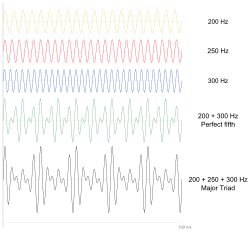 The second reason is perceptual fusion. A chord fuses in perception if its overall spectrum is similar to a harmonic series. According to this definition a major triad fuses better than a minor triad and a major-minor seventh chord fuses better than a major-major seventh or minor-minor seventh. These differences may not be readily apparent in tempered contexts but can explain why major triads are generally more prevalent than minor triads and major-minor sevenths generally more prevalent than other sevenths (in spite of the dissonance of the tritone interval) in mainstream tonal music. Of course these comparisons depend on style.
The third reason is familiarity. Chords that have often been heard in musical contexts tend to sound more consonant. This principle explains the gradual historical increase in harmonic complexity of Western music. For example, around 1600 unprepared seventh chords gradually became familiar and were therefore gradually perceived as more consonant.
Western music is based on major and minor triads. The reason why these chords are so central is that they are consonant in terms of both fusion and lack of roughness. they fuse because they include the perfect fourth/fifth interval. They lack roughness because they lack major and minor second intervals. No other combination of three tones in the chromatic scale satisfies these criteria.
or Classical
periods, thus producing new styles such as post-romantic harmony, impressionism, pantonality, Jazz
and Blues
, where dissonance may not be prepared in the way seen in 'common practice' harmony. In a jazz or blues song, the tonic chord may be a dominant seventh chord.
Music
Music is an art form whose medium is sound and silence. Its common elements are pitch , rhythm , dynamics, and the sonic qualities of timbre and texture...
, harmony is the use of simultaneous pitches
Pitch (music)
Pitch is an auditory perceptual property that allows the ordering of sounds on a frequency-related scale.Pitches are compared as "higher" and "lower" in the sense associated with musical melodies,...
(tones, notes), or chords
Chord (music)
A chord in music is any harmonic set of two–three or more notes that is heard as if sounding simultaneously. These need not actually be played together: arpeggios and broken chords may for many practical and theoretical purposes be understood as chords...
. The study of harmony involves chords and their construction and chord progression
Chord progression
A chord progression is a series of musical chords, or chord changes that "aims for a definite goal" of establishing a tonality founded on a key, root or tonic chord. In other words, the succession of root relationships...
s and the principles of connection that govern them. Harmony is often said to refer to the "vertical" aspect of music, as distinguished from melodic line
Melody
A melody , also tune, voice, or line, is a linear succession of musical tones which is perceived as a single entity...
, or the "horizontal" aspect. Counterpoint
Counterpoint
In music, counterpoint is the relationship between two or more voices that are independent in contour and rhythm and are harmonically interdependent . It has been most commonly identified in classical music, developing strongly during the Renaissance and in much of the common practice period,...
, which refers to the interweaving of melodic lines, and polyphony
Polyphony
In music, polyphony is a texture consisting of two or more independent melodic voices, as opposed to music with just one voice or music with one dominant melodic voice accompanied by chords ....
, which refers to the relationship of separate independent voices, are thus sometimes distinguished from harmony.
In popular and jazz harmony, chords are named by their root plus various terms and characters indicating their qualities. In many types of music, notably baroque, romantic, modern and jazz, chords are often augmented with "tensions". A tension is an additional chord member that creates a relatively dissonant interval
Consonance and dissonance
In music, a consonance is a harmony, chord, or interval considered stable, as opposed to a dissonance , which is considered to be unstable...
in relation to the bass. Typically, in the classical Common practice period
Common practice period
The common practice period, in the history of Western art music , spanning the Baroque, Classical, and Romantic periods, lasted from c. 1600 to c. 1900.-General characteristics:...
a dissonant chord (chord with tension) will "resolve" to a consonant chord. Harmonization usually sounds pleasant to the ear when there is a balance between the consonant and dissonant sounds. In simple words, that occurs when there is a balance between "tense" and "relaxed" moments.
Etymology and definitions
The term harmony derives from the GreekGreek language
Greek is an independent branch of the Indo-European family of languages. Native to the southern Balkans, it has the longest documented history of any Indo-European language, spanning 34 centuries of written records. Its writing system has been the Greek alphabet for the majority of its history;...
ἁρμονία (harmonía
Harmonia (mythology)
In Greek mythology, Harmonia is the immortal goddess of harmony and concord. Her Roman counterpart is Concordia, and her Greek opposite is Eris, whose Roman counterpart is Discordia.-Origins:...
), meaning "joint, agreement, concord", from the verb ἁρμόζω (harmozo), "to fit together, to join". The term was often used for the whole field of music, while "music" referred to the arts in general. In Ancient Greece, the term defined the combination of contrasted elements: a higher and lower note. Nevertheless, it is unclear whether the simultaneous sounding of notes was part of ancient Greek musical practice; "harmonía" may have merely provided a system of classification of the relationships between different pitches. In the Middle Ages the term was used to describe two pitches sounding in combination, and in the Renaissance the concept was expanded to denote three pitches sounding together.
It was not until the publication of Rameau's 'Traité de l'harmonie' (Treatise on Harmony) in 1722 that any text discussing musical practice made use of the term in the title, though that work is not the earliest record of theoretical discussion of the topic. The underlying principle behind these texts is that harmony sanctions harmoniousness (sounds that 'please') by conforming to certain pre-established compositional principles.
Current dictionary definitions, while attempting to give concise descriptions, often highlight the ambiguity of the term in modern use. Ambiguities tend to arise from either aesthetic considerations (for example the view that only "pleasing" concords may be harmonious) or from the point of view of musical texture (distinguishing between "harmonic" (simultaneously sounding pitches) and "contrapuntal" (successively sounding tones). In the words of Arnold Whittall
Arnold Whittall
Arnold Whittall is a British musicologist and writer. He is Professor Emeritus at King's College London. Between 1975 and 1996 he was Professor at King's...
:
The view that modern tonal
Tonality
Tonality is a system of music in which specific hierarchical pitch relationships are based on a key "center", or tonic. The term tonalité originated with Alexandre-Étienne Choron and was borrowed by François-Joseph Fétis in 1840...
harmony in Western music began in about 1600 is commonplace in music theory. This is usually accounted for by the 'replacement' of horizontal (of contrapuntal) writing, common in the music of the Renaissance
Renaissance
The Renaissance was a cultural movement that spanned roughly the 14th to the 17th century, beginning in Italy in the Late Middle Ages and later spreading to the rest of Europe. The term is also used more loosely to refer to the historical era, but since the changes of the Renaissance were not...
, with a new emphasis on the 'vertical' element of composed music. Modern theorists, however, tend to see this as an unsatisfactory generalisation. As Carl Dahlhaus
Carl Dahlhaus
Carl Dahlhaus , a musicologist from Berlin, was one of the major contributors to the development of musicology as a scholarly discipline during the post-war era....
puts it:
Descriptions and definitions of harmony and harmonic practice may show bias towards Europe
Europe
Europe is, by convention, one of the world's seven continents. Comprising the westernmost peninsula of Eurasia, Europe is generally 'divided' from Asia to its east by the watershed divides of the Ural and Caucasus Mountains, the Ural River, the Caspian and Black Seas, and the waterways connecting...
an (or Western
Western culture
Western culture, sometimes equated with Western civilization or European civilization, refers to cultures of European origin and is used very broadly to refer to a heritage of social norms, ethical values, traditional customs, religious beliefs, political systems, and specific artifacts and...
) musical traditions. For example, South Asian art music (Hindustani
Hindustani classical music
Hindustani classical music is the Hindustani or North Indian style of Indian classical music found throughout the northern Indian subcontinent. The style is sometimes called North Indian Classical Music or Shāstriya Sangeet...
and Carnatic music
Carnatic music
Carnatic music is a system of music commonly associated with the southern part of the Indian subcontinent, with its area roughly confined to four modern states of India: Andhra Pradesh, Karnataka, Kerala, and Tamil Nadu...
) is frequently cited as placing little emphasis on what is perceived in western practice as conventional 'harmony'; the underlying 'harmonic' foundation for most South Asian music is the drone
Drone (music)
In music, a drone is a harmonic or monophonic effect or accompaniment where a note or chord is continuously sounded throughout most or all of a piece. The word drone is also used to refer to any part of a musical instrument that is just used to produce such an effect.-A musical effect:A drone...
, a held open fifth (or fourth) that does not alter in pitch throughout the course of a composition. Pitch simultaneity in particular is rarely a major consideration. Nevertheless many other considerations of pitch are relevant to the music, its theory and its structure, such as the complex system of Rāga
Raga
A raga is one of the melodic modes used in Indian classical music.It is a series of five or more musical notes upon which a melody is made...
s, which combines both melodic and modal considerations and codifications within it.
So although intricate combinations of pitches sounding simultaneously do occur in Indian classical music
Indian classical music
The origins of Indian classical music can be found in the Vedas, which are the oldest scriptures in the Hindu tradition. Indian classical music has also been significantly influenced by, or syncretised with, Indian folk music and Persian music. The Samaveda, one of the four Vedas, describes music...
, they are rarely studied as teleological harmonic or contrapuntal progressions, which is the case with notated Western music. This contrasting emphasis (with regard to Indian music in particular) manifests itself to some extent in the different methods of performance adopted: in Indian Music improvisation takes a major role in the structural framework of a piece, whereas in Western Music improvisation has been uncommon since the end of the 19th century,. Where it does occur in Western music (or has in the past), the improvisation will either embellish pre-notated music or, if not, draw from musical models that have previously been established in notated compositions, and therefore employ familiar harmonic schemes.
There is no doubt, nevertheless, that the emphasis on the precomposed in European art music and the written theory surrounding it shows considerable cultural bias. The Grove Dictionary of Music and Musicians (Oxford University Press) identifies this quite clearly:
Yet the evolution of harmonic practice and language itself, in Western art music, is and was facilitated by this process of prior composition (which permitted the study and analysis by theorists and composers alike of individual pre-constructed works in which pitches (and to some extent rhythms) remained unchanged regardless of the nature of the performance).
Historical rules
Some traditionTradition
A tradition is a ritual, belief or object passed down within a society, still maintained in the present, with origins in the past. Common examples include holidays or impractical but socially meaningful clothes , but the idea has also been applied to social norms such as greetings...
s of Western music performance
Performance
A performance, in performing arts, generally comprises an event in which a performer or group of performers behave in a particular way for another group of people, the audience. Choral music and ballet are examples. Usually the performers participate in rehearsals beforehand. Afterwards audience...
, composition
Musical composition
Musical composition can refer to an original piece of music, the structure of a musical piece, or the process of creating a new piece of music. People who practice composition are called composers.- Musical compositions :...
, and theory
Music theory
Music theory is the study of how music works. It examines the language and notation of music. It seeks to identify patterns and structures in composers' techniques across or within genres, styles, or historical periods...
have specific rules of harmony. These rules are often held to be based on natural properties such as Pythagorean tuning
Pythagorean tuning
Pythagorean tuning is a system of musical tuning in which the frequency relationships of all intervals are based on the ratio 3:2. This interval is chosen because it is one of the most consonant...
's law whole number ratios ("harmoniousness" being inherent in the ratios either perceptually or in themselves) or harmonic
Harmonic
A harmonic of a wave is a component frequency of the signal that is an integer multiple of the fundamental frequency, i.e. if the fundamental frequency is f, the harmonics have frequencies 2f, 3f, 4f, . . . etc. The harmonics have the property that they are all periodic at the fundamental...
s and resonances
Acoustic resonance
Acoustic resonance is the tendency of an acoustic system to absorb more energy when it is forced or driven at a frequency that matches one of its own natural frequencies of vibration than it does at other frequencies....
("harmoniousness" being inherent in the quality of sound), with the allowable pitches and harmonies gaining their beauty or simplicity from their closeness to those properties. This model provides that the minor seventh and ninth are not dissonant (i.e., are consonant). While Pythagorean ratios can provide a rough approximation of perceptual harmonicity, they cannot account for cultural factors.
Early Western religious music often features parallel perfect intervals; these intervals would preserve the clarity of the original plainsong
Plainsong
Plainsong is a body of chants used in the liturgies of the Catholic Church. Though the Eastern Orthodox churches and the Catholic Church did not split until long after the origin of plainchant, Byzantine chants are generally not classified as plainsong.Plainsong is monophonic, consisting of a...
. These works were created and performed in cathedrals, and made use of the resonant modes of their respective cathedrals to create harmonies. As polyphony developed, however, the use of parallel intervals was slowly replaced by the English style of consonance that used thirds and sixths. The English style was considered to have a sweeter sound, and was better suited to polyphony in that it offered greater linear flexibility in part-writing. Early music also forbade usage of the tritone
Tritone
In classical music from Western culture, the tritone |tone]]) is traditionally defined as a musical interval composed of three whole tones. In a chromatic scale, each whole tone can be further divided into two semitones...
, as its dissonance was associated with the devil, and composers often went to considerable lengths, via musica ficta
Musica ficta
Musica ficta was a term used in European music theory from the late 12th century to about 1600 to describe any pitches, whether notated or to be added by performers in accordance with their training, that lie outside the system of musica recta or musica vera as defined by the hexachord system of...
, to avoid using it. In the newer triadic harmonic system, however, the tritone became permissible, as the standardization of functional dissonance made its use in dominant chords desirable.
Although most harmony comes about as a result of two or more notes being sounded simultaneously, it is possible to strongly imply harmony with only one melodic line through the use of arpeggio
Arpeggio
An arpeggio is a musical technique where notes in a chord are played or sung in sequence, one after the other, rather than ringing out simultaneously...
s or hocket
Hocket
In music, hocket is the rhythmic linear technique using the alternation of notes, pitches, or chords. In medieval practice of hocket, a single melody is shared between two voices such that alternately one voice sounds while the other rests.In European music, hocket was used primarily in vocal...
. Many pieces from the baroque
Baroque music
Baroque music describes a style of Western Classical music approximately extending from 1600 to 1760. This era follows the Renaissance and was followed in turn by the Classical era...
period for solo string instrument
String instrument
A string instrument is a musical instrument that produces sound by means of vibrating strings. In the Hornbostel-Sachs scheme of musical instrument classification, used in organology, they are called chordophones...
s, such as Bach's Sonatas and partitas for solo violin and cello, convey subtle harmony through inference rather than full chordal structures. These works create a sense of harmonies by using arpeggiated chords and implied bassline
Bassline
A bassline is the term used in many styles of popular music, such as jazz, blues, funk, dub and electronic music for the low-pitched instrumental part or line played by a rhythm section instrument such as the electric bass, double bass, tuba or keyboard...
s. The implied basslines are created with low notes of short duration that many listeners perceive as being the bass note of a chord; (see below):
Types
Carl DahlhausCarl Dahlhaus
Carl Dahlhaus , a musicologist from Berlin, was one of the major contributors to the development of musicology as a scholarly discipline during the post-war era....
(1990) distinguishes between coordinate and subordinate harmony. Subordinate harmony is the hierarchical tonality
Tonality
Tonality is a system of music in which specific hierarchical pitch relationships are based on a key "center", or tonic. The term tonalité originated with Alexandre-Étienne Choron and was borrowed by François-Joseph Fétis in 1840...
or tonal harmony well known today, while coordinate harmony is the older Medieval
Medieval music
Medieval music is Western music written during the Middle Ages. This era begins with the fall of the Roman Empire and ends sometime in the early fifteenth century...
and Renaissance
Renaissance music
Renaissance music is European music written during the Renaissance. Defining the beginning of the musical era is difficult, given that its defining characteristics were adopted only gradually; musicologists have placed its beginnings from as early as 1300 to as late as the 1470s.Literally meaning...
tonalité ancienne, "the term is meant to signify that sonorities are linked one after the other without giving rise to the impression of a goal-directed development. A first chord forms a 'progression' with a second chord, and a second with a third. But the former chord progression is independent of the later one and vice versa." Coordinate harmony follows direct (adjacent) relationships rather than indirect as in subordinate. Interval cycle
Interval cycle
In music, an interval cycle is a collection of pitch classes created from a sequence of the same interval class. In other words a collection of pitches by starting with a certain note and going up by a certain interval until the original note is reached In music, an interval cycle is a collection...
s create symmetrical harmonies, which have been extensively used by the composers Alban Berg
Alban Berg
Alban Maria Johannes Berg was an Austrian composer. He was a member of the Second Viennese School with Arnold Schoenberg and Anton Webern, and produced compositions that combined Mahlerian Romanticism with a personal adaptation of Schoenberg's twelve-tone technique.-Early life:Berg was born in...
, George Perle
George Perle
George Perle was a composer and music theorist. He was born in Bayonne, New Jersey. Perle was an alumnus of DePaul University...
, Arnold Schoenberg
Arnold Schoenberg
Arnold Schoenberg was an Austrian composer, associated with the expressionist movement in German poetry and art, and leader of the Second Viennese School...
, Béla Bartók
Béla Bartók
Béla Viktor János Bartók was a Hungarian composer and pianist. He is considered one of the most important composers of the 20th century and is regarded, along with Liszt, as Hungary's greatest composer...
, and Edgard Varèse
Edgard Varèse
Edgard Victor Achille Charles Varèse, , whose name was also spelled Edgar Varèse , was an innovative French-born composer who spent the greater part of his career in the United States....
's Density 21.5
Density 21.5
Density 21.5 is a piece of music for solo flute written by Edgard Varèse in 1936 and revised in 1946. The piece was composed at the request of Georges Barrère for the premiere of his platinum flute, the density of platinum being close to 21.5 grammes per cubic centimetre .Allmusic's Sean Hickey...
.
Close harmony and open harmony use close position and open position chords, respectively. See: voicing (music)
Voicing (music)
In music composition and arranging, a voicing is the instrumentation and vertical spacing and ordering of the pitches in a chord...
.
Other types of harmony are based upon the intervals used in constructing the chords used in that harmony. Most chords used in western music are based on "tertian" harmony, or chords built with the interval of thirds. In the chord C Major7, C-E is a major third; E-G is a minor third; and G to B is a major third. Other types of harmony consist of quartal harmony and quintal harmony.
Intervals
An interval is the relationship between two separate musical pitches. For example, in the melody "Twinkle Twinkle Little StarTwinkle Twinkle Little Star
"Twinkle, Twinkle, Little Star" is a popular English nursery rhyme. The lyrics are from an early nineteenth-century English poem, "The Star" by Jane Taylor. The poem, which is in couplet form, was first published in 1806 in Rhymes for the Nursery, a collection of poems by Taylor and her sister Ann...
", the first two notes (the first "twinkle") and the second two notes (the second "twinkle") are at the interval of one fifth. What this means is that if the first two notes were the pitch "C", the second two notes would be the pitch "G"—four scale notes, or seven chromatic notes (a perfect fifth), above it.
The following are common intervals:
| Root | Major Third Major third In classical music from Western culture, a third is a musical interval encompassing three staff positions , and the major third is one of two commonly occurring thirds. It is qualified as major because it is the largest of the two: the major third spans four semitones, the minor third three... |
Minor third Minor third In classical music from Western culture, a third is a musical interval encompassing three staff positions , and the minor third is one of two commonly occurring thirds. The minor quality specification identifies it as being the smallest of the two: the minor third spans three semitones, the major... |
Fifth |
|---|---|---|---|
| C | E | E♭ | G |
| D♭ | F | F♭ | A♭ |
| D | F♯ | F | A |
| E♭ | G | G♭ | B♭ |
| E | G♯ | G | B |
| F | A | A♭ | C |
| F♯ | A♯ | A | C♯ |
| G | B | B♭ | D |
| A♭ | C | C♭ | E♭ |
| A | C♯ | C | E |
| B♭ | D | D♭ | F |
| B | D♯ | D | F♯ |
Therefore, the combination of notes with their specific intervals —a chord— creates harmony. For example, in a C chord, there are three notes: C, E, and G. The note "C" is the root, with the notes "E" and "G" providing harmony, and in a G7 (G dominant 7th) chord, the root G with each subsequent note (in this case B, D and F) provide the harmony.
In the musical scale, there are twelve pitches. Each pitch is referred to as a "degree" of the scale. The names A, B, C, D, E, F, and G are insignificant. The intervals, however, are not. Here is an example:
| 1° | 2° | 3° | 4° | 5° | 6° | 7° | 8° |
|---|---|---|---|---|---|---|---|
| C | D | E | F | G | A | B | C |
| D | E | F♯ | G | A | B | C♯ | D |
As can be seen, no note always corresponds to a certain degree of the scale. The "tonic", or 1st-degree note, can be any of the 12 notes (pitch classes) of the chromatic scale. All the other notes fall into place. So, when C is the tonic, the fourth degree, subdominant, is F. But when D is the tonic, the fourth degree is G. So while the note names are intransigent, the intervals are not. In layman's terms: the subdominant, "fourth" (four-step interval) is always a fourth, no matter what the tonic is. The great power of this fact is that any song can be played or sung in any key—it will be the same song, as long as the intervals are kept the same, thus transposing the melody into the corresponding key. When the intervals surpass the perfect Octave (12 semitones), these intervals are named as "Compound intervals", which include particularly the 9th, 11th, and 13th Intervals, widely used in Jazz
Jazz
Jazz is a musical style that originated at the beginning of the 20th century in African American communities in the Southern United States. It was born out of a mix of African and European music traditions. From its early development until the present, jazz has incorporated music from 19th and 20th...
and Blues
Blues
Blues is the name given to both a musical form and a music genre that originated in African-American communities of primarily the "Deep South" of the United States at the end of the 19th century from spirituals, work songs, field hollers, shouts and chants, and rhymed simple narrative ballads...
Music.
Compound Intervals are formed and named as following:
- 2nd + Octave = 9th
- 3rd + octave = 10th
- 4th + Octave = 11th
- 5th + octave = 12th
- 6th + Octave = 13th
- 7th + octave = 14th
The reason the two numbers don't "add" correctly is that one note is counted twice.
Apart from this categorization, intervals can also be divided into consonant
Consonant
In articulatory phonetics, a consonant is a speech sound that is articulated with complete or partial closure of the vocal tract. Examples are , pronounced with the lips; , pronounced with the front of the tongue; , pronounced with the back of the tongue; , pronounced in the throat; and ,...
and dissonant. As explained in the following paragraphs, consonant
Consonance and dissonance
In music, a consonance is a harmony, chord, or interval considered stable, as opposed to a dissonance , which is considered to be unstable...
intervals produce a sensation of relaxation and dissonant
Consonance and dissonance
In music, a consonance is a harmony, chord, or interval considered stable, as opposed to a dissonance , which is considered to be unstable...
intervals a sensation of tension. In tonal music, the term consonant also means "brings resolution" (to some degree at least, whereas dissonance "requires resolution").
The consonant intervals are considered to be the perfect Unison
Unison
In music, the word unison can be applied in more than one way. In general terms, it may refer to two notes sounding the same pitch, often but not always at the same time; or to the same musical voice being sounded by several voices or instruments together, either at the same pitch or at a distance...
, Octave
Octave
In music, an octave is the interval between one musical pitch and another with half or double its frequency. The octave relationship is a natural phenomenon that has been referred to as the "basic miracle of music", the use of which is "common in most musical systems"...
, Fifth
Perfect fifth
In classical music from Western culture, a fifth is a musical interval encompassing five staff positions , and the perfect fifth is a fifth spanning seven semitones, or in meantone, four diatonic semitones and three chromatic semitones...
, Fourth
Perfect fourth
In classical music from Western culture, a fourth is a musical interval encompassing four staff positions , and the perfect fourth is a fourth spanning five semitones. For example, the ascending interval from C to the next F is a perfect fourth, as the note F lies five semitones above C, and there...
and Major and Minor Third and sixth, and their compound forms. An interval is referred to as "perfect" when the harmonic relationship is found in the natural overtone series (namely, the unison 1:1, octave 1:2, fifth 2:3, and fourth 3:4). The other basic intervals (second, third, sixth, and seventh) are called "imperfect" because the harmonic relationships are not found mathematically exact in the overtone series. In classical music the perfect fourth above the bass may be considered to be dissonant when its function is contrapuntal.
Other intervals, the second and the seventh (and their compound forms) are considered Dissonant and require resolution (of the produced tension) and usually preparation (depending on the music style used). It should be noted that the effect of dissonance is perceived relatively within musical context: for example, a major seventh interval alone (i.e. C up to B) may be perceived as dissonant, but the same interval as part of a major seventh chord may sound relatively consonant. A Tritone (the interval of the fourth step to the seventh step of the major scale, i.e. F to B) sounds very dissonant alone, but less so within the context of a dominant seventh chord (G7 or Db7 in that example).
Chords and tension
In the Western tradition, in music after the seventeenth century, harmony is manipulated using chord
Chord (music)
A chord in music is any harmonic set of two–three or more notes that is heard as if sounding simultaneously. These need not actually be played together: arpeggios and broken chords may for many practical and theoretical purposes be understood as chords...
s, which are combinations of pitch class
Pitch class
In music, a pitch class is a set of all pitches that are a whole number of octaves apart, e.g., the pitch class C consists of the Cs in all octaves...
es. In tertian
Tertian
In music theory, tertian describes any piece, chord, counterpoint etc. constructed from the interval of a third...
or tertial harmony, so named after the interval of a third, the members of chords are found and named by stacking intervals of the third, starting with the "root", then the "third" above the root, and the "fifth" above the root (which is a third above the third), etc. (Note that chord members are named after their interval above the root.) Dyad
Dyad (music)
In music, a dyad is a set of two notes or pitches. Although most chords have three or more notes, in certain contexts a dyad may be considered to be a chord. The most common two-note chord is made from the interval of a perfect fifth, which may be suggestive of music of the Medieval or Renaissance...
s, the simplest chords, contain only two members (see power chords).
A chord with three members is called a triad
Triad (music)
In music and music theory, a triad is a three-note chord that can be stacked in thirds. Its members, when actually stacked in thirds, from lowest pitched tone to highest, are called:* the Root...
because it has three members, not because it is necessarily built in thirds (see Quartal and quintal harmony
Quartal and quintal harmony
In music, quartal harmony is the building of harmonic structures with a distinct preference for the intervals of the perfect fourth, the augmented fourth and the diminished fourth. Quintal harmony is harmonic structure preferring the perfect fifth, the augmented fifth and the diminished fifth...
for chords built with other intervals). Depending on the size of the intervals being stacked, different qualities of chords are formed. In popular and jazz harmony, chords are named by their root plus various terms and characters indicating their qualities. To keep the nomenclature as simple as possible, some defaults are accepted (not tabulated here). For example, the chord members C, E, and G, form a C Major triad, called by default simply a "C" chord. In an "A♭" chord , the members are A♭, C, and E♭.
In many types of music, notably baroque, romantic, modern and jazz, chords are often augmented with "tensions". A tension is an additional chord member that creates a relatively dissonant interval
Consonance and dissonance
In music, a consonance is a harmony, chord, or interval considered stable, as opposed to a dissonance , which is considered to be unstable...
in relation to the bass. Following the tertian practice of building chords by stacking thirds, the simplest first tension is added to a triad by stacking on top of the existing root, third, and fifth, another third above the fifth, giving a new, potentially dissonant member the interval of a seventh away from the root and therefore called the "seventh" of the chord, and producing a four-note chord, called a "seventh chord
Seventh chord
A seventh chord is a chord consisting of a triad plus a note forming an interval of a seventh above the chord's root. When not otherwise specified, a "seventh chord" usually means a major triad with an added minor seventh...
".
Depending on the widths of the individual thirds stacked to build the chord, the interval between the root and the seventh of the chord may be major, minor, or diminished. (The interval of an augmented seventh reproduces the root, and is therefore left out of the chordal nomenclature.) The nomenclature allows that, by default, "C7" indicates a chord with a root, third, fifth, and seventh spelled C, E, G, and B♭. Other types of seventh chords must be named more explicitly, such as "C Major 7" (spelled C, E, G, B), "C augmented 7" (here the word augmented applies to the fifth, not the seventh, spelled C, E, G#, B♭), etc. (For a more complete exposition of nomenclature see Chord (music)
Chord (music)
A chord in music is any harmonic set of two–three or more notes that is heard as if sounding simultaneously. These need not actually be played together: arpeggios and broken chords may for many practical and theoretical purposes be understood as chords...
.)
Continuing to stack thirds on top of a seventh chord produces extensions, and brings in the "extended tensions" or "upper tensions" (those more than an octave above the root when stacked in thirds), the ninths, elevenths, and thirteenths. This creates the chords named after them. (Note that except for dyads and triads, tertian chord types are named for the interval of the largest size and magnitude in use in the stack, not for the number of chord members : thus a ninth chord has five members, not nine.) Extensions beyond the thirteenth reproduce existing chord members and are (usually) left out of the nomenclature. Complex harmonies based on extended chords are found in abundance in jazz, late-romantic music, modern orchestral works, film music, etc.
Typically, in the classical Common practice period
Common practice period
The common practice period, in the history of Western art music , spanning the Baroque, Classical, and Romantic periods, lasted from c. 1600 to c. 1900.-General characteristics:...
a dissonant chord (chord with tension) will "resolve" to a consonant chord. Harmonization usually sounds pleasant to the ear when there is a balance between the consonant and dissonant sounds. In simple words, that occurs when there is a balance between "tense" and "relaxed" moments. For this reason, usually tension is 'prepared' and then 'resolved'.
Preparing tension means to place a series of consonant chords that lead smoothly to the dissonant chord. In this way the composer ensures introducing tension smoothly, without disturbing the listener. Once the piece reaches its sub-climax, the listener needs a moment of relaxation to clear up the tension, which is obtained by playing a consonant chord that resolves the tension of the previous chords. The clearing of this tension usually sounds pleasant to the listener, although this is not always the case in late-nineteenth century music, such as Tristan und Isolde by Richard Wagner.
Perception of harmony
Harmony is based on consonance, a concept whose definition has changed various times during the history of Western music. In a psychological approach, consonance is a continuous variable. Consonance can vary across a wide range. A chord may sound consonant for various reasons.One is lack of perceptual roughness. Roughness happens when partials (frequency components) lie within a critical bandwidth, which is a measure of the ear's ability to separate different frequencies. Critical bandwidth lies between 2 and 3 semitones at high frequencies and becomes larger at lower frequencies. The roughness of two simultaneous harmonic complex tones depends on the amplitudes of the harmonics and the interval between the tones. The roughest interval in the chromatic scale is the minor second and its inversion the major seventh. For typical spectral envelopes in the central range, the second roughest interval is the major second and minor seventh, followed by the tritone, the minor third (major sixth), the major third (minor sixth) and the perfect fourth (fifth).
The third reason is familiarity. Chords that have often been heard in musical contexts tend to sound more consonant. This principle explains the gradual historical increase in harmonic complexity of Western music. For example, around 1600 unprepared seventh chords gradually became familiar and were therefore gradually perceived as more consonant.
Western music is based on major and minor triads. The reason why these chords are so central is that they are consonant in terms of both fusion and lack of roughness. they fuse because they include the perfect fourth/fifth interval. They lack roughness because they lack major and minor second intervals. No other combination of three tones in the chromatic scale satisfies these criteria.
Consonance and dissonance in balance
Post-nineteenth century music has evolved in the way that tension may be less often prepared and less formally structured than in BaroqueBaroque music
Baroque music describes a style of Western Classical music approximately extending from 1600 to 1760. This era follows the Renaissance and was followed in turn by the Classical era...
or Classical
Classical music
Classical music is the art music produced in, or rooted in, the traditions of Western liturgical and secular music, encompassing a broad period from roughly the 11th century to present times...
periods, thus producing new styles such as post-romantic harmony, impressionism, pantonality, Jazz
Jazz
Jazz is a musical style that originated at the beginning of the 20th century in African American communities in the Southern United States. It was born out of a mix of African and European music traditions. From its early development until the present, jazz has incorporated music from 19th and 20th...
and Blues
Blues
Blues is the name given to both a musical form and a music genre that originated in African-American communities of primarily the "Deep South" of the United States at the end of the 19th century from spirituals, work songs, field hollers, shouts and chants, and rhymed simple narrative ballads...
, where dissonance may not be prepared in the way seen in 'common practice' harmony. In a jazz or blues song, the tonic chord may be a dominant seventh chord.
See also
- Barbershop musicBarbershop musicBarbershop vocal harmony, as codified during the barbershop revival era , is a style of a cappella, or unaccompanied vocal music characterized by consonant four-part chords for every melody note in a predominantly homophonic texture...
- Consonance and dissonanceConsonance and dissonanceIn music, a consonance is a harmony, chord, or interval considered stable, as opposed to a dissonance , which is considered to be unstable...
- Chord (music)Chord (music)A chord in music is any harmonic set of two–three or more notes that is heard as if sounding simultaneously. These need not actually be played together: arpeggios and broken chords may for many practical and theoretical purposes be understood as chords...
- Chord sequence
- Chromatic chord
- Chromatic mediant
- CounterpointCounterpointIn music, counterpoint is the relationship between two or more voices that are independent in contour and rhythm and are harmonically interdependent . It has been most commonly identified in classical music, developing strongly during the Renaissance and in much of the common practice period,...
- Harmonic seriesHarmonic series (music)Pitched musical instruments are often based on an approximate harmonic oscillator such as a string or a column of air, which oscillates at numerous frequencies simultaneously. At these resonant frequencies, waves travel in both directions along the string or air column, reinforcing and canceling...
- Harmonized scaleHarmonized scaleIn music, harmonization is the chordal accompaniment to a line or melody: "Using chords and melodies together, making harmony by stacking scale tones as triads"....
- Homophony (music)
- List of musical terminology
- Mathematics of musical scales
- Musica universalisMusica universalisMusica universalis is an ancient philosophical concept that regards proportions in the movements of celestial bodies—the Sun, Moon, and planets—as a form of musica . This 'music' is not usually thought to be literally audible, but a harmonic and/or mathematical and/or religious concept...
- Peter Westergaard's tonal theoryPeter Westergaard's Tonal TheoryPeter Westergaard's tonal theory is the theory of tonal music developed by Peter Westergaard and outlined in Westergaard's 1975 book An Introduction to Tonal Theory...
- ProlongationProlongationIn music theory, prolongation refers to the process in tonal music through which a pitch, interval, or consonant triad is able to govern spans of music when not physically sounding...
- Physics of music
- TonalityTonalityTonality is a system of music in which specific hierarchical pitch relationships are based on a key "center", or tonic. The term tonalité originated with Alexandre-Étienne Choron and was borrowed by François-Joseph Fétis in 1840...
- Unified fieldUnified fieldIn music, unified field is often used to refer to the "unity of musical space" created by the free use of melodic material as harmonic material and vice-versa....
- Voice leadingVoice leadingIn musical composition, voice leading is the term used to refer to a decision-making consideration when arranging voices , namely, how each voice should move in advancing from each chord to the next.- Details :...
Notations
- Dahlhaus, Carl. Gjerdingen, Robert O. trans. (1990). Studies in the Origin of Harmonic Tonality, p. 141. Princeton University Press. ISBN 0-691-09135-8.
- van der Merwe, Peter (1989). Origins of the Popular Style: The Antecedents of Twentieth-Century Popular Music. Oxford: Clarendon Press. ISBN 0-19-316121-4.
- Nettles, Barrie & Graf, Richard (1997). The Chord Scale Theory and Jazz Harmony. Advance Music, ISBN 3-89221-056-X
External links
- Chord Geometry - Graphical Analysis of Harmony Tool
- Interactive Lessons about harmonizing melodies and scales using different Musical Styles
- Harmonic Progressions with demos and how to harmonize a melody
- General Principles of Harmony by Alan Belkin
- Morphogenesis of chords and scales Chords and scales classification
- A Beginner's Guide to Modal Harmony
- Posts about traditional and jazz harmony
- Sonantometry as Natural Harmony Algebra
- Chord Harmonization Tool Online tool that automates chord progression analysis to identify underlying scales and related chords
Further reading
- Prout, EbenezerEbenezer ProutEbenezer Prout , was an English musical theorist, writer, teacher and composer, whose instruction, afterwards embodied in a series of standard works, underpinned the work of many British musicians of succeeding generations....
, Harmony, its Theory and Practice (1889, revised 1901)